2 Kings 23:14

Hebrew (Westminster Leningrad Codex) 2 Kings 23:14 appears in the Hebrew Old Testament. The text above is from the Westminster Leningrad Codex. Each word links to its Strong’s number, a concise gloss, and parsing drawn from the Open Scriptures Hebrew Bible morphology. Click any word for its full Brown-Driver-Briggs (BDB) entry.
Download image
Cite this verse

2 Kings 23:14 (World English Bible). Public Domain. Lemma interlinear Bible study tool, https://lemma.gebible.app/v/2-kings/23/14.

Show BibTeX & RIS
BibTeX
RIS
English Translation
He broke in pieces the pillars, and cut down the Asherim, and filled their places with the bones of men.
World English Bible · Public Domain
Download a study sheet

One document with this verse’s original text, its word-by-word gloss line, the meaning frame, cross-references with their text, attributed commentary, and full source and license credits — printable, and it pastes into notes with its structure intact.

This verse Autodidact and up

Study sheet (.html) Plain text (.txt)

A passage Seminary Student

Up to 50 verses in one chapter. A passage sheet keeps up to 6 commentary sources and 12 cross-references per verse, in the order this page ranks them, and says so on the sheet whenever that leaves anything out. Ask for a single verse and you get the Autodidact verse sheet above.

Everything on this page stays free to read, with no account — the sheet is a download of what is already on screen, not access to it.

Want to remove ads? Support Godless Engineer
Compare translations 3

The same verse in 3 English versions, stacked beneath the original-language interlinear above. Click any original word for its lexicon entry.

Each is an independent rendering of the whole verse — the interlinear is not word-aligned to these translations.

Highlighted words mark where these versions differ — a whole-verse word diff, not a word-by-word alignment.

  • World English Bible Public Domain
    He broke in pieces the pillars, and cut down the Asherim, and filled their places with the bones of men.
  • King James Version Public Domain
    And he brake in pieces the images, and cut down the groves, and filled their places with the bones of men.
  • unfoldingWord Literal Text CC BY-SA 4.0
    And he shattered the pillars, and he cut down the Asherahs, and he filled their place with bones of man.

unfoldingWord Literal Text — © unfoldingWord, licensed CC BY-SA 4.0. Word-aligned USFM3 via Door43 (git.door43.org/unfoldingWord/en_ult).

Versions to compare (up to 4)

3 of 4 selected

Show all 18 translations

Every available English version of this verse, each an independent rendering of the whole verse.

  • World English Bible Public Domain
    He broke in pieces the pillars, and cut down the Asherim, and filled their places with the bones of men.
  • Berean Standard Bible Public Domain
    He smashed the sacred pillars to pieces, cut down the Asherah poles, and covered the sites with human bones.
  • Majority Standard Bible Public Domain
    He smashed the sacred pillars to pieces, cut down the Asherah poles, and covered the sites with human bones.
  • King James Version Public Domain
    And he brake in pieces the images, and cut down the groves, and filled their places with the bones of men.
  • American Standard Version (1901) Public Domain
    And he brake in pieces the pillars, and cut down the Asherim, and filled their places with the bones of men.
  • Revised Version (1885) Public Domain
    And he brake in pieces the pillars, and cut down the Asherim, and filled their places with the bones of men.
  • Geneva Bible (1599) Public Domain
    And he brake the images in pieces, and cut downe the groues and filled their places with the bones of men.
  • Douay-Rheims (1899) Public Domain
    And he broke in pieces the statues, and cut down the groves: and he filled their places with the bones of dead men.
  • Young's Literal Translation Public Domain
    And he hath broken in pieces the standing-pillars, and cutteth down the shrines, and filleth their place with bones of men;
  • Literal Standard Version CC BY-SA 4.0
    And he has broken the standing-pillars in pieces, and cuts down the Asherim, and fills their place with bones of men;
  • Unlocked Literal Bible CC BY-SA 4.0
    He broke the stone pillars into pieces and cut down the Asherah poles and he filled those places with the bones of human beings.
  • unfoldingWord Literal Text CC BY-SA 4.0
    And he shattered the pillars, and he cut down the Asherahs, and he filled their place with bones of man.
  • Darby Bible Public Domain
    And he broke in pieces the columns, and cut down the Asherahs, and filled their place with the bones of men.
  • World Messianic Bible Public Domain
    He broke in pieces the pillars, cut down the Asherah poles, and filled their places with men’s bones.
  • Webster's Bible Public Domain
    And he broke in pieces the images, and cut down the groves, and filled their places with the bones of men.
  • Free Bible Version CC BY-SA 4.0
    He smashed the sacred stone pillars to pieces, chopped down the Asherah poles, and covered the places with human bones.
  • Bible in Basic English Public Domain
    The stone pillars were broken to bits and the wood pillars cut down, and the places where they had been were made full of the bones of the dead.
  • JPS Tanakh (1917) Public Domain
    And he broke in pieces the pillars, and cut down the Asherim, and filled their places with the bones of men.

Literal Standard Version (2020), Covenant Press — licensed CC BY-SA 4.0. Text via the HelloAO Bible API (eBible.org). Unlocked Literal Bible (unfoldingWord) — licensed CC BY-SA 4.0. Text via the HelloAO Bible API (eBible.org). unfoldingWord Literal Text — © unfoldingWord, licensed CC BY-SA 4.0. Word-aligned USFM3 via Door43 (git.door43.org/unfoldingWord/en_ult). Free Bible Version, Dr. Jonathan Gallagher — licensed CC BY-SA 4.0. Text via the HelloAO Bible API (eBible.org).

Word by word

More ways to search: Search by grammar → Find every occurrence → Compare this word →

Practice this passage: Drill this verse → Learn its vocabulary →

הַמַּצֵּב֔וֹת
matstsêbâh
H4676
“the · pillars”
Particle, Definite Article + Noun, Common, Feminine, Plural, Absolute
Part of Speech
Particle + Noun
Type
Common
Gender
Feminine
Number
Plural
State
Absolute
Full BDB Definition

Origin: (causatively) participle of H5324

TWOT: 1398g

pillar, mastaba, stump - pillar - as monument, personal memorial - with an altar - (Hophal) stock, stump (of tree)
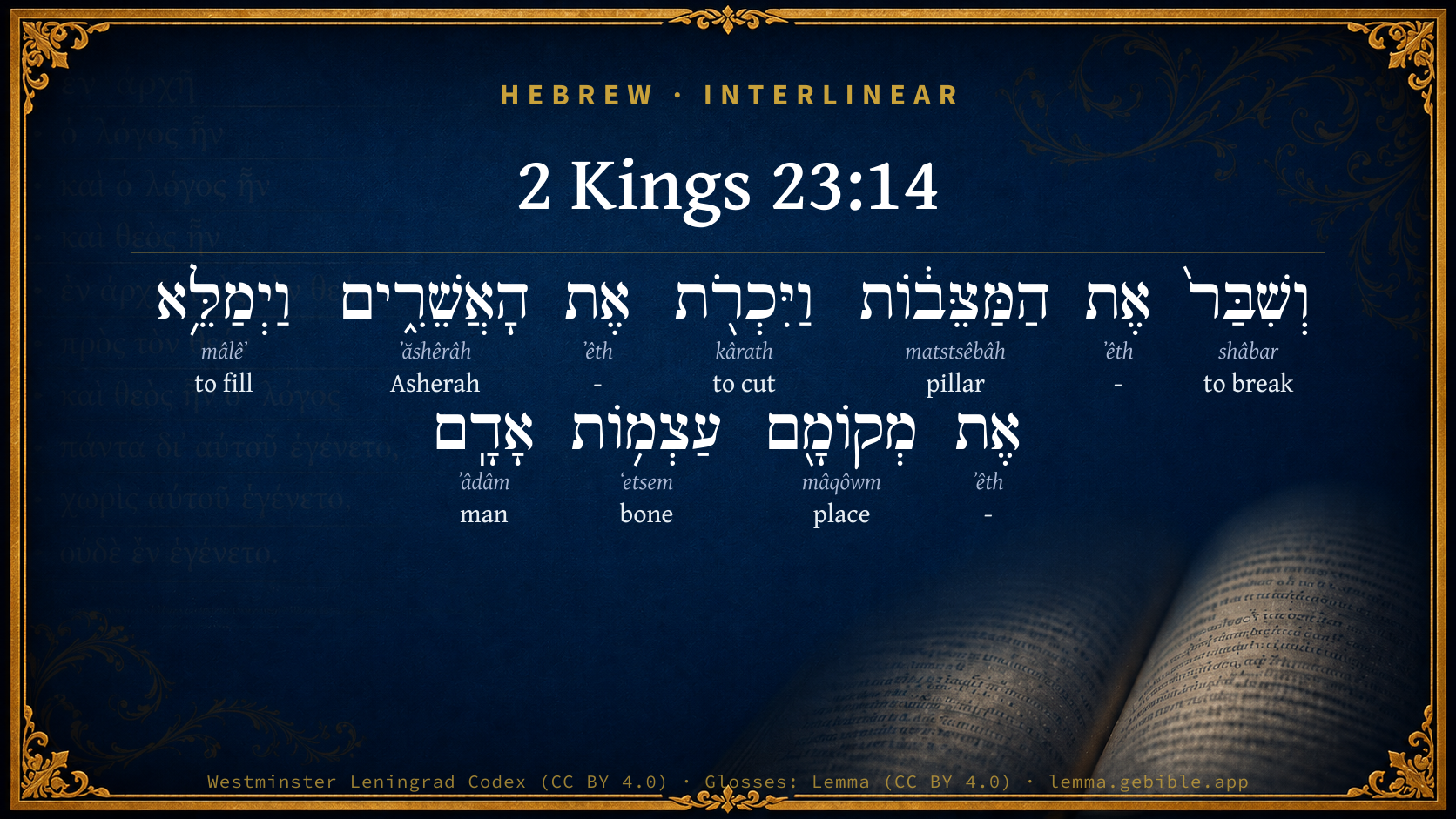
  1. וְשִׁבַּר֙ shâbar H7665 “and · to break” Conjunction + Verb, Piel, Perfect, 3rd Person, Masculine, Singular
  2. אֶת ʼêth H853 “-” Particle, Direct Object
  3. וַיִּכְרֹ֖ת kârath H3772 “and · to cut” Conjunction + Verb, Qal, Sequential Imperfect, 3rd Person, Masculine, Singular
  4. אֶת ʼêth H853 “-” Particle, Direct Object
  5. הָאֲשֵׁרִ֑ים ʼăshêrâh H842 “the · Asherah” Particle, Definite Article + Noun, Proper
  6. וַיְמַלֵּ֥א mâlêʼ H4390 “and · to fill” Conjunction + Verb, Piel, Sequential Imperfect, 3rd Person, Masculine, Singular
  7. אֶת ʼêth H853 “-” Particle, Direct Object
  8. מְקוֹמָ֖ם mâqôwm H4725 “place · their” Noun, Common, Masculine, Singular, Construct + Suffix, Personal, 3rd Person, Masculine, Plural
  9. עַצְמ֥וֹת ʻetsem H6106 “bones of” Noun, Common, Feminine, Plural, Construct
  10. אָדָֽם ʼâdâm H120 “man” Noun, Common, Masculine, Singular, Absolute

About this verse

These counts appear in no published source. They are computed here, from the morphology-tagged text and Lemma’s own curated glosses. What Lemma adds →

11
words
9
distinct lemmas
Historical
section

Shared distinctive vocabulary

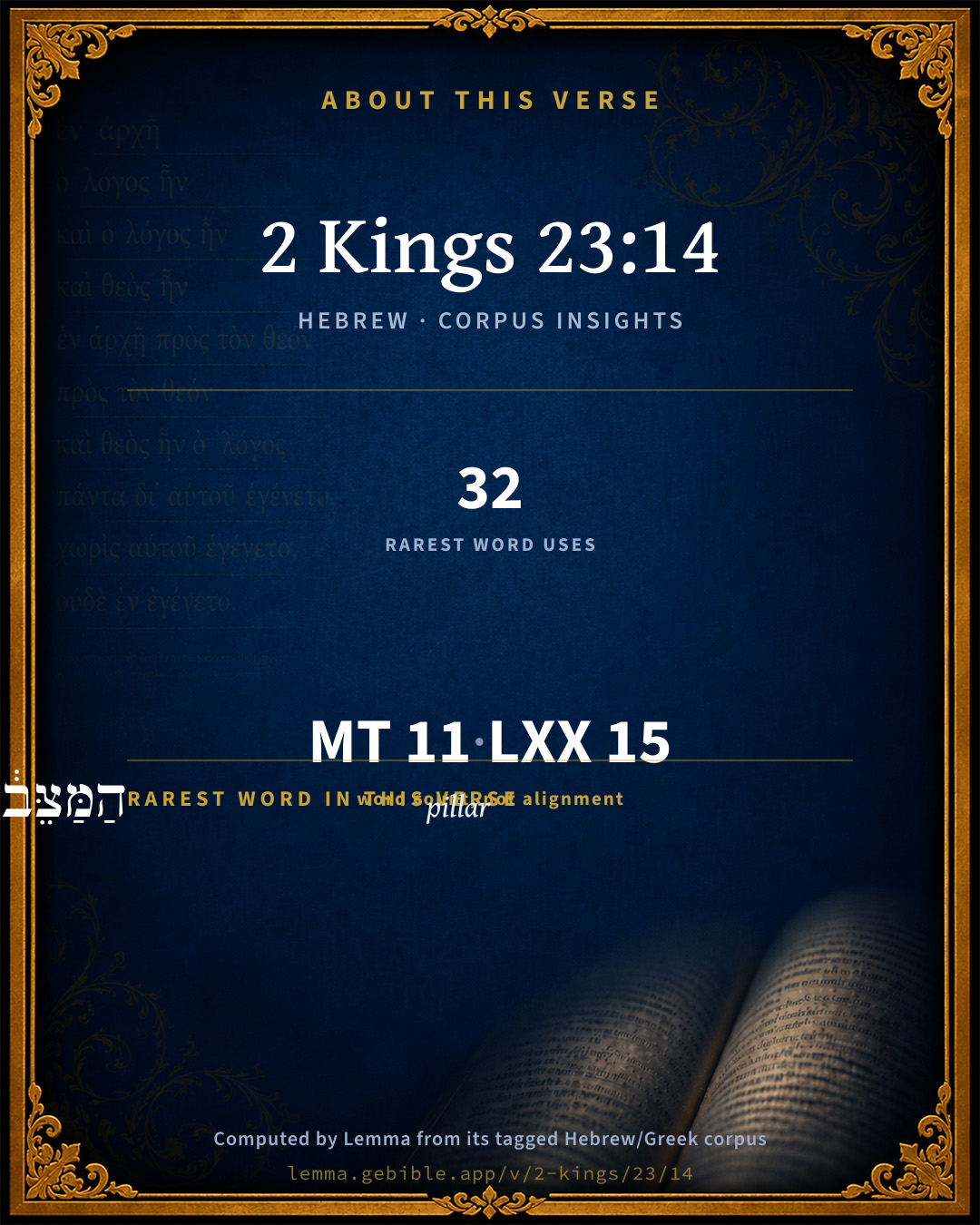
הַמַּצֵּב֔וֹת pillar H4676 occurs in 31 verses of the Hebrew Bible. Also found in:

Grammatical profile

  • 3 verbs
  • 5 nouns
  • 3 particles

Verb forms

  • וְשִׁבַּר֙ Piel · Perfect
  • וַיִּכְרֹ֖ת Qal · Sequential Imperfect
  • וַיְמַלֵּ֥א Piel · Sequential Imperfect

Hebrew & Septuagint length

In English translation the verse runs 20 words from the Hebrew and 21 from the Septuagint (LXX English) — closely comparable.

A rough comparison of the two English renderings, which tokenize alike — not a word-level alignment.

Word counts can differ between the Hebrew and the Greek without any difference in meaning — e.g. the Hebrew direct-object marker אֵת has no separate Greek word, and Greek often adds the article ὁ.

In the original languages it is 11 Hebrew tokens and 15 Greek tokens — but the two are counted differently (Hebrew bundles its prefixes and suffixes into one token; the Greek is in lemma form), so that isn’t a like-for-like length.

Cross-references

12

Topical passages linked to 2 Kings 23:14 in the Treasury of Scripture Knowledge — connected by theme and wording, ordered by reader-vote popularity; previews shown in the World English Bible.

  • Exodus 23:24 You shall not bow down to their gods, nor serve them, nor follow their practices, but you shall utterly overthrow them and demolish their pillars.
  • Deuteronomy 7:5 But thus shall you deal with them: you shall break down their altars, and dash in pieces their pillars, and hew down their Asherim, and burn their engraved images with fire.
  • 2 Kings 23:16 As Josiah turned himself, he spied the tombs that were there in the mountain; and he sent, and took the bones out of the tombs, and burned them on the altar, and defiled it, according to the word of Yahweh which the man of God proclaimed, who proclaimed these things.
  • Numbers 19:16 Whoever in the open field touches one who is slain with a sword, or a dead body, or a bone of a man, or a grave, shall be unclean seven days.
  • Numbers 19:18 and a clean person shall take hyssop, and dip it in the water, and sprinkle it on the tent, and on all the vessels, and on the persons who were there, and on him who touched the bone, or the slain, or the dead, or the grave:
  • Numbers 33:52 then you shall drive out all the inhabitants of the land from before you, and destroy all their figured [stones], and destroy all their molten images, and demolish all their high places:
  • Deuteronomy 7:25–26 The engraved images of their gods shall you burn with fire: you shall not covet the silver or the gold that is on them, nor take it to you, lest you be snared therein; for it is an abomination to Yahweh your God.
  • 2 Chronicles 34:3–4 For in the eighth year of his reign, while he was yet young, he began to seek after the God of David his father; and in the twelfth year he began to purge Judah and Jerusalem from the high places, and the Asherim, and the engraved images, and the molten images.
  • Jeremiah 8:1–2 At that time, says Yahweh, they shall bring out the bones of the kings of Judah, and the bones of his princes, and the bones of the priests, and the bones of the prophets, and the bones of the inhabitants of Jerusalem, out of their graves;
  • Ezekiel 39:12–16 Seven months shall the house of Israel be burying them, that they may cleanse the land.
  • Micah 1:7 All her idols will be beaten to pieces, And all her temple gifts will be burned with fire, And all her images I will destroy; For of the hire of a prostitute has she gathered them, And to the hire of a prostitute shall they return."
  • Matthew 23:27–28 "Woe to you, scribes and Pharisees, hypocrites! For you are like whitened tombs, which outwardly appear beautiful, but inwardly are full of dead men's bones, and of all uncleanness.

Cross-references courtesy of OpenBible.info (CC BY 4.0).

Hebrew and Greek witnesses Masoretic Hebrew ↔ Greek Septuagint

The same verse in the two great witnesses to the Old Testament, shown verse-for-verse.

These are two independent witnesses, not word-aligned to each other, and the Septuagint is shown in lemma (dictionary) form.

Hebrew 2 Kings 23:14 Masoretic · Westminster Leningrad Codex

וְשִׁבַּר֙ אֶת הַמַּצֵּב֔וֹת וַיִּכְרֹ֖ת אֶת הָאֲשֵׁרִ֑ים וַיְמַלֵּ֥א אֶת מְקוֹמָ֖ם עַצְמ֥וֹת אָדָֽם

He broke in pieces the pillars, and cut down the Asherim, and filled their places with the bones of men.

World English Bible · Public Domain

Greek LXX 2 Kings 23:14 Septuagint · lemma form

καί συντρίβω ὁ στήλη καί ἐκὀλεθρεύω ὁ ἄλσος καί πίμπλημι ὁ τόπος αὐτός ὀστέον ἄνθρωπος

And he broke in pieces the pillars, and utterly destroyed the groves, and filled their places with the bones of men.

LXX2012 (modern English Septuagint) · Public Domain

On this verse, Haydock's Catholic Bible Commentary discusses the Septuagint’s reading. Read the note in Commentary ↓

Hebrew: Westminster Leningrad Codex (CC BY 4.0). Greek: Septuagint (public domain); English from LXX2012 (modern English Septuagint) (Public Domain). How the Septuagint differs from the Hebrew →

Targum (Aramaic paraphrase)

1

The Targum is the ancient Jewish Aramaic paraphrase of the Hebrew Scriptures — an interpretive translation, not the Hebrew text itself. Onkelos (literal) and Pseudo-Jonathan (expansive) render the Torah, and Jonathan the Prophets. Coverage is partial: where no permissively-licensed English translation exists for a verse, only the Aramaic is shown. This is verse-level text, not a word-by-word alignment to the Hebrew.

  1. Targum Jonathan Prophets (Joshua–Malachi)
    וְתַבַּר יַת קָמָתָא וְקָץ יַת אֲשֵׁירָתָא וּמַלֵא יַת אַתְרֵהוֹן גַרְמֵי אֱנָשָׁא:

    (no public-domain English translation for this verse)

    Targum Jonathan — Aramaic: “Mikraot Gedolot” (public domain). English: “Sefaria Community Translation” (CC0 1.0 (public-domain dedication)); “London "Chaldee Paraphrase," 1871” (public domain). Text via Sefaria.

Commentary

Notes on 2 Kings 23:14 from classic Christian and Jewish commentators (each source and its license shown beneath its notes). The classic Christian expositions comment on the surrounding passage and are grouped to its opening verse, so a note may address several verses; the Jewish commentaries on the Tanakh (Rashi and others) are per-verse, so they appear only where the commentator wrote on this verse.

Lemma curates 59 commentaries, every one of them public domain or Creative Commons licensed, each selected and text-cleaned for this edition rather than reprinted as found. About our sources →

Trapp's Complete Commentary

John Trapp

2Ki 23:14 And he brake in pieces the images, and cut down the groves, and filled their places with the bones of men.

Ver. 14. And he brake in pieces the images.] He made no spare of any of those idols and monuments of idolatry, though there wanted not some about him, doubtless, that could have wished it otherwise, and moved him to spare those goodly horses and chariots of the sun, &c. But he was resolved to make a hand with them all. We may give peace to buy truth, but we may not give truth to buy peace.

John Trapp, A Commentary or Exposition upon All the Books of the Old and New Testament (1647–1656) — public domain. Text from a community e-Sword module.

Joseph Benson's Commentary

2Ki 23:14. And filled their places — The places of the groves; with the bones of men — Of the idolatrous priests, which he caused to be taken out of their graves, 2Ki 23:18. As he carried the ashes of the images to the graves, to mingle them with dead men’s bones, so he carried dead men’s bones to the places where the images had been, that both ways idolatry might be rendered loathsome. Dead men and dead gods were indeed much alike, and fittest to go together.

Joseph Benson's Commentary on the Old and New Testaments (1811–1818) — public domain. Text from a community e-Sword module.

Jamieson, Fausset & Brown

Robert Jamieson, A. R. Fausset & David Brown

filled their places with the bones of men--Every monument of idolatry in his dominion he in like manner destroyed, and the places where they stood he defiled by strewing them with dead men's bones. The presence of a dead carcass rendered both persons and places unclean in the eyes both of Jews and heathens.

Jamieson, Fausset & Brown — Commentary Critical and Explanatory on the Whole Bible (1871) — public domain (CC PDM 1.0). Text via the HelloAO Bible API.

Adam Clarke's Commentary

Verse 14. Filled their places with the bones of men.] This was allowed to be the utmost defilement to which any thing could be exposed.

Adam Clarke's Commentary on the Bible (1810–1826) — public domain. Text from a community e-Sword/MySword module.

Ellicott's Commentary for English Readers

(14) The images . . . the groves.—The pillars . . . the ashçrahs. These pillars and sacred trees may have been set up at the high places mentioned in the last verse; but the Hebrew construction does not prove this, for comp. 2Ki_23:10. The reference is probably general.

Their places.—Their place or station; a technical term for the position of an idol (the Heb. mâqôm, equivalent to Sabæan maqâmum. and Arabic muqâm, which is still the common designation of holy sites in Palestine.

A Bible Commentary for English Readers, edited by Charles John Ellicott (1878–1897) — public domain. Text from a community e-Sword module.

The Cambridge Bible for Schools and Colleges

gen. ed. J. J. S. Perowne

14. he brake in pieces the images [R.V. pillars], and cut down the groves] R.V. the Asherim. From such passages as this we may conclude that the images of Asherah were generally of wood.

bones of men] To the mind of a Jew, trained by the Law to consider the touch of a dead body to be defilement (Num_5:2) a place defiled in this manner could never again be used for any religious purpose, and we may feel sure that the people would not have shaken off this feeling though they had begun to worship idols.

The Cambridge Bible for Schools and Colleges (gen. ed. J. J. S. Perowne; Cambridge University Press, 1878–1918) — public domain. Text from a community e-Sword module.

John Gill's Exposition

Moreover, the altar that was at Bethel, and the high place which Jeroboam the son of Nebat, who made Israel to sin, had made. For the worship of the calf there:

both that altar, and the high place, he brake down; according to an ancient prophecy of the man of God, Kg1 13:3 and of Amos in later times, Amo 9:1.

and burnt the high place, and stamped it small to powder; that there might be no remains of it:

and burnt the grove; either the grove of trees on it, or the idol that was in it.

John Gill's Exposition of the Whole Bible (1746–1763) — public domain (CC PDM 1.0). Text via the HelloAO Bible API.

Haydock's Catholic Bible Commentary

Statues is more proper than the Protestant "images," which would rather be torn. --- Dead is not expressed in the Hebrew or Septuagint, but must be understood. (Haydock) --- The pagans had the same idea of their impurity: incestat funere classem. (Virgil, Æneid vi.)

George Leo Haydock (1774–1849), Haydock's Catholic Family Bible and Commentary, 1859 edition — public domain. Excludes Psalms (Douay-Rheims chapter numbering differs from Protestant) and Deuterocanonical books (Catholic canon only).

Matthew Poole's English Annotations

i.e. of the idolatrous priests, which he caused to be taken out of their graves, 2Ki 21:18.

Matthew Poole's English Annotations on the Holy Bible (1683–1685) — public domain. Text from a community e-Sword/MySword module.

Whedon's Commentary on the Bible

Daniel D. Whedon

14. Filled their places with the bones of men — Turned them into burial grounds, so as utterly to defile them, and prevent their ever being used again for idolatrous purposes.

Daniel D. Whedon (gen. ed.), Commentary on the Old and New Testaments (1874–1909) — public domain. Text from a community e-Sword module.

The Pulpit Commentary

And he brake in pieces the images or, pillars (see the comment on 1Ki_14:23) and out down the grovesi.e. the asherirn, or "sacred treesand filled their places with the bones of men. Whatever spoke of death and dissolution was a special defilement to shrines where the gods worshipped were deities of productivity and generation. Bones of men had also the actual taint of corruption about them. The "uncleanness" of dead bodies arose first out of man"s natural shrinking from death, and was then further confirmed by the horrors accompanying decay. The notion was probably coeval with death itself. It received a sanction from the Law, which made it a legal defilement to touch a corpse, (Num_19:11, Num_19:16) and placed under a sentence of uncleanness all that was in the tent where a man died. (Num_19:14, Num_19:15)

The Pulpit Commentary (1880–1919), ed. H.D.M. Spence-Jones & Joseph S. Exell — public domain. Text from a community e-Sword module.

John Wesley's Explanatory Notes

Men - Of the idolatrous priests, which he caused to be taken out of their graves, ver. 18. As he carried the ashes of the images to the graves, to mingle them with dead mens bones, so he carried dead mens bones to the places where the images had been, that both ways idolatry might be rendered loathsome. Dead men and dead gods were indeed much alike, and fittest to go together.

John Wesley, Explanatory Notes Upon the Whole Bible (1754–1765) — public domain. Text via the GEBible commentary corpus.

Lesson kit

Teaching starters — assembled from the data on this page, not authored interpretation. Every prompt links to the verse data it draws on. Edit before teaching.

2 Kings, in the Historical, opens this verse with 11 words (9 distinct Hebrew lemmas). Its most distinctive word is matstsêbâh (“pillar”). A historical commentator’s framing appears above. Read the whole chapter for the surrounding context.

Discussion questions

  1. The word matstsêbâh carries the sense “pillar.” How does it shape the verse?
  2. Genesis 28:18 shares the word «pillar» with this verse. How do the two illuminate each other?
  3. These translations render this verse differently; the difference is in the English rendering, not the original. What questions does that raise?
  4. The verb «וְשִׁבַּר֙» is Piel Perfect. How does its form color the action?
  5. Reading how Trapp's Complete Commentary and Joseph Benson's Commentary read this verse, where do the two commentators agree and where do they part?

Things to notice

Reading settings

Reading text

Shown beneath each verse's original-language words.

Old Testament
Old Testament edition

Read the OT as the Masoretic Hebrew (MT) or the Greek Septuagint (LXX).

English shown for the Greek Septuagint (in the Hebrew ↔ Greek comparison).

Comparing translations? Open the Compare panel on any verse page to stack up to four side by side.