
Leviticus 17:10

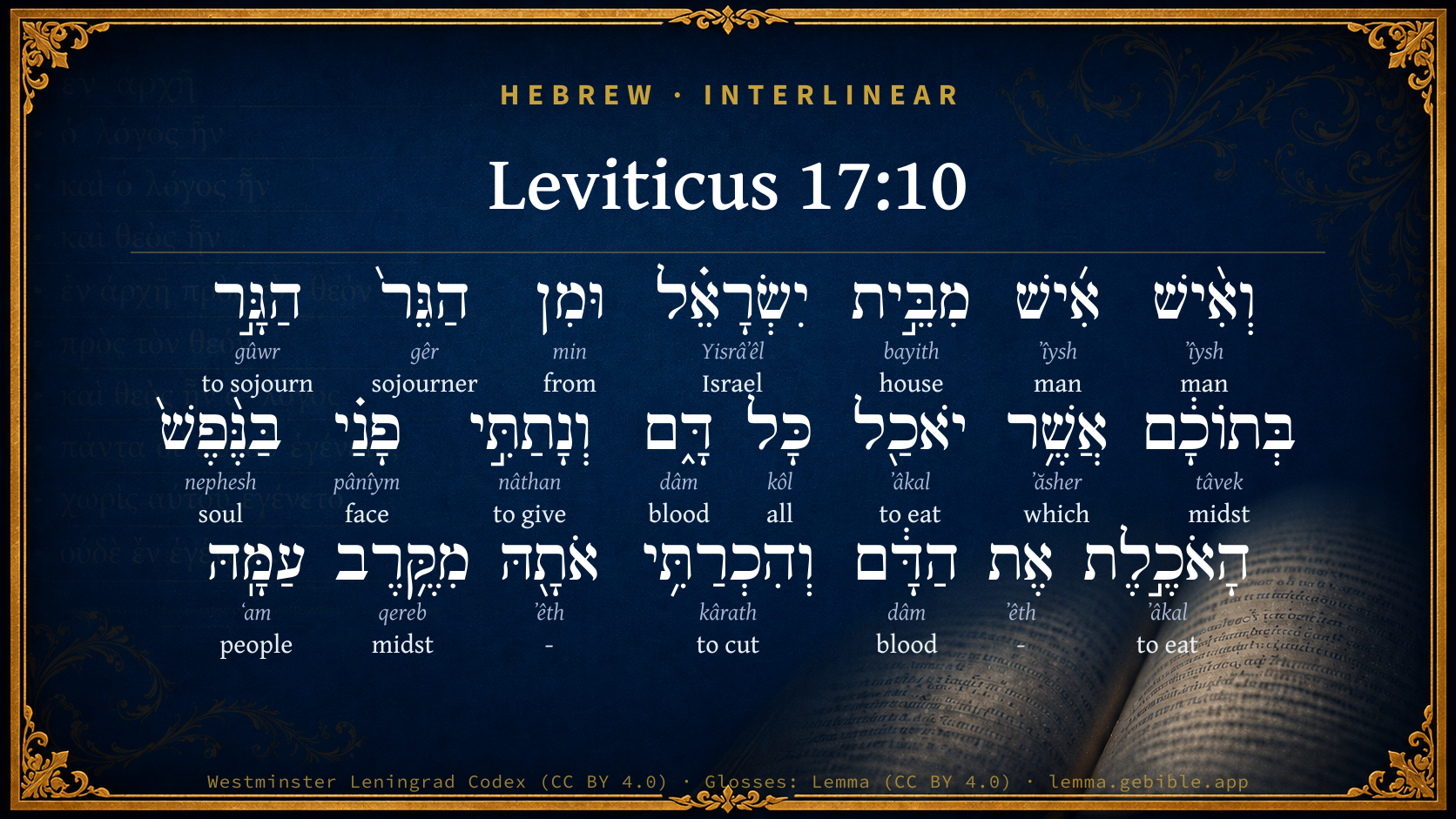
Hebrew (Westminster Leningrad Codex) Leviticus 17:10 appears in the Hebrew Old Testament. The text above is from the Westminster Leningrad Codex. Each word links to its Strong’s number, a concise gloss, and parsing drawn from the Open Scriptures Hebrew Bible morphology. Click any word for its full Brown-Driver-Briggs (BDB) entry.
Download image
Cite this verse

Leviticus 17:10 (World English Bible). Public Domain. Lemma interlinear Bible study tool, https://lemma.gebible.app/v/leviticus/17/10.

Show BibTeX & RIS
BibTeX
RIS
English Translation
"'Any man of the house of Israel, or of the strangers who live as foreigners among them, who eats any kind of blood, I will set my face against that soul who eats blood, and will cut him off from among his people.
World English Bible · Public Domain
Download a study sheet

One document with this verse’s original text, its word-by-word gloss line, the meaning frame, cross-references with their text, attributed commentary, and full source and license credits — printable, and it pastes into notes with its structure intact.

This verse Autodidact and up

Study sheet (.html) Plain text (.txt)

A passage Seminary Student

Up to 50 verses in one chapter. A passage sheet keeps up to 6 commentary sources and 12 cross-references per verse, in the order this page ranks them, and says so on the sheet whenever that leaves anything out. Ask for a single verse and you get the Autodidact verse sheet above.

Everything on this page stays free to read, with no account — the sheet is a download of what is already on screen, not access to it.

Want to remove ads? Support Godless Engineer
Compare translations 3

The same verse in 3 English versions, stacked beneath the original-language interlinear above. Click any original word for its lexicon entry.

Each is an independent rendering of the whole verse — the interlinear is not word-aligned to these translations.

Highlighted words mark where these versions differ — a whole-verse word diff, not a word-by-word alignment.

  • World English Bible Public Domain
    "'Any man of the house of Israel, or of the strangers who live as foreigners among them, who eats any kind of blood, I will set my face against that soul who eats blood, and will cut him off from among his people.
  • King James Version Public Domain
    And whatsoever man there be of the house of Israel, or of the strangers that sojourn among you, that eateth any manner of blood; I will even set my face against that soul that eateth blood, and will cut him off from among his people.
  • unfoldingWord Literal Text CC BY-SA 4.0
    And a man, a man from the house of Israel or from the sojourner sojourning in their midst, who eats any blood, then I will set my face against the person having eaten blood, and I will cut him off from the midst of his people.

unfoldingWord Literal Text — © unfoldingWord, licensed CC BY-SA 4.0. Word-aligned USFM3 via Door43 (git.door43.org/unfoldingWord/en_ult).

Versions to compare (up to 4)

3 of 4 selected

Show all 18 translations

Every available English version of this verse, each an independent rendering of the whole verse.

  • World English Bible Public Domain
    "'Any man of the house of Israel, or of the strangers who live as foreigners among them, who eats any kind of blood, I will set my face against that soul who eats blood, and will cut him off from among his people.
  • Berean Standard Bible Public Domain
    If anyone from the house of Israel or a foreigner living among them eats any blood, I will set My face against that person and cut him off from among his people.
  • Majority Standard Bible Public Domain
    If anyone from the house of Israel or a foreigner living among them eats any blood, I will set My face against that person and cut him off from among his people.
  • King James Version Public Domain
    And whatsoever man there be of the house of Israel, or of the strangers that sojourn among you, that eateth any manner of blood; I will even set my face against that soul that eateth blood, and will cut him off from among his people.
  • American Standard Version (1901) Public Domain
    And whatsoever man there be of the house of Israel, or of the strangers that sojourn among them, that eateth any manner of blood, I will set my face against that soul that eateth blood, and will cut him off from among his people.
  • Revised Version (1885) Public Domain
    And whatsoever man there be of the house of Israel, or of the strangers that sojourn among them, that eateth any manner of blood; I will set my face against that soul that eateth blood, and will cut him off from among his people.
  • Geneva Bible (1599) Public Domain
    Likewise whosoeuer he be of the house of Israel, or of the strangers that soiourne among them, that eateth any blood, I will euen set my face against that person that eateth blood, and will cut him off from among his people.
  • Douay-Rheims (1899) Public Domain
    If any man whosoever of the house of Israel, and of the strangers that sojourn among them, eat blood, I will set my face against his soul, and will cut him off from among his people:
  • Young's Literal Translation Public Domain
    `And any man of the house of Israel, or of the sojourners, who is sojourning in your midst, who eateth any blood, I have even set My face against the person who is eating the blood, and have cut him off from the midst of his people;
  • Literal Standard Version CC BY-SA 4.0
    And any man of the house of Israel, or of the sojourners who is sojourning in your midst, who eats any blood, I have even set My face against the person who is eating the blood, and have cut him off from the midst of his people;
  • Unlocked Literal Bible CC BY-SA 4.0
    If any person of the house of Israel, or any foreigner who lives among them consumes any blood, I will set my face against that person who consumes blood and I will cut him off from among his people.
  • unfoldingWord Literal Text CC BY-SA 4.0
    And a man, a man from the house of Israel or from the sojourner sojourning in their midst, who eats any blood, then I will set my face against the person having eaten blood, and I will cut him off from the midst of his people.
  • Darby Bible Public Domain
    And every one of the house of Israel, or of the strangers who sojourn among them, that eateth any manner of blood, -- I will set my face against the soul that hath eaten blood, and will cut him off from among his people;
  • World Messianic Bible Public Domain
    “‘Any man of the house of Israel, or of the strangers who live as foreigners among them, who eats any kind of blood, I will set my face against that soul who eats blood, and will cut him off from among his people.
  • Webster's Bible Public Domain
    And whatever man there may be of the house of Israel, or of the strangers that sojourn among you, that eateth any manner of blood; I will even set my face against that soul that eateth blood, and will cut him off from among his people.
  • Free Bible Version CC BY-SA 4.0
    I will disown any Israelite or any foreigner living among them who eats any blood and I will expel them from their people.
  • Bible in Basic English Public Domain
    And if any man of Israel, or any other living among them, takes any sort of blood for food, my wrath will be turned against that man and he will be cut off from among his people.
  • JPS Tanakh (1917) Public Domain
    And whatsoever man there be of the house of Israel, or of the strangers that sojourn among them, that eateth any manner of blood, I will set My face against that soul that eateth blood, and will cut him off from among his people.

Literal Standard Version (2020), Covenant Press — licensed CC BY-SA 4.0. Text via the HelloAO Bible API (eBible.org). Unlocked Literal Bible (unfoldingWord) — licensed CC BY-SA 4.0. Text via the HelloAO Bible API (eBible.org). unfoldingWord Literal Text — © unfoldingWord, licensed CC BY-SA 4.0. Word-aligned USFM3 via Door43 (git.door43.org/unfoldingWord/en_ult). Free Bible Version, Dr. Jonathan Gallagher — licensed CC BY-SA 4.0. Text via the HelloAO Bible API (eBible.org).

Word by word

More ways to search: Search by grammar → Find every occurrence → Compare this word →

Practice this passage: Drill this verse → Learn its vocabulary →

הַגֵּר֙
gêr
H1616
“the · sojourner”
Particle, Definite Article + Noun, Common, Masculine, Singular, Absolute
Part of Speech
Particle + Noun
Type
Common
Gender
Masculine
Number
Singular
State
Absolute
Full BDB Definition

Origin: from H1481

TWOT: 330a

sojourner - a temporary inhabitant, a newcomer lacking inherited rights - of foreigners in Israel, though conceded rights
  1. וְאִ֨ישׁ ʼîysh H376 “and · man” Conjunction + Noun, Common, Masculine, Singular, Absolute
  2. אִ֜ישׁ ʼîysh H376 “man” Noun, Common, Masculine, Singular, Absolute
  3. מִבֵּ֣ית bayith H1004 “from · house of” Preposition + Noun, Common, Masculine, Singular, Construct
  4. יִשְׂרָאֵ֗ל Yisrâʼêl H3478 “Israel” Noun, Proper
  5. וּמִן min H4480 “and · from” Conjunction + Preposition
  6. הַגָּ֣ר gûwr H1481 “the · sojourning” Particle, Definite Article + Verb, Qal, Participle Active, Masculine, Singular, Absolute
  7. בְּתוֹכָ֔ם tâvek H8432 “in/at · midst · their” Preposition + Noun, Common, Masculine, Singular, Construct + Suffix, Personal, 3rd Person, Masculine, Plural
  8. אֲשֶׁ֥ר ʼăsher H834 “which” Particle, Relative
  9. יֹאכַ֖ל ʼâkal H398 “to eat” Verb, Qal, Imperfect, 3rd Person, Masculine, Singular
  10. כָּל kôl H3605 “all of” Noun, Common, Masculine, Singular, Construct
  11. דָּ֑ם dâm H1818 “blood” Noun, Common, Masculine, Singular, Absolute
  12. וְנָתַתִּ֣י nâthan H5414 “and · to give” Conjunction + Verb, Qal, Sequential Perfect, 1st Person, Common, Singular
  13. פָנַ֗י pânîym H6440 “face(s) · my” Noun, Common, Both, Plural, Construct + Suffix, Personal, 1st Person, Common, Singular
  14. בַּנֶּ֨פֶשׁ֙ nephesh H5315 “in/at the · soul” Preposition, Determined + Noun, Common, Both, Singular, Absolute
  15. הָאֹכֶ֣לֶת ʼâkal H398 “the · eating” Particle, Definite Article + Verb, Qal, Participle Active, Feminine, Singular, Absolute
  16. אֶת ʼêth H853 “-” Particle, Direct Object
  17. הַדָּ֔ם dâm H1818 “the · blood” Particle, Definite Article + Noun, Common, Masculine, Singular, Absolute
  18. וְהִכְרַתִּ֥י kârath H3772 “and · to cut” Conjunction + Verb, Hiphil, Sequential Perfect, 1st Person, Common, Singular
  19. אֹתָ֖הּ ʼêth H853 “- · her” Particle, Direct Object + Suffix, Personal, 3rd Person, Feminine, Singular
  20. מִקֶּ֥רֶב qereb H7130 “from · midst of” Preposition + Noun, Common, Masculine, Singular, Construct
  21. עַמָּֽהּ ʻam H5971 “people · her” Noun, Common, Masculine, Singular, Construct + Suffix, Personal, 3rd Person, Feminine, Singular

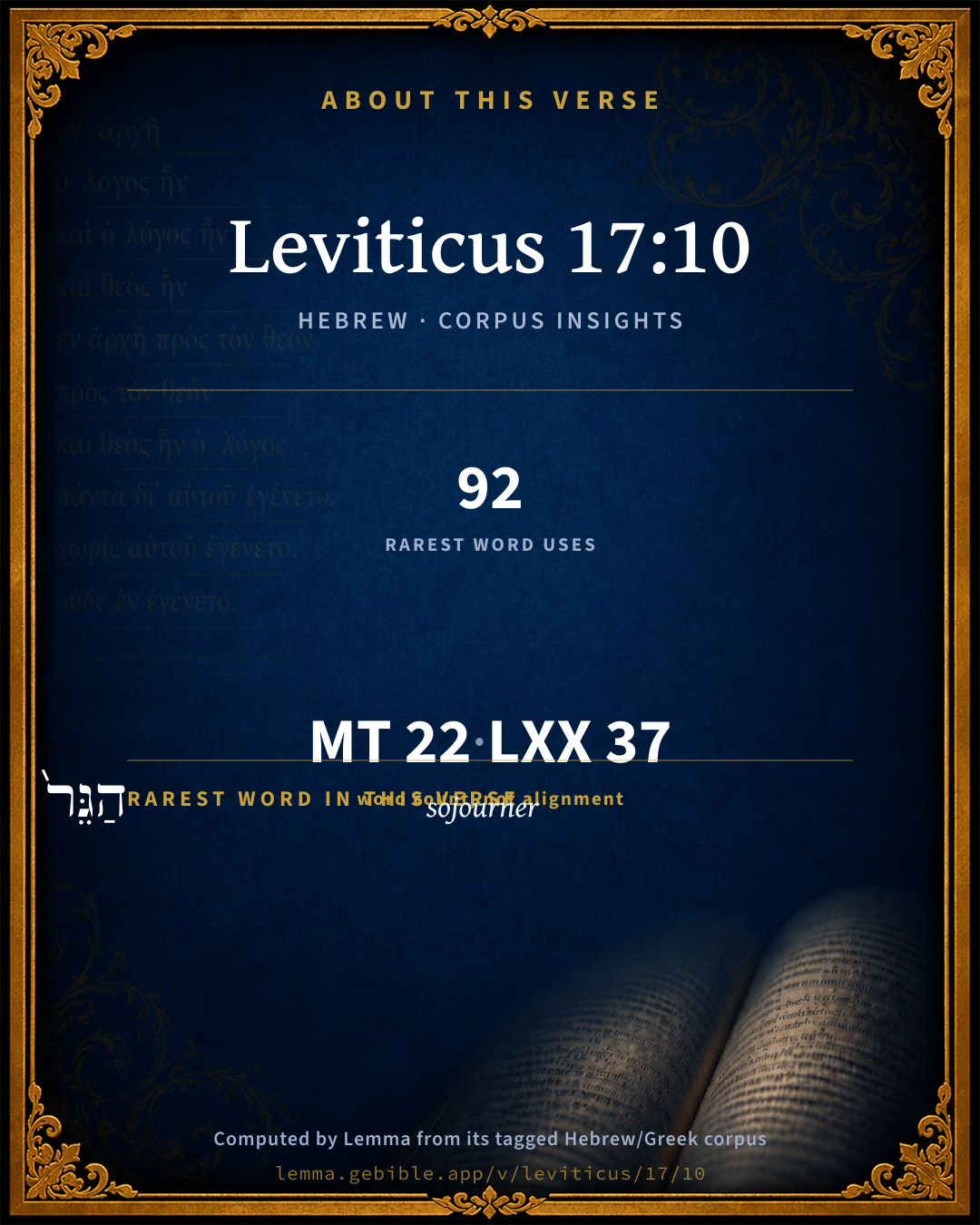
About this verse

These counts appear in no published source. They are computed here, from the morphology-tagged text and Lemma’s own curated glosses. What Lemma adds →

22
words
18
distinct lemmas
Pentateuch
section

Grammatical profile

  • 5 verbs
  • 13 nouns
  • 1 preposition
  • 3 particles

Verb forms

  • הַגָּ֣ר Qal · Participle Active
  • יֹאכַ֖ל Qal · Imperfect
  • וְנָתַתִּ֣י Qal · Sequential Perfect
  • הָאֹכֶ֣לֶת Qal · Participle Active
  • וְהִכְרַתִּ֥י Hiphil · Sequential Perfect

Repetition

Words recur within this verse — often emphatic in Hebrew:

  • וְאִ֨ישׁ man H376 ×2
  • יֹאכַ֖ל to eat H398 ×2
  • דָּ֑ם blood H1818 ×2

Hebrew & Septuagint length

In English translation the verse runs 43 words from the Hebrew and 38 from the Septuagint (LXX English) — closely comparable.

A rough comparison of the two English renderings, which tokenize alike — not a word-level alignment.

Word counts can differ between the Hebrew and the Greek without any difference in meaning — e.g. the Hebrew direct-object marker אֵת has no separate Greek word, and Greek often adds the article ὁ.

In the original languages it is 22 Hebrew tokens and 37 Greek tokens — but the two are counted differently (Hebrew bundles its prefixes and suffixes into one token; the Greek is in lemma form), so that isn’t a like-for-like length.

Cross-references

21

Topical passages linked to Leviticus 17:10 in the Treasury of Scripture Knowledge — connected by theme and wording, ordered by reader-vote popularity; previews shown in the World English Bible.

  • Leviticus 17:11 For the life of the flesh is in the blood; and I have given it to you on the altar to make atonement for your souls: for it is the blood that makes atonement by reason of the life.
  • Leviticus 3:17 "'It shall be a perpetual statute throughout your generations in all your dwellings, that you shall eat neither fat nor blood.'"
  • Deuteronomy 12:16 Only you shall not eat the blood; you shall pour it out on the earth as water.
  • Deuteronomy 12:23 Only be sure that you don't eat the blood: for the blood is the life; and you shall not eat the life with the flesh.
  • Genesis 9:4 But flesh with the life of it, the blood of it, you shall not eat.
  • Leviticus 7:26–27 You shall not eat any blood, whether it is of bird or of animal, in any of your dwellings.
  • Leviticus 26:17 I will set my face against you, and you will be struck before your enemies. Those who hate you will rule over you; and you will flee when no one pursues you.
  • 1 Samuel 14:33 Then they told Saul, saying, Behold, the people sin against Yahweh, in that they eat with the blood. He said, you have dealt treacherously: roll a great stone to me this day.
  • Jeremiah 44:11 Therefore thus says Yahweh of Hosts, the God of Israel: Behold, I will set my face against you for evil, even to cut off all Judah.
  • Leviticus 19:26 "'You shall not eat any meat with the blood still in it; neither shall you use enchantments, nor practice sorcery.
  • Leviticus 20:3–6 I also will set my face against that person, and will cut him off from among his people because he has given of his seed to Molech, to defile my sanctuary, and to profane my holy name.
  • Deuteronomy 15:23 Only you shall not eat its blood; you shall pour it out on the ground as water.
  • Psalms 34:16 Yahweh's face is against those who do evil, To cut off the memory of them from the earth.
  • Ezekiel 14:8 and I will set my face against that man, and will make him an astonishment, for a sign and a proverb, and I will cut him off from the midst of my people; and you shall know that I am Yahweh.
  • Ezekiel 15:7 I will set my face against them; they shall go forth from the fire, but the fire shall devour them; and you shall know that I am Yahweh, when I set my face against them.
  • Ezekiel 44:7 in that you have brought in foreigners, uncircumcised in heart and uncircumcised in flesh, to be in my sanctuary, to profane it, even my house, when you offer my bread, the fat and the blood, and they have broken my covenant, [to add] to all your abominations.
  • Jeremiah 21:10 For I have set my face on this city for evil, and not for good, says Yahweh: it shall be given into the hand of the king of Babylon, and he shall burn it with fire.
  • Ezekiel 33:25 Therefore tell them, Thus says the Lord Yahweh: You eat with the blood, and lift up your eyes to your idols, and shed blood: and shall you possess the land?
  • Acts 15:20 but that we write to them that they abstain from the pollution of idols, from sexual immorality, from what is strangled, and from blood.
  • Acts 15:29 that you abstain from things sacrificed to idols, from blood, from things strangled, and from sexual immorality, from which if you keep yourselves, it will be well with you. Farewell."
  • Hebrews 10:29 How much worse punishment, do you think, will he be judged worthy of, who has trodden under foot the Son of God, and has counted the blood of the covenant with which he was sanctified an unholy thing, and has insulted the Spirit of grace?

Cross-references courtesy of OpenBible.info (CC BY 4.0).

Hebrew and Greek witnesses Masoretic Hebrew ↔ Greek Septuagint

The same verse in the two great witnesses to the Old Testament, shown verse-for-verse.

These are two independent witnesses, not word-aligned to each other, and the Septuagint is shown in lemma (dictionary) form.

Hebrew Leviticus 17:10 Masoretic · Westminster Leningrad Codex

וְאִ֨ישׁ אִ֜ישׁ מִבֵּ֣ית יִשְׂרָאֵ֗ל וּמִן הַגֵּר֙ הַגָּ֣ר בְּתוֹכָ֔ם אֲשֶׁ֥ר יֹאכַ֖ל כָּל דָּ֑ם וְנָתַתִּ֣י פָנַ֗י בַּנֶּ֨פֶשׁ֙ הָאֹכֶ֣לֶת אֶת הַדָּ֔ם וְהִכְרַתִּ֥י אֹתָ֖הּ מִקֶּ֥רֶב עַמָּֽהּ

"'Any man of the house of Israel, or of the strangers who live as foreigners among them, who eats any kind of blood, I will set my face against that soul who eats blood, and will cut him off from among his people.

World English Bible · Public Domain

Greek LXX Leviticus 17:10 Septuagint · lemma form

καί ἄνθρωπος ἄνθρωπος ὁ υἱός ἰσραήλ ἤ ὁ προσήλυτος ὁ προςκεῖμαι ἐν σύ ὅς ἄν ἐσθίω πᾶς αἷμα καί ἐπιἵστημι ὁ πρόσωπον ἐγώ ἐπί ὁ ψυχή ὁ ἐσθίω ὁ αἷμα καί ἀποὀλλύω αὐτός ἐκ ὁ λαός αὐτός

And whatever man of the children of Israel, or of the strangers dwelling among you, shall eat any blood, I will even set my face against that soul that eats blood, and will destroy it from its people.

LXX2012 (modern English Septuagint) · Public Domain

Hebrew: Westminster Leningrad Codex (CC BY 4.0). Greek: Septuagint (public domain); English from LXX2012 (modern English Septuagint) (Public Domain). How the Septuagint differs from the Hebrew →

Targum (Aramaic paraphrase)

2

The Targum is the ancient Jewish Aramaic paraphrase of the Hebrew Scriptures — an interpretive translation, not the Hebrew text itself. Onkelos (literal) and Pseudo-Jonathan (expansive) render the Torah, and Jonathan the Prophets. Coverage is partial: where no permissively-licensed English translation exists for a verse, only the Aramaic is shown. This is verse-level text, not a word-by-word alignment to the Hebrew.

  1. Targum Onkelos Torah (Genesis–Deuteronomy)
    וּגְבַר גְבַר מִבֵּית יִשְׂרָאֵל וּמִן גִיוֹרָא דְיִתְגַיְרוּן בֵּינֵיכוֹן דִי יֵיכוּל כָּל דְמָא וְאֶתֵּן רוּגְזִי בַּאֲנָשָׁא דְיֵיכוּל יָת דְמָא וֶאֱשֵׁיצֵי יָתֵהּ מִגוֹ עַמֵהּ

    (no public-domain English translation for this verse)

    Targum Onkelos — Aramaic: “Onkelos Genesis” (public domain); “Onkelos Exodus” (public domain); “Onkelos Leviticus” (public domain); “Onkelos Numbers” (public domain); “Onkelos Deuteronomy” (public domain). English: “Sefaria Community Translation” (CC0 1.0 (public-domain dedication)); “J.W. Etheridge. The Targums of Onkelos and Jonathan Ben Uzziel on the Pentateuch. London: Longmans, Green, 1862” (public domain). Text via Sefaria.

  2. Targum Pseudo-Jonathan Torah (Genesis–Deuteronomy)
    וּגְבַר טְלֵי וּגְבַר סִיב מִבֵּית גְנִיסַת יִשְרָאֵל וּמִן גִיוֹרָא דְמִתְגַיְירוּן לְמֵיתַב בֵּינֵיהוֹן דִי יֵיכוּל כָּל אַדְמָא וְאֶתֵּן יַת פְּנוּיָיתָא לְמֶעֱסוֹק בְּבַר נְשָׁא הַהוּא דִי יֵיכוּל כָּל אַדְמָא וְאֵישֵׁיצֵי יָתֵיהּ מִגוֹ עַמֵיהּ

    A man also, whether young or old, of the house of the family of Israel, or of the strangers who sojourn, in dwelling among them, who shall eat any blood, I will cause employment to turn away (or cease) from that man who eateth any blood, and will destroy him from among his people.

    Targum Pseudo-Jonathan — Aramaic: “Targum Jonathan on Genesis” (public domain); “Targum Jonathan on Exodus” (public domain); “Targum Jonathan on Leviticus” (public domain); “Targum Jonathan on Numbers” (public domain); “Targum Jonathan on Deuteronomy” (public domain). English: “The Targum of Jonathan ben Uzziel, trans. J. W. Etheridge, London, 1862” (public domain). Text via Sefaria.

Commentary

Notes on Leviticus 17:10 from classic Christian and Jewish commentators (each source and its license shown beneath its notes). The classic Christian expositions comment on the surrounding passage and are grouped to its opening verse, so a note may address several verses; the Jewish commentaries on the Tanakh (Rashi and others) are per-verse, so they appear only where the commentator wrote on this verse.

Lemma curates 59 commentaries, every one of them public domain or Creative Commons licensed, each selected and text-cleaned for this edition rather than reprinted as found. About our sources →

Matthew Henry's Commentary

We have here, I. A repetition and confirmation of the law against eating blood. We have met with this prohibition twice before in the levitical law (Lev 3:17; Lev 7:26), besides the place it had in the precepts of Noah, Gen 9:4. But here, 1. The prohibition is repeated again and again, and reference had to the former laws to this purport (Lev 17:12): I said to the children of Israel, No soul of you shall eat blood; and again (Lev 17:14), You shall eat the blood of no manner of flesh. A great stress is laid upon it, as a law which has more in it than at first view one would think. 2. It is made binding, not only on the house of Israel, but on the strangers that sojourned among them (Lev 17:10), which perhaps was one reason why it was thought advisable, for a time, to forbid blood to the Gentile converts, Act 15:29. 3. The penalty annexed to this law is very severe (Lev 17:10): I will even set my face against that soul that eateth blood, if he do it presumptuously, and will cut him off; and again (Lev 17:14), He shall be cut off. Note, God's wrath will be the sinner's ruin. Write that man undone, for ever undone, against whom God sets his face; for what creature is able to confront the Creator? 4. A reason is given for this law (Lev 17:11): because it is the blood that makes atonement for the soul; and therefore it was appointed to make atonement with, because the life of the flesh is the blood. The sinner deserved to die; therefore the sacrifice must die. Now, the blood being so the life that ordinarily beasts were killed for man's use by the drawing out of all their blood, God appointed the sprinkling or pouring out of the blood of the sacrifice upon the altar to signify that the life of the sacrifice was given to God instead of the sinner's life, and as a ransom or counter-price for it; therefore without shedding of blood there was no remission, Heb 9:22. For this reason they must eat no blood, and, (1.) It was then a very good reason; for God would by this means preserve the honour of that way of atonement which he had instituted, and keep up in the minds of the people a reverent regard to it. The blood of the covenant being then a sensible object, no blood must be either eaten or trodden under foot as a common thing, as they must have no ointment nor perfume like that which God ordered them to make for himself. But, (2.) This reason is now superseded, which intimates that the law itself was ceremonial, and is now no longer in force: the blood of Christ who has come (and we are to look for no other) is that alone which makes atonement for the soul, and of which the blood of the sacrifices was an imperfect type: the coming of the substance supersedes the shadow. The blood of beasts is no longer the ransom, but Christ's blood only; and therefore there is not now that reason for abstaining from blood which there was then, and we cannot suppose it was the will of God that the law should survive the reason of it. The blood, provided it be so prepared as not to be unwholesome, is now allowed for the nourishment of our bodies, because it is no longer appointed to make an atonement for the soul. (3.) Yet it has still useful significancy. The life is in the blood; it is the vehicle of the animal spirits, and God would have his people to regard the life even of their beasts, and not to be cruel and hard-hearted, not to take delight in any thing that is barbarous. They must not be a blood-thirsty people. The blood then made atonement figuratively, now the blood of Christ makes atonement really and effectually; to this therefore we must have a reverent regard, and not use it as a common thing, for he will set his face against those that do so, and they shall be cut off, Heb 10:29.

II. Some other precepts are here given as appendages to this law, and hedges about it, 1. They must cover the blood of that which they took in hunting, Lev 17:13. They must not only not eat it, but must give it a decent burial, in token of some mystery which they must believe lay hidden in this constitution. the Jews look upon this as a very weighty precept and appoint that the blood should be covered with these words, Blessed be he that hath sanctified us by his precepts, and commanded us to cover blood. 2. They must not eat that which died of itself or was torn of beasts (Lev 17:15), for the blood was either not at all, or not regularly, drawn out of them. God would have them to be curious in their diet, not with the curiosity that gratifies the sensual appetite, but with that which checks and restrains it. God would not have his children to eat every thing that came in their way with greediness, but to consider diligently what was before them, that they might learn in other things to ask questions for conscience' sake. Those that flew upon the spoiled sinned, Sa1 14:32, Sa1 14:33. If a man did, through ignorance or inconsideration, eat the flesh of any beast not duly slain, he must wash himself and his clothes, else he bore his iniquity, Lev 17:15, Lev 17:16. The pollution was ceremonial, so was the purification from it; but if a man slighted the prescribed method of cleansing, or would not submit, he thereby contracted moral guilt. See the nature of a remedial law: he that obeys it has the benefit of it; he that does not, not only remains under his former guilt, but adds to that guilt of contemning the provisions made by divine grace for his relief, and sins against the remedy.

Matthew Henry's Commentary on the Whole Bible (1708–1710) — public domain (CC PDM 1.0). Text via the HelloAO Bible API.

Trapp's Complete Commentary

John Trapp

Lev 17:10 And whatsoever man [there be] of the house of Israel, or of the strangers that sojourn among you, that eateth any manner of blood; I will even set my face against that soul that eateth blood, and will cut him off from among his people.

Ver. 10. That eateth any manner of blood.] {See Trapp on "Gen 9:4"}

John Trapp, A Commentary or Exposition upon All the Books of the Old and New Testament (1647–1656) — public domain. Text from a community e-Sword module.

Joseph Benson's Commentary

Lev 17:10. I will set my face — I will be an enemy to him, and execute vengeance upon him immediately; because such persons probably would do this in private, so that the magistrate could not know nor punish it. Write that man undone, for ever undone, against whom God sets his face.

Joseph Benson's Commentary on the Old and New Testaments (1811–1818) — public domain. Text from a community e-Sword module.

Geneva Bible (1599)

Geneva Bible translators

I will declare my wrath by taking vengeance on him, as Lev. 20:3.

Geneva Bible (1599) marginal notes — public domain. Text via Bolls.life.

Jamieson, Fausset & Brown

Robert Jamieson, A. R. Fausset & David Brown

I will even set my face against that soul that eateth blood, and will cut him off from among his people--The face of God is often used in Scripture to denote His anger (Psa 34:16; Rev 6:16; Eze 38:18). The manner in which God's face would be set against such an offender was, that if the crime were public and known, he was condemned to death; if it were secret, vengeance would overtake him. (See on Gen 9:4). But the practice against which the law is here pointed was an idolatrous rite. The Zabians, or worshippers of the heavenly host, were accustomed, in sacrificing animals, to pour out the blood and eat a part of the flesh at the place where the blood was poured out (and sometimes the blood itself) believing that by means of it, friendship, brotherhood, and familiarity were contracted between the worshippers and the deities. They, moreover, supposed that the blood was very beneficial in obtaining for them a vision of the demon during their sleep, and a revelation of future events. The prohibition against eating blood, viewed in the light of this historic commentary and unconnected with the peculiar terms in which it is expressed, seems to have been levelled against idolatrous practices, as is still further evident from Eze 33:25-26; Co1 10:20-21.

Jamieson, Fausset & Brown — Commentary Critical and Explanatory on the Whole Bible (1871) — public domain (CC PDM 1.0). Text via the HelloAO Bible API.

Ellicott's Commentary for English Readers

(10) And whatsoever man.—Better, and what man soever. (See Lev_17:8.)

Eateth any manner of blood.—This prohibition, which has already been mentioned twice in Leviticus, is in both instances joined to the prohibition of fat. (See Lev_3:17; Lev_7:26-27.) Owing to its great importance, however, the law is enacted here separately, where it naturally follows the order that the blood of all animals sacrificed in the sanctuary is to be offered to the Lord upon the altar. According to the canons which obtained during the second Temple, the blood of clean fishes, of locusts, and of permissible creeping things is exempted.

I will even set my face against that soul.—That is, make him feel my anger. Though this phrase only occurs twice more in this book, and only once in connection with legal enactments (see Lev_20:3; Lev_20:6; Lev_26:17), yet from its usages in other passages it is clear that the expression “face” denotes anger, which shows itself in the countenance. Thus the phrase, which is translated in the Authorised Version, “I will appease him” (Gen_30:20), is in the original, “I will appease his face,” where it manifestly stands for anger. Hence Lam_4:16, which is in the original, “the face of the Lord hath divided them,” is properly rendered in the Authorised Version in the text by “the anger of the Lord.” (Comp. also 1Pe_3:12.)

A Bible Commentary for English Readers, edited by Charles John Ellicott (1878–1897) — public domain. Text from a community e-Sword module.

The Cambridge Bible for Schools and Colleges

gen. ed. J. J. S. Perowne

10. The prohibition (cp. Lev_17:12) is found also in Lev_3:17, Lev_7:26, Lev_19:26; Deu_12:16; Deu_12:23-24; Deu_15:23. It is regarded as having been obligatory from the beginning (Gen_9:4). The word ‘eat’ is probably used in order to include eating flesh which contained blood. When the people ate thus in their haste after the defeat of the Philistines, this is described as eating ‘with (Heb. upon) the blood’ (1Sa_14:32-34). Cp. ch. Lev_19:26; Eze_33:25.

The Cambridge Bible for Schools and Colleges (gen. ed. J. J. S. Perowne; Cambridge University Press, 1878–1918) — public domain. Text from a community e-Sword module.

John Gill's Exposition

And whatsoever man there be of the house of Israel,.... That is by birth an Israelite, of every age, sex, or condition, as before:

or of the strangers that sojourn among you; proselytes of righteousness, for the following law was only obligatory on such, and upon Israelites, as appears from its being lawful to give or sell that which dies of itself to a stranger, that is, to a proselyte of the gate, or to an Heathen, Deu 14:21,

that eateth any manner of blood; that is, as Ben Gersom interprets it, of beasts and birds, concerning which the prohibition only is, according to him; for as for the blood of others there was no obligation, nor were any guilty on account of them; particularly the blood of fishes, and of locusts, or human blood, the blood of a man's teeth, which a man might swallow without being guilty of the breach of this law (g). Some restrain this to the blood of the sacrifices before treated of; but Jarchi observes, lest any should think, because it is said, it is "the blood that maketh the atonement for the soul": that a man is not guilty only on account of the blood of sanctified things, therefore it is said "any manner of blood":

I will set my face against that soul that eateth blood; signifying how greatly he should be provoked thereby, how much he should resent it, how exceedingly displeasing it would be to him, and what severity might be expected to be exercised towards him for it; for dreadful it is to have the face of God set against a man, see Psa 34:16. Maimonides (h) observes, that this form of speech does not occur in any third precept besides these two, concerning idolatry or sacrificing a son to Moloch, Lev 20:3, and eating blood; because eating of blood gives an occasion to one species of idolatry, worshipping of devils, see Lev 19:26,

and will cut him off from among his people; which confirms the above sense of the phrase of cutting off as expressive of death by the hand of God; See Gill on Lev 17:4.

(g) Hilchot Maacolot Asurot, c. 6. sect. 1. (h) Ut supra. (Moreh Nevochim, p. 3. c. 46.)

John Gill's Exposition of the Whole Bible (1746–1763) — public domain (CC PDM 1.0). Text via the HelloAO Bible API.

Albert Barnes' Notes on the Bible

The prohibition to eat blood is repeated in seven places in the Pentateuch, but in this passage two distinct grounds are given for the prohibition: first, its own nature as the vital fluid; secondly, its consecration in sacrificial worship.

Lev 17:11

Rather, For the soul of the flesh is in the blood; and I have ordained it for you upon the altar, to make atonement for your souls, for the blood it is which makes atonement by means of the soul. In the Old Testament there are three words relating to the constitution of man;

(a) “life” as opposed to death Gen 1:20; Deu 30:15;

(b) the “soul” as distinguished from the body; the individual life either in man or beast, whether united to the body during life, or separated from the body after death (compare Gen 2:7);

(c) the “spirit” as opposed to the flesh Rom 8:6, and as distinguished from the life of the flesh; the highest element in man; that which, in its true condition, holds communion with God. The soul has its abode in the blood as long as life lasts. In Lev 17:14, the soul is identified with the blood, as it is in Gen 9:4; Deu 12:23. That the blood is rightly thus distinguished from all other constituents of the body is acknowledged by the highest authorities in physiology.

“It is the fountain of life (says Harvey), the first to live, and the last to die, and the primary seat of the animal soul; it lives and is nourished of itself, and by no other part of the human body.” John Hunter inferred that it is the seat of life, because all the parts of the frame are formed and nourished from it. “And if (says he) it has not life previous to this operation, it must then acquire it in the act of forming: for we all give our assent to the existence of life in the parts when once formed.” Milne Edwards observes that, “if an animal be bled until it falls into a state of syncope, and the further loss of blood is not prevented, all muscular motion quickly ceases, respiration is suspended, the heart pauses from its action, life is no longer manifested by any outward sign, and death soon becomes inevitable; but if, in this state, the blood of another animal of the same species be injected into the veins of the one to all appearance dead, we see with amazement this inanimate body return to life, gaining accessions of vitality with each new quantity of blood that is introduced, eventual beginning to breathe freely, moving with ease, and finally walking as it was wont to do, and recovering completely.” More or less distinct traces of the recognition of blood as the vehicle of life are found in Greek and Roman writers. The knowledge of the ancients on the subject may indeed have been based on the mere observation that an animal loses its life when it loses its blood: but it may deepen our sense of the wisdom and significance of the Law of Moses to know that the fact which it sets forth so distinctly and consistently, and in such pregnant connection, is so clearly recognized by modern scientific research.

Lev 17:14

Rather, For the soul of all flesh is its blood with its soul (i. e. its blood and soul together): therefore spake I to the children of Israel, Ye shall not eat the blood of any flesh, for the soul of all flesh is its blood, etc.

Albert Barnes' Notes on the Bible (1834–1885) — public domain. Text from a community e-Sword/MySword module.

Haydock's Catholic Bible Commentary

Eat blood. To eat blood, was forbidden in the law; partly because God reserved it to himself to be offered in sacrifices on the altar, as to the Lord of life and death; and as a figure of the blood of Christ; and partly to give men a horror of shedding blood, Genesis ix. 4, 5, 6. (Challoner) --- Some barbarians feast on human blood. The Massagetes drunk the blood of horses, and the Gelonians of Pontus mixed it with milk. (Georg. iii. 463.) If the Hebrews did any such thing, and it became public, they were put to death. But if it remained private, God threatens to take vengeance himself of their cruelty and disobedience. The face often denotes anger.

George Leo Haydock (1774–1849), Haydock's Catholic Family Bible and Commentary, 1859 edition — public domain. Excludes Psalms (Douay-Rheims chapter numbering differs from Protestant) and Deuterocanonical books (Catholic canon only).

Matthew Poole's English Annotations

i.e. I will be an enemy to him, and execute vengeance upon him immediately; because such persons probably would do this in private, so as the magistrate could not know nor punish it. See this or the like phrase Lev 20:3; 26:17; Jer 3:12; Eze 14:8.

Matthew Poole's English Annotations on the Holy Bible (1683–1685) — public domain. Text from a community e-Sword/MySword module.

Whedon's Commentary on the Bible

Daniel D. Whedon

10. I will even set my face against — This form of words indicates that the extermination of the blood eater will not be by imperfect human judicatories, but by the direct intervention of Jehovah cutting off the offender, as if guilty of a most heinous crime. See Lev_7:26, note.

Daniel D. Whedon (gen. ed.), Commentary on the Old and New Testaments (1874–1909) — public domain. Text from a community e-Sword module.

The Pulpit Commentary

Vers. 10, 11. The appointment made just above, that the blood of all animals slain in sacrifice should be offered to the Lord on his altar in the court of the tabernacle, leads naturally to a reiteration of the prohibition of the eating of blood, and a statement of the reason of that prohibition. "But flesh with the life thereof, which is the blood thereof, shall ye not eat," was given as a command to Noah. (Gen_9:4) It has already been repeated twice in the Book of Leviticus, (Lev_3:17 Lev_7:26) and it is still again found in Lev_19:26 Deu_12:16 Deu_15:23. The present is the locus classicus which explains the earnestness with which the rule is enforced. It begins with an extension of the obligation from the Israelites to the sojourners among them, and with a solemn declaration that, in case of transgression, God will take into his own bands the punishment of the offenders; not only is he to be cut off or excommunicated by political or ecclesiastical authority, but God himself will set his face against that soul that eateth blood, and will cut him off from among his people, by death, or such means as he chooses to adopt. Then follows the reason for the prohibition. For the life of the flesh is in the blood. The blood may not be eaten because it is the vehicle of life, literally, the soul of the flesh, that is, it is the seat of the animal life of the body. "It is the fountain of life," says Harvey; "the first to live, the last to die, and the primary seat of the animal soul; it lives and is nourished of itself, and by no other part of the human body." In consequence of possessing this character, it is to be reserved, to make an atonement for your souls upon the altar; for thus only blood became qualified for the purpose of atonement. The clause, for it is the blood that maketh an atonement for the soul, should be translated, for the blood maketh atonement by means of the soul, i.e., by means of the life which it contains. It is because the blood is the vehicle of the animal"s life, and represents that life, that it serves to cover, or make atonement for, the soul of the offerer of the sacrifice, who presents it instead of his own life.

Vers. 10-13. The eating of blood is strictly prohibited;

therefore our Lord"s words must have sounded so much the more strange in the ears of the Jews, when he said, "Except ye eat the flesh of the Son of man, and drink his blood, ye have no life in you". (Joh_6:53) The reason why blood may not be eaten is that the life of the flesh is its blood (verse 11). Eating the blood was the same thing as eating the life of the animal. Therefore his Jewish auditors would understand our Lord to mean by the words, "Whoso eateth my flesh, and drinketh my blood, hath eternal life; and I will raise him up at the last day", (Joh_6:54) that whoso became a partaker of his life, would thereby become a possessor of eternal life, and, possessing that, would share in its privileges resurrection and immortality (see Wordsworth, ad lee. ) There is an eating and drinking of Christ"s flesh and blood, that is, a partaking of his life and Spirit, which may be accomplished without any outward act whatever; but no doubt a special method of performing this mysterious act was instituted when "Jesus took bread, and blessed it, and brake it, and gave it to the disciples, and said, Take, eat; this is my body. And he took the cup, and gave thanks, and gave it to them, saying, Drink ye all of it; for this is my blood of the new testament, which is shed for many for the remission of sins". (Mat_26:27, Mat_26:28) It may well be questioned whether a Church which forbids its members to drink of that cup does not shut them out from a full partaking of the life of Christ, so far as that blessing is imparted by that ordinance.

Vers. 10-16. Atoning death.

We have here a repetition of a law which had already been twice delivered. (Lev_3:17 Lev_7:23-26) Its full and formal restatement is very significant, and this the more because of the emphatic utterance of Divine displeasure in the event of disobedience. "I will even set my face against that soul... and will cut him off," etc. (verse 10). Obviously, the highest importance was attached by God to the observance of this injunction not to eat "any manner of blood." We regard

I THE PRIMARY SIGNIFICANCE OF THIS LAW. This is clearly indicated in verses 11 and 12. We shall understand it if we consider the subject thus:

1. Happy and harmonious relations between Jehovah and his people weremaintained by continual sacrifices at his altar.

2. In these sacrifices the life of the slain animal was accepted by God as anatonement for the forfeited life of the human transgressor.

3. But the blood of the animal was regarded as the seat and source of itslife. When its blood was shed its life was taken, and the shed blood was sprinkled before the vail or poured on the altar, (Lev_2:6, Lev_2:7) as standing for the life which had been offered by man, and been accepted by God. "The blood of bulls and of goats," therefore, however insufficient of itself for the high purpose of atonement for human sin, was yet the outward and visible means which the Holy One of Israel was pleased to appoint for reconciliation between himself and his people. Therefore it was to be held sacred; the idea of it must not be vulgarized, as it would inevitably be if blood were used as common food at ordinary meals. Its sanctity must be carefully fenced. Men must associate with it, in their minds, nothing but the forfeited life, the atonement, with which it was so closely connected. All their domestic and social customs (verses 13, 15, 16) must be so ordered that the blood of animals, anywhere and anywise slain, should speak of those sacrifices at the altar in which the erring souls of men sought and found the mercy and the favour of their God.

II ITS SIGNIFICANCE TO OURSELVES. It suggests to us the truth that, as the disciples of Jesus Christ, we also should count very sacred in our esteem the thought of atoning blood.

1. For we, too, are redeemed by "precious blood". (see 1Pe_1:18, 19 Eph_1:7 Heb_9:12-14 Rev_5:9) It may not have been needful that, in the literal sense, the blood of the Son of man should flow, but it was needful that his life, of which the blood is the source and the symbol, should be laid down.

2. Our Lord has given us a permanent institution, the object of which is to keep before our minds the shedding of his blood for our sins. (Mat_26:28 1Co_11:26)

3. By their words, he and his apostles laid the greatest stress on his atoning death as the source of our life and hope. (Joh_12:32 Joh 6:53 Luk_24:46, 47 Heb_9:14 1Jn_1:7, etc.)

4. His atoning death was the object of our soul"s trust when we entered our Christian course, and will be at the hour when we shall complete it.

5. It is the will of Christ that we should keep it continually in view throughout our life. It is our wisdom as well as our duty so to do, inasmuch as the contemplation of his death for our sins will minister

a. to our humility;

b. to our gratitude;

c. to a consecrated life of cheerful obedience and submission.

Vers. 10-16. Verse 11, "The life of the flesh is in the blood: and I have given it to you upon the altar to make an atonement for your souls: for it is the blood that maketh an atonement for the soul.

I THE NATURAL BASIS OF ATONEMENT.

1. The preciousness of life. The blood is the seat of life.

2. The exchange of the altar, blood for life, a lower for a higher, requires a supplementary value, which is represented by the altar itself.

3. The law proclaimed at the first against the shedding of blood taken up into the higher law of redemption; righteousness becoming at the altar of God the refuge of man.

II ATONEMENT FOR THE SOUL PROVIDED BY DIVINE LOVE. "I have given it you to make an atonement.

1. All atonement must proceed from Divine love, otherwise it will be heathenish as effecting a change in God. Christ is set forth a propitiation.

2. Atonement is made, i.e., by being offered, the blood shed at the tabernacle door, offered upon the altar. Thus the sacrifice is a revelation and consecration of the bond of union in the covenant relation between God and man.

3. The blood, while representing the life, also represents the obedience active and passive of Christ, which was both a rendering up to God of a perfect humanity, and an exaltation of the Law in the sufferings and death of Calvary; the old man crucified, the new man glorified.

4. All human merit is excluded: "I have given it you. No amount of sacrifice would be of any avail except it be according to the will of God. We give back to him of his own. Hence the difference between the Jewish sacrifices and those of pagan nations, and between the morality which is founded on the sacrifice of Christ, and that which proceeds from mere self-will or an unjustifiable and false exaltation of human nature as it is. He that is not clean as God makes him clean shall "bear his iniquity." Necessity of insisting on this doctrine of atonement in the present day. Falsehood as to humanity, in the way of all true progress. Those who boast are not those who make sacrifices to elevate man. "Survival of the fittest" a cruel remedy for the world"s miseries. Christ"s doctrine is elevation of the lowest. Atonement for your souls is the beginning of all true life. R.

The Pulpit Commentary (1880–1919), ed. H.D.M. Spence-Jones & Joseph S. Exell — public domain. Text from a community e-Sword module.

John Wesley's Explanatory Notes

I will set my face - I will be an enemy to him, and execute vengeance upon him immediately; because such persons probably would do this in private, so that the magistrate could not know nor punish it. Write that man undone, forever undone, against whom God sets his face.

John Wesley, Explanatory Notes Upon the Whole Bible (1754–1765) — public domain. Text via the GEBible commentary corpus.

Kretzmann's Popular Commentary

Paul E. Kretzmann

Eating of Blood Forbidden

v. 10. And whatsoever man there be of the house of Israel, or of the strangers that sojourn among you, that eateth any manner of blood, I will even set My face against that soul that eateth blood, and will cut him off from among his people. Cf 7:27. The Lord Himself threatens to be the executor in this case, for the transgression of this law was inconsistent with membership among the holy people of God.

v. 11. For the life of the flesh is in the blood, is carried by the blood; and I have given it to you upon the altar to make an atonement for your souls; for it is the blood that maketh an atonement for the soul. Since the blood was the bearer of the soul of the sacrificial animal, therefore the Lord had ordered it to be used as the means of expiation for the souls of men and had forbidden its use for food.

v. 12. Therefore I said unto the children of Israel, No soul of you shall eat blood, neither shall any stranger that sojourneth among you eat blood.

v. 13. And whatsoever man there be of the children of Israel, or of the strangers that sojourn among you, which hunteth and catcheth any beast or fowl that may be eaten, those that had been declared unclean being, of course, excepted, Leviticus 11, he shall even pour out the blood thereof, and cover it with dust, to prevent any desecration of the blood as the means of the expiation and atonement for sins.

v. 14. For it is the life of all flesh; the blood of it is the life thereof. Therefore I said unto the children of Israel, Ye shall eat the blood of no manner of flesh; for the life of all flesh is the blood thereof; whosoever eateth it shall be cut off. He that ate blood or permitted dogs or other animals to eat blood which he had shed, desecrated that which the Lord had set apart as consecrated to Himself, and thus became guilty.

v. 15. And every soul that eateth that which died of itself, or that which was torn with beasts, whether it be one of your own country or a stranger, he shall both wash his clothes, and bathe himself in water, and be unclean until the even; then shall he be clean. Cf Leviticus 22-8; Exo 22:31.

v. 16. But if he wash them not, nor bathe his flesh, then he shall bear his iniquity. He that ate of such food was polluted, and he that touched it was defiled. The Lord’s intention was to have the inner purity of the heart symbolized by a strict outward Levitical cleanness, just as He expects the Christians to give evidence of their regenerated hearts in the sanctity of their lives.

Paul E. Kretzmann, Popular Commentary of the Bible (1921–1924) — public domain. Text from a community e-Sword module.

unfoldingWord translationNotes

Door43 World Missions Community

I will set my face against that person

This idiom means he "firmly decided." AT: "I have made up my mind to oppose that person" (See: Idiom)

will set my face against

"will stare angrily at"

I will cut him off from among his people

A person being excluded from his community is spoken of as if he had been cut off from his people, as one would cut a piece of cloth or cut a branch from a tree. AT: "I will not permit that person to live among his people any longer" or "I will separate that person from his people" (See: Metaphor)

For the life of an animal is in its blood ... that atones for the life

This means God uses the blood to atone for the sins of the people because the blood is life. The people should not consume the blood because it has this special purpose.

translationWords

blood

face

life

atonement

altar

unfoldingWord translationNotes — © Distant Shores Media and the Door43 World Missions Community, licensed CC BY-SA 4.0. Source: git.door43.org/Door43/en_tn.

Rashi

Rabbi Shlomo Yitzchaki (Rashi)

כל דם [WHATSOEVER MAN THERE BE … THAT EATETH] ANY BLOOD — Since Scripture states (v. 11) “[for it is the blood] with the life that maketh expiation", I might think that one is liable only for eating the blood of consecrated animals, (i. e. sacrifices), for it is only the blood of such animals that makes expiation. Scripture therefore states here “[Whatsoever man there be … that eateth] any blood [I will cut him off from among his people]" (Sifra, Acharei Mot, Section 7 3).

ונתתי פני I WILL SET פני [AGAINST THAT SOUL] — ‎פני is taken to mean as much as פנאי שלי My leisure — i.e. I will turn away (פונה) from all My affairs and concern Myself only with him (Sifra, Acharei Mot, Section 7 4; cf. also Targum Jonathan)

Rashi on the Tanakh — English translations: “The Judaica Press complete Tanach with Rashi, translated by A. J. Rosenberg” (CC BY 4.0); “Pentateuch with Rashi's commentary by M. Rosenbaum and A.M. Silbermann, 1929-1934” (public domain); “The Metsudah Tanach series, Lakewood, N.J” (CC BY 4.0); and “The Book of Joshua, Metsudah Publications, 1997” (CC BY 4.0). Text via Sefaria.

Lesson kit

Teaching starters — assembled from the data on this page, not authored interpretation. Every prompt links to the verse data it draws on. Edit before teaching.

Leviticus, in the Pentateuch, opens this verse with 22 words (18 distinct Hebrew lemmas). Its most distinctive word is gêr (“sojourner”). A historical commentator’s framing appears above. Read the whole chapter for the surrounding context.

Discussion questions

  1. What does “sojourner” (gêr) contribute to the verse as a whole?
  2. How does Leviticus 17:11, which shares this passage’s theme, read alongside this verse?
  3. What does the repetition of “man” (2× in this one verse) do in this verse?
  4. The translations on this page render this verse differently — a whole-verse word diff, not a word-by-word alignment. What might account for the different wordings?
  5. «הַגָּ֣ר» is a Qal Participle Active verb. How does that grammatical form shape the action described?
  6. Compare how Matthew Henry's Commentary and Trapp's Complete Commentary read this verse. Where do they agree or differ?

Things to notice

Reading settings

Reading text

Shown beneath each verse's original-language words.

Old Testament
Old Testament edition

Read the OT as the Masoretic Hebrew (MT) or the Greek Septuagint (LXX).

English shown for the Greek Septuagint (in the Hebrew ↔ Greek comparison).

Comparing translations? Open the Compare panel on any verse page to stack up to four side by side.