
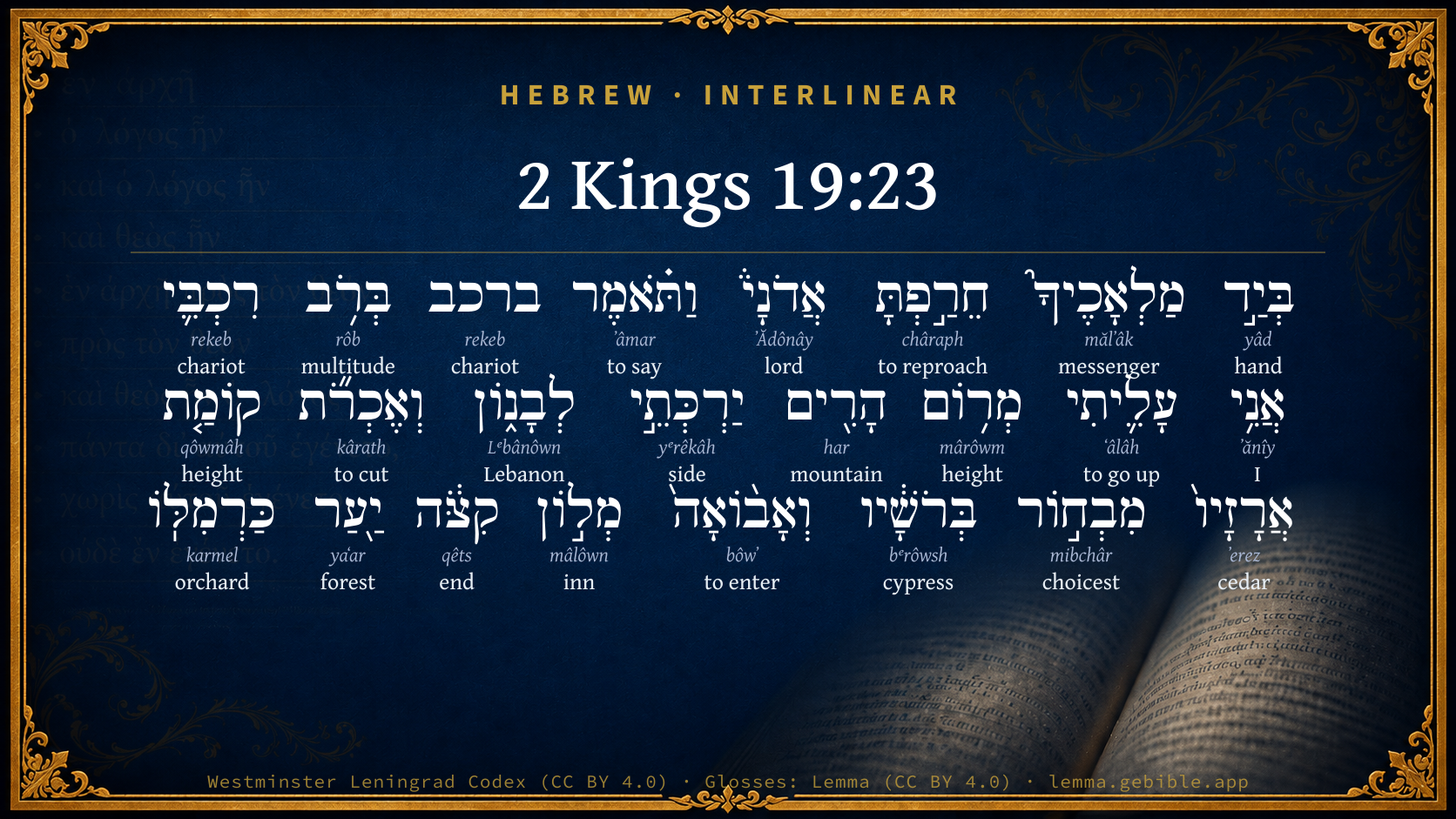
2 Kings 19:23

Hebrew (Westminster Leningrad Codex) 2 Kings 19:23 appears in the Hebrew Old Testament. The text above is from the Westminster Leningrad Codex. Each word links to its Strong’s number, a concise gloss, and parsing drawn from the Open Scriptures Hebrew Bible morphology. Click any word for its full Brown-Driver-Briggs (BDB) entry.
Download image
Cite this verse

2 Kings 19:23 (World English Bible). Public Domain. Lemma interlinear Bible study tool, https://lemma.gebible.app/v/2-kings/19/23.

Show BibTeX & RIS
BibTeX
RIS
English Translation
By your messengers you have defied the Lord, and have said, With the multitude of my chariots am I come up to the height of the mountains, to the innermost parts of Lebanon; and I will cut down the tall cedars of it, and the choice fir trees of it; and I will enter into his farthest lodging-place, the forest of his fruitful field.
World English Bible · Public Domain
Download a study sheet

One document with this verse’s original text, its word-by-word gloss line, the meaning frame, cross-references with their text, attributed commentary, and full source and license credits — printable, and it pastes into notes with its structure intact.

This verse Autodidact and up

Study sheet (.html) Plain text (.txt)

A passage Seminary Student

Up to 50 verses in one chapter. A passage sheet keeps up to 6 commentary sources and 12 cross-references per verse, in the order this page ranks them, and says so on the sheet whenever that leaves anything out. Ask for a single verse and you get the Autodidact verse sheet above.

Everything on this page stays free to read, with no account — the sheet is a download of what is already on screen, not access to it.

Want to remove ads? Support Godless Engineer
Compare translations 3

The same verse in 3 English versions, stacked beneath the original-language interlinear above. Click any original word for its lexicon entry.

Each is an independent rendering of the whole verse — the interlinear is not word-aligned to these translations.

Highlighted words mark where these versions differ — a whole-verse word diff, not a word-by-word alignment.

  • World English Bible Public Domain
    By your messengers you have defied the Lord, and have said, With the multitude of my chariots am I come up to the height of the mountains, to the innermost parts of Lebanon; and I will cut down the tall cedars of it, and the choice fir trees of it; and I will enter into his farthest lodging-place, the forest of his fruitful field.
  • King James Version Public Domain
    By thy messengers thou hast reproached the LORD, and hast said, With the multitude of my chariots I am come up to the height of the mountains, to the sides of Lebanon, and will cut down the tall cedar trees thereof, and the choice fir trees thereof: and I will enter into the lodgings of his borders, and into the forest of his Carmel.
  • unfoldingWord Literal Text CC BY-SA 4.0
    By the hand of your messengers you mocked the Lord and said, “With the multitude of my chariotry, I, I went up the height of the mountains, the recesses of Lebanon. And I cut down the heights of its cedars, the choicest of its cypress trees, that I might enter the lodging place of its end, the forest of its garden.

unfoldingWord Literal Text — © unfoldingWord, licensed CC BY-SA 4.0. Word-aligned USFM3 via Door43 (git.door43.org/unfoldingWord/en_ult).

Versions to compare (up to 4)

3 of 4 selected

Show all 18 translations

Every available English version of this verse, each an independent rendering of the whole verse.

  • World English Bible Public Domain
    By your messengers you have defied the Lord, and have said, With the multitude of my chariots am I come up to the height of the mountains, to the innermost parts of Lebanon; and I will cut down the tall cedars of it, and the choice fir trees of it; and I will enter into his farthest lodging-place, the forest of his fruitful field.
  • Berean Standard Bible Public Domain
    Through your servants you have taunted the Lord, and you have said: “With my many chariots I have ascended to the heights of the mountains, to the remote peaks of Lebanon. I have cut down its tallest cedars, the finest of its cypresses. I have reached its farthest outposts, the densest of its forests.
  • Majority Standard Bible Public Domain
    Through your servants you have taunted the Lord, and you have said: “With my many chariots I have ascended to the heights of the mountains, to the remote peaks of Lebanon. I have cut down its tallest cedars, the finest of its cypresses. I have reached its farthest outposts, the densest of its forests.
  • King James Version Public Domain
    By thy messengers thou hast reproached the LORD, and hast said, With the multitude of my chariots I am come up to the height of the mountains, to the sides of Lebanon, and will cut down the tall cedar trees thereof, and the choice fir trees thereof: and I will enter into the lodgings of his borders, and into the forest of his Carmel.
  • American Standard Version (1901) Public Domain
    By thy messengers thou hast defied the Lord, and hast said, With the multitude of my chariots am I come up to the height of the mountains, to the innermost parts of Lebanon; and I will cut down the tall cedars thereof, and the choice fir-trees thereof; and I will enter into his farthest lodging-place, the forest of his fruitful field.
  • Revised Version (1885) Public Domain
    By thy messengers thou hast reproached the Lord, and hast said, With the multitude of my chariots am I come up to the height of the mountains, to the innermost parts of Lebanon; and I will cut down the tall cedars thereof, and the choice fir trees thereof: and I will enter into his farthest lodging place, the forest of his fruitful field.
  • Geneva Bible (1599) Public Domain
    By thy messengers thou hast rayled on the Lord, and said, By the multitude of my charets I am come vp to the toppe of the mountaines, by the sides of Lebanon, and will cut downe the hie cedars thereof, and the faire firre trees thereof, and I will goe into the lodging of his borders, and into the forest of his Carmel.
  • Douay-Rheims (1899) Public Domain
    By the hand of thy servants thou hast reproached the Lord, and hast said: With the multitude of my chariots I have gone up to the height of the mountains, to the top of Libanus, and have cut down its tall cedars, and its choice fir trees. And I have entered into the furthest parts thereof, and the forest of its Carmel.
  • Young's Literal Translation Public Domain
    By the hand of thy messengers Thou hast reproached the Lord, and sayest: In the multitude of my chariots I have come up to a high place of mountains -- The sides of Lebanon, And I cut down the height of its cedars, The choice of its firs, And I enter the lodging of its extremity, The forest of its Carmel.
  • Literal Standard Version CC BY-SA 4.0
    By the hand of your messengers || You have reproached the Lord, and say, || In the multitude of my chariots I have come up to a high place of mountains—The sides of Lebanon, || And I cut down the height of its cedars, || The choice of its firs, || And I enter the lodging of its extremity, || The forest of its Carmel.
  • Unlocked Literal Bible CC BY-SA 4.0
    By your messengers you have defied the Lord, and have said, 'With the multitude of my chariots I have gone up to the heights of the mountains, to the highest elevations of Lebanon. I will cut down the tall cedars and the choice cypress trees there. I will enter into its farthest parts, its most fruitful forest.
  • unfoldingWord Literal Text CC BY-SA 4.0
    By the hand of your messengers you mocked the Lord and said, “With the multitude of my chariotry, I, I went up the height of the mountains, the recesses of Lebanon. And I cut down the heights of its cedars, the choicest of its cypress trees, that I might enter the lodging place of its end, the forest of its garden.
  • Darby Bible Public Domain
    By thy messengers thou hast reproached the Lord, and hast said, With the multitude of my chariots have I come up To the height of the mountain, to the recesses of Lebanon, And I will cut down its tall cedars, the choice of its cypresses; And I will enter into its furthest lodging-place, [into] the forest of its fruitful field.
  • World Messianic Bible Public Domain
    By your messengers, you have defied the Lord, and have said, “With the multitude of my chariots, I have come up to the height of the mountains, to the innermost parts of Lebanon, and I will cut down its tall cedars and its choice cypress trees; and I will enter into his farthest lodging place, the forest of his fruitful field.
  • Webster's Bible Public Domain
    By thy messengers thou hast reproached the Lord, and hast said, With the multitude of my chariots I am come up to the hight of the mountains, to the sides of Lebanon, and will cut down its tall cedar trees, and its choice fir trees: and I will enter into the lodgings of his borders, and into the forest of his Carmel.
  • Free Bible Version CC BY-SA 4.0
    By your servants you have mocked the Lord. You said: ‘With my many chariots I have ascended to the high mountains, to the farthest peaks of Lebanon. I have chopped down its tallest cedars, the best of its cypress trees. I have reached its most distant outposts, its deepest forests.
  • Bible in Basic English Public Domain
    You have sent your servants with evil words against the Lord, and have said, With all my war-carriages I have come up to the top of the mountains, to the inmost parts of Lebanon; its tall cedars will be cut down, and the best trees of its woods; I will come up into his highest places, into his thick woods.
  • JPS Tanakh (1917) Public Domain
    By the messengers thou hast taunted the Lord, and hast said: With the multitude of my chariots am I come up to the height of the mountains, to the innermost parts of Lebanon; and I have cut down the tall cedars thereof, and the choice cypresses thereof; and I have entered into his farthest lodge, the forest of his fruitful field.

Literal Standard Version (2020), Covenant Press — licensed CC BY-SA 4.0. Text via the HelloAO Bible API (eBible.org). Unlocked Literal Bible (unfoldingWord) — licensed CC BY-SA 4.0. Text via the HelloAO Bible API (eBible.org). unfoldingWord Literal Text — © unfoldingWord, licensed CC BY-SA 4.0. Word-aligned USFM3 via Door43 (git.door43.org/unfoldingWord/en_ult). Free Bible Version, Dr. Jonathan Gallagher — licensed CC BY-SA 4.0. Text via the HelloAO Bible API (eBible.org).

Word by word

More ways to search: Search by grammar → Find every occurrence → Compare this word →

Practice this passage: Drill this verse → Learn its vocabulary →

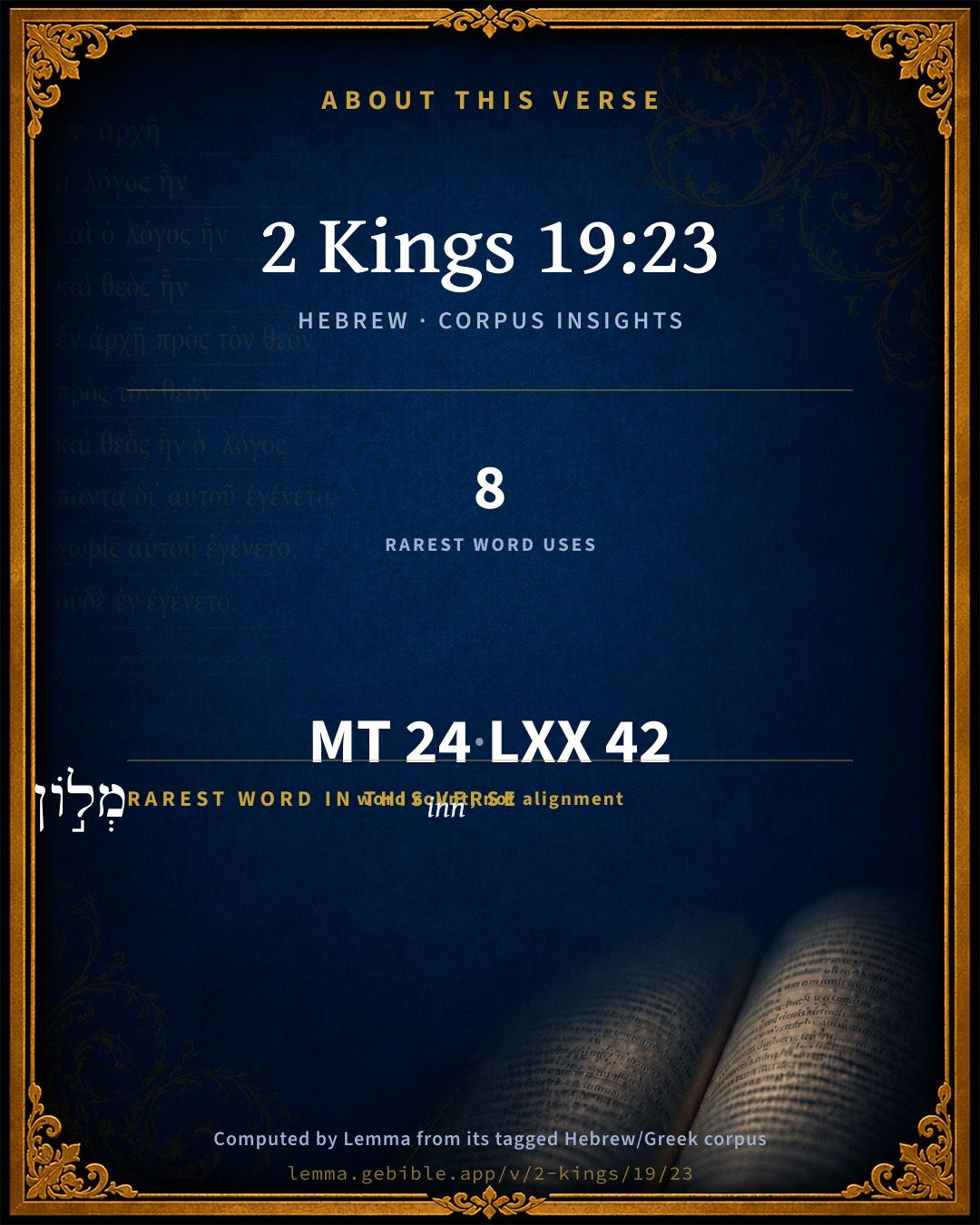
מְל֣וֹן
mâlôwn
H4411
“inn of”
Noun, Common, Masculine, Singular, Construct
Part of Speech
Noun
Type
Common
Gender
Masculine
Number
Singular
State
Construct
Full BDB Definition

Origin: from H3885

TWOT: 1096a

place of lodging, inn, khan
  1. בְּיַ֣ד yâd H3027 “in/at · hand of” Preposition + Noun, Common, Both, Singular, Construct
  2. מַלְאָכֶיךָ֮ mălʼâk H4397 “messengers · your” Noun, Common, Masculine, Plural, Construct + Suffix, Personal, 2nd Person, Masculine, Singular
  3. חֵרַ֣פְתָּ châraph H2778 “to reproach” Verb, Piel, Perfect, 2nd Person, Masculine, Singular
  4. אֲדֹנָי֒ ʼĂdônây H136 “Lord · my” Noun, Common, Masculine, Plural, Construct + Suffix, Personal, 1st Person, Common, Singular
  5. וַתֹּ֗אמֶר ʼâmar H559 “and · to say” Conjunction + Verb, Qal, Sequential Imperfect, 2nd Person, Masculine, Singular
  6. ברכב rekeb H7393 “in/at · chariot of” Preposition + Noun, Common, Masculine, Singular, Construct
  7. בְּרֹ֥ב rôb H7230 “in/at · multitude of” Preposition + Noun, Common, Both, Singular, Construct
  8. רִכְבִּ֛י rekeb H7393 “chariot · my” Noun, Common, Masculine, Singular, Construct + Suffix, Personal, 1st Person, Common, Singular
  9. אֲנִ֥י ʼănîy H589 “I” Pronoun, Personal, 1st Person, Common, Singular
  10. עָלִ֛יתִי ʻâlâh H5927 “to go up” Verb, Qal, Perfect, 1st Person, Common, Singular
  11. מְר֥וֹם mârôwm H4791 “height of” Noun, Common, Masculine, Singular, Construct
  12. הָרִ֖ים har H2022 “mountains” Noun, Common, Masculine, Plural, Absolute
  13. יַרְכְּתֵ֣י yᵉrêkâh H3411 “sides of” Noun, Common, Feminine, Dual, Construct
  14. לְבָנ֑וֹן Lᵉbânôwn H3844 “Lebanon” Noun, Proper
  15. וְאֶכְרֹ֞ת kârath H3772 “and · to cut” Conjunction + Verb, Qal, Imperfect, 1st Person, Common, Singular
  16. קוֹמַ֤ת qôwmâh H6967 “height of” Noun, Common, Feminine, Singular, Construct
  17. אֲרָזָיו֙ ʼerez H730 “cedars · his” Noun, Common, Masculine, Plural, Construct + Suffix, Personal, 3rd Person, Masculine, Singular
  18. מִבְח֣וֹר mibchâr H4005 “choicest of” Noun, Common, Masculine, Singular, Construct
  19. בְּרֹשָׁ֔יו bᵉrôwsh H1265 “cypresses · his” Noun, Common, Masculine, Plural, Construct + Suffix, Personal, 3rd Person, Masculine, Singular
  20. וְאָב֨וֹאָה֙ bôwʼ H935 “and · to enter” Conjunction + Verb, Qal, Cohortative, 1st Person, Common, Singular
  21. קִצֹּ֔ה qêts H7093 “end · his” Noun, Common, Masculine, Singular, Construct + Suffix, Personal, 3rd Person, Masculine, Singular
  22. יַ֖עַר yaʻar H3293 “forest of” Noun, Common, Masculine, Singular, Construct
  23. כַּרְמִלּֽוֹ karmel H3759 “orchard · his” Noun, Common, Masculine, Singular, Construct + Suffix, Personal, 3rd Person, Masculine, Singular

About this verse

These counts appear in no published source. They are computed here, from the morphology-tagged text and Lemma’s own curated glosses. What Lemma adds →

24
words
23
distinct lemmas
Historical
section

Notable vocabulary

The rarest word here is מְל֣וֹן inn H4411 — appearing just 8 times in the whole Hebrew Bible.

Shared distinctive vocabulary

מְל֣וֹן inn H4411 occurs in 8 verses of the Hebrew Bible. Also found in:

Grammatical profile

  • 5 verbs
  • 18 nouns
  • 1 pronoun

Verb forms

  • חֵרַ֣פְתָּ Piel · Perfect
  • וַתֹּ֗אמֶר Qal · Sequential Imperfect
  • עָלִ֛יתִי Qal · Perfect
  • וְאֶכְרֹ֞ת Qal · Imperfect
  • וְאָב֨וֹאָה֙ Qal · Cohortative

Repetition

A word recurs within this verse — often emphatic in Hebrew:

  • ברכב chariot H7393 ×2

Hebrew & Septuagint length

In English translation the verse runs 64 words from the Hebrew and 59 from the Septuagint (LXX English) — closely comparable.

A rough comparison of the two English renderings, which tokenize alike — not a word-level alignment.

Word counts can differ between the Hebrew and the Greek without any difference in meaning — e.g. the Hebrew direct-object marker אֵת has no separate Greek word, and Greek often adds the article ὁ.

In the original languages it is 24 Hebrew tokens and 42 Greek tokens — but the two are counted differently (Hebrew bundles its prefixes and suffixes into one token; the Greek is in lemma form), so that isn’t a like-for-like length.

Cross-references

11

Topical passages linked to 2 Kings 19:23 in the Treasury of Scripture Knowledge — connected by theme and wording, ordered by reader-vote popularity; previews shown in the World English Bible.

  • 2 Kings 18:17 The king of Assyria sent Tartan and Rabsaris and Rabshakeh from Lachish to king Hezekiah with a great army to Jerusalem. They went up and came to Jerusalem. When they were come up, they came and stood by the conduit of the upper pool, which is in the highway of the fuller's field.
  • Psalms 20:7 Some trust in chariots, and some in horses, But we trust the name of Yahweh our God.
  • Isaiah 10:18 He will consume the glory of his forest, and of his fruitful field, both soul and body: and it shall be as when a standard-bearer faints.
  • 2 Kings 18:23 Now therefore, Please give pledges to my master the king of Assyria, and I will give you two thousand horses, if you are able on your part to set riders on them.
  • 2 Kings 18:33–34 Has any of the gods of the nations ever delivered his land out of the hand of the king of Assyria?
  • 2 Chronicles 26:10 He built towers in the wilderness, and hewed out many cisterns, for he had much cattle; in the lowland also, and in the plain: [and he had] farmers and vineyard keepers in the mountains and in the fruitful fields; for he loved farming.
  • 2 Chronicles 32:17 He wrote also letters, to rail on Yahweh, the God of Israel, and to speak against him, saying, As the gods of the nations of the lands, which have not delivered their people out of my hand, so shall the God of Hezekiah not deliver his people out of my hand.
  • Isaiah 10:7–11 However he doesn't mean so, neither does his heart think so; but it is in his heart to destroy, and to cut off not a few nations.
  • Isaiah 10:14 and my hand has found as a nest the riches of the peoples; and as one gathers eggs that are forsaken, have I gathered all the earth: and there was none that moved the wing, or that opened the mouth, or chirped.
  • Isaiah 37:24–25 By your servants have you defied the Lord, and have said, With the multitude of my chariots am I come up to the height of the mountains, to the innermost parts of Lebanon; and I will cut down the tall cedars of it, and the choice fir trees of it; and I will enter into its farthest height, the forest of its fruitful field;
  • Ezekiel 31:3–18 Behold, the Assyrian was a cedar in Lebanon with beautiful branches, and with a forest-like shade, and of high stature; and its top was among the thick boughs.

Cross-references courtesy of OpenBible.info (CC BY 4.0).

Hebrew and Greek witnesses Masoretic Hebrew ↔ Greek Septuagint

The same verse in the two great witnesses to the Old Testament, shown verse-for-verse.

These are two independent witnesses, not word-aligned to each other, and the Septuagint is shown in lemma (dictionary) form.

Hebrew 2 Kings 19:23 Masoretic · Westminster Leningrad Codex

בְּיַ֣ד מַלְאָכֶיךָ֮ חֵרַ֣פְתָּ אֲדֹנָי֒ וַתֹּ֗אמֶר ברכב בְּרֹ֥ב רִכְבִּ֛י אֲנִ֥י עָלִ֛יתִי מְר֥וֹם הָרִ֖ים יַרְכְּתֵ֣י לְבָנ֑וֹן וְאֶכְרֹ֞ת קוֹמַ֤ת אֲרָזָיו֙ מִבְח֣וֹר בְּרֹשָׁ֔יו וְאָב֨וֹאָה֙ מְל֣וֹן קִצֹּ֔ה יַ֖עַר כַּרְמִלּֽוֹ

By your messengers you have defied the Lord, and have said, With the multitude of my chariots am I come up to the height of the mountains, to the innermost parts of Lebanon; and I will cut down the tall cedars of it, and the choice fir trees of it; and I will enter into his farthest lodging-place, the forest of his fruitful field.

World English Bible · Public Domain

Greek LXX 2 Kings 19:23 Septuagint · lemma form

ἐν χείρ ἄγγελος σύ ὀνειδίζω κύριος καί εἶπον ἐν ὁ πλῆθος ὁ ἅρμα ἐγώ ἐγώ ἀναβαίνω εἰς ὕψος ὄρος μηρός ὁ λίβανος καί κόπτω ὁ μέγεθος ὁ κέδρος αὐτός ὁ ἐκλεκτός κυπάρισσος αὐτός καί ἔρχομαι εἰς μελον τέλος αὐτός δρυμός κάρμηλος αὐτός

By your messengers you have reproached the Lord, and have said, I will go up with the multitude of my chariots, to the height of the mountains, to the sides of Libanus, and I have cut down the height of his cedar, and his choice cypresses; and I have come into the midst of the forest and of Carmel.

LXX2012 (modern English Septuagint) · Public Domain

On this verse, The Cambridge Bible for Schools and Colleges discusses the Septuagint’s reading. Read the note in Commentary ↓

Hebrew: Westminster Leningrad Codex (CC BY 4.0). Greek: Septuagint (public domain); English from LXX2012 (modern English Septuagint) (Public Domain). How the Septuagint differs from the Hebrew →

Targum (Aramaic paraphrase)

1

The Targum is the ancient Jewish Aramaic paraphrase of the Hebrew Scriptures — an interpretive translation, not the Hebrew text itself. Onkelos (literal) and Pseudo-Jonathan (expansive) render the Torah, and Jonathan the Prophets. Coverage is partial: where no permissively-licensed English translation exists for a verse, only the Aramaic is shown. This is verse-level text, not a word-by-word alignment to the Hebrew.

  1. Targum Jonathan Prophets (Joshua–Malachi)
    בְּיַד אִזְגַדָךְ חֲסֵידְתָּא עַמָא דַייָ וַאֲמַרְתָּ בִּסְגִיאוּת רְתִיכִי אֲנָא סְלֵיקִית לִתְקוֹף כְּרַכֵּיהוֹן אַף אֵיחוֹד בֵּית מַקְדַשְׁהוֹן וְאֶקְטוֹל שְׁפַר גִבָּרֵיהוֹן מִבְחַר שִׁלְטוֹנֵיהוֹן וְאַכְבֵּישׁ קִרְיַת תּוּקְפֵיהוֹן וֶאֱשֵׁיצֵי סַגִי מַשִׁרְיַתְהוֹן:

    (no public-domain English translation for this verse)

    Targum Jonathan — Aramaic: “Mikraot Gedolot” (public domain). English: “Sefaria Community Translation” (CC0 1.0 (public-domain dedication)); “London "Chaldee Paraphrase," 1871” (public domain). Text via Sefaria.

Commentary

Notes on 2 Kings 19:23 from classic Christian and Jewish commentators (each source and its license shown beneath its notes). The classic Christian expositions comment on the surrounding passage and are grouped to its opening verse, so a note may address several verses; the Jewish commentaries on the Tanakh (Rashi and others) are per-verse, so they appear only where the commentator wrote on this verse.

Lemma curates 59 commentaries, every one of them public domain or Creative Commons licensed, each selected and text-cleaned for this edition rather than reprinted as found. About our sources →

Trapp's Complete Commentary

John Trapp

2Ki 19:23 By thy messengers thou hast reproached the Lord, and hast said, With the multitude of my chariots I am come up to the height of the mountains, to the sides of Lebanon, and will cut down the tall cedar trees thereof, [and] the choice fir trees thereof: and I will enter into the lodgings of his borders, [and into] the forest of his Carmel.

Ver. 23. And hast said.] Not in so many words that we anywhere read of; but it is said, in 2Ch 32:16, that his messengers spake more than is expressed. Or, Thou hast said, that is, thou hast thought all this, and I will therefore justly punish thee and thine army wherein thou gloriest, and wherewith thou intendest to destroy Jerusalem and my temple there. Polybius, a heathen historian, could say that Antiochus came to an ill end, only for purposing to spoil the temple of Apollo at Delphos.

With the multitude of my chariots I am come up, &c.] We may say of this proud and arrogant speech, as the historian doth in a like case, No man could deliver so bad matter in better words and more quaint phrases.

John Trapp, A Commentary or Exposition upon All the Books of the Old and New Testament (1647–1656) — public domain. Text from a community e-Sword module.

Joseph Benson's Commentary

2Ki 19:23. By thy messengers thou hast reproached the Lord — Advancing hereby thy very servants above him. And hast said, With the multitude of my chariots, I am come up, &c. — I have brought up my very chariots to those mountains, which were thought inaccessible by my army. To the sides of Lebanon — A high hill famous for cedars and fir-trees, as is signified in what follows. And will cut down the tall cedars thereof, &c. — This may be understood, 1st, Mystically, I will destroy the princes and nobles of Judah, sometimes compared to cedars and fir-trees, or their strongest cities. “Cities,” says Dr. Dodd, “in the prophetical writings are metaphorically represented by woods or forests, especially those of Lebanon and Carmel; and the several ranks of inhabitants by the taller and lesser trees growing there. Hence we may collect the true sense of this passage, which represents the Assyrian prince as threatening to take mount Zion, together with the capital city Jerusalem, and to destroy their principal inhabitants.” The following words, the height of his border, and the forest of his Carmel, or, as the latter clause is more properly rendered, the grove of his fruitful field, are generally thought figuratively to refer to the temple and city. The Chaldee paraphrast renders it, And I will also take the house of their sanctuary, and I will subject to me their fortified cities. If, 2d, The reader prefer understanding the words literally, the meaning is, I will cut down the trees and woods that hinder my march, and will prepare and make plain the way for all my numerous army and chariots. Nothing shall stand in my way, nor be able to obstruct or impede my march, no, not the highest and strongest places. The words contain an admirable description of the boastings of a proud monarch, puffed up with his great success. As if he had said, What place is there into which I cannot make my way? Or, what is there I cannot achieve? Even if it were to go up to the top of the steepest mountains with my chariots? My power is sufficient to remove all obstacles, and overcome all opposition.

Joseph Benson's Commentary on the Old and New Testaments (1811–1818) — public domain. Text from a community e-Sword module.

Tyndale Open Study Notes

Tyndale Open Resources

19:23-24 highest mountains . . . of Lebanon: In his annals, Sennacherib told of scaling high mountain passes and felling Lebanon’s great trees. Sennacherib felt invincible, but he was a mere man, no match for the omniscient Lord of the universe (1 Chr 28:9).

Tyndale Open Study Notes — © Tyndale Open Resources, licensed CC BY-SA 4.0. Text via the HelloAO Bible API.

Geneva Bible (1599)

Geneva Bible translators

Or, pleasant country.

Meaning, Jerusalem, which Isaiah calleth the height of his borders, to wit, of Judah, Isa. 37:24.

Geneva Bible (1599) marginal notes — public domain. Text via Bolls.life.

Adam Clarke's Commentary

Verse 23. The tall cedar trees - the choice fir trees] Probably meaning the princes and nobles of the country.

The forest of his Carmel.] Better in the margin: the forest and his fruitful field.

Adam Clarke's Commentary on the Bible (1810–1826) — public domain. Text from a community e-Sword/MySword module.

Ellicott's Commentary for English Readers

(23) The multitude.—The reading of the Hebrew margin, of many MSS., Isaiah, and all the versions. The Hebrew text has “with the chariotry of my chariotry”—obviously a scribe’s error.

I am come up . . . mountains.—I (emphatic) have ascended lofty mountains. Such boasts are common in the Assyrian inscriptions.

To the sides of Lebanon.—Thenius explains: “the spurs of the Lebanon—i.e., the strongholds of Judæa, which Sennacherib had already captured.” “Lebanon, as the northern bulwark of the land of Israel, is used as a representative or symbol for the whole country (Zec_11:1)” (Cheyne). The language is similar in Isa_14:13.

And will cut down . . .—Or, and I will fell the tallest cedars thereof, the choicest firs thereof. Cedars and firs in Isaiah’s language symbolise “kings, princes, and nobles, all that is highest and most stately” (Birks), or “the most puissant defenders” (Thenius). (See Isa_2:13; Isa_10:33-34.)

The lodgings of his borders.—Or, the furthest lodging thereof—i.e., Mount Zion or Jerusalem. Isaiah has height for lodging, either a scribe’s error or an editor’s correction.

Carmel—i.e., pleasure-garden or park (Isa_10:18). The royal palace and grounds appear to be meant. Thenius compares “the house of the forest of Lebanon” (1Ki_7:2).

A Bible Commentary for English Readers, edited by Charles John Ellicott (1878–1897) — public domain. Text from a community e-Sword module.

The Cambridge Bible for Schools and Colleges

gen. ed. J. J. S. Perowne

23. By thy messengers] Rab-shakeh and his companions.

With the multitude of my chariots] This is the translation of the marginal reading (Keri) which stands as Kethib in the corresponding verse of Isaiah. Another reading is represented on the margin of the R.V. thus ‘with the driving of my chariots’. This stands in the Hebrew text in Kings, and by some is preferred as being more unusual and therefore perhaps better suited to a poetical passage like the present. But the form in Isaiah has the support of all the versions and so had better be adopted here.

to the sides [R.V. innermost parts] of Lebanon] The word which A.V. translates ‘sides’ is very frequently applied to the interior, as of a house (Amo_6:10), or a ship (Jon_1:5), or a cave (1Sa_24:4), or a grave (Isa_14:15). And so here it indicates the interior recesses of Lebanon, whither as conqueror Sennacherib expects to penetrate. The Lebanon was one of the choicest parts of the Holy Land, and its beauty is extolled in several passages of Solomon’s song (see note on 1Ki_9:16).

and will [R.V. I will] cut down the tall cedar trees [R.V. cedars] thereof] Both the changes are to the form in Isaiah. The beauty of the Lebanon was in its glorious trees. The figure chosen therefore expresses the devastation which the Assyrian purposed to bring on the grandest features of the country.

the lodgings of his borders] R.V. his farthest lodging-places. The words express the intention of the Assyrian to leave no place in the whole land of Judah unravaged, however remote it might be. There is a various reading in Isaiah, which is rendered ‘the height of his border’. The LXX. does not represent this clause.

and into the forest of his Carmel] R.V. the forest of his fruitful field. R.V. also omits the italics. Carmel though often used as a proper name to designate that beautiful and fertile promontory which stretches out to the Mediterranean on the border of the tribe of Asher, yet as a common noun signifies a fruitful garden-like field. Thus Jer_2:7, ‘I brought you into a plentiful country’ (lit. a country of garden-land, Heb. Carmel). So here the phrase describes some park-like grounds with all the beauty of fine gardens. ‘His wood which is cultivated like a garden’.

The Cambridge Bible for Schools and Colleges (gen. ed. J. J. S. Perowne; Cambridge University Press, 1878–1918) — public domain. Text from a community e-Sword module.

Albert Barnes' Notes on the Bible

And hast said - Isaiah clothes in words the thoughts of Sennacherib’s heart - thoughts of the most extreme self-confidence. Compare Isa 10:7-14, where, probably at an earlier date, the same overweening pride is ascribed to this king.

With the multitude of my chariots - There are two readings here, which give, however, nearly the same sense. The more difficult and more poetical of the two is to be preferred. Literally, translated it runs - “With chariots upon chariots am I come up, etc.”

To the sides of Lebanon - , “Lebanon,” with its “cedars” and its “fir-trees,” is to be understood here both literally and figuratively. Literally, the hewing of timber in Lebanon was an ordinary feature of an Assyrian expedition into Syria. Figuratively, the mountain represents all the more inaccessible parts of Palestine, and the destruction of its firs and cedars denotes the complete devastation of the entire country from one end to the other.

The lodgings of his borders - literally, “the lodge of its (Lebanon’s) end;” either an actual habitation situated on the highest point of the mountain-range, or a poetical periphrasis for the highest point itself.

The forest of his Carmel - Or, “the forest of its garden” - i. e., “its forest which is like a garden,” etc.

Albert Barnes' Notes on the Bible (1834–1885) — public domain. Text from a community e-Sword/MySword module.

Haydock's Catholic Bible Commentary

Carmel. A pleasant fruitful hill in the forest. These expressions are figurative, signifying, under the names of mountains and forests, the kings and provinces whom the Assyrians had triumphed over. (Challoner) --- He must have passed by Libanus, and might boast of this exploit. Other proud words to the same purpose are mentioned [in] Isaias x. 9., and xxxiii. 9. He had made himself master of Mount Carmel, as well as of Libanus. (Calmet)

George Leo Haydock (1774–1849), Haydock's Catholic Family Bible and Commentary, 1859 edition — public domain. Excludes Psalms (Douay-Rheims chapter numbering differs from Protestant) and Deuterocanonical books (Catholic canon only).

Matthew Poole's English Annotations

By thy messengers; so thou hast advanced thy very servants above me.

I am come up to the height of the mountains; I have brought up my very chariots to those mountains which were thought inaccessible by my army.

Lebanon; a high hill, famous for cedars and fir trees, here following.

Will cut down the tall cedars thereof, and the choice fir trees thereof: this may be understood, either,

1. Mystically, I will destroy the princes and nobles of Judah, (which are sometimes compared to cedars, &c.,) or their strongest cities. Or rather,

2. Literally, I will cut down the trees that hinder my march and plain and prepare the way for all my numerous army and chariots. And by this one instance he intimates that nothing should stand in his way; no, not the highest and strongest places.

The lodgings of his borders, i.e. those towns and cities (which he calls lodgings in way of contempt) which are in his utmost borders, and most remote from me. I am come into the land of Canaan at one border, Lebanon, and I resolve to march on to the other extreme border, and so to destroy the whole country, from one border to another; the borders of a land being oft put for the whole land within its, borders; as Exo 8:2; Psa 74:17; 147:14; Isa 44:12. Or, as it is in the Hebrew, into the lodging of his border; for which, in the parallel place, Isa 37:21, it is into the height of his border. And so this may be understood of Jerusalem; which it is not probable that in all his brags he would omit; and against which his chief design now lay; which he here calleth a lodging for its contemptible smallness, if compared with his great and vast city of Nineveh: or, as it is in Isa 37, the height, for its two famous mountains, Zion and Moriah; or for the mountains which were round about Jerusalem, Psa 125:2; and he adds, of his border, because this city was in the border of Judah; as being part of it in the tribe of Benjamin, and near the kingdom of the ten tribes, which was now in the Assyrian’s hands.

The forest of his Carmel, i.e. the forest of Mount Carmel, which may seem to be another inaccessible place, like Lebanon. Or, into his forest, and his fruitful field; for Carmel, though properly it was a pleasant and fruitful mountain in the tribe of Issachar, of which see Jos 12:22; yet it is oft used to signify any fruitful place, as is manifest from Isa 10:18; 16:10; Jer 2:7. And thus all the parts of the land are here enumerated; the mountains, the cities, the woods, and the fruitful fields. Or, his fruitful forest, to wit, Jerusalem; which is thought by many interpreters to be called a forest, Jer 21:14; Eze 20:46, a name which agrees well enough to cities, where buildings are very numerous, and close, and high, like trees in a forest. And if Jerusalem might be called a forest, it might well be called Hezekiah’s Carmel, or fruitful place, because his chief strength, and treasure, and fruit was now in it; and this last word may seem to be added here, to intimate that this was not like other forests, unfruitful and barren. And so both this and the foregoing words are understood of the same place, even of Jerusalem; the last branch being joined to the former by way of apposition; into the lodging of his border, the forest of his Carmel, or his fruitful forest; there being no more words in the Hebrew text.

Matthew Poole's English Annotations on the Holy Bible (1683–1685) — public domain. Text from a community e-Sword/MySword module.

Whedon's Commentary on the Bible

Daniel D. Whedon

23. By thy messengers — Hebrew, by the hand of thy messengers, referring to the letter mentioned 2Ki_19:14, and also other messages.

The multitude of my chariots — So the Keri and the parallel passage, Isa_37:24; but the Chethib seems to be the more original reading, and is, literally, with chariot of my chariots. The sense in either case is substantially the same, the latter expression (רכב רכבי) meaning with my numberless chariots, or chariots on chariots. Compare גוב גובי, locust of locusts, in Nah_3:17, which is properly rendered swarms of locusts; not great grasshoppers, as in our version.

Lebanon… cedar trees… fir trees — See notes on 1Ki_5:6; 1Ki_5:8.

Lodgings of his borders — Literally, lodging place of his extremity. The Hebrew מלון קצה, is explained, but not to be emended, by the parallel passage in Isaiah, where we have מרום קצו, height of his extremity, that is, its extreme summit. Sennacherib’s boast is, that he pitches his camp and lodges on the very summit of Lebanon.

Forest of his Carmel — The word Carmel is here to be taken in its primary sense of garden, cultivated field; not as a proper name. The forest of his garden, or garden forest, designates the orchard-like groves, or beautiful parks of choice trees, on the terraces and summit of Lebanon. This pompous boasting of the king of Assyria is not to be understood as literally historical, nor yet as without historical foundation. Sennacherib probably entered Palestine from the north, and so would cross the summit and sides of some part of Lebanon, and this, in connexion with the various triumphs of his march, would be sufficient ground for the hyperbolical language of his boasts. His language is poetical, but not mere poetry; and the whole verse is to be understood of what he has power to do.

Daniel D. Whedon (gen. ed.), Commentary on the Old and New Testaments (1874–1909) — public domain. Text from a community e-Sword module.

The Pulpit Commentary

By thy messengers literally, by the hand of thy messengers Rabshakeh and others (see 2Ki_18:30, 35 19:10-13) thou hast reproached the Lord, and but said. Sennacherib had net said what is here attributed to him, any more than Sargon had said the words ascribed to him in Isa_10:13, Isa_10:14. But he had thought it; and God accounts men"s deliberate thoughts as their utterances. Isaiah"s "oracle" brings out and places in a striking light the pride, self-confidence, and self-sufficiency which underlay Sennacherib"s messages and letters. With the multitude of my chariots; or, with chariots upon chariots. The chariot-force was the main arm of the Assyrian military service that on which most dependence was placed, and to which victory was commonly attributed. The number of chariots that could be brought into the field by the Assyrians is nowhere stated; but we find nearly four thousand hostile chariots collected to oppose an ordinary Assyrian invasion, and defeated (see "Ancient Monarchies," vol. 2. p. 362, note 8). The estimates of Cterias eleven thousand for Ninas, and a hundred thousand for Semiramis (Died. Sic., 2:5. are, of course, unhistorical. I am come up to the height of the mountains. "The height of the mountains" is here the high ground which an army would have to traverse in passing from the Coele-Syrian valley into Palestine. It is not exactly Lebanon, which runs parallel with the coast, and certainly does not "guard Palestine to the north," as Keil supposes; But it may be viewed as a "side" or "flank" of Lebanon. In point of fact, Lebanon and Hermon unite their roots to form a barrier between the Coele-Syrian plain (El Buka"a) and the valley of the Jordan, and an invader from the north must cross this barrier. It is not so difficult or rugged but that the Assyrians could bring their chariots ever it. They were accustomed to traverse far more difficult regions in Zagros and Niphatos and Taurus, and to carry their chariots with them, dismounting when necessary, and having the vehicles lifted over obstacles by human hands (see "Ancient Monarchies," vol. 2. p. 74). To the sides of Lebanon. An army which invades Palestine by the Coele-Syrian valley quite the easiest and most usual line of invasion necessarily passes along the entire eastern "side," or "flank," of Lebanon, which is the proper meaning of hK; ry, and not "loftiest height" (Keil), or "innermost recess" (Revised Version). The plural, ytekry, is natural when a mountain range, like Lebanon, is spoken of. And will cut down the tall cedar trees thereof, and the choice fir trees thereof. The felling of timber in the Syrian mountain-chains was a common practice of the Assyrian invaders, and had two quite distinct objects. Sometimes it was mere cruel devastation, done to injure and impoverish the inhabitants; but more often it was done for the sake of the timber which the conqueror carried off into his own country. "The mountains of Amanus I ascended," says Asshur-nazir-pal; "wood for bridges, pines, box, cypress, I cut down... cedar-wood from Amanus I destined for Bit-Hira and my pleasure-house called Azmaku, and for the temple of the moon and sun, the exalted gods. I proceeded to the land of Iz-mehri, and took possession of it throughout: I cut down beams for bridges, and carried them to Nineveh" ("Records of the Past," vol. 3. p. 74). The cedar (erez) and the pine, or juniper (berosh), were in special request. And I will enter into the lodgings of his borders rather, the lodge of its border perhaps a palace or hunting-lodge on the outskirt of the Lebanon forest region. (comp. Son_7:4) and into the forest of his Carmel; rather, the forest of its orchard; i.e. the choicest part of the Lebanon forest region the part which is rather park or orchard than mere forest.

The Pulpit Commentary (1880–1919), ed. H.D.M. Spence-Jones & Joseph S. Exell — public domain. Text from a community e-Sword module.

John Wesley's Explanatory Notes

Mountains - I have brought up my very chariots to those mountains which were thought inaccessible by my army. Lebanon - An high hill, famous for cedars and fir-trees. Cut down - I will cut down the trees that hinder my march, and plane the way for my numerous army and chariots. Lodgings - Those cities (which he calls lodgings in way of contempt) which are in his utmost borders. I am come into the land of Canaan at one border, Lebanon, and I resolve to march on to the other border, and so destroy the whole country, from one border to the other. Carmel - The forest of mount Carmel, which may seem to be another inaccessible place, like Lebanon.

John Wesley, Explanatory Notes Upon the Whole Bible (1754–1765) — public domain. Text via the GEBible commentary corpus.

unfoldingWord translationNotes

Door43 World Missions Community

General Information:

This continues the message from Yahweh given by Isaiah, the prophet, to King Hezekiah concerning King Sennacherib. It uses parallelism throughout. (See: Parallelism)

you have defied the Lord

To "defy" is to openly resist or mock.

I have gone up ... I will cut down ... I will enter

These boasts made by Sennacherib could only be fulfilled by his army. The pronoun "I" represents him and his army. (See: Synecdoche)

I dried up all the rivers of Egypt under the soles of my feet.

This is a boast that Sennacherib has so many soldiers that their feet dry up the water when they cross a river. This is an exaggeration to emphasize the great number of soldiers he has. AT: "And by marching through the streams of Egypt, we dried them all up!" (See: Hyperbole and Generalization)

translationWords

messenger

lord

chariot

Lebanon

cedar

fir

Egypt

unfoldingWord translationNotes — © Distant Shores Media and the Door43 World Missions Community, licensed CC BY-SA 4.0. Source: git.door43.org/Door43/en_tn.

Rashi

Rabbi Shlomo Yitzchaki (Rashi)

The highest mountains. [This refers to] the Temple Mount.

To the end of the Levanon. [This refers to] the Beis Hamikdosh which whitens [=מלבן] sins.

And I will cut down its tallest cedar [trees]. I will not return until I have destroyed it.

Remotest. Its end.

Its fruitful forest. The fullness of its land and the beauty of its splendor.

Rashi on the Tanakh — English translations: “The Judaica Press complete Tanach with Rashi, translated by A. J. Rosenberg” (CC BY 4.0); “Pentateuch with Rashi's commentary by M. Rosenbaum and A.M. Silbermann, 1929-1934” (public domain); “The Metsudah Tanach series, Lakewood, N.J” (CC BY 4.0); and “The Book of Joshua, Metsudah Publications, 1997” (CC BY 4.0). Text via Sefaria.

Lesson kit

Teaching starters — assembled from the data on this page, not authored interpretation. Every prompt links to the verse data it draws on. Edit before teaching.

2 Kings, in the Historical, opens this verse with 24 words (23 distinct Hebrew lemmas). Its most distinctive word is mâlôwn (“inn”). A historical commentator’s framing appears above. Read the whole chapter for the surrounding context.

Discussion questions

  1. The word mâlôwn carries the sense “inn.” How does it shape the verse?
  2. How does Genesis 42:27, which shares the word «inn», read alongside this verse?
  3. What does the repetition of “chariot” (2× in this one verse) do in this verse?
  4. These translations render this verse differently. What is at stake in choosing one wording over another?
  5. «חֵרַ֣פְתָּ» is a Piel Perfect verb. How does that grammatical form shape the action described?
  6. Compare how Trapp's Complete Commentary and Joseph Benson's Commentary read this verse. Where do they agree or differ?

Things to notice

Reading settings

Reading text

Shown beneath each verse's original-language words.

Old Testament
Old Testament edition

Read the OT as the Masoretic Hebrew (MT) or the Greek Septuagint (LXX).

English shown for the Greek Septuagint (in the Hebrew ↔ Greek comparison).

Comparing translations? Open the Compare panel on any verse page to stack up to four side by side.