
Jeremiah 11:19

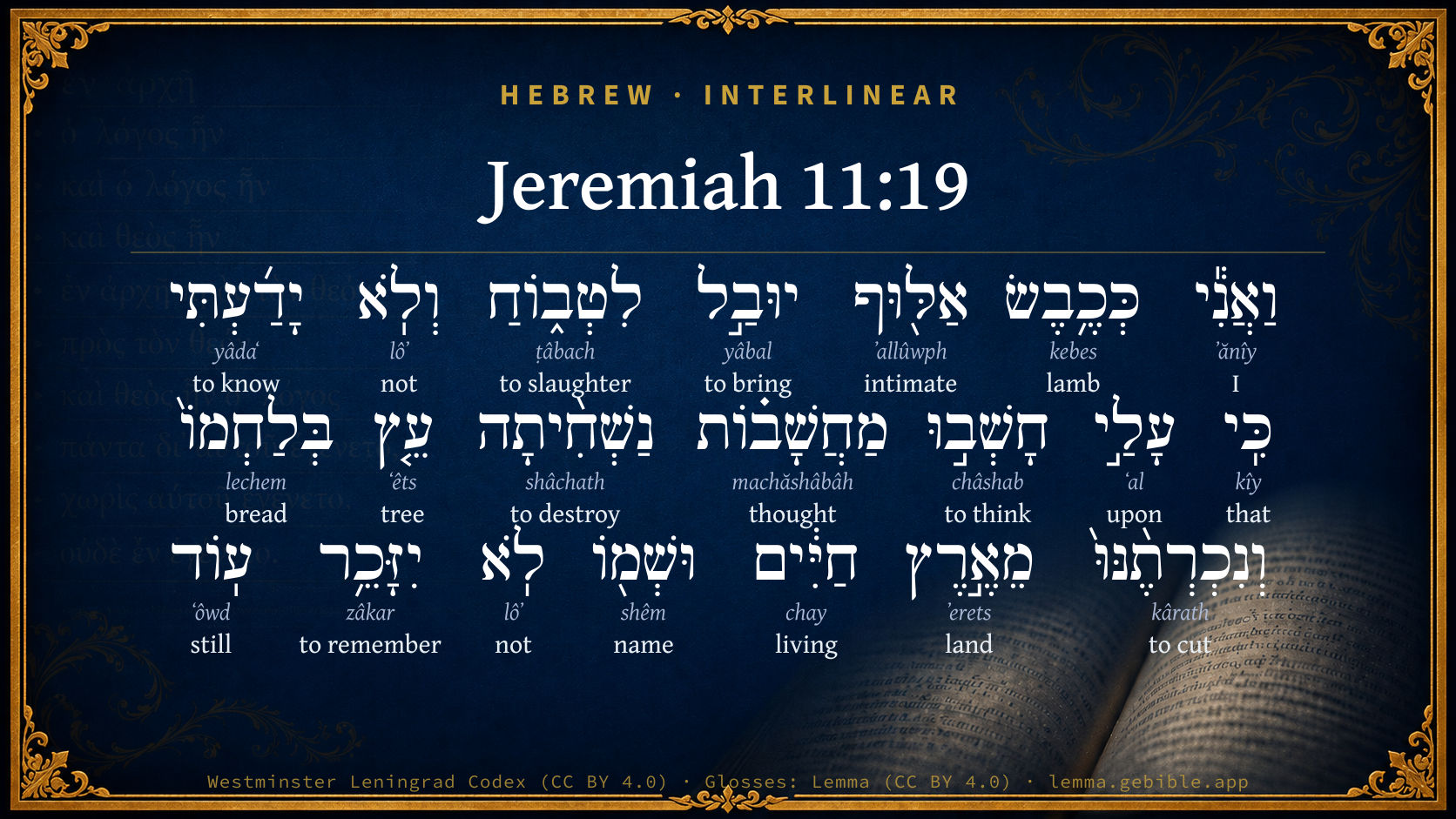
Hebrew (Westminster Leningrad Codex) Jeremiah 11:19 appears in the Hebrew Old Testament. The text above is from the Westminster Leningrad Codex. Each word links to its Strong’s number, a concise gloss, and parsing drawn from the Open Scriptures Hebrew Bible morphology. Click any word for its full Brown-Driver-Briggs (BDB) entry.
Download image
Cite this verse

Jeremiah 11:19 (World English Bible). Public Domain. Lemma interlinear Bible study tool, https://lemma.gebible.app/v/jeremiah/11/19.

Show BibTeX & RIS
BibTeX
RIS
English Translation
But I was like a gentle lamb that is led to the slaughter; and I didn't know that they had devised devices against me, [saying], Let us destroy the tree with the fruit of it, and let us cut him off from the land of the living, that his name may be no more remembered.
World English Bible · Public Domain
Download a study sheet

One document with this verse’s original text, its word-by-word gloss line, the meaning frame, cross-references with their text, attributed commentary, and full source and license credits — printable, and it pastes into notes with its structure intact.

This verse Autodidact and up

Study sheet (.html) Plain text (.txt)

A passage Seminary Student

Up to 50 verses in one chapter. A passage sheet keeps up to 6 commentary sources and 12 cross-references per verse, in the order this page ranks them, and says so on the sheet whenever that leaves anything out. Ask for a single verse and you get the Autodidact verse sheet above.

Everything on this page stays free to read, with no account — the sheet is a download of what is already on screen, not access to it.

Want to remove ads? Support Godless Engineer
Compare translations 3

The same verse in 3 English versions, stacked beneath the original-language interlinear above. Click any original word for its lexicon entry.

Each is an independent rendering of the whole verse — the interlinear is not word-aligned to these translations.

Highlighted words mark where these versions differ — a whole-verse word diff, not a word-by-word alignment.

  • World English Bible Public Domain
    But I was like a gentle lamb that is led to the slaughter; and I didn't know that they had devised devices against me, [saying], Let us destroy the tree with the fruit of it, and let us cut him off from the land of the living, that his name may be no more remembered.
  • King James Version Public Domain
    But I was like a lamb or an ox that is brought to the slaughter; and I knew not that they had devised devices against me, saying, Let us destroy the tree with the fruit thereof, and let us cut him off from the land of the living, that his name may be no more remembered.
  • unfoldingWord Literal Text CC BY-SA 4.0
    And I was like a gentle lamb brought to slaughter, and I did not know that they had devised plans against me, “Let us destroy the tree with its fruit! And let us cut him off from the land of the living, that his name will not be remembered any longer.”

unfoldingWord Literal Text — © unfoldingWord, licensed CC BY-SA 4.0. Word-aligned USFM3 via Door43 (git.door43.org/unfoldingWord/en_ult).

Versions to compare (up to 4)

3 of 4 selected

Show all 18 translations

Every available English version of this verse, each an independent rendering of the whole verse.

  • World English Bible Public Domain
    But I was like a gentle lamb that is led to the slaughter; and I didn't know that they had devised devices against me, [saying], Let us destroy the tree with the fruit of it, and let us cut him off from the land of the living, that his name may be no more remembered.
  • Berean Standard Bible Public Domain
    For I was like a gentle lamb led to slaughter; I did not know that they had plotted against me: “Let us destroy the tree with its fruit; let us cut him off from the land of the living, that his name may be remembered no more.”
  • Majority Standard Bible Public Domain
    For I was like a gentle lamb led to slaughter; I did not know that they had plotted against me: “Let us destroy the tree with its fruit; let us cut him off from the land of the living, that his name may be remembered no more.”
  • King James Version Public Domain
    But I was like a lamb or an ox that is brought to the slaughter; and I knew not that they had devised devices against me, saying, Let us destroy the tree with the fruit thereof, and let us cut him off from the land of the living, that his name may be no more remembered.
  • American Standard Version (1901) Public Domain
    But I was like a gentle lamb that is led to the slaughter; and I knew not that they had devised devices against me, `saying', Let us destroy the tree with the fruit thereof, and let us cut him off from the land of the living, that his name may be no more remembered.
  • Revised Version (1885) Public Domain
    But I was like a gentle lamb that is led to the slaughter; and I knew not that they had devised devices against me, saying, Let us destroy the tree with the fruit thereof, and let us cut him off from the land of the living, that his name may be no more remembered.
  • Geneva Bible (1599) Public Domain
    But I was like a lambe, or a bullocke, that is brought to the slaughter, and I knewe not that they had deuised thus against me, saying, Let vs destroy the tree with the fruite thereof, and cut him out of the lande of the liuing, that his name may be no more in memory.
  • Douay-Rheims (1899) Public Domain
    And I was as a meek lamb, that is carried to be a victim: and I knew not that they had devised counsels against me, saying: Let us put wood on his bread, and cut him off from the land of the living, and let his name be remembered no more.
  • Young's Literal Translation Public Domain
    And I `am' as a trained lamb brought to slaughter, And I have not known That against me they have devised devices: We destroy the tree with its food, and cut him off From the land of the living, And his name is not remembered again.
  • Literal Standard Version CC BY-SA 4.0
    And I [am] as a trained lamb brought to slaughter, || And I have not known || That they have devised schemes against me: “We destroy the tree with its food, || And cut him off from the land of the living, || And his name is not remembered again.”
  • Unlocked Literal Bible CC BY-SA 4.0
    I was like a gentle lamb being led to a butcher. I did not know that they had formed plans against me, “Let us destroy the tree with its fruit! Let us cut him off from the land of the living so his name will be no longer remembered.”
  • unfoldingWord Literal Text CC BY-SA 4.0
    And I was like a gentle lamb brought to slaughter, and I did not know that they had devised plans against me, “Let us destroy the tree with its fruit! And let us cut him off from the land of the living, that his name will not be remembered any longer.”
  • Darby Bible Public Domain
    And I was like a tame lamb [that] is led to the slaughter; and I knew not that they devised devices against me, [saying,] Let us destroy the tree with the fruit thereof, and let us cut him off from the land of the living, that his name may be no more remembered.
  • World Messianic Bible Public Domain
    But I was like a gentle lamb that is led to the slaughter. I didn’t know that they had devised plans against me, saying, “Let’s destroy the tree with its fruit, and let’s cut him off from the land of the living, that his name may be no more remembered.”
  • Webster's Bible Public Domain
    But I was like a lamb or an ox that is brought to the slaughter; and I knew not that they had devised devices against me, saying, Let us destroy the tree with its fruit, and let us cut him off from the land of the living, that his name may be no more remembered.
  • Free Bible Version CC BY-SA 4.0
    I was like a trusting little lamb being led away to be slaughtered. I didn't know that they had been plotting against me. They said, “Let's destroy the tree along with everything it produces. Let's kill him so no one will even remember his name.”
  • Bible in Basic English Public Domain
    But I was like a gentle lamb taken to be put to death; I had no thought that they were designing evil against me, saying, Come and let us make trouble his food, cutting him off from the land of the living, so that there may be no more memory of his name.
  • JPS Tanakh (1917) Public Domain
    But I was like a docile lamb that is led to the slaughter; and I knew not that they had devised devices against me: 'Let us destroy the tree with the fruit thereof, and let us cut him off from the land of the living, that his name may be no more remembered.'

Literal Standard Version (2020), Covenant Press — licensed CC BY-SA 4.0. Text via the HelloAO Bible API (eBible.org). Unlocked Literal Bible (unfoldingWord) — licensed CC BY-SA 4.0. Text via the HelloAO Bible API (eBible.org). unfoldingWord Literal Text — © unfoldingWord, licensed CC BY-SA 4.0. Word-aligned USFM3 via Door43 (git.door43.org/unfoldingWord/en_ult). Free Bible Version, Dr. Jonathan Gallagher — licensed CC BY-SA 4.0. Text via the HelloAO Bible API (eBible.org).

Word by word

More ways to search: Search by grammar → Find every occurrence → Compare this word →

Practice this passage: Drill this verse → Learn its vocabulary →

לִטְב֑וֹחַ
ṭâbach
H2873
“to slaughter”
Preposition + Verb, Qal, Infinitive Construct
Part of Speech
Preposition + Verb
Stem
Qal
Form
Infinitive Construct
Full BDB Definition

Origin: a primitive root

TWOT: 786

to slaughter, slay, butcher, kill ruthlessly - (Qal) - to slaughter, butcher - to slay, kill ruthlessly (figuratively)
  1. וַאֲנִ֕י ʼănîy H589 “and · I” Conjunction + Pronoun, Personal, 1st Person, Common, Singular
  2. כְּכֶ֥בֶשׂ kebes H3532 “like/as · lamb” Preposition + Noun, Common, Masculine, Singular, Absolute
  3. אַלּ֖וּף ʼallûwph H441 “intimate” Adjective, Adjective, Masculine, Singular, Absolute
  4. יוּבַ֣ל yâbal H2986 “to bring” Verb, Hophal, Imperfect, 3rd Person, Masculine, Singular
  5. וְלֹֽא lôʼ H3808 “and · not” Conjunction + Particle, Negative
  6. יָדַ֜עְתִּי yâdaʻ H3045 “to know” Verb, Qal, Perfect, 1st Person, Common, Singular
  7. כִּֽי kîy H3588 “that” Conjunction
  8. עָלַ֣י ʻal H5921 “upon · me” Preposition + Suffix, Personal, 1st Person, Common, Singular
  9. חָשְׁב֣וּ châshab H2803 “to think” Verb, Qal, Perfect, 3rd Person, Common, Plural
  10. מַחֲשָׁב֗וֹת machăshâbâh H4284 “thoughts” Noun, Common, Feminine, Plural, Absolute
  11. נַשְׁחִ֨יתָה shâchath H7843 “to destroy” Verb, Hiphil, Cohortative, 1st Person, Common, Plural
  12. עֵ֤ץ ʻêts H6086 “tree” Noun, Common, Masculine, Singular, Absolute
  13. בְּלַחְמוֹ֙ lechem H3899 “in/at · bread · his” Preposition + Noun, Common, Both, Singular, Construct + Suffix, Personal, 3rd Person, Masculine, Singular
  14. וְנִכְרְתֶ֨נּוּ֙ kârath H3772 “and · to cut · him” Conjunction + Verb, Qal, Cohortative, 1st Person, Common, Plural + Suffix, Personal, 3rd Person, Masculine, Singular
  15. מֵאֶ֣רֶץ ʼerets H776 “from · land of” Preposition + Noun, Common, Both, Singular, Construct
  16. חַיִּ֔ים chay H2416 “living” Adjective, Adjective, Masculine, Plural, Absolute
  17. וּשְׁמ֖וֹ shêm H8034 “and · name · his” Conjunction + Noun, Common, Masculine, Singular, Construct + Suffix, Personal, 3rd Person, Masculine, Singular
  18. לֹֽא lôʼ H3808 “not” Particle, Negative
  19. יִזָּכֵ֥ר zâkar H2142 “to remember” Verb, Niphal, Imperfect, 3rd Person, Masculine, Singular
  20. עֽוֹד ʻôwd H5750 “still” Adverb

About this verse

These counts appear in no published source. They are computed here, from the morphology-tagged text and Lemma’s own curated glosses. What Lemma adds →

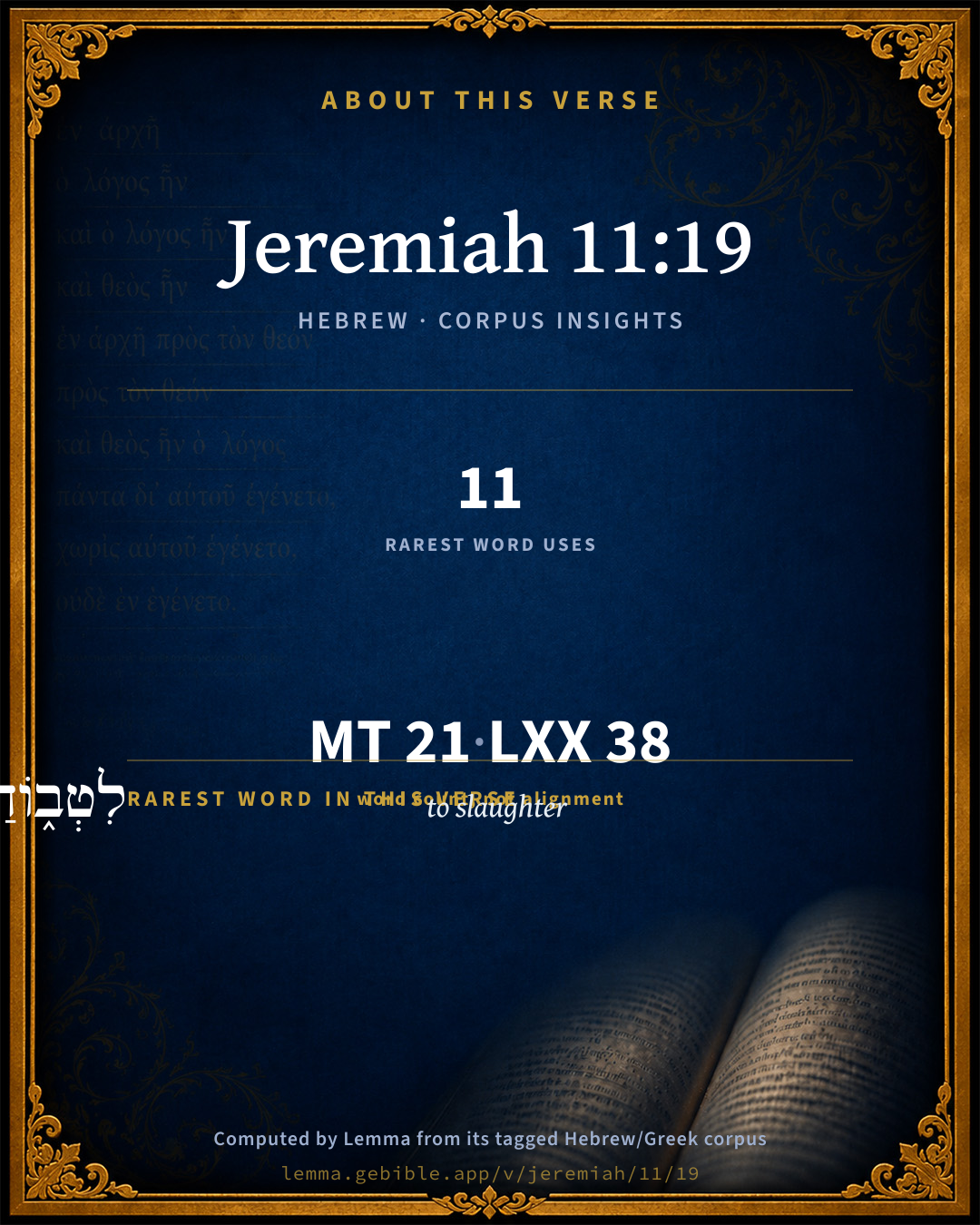
21
words
20
distinct lemmas
Prophets
section

Notable vocabulary

The rarest word here is לִטְב֑וֹחַ to slaughter H2873 — appearing just 11 times in the whole Hebrew Bible.

Shared distinctive vocabulary

לִטְב֑וֹחַ to slaughter H2873 occurs in 11 verses of the Hebrew Bible. Also found in:

Grammatical profile

  • 7 verbs
  • 6 nouns
  • 2 adjectives
  • 1 pronoun
  • 1 preposition
  • 1 conjunction
  • 1 adverb
  • 2 particles

Verb forms

  • יוּבַ֣ל Hophal · Imperfect
  • לִטְב֑וֹחַ Qal · Infinitive Construct
  • יָדַ֜עְתִּי Qal · Perfect
  • חָשְׁב֣וּ Qal · Perfect
  • נַשְׁחִ֨יתָה Hiphil · Cohortative
  • וְנִכְרְתֶ֨נּוּ֙ Qal · Cohortative
  • יִזָּכֵ֥ר Niphal · Imperfect

Repetition

A word recurs within this verse — often emphatic in Hebrew:

  • וְלֹֽא not H3808 ×2

Hebrew & Septuagint length

In the original languages it is 21 Hebrew tokens and 38 Greek tokens — but the two are counted differently (Hebrew bundles its prefixes and suffixes into one token; the Greek is in lemma form), so that isn’t a like-for-like length.

Cross-references

22

Topical passages linked to Jeremiah 11:19 in the Treasury of Scripture Knowledge — connected by theme and wording, ordered by reader-vote popularity; previews shown in the World English Bible.

  • Isaiah 53:7–8 He was oppressed, yet when he was afflicted he didn't open his mouth; as a lamb that is led to the slaughter, and as a sheep that before its shearers is mute, so he didn't open his mouth.
  • Jeremiah 20:10 For I have heard the defaming of many, terror on every side. Denounce, and we will denounce him, [say] all my familiar friends, those who watch for my fall; peradventure he will be persuaded, and we shall prevail against him, and we shall take our revenge on him.
  • Psalms 83:4 "Come," they say, "and let's destroy them as a nation, That the name of Israel may be remembered no more."
  • Jeremiah 18:18 Then said they, Come, and let us devise devices against Jeremiah; for the law shall not perish from the priest, nor counsel from the wise, nor the word from the prophet. Come, and let us strike him with the tongue, and let us not give heed to any of his words.
  • Job 28:13 Man doesn't know its price; Neither is it found in the land of the living.
  • Psalms 31:13 For I have heard the slander of many, terror on every side, While they conspire together against me, They plot to take away my life.
  • Numbers 1:14 Of Gad: Eliasaph the son of Deuel.
  • Psalms 27:13 I am still confident of this: I will see the goodness of Yahweh in the land of the living.
  • Psalms 37:32–33 The wicked watches the righteous, And seeks to kill him.
  • Luke 20:10–15 At the proper season, he sent a servant to the farmers to collect his share of the fruit of the vineyard. But the farmers beat him, and sent him away empty.
  • Psalms 109:13 Let his posterity be cut off. In the generation following let their name be blotted out.
  • Psalms 116:9 I will walk before Yahweh in the land of the living.
  • Proverbs 7:22 He followed her immediately, As an ox goes to the slaughter, As a fool stepping into a noose.
  • Isaiah 32:7 The instruments of the churl are evil: he devises wicked devices to destroy the humble with lying words, even when the needy speaks right.
  • Isaiah 38:11 I said, I shall not see Yah, Yah in the land of the living: I shall see man no more with the inhabitants of the world.
  • Psalms 35:15 But in my adversity, they rejoiced, and gathered themselves together. The attackers gathered themselves together against me, and I didn't know it. They tore at me, and didn't cease.
  • Psalms 52:5 God will likewise destroy you forever. He will take you up, and pluck you out of your tent, And root you out of the land of the living. Selah.
  • Psalms 112:6 For he will never be shaken. The righteous will be remembered forever.
  • Psalms 142:5 I cried to you, Yahweh. I said, "You are my refuge, My portion in the land of the living."
  • Proverbs 10:7 The memory of the righteous is blessed, But the name of the wicked will rot.
  • Daniel 9:26 After the sixty-two weeks the Anointed One shall be cut off, and shall have nothing: and the people of the prince who shall come shall destroy the city and the sanctuary; and the end of it shall be with a flood, and even to the end shall be war; desolations are determined.
  • Matthew 26:3–4 Then the chief priests, the scribes, and the elders of the people were gathered together in the court of the high priest, who was called Caiaphas.

Cross-references courtesy of OpenBible.info (CC BY 4.0).

Hebrew and Greek witnesses Masoretic Hebrew ↔ Greek Septuagint

The same verse in the two great witnesses to the Old Testament, shown verse-for-verse.

These are two independent witnesses, not word-aligned to each other, and the Septuagint is shown in lemma (dictionary) form.

Hebrew Jeremiah 11:19 Masoretic · Westminster Leningrad Codex

וַאֲנִ֕י כְּכֶ֥בֶשׂ אַלּ֖וּף יוּבַ֣ל לִטְב֑וֹחַ וְלֹֽא יָדַ֜עְתִּי כִּֽי עָלַ֣י חָשְׁב֣וּ מַחֲשָׁב֗וֹת נַשְׁחִ֨יתָה עֵ֤ץ בְּלַחְמוֹ֙ וְנִכְרְתֶ֨נּוּ֙ מֵאֶ֣רֶץ חַיִּ֔ים וּשְׁמ֖וֹ לֹֽא יִזָּכֵ֥ר עֽוֹד

But I was like a gentle lamb that is led to the slaughter; and I didn't know that they had devised devices against me, [saying], Let us destroy the tree with the fruit of it, and let us cut him off from the land of the living, that his name may be no more remembered.

World English Bible · Public Domain

Greek LXX Structure differs

In the Septuagint, Jeremiah is about an eighth shorter than the Hebrew and arranges its material differently — the Oracles Against the Nations (Hebrew chapters 46–51) appear in the middle of the Greek book, after 25:13. Because the chapter and verse boundaries do not line up, a verse-for-verse comparison with the Hebrew is not shown.

A verse-for-verse comparison isn’t shown here because the chapters and verses don’t line up. Switch to the LXX edition with the MT / LXX toggle above to read the Greek directly.

On this verse, Ellicott's Commentary for English Readers discusses the Septuagint’s reading. Read the note in Commentary ↓

Hebrew: Westminster Leningrad Codex (CC BY 4.0). Greek: Septuagint (public domain); English from a public-domain English Septuagint. How the Septuagint differs from the Hebrew →

Targum (Aramaic paraphrase)

1

The Targum is the ancient Jewish Aramaic paraphrase of the Hebrew Scriptures — an interpretive translation, not the Hebrew text itself. Onkelos (literal) and Pseudo-Jonathan (expansive) render the Torah, and Jonathan the Prophets. Coverage is partial: where no permissively-licensed English translation exists for a verse, only the Aramaic is shown. This is verse-level text, not a word-by-word alignment to the Hebrew.

  1. Targum Jonathan Prophets (Joshua–Malachi)
    וַאֲנָא כְּאִימַר בְּחִיר דִלְנִכְסְתָא מְתוּבַל וְלָא יְדָעִית אֲרֵי עֲלֵי חֲשִׁיבוּ עֶשְׁתּוֹנִין בִּישִׁין אָמְרִין נִרְמֵי סַמָא דְמוֹתָא בְּמֵיכְלֵיהּ וּנְשֵׁיצִינֵיהּ מֵאַרְעָא דְיִשְׂרָאֵל וּשְׁמֵיהּ לָא יִדְכַּר עוֹד:

    (no public-domain English translation for this verse)

    Targum Jonathan — Aramaic: “Mikraot Gedolot” (public domain). English: “Sefaria Community Translation” (CC0 1.0 (public-domain dedication)); “London "Chaldee Paraphrase," 1871” (public domain). Text via Sefaria.

Commentary

Notes on Jeremiah 11:19 from classic Christian and Jewish commentators (each source and its license shown beneath its notes). The classic Christian expositions comment on the surrounding passage and are grouped to its opening verse, so a note may address several verses; the Jewish commentaries on the Tanakh (Rashi and others) are per-verse, so they appear only where the commentator wrote on this verse.

Lemma curates 59 commentaries, every one of them public domain or Creative Commons licensed, each selected and text-cleaned for this edition rather than reprinted as found. About our sources →

Trapp's Complete Commentary

John Trapp

Jer 11:19 But I [was] like a lamb [or] an ox [that] is brought to the slaughter; and I knew not that they had devised devices against me, [saying], Let us destroy the tree with the fruit thereof, and let us cut him off from the land of the living, that his name may be no more remembered.

Ver. 19. But I was like a lamb or an ox.] Harmless and blameless, busied in my function, and not in the least suspecting any such evil design against me. "I send you forth as lambs among wolves," saith Christ, {Mat 10:16} who, himself being the Lamb of God, was slain from the beginning of the world; his servants also are slain all the day long, and counted as sheep to the slaughter. {Rom 8:36}

Let us destroy the tree with the fruit thereof.] Let us poison his food, so the Chaldee senseth it, Ponamus tignum taxi in sorbitiunculam. Others, Let us destroy the prophet and his prophecies together: others, Let us make an end of him either by sword or by famine, as the punishment threatened {Jer 11:22} pointeth us to.

That his name may be no more remembered.] Sic veritas odium peperit. So the Papists have given order that wheresoever Calvin’s name is found, it shall be blotted out; and by a most malicious anagram they have turned Calvin into Lucian. One of them recently took a long journey to Rome only to have his name changed from Calvin to some other, and that out of devilish hatred of that most learned and holy man,

“ Ipsa a quo virtus virtutem discere posset. ”

John Trapp, A Commentary or Exposition upon All the Books of the Old and New Testament (1647–1656) — public domain. Text from a community e-Sword module.

Geneva Bible (1599)

Geneva Bible translators

Let us destroy the Prophet and his doctrine. Some read, Let us corrupt his meat with wood, meaning, poison.

Geneva Bible (1599) marginal notes — public domain. Text via Bolls.life.

Jamieson, Fausset & Brown

Robert Jamieson, A. R. Fausset & David Brown

lamb--literally, a "pet lamb," such as the Jews often had in their houses, for their children to play with; and the Arabs still have (Sa2 12:3). His own familiar friends had plotted against the prophet. The language is exactly the same as that applied to Messiah (Isa 53:7). Each prophet and patriarch exemplified in his own person some one feature or more in the manifold attributes and sufferings of the Messiah to come; just as the saints have done since His coming (Gal 2:20; Phi 3:10; Col 1:24). This adapted both the more experimentally to testify of Christ.

devices-- (Jer 18:18).

tree with . . . fruit--literally, "in its fruit" or "food," that is, when it is in fruit. Proverbial, to express the destruction of cause and effect together. The man is the tree; his teaching, the fruit. Let us destroy the prophet and his prophecies; namely, those threatening destruction to the nation, which offended them. Compare Mat 7:17, which also refers to prophets and their doctrines.

Jamieson, Fausset & Brown — Commentary Critical and Explanatory on the Whole Bible (1871) — public domain (CC PDM 1.0). Text via the HelloAO Bible API.

Adam Clarke's Commentary

Verse 19. I was like a lamb or an ox] Dahler translates, "I was like a fattened lamb that is led to the slaughter." Blayney, "I was like a tame lamb that is led to slaughter." The word אלוף alluph, which we translate ox, is taken by both as an adjective, qualifying the noun כבש kebes, a lamb. It may probably signify a lamb brought up in the house-fed at home, (אלוף alluph,) instructed or nourished at home; perfectly innocent and unsuspecting, while leading to the slaughter. This meaning the word will bear in Arabic, for [Arabic] alaf signifies accustomed, familiar, (to or with any person or thing;) a companion, a comrade, an intimate friend. I therefore think that ככבש אלוף kechebes alluph signifies, like the familiar lamb - the lamb bred up in the house, in a state of friendship with the family. The people of Anathoth were Jeremiah's townsmen; he was born and bred among them; they were his familiar friends; and now they lay wait for his life! All the Versions understood אלוף alluph as an epithet of כבש kebes, a chosen, simple, innocent lamb.

Let us destroy the tree with the fruit] Let us slay the prophet, and his prophecies will come to an end. The Targum has, Let us put mortal poison in his food; and all the Versions understand it something in the same way.

Adam Clarke's Commentary on the Bible (1810–1826) — public domain. Text from a community e-Sword/MySword module.

John Calvin's Commentaries

The Prophet adds here, as I think, that he did not retaliate private wrongs: for the Jews might, under this pretext, have rejected his doctrine, and have said, that he was moved by anger to treat them sharply and severely. And doubtless, whosoever allows his own reelings to prevail in the least degree, cannot teach in sincerity; for he who prepares himself for the prophetic office, ought to put off all the affections of the flesh, and to manifest a pure, and, so to speak, a limpid zeal, and also a calm mind, so that he may seek nothing, and have no object but the glory of God and the salvation of those to whom he is sent a teacher. Whosoever then is under the influence of private feelings cannot act otherwise than violently, so that he cannot either faithfully or profitably discharge the office of a prophet or a teacher.

Hence the Prophet now adds, in the second place, that he did not plead his own cause, nor had respect, as they say, to his own person; for he knew not what the Jews had devised against him. They who join the two verses think that they have some reason for doing so, as they suppose that the Prophet now expresses more fully what he had before briefly touched upon: but if any maturely considers the whole passage, he will easily see that Jeremiah had another object in view, and that was, to secure authority to his doctrine. The Jews probably employed two ways to discredit the holy Prophet: “O, thou divinest! — the same thing, as we have said, is done now by many.” He therefore summons the Jews here before God’s tribunal, and shews that it was nothing strange, that he brought to light what they thought to be hidden, because it had been revealed to him by the Spirit of God. Even Christ said the same,

“The Spirit, when he comes, shall judge the world.” (John 16:8)

The Spirit did not appear except in the doctrine of the Apostles; but he exercised by the Apostles his own functions. The Apostle also seems to have this in view in Hebrews 4:12, when he says, that the word of God is like a two — edged sword, which penetrates into the inmost thoughts and hidden feelings, even to the marrow and bones, so as to distinguish between thoughts and feelings.

Then the Prophet, in the first place, shews that it was nothing strange that he ascended above all human judgments, for he was endued with the authority of the Holy Spirit. And he adds, in the second place, that he was not influenced by carnal feelings, but by a pure zeal for God, for he knew not their wicked designs; and he says that he was like a lamb and an ox, or a calf. There is here no conjunction, and hence some join the two words, “And I am like a lamb a year old:” for the Hebrews, they say, call a lamb a year old כבש, cabesh, and then a ram; but this is, in my view, a forced meaning, and a copulative or a disjunctive may be supposed to be understood. I am then as a lamb or as a calf, which is led to the slaughter (to be sacrificed or kined) Here the Prophet intimates that he was not violent, as angry men are wont to be, who are excited either by indignation or great grief. He then testifies that he was moved by no such feeling, for he differed nothing from a lamb or a calf that is led to the slaughter.

For the sake of amplifying, he adds, I knew not that they devised devices against me, that is, this did not come to my mind. The Prophet, indeed, might have suspected or even have known this; but as he disregarded himself, and even his own life, he testifies here that he had acted with so much simplicity as not to regard what they planned and contrived.

He then adds, Let us spoil wood in his bread They think rightly, according to my judgment, who consider that there is here a change of case; for it ought rather to be, “Let us spoil with wood his bread:” for that exposition is too unmeaning, “Let us spoil or destroy wood,” as though they spoke of a thing of no value: for what has this to do with the subject? On the contrary, if we retain, as they say, the letter, the Prophet might think that wood would be spoiled in bread, as it would become rotten: but wood in bread, except by becoming rotten, would do no harm. But doubtless the Prophet speaks here metaphorically, as David does in Psalm 69:22, when he says,

“They have put gall in my bread, and vinegar in my drink.”

Jeremiah also, in Lamentations 3:15, complains that his food was mingled with poison. Similitudes of this kind often occur; for when the very food of man is corrupted, there is no more any support for life. The meaning then is, that his enemies had acted cruelly towards the Prophet, as they sought in every way to destroy him, even by poison.

Some take wood for poison, but I know not whether that can be done. They indeed imagine that a poisonous wood is what is here meant; but this is too refined. I take the meaning to be simply this, as though they had said, “Let us spoil with wood his food,” that is, “Let us give him wood instead of bread; and this, by its hardness, will hurt his teeth, ulcerate his throat, and cannot be digested so as to become nourishment.” To spoil this bread with wood is to cause the wood to spoil the food either by its hardness or by its putridity. In this sense there is nothing ambiguous.

The ancients perverted this passage in the most childish manner when they applied it to the body of Christ. The Papists too, at this day, boast wonderfully of this allegory, though they make the most absurd use of it; for they seek to prove by it that bread is converted, or, as they say, transubstantiated into the body of Christ; and they quote Origen and Irenaeus, and others like them: “Behold, explained is that passage of Jeremiah, let us send wood for his bread, (such is the meaning of the Vulgate) for the body of Christ has been crucified;” and then they add, “For he said, ‘Take and eat, this is my body.’”We see how extremely absurd this is; and it must appear ridiculous even to children. But so great is the dishonesty and wantonness of the Papists, that they cast off all shame, and only boastfully pretend the authority of the ancients; and whatever Origen may have foolishly and falsely said, they will have it to be regarded as something oracular, provided their errors are thereby confirmed. But if we grant that the Prophet was a type of Christ, what has this to do with the similitude of his body, since he speaks here only of food? It is as though he had said, that his aliment was corrupted, as it were, with poison, and that he was so cruelly treated by his enemies, that they sought to destroy him by the means of his food.

It then follows, Let us cut him off from the land of the living This kind of speaking often occurs: the land or region of the living means the state of the present life. He at last adds, That his name may not be in remembrance any more In short, the Prophet meant in these words to set forth the extreme savageness with which his enemies were inflamed; for they were not content with intrigues or with open violence, but wished to destroy him by poison, and wholly to obliterate his name. it follows —

John Calvin's Commentaries (1540-1563) — public domain. Text from the Calvin Translation Society English edition (1840s-50s) via the Christian Classics Ethereal Library (ccel.org). Calvin's coverage is partial (roughly two-thirds of the Bible); uncommented books and verses are honest gaps, never fabricated. The 19th-century editor's footnotes and remarks are omitted so the notes are faithfully Calvin's own voice.

Ellicott's Commentary for English Readers

(19) Like a lamb or an ox.—Better, as a tame lamb, i.e., one, like the ewe-lamb of Nathan’s parable (2Sa_12:3), brought up in the home of its master. There is no “or” in the Hebrew, and the translators seem to have mistaken the adjective (tame) for a noun. The LXX., Vulg., and Luther agree in the rendering now given. Assuming the earlier date of Isa_53:7, the words would seem to have been an allusive reference to the sufferer there described.

The tree with the fruit thereof.—Literally, the tree with its bread, here taken for its “fruit.” Some scholars, however, render the word “sap,” or adopt a reading which gives that meaning. The phrase would seem to be proverbial for total destruction, not of the man only, but of his work. While the prophet’s life had been innocent and unsuspecting, his own townsmen were conspiring to crush him, and bury his name and work in oblivion. The sufferings of the prophet present, in this matter, a parallel to those of the Christ (Luk_4:29).

A Bible Commentary for English Readers, edited by Charles John Ellicott (1878–1897) — public domain. Text from a community e-Sword module.

The Cambridge Bible for Schools and Colleges

gen. ed. J. J. S. Perowne

19. The prophet no more expected harm from his kindred than does the pet lamb from the family with which it lives (cp. 2Sa_12:3).

gentle] A.V. “an ox” represents the Hebrew word identical in form indeed with one so rendered in Psa_144:14 (where, however, the sense is dubious), but here the meaning is familiar, domesticated (cp. the rendering “companion” in Psa_55:13). It is rendered “friends” in Jer_13:21.

fruit] mg. Heb. bread. So the LXX read, but it is tempting to omit (with Hitzig, and Dr.) one Hebrew consonant, and so obtain the much needed improvement “sap.” Thus we shall get the meaning to be, not the words which came from Jeremiah, as fruit from a tree, but his vigorous youth.

The Cambridge Bible for Schools and Colleges (gen. ed. J. J. S. Perowne; Cambridge University Press, 1878–1918) — public domain. Text from a community e-Sword module.

John Gill's Exposition

But, O Lord of hosts, that judgest righteously,.... This is the prophet's appeal to God, as the Judge of the whole earth, who will do right; he found there was no justice to be done him among men; he therefore has recourse to a righteous God, who he knew judged righteous judgment:

that triest the reins and the heart; of all men; as of his own, so of his enemies; and which he mentions, not so much on his own account as theirs:

let me see thy vengeance on them; which imprecation arose from a pure zeal for God, for his glory, and the honour of his justice; and not from private revenge; and so no ways inconsistent with the character of a good man; though some consider the words as a prediction of what would befall them, and he should live to see accomplished; and render them, "I shall see &c." (q); and so the Targum,

"I shall see the vengeance of thy judgment on them:''

for unto thee have I revealed my cause; as a client to his patron; told his whole case, and left it with him, believing he would manage it for him, and do him justice. The Apostle Peter seems to have this passage in view, when speaking of Christ, Pe1 2:23.

(q) "videbo", Munster, Schmidt; "visurus sum", Junius & Tremellius.

John Gill's Exposition of the Whole Bible (1746–1763) — public domain (CC PDM 1.0). Text via the HelloAO Bible API.

Albert Barnes' Notes on the Bible

Like a lamb or an ox - Rather, “like a tame lamb.” Jeremiah had lived at Anathoth as one of the family, never suspecting that, like a tame lamb, the time would come for him to be killed.

The tree with the fruit thereof - The words are those of a proverb or dark saying. All the Churches agree in understanding that under the person of Jeremiah these things are said by Christ.

Albert Barnes' Notes on the Bible (1834–1885) — public domain. Text from a community e-Sword/MySword module.

Haydock's Catholic Bible Commentary

Meek: pet lamb. The Arabs still keep one in their houses, 2 Kings xii. 3. (Bochart ii. 46.) (Calmet) --- Knew. I acted as if I had been ignorant. (Menochius) --- Yet Christ foretold his sufferings, Matthew xx. 18., &c. (Worthington) --- Bread. Christ, the bread of life, was nailed to the disgraceful wood. (St. Jerome; St. Gregory, Mor. iii. 12.) --- They threaten to beat him, (De Dieu) or to mix a poisonous wood with his food. (Calmet) (Menochius) --- Some Jews had corrupted this text in St. Justin’s time. (Du Hamel)

George Leo Haydock (1774–1849), Haydock's Catholic Family Bible and Commentary, 1859 edition — public domain. Excludes Psalms (Douay-Rheims chapter numbering differs from Protestant) and Deuterocanonical books (Catholic canon only).

Matthew Poole's English Annotations

We have no other mention of this conspiracy in holy writ, but it is plain, both from this verse and what followeth to the end of this chapter, that the men of Anathoth (which was Jeremiah’s own town) were offended at his prophesying so sharp things against the land of Judah, and had threatened to kill him if he would not leave off that style, and had conspired to that purpose, some think to mix poison with his meat, others by starving of him, others think by beating of him, into which variety of sense they interpret that phrase in this verse,

Let us destroy the tree with the fruit thereof; but the sense is plain, Let us not only put an end to his prophesying, but to his being also;

let us cut him off some way or other,

that his name may no more be remembered. Of this the prophet saith he was as ignorant as an ox or a lamb that is brought to the slaughter-house, that knoweth nothing what design is against its life.

Matthew Poole's English Annotations on the Holy Bible (1683–1685) — public domain. Text from a community e-Sword/MySword module.

Whedon's Commentary on the Bible

Daniel D. Whedon

19. Like a lamb or an ox — Rather, as a tame lamb. Such as is frequently found in Arab tents. The comparison is most felicitous, as suggesting innocence and harmlessness.

Tree with the fruit — Literally, tree in its bread.

Daniel D. Whedon (gen. ed.), Commentary on the Old and New Testaments (1874–1909) — public domain. Text from a community e-Sword module.

The Pulpit Commentary

Like a lamb or an ox; rather, as a mild lamb (as one of the old translations has it), equivalent to quasi agaus mansuetus (Vulgate). Jeremiah says that he was as unsuspicious as a tame lamb which has grown up with its master"s family. (2Sa_12:3) The Arabs use the very same adjective in a slightly different form as an epithet of such tame lambs (Bochart, "Hierozoicon," 1:520-522, edit. 1663). It is impossible to help thinking of that "Servant of Jehovah," of whom Jeremiah was a type, who is said, in prophetic vision, to have been "brought as a lamb to the slaughter," and "not to have opened his mouth". (Isa_53:7) The tree with the fruit thereof; apparently a proverbial expression. Giving the words their ordinary meaning, the rendering would be, the tree with its bread (blakhmo). Our translators appear to have thought that the transition from "bread" to "fruit" was as justifiable in Hebrew as it is in Arabic (in which uklu means properly "food" in general, but also "date fruit"). Fruit, however, was not such an important article of food with the Israelites as with the Arabs; and we must either, with Hitzig, suppose a letter to have intruded into the text, and render (from a corrected reading blekho), with its sap, (comp. Deu_34:7, Hebrew) or else appeal to the etymology of lekhem (commonly "bread"), which is "firm, consistent," and render, the tree with its pith (Hence lahmu in Arabic means "flesh," and luhmatu, "a woof"). It is no credit to St. Jerome that he followed the absurd version of the Septuagint, "Let us put wood into his bread."

The Pulpit Commentary (1880–1919), ed. H.D.M. Spence-Jones & Joseph S. Exell — public domain. Text from a community e-Sword module.

John Wesley's Explanatory Notes

Let us destroy - We have no other mention of this conspiracy, but it is plain both from this verse, and what follows, that the men of Anathoth (which was Jeremiah's own town) were offended at his prophesying, and had conspired to kill him. Let us destroy the tree with the fruit thereof - Let us not only put an end to his prophesying, but to his life.

John Wesley, Explanatory Notes Upon the Whole Bible (1754–1765) — public domain. Text via the GEBible commentary corpus.

Rashi

Rabbi Shlomo Yitzchaki (Rashi)

And I was like a lamb [and] a bull that will be brought to the slaughter.

brought Since I let them know of the evil, they plan to kill me.

like a lamb [and] a bull Heb. ככבש אלוף. Dunash and Judah son of Kudish (Karish) interpreted it as a lamb and a bull, brought to the slaughter. And אלוף is like (Deut. 28:4) “the offspring of your cattle (אלפיך).” Although it was not stated ואלוף, we find similar cases, e.g., (Habukkuk 3:11) “The sun [and] the moon (ירח) stood on high”; (Isaiah 38:14) “Like a crane [and] a swallow (עגור) so I chirp.” And Menahem interpreted ככבש אלוף, a large lamb (see Psalms 58:9, Rashi ad loc.), and Jonathan supports him, since he renders like a choice lamb.

Let us destroy his food with wood Let us put poison into his food.

Rashi on the Tanakh — English translations: “The Judaica Press complete Tanach with Rashi, translated by A. J. Rosenberg” (CC BY 4.0); “Pentateuch with Rashi's commentary by M. Rosenbaum and A.M. Silbermann, 1929-1934” (public domain); “The Metsudah Tanach series, Lakewood, N.J” (CC BY 4.0); and “The Book of Joshua, Metsudah Publications, 1997” (CC BY 4.0). Text via Sefaria.

Lesson kit

Teaching starters — assembled from the data on this page, not authored interpretation. Every prompt links to the verse data it draws on. Edit before teaching.

Jeremiah, in the Prophets, opens this verse with 21 words (20 distinct Hebrew lemmas). Its most distinctive word is ṭâbach (“to slaughter”). A historical commentator’s framing appears above. Read the whole chapter for the surrounding context.

Discussion questions

  1. What does “to slaughter” (ṭâbach) contribute to the verse as a whole?
  2. How does Genesis 43:16, which shares the word «to slaughter», read alongside this verse?
  3. What does the repetition of “not” (2× in this one verse) do in this verse?
  4. These translations render this verse differently; the difference is in the English rendering, not the original. What questions does that raise?
  5. «יוּבַ֣ל» is a Hophal Imperfect verb. How does that grammatical form shape the action described?
  6. Compare how Trapp's Complete Commentary and Geneva Bible (1599) read this verse. Where do they agree or differ?

Things to notice

Reading settings

Reading text

Shown beneath each verse's original-language words.

Old Testament
Old Testament edition

Read the OT as the Masoretic Hebrew (MT) or the Greek Septuagint (LXX).

English shown for the Greek Septuagint (in the Hebrew ↔ Greek comparison).

Comparing translations? Open the Compare panel on any verse page to stack up to four side by side.