Joel 1:5

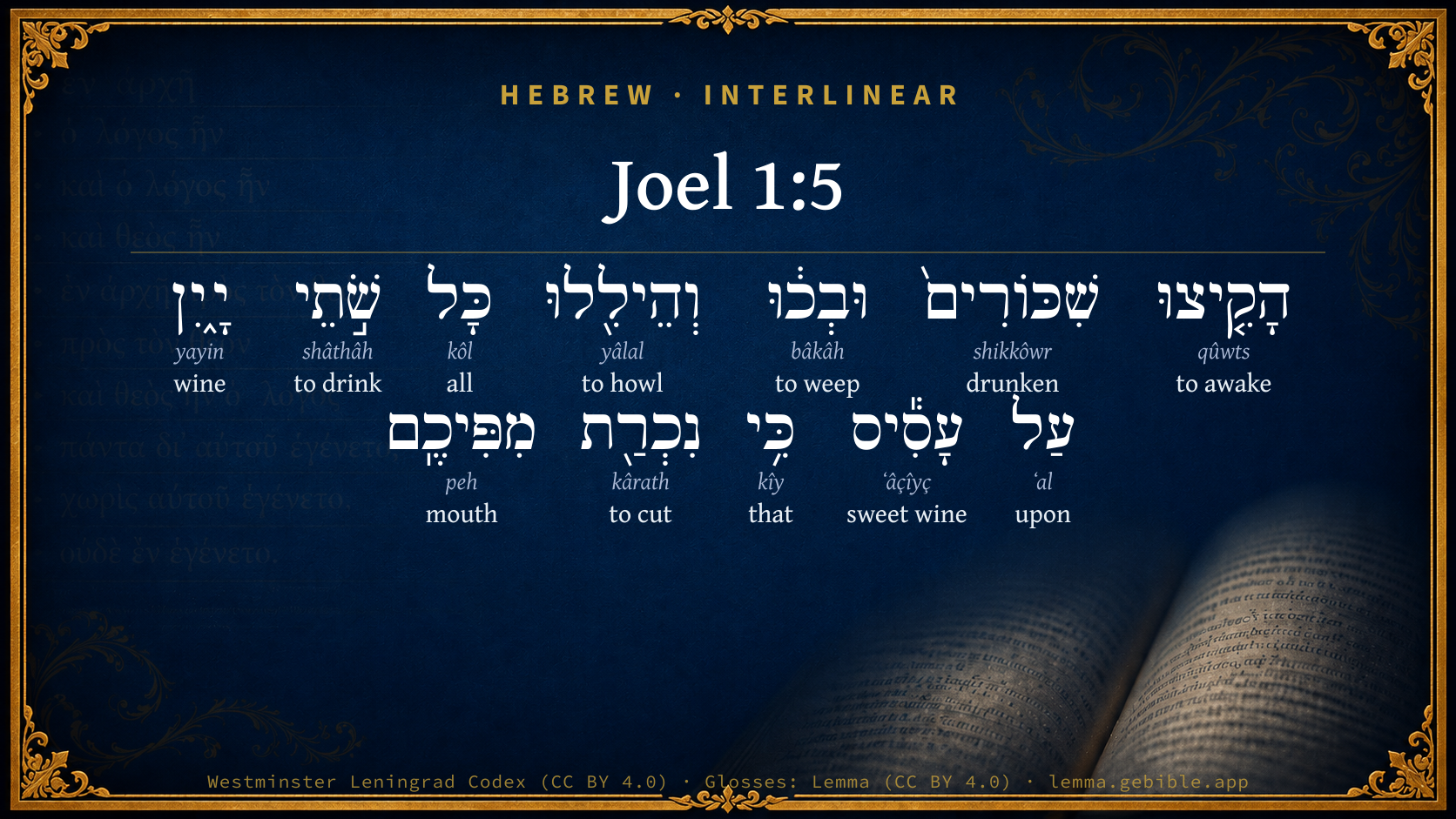
Hebrew (Westminster Leningrad Codex) Joel 1:5 appears in the Hebrew Old Testament. The text above is from the Westminster Leningrad Codex. Each word links to its Strong’s number, a concise gloss, and parsing drawn from the Open Scriptures Hebrew Bible morphology. Click any word for its full Brown-Driver-Briggs (BDB) entry.
Download image
Cite this verse

Joel 1:5 (World English Bible). Public Domain. Lemma interlinear Bible study tool, https://lemma.gebible.app/v/joel/1/5.

Show BibTeX & RIS
BibTeX
RIS
English Translation
Wake up, you drunkards, and weep! Wail, all you drinkers of wine, because of the sweet wine; For it is cut off from your mouth.
World English Bible · Public Domain
Download a study sheet

One document with this verse’s original text, its word-by-word gloss line, the meaning frame, cross-references with their text, attributed commentary, and full source and license credits — printable, and it pastes into notes with its structure intact.

This verse Autodidact and up

Study sheet (.html) Plain text (.txt)

A passage Seminary Student

Up to 50 verses in one chapter. A passage sheet keeps up to 6 commentary sources and 12 cross-references per verse, in the order this page ranks them, and says so on the sheet whenever that leaves anything out. Ask for a single verse and you get the Autodidact verse sheet above.

Everything on this page stays free to read, with no account — the sheet is a download of what is already on screen, not access to it.

Want to remove ads? Support Godless Engineer
Compare translations 3

The same verse in 3 English versions, stacked beneath the original-language interlinear above. Click any original word for its lexicon entry.

Each is an independent rendering of the whole verse — the interlinear is not word-aligned to these translations.

Highlighted words mark where these versions differ — a whole-verse word diff, not a word-by-word alignment.

  • World English Bible Public Domain
    Wake up, you drunkards, and weep! Wail, all you drinkers of wine, because of the sweet wine; For it is cut off from your mouth.
  • King James Version Public Domain
    Awake, ye drunkards, and weep; and howl, all ye drinkers of wine, because of the new wine; for it is cut off from your mouth.
  • unfoldingWord Literal Text CC BY-SA 4.0
    Wake up, drunkards, and weep! And wail, all of the drinkers of wine, upon the sweet wine, for it has been cut off from your mouth.

unfoldingWord Literal Text — © unfoldingWord, licensed CC BY-SA 4.0. Word-aligned USFM3 via Door43 (git.door43.org/unfoldingWord/en_ult).

Versions to compare (up to 4)

3 of 4 selected

Show all 18 translations

Every available English version of this verse, each an independent rendering of the whole verse.

  • World English Bible Public Domain
    Wake up, you drunkards, and weep! Wail, all you drinkers of wine, because of the sweet wine; For it is cut off from your mouth.
  • Berean Standard Bible Public Domain
    Wake up, you drunkards, and weep; wail, all you drinkers of wine, because of the sweet wine, for it has been cut off from your mouth.
  • Majority Standard Bible Public Domain
    Wake up, you drunkards, and weep; wail, all you drinkers of wine, because of the sweet wine, for it has been cut off from your mouth.
  • King James Version Public Domain
    Awake, ye drunkards, and weep; and howl, all ye drinkers of wine, because of the new wine; for it is cut off from your mouth.
  • American Standard Version (1901) Public Domain
    Awake, ye drunkards, and weep; and wail, all ye drinkers of wine, because of the sweet wine; for it is cut off from your mouth.
  • Revised Version (1885) Public Domain
    Awake, ye drunkards, and weep; and howl, all ye drinkers of wine, because of the sweet wine; for it is cut off from your mouth.
  • Geneva Bible (1599) Public Domain
    Awake ye drunkards, and weepe, and howle all ye drinkers of wine, because of the newe wine: for it shalbe pulled from your mouth.
  • Douay-Rheims (1899) Public Domain
    Awake, ye that are drunk, and weep, and mourn all ye that take delight in drinking sweet wine: for it is cut off from your mouth.
  • Young's Literal Translation Public Domain
    Awake, ye drunkards, and weep, And howl all drinking wine, because of the juice, For it hath been cut off from your mouth.
  • Literal Standard Version CC BY-SA 4.0
    Awake, you drunkards, and weep, || And howl all drinking wine, because of the juice, || For it has been cut off from your mouth.
  • Unlocked Literal Bible CC BY-SA 4.0
    Wake up, you drunkards, and weep! Wail, all you drinkers of wine, because the sweet wine has been cut off from you.
  • unfoldingWord Literal Text CC BY-SA 4.0
    Wake up, drunkards, and weep! And wail, all of the drinkers of wine, upon the sweet wine, for it has been cut off from your mouth.
  • Darby Bible Public Domain
    Awake, ye drunkards, and weep; and howl, all ye drinkers of wine, because of the new wine: for it is cut off from your mouth.
  • World Messianic Bible Public Domain
    Wake up, you drunkards, and weep! Wail, all you drinkers of wine, because of the sweet wine, for it is cut off from your mouth.
  • Webster's Bible Public Domain
    Awake, ye drunkards, and weep; and howl, all ye drinkers of wine, because of the new wine; for it is cut off from your mouth.
  • Free Bible Version CC BY-SA 4.0
    Wake up, you drunks, and weep! Howl you wine drinkers, because the new wine has been suddenly taken away from your mouth!
  • Bible in Basic English Public Domain
    Come out of your sleep, you who are overcome with wine, and give yourselves to weeping; give cries of sorrow, all you drinkers of wine, because of the sweet wine; for it has been cut off from your mouths.
  • JPS Tanakh (1917) Public Domain
    Awake, ye drunkards, and weep, and wail, all ye drinkers of wine, because of the sweet wine, for it is cut off from your mouth.

Literal Standard Version (2020), Covenant Press — licensed CC BY-SA 4.0. Text via the HelloAO Bible API (eBible.org). Unlocked Literal Bible (unfoldingWord) — licensed CC BY-SA 4.0. Text via the HelloAO Bible API (eBible.org). unfoldingWord Literal Text — © unfoldingWord, licensed CC BY-SA 4.0. Word-aligned USFM3 via Door43 (git.door43.org/unfoldingWord/en_ult). Free Bible Version, Dr. Jonathan Gallagher — licensed CC BY-SA 4.0. Text via the HelloAO Bible API (eBible.org).

Word by word

More ways to search: Search by grammar → Find every occurrence → Compare this word →

Practice this passage: Drill this verse → Learn its vocabulary →

עָסִ֕יס
ʻâçîyç
H6071
“sweet wine”
Noun, Common, Masculine, Singular, Absolute
Part of Speech
Noun
Type
Common
Gender
Masculine
Number
Singular
State
Absolute
Full BDB Definition

Origin: from H6072

TWOT: 1660a

sweet wine, wine, pressed out juice
  1. הָקִ֤יצוּ qûwts H6974 “awake” Verb, Hiphil, Imperative, 2nd Person, Masculine, Plural
  2. שִׁכּוֹרִים֙ shikkôwr H7910 “drunken” Adjective, Adjective, Masculine, Plural, Absolute
  3. וּבְכ֔וּ bâkâh H1058 “and · weep” Conjunction + Verb, Qal, Imperative, 2nd Person, Masculine, Plural
  4. וְהֵילִ֖לוּ yâlal H3213 “and · howl” Conjunction + Verb, Hiphil, Imperative, 2nd Person, Masculine, Plural
  5. כָּל kôl H3605 “all of” Noun, Common, Masculine, Singular, Construct
  6. שֹׁ֣תֵי shâthâh H8354 “drinking” Verb, Qal, Participle Active, Masculine, Plural, Construct
  7. יָ֑יִן yayin H3196 “wine” Noun, Common, Masculine, Singular, Absolute
  8. עַל ʻal H5921 “upon” Preposition
  9. כִּ֥י kîy H3588 “that” Conjunction
  10. נִכְרַ֖ת kârath H3772 “to cut” Verb, Niphal, Perfect, 3rd Person, Masculine, Singular
  11. מִפִּיכֶֽם peh H6310 “from · mouth · your” Preposition + Noun, Common, Masculine, Singular, Construct + Suffix, Personal, 2nd Person, Masculine, Plural

About this verse

These counts appear in no published source. They are computed here, from the morphology-tagged text and Lemma’s own curated glosses. What Lemma adds →

12
words
12
distinct lemmas
Prophets
section

Notable vocabulary

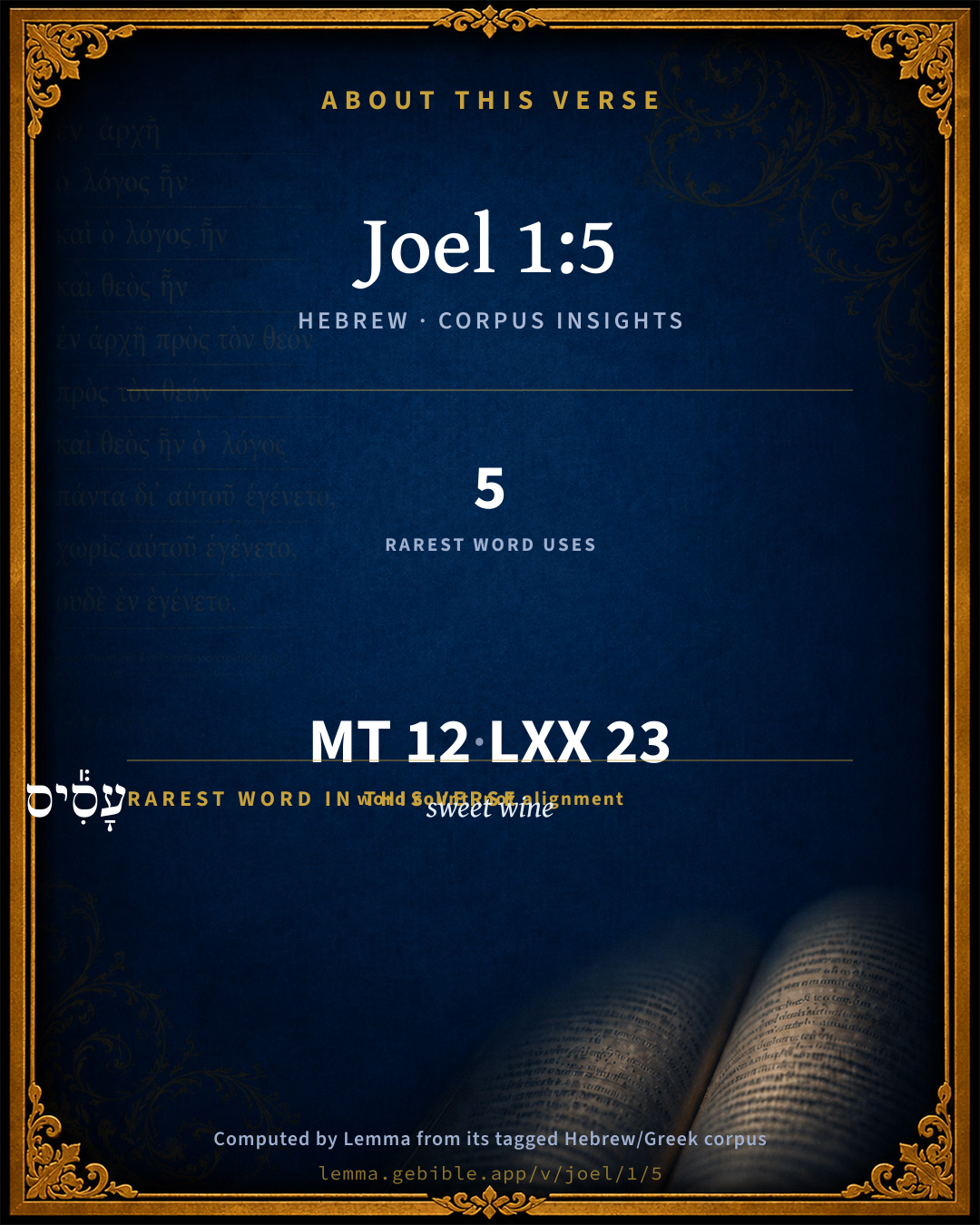
The rarest word here is עָסִ֕יס sweet wine H6071 — appearing just 5 times in the whole Hebrew Bible.

Shared distinctive vocabulary

עָסִ֕יס sweet wine H6071 occurs in 5 verses of the Hebrew Bible. Also found in:

Grammatical profile

  • 5 verbs
  • 4 nouns
  • 1 adjective
  • 1 preposition
  • 1 conjunction

Verb forms

  • הָקִ֤יצוּ Hiphil · Imperative
  • וּבְכ֔וּ Qal · Imperative
  • וְהֵילִ֖לוּ Hiphil · Imperative
  • שֹׁ֣תֵי Qal · Participle Active
  • נִכְרַ֖ת Niphal · Perfect

Hebrew & Septuagint length

In English translation the verse runs 25 words from the Hebrew and 26 from the Septuagint (LXX English) — closely comparable.

A rough comparison of the two English renderings, which tokenize alike — not a word-level alignment.

Word counts can differ between the Hebrew and the Greek without any difference in meaning — e.g. the Hebrew direct-object marker אֵת has no separate Greek word, and Greek often adds the article ὁ.

In the original languages it is 12 Hebrew tokens and 23 Greek tokens — but the two are counted differently (Hebrew bundles its prefixes and suffixes into one token; the Greek is in lemma form), so that isn’t a like-for-like length.

Cross-references

13

Topical passages linked to Joel 1:5 in the Treasury of Scripture Knowledge — connected by theme and wording, ordered by reader-vote popularity; previews shown in the World English Bible.

  • James 5:1 Come now, you rich, weep and howl for your miseries that are coming on you.
  • Luke 21:34–36 "So be careful, or your hearts will be loaded down with carousing, drunkenness, and cares of this life, and that day will come on you suddenly.
  • Isaiah 32:10–12 For days beyond a year shall you be troubled, you careless women; for the vintage shall fail, the harvest shall not come.
  • Isaiah 24:7–11 The new wine mourns, the vine languishes, all the merry-hearted do sigh.
  • Jeremiah 4:8 For this gird you with sackcloth, lament and wail; for the fierce anger of Yahweh hasn't turned back from us.
  • Ezekiel 30:2 Son of man, prophesy, and say, Thus says the Lord Yahweh: Wail, Alas for the day!
  • Joel 1:11 Be confounded, you farmers! Wail, you vineyard keepers; For the wheat and for the barley; For the harvest of the field has perished.
  • Joel 1:13 Put on sackcloth and mourn, you priests! Wail, you ministers of the altar. Come, lie all night in sackcloth, you ministers of my God, For the meal offering and the drink offering are withheld from your God's house.
  • Joel 3:3 And have cast lots for my people, And have given a boy for a prostitute, And sold a girl for wine, that they may drink.
  • Amos 6:3–7 Those who put far away the evil day, And cause the seat of violence to come near;
  • Luke 16:19 "Now there was a certain rich man, and he was clothed in purple and fine linen, living in luxury every day.
  • Luke 16:23–25 In Hades, he lifted up his eyes, being in torment, and saw Abraham far off, and Lazarus at his bosom.
  • Romans 13:11–14 Do this, knowing the time, that it is already time for you to awaken out of sleep, for salvation is now nearer to us than when we first believed.

Cross-references courtesy of OpenBible.info (CC BY 4.0).

Hebrew and Greek witnesses Masoretic Hebrew ↔ Greek Septuagint

The same verse in the two great witnesses to the Old Testament, shown verse-for-verse.

These are two independent witnesses, not word-aligned to each other, and the Septuagint is shown in lemma (dictionary) form.

Hebrew Joel 1:5 Masoretic · Westminster Leningrad Codex

הָקִ֤יצוּ שִׁכּוֹרִים֙ וּבְכ֔וּ וְהֵילִ֖לוּ כָּל שֹׁ֣תֵי יָ֑יִן עַל עָסִ֕יס כִּ֥י נִכְרַ֖ת מִפִּיכֶֽם

Wake up, you drunkards, and weep! Wail, all you drinkers of wine, because of the sweet wine; For it is cut off from your mouth.

World English Bible · Public Domain

Greek LXX Joel 1:5 Septuagint · lemma form

ἐκνήφω ὁ μεθύω ἐκ οἶνος αὐτός καί κλαίω θρηνέω πᾶς ὁ πίνω οἶνος εἰς μέθη ὅτι ἐκαἴρω ἐκ στόμα σύ εὐφροσύνη καί χαρά

Awake, you⌃ drunkards, from your wine, and weep: mourn, all you⌃ that drink wine to drunkenness: for joy and gladness and removed are from your mouth.

LXX2012 (modern English Septuagint) · Public Domain

On this verse, Ellicott's Commentary for English Readers discusses the Septuagint’s reading. Read the note in Commentary ↓

Hebrew: Westminster Leningrad Codex (CC BY 4.0). Greek: Septuagint (public domain); English from LXX2012 (modern English Septuagint) (Public Domain). How the Septuagint differs from the Hebrew →

Targum (Aramaic paraphrase)

1

The Targum is the ancient Jewish Aramaic paraphrase of the Hebrew Scriptures — an interpretive translation, not the Hebrew text itself. Onkelos (literal) and Pseudo-Jonathan (expansive) render the Torah, and Jonathan the Prophets. Coverage is partial: where no permissively-licensed English translation exists for a verse, only the Aramaic is shown. This is verse-level text, not a word-by-word alignment to the Hebrew.

  1. Targum Jonathan Prophets (Joshua–Malachi)
    אִתְעָרוּ רַוַיָא וּבְכוֹ וְאַיְלִילוּ כָּל שָׁתֵי חֲמַר עַל חֲמַר מְרַת אֲרֵי אִתְמְנַע מִפּוּמְכוֹן:

    (no public-domain English translation for this verse)

    Targum Jonathan — Aramaic: “Mikraot Gedolot” (public domain). English: “Sefaria Community Translation” (CC0 1.0 (public-domain dedication)); “London "Chaldee Paraphrase," 1871” (public domain). Text via Sefaria.

Commentary

Notes on Joel 1:5 from classic Christian and Jewish commentators (each source and its license shown beneath its notes). The classic Christian expositions comment on the surrounding passage and are grouped to its opening verse, so a note may address several verses; the Jewish commentaries on the Tanakh (Rashi and others) are per-verse, so they appear only where the commentator wrote on this verse.

Lemma curates 59 commentaries, every one of them public domain or Creative Commons licensed, each selected and text-cleaned for this edition rather than reprinted as found. About our sources →

The Cambridge Bible for Schools and Colleges

gen. ed. J. J. S. Perowne

5–12. All classes are to unite in lamenting this calamity, which has not only (1) deprived them of some of their most valued luxuries, Joe_1:5-7, but also (2) interrupted the public worship of God, Joe_1:8-10, and (3) even left them destitute of the means of subsistence, Joe_1:11-12.

Awake, ye drunkards] viz. from the sleep of intoxication (Gen_9:24; Pro_23:35), which the ruin of the vintage will soon render impossible.

howl] in wild and desperate grief: so Joe_1:11; Joe_1:13. Comp. on Amo_8:3.

because of the sweet wine] Heb. ‘âsîs: see on Amo_9:13.

from your mouth] where it is a source to you of gratification.

The Cambridge Bible for Schools and Colleges (gen. ed. J. J. S. Perowne; Cambridge University Press, 1878–1918) — public domain. Text from a community e-Sword module.

Trapp's Complete Commentary

John Trapp

Joe 1:5 Awake, ye drunkards, and weep; and howl, all ye drinkers of wine, because of the new wine; for it is cut off from your mouth.

Ver. 5. Awake, ye drunkards] Ye ale stakes, and suckers (Heb. Shiccorim), that pour in heady and intoxicating drinks, such as soon lay you to sleep, and (besides) take away your heart, Hos 4:11, rob you of yourselves, and lay a beast in your room. Portentosum sane potionis genus, saith Pliny concerning ale, that excessively drunk maketh men mere sleepy than dormice: besides that worse sleep of carnal security, Eph 5:14 Rom 13:11. These, therefore, are here called upon to be sober and watch, {see 1Th 5:6 1Pe 5:8 1Pe 4:7} yea, to weep and howl, to turn their laughter into mourning, and their joy into heaviness. And why? For their sin they should have done (as that drunkard in the ecclesiastical history, that, touched with a sense of his sin, wept himself blind), but here they are sarcastically called upon to weep for their great loss, as they esteem it.

Because of the new wine, for it is cut off from your mouth] As many things occur between the chin and the chalice, the cup and the lip: you made account to have mouthed it, to have swilled your souls, as they say, and to have swallowed it down your wide gullets, Vinum merum nondum dilutum. But behold, it happens somewhat otherwise; the caterpillar hath been before you, and left you nothing better than Adam’s ale to tipple. This as cold comfort to the drunkard, whose word is that of the vine in Jotham’s parable, Non possum relinquere vinum meum, I am not able to leave my wine. Take away my liquor, you take away my life. Austin brings him in saying, Malle se vitam quam vinum eripi, He would rather lose his life than his wine. And Ambrose tells of one Theotimus, that being told by his physicians, that much quaffing would make him blind, Vale lumen amicum, said he, Farewell, sweet eyes; if ye will not bear wine, ye are no eyes for me. This drunkard would rather lose his sight than his sin; his soul than his lust. Such kind of persons are like the panther, which is said to love the dung of man so much, as if it be hanged on high from it, it will skip and leap up, and never leave till it have burst itself in pieces to get it; and this is the way they take that creature. God will take these natural brute beasts, made to be taken and destroyed, 2Pe 2:14, after another manner. He will not only cut them short enough here, but turn a cup of fire and brimstone down their throats, Psa 11:6, which will be worse to them than that ladleful of boiling lead poured down the throat of a drunken Turk, by the command of a bashaw.

John Trapp, A Commentary or Exposition upon All the Books of the Old and New Testament (1647–1656) — public domain. Text from a community e-Sword module.

The Biblical Illustrator

Joseph S. Exell

Joe_1:5-9

Awake, ye drunkards, and weep.

The insensibility and misery of the drunkard

The prophet now endeavours to awaken certain characters in the nation to an earnest sense of the woe that has overtaken them, and to deep repentance, that it may be averted. His first warning cry is to the drunkard. The evils of intoxication are often intimately connected with national plagues, and require that earnest ministries should be directed against them.

I. that the drunkard is insensible to the most important concerns of life, Awake. The prophet knew that it was the tendency of intoxicating drink to cast men into an unholy slumber, and to render them dangerously insensible to the most important things around them.

1. Intoxicating drink has a tendency to darken the intelligence of man.

2. Intoxicating drink has a tendency to deaden the moral susceptibilities of man. These drunkards of Judah were not merely mentally blind to the calamities which had come upon their country, but were morally incapable of estimating their due social effect.

3. Intoxicating drink has a tendency to destroy the conscience of man. These drunkards of Judah probably did not consider that they were working their own moral degradation, and that they were inviting the retribution of heaven. They imagined that they were enjoying the plenty they possessed, and that they were the happiest of men. The prosperity of fools shall slay them.

II. That the drunkard is exposed to the most abject misery. And howl, all ye drinkers of wine, because of the new wine; for it is cut off from your mouth.

1. He is liable to the misery of self-loathing. We can readily imagine that these drunkards of Judah would now and then awake from their sottish slumber, and that in the moment of bodily pain they would be seized with sad thoughts of their own degradation.

2. He is liable to the misery of social contempt. Drunkards are the object of social scorn, they are incapable of industrious work, they are injurious to the common good. They prostitute great abilities. They misuse golden opportunities. They place manhood on a level with the brute.

3. They are liable to the misery of unsatisfied appetite. The drunkards of Judah would howl because the new wine was cut off from their mouth. They had abused the gifts of providence, and now they are no longer allowed to enjoy them. Sin brings the wealthiest of sinners to want. Plenty at one time is no guarantee against penury at another. In the next life the appetite which sin has created will be for ever unsatisfied; then the wine will indeed be cut off from the mouth.

III. that the drunkard is in immediate need of the most earnest ministry which can be addressed to him. We cannot but see in this verse that the prophet addressed the drunkards of Judah in earnest and faithful speech. He called them by their right name. He urged them to thoughtfulness and repentance. There is need that the pulpit of our age should take up his cry. Lessons--

1. That the drunkard is incapable of the qualities necessary for true citizenship.

2. That many national calamities are occasioned by the drunkard.

3. That the most effective ministries of the Church should be directed against this, terrible evil. (J. S. Exell, M. A.)

Judgments adapted to sins

Prevailing Sins are often visited with corresponding judgments. The Lord in His righteous dealings withholds those gifts of His providence which have been abused. He takes from an ungodly people the means of gratifying their lusts, and leads them to repentance by afflictions which are not capriciously ordered, but with exactest wisdom suited to their character. Thus, to check a thoughtless indifference to religion, He sends forth pestilences which strike down thousands and spread universal dismay. To restrain from habits of self-indulgence and extravagance, He causes a blight to fall upon the earth, bringing on scarceness and want. To put a rein upon the unsatiated pursuit of wealth, He allows a panic on the Stock Exchange. So here the prophet denounces no other woe against the drunkards than the deprivation of the wine they had abused. It is not unlikely that this part of the prophecy has a literal as well as symbolical aspect, that it inveighs against intemperance as well as idolatry. It was sensuality that first led the Israelites into idolatry. Persistence in indulgences so debilitated their minds and blinded their understandings as to cause them to apostatise from Jehovah, and fall down before images of wood and stone. On no class of persons do Gods judgments fall more heavily than on those who embrute their souls with the intoxicating delights of idolatrous worship. (C. Robinson, LL. D.)

Woe to drunkards

Satan has three or four grades down which he takes men to destruction. One man he takes up, and through one spree pitches him into eternal darkness. That is a rare case. Very seldom, indeed, can you find a man who will be such a fool as that. Satan will take another man to a grade, to a descent at an angle about like that of the Pennsylvania coal-shute or the Mount Washington rail-track, and shove him off. But that is very rare. When a man goes down to destruction Satan brings him to a plane. It is almost a level. The depression is so slight that you can hardly see it. The man does not actually know that he is on the down grade and it tips only a little towards darkness--just a little. And the first mile it is claret, and the second mile it is sherry, and the third mile it is punch,, and the fourth mile it is ale, and the fifth mile it is porter, and the sixth mile it is brandy, and then it gets steeper and steeper and steeper and the man gets frightened and says, Oh, let me get off! No, says the conductor, this is an express train, and it does not stop until it gets to the Grand Central Depot at Smashupton. (T. De Witt Talmage.)

For a nation is come up upon my land, strong, and without number.

The agencies of Divine retribution

It is generally the way of God to meet sin by appropriate retribution; hence He destroys the vines of the drunkard. Some men are only reached through the lowest propensities of their nature, and are only conscious of penalty when their carnal wants are unsupplied.

I. That the agencies of divine retribution are great in their number, For a nation is come up upon my land, strong, and without number.

1. These agencies are numerous; The locusts did not come in a single flight, but in incredible and successive swarms, Heaven has an infinite resource of retributive messengers waiting its behest, It can soon darken our lives by a throng of hostile energies.

2. These agencies are strong. True, these locusts were in themselves weak and diminutive creatures, They were not like the proud monarch of the forest, and had not the majestic appearance or strength of the lion or the bear. They were insects. And so the most trivial agencies of the universe, when sent by God to punish sin, become mighty and resistless. Then the superior intelligence of man will avail nothing against them. Then the pride of the mighty will be brought to the dust.

3. These agencies are united, The locusts came upon the land of Judah as though they were animated by one national policy. The ants and conies are designated a people (Pro_30:25-26), indicative of the wisdom by which they are Divinely taught to act. Hence the term nation gives no favour to the view that the locusts are symbolical era foreign invasion. And so the retributive agencies of heaven often come upon the wicked in terrible combination. The agencies of Eternal Justice are unconsciously in sympathy with each other, and advance in one vast army to execute the penalty of sin.

II. That the agencies of divine retribution are well equipped for their work. Whose teeth are the teeth of a lion, and he hath the cheek-teeth of a great lion.

1. Their equipment is appropriate. The teeth of the locust are said to be harder than stone. They appear to be created for a scourge; since to strength incredible for so small a creature, they add saw-like teeth admirably calculated to eat up all the herbs in the land. The providence of God in executing the penalty of sin generally employs those agencies whose natural constitution the best fit them for the end contemplated. Heaven knows the most appropriate instrumentalities by which to punish the sinner.

2. Their equipment is fierce. These locusts were armed as with the cheek-teeth of a great lion. Thus they would be able to bite off the top, branches, and boughs of trees. And truly there are times when the judgments of heaven come fiercely upon the wicked, and destroy all that is precious to them.

III. That the agencies of divine retribution are desolating in their effect. He hath laid my vine waste, and barked my fig-tree: he hath made it Clean bare, and cast it away; the branches thereof are made white.

1. They desolate things of the greatest value. These locusts laid waste the noblest and most valuable fruit-trees of the land, which the Lord had given to His people for their inheritance. The messengers of Eternal Justice will not spare the vines and fig-trees of a sinful life. They strike at the root of all secular prosperity.

2. They desolate things to the utmost extent. These locusts attacked the herbage, fruit, leaves of trees, the young shoots, and their bark. Everything in the country was devoured and made clean bare. And so the agencies of Divine retribution sometimes spread their desolation over a vast area, over the entire history of a nation, throughout the entire circumstances of a family, or of an individual. They leave no token of former splendour.

3. They desolate things to the remotest period. The agencies of Divine retribution often achieve a destruction which is felt to the end of life.

IV. That the agencies of Divine retribution are productive of sad contemplation in the mind of the truly patriotic. For a nation is come up upon my land. The prophet here speaks in his character of representative of the people of God, and sees in the desolation of his country an occasion for sorrow. Hence the prophet, regarding the land as a Christian patriot, was pained by its desolation, and sought to remove the cause of the Divine anger. Piety makes men truly patriotic. Lessons--

1. That the retributive agencies of heaven are countless in number.

2. That the retributive agencies of heaven are effective in equipment.

3. That the retributive agencies of heaven spare not the most sacred possessions. (J. S. Exell, M. A.)

And barked my fig-tree.--

The fig-tree barked

We all have our fig-trees, and very early we become proprietors. Do these fig-trees continue to live and to thrive? Experience and observation furnish a prompt and sufficient reply. To bark a tree is to destroy it. To bark our fig-tree is to remove that in which we have found chief pleasure and advantage.

I. When may God be said to bark our fig-tree?

1. When God renders that which has been useful to us useless, and that which has been pleasant, obnoxious; and that which has been helpful, injurious.

2. When God removes something from us which He has given to us, and which we have taken to our hearts as all-important, and as supremely precious.

3. By breaking up some work of ours in which we have found much pleasure; or by rooting up something which we have planted, it may be with tears, it may be with joy.

II. By what means does god bark our fig-trees? God uses various means. He may permit some devil, commission some angel, allow or employ a fellow-man to bark our tree. He may use some inanimate and unconscious agent. Or He may effect the destructive work by some influence upon our minds and hearts.

III. With what intent is this done? What is the end of the Lord? Does He do this wantonly, cruelly, ignorantly, or unwisely? Nay, His object is either correction or prevention.

IV. How should a man of god demean himself when God barks his fig-tree? Submit quietly. Reverently ask, Why has God done this? Learn to use all temporal things without abusing thorn. (Samuel Martin.)

Barked fig-trees

I. Look at some of these barked fig-trees. High hopes are often changed into cruel disappointments. Bright prospects of coming happiness are turned, like fairy gold, into withered leaves. A young mans fig-tree is a healthy body and high spirits, and that tree is barked when affliction seizes him, and bodily weakness and mental depression make him as pale and helpless as a downright old man. A workmans fig-tree is regular work and a living wage; that tree is barked when work is scarce and wages low. The tradesmans fig-tree is a prosperous business; providence smiles upon him, friends multiply, and everything promises a golden harvest, when suddenly he meets with disappointment, his schemes are thwarted, the bank fails, and he is doomed to spend a helpless and penniless old age. A familys fig-tree is the father and husband; and it is barked when he is smitten down by death. The old mans fig-tree is a gladsome old age, which he hopes to spend with his wife and children about him; and that tree is barked when he suddenly dies before he has realised a thousandth part of his anticipated enjoyment. The invalids fig-tree is some glimmering hope of returning health; and it is barked when the doctor tells him that his disease is incurable, and that he must die.

II. Who barks our fig-trees? The prophet, looking up to God, said, Thou hast barked my fig-tree. The affairs of men, and especially of good men, are under Gods wise, omniscient, benevolent, and almighty control. Were there no particular, there could be no general providence, for it seems quite impossible to take care of the whole ii the separate and dependent parts be neglected. He holds the helm of the universe, and He will bring us into the desired haven.

III. Why does God bark our fig-trees?

1. Does He do it unkindly? No! He is too good to be unkind.

2. Does He do it unwisely? No! He is too wise to err.

3. God barks our fig-trees in mercy, and not in wrath. We are prone to think too much of those trees; to bestow too much thought and affection upon them, and to expect too much happiness from them.

4. Barked fig-trees destroy worldliness. Thomas Erskine used to say: Education would cease if we and our circumstances fitted each other. If our position in this world were always one of unmixed comfort, Im afraid we should never stretch our desires for a better. It is often said that the world satisfies no one; but, as a matter of fact, most men are so satisfied with it that they feel no concern for a better country, that is, a heavenly. Now, what is God to do with such people if their souls are not to be lost, but saved? They must be rendered dissatisfied with their earthly condition, and be made to welcome the hope of a happier state beyond the grave. And what is so likely to do this as some dispensation which snatches from them the objects of their inordinate affection?

5. Barked fig-trees help to mature Christian character. In the midst of our heaviest trials and deepest woes we can sing of mercy as well as of judgment.

(1) Jobs fig-tree was barked (Jam_5:11).

(2) Jacobs fig-tree was barked. The loss of Joseph was regarded by his family as a great domestic calamity.

(3) Pauls fig-tree was barked. He suffered imprisonment at Rome; some false brethren created division and strife in the Church.

(4) Barked fig-trees help to develop latent qualities. It was when Paul Gerdhart was banished from his church and manse, for preaching unpalatable truth, that he wrote that inspiring hymn, Give to the winds thy fears, etc.

IV. What are the lessons that this subject suggests?

1. Recognise the providence of God in all the events of life.

2. Moral goodness is the aim of all Gods dispensations.

3. Trust Gods providence. (H. Woodcock.)

The Biblical Illustrator, edited by Joseph S. Exell (c. 1880s–1900s) — public domain. Text from a community e-Sword module.

Joseph Benson's Commentary

Joe 1:5. Awake, ye drunkards — From the long sleep occasioned by your intoxication. Kimchi comments thus on the place: “You, who accustom yourselves to get drunk with wine, awake out of your sleep, and weep night and day; for the wine shall fail you, because the locust shall devour the grape.” The exhortation implies, that the calamity should particularly affect those who were given to an excess of drinking, and that it should touch them in a tender part; the wine which they loved so well should be cut off from their mouths. Observe, reader, it is just with God to take away those comforts which are abused to luxury and excess.

Joseph Benson's Commentary on the Old and New Testaments (1811–1818) — public domain. Text from a community e-Sword module.

Whedon's Commentary on the Bible

Daniel D. Whedon

5-12. The prophet calls upon all to lament, because all luxuries are cut off (Joe_1:5-7); the worship of Jehovah has suffered through the interruption, or at least threatened interruption, of the meal offerings and the drink offerings (8-10); and the means for the sustenance of life are destroyed and cut off by the locusts (Joe_1:11-12). Joe_1:5.

Wine — Frequently spoken of as a blessing from God (Hos_2:8, etc.), which was often abused. One of the results of abuse is the blinding of the spiritual faculties. One of the six woes in Isa_5:8 ff., is against the dissipating nobles who, as a result of their revelries, “regard not the work of Jehovah, neither have they considered the operation of his hand.” Though the judgment has fallen, the stupefied drunkards are not yet aware of it.

Awake — It is high time to awake from the sleep of intoxication (Gen_9:24; Pro_23:35).

Weep — If no other and higher motives appeal to them, at least the loss of the wine should arouse them; the supply will soon be exhausted, the luxurious living, the revelries, must cease.

New [“sweet”] wine — Hebrews ‘asis, “that which is pressed out”; therefore, “the newly pressed wine,” “sweet wine,” “must.” In Joe_3:18, it is regarded as a blessing from God (Amo_9:13). In Isa_49:26, it is referred to in a way that would indicate its intoxicating character (compare Son_8:2). The exhortation was very appropriate if the vintage was near at hand when the locusts appeared and laid waste the vineyards (Joe_1:7; Joe_1:12).

The drunkards, startled from their slumber, might inquire for the cause of it all. Joe_1:6-7 furnish the answer. First the prophet calls attention to the immense numbers of the enemies, then to their terrible weapons, finally to the awful results of their attack.

Nation — Hebrews goy. The locusts devastate the land like a hostile army. The use of goy furnishes no support to the allegorical view; it is synonymous with ‘am (Joe_2:27), which is used of animals (Pro_30:25-26; Zep_2:14); here specially appropriate, because the figure of a hostile army is continued.

Come up upon — A military term used of the approach of an enemy (1Ki_20:22; Isa_21:2; Nah_2:2).

My land — A comparison with Joe_2:1, “my holy mountain,” might justify the explanation that the prophet means Jehovah’s land (Pusey, Von Orelli, and others), but it is better to interpret the pronoun as referring to the prophet, who identifies himself with and speaks in the name of the people (Joe_1:7; Joe_1:13; Joe_1:19, etc.).

Strong — Not easily tired, able to take a long journey, and to persevere until the destruction is complete.

Without number — No exaggeration, if we accept the testimony of those who have experienced calamities of this sort. “Myriads upon myriads of locusts were about us, covering the ground and shutting out the view in all directions.”

Teeth — These are the weapons of the enemy. “The locusts’ teeth are edged like a saw and very powerful; hence, though infinitely smaller, they may for destructiveness be compared with those of a lion.” It is said by Morier that the teeth of the locust “appear to have been created for a scourge; since to strength incredible for so small a creature they add saw-like teeth admirably calculated to eat up all the herbs in the land.” An interesting parallel to “a lion’s teeth” is Sir_21:2, where the teeth of sin are likened to the “teeth of a lion slaying the souls of men.”

Cheek teeth — Better, jaw teeth — the sharp and prominent eyeteeth.

Lion,… great lion — Or, lioness — The second line is not a useless repetition, but an advance over the first. It is generally thought that the lioness is even fiercer than the lion in attack, especially when she tries to defend her whelps (see on Hos_13:8). An early writer, AElianus (Historia, 12:39), says, “Not only among the Greeks, but also among the barbarians, the lioness is thought to be the strongest animal and the one hardest to be fought.”

Joe_1:7 deals with the destruction wrought. Literally, He has made my vine to waste, and my fig tree to splinter. The Hebrew for the last word occurs only here; its meaning is, therefore, somewhat uncertain. The same word in its masculine form is found in Hos_10:7, where it is translated (in R.V. margin) “twigs,” so here, “twigs” or “splinters.” The interpretation implied in the rendering of A.V. is undoubtedly correct, for the prophet has in mind the “gnawing and eating away” of the bark. The vine and the fig tree are the principal fruit trees of Palestine, the pride of the land; their destruction would be the greatest possible calamity.

Clean bare — Literally, making bare he has made it bare. Through constant gnawing the locust has made the tree entirely bare; the blossoms, the foliage, the bark, everything that can be gnawed off he has taken away. “It is sufficient if these terrible columns stop half an hour on a spot for everything growing on it, vines, olive trees, corn, to be entirely destroyed. After they have passed nothing remains but the large branches and the roots, which, being underground, have escaped their voracity.” (From an account of the devastation caused by locusts, in Spain in 1841.) “The bushes were eaten quite bare, though the animals could not have been long on the spot.… They sat by hundreds on a bush gnawing the rind and the woody fibers” (Lichtenstein, Travels in South Africa, p. 251).

And cast it away — R.V. margin, “down” — to the ground. As the italics indicate, there is in the original no pronominal suffix to indicate what is cast down. Hardly the trees themselves (Keil); more probably, that “which is not green and contains no sap, that which is uneatable”; it the locust flings away with anger and contempt. And the branches thereof are made white —Literally, they make white, show whiteness. Branches, as the etymology of the word, something intertwined, indicates, are the branches of the vine only; through the gnawing off of the bark the white of the vine becomes visible. “The country did not seem to be burned, but to be covered with snow on account of the whiteness of the trees” (Fr. Alvarez, das Indias, quoted by Pusey in loco). H. Ludolf, in History of AEthiopia, speaking of locusts, says: “Neither herbs, nor shrubs, nor trees remain unhurt. Whatever is either grassy or covered with leaves is injured as if it had been burned with fire; even the bark of the trees is nibbled with their teeth, so that the injury is not confined to one year alone” (Joe_2:25).

With Joe_1:8 begins a new paragraph. The prophet turns from the winebibbers to the entire community (Joe_1:8-10), urging it to bewail the devastation of the land, as a virgin would mourn the death of the beloved of her youth. All prospects for the future are blighted; want stares them in the face. The most serious aspect of the calamity, however, is the fact that the means to maintain the legal worship have become or are about to become exhausted.

Daniel D. Whedon (gen. ed.), Commentary on the Old and New Testaments (1874–1909) — public domain. Text from a community e-Sword module.

Keil & Delitzsch

C. F. Keil & F. Delitzsch

In order that Judah may discern in this unparalleled calamity a judgment of God, and the warning voice of God calling to repentance, the prophet first of all summons the wine-bibbers to sober themselves, and observe the visitation of God. Joe 1:5. "Awake, ye drunken ones, and weep! and howl, all ye drinkers of wine! at the new wine; for it is cut off from your mouth. Joe 1:6. For a people has come up over my land, a strong one, and innumerable: its teeth are lion's teeth, and it has the bite of a lioness. Joe 1:7. It has made my vine a wilderness, and my fig-tree into sticks. Peeling, it has peeled it off, and cast it away: its shoots have grown white." הקיץ to awake out of the reeling of intoxication, as in Pro 23:35. They are to howl for the new wine, the fresh sweet juice of the grape, because with the destruction of the vines it is taken away and destroyed from their mouth. Joe 1:6 and Joe 1:7 announce through whom. In the expression gōi ‛âlâh (a people has come up) the locusts are represented as a warlike people, because they devastate the land like a hostile army. Gōi furnishes no support to the allegorical view. In Pro 30:25-26, not only are the ants described as a people (‛âm), but the locusts also; although it is said of them that they have no king. And ‛âm is synonymous with gōi, which has indeed very frequently the idea of that which is hostile, and even here is used in this sense; though it by no means signifies a heathen nation, but occurs in Zep 2:9 by the side of ‛âm, as an epithet applied to the people of Jehovah (i.e., Israel: see also Gen 12:2). The weapons of this army consist in its teeth, its "bite," which grinds in pieces as effectually as the teeth of the lion or the bite of the lioness (מתלּעות; see at Job 29:17). The suffix attached to ארצי does not refer to Jehovah, but to the prophet, who speaks in the name of the people, so that it is the land of the people of God. And this also applies to the suffixes in גּפני and תּאנתי in Joe 1:7. In the description of the devastation caused by the army of locusts, the vine and fig-tree are mentioned as the noblest productions of the land, which the Lord has given to His people for their inheritance (see at Hos 2:14). לקצפה, εἰς κλασμόν, literally, for crushing. The suffix in chăsâphâh refers, no doubt, simply to the vine as the principal object, the fig-tree being mentioned casually in connection with it. Châsaph, to strip, might be understood as referring simply to the leaves of the vine (cf. Psa 29:9); but what follows shows that the gnawing or eating away of the bark is also included. Hishlı̄kh, to throw away not merely what is uneatable, "that which is not green and contains no sap" (Hitzig), but the vine itself, which the locusts have broken when eating off its leaves and bark. The branches of the vine have become white through the eating off of the bark (sârı̄gı̄m, Gen 40:10).

(Note: H. Ludolf, in his Histor. Aethiop. i. c. 13, 16, speaking of the locusts, says: "Neither herbs, nor shrubs, nor trees remain unhurt. Whatever is either grassy or covered with leaves, is injured, as if it had been burnt with fire. Even the bark of trees is nibbled with their teeth, so that the injury is not confined to one year alone.")

Keil & Delitzsch — Biblical Commentary on the Old Testament (1861–1891) — public domain (CC PDM 1.0). Text via the HelloAO Bible API. (Old Testament only.)

Tyndale Open Study Notes

Tyndale Open Resources

1:5 Wake up . . . Wail: The prophet sought to arouse the people and alert them to the gravity of the locust plague.

Tyndale Open Study Notes — © Tyndale Open Resources, licensed CC BY-SA 4.0. Text via the HelloAO Bible API.

Geneva Bible (1599)

Geneva Bible translators

Meaning, that the occasion of their excess and drunkenness was taken away.

Geneva Bible (1599) marginal notes — public domain. Text via Bolls.life.

Jamieson, Fausset & Brown

Robert Jamieson, A. R. Fausset & David Brown

Awake--out of your ordinary state of drunken stupor, to realize the cutting off from you of your favorite drink. Even the drunkards (from a Hebrew root, "any strong drink") shall be forced to "howl," though usually laughing in the midst of the greatest national calamities, so palpably and universally shall the calamity affect all.

wine . . . new wine--"New" or "fresh wine," in Hebrew, is the unfermented, and therefore unintoxicating, sweet juice extracted by pressure from grapes or other fruit, as pomegranates (Sol 8:2). "Wine" is the produce of the grape alone, and is intoxicating (see on Joe 1:10).

Jamieson, Fausset & Brown — Commentary Critical and Explanatory on the Whole Bible (1871) — public domain (CC PDM 1.0). Text via the HelloAO Bible API.

Adam Clarke's Commentary

Verse 5. Awake, ye drunkards] The general destruction of vegetation by these devouring creatures has totally prevented both harvest and vintage; so that there shall not be wine even for necessary uses, much less for the purposes of debauchery. It is well known that the ruin among the vines by locusts prevents the vintage for several years after.

Adam Clarke's Commentary on the Bible (1810–1826) — public domain. Text from a community e-Sword/MySword module.

John Calvin's Commentaries

The Prophet adds this verse for the sake of amplifying; for when God sees men either contemptuously laughing at or disregarding his judgments, he derides them; and this mode the Prophet now adopts. ‘Ye drunkards,’ he says, ‘awake, and weep and howl.’ In these words he addresses, on the subject in hand, those who had willfully closed their eyes to judgments so manifest. The Jews had become torpid, and had covered themselves over as it were with hardness; it was then necessary to draw them forth as by force into the light. But the Prophet accosts the drunkards by name; and it is probable that this vice was then very common among the people. However that might be, the Prophet by mentioning this instance shows more convincingly, that there was no pretense for passing by things, and that the Jews could not excuse their indifference if they took no notice; for the very drunkards, who had degenerated from the state of men, did themselves feel the calamity, for the wine had been cut off from their mouth. And this expression of the Prophet, “Awake”, ought to be noticed; for the drunkards, even while awake, are asleep, and also spend a great portion of time in sleep. The Prophet had this in view, that men, though not endued with great knowledge, but even void of common sense, could no longer flatter themselves; for the very drunkards, who had wholly suffocated their senses, and had become thus estranged in their minds, did yet perceive the judgment of God; though drowsiness held them bound, they were yet constrained to awake at such a manifest punishment. What then does this ignorance mean, when ye see not that you are smitten by God’s hand?

To the same purpose are the words, Weep and howl. Drunkards, on the contrary, give themselves up to mirth, and intemperately indulge themselves; and there is nothing more difficult than to make them to feel sorrow; for wine so infatuates their senses, that they continue to laugh in the greatest calamities. But the Prophet says, Weep and howl, ye drunkards! What then ought sober men to do? He then adds, Cut off is the wine from your mouth. He says not, “The use of wine is taken away from you;” but he says, from your mouth. Though no one should think of vineyards or of winecellars or of cups, yet they shall be forced, willing or unwilling, to feel the judgment of God in their mouth and in their lips. This is what the Prophet means. We then see how much he aggravates what he had said before: and we must remember that his object was to strike shame into the people, who had become thus torpid with regard to God’s judgments.

As to the word עסיס osis, some render it new wine. עסס osas is to press; and hence עסיס osis is properly the wine that is pressed in the wine-vat. New wine is not what is drawn out of the bottle, but what is pressed out as it were by force. But the Prophet, I have no doubt, includes here under one kind every sort of wine. Let us go on.

John Calvin's Commentaries (1540-1563) — public domain. Text from the Calvin Translation Society English edition (1840s-50s) via the Christian Classics Ethereal Library (ccel.org). Calvin's coverage is partial (roughly two-thirds of the Bible); uncommented books and verses are honest gaps, never fabricated. The 19th-century editor's footnotes and remarks are omitted so the notes are faithfully Calvin's own voice.

Ellicott's Commentary for English Readers

(5) Awake, ye drunkards—i.e., awake from such an insensibility as wine causes. The people failed to see the hand of God in the terrible calamity, like an acted parable, of the locusts. Insensate, as the revellers in the halls of Belshazzar, they carried on their feasting even while the enemies were at the city gates.

It is cut off from your mouth.—Either joy and gladness, as given in the LXX., or the means of indulgence have been suddenly taken away.

A Bible Commentary for English Readers, edited by Charles John Ellicott (1878–1897) — public domain. Text from a community e-Sword module.

John Gill's Exposition

Awake, ye drunkards, and weep: and howl, all ye drinkers of wine,.... Who are used to neither, either to awake or to howl, being very prone to drowsiness upon their drinking bouts, and to mirth and jollity in them; but now should be awake, and sober enough, not as being a virtue in them, but through want of wine; and for the same reason should howl, as follows:

because of the new wine, for it is cut off from your mouth; the locusts having spoiled the vines and eaten the grapes, no new wine could be made, and so none could be brought in cups to their mouths; nor they drink it in bowls, as they had used to do; and which, being sweet and grateful to their taste, they were wont to drink in great abundance, till they were inebriated with it; but now there was a scarcity, their lips were dry, but not their eyes. The word, Kimchi says, signifies all liquor which is squeezed by bruising or treading.

John Gill's Exposition of the Whole Bible (1746–1763) — public domain (CC PDM 1.0). Text via the HelloAO Bible API.

Albert Barnes' Notes on the Bible

Awake, ye drunkards, and weep - All sin stupefies the sinner. All intoxicate the mind, bribe and pervert the judgment, dull the conscience, blind the soul and make it insensible to its own ills. All the passions, anger, vain glory, ambition, avarice and the rest are a spiritual drunkenness, inebriating the soul, as strong drink doth the body. : “They are called drunkards, who, confused with the love of this world, feel not the ills which they suffer. What then is meant by, “Awake, ye drunkards and weep,” but, ‘shake off the sleep of your insensibility, and oppose by watchful lamentations the many plagues of sins, which succeed one to the other in the devastation of your hearts?’” God arouse those who will be aroused, by withdrawing from them the pleasures wherein they offended Him. Awake, the prophet cries, from the sottish slumber of your drunkenness; awake to weep and howl, at least when your feverish enjoyments are dashed from your lips. Weeping for things temporal may awaken to the fear of losing things eternal.

Albert Barnes' Notes on the Bible (1834–1885) — public domain. Text from a community e-Sword/MySword module.

Haydock's Catholic Bible Commentary

Sweet. Hebrew, "wine, because of the sweet wine," (Haydock) or liquors extracted from fruit. The things which you have abused, are now taken away.

George Leo Haydock (1774–1849), Haydock's Catholic Family Bible and Commentary, 1859 edition — public domain. Excludes Psalms (Douay-Rheims chapter numbering differs from Protestant) and Deuterocanonical books (Catholic canon only).

Matthew Poole's English Annotations

Awake: great drinkers of intoxicating liquors are apt to sleep and be secure, the prophet doth therefore here call to them, as to sleepers, and by one apt word expresseth a double duty, vigilance of mind as well as of the body; so may this be paralleled with Rom 13:11; 1Th 5:6; 1Pe 5:8, or Eph 5:14.

Ye drunkards; riotous livers, such as Pro 23:30-32; Isa 5:11,12, whose life is nothing but a continued feasting with choicest wines, and in excess, such as Amo 6:4-6, describeth.

Weep and howl; lament your condition with sober tears, for the sorrows coming upon you are just matter of weeping; nor will an ordinary degree of weeping suffice, cry out and howl, like men surprised with insupportable miseries, Isa 13:6; 14:31; 15:2.

All ye drinkers of wine, who offend by an inordinate use of wine, for it is not to be understood of every one that drinketh wine, but of such as before are called drunkards, who are in love with wine.

Because of the new wine, which is sweet and pleasing to the taste, and no doubt drank without stint or measure by men of that age, against which Joel prophesieth.

For it is cut off from your mouth; suddenly cut off, even when you are ready to drink it, and totally, all cut off by these devouring vermin; which as it was a narrative of what was already done, refers to that waste and famine by the locusts; as it is allegorical and predictive, it will be more dreadfully fulfilled when the enemies of Judah shall destroy all.

Matthew Poole's English Annotations on the Holy Bible (1683–1685) — public domain. Text from a community e-Sword/MySword module.

The Pulpit Commentary

Three classes are called on to lament the winebibbers, the husbandmen, and the priests. The verses before us (vers. 5-7) contain the prophet"s appeal to the drunkards. Their sin had not alarmed them; the danger with which their soul was imperilled bad not aroused them; now, however, the heavy visitation that awaited them would affect them more vehemently, touching them more nearly. Deprived of the means of their favourite indulgence, they are urged to awake from their stupid slumber and perilous day-dream. They are summoned to weep, shedding silent but bitter tears, and howl, venting their sorrow and disappointment in loud and long lamentation: Awake, ye drunkards, and weep; and howl, all ye drinkers of wine! He backs this exhortation by a most cogent and unanswerable reason because of the new wine; for it is cut off from your mouth. The word asis is explained by Kimchi thus: "Wine is called sys, and so every kind of drink that goes out (is pressed out) by bruising and treading is called sys, according to the meaning of the root ss in Mal 3.

Vers. 5-8. The lessons taught by this calamity.

The lessons which God intended to teach his people by the calamitous events here recorded are solemn as salutary. Among them may be reckoned the ends for which they were sent, the alarming extent of them, and the effects produced.

I THE ENDS OF THE CRUSHING CALAMITY THEN PRESSING ON THE PEOPLE OF JUDAH.

1. It was designed to rouse them out of their sinful slumber. Previous intimations of Divine displeasure had failed. Now God speaks to them in a way which they could no longer mistake or withstand.

2. He had spoken to them by the word of his prophets, now he speaks to them by the rod of his wrath.

3. The nature of their sufferings remind them of the nature of their sins, filling them with remorse, not so much, if at all, because of their sins, but because they are debarred the indulgence of those sins. Their regret fulness arises from their besetting sins becoming impossible to them.

II THE EXTENT OF THE CALAMITY.

III THE EFFECTS ARE PARTICULARIZED. The effects as here detailed prove the extremity of the distress. Every green thing perished before this terrible locust army of invasion; every succulent herb was devoured by them; then the trees were attacked their fruitage, their sheltering leafage, their branches, their bark. No wonder they are again called on, both in their individual and national capacity, to mourn, and lamentation behoved to be of the most sincere and sorrowful kind. When God"s judgments are abroad in the earth men learn righteousness.

"Awake!

This solemn appeal to those who are designated and denounced as drunkards is fraught with implicit lessons of wisdom and faithfulness for all devout readers of God"s Word.

I IT IMPLIES THE PREVALENCE OF SPIRITUAL SLUMBER. Such is the state of those who are immersed in the cares and the enjoyments of this earthly life, who are deaf to the thunder of the Law and to the promises of the gospel, who are blind to the visions of judgment or of grace that are passing before their closed eyes.

II IT DENOUNCES SPIRITUAL SLUMBER AS SIN AND FOLLY. The body needs sleep and repose; but the soul should never be insensible and indifferent to Divine and eternal realities. Such a state is one of indifference to the presence and to the revelation of him who has the first claim upon the hearts he has framed. Slumber such as this is fast deepening into death.

III IT CALLS FOR REPENTANCE AND NEWNESS OF LIFE. There is implied a power to respond to the Divine summons. And certainly the first thing for the sinner to do is to shake off sloth and indifference, to look about him, to listen to the voice that speaks from heaven, to catch the welcome accents of the gospel, which is the message of God to the souls of men. Blessed be God, this is the appeal: "Awake thou that sleepest, and arise from the dead, and Christ shall give thee light! T.

A call to drunkards.

"Awake, ye drunkards, and weep I and howl, all ye drinkers of wine, because of the new wine! for it is cut off from your mouth." The words imply that the wine used in Judah was of an intoxicating character, that men in that country used it to an inebriating extent, and that such men should humble themselves in deep penitence on account of the great calamity that was coming upon the land. A more contemptible character, a more injurious member of the human family, exists not upon earth than a drunkard. Drunkenness is the chief curse of England to-day. Despite the earnest and praiseworthy efforts of temperance reformers, establishments for creating and supplying the intoxicating beverage are increasing in size and multiplying in number on all hands. The beer-house has become one of the most influential estates of the realm. A few years ago there were only three estates the throne, Parliament, and the Church. Not long since journalism was added to the number, and now we must add the beer-house. This beer-house bids fair to control the House of Commons, sport with Cabinets, and even to govern the nation. The prophet here thunders in the ears of the drunkards of his country. Why should these drunkards now weep?

I BECAUSE THEY WERE TO BE DEPRIVED OF THE BLESSING THEY PRIZED THE MOST. What does the drunkard value most? The intoxicating cup. For this he will sell his country, his self-respect, his health, his wife, his children, his all. By the intoxicating cup you can buy him over to any cause. But these drunkards in Judah were to lose that. Joel says, "For it is cut off from your mouth." The locusts were to destroy the vine, and there would be no grapes, and therefore no wine. God will sooner or later take from every sinner that which he values most, that which he esteems his greatest pleasure or enjoyment. He will take power from the ambitious, wealth from the miser, pleasure from the voluptuary, the intoxicating cup from the drunkard.

II BECAUSE THEY WERE TO LOSE THE BLESSING THEY HAD ABUSED, God will not have his gifts abused. He who abuses his blessings shall inevitably lose them. He dried up the vine now in Judah because men had abused it. And! am disposed to think it would be a blessed thing for England, ay, and a blessed thing for drunkards, were all the spirit-distilleries, all the breweries, all the beer-houses, dried up as this vine now was. I scarcely know which is the worse, the drunkard or the drunkard-makers.

CONCLUSION. "Awake, ye drunkards!" Awake from your sottish stupidity! Reflect upon what you are, and what a self-ruinous course you are pursuing. Awake! You are sleeping on the bosom of a volcanic hill about to burst and engulf you. "And weep." Because of the blessings you have abused, because of the injuries you have inflicted upon your own natures as well as others; weep because of the sins you have committed against yourself, society, and God. "Howl, all ye drinkers of wine!" Ah! if you were aware of your true situation, you would howl indeed howl out your soul in confession and prayer. "O thou invisible spirit of wine, If thou hast no name to be known by, let Us call thee devil. (Shakespeare.) D.T.

The Pulpit Commentary (1880–1919), ed. H.D.M. Spence-Jones & Joseph S. Exell — public domain. Text from a community e-Sword module.

John Wesley's Explanatory Notes

Is cut off - Suddenly cut off even when you are ready to drink it, and totally cut off by these devouring vermin.

John Wesley, Explanatory Notes Upon the Whole Bible (1754–1765) — public domain. Text via the GEBible commentary corpus.

unfoldingWord translationNotes

Door43 World Missions Community

General Information:

God warns the people of Israel about the coming locust army.

you drunkards, and weep! Wail, all you drinkers of wine

If your language has only one word for "weep" and "wail," you can combine the lines: "you people who love wine should cry out in sorrow" (See: Parallelism)

a nation

The locust swarm is like an invading army. (See: Metaphor)

His teeth ... he has the teeth ... He has made ... He has stripped

The locusts are like a nation which is like one person. You can refer to the nation as "it," or to the locusts as "they," or to the invader as one person.

His teeth are the teeth of a lion, and he has the teeth of a lioness.

These two lines share similar meanings. The reference to the locusts' teeth being as sharp as lions' teeth emphasize how fierce they are as they eat all of the crops of the land. (See: Parallelism and Metaphor)

my land ... my vineyard ... my fig tree

Yahweh's land, vineyard, and fig tree

desolate

empty and without life

translationWords

drunk

wine

lions

vineyard

fig

unfoldingWord translationNotes — © Distant Shores Media and the Door43 World Missions Community, licensed CC BY-SA 4.0. Source: git.door43.org/Door43/en_tn.

Rashi

Rabbi Shlomo Yitzchaki (Rashi)

the strong wine—Heb. עָסִיס, good wine.

Rashi on the Tanakh — English translations: “The Judaica Press complete Tanach with Rashi, translated by A. J. Rosenberg” (CC BY 4.0); “Pentateuch with Rashi's commentary by M. Rosenbaum and A.M. Silbermann, 1929-1934” (public domain); “The Metsudah Tanach series, Lakewood, N.J” (CC BY 4.0); and “The Book of Joshua, Metsudah Publications, 1997” (CC BY 4.0). Text via Sefaria.

Lesson kit

Teaching starters — assembled from the data on this page, not authored interpretation. Every prompt links to the verse data it draws on. Edit before teaching.

Joel, in the Prophets, opens this verse with 12 words (12 distinct Hebrew lemmas). Its most distinctive word is ʻâçîyç (“sweet wine”). A historical commentator’s framing appears above. Read the whole chapter for the surrounding context.

Discussion questions

  1. The word ʻâçîyç carries the sense “sweet wine.” How does it shape the verse?
  2. Song of Solomon 8:2 shares the word «sweet wine» with this verse. How do the two illuminate each other?
  3. These translations render this verse differently; the difference is in the English rendering, not the original. What questions does that raise?
  4. The verb «הָקִ֤יצוּ» is Hiphil Imperative. How does its form color the action?
  5. Reading how The Cambridge Bible for Schools and Colleges and Trapp's Complete Commentary read this verse, where do the two commentators agree and where do they part?

Things to notice

Reading settings

Reading text

Shown beneath each verse's original-language words.

Old Testament
Old Testament edition

Read the OT as the Masoretic Hebrew (MT) or the Greek Septuagint (LXX).

English shown for the Greek Septuagint (in the Hebrew ↔ Greek comparison).

Comparing translations? Open the Compare panel on any verse page to stack up to four side by side.