Isaiah 48:19

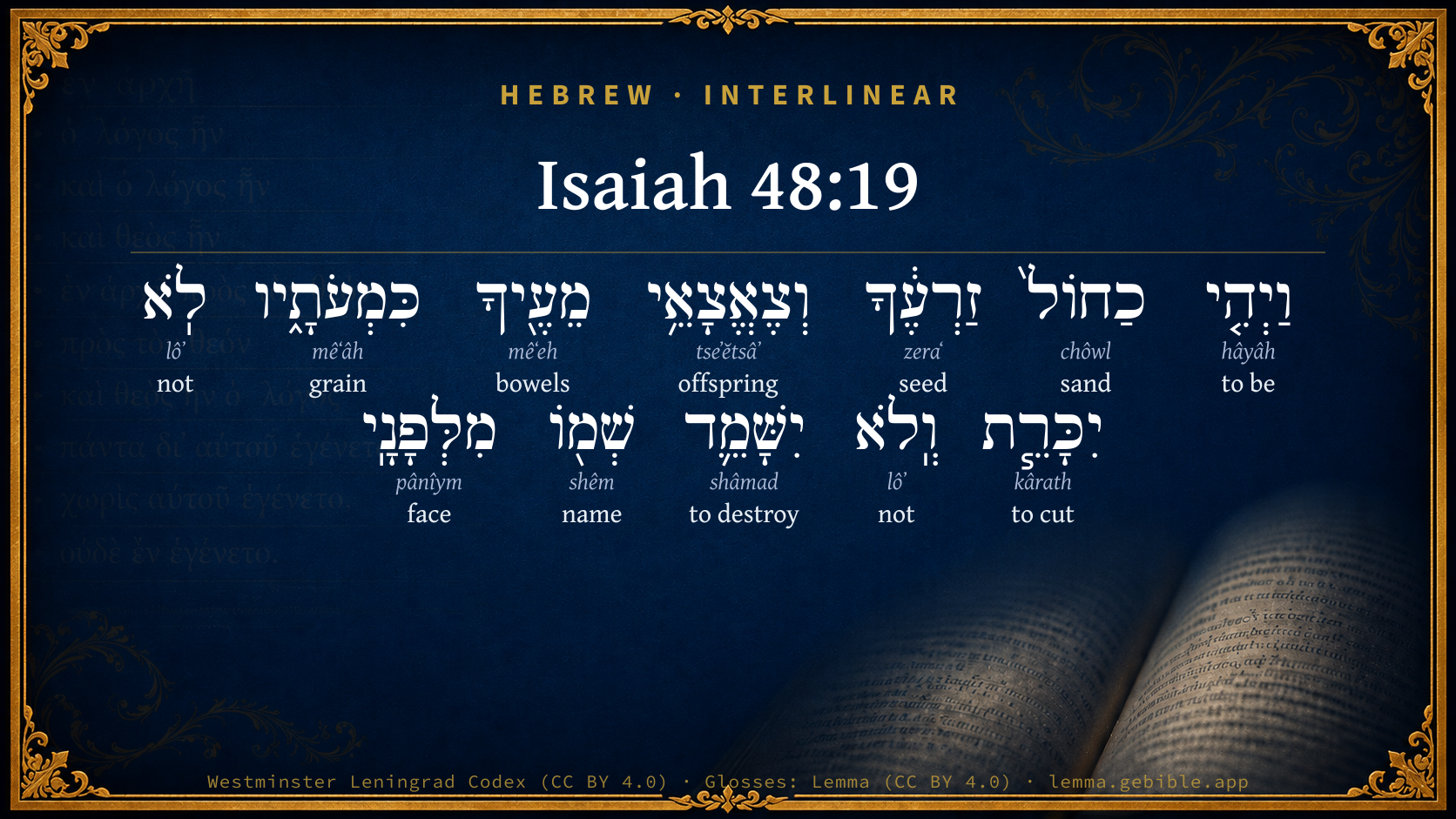
Hebrew (Westminster Leningrad Codex) Isaiah 48:19 appears in the Hebrew Old Testament. The text above is from the Westminster Leningrad Codex. Each word links to its Strong’s number, a concise gloss, and parsing drawn from the Open Scriptures Hebrew Bible morphology. Click any word for its full Brown-Driver-Briggs (BDB) entry.
Download image
Cite this verse

Isaiah 48:19 (World English Bible). Public Domain. Lemma interlinear Bible study tool, https://lemma.gebible.app/v/isaiah/48/19.

Show BibTeX & RIS
BibTeX
RIS
English Translation
your seed also had been as the sand, and the offspring of your loins like the grains of it: his name would not be cut off nor destroyed from before me.
World English Bible · Public Domain
Highlights
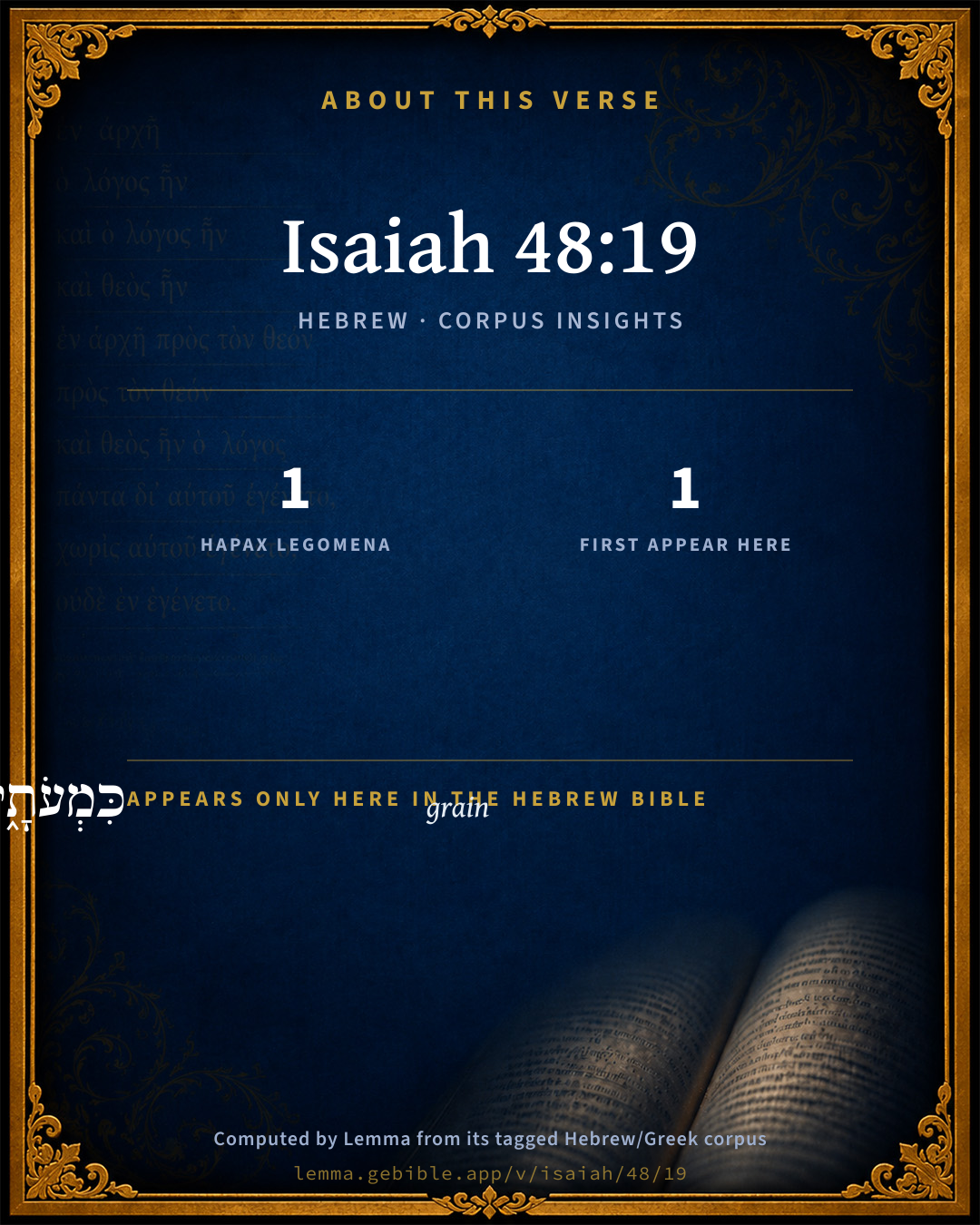
  • 1 hapax legomenon — only here in the Hebrew Bible
  • 1 first appearance in the Hebrew Bible
Full analysis ↓
Download a study sheet

One document with this verse’s original text, its word-by-word gloss line, the meaning frame, cross-references with their text, attributed commentary, and full source and license credits — printable, and it pastes into notes with its structure intact.

This verse Autodidact and up

Study sheet (.html) Plain text (.txt)

A passage Seminary Student

Up to 50 verses in one chapter. A passage sheet keeps up to 6 commentary sources and 12 cross-references per verse, in the order this page ranks them, and says so on the sheet whenever that leaves anything out. Ask for a single verse and you get the Autodidact verse sheet above.

Everything on this page stays free to read, with no account — the sheet is a download of what is already on screen, not access to it.

Want to remove ads? Support Godless Engineer
Compare translations 3

The same verse in 3 English versions, stacked beneath the original-language interlinear above. Click any original word for its lexicon entry.

Each is an independent rendering of the whole verse — the interlinear is not word-aligned to these translations.

Highlighted words mark where these versions differ — a whole-verse word diff, not a word-by-word alignment.

  • World English Bible Public Domain
    your seed also had been as the sand, and the offspring of your loins like the grains of it: his name would not be cut off nor destroyed from before me.
  • King James Version Public Domain
    Thy seed also had been as the sand, and the offspring of thy bowels like the gravel thereof; his name should not have been cut off nor destroyed from before me.
  • unfoldingWord Literal Text CC BY-SA 4.0
    And your seed would have been like the sand, and the offspring of your womb, like its grains. He would not have been cut off, and his name would not have been destroyed from to my face.” q1

unfoldingWord Literal Text — © unfoldingWord, licensed CC BY-SA 4.0. Word-aligned USFM3 via Door43 (git.door43.org/unfoldingWord/en_ult).

Versions to compare (up to 4)

3 of 4 selected

Show all 18 translations

Every available English version of this verse, each an independent rendering of the whole verse.

  • World English Bible Public Domain
    your seed also had been as the sand, and the offspring of your loins like the grains of it: his name would not be cut off nor destroyed from before me.
  • Berean Standard Bible Public Domain
    Your descendants would have been as countless as the sand, and your offspring as numerous as its grains; their name would never be cut off or eliminated from My presence.”
  • Majority Standard Bible Public Domain
    Your descendants would have been as countless as the sand, and your offspring as numerous as its grains; their name would never be cut off or eliminated from My presence.”
  • King James Version Public Domain
    Thy seed also had been as the sand, and the offspring of thy bowels like the gravel thereof; his name should not have been cut off nor destroyed from before me.
  • American Standard Version (1901) Public Domain
    thy seed also had been as the sand, and the offspring of thy bowels like the grains thereof: his name would not be cut off nor destroyed from before me.
  • Revised Version (1885) Public Domain
    thy seed also had been as the sand, and the offspring of thy bowels like the grains thereof: his name should not be cut off nor destroyed from before me.
  • Geneva Bible (1599) Public Domain
    Thy seede also had beene as the sande, and the fruite of thy body like the grauell thereof: his name should not haue bene cut off nor destroied before me.
  • Douay-Rheims (1899) Public Domain
    And thy seed had been as the sand, and the offspring of thy bowels like the gravel thereof: his name should not have perished, nor have been destroyed from before my face.
  • Young's Literal Translation Public Domain
    And as sand is thy seed, And the offspring of thy bowels as its gravel, Not cut off nor destroyed his name before Me.
  • Literal Standard Version CC BY-SA 4.0
    And your seed is as sand, || And the offspring of your bowels as gravel, || His name would not be cut off nor destroyed before Me.”
  • Unlocked Literal Bible CC BY-SA 4.0
    Your descendants would have been as numerous as the sand, and the children from your womb as numerous as the grains of sand; their name would not have been cut off nor blotted out from before me.
  • unfoldingWord Literal Text CC BY-SA 4.0
    And your seed would have been like the sand, and the offspring of your womb, like its grains. He would not have been cut off, and his name would not have been destroyed from to my face.” q1
  • Darby Bible Public Domain
    and thy seed would have been as the sand, and the offspring of thy bowels like the gravel thereof: their name should not have been cut off nor destroyed from before me.
  • World Messianic Bible Public Domain
    Your offspring also would have been as the sand and the descendants of your body like its grains. His name would not be cut off nor destroyed from before me.”
  • Webster's Bible Public Domain
    Thy seed also had been as the sand, and the offspring of thy bowels like its gravel; his name should not have been cut off nor destroyed from before me.
  • Free Bible Version CC BY-SA 4.0
    Your children, your descendants, would have been like all those grains of sand. They wouldn't have had to be destroyed, wiped out before me.
  • Bible in Basic English Public Domain
    Your seed would have been like the sand, and your offspring like the dust: your name would not be cut off or come to an end before me.
  • JPS Tanakh (1917) Public Domain
    Thy seed also would be as the sand, and the offspring of thy body like the grains thereof; his name would not be cut off nor destroyed from before Me.

Literal Standard Version (2020), Covenant Press — licensed CC BY-SA 4.0. Text via the HelloAO Bible API (eBible.org). Unlocked Literal Bible (unfoldingWord) — licensed CC BY-SA 4.0. Text via the HelloAO Bible API (eBible.org). unfoldingWord Literal Text — © unfoldingWord, licensed CC BY-SA 4.0. Word-aligned USFM3 via Door43 (git.door43.org/unfoldingWord/en_ult). Free Bible Version, Dr. Jonathan Gallagher — licensed CC BY-SA 4.0. Text via the HelloAO Bible API (eBible.org).

Word by word

More ways to search: Search by grammar → Find every occurrence → Compare this word →

Practice this passage: Drill this verse → Learn its vocabulary →

כִּמְעֹתָ֑יו
mêʻâh
H4579
“like/as · grains · his”
Preposition + Noun, Common, Feminine, Plural, Construct + Suffix, Personal, 3rd Person, Masculine, Singular
Part of Speech
Preposition + Noun
Type
Common
Gender
Feminine
Number
Plural
State
Construct
Full BDB Definition

Origin: from H4578

TWOT: 1227b

grain (of sand)
  1. וַיְהִ֤י hâyâh H1961 “and · to be” Conjunction + Verb, Qal, Sequential Imperfect, 3rd Person, Masculine, Singular
  2. כַחוֹל֙ chôwl H2344 “like/as the · sand” Preposition, Determined + Noun, Common, Masculine, Singular, Absolute
  3. זַרְעֶ֔ךָ zeraʻ H2233 “seed · your” Noun, Common, Masculine, Singular, Construct + Suffix, Personal, 2nd Person, Masculine, Singular
  4. וְצֶאֱצָאֵ֥י tseʼĕtsâʼ H6631 “and · offspring of” Conjunction + Noun, Common, Masculine, Plural, Construct
  5. מֵעֶ֖יךָ mêʻeh H4578 “bowels · your” Noun, Common, Masculine, Plural, Construct + Suffix, Personal, 2nd Person, Masculine, Singular
  6. לֹֽא lôʼ H3808 “not” Particle, Negative
  7. יִכָּרֵ֧ת kârath H3772 “to cut” Verb, Niphal, Imperfect, 3rd Person, Masculine, Singular
  8. וְֽלֹא lôʼ H3808 “and · not” Conjunction + Particle, Negative
  9. יִשָּׁמֵ֛ד shâmad H8045 “to destroy” Verb, Niphal, Imperfect, 3rd Person, Masculine, Singular
  10. שְׁמ֖וֹ shêm H8034 “name · his” Noun, Common, Masculine, Singular, Construct + Suffix, Personal, 3rd Person, Masculine, Singular
  11. מִלְּפָנָֽי pânîym H6440 “from · to/for · face(s) · my” Preposition + Preposition + Noun, Common, Both, Plural, Construct + Suffix, Personal, 1st Person, Common, Singular

About this verse

These counts appear in no published source. They are computed here, from the morphology-tagged text and Lemma’s own curated glosses. What Lemma adds →

12
words
11
distinct lemmas
Prophets
section

Notable vocabulary

1 hapax legomenon — a word that appears only here in the entire Hebrew Bible:

  • כִּמְעֹתָ֑יו grain H4579

First appearance in Scripture

This word makes its first canonical appearance in the Hebrew Bible here:

  • כִּמְעֹתָ֑יו grain H4579

Shared distinctive vocabulary

וְצֶאֱצָאֵ֥י offspring H6631 occurs in 11 verses of the Hebrew Bible. Also found in:

Grammatical profile

  • 3 verbs
  • 7 nouns
  • 2 particles

Verb forms

  • וַיְהִ֤י Qal · Sequential Imperfect
  • יִכָּרֵ֧ת Niphal · Imperfect
  • יִשָּׁמֵ֛ד Niphal · Imperfect

Repetition

A word recurs within this verse — often emphatic in Hebrew:

Hebrew & Septuagint length

In English translation the verse runs 31 words from the Hebrew and 38 from the Septuagint (LXX English) — closely comparable.

A rough comparison of the two English renderings, which tokenize alike — not a word-level alignment.

Word counts can differ between the Hebrew and the Greek without any difference in meaning — e.g. the Hebrew direct-object marker אֵת has no separate Greek word, and Greek often adds the article ὁ.

Cross-references

17

Topical passages linked to Isaiah 48:19 in the Treasury of Scripture Knowledge — connected by theme and wording, ordered by reader-vote popularity; previews shown in the World English Bible.

  • Isaiah 10:22 For though your people, Israel, be as the sand of the sea, [only] a remnant of them shall return: a destruction [is] determined, overflowing with righteousness.
  • Genesis 22:17 that in blessing I will bless you, and in multiplying I will multiply your seed as the stars of the heavens, and as the sand which is on the seashore. Your seed will possess the gate of his enemies.
  • Jeremiah 33:22 As the host of the sky can't be numbered, neither the sand of the sea measured; so will I multiply the seed of David my servant, and the Levites who minister to me.
  • Hosea 1:10 Yet the number of the children of Israel will be as the sand of the sea, which can't be measured nor numbered; and it will come to pass that, in the place where it was said to them, 'You are not my people,' they will be called 'sons of the living God.'
  • Romans 9:27 Isaiah cries concerning Israel, "If the number of the children of Israel are as the sand of the sea, It is the remnant who will be saved;
  • Genesis 13:16 I will make your offspring as the dust of the earth, so that if a man can number the dust of the earth, then your seed may also be numbered.
  • Joshua 7:9 For the Canaanites and all the inhabitants of the land will hear of it, and will compass us round, and cut off our name from the earth: and what will you do for your great name?
  • Ruth 4:10 Moreover Ruth the Moabitess, the wife of Mahlon, have I purchased to be my wife, to raise up the name of the dead on his inheritance, that the name of the dead not be cut off from among his brothers, and from the gate of his place: you are witnesses this day.
  • 1 Kings 9:7 then will I cut off Israel out of the land which I have given them; and this house, which I have made holy for my name, will I cast out of my sight; and Israel shall be a proverb and a byword among all peoples.
  • Psalms 9:5 You have rebuked the nations. You have destroyed the wicked. You have blotted out their name forever and ever.
  • Psalms 109:13 Let his posterity be cut off. In the generation following let their name be blotted out.
  • Isaiah 9:14 Therefore Yahweh will cut off from Israel head and tail, palm-branch and rush, in one day.
  • Isaiah 14:22 I will rise up against them, says Yahweh of Hosts, and cut off from Babylon name and remnant, and son and son's son, says Yahweh.
  • Isaiah 48:9 For my name's sake will I defer my anger, and for my praise will I refrain for you, that I not cut you off.
  • Isaiah 56:5 To them will I give in my house and within my walls a memorial and a name better than of sons and of daughters; I will give them an everlasting name, that shall not be cut off.
  • Isaiah 66:22 For as the new heavens and the new earth, which I will make, shall remain before me, says Yahweh, so shall your seed and your name remain.
  • Zephaniah 1:4 I will stretch out my hand against Judah, and against all the inhabitants of Jerusalem. I will cut off the remnant of Baal from this place: the name of the idolatrous and pagan priests,

Cross-references courtesy of OpenBible.info (CC BY 4.0).

Hebrew and Greek witnesses Masoretic Hebrew ↔ Greek Septuagint

The same verse in the two great witnesses to the Old Testament, shown verse-for-verse.

These are two independent witnesses, not word-aligned to each other, and the Septuagint is shown in lemma (dictionary) form.

Hebrew Isaiah 48:19 Masoretic · Westminster Leningrad Codex

וַיְהִ֤י כַחוֹל֙ זַרְעֶ֔ךָ וְצֶאֱצָאֵ֥י מֵעֶ֖יךָ כִּמְעֹתָ֑יו לֹֽא יִכָּרֵ֧ת וְֽלֹא יִשָּׁמֵ֛ד שְׁמ֖וֹ מִלְּפָנָֽי

your seed also had been as the sand, and the offspring of your loins like the grains of it: his name would not be cut off nor destroyed from before me.

World English Bible · Public Domain

Greek LXX Isaiah 48:19 Septuagint · lemma form

καί γίγνομαι ἄν ὡς ὁ ἄμμος ὁ σπέρμα σύ καί ὁ ἔκγονος ὁ κοιλία σύ ὡς ὁ χοῦς ὁ γῆ οὐδέ νῦν οὐ μή ἐκὀλεθρεύω οὐδέ ἀποὀλλύω ὁ ὄνομα σύ ἐνώπιόν ἐγώ

Your seed also would have been as the sand, and the offspring of your belly as the dust of the ground: neither now shall you by any means be utterly destroyed, neither shall your name perish before me.

LXX2012 (modern English Septuagint) · Public Domain

On this verse, Adam Clarke's Commentary discusses the Septuagint’s reading. Read the note in Commentary ↓

Hebrew: Westminster Leningrad Codex (CC BY 4.0). Greek: Septuagint (public domain); English from LXX2012 (modern English Septuagint) (Public Domain). How the Septuagint differs from the Hebrew →

Targum (Aramaic paraphrase)

1

The Targum is the ancient Jewish Aramaic paraphrase of the Hebrew Scriptures — an interpretive translation, not the Hebrew text itself. Onkelos (literal) and Pseudo-Jonathan (expansive) render the Torah, and Jonathan the Prophets. Coverage is partial: where no permissively-licensed English translation exists for a verse, only the Aramaic is shown. This is verse-level text, not a word-by-word alignment to the Hebrew.

  1. Targum Jonathan Prophets (Joshua–Malachi)
    וַהֲווֹ פּוֹן סַגִין כְּחָלָא דְיַמָא בְּנָךְ וּבְנֵי בְנָךְ כְּפֵּירוּדוֹהִי לָא יִפְסוֹק וְלָא יִשְׁתֵּצֵי שְׁמֵיהּ דְיִשְׂרָאֵל מִן קֳדָמַי לַעֲלַם:

    Thy seed had certainly been as numerous as the sand; and thy children's children as the gravel thereof: the name of Israel should not have ceased nor have been destroyed from before me for ever.

    Targum Jonathan — Aramaic: “Mikraot Gedolot” (public domain). English: “Sefaria Community Translation” (CC0 1.0 (public-domain dedication)); “London "Chaldee Paraphrase," 1871” (public domain). Text via Sefaria.

Commentary

Notes on Isaiah 48:19 from classic Christian and Jewish commentators (each source and its license shown beneath its notes). The classic Christian expositions comment on the surrounding passage and are grouped to its opening verse, so a note may address several verses; the Jewish commentaries on the Tanakh (Rashi and others) are per-verse, so they appear only where the commentator wrote on this verse.

Lemma curates 59 commentaries, every one of them public domain or Creative Commons licensed, each selected and text-cleaned for this edition rather than reprinted as found. About our sources →

Trapp's Complete Commentary

John Trapp

Isa 48:19 Thy seed also had been as the sand, and the offspring of thy bowels like the gravel thereof; his name should not have been cut off nor destroyed from before me.

Ver. 19. Thy seed also had been as the sand.] As was promised to Abraham, and performed to his posterity; such a μυριομακαριοτης there is in godliness, and in doing of God’s commandments so great reward.

His name should not have been cut off.] As it was of old among the heathens (see Horace, Juvenal, Martial, &c.), and is at this day among the Turks, who usually swear, Iudaeus sim si fallam, &c. See Zec 8:13. {See Trapp on "Zec 8:13"}

John Trapp, A Commentary or Exposition upon All the Books of the Old and New Testament (1647–1656) — public domain. Text from a community e-Sword module.

Tyndale Open Study Notes

Tyndale Open Resources

48:19 Your descendants . . . like the sands: This would fulfill God’s covenant to Abraham (Gen 22:17); by contrast, the Israelites were nearly wiped out in the Exile (see Isa 44:26).

Tyndale Open Study Notes — © Tyndale Open Resources, licensed CC BY-SA 4.0. Text via the HelloAO Bible API.

Geneva Bible (1599)

Geneva Bible translators

That is, the prosperous estate of Israel.

Geneva Bible (1599) marginal notes — public domain. Text via Bolls.life.

Jamieson, Fausset & Brown

Robert Jamieson, A. R. Fausset & David Brown

sand--retaining the metaphor of "the sea" (Isa 48:18).

like the gravel thereof--rather, as the Hebrew, "like that (the offspring) of its (the sea's) bowels"; referring to the countless living creatures, fishes, &c., of the sea, rather than the gravel [MAURER]. JEROME, Chaldee, and Syriac support English Version.

his name . . . cut off--transition from the second person, "thy," to the third "his." Israel's name was cut off "as a nation" during the Babylonish captivity; also it is so now, to which the prophecy especially looks (Rom 11:20).

Jamieson, Fausset & Brown — Commentary Critical and Explanatory on the Whole Bible (1871) — public domain (CC PDM 1.0). Text via the HelloAO Bible API.

Adam Clarke's Commentary

Verse 19. Like the gravel thereof - "Like that of the bowels thereof"] בצאצאי מעי הים והם הדגים betseetsaey meey haiyam vehem haddagim; "As the issue of the bowels of the sea; that is, fishes." - Salom. ben Melec. And so likewise Aben Ezra, Jarchi, Kimchi, &c.

His name - "Thy name"] For שמו shemo, "his name," the Septuagint had in the copy from which they translated שמך shimcha, "thy name."

Adam Clarke's Commentary on the Bible (1810–1826) — public domain. Text from a community e-Sword/MySword module.

Ellicott's Commentary for English Readers

(19) Like the gravel thereof.—Literally, as the bowels thereof, i.e., as that within the bowels of the sand, the living creatures that swarm in countless myriads in the sea. The two verses utter the sigh which has come from the heart of all true teachers as they contemplate the actual state of men and compare it with what might have been. (Comp. Deu_32:29-30; Luk_19:42.)

A Bible Commentary for English Readers, edited by Charles John Ellicott (1878–1897) — public domain. Text from a community e-Sword module.

The Cambridge Bible for Schools and Colleges

gen. ed. J. J. S. Perowne

19. as the sand] A common comparison; see ch. Isa_10:22; Gen_22:17; Hos_1:10 &c.

like the gravel thereof] Lit. the grains thereof. The word used resembles a fem. plur. of that which immediately precedes (“bowels”); hence some commentators translate “the entrails thereof” (i.e. the fishes), taking as antecedent of the pronoun the word “sea” in the previous verse (see R.V. marg.). It would be better to explain it at once of the “entrails” of the sand (i.e. worms), for which indeed there is said to be a Syriac parallel (see Payne Smith, Thesaurus, col. 2185). But both comparisons alike are prosaic and unnatural. The word is no doubt identical with the Aramaic mâ‘âh, “kernel” (generally used of a small coin).

his name &c.] its name (that of the “seed”) should not be cut off &c.

20, 21 (cf. ch. Isa_52:11-12) form the lyrical conclusion of this division of the prophecy. In anticipation of this second exodus of Israel, the prophet puts a song of praise in the mouth of the redeemed exiles.

flee ye from the Chaldeans] or “from Chaldæa” (see on Isa_47:1). The verb flee probably means no more than “hasten” (see ch. Isa_52:12).

with a voice of singing … tell this] The exiles’ shout of joy is a revelation to the world of the greatness of the God of Israel.

utter it] Lit. “send it forth,” as in ch. Isa_42:1.

The Cambridge Bible for Schools and Colleges (gen. ed. J. J. S. Perowne; Cambridge University Press, 1878–1918) — public domain. Text from a community e-Sword module.

John Gill's Exposition

Thy seed had also been as the sand,.... Upon the sea shore, as numerous as that, as was promised to Abraham, Gen 22:17,

and the offspring of thy bowels as the gravel thereof; that is, of the sand; the little stones that are in it, which lie in great numbers on the sea shore; the same thing expressed in different words, denoting the number of their posterity, as it would have been, had they received the Messiah, his doctrines and ordinances: it may be rendered, "and the offspring", or "those that go out of thy bowels", that spring from thee, are born of thee, "as the bowels thereof" (q), that is, of the sea; as what is within it, particularly the fishes of it, which are innumerable; and so Aben Ezra and Jarchi interpret it; and which sense is mentioned by Kimchi and Ben Melech:

his name should not have been cut off nor destroyed from before me: the name of Israel, as the Targum has it; the name of the people of the Jews is no more in the land where they dwelt; they are cut off as a nation; their city and temple are destroyed, where they appear no more before the Lord; which would not have been, had they hearkened to the Messiah, embraced his truths, and been obedient to his commands.

(q) "sicut viscera ejus", Montanus; "interiora maris"; Munster.

John Gill's Exposition of the Whole Bible (1746–1763) — public domain (CC PDM 1.0). Text via the HelloAO Bible API.

Albert Barnes' Notes on the Bible

Thy seed also - Instead of being reduced to a small number by the calamities incident to war, and being comparatively a small and powerless people sighing in captivity, you would have been a numerous and mighty nation. This is another of the blessings which would have followed from obedience to the commands of God; and it proves that a people who are virtuous and pious will become numerous and mighty. Vice, and the diseases, the wars, and the divine judgments consequent on vice, tend to depopulate a nation, and to make it feeble.

As the sand - This is often used to denote a great and indefinite number (Gen 22:17; Gen 32:12; Gen 41:49; Jos 11:4; Jdg 7:12; 1Sa 13:5; 2Sa 17:11; 1Ki 4:20-29; Job 29:18; Psa 139:18; the note at Isa 10:22; Hos 1:10; Rev 20:8).

And the offspring of thy bowels - On the meaning of the word used here, see the note at Isa 22:24.

Like the gravel thereof - literally, ‘and the offspring of thy bowels shall be like its bowels,’ that is, like the offspring of the sea. The phrase refers probably rather to the fish of the sea, or the innumerable multitudes of animals that swim in the sea, than to the gravel. There is no place where the word means gravel. Jerome, however, renders it, Ut lapili ejus - ‘As its pebbles.’ The Septuagint Ὡς ὁ χοῦς τῆς γῆς hōs ho chous tēs gēs - ‘As the dust of the earth.’ The Chaldee also renders it, ‘As the stones of the sea;’ and the Syriac also. The sense is essentially the same that the number of the people of the nation would have been vast.

His name should not have been out off - This does not imply of necessity that they had ceased to be a nation when they were in Babylon, but the meaning is, that if they had been, and would continue to be, obedient, their national existence would have been perpetuated to the end of time. When they ceased to be a distinct nation, and their name was blotted out among the kingdoms of the earth, it was for national crime and unbelief Rom 11:20.

Albert Barnes' Notes on the Bible (1834–1885) — public domain. Text from a community e-Sword/MySword module.

Haydock's Catholic Bible Commentary

Name. The Jews were not forgotten, till they had rejected the Messias.

George Leo Haydock (1774–1849), Haydock's Catholic Family Bible and Commentary, 1859 edition — public domain. Excludes Psalms (Douay-Rheims chapter numbering differs from Protestant) and Deuterocanonical books (Catholic canon only).

Matthew Poole's English Annotations

Thy seed also had been as the sand, to wit, for multitude, according to my promise made to Abraham; whereas now I have, for thy sins, made thee to know my breach of promise, as is said. Num 14:34, and greatly diminished thy numbers.

The offspring of thy bowels; which come out of thy bowels, or belly, or loins; for all these are but various expressions of the same thing.

His name; which is continued in a man’s posterity, and commonly dies with them; and so the name here is the same thing in effect with the seed and offspring in the former clauses, which, for the most part, are only the memorials of men, and of their names, when they are dead and gone.

Should not have been cut off, as now it hath been in a great measure; and should have been totally and finally cut off, if I had not spared them for my own name’s sake, as he said before.

From before me; or, out of my sight; out of their own land, the place of my special presence and residence.

Matthew Poole's English Annotations on the Holy Bible (1683–1685) — public domain. Text from a community e-Sword/MySword module.

The Pulpit Commentary

Thy seed also had been as the sand. Israel, at the close of the Captivity, was "a remnant", (Isa_37:31) a "very small remnant"; (Isa_1:9) the ten tribes were for the most part absorbed into the heathen among whom they had been scattered; the two tribes had dwindled in number through the hardships of the Captivity, and were scarcely more than a "handful." Less than fifty thousand returned with Zerubbabel; (Ezr_2:64) less than two thousand males with Ezra. (Ezr_8:2-20) Had Israel not been disobedient, the promises made to Abraham, Isaac, and Jacob would have been literally fulfilled, and the descendants of Abraham would have been millions upon millions, instead of being one or two hundred thousand. The offspring of thy bowels like the gravel thereof; rather, like the grains thereof; i.e. the grains of the sand. His name; i.e. "Israel"s name." Should not have been cut off. Israel"s name had not been wholly "cut off" or "destroyed." But it had been approximately "cut off." Israel was no more a people, but only a horde of slaves. The restoration to Palestine was a resurrection the re-creation of a nation which, humanly speaking, had ceased to be.

The Pulpit Commentary (1880–1919), ed. H.D.M. Spence-Jones & Joseph S. Exell — public domain. Text from a community e-Sword module.

J. A. Alexander on Isaiah

Joseph Addison Alexander

“Then should have been like the sand thy seed,” a common scriptural expression for great multitude, with special reference, in this case, to the promise made to Abraham and Jacob (Gen 22:17; Gen 32:12) the partial accomplishment of which (2Sa 17:11) is not inconsistent with the thought here expressed, that, in the case supposed, it would have been far more ample and conspicuous. The image is that of a parent (here the patriarch Jacob) and his personal descendants. And the issues (or offspring) of thy bowels (an equivalent expression to thy seed). Of the next word there are two interpretations. Some give it the sense of stones, pebbles, gravel, and make it a poetical equivalent to sand. Others make the antithesis between thy bowels and its bowels, viz. those of the sea; and the whole clause, supplying the ellipsis, will read thus, ‘the offspring of thy bowels like (the offspring of) its bowels’, in allusion to the vast increase of fishes. “His name.” We must either suppose an abrupt transition from the second to the third person, or make ‘seed’ the antecedent of the pronoun, which is harsh in itself, and rendered more so by the intervening plural forms. All the requisitions of the text are answered by the common understanding of ‘name’, in such connections, as equivalent to ‘memory’. The excision or destruction of the name from before God is expressive of entire extermination. The precise sense of the futures in this clause is somewhat dubious. Most interpreters assimilate them to the futures of the foregoing clause, as in the English Version (should not have been cut off nor destroyed). Those who understand the first clause as expressing a wish in relation to the present or the future, make this last a promise, either absolute (his name shall not be cut off) or conditional (his name should not be cut off). Nor is this direct construction of the last clause inconsistent with the old interpretation of the first; as we may suppose that the writer, after wishing that the people had escaped the strokes provoked by their iniquities, declares that even now they shall not be entirely destroyed. This is precisely the sense given to the clause in the Septuagint, and is recommended by its perfect agreement with the whole drift of the passage and the analogy of others like it, where the explanation of the sufferings of the people as the fruit of their own sin is combined with a promise of exemption from complete destruction.

Joseph Addison Alexander, The Prophecies of Isaiah (1846–1847; New York: Scribner, 1870–1878) — public domain. Text from a community e-Sword module.

unfoldingWord translationNotes

Door43 World Missions Community

General Information:

Yahweh continues describing a hypothetical situation to the people of Israel.

Your descendants would have been as numerous as the sand, and the children from your womb as numerous as the grains of sand

These both mean that the people would have had more descendants than they could count. (See: Parallelism)

the children from your womb

Yahweh speaks of the descendants of the people of Israel as if they were children to which the nation gives birth. (See: Metaphor)

their name would not have been cut off nor blotted out

The people of Israel being destroyed is spoken of as if their name had been cut off, as one would cut a piece of cloth or cut a branch from a tree, or blotted out. This can be translated in active form. AT: "I would not have cut off nor blotted out their name" (See: Metonymy and Active or Passive)

their name

Here the word "name" refers to the descendants who would carry on the name of Israel. AT: "they" (See: Metonymy)

cut off nor blotted out

These two expressions in this context refer to destroying the people. AT: "destroyed" (See: Doublet)

translationWords

descend

womb

grain

name

cut off

blot out

unfoldingWord translationNotes — © Distant Shores Media and the Door43 World Missions Community, licensed CC BY-SA 4.0. Source: git.door43.org/Door43/en_tn.

Rashi

Rabbi Shlomo Yitzchaki (Rashi)

like its innards of the sea, like the fish of the sea for multitude.

Rashi on the Tanakh — English translations: “The Judaica Press complete Tanach with Rashi, translated by A. J. Rosenberg” (CC BY 4.0); “Pentateuch with Rashi's commentary by M. Rosenbaum and A.M. Silbermann, 1929-1934” (public domain); “The Metsudah Tanach series, Lakewood, N.J” (CC BY 4.0); and “The Book of Joshua, Metsudah Publications, 1997” (CC BY 4.0). Text via Sefaria.

Ibn Ezra

Rabbi Abraham ibn Ezra

Thy seed. The number of thy children.

בטנך═מעיך Thy womb.

כמעותיו As its bowels. The possessive pronoun refers to the sea, the waves and sand of which have just been mentioned (ver. 18 and 19); by the bowels of the sea the roe of the fish is meant.

His name. The name of thy seed.

Ibn Ezra on the Tanakh — English translations: “Sefaria Community Translation” (CC0 1.0 (public-domain dedication)); “Yalkut, Sifsei Chachomim Chumash, Metsudah Publications, 2009” (CC BY 4.0); and “Commentary of Ibn Ezra on Isaiah - trans. by M. Friedlander, 1873” (public domain). Text via Sefaria.

Lesson kit

Teaching starters — assembled from the data on this page, not authored interpretation. Every prompt links to the verse data it draws on. Edit before teaching.

Isaiah, in the Prophets, opens this verse with 12 words (11 distinct Hebrew lemmas). Its most distinctive word is mêʻâh (“grain”). A historical commentator’s framing appears above. Read the whole chapter for the surrounding context.

Discussion questions

  1. How does “grain” (mêʻâh) shape what this verse is saying?
  2. 1 word here appears nowhere else in the Hebrew Bible. Why might the author reach for such rare wording?
  3. This is the first place “grain” appears in Scripture (first appears here). What does its debut here establish?
  4. How does Job 5:25, which shares the word «offspring», read alongside this verse?
  5. What does the repetition of “not” (2× in this one verse) do in this verse?
  6. These translations render this verse differently; the difference is in the English rendering, not the original. What questions does that raise?
  7. «וַיְהִ֤י» is a Qal Sequential Imperfect verb. How does that grammatical form shape the action described?
  8. Compare how Trapp's Complete Commentary and Tyndale Open Study Notes read this verse. Where do they agree or differ?

Things to notice

  • 1 word in this verse appears nowhere else in the Hebrew Bible.
  • 1 word makes its first canonical appearance in Scripture here.
  • These translations choose different wording for 15 words in this verse.
  • “not” occurs 2× in this single verse.
  • 11 distinct Hebrew lemmas span 12 words in this verse.

Reading settings

Reading text

Shown beneath each verse's original-language words.

Old Testament
Old Testament edition

Read the OT as the Masoretic Hebrew (MT) or the Greek Septuagint (LXX).

English shown for the Greek Septuagint (in the Hebrew ↔ Greek comparison).

Comparing translations? Open the Compare panel on any verse page to stack up to four side by side.