
1 Kings 18:4

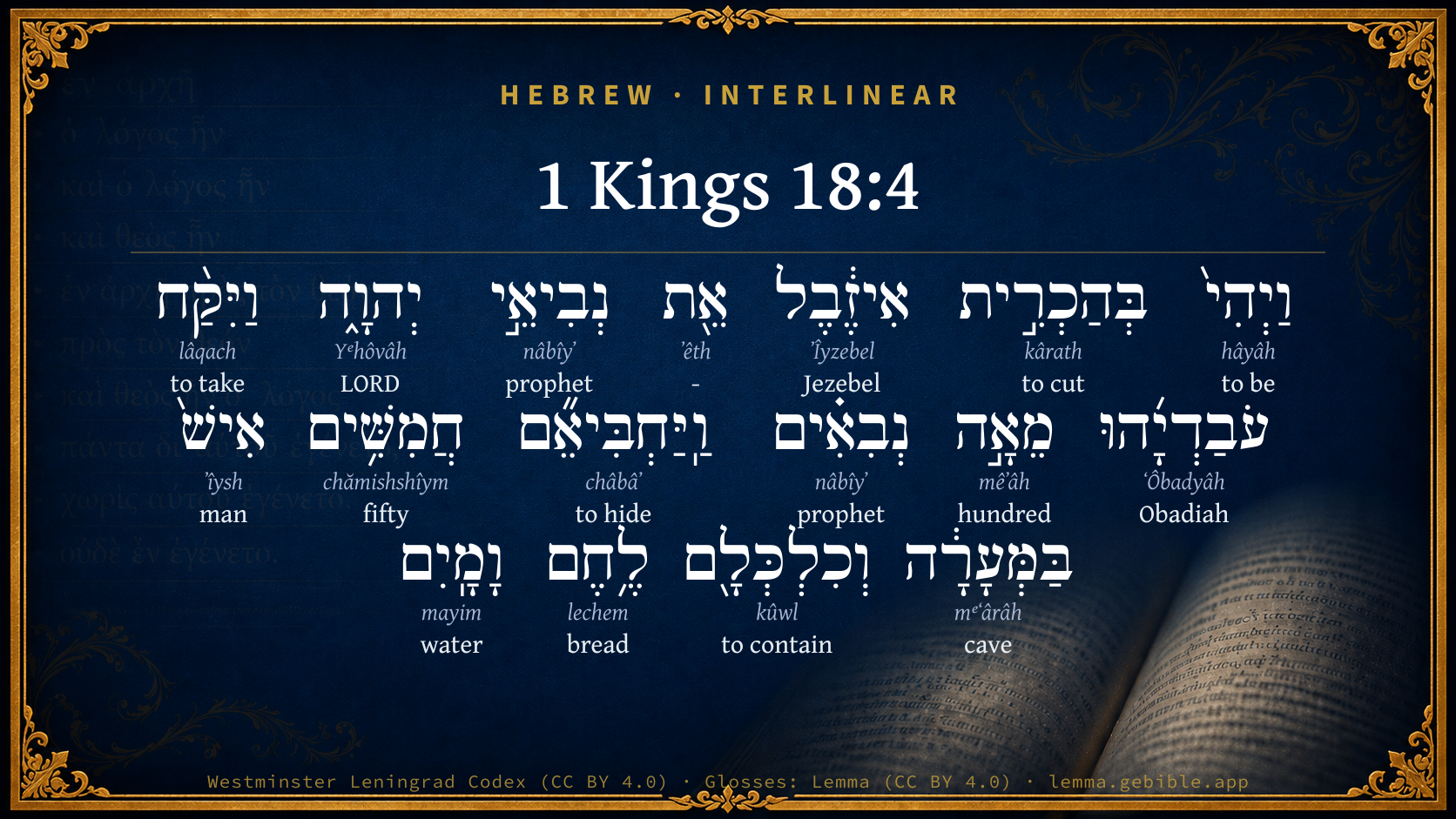
Hebrew (Westminster Leningrad Codex) 1 Kings 18:4 appears in the Hebrew Old Testament. The text above is from the Westminster Leningrad Codex. Each word links to its Strong’s number, a concise gloss, and parsing drawn from the Open Scriptures Hebrew Bible morphology. Click any word for its full Brown-Driver-Briggs (BDB) entry.
Download image
Cite this verse

1 Kings 18:4 (World English Bible). Public Domain. Lemma interlinear Bible study tool, https://lemma.gebible.app/v/1-kings/18/4.

Show BibTeX & RIS
BibTeX
RIS
English Translation
for it was so, when Jezebel cut off the prophets of Yahweh, that Obadiah took one hundred prophets, and hid them by fifty in a cave, and fed them with bread and water.)
World English Bible · Public Domain
Download a study sheet

One document with this verse’s original text, its word-by-word gloss line, the meaning frame, cross-references with their text, attributed commentary, and full source and license credits — printable, and it pastes into notes with its structure intact.

This verse Autodidact and up

Study sheet (.html) Plain text (.txt)

A passage Seminary Student

Up to 50 verses in one chapter. A passage sheet keeps up to 6 commentary sources and 12 cross-references per verse, in the order this page ranks them, and says so on the sheet whenever that leaves anything out. Ask for a single verse and you get the Autodidact verse sheet above.

Everything on this page stays free to read, with no account — the sheet is a download of what is already on screen, not access to it.

Want to remove ads? Support Godless Engineer
Compare translations 3

The same verse in 3 English versions, stacked beneath the original-language interlinear above. Click any original word for its lexicon entry.

Each is an independent rendering of the whole verse — the interlinear is not word-aligned to these translations.

Highlighted words mark where these versions differ — a whole-verse word diff, not a word-by-word alignment.

  • World English Bible Public Domain
    for it was so, when Jezebel cut off the prophets of Yahweh, that Obadiah took one hundred prophets, and hid them by fifty in a cave, and fed them with bread and water.)
  • King James Version Public Domain
    For it was so, when Jezebel cut off the prophets of the LORD, that Obadiah took an hundred prophets, and hid them by fifty in a cave, and fed them with bread and water.)
  • unfoldingWord Literal Text CC BY-SA 4.0
    Now it had happened, when Jezebel cut off the prophets of Yahweh, that Obadiah had taken 100 prophets and hidden them, 50 men in the cave, and he had sustained them bread and water.)

unfoldingWord Literal Text — © unfoldingWord, licensed CC BY-SA 4.0. Word-aligned USFM3 via Door43 (git.door43.org/unfoldingWord/en_ult).

Versions to compare (up to 4)

3 of 4 selected

Show all 18 translations

Every available English version of this verse, each an independent rendering of the whole verse.

  • World English Bible Public Domain
    for it was so, when Jezebel cut off the prophets of Yahweh, that Obadiah took one hundred prophets, and hid them by fifty in a cave, and fed them with bread and water.)
  • Berean Standard Bible Public Domain
    for when Jezebel had slaughtered the prophets of the LORD, Obadiah had taken a hundred prophets and hidden them, fifty men per cave, providing them with food and water.)
  • Majority Standard Bible Public Domain
    for when Jezebel had slaughtered the prophets of the LORD, Obadiah had taken a hundred prophets and hidden them, fifty men per cave, providing them with food and water.)
  • King James Version Public Domain
    For it was so, when Jezebel cut off the prophets of the LORD, that Obadiah took an hundred prophets, and hid them by fifty in a cave, and fed them with bread and water.)
  • American Standard Version (1901) Public Domain
    for it was so, when Jezebel cut off the prophets of Jehovah, that Obadiah took a hundred prophets, and hid them by fifty in a cave, and fed them with bread and water.)
  • Revised Version (1885) Public Domain
    for it was so, when Jezebel cut off prophets of the LORD, that Obadiah took an hundred prophets, and hid them by fifty in a cave, and fed them with bread and water.)
  • Geneva Bible (1599) Public Domain
    For when Iezebel destroyed the Prophets of the Lord, Obadiah tooke an hundreth Prophets, and hid them, by fiftie in a caue, and he fed them with bread and water.)
  • Douay-Rheims (1899) Public Domain
    For when Jezabel killed the prophets of the Lord, he took a hundred prophets and hid them by fifty and fifty in caves, and fed them with bread and water.
  • Young's Literal Translation Public Domain
    and it cometh to pass, in Jezebel's cutting off the prophets of Jehovah, that Obadiah taketh a hundred prophets, and hideth them, fifty men in a cave, and hath sustained them with bread and water --
  • Literal Standard Version CC BY-SA 4.0
    and it comes to pass, in Jezebel’s cutting off the prophets of YHWH, that Obadiah takes one hundred prophets, and hides them, fifty men in a cave, and has sustained them with bread and water—
  • Unlocked Literal Bible CC BY-SA 4.0
    for when Jezebel was killing the prophets of Yahweh, Obadiah took one hundred prophets and hid them by fifties in a cave and fed them with bread and water.
  • unfoldingWord Literal Text CC BY-SA 4.0
    Now it had happened, when Jezebel cut off the prophets of Yahweh, that Obadiah had taken 100 prophets and hidden them, 50 men in the cave, and he had sustained them bread and water.)
  • Darby Bible Public Domain
    and it was so, when Jezebel cut off the prophets of Jehovah, that Obadiah took a hundred prophets, and hid them by fifty in a cave, and maintained them with bread and water);
  • World Messianic Bible Public Domain
    for when Jezebel cut off the LORD’s prophets, Obadiah took one hundred prophets, and hid them fifty to a cave, and fed them with bread and water.)
  • Webster's Bible Public Domain
    For it was so, when Jezebel cut off the prophets of the LORD, that Obadiah took a hundred prophets, and hid them by fifty in a cave, and fed them with bread and water.)
  • Free Bible Version CC BY-SA 4.0
    While Jezebel was busy killing the Lord's prophets, Obadiah had taken one hundred prophets and hidden them, fifty in each of two caves, and had provided them with food and water.)
  • Bible in Basic English Public Domain
    For when Jezebel was cutting off the prophets of the Lord, Obadiah took a hundred of them, and kept them secretly in a hole in the rock, fifty at a time, and gave them bread and water.)
  • JPS Tanakh (1917) Public Domain
    for it was so, when Jezebel cut off the prophets of the LORD, that Obadiah took a hundred prophets, and hid them fifty in a cave, and fed them with bread and water. —

Literal Standard Version (2020), Covenant Press — licensed CC BY-SA 4.0. Text via the HelloAO Bible API (eBible.org). Unlocked Literal Bible (unfoldingWord) — licensed CC BY-SA 4.0. Text via the HelloAO Bible API (eBible.org). unfoldingWord Literal Text — © unfoldingWord, licensed CC BY-SA 4.0. Word-aligned USFM3 via Door43 (git.door43.org/unfoldingWord/en_ult). Free Bible Version, Dr. Jonathan Gallagher — licensed CC BY-SA 4.0. Text via the HelloAO Bible API (eBible.org).

Word by word

More ways to search: Search by grammar → Find every occurrence → Compare this word →

Practice this passage: Drill this verse → Learn its vocabulary →

עֹבַדְיָ֜הוּ
ʻÔbadyâh
H5662
“Obadiah”
Noun, Proper
Part of Speech
Noun
Type
Proper
Full BDB Definition

Origin: act part of H5647 and H3050

TWOT: None

Obadiah = "servant of Jehovah" - the 4th of the 12 minor prophets; nothing personal is known of him but it is probable that he was contemporary with Jeremiah, Ezekiel, and Daniel - the prophetic book by him; prophesies against Edom - father of Ishmaiah, one of the chiefs of Zebulun in the time of David - a Merarite Levite overseer of the work of restoring the temple in the time of king Josiah of Judah - chief of the household of king Ahab of Israel; an devout worshipper of Jehovah who at risk to his own life hid over 100 prophets during the persecution of Jezebel - a descendant of David - a chief of the tribe of Issachar - a Benjamite, one of the 6 sons of Azel and a descendant of king Saul - a Levite, son of Shemaiah and a descendant of Jeduthun - a Gadite chief, the 2nd of the lion-faced Gadites who joined David at Ziklag - a prince of Judah in the time of king Jehoshaphat of Judah - a priest, son of Jehiel of the sons of Joab who returned from exile with Ezra - a gatekeeper in the time of Nehemiah - one of the men who sealed the covenant with Nehemiah - perhaps the same as 12
  1. וַיְהִי֙ hâyâh H1961 “and · to be” Conjunction + Verb, Qal, Sequential Imperfect, 3rd Person, Masculine, Singular
  2. בְּהַכְרִ֣ית kârath H3772 “in/at · to cut” Preposition + Verb, Hiphil, Infinitive Construct
  3. אִיזֶ֔בֶל ʼÎyzebel H348 “Jezebel” Noun, Proper
  4. אֵ֖ת ʼêth H853 “-” Particle, Direct Object
  5. נְבִיאֵ֣י nâbîyʼ H5030 “prophets of” Noun, Common, Masculine, Plural, Construct
  6. יְהוָ֑ה Yᵉhôvâh H3068 “LORD” Noun, Proper
  7. וַיִּקַּ֨ח lâqach H3947 “and · to take” Conjunction + Verb, Qal, Sequential Imperfect, 3rd Person, Masculine, Singular
  8. מֵאָ֣ה mêʼâh H3967 “hundred” Adjective, Cardinal number, Both, Singular, Absolute
  9. נְבִאִ֗ים nâbîyʼ H5030 “prophets” Noun, Common, Masculine, Plural, Absolute
  10. וַֽיַּחְבִּיאֵ֞ם châbâʼ H2244 “and · to hide · them” Conjunction + Verb, Hiphil, Sequential Imperfect, 3rd Person, Masculine, Singular + Suffix, Personal, 3rd Person, Masculine, Plural
  11. חֲמִשִּׁ֥ים chămishshîym H2572 “fifty” Adjective, Cardinal number, Both, Plural, Absolute
  12. אִישׁ֙ ʼîysh H376 “man” Noun, Common, Masculine, Singular, Absolute
  13. בַּמְּעָרָ֔ה mᵉʻârâh H4631 “in/at the · cave” Preposition, Determined + Noun, Common, Feminine, Singular, Absolute
  14. וְכִלְכְּלָ֖ם kûwl H3557 “and · to contain · them” Conjunction + Verb, Piel, Perfect, 3rd Person, Masculine, Singular + Suffix, Personal, 3rd Person, Masculine, Plural
  15. לֶ֥חֶם lechem H3899 “bread” Noun, Common, Both, Singular, Absolute
  16. וָמָֽיִם mayim H4325 “and · water(s)” Conjunction + Noun, Common, Masculine, Plural, Absolute

About this verse

These counts appear in no published source. They are computed here, from the morphology-tagged text and Lemma’s own curated glosses. What Lemma adds →

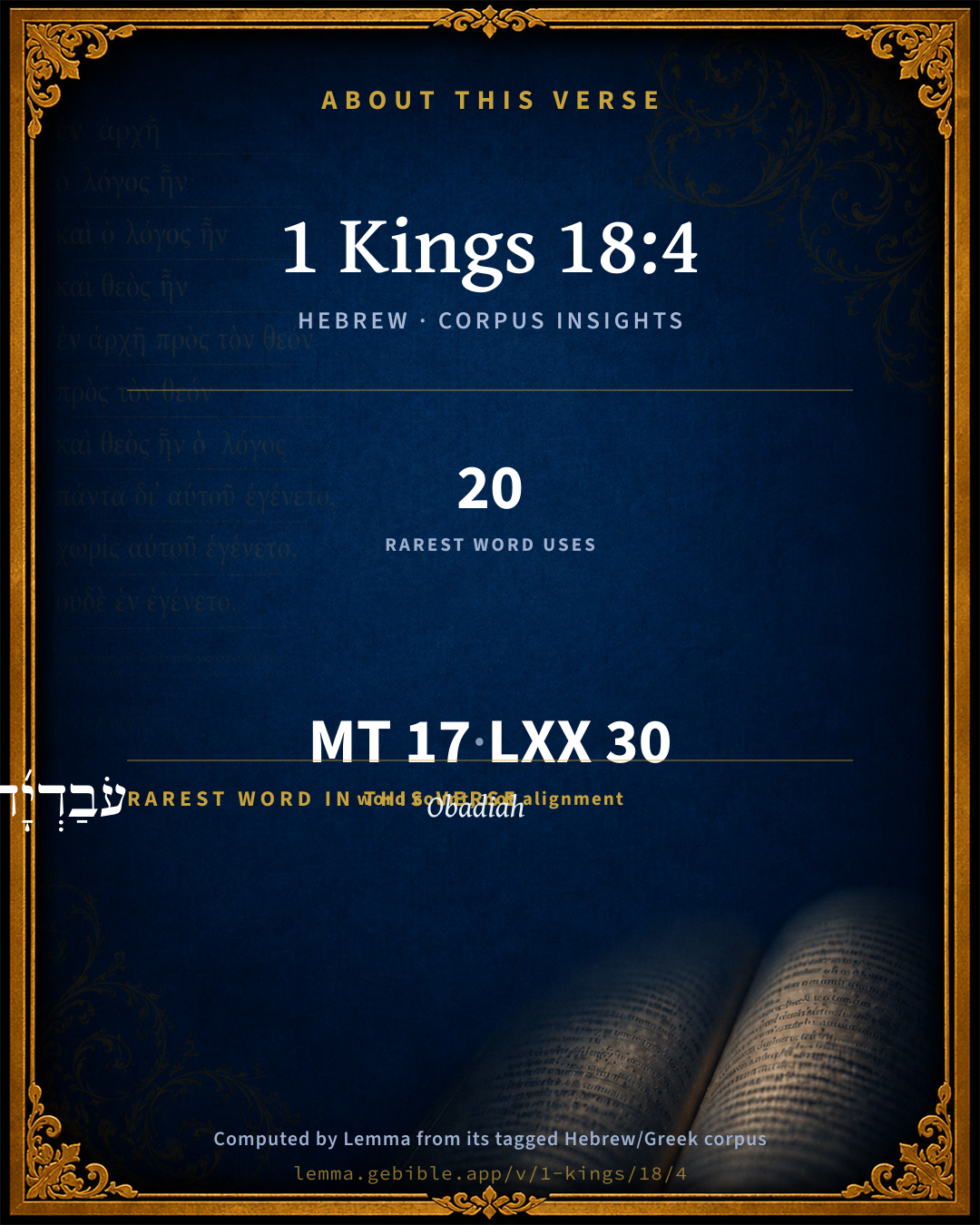
17
words
16
distinct lemmas
Historical
section

Notable vocabulary

The rarest word here is עֹבַדְיָ֜הוּ Obadiah H5662 — appearing just 20 times in the whole Hebrew Bible.

Shared distinctive vocabulary

עֹבַדְיָ֜הוּ Obadiah H5662 occurs in 19 verses of the Hebrew Bible. Also found in:

Grammatical profile

  • 5 verbs
  • 9 nouns
  • 2 adjectives
  • 1 particle

Verb forms

  • וַיְהִי֙ Qal · Sequential Imperfect
  • בְּהַכְרִ֣ית Hiphil · Infinitive Construct
  • וַיִּקַּ֨ח Qal · Sequential Imperfect
  • וַֽיַּחְבִּיאֵ֞ם Hiphil · Sequential Imperfect
  • וְכִלְכְּלָ֖ם Piel · Perfect

Repetition

A word recurs within this verse — often emphatic in Hebrew:

  • נְבִיאֵ֣י prophet H5030 ×2

Hebrew & Septuagint length

In English translation the verse runs 33 words from the Hebrew and 34 from the Septuagint (LXX English) — closely comparable.

A rough comparison of the two English renderings, which tokenize alike — not a word-level alignment.

Word counts can differ between the Hebrew and the Greek without any difference in meaning — e.g. the Hebrew direct-object marker אֵת has no separate Greek word, and Greek often adds the article ὁ.

In the original languages it is 17 Hebrew tokens and 30 Greek tokens — but the two are counted differently (Hebrew bundles its prefixes and suffixes into one token; the Greek is in lemma form), so that isn’t a like-for-like length.

Cross-references

11

Topical passages linked to 1 Kings 18:4 in the Treasury of Scripture Knowledge — connected by theme and wording, ordered by reader-vote popularity; previews shown in the World English Bible.

  • 1 Kings 18:13 Wasn't it told my lord what I did when Jezebel killed the prophets of Yahweh, how I hid one hundred men of Yahweh's prophets by fifty in a cave, and fed them with bread and water?
  • Matthew 10:40–42 He who receives you receives me, and he who receives me receives him who sent me.
  • Nehemiah 9:26 Nevertheless they were disobedient, and rebelled against you, and cast your law behind their back, and killed your prophets that testified against them to turn them again to you, and they committed awful blasphemies.
  • Matthew 21:35 The farmers took his servants, beat one, killed another, and stoned another.
  • Matthew 25:35 for I was hungry, and you gave me food to eat; I was thirsty, and you gave me drink; I was a stranger, and you took me in;
  • Matthew 25:40 "The King will answer them, 'Most assuredly I tell you, inasmuch as you did it to one of the least of these my brothers, you did it to me.'
  • Hebrews 11:38 (of whom the world was not worthy), wandering in deserts, mountains, caves, and the holes of the earth.
  • Revelation 17:4–6 The woman was dressed in purple and scarlet, and decked with gold and precious stones and pearls, having in her hand a golden cup full of abominations and the impurities of the sexual immorality of the earth.
  • 1 Kings 13:8–9 The man of God said to the king, If you will give me half your house, I will not go in with you, neither will I eat bread nor drink water in this place;
  • 1 Kings 13:16 He said, I may not return with you, nor go in with you; neither will I eat bread nor drink water with you in this place:
  • 2 Kings 6:22–23 He answered, You shall not strike them: would you strike those whom you have taken captive with your sword and with your bow? set bread and water before them, that they may eat and drink, and go to their master.

Cross-references courtesy of OpenBible.info (CC BY 4.0).

Hebrew and Greek witnesses Masoretic Hebrew ↔ Greek Septuagint

The same verse in the two great witnesses to the Old Testament, shown verse-for-verse.

These are two independent witnesses, not word-aligned to each other, and the Septuagint is shown in lemma (dictionary) form.

Hebrew 1 Kings 18:4 Masoretic · Westminster Leningrad Codex

וַיְהִי֙ בְּהַכְרִ֣ית אִיזֶ֔בֶל אֵ֖ת נְבִיאֵ֣י יְהוָ֑ה וַיִּקַּ֨ח עֹבַדְיָ֜הוּ מֵאָ֣ה נְבִאִ֗ים וַֽיַּחְבִּיאֵ֞ם חֲמִשִּׁ֥ים אִישׁ֙ בַּמְּעָרָ֔ה וְכִלְכְּלָ֖ם לֶ֥חֶם וָמָֽיִם

for it was so, when Jezebel cut off the prophets of Yahweh, that Obadiah took one hundred prophets, and hid them by fifty in a cave, and fed them with bread and water.)

World English Bible · Public Domain

Greek LXX 1 Kings 18:4 Septuagint · lemma form

καί γίγνομαι ἐν ὁ τύπτω ὁ ιεζαβελ ὁ προφήτης κύριος καί λαμβάνω αβδιου ἑκατόν ἀνήρ προφήτης καί κρύπτω αὐτός κατά πεντήκοντα ἐν σπήλαιον καί διατρέφω αὐτός ἐν ἄρτος καί ὕδωρ

And it came to pass when Jezabel struck the prophets of the Lord, that Abdiu took one hundred prophets, and hid them by fifty in a cave, and fed them with bread and water.

LXX2012 (modern English Septuagint) · Public Domain

On this verse, The Pulpit Commentary discusses the Septuagint’s reading. Read the note in Commentary ↓

Hebrew: Westminster Leningrad Codex (CC BY 4.0). Greek: Septuagint (public domain); English from LXX2012 (modern English Septuagint) (Public Domain). How the Septuagint differs from the Hebrew →

Targum (Aramaic paraphrase)

1

The Targum is the ancient Jewish Aramaic paraphrase of the Hebrew Scriptures — an interpretive translation, not the Hebrew text itself. Onkelos (literal) and Pseudo-Jonathan (expansive) render the Torah, and Jonathan the Prophets. Coverage is partial: where no permissively-licensed English translation exists for a verse, only the Aramaic is shown. This is verse-level text, not a word-by-word alignment to the Hebrew.

  1. Targum Jonathan Prophets (Joshua–Malachi)
    וַהֲוָה כַּד קְטַלַת אִיזֶבֶל יַת נְבִיאַיָא דַייָ וּדְבַר עוֹבַדְיָהוּ מְאָה גַבְרִין נְבִיאִין וְאַטְמְרִינוּן חַמְשִׁין גַבְרָא בִּמְעַרְתָּא וְסוֹבְרִינוּן בְּלַחְמָא וּבְמַיָא:

    (no public-domain English translation for this verse)

    Targum Jonathan — Aramaic: “Mikraot Gedolot” (public domain). English: “Sefaria Community Translation” (CC0 1.0 (public-domain dedication)); “London "Chaldee Paraphrase," 1871” (public domain). Text via Sefaria.

Commentary

Notes on 1 Kings 18:4 from classic Christian and Jewish commentators (each source and its license shown beneath its notes). The classic Christian expositions comment on the surrounding passage and are grouped to its opening verse, so a note may address several verses; the Jewish commentaries on the Tanakh (Rashi and others) are per-verse, so they appear only where the commentator wrote on this verse.

Lemma curates 59 commentaries, every one of them public domain or Creative Commons licensed, each selected and text-cleaned for this edition rather than reprinted as found. About our sources →

Trapp's Complete Commentary

John Trapp

1Ki 18:4 For it was [so], when Jezebel cut off the prophets of the LORD, that Obadiah took an hundred prophets, and hid them by fifty in a cave, and fed them with bread and water.)

Ver. 4. When Jezebel cut off the prophets of the Lord.] Who declaimed against her idolatry, and proclaimed hell fire, &c. Who can stand still to have his eyes picked out

Obadiah took a hundred prophets.] This was a sure sign of the true fear of God in him, {see Job 6:14} quitting his heart of carnal fears, and quickening it to help God’s persecuted prophets not without the hazard of his head, if once it had been noticed. But he was as secret as good; else he could not have done so much service to the Church. Policy and religion do as well together, as they do ill asunder; their match maketh themselves secure, and many happy.

With bread and water.] Which though but mean fare, yet - to them that had the continual feast of a good conscience within - it was as brown bread and water was to the martyrs in those Marian times, better than the fine bread and wine would have been at Jezebel’s table.

John Trapp, A Commentary or Exposition upon All the Books of the Old and New Testament (1647–1656) — public domain. Text from a community e-Sword module.

Joseph Benson's Commentary

1Ki 18:4. When Jezebel cut off the prophets of the Lord — The name of prophets was not only given to such as were endowed with an extraordinary spirit of prophecy, but to such ministers of religion as devoted themselves to the service of God, in preaching, praying, and praising him. There were schools of these prophets, it is likely, still remaining in Israel; but Jezebel endeavoured both to destroy the schools, and those that were brought up in them, in order that none might be left to instruct the people in the true religion. Obadiah — hid them by fifty in a cave — At the hazard of his own life, and against the king’s command; wisely considering that no command of an earthly prince could overrule the command of the King of kings. And fed them with bread and water — Sent them meat and drink privately every day. See how wonderfully God raises up friends for his ministers and people, where one would least expect them!

Joseph Benson's Commentary on the Old and New Testaments (1811–1818) — public domain. Text from a community e-Sword module.

Tyndale Open Study Notes

Tyndale Open Resources

18:4 Obadiah’s care for 100 of the Lord’s prophets may indicate a group of prophets such as had existed since Samuel’s time (1 Sam 10:5-18; 19:20, 24). Such groups met together for study and mutual spiritual encouragement and are mentioned several times (2 Kgs 4:1, 38; 9:1). Elijah and Elisha apparently exercised leadership in some of these groups (2 Kgs 2:3-7, 15; 6:1-7).

Tyndale Open Study Notes — © Tyndale Open Resources, licensed CC BY-SA 4.0. Text via the HelloAO Bible API.

Jamieson, Fausset & Brown

Robert Jamieson, A. R. Fausset & David Brown

an hundred prophets--not men endowed with the extraordinary gifts of the prophetic office, but who were devoted to the service of God, preaching, praying, praising, &c. (Sa1 10:10-12).

fed them with bread and water--These articles are often used to include sustenance of any kind. As this succor must have been given them at the hazard, not only of his place, but his life, it was a strong proof of his attachment to the true religion.

Jamieson, Fausset & Brown — Commentary Critical and Explanatory on the Whole Bible (1871) — public domain (CC PDM 1.0). Text via the HelloAO Bible API.

Adam Clarke's Commentary

Verse 4. Fed them with bread and water.] By these are signified the necessaries of life, of whatsoever kind.

Adam Clarke's Commentary on the Bible (1810–1826) — public domain. Text from a community e-Sword/MySword module.

Ellicott's Commentary for English Readers

(4) Jezebel cut off the prophets.—The persecution here referred to, in which for the first time the royal power was placed in distinct antagonism to the prophetic order, is only known by this allusion. It may probably have followed on the denunciation of judgment; and Elijah’s retirement to Cherith and Zarephath may have been a means of escape from it. If Elijah’s oft-repeated phrase, “I, even I, alone remain,” is to be taken literally, Obadiah’s merciful interposition must have availed only for a time, or have simply given opportunity of escape.

A Bible Commentary for English Readers, edited by Charles John Ellicott (1878–1897) — public domain. Text from a community e-Sword module.

The Cambridge Bible for Schools and Colleges

gen. ed. J. J. S. Perowne

4. Jezebel cut off the prophets of the Lord] Not content with having Baal-worship established and fostered by her husband, the queen determined to destroy all the worshippers of Jehovah, and probably she included in her extermination the priests who ministered at Dan and Bethel, for they did not disown Jehovah, though they brake His law by setting up an image to represent him. But no doubt the larger number whom Jezebel cut off were ‘the sons of the prophets,’ those who belonged to the schools of the prophets, which we learn from 2 Kings 2. were both numerous and largely frequented. It was a hundred of these men whom Obadiah saved in the time of persecution. The story of Jezebel’s butchery is not given us, but it is alluded to here and in 1Ki_19:10-14.

The Cambridge Bible for Schools and Colleges (gen. ed. J. J. S. Perowne; Cambridge University Press, 1878–1918) — public domain. Text from a community e-Sword module.

John Gill's Exposition

For it was so, when Jezebel cut off the prophets of the Lord,.... Or slew them, as the Targum; put them to death some way or another; such as were brought up in the schools of the prophets, trained up in religious exercises, and instructed others therein:

that Obadiah took one hundred prophets, and hid them by fifty in a cave; fifty in one cave and fifty in another; for there were large caves in the land of Israel capable of holding such a number, and many more, see Sa1 22:1 and fed them with bread and water; which in this time of famine were very acceptable; though these may be put for all the necessaries of life.

John Gill's Exposition of the Whole Bible (1746–1763) — public domain (CC PDM 1.0). Text via the HelloAO Bible API.

Albert Barnes' Notes on the Bible

We have no details of Jezebel’s deed of blood. Some have conjectured that it was the answer of Jezebel to Elijah’s threat, and that the command given him to hide in Cherith alone saved him from being one of the victims. This view receives some support from Obadiah’s act and words 1Ki 18:13.

Fifty in a cave - The limestone formation of Judaea and Samaria abounds with large natural caverns, the size of which is easily increased by art. These “caves” play an important part in the history of the country, serving especially as refuges for political offenders and other fugitives Jdg 6:2; 1Sa 13:6; Heb 11:38.

Albert Barnes' Notes on the Bible (1834–1885) — public domain. Text from a community e-Sword/MySword module.

Matthew Poole's English Annotations

Prophets: this name is not only given to such as are endowed with an extraordinary spirit of prophecy, but to such ministers as devoted themselves to the service of God in preaching, praying, praising God, and the like, as 1Sa 10:10-12; and in this place compared with 1Ki 18:22, where Elijah saith,

I only remain a prophet of the Lord, to wit, strictly so called; and Mat 10:41; 1Co 12:28,29; 1Co 14:29.

Fed them, with the hazard of his own life, and against the king’s command; as wisely considering that no command of an earthly prince could overrule the command of the supreme Lord, the King of kings, or discharge him from those acts of piety to God, and charity to men, which God’s law indispensably required.

With bread and water; either properly, which was a great kindness in those circumstances; or figuratively, i.e. with meat and drink.

Matthew Poole's English Annotations on the Holy Bible (1683–1685) — public domain. Text from a community e-Sword/MySword module.

Whedon's Commentary on the Bible

Daniel D. Whedon

4. When Jezebel cut off the prophets — Whence it appears that this woman had not only set up Baal-worship in Israel, but had also persecuted unto death the true prophets of Jehovah. This persecution she had probably ordered in vengeance and passion because Elijah could not be found, (1Ki_18:10,) and on suspicion that they were privy to his concealment.

A hundred prophets — These were doubtless mostly members of the prophetical schools, now numerous in Israel. See note on 1Sa_10:5.

Hid them by fifty in a cave — That is, hid them in two caves, fifty in each cave. These were they “of whom the world was not worthy,” mentioned in Heb_11:38, as noble exemplars of faith.

Daniel D. Whedon (gen. ed.), Commentary on the Old and New Testaments (1874–1909) — public domain. Text from a community e-Sword module.

The Pulpit Commentary

For it was so, when Jezebel cut off the prophets of the Lord Our author now instances a proof of Obadiah"s devotion. The incident to which he refers is otherwise unknown to us, nor can we refer it with certainty to its proper place in the history. But it is extremely probable that this work of extermination was begun as an act of reprisals for the drought denounced by Elijah. Ver. 13 almost implies that it had taken place during his absence. We see here, consequently, an additional reason for his flight. (1Ki_19:2) These "prophets" are the same as those elsewhere called the sons of the prophets, i.e., members of the prophetic schools; (cf. 2Ki_2:3, 2Ki_2:5, 2Ki_2:7, etc.) that Obadiah took a hundred prophets This would lead us to suppose that the great majority escaped. But see ver. 19 and 1Ki_22:6. That we find so large a number still in the land, notwithstanding the exodus, (2Ch_11:16) and the steady growth of impiety, shows that God had not left Himself without witnesses, and hid them by fifty Keil would insert a second as do some MSS. (Gardiner), and as in ver. 13. Such a word might easily be omitted in transcription, it is true. But proclivi lectioni," etc. in a cave Heb. the cave; but LXX ejn sphlaiw. Similarly in ver. 13. What is the force of the article here it is somewhat difficult to say. It has been suggested that these caves were in the sides of Mount Carmel; there are large caves under the western cliffs (Stanley); more than two thousand, according to others; "often of great length and extremely tortuous" (Dic. Bib. 1. p. 278); but this is mere guesswork, as Palestine, being of limestone formation, abounds in caverns. See Stanley, S. and P. pp. 151, 52. From the earliest times we find men outlaws and the like taking up their abode therein. Of. Jos_10:17; Jud_1:6:2; 1Sa_22:1; Eze_33:27; Heb_11:38. Probably the division into two companies was partly for the sake of security, (see Gen_22:8) and partly for the sake of convenience. The greater the number to be fed, the greater the chance of detection. Compare also Jacob"s precautions, (Gen_32:8) and fed them with bread or, food and water.) It is to be observed, as bearing 1Ki_17:3-6, that these hundred prophets, though preserved by the special providence of God, were nevertheless maintained through human agency and by natural means.

The Pulpit Commentary (1880–1919), ed. H.D.M. Spence-Jones & Joseph S. Exell — public domain. Text from a community e-Sword module.

John Wesley's Explanatory Notes

Prophets - This name is not only given to such as are endowed with an extraordinary spirit of prophecy, but to such ministers as devoted themselves to the service of God in preaching, praying, and praising God. And fed - With the hazard of his own life, and against the king's command; as wisely considering, that no command of an earthly prince could over-rule the command of the king of kings. Bread and water - With meat and drink. See how wonderfully God raises up friends for his ministers and people where one would least expect them!

John Wesley, Explanatory Notes Upon the Whole Bible (1754–1765) — public domain. Text via the GEBible commentary corpus.

Rashi

Rabbi Shlomo Yitzchaki (Rashi)

And when Ezevel killed. [Scripture] comes to tell [us] how Ovadyahu feared God.

Fifty men in a cave. And fifty men in another cave.

Rashi on the Tanakh — English translations: “The Judaica Press complete Tanach with Rashi, translated by A. J. Rosenberg” (CC BY 4.0); “Pentateuch with Rashi's commentary by M. Rosenbaum and A.M. Silbermann, 1929-1934” (public domain); “The Metsudah Tanach series, Lakewood, N.J” (CC BY 4.0); and “The Book of Joshua, Metsudah Publications, 1997” (CC BY 4.0). Text via Sefaria.

Lesson kit

Teaching starters — assembled from the data on this page, not authored interpretation. Every prompt links to the verse data it draws on. Edit before teaching.

1 Kings, in the Historical, opens this verse with 17 words (16 distinct Hebrew lemmas). Its most distinctive word is ʻÔbadyâh (“Obadiah”). A historical commentator’s framing appears above. Read the whole chapter for the surrounding context.

Discussion questions

  1. What does “Obadiah” (ʻÔbadyâh) contribute to the verse as a whole?
  2. 1 Kings 18:3 shares the word «Obadiah» with this verse. How do the two illuminate each other?
  3. “prophet” occurs 2× in this one verse. What is the effect of the repetition?
  4. These translations render this verse differently; the difference is in the English rendering, not the original. What questions does that raise?
  5. The verb «וַיְהִי֙» is Qal Sequential Imperfect. How does its form color the action?
  6. Reading how Trapp's Complete Commentary and Joseph Benson's Commentary read this verse, where do the two commentators agree and where do they part?

Things to notice

Reading settings

Reading text

Shown beneath each verse's original-language words.

Old Testament
Old Testament edition

Read the OT as the Masoretic Hebrew (MT) or the Greek Septuagint (LXX).

English shown for the Greek Septuagint (in the Hebrew ↔ Greek comparison).

Comparing translations? Open the Compare panel on any verse page to stack up to four side by side.