Exodus 34:12

Hebrew (Westminster Leningrad Codex) Exodus 34:12 appears in the Hebrew Old Testament. The text above is from the Westminster Leningrad Codex. Each word links to its Strong’s number, a concise gloss, and parsing drawn from the Open Scriptures Hebrew Bible morphology. Click any word for its full Brown-Driver-Briggs (BDB) entry.
Download image
Cite this verse

Exodus 34:12 (World English Bible). Public Domain. Lemma interlinear Bible study tool, https://lemma.gebible.app/v/exodus/34/12.

Show BibTeX & RIS
BibTeX
RIS
English Translation
Be careful, lest you make a covenant with the inhabitants of the land where you are going, lest it be for a snare in the midst of you:
World English Bible · Public Domain
Download a study sheet

One document with this verse’s original text, its word-by-word gloss line, the meaning frame, cross-references with their text, attributed commentary, and full source and license credits — printable, and it pastes into notes with its structure intact.

This verse Autodidact and up

Study sheet (.html) Plain text (.txt)

A passage Seminary Student

Up to 50 verses in one chapter. A passage sheet keeps up to 6 commentary sources and 12 cross-references per verse, in the order this page ranks them, and says so on the sheet whenever that leaves anything out. Ask for a single verse and you get the Autodidact verse sheet above.

Everything on this page stays free to read, with no account — the sheet is a download of what is already on screen, not access to it.

Want to remove ads? Support Godless Engineer
Compare translations 3

The same verse in 3 English versions, stacked beneath the original-language interlinear above. Click any original word for its lexicon entry.

Each is an independent rendering of the whole verse — the interlinear is not word-aligned to these translations.

Highlighted words mark where these versions differ — a whole-verse word diff, not a word-by-word alignment.

  • World English Bible Public Domain
    Be careful, lest you make a covenant with the inhabitants of the land where you are going, lest it be for a snare in the midst of you:
  • King James Version Public Domain
    Take heed to thyself, lest thou make a covenant with the inhabitants of the land whither thou goest, lest it be for a snare in the midst of thee:
  • unfoldingWord Literal Text CC BY-SA 4.0
    Guard yourself, lest you cut a covenant with the inhabitant of the land where you are about to go into, lest he become as a trap in your midst.

unfoldingWord Literal Text — © unfoldingWord, licensed CC BY-SA 4.0. Word-aligned USFM3 via Door43 (git.door43.org/unfoldingWord/en_ult).

Versions to compare (up to 4)

3 of 4 selected

Show all 18 translations

Every available English version of this verse, each an independent rendering of the whole verse.

  • World English Bible Public Domain
    Be careful, lest you make a covenant with the inhabitants of the land where you are going, lest it be for a snare in the midst of you:
  • Berean Standard Bible Public Domain
    Be careful not to make a treaty with the inhabitants of the land you are entering, lest they become a snare in your midst.
  • Majority Standard Bible Public Domain
    Be careful not to make a treaty with the inhabitants of the land you are entering, lest they become a snare in your midst.
  • King James Version Public Domain
    Take heed to thyself, lest thou make a covenant with the inhabitants of the land whither thou goest, lest it be for a snare in the midst of thee:
  • American Standard Version (1901) Public Domain
    Take heed to thyself, lest thou make a covenant with the inhabitants of the land whither thou goest, lest it be for a snare in the midst of thee:
  • Revised Version (1885) Public Domain
    Take heed to thyself, lest thou make a covenant with the inhabitants of the land whither thou goest, lest it be for a snare in the midst of thee:
  • Geneva Bible (1599) Public Domain
    Take heede to thy selfe, that thou make no compact with ye inhabitantes of the land whither thou goest, least they be the cause of ruine among you:
  • Douay-Rheims (1899) Public Domain
    Beware thou never join in friendship with the inhabitants of that land, which may be thy ruin:
  • Young's Literal Translation Public Domain
    take heed to thyself, lest thou make a covenant with the inhabitant of the land into which thou art going, lest it become a snare in thy midst;
  • Literal Standard Version CC BY-SA 4.0
    take heed to yourself lest you make a covenant with the inhabitant of the land into which you are going, lest it become a snare in your midst;
  • Unlocked Literal Bible CC BY-SA 4.0
    Be careful not to make a covenant with the inhabitants of the land where you are going, or they will become a trap among you.
  • unfoldingWord Literal Text CC BY-SA 4.0
    Guard yourself, lest you cut a covenant with the inhabitant of the land where you are about to go into, lest he become as a trap in your midst.
  • Darby Bible Public Domain
    Take heed to thyself, that thou make no covenant with the inhabitants of the land to which thou shalt come, lest it be a snare in the midst of thee;
  • World Messianic Bible Public Domain
    Be careful, lest you make a covenant with the inhabitants of the land where you are going, lest it be for a snare among you;
  • Webster's Bible Public Domain
    Take heed to thyself, lest thou make a covenant with the inhabitants of the land whither thou goest, lest it be for a snare in the midst of thee:
  • Free Bible Version CC BY-SA 4.0
    Make sure you don't agree to a peace treaty with the people living in the land where you are going. Otherwise they will become a trap for you.
  • Bible in Basic English Public Domain
    But take care, and do not make any agreement with the people of the land where you are going, for it will be a cause of sin to you.
  • JPS Tanakh (1917) Public Domain
    Take heed to thyself, lest thou make a covenant with the inhabitants of the land whither thou goest, lest they be for a snare in the midst of thee.

Literal Standard Version (2020), Covenant Press — licensed CC BY-SA 4.0. Text via the HelloAO Bible API (eBible.org). Unlocked Literal Bible (unfoldingWord) — licensed CC BY-SA 4.0. Text via the HelloAO Bible API (eBible.org). unfoldingWord Literal Text — © unfoldingWord, licensed CC BY-SA 4.0. Word-aligned USFM3 via Door43 (git.door43.org/unfoldingWord/en_ult). Free Bible Version, Dr. Jonathan Gallagher — licensed CC BY-SA 4.0. Text via the HelloAO Bible API (eBible.org).

Word by word

More ways to search: Search by grammar → Find every occurrence → Compare this word →

Practice this passage: Drill this verse → Learn its vocabulary →

לְמוֹקֵ֖שׁ
môwqêsh
H4170
“to/for · snare”
Preposition + Noun, Common, Masculine, Singular, Absolute
Part of Speech
Preposition + Noun
Type
Common
Gender
Masculine
Number
Singular
State
Absolute
Full BDB Definition

Origin: from H3369

TWOT: 906c

bait, lure, snare
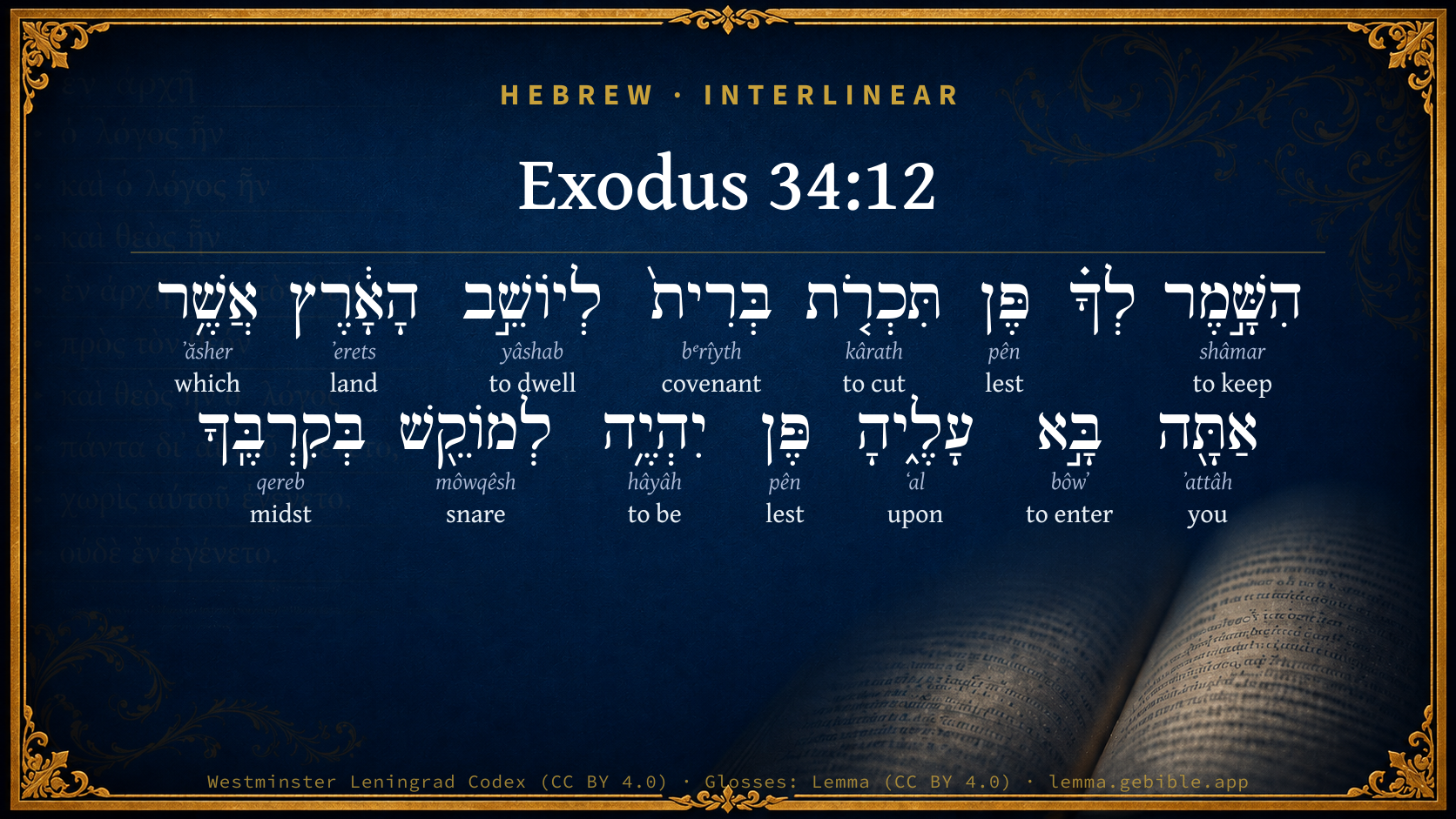
  1. הִשָּׁ֣מֶר shâmar H8104 “keep” Verb, Niphal, Imperative, 2nd Person, Masculine, Singular
  2. פֶּן pên H6435 “lest” Conjunction
  3. תִּכְרֹ֤ת kârath H3772 “to cut” Verb, Qal, Imperfect, 2nd Person, Masculine, Singular
  4. בְּרִית֙ bᵉrîyth H1285 “covenant” Noun, Common, Feminine, Singular, Absolute
  5. לְיוֹשֵׁ֣ב yâshab H3427 “to/for · dwelling” Preposition + Verb, Qal, Participle Active, Masculine, Singular, Construct
  6. הָאָ֔רֶץ ʼerets H776 “the · land” Particle, Definite Article + Noun, Common, Both, Singular, Absolute
  7. אֲשֶׁ֥ר ʼăsher H834 “which” Particle, Relative
  8. אַתָּ֖ה ʼattâh H859 “you” Pronoun, Personal, 2nd Person, Masculine, Singular
  9. בָּ֣א bôwʼ H935 “entering” Verb, Qal, Participle Active, Masculine, Singular, Absolute
  10. עָלֶ֑יהָ ʻal H5921 “upon · her” Preposition + Suffix, Personal, 3rd Person, Feminine, Singular
  11. פֶּן pên H6435 “lest” Conjunction
  12. יִהְיֶ֥ה hâyâh H1961 “to be” Verb, Qal, Imperfect, 3rd Person, Masculine, Singular
  13. בְּקִרְבֶּֽךָ qereb H7130 “in/at · midst · your” Preposition + Noun, Common, Masculine, Singular, Construct + Suffix, Personal, 2nd Person, Masculine, Singular

About this verse

These counts appear in no published source. They are computed here, from the morphology-tagged text and Lemma’s own curated glosses. What Lemma adds →

15
words
13
distinct lemmas
Pentateuch
section

Shared distinctive vocabulary

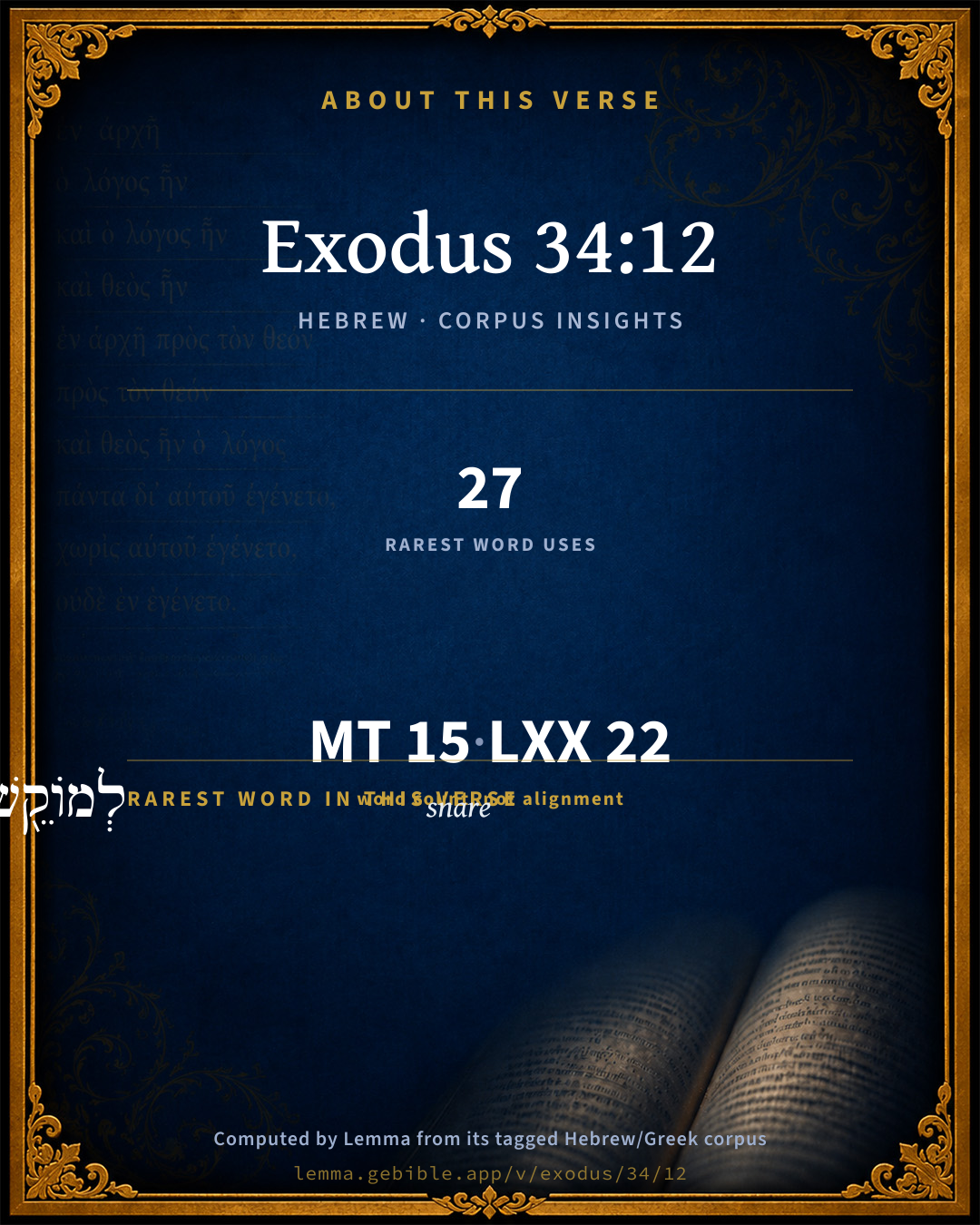
לְמוֹקֵ֖שׁ snare H4170 occurs in 27 verses of the Hebrew Bible. Also found in:

Grammatical profile

  • 5 verbs
  • 4 nouns
  • 1 pronoun
  • 2 prepositions
  • 2 conjunctions
  • 1 particle

Verb forms

  • הִשָּׁ֣מֶר Niphal · Imperative
  • תִּכְרֹ֤ת Qal · Imperfect
  • לְיוֹשֵׁ֣ב Qal · Participle Active
  • בָּ֣א Qal · Participle Active
  • יִהְיֶ֥ה Qal · Imperfect

Repetition

A word recurs within this verse — often emphatic in Hebrew:

  • פֶּן lest H6435 ×2

Hebrew & Septuagint length

In English translation the verse runs 28 words from the Hebrew and 33 from the Septuagint (LXX English) — closely comparable.

A rough comparison of the two English renderings, which tokenize alike — not a word-level alignment.

Word counts can differ between the Hebrew and the Greek without any difference in meaning — e.g. the Hebrew direct-object marker אֵת has no separate Greek word, and Greek often adds the article ὁ.

In the original languages it is 15 Hebrew tokens and 22 Greek tokens — but the two are counted differently (Hebrew bundles its prefixes and suffixes into one token; the Greek is in lemma form), so that isn’t a like-for-like length.

Cross-references

7

Topical passages linked to Exodus 34:12 in the Treasury of Scripture Knowledge — connected by theme and wording, ordered by reader-vote popularity; previews shown in the World English Bible.

  • Exodus 23:32–33 You shall make no covenant with them, nor with their gods.
  • Joshua 23:12–13 Else if you do at all go back, and cleave to the remnant of these nations, even these who remain among you, and make marriages with them, and go in to them, and they to you;
  • Deuteronomy 7:2 and when Yahweh your God shall deliver them up before you, and you shall strike them; then you shall utterly destroy them: you shall make no covenant with them, nor show mercy to them;
  • Deuteronomy 7:16 You shall consume all the peoples who Yahweh your God shall deliver to you; your eye shall not pity them: neither shall you serve their gods; for that will be a snare to you.
  • Judges 2:2–3 and you shall make no covenant with the inhabitants of this land; you shall break down their altars. But you have not listened to my voice: why have you done this?
  • Psalms 106:36 They served their idols, Which became a snare to them.
  • Judges 8:27 Gideon made an ephod of it, and put it in his city, even in Ophrah: and all Israel played the prostitute after it there; and it became a snare to Gideon, and to his house.

Cross-references courtesy of OpenBible.info (CC BY 4.0).

Hebrew and Greek witnesses Masoretic Hebrew ↔ Greek Septuagint

The same verse in the two great witnesses to the Old Testament, shown verse-for-verse.

These are two independent witnesses, not word-aligned to each other, and the Septuagint is shown in lemma (dictionary) form.

Hebrew Exodus 34:12 Masoretic · Westminster Leningrad Codex

הִשָּׁ֣מֶר לְךָ֗ פֶּן תִּכְרֹ֤ת בְּרִית֙ לְיוֹשֵׁ֣ב הָאָ֔רֶץ אֲשֶׁ֥ר אַתָּ֖ה בָּ֣א עָלֶ֑יהָ פֶּן יִהְיֶ֥ה לְמוֹקֵ֖שׁ בְּקִרְבֶּֽךָ

Be careful, lest you make a covenant with the inhabitants of the land where you are going, lest it be for a snare in the midst of you:

World English Bible · Public Domain

Greek LXX Exodus 34:12 Septuagint · lemma form

προςἔχω σεαυτοῦ μήποτε τίθημι διαθήκη ὁ ἐν καταἧμαι ἐπί ὁ γῆ εἰς ὅς εἰςπορεύομαι εἰς αὐτός μή σύ γίγνομαι πρόσκομμα ἐν σύ

take heed to yourself, lest at any time you make a covenant with the dwellers on the land, into which you are entering, lest it be to you a stumbling block among you.

LXX2012 (modern English Septuagint) · Public Domain

Hebrew: Westminster Leningrad Codex (CC BY 4.0). Greek: Septuagint (public domain); English from LXX2012 (modern English Septuagint) (Public Domain). How the Septuagint differs from the Hebrew →

Targum (Aramaic paraphrase)

2

The Targum is the ancient Jewish Aramaic paraphrase of the Hebrew Scriptures — an interpretive translation, not the Hebrew text itself. Onkelos (literal) and Pseudo-Jonathan (expansive) render the Torah, and Jonathan the Prophets. Coverage is partial: where no permissively-licensed English translation exists for a verse, only the Aramaic is shown. This is verse-level text, not a word-by-word alignment to the Hebrew.

  1. Targum Onkelos Torah (Genesis–Deuteronomy)
    אִסְתַּמַר לָךְ דִילְמָא תִגְזַר קְיַם לְיָתֵב אַרְעָא דִי אַתְּ עָלֵל עֲלַהּ דִילְמָא יְהֵי לְתַקְלָא בֵּינָךְ:

    (no public-domain English translation for this verse)

    Targum Onkelos — Aramaic: “Onkelos Genesis” (public domain); “Onkelos Exodus” (public domain); “Onkelos Leviticus” (public domain); “Onkelos Numbers” (public domain); “Onkelos Deuteronomy” (public domain). English: “Sefaria Community Translation” (CC0 1.0 (public-domain dedication)); “J.W. Etheridge. The Targums of Onkelos and Jonathan Ben Uzziel on the Pentateuch. London: Longmans, Green, 1862” (public domain). Text via Sefaria.

  2. Targum Pseudo-Jonathan Torah (Genesis–Deuteronomy)
    אִיסְתַּמַּר לָךְ דִּילְמָא תִגְזוֹר קְיַים לְיָתֵיב אַרְעָא דְאַנְתְּ עָלֵיל עֲלָהּ דִּלְמָא יְהֵי לְתַקָּלָא בֵּינָךְ

    Take heed to thee, lest thou strike covenants with the inhabitants of that land into which thou art to enter; that it may not be a stumbling-block unto thee.

    Targum Pseudo-Jonathan — Aramaic: “Targum Jonathan on Genesis” (public domain); “Targum Jonathan on Exodus” (public domain); “Targum Jonathan on Leviticus” (public domain); “Targum Jonathan on Numbers” (public domain); “Targum Jonathan on Deuteronomy” (public domain). English: “The Targum of Jonathan ben Uzziel, trans. J. W. Etheridge, London, 1862” (public domain). Text via Sefaria.

Commentary

Notes on Exodus 34:12 from classic Christian and Jewish commentators (each source and its license shown beneath its notes). The classic Christian expositions comment on the surrounding passage and are grouped to its opening verse, so a note may address several verses; the Jewish commentaries on the Tanakh (Rashi and others) are per-verse, so they appear only where the commentator wrote on this verse.

Lemma curates 59 commentaries, every one of them public domain or Creative Commons licensed, each selected and text-cleaned for this edition rather than reprinted as found. About our sources →

Trapp's Complete Commentary

John Trapp

Exo 34:12 Take heed to thyself, lest thou make a covenant with the inhabitants of the land whither thou goest, lest it be for a snare in the midst of thee:

Ver. 12. With the inhabitants.] They were devoted to destruction, as having filled the land from one end to another with their uncleanness. {Ezr 9:11}

John Trapp, A Commentary or Exposition upon All the Books of the Old and New Testament (1647–1656) — public domain. Text from a community e-Sword module.

Albert Barnes' Notes on the Bible

The precepts contained in these verses are, for the most part, identical in substance with some of those which follow the Ten Commandments and are recorded in “the Book of the covenant” (Exo. 20–23; see Exo 24:7).

Exo 34:13

Cut down their groves - This is the first reference to what is commonly known as grove-worship. The original word for “grove” in this connection אשׁרה 'ăshêrāh is different from that so rendered in Gen 21:33. Our translators supposed that what the law commands is the destruction of groves dedicated to the worship of false deities Jdg 6:25; 2Ki 18:4; but inasmuch as the worship of asherah is found associated with that of Astarte, or Ashtoreth Jdg 2:13; Jdg 10:6; 1Sa 7:4, it seems probable that while Astarte was the personal name of the goddess, the asherah was a symbol of her, probably in some one of her characters, made in wood in some conventional form.

Exo 34:15-16

An expansion of Exo 34:12. The unfaithfulness of the nation to its covenant with Yahweh is here for the first time spoken of as a breach of the marriage bond. The metaphor is, in any case, a natural one, but it seems to gain point, if we suppose it to convey an allusion to the abominations connected with pagan worship, such as are spoken of in Num 25:1-3.

Exo 34:21

See Exo 20:9; Exo 23:12. There is here added to the commandment a particular caution respecting those times of year when the land calls for most labor. The old verb “to ear” (i. e. to plow) is genuine English.

Exo 34:24

Neither shall any man desire etc. - Intended to encourage such as might fear the consequences of obeying the divine law in attending to their religious duties. Compare Pro 16:7.

Albert Barnes' Notes on the Bible (1834–1885) — public domain. Text from a community e-Sword/MySword module.

Joseph Benson's Commentary

Exo 34:12. Take heed to thyself — It is a sin thou art prone to, and that will easily beset thee; carefully abstain from all advances toward it; make no covenant with the inhabitants of the land — If God, in kindness to them, drove out the Canaanites, they ought, in duty to God, not to harbour them: If they espoused their children, they would be in danger of espousing their gods. That they might not be tempted to make molten gods, they must utterly destroy those they found, and all that belonged to them, the altars and groves, lest, if they were left standing, they should be brought in process of time either to use them, or to take pattern by them.

Joseph Benson's Commentary on the Old and New Testaments (1811–1818) — public domain. Text from a community e-Sword module.

Whedon's Commentary on the Bible

Daniel D. Whedon

12-26. Take heed to thyself — Here follows a brief resume of the laws previously ordained, and written in the Book of the Covenant, 21-23. They may be resolved into ten precepts, as follows:

1. Thou shalt make no covenant with the heathen. Exo_34:12.

2. Thou shalt destroy their altars and images. Exo_34:18.

3. Thou shalt worship no other god save Jehovah. Exo_34:14.

4. Thou shalt make no molten gods. Exo_34:17.

5. Thou shalt keep the feast of unleavened bread. Exo_34:18.

6. Thou shalt redeem all the firstborn. Exo_34:19-20.

7. Thou shalt keep the sabbath day. Exo_34:21.

8. Thou shalt observe the three annual feasts. Exo_34:22-23.

9. Thou shalt not offer sacrifice with leaven. Exo_34:25.

10. Thou shalt not seethe a kid in its mother’s milk. Exo_34:26.

We should lay no stress upon this division into ten commandments; for it is possible, by making separate precepts of the firstfruits, (Exo_34:26,) and the not appearing empty (Exo_34:20,) to make more than ten; or by combining several very kindred laws to reduce the number to seven or eight. In no case should this recapitulation of laws be identified with the ten commandments mentioned in Exo_34:28, for these were identical with those in the first tables. Exo_34:1.

Daniel D. Whedon (gen. ed.), Commentary on the Old and New Testaments (1874–1909) — public domain. Text from a community e-Sword module.

Tyndale Open Study Notes

Tyndale Open Resources

34:12-17 Worship of idols was prohibited, particularly the idols of the peoples into whose lands the Israelites were going. Central to this restriction was the prohibition of treaties, or covenants, with these idol-worshiping peoples. Not only would the making of a treaty involve recognizing those peoples’ gods (because ancient treaties would call upon the gods as witnesses; see study note on 20:1–23:33), but the very existence of the treaties would predispose the Israelites to accept the ways of their treaty partners (34:12, 15-16).

Tyndale Open Study Notes — © Tyndale Open Resources, licensed CC BY-SA 4.0. Text via the HelloAO Bible API.

Geneva Bible (1599)

Geneva Bible translators

If thou follow their wickedness, and pollute thyself with their idolatry.

Geneva Bible (1599) marginal notes — public domain. Text via Bolls.life.

Ellicott's Commentary for English Readers

(12) A snare.—Comp. Exo_23:33; and for the nature of the snare, see Exo_34:15-16 of the present chapter.

(12-16) This passage may be compared with Exo_23:24-25; Exo_23:32-33. It repeats, with some enlargements, the enactments there made, and traces in detail the evil consequences which would follow from a neglect of the enactments.

A Bible Commentary for English Readers, edited by Charles John Ellicott (1878–1897) — public domain. Text from a community e-Sword module.

The Cambridge Bible for Schools and Colleges

gen. ed. J. J. S. Perowne

12. Take heed to thyself] Also a phrase common in Dt. (Deu_4:9; Deu_4:23, Deu_6:12 Heb., Deu_8:11 Heb., Deu_11:16 al.).

lest thou make, &c.] Cf. Exo_23:32.

a snare] i.e. an allurement to ruin: cf. Exo_23:33 b with the note.

The Cambridge Bible for Schools and Colleges (gen. ed. J. J. S. Perowne; Cambridge University Press, 1878–1918) — public domain. Text from a community e-Sword module.

John Gill's Exposition

Take heed to thyself,.... This is said not to Moses, but to the people of Israel, as a caution to them when they should enter the land of Canaan, and possess it:

lest thou make a covenant with the inhabitants of the land whither thou goest: enter into a league and alliance, to live friendly and amicably, and support and assist each other against the common enemy; whereas they were to smite the seven nations and destroy them, and show them no mercy, Deu 7:1.

lest it be for a snare in the midst of thee; be the means of drawing them into the same sinful practices with themselves, especially into idolatrous ones, and so of bringing ruin and destruction on them.

John Gill's Exposition of the Whole Bible (1746–1763) — public domain (CC PDM 1.0). Text via the HelloAO Bible API.

The Pulpit Commentary

Take heed to thyself lest thou make a covenant. See above, Exo_23:32. A snare. See Exo_23:33.

The Pulpit Commentary (1880–1919), ed. H.D.M. Spence-Jones & Joseph S. Exell — public domain. Text from a community e-Sword module.

John Wesley's Explanatory Notes

Take heed to thyself - It is a sin thou art prone to, and that will easily beset thee; carefully abstain from all advances towards it, make no covenant with the inhabitants of the land - If God in kindness to them drove out the Canaanites, they ought in duty to God not to harbour them: If they espoused their children they would be in danger of espousing their gods. That they might not be tempted to make molten gods, they must utterly destroy those they found, and all that belonged to them, the altars and groves, lest, if they were left standing, they should be brought in process of time either to use them, or to take pattern by them.

John Wesley, Explanatory Notes Upon the Whole Bible (1754–1765) — public domain. Text via the GEBible commentary corpus.

unfoldingWord translationNotes

Door43 World Missions Community

General Information:

Yahweh continues speaking to Moses. Here he tells him what Moses and the people must do.

they will become a trap among you

People who tempt others to sin are spoken of as if they were a trap. AT: "they will tempt you to sin" (See: Metaphor)

Yahweh, whose name is Jealous

The word "Jealous" here means that God is concerned to keep his honor. If his people worship other gods, he loses honor, because when his people do not honor him, other people also will not honor him. AT: "I, Yahweh, always guard my honor" (See: Metonymy)

whose name is Jealous,

The word "name" here represents God's character. AT: "I, Yahweh, who am always jealous" or "I, Yahweh, am always jealous" (See: Metonymy)

translationWords

covenant

altar

column

Asherah

worship

false god

Yahweh

name

jealous

God

unfoldingWord translationNotes — © Distant Shores Media and the Door43 World Missions Community, licensed CC BY-SA 4.0. Source: git.door43.org/Door43/en_tn.

Lesson kit

Teaching starters — assembled from the data on this page, not authored interpretation. Every prompt links to the verse data it draws on. Edit before teaching.

Exodus, in the Pentateuch, opens this verse with 15 words (13 distinct Hebrew lemmas). Its most distinctive word is môwqêsh (“snare”). A historical commentator’s framing appears above. Read the whole chapter for the surrounding context.

Discussion questions

  1. How does “snare” (môwqêsh) shape what this verse is saying?
  2. Exodus 10:7 shares the word «snare» with this verse. How do the two illuminate each other?
  3. “lest” occurs 2× in this one verse. What is the effect of the repetition?
  4. The translations on this page render this verse differently — a whole-verse word diff, not a word-by-word alignment. What might account for the different wordings?
  5. The verb «הִשָּׁ֣מֶר» is Niphal Imperative. How does its form color the action?
  6. Reading how Trapp's Complete Commentary and Albert Barnes' Notes on the Bible read this verse, where do the two commentators agree and where do they part?

Things to notice

Reading settings

Reading text

Shown beneath each verse's original-language words.

Old Testament
Old Testament edition

Read the OT as the Masoretic Hebrew (MT) or the Greek Septuagint (LXX).

English shown for the Greek Septuagint (in the Hebrew ↔ Greek comparison).

Comparing translations? Open the Compare panel on any verse page to stack up to four side by side.