Isaiah 10:7

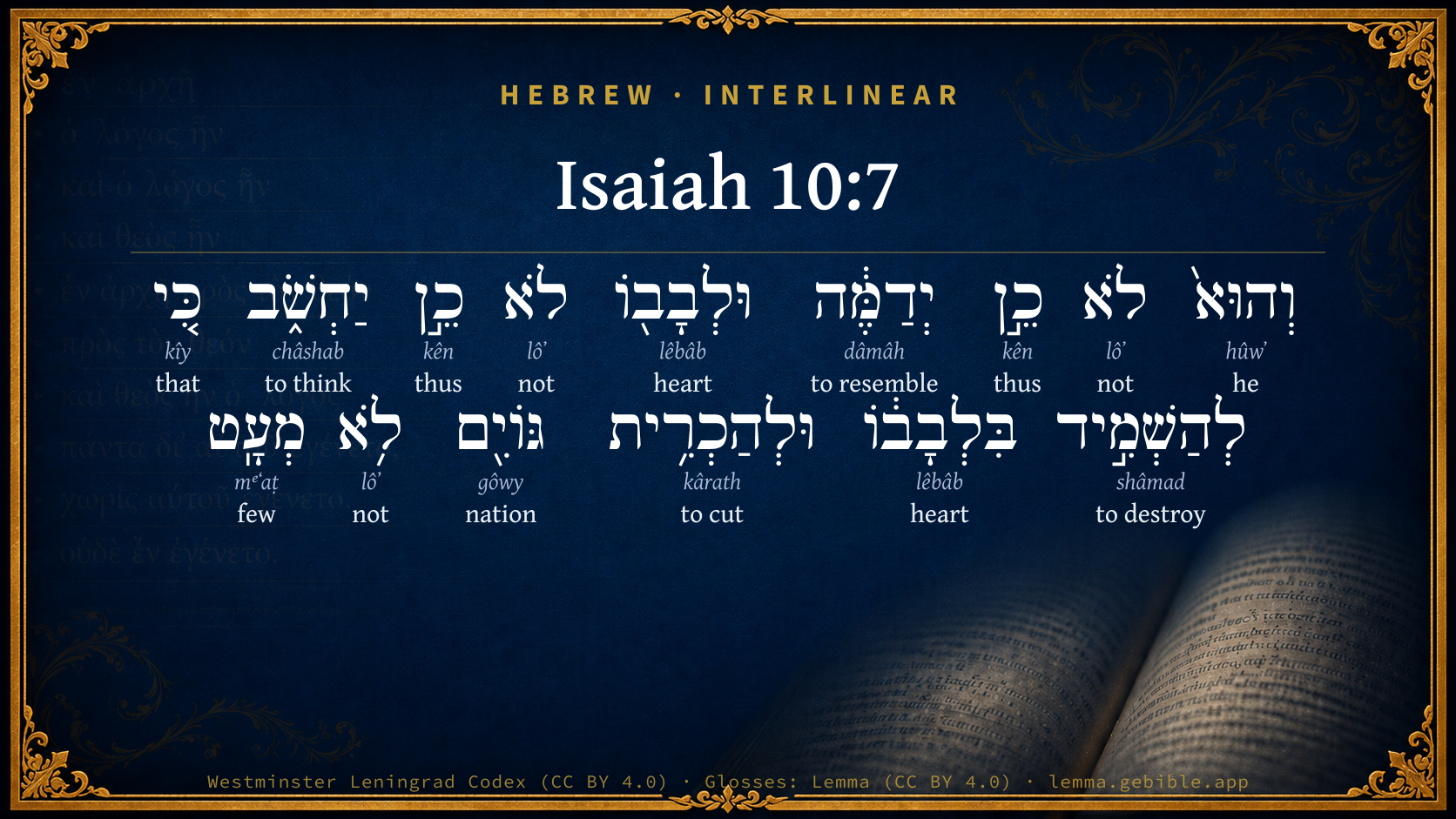
Hebrew (Westminster Leningrad Codex) Isaiah 10:7 appears in the Hebrew Old Testament. The text above is from the Westminster Leningrad Codex. Each word links to its Strong’s number, a concise gloss, and parsing drawn from the Open Scriptures Hebrew Bible morphology. Click any word for its full Brown-Driver-Briggs (BDB) entry.
Download image
Cite this verse

Isaiah 10:7 (World English Bible). Public Domain. Lemma interlinear Bible study tool, https://lemma.gebible.app/v/isaiah/10/7.

Show BibTeX & RIS
BibTeX
RIS
English Translation
However he doesn't mean so, neither does his heart think so; but it is in his heart to destroy, and to cut off not a few nations.
World English Bible · Public Domain
Download a study sheet

One document with this verse’s original text, its word-by-word gloss line, the meaning frame, cross-references with their text, attributed commentary, and full source and license credits — printable, and it pastes into notes with its structure intact.

This verse Autodidact and up

Study sheet (.html) Plain text (.txt)

A passage Seminary Student

Up to 50 verses in one chapter. A passage sheet keeps up to 6 commentary sources and 12 cross-references per verse, in the order this page ranks them, and says so on the sheet whenever that leaves anything out. Ask for a single verse and you get the Autodidact verse sheet above.

Everything on this page stays free to read, with no account — the sheet is a download of what is already on screen, not access to it.

Want to remove ads? Support Godless Engineer
Compare translations 3

The same verse in 3 English versions, stacked beneath the original-language interlinear above. Click any original word for its lexicon entry.

Each is an independent rendering of the whole verse — the interlinear is not word-aligned to these translations.

Highlighted words mark where these versions differ — a whole-verse word diff, not a word-by-word alignment.

  • World English Bible Public Domain
    However he doesn't mean so, neither does his heart think so; but it is in his heart to destroy, and to cut off not a few nations.
  • King James Version Public Domain
    Howbeit he meaneth not so, neither doth his heart think so; but it is in his heart to destroy and cut off nations not a few.
  • unfoldingWord Literal Text CC BY-SA 4.0
    But he does not intend thus, and his heart does not think thus, for to destroy in his heart, and to cut off nations not a few.

unfoldingWord Literal Text — © unfoldingWord, licensed CC BY-SA 4.0. Word-aligned USFM3 via Door43 (git.door43.org/unfoldingWord/en_ult).

Versions to compare (up to 4)

3 of 4 selected

Show all 18 translations

Every available English version of this verse, each an independent rendering of the whole verse.

  • World English Bible Public Domain
    However he doesn't mean so, neither does his heart think so; but it is in his heart to destroy, and to cut off not a few nations.
  • Berean Standard Bible Public Domain
    But this is not his intention; this is not his plan. For it is in his heart to destroy and cut off many nations.
  • Majority Standard Bible Public Domain
    But this is not his intention; this is not his plan. For it is in his heart to destroy and cut off many nations.
  • King James Version Public Domain
    Howbeit he meaneth not so, neither doth his heart think so; but it is in his heart to destroy and cut off nations not a few.
  • American Standard Version (1901) Public Domain
    Howbeit he meaneth not so, neither doth his heart think so; but it is in his heart to destroy, and to cut off nations not a few.
  • Revised Version (1885) Public Domain
    Howbeit he meaneth not so, neither doth his heart think so; but it is in his heart to destroy, and to cut off nations not a few.
  • Geneva Bible (1599) Public Domain
    But he thinketh not so, neither doeth his heart esteeme it so: but he imagineth to destroy and to cut off not a fewe nations.
  • Douay-Rheims (1899) Public Domain
    But he shall not take it so, and his heart shall not think so: but his heart shall be set to destroy, and to cut off nations not a few.
  • Young's Literal Translation Public Domain
    And he -- he thinketh not so, And his heart reckoneth not so, For -- to destroy `is' in his heart, And to cut off nations not a few.
  • Literal Standard Version CC BY-SA 4.0
    And he does not think [it] so, || And his heart does not reckon [it] so, || For—to destroy [is] in his heart, || And to cut off nations—not a few.
  • Unlocked Literal Bible CC BY-SA 4.0
    But this is not what he intends, nor does he think this way. It is in his heart to destroy and eliminate many nations.
  • unfoldingWord Literal Text CC BY-SA 4.0
    But he does not intend thus, and his heart does not think thus, for to destroy in his heart, and to cut off nations not a few.
  • Darby Bible Public Domain
    But he meaneth not so, neither doth his heart think so; for it is in his heart to extirpate and cut off nations not a few.
  • World Messianic Bible Public Domain
    However, he doesn’t mean so, neither does his heart think so; but it is in his heart to destroy, and to cut off not a few nations.
  • Webster's Bible Public Domain
    Howbeit he meaneth not so, neither doth his heart think so; but it is in his heart to destroy and cut off nations not a few.
  • Free Bible Version CC BY-SA 4.0
    But this isn't what is behind the thinking of the king of Assyria. This isn't the plan he has in mind. What he wants to do is to destroy and eliminate many nations.
  • Bible in Basic English Public Domain
    But this is not what is in his mind, and this is not his design; but his purpose is destruction, and the cutting off of more and more nations.
  • JPS Tanakh (1917) Public Domain
    Howbeit he meaneth not so, neither doth his heart think so; but it is in his heart to destroy, and to cut off nations not a few.

Literal Standard Version (2020), Covenant Press — licensed CC BY-SA 4.0. Text via the HelloAO Bible API (eBible.org). Unlocked Literal Bible (unfoldingWord) — licensed CC BY-SA 4.0. Text via the HelloAO Bible API (eBible.org). unfoldingWord Literal Text — © unfoldingWord, licensed CC BY-SA 4.0. Word-aligned USFM3 via Door43 (git.door43.org/unfoldingWord/en_ult). Free Bible Version, Dr. Jonathan Gallagher — licensed CC BY-SA 4.0. Text via the HelloAO Bible API (eBible.org).

Word by word

More ways to search: Search by grammar → Find every occurrence → Compare this word →

Practice this passage: Drill this verse → Learn its vocabulary →

יְדַמֶּ֔ה
dâmâh
H1819
“to resemble”
Verb, Piel, Imperfect, 3rd Person, Masculine, Singular
Part of Speech
Verb
Stem
Piel
Form
Imperfect
Person
3rd Person
Gender
Masculine
Number
Singular
Full BDB Definition

Origin: a primitive root

TWOT: 437

to be like, resemble - (Qal) to be like, resemble - (Piel) - to liken, compare - to imagine, think - (Hithpael) to make oneself like - (Niphal)
  1. וְהוּא֙ hûwʼ H1931 “and · he” Conjunction + Pronoun, Personal, 3rd Person, Masculine, Singular
  2. לֹא lôʼ H3808 “not” Particle, Negative
  3. כֵ֣ן kên H3651 “thus” Adverb
  4. וּלְבָב֖וֹ lêbâb H3824 “and · heart · his” Conjunction + Noun, Common, Masculine, Singular, Construct + Suffix, Personal, 3rd Person, Masculine, Singular
  5. לֹא lôʼ H3808 “not” Particle, Negative
  6. כֵ֣ן kên H3651 “thus” Adverb
  7. יַחְשֹׁ֑ב châshab H2803 “to think” Verb, Qal, Imperfect, 3rd Person, Masculine, Singular
  8. כִּ֚י kîy H3588 “that” Conjunction
  9. לְהַשְׁמִ֣יד shâmad H8045 “to destroy” Preposition + Verb, Hiphil, Infinitive Construct
  10. בִּלְבָב֔וֹ lêbâb H3824 “in/at · heart · his” Preposition + Noun, Common, Masculine, Singular, Construct + Suffix, Personal, 3rd Person, Masculine, Singular
  11. וּלְהַכְרִ֥ית kârath H3772 “and · to cut” Conjunction + Preposition + Verb, Hiphil, Infinitive Construct
  12. גּוֹיִ֖ם gôwy H1471 “nations” Noun, Common, Masculine, Plural, Absolute
  13. לֹ֥א lôʼ H3808 “not” Particle, Negative
  14. מְעָֽט mᵉʻaṭ H4592 “few” Noun, Common, Masculine, Singular, Absolute

About this verse

These counts appear in no published source. They are computed here, from the morphology-tagged text and Lemma’s own curated glosses. What Lemma adds →

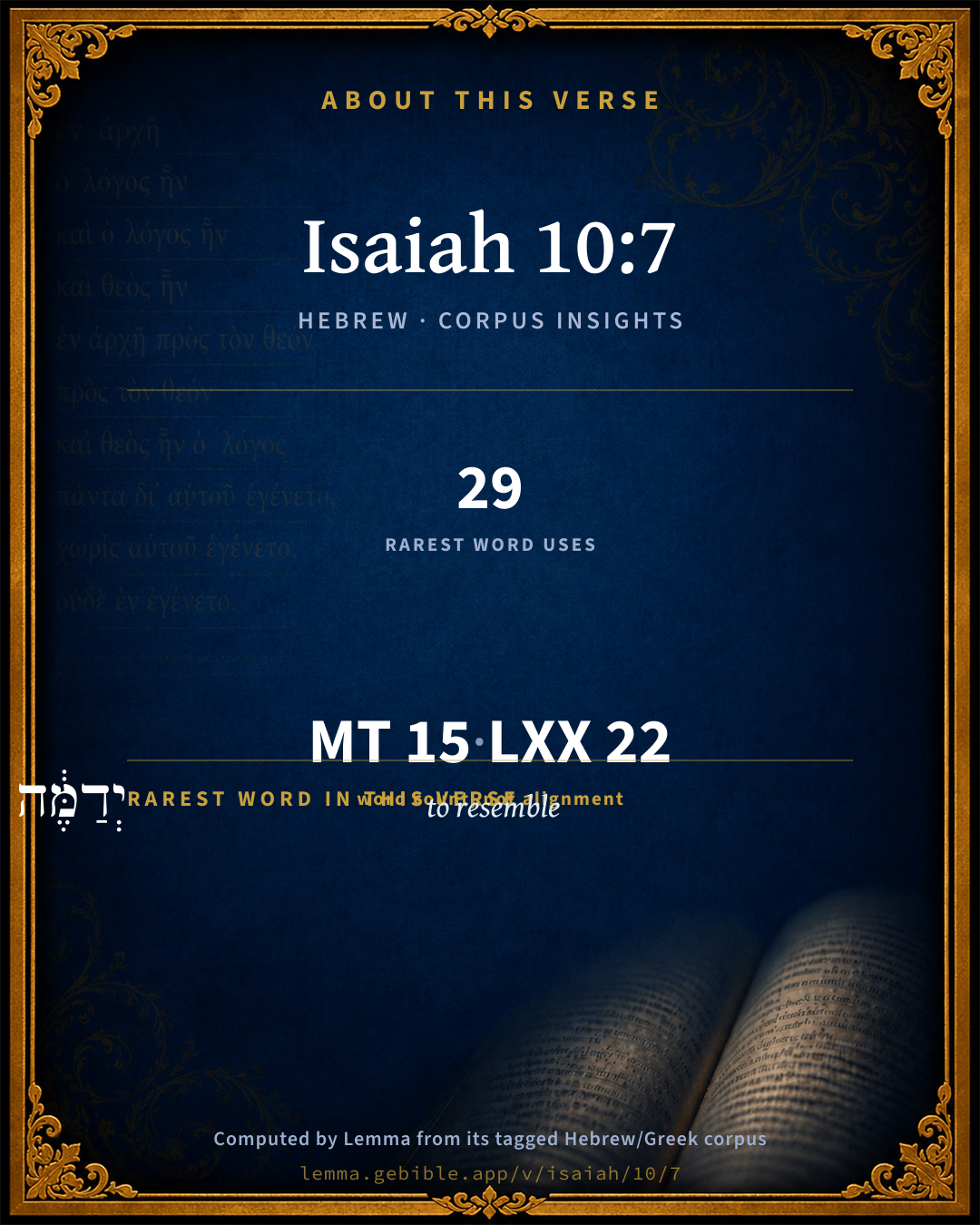
15
words
11
distinct lemmas
Prophets
section

Shared distinctive vocabulary

יְדַמֶּ֔ה to resemble H1819 occurs in 27 verses of the Hebrew Bible. Also found in:

Grammatical profile

  • 4 verbs
  • 4 nouns
  • 1 pronoun
  • 1 conjunction
  • 2 adverbs
  • 3 particles

Verb forms

  • יְדַמֶּ֔ה Piel · Imperfect
  • יַחְשֹׁ֑ב Qal · Imperfect
  • לְהַשְׁמִ֣יד Hiphil · Infinitive Construct
  • וּלְהַכְרִ֥ית Hiphil · Infinitive Construct

Repetition

Words recur within this verse — often emphatic in Hebrew:

  • כֵ֣ן thus H3651 ×2
  • וּלְבָב֖וֹ heart H3824 ×2
  • לֹא not H3808 ×3

Hebrew & Septuagint length

In English translation the verse runs 27 words from the Hebrew and 26 from the Septuagint (LXX English) — closely comparable.

A rough comparison of the two English renderings, which tokenize alike — not a word-level alignment.

Word counts can differ between the Hebrew and the Greek without any difference in meaning — e.g. the Hebrew direct-object marker אֵת has no separate Greek word, and Greek often adds the article ὁ.

In the original languages it is 15 Hebrew tokens and 22 Greek tokens — but the two are counted differently (Hebrew bundles its prefixes and suffixes into one token; the Greek is in lemma form), so that isn’t a like-for-like length.

Cross-references

6

Topical passages linked to Isaiah 10:7 in the Treasury of Scripture Knowledge — connected by theme and wording, ordered by reader-vote popularity; previews shown in the World English Bible.

  • Genesis 50:20 As for you, you meant evil against me, but God meant it for good, to bring to pass, as it is this day, to save many people alive.
  • Micah 4:11–12 Now many nations have assembled against you, that say, 'Let her be defiled, And let our eye gloat over Zion.'
  • Acts 2:23 him, being delivered up by the determined counsel and foreknowledge of God, you have taken by the hand of lawless men, crucified and killed;
  • Isaiah 36:18–20 Beware lest Hezekiah persuade you, saying, Yahweh will deliver us. Has any of the gods of the nations delivered his land out of the hand of the king of Assyria?
  • Isaiah 37:11–13 Behold, you have heard what the kings of Assyria have done to all lands, by destroying them utterly: and shall you be delivered?
  • Acts 13:27–30 For those who dwell in Jerusalem, and their rulers, because they didn't know him, nor the voices of the prophets which are read every Sabbath, fulfilled them by condemning him.

Cross-references courtesy of OpenBible.info (CC BY 4.0).

Hebrew and Greek witnesses Masoretic Hebrew ↔ Greek Septuagint

The same verse in the two great witnesses to the Old Testament, shown verse-for-verse.

These are two independent witnesses, not word-aligned to each other, and the Septuagint is shown in lemma (dictionary) form.

Hebrew Isaiah 10:7 Masoretic · Westminster Leningrad Codex

וְהוּא֙ לֹא כֵ֣ן יְדַמֶּ֔ה וּלְבָב֖וֹ לֹא כֵ֣ן יַחְשֹׁ֑ב כִּ֚י לְהַשְׁמִ֣יד בִּלְבָב֔וֹ וּלְהַכְרִ֥ית גּוֹיִ֖ם לֹ֥א מְעָֽט

However he doesn't mean so, neither does his heart think so; but it is in his heart to destroy, and to cut off not a few nations.

World English Bible · Public Domain

Greek LXX Isaiah 10:7 Septuagint · lemma form

αὐτός δέ οὐ οὕτως ἐνθυμέομαι καί ὁ ψυχή οὐ οὕτως λογίζομαι ἀλλά ἀποἀλλάσσω ὁ νοῦς αὐτός καί ὁ ἔθνος ἐκὀλεθρεύω οὐ ὀλίγος

But he meant not thus, neither did he devise thus in his soul: but his mind shall change, and that to destroy nations not a few.

LXX2012 (modern English Septuagint) · Public Domain

Hebrew: Westminster Leningrad Codex (CC BY 4.0). Greek: Septuagint (public domain); English from LXX2012 (modern English Septuagint) (Public Domain). How the Septuagint differs from the Hebrew →

Targum (Aramaic paraphrase)

1

The Targum is the ancient Jewish Aramaic paraphrase of the Hebrew Scriptures — an interpretive translation, not the Hebrew text itself. Onkelos (literal) and Pseudo-Jonathan (expansive) render the Torah, and Jonathan the Prophets. Coverage is partial: where no permissively-licensed English translation exists for a verse, only the Aramaic is shown. This is verse-level text, not a word-by-word alignment to the Hebrew.

  1. Targum Jonathan Prophets (Joshua–Malachi)
    וְהוּא לָא כֵן מְדַמֵי וְלִבֵּיהּ לָא כֵן מַחְשֵׁיב אֲרֵי לְשֵׁיצָאָה אֲמַר בְּלִבֵּיהּ וְלַאֲסָפָא עַמְמִין לָא בַּחֲיָס:

    Howbeit he did not purpose so, neither doth his heart think so; but to destroy he hath said in his heart, and to make an end of nations without compassion.

    Targum Jonathan — Aramaic: “Mikraot Gedolot” (public domain). English: “Sefaria Community Translation” (CC0 1.0 (public-domain dedication)); “London "Chaldee Paraphrase," 1871” (public domain). Text via Sefaria.

Commentary

Notes on Isaiah 10:7 from classic Christian and Jewish commentators (each source and its license shown beneath its notes). The classic Christian expositions comment on the surrounding passage and are grouped to its opening verse, so a note may address several verses; the Jewish commentaries on the Tanakh (Rashi and others) are per-verse, so they appear only where the commentator wrote on this verse.

Lemma curates 59 commentaries, every one of them public domain or Creative Commons licensed, each selected and text-cleaned for this edition rather than reprinted as found. About our sources →

Trapp's Complete Commentary

John Trapp

Isa 10:7 Howbeit he meaneth not so, neither doth his heart think so; but [it is] in his heart to destroy and cut off nations not a few.

Ver. 7. Howbeit he meaneth not so.] He is otherwise minded and affected than I am, and doeth my will merely beside and against his own will. As in applying of leeches the physician seeketh the health of his patient, the leech only the filling of his gorge, so is it when God turneth loose a bloody enemy upon his people; he hath excellent ends, which they think not on.

But it is in his heart to destroy and cut off.] This was to exceed his commission, which was only to "take the spoil, and to take the prey," {Isa 10:6} not to cut off nations, and to make havoc of all. How much better our King Edward the Confessor, who, when his captains promised for his sake they would not leave one Dane alive, thought it better to lead a private and unbloody life than to be a king by such bloody butcheries. {a} Of Charles V, emperor, we read, that when Antonius Leva, and other of his chief commanders, commended Alexander the Great and Julius Caesar for their great exploits in overrunning and destroying nations not a few, to their great renown; and, on the other side, complained that Charles made not the like use of his power and victories as he might and ought to do for such a purpose, he gravely replied, that Alexander and Julius had, in waging wars, nothing else to aim at besides honour and glory, but that Christian princes were in all their enterprises to mind the glory of God and the salvation of their own souls. {b}

{a} Camd. Rem., p. 214.

{b} Parei Hist. Prof. Med., p. 895.

John Trapp, A Commentary or Exposition upon All the Books of the Old and New Testament (1647–1656) — public domain. Text from a community e-Sword module.

The Biblical Illustrator

Joseph S. Exell

Isa_10:7-9

Howbeit he meaneth not so

Man proposes, but God disposes

He meaneth not so.

1. The wise God often makes even the sinful passions and projects of men subservient to His own great and holy purposes.

2. When God makes use of men as instruments in His hands to do His work, it is very common for Him to mean one thing, and them to mean another; nay, for them to mean quite contrary to what He intends Gen_50:20; Mic_4:11-12). Men have their ends, and God His; but we are sure the counsel of the Lord that shall stand. (M. Henry.)

Gods use of evil men

As in applying of leeches the physician seeketh the health of his patient, the leech only the filling of his gorge, so is it when God turneth loose a bloody enemy upon His people; He hath excellent ends, which they think not on. (J. Trapp.)

It is in his heart to destroy and cut off nations not a few

Assyrian conquests

The significance of Isa_10:9 appears when the dates of the events alluded to are considered . . . The application to Jerusalem is obvious . . . It is true the conquests alluded to in Isa_10:9-11 are not those of Sennacherib, and Isa_10:13, etc., would be in his mouth an exaggeration; and hence the prophecy has been referred by some to the period of Sargon. But the subject in Isa_10:7-11 is Assyria (see Isa_10:5), and though Isaiah may have regarded the king (verse 12) as being here the speaker, yet verses 5, etc., show that he speaks, not with reference to his personal achievements, but as an impersonation of the policy of his nation. And this policy Sennacherib in 701 was truly maintaining. The language of these verses does not, therefore, in reality militate against a date which in other respects is in entire accordance with the contents of the prophecy. (Prof. S. R. Driver, D. D.)

Foolish ambition

Pyrrhus, King of Epirus, having enlarged his dominions by the conquest of Macedonia, was bent upon subduing Italy, and adding it to his empire. Asking the advice of his counsellor Cineas, he inquired of the prince what he meant to do after he conquered Italy? Next, said he, I mean to invade Sicily, which is a rich and powerful country and not far off. When you have got Sicily, said Cineas, what then? Africa, replied the king, containing many fine kingdoms, is at no great distance, and through my renown and the valour of my troops, I may subdue them. Be it so, said the counsellor, when you have vanquished the kingdoms of Africa, what will you do then! Pyrrhus answered, Then you and I will be merry to make you and me merry: had you all the world you could not be more merry, nor have better cheer. (R. Macculloch.)

The Biblical Illustrator, edited by Joseph S. Exell (c. 1880s–1900s) — public domain. Text from a community e-Sword module.

The Preacher's Complete Homiletical Commentary

Joseph S. Exell (gen. ed.)

MAN PROPOSES, GOD DISPOSES

Isa_10:7-15. Howbeit He meaneth not so, &c.

“Man appoints, but God disappoints,” “Man proposes, but God disposes,” are proverbs which sum up a good deal of human experience. We are often reminded of their truth even when we are striving to be on the side of God, and to be co-workers with Him. There will be great differences between what we “mean” and “think,” and what He has determined in reference to the same actions [970] But more frequently we see this in the case of men who, like the Assyrians, are constructing their plans in direct opposition to God, fully bent on carrying out ambitious and rapacious schemes. All the while they are only agents in effecting Divine purposes; they do what they never “meant” to do.

[970] P., D., 2899, 2906.

See the whole article PROVIDENCE in the H. E. I., and the other references given under this heading in the “Index of Arrangement.”

I. Man’s purposes are often godless. In the sense,

1. Of being formed independently of God (Isa_10:11; Isa_10:13-14). Men forget that God is inseparably connected with us and all our movements (Psa_139:1-12; they never ask whether God will approve of their plans, nor what will happen should He frown upon them; they assume that they have only to plan and execute, forgetting the lessons of experience. Their conduct is as foolish as it is irreligious; irrational because it is atheistic (Jas_4:13-15).

2. Of being formed in defiance of God. Men harden themselves against the appeals and warnings of conscience and Scripture, and deliberately engage in enterprises upon which they know they cannot ask God’s blessing, upon which they know must rest God’s curse. Amid all their dark designs there is the torturing thought, which they would fain banish, but which clings to them still, that there is a Sovereign Lord whose counsel shall stand.

II. God knows how to use man’s godless purposes for the furtherance of His glorious designs. This is done,

1. Sometimes by making an evil purpose the very means of continuing and spreading His good work. How often is this seen in the history of persecutions! (See Act_18:1-2. The Pilgrim Fathers. Tyndale’s Bible. Martyrdoms, &c.). The means which men take for putting out the light are used by God for spreading it.

2. Sometimes by allowing the evil purpose to work on up to the point when its success appears certain, and then bringing about a totally different result. The device of Joseph’s brethren only needed time to effect God’s purpose. Haman; enemies of Daniel. There is no stage of a wicked design safe from the chance of utter confusion, and even its last act that was intended to be a triumph may turn out a tragedy.

3. Sometimes the evil purpose is allowed to do all that was intended, and yet God effects through it His highest designs, even when human wisdom would declare that the case was hopeless. The crowning example of this is to be found in the suffering and death of our Lord Himself. Every step of that malignant crime, which was thought to be a step towards the utter destruction of the Saviour’s mission, was but helping on the triumph intended in the counsels of Eternal Love (Joh_12:32).

Learn,

1. The folly of leaving God out of our plans. To plan without Him is presumptuous arrogance (Isa_10:15). It is to invite defeat, our knowledge being so limited and so certain to leave out some disturbing influence that will frustrate all our anticipations. A godless plan always means defeat in proportion to its apparent successes. The choice that really lies before us is to work with God as His children, or for Him as His slaves, His tools, His instruments. Our choice will be left perfectly free; but if we choose to reject His paternal guidance, we shall find that all that we have secured for ourselves is merely the contemptible honour of figuring in our small way as reprobates (Exo_9:16).

2. The dignity of human life generally, as being comprehended in the supreme plans of God (Gen_45:8) [973]

3. How to regard the disappointments of life. When things turn out differently than we “meant” or “thought,” it is useless to fret and fume against them. Instructed by God’s Word, let us humbly and reverently acquiesce in our disappointments as forming part of a plan of God, conceived in paternal love, which is unfolding moment by moment: each event, whether bright or dark, having its mission from Him, and clothed with the grandeur of an unerring counsel. If our purpose has been a righteous or beneficent one, though it may seem for a time to have been utterly set aside, yet in the end we shall find that God has used it to further results more important and glorious than it entered into our mind to ask or think [976]William Manning.

[973] See Outline: EVERY MAN’S LIFE A PLAN OF GOD, chap. Isa_45:5.

[976] P. D., 863, 865, 867, 868, 2101, 3239.

“God’s help is always sure,

His methods seldom guessed;

Delay will make our pleasure pure,

Surprise will give it zest;

His wisdom is sublime,

His heart profoundly kind;

God never is before His time,

And never is behind.”

—Lynch.

The Preacher's Complete Homiletical Commentary (gen. ed. Joseph S. Exell; Funk & Wagnalls, c. 1892) — public domain (pre-1929). A full-Bible homiletical/sermon-outline anthology covering 65 of 66 books (2 John is absent from the source module). Text from a community e-Sword module.

Keil & Delitzsch

C. F. Keil & F. Delitzsch

Asshur was to be an instrument of divine wrath upon all Israel; but it would exalt itself, and make itself the end instead of the means. Isa 10:7 "Nevertheless he meaneth not so, neither doth his heart think so; for it is in his heart to destroy and cut off nations not a few." Asshur did not think so (lo'-cēn), i.e., not as he ought to think, seeing that his power over Israel was determined by Jehovah Himself. For what filled his heart was the endeavour, peculiar to the imperial power, to destroy not a few nations, i.e., as many nations as possible, for the purpose of extending his own dominions, and with the determination to tolerate no other independent nation, and the desire to deal with Judah as with all the rest. For Jehovah was nothing more in his esteem than one of the idols of the nations. Isa 10:8-11 "For he saith, Are not my generals all kings? Is not Calno as Carchemish, or Hamath as Arpad, or Samaria as Damascus? As my hand hath reached the kingdoms of the idols, and their graven images were more than those of Jerusalem and Samaria; shall I not, as I have done unto Samaria and her idols, do likewise to Jerusalem and her idols?" The king of Asshur bore the title of the great king (Isa 36:4), and indeed, as we may infer from Eze 26:7, that of the king of kings. The generals in his army he could call kings,

(Note: The question is expressed in Hebrew phraseology, since sar in Assyrian was a superior title to that of melek, as we may see from inscriptions and proper names.)

because the satraps

(Note: Satrapes is the old Persian (arrow-headed) khshatra (Sanscr. xatra) pâvan, i.e., keeper of government. Pâvan (nom. pâvâ), which occurs in the Zendik as an independent word pavan (nom. pavao) in the sense of sentry or watchman, is probably the original of the Hebrew pechâh (see Spiegel, in Kohler on Mal 1:8).)

who led their several contingents were equal to kings in the extent and splendour of their government, and some of them were really conquered kings (cf., Kg2 25:28). He proudly asks whether every one of the cities named has not been as incapable as the rest, of offering a successful resistance to him. Carchemish is the later Circesium (Cercusium), at the junction of the Chaboras with the Euphrates (see above); Calno, the later Ctesiphon, on the left bank of the Tigris; Arpad (according to Mershid, i. p. 47, in the pashalic of Chaleb, i.e., Aleppo) and Hamath (i.e., Epiphania) were Syrian cities, the latter on the river Orontes, still a large and wealthy place. The king of Asshur had also already conquered Samaria, at the time when the prophet introduced him as uttering these words. Jerusalem, therefore, would be unable to resist him. As he had obtained possession of idolatrous kingdoms (ל מעא, to reach, as in Psa 21:9 : hâ-'elil with the article indicating the genus), which had more idols than Jerusalem or than Samaria; so would he also overcome Jerusalem, which had just as few and just as powerless idols as Samaria had. Observe there that Isa 10:11 is the apodosis to Isa 10:10, and that the comparative clause of Isa 10:10 is repeated in Isa 10:11, for the purpose of instituting a comparison, more especially with Samaria and Jerusalem. The king of Asshur calls the gods of the nations by the simple name of idols, though the prophet does not therefore make him speak from his own Israelitish standpoint. On the contrary, the great sin of the king of Asshur consisted in the manner in which he spoke. For since he recognised no other gods than his own Assyrian national deities, he placed Jehovah among the idols of the nations, and, what ought particularly to be observed, with the other idols, whose worship had been introduced into Samaria and Jerusalem. But in this very fact there was so far consolation for the worshippers of Jehovah, that such blasphemy of the one living God would not remain unavenged; whilst for the worshipers of idols it contained a painful lesson, since their gods really deserved nothing better than that contempt should be heaped upon them. The prophet has now described the sin of Asshur. It was ambitious self-exaltation above Jehovah, amounting even to blasphemy. And yet he was only the staff of Jehovah, who could make use of him as He would.

Keil & Delitzsch — Biblical Commentary on the Old Testament (1861–1891) — public domain (CC PDM 1.0). Text via the HelloAO Bible API. (Old Testament only.)

Tyndale Open Study Notes

Tyndale Open Resources

10:7 will not understand: The Assyrians did not realize they were following God’s intended purpose to punish Israel and Judah. Because they went about savagely killing and looting other nations of their own accord, God would also hold them guilty.

Tyndale Open Study Notes — © Tyndale Open Resources, licensed CC BY-SA 4.0. Text via the HelloAO Bible API.

Jamieson, Fausset & Brown

Robert Jamieson, A. R. Fausset & David Brown

meaneth not so--He is only thinking of his own schemes, while God is overruling them to His purposes.

think--intend. Sinners' plans are no less culpable, though they by them unconsciously fulfil God's designs (Psa 76:10; Mic 4:12). So Joseph's brethren (Gen 50:20; Pro 16:4). The sinner's motive, not the result (which depends on God), will be the test in judgment.

heart to destroy . . . not a few--Sennacherib's ambition was not confined to Judea. His plan was also to conquer Egypt and Ethiopia (Isa 20:1-6; Zac 1:15).

Jamieson, Fausset & Brown — Commentary Critical and Explanatory on the Whole Bible (1871) — public domain (CC PDM 1.0). Text via the HelloAO Bible API.

Ellicott's Commentary for English Readers

(7) Howbeit he meaneth not so.—The thoughts which Isaiah puts into the mouth of the Assyrian are exactly in accord with the supreme egotism of the Sargon inscription, “I conquered,” “I besieged,” “I burnt,” “I killed,” “I destroyed”; this is the ever-recurring burden, mingled here and there with the boast that he is the champion of the great deities of Assyria, of Ishtar and of Nebo.

A Bible Commentary for English Readers, edited by Charles John Ellicott (1878–1897) — public domain. Text from a community e-Sword module.

The Cambridge Bible for Schools and Colleges

gen. ed. J. J. S. Perowne

7. Howbeit he meaneth not so] The charge is not so much that Asshur exceeds his commission (as in Zec_1:15), as that he recognises no commission at all; his policy is entirely oblivious of moral interests.

The Cambridge Bible for Schools and Colleges (gen. ed. J. J. S. Perowne; Cambridge University Press, 1878–1918) — public domain. Text from a community e-Sword module.

John Gill's Exposition

Howbeit he meaneth not so, neither doth his heart think so,.... His purposes, intentions, and thoughts, were not as the Lord's; he did not imagine that he was only the rod of his anger, and the staff of his indignation, a minister of his wrath, and the executioner of his vengeance; he thought he was his own lord and master, and acted by his own power, and according to his own will, and was not under the direction and restraints of another; his intention was not to chastise and correct the people of the Jews, but utterly to destroy them, and not them only, but many other nations; as follows:

but it is in his heart to destroy and cut off nations, not a few; not the nation of the Jews only, but many others, and so establish an universal monarchy; and what flushed him with hope and expectation of success were the magnificence of his princes, and the conquests he had already made.

John Gill's Exposition of the Whole Bible (1746–1763) — public domain (CC PDM 1.0). Text via the HelloAO Bible API.

Albert Barnes' Notes on the Bible

Howbeit he meaneth not so - It is not his purpose to be the instrument, in the hand of God, of executing his designs. He has a different plan; a plan of his own which he intends to accomplish.

Neither doth his heart think so - He does not intend or design it. The “heart” here, is put to express “purpose, or will.”

It is “in his heart to cut off nations - Utterly to destroy or to annihilate their political existence.

Not a few - The ambitious purpose of Sennacherib was not confined to Judea. His plan was also to invade and to conquer Egypt; and the destruction of Judea, was only a part of his scheme; Isa 20:1-6. This is a most remarkable instance of the supremacy which God asserts over the purposes of wicked people. Sennacherib formed his own plan without compulsion. He devised large purposes of ambition, and intended to devastate kingdoms. And yet God says that he was under his direction, and that his plans would be overruled to further his own purposes. Thus ‘the wrath of man would be made to praise him;’ Psa 76:10. And from this we may learn

(1) That wicked people form their plans and devices with perfect freedom. They lay their schemes as if there were no superintending providence; and feel, correctly, that they are not under the laws of compulsion, or of fate.

(2) That God presides over their schemes. and suffers them to be formed and executed with reference to his own purposes.

(3) That the plans of wicked people often, though they do not intend it, go to execute the purposes of God. Their schemes result in just what they did not intend - the furtherance of his plans, and the promotion of his glory

(4) That their plans are, nevertheless, wicked and abominable. They are to be judged according to what they are in themselves, and not according to the use which God may make of them by counteracting or overruling them. “Their” intention is evil; and by that they must be judged. That God brings good out of them, is contrary to their design, and a thing for which “they” deserve no credit, and should receive no reward.

(5) The wicked are in the hands of God.

(6) There is a superintending providence; and people cannot defeat the purposes of the Almighty. This extends to princes on their thrones; to the rich, the great, and the mighty, as well as to the poor and the humble - and to the humble as well as to the rich and the great. Over all people is this superintending and controlling providence; and all are subject to the direction of God.

(7) It has often happened, “in fact,” that the plans of wicked people have been made to contribute to the purposes of God. Instances like those of Pharaoh, of Cyrus, and of Sennacherib; of Pontius Pilate, and of the kings and emperors who persecuted the early Christian church, show that they are in the hand of God, and that he can overrule their wrath and wickedness to his glory. The madness of Pharaoh was the occasion of the signal displays of the power of God in Egypt. The wickedness, and weakness, and flexibility of Pilate, was the occasion of the atonement made for the sins of the world. And the church rose, in its primitive brightness and splendor, amid the flames which persecution kindled, and was augmented in numbers, and in moral loveliness and power, just in proportion as the wrath of monarchs raged to destroy it.

Albert Barnes' Notes on the Bible (1834–1885) — public domain. Text from a community e-Sword/MySword module.

Haydock's Catholic Bible Commentary

So. He will not think that he is executing my vengeance, supposing that he conquers by his own power.

George Leo Haydock (1774–1849), Haydock's Catholic Family Bible and Commentary, 1859 edition — public domain. Excludes Psalms (Douay-Rheims chapter numbering differs from Protestant) and Deuterocanonical books (Catholic canon only).

Matthew Poole's English Annotations

He meaneth not so; he doth not at all design the execution of my will. and the glory of my justice, in punishing mine enemies; but only to enlarge his own empire, and satisfy his own lusts; which is seasonably added, to justify God in his judgments threatened to the Assyrian, notwithstanding this service.

To destroy and cut off nations not a few; to sacrifice multitudes of people to his own ambition and covetousness; which is abominable impiety.

Matthew Poole's English Annotations on the Holy Bible (1683–1685) — public domain. Text from a community e-Sword/MySword module.

Whedon's Commentary on the Bible

Daniel D. Whedon

7. He meaneth not so — The Assyrian is unconsciously God’s instrument in inflicting punishment. He thinks only to build himself up. No thanks to him for executing the divine judgments. Woe to him, rather. His motives are worldly, selfish, and impure.

Daniel D. Whedon (gen. ed.), Commentary on the Old and New Testaments (1874–1909) — public domain. Text from a community e-Sword module.

The Pulpit Commentary

Howbeit he meaneth not so. "Assyria," i.e. , "does not view the matter in this light is not aware that she is merely God"s instrument in working out his will. On the contrary, it is in her heart to destroy the nations for her own advantage, and she imagines that she is doing it by her own strength."

The Pulpit Commentary (1880–1919), ed. H.D.M. Spence-Jones & Joseph S. Exell — public domain. Text from a community e-Sword module.

John Wesley's Explanatory Notes

Howbeit - He doth not design the execution of my will, but only to enlarge his own empire. Which is seasonably added, to justify God in his judgments threatened to the Assyrian. To cut off - To sacrifice multitudes of people to his own ambition and covetousness.

John Wesley, Explanatory Notes Upon the Whole Bible (1754–1765) — public domain. Text via the GEBible commentary corpus.

J. A. Alexander on Isaiah

Joseph Addison Alexander

The Assyrian is now described as an unconscious instrument in God’s hand, and as entertaining in his own mind nothing but ambitious plans of universal conquest “And he (Assyria personified, or the king of Assyria) not so will think (will not imagine for what purpose he was raised up, or will not intend to execute my will), and his heart not so will think (or purpose); for (on the contrary) to destroy (is) in his heart; and to cut of nations not a few,” (i.e., very many nations).

Joseph Addison Alexander, The Prophecies of Isaiah (1846–1847; New York: Scribner, 1870–1878) — public domain. Text from a community e-Sword module.

unfoldingWord translationNotes

Door43 World Missions Community

But this is not what he intends, nor does he think this way

The meaning of "this" and "this way" can be made explicit. AT: "But the king of Assyria does not intend to do what I tell him, nor does he think that I am using him as my weapon" (See: Assumed Knowledge and Implicit Information)

It is in his heart to destroy and eliminate many nations

The words "destroy" and "eliminate" mean basically the same thing. They are used for emphasis. AT: "He wants to completely destroy many nations" (See: Doublet)

Are not all my princes kings?

The king of Assyria uses a question to emphasize what he believes everyone should already know. AT: "I have made captains of my army kings over lands I have conquered!" (See: Rhetorical Question)

Is not Kalno like Carchemish? Is not Hamath like Arpad? Is not Samaria like Damascus?

The king of Assyria uses these questions for emphasis. AT: "Kalno is no different from Carchemish. Hamath is no different from Arpad. Samaria is no different from Damascus. I have conquered them all!" (See: Rhetorical Question)

Kalno ... Carchemish ... Hamath ... Arpad

These are all names of cities. (See: How to Translate Names)

translationWords

heart

nation

prince

king

Samaria

Damascus

unfoldingWord translationNotes — © Distant Shores Media and the Door43 World Missions Community, licensed CC BY-SA 4.0. Source: git.door43.org/Door43/en_tn.

Rashi

Rabbi Shlomo Yitzchaki (Rashi)

But he Sennacherib.

does not deem it so that the decree is from Me, and that I am sending him. יְדַמֶּה koujjder in O.F.

(and his heart does not think so that I sent him concerning money, to take plunder and spoils.) but in his heart is the thought to destroy everything with his haughtiness.

Rashi on the Tanakh — English translations: “The Judaica Press complete Tanach with Rashi, translated by A. J. Rosenberg” (CC BY 4.0); “Pentateuch with Rashi's commentary by M. Rosenbaum and A.M. Silbermann, 1929-1934” (public domain); “The Metsudah Tanach series, Lakewood, N.J” (CC BY 4.0); and “The Book of Joshua, Metsudah Publications, 1997” (CC BY 4.0). Text via Sefaria.

Ibn Ezra

Rabbi Abraham ibn Ezra

ידמה He meaneth. Comp. דמיתי I thought (Num. 33:56); דמיון imagination (Ps. 17:12). He does not think that I have sent him to chastise; he only considers how to overthrow every kingdom.

Ibn Ezra on the Tanakh — English translations: “Sefaria Community Translation” (CC0 1.0 (public-domain dedication)); “Yalkut, Sifsei Chachomim Chumash, Metsudah Publications, 2009” (CC BY 4.0); and “Commentary of Ibn Ezra on Isaiah - trans. by M. Friedlander, 1873” (public domain). Text via Sefaria.

Lesson kit

Teaching starters — assembled from the data on this page, not authored interpretation. Every prompt links to the verse data it draws on. Edit before teaching.

Isaiah, in the Prophets, opens this verse with 15 words (11 distinct Hebrew lemmas). Its most distinctive word is dâmâh (“to resemble”). A historical commentator’s framing appears above. Read the whole chapter for the surrounding context.

Discussion questions

  1. The word dâmâh carries the sense “to resemble.” How does it shape the verse?
  2. How does Numbers 33:56, which shares the word «to resemble», read alongside this verse?
  3. What does the repetition of “thus” (2× in this one verse) do in this verse?
  4. These translations render this verse differently; the difference is in the English rendering, not the original. What questions does that raise?
  5. «יְדַמֶּ֔ה» is a Piel Imperfect verb. How does that grammatical form shape the action described?
  6. Compare how Trapp's Complete Commentary and The Biblical Illustrator read this verse. Where do they agree or differ?

Things to notice

Reading settings

Reading text

Shown beneath each verse's original-language words.

Old Testament
Old Testament edition

Read the OT as the Masoretic Hebrew (MT) or the Greek Septuagint (LXX).

English shown for the Greek Septuagint (in the Hebrew ↔ Greek comparison).

Comparing translations? Open the Compare panel on any verse page to stack up to four side by side.