Judges 4:24

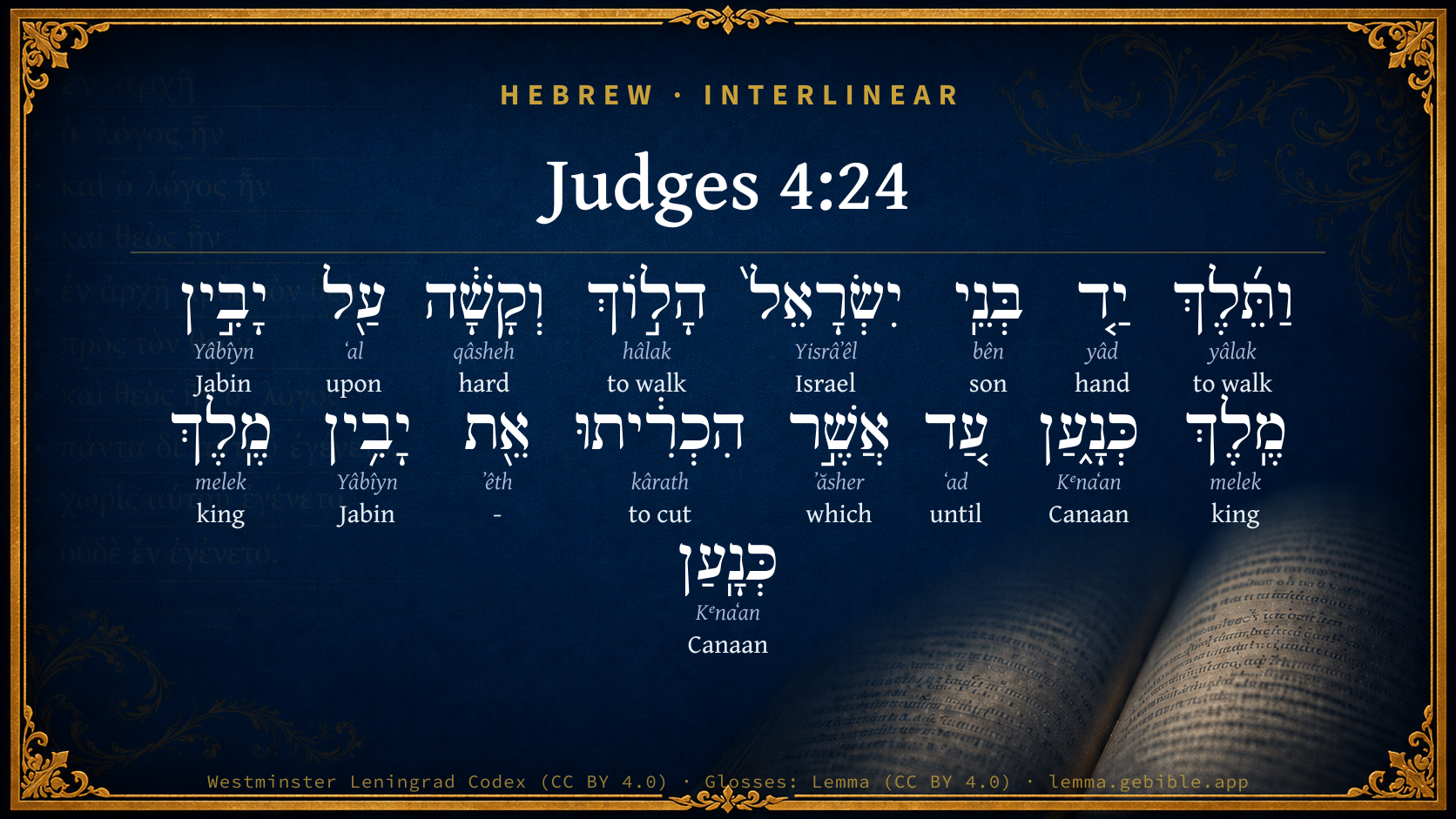
Hebrew (Westminster Leningrad Codex) Judges 4:24 appears in the Hebrew Old Testament. The text above is from the Westminster Leningrad Codex. Each word links to its Strong’s number, a concise gloss, and parsing drawn from the Open Scriptures Hebrew Bible morphology. Click any word for its full Brown-Driver-Briggs (BDB) entry.
Download image
Cite this verse

Judges 4:24 (World English Bible). Public Domain. Lemma interlinear Bible study tool, https://lemma.gebible.app/v/judges/4/24.

Show BibTeX & RIS
BibTeX
RIS
English Translation
The hand of the children of Israel prevailed more and more against Jabin the king of Canaan, until they had destroyed Jabin king of Canaan.
World English Bible · Public Domain
Download a study sheet

One document with this verse’s original text, its word-by-word gloss line, the meaning frame, cross-references with their text, attributed commentary, and full source and license credits — printable, and it pastes into notes with its structure intact.

This verse Autodidact and up

Study sheet (.html) Plain text (.txt)

A passage Seminary Student

Up to 50 verses in one chapter. A passage sheet keeps up to 6 commentary sources and 12 cross-references per verse, in the order this page ranks them, and says so on the sheet whenever that leaves anything out. Ask for a single verse and you get the Autodidact verse sheet above.

Everything on this page stays free to read, with no account — the sheet is a download of what is already on screen, not access to it.

Want to remove ads? Support Godless Engineer
Compare translations 3

The same verse in 3 English versions, stacked beneath the original-language interlinear above. Click any original word for its lexicon entry.

Each is an independent rendering of the whole verse — the interlinear is not word-aligned to these translations.

Highlighted words mark where these versions differ — a whole-verse word diff, not a word-by-word alignment.

  • World English Bible Public Domain
    The hand of the children of Israel prevailed more and more against Jabin the king of Canaan, until they had destroyed Jabin king of Canaan.
  • King James Version Public Domain
    And the hand of the children of Israel prospered, and prevailed against Jabin the king of Canaan, until they had destroyed Jabin king of Canaan.
  • unfoldingWord Literal Text CC BY-SA 4.0
    For going, the hand of the sons of Israel went and severe against Jabin, the king of Canaan, until that they destroyed Jabin, the king of Canaan.

unfoldingWord Literal Text — © unfoldingWord, licensed CC BY-SA 4.0. Word-aligned USFM3 via Door43 (git.door43.org/unfoldingWord/en_ult).

Versions to compare (up to 4)

3 of 4 selected

Show all 18 translations

Every available English version of this verse, each an independent rendering of the whole verse.

  • World English Bible Public Domain
    The hand of the children of Israel prevailed more and more against Jabin the king of Canaan, until they had destroyed Jabin king of Canaan.
  • Berean Standard Bible Public Domain
    And the hand of the Israelites grew stronger and stronger against Jabin king of Canaan until they destroyed him.
  • Majority Standard Bible Public Domain
    And the hand of the Israelites grew stronger and stronger against Jabin king of Canaan until they destroyed him.
  • King James Version Public Domain
    And the hand of the children of Israel prospered, and prevailed against Jabin the king of Canaan, until they had destroyed Jabin king of Canaan.
  • American Standard Version (1901) Public Domain
    And the hand of the children of Israel prevailed more and more against Jabin the king of Canaan, until they had destroyed Jabin king of Canaan.
  • Revised Version (1885) Public Domain
    And the hand of the children of Israel prevailed more and more against Jabin the king of Canaan, until they had destroyed Jabin king of Canaan.
  • Geneva Bible (1599) Public Domain
    And the hande of the children of Israel prospered, and preuailed against Iabin the King of Canaan, vntill they had destroyed Iabin King of Canaan.
  • Douay-Rheims (1899) Public Domain
    Who grew daily stronger, and with a mighty hand overpowered Jabin king of Chanaan, till they quite destroyed him.
  • Young's Literal Translation Public Domain
    and the hand of the sons of Israel goeth, going on and becoming hard on Jabin king of Canaan, till that they have cut off Jabin king of Canaan.
  • Literal Standard Version CC BY-SA 4.0
    and the hand of the sons of Israel goes, going on and becoming hard on Jabin king of Canaan, until they have cut off Jabin king of Canaan.
  • Unlocked Literal Bible CC BY-SA 4.0
    The might of the people of Israel grew stronger and stronger against Jabin the king of Canaan, until they destroyed him.
  • unfoldingWord Literal Text CC BY-SA 4.0
    For going, the hand of the sons of Israel went and severe against Jabin, the king of Canaan, until that they destroyed Jabin, the king of Canaan.
  • Darby Bible Public Domain
    And the hand of the people of Israel bore harder and harder on Jabin the king of Canaan, until they destroyed Jabin king of Canaan.
  • World Messianic Bible Public Domain
    The hand of the children of Israel prevailed more and more against Jabin the king of Canaan, until they had destroyed Jabin king of Canaan.
  • Webster's Bible Public Domain
    And the hand of the children of Israel prospered, and prevailed against Jabin the king of Canaan, until they had destroyed Jabin king of Canaan.
  • Free Bible Version CC BY-SA 4.0
    From then on Israel grew ever more powerful until they destroyed Jabin, king of Hazor.
  • Bible in Basic English Public Domain
    And the power of the children of Israel went on increasing against Jabin, king of Canaan, till he was cut off.
  • JPS Tanakh (1917) Public Domain
    And the hand of the children of Israel prevailed more and more against Jabin the king of Canaan, until they had destroyed Jabin king of Canaan.

Literal Standard Version (2020), Covenant Press — licensed CC BY-SA 4.0. Text via the HelloAO Bible API (eBible.org). Unlocked Literal Bible (unfoldingWord) — licensed CC BY-SA 4.0. Text via the HelloAO Bible API (eBible.org). unfoldingWord Literal Text — © unfoldingWord, licensed CC BY-SA 4.0. Word-aligned USFM3 via Door43 (git.door43.org/unfoldingWord/en_ult). Free Bible Version, Dr. Jonathan Gallagher — licensed CC BY-SA 4.0. Text via the HelloAO Bible API (eBible.org).

Word by word

More ways to search: Search by grammar → Find every occurrence → Compare this word →

Practice this passage: Drill this verse → Learn its vocabulary →

יָבִ֣ין
Yâbîyn
H2985
“Jabin”
Noun, Proper
Part of Speech
Noun
Type
Proper
Full BDB Definition

Origin: from H995

TWOT: None

Jabin = "whom God observes" - a king of Hazor who organised a confederacy of the northern princes against Joshua; confederacy routed by the waters of Merom - another king of Hazor whose general, Sisera, was defeated by Barak
  1. וַתֵּ֜לֶךְ yâlak H3212 “and · to walk” Conjunction + Verb, Qal, Sequential Imperfect, 3rd Person, Feminine, Singular
  2. יַ֤ד yâd H3027 “hand of” Noun, Common, Both, Singular, Construct
  3. בְּנֵֽי bên H1121 “sons of” Noun, Common, Masculine, Plural, Construct
  4. יִשְׂרָאֵל֙ Yisrâʼêl H3478 “Israel” Noun, Proper
  5. הָל֣וֹךְ hâlak H1980 “to walk” Verb, Qal, Infinitive Absolute
  6. וְקָשָׁ֔ה qâsheh H7186 “and · hard” Conjunction + Adjective, Adjective, Feminine, Singular, Absolute
  7. עַ֖ל ʻal H5921 “upon” Preposition
  8. מֶֽלֶךְ melek H4428 “king of” Noun, Common, Masculine, Singular, Construct
  9. כְּנָ֑עַן Kᵉnaʻan H3667 “Canaan” Noun, Proper
  10. עַ֚ד ʻad H5704 “until” Preposition
  11. אֲשֶׁ֣ר ʼăsher H834 “which” Particle, Relative
  12. הִכְרִ֔יתוּ kârath H3772 “to cut” Verb, Hiphil, Perfect, 3rd Person, Common, Plural
  13. אֵ֖ת ʼêth H853 “-” Particle, Direct Object
  14. יָבִ֥ין Yâbîyn H2985 “Jabin” Noun, Proper
  15. מֶֽלֶךְ melek H4428 “king of” Noun, Common, Masculine, Singular, Construct
  16. כְּנָֽעַן Kᵉnaʻan H3667 “Canaan” Noun, Proper

About this verse

These counts appear in no published source. They are computed here, from the morphology-tagged text and Lemma’s own curated glosses. What Lemma adds →

17
words
14
distinct lemmas
Historical
section

Notable vocabulary

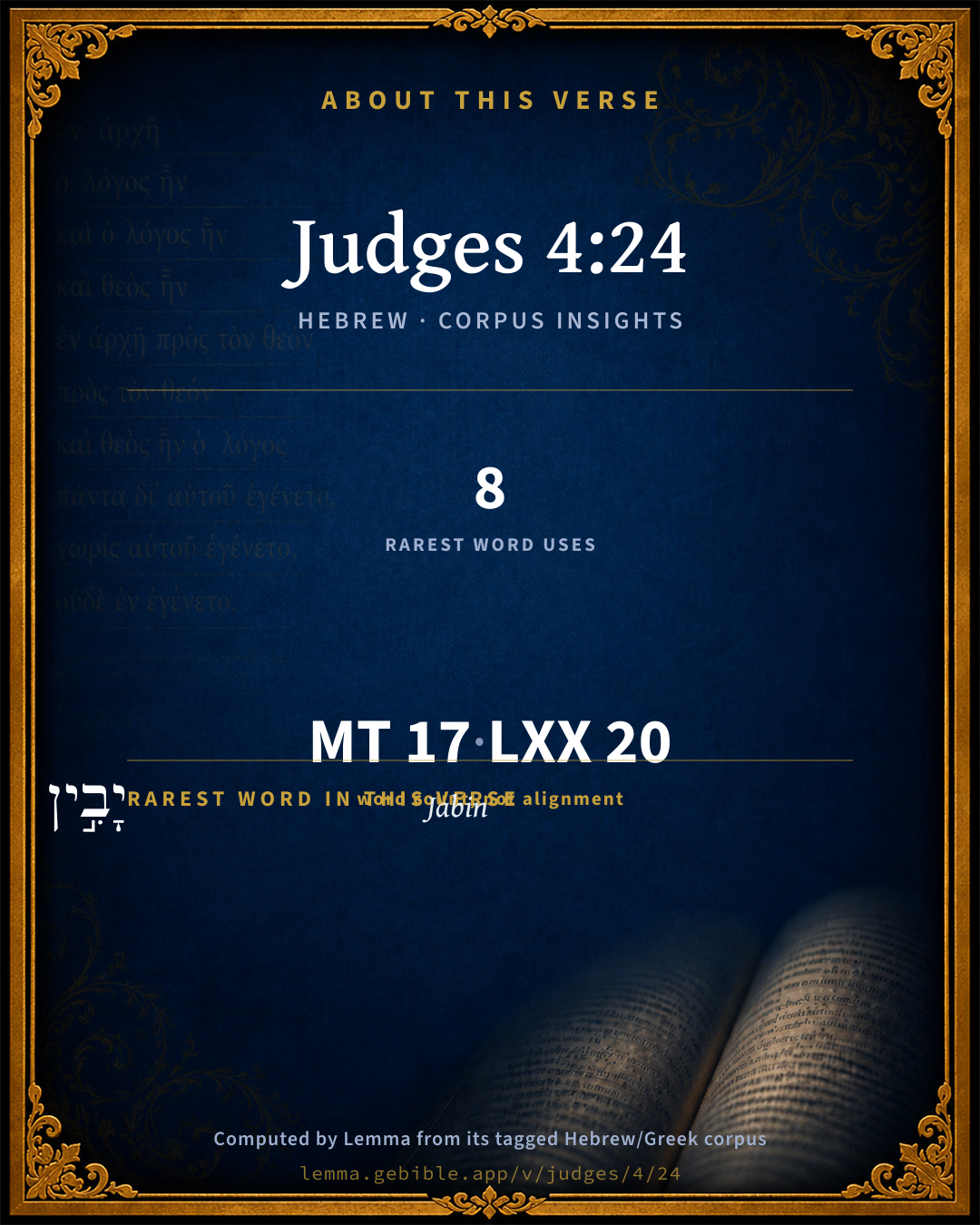
The rarest word here is יָבִ֣ין Jabin H2985 — appearing just 8 times in the whole Hebrew Bible.

Shared distinctive vocabulary

יָבִ֣ין Jabin H2985 occurs in 7 verses of the Hebrew Bible. Also found in:

Grammatical profile

  • 3 verbs
  • 9 nouns
  • 1 adjective
  • 2 prepositions
  • 2 particles

Verb forms

  • וַתֵּ֜לֶךְ Qal · Sequential Imperfect
  • הָל֣וֹךְ Qal · Infinitive Absolute
  • הִכְרִ֔יתוּ Hiphil · Perfect

Repetition

Words recur within this verse — often emphatic in Hebrew:

  • יָבִ֣ין Jabin H2985 ×2
  • מֶֽלֶךְ king H4428 ×2
  • כְּנָ֑עַן Canaan H3667 ×2

Hebrew & Septuagint length

In English translation the verse runs 25 words from the Hebrew and 25 from the Septuagint (LXX English) — the same length.

A rough comparison of the two English renderings, which tokenize alike — not a word-level alignment.

Word counts can differ between the Hebrew and the Greek without any difference in meaning — e.g. the Hebrew direct-object marker אֵת has no separate Greek word, and Greek often adds the article ὁ.

In the original languages it is 17 Hebrew tokens and 20 Greek tokens — but the two are counted differently (Hebrew bundles its prefixes and suffixes into one token; the Greek is in lemma form), so that isn’t a like-for-like length.

Cross-references

1

Topical passages linked to Judges 4:24 in the Treasury of Scripture Knowledge — connected by theme and wording, ordered by reader-vote popularity; previews shown in the World English Bible.

  • 1 Samuel 3:12 In that day I will perform against Eli all that I have spoken concerning his house, from the beginning even to the end.

Cross-references courtesy of OpenBible.info (CC BY 4.0).

Hebrew and Greek witnesses Masoretic Hebrew ↔ Greek Septuagint

The same verse in the two great witnesses to the Old Testament, shown verse-for-verse.

These are two independent witnesses, not word-aligned to each other, and the Septuagint is shown in lemma (dictionary) form.

Hebrew Judges 4:24 Masoretic · Westminster Leningrad Codex

וַתֵּ֜לֶךְ יַ֤ד בְּנֵֽי יִשְׂרָאֵל֙ הָל֣וֹךְ וְקָשָׁ֔ה עַ֖ל יָבִ֣ין מֶֽלֶךְ כְּנָ֑עַן עַ֚ד אֲשֶׁ֣ר הִכְרִ֔יתוּ אֵ֖ת יָבִ֥ין מֶֽלֶךְ כְּנָֽעַן

The hand of the children of Israel prevailed more and more against Jabin the king of Canaan, until they had destroyed Jabin king of Canaan.

World English Bible · Public Domain

Greek LXX Judges 4:24 Septuagint · lemma form

καί πορεύομαι χείρ ὁ υἱός ἰσραήλ πορεύομαι καί σκληρύνω ἐπί ιαβιν βασιλεύς χανααν ἕως ὅς ἐκὀλεθρεύω ὁ ιαβιν βασιλεύς χανααν

And the hand of the children of Israel prevailed more and more against Jabin king of Chanaan, until they utterly destroyed Jabin king of Chanaan.

LXX2012 (modern English Septuagint) · Public Domain

Hebrew: Westminster Leningrad Codex (CC BY 4.0). Greek: Septuagint (public domain); English from LXX2012 (modern English Septuagint) (Public Domain). How the Septuagint differs from the Hebrew →

Targum (Aramaic paraphrase)

1

The Targum is the ancient Jewish Aramaic paraphrase of the Hebrew Scriptures — an interpretive translation, not the Hebrew text itself. Onkelos (literal) and Pseudo-Jonathan (expansive) render the Torah, and Jonathan the Prophets. Coverage is partial: where no permissively-licensed English translation exists for a verse, only the Aramaic is shown. This is verse-level text, not a word-by-word alignment to the Hebrew.

  1. Targum Jonathan Prophets (Joshua–Malachi)
    וְאַזְלַת יַד בְּנֵי יִשְׂרָאֵל אָזְלָא וְתָקְפָא עַל יָבִין מַלְכָּא דִכְנָעַן עַד דִי שֵׁצִיאוּ יַת יָבִין מַלְכָּא דִכְנָעַן:

    (no public-domain English translation for this verse)

    Targum Jonathan — Aramaic: “Mikraot Gedolot” (public domain). English: “Sefaria Community Translation” (CC0 1.0 (public-domain dedication)); “London "Chaldee Paraphrase," 1871” (public domain). Text via Sefaria.

Commentary

Notes on Judges 4:24 from classic Christian and Jewish commentators (each source and its license shown beneath its notes). The classic Christian expositions comment on the surrounding passage and are grouped to its opening verse, so a note may address several verses; the Jewish commentaries on the Tanakh (Rashi and others) are per-verse, so they appear only where the commentator wrote on this verse.

Lemma curates 59 commentaries, every one of them public domain or Creative Commons licensed, each selected and text-cleaned for this edition rather than reprinted as found. About our sources →

Trapp's Complete Commentary

John Trapp

Jdg 4:24 And the hand of the children of Israel prospered, and prevailed against Jabin the king of Canaan, until they had destroyed Jabin king of Canaan.

Ver. 24. Until they had destroyed Jabin.] So let all thine enemies perish, O Lord. Read the Church’s prayer, Psa 83:9-10; - "Do unto them as to Sisera, as to Jabin, at the brook of Kison: which perished at Endor: they became as dung for the earth."

John Trapp, A Commentary or Exposition upon All the Books of the Old and New Testament (1647–1656) — public domain. Text from a community e-Sword module.

Geneva Bible (1599)

Geneva Bible translators

Hebrew, went and was strong.

Geneva Bible (1599) marginal notes — public domain. Text via Bolls.life.

Adam Clarke's Commentary

Verse 24. The hand of the children of Israel prospered] ותלך הלוך vattelech haloch, it went, going - they followed up this victory, and the consequence was, they utterly destroyed Jabin and his kingdom.

IT will naturally be expected that something should be said to justify the conduct of Jael: it must be owned that she slew Sisera in circumstances which caused the whole transaction to appear exceedingly questionable. They are the following: -

1. There was peace between her family and the king of Canaan.

2. That peace was no doubt made, as all transactions of the kind were, with a sacrifice and an oath.

3. Sisera, knowing this, came to her tent with the utmost confidence.

4. She met him with the most friendly greetings and assurances of safety.

5. Having asked for water, to show her friendship and respect she gave him cream, and that in a vessel suitable to his dignity.

6. She put him in the secret part of her own tent, and covered him in such a way as to evidence her good faith, and to inspire him with the greater confidence.

7. She agreed to keep watch at the door, and deny his being there to any that might inquire.

8. As she gave him permission to secrete himself with her, and gave him refreshment, she was bound by the rules of Asiatic hospitality to have defended his life, even at the risk of her own.

9. Notwithstanding, she took the advantage of his weariness and deep sleep, and took away his life!

10. She exulted in her deed, met Barak, and showed him in triumph what she had done.

Now do we not find, in all this, bad faith, deceit, deep hypocrisy, lying, breach of treaty, contempt of religious rites, breach of the laws of hospitality, deliberate and unprovoked murder? But what can be said in her justification? All that can be said, and all that has been said is simply this: "She might have been sincere at first, but was afterwards Divinely directed to do what she did." If this was so, she is sufficiently vindicated by the fact; for God has a right to dispose of the lives of his creatures as he pleases: and probably the cup of Sisera's iniquity was full, and his life already forfeited to the justice of God. But does it appear that she received any such direction from God? There is no sufficient evidence of it: it is true that Deborah, a prophetess, declares her blessed above women; and this seems to intimate that her conduct was pleasing to God. If Deborah was inspired on this occasion, her words are a presumptive proof that the act was right; unless we are to understand it as a simple declaration of the reputation she should be held in among her own sex. But we do not find one word from Jael herself, stating how she was led to do an act repugnant to her feelings as a woman, contrary to good faith, and a breach of the rules of hospitality. Nor does the sacred penman say one word to explain the case; as in the case of Ehud, he states the fact, and leaves his readers to form their own opinion.

To say, as has been said in the case of Eglon, that "Sisera was a public enemy, and any of the people whom he oppressed might be justified in taking away his life," is a very dangerous position, as it refers one of the most solemn acts of judgment and justice to the caprice, or prejudice, or enthusiastic feeling of every individual who may persuade himself that he is not only concerned in the business, but authorized by God to take vengeance by his own hand. While justice and law are in the world, God never will, as he never did, abandon cases of this kind to the caprice, prejudice, or party feeling, of any man. The conduct of Ehud and Jael are before the tribunal of God: I will not justify, I dare not absolutely condemn; there I leave them, and entreat my readers to do the like; after referring them to the observations at the end of the preceding chapter, where the subject is considered more at large.

Adam Clarke's Commentary on the Bible (1810–1826) — public domain. Text from a community e-Sword/MySword module.

Ellicott's Commentary for English Readers

(24) The hand of the children of Israel prospered, and prevailed.—Literally, as in the margin, The hand. . . . going went, and was hard—i.e., “became heavier and heavier in its pressure.” The battle of the Kishon was the beginning of a complete deliverance of Israel from the yoke of the Canaanites.

A Bible Commentary for English Readers, edited by Charles John Ellicott (1878–1897) — public domain. Text from a community e-Sword module.

John Gill's Exposition

And the hand of the children of Israel, prospered and prevailed against Jabin, the king of Canaan,.... They continued their wars with him, in which they were successful:

until they had destroyed Jabin, king of Canaan; took him, and put him to death, and took his cities, and destroyed the inhabitants of them, and so acted more agreeably to the declared will of God, that they should not spare the Canaanites, but destroy them.

Next: Judges Chapter 5

John Gill's Exposition of the Whole Bible (1746–1763) — public domain (CC PDM 1.0). Text via the HelloAO Bible API.

Albert Barnes' Notes on the Bible

See the margin. The meaning is, that Barak’s great victory was the beginning of a successful resistance to Jabin, by which the Israelites recovered their independence, and finally broke the Canaanite power. Accordingly, we hear no more of Canaanite domination in the Book of Judges.

Albert Barnes' Notes on the Bible (1834–1885) — public domain. Text from a community e-Sword/MySword module.

Whedon's Commentary on the Bible

Daniel D. Whedon

24. Prospered… prevailed… destroyed — Compare marginal reading. “The meaning is, that Barak’s great victory was the beginning of a successful resistance to Jabin, by which the Israelites recovered their independence, and finally broke the Canaanite power. Accordingly we hear no more of Canaanite dominion in the Book of Judges.” — Hervey.

The morality of Jael’s deed has been, of course, the subject of many a dissertation. The enemies of the Bible would fain use it to throw reproach on the sacred history; and as both Jael and her deed are evidently praised by an inspired poetess, in Jdg_5:24-27, the friends of truth have sought in various ways to show how such praise might be compatible with the apparent wickedness of Jael’s act. It is claimed that her deed violated all the proper usages of war. A fugitive chieftain, an ally of her husband, defeated and almost exhausted, sought protection in her tent, and received from her more than the common tokens of security. But, in violation of the sacred rites of hospitality, she murdered in his sleep her confiding and unprotected guest. This surely makes up a dark picture; but it is one sided, and overdrawn by magnifying certain points at the expense of others which are equally prominent in the sacred history. The whole subject may be relieved of difficulty by attention to the following considerations.

1. Though Heber was at peace with Jabin, and neutral in this war, there were circumstances in view of which Jael might not have felt herself bound to observe at this time the treaty of her husband. She was, perhaps, an Israelitess; but if not, her husband’s family were historically identified with the interests of Israel. She had before her eyes abundant evidence that Jabin’s power was utterly broken and annihilated in all that region where Heber had his home. She could not but feel, therefore, that her husband’s alliance with Jabin was no longer binding. “Israel’s freedom is her freedom; Israel’s glory her glory. Shall she be idle when the tyrant gives himself up into her hands? What if she saves him? Will it not be treason on her part against the ancient covenant with Israel? The conflict in which she finds herself is great, and none but a great and powerful soul could end it as she does. She scorns the reward which Sisera’s safety might, perhaps, have brought her. She takes the nobler object into consideration — the freedom of a kindred nation — and the older right preponderates. A ruthless warrior is before her, the violator of a thousand laws of right, and all hesitation vanishes.” — Cassel.

2. The prophecy of Deborah, that Sisera was to fall by a woman’s hand, (Jdg_4:9,) was probably known to Jael. She had not been personally designated as that woman, but when she saw Sisera flying on foot and alone, and coming towards her tent, the thought might naturally have flashed upon her mind that she herself was the divinely appointed instrument.

3. In Jdg_4:19 we are expressly told that Jael went out to meet Sisera, and urged him to come in. Now suppose that upon his approach she had not gone forth to meet him, but, like the woman of Thebez who killed Abimelech, (Jdg_9:53,) had broken his skull with a stone, or even had suddenly rushed forth and thrust a dagger to his heart, who would have charged her with gross wickedness? But if it was her purpose, from the moment she first saw him running towards her, to destroy him, then where appears so much guilt and wickedness as is pretended, merely in the means she used? She probably knew no other way to ensure his destruction by her own hand. Her tent afforded no height from which to crush him with a stone, and to rush forth and attack him in single combat would have been to expose herself to needless danger, if not to certain death. She therefore strategically drew him as into a snare and killed him. Once grant that his destruction was her settled purpose from the beginning, based on her knowledge of Deborah’s prophecy, and the measures she used were but the stratagems of battle. Her deed receives all its glory and significance from the war, with which it is ever to be associated; and what are artifice and stratagem but legitimate parts of war? Who blames the artifice by which Ai was taken when once he sees that its destruction was the will of God? The ability of the greatest generals is often seen more in their skill to deceive and entrap the foe than in their prowess in battle; and, in Jdg_4:20, Sisera orders her to lie, and thus deceive his pursuers.

4. As for Deborah’s praise of Jael’s deed, a clew is furnished in the closing verse of her song, (Jdg_5:31,) “So perish all thy enemies, Jehovah.” It is to be explained, like the vindictive Psalms, from the standpoint of the Divine administration. “It is not the poetess, who utters a private wish of her own,” says Bachmann, “but the prophetess, who utters a truth deeply grounded in the very essence of God — a weighty law of divine righteousness for all after ages to observe. Sisera’s fall is regarded by her as a righteous judgment of Heaven upon one who was a foe to the name and kingdom of God.” The same Spirit that could justly curse Meroz for neglect to intercept the flying the (Jdg_5:23) might well bless Jael’s deed, but might as justly have cursed her had she been guilty of similar neglect. And so the whole song of Deborah breathes the noblest theocratic spirit of her age and people.

There is no need, therefore, of supposing that Deborah speaks only as the poetess, or the patriotic woman in sympathy with the fortunes of Israel; and we reject the notion of Farrar, (in Smith’s Bible Dictionary,) and all similar views, that an inspired prophetess uttered this blessing “in the passionate moment of patriotic triumph,” without pausing “to scrutinize the moral bearings of an act which had been so splendid a benefit to herself and her people.”

Daniel D. Whedon (gen. ed.), Commentary on the Old and New Testaments (1874–1909) — public domain. Text from a community e-Sword module.

Lesson kit

Teaching starters — assembled from the data on this page, not authored interpretation. Every prompt links to the verse data it draws on. Edit before teaching.

Judges, in the Historical, opens this verse with 17 words (14 distinct Hebrew lemmas). Its most distinctive word is Yâbîyn (“Jabin”). A historical commentator’s framing appears above. Read the whole chapter for the surrounding context.

Discussion questions

  1. What does “Jabin” (Yâbîyn) contribute to the verse as a whole?
  2. Joshua 11:1 shares the word «Jabin» with this verse. How do the two illuminate each other?
  3. “Jabin” occurs 2× in this one verse. What is the effect of the repetition?
  4. These translations render this verse differently; the difference is in the English rendering, not the original. What questions does that raise?
  5. The verb «וַתֵּ֜לֶךְ» is Qal Sequential Imperfect. How does its form color the action?
  6. Reading how Trapp's Complete Commentary and Geneva Bible (1599) read this verse, where do the two commentators agree and where do they part?

Things to notice

Reading settings

Reading text

Shown beneath each verse's original-language words.

Old Testament
Old Testament edition

Read the OT as the Masoretic Hebrew (MT) or the Greek Septuagint (LXX).

English shown for the Greek Septuagint (in the Hebrew ↔ Greek comparison).

Comparing translations? Open the Compare panel on any verse page to stack up to four side by side.