
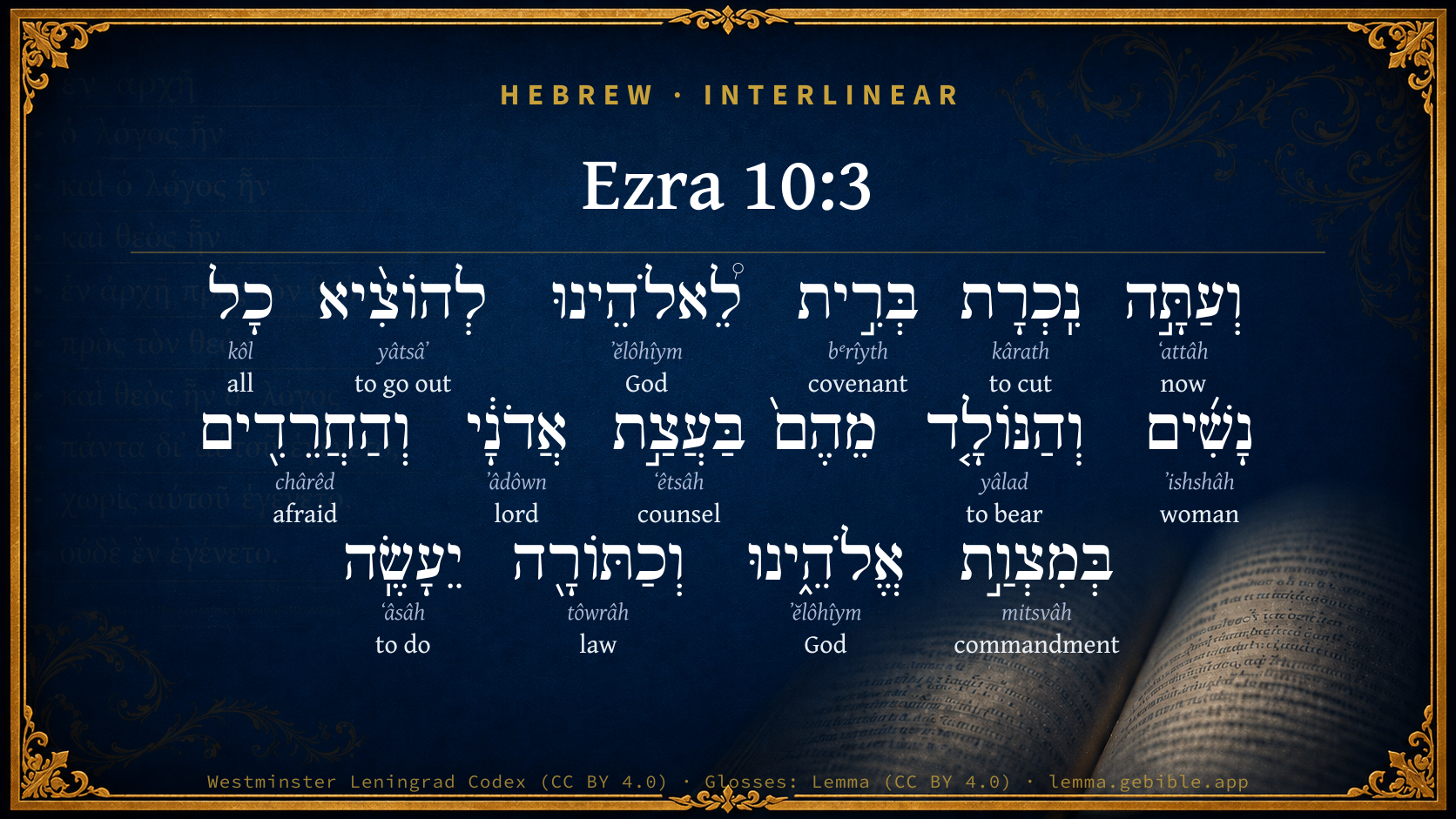
Ezra 10:3

Hebrew (Westminster Leningrad Codex) Ezra 10:3 appears in the Hebrew Old Testament. The text above is from the Westminster Leningrad Codex. Each word links to its Strong’s number, a concise gloss, and parsing drawn from the Open Scriptures Hebrew Bible morphology. Click any word for its full Brown-Driver-Briggs (BDB) entry.
Download image
Cite this verse

Ezra 10:3 (World English Bible). Public Domain. Lemma interlinear Bible study tool, https://lemma.gebible.app/v/ezra/10/3.

Show BibTeX & RIS
BibTeX
RIS
English Translation
Now therefore let us make a covenant with our God to put away all the wives, and such as are born of them, according to the counsel of my lord, and of those who tremble at the commandment of our God; and let it be done according to the law.
World English Bible · Public Domain
Download a study sheet

One document with this verse’s original text, its word-by-word gloss line, the meaning frame, cross-references with their text, attributed commentary, and full source and license credits — printable, and it pastes into notes with its structure intact.

This verse Autodidact and up

Study sheet (.html) Plain text (.txt)

A passage Seminary Student

Up to 50 verses in one chapter. A passage sheet keeps up to 6 commentary sources and 12 cross-references per verse, in the order this page ranks them, and says so on the sheet whenever that leaves anything out. Ask for a single verse and you get the Autodidact verse sheet above.

Everything on this page stays free to read, with no account — the sheet is a download of what is already on screen, not access to it.

Want to remove ads? Support Godless Engineer
Compare translations 3

The same verse in 3 English versions, stacked beneath the original-language interlinear above. Click any original word for its lexicon entry.

Each is an independent rendering of the whole verse — the interlinear is not word-aligned to these translations.

Highlighted words mark where these versions differ — a whole-verse word diff, not a word-by-word alignment.

  • World English Bible Public Domain
    Now therefore let us make a covenant with our God to put away all the wives, and such as are born of them, according to the counsel of my lord, and of those who tremble at the commandment of our God; and let it be done according to the law.
  • King James Version Public Domain
    Now therefore let us make a covenant with our God to put away all the wives, and such as are born of them, according to the counsel of my lord, and of those that tremble at the commandment of our God; and let it be done according to the law.
  • unfoldingWord Literal Text CC BY-SA 4.0
    So now, let us cut a covenant with our God to cause all the women to go out, and the ones who were born from them, by the counsel of my lord and the ones who tremble at the commandment of our God. And let it be done according to the law.

unfoldingWord Literal Text — © unfoldingWord, licensed CC BY-SA 4.0. Word-aligned USFM3 via Door43 (git.door43.org/unfoldingWord/en_ult).

Versions to compare (up to 4)

3 of 4 selected

Show all 18 translations

Every available English version of this verse, each an independent rendering of the whole verse.

  • World English Bible Public Domain
    Now therefore let us make a covenant with our God to put away all the wives, and such as are born of them, according to the counsel of my lord, and of those who tremble at the commandment of our God; and let it be done according to the law.
  • Berean Standard Bible Public Domain
    So now let us make a covenant before our God to send away all the foreign wives and their children, according to the counsel of my lord and of those who tremble at the command of our God. Let it be done according to the Law.
  • Majority Standard Bible Public Domain
    So now let us make a covenant before our God to send away all the foreign wives and their children, according to the counsel of my lord and of those who tremble at the command of our God. Let it be done according to the Law.
  • King James Version Public Domain
    Now therefore let us make a covenant with our God to put away all the wives, and such as are born of them, according to the counsel of my lord, and of those that tremble at the commandment of our God; and let it be done according to the law.
  • American Standard Version (1901) Public Domain
    Now therefore let us make a covenant with our God to put away all the wives, and such as are born of them, according to the counsel of my lord, and of those that tremble at the commandment of our God; and let it be done according to the law.
  • Revised Version (1885) Public Domain
    Now therefore let us make a covenant with our God to put away all the wives, and such as are born of them, according to the counsel of my lord, and of those that tremble at the commandment of our God; and let it be done according to the law.
  • Geneva Bible (1599) Public Domain
    Now therfore let vs make a couenant with our God, to put away all the wiues (and such as are borne of them) according to the counsell of the Lord, and of those that feare the commandements of our God, and let it be done according to the Lawe.
  • Douay-Rheims (1899) Public Domain
    Let us make a covenant with the Lord our God, to put away all the wives, and such as are born of them, according to the will of the Lord, and of them that fear the commandment of the Lord our God: let it be done according to the law.
  • Young's Literal Translation Public Domain
    and now, let us make a covenant with our God, to cause all the women to go out, and that which is born of them, by the counsel of the Lord, and of those trembling at the command of our God, and according to law it is done;
  • Literal Standard Version CC BY-SA 4.0
    and now, let us make a covenant with our God, to cause all the women to go out, and that which is born of them, by the counsel of the Lord, and of those trembling at the command of our God, and according to law it is done;
  • Unlocked Literal Bible CC BY-SA 4.0
    So now let us make a covenant with our God to send out all the women and their children according to the Lord's instructions and the instructions of those who tremble at the commandments of our God, and let it be done according to the law.
  • unfoldingWord Literal Text CC BY-SA 4.0
    So now, let us cut a covenant with our God to cause all the women to go out, and the ones who were born from them, by the counsel of my lord and the ones who tremble at the commandment of our God. And let it be done according to the law.
  • Darby Bible Public Domain
    And now let us make a covenant with our God to put away all the wives, and such as are born of them, according to the counsel of [my] lord, and of those that tremble at the commandments of our God; and let it be done according to the law.
  • World Messianic Bible Public Domain
    Now therefore let’s make a covenant with our God to put away all the wives and those who are born of them, according to the counsel of my lord and of those who tremble at the commandment of our God. Let it be done according to the law.
  • Webster's Bible Public Domain
    Now therefore let us make a covenant with our God to put away all the wives, and such as are born of them, according to the counsel of my lord, and of those that tremble at the commandment of our God; and let it be done according to the law.
  • Free Bible Version CC BY-SA 4.0
    Let us make a solemn agreement right now before our God that we will send away all the foreign wives and their children. We will follow the directions given by you and those who respect the instructions of our God, carried out according to the Law.
  • Bible in Basic English Public Domain
    Let us now make an agreement with our God to put away all the wives and all their children, if it seems right to my lord and to those who go in fear of the words of our God; and let it be done in keeping with the law.
  • JPS Tanakh (1917) Public Domain
    Now therefore let us make a covenant with our God to put away all the wives, and such as are born of them, according to the counsel of the LORD, and of those that tremble at the commandment of our God; and let it be done according to the law.

Literal Standard Version (2020), Covenant Press — licensed CC BY-SA 4.0. Text via the HelloAO Bible API (eBible.org). Unlocked Literal Bible (unfoldingWord) — licensed CC BY-SA 4.0. Text via the HelloAO Bible API (eBible.org). unfoldingWord Literal Text — © unfoldingWord, licensed CC BY-SA 4.0. Word-aligned USFM3 via Door43 (git.door43.org/unfoldingWord/en_ult). Free Bible Version, Dr. Jonathan Gallagher — licensed CC BY-SA 4.0. Text via the HelloAO Bible API (eBible.org).

Word by word

More ways to search: Search by grammar → Find every occurrence → Compare this word →

Practice this passage: Drill this verse → Learn its vocabulary →

וְהַחֲרֵדִ֖ים
chârêd
H2730
“and · the · afraid”
Conjunction + Particle, Definite Article + Adjective, Adjective, Masculine, Plural, Absolute
Part of Speech
Conjunction + Particle + Adjective
Type
Adjective
Gender
Masculine
Number
Plural
State
Absolute
Full BDB Definition

Origin: from H2729

TWOT: 735a

trembling, fearful, afraid
  1. וְעַתָּ֣ה ʻattâh H6258 “and · now” Conjunction + Adverb
  2. נִֽכְרָת kârath H3772 “to cut” Verb, Qal, Cohortative, 1st Person, Common, Plural
  3. בְּרִ֣ית bᵉrîyth H1285 “covenant” Noun, Common, Feminine, Singular, Absolute
  4. לֵ֠אלֹהֵינוּ ʼĕlôhîym H430 “to/for · God(s) · our” Preposition + Noun, Common, Masculine, Plural, Construct + Suffix, Personal, 1st Person, Common, Plural
  5. לְהוֹצִ֨יא yâtsâʼ H3318 “to go out” Preposition + Verb, Hiphil, Infinitive Construct
  6. כָל kôl H3605 “all of” Noun, Common, Masculine, Singular, Construct
  7. נָשִׁ֜ים ʼishshâh H802 “women” Noun, Common, Feminine, Plural, Absolute
  8. וְהַנּוֹלָ֤ד yâlad H3205 “and · the · borne” Conjunction + Particle, Definite Article + Verb, Niphal, Participle Passive, Masculine, Singular, Absolute
  9. בַּעֲצַ֣ת ʻêtsâh H6098 “in/at · counsel of” Preposition + Noun, Common, Feminine, Singular, Construct
  10. אֲדֹנָ֔י ʼâdôwn H113 “lords · my” Noun, Common, Masculine, Plural, Construct + Suffix, Personal, 1st Person, Common, Singular
  11. בְּמִצְוַ֣ת mitsvâh H4687 “in/at · commandment of” Preposition + Noun, Common, Feminine, Singular, Construct
  12. אֱלֹהֵ֑ינוּ ʼĕlôhîym H430 “God(s) · our” Noun, Common, Masculine, Plural, Construct + Suffix, Personal, 1st Person, Common, Plural
  13. וְכַתּוֹרָ֖ה tôwrâh H8451 “and · like/as the · law” Conjunction + Preposition, Determined + Noun, Common, Feminine, Singular, Absolute
  14. יֵעָשֶֽׂה ʻâsâh H6213 “to do” Verb, Niphal, Jussive, 3rd Person, Masculine, Singular

About this verse

These counts appear in no published source. They are computed here, from the morphology-tagged text and Lemma’s own curated glosses. What Lemma adds →

16
words
14
distinct lemmas
Historical
section

Notable vocabulary

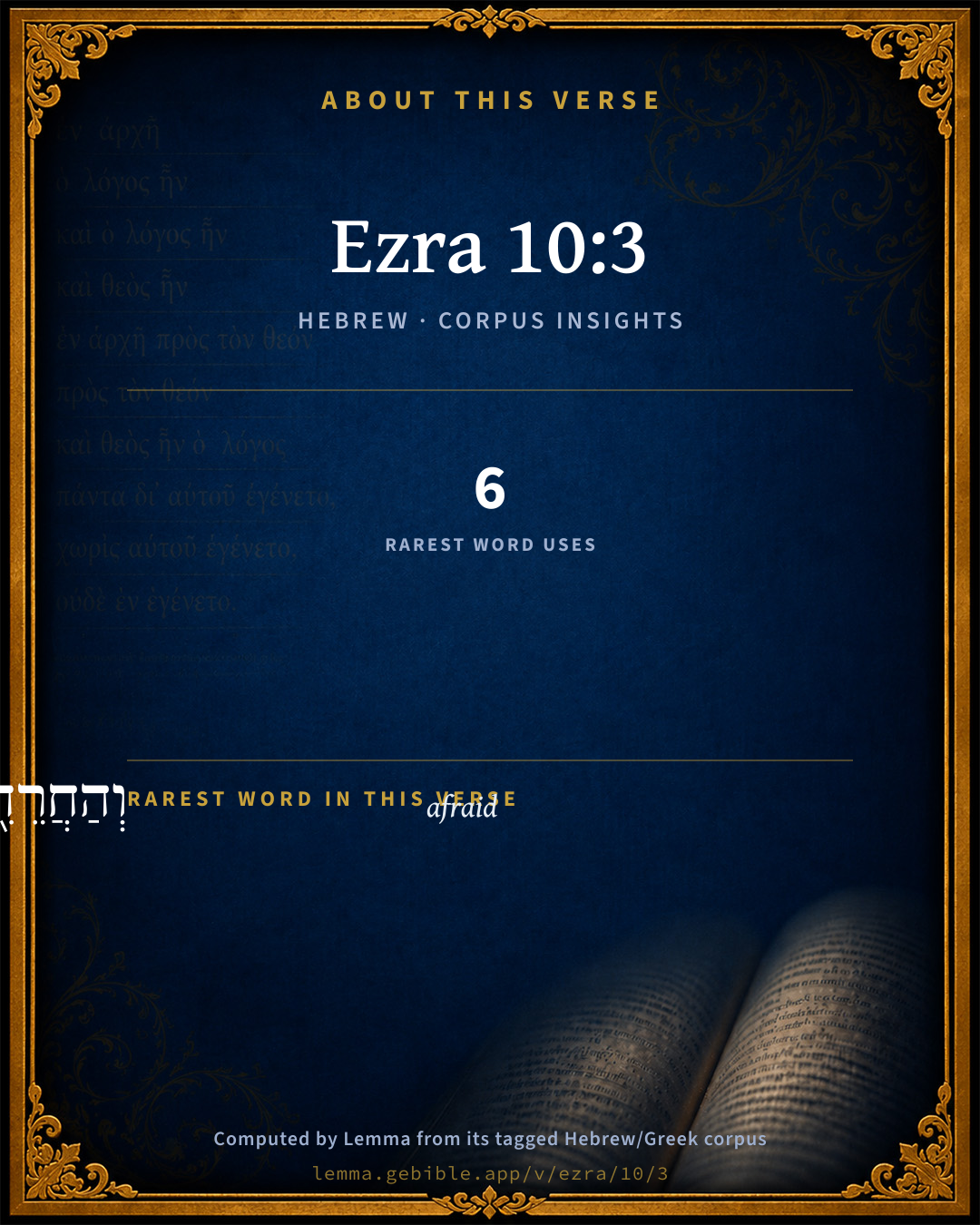
The rarest word here is וְהַחֲרֵדִ֖ים afraid H2730 — appearing just 6 times in the whole Hebrew Bible.

Shared distinctive vocabulary

וְהַחֲרֵדִ֖ים afraid H2730 occurs in 6 verses of the Hebrew Bible. Also found in:

Grammatical profile

  • 4 verbs
  • 9 nouns
  • 1 adjective
  • 1 preposition
  • 1 adverb

Verb forms

  • נִֽכְרָת Qal · Cohortative
  • לְהוֹצִ֨יא Hiphil · Infinitive Construct
  • וְהַנּוֹלָ֤ד Niphal · Participle Passive
  • יֵעָשֶֽׂה Niphal · Jussive

Repetition

A word recurs within this verse — often emphatic in Hebrew:

  • לֵ֠אלֹהֵינוּ God H430 ×2

Hebrew & Septuagint length

In English translation the verse runs 50 words from the Hebrew and 23 from the Septuagint (LXX English) — the Septuagint runs noticeably shorter here. See the side-by-side →

A rough comparison of the two English renderings, which tokenize alike — not a word-level alignment.

Word counts can differ between the Hebrew and the Greek without any difference in meaning — e.g. the Hebrew direct-object marker אֵת has no separate Greek word, and Greek often adds the article ὁ.

Cross-references

22

Topical passages linked to Ezra 10:3 in the Treasury of Scripture Knowledge — connected by theme and wording, ordered by reader-vote popularity; previews shown in the World English Bible.

  • Deuteronomy 7:2–3 and when Yahweh your God shall deliver them up before you, and you shall strike them; then you shall utterly destroy them: you shall make no covenant with them, nor show mercy to them;
  • Ezra 9:4 Then were assembled to me everyone who trembled at the words of the God of Israel, because of the trespass of them of the captivity; and I sat confounded until the evening offering.
  • Joshua 23:12–13 Else if you do at all go back, and cleave to the remnant of these nations, even these who remain among you, and make marriages with them, and go in to them, and they to you;
  • Psalms 119:120 My flesh trembles for fear of you. I am afraid of your judgments.
  • 1 Corinthians 7:12–13 But to the rest I--not the Lord--say, if any brother has an unbelieving wife, and she is content to live with him, let him not leave her.
  • Deuteronomy 29:12 that you may enter into the covenant of Yahweh your God, and into his oath, which Yahweh your God makes with you this day;
  • 2 Chronicles 34:21 Go you, inquire of Yahweh for me, and for those who are left in Israel and in Judah, concerning the words of the book that is found; for great is the wrath of Yahweh that is poured out on us, because our fathers have not kept the word of Yahweh, to do according to all that is written in this book.
  • Nehemiah 9:38 Yet for all this we make a sure covenant, and write it; and our princes, our Levites, [and] our priests, seal to it.
  • Psalms 119:59 I considered my ways, And turned my steps to your statutes.
  • Joshua 9:6 They went to Joshua to the camp at Gilgal, and said to him, and to the men of Israel, We are come from a far country: now therefore make you a covenant with us.
  • 2 Kings 11:17 Jehoiada made a covenant between Yahweh and the king and the people, that they should be Yahweh's people; between the king also and the people.
  • 2 Chronicles 29:10 Now it is in my heart to make a covenant with Yahweh, the God of Israel, that his fierce anger may turn away from us.
  • 2 Chronicles 30:12 Also on Judah came the hand of God to give them one heart, to do the commandment of the king and of the princes by the word of Yahweh.
  • 2 Chronicles 34:27 because your heart was tender, and you did humble yourself before God, when you heard his words against this place, and against the inhabitants of it, and have humbled yourself before me, and have torn your clothes, and wept before me; I also have heard you, says Yahweh.
  • 2 Chronicles 34:31–32 The king stood in his place, and made a covenant before Yahweh, to walk after Yahweh, and to keep his commandments, and his testimonies, and his statutes, with all his heart, and with all his soul, to perform the words of the covenant that were written in this book.
  • Ezra 10:44 All these had taken foreign wives; and some of them had wives by whom they had children.
  • Nehemiah 8:14 They found written in the law, how that Yahweh had commanded by Moses, that the children of Israel should dwell in booths in the feast of the seventh month;
  • Nehemiah 10:29–39 They joined with their brothers, their nobles, and entered into a curse, and into an oath, to walk in God's law, which was given by Moses the servant of God, and to observe and do all the commandments of Yahweh our Lord, and his ordinances and his statutes;
  • Nehemiah 13:1–3 On that day they read in the book of Moses in the audience of the people; and therein was found written, that an Ammonite and a Moabite should not enter into the assembly of God forever,
  • Isaiah 8:20 To the law and to the testimony! if they don't speak according to this word, surely there is no morning for them.
  • Isaiah 66:2 For all these things has my hand made, and [so] all these things came to be, says Yahweh: but to this man will I look, even to him who is poor and of a contrite spirit, and who trembles at my word.
  • Ezekiel 9:4 Yahweh said to him, Go through the midst of the city, through the midst of Jerusalem, and set a mark on the foreheads of the men that sigh and that cry over all the abominations that are done in the midst of it.

Cross-references courtesy of OpenBible.info (CC BY 4.0).

Hebrew and Greek witnesses Masoretic Hebrew ↔ Greek Septuagint

The same verse in the two great witnesses to the Old Testament, shown verse-for-verse.

Here the Septuagint runs noticeably shorter than the Hebrew — LXX2012 (modern English Septuagint) 23 words vs World English Bible 50. A rough length comparison of the two English translations, not a word-level alignment — read both below.

These are two independent witnesses, not word-aligned to each other, and the Septuagint is shown in lemma (dictionary) form.

Hebrew Ezra 10:3 Masoretic · Westminster Leningrad Codex

וְעַתָּ֣ה נִֽכְרָת בְּרִ֣ית לֵ֠אלֹהֵינוּ לְהוֹצִ֨יא כָל נָשִׁ֜ים וְהַנּוֹלָ֤ד מֵהֶם֙ בַּעֲצַ֣ת אֲדֹנָ֔י וְהַחֲרֵדִ֖ים בְּמִצְוַ֣ת אֱלֹהֵ֑ינוּ וְכַתּוֹרָ֖ה יֵעָשֶֽׂה

Now therefore let us make a covenant with our God to put away all the wives, and such as are born of them, according to the counsel of my lord, and of those who tremble at the commandment of our God; and let it be done according to the law.

World English Bible · Public Domain

Greek LXX Ezra 10:3 Septuagint · lemma form

καί νῦν διατίθημι διαθήκη ὁ θεός ἐγώ ἐκβάλλω πᾶς ὁ γυνή καί ὁ γίγνομαι ἐκ αὐτός ὡς ἄν βούλομαι ἀναἵστημι καί φοβερίζω αὐτός ἐν ἐντολή θεός ἐγώ καί ὡς ὁ νόμος γίγνομαι

Now then let us make a covenant with our God, to put away all the wives, and their offspring, as you shall advise:

LXX2012 (modern English Septuagint) · Public Domain

In the Septuagint this is one book — Esdras B (2 Esdras): Ezra is chapters 1–10, Nehemiah 11–23.

On this verse, The Cambridge Bible for Schools and Colleges discusses the Septuagint’s reading. Read the note in Commentary ↓

Hebrew: Westminster Leningrad Codex (CC BY 4.0). Greek: Septuagint (public domain); English from LXX2012 (modern English Septuagint) (Public Domain). How the Septuagint differs from the Hebrew →

Commentary

Notes on Ezra 10:3 from classic Christian and Jewish commentators (each source and its license shown beneath its notes). The classic Christian expositions comment on the surrounding passage and are grouped to its opening verse, so a note may address several verses; the Jewish commentaries on the Tanakh (Rashi and others) are per-verse, so they appear only where the commentator wrote on this verse.

Lemma curates 59 commentaries, every one of them public domain or Creative Commons licensed, each selected and text-cleaned for this edition rather than reprinted as found. About our sources →

Trapp's Complete Commentary

John Trapp

Ezr 10:3 Now therefore let us make a covenant with our God to put away all the wives, and such as are born of them, according to the counsel of my lord, and of those that tremble at the commandment of our God; and let it be done according to the law.

Ver. 3. Now therefore let us make a covenant] And so tie ourselves thereby to the better abearance; that we slip not collar, that we detract not the yoke of God’s obedience, Deu 10:20. Cleaving to God with full purpose of heart will require swearing. Broken bones must have strong bands to close them. Tottering houses must be cramped with iron bars, or they will soon fall down. If the vows of God be upon us, if we are covenanters, it will help against the fickleness of our false hearts; which cannot but know that if God shall be all-sufficient to us, we must be altogether his, Son 2:16. His is a covenant of mercy, even the sure mercies of David; ours is a covenant of obedience to him, in every part and point of duty.

To put away all the wives] This Jews might do in this, and some other cases. So did Romans also with this only bill of divorce, Res tuas tibi habeto, Take what is thine own, and be packing. But Christians may not do thus because of difference in religion, 1Co 7:12, whatever some late upstarts have printed and practised to the contrary.

And such as are born of them] The children of those strange wives, persisting in their Paganism. These children, though disinherited, yet were not to be altogether deserted; but nourished and nurtured also in the fear and admonition of the Lord, Eph 6:4. Proving if, peradventure, God will give them repentance to the acknowledging of the truth, &c., 2Ti 2:25.

According to the counsel of my lord] Terms full of hearty respect and humble submission. He calls Ezra My lord, as Hannah did Eli, with an eye to his dignity, and authority, both as a priest and as a commissioner from the king of Persia. At Venice every ordinary mechanic is called Magnifico. At Vicenza, in Italy, the common title to a common gentleman is Signor Conte, as much as my lord earl. But Ezra was every way honourable and deserving; titles of honour were not worthy of him.

And of those that tremble at the commandment of our God] A periphrasis of a truly pious person, sc. such a one as feareth God and keepeth his commandments. And this is the man alone that is fit to judge the cases of conscience, and to comfort the feeble-minded. Now, although the comfort given by God’s ministers, such as Ezra was, be ordinarily most effectual (as is the blessing of parents, who are in God’s room), yet others also, that are conscientious and experienced persons, that tremble at the commandment of God, as here, may give excellent counsel and comfort in such a case. But how like the motion of a puppet, the language of a parrot, is the best discourse, in this subject of conscience, of the uninterested man.

And let it be done accordiny to the law] Which, though it take no direct and express order in this case, yet by due deduction and just inference it was determined both here and in Neh 9:2, that those strange wives should be put away.

John Trapp, A Commentary or Exposition upon All the Books of the Old and New Testament (1647–1656) — public domain. Text from a community e-Sword module.

Joseph Benson's Commentary

Ezr 10:3. To put away all the wives, and such as are born of them — If this seem to any to have been an act of great severity, if not injustice, “let it be observed that the law (Deu 7:1, &c.) was express, and enforced with weighty reasons against these pagan marriages; and, therefore, since whatever is done contrary to law is, ipso facto, null and void, these marriages with idolatrous women, which were strictly forbidden by God, were, properly speaking, no marriages at all; and the children which proceeded from them were in no better condition than those whom we call bastards. No interposition of civil authority was therefore needful to dissolve these marriages; the infidelity and idolatry of the party espoused were as much an interdiction as any the most proximate degree of consanguinity, which, by the laws of all civilized nations, is known to vacate the marriage. But even suppose the civil authority thought proper to interpose in this matter, yet wherein had the Jews any reason to complain, if, in just punishment of their wilful breach of a known and positive law, they were excluded from cohabiting with these illegal wives; those Jews, who, for every light and trivial cause, made no scruple to give even their lawful wives a bill of divorcement, and might, therefore, with much less difficulty, be supposed willing to repudiate those whom the laws of their God, for fear of their catching the infection of idolatry, had forbidden them to live with?” — Dodd. See Selden, Uxor. Hebrews, 50:3, c. 18. It may be observed further here, that these wives and children were only cast out of the commonwealth of Israel, but were not utterly forsaken: probably care was taken by authority that they should have some provision made for them. For all was to be done according to the counsel of Ezra, and other good men, who feared God, and would not enjoin or advise any thing that was unjust or unmerciful. They would also probably take care that the children should be educated in the Jewish religion.

Joseph Benson's Commentary on the Old and New Testaments (1811–1818) — public domain. Text from a community e-Sword module.

Tyndale Open Study Notes

Tyndale Open Resources

10:3 A covenant is a binding agreement, in this case specifically to divorce . . . pagan wives that the people of Israel had inappropriately married. By taking this action, they would renew their commitment to the Sinai covenant. • Women were generally given custody of their children when a marriage failed (cp. Hagar and Ishmael, Gen 21:14).

Tyndale Open Study Notes — © Tyndale Open Resources, licensed CC BY-SA 4.0. Text via the HelloAO Bible API.

Geneva Bible (1599)

Geneva Bible translators

Which are strangers and married contrary to the Law of God.

Geneva Bible (1599) marginal notes — public domain. Text via Bolls.life.

Adam Clarke's Commentary

Verse 3. Let us make a covenant] נכרת ברית nichrath berith, let us cut or divide the covenant sacrifice. See Clarke on Ge 15:10.

Adam Clarke's Commentary on the Bible (1810–1826) — public domain. Text from a community e-Sword/MySword module.

The Cambridge Bible for Schools and Colleges

gen. ed. J. J. S. Perowne

3. let us make a covenant &c.] Compare other covenants undertaken by the people, e.g. 2Ch_15:12; 2Ch_29:10; 2Ch_34:31-32; Neh_10:29; Jer_34:15.

to put away the wives &c.] Either legal divorce or the annulling of the marriages by public decree. The marriages had been valid, but were now declared sinful. The method of separation was forcible expulsion. The case of the wives and of their children, who had become ‘proselytes’ and embraced the Israelite religion, is not taken into account. The words ‘and such as are born of them’ probably refer to the children of tender years.

according to the counsel of my lord] so R.V. text: R.V. Marg. Or, ‘the Lord’. The Hebrew text is ‘Adonai’, ‘my Lord’, and the Vulgate accordingly renders ‘juxta voluntatem Domini’. It is objected, (1) that the word ‘counsel’ (as in Ezr_10:8) seems in this context to imply human counsel, as generally. (2) Used of the Divine purpose, it is found chiefly in poetry and prophecy (e.g. Psa_33:11; Isa_5:19; Isa_19:17; Jer_49:20; Jer_50:45). (3) The name ‘Adonai’ (Lord) as a Divine title only occurs elsewhere in these books, Neh_1:11; Neh_4:14; Neh_8:10; Neh_10:30. (4) The expression ‘the counsel of the Lord and of those that tremble at the word of God’ is harsh. The rendering ‘my lord’ requires us to read ‘Adoni’, a very slight change. This was apparently read by the LXX. and by 1 Esdr., where there is no mention of the Divine name. The application of the title ‘my lord’ to Ezra is peculiar (but see Neh_3:5), and the allusion to his ‘counsel’, which can only refer to the substance of Ezra’s prayer, is not very natural. It is not easy to decide between the two readings. On the whole the R.V. text rendering is to be preferred. The tendency of Jewish scribes would be rather to introduce the Divine Name, if it was not in the text, than to alter it, if it was in the text, into a common word: and this tendency would be assisted, in this case, by the use of ‘Adonai’ in Neh_1:11; Neh_4:14. If the rendering of the R.V. marg. be adopted, then the ‘counsel of the Lord’ will refer to the teaching of the law. The combination of the Divine name ‘with those who trembled at the commandment of our God’ may be paralleled by Ezr_6:14, or Act_15:28.

of those that tremble at &c.] Cf. note on Ezr_9:4.

and let it be done according to the law] or ‘and according to the law it shall be done’. The clause is not very definitely expressed. And it has been differently understood to mean either that the general law forbidding marriage with the heathen should now be observed, or that this particular act of ‘putting away the strange wives’ should be performed in accordance with the regulations for divorce contained in the law (e.g. Deu_24:1-4).

The Cambridge Bible for Schools and Colleges (gen. ed. J. J. S. Perowne; Cambridge University Press, 1878–1918) — public domain. Text from a community e-Sword module.

John Gill's Exposition

Now therefore let us make a covenant with our God,.... Renew our covenant with him, and lay ourselves under fresh obligation by promise and oath, and unanimously agree

to put away all the wives, and such as are born of them; he means all the strange wives, such marriages being unlawful; and such wives might the more easily be put away, since bills of divorce were in frequent use with the Jews, and the children of such also being illegitimate; and the rather they were to be put away, lest they should corrupt other children, or get into the affections of their fathers, which might lead on to receive their mothers again, and especially this was to be done as a punishment of their sin: though no doubt but a provision was to be made, and was made, for the maintenance both of wives and children:

according to the counsel of my Lord; either of Ezra, whom he honours with this title, being a ruler under the king of Persia; or of the Lord God, according to his will declared in his words, which is his counsel:

and of those that tremble at the commandment of our God; feared to break it, and dreaded the effect of such a breach; and who no doubt would follow the counsel of the Lord, and join in their advice to act according to the proposal made:

and let it be done according to the law; as that directs in such cases.

John Gill's Exposition of the Whole Bible (1746–1763) — public domain (CC PDM 1.0). Text via the HelloAO Bible API.

Albert Barnes' Notes on the Bible

Let it be done according to the law - i. e., let a formal “bill of divorcement” be given to each foreign wife, whereby she will be restored to the condition of an unmarried woman, and be free to marry another husband (see Deu 24:1-2). The facility of divorce among the Jews is well-known. According to many of the rabbis, a bill of divorcement might he given by the husband for the most trivial cause. Thus, no legal difficulty stood in the way of Shechaniah’s proposition; and Ezra regarded it as necessary for the moral and religious welfare of the people.

Albert Barnes' Notes on the Bible (1834–1885) — public domain. Text from a community e-Sword/MySword module.

Haydock's Catholic Bible Commentary

Covenant. The marrying with strange women seemed to have annulled the covenant of God. --- Of them. The children were to follow the mothers, as in other unlawful connections. Their being suffered to remain behind, might have had dangerous consequences. (Calmet) --- The custom of divorcing was then in force, (Tirinus) and the Jews looked upon all as null, which was done contrary to the law; (Ven. Bede; Estius; Calmet; Grotius) though here the law was only prohibitory. (Cajetan) (Tirinus) --- As all was directed by the will of God, the dictates of humanity would not be disregarded (Calmet) on this trying occasion. (Haydock) --- The children migth be placed in houses for education. (Cajetan) (Tirinus)

George Leo Haydock (1774–1849), Haydock's Catholic Family Bible and Commentary, 1859 edition — public domain. Excludes Psalms (Douay-Rheims chapter numbering differs from Protestant) and Deuterocanonical books (Catholic canon only).

Matthew Poole's English Annotations

To put away all the wives; which though it may seem harsh, yet is not unjust, if it be considered,

1. That marriages made between some prohibited persons; as suppose, between a father and his daughter, a brother and a sister, are not only unlawful, but void marriages, and ipso facto null, by the political laws of civil nations. And therefore these marriages with idolatrous and heathen women, being expressly and severely forbidden by God, might well be disannulled. And it was one of good Theodosius’s laws, that those actions which were done against law, should be accounted not only unlawful, but null.

2. That there were many peculiar laws given to the Jews concerning the marrying and putting away of wives, as hath been observed before in their proper places, and therefore it is not strange if there be something more in this case that is now usual with us.

3. Supposing the matrimonial tie had continued, yet they might be excluded from cohabitation with them, as a just punishment upon them for the wilful breach of a known and positive law of God.

And such as are born of them: this may seem harder than the former, but many things may be said.

1. Whatsoever evil befell either them or their children, they had all reason to accept it as the just and deserved fruit of their own sin.

2. That children may and sometimes do suffer, at least temporal evils, for their parents’ sins, or upon occasion of them, is most evident, both by the Scripture instances, and by the laws and usages of nations in some cases.

3. This may seem to have been a necessary part of severity, partly, as a proper punishment of the parents’ sin herein, and to deter others more effectually from the like practices; partly, to prevent the corruption of their other children by the conversation and society of this ungodly and idolatrous brood; and partly, lest such children, being continually present with them, and stealing into their affections, might at last prevail with them to take their ejected wives again.

4. These children were only cast out of the families and commonwealth of Israel, but were not utterly forsaken and ruined; but due care was probably taken by authority that they should have some provision made for them, and some care taken about their education in the Jewish religion, &c.

According to the counsel of my lord; either,

1. As thou counsellest and desirest us to do. Or,

2. Let us do it in such manner as thou shalt think fit and agreeable to the law, as it follows; for it requires great caution, as being a matter of no small difficulty.

And of those that tremble at the commandment of our God: and of other serious and religious persons who may with thee consider and regulate the business.

Let it be done according to the law: this is meant, either,

1. Of the matter of the business, let that be done which the law requires; let them be put away. Or,

2. Of the manner of it, which must be according to the rules of God’s law.

Matthew Poole's English Annotations on the Holy Bible (1683–1685) — public domain. Text from a community e-Sword/MySword module.

Whedon's Commentary on the Bible

Daniel D. Whedon

3. Make a covenant — Enter into a solemn agreement, and swear to put away all the wives. Comp. Ezr_10:5; Ezr_10:12; Ezr_10:19.

And such as are born of them — This was Shechaniah’s proposition; but how far the children with their mothers were put away does not appear, for in Ezr_10:11; Ezr_10:19 there is no mention of children. Doubtless all infant children went with their mothers, and this would be likely to be the rule with all children, unless some, old enough to express a choice, preferred to be adopted into the Jewish community. Such might have been retained as proselytes. See note on Ezr_10:44.

The counsel of my lord — The advice and arrangements which Ezra might propose. Thus Shechaniah courteously addresses Ezra.

Those that tremble — Those who, like Ezra, had a keen sense of the dangers of the hour, and the people’s exposure to the curse of God. See note on Ezr_9:4.

According to the law — The whole reform should proceed in strict accordance with the law of Moses.

Daniel D. Whedon (gen. ed.), Commentary on the Old and New Testaments (1874–1909) — public domain. Text from a community e-Sword module.

The Pulpit Commentary

Now therefore let us make a covenant. Shechaniah had probably in his thoughts the (comparatively) recent covenant which the people had made in the reign of Zedekiah (Jer_34:15) on the subject of releasing their Hebrew slaves after six years of servitude. That covenant was entered into before God, in the temple, by the princes and all the people (ibid. ver. 10). To put away all the wives. Shechaniah probably held that marriages made contrary to the law were not merely wrongful, but invalid. At any rate, since the law of Moses, as interpreted by the Rabbis, allowed divorce "for every cause", (Mat_19:3) the remedy suggested was feasible, though scarcely one which the civil power could enforce. And such as are born of them. "Filii matrem sequuntur" was a maxim of Roman, and, apparently, also of Jewish law. Young children require especially a mother"s care. Older ones might be already tainted with idolatry. It was best, Shechaniah thought, to make a clean sweep, and dismiss the children as well as the mothers. According to the counsel of my lord. Ezra had not yet advised any course; but Shechaniah gathers from the horror which he has expressed what his wishes must be. Let it be done according to the law. Either, Let the law, which forbids these marriages, be in this way satisfied" (Dathe); or, Let the repudiation of the wives take place in the mode prescribed by the law". (see Deu_24:1)

The Pulpit Commentary (1880–1919), ed. H.D.M. Spence-Jones & Joseph S. Exell — public domain. Text from a community e-Sword module.

John Wesley's Explanatory Notes

Such as are born - These children were only cast out of the common-wealth of Israel, but were not utterly forsaken; probably care was taken by authority, that they should have provision made for them.

John Wesley, Explanatory Notes Upon the Whole Bible (1754–1765) — public domain. Text via the GEBible commentary corpus.

unfoldingWord translationNotes

Door43 World Missions Community

we are with you

"we will help you"

translationWords

covenant

God

children

law

unfoldingWord translationNotes — © Distant Shores Media and the Door43 World Missions Community, licensed CC BY-SA 4.0. Source: git.door43.org/Door43/en_tn.

Rashi

Rabbi Shlomo Yitzchaki (Rashi)

by the counsel of the Lord by the counsel and the will of the Holy One, blessed be He.

and those who hasten to [perform] the commandment of our God and the God-fearers, they shall cast them out.

and according to the Law it shall be done he who performs this act, who will cast out his gentile wife and children.

Rashi on the Tanakh — English translations: “The Judaica Press complete Tanach with Rashi, translated by A. J. Rosenberg” (CC BY 4.0); “Pentateuch with Rashi's commentary by M. Rosenbaum and A.M. Silbermann, 1929-1934” (public domain); “The Metsudah Tanach series, Lakewood, N.J” (CC BY 4.0); and “The Book of Joshua, Metsudah Publications, 1997” (CC BY 4.0). Text via Sefaria.

Lesson kit

Teaching starters — assembled from the data on this page, not authored interpretation. Every prompt links to the verse data it draws on. Edit before teaching.

Ezra, in the Historical, opens this verse with 16 words (14 distinct Hebrew lemmas). Its most distinctive word is chârêd (“afraid”). The Greek Septuagint runs shorter here. A historical commentator’s framing appears above. Read the whole chapter for the surrounding context.

Discussion questions

  1. What does “afraid” (chârêd) contribute to the verse as a whole?
  2. Judges 7:3 shares the word «afraid» with this verse. How do the two illuminate each other?
  3. “God” occurs 2× in this one verse. What is the effect of the repetition?
  4. Compared with the Hebrew, the Septuagint runs shorter here. What questions does that raise?
  5. The translations on this page render this verse differently — a whole-verse word diff, not a word-by-word alignment. What might account for the different wordings?
  6. The verb «נִֽכְרָת» is Qal Cohortative. How does its form color the action?
  7. Reading how Trapp's Complete Commentary and Joseph Benson's Commentary read this verse, where do the two commentators agree and where do they part?

Things to notice

Reading settings

Reading text

Shown beneath each verse's original-language words.

Old Testament
Old Testament edition

Read the OT as the Masoretic Hebrew (MT) or the Greek Septuagint (LXX).

English shown for the Greek Septuagint (in the Hebrew ↔ Greek comparison).

Comparing translations? Open the Compare panel on any verse page to stack up to four side by side.