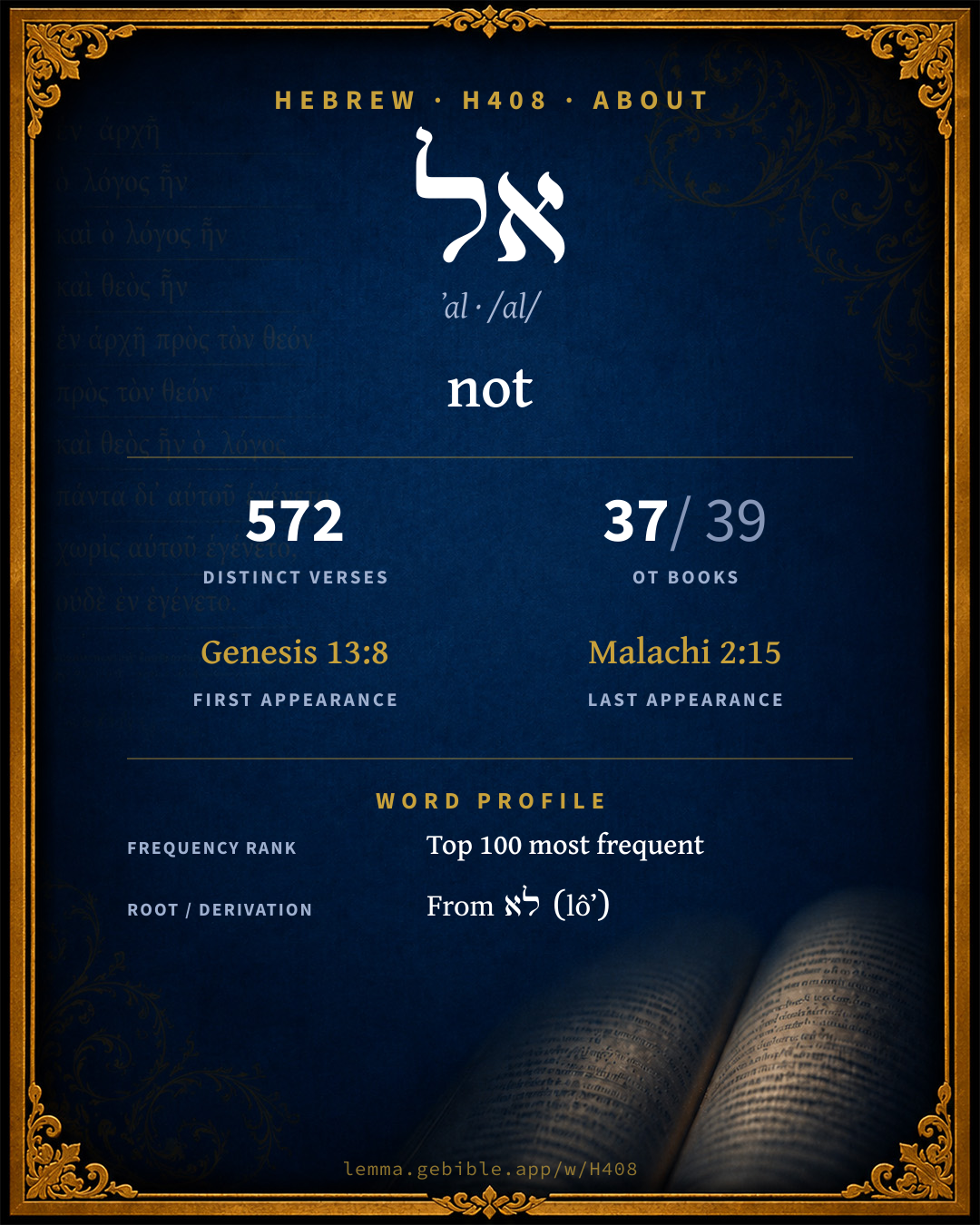
אַל
not
also: no, nor, neither, nothing fuller range ↓
Full lexicon entry — Brown-Driver-Briggs (BDB)
From Brown-Driver-Briggs (BDB)
Where this word appears
Grammar key — what these labels mean
Part of speech
- Particle
- A short function word — article, negation, interrogative, the sign of the direct object, and the like.
- Preposition
- A relational word (e.g. “in,” “to,” “from”) governing a noun.
Grammatical forms
- Particle, Negative 722 times (100%)
- Preposition 3 times (0%)
Parsed forms decoded from the imported morphology (morphhb / Westminster Leningrad Codex — WLC text public domain, morphhb tagging CC BY 4.0), counted across 725 parsed occurrences — not distinct verses.
Page 1 of 3 — showing verses 1–200 of 572 distinct verses where H408 appears, across 37 books. Click any verse to open its interlinear word-by-word view. Verse text shown in the World English Bible for context — . Each verse’s Hebrew form is shown with its reference; the English is not keyword-highlighted, since the data carries no word-level English alignment. Use “Compare translations” on any verse to read it across multiple English versions. This concordance covers the Hebrew Bible; Septuagint (Greek Old Testament) occurrences are not indexed here.
Genesis 34 verses
- Genesis 13:8 אַל ptcl neg Abram said to Lot, "Please, let there be no strife between me and you, and between my herdsmen and your herdsmen; for we are relatives.
- Genesis 15:1 אַל ptcl neg After these things the word of Yahweh came to Abram in a vision, saying, "Don't be afraid, Abram. I am your shield, your exceedingly great reward."
- Genesis 18:3 אַל ptcl neg and said, "My lord, if now I have found favor in your sight, please don't go away from your servant.
- Genesis 18:30 אַל ptcl neg He said, "Oh don't let the Lord be angry, and I will speak. What if there are thirty found there?" He said, "I will not do it, if I find thirty there."
- Genesis 18:32 אַל ptcl neg He said, "Oh don't let the Lord be angry, and I will speak yet but this once. What if ten are found there?" He said, "I will not destroy it for the ten's sake."
- Genesis 19:7 אַל ptcl neg He said, "Please, my brothers, don't act so wickedly.
- Genesis 19:8 אַל ptcl neg See now, I have two virgin daughters. Please let me bring them out to you, and do you to them as is good in your eyes. Only don't do anything to these men, because they have come under the shadow of my roof."
- Genesis 19:17 אַל וְ/אַֽל ptcl neg conj + ptcl neg It came to pass, when they had taken them out, that he said, "Escape for your life! Don't look behind you, neither stay anywhere in the plain. Escape to the mountain, lest you be consumed!"
- Genesis 19:18 אַל ptcl neg Lot said to them, "Oh, not so, my lord.
- Genesis 21:12 אַל ptcl neg God said to Abraham, "Don't let it be grievous in your sight because of the boy, and because of your handmaid. In all that Sarah says to you, listen to her voice. For from Isaac will your seed be called.
- Genesis 21:16 אַל ptcl neg She went and sat down opposite him, a good way off, about a bow shot away. For she said, "Don't let me see the death of the child." She sat over against him, and lifted up her voice, and wept.
- Genesis 21:17 אַל ptcl neg God heard the voice of the boy. The angel of God called to Hagar out of the sky, and said to her, "What ails you, Hagar? Don't be afraid. For God has heard the voice of the boy where he is.
- Genesis 22:12 אַל וְ/אַל ptcl neg conj + ptcl neg He said, "Don't lay your hand on the boy, neither do anything to him. For now I know that you fear God, seeing you have not withheld your son, your only son, from me."
- Genesis 24:56 אַל ptcl neg He said to them, "Don't hinder me, seeing Yahweh has prospered my way. Send me away that I may go to my master."
- Genesis 26:2 אַל ptcl neg Yahweh appeared to him, and said, "Don't go down into Egypt. Dwell in the land which I will tell you of.
- Genesis 26:24 אַל ptcl neg Yahweh appeared to him the same night, and said, "I am the God of Abraham your father. Don't be afraid, for I am with you, and will bless you, and multiply your seed for my servant Abraham's sake."
- Genesis 31:35 אַל ptcl neg She said to her father, "Don't let my lord be angry that I can't rise up before you; for the manner of women is on me." He searched, but didn't find the teraphim.
- Genesis 33:10 אַל ptcl neg Jacob said, "Please, no, if I have now found favor in your sight, then receive my present at my hand, because I have seen your face, as one sees the face of God, and you were pleased with me.
- Genesis 35:17 אַל ptcl neg It happened that, when she was in hard labor, that the midwife said to her, "Don't be afraid, for now you will have another son."
- Genesis 37:22 אַל ptcl neg Reuben said to them, "Shed no blood. Throw him into this pit that is in the wilderness, but lay no hand on him"-- that he might deliver him out of their hand, to restore him to his father.
- Genesis 37:27 אַל ptcl neg Come, and let's sell him to the Ishmaelites, and not let our hand be on him; for he is our brother, our flesh." His brothers listened to him.
- Genesis 42:22 אַל ptcl neg Reuben answered them, saying, "Didn't I tell you, saying, 'Don't sin against the child,' and you wouldn't listen? Therefore also, behold, his blood is required."
- Genesis 43:23 אַל ptcl neg He said, "Peace be to you. Don't be afraid. Your God, and the God of your father, has given you treasure in your sacks. I received your money." He brought Simeon out to them.
- Genesis 44:18 וְ/אַל conj + ptcl neg Then Judah came near to him, and said, "Oh, my lord, please let your servant speak a word in my lord's ears, and don't let your anger burn against your servant; for you are even as Pharaoh.
- Genesis 45:5 אַל וְ/אַל ptcl neg conj + ptcl neg Now don't be grieved, nor angry with yourselves, that you sold me here, for God sent me before you to preserve life.
- Genesis 45:9 אַֽל ptcl neg Hurry, and go up to my father, and tell him, 'This is what your son Joseph says, "God has made me lord of all Egypt. Come down to me. Don't wait.
- Genesis 45:20 אַל ptcl neg Also, don't concern yourselves about your belongings, for the good of all of the land of Egypt is yours."
- Genesis 45:24 אַֽל ptcl neg So he sent his brothers away, and they departed. He said to them, "See that you don't quarrel on the way."
- Genesis 46:3 אַל ptcl neg He said, "I am God, the God of your father. Don't be afraid to go down into Egypt; for there I will make of you a great nation.
- Genesis 47:29 אַל ptcl neg The time drew near that Israel must die, and he called his son Joseph, and said to him, "If now I have found favor in your sight, please put your hand under my thigh, and deal kindly and truly with me. Please don't bury me in Egypt,
- Genesis 49:4 אַל ptcl neg Boiling over as water, you shall not have the pre-eminence; Because you went up to your father's bed; Then defiled it. He went up to my couch.
- Genesis 49:6 אַל אַל ptcl neg ptcl neg My soul, don't come into their council; My glory, don't be united to their assembly; For in their anger they killed a man, In their self-will they hamstrung an ox.
- Genesis 50:19 אַל ptcl neg Joseph said to them, "Don't be afraid, for am I in the place of God?
- Genesis 50:21 אַל ptcl neg Now therefore don't be afraid. I will nourish you and your little ones." He comforted them, and spoke kindly to them.
Exodus 19 verses
- Exodus 3:5 אַל ptcl neg He said, "Don't come close. Take off your sandals from off your feet, for the place you are standing on is holy ground."
- Exodus 5:9 וְ/אַל conj + ptcl neg Let heavier work be laid on the men, that they may labor therein; and don't let them pay any attention to lying words."
- Exodus 8:29 אַל ptcl neg Moses said, "Behold, I go out from you, and I will pray to Yahweh that the swarms of flies may depart from Pharaoh, from his servants, and from his people, tomorrow; only don't let Pharaoh deal deceitfully any more in not letting the people go to sacrifice to Yahweh."
- Exodus 10:28 אֶל ptcl neg Pharaoh said to him, "Get away from me! Be careful to see my face no more; for in the day you see my face you shall die!"
- Exodus 12:9 אַל ptcl neg Don't eat it raw, nor boiled at all with water, but roasted with fire; with its head, its legs and its inner parts.
- Exodus 14:13 אַל ptcl neg Moses said to the people, "Don't be afraid. Stand still, and see the salvation of Yahweh, which he will work for you today: for the Egyptians whom you have seen today, you shall never see them again.
- Exodus 16:19 אַל ptcl neg Moses said to them, "Let no one leave of it until the morning."
- Exodus 16:29 אַל ptcl neg Behold, because Yahweh has given you the Sabbath, therefore he gives you on the sixth day the bread of two days. Everyone stay in his place. Let no one go out of his place on the seventh day."
- Exodus 19:15 אַֽל ptcl neg He said to the people, "Be ready by the third day. Don't have sexual relations with a woman."
- Exodus 19:24 אַל ptcl neg Yahweh said to him, "Go down and you shall bring Aaron up with you, but don't let the priests and the people break through to come up to Yahweh, lest he break forth on them."
- Exodus 20:19 וְ/אַל conj + ptcl neg They said to Moses, "Speak with us yourself, and we will listen; but don't let God speak with us, lest we die."
- Exodus 20:20 אַל ptcl neg Moses said to the people, "Don't be afraid, for God has come to test you, and that his fear may be before you, that you won't sin."
- Exodus 23:1 אַל ptcl neg "You shall not spread a false report. Don't join your hand with the wicked to be a malicious witness.
- Exodus 23:7 אַֽל ptcl neg "Keep far from a false charge, and don't kill the innocent and righteous: for I will not justify the wicked.
- Exodus 23:21 אַל ptcl neg Pay attention to him, and listen to his voice. Don't provoke him, for he will not pardon your disobedience, for my name is in him.
- Exodus 32:22 אַל ptcl neg Aaron said, "Don't let the anger of my lord grow hot. You know the people, that they are set on evil.
- Exodus 33:15 אַֽל ptcl neg He said to him, "If your presence doesn't go with me, don't carry us up from here.
- Exodus 34:3 אַל אַל ptcl neg ptcl neg No one shall come up with you; neither let anyone be seen throughout all the mountain; neither let the flocks nor herds feed before that mountain."
- Exodus 36:6 אַל ptcl neg Moses gave commandment, and they caused it to be proclaimed throughout the camp, saying, "Let neither man nor woman make anything else for the offering for the sanctuary." So the people were restrained from bringing.
Leviticus 10 verses
- Leviticus 10:6 אַל ptcl neg Moses said to Aaron, and to Eleazar and to Ithamar, his sons, "Don't let the hair of your heads go loose, neither tear your clothes; that you don't die, and that he not be angry with all the congregation: but let your brothers, the whole house of Israel, bewail the burning which Yahweh has kindled.
- Leviticus 10:9 אַל ptcl neg "Drink no wine nor strong drink, you, nor your sons with you, when you go into the Tent of Meeting, that you don't die: it shall be a statute forever throughout your generations:
- Leviticus 11:43 אַל ptcl neg You shall not make yourselves abominable with any creeping thing that creeps, neither shall you make yourselves unclean with them, that you should be defiled thereby.
- Leviticus 16:2 וְ/אַל conj + ptcl neg and Yahweh said to Moses, "Tell Aaron your brother, not to come at all times into the Most Holy Place within the veil, before the mercy seat which is on the ark; lest he die: for I will appear in the cloud on the mercy seat.
- Leviticus 18:24 אַל ptcl neg "'Don't defile yourselves in any of these things: for in all these the nations which I am casting out before you were defiled.
- Leviticus 19:4 אַל ptcl neg "'Don't turn to idols, nor make molten gods for yourselves. I am Yahweh your God.
- Leviticus 19:29 אַל ptcl neg Don't profane your daughter, to make her a prostitute; lest the land fall to prostitution, and the land become full of wickedness.
- Leviticus 19:31 אַל אַל ptcl neg ptcl neg "'Don't turn to those who are mediums, nor to the wizards. Don't seek them out, to be defiled by them. I am Yahweh your God.
- Leviticus 25:14 אַל ptcl neg "'If you sell anything to your neighbor, or buy from your neighbor, you shall not wrong one another.
- Leviticus 25:36 אַל ptcl neg Take no interest from him or profit, but fear your God; that your brother may live among you.
Numbers 12 verses
- Numbers 4:18 אַל ptcl neg "Don't cut off the tribe of the families of the Kohathites from among the Levites;
- Numbers 10:31 אַל ptcl neg He said, Don't leave us, please; because you know how we are to encamp in the wilderness, and you shall be to us instead of eyes.
- Numbers 11:15 וְ/אַל conj + ptcl neg If you deal thus with me, please kill me out of hand, if I have found favor in your sight; and let me not see my wretchedness.
- Numbers 12:11 אַל ptcl neg Aaron said to Moses, Oh, my lord, please don't lay sin on us, for that we have done foolishly, and for that we have sinned.
- Numbers 12:12 אַל ptcl neg Let her not, I pray, be as one dead, of whom the flesh is half consumed when he comes out of his mother's womb.
- Numbers 14:9 אַל אַל אַל ptcl neg ptcl neg ptcl neg Only don't rebel against Yahweh, neither fear the people of the land; for they are bread for us: their defense is removed from over them, and Yahweh is with us: don't fear them.
- Numbers 14:42 אַֽל ptcl neg Don't go up, for Yahweh isn't among you; that you not be struck down before your enemies.
- Numbers 16:15 אַל ptcl neg Moses was very angry, and said to Yahweh, "Don't respect their offering: I have not taken one donkey from them, neither have I hurt one of them."
- Numbers 16:26 וְ/אַֽל conj + ptcl neg He spoke to the congregation, saying, Depart, I pray you, from the tents of these wicked men, and touch nothing of theirs, lest you be consumed in all their sins.
- Numbers 21:34 אַל ptcl neg Yahweh said to Moses, Don't fear him: for I have delivered him into your hand, and all his people, and his land; and you shall do to him as you did to Sihon king of the Amorites, who lived at Heshbon.
- Numbers 22:16 אַל ptcl neg They came to Balaam, and said to him, Thus says Balak the son of Zippor, Please let nothing hinder you from coming to me:
- Numbers 32:5 אַל ptcl neg They said, If we have found favor in your sight, let this land be given to your servants for a possession; don't bring us over the Jordan.
Deuteronomy 14 verses
- Deuteronomy 1:21 אַל וְ/אַל ptcl neg conj + ptcl neg Behold, Yahweh your God has set the land before you: go up, take possession, as Yahweh, the God of your fathers, has spoken to you; don't be afraid, neither be dismayed.
- Deuteronomy 2:5 אַל ptcl neg don't contend with them; for I will not give you of their land, no, not so much as for the sole of the foot to tread on; because I have given Mount Seir to Esau for a possession.
- Deuteronomy 2:9 אֶל וְ/אַל prep conj + ptcl neg Yahweh said to me, Don't bother Moab, neither contend with them in battle; for I will not give you of his land for a possession; because I have given Ar to the children of Lot for a possession.
- Deuteronomy 2:19 אַל וְ/אַל ptcl neg conj + ptcl neg and when you come near over against the children of Ammon, don't bother them, nor contend with them; for I will not give you of the land of the children of Ammon for a possession; because I have given it to the children of Lot for a possession.
- Deuteronomy 3:2 אַל ptcl neg Yahweh said to me, Don't fear him; for I have delivered him, and all his people, and his land, into your hand; and you shall do to him as you did to Sihon king of the Amorites, who lived at Heshbon.
- Deuteronomy 3:26 אַל ptcl neg But Yahweh was angry with me for your sakes, and didn't listen to me; and Yahweh said to me, Let it suffice you; speak no more to me of this matter.
- Deuteronomy 9:4 אַל ptcl neg Don't speak in your heart, after that Yahweh your God has thrust them out from before you, saying, For my righteousness Yahweh has brought me in to possess this land; whereas for the wickedness of these nations Yahweh does drive them out from before you.
- Deuteronomy 9:7 אַל ptcl neg Remember, don't forget, how you provoked Yahweh your God to wrath in the wilderness: from the day that you went forth out of the land of Egypt, until you came to this place, you have been rebellious against Yahweh.
- Deuteronomy 9:26 אַל ptcl neg I prayed to Yahweh, and said, Lord Yahweh, don't destroy your people and your inheritance, that you have redeemed through your greatness, that you have brought forth out of Egypt with a mighty hand.
- Deuteronomy 9:27 אַל ptcl neg Remember your servants, Abraham, Isaac, and Jacob; don't look to the stubbornness of this people, nor to their wickedness, nor to their sin,
- Deuteronomy 20:3 אַל אַל וְ/אַֽל וְ/אַל ptcl neg ptcl neg conj + ptcl neg conj + ptcl neg and shall tell them, Hear, Israel, you draw near this day to battle against your enemies: don't let your heart faint; don't be afraid, nor tremble, neither be scared of them;
- Deuteronomy 21:8 וְ/אַל conj + ptcl neg Forgive, Yahweh, your people Israel, whom you have redeemed, and don't allow innocent blood [to remain] in the midst of your people Israel. The blood shall be forgiven them.
- Deuteronomy 31:6 אַל וְ/אַל ptcl neg conj + ptcl neg Be strong and of good courage, don't be afraid, nor be scared of them: for Yahweh your God, he it is who does go with you; he will not fail you, nor forsake you.
- Deuteronomy 33:6 וְ/אַל conj + ptcl neg Let Reuben live, and not die; Nor let his men be few.
Joshua 14 verses
- Joshua 1:7 אַל ptcl neg Only be strong and very courageous, to observe to do according to all the law, which Moses my servant commanded you: don't turn from it to the right hand or to the left, that you may have good success wherever you go.
- Joshua 1:9 אַֽל וְ/אַל ptcl neg conj + ptcl neg Haven't I commanded you? Be strong and of good courage; don't be afraid, neither be dismayed: for Yahweh your God is with you wherever you go.
- Joshua 3:4 אַֽל ptcl neg Yet there shall be a space between you and it, about two thousand cubits by measure: don't come near to it, that you may know the way by which you must go; for you have not passed this way heretofore.
- Joshua 7:3 אַל אַל ptcl neg ptcl neg They returned to Joshua, and said to him, Don't let all the people go up; but let about two or three thousand men go up and strike Ai; don't make all the people to toil there; for they are but few.
- Joshua 7:19 אַל ptcl neg Joshua said to Achan, My son, please give glory to Yahweh, the God of Israel, and make confession to him; and tell me now what you have done; don't hide it from me.
- Joshua 8:1 אַל וְ/אַל ptcl neg conj + ptcl neg Yahweh said to Joshua, Don't be afraid, neither be dismayed: take all the people of war with you, and arise, go up to Ai; behold, I have given into your hand the king of Ai, and his people, and his city, and his land;
- Joshua 8:4 אַל ptcl neg He commanded them, saying, Behold, you shall lie in ambush against the city, behind the city; don't go very far from the city, but be all ready:
- Joshua 10:6 אַל ptcl neg The men of Gibeon sent to Joshua to the camp to Gilgal, saying, Don't slack your hand from your servants; come up to us quickly, and save us, and help us: for all the kings of the Amorites that dwell in the hill-country are gathered together against us.
- Joshua 10:8 אַל ptcl neg Yahweh said to Joshua, Don't fear them: for I have delivered them into your hands; there shall not a man of them stand before you.
- Joshua 10:19 אַֽל אַֽל ptcl neg ptcl neg but don't stay; pursue after your enemies, and strike the hindmost of them; don't allow them to enter into their cities: for Yahweh your God has delivered them into your hand.
- Joshua 10:25 אַל וְ/אַל ptcl neg conj + ptcl neg Joshua said to them, Don't be afraid, nor be dismayed; be strong and of good courage: for thus shall Yahweh do to all your enemies against whom you fight.
- Joshua 11:6 אַל ptcl neg Yahweh said to Joshua, Don't be afraid because of them; for tomorrow at this time will I deliver them up all slain before Israel: you shall hamstring their horses, and burn their chariots with fire.
- Joshua 22:19 אַל אֶל ptcl neg prep However, if the land of your possession be unclean, then pass over to the land of the possession of Yahweh, in which Yahweh's tent dwells, and take possession among us: but don't rebel against Yahweh, nor rebel against us, in building you an altar besides the altar of Yahweh our God.
- Joshua 22:22 אַל ptcl neg The Mighty One, God, Yahweh, the Mighty One, God, Yahweh, he knows; and Israel he shall know: if it be in rebellion, or if in trespass against Yahweh (don't save us this day),
Judges 11 verses
- Judges 4:18 אַל ptcl neg Jael went out to meet Sisera, and said to him, Turn in, my lord, turn in to me; don't be afraid. He came in to her into the tent, and she covered him with a rug.
- Judges 6:18 אַל ptcl neg Please don't go away, until I come to you, and bring out my present, and lay it before you. He said, I will wait until you come again.
- Judges 6:23 אַל ptcl neg Yahweh said to him, Peace be to you; don't be afraid: you shall not die.
- Judges 6:39 אַל ptcl neg Gideon said to God, Don't let your anger be kindled against me, and I will speak but this once: Please let me make a trial just this once with the fleece; let it now be dry only on the fleece, and on all the ground let there be dew.
- Judges 13:4 וְ/אַל וְ/אַל conj + ptcl neg conj + ptcl neg Now therefore please beware and drink no wine nor strong drink, and don't eat any unclean thing:
- Judges 13:7 אַל וְ/אַל ptcl neg conj + ptcl neg but he said to me, Behold, you shall conceive, and bear a son; and now drink no wine nor strong drink, and eat not any unclean thing; for the child shall be a Nazirite to God from the womb to the day of his death.
- Judges 13:14 אַל אַל ptcl neg ptcl neg She may not eat of anything that comes of the vine, neither let her drink wine or strong drink, nor eat any unclean thing; all that I commanded her let her observe.
- Judges 18:9 אַל ptcl neg They said, Arise, and let us go up against them; for we have seen the land, and, behold, it is very good: and are you still? don't be slothful to go and to enter in to possess the land.
- Judges 18:25 אַל ptcl neg The children of Dan said to him, "Don't let your voice be heard among us, lest angry fellows fall on you, and you lose your life, with the lives of your household."
- Judges 19:20 אַל ptcl neg The old man said, Peace be to you; howsoever let all your wants lie on me; only don't lodge in the street.
- Judges 19:23 אַל אַל אַֽל ptcl neg ptcl neg ptcl neg The man, the master of the house, went out to them, and said to them, No, my brothers, please don't act so wickedly; seeing that this man is come into my house, don't do this folly.
Ruth 8 verses
- Ruth 1:13 אַ֣ל ptcl neg would you therefore wait until they were grown? would you therefore stay from having husbands? nay, my daughters, for it grieves me much for your sakes, for the hand of Yahweh is gone forth against me.
- Ruth 1:16 אַל ptcl neg Ruth said, "Don't entreat me to leave you, and to return from following after you, for where you go, I will go; and where you lodge, I will lodge; your people shall be my people, and your God my God;
- Ruth 1:20 אַל ptcl neg She said to them, "Don't call me Naomi, call me Mara; for the Almighty has dealt very bitterly with me.
- Ruth 2:8 אַל ptcl neg Then said Boaz to Ruth, Don't you hear, my daughter? Don't go to glean in another field, neither pass from hence, but abide here fast by my maidens.
- Ruth 3:3 אַל ptcl neg Wash yourself therefore, and anoint you, and put your clothing on you, and get you down to the threshing floor, but don't make yourself known to the man, until he shall have done eating and drinking.
- Ruth 3:11 אַל ptcl neg Now, my daughter, don't be afraid; I will do to you all that you say; for all the city of my people does know that you are a worthy woman.
- Ruth 3:14 אַל ptcl neg She lay at his feet until the morning. She rose up before one could discern another. For he said, Let it not be known that the woman came to the threshing floor.
- Ruth 3:17 אַל ptcl neg She said, These six [measures] of barley gave he me; for he said, "Don't go empty to your mother-in-law."
1 Samuel 25 verses
- 1 Samuel 1:16 אַל ptcl neg Don't count your handmaid for a wicked woman; for out of the abundance of my complaint and my provocation have I spoken hitherto.
- 1 Samuel 2:3 אַל ptcl neg Talk no more so exceeding proudly; Don't let arrogance come out of your mouth; For Yahweh is a God of knowledge, By him actions are weighed.
- 1 Samuel 2:24 אַ֖ל ptcl neg No, my sons; for it is no good report that I hear: you make Yahweh's people to disobey.
- 1 Samuel 3:17 אַל ptcl neg He said, "What is the thing that [Yahweh] has spoken to you? Please don't hide it from me. God do so to you, and more also, if you hide anything from me of all the things that he spoke to you."
- 1 Samuel 4:20 אַל ptcl neg About the time of her death the women who stood by her said to her, Don't be afraid; for you have brought forth a son. But she didn't answer, neither did she regard it.
- 1 Samuel 6:3 אַל ptcl neg They said, "If you send away the ark of the God of Israel, don't send it empty; but by all means return him a trespass-offering: then you shall be healed, and it shall be known to you why his hand is not removed from you."
- 1 Samuel 7:8 אַל ptcl neg The children of Israel said to Samuel, "Don't cease to cry to Yahweh our God for us, that he will save us out of the hand of the Philistines."
- 1 Samuel 9:20 אַל ptcl neg As for your donkeys who were lost three days ago, don't set your mind on them; for they are found. For whom is all that is desirable in Israel? Is it not for you, and for all your father's house?
- 1 Samuel 12:19 וְ/אַל conj + ptcl neg All the people said to Samuel, Pray for your servants to Yahweh your God, that we not die; for we have added to all our sins [this] evil, to ask us a king.
- 1 Samuel 12:20 אַל אַל ptcl neg ptcl neg Samuel said to the people, "Don't be afraid; you have indeed done all this evil; yet don't turn aside from following Yahweh, but serve Yahweh with all your heart:
- 1 Samuel 16:7 אַל ptcl neg But Yahweh said to Samuel, "Don't look on his face, or on the height of his stature; because I have rejected him: for [Yahweh sees] not as man sees; for man looks at the outward appearance, but Yahweh looks at the heart."
- 1 Samuel 17:32 אַל ptcl neg David said to Saul, Let no man's heart fail because of him; your servant will go and fight with this Philistine.
- 1 Samuel 18:17 אַל ptcl neg Saul said to David, Behold, my elder daughter Merab, her will I give you as wife: only be valiant for me, and fight Yahweh's battles. For Saul said, Don't let my hand be on him, but let the hand of the Philistines be on him.
- 1 Samuel 19:4 אַל ptcl neg Jonathan spoke good of David to Saul his father, and said to him, Don't let the king sin against his servant, against David; because he has not sinned against you, and because his works have been very good toward you:
- 1 Samuel 20:3 אַל ptcl neg David swore moreover, and said, Your father knows well that I have found favor in your eyes; and he says, Don't let Jonathan know this, lest he be grieved: but truly as Yahweh lives, and as your soul lives, there is but a step between me and death.
- 1 Samuel 20:38 אַֽל ptcl neg Jonathan cried after the boy, Go fast! Hurry! Don't delay! Jonathan's boy gathered up the arrows, and came to his master.
- 1 Samuel 21:2 אַל ptcl neg David said to Ahimelech the priest, The king has commanded me a business, and has said to me, Let no man know anything of the business about which I send you, and what I have commanded you: and I have appointed the young men to such and such a place.
- 1 Samuel 22:15 אַל ptcl neg Have I today begun to inquire of God for him? be it far from me: don't let the king impute anything to his servant, nor to all the house of my father; for your servant knows nothing of all this, less or more.
- 1 Samuel 22:23 אַל ptcl neg Abide you with me, don't be afraid; for he who seeks my life seeks your life: for with me you shall be in safeguard.
- 1 Samuel 23:17 אַל ptcl neg He said to him, Don't be afraid; for the hand of Saul my father shall not find you; and you shall be king over Israel, and I shall be next to you; and that also Saul my father knows.
- 1 Samuel 25:25 אַל ptcl neg Please don't let my lord regard this worthless fellow, even Nabal; for as his name is, so is he; Nabal is his name, and folly is with him: but I your handmaid didn't see the young men of my lord, whom you did send.
- 1 Samuel 26:9 אַל ptcl neg David said to Abishai, Don't destroy him; for who can put forth his hand against Yahweh's anointed, and be guiltless?
- 1 Samuel 26:20 אַל ptcl neg Now therefore, don't let my blood fall to the earth away from the presence of Yahweh: for the king of Israel is come out to seek a flea, as when one does hunt a partridge in the mountains.
- 1 Samuel 27:10 אַל ptcl neg Achish said, Against whom have you made a raid today? David said, Against the South of Judah, and against the South of the Jerahmeelites, and against the South of the Kenites.
- 1 Samuel 28:13 אַל ptcl neg The king said to her, Don't be afraid: for what do you see? The woman said to Saul, I see a god coming up out of the earth.
2 Samuel 17 verses
- 2 Samuel 1:20 אַל אַֽל ptcl neg ptcl neg Don't tell it in Gath, Don't publish it in the streets of Ashkelon; Lest the daughters of the Philistines rejoice, Lest the daughters of the uncircumcised triumph.
- 2 Samuel 1:21 אַל וְ/אַל ptcl neg conj + ptcl neg You mountains of Gilboa, Let there be no dew nor rain on you, neither fields of offerings: For there the shield of the mighty was vilely cast away, The shield of Saul, not anointed with oil.
- 2 Samuel 3:29 וְֽ/אַל conj + ptcl neg let it fall on the head of Joab, and on all his father's house; and let there not fail from the house of Joab one who has an issue, or who is a leper, or who leans on a staff, or who falls by the sword, or who lacks bread.
- 2 Samuel 9:7 אַל ptcl neg David said to him, "Don't be afraid of him; for I will surely show you kindness for Jonathan your father's sake, and will restore you all the land of Saul your father; and you shall eat bread at my table continually."
- 2 Samuel 11:25 אַל ptcl neg Then David said to the messenger, Thus shall you tell Joab, Don't let this thing displease you, for the sword devours one as well as another; make your battle more strong against the city, and overthrow it: and encourage you him.
- 2 Samuel 13:12 אַל אַל אַֽל ptcl neg ptcl neg ptcl neg She answered him, No, my brother, do not force me; for no such thing ought to be done in Israel. Don't you do this folly.
- 2 Samuel 13:16 אַל ptcl neg She said to him, Not so, because this great wrong in putting me forth is [worse] than the other that you did to me. But he would not listen to her.
- 2 Samuel 13:20 אַל ptcl neg Absalom her brother said to her, Has Amnon your brother been with you? but now hold your peace, my sister: he is your brother; don't take this thing to heart. So Tamar remained desolate in her brother Absalom's house.
- 2 Samuel 13:25 אַל אַל ptcl neg ptcl neg The king said to Absalom, No, my son, let us not all go, lest we be burdensome to you. He pressed him: however he would not go, but blessed him.
- 2 Samuel 13:28 אַל ptcl neg Absalom commanded his servants, saying, Mark you now, when Amnon's heart is merry with wine; and when I tell you, Smite Amnon, then kill him; don't be afraid; haven't I commanded you? be courageous, and be valiant.
- 2 Samuel 13:32 אַל ptcl neg Jonadab, the son of Shimeah, David's brother, answered, Don't let my lord suppose that they have killed all the young men the king's sons; for Amnon only is dead; for by the appointment of Absalom this has been determined from the day that he forced his sister Tamar.
- 2 Samuel 13:33 אַל ptcl neg Now therefore don't let my lord the king take the thing to his heart, to think that all the king's sons are dead; for Amnon only is dead.
- 2 Samuel 14:2 וְ/אַל conj + ptcl neg Joab sent to Tekoa, and fetched there a wise woman, and said to her, please act like a mourner, and put on mourning clothing, Please, and don't anoint yourself with oil, but be as a woman who has a long time mourned for the dead:
- 2 Samuel 14:18 אַל ptcl neg Then the king answered the woman, Please don't hide anything from me that I shall ask you. The woman said, Let my lord the king now speak.
- 2 Samuel 17:16 אַל ptcl neg Now therefore send quickly, and tell David, saying, Don't lodge this night at the fords of the wilderness, but by all means pass over; lest the king be swallowed up, and all the people who are with him.
- 2 Samuel 19:19 אַל וְ/אַל ptcl neg conj + ptcl neg He said to the king, Don't let my lord impute iniquity to me, neither do you remember that which your servant did perversely the day that my lord the king went out of Jerusalem, that the king should take it to his heart.
- 2 Samuel 24:14 אַל ptcl neg David said to Gad, I am in a great strait: let us fall now into the hand of Yahweh; for his mercies are great; and let me not fall into the hand of man.
1 Kings 11 verses
- 1 Kings 2:9 אַל ptcl neg Now therefore don't hold him guiltless, for you are a wise man; and you will know what you ought to do to him, and you shall bring his gray head down to Sheol with blood.
- 1 Kings 2:16 אַל ptcl neg Now I ask one petition of you; don't deny me. She said to him, Say on.
- 1 Kings 2:20 אַל ptcl neg Then she said, I ask one small petition of you; don't deny me. The king said to her, Ask on, my mother; for I will not deny you.
- 1 Kings 3:26 אַל ptcl neg Then spoke the woman whose the living child was to the king, for her heart yearned over her son, and she said, Oh, my lord, give her the living child, and in no way kill it. But the other said, It shall be neither mine nor yours; divide it.
- 1 Kings 8:57 אַל וְ/אַֽל ptcl neg conj + ptcl neg Yahweh our God be with us, as he was with our fathers: let him not leave us, nor forsake us;
- 1 Kings 13:22 אַל וְ/אַל ptcl neg conj + ptcl neg but came back, and have eaten bread and drunk water in the place of which he said to you, Eat no bread, and drink no water; your body shall not come to the tomb of your fathers.
- 1 Kings 17:13 אַל ptcl neg Elijah said to her, Don't be afraid; go and do as you have said; but make me of it a little cake first, and bring it forth to me, and afterward make for you and for your son.
- 1 Kings 18:40 אַל ptcl neg and Elijah said to them, Take the prophets of Baal; don't let one of them escape. They took them; and Elijah brought them down to the brook Kishon, and killed them there.
- 1 Kings 20:8 אַל ptcl neg All the elders and all the people said to him, Don't you listen, neither consent.
- 1 Kings 20:11 אַל ptcl neg The king of Israel answered, Tell him, Don't let him who girds on [his armor] boast himself as he who puts it off.
- 1 Kings 22:8 אַל ptcl neg The king of Israel said to Jehoshaphat, there is yet one man by whom we may inquire of Yahweh, Micaiah the son of Imlah: but I hate him; for he does not prophesy good concerning me, but evil. Jehoshaphat said, "Don't let the king say so."
2 Kings 22 verses
- 2 Kings 1:15 אַל ptcl neg The angel of Yahweh said to Elijah, Go down with him: don't be afraid of him. He arose, and went down with him to the king.
- 2 Kings 2:18 אַל ptcl neg They came back to him, while he stayed at Jericho; and he said to them, "Didn't I tell you, 'Don't go?'"
- 2 Kings 3:13 אַ֗ל ptcl neg Elisha said to the king of Israel, What have I to do with you? get you to the prophets of your father, and to the prophets of your mother. The king of Israel said to him, No; for Yahweh has called these three kings together to deliver them into the hand of Moab.
- 2 Kings 4:3 אַל ptcl neg Then he said, Go, borrow you vessels abroad of all your neighbors, even empty vessels; borrow not a few.
- 2 Kings 4:16 אַל אַל ptcl neg ptcl neg He said, At this season, when the time comes round, you shall embrace a son. She said, No, my lord, you man of God, do not lie to your handmaid.
- 2 Kings 4:24 אַל ptcl neg Then she saddled a donkey, and said to her servant, Drive, and go forward; don't slacken me the riding, except I bid you.
- 2 Kings 6:16 אַל ptcl neg He answered, Don't be afraid; for those who are with us are more than those who are with them.
- 2 Kings 6:27 אַל ptcl neg He said, If Yahweh doesn't help you, whence shall I help you? out of the threshing floor, or out of the winepress?
- 2 Kings 9:15 אַל ptcl neg but king Joram was returned to be healed in Jezreel of the wounds which the Syrians had given him, when he fought with Hazael king of Syria.) Jehu said, If this be your mind, then let none escape and go forth out of the city, to go to tell it in Jezreel.
- 2 Kings 10:19 אַל ptcl neg Now therefore call to me all the prophets of Baal, all his worshippers, and all his priests; let none be wanting: for I have a great sacrifice [to do] to Baal; whoever shall be wanting, he shall not live. But Jehu did it in subtlety, to the intent that he might destroy the worshippers of Baal.
- 2 Kings 10:25 אַל ptcl neg It happened, as soon as he had made an end of offering the burnt offering, that Jehu said to the guard and to the captains, Go in, and kill them; let none come forth. They struck them with the edge of the sword; and the guard and the captains cast them out, and went to the city of the house of Baal.
- 2 Kings 11:15 אַל ptcl neg Jehoiada the priest commanded the captains of hundreds who were set over the host, and said to them, Have her forth between the ranks; and him who follows her kill with the sword. For the priest said, Don't let her be slain in the house of Yahweh.
- 2 Kings 12:7 אַל ptcl neg Then king Jehoash called for Jehoiada the priest, and for the [other] priests, and said to them, Why don't you repair the breaches of the house? now therefore take no [more] money from your acquaintance, but deliver it for the breaches of the house.
- 2 Kings 18:26 וְ/אַל conj + ptcl neg Then said Eliakim the son of Hilkiah, and Shebnah, and Joah, to Rabshakeh, Please speak to your servants in the Syrian language; for we understand it: and don't speak with us in the Jews' language, in the ears of the people who are on the wall.
- 2 Kings 18:29 אַל ptcl neg Thus says the king, Don't let Hezekiah deceive you; for he will not be able to deliver you out of his hand:
- 2 Kings 18:30 וְ/אַל conj + ptcl neg neither let Hezekiah make you trust in Yahweh, saying, Yahweh will surely deliver us, and this city shall not be given into the hand of the king of Assyria.
- 2 Kings 18:31 אַֽל ptcl neg Don't listen to Hezekiah: for thus says the king of Assyria, Make your peace with me, and come out to me; and eat you everyone of his vine, and everyone of his fig tree, and everyone drink the waters of his own cistern;
- 2 Kings 18:32 וְ/אַֽל conj + ptcl neg Until I come and take you away to a land like your own land, a land of grain and new wine, a land of bread and vineyards, a land of olive trees and of honey, that you may live, and not die: and don't listen to Hezekiah, when he persuades you, saying, Yahweh will deliver us.
- 2 Kings 19:6 אַל ptcl neg Isaiah said to them, Thus shall you tell your master, Thus says Yahweh, Don't be afraid of the words that you have heard, with which the servants of the king of Assyria have blasphemed me.
- 2 Kings 19:10 אַל ptcl neg Thus shall you speak to Hezekiah king of Judah, saying, Don't let your God in whom you trust deceive you, saying, Jerusalem shall not be given into the hand of the king of Assyria.
- 2 Kings 23:18 אַל ptcl neg He said, Let him be; let no man move his bones. So they let his bones alone, with the bones of the prophet who came out of Samaria.
- 2 Kings 25:24 אַל ptcl neg Gedaliah swore to them and to their men, and said to them, Don't be afraid because of the servants of the Chaldeans: dwell in the land, and serve the king of Babylon, and it shall be well with you.
1 Chronicles 4 verses
- 1 Chronicles 16:22 אַֽל אַל ptcl neg ptcl neg [Saying], Don't touch my anointed ones, Do my prophets no harm.
- 1 Chronicles 21:13 אַל ptcl neg David said to Gad, I am in a great strait: let me fall, I pray, into the hand of Yahweh; for very great are his mercies: and let me not fall into the hand of man.
- 1 Chronicles 22:13 אַל וְ/אַל ptcl neg conj + ptcl neg Then shall you prosper, if you observe to do the statutes and the ordinances which Yahweh gave Moses concerning Israel. Be strong, and of good courage. Don't be afraid, neither be dismayed.
About this entry
At a glance — auto-summarized from this page’s data, not written by a person. Every figure links to its source below. This summary describes the numbers; it doesn’t interpret them.
אל — transliterated ʼal — is a Hebrew word carrying the sense “not.” It also covers “no”, “nor”, and “neither”, alongside “not” — see its full sense range. It appears 572 verses across 37 books of the Hebrew Bible, among its most common vocabulary. Debuting at Genesis 13:8, it then recurs through the corpus. Related forms include לא, אל and אלו. See the sense tree, 572-verse concordance, and the renderings breakdown below.
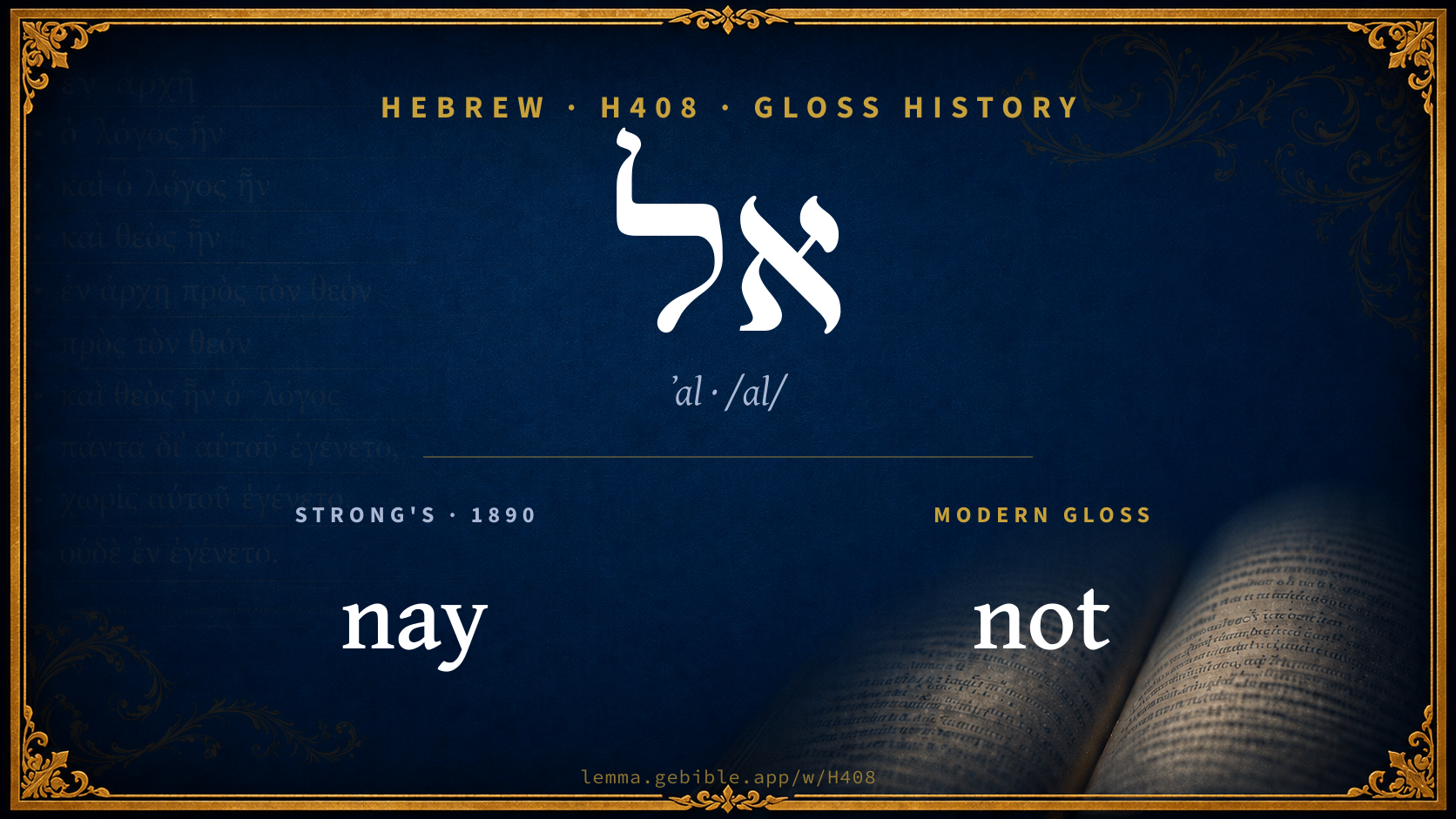
Gloss history
Strong's 1890 vs modern scholarship
About this word
Strong's H408 catalogs a Hebrew word from the Hebrew Old Testament.
These counts are not copied from any lexicon or concordance. They are computed here, from the morphology-tagged Hebrew Old Testament. What Lemma adds →
- 572
- distinct verses
- The word appears in 572 distinct verses.
- 37 / 39
- OT books
- The word appears in 37 of 39 Old Testament books.
- #70
- by frequency
- Top 100 most frequent Hebrew words (rank 70 of 8,640 Hebrew words by occurrence).
View all 572 occurrences in the concordance →
By section of the Old Testament
By traditional corpus
Conventional, traditional groupings — biblical authorship is debated, so this is a traditional corpus grouping, not an authorship claim. Each share is this word’s portion of its verses in that division of the Hebrew canon. Each figure is a share of the word’s 572 distinct verses.
- Writings (Ketuvim) 247 verses · 43%
- Prophets (Nevi'im) 236 verses · 41%
- Torah (Pentateuch) 89 verses · 16%
How translations render this word
Counts come from each version’s own published word-to-Strong’s tagging or interlinear alignment — an approximate guide to how each version renders this word, not a word-level alignment the data otherwise carries. Because each total is that version’s own tagged count, the per-version totals vary from one another and need not match the appearance or distinct-verse counts above. These counts may also differ from a printed concordance because Lemma counts each distinctly tagged rendering and does not collapse phrase taggings into a single head-word total. This is a fixed set of word-tagged versions (KJV, ASV, BSB, ULT) and does not change with the reading translation you choose elsewhere. Each version’s license is shown beside its name below (and on Sources).
BDB lists this Strong’s number as 2 distinct words (homographs). Each count above pools all of them and is not split by sense — see the Senses section below. A low-frequency rendering may belong to a different one of those words, not the primary meaning.
- King James Version†: Let me never 2×
- American Standard Version†: Let me never 2×
- Berean Standard Bible†: Do not 455×, Not 33×, No 26×
- unfoldingWord Literal Text†: Not 583×, And 104×, Do not 62×
King James Version Public Domain
Renders H408 across 12† tagged occurrences — most commonly:
Plus 10 renderings that appear only once — usually multi-word phrases or single function words the recovered tagging swept in, not distinct renderings.
American Standard Version Public Domain
Renders H408 across 12† tagged occurrences — most commonly:
Plus 10 renderings that appear only once — usually multi-word phrases or single function words the recovered tagging swept in, not distinct renderings.
Berean Standard Bible Public Domain
Renders H408 across 662† tagged occurrences — most commonly:
Plus other, less common renderings. Plus 44 renderings that appear only once — usually multi-word phrases or single function words the recovered tagging swept in, not distinct renderings. Not rendered by a distinct English word in 58 further occurrences.
unfoldingWord Literal Text CC BY-SA 4.0
Renders H408 across 807† tagged occurrences — most commonly:
Plus 14 renderings that appear only once — usually multi-word phrases or single function words the recovered tagging swept in, not distinct renderings.
Senses in the full BDB
What do BDB’s symbols mean?
BDB uses these scholarly abbreviations:
| Symbol | Meaning |
|---|---|
| 𝔊 | the Septuagint (the ancient Greek translation, LXX) |
| 𝔙 | the Vulgate (the Latin translation) |
| 𝔖 | the Syriac version (the Peshitta) |
| 𝔗 | the Targum (the Aramaic translation) |
| ψ | the Psalms |
| √ | root (the underlying root or stem) |
| ‖ | parallel passage (a synonymous or contrasted parallel) |
| † | the dagger: every passage where the word occurs is cited |
The 3 senses and sub-senses the full Brown-Driver-Briggs lexicon distinguishes for this word, in lexicon order (not ranked by frequency), with BDB’s own verbatim wording and sub-sense lettering. Shown in Hebrew script with BDB’s own scholarly abbreviations. The condensed entry is in the Lexicon Entry tab. See also the Forms in the corpus table below.
אל I (= اَلْ, Ar. article, preserved perh. in following words derived by Hebrews from (or through) Arabic-speaking tribes
אל II
- a. (a) with a verb, which is then always an impf. (never an imperative), by preference in the cohort. or jussive mood, where this is in use, and may be of any person or number; Gn 15:1 and often אַל־תִּירָא fear not! 22:12 אַל־תִּשְׁלַח יָֽדְךָ put not forth thy hand, 37:27 וְיָדֵנוּ אַל־תְּהִי־בוֹ and let not our hand be upon him, 21:16 אַל־אֶרְאֶה let me not look upon the death of the lad! ψ 25:2 אַל־אֵבוֹשָׁה let me not be ashamed; with 1 pl. (rare) 2 S 13:25 Je 18:18 Jon 1:14. In an imprecation: Gn 49:4 אַל־תּוֹתַר have not thou the excellency! ψ 109:12 Jb 3:4, 6. Sometimes strengthened by נָא: Gn 13:8 18:3 al. (b) without a verb, (α) 2 S 1:21 let (there be) not dew & not rain upon you! Is 62:6 ψ 83:2. (β) used absol., in deprecation Gn 19:18 2 S 13:16 (v. sub אוֹדָה) 2 K 3:13; 4:16; 6:27 (v. RVm: but possibly to be expl. by Dr§ 152 iii; so Th Ke: hardly as Ew§ 355b) Ru 1:13 אַל בְּנֹתַי Nay, my daughters, cf. Ju 19:23; (γ) after a preceding imper. Am 5:14 Jo 2:13 Pr 8:10, a juss. 27:2, an inf. abs. 17:12. (c) in poetry אַל sometimes expresses vividly the emotion or sympathy of the poet (v. Dr§ 56–8); Is 2:9 וְאַל־תִּשָּׂא לָהֶם and forgive them not! (with a touch of passion), ψ 41:3 Pr 3:25 Jb 5:22; ψ 34:6 (but 𝔊 𝔖 Ew Che here rd. וּפְנֵיכֶם, prob. rightly); 50:3a may our God come וְאַל־יֶ֫חֱרָ֥שׁ and not be silent! (the psalmist identifying himself with a spectator of the scene v 2, 3b–c) 121:3 (contrast v 4 לֹא) Je 46:6 +., e.g. Genesis 15:1
- b. once Pr 12:28 joined closely to a subst. (cf. לֹא 2b): In the way of righteousness is life, and in the pathway thereof אַל־מָוֶת there is no-death!; but error for אֶל־ ‘unto’ Capp 𝔊 𝔙 𝔗 𝔅. e.g. Proverbs 12:28
- c. once Jb 24:25 used poet. as a subst., And bring my words לְאַל to nought!—N.B. 1 S 27:10 אַל־פְּשַׁטְתֶּם הַיּוֹם, אַל with the pf. is against all analogy; and either אֶל־מִי (with 𝔊 𝔙), or better אָן whither? (with 𝔖 𝔗: v. 1 S 10:14) must be read. e.g. Job 24:25
Senses from the full Brown-Driver-Briggs lexicon (Brown, Driver, Briggs; Oxford 1906 — public domain), digitized via Sefaria, supplemented by the OpenScriptures HebrewLexicon (CC BY 4.0). Full attribution on Sources.
Word origin
I. (= اَلْ, Ar. article, preserved perh. in following words derived by Hebrews from (or through) Arabic-speaking tribes; cf. Eng. algebra, Alhambra, alkali, alcohol, alcove, etc.)
II. adv. of negation (so Ph. e.g. CIS i.3,4.5.8, Bi Aramaic, Sab. (DHMZMG 1875, 596), and in the Eth. አልቦ albo, is not), denying however, not objectively as a fact (like לֹא, οὐ), but subjectively as a wish (like μή), expressing therefore a deprecation or prohibition:
— Brown-Driver-Briggs (Oxford 1906, public domain), digitized via Sefaria, supplemented by the OpenScriptures HebrewLexicon (CC BY 4.0). See Sources.
Derived from לא (lôʼ) (H3808) — not.
Jastrow Dictionary
A second Hebrew/Aramaic lexicon for comparison, covering Aramaic and post-biblical (Talmudic, Targumic, Midrashic) usage that the biblical-Hebrew BDB does not. Matched by lemma rather than by Strong’s number, so a lemma may carry more than one Jastrow headword (shown separately below), and the entries cover usage well beyond the Bible.
אַל־
- a prefix, = עַל; e.g. אַלְתּוּסְבְּרָאוֹת (= על האוצרות) appointed over treasures, v. אַ־.
אַל
- (b. h.) not, no (according to Talmud a milder form of prohibition than לֹא; v. Y. Pes. VI, 33ᵇ). Aboth I, 3.—אל תקרי (abbr. א"ת), v. אֶלָּא. Taan. 11ᵃ א׳ יראה וכ׳ shall not live to see &c.; a. v. fr.
אֶל
- אול to turn) prep. to, toward. — Pl., with prefix מ a. suffix of pers. pron., of itself, of my (his &c.) own accord, on my (his &c.) authority. Yoma 5ᵇ לא מֵאֵלַי not on my own authority. Orlah I, 2 העולה מֵאֵלָיו growing spontaneously.—Y. Peah VII, 20ᵇ bot. its sacred character מֵאֵלָיו למדו they did derive from itself (i.e. from the wording of the law itself).—Hence מִמֵּילָא, v. מֵילָא.
אֵל
- v. אלל) God. Shebu. 35ᵃ divine names which dare not be erased are El &c. Taan. 6ᵇ bot.; a. fr.
A Dictionary of the Targumim, the Talmud Babli and Yerushalmi, and the Midrashic Literature (Marcus Jastrow; London, Luzac, 1903) — Public Domain. Digitized via Sefaria. Digitized via Sefaria. Full attribution on Sources.
Forms in the corpus
The 16 distinct written forms H408 takes in the Hebrew Bible, most frequent first — each parse links to that state’s occurrences in the concordance. Hebrew forms include their vowel points and cantillation, so a single lemma takes many written forms.
| Form | Parsing | Example | Uses |
|---|---|---|---|
| אַל | Particle, Negative | Daniel 9:19 | 500 |
| וְ/אַל | Particle, Negative | Amos 5:14 | 124 |
| אַֽל | Particle, Negative | Ecclesiastes 8:3 | 65 |
| וְ/אַֽל | Particle, Negative | Amos 5:5 | 13 |
| וְֽ/אַל | Particle, Negative | 2 Samuel 3:29 | 9 |
| אֶל | Preposition | Deuteronomy 2:9 | 3 |
| אַ֣ל | Particle, Negative | Proverbs 31:4 | 2 |
| אֲל | Particle, Negative | Psalms 35:22 | 1 |
| אַ֖ל | Particle, Negative | 1 Samuel 2:24 | 1 |
| אַ֗ל | Particle, Negative | 2 Kings 3:13 | 1 |
| אַ֤ל | Particle, Negative | Proverbs 31:4 | 1 |
| אַ֨ל | Particle, Negative | Jonah 3:7 | 1 |
| אַֽל | Particle, Negative | Psalms 71:9 | 1 |
| וְ/אֶל | Preposition | Jeremiah 51:3 | 1 |
| וְ/אַ֣ל | Particle, Negative | Psalms 119:36 | 1 |
| לְ֝/אַ֗ל | Particle, Negative | Job 24:25 | 1 |
Same root — word family
Other BDB entries built from the same root as H408, grouped by Strong’s listed origin. These share a root / origin per the lexicon — not necessarily a shared meaning. Each links to that word’s own entry.
Derives from
Derived from this word
- אל ʼal H409 not
- אלו ʼillûw H432 if
- אליל ʼĕlîyl H457 worthless
- אלקום ʼalqûwm H510 not
- אל תשחת ʼAl tashchêth H516 do not destroy
Proper names from this root
People and places named from this root — a name, not an additional meaning of the word.
- לא דבר Lôʼ Dᵉbar H3810 Lo-debar
- לא עמי Lôʼ ʻAmmîy H3818 Lo-ammi
- לא רחמה Lôʼ Ruchâmâh H3819 Lo-ruhamah
Compare all same-root words → Showing 4 of 10 — not the complete family. 3 of the same-root words are proper names (people or places). They share a root, not necessarily a meaning.
Septuagint verse parallels
This word appears in 516 verses that also exist in the Greek Old Testament (Septuagint), out of the 572 Hebrew verses it occurs in. You can read those verses in Greek by switching the Old Testament edition to the Septuagint.
Read these verses in the Septuagint
- Genesis 13:8
- Exodus 3:5
- Leviticus 10:6
- Numbers 4:18
- Deuteronomy 1:21
- Joshua 1:7
- Judges 4:18
- Ruth 1:13
- 1 Samuel 1:16
- 2 Samuel 1:20
- 1 Kings 2:9
- 2 Kings 1:15
This is a verse-level parallel only — the same verses exist in both the Hebrew and Greek Old Testaments. No word-level Hebrew↔Greek correspondence is claimed: the data carries no such alignment, so no Greek word is shown as this Hebrew word’s translation. Coverage is not total — the Septuagint omits the deuterocanon and renumbers the Psalms, so some Hebrew verses have no direct Greek parallel.