
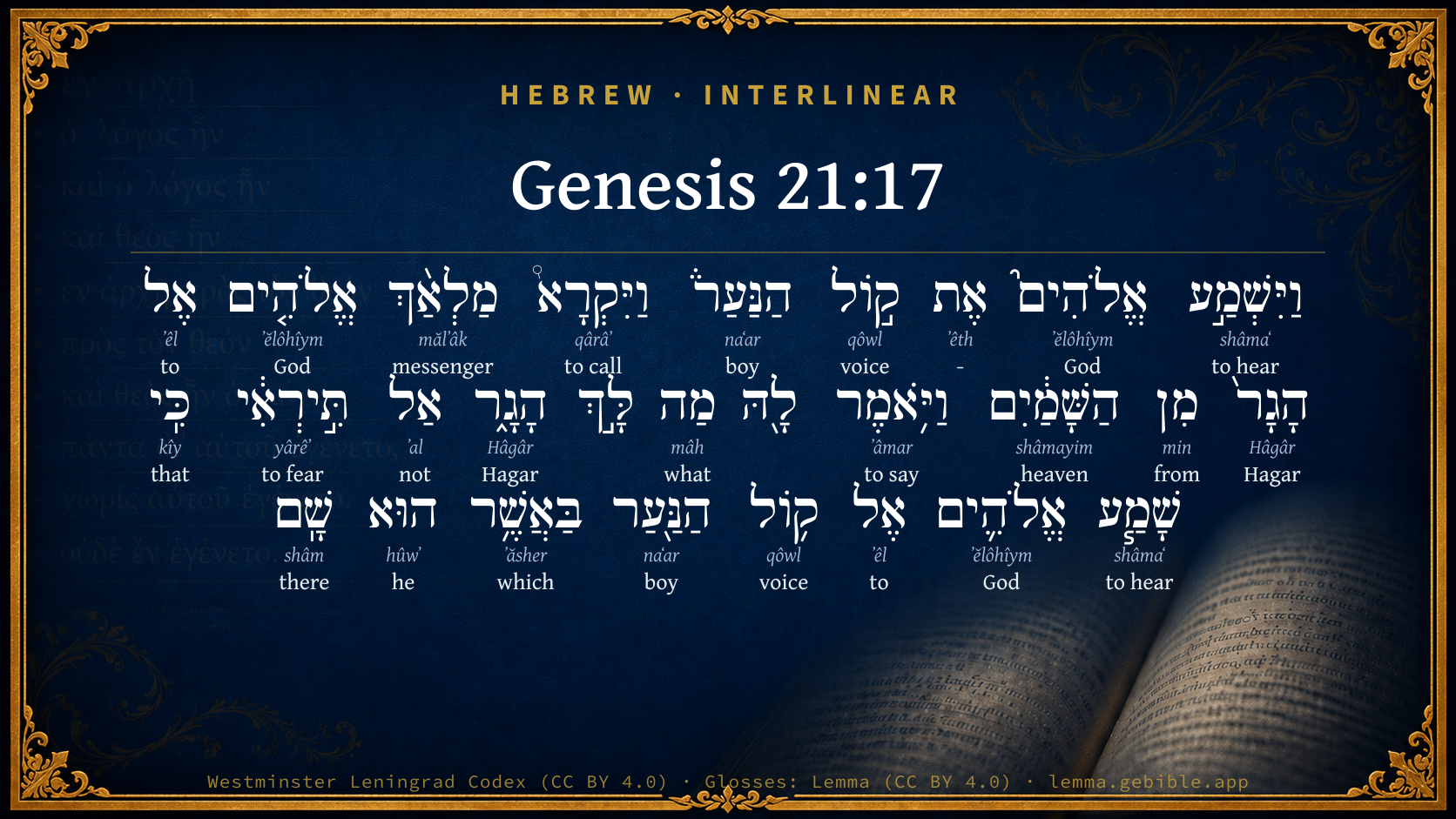
Genesis 21:17

Hebrew (Westminster Leningrad Codex) Genesis 21:17 appears in the Hebrew Old Testament. The text above is from the Westminster Leningrad Codex. Each word links to its Strong’s number, a concise gloss, and parsing drawn from the Open Scriptures Hebrew Bible morphology. Click any word for its full Brown-Driver-Briggs (BDB) entry.
Download image
Cite this verse

Genesis 21:17 (World English Bible). Public Domain. Lemma interlinear Bible study tool, https://lemma.gebible.app/v/genesis/21/17.

Show BibTeX & RIS
BibTeX
RIS
English Translation
God heard the voice of the boy. The angel of God called to Hagar out of the sky, and said to her, "What ails you, Hagar? Don't be afraid. For God has heard the voice of the boy where he is.
World English Bible · Public Domain
Download a study sheet

One document with this verse’s original text, its word-by-word gloss line, the meaning frame, cross-references with their text, attributed commentary, and full source and license credits — printable, and it pastes into notes with its structure intact.

This verse Autodidact and up

Study sheet (.html) Plain text (.txt)

A passage Seminary Student

Up to 50 verses in one chapter. A passage sheet keeps up to 6 commentary sources and 12 cross-references per verse, in the order this page ranks them, and says so on the sheet whenever that leaves anything out. Ask for a single verse and you get the Autodidact verse sheet above.

Everything on this page stays free to read, with no account — the sheet is a download of what is already on screen, not access to it.

Want to remove ads? Support Godless Engineer
Compare translations 3

The same verse in 3 English versions, stacked beneath the original-language interlinear above. Click any original word for its lexicon entry.

Each is an independent rendering of the whole verse — the interlinear is not word-aligned to these translations.

Highlighted words mark where these versions differ — a whole-verse word diff, not a word-by-word alignment.

  • World English Bible Public Domain
    God heard the voice of the boy. The angel of God called to Hagar out of the sky, and said to her, "What ails you, Hagar? Don't be afraid. For God has heard the voice of the boy where he is.
  • King James Version Public Domain
    And God heard the voice of the lad; and the angel of God called to Hagar out of heaven, and said unto her, What aileth thee, Hagar? fear not; for God hath heard the voice of the lad where he is.
  • unfoldingWord Literal Text CC BY-SA 4.0
    And God heard the voice of the boy, so the angel of God called to Hagar from heaven and said to her, “What you, Hagar? Do not be afraid, because God has listened to the voice of the boy where he there.

unfoldingWord Literal Text — © unfoldingWord, licensed CC BY-SA 4.0. Word-aligned USFM3 via Door43 (git.door43.org/unfoldingWord/en_ult).

Versions to compare (up to 4)

3 of 4 selected

Show all 18 translations

Every available English version of this verse, each an independent rendering of the whole verse.

  • World English Bible Public Domain
    God heard the voice of the boy. The angel of God called to Hagar out of the sky, and said to her, "What ails you, Hagar? Don't be afraid. For God has heard the voice of the boy where he is.
  • Berean Standard Bible Public Domain
    Then God heard the voice of the boy, and the angel of God called to Hagar from heaven, “What is wrong, Hagar? Do not be afraid, for God has heard the voice of the boy where he lies.
  • Majority Standard Bible Public Domain
    Then God heard the voice of the boy, and the angel of God called to Hagar from heaven, “What is wrong, Hagar? Do not be afraid, for God has heard the voice of the boy where he lies.
  • King James Version Public Domain
    And God heard the voice of the lad; and the angel of God called to Hagar out of heaven, and said unto her, What aileth thee, Hagar? fear not; for God hath heard the voice of the lad where he is.
  • American Standard Version (1901) Public Domain
    And God heard the voice of the lad. And the angel of God called to Hagar out of heaven, and said unto her, What aileth thee, Hagar? Fear not. For God hath heard the voice of the lad where he is.
  • Revised Version (1885) Public Domain
    And God heard the voice of the lad; and the angel of God called to Hagar out of heaven, and said unto her, What aileth thee, Hagar? fear not; for God hath heard the voice of the lad where he is.
  • Geneva Bible (1599) Public Domain
    Then God heard the voyce of ye childe, and the Angel of God called to Hagar from heauen, and said vnto her, What aileth thee, Hagar? feare not, for God hath heard the voyce of the childe where he is.
  • Douay-Rheims (1899) Public Domain
    And God heard the voice of the boy: and an angel of God called to Agar from heaven, saying: What art thou doing, Agar? fear not: for God hath heard the voice of the boy, from the place wherein he is.
  • Young's Literal Translation Public Domain
    And God heareth the voice of the youth; and the messenger of God calleth unto Hagar from the heavens, and saith to her, `What to thee, Hagar? fear not; for God hath hearkened unto the voice of the youth where he `is';
  • Literal Standard Version CC BY-SA 4.0
    And God hears the voice of the youth; and the messenger of God calls to Hagar from the heavens and says to her, “What to you, Hagar? Do not fear; for God has listened to the voice of the youth where he [is];
  • Unlocked Literal Bible CC BY-SA 4.0
    God heard the voice of the lad, and the angel of God called to Hagar out of heaven, and said to her, “What troubles you, Hagar? Do not be afraid, for God has heard the voice of the lad where he is.
  • unfoldingWord Literal Text CC BY-SA 4.0
    And God heard the voice of the boy, so the angel of God called to Hagar from heaven and said to her, “What you, Hagar? Do not be afraid, because God has listened to the voice of the boy where he there.
  • Darby Bible Public Domain
    And God heard the voice of the lad. And the Angel of God called to Hagar from the heavens, and said to her, What [aileth] thee, Hagar? Fear not; for God hath heard the voice of the lad there, where he is.
  • World Messianic Bible Public Domain
    God heard the voice of the boy. The angel of God called to Hagar out of the sky, and said to her, “What troubles you, Hagar? Don’t be afraid. For God has heard the voice of the boy where he is.
  • Webster's Bible Public Domain
    And God heard the voice of the lad: and the angel of God called to Hagar out of heaven, and said to her, What aileth thee, Hagar? fear not; for God hath heard the voice of the lad where he is.
  • Free Bible Version CC BY-SA 4.0
    God heard the boy's cries, and the angel of God called to Hagar from heaven and asked her, “What's the matter, Hagar? Don't be afraid! God has heard the boy crying from where he is.
  • Bible in Basic English Public Domain
    And the boy's cry came to the ears of God; and the angel of God said to Hagar from heaven, Hagar, why are you weeping? have no fear, for the child's cry has come to the ears of God.
  • JPS Tanakh (1917) Public Domain
    And God heard the voice of the lad; and the angel of God called to Hagar out of heaven, and said unto her: 'What aileth thee, Hagar? fear not; for God hath heard the voice of the lad where he is.

Literal Standard Version (2020), Covenant Press — licensed CC BY-SA 4.0. Text via the HelloAO Bible API (eBible.org). Unlocked Literal Bible (unfoldingWord) — licensed CC BY-SA 4.0. Text via the HelloAO Bible API (eBible.org). unfoldingWord Literal Text — © unfoldingWord, licensed CC BY-SA 4.0. Word-aligned USFM3 via Door43 (git.door43.org/unfoldingWord/en_ult). Free Bible Version, Dr. Jonathan Gallagher — licensed CC BY-SA 4.0. Text via the HelloAO Bible API (eBible.org).

Word by word

More ways to search: Search by grammar → Find every occurrence → Compare this word →

Practice this passage: Drill this verse → Learn its vocabulary →

הָגָר֙
Hâgâr
H1904
“Hagar”
Noun, Proper
Part of Speech
Noun
Type
Proper
Full BDB Definition

Origin: of uncertain (perhaps foreign) derivation

TWOT: None

Hagar = "flight" - Sarah's Egyptian slave girl, Abraham's concubine, Ishmael's mother
  1. וַיִּשְׁמַ֣ע shâmaʻ H8085 “and · to hear” Conjunction + Verb, Qal, Sequential Imperfect, 3rd Person, Masculine, Singular
  2. אֱלֹהִים֮ ʼĕlôhîym H430 “God(s)” Noun, Common, Masculine, Plural, Absolute
  3. אֶת ʼêth H853 “-” Particle, Direct Object
  4. ק֣וֹל qôwl H6963 “voice of” Noun, Common, Masculine, Singular, Construct
  5. הַנַּעַר֒ naʻar H5288 “the · boy” Particle, Definite Article + Noun, Common, Masculine, Singular, Absolute
  6. וַיִּקְרָא֩ qârâʼ H7121 “and · to call” Conjunction + Verb, Qal, Sequential Imperfect, 3rd Person, Masculine, Singular
  7. מַלְאַ֨ךְ mălʼâk H4397 “messenger of” Noun, Common, Masculine, Singular, Construct
  8. אֱלֹהִ֤ים ʼĕlôhîym H430 “God(s)” Noun, Common, Masculine, Plural, Absolute
  9. אֶל ʼêl H413 “to” Preposition
  10. מִן min H4480 “from” Preposition
  11. הַשָּׁמַ֔יִם shâmayim H8064 “the · heaven(s)” Particle, Definite Article + Noun, Common, Masculine, Plural, Absolute
  12. וַיֹּ֥אמֶר ʼâmar H559 “and · to say” Conjunction + Verb, Qal, Sequential Imperfect, 3rd Person, Masculine, Singular
  13. מַה mâh H4100 “what” Particle, Interrogative
  14. הָגָ֑ר Hâgâr H1904 “Hagar” Noun, Proper
  15. אַל ʼal H408 “not” Particle, Negative
  16. תִּ֣ירְאִ֔י yârêʼ H3372 “to fear” Verb, Qal, Jussive, 2nd Person, Feminine, Singular
  17. כִּֽי kîy H3588 “that” Conjunction
  18. שָׁמַ֧ע shâmaʻ H8085 “to hear” Verb, Qal, Perfect, 3rd Person, Masculine, Singular
  19. אֱלֹהִ֛ים ʼĕlôhîym H430 “God(s)” Noun, Common, Masculine, Plural, Absolute
  20. אֶל ʼêl H413 “to” Preposition
  21. ק֥וֹל qôwl H6963 “voice of” Noun, Common, Masculine, Singular, Construct
  22. הַנַּ֖עַר naʻar H5288 “the · boy” Particle, Definite Article + Noun, Common, Masculine, Singular, Absolute
  23. בַּאֲשֶׁ֥ר ʼăsher H834 “in/at · which” Preposition + Particle, Relative
  24. הוּא hûwʼ H1931 “he” Pronoun, Personal, 3rd Person, Masculine, Singular
  25. שָֽׁם shâm H8033 “there” Adverb

About this verse

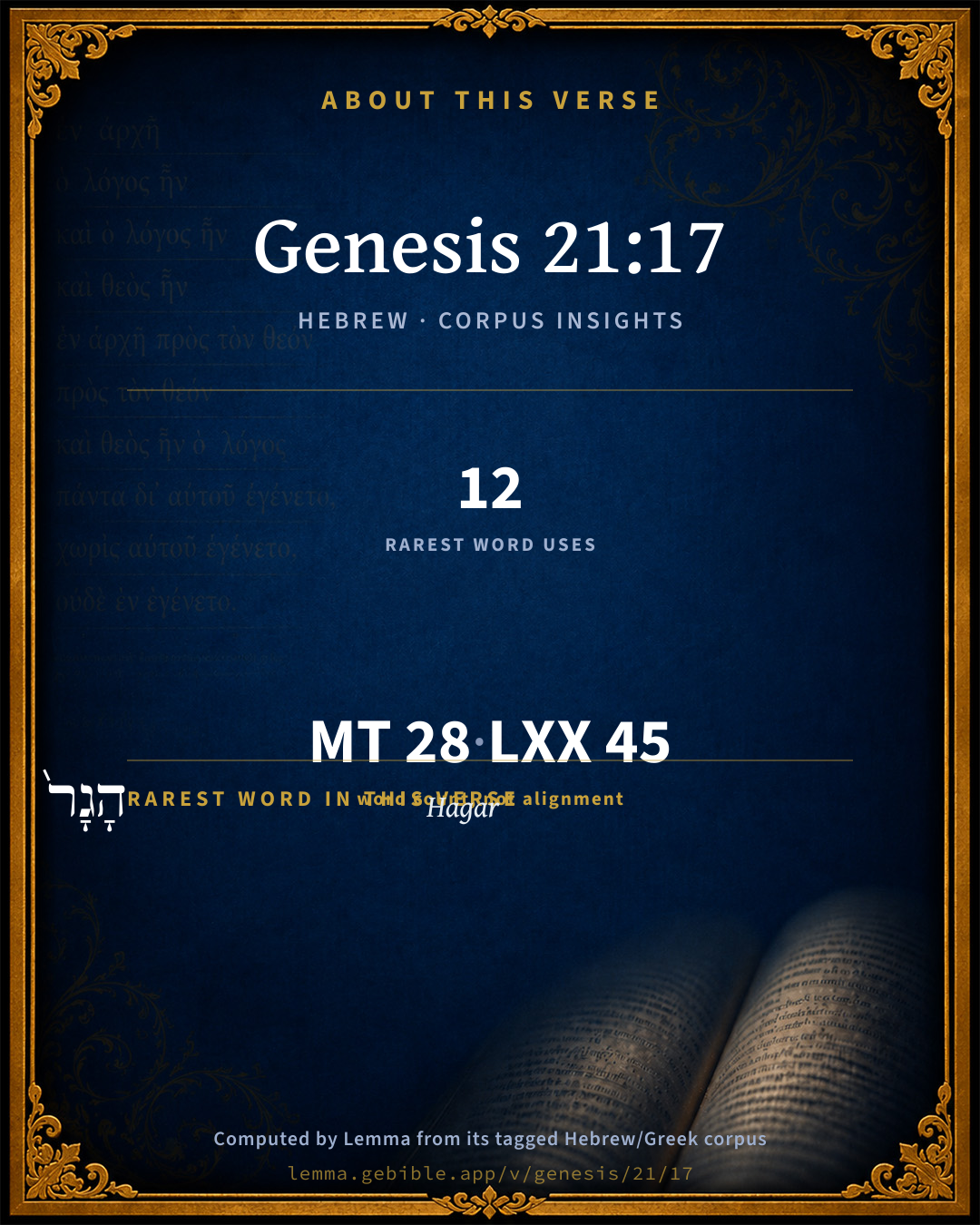
These counts appear in no published source. They are computed here, from the morphology-tagged text and Lemma’s own curated glosses. What Lemma adds →

28
words
19
distinct lemmas
Pentateuch
section

Notable vocabulary

The rarest word here is הָגָר֙ Hagar H1904 — appearing just 12 times in the whole Hebrew Bible.

Shared distinctive vocabulary

הָגָר֙ Hagar H1904 occurs in 10 verses of the Hebrew Bible. Also found in:

Grammatical profile

  • 5 verbs
  • 11 nouns
  • 1 pronoun
  • 5 prepositions
  • 1 conjunction
  • 1 adverb
  • 4 particles

Verb forms

  • וַיִּשְׁמַ֣ע Qal · Sequential Imperfect
  • וַיִּקְרָא֩ Qal · Sequential Imperfect
  • וַיֹּ֥אמֶר Qal · Sequential Imperfect
  • תִּ֣ירְאִ֔י Qal · Jussive
  • שָׁמַ֧ע Qal · Perfect

Repetition

Words recur within this verse — often emphatic in Hebrew:

  • אֱלֹהִים֮ God H430 ×3
  • וַיִּשְׁמַ֣ע to hear H8085 ×2
  • ק֣וֹל voice H6963 ×2
  • הַנַּעַר֒ boy H5288 ×2
  • הָגָר֙ Hagar H1904 ×2
  • אֶל to H413 ×2

Hebrew & Septuagint length

In English translation the verse runs 41 words from the Hebrew and 49 from the Septuagint (LXX English) — closely comparable.

A rough comparison of the two English renderings, which tokenize alike — not a word-level alignment.

Word counts can differ between the Hebrew and the Greek without any difference in meaning — e.g. the Hebrew direct-object marker אֵת has no separate Greek word, and Greek often adds the article ὁ.

In the original languages it is 28 Hebrew tokens and 45 Greek tokens — but the two are counted differently (Hebrew bundles its prefixes and suffixes into one token; the Greek is in lemma form), so that isn’t a like-for-like length.

Cross-references

22

Topical passages linked to Genesis 21:17 in the Treasury of Scripture Knowledge — connected by theme and wording, ordered by reader-vote popularity; previews shown in the World English Bible.

  • Genesis 16:11 The angel of Yahweh said to her, "Behold, you are with child, and will bear a son. You shall call his name Ishmael, because Yahweh has heard your affliction.
  • Psalms 50:15 Call on me in the day of trouble. I will deliver you, and you will honor me."
  • Exodus 3:7 Yahweh said, "I have surely seen the affliction of my people who are in Egypt, and have heard their cry because of their taskmasters, for I know their sorrows.
  • Psalms 91:15 He will call on me, and I will answer him. I will be with him in trouble. I will deliver him, and honor him.
  • Genesis 15:1 After these things the word of Yahweh came to Abram in a vision, saying, "Don't be afraid, Abram. I am your shield, your exceedingly great reward."
  • Genesis 16:9 The angel of Yahweh said to her, "Return to your mistress, and submit yourself under her hands."
  • Genesis 46:3 He said, "I am God, the God of your father. Don't be afraid to go down into Egypt; for there I will make of you a great nation.
  • Exodus 14:13 Moses said to the people, "Don't be afraid. Stand still, and see the salvation of Yahweh, which he will work for you today: for the Egyptians whom you have seen today, you shall never see them again.
  • Exodus 22:23 If you take advantage of them at all, and they cry at all to me, I will surely hear their cry;
  • Exodus 22:27 for that is his only covering, it is his garment for his skin. What would he sleep in? It will happen, when he cries to me, that I will hear, for I am gracious.
  • Judges 18:23 They cried to the children of Dan. They turned their faces, and said to Micah, What ails you, that you come with such a company?
  • 1 Samuel 11:5 Behold, Saul came following the oxen out of the field; and Saul said, What ails the people that they weep? They told him the words of the men of Jabesh.
  • 2 Kings 13:4 Jehoahaz begged Yahweh, and Yahweh listened to him; for he saw the oppression of Israel, how that the king of Syria oppressed them.
  • 2 Kings 13:23 But Yahweh was gracious to them, and had compassion on them, and had respect to them, because of his covenant with Abraham, Isaac, and Jacob, and would not destroy them, neither cast he them from his presence as yet.
  • Psalms 65:2 You who hear prayer, To you all men will come.
  • Psalms 107:4–6 They wandered in the wilderness in a desert way. They found no city to live in.
  • Isaiah 22:1 The burden of the valley of vision. What ails you now, that you are wholly gone up to the housetops?
  • Isaiah 41:10 Don't you be afraid, for I am with you; don't be dismayed, for I am your God; I will strengthen you; yes, I will help you; yes, I will uphold you with the right hand of my righteousness.
  • Isaiah 41:13–14 For I, Yahweh your God, will hold your right hand, saying to you, Don't be afraid; I will help you.
  • Isaiah 43:1–2 But now thus says Yahweh who created you, Jacob, and he who formed you, Israel: Don't be afraid, for I have redeemed you; I have called you by your name, you are mine.
  • Matthew 15:32 Jesus summoned his disciples and said, "I have compassion on the multitude, because they continue with me now three days and have nothing to eat. I don't want to send them away fasting, or they might faint on the way."
  • Mark 5:36 But Jesus, when he heard the message spoken, immediately said to the ruler of the synagogue, "Don't be afraid, only believe."

Cross-references courtesy of OpenBible.info (CC BY 4.0).

Hebrew and Greek witnesses Masoretic Hebrew ↔ Greek Septuagint

The same verse in the two great witnesses to the Old Testament, shown verse-for-verse.

These are two independent witnesses, not word-aligned to each other, and the Septuagint is shown in lemma (dictionary) form.

Hebrew Genesis 21:17 Masoretic · Westminster Leningrad Codex

וַיִּשְׁמַ֣ע אֱלֹהִים֮ אֶת ק֣וֹל הַנַּעַר֒ וַיִּקְרָא֩ מַלְאַ֨ךְ אֱלֹהִ֤ים אֶל הָגָר֙ מִן הַשָּׁמַ֔יִם וַיֹּ֥אמֶר לָ֖הּ מַה לָּ֣ךְ הָגָ֑ר אַל תִּ֣ירְאִ֔י כִּֽי שָׁמַ֧ע אֱלֹהִ֛ים אֶל ק֥וֹל הַנַּ֖עַר בַּאֲשֶׁ֥ר הוּא שָֽׁם

God heard the voice of the boy. The angel of God called to Hagar out of the sky, and said to her, "What ails you, Hagar? Don't be afraid. For God has heard the voice of the boy where he is.

World English Bible · Public Domain

Greek LXX Genesis 21:17 Septuagint · lemma form

εἰςἀκούω δέ ὁ θεός ὁ φωνή ὁ παιδίον ἐκ ὁ τόπος οὗ εἰμί καί καλέω ἄγγελος ὁ θεός ὁ αγαρ ἐκ ὁ οὐρανός καί εἶπον αὐτός τίς εἰμί αγαρ μή φοβέω ἐπιἀκούω γάρ ὁ θεός ὁ φωνή ὁ παιδίον σύ ἐκ ὁ τόπος οὗ εἰμί

And God heard the voice of the child from the place where he was, and an angel of God called Agar out of heaven, and said to her, What is it, Agar? fear not, for God has heard the voice of the child from the place where he is.

LXX2012 (modern English Septuagint) · Public Domain

On this verse, The Pulpit Commentary discusses the Septuagint’s reading. Read the note in Commentary ↓

Hebrew: Westminster Leningrad Codex (CC BY 4.0). Greek: Septuagint (public domain); English from LXX2012 (modern English Septuagint) (Public Domain). How the Septuagint differs from the Hebrew →

Targum (Aramaic paraphrase)

2

The Targum is the ancient Jewish Aramaic paraphrase of the Hebrew Scriptures — an interpretive translation, not the Hebrew text itself. Onkelos (literal) and Pseudo-Jonathan (expansive) render the Torah, and Jonathan the Prophets. Coverage is partial: where no permissively-licensed English translation exists for a verse, only the Aramaic is shown. This is verse-level text, not a word-by-word alignment to the Hebrew.

  1. Targum Onkelos Torah (Genesis–Deuteronomy)
    וּשְׁמִיעַ קֳדָם יְיָ יָת קָלֵהּ דְּרַבְיָא וּקְרָא מַלְאֲכָא דַּיְיָ לְהָגָר מִן שְׁמַיָּא וַאֲמַר לַהּ מָה לָיךְ הָגָר לָא תִדְחֲלִי אֲרֵי שְׁמִיעַ קֳדָם יְיָ יָת קָלֵהּ דְּרַבְיָא בַּאֲתַר דְּהוּא תַמָּן

    (no public-domain English translation for this verse)

    Targum Onkelos — Aramaic: “Onkelos Genesis” (public domain); “Onkelos Exodus” (public domain); “Onkelos Leviticus” (public domain); “Onkelos Numbers” (public domain); “Onkelos Deuteronomy” (public domain). English: “Sefaria Community Translation” (CC0 1.0 (public-domain dedication)); “J.W. Etheridge. The Targums of Onkelos and Jonathan Ben Uzziel on the Pentateuch. London: Longmans, Green, 1862” (public domain). Text via Sefaria.

  2. Targum Pseudo-Jonathan Torah (Genesis–Deuteronomy)
    וּשְׁמִיעַ קֳדָם יְיָ יַת קָלֵיהּ דְטַלְיָא בְּגִין זְכוּתֵיהּ דְאַבְרָהָם וּקְרָא מַלְאָכָא דַיְיָ לְהָגָר מִן שְׁמַיָא וַאֲמַר לָהּ מַה לִיךְ הָגָר לָא תַּסְתִּיפִין אֲרוּם שְׁמִיעַ קֳדָם יְיָ יַת קָלֵיהּ דְטַלְיָא וְלָא דָן יָתֵיהּ לְפוּם עוֹבְדוֹי בִּשַׁיָא דְהוּא עָתִיד לְמֶעֱבַד אֱלָהֵין בְּגִין זְכוּתֵיהּ דְאַבְרָהָם חַס עִילוֹי בַּאֲתַר דְהוּא תַּמָן

    And the voice of the youth was heard before the Lord for the righteousness' sake of Abraham; and the Angel of the Lord called to Hagar from heaven, and said, What to thee, Hagar? Faint not, for the voice of the youth is heard before the Lord; neither shall judgment be according to the evil which he will do, but according to the righteousness of Abraham is mercy upon him in the place where he is.

    Targum Pseudo-Jonathan — Aramaic: “Targum Jonathan on Genesis” (public domain); “Targum Jonathan on Exodus” (public domain); “Targum Jonathan on Leviticus” (public domain); “Targum Jonathan on Numbers” (public domain); “Targum Jonathan on Deuteronomy” (public domain). English: “The Targum of Jonathan ben Uzziel, trans. J. W. Etheridge, London, 1862” (public domain). Text via Sefaria.

Commentary

Notes on Genesis 21:17 from classic Christian and Jewish commentators (each source and its license shown beneath its notes). The classic Christian expositions comment on the surrounding passage and are grouped to its opening verse, so a note may address several verses; the Jewish commentaries on the Tanakh (Rashi and others) are per-verse, so they appear only where the commentator wrote on this verse.

Lemma curates 59 commentaries, every one of them public domain or Creative Commons licensed, each selected and text-cleaned for this edition rather than reprinted as found. About our sources →

Trapp's Complete Commentary

John Trapp

Gen 21:17 And God heard the voice of the lad; and the angel of God called to Hagar out of heaven, and said unto her, What aileth thee, Hagar? fear not; for God hath heard the voice of the lad where he [is].

Ver. 17. And God heard the voice of the lad.] Weeping hath a voice. {Psa 6:8} And as music upon the water sounds farther and more harmoniously than upon the land, so prayers joined with tears. These, if they proceed from faith, are showers quenching the devil’s cannon shot; a second baptism of the soul, wherein it is rinsed anew, nay, perfectly cured: as the tears of vines cure the leprosy; as the lame were healed in the troubled waters. Whether Hagar’s and Ishmael’s tears were for sin, or for the present pressure only, I have not to say. {a} But God is so pitiful, that he hears and helps our affliction, as he had done Hagar’s once afore. {Gen 16:11} And as our Saviour raised the young man of Nain, though none sought to him, merely because he was the only son of his mother, a widow, the stay of her life, and staff of her old age. See a sweet place, 2Ki 14:26-27.

{a} Lachrymas angustiae, exprimit crux; lachrymas poenitentiae, peccatum.

John Trapp, A Commentary or Exposition upon All the Books of the Old and New Testament (1647–1656) — public domain. Text from a community e-Sword module.

The Biblical Illustrator

Joseph S. Exell

Gen_21:17

And God heard the voice of the lad

Prayer

A minister once said to a boy, Can you pray?

How did you pray? He said, Sir, I begged. He could not have used a better word; praying is begging of God. Prayer is very much like a bow. The arrow is a promise; the string is faith. You use your faith, and with it send a promise up to the skies. There are a great many things to think of in prayer. Let me tell you of one or two.

1. You should always address God by one of His names or titles, in a very reverent way. You have to thank God for His mercies; you have to confess to God your sins; you have to trust God to bless you; you have to ask for other people; then, to end all, For Jesus Christs sake. Tell God anything you like, only take care you ask it all in the name of Jesus, because we have no promise to prayer that God will hear us unless we add the name of Jesus to it.

2. Every boy and girl ought to have a form of prayer, though they need not always use it. A psalm is sometimes very good. But the more you practise, the more you will have to say out of your heart.

3. Wandering thoughts often trouble us in prayer. They are like the birds which flew down on Abrahams altar and spoiled the sacrifice. We must drive away these little birds; we must ask God to keep off the wandering thoughts.

4. When you are praying always remember that there is One who is offering up that prayer for you to God. That prayer does not go to God just as you send it up; but before it gets to the throne of God it gets much sweeter. Jesus puts His sweet incense into our prayer. So God will be pleased with us for His sake.

5. Pray always. You cannot always kneel down and pray, but little prayers in your hearts can always be going up. These little darts or ejaculations can be sent up anywhere, at any time. (J. Vaughan, M. A.)

God is with us everywhere

I. THIS PASSAGE TEACHES A LESSON TO PARENTS. It teaches that God is with us at our work; that the wilderness of life is full of Him; that in the waste of this world He is close beside us; that our children are His children; that He sees them under the shrub of the desert; that He has a property in them, a work for them, a work in them; that they are heirs, not of the desert in which they seem to be perishing, but of the many mansions of their heavenly Fathers house. Believe that your children have been united to Christ; and that if you teach them to claim this union for themselves, its strength and its healing shall come out for them day by day as you seek to bring them up for Him.

II. THIS PASSAGE CONTAINS INSTRUCTION FOR THE YOUNG THEMSELVES.

1. God saw the lad as he lay beneath the desert shrub. And He sees you, wherever you are, at home or abroad--His eye is ever on you. Learn this lesson first--Gods eye is ever on the lad, and sees him wherever he is.

2. God was the true protector of the lad, and He is your true and only Friend. He sees in you the adopted children of Jesus Christ. Even from your helpless infancy has He thus looked on you, and had purposes of love towards you.

3. God had a purpose for the lad and a work in him. He meant him to become a great nation in these waste places. His casting out, dark as it seemed, was preparing the way for this; and so it is with you. Everything around you is ordered by God for an end. That end is truly your best spiritual happiness.

4. God heard the voice of the lad; and He will hear you in every time of your trouble. Ishmael was heard because he was the son of Abraham; you will be heard because you are the son of God through Christ. (Bishop Samuel Wilberforce.)

Gods constant care

Homeless, helpless: is there any sight more pitiable than this--a child in the wilderness? Think of the hundreds about us, pinched with hunger, perishing in sore need; the young life passing away neglected, to appear before the throne of God, there by its presence to plead against us, or else rising up in this wilderness to avenge our disregard--a wild man whose hand shall be against every man, and every mans hand against him.

I. We dwell on these words especially as teaching THE FATHERS CARE FOR THE CHILDREN. DO not think of this event as occurring under a dispensation so different from ours that we can find in it no distinct teaching for to-day--very beautiful, but of little worth save for its beauty. These words mean a thousandfold more to us than they could do to Hagar. The Father had not then revealed Himself in the only-begotten Son. The Son of God went away into the wilderness; He shivered in the cold night-blast; He felt the pitiless beating of the storm. And now in all the world there is not one poor child shut out from His sympathy, for He Himself has lived a child of poverty and woe.

II. NOT TO ANGELS NOW IS THIS WORK OF RESCUE GIVEN. It is our high honour and prerogative to be the ministers of the Fathers love. Angels may bring the tidings, perhaps, but only that we may obey. Angels shall reveal the means, but only that we may carry the blessing. Hagar must fill the bottle and give the lad to drink; she must lift him up and hold him by the hand. (M. G. Pearse.)

What aileth thee, Hagar?--

What aileth thee?

As there was a well of water close to Hagar, though unknown to her at the time, so the Lord has made provision for every human life. In the worst straits there is a well for us, and God places a beauteous flower in every thorny path.

1. First, let me come to you who consider yourself to be a Christian believer.

(1) Believer, what aileth thee? You are not so happy as you were when first you gave your heart to God. In China, if a lady were to ask how it is she cannot enjoy a brisk walk, you would reply, It is because you cramped your feet in tight shoes from childhood and have hindered their growth. Now, believer, faith may be compared to the feet on which a Christian stands; and if you have bound up your faith in the tight shoes of doubt, how can you expect to run and not be weary, or to walk and not faint? Have you not allowed your soul to be thrust in the prison of unbelief? Unshackle your mind from the fetters of that grim tyrant, Unbelief; end as your faith grows, so shall you enjoy the peace you have lost.

(2) I go to another and say, Believer, what aileth thee? You reply, Paul sang praises in the dungeon at midnight; but the least cross worries and frets me. How is it? Well, I will tell you. My friend, you say you have done no harm; but the reason why little vexations worry you, is that you have not done much good. Let us be tender-hearted, cheerful-looking, and ready-helping Christians; and, like a pleasant flower, let us exhibit beauty of character and exhale perfume of blessings. A young man, up there in the corner, may say, I want to do great things! Ah, young Christian, first of all begin to scatter little seeds of kindness. Be more lovable and helpful at home than you have been. On a cold day we long for the sun, because it cheers us; likewise make yourself such a blessing that every member of your home shall long for you to come, because your presence cheers their path and soothes their soul.

(3) Now, I go to another, and ask, What aileth thee? You reply, I have not so much pleasure in prayer as I used to have. Well, the reason is, that you have neglected prayer.

(4) Let me pass on to another believer, who, I see, bears the look of anxious care in his face. Friend, what aileth thee? You reply, I have to pass through much trouble, and I fret, and am in despair. Now, why should you allow worrying care to destroy your peace? Let me tell you a tale to comfort you. Some time ago, a father and his little daughter were travelling in the train to London. After rushing rapidly on for many miles, the train came to a sudden stop. The little child was anxious, and said, Father, let us jump out! The father looked out through the window, and seeing the signal ahead indicated that the line was not clear, he replied, No, my dear; we are quite safe. The child exclaimed, But, father, what are we stopping here for? I am so afraid! I wish I could get out. The father tried to explain, but the child could understand nothing except that the train stood still, and that she wanted to go on. Now, like that little child, you are perplexed as to certain stoppages of the wheels of the circumstances of your life; but you cannot understand it until later on. After a long time, the train, of which I have told you, went on and slowly passed an overturned engine, which had been thrown off the rails. The father said, See, my dear, if we had gone on as you wished, we should have run into that train, and have been smashed up. Christian friend, when we reach our mansion in paradise, we shall see that the unpleasant stoppage, which we thought was against us, and that great crash, which prevented us from becoming rich, were directed by a gentle hand, a wise mind, and a loving heart.

2. I intend, now, to go to another class amongst you. I find here a person who makes an outward profession of religion, but who is not a sincere Christian. What aileth thee, professor? You reply, Well, though I profess to be religious, I am not religious in all things.

3. What aileth thee, backslider? You reply, The Lord has withdrawn from me. Ah, you judge the Lord as if He were human. I come to another backslider, and ask, What aileth thee? You reply, I cannot return to God; for He must be disgusted with my character. Let me tell you of a man who had a foul disease. He was taken to the hospital in Piccadilly, but his breath was offensive and his body so full of pollution that few could bear to be near him. He was placed in a spare bed; but though he had a disease of such a disgusting nature, the doctor smiled kindly upon him, and did all in his power to heal him. As the gentle surgeon did not turn from that wretched man, so the Lord will receive you, and heal your backsliding. (W. Birch.)

What aileth thee, Hagar?

I. Now first, WHAT AILETH THEE, HAGAR? And to that question we give three answers. The first answer is this--she thought her son was given over unto death. Poor Hagar had a grief that swallowed up all other griefs. She had a sorrow that made all other sorrows appear utterly insignificant. What cared she if she had lost an Abrahams home? She was losing her boy, that was something infinitely worse. What did it matter to her if all her hopes for the future were blighted and blasted? What a picture we have here of the anxious inquirer--the experience of the sinner when first awakened to the consciousness of his souls danger. The grief of the anxious inquirer is a grief that swallows up all other griefs. How little does it matter to him whether he has trouble in business or not. The trouble of his soul has made him oblivious to all other trouble. The one all-absorbing thought of the anxious soul, the thought that drives all others out of the mind, is--not my son, but my soul is dying. But observe, that Ishmael was her only son, and this added to her trial. If she had had another boy, it would have been bad enough, but poor Ishmael--if he was gone, her all was gone. No other hope. Lose him, and she had lost everything. Here again I see the sinners sorrow, for he also argues, I have but one soul, and if that is lost, it is a loss indeed. I think there was a third drop of bitterness in her cup, and that was her previously bright expectations. I do not know what exact future Hagar pictured for her boy, but doubtless it was a happy one. He was Abrahams son; he would be Abrahams heir. Likely enough, that often before Isaac was born, she used to pat the head of Ishmael, and say, Ah, my boy, you are born to a fortune; you will never have to slave for your bread like some poor wretches. Thank God you are not like others. And so the sinner, when convinced of sin, feels the painfulness of his condition all the more because of his previously bright expectations. Ah, he used once to think his soul was so well to do, it could never be in want. Often would he say, Oh, soul, thank God thou art not as other souls. Thou art a good, moral, well-meaning soul, and thou needst never have a doubt about resting in the bosom of father Abraham above. But, oh, when the light of God streamed into his soul, then he saw how utterly deluded he had been.

2. The second thing that ailed Hagar was, that she was powerless to aid him. Not only was the case bad, but she could not make it better. All human resources had now failed. The bottle is as dry as the desert itself, and she has flung it aside in despairing rage. The dry sand rattles in it unmoistened, and the skin is cracking in the heat. Here again I see the sinners case exactly photographed; all his hopes frustrated, and all his wonderfully clever expedients proving utterly futile. There was a time when he managed to satisfy or stupify his soul with the expedients of formal worship--outward reformation and life alteration. But there comes a time when he gets to the end of all his old resources, and a blessed time it is, although he does not think so.

3. The third thing that ailed Hagar was that she was stupefied with despair. Frantic effort had given place to despairing quiet; and that was a more fatal sign. If the boy is to die, let him die, and I cannot help it. So she takes the poor, emaciated lad and casts him down in the sand, saying, Let him have the little benefit that the shadow of a shrub can give, and I will go and sit with my back towards him, for I cannot see him die. She is so stupefied with her sorrow--so utterly benumbed by it, that she could not even pray. Is this thy case? Has frantic effort with thee given place to the quietude of despair? Art thou now found saying, There is no hope for me, I am the man with the unclean spirit in me. Better I never can be. Saved I never shall be. It may be said of many a sinner who thinks he is dumb with despair, God has heard the crying of thy soul. Your lips could not pray, but, unconsciously to yourself, your heart did.

4. Now, we observe here, that sad as was the case of Hagar, yet there were many favourable signs about her, using her as an illustration of the sinner; and the first favourable thing I notice is that all indifference was gone. If there ever had been any it was clean gone to the winds now. Indifference! Why Hagar was ready to die for the salvation of her boy. Art thou like Hagar? Is thine indifference broken through? It is a grand moment when a man finds out he has a soul. And the next hopeful thing I observe in Hagar was--she was completely humbled. What a difference between that broken-hearted woman sitting under the shrub, and the jaunty maid of Sarah. Who would recognize in her the one that used to be so pert and quick with her answers, and who gaily laughed at her mistress? Sinner, is that the case with you? There was a time when you had plenty of excuses to offer about yourself. And then we notice that a third favourable sign was--she had come to the end of her own resources. When Hagar came to theend of the bottle, she was very near finding the well; and he who comes to the end of his own expedients is very near finding out Gods grand plan of salvation.

II. HAGAR AILED A GREAT DEAL MORE THAN SHE NEED HAVE DONE. She need not have been so miserable after all. And the first reason why she need not have ailed so much is this: Her son was not appointed to death, he was appointed to life. God had said to Abraham, I will make of him a great nation. When a broken-hearted sinner says, My poor soul is appointed unto death, we say to ourselves, He is mistaken; God has not appointed his soul unto death, but unto life. She ailed more than she need have done, for the very thing that she wanted was already prepared. What aileth thee, Hagar? She answers, Want of water. Why, Hagar, there it is. And oh, blessed truth, dear anxious soul, everything you want is already prepared. Do you want an atonement? The atonement was made eighteen hundred and seventy-two years ago. Do you feel you need cleansing? There is the blood already shed. Do you need forgiveness? There are with our God plenteous pardons. And observe next, the water for which her son was dying was within--what distance? Why, within a bow-shot of her--nearer than that, for I am inclined to think that the well was just between Ishmael and Hagar, and that was the reason she did not see it. Oh, friend, Christ is nearer to thee than the well was to Hagar.

III. I conclude by showing you HOW HAGAR LOST ALL HER AILMENTS.

1. She lost them I think, first, through prayer. I have heard the cry of the lad. These are the sighings of a soul that God can understand, and He saith to thee, poor, despairing sinner, to-night, though you say you cannot pray, I have heard the praying of thy soul.

2. And then notice, He opened her eyes to see what was already provided. He did not strengthen Hagar to do anything fresh, He only opened her eyes to see what was already done. And that is just how God deals with souls now. He does not ask the sinner to do anything further, but simply says, Look this way. At the command the sinners eyes are turned into the right direction, and the soul says what in all probability Hagar said, Why, there it is!--there is what I want--there is the well--there is the water. Yes, there it is; and oh, why did not the sinner see it before?

3. And then, lastly, God used her pitcher. The very thing that had been no use came in very handy now. While she trusted to the pitcher it was a worthless thing, but the moment she made it subservient to the well it became valuable. It was useful as a means. Do not trust in the sermon, or you will be like Hagar, trusting to her bottle. Do not rest on the service; you will be as bitterly disappointed as she was when that bottle, all dried and cracked and sandy, lay at her feet. But, oh--may God open thine eyes to see the well, and may He make the words of tonight the pitcher to carry the water to thy dying soul! God grant it for Christs sake!--Amen. (A. G. Brown.)

All right by and by

A woman, with sad face and doleful voice, was once complaining bitterly of her hard lot in life, and of the trials and misfortunes which she was called to pass through, when the sweet voice of a child, of only five years, broke in with: It will all come right by-and-by, mother. Those words, coming as they did from childish lips, made an impression on my mind which will never be erased. Many times since, amid the conflicts of life, I have seemed to hear a childish voice saying, It will all come right by-and-by. Oh that we might always have the love and confidence of a little child. Then we should ever trust in our heavenly Fathers tender care, feeling that He will bring us safely through all the troubles of this life, and that all things shall work together for our good and the glory of God. (S. W. W.)

The Biblical Illustrator, edited by Joseph S. Exell (c. 1880s–1900s) — public domain. Text from a community e-Sword module.

Joseph Benson's Commentary

Gen 21:17-19. God heard the voice of the lad — We read not of a word that he said; but his sighs and groans, though not proceeding from true repentance, but extorted from him by his pressing calamity, cried aloud in the ears of the God of mercy. An angel was sent to comfort Hagar, and assure her that God had heard the voice of the lad. Arise, lift up the lad, and hold him in thy hand — God’s readiness to help us when we are in trouble must not slacken, but quicken our endeavours to help ourselves. He repeats the promise concerning her son, that he should be a great nation, as a reason why she should bestir herself to help him. She saw a well of water — Which, it seems, was near at hand, but had not been observed by her before. Thus she obtained the relief she most wanted.

Joseph Benson's Commentary on the Old and New Testaments (1811–1818) — public domain. Text from a community e-Sword module.

Geneva Bible (1599)

Geneva Bible translators

For his promise sake made to Abraham; and not because the child had discretion and judgment to pray.

Geneva Bible (1599) marginal notes — public domain. Text via Bolls.life.

John Calvin's Commentaries

17. God heard the voice of the lad. Moses had said before that Hagar wept: how is it then, that, disregarding her tears, God only hears the voice of the lad ? If we should say, that the mother did not deserve to receive a favorable answer to her prayers; her son, certainly, was in no degree more worthy. For, as to the supposition of some, that they both were brought to repentance by this chastisement, it is but an uncertain conjecture. I leave their repentance, of which I can see no sign, to the judgment of God. The cry of the boy was heard, as I understand it, not because he had prayed in faith; but because God, mindful of his own promise, was inclined to have compassion upon them. For Moses does not say, that their vows and sighs were directed towards heaven; it is rather to be believed, that, in bewailing their miseries, they did not resort to divine help. But God, in assisting them, had respect, not to what they desired of him, but to what he had promised to Abraham concerning Ishmael. In this sense Moses seems to say that the voice of the boy was heard; namely, because he was the son of Abraham.

What aileth thee, Hagar? The angel reproves the ingratitude of Hagar; because, when reduced to the greatest straits, she does not reflect on God’s former kindness towards her, in similar danger; so that, as one who has found him to be a deliverer, she might again cast herself upon his faithfulness. Nevertheless, the angel assures her that a remedy is prepared for her sorrows if only she will seek it. Therefore in the clause, What aileth thee? is a reproof for having tormented herself in vain, by confused lamentation. When he afterwards says, Fear not, he invites and exhorts her to hope for mercy. But what, we may ask, is the meaning of the expression, which he adds, where he is? It may seem that there is a suppressed antithesis between the place where he now was, and the house of Abraham; so that Hagar might conclude, that although she was wandering in the desert as an exile from the sanctuary of God, yet she was not entirely forsaken by God; since she had him for a Leader in her exile. Or else, the phrase is emphatical; implying, that, though the boy is cast into solitude, and counted as one forsaken, he nevertheless has God nigh unto him. And thus the angel, to relieve the despair of the anxious mother, commands her to return to the place where she had laid down her son. For (as is usual in desperate circumstances) she had become stupefied through grief; and would have lain as one lifeless, unless she had been roused by the voice of the angel. We perceive, moreover, in this example, how truly it is said, that when father and mother forsake us, the Lord will take us up.

John Calvin's Commentaries (1540-1563) — public domain. Text from the Calvin Translation Society English edition (1840s-50s) via the Christian Classics Ethereal Library (ccel.org). Calvin's coverage is partial (roughly two-thirds of the Bible); uncommented books and verses are honest gaps, never fabricated. The 19th-century editor's footnotes and remarks are omitted so the notes are faithfully Calvin's own voice.

Ellicott's Commentary for English Readers

(17) The angel of God.—In Gen_16:7 it was “the angel of Jehovah” which appeared unto Hagar; here it is the angel of Elohim. It is impossible not to be struck with this exact use of the names of Deity. Hagar was then still a member of Abraham’s family; here she is so no longer; and it is Elohim, and not Jehovah, the covenant God of the chosen race, who saves her.

A Bible Commentary for English Readers, edited by Charles John Ellicott (1878–1897) — public domain. Text from a community e-Sword module.

The Cambridge Bible for Schools and Colleges

gen. ed. J. J. S. Perowne

17. God heard the voice of the lad] The voice God heard was that of the lad. He had pity on the anguish, and gave ear to the cry, of the child. Once more we have a play upon the name of Ishmael with its meaning of “God heareth.” Cf. Gen_16:11.

the angel of God] A different manifestation to Hagar from that in chap. Gen_16:7. “The angel” (cf. Gen_28:12, Gen_31:11, Gen_32:2) speaks “from heaven” (Gen_22:11 E). God protects the handmaid and her child no less than the Chosen Family.

The Cambridge Bible for Schools and Colleges (gen. ed. J. J. S. Perowne; Cambridge University Press, 1878–1918) — public domain. Text from a community e-Sword module.

John Gill's Exposition

Arise, lift up the lad,.... She had set herself down at some distance, and now she is bid to rise up and go to the place where she had left her son, and raise aim up from the ground, on which he lay along:

and hold him in thine hand: or take hold on him with thine hand, and hold him up with it, he being so weak that he could not sit up without being supported:

for I will make him a great nation: which is a renewal of a promise before made both to her and to Abraham, Gen 16:10; and by this Hagar is assured that he would recover and live, and become a man and the father of children, who in time would become a great nation; See Gill on Gen 16:10, Gen 17:20, Gen 21:13, this shows that the Angel of God here speaking is God himself, or a divine Person, since none but he could make him a great nation.

John Gill's Exposition of the Whole Bible (1746–1763) — public domain (CC PDM 1.0). Text via the HelloAO Bible API.

Haydock's Catholic Bible Commentary

Of the boy, who was 17 years old, and wept at the approach of death. --- Fear not. Yare are under the protection of God, who will not abandon you, when all human succour fails; nor will he negelct his promises. (chap. 16.) (Haydock)

George Leo Haydock (1774–1849), Haydock's Catholic Family Bible and Commentary, 1859 edition — public domain. Excludes Psalms (Douay-Rheims chapter numbering differs from Protestant) and Deuterocanonical books (Catholic canon only).

Matthew Poole's English Annotations

God heard his cries, though not flowing from true repentance, but extorted from him by his pressing calamity. Though he be in a vast and desolate wilderness, yet my eye is upon him, and I will take care of him.

Matthew Poole's English Annotations on the Holy Bible (1683–1685) — public domain. Text from a community e-Sword/MySword module.

Whedon's Commentary on the Bible

Daniel D. Whedon

17. Heard the voice of the lad — From which it appears he wept as well as his mother.

Angel of God — Not the angel of Jehovah, who found her before. Gen_16:7. This was not an appearance, but a voice out of heaven, answering her voice (Gen_21:16) and the voice of the lad. Jehovah’s Angel has many a ministering angel to send at will.

Daniel D. Whedon (gen. ed.), Commentary on the Old and New Testaments (1874–1909) — public domain. Text from a community e-Sword module.

The Pulpit Commentary

And God Elohim; Hagar and Ishmael having now been removed from the care and superintendence of the covenant God to the guidance and providence of God the ruler of all nations (Keil)heard the voice of the lad; praying (Inglis), or weeping, ut supraand the angel of GodMaleach Elohim; not Maleach Jehovah, as in Gen_16:7-13, for the reason above specified (Hengstenberg, Quarry) called to Hagar out of heaven, it may be inferred there was no external appearance or theophaneia, such as was vouchsafed to her when wandering in the wilderness of Shut (Gen_16:7) and said unto her, What aileth thee (literally, What to thee?) Hagar? fear not; so the word of Jehovah addressed Abram, (Gen_15:1) Isaac, (Gen_26:4) Daniel, (Dan_10:12 and Rev_1:17) for God hath heard the voice of the ladi.e. the voice (perhaps the mute cry) of the lad"s misery, and in that also the audible sob of Hagar"s weeping. It is net said that either Ishmael or his mother prayed to God in their distress. Hence the Divine interposition on their behalf non quid a se peterent, sed quid servo suo Abrahae de Ismaele pollicitus foret, respexit (Calvin)where he is an ellipsis for from, or in, the place where he is; ejk tou topou ouJ ejstin (LXX); ex loco ubi est (Calvin); meaning either "in his helpless condition" (Keil), or out in the desolate wilderness, as contrasted with the house of Abraham (Calvin).

HOMILIES BY F. HASTINGS Ver. 17.

Hagar, a weary outcast.

aileth thee, Hagar?" Hagar is sent away from Abraham"s tents. In the wilderness wandering she is lost. In despair she sinks down and weeps. An angel"s voice is heard inquiring, "What aileth thee, Hagar?

I HAGAR MAY BE TAKEN AS REPRESENTING THE SOULS STILL CHRISTLESS, They are

1. Weary.

2. Thirsty.

3. Apparently man-forsaken and God-forsaken.

4. Their dearest comforts slipping from them, as Hagar"s child, by death.

5. Death expecting.

II HAGAR"S ACT INDICATES HOW SUCH SOULS SHOULD ACT IN TROUBLE.

1. Realize it.

2. Seek deliverance from above.

God nearer to us than we imagine. He feels for us, hears us, helps us. He gives sustenance, cheer, guidance. H.

HOMILIES BY R.A. REDFORD Vers. 17-19.

God"s appearance to Hagar.

The greatest truths in the Bible put before us in a setting of human interest and feeling. Our hearts strangely touched by the picture of the desolate woman and the helpless child. The fatherly character of God exhibited. He heard the voice of the lad. All such facts point to the greatest fact, the union of God and man in the man Christ Jesus. We see here

I GOD"S NOTICE OF AND COMPASSION FOR HUMAN SUFFERING: our example, The object of pity apart from antecedents.

II THE WORKING OUT OF DIVINE PURPOSES notwithstanding, and to some extent by means of, human infirmities, errors, and sins. Ishmael must be preserved, and has his part to play in the future.

III Taken TYPICALLY, Hagar and Ishmael represent the life of man apart from the covenant of God, outside the circle of special privilege. There is God in the wilderness. The eyes which are darkened with ignorance and self-will may yet be mercifully opened to see the well of water. The angel of deliverance follows even the bondwoman and her son. But the way to God through the wilderness is a hard way, a way of suffering, a way of danger. God was with Ishmael. He was with him through Abraham, for Abraham"s sake. The course of Ishmael"s life illustrates the contrast between a truly religious career and one given up to natural impulse. Cf. Esau and Joseph"s brethren. R.

The Pulpit Commentary (1880–1919), ed. H.D.M. Spence-Jones & Joseph S. Exell — public domain. Text from a community e-Sword module.

John Wesley's Explanatory Notes

God heard the voice of the lad - We read not of a word be said; but his sighs and groans, cried loud in the ears of the God of mercy. An angel was sent to comfort Hagar, who assures her, God has heard the voice of the lad where he is - Though he be in the wilderness; for wherever we are, there is a way open heavenwards; therefore lift up the lad, and hold him in thy hand - God's readiness to help us when we are in trouble must not slacken, but quicken our endeavours to help ourselves. He repeats the promise concerning her son, that he should be a great nation, as a reason why she should bestir herself to help him.

John Wesley, Explanatory Notes Upon the Whole Bible (1754–1765) — public domain. Text via the GEBible commentary corpus.

Scofield Reference Notes

C. I. Scofield

angel

(See Scofield "Heb 1:4").

The Scofield Reference Bible (1917 edition), notes by C. I. Scofield — public domain. Text from a community e-Sword module.

unfoldingWord translationNotes

Door43 World Missions Community

the voice of the lad

"the boy's voice." Here "voice" stands for the sound of the boy crying or speaking. AT: "the sound of Ishmael" (See: Metonymy)

the angel of God

"a messenger from God" or "God's messenger"

out of heaven

Here "heaven" means the place where God lives.

What troubles you

"What is wrong" or "Why are you crying"

the voice of the lad where he is

Here "voice" stands for the sound of the boy crying or speaking. AT: "the sound of the boy lying over there" (See: Metonymy)

raise up the lad

"help the boy stand up"

I will make him into a great nation

To make Ishmael into a great nation means God will give him many descendants who will become a great nation. AT: "I will make his descendants become a great nation" or "I will make him become the ancestor of a great nation" (See: Metonymy)

translationWords

God

voice

angel

Hagar

heaven

courage

nation

unfoldingWord translationNotes — © Distant Shores Media and the Door43 World Missions Community, licensed CC BY-SA 4.0. Source: git.door43.org/Door43/en_tn.

Rashi

Rabbi Shlomo Yitzchaki (Rashi)

את קול הנער THE VOICE OF THE LAD — From this we may infer that the prayer of a sick person is more effective than the prayer offered by others for him and that it is more readily accepted (Genesis Rabbah 53:14).

באשר הוא שם WHERE HE IS — According to the actions he is now doing shall he be judged and not according to what he may do in future. Because the ministering angels laid information against him, saying, “Master of the Universe, for him whose descendants will at one time kill your children with thirst will You provide a well?” He asked them, “What is he now, righteous or wicked?” They replied to him, “Righteous.” He said to them, “According to his present deeds will I judge him.” This is the meaning of what is written: “[For God hath heard the voice of the lad ] באשר הוא שם in that condition in which he now is” (Genesis Rabbah 53:14). Where did he (Ishmael) kill Israel with thirst? When Nebuchadnezzar carried them into exile — as it is said, (Isaiah 21:13, 14) “The burden upon Arabia … O ye caravans of Dedanites, unto him that is thirsty bring ye water! etc.” When they were bringing them near the Arabians the Israelites said to their captors, “We beg of you bring us to the children of our uncle, Ishmael, who will certainly show pity to us”, as it is said, “O ye caravans of the Dedanites (דדנים)”; read not דדנים but דודים, kinsmen. — These indeed came to them bringing them salted meat and fish and water-skins inflated with air. The Israelites believed that these were full of water and when they placed them in their mouths, after having opened them, the air entered their bodies and they died (Eichah Rabbah 2:4).

Rashi on the Tanakh — English translations: “The Judaica Press complete Tanach with Rashi, translated by A. J. Rosenberg” (CC BY 4.0); “Pentateuch with Rashi's commentary by M. Rosenbaum and A.M. Silbermann, 1929-1934” (public domain); “The Metsudah Tanach series, Lakewood, N.J” (CC BY 4.0); and “The Book of Joshua, Metsudah Publications, 1997” (CC BY 4.0). Text via Sefaria.

Ramban (Nachmanides)

Rabbi Moshe ben Nachman (Ramban / Nachmanides)

WHERE HE IS. He shall be judged according to his present deeds, and not according to those actions which he may do in the future. This was because the ministering angels laid charges, etc. Thus the words of Rashi quoting from the teachings of our Rabbis., 19.The correct interpretation, in line with the simple meaning of Scripture, appears to me to be that the verse is stating that G-d heard the voice of the lad in the place in which he was. He informed her that she will not need to go from there to a fountain or well for in that very place he will quench his thirst immediately. He thus said to her, “Arise, lift up the lad after you will have given him to drink, for I will make him a great nation. Similarly, the word sham (there) in verses, Where he sunk, there he fell down dead; And where the slain are, there is she, alludes to the place.

Ramban (Nachmanides) on the Tanakh — English translation: “Commentary on the Torah by Ramban (Nachmanides). Translated and annotated by Charles B. Chavel. New York, Shilo Pub. House, 1971-1976” (CC BY 4.0). Text via Sefaria.

Radak

Rabbi David Kimhi (Radak)

וישמע אלוקים את קול הנער, he too had raised his voice and was crying.

מן השמים, she heard his voice without seeing the source of the voice as opposed to the first encounter she had with an angel in 16,13. At the beginning of the verse the Torah uses the proposition את, whereas at the end of the verse it switches to the preposition אל. The letters ת and ל are used interchangeably here without the meaning of the preposition undergoing any change.

באשר הוא שם, at the very site where Hagar had thrown the boy. The message to Hagar was that at the very site where she thought that her so was going to die, there G’d heard his voice, his prayer. Our sages (Rosh Hashanah 16) derive from this wording that human beings are not judged by the Heavenly Court on the basis of what they might become guilty of in the future, but their judgment is based on their status at the time judgment is in progress. If someone is wicked at the time the Heavenly Court is in session, the fact that G’d foresees that he will (would) become righteous at some point in the future is not taken into consideration. Equally, if someone at the time when the Court is in session is deemed innocent, the fact that G’d foresees that he will become a great sinner is not used to influence his judgment at that time. There is an interesting aggadah, according to which the angels remonstrated with G’d at this time, challenging G’d’s mercy on the basis of the untold harm Ishmael’s descendants would visit upon G’d’s people, the Jews in the future. The angels referred specifically to the Ishmaelites denying Jews on the march into exile water to quench their thirst. (a reference to Isaiah 21,13-14) G’d silenced them by asking whether at this particular point in time Ishmael deserved to die. They had to admit that he did not. Hence G’d felt free to exercise His mercy and to let him live.

Radak on the Tanakh — English translations: “Sefaria Community Translation” (CC0 1.0 (public-domain dedication)); “Eliyahu Munk, HaChut Hameshulash” (CC BY 4.0); “Rabbi Mike Feuer, Jerusalem Anthology” (CC BY 4.0); and “R. David Kimhi on the first book of Psalms, Translated by R.G. Finch, London, 1919” (public domain). Text via Sefaria.

Lesson kit

Teaching starters — assembled from the data on this page, not authored interpretation. Every prompt links to the verse data it draws on. Edit before teaching.

Genesis, in the Pentateuch, opens this verse with 28 words (19 distinct Hebrew lemmas). Its most distinctive word is Hâgâr (“Hagar”). A historical commentator’s framing appears above. Read the whole chapter for the surrounding context.

Discussion questions

  1. How does “Hagar” (Hâgâr) shape what this verse is saying?
  2. How does Genesis 16:1, which shares the word «Hagar», read alongside this verse?
  3. What does the repetition of “God” (3× in this one verse) do in this verse?
  4. These translations render this verse differently. What is at stake in choosing one wording over another?
  5. «וַיִּשְׁמַ֣ע» is a Qal Sequential Imperfect verb. How does that grammatical form shape the action described?
  6. Compare how Trapp's Complete Commentary and The Biblical Illustrator read this verse. Where do they agree or differ?

Things to notice

Reading settings

Reading text

Shown beneath each verse's original-language words.

Old Testament
Old Testament edition

Read the OT as the Masoretic Hebrew (MT) or the Greek Septuagint (LXX).

English shown for the Greek Septuagint (in the Hebrew ↔ Greek comparison).

Comparing translations? Open the Compare panel on any verse page to stack up to four side by side.