
2 Samuel 13:32

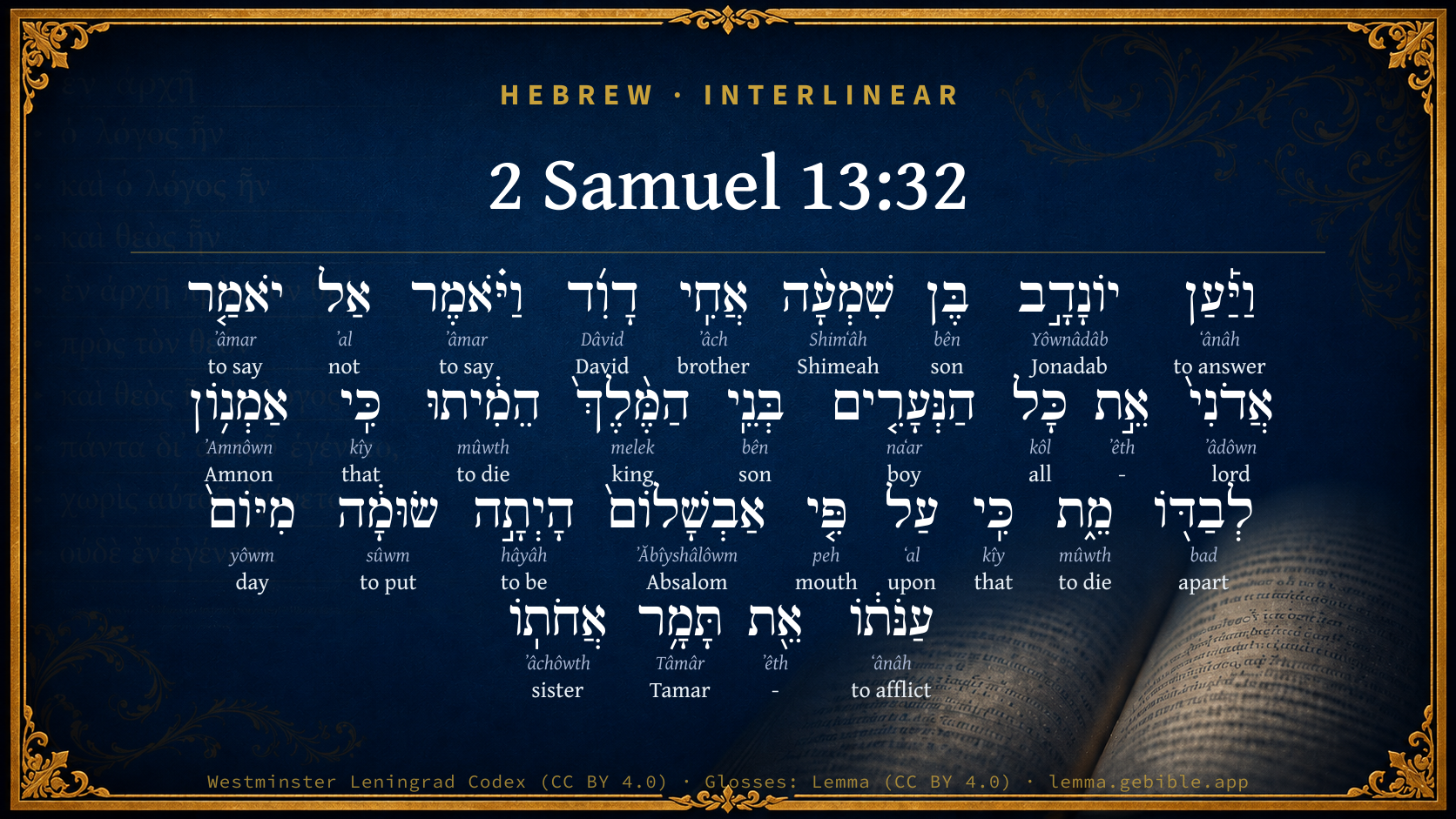
Hebrew (Westminster Leningrad Codex) 2 Samuel 13:32 appears in the Hebrew Old Testament. The text above is from the Westminster Leningrad Codex. Each word links to its Strong’s number, a concise gloss, and parsing drawn from the Open Scriptures Hebrew Bible morphology. Click any word for its full Brown-Driver-Briggs (BDB) entry.
Download image
Cite this verse

2 Samuel 13:32 (World English Bible). Public Domain. Lemma interlinear Bible study tool, https://lemma.gebible.app/v/2-samuel/13/32.

Show BibTeX & RIS
BibTeX
RIS
English Translation
Jonadab, the son of Shimeah, David's brother, answered, Don't let my lord suppose that they have killed all the young men the king's sons; for Amnon only is dead; for by the appointment of Absalom this has been determined from the day that he forced his sister Tamar.
World English Bible · Public Domain
Download a study sheet

One document with this verse’s original text, its word-by-word gloss line, the meaning frame, cross-references with their text, attributed commentary, and full source and license credits — printable, and it pastes into notes with its structure intact.

This verse Autodidact and up

Study sheet (.html) Plain text (.txt)

A passage Seminary Student

Up to 50 verses in one chapter. A passage sheet keeps up to 6 commentary sources and 12 cross-references per verse, in the order this page ranks them, and says so on the sheet whenever that leaves anything out. Ask for a single verse and you get the Autodidact verse sheet above.

Everything on this page stays free to read, with no account — the sheet is a download of what is already on screen, not access to it.

Want to remove ads? Support Godless Engineer
Compare translations 3

The same verse in 3 English versions, stacked beneath the original-language interlinear above. Click any original word for its lexicon entry.

Each is an independent rendering of the whole verse — the interlinear is not word-aligned to these translations.

Highlighted words mark where these versions differ — a whole-verse word diff, not a word-by-word alignment.

  • World English Bible Public Domain
    Jonadab, the son of Shimeah, David's brother, answered, Don't let my lord suppose that they have killed all the young men the king's sons; for Amnon only is dead; for by the appointment of Absalom this has been determined from the day that he forced his sister Tamar.
  • King James Version Public Domain
    And Jonadab, the son of Shimeah David's brother, answered and said, Let not my lord suppose that they have slain all the young men the king's sons; for Amnon only is dead: for by the appointment of Absalom this hath been determined from the day that he forced his sister Tamar.
  • unfoldingWord Literal Text CC BY-SA 4.0
    But Jonadab, the son of Shimeah the brother of David, answered and said, “May my lord not say, ‘All of the young men, the sons of the king, have been killed,’ for Amnon alone has died. For it was placed on the mouth of Absalom from the day of his humbling Tamar his sister.

unfoldingWord Literal Text — © unfoldingWord, licensed CC BY-SA 4.0. Word-aligned USFM3 via Door43 (git.door43.org/unfoldingWord/en_ult).

Versions to compare (up to 4)

3 of 4 selected

Show all 18 translations

Every available English version of this verse, each an independent rendering of the whole verse.

  • World English Bible Public Domain
    Jonadab, the son of Shimeah, David's brother, answered, Don't let my lord suppose that they have killed all the young men the king's sons; for Amnon only is dead; for by the appointment of Absalom this has been determined from the day that he forced his sister Tamar.
  • Berean Standard Bible Public Domain
    But Jonadab, the son of David’s brother Shimeah, spoke up: “My lord must not think they have killed all the sons of the king, for only Amnon is dead. In fact, Absalom has planned this since the day Amnon violated his sister Tamar.
  • Majority Standard Bible Public Domain
    But Jonadab, the son of David’s brother Shimeah, spoke up: “My lord must not think they have killed all the sons of the king, for only Amnon is dead. In fact, Absalom has planned this since the day Amnon violated his sister Tamar.
  • King James Version Public Domain
    And Jonadab, the son of Shimeah David's brother, answered and said, Let not my lord suppose that they have slain all the young men the king's sons; for Amnon only is dead: for by the appointment of Absalom this hath been determined from the day that he forced his sister Tamar.
  • American Standard Version (1901) Public Domain
    And Jonadab, the son of Shimeah, David's brother, answered and said, Let not my lord suppose that they have killed all the young men the king's sons; for Amnon only is dead; for by the appointment of Absalom this hath been determined from the day that he forced his sister Tamar.
  • Revised Version (1885) Public Domain
    And Jonadab, the son of Shimeah David’s brother, answered and said, Let not my lord suppose that they have killed all the young men the king’s sons; for Amnon only is dead: for by the appointment of Absalom this hath been determined from the day that he forced his sister Tamar.
  • Geneva Bible (1599) Public Domain
    And Ionadab the sonne of Shimeah Dauids brother answered and sayde, Let not my lord suppose that they haue slayne all the yong men the Kings sonnes: for Amnon onely is dead, because Absalom had reported so, since hee forced his sister Tamar.
  • Douay-Rheims (1899) Public Domain
    But Jonadab the son of Semmaa David's brother answering, said: Let not my lord the king think that all the king's sons are slain: Amnon only is dead, for he was appointed by the mouth of Absalom from the day that he ravished his sister Thamar.
  • Young's Literal Translation Public Domain
    And Jonadab son of Shimeah, David's brother, answereth and saith, `Let not my lord say, The whole of the young men, the sons of the king, they have put to death; for Amnon alone `is' dead, for by the command of Absalom it hath been appointed from the day of his humbling Tamar his sister;
  • Literal Standard Version CC BY-SA 4.0
    And Jonadab son of Shimeah, David’s brother, answers and says, “Do not let my lord say, The whole of the young men, the sons of the king, they have put to death; for Amnon alone [is] dead, for it has been appointed by the command of Absalom from the day of his humbling his sister Tamar;
  • Unlocked Literal Bible CC BY-SA 4.0
    Jonadab son of Shimeah, David's brother, answered and said, “Let not my master believe that they have killed all the young men who are the king's sons, for Amnon only is dead. Absalom has planned this from the day that Amnon violated his sister Tamar.
  • unfoldingWord Literal Text CC BY-SA 4.0
    But Jonadab, the son of Shimeah the brother of David, answered and said, “May my lord not say, ‘All of the young men, the sons of the king, have been killed,’ for Amnon alone has died. For it was placed on the mouth of Absalom from the day of his humbling Tamar his sister.
  • Darby Bible Public Domain
    And Jonadab, the son of Shimeah David's brother, answered and said, Let not my lord suppose that they have slain all the young men the king's sons; for Amnon only is dead; for by the appointment of Absalom this has been determined from the day that he humbled his sister Tamar.
  • World Messianic Bible Public Domain
    Jonadab the son of Shimeah, David’s brother, answered, “Don’t let my lord suppose that they have killed all the young men, the king’s sons, for Amnon only is dead; for by the appointment of Absalom this has been determined from the day that he forced his sister Tamar.
  • Webster's Bible Public Domain
    And Jonadab, the son of Shimeah David's brother, answered and said, Let not my lord suppose that they have slain all the young men the king's sons; for Amnon only is dead: for by the appointment of Absalom this hath been determined from the day that he forced his sister Tamar.
  • Free Bible Version CC BY-SA 4.0
    But Jonadab, son of David's brother Shimeah, told them: “Your Majesty must not think they have killed all the king's sons—only Amnon is dead. Absalom has been planning ever since the day Amnon raped his sister Tamar.
  • Bible in Basic English Public Domain
    And Jonadab, the son of Shimeah, David's brother, said, Let not my lord have the idea that all the sons of the king have been put to death; for only Amnon is dead: this has been purposed by Absalom from the day when he took his sister Tamar by force.
  • JPS Tanakh (1917) Public Domain
    And Jonadab, the son of Shimeah David's brother, answered and said: 'Let not my lord suppose that they have killed all the young men the king's sons; for Amnon only is dead; for by the appointment of Absalom this hath been determined from the day that he forced his sister Tamar.

Literal Standard Version (2020), Covenant Press — licensed CC BY-SA 4.0. Text via the HelloAO Bible API (eBible.org). Unlocked Literal Bible (unfoldingWord) — licensed CC BY-SA 4.0. Text via the HelloAO Bible API (eBible.org). unfoldingWord Literal Text — © unfoldingWord, licensed CC BY-SA 4.0. Word-aligned USFM3 via Door43 (git.door43.org/unfoldingWord/en_ult). Free Bible Version, Dr. Jonathan Gallagher — licensed CC BY-SA 4.0. Text via the HelloAO Bible API (eBible.org).

Word by word

More ways to search: Search by grammar → Find every occurrence → Compare this word →

Practice this passage: Drill this verse → Learn its vocabulary →

שִׁמְעָ֨ה
Shimʻâh
H8093
“Shimeah”
Noun, Proper
Part of Speech
Noun
Type
Proper
Full BDB Definition

Origin: fem. of H8088

TWOT: None

Shimeah = "fame" - brother of David, the 3rd son of Jesse - also 'Shammah', and 'Shimma'
  1. וַיַּ֡עַן ʻânâh H6030 “and · to answer” Conjunction + Verb, Qal, Sequential Imperfect, 3rd Person, Masculine, Singular
  2. יוֹנָדָ֣ב Yôwnâdâb H3122 “Jonadab” Noun, Proper
  3. בֶּן bên H1121 “son of” Noun, Common, Masculine, Singular, Construct
  4. אֲחִֽי ʼâch H251 “brother of” Noun, Common, Masculine, Singular, Construct
  5. דָוִ֜ד Dâvid H1732 “David” Noun, Proper
  6. וַיֹּ֗אמֶר ʼâmar H559 “and · to say” Conjunction + Verb, Qal, Sequential Imperfect, 3rd Person, Masculine, Singular
  7. אַל ʼal H408 “not” Particle, Negative
  8. יֹאמַ֤ר ʼâmar H559 “to say” Verb, Qal, Jussive, 3rd Person, Masculine, Singular
  9. אֲדֹנִי֙ ʼâdôwn H113 “lord · my” Noun, Common, Masculine, Singular, Construct + Suffix, Personal, 1st Person, Common, Singular
  10. אֵ֣ת ʼêth H853 “-” Particle, Direct Object
  11. כָּל kôl H3605 “all of” Noun, Common, Masculine, Singular, Construct
  12. הַנְּעָרִ֤ים naʻar H5288 “the · boys” Particle, Definite Article + Noun, Common, Masculine, Plural, Absolute
  13. בְּנֵֽי bên H1121 “sons of” Noun, Common, Masculine, Plural, Construct
  14. הַמֶּ֨לֶךְ֙ melek H4428 “the · king” Particle, Definite Article + Noun, Common, Masculine, Singular, Absolute
  15. הֵמִ֔יתוּ mûwth H4191 “to die” Verb, Hiphil, Perfect, 3rd Person, Common, Plural
  16. כִּֽי kîy H3588 “that” Conjunction
  17. אַמְנ֥וֹן ʼAmnôwn H550 “Amnon” Noun, Proper
  18. לְבַדּ֖וֹ bad H905 “to/for · apart · his” Preposition + Noun, Common, Masculine, Singular, Construct + Suffix, Personal, 3rd Person, Masculine, Singular
  19. מֵ֑ת mûwth H4191 “to die” Verb, Qal, Perfect, 3rd Person, Masculine, Singular
  20. כִּֽי kîy H3588 “that” Conjunction
  21. עַל ʻal H5921 “upon” Preposition
  22. פִּ֤י peh H6310 “mouth of” Noun, Common, Masculine, Singular, Construct
  23. אַבְשָׁלוֹם֙ ʼĂbîyshâlôwm H53 “Absalom” Noun, Proper
  24. הָיְתָ֣ה hâyâh H1961 “to be” Verb, Qal, Perfect, 3rd Person, Feminine, Singular
  25. שׂוּמָ֔ה sûwm H7760 “put” Verb, Qal, Participle Passive, Feminine, Singular, Absolute
  26. מִיּוֹם֙ yôwm H3117 “from · day of” Preposition + Noun, Common, Masculine, Singular, Construct
  27. עַנֹּת֔וֹ ʻânâh H6031 “to afflict · him” Verb, Piel, Infinitive Construct + Suffix, Personal, 3rd Person, Masculine, Singular
  28. אֵ֖ת ʼêth H853 “-” Particle, Direct Object
  29. תָּמָ֥ר Tâmâr H8559 “Tamar” Noun, Proper
  30. אֲחֹתֽוֹ ʼâchôwth H269 “sister · his” Noun, Common, Feminine, Singular, Construct + Suffix, Personal, 3rd Person, Masculine, Singular

About this verse

These counts appear in no published source. They are computed here, from the morphology-tagged text and Lemma’s own curated glosses. What Lemma adds →

31
words
26
distinct lemmas
Historical
section

Notable vocabulary

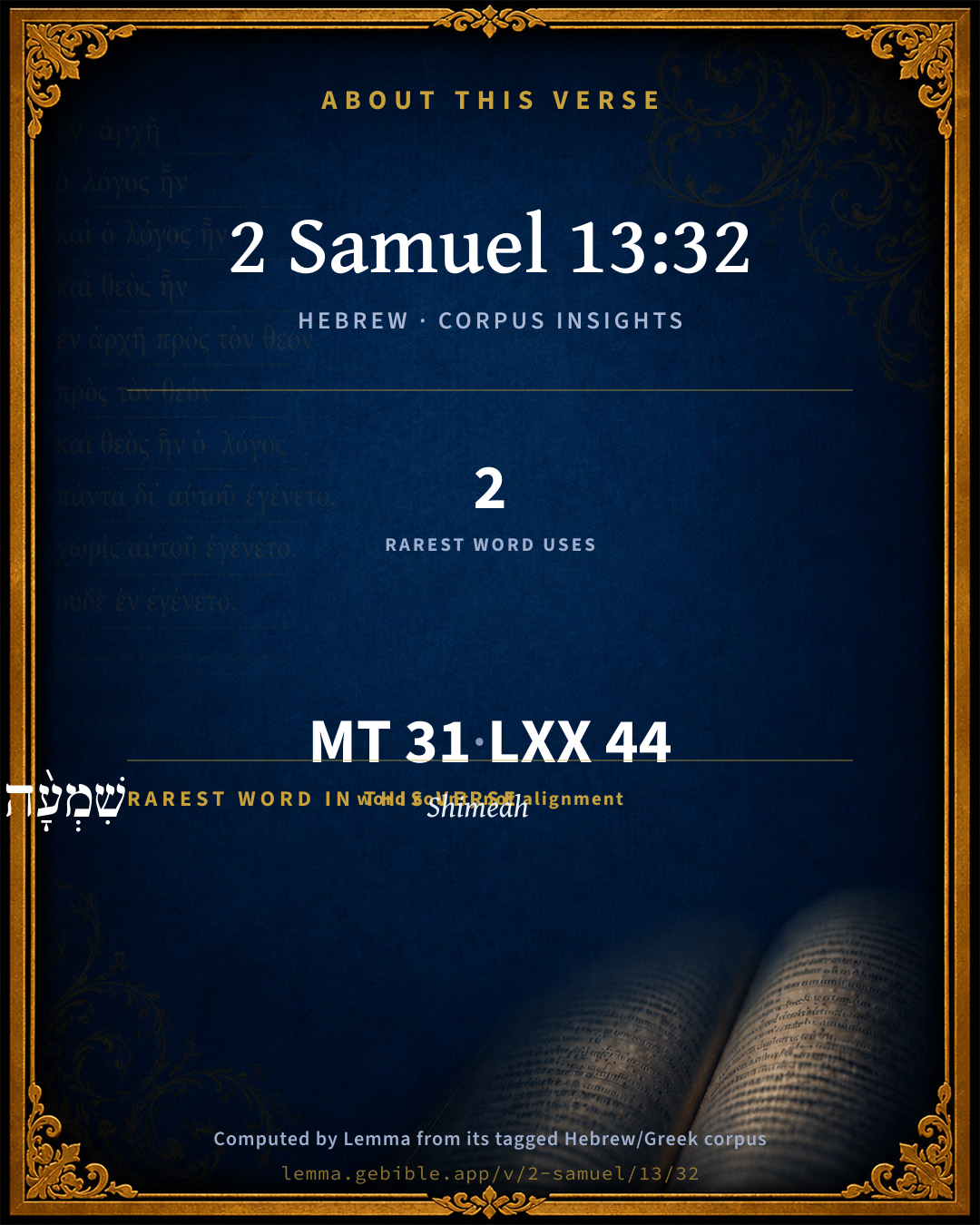
The rarest word here is שִׁמְעָ֨ה Shimeah H8093 — appearing just 2 times in the whole Hebrew Bible.

Shared distinctive vocabulary

שִׁמְעָ֨ה Shimeah H8093 occurs in 2 verses of the Hebrew Bible. Also found in:

Grammatical profile

  • 8 verbs
  • 17 nouns
  • 1 preposition
  • 2 conjunctions
  • 3 particles

Verb forms

  • וַיַּ֡עַן Qal · Sequential Imperfect
  • וַיֹּ֗אמֶר Qal · Sequential Imperfect
  • יֹאמַ֤ר Qal · Jussive
  • הֵמִ֔יתוּ Hiphil · Perfect
  • מֵ֑ת Qal · Perfect
  • הָיְתָ֣ה Qal · Perfect
  • שׂוּמָ֔ה Qal · Participle Passive
  • עַנֹּת֔וֹ Piel · Infinitive Construct

Repetition

Words recur within this verse — often emphatic in Hebrew:

  • בֶּן son H1121 ×2
  • וַיֹּ֗אמֶר to say H559 ×2
  • הֵמִ֔יתוּ to die H4191 ×2
  • כִּֽי that H3588 ×2

Hebrew & Septuagint length

In English translation the verse runs 48 words from the Hebrew and 60 from the Septuagint (LXX English) — closely comparable.

A rough comparison of the two English renderings, which tokenize alike — not a word-level alignment.

Word counts can differ between the Hebrew and the Greek without any difference in meaning — e.g. the Hebrew direct-object marker אֵת has no separate Greek word, and Greek often adds the article ὁ.

In the original languages it is 31 Hebrew tokens and 44 Greek tokens — but the two are counted differently (Hebrew bundles its prefixes and suffixes into one token; the Greek is in lemma form), so that isn’t a like-for-like length.

Cross-references

5

Topical passages linked to 2 Samuel 13:32 in the Treasury of Scripture Knowledge — connected by theme and wording, ordered by reader-vote popularity; previews shown in the World English Bible.

  • Genesis 27:41 Esau hated Jacob because of the blessing with which his father blessed him. Esau said in his heart, "The days of mourning for my father are at hand. Then I will kill my brother Jacob."
  • 1 Samuel 16:9 Then Jesse made Shammah to pass by. He said, Neither has Yahweh chosen this.
  • 2 Samuel 13:3 But Amnon had a friend, whose name was Jonadab, the son of Shimeah, David's brother; and Jonadab was a very subtle man.
  • Psalms 7:14 Behold, he travails with iniquity; Yes, he has conceived mischief, And brought forth falsehood.
  • Proverbs 24:11–12 Rescue those who are being led away to death! Indeed, hold back those who are staggering to the slaughter!

Cross-references courtesy of OpenBible.info (CC BY 4.0).

Hebrew and Greek witnesses Masoretic Hebrew ↔ Greek Septuagint

The same verse in the two great witnesses to the Old Testament, shown verse-for-verse.

These are two independent witnesses, not word-aligned to each other, and the Septuagint is shown in lemma (dictionary) form.

Hebrew 2 Samuel 13:32 Masoretic · Westminster Leningrad Codex

וַיַּ֡עַן יוֹנָדָ֣ב בֶּן שִׁמְעָ֨ה אֲחִֽי דָוִ֜ד וַיֹּ֗אמֶר אַל יֹאמַ֤ר אֲדֹנִי֙ אֵ֣ת כָּל הַנְּעָרִ֤ים בְּנֵֽי הַמֶּ֨לֶךְ֙ הֵמִ֔יתוּ כִּֽי אַמְנ֥וֹן לְבַדּ֖וֹ מֵ֑ת כִּֽי עַל פִּ֤י אַבְשָׁלוֹם֙ הָיְתָ֣ה שׂוּמָ֔ה מִיּוֹם֙ עַנֹּת֔וֹ אֵ֖ת תָּמָ֥ר אֲחֹתֽוֹ

Jonadab, the son of Shimeah, David's brother, answered, Don't let my lord suppose that they have killed all the young men the king's sons; for Amnon only is dead; for by the appointment of Absalom this has been determined from the day that he forced his sister Tamar.

World English Bible · Public Domain

Greek LXX 2 Samuel 13:32 Septuagint · lemma form

καί ἀποκρίνω ιωναδαβ υἱός σαμαα ἀδελφός δαυίδ καί εἶπον μή εἰπάτω ὁ κύριος ἐγώ ὁ βασιλεύς ὅτι πᾶς ὁ παιδάριον ὁ υἱός ὁ βασιλεύς θανατόω ὅτι αμνων μόνος ἀποθνήσκω ὅτι ἐπί στόμα αβεσσαλωμ εἰμί κεῖμαι ἀπό ὁ ἡμέρα ὅς ταπεινόω θημαρ ὁ ἀδελφή αὐτός

And Jonadab the son of Samaa brother of David, answered and said, Let not my Lord the king say that he has slain all the young men the sons of the king, for Amnon only of them all is dead; for he was appointed to death by the mouth of Abessalom from the day that he humbled his sister Themar.

LXX2012 (modern English Septuagint) · Public Domain

On this verse, Keil & Delitzsch discusses the Septuagint’s reading. Read the note in Commentary ↓

Hebrew: Westminster Leningrad Codex (CC BY 4.0). Greek: Septuagint (public domain); English from LXX2012 (modern English Septuagint) (Public Domain). How the Septuagint differs from the Hebrew →

Targum (Aramaic paraphrase)

1

The Targum is the ancient Jewish Aramaic paraphrase of the Hebrew Scriptures — an interpretive translation, not the Hebrew text itself. Onkelos (literal) and Pseudo-Jonathan (expansive) render the Torah, and Jonathan the Prophets. Coverage is partial: where no permissively-licensed English translation exists for a verse, only the Aramaic is shown. This is verse-level text, not a word-by-word alignment to the Hebrew.

  1. Targum Jonathan Prophets (Joshua–Malachi)
    וַאֲתֵיב יוֹנָדָב בַּר שִׁמְעָה אֲחוֹהִי דְדָוִד וַאֲמַר לָא יֵימַר רִבּוֹנִי יַת כָּל עוּלֵימַיָא בְּנֵי מַלְכָּא קְטַלוּ אֲרֵי אַמְנוֹן בִּלְחוֹדוֹהִי מִית אֲרֵי בְלִבָּא דְאַבְשָׁלוֹם הֲוַת כְּמָנָא מִיוֹמָא דְעַנֵי יַת תָּמָר אֲחָתֵיהּ:

    (no public-domain English translation for this verse)

    Targum Jonathan — Aramaic: “Mikraot Gedolot” (public domain). English: “Sefaria Community Translation” (CC0 1.0 (public-domain dedication)); “London "Chaldee Paraphrase," 1871” (public domain). Text via Sefaria.

Commentary

Notes on 2 Samuel 13:32 from classic Christian and Jewish commentators (each source and its license shown beneath its notes). The classic Christian expositions comment on the surrounding passage and are grouped to its opening verse, so a note may address several verses; the Jewish commentaries on the Tanakh (Rashi and others) are per-verse, so they appear only where the commentator wrote on this verse.

Lemma curates 59 commentaries, every one of them public domain or Creative Commons licensed, each selected and text-cleaned for this edition rather than reprinted as found. About our sources →

Trapp's Complete Commentary

John Trapp

2Sa 13:32 And Jonadab, the son of Shimeah David’s brother, answered and said, Let not my lord suppose [that] they have slain all the young men the king’s sons; for Amnon only is dead: for by the appointment of Absalom this hath been determined from the day that he forced his sister Tamar.

Ver. 32. And Jonadab, the son of Shimeah.] This cunning pated man, seeking somewhat to mitigate his uncle David’s extreme sorrow, which he had caused by his wicked counsel to Amnon, guesseth at the truth, and hitteth upon the right: whereunto, perhaps, he might be at some time by Absalom made privy. He had advised Amnon how to compass his unlawful lust: and now that he was slain, he could tell what was become of him: the devil can do the like. Great pity it was that David did no further sift him hereupon, to find out the bottom of the business, and to give him his due payment.

For by the appointment of Absalom.] Heb., By the mouth, i.e., by the purpose of his exulcerate heart, breaking forth haply some time at his lips.

From the day that he forced his sister Tamar.] So the Lacedemonian commonwealth was utterly overturned at Leuctra, for a rape there committed on the two daughters of Scedasus. So when a certain monk had ravished the sister of Zisca, that noble Bohemian, he took up arms against the monks, and those that favoured them; casting to the ground three hundred monasteries, and doing many great exploits against the Papists in Bohemia and Germany. But what an impenitent and impudent man was this Jonadab, that he could speak of the rape of Tamar, which he had contrived, together with the sad consequents, without any remorse or regret! And what sots are some Rabbis for saying that this Jonadab here was Nathan the prophet, who knew by the Spirit what was done at Baalhazor!

John Trapp, A Commentary or Exposition upon All the Books of the Old and New Testament (1647–1656) — public domain. Text from a community e-Sword module.

Geneva Bible (1599)

Geneva Bible translators

Hebrew, because it was put in Absalom’s mouth.

Geneva Bible (1599) marginal notes — public domain. Text via Bolls.life.

Adam Clarke's Commentary

Verse 32. And Jonadab - said - Amnon only is dead] This was a very bad man, and here speaks coolly of a most bloody tragedy, which himself had contrived.

Adam Clarke's Commentary on the Bible (1810–1826) — public domain. Text from a community e-Sword/MySword module.

Ellicott's Commentary for English Readers

(32) Jonadab.—The same subtle counsellor who had led Amnon into his sin, now at once divined how the case really stood and reassured the king.

By the appointment of Absalom this hath been determined.—Literally, upon Absalom’s mouth it hath been set, an expression which has given rise to much variety of interpretation. The Authorised Version expresses the sense accurately.

A Bible Commentary for English Readers, edited by Charles John Ellicott (1878–1897) — public domain. Text from a community e-Sword module.

The Cambridge Bible for Schools and Colleges

gen. ed. J. J. S. Perowne

32. Let not my lord suppose, &c.] A practical illustration of the sagacity for which Jonadab was famous (2Sa_13:3). He at once rejects the exaggerations of rumour, and predicts accurately what had really happened.

by the appointment of Absalom this hath been determined] Lit., upon Absalom’s mouth hath it been set; that is, Absalom’s sinister looks have all along betrayed his determination to kill Amnon; or, his purpose has been obvious from his words; but the latter explanation is less likely, as Absalom seems to have dissembled his revenge in order to disarm Amnon’s suspicion.

The Cambridge Bible for Schools and Colleges (gen. ed. J. J. S. Perowne; Cambridge University Press, 1878–1918) — public domain. Text from a community e-Sword module.

John Gill's Exposition

And Jonadab the son of Shimeah, David's brother,.... The same that advised Amnon to feign himself sick, to get Tamar sent to him, that he might enjoy her, Sa2 13:3,

answered and said; said in answer to the report brought to the king, which threw him into such an agony:

let not my lord suppose that they have slain all the young men the king's sons; he did not believe it himself, and would not have the king entertain such a thought, and distress himself with it:

for Amnon only is dead; he is very positive, and speaks with great assurance; it looks as if he was in the secret, and knew of the plot against Amnon's life; and, if so, he must be a very wicked man, first to form a scheme whereby Amnon might come at Tamar to ravish her, and then be accessory to the murder of him, as he must, if he knew of the design against his life, and did not acquaint him and the king of it; and this seems to be confirmed by what follows:

for by the appointment of Absalom this hath been determined, from the day that he forced his sister Tamar; that is, the slaying of Amnon; the meaning is, either that Absalom had given orders to his servants to slay him, whenever they had an opportunity; or it was "in the mouth of Absalom" (p), as it may be rendered; he used to declare it to his intimate friends, that it was the purpose and resolution of his heart to kill Amnon some time or another; and this he had taken up from the time of his sister Tamar's being forced, and because of that, of which Jonadab had intelligence by some means or another; and who speaks of this rape without any seeming emotion, as if he had no concern at all in it.

(p) "in ore Absalom", V. L. Vatablus.

John Gill's Exposition of the Whole Bible (1746–1763) — public domain (CC PDM 1.0). Text via the HelloAO Bible API.

Albert Barnes' Notes on the Bible

The history supplies another (compare 2Sa 13:3) instance of Jonadab’s subtlety and sagacity. He at once gave the true explanation of the catastrophe at Baal-hazor, in spite of the false rumour.

By the appointment of Absalom ... - Meaning that Absalom’s resolution to slay Amnon had been formed at the time, and only waited an opportunity to give expression to it.

Albert Barnes' Notes on the Bible (1834–1885) — public domain. Text from a community e-Sword/MySword module.

Haydock's Catholic Bible Commentary

Mouth. Chaldean [and] Syriac, "heart." Aquila, "because Absalom was in wrath against him." He had resolved upon his destruction. (Calmet) --- Perhaps he had expressed his intention to some of the court; and this Jonadab (by whose means the crime had been committed, ver. 5) had heard of it. (Haydock)

George Leo Haydock (1774–1849), Haydock's Catholic Family Bible and Commentary, 1859 edition — public domain. Excludes Psalms (Douay-Rheims chapter numbering differs from Protestant) and Deuterocanonical books (Catholic canon only).

Matthew Poole's English Annotations

Jonadab was a man of great craft and subtlety, and one that had exact knowledge of Amnon’s fact, and of Absalom’s temper.

By the appointment, or, by the command; Heb. mouth, put for command, Num 3:16. From the day; it was resolved from that time in his breast; but the word of command was not then given to others, for that would probably have hindered his design. But all this he seems to have spoken from a probable conjecture, rather than of certain knowledge, as appears by the sequel.

Matthew Poole's English Annotations on the Holy Bible (1683–1685) — public domain. Text from a community e-Sword/MySword module.

Whedon's Commentary on the Bible

Daniel D. Whedon

32. Jonadab… said — That subtle busybody, who is posted on all the secrets of the royal family, (2Sa_13:3-5,) now coolly explains the matter as only a thing that had long been determined.

Daniel D. Whedon (gen. ed.), Commentary on the Old and New Testaments (1874–1909) — public domain. Text from a community e-Sword module.

The Pulpit Commentary

By the appointment; literally, for upon the mouth of Absalom it was laid from the day he humbled Tamar his sister, "Mouth" is not the word we should have expected here, and the Syriac instead has "mind," and the Chaldee "heart." But the mouth often expresses determination, and Jonadab may have noticed Absalom looking at his brother with compressed lips. More probably, however, it is a colloquial phrase, with no special application to Absalom; and the Syriac gives the true sense.

The Pulpit Commentary (1880–1919), ed. H.D.M. Spence-Jones & Joseph S. Exell — public domain. Text from a community e-Sword module.

Keil & Delitzsch

C. F. Keil & F. Delitzsch

Then Jonadab, the same person who had helped Amnon to commit his crime, said, "Let not my lord say (or think) that they have slain all the young men the king's sons, but Amnon alone is dead; for it was laid upon the mouth of Absalom from the day that he forced his sister Tamar." The meaning is either "they might see it (the murder of Amnon) by his mouth," or "they might gather it from what he said." שׂימה היתה: it was a thing laid down, i.e., determined (vid., Exo 21:13). The subject, viz., the thing itself, or the intended murder of Amnon, may easily be supplied from the context. אם כּי is undoubtedly used in the sense of "no but." The negation is implied in the thought: Let the king not lay it to heart, that they say all the king's sons are dead; it is not so, but only Amnon is dead. Jonadab does not seem to speak from mere conjecture; he is much too sure of what he says. He might possibly have heard expressions from Absalom's lips which made him certain as to how the matter stood.

Sa2 13:34

"And Absalom fled." This statement follows upon Sa2 13:29. When the king's sons fled upon their mules, Absalom also took to flight.

Sa2 13:30-33 are a parenthesis, in which the writer describes at once the impression made upon the king and his court by the report of what Absalom had done. The apparently unsuitable position in which this statement is placed may be fully explained from the fact, that the flight of Absalom preceded the arrival of the rest of the sons at the king's palace. The alteration which Bttcher proposes to make in the text, so as to remove this statement altogether on account of its unsuitable position, is proved to be inadmissible by the fact that the account of Absalom's flight cannot possibly be left out, as reference is made to it again afterwards (Sa2 13:37, Sa2 13:38, "Absalom had fled"). The other alterations proposed by Thenius in the text of Sa2 13:34, Sa2 13:37, Sa2 13:38, are just as arbitrary and out of place, and simply show that this critic was ignorant of the plan adopted by the historian. His plan is the following: To the account of the murder of Amnon, and the consequent flight of the rest of the king's sons whom Absalom had invited to the feast (Sa2 13:29), there is first of all appended a notice of the report which preceded the fugitives and reached the king's ears in an exaggerated form, together with the impression which it made upon the king, and the rectification of that report by Jonadab (Sa2 13:30-33). Then follows the statement that Absalom fled, also the account of the arrival of the king's sons (Sa2 13:34-36). After this we have a statement as to the direction in which Absalom fled, the king's continued mourning, and the length of time that Absalom's banishment lasted (Sa2 13:37, Sa2 13:38), and finally a remark as to David's feelings towards Absalom (Sa2 13:39).

Jonadab's assertion, that Amnon only had been slain, was very speedily confirmed (Sa2 13:34). The young man, the spy, i.e., the young man who was looking out for the return of those who had been invited to the feast, "lifted up his eyes and saw," i.e., saw as he looked out into the distance, "much people (a crowd of men) coming from the way behind him along the side of the mountain." אחריו מדּרך, ἐν τῇ ὁδῷ ὄπισθεν αὐτοῦ (lxx), per iter devium (Vulg.), is obscure; and אהר, "behind," is probably to be understood as meaning "to the west:" from the way at the back of the spy, i.e., to the west of his station. The following words, ההר מצּד, also remain obscure, as the position of the spy is not given, so that the allusion may be to a mountain in the north-west of Jerusalem quite as well as to one on the west.

(Note: The lxx have very comprehensive additions here: first of all, after ἐκ πλευρᾶς τοῦ ὄρους, they have the more precise definition ἐν τῇ καταβάσει, and then the further clause, "and the spy came and announced to the king," Ἄνδρας ὲώρακα ἐκ τῆς ὁδοῦ τῆς ὠρωνῆν (?) ἐκ μέρους τοῦ ὅρους, partly to indicate more particularly the way by which the king's sons came, and partly to fill up a supposed gap in the account. But they did not consider that the statement in Sa2 13:35, "and Jonadab said to the king, Behold, the king's sons are coming," does not square with these additions; for if the spy had already informed the king that his sons were coming, there was no necessity for Jonadab to do it again. This alone is sufficient to show that the additions made by the lxx are nothing but worthless glosses, introduced according to subjective conjectures and giving no foundation for alterations of the text.)

When the spy observed the crowd of men approaching, Jonadab said to the king (Sa2 13:35), "Behold, the king's sons are coming: as thy servant said, so has it come to pass."

Keil & Delitzsch — Biblical Commentary on the Old Testament (1861–1891) — public domain (CC PDM 1.0). Text via the HelloAO Bible API. (Old Testament only.)

unfoldingWord translationNotes

Door43 World Missions Community

Jonadab ... Shimeah

See how you translated these men's names in 2 Samuel 13:03.

Let not my master believe

"My master, do not believe"

my master

Jonadab calls David "my master" to show respect.

Amnon violated his sister

This is a polite way of saying that Amnon raped his sister. (See: Euphemism)

let not my master the king

"my master the king, do not"

take this report to heart

The phrase "take something to heart" means "to worry about it." AT: "worry about this report" (See: Idiom)

translationWords

lord

believe

die

king

unfoldingWord translationNotes — © Distant Shores Media and the Door43 World Missions Community, licensed CC BY-SA 4.0. Source: git.door43.org/Door43/en_tn.

Rashi

Rabbi Shlomo Yitzchaki (Rashi)

This has been Avsholom's order. By Avsholom's command was this order bestowed on his servants to kill Amnon.

Rashi on the Tanakh — English translations: “The Judaica Press complete Tanach with Rashi, translated by A. J. Rosenberg” (CC BY 4.0); “Pentateuch with Rashi's commentary by M. Rosenbaum and A.M. Silbermann, 1929-1934” (public domain); “The Metsudah Tanach series, Lakewood, N.J” (CC BY 4.0); and “The Book of Joshua, Metsudah Publications, 1997” (CC BY 4.0). Text via Sefaria.

Lesson kit

Teaching starters — assembled from the data on this page, not authored interpretation. Every prompt links to the verse data it draws on. Edit before teaching.

2 Samuel, in the Historical, opens this verse with 31 words (26 distinct Hebrew lemmas). Its most distinctive word is Shimʻâh (“Shimeah”). A historical commentator’s framing appears above. Read the whole chapter for the surrounding context.

Discussion questions

  1. How does “Shimeah” (Shimʻâh) shape what this verse is saying?
  2. 2 Samuel 13:3 shares the word «Shimeah» with this verse. How do the two illuminate each other?
  3. “son” occurs 2× in this one verse. What is the effect of the repetition?
  4. The translations on this page render this verse differently — a whole-verse word diff, not a word-by-word alignment. What might account for the different wordings?
  5. The verb «וַיַּ֡עַן» is Qal Sequential Imperfect. How does its form color the action?
  6. Reading how Trapp's Complete Commentary and Geneva Bible (1599) read this verse, where do the two commentators agree and where do they part?

Things to notice

Reading settings

Reading text

Shown beneath each verse's original-language words.

Old Testament
Old Testament edition

Read the OT as the Masoretic Hebrew (MT) or the Greek Septuagint (LXX).

English shown for the Greek Septuagint (in the Hebrew ↔ Greek comparison).

Comparing translations? Open the Compare panel on any verse page to stack up to four side by side.