
Ecclesiastes 8:3

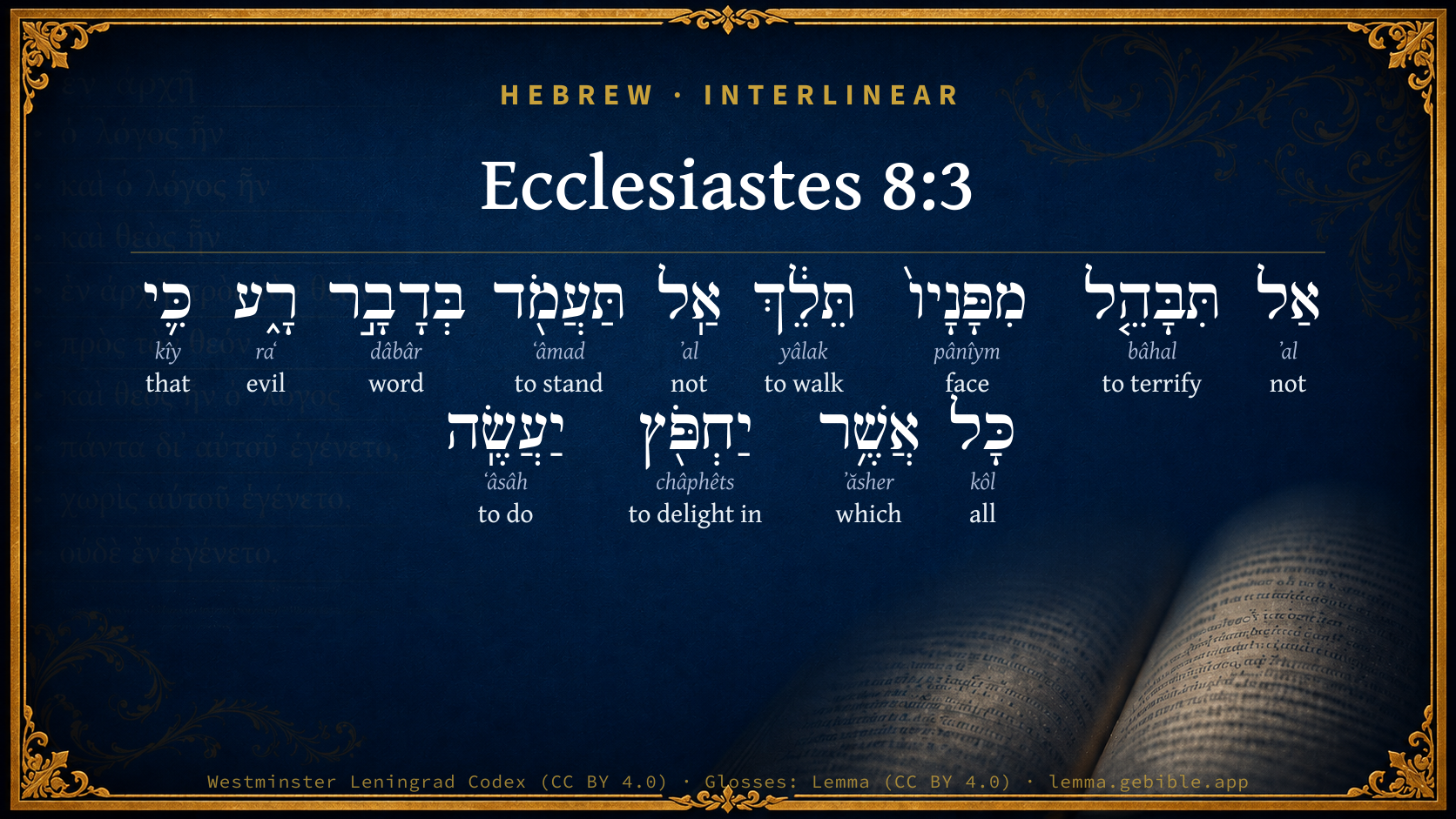
Hebrew (Westminster Leningrad Codex) Ecclesiastes 8:3 appears in the Hebrew Old Testament. The text above is from the Westminster Leningrad Codex. Each word links to its Strong’s number, a concise gloss, and parsing drawn from the Open Scriptures Hebrew Bible morphology. Click any word for its full Brown-Driver-Briggs (BDB) entry.
Download image
Cite this verse

Ecclesiastes 8:3 (World English Bible). Public Domain. Lemma interlinear Bible study tool, https://lemma.gebible.app/v/ecclesiastes/8/3.

Show BibTeX & RIS
BibTeX
RIS
English Translation
Don't be hasty to go out of his presence. Don't persist in an evil thing, for he does whatever pleases him,
World English Bible · Public Domain
Download a study sheet

One document with this verse’s original text, its word-by-word gloss line, the meaning frame, cross-references with their text, attributed commentary, and full source and license credits — printable, and it pastes into notes with its structure intact.

This verse Autodidact and up

Study sheet (.html) Plain text (.txt)

A passage Seminary Student

Up to 50 verses in one chapter. A passage sheet keeps up to 6 commentary sources and 12 cross-references per verse, in the order this page ranks them, and says so on the sheet whenever that leaves anything out. Ask for a single verse and you get the Autodidact verse sheet above.

Everything on this page stays free to read, with no account — the sheet is a download of what is already on screen, not access to it.

Want to remove ads? Support Godless Engineer
Compare translations 3

The same verse in 3 English versions, stacked beneath the original-language interlinear above. Click any original word for its lexicon entry.

Each is an independent rendering of the whole verse — the interlinear is not word-aligned to these translations.

Highlighted words mark where these versions differ — a whole-verse word diff, not a word-by-word alignment.

  • World English Bible Public Domain
    Don't be hasty to go out of his presence. Don't persist in an evil thing, for he does whatever pleases him,
  • King James Version Public Domain
    Be not hasty to go out of his sight: stand not in an evil thing; for he doeth whatsoever pleaseth him.
  • unfoldingWord Literal Text CC BY-SA 4.0
    Do not be terrified from his face. Go! Do not stand in a bad matter, for everything that he pleases, he will do,

unfoldingWord Literal Text — © unfoldingWord, licensed CC BY-SA 4.0. Word-aligned USFM3 via Door43 (git.door43.org/unfoldingWord/en_ult).

Versions to compare (up to 4)

3 of 4 selected

Show all 18 translations

Every available English version of this verse, each an independent rendering of the whole verse.

  • World English Bible Public Domain
    Don't be hasty to go out of his presence. Don't persist in an evil thing, for he does whatever pleases him,
  • Berean Standard Bible Public Domain
    Do not hasten to leave his presence, and do not persist in a bad cause, for he will do whatever he pleases.
  • Majority Standard Bible Public Domain
    Do not hasten to leave his presence, and do not persist in a bad cause, for he will do whatever he pleases.
  • King James Version Public Domain
    Be not hasty to go out of his sight: stand not in an evil thing; for he doeth whatsoever pleaseth him.
  • American Standard Version (1901) Public Domain
    Be not hasty to go out of his presence; persist not in an evil thing: for he doeth whatsoever pleaseth him.
  • Revised Version (1885) Public Domain
    Be not hasty to go out of his presence; persist not in an evil thing: for he doeth whatsoever pleaseth him.
  • Geneva Bible (1599) Public Domain
    Haste not to goe forth of his sight: stand not in an euill thing: for he will doe whatsoeuer pleaseth him.
  • Douay-Rheims (1899) Public Domain
    Be not hasty to depart from his face, and do not continue in an evil work: for he will do all that pleaseth him:
  • Young's Literal Translation Public Domain
    Be not troubled at his presence, thou mayest go, stand not in an evil thing, for all that he pleaseth he doth.
  • Literal Standard Version CC BY-SA 4.0
    Do not be troubled at his presence, you may go, do not stand in an evil thing, for all that he pleases he does.
  • Unlocked Literal Bible CC BY-SA 4.0
    Do not hurry out of his presence, and do not stand in support of something wrong, for the king does whatever he desires.
  • unfoldingWord Literal Text CC BY-SA 4.0
    Do not be terrified from his face. Go! Do not stand in a bad matter, for everything that he pleases, he will do,
  • Darby Bible Public Domain
    Be not hasty to go out of his sight; persist not in an evil thing: for he doeth whatever pleaseth him,
  • World Messianic Bible Public Domain
    Don’t be hasty to go out of his presence. Don’t persist in an evil thing, for he does whatever pleases him,
  • Webster's Bible Public Domain
    Be not hasty to go out of his sight: stand not in an evil thing; for he doeth whatever pleaseth him.
  • Free Bible Version CC BY-SA 4.0
    Don't be quick to walk out on the king without thinking what you're doing, and don't get involved with those who plot against him, for the king can do what he pleases.
  • Bible in Basic English Public Domain
    Be not quick to go from before him. Be not fixed in an evil design, because he does whatever is pleasing to him.
  • JPS Tanakh (1917) Public Domain
    Be not hasty to go out of his presence; stand not in an evil thing; for he doeth whatsoever pleaseth him.

Literal Standard Version (2020), Covenant Press — licensed CC BY-SA 4.0. Text via the HelloAO Bible API (eBible.org). Unlocked Literal Bible (unfoldingWord) — licensed CC BY-SA 4.0. Text via the HelloAO Bible API (eBible.org). unfoldingWord Literal Text — © unfoldingWord, licensed CC BY-SA 4.0. Word-aligned USFM3 via Door43 (git.door43.org/unfoldingWord/en_ult). Free Bible Version, Dr. Jonathan Gallagher — licensed CC BY-SA 4.0. Text via the HelloAO Bible API (eBible.org).

Word by word

More ways to search: Search by grammar → Find every occurrence → Compare this word →

Practice this passage: Drill this verse → Learn its vocabulary →

תִּבָּהֵ֤ל
bâhal
H926
“to terrify”
Verb, Niphal, Jussive, 2nd Person, Masculine, Singular
Part of Speech
Verb
Stem
Niphal
Form
Jussive
Person
2nd Person
Gender
Masculine
Number
Singular
Full BDB Definition

Origin: a primitive root

TWOT: 207

to disturb, alarm, terrify, hurry, be disturbed, be anxious, be afraid, be hurried, be nervous - (Niphal) - to be disturbed, dismayed, terrified, anxious - to be in haste, be hasty - (Piel) - to make haste, act hastily, be hurried, be hastened - to dismay, terrify - (Pual) - to hasten - hastened, hastily gained (participle) - (Hiphil) - to hasten, hurry, make haste - to dismay, terrify
  1. אַל ʼal H408 “not” Particle, Negative
  2. מִפָּנָיו֙ pânîym H6440 “from · face(s) · his” Preposition + Noun, Common, Both, Plural, Construct + Suffix, Personal, 3rd Person, Masculine, Singular
  3. תֵּלֵ֔ךְ yâlak H3212 “to walk” Verb, Qal, Imperfect, 2nd Person, Masculine, Singular
  4. אַֽל ʼal H408 “not” Particle, Negative
  5. תַּעֲמֹ֖ד ʻâmad H5975 “to stand” Verb, Qal, Jussive, 2nd Person, Masculine, Singular
  6. בְּדָבָ֣ר dâbâr H1697 “in/at · word” Preposition + Noun, Common, Masculine, Singular, Absolute
  7. רָ֑ע raʻ H7451 “evil” Adjective, Adjective, Masculine, Singular, Absolute
  8. כִּ֛י kîy H3588 “that” Conjunction
  9. כָּל kôl H3605 “all” Noun, Common, Masculine, Singular, Absolute
  10. אֲשֶׁ֥ר ʼăsher H834 “which” Particle, Relative
  11. יַחְפֹּ֖ץ châphêts H2654 “to delight in” Verb, Qal, Imperfect, 3rd Person, Masculine, Singular
  12. יַעֲשֶֽׂה ʻâsâh H6213 “to do” Verb, Qal, Imperfect, 3rd Person, Masculine, Singular

About this verse

These counts appear in no published source. They are computed here, from the morphology-tagged text and Lemma’s own curated glosses. What Lemma adds →

13
words
12
distinct lemmas
Wisdom
section

Shared distinctive vocabulary

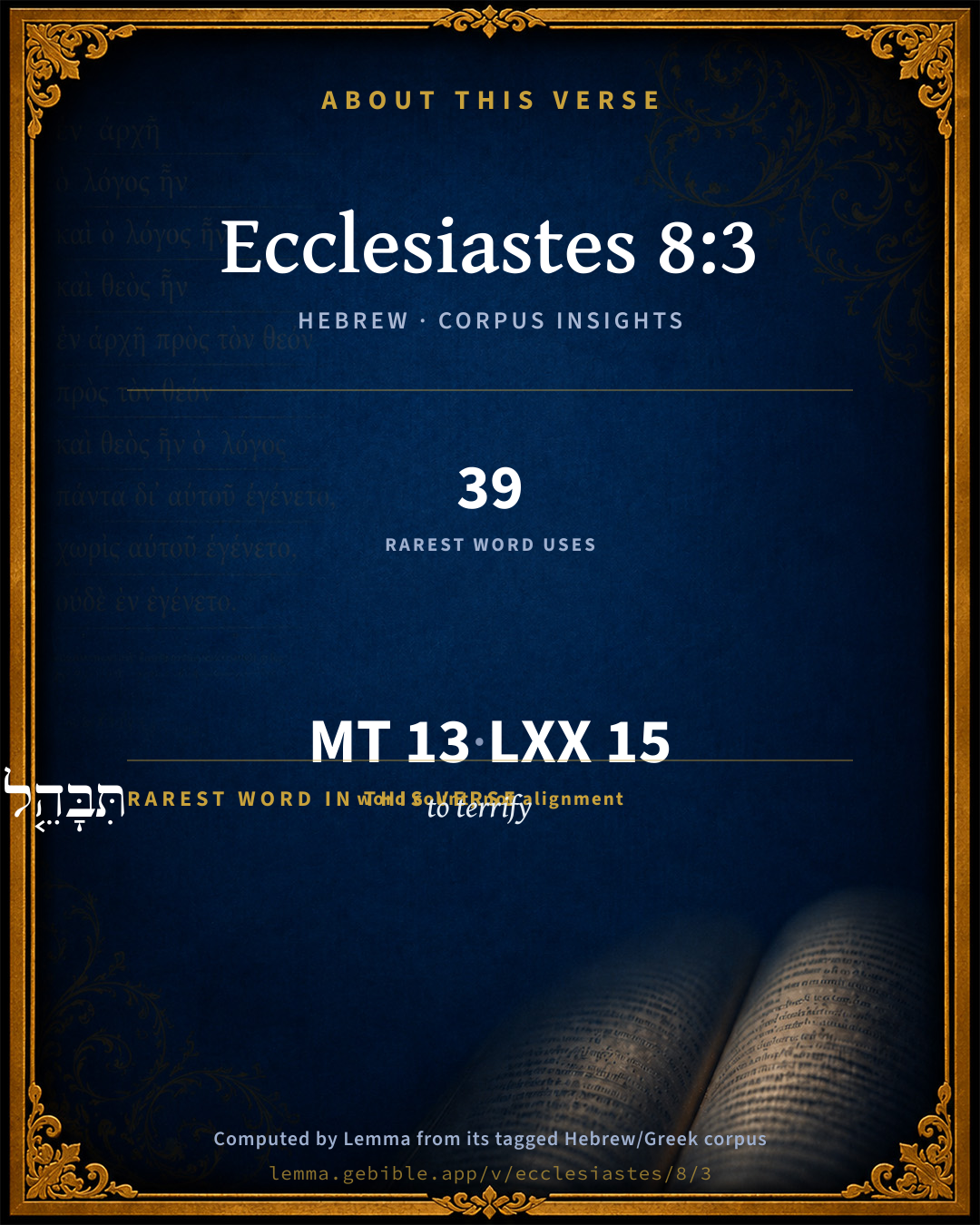
תִּבָּהֵ֤ל to terrify H926 occurs in 39 verses of the Hebrew Bible. Also found in:

Grammatical profile

  • 5 verbs
  • 3 nouns
  • 1 adjective
  • 1 conjunction
  • 3 particles

Verb forms

  • תִּבָּהֵ֤ל Niphal · Jussive
  • תֵּלֵ֔ךְ Qal · Imperfect
  • תַּעֲמֹ֖ד Qal · Jussive
  • יַחְפֹּ֖ץ Qal · Imperfect
  • יַעֲשֶֽׂה Qal · Imperfect

Repetition

A word recurs within this verse — often emphatic in Hebrew:

  • אַל not H408 ×2

Hebrew & Septuagint length

In English translation the verse runs 21 words from the Hebrew and 25 from the Septuagint (LXX English) — closely comparable.

A rough comparison of the two English renderings, which tokenize alike — not a word-level alignment.

Word counts can differ between the Hebrew and the Greek without any difference in meaning — e.g. the Hebrew direct-object marker אֵת has no separate Greek word, and Greek often adds the article ὁ.

In the original languages it is 13 Hebrew tokens and 15 Greek tokens — but the two are counted differently (Hebrew bundles its prefixes and suffixes into one token; the Greek is in lemma form), so that isn’t a like-for-like length.

Cross-references

11

Topical passages linked to Ecclesiastes 8:3 in the Treasury of Scripture Knowledge — connected by theme and wording, ordered by reader-vote popularity; previews shown in the World English Bible.

  • Ecclesiastes 10:4 If the spirit of the ruler rises up against you, don't leave your place; for gentleness lays great offenses to rest.
  • Proverbs 14:29 He who is slow to anger has great understanding, But he who has a quick temper displays folly.
  • Daniel 4:35 All the inhabitants of the earth are reputed as nothing; and he does according to his will in the army of heaven, and among the inhabitants of the earth; and none can stay his hand, or tell him, What do you?
  • Daniel 5:19 and because of the greatness that he gave him, all the peoples, nations, and languages trembled and feared before him: whom he would he killed, and whom he would he kept alive; and whom he would he raised up, and whom he would he put down.
  • Acts 5:8–9 Peter answered her, "Tell me whether you sold the land for so much." She said, "Yes, for so much."
  • 1 Kings 1:50–52 Adonijah feared because of Solomon; and he arose, and went, and caught hold on the horns of the altar.
  • 1 Kings 2:21–24 She said, Let Abishag the Shunammite be given to Adonijah your brother as wife.
  • Proverbs 16:14–15 The king's wrath is a messenger of death, But a wise man will pacify it.
  • Proverbs 30:31 The greyhound, The male goat also; And the king against whom there is no rising up.
  • Isaiah 48:4 Because I knew that you are obstinate, and your neck is an iron sinew, and your brow brass;
  • Jeremiah 44:16–17 As for the word that you have spoken to us in the name of Yahweh, we will not listen to you.

Cross-references courtesy of OpenBible.info (CC BY 4.0).

Hebrew and Greek witnesses Masoretic Hebrew ↔ Greek Septuagint

The same verse in the two great witnesses to the Old Testament, shown verse-for-verse.

These are two independent witnesses, not word-aligned to each other, and the Septuagint is shown in lemma (dictionary) form.

Hebrew Ecclesiastes 8:3 Masoretic · Westminster Leningrad Codex

אַל תִּבָּהֵ֤ל מִפָּנָיו֙ תֵּלֵ֔ךְ אַֽל תַּעֲמֹ֖ד בְּדָבָ֣ר רָ֑ע כִּ֛י כָּל אֲשֶׁ֥ר יַחְפֹּ֖ץ יַעֲשֶֽׂה

Don't be hasty to go out of his presence. Don't persist in an evil thing, for he does whatever pleases him,

World English Bible · Public Domain

Greek LXX Ecclesiastes 8:3 Septuagint · lemma form

ἀπό πρόσωπον αὐτός πορεύομαι μή ἵστημι ἐν λόγος πονηρός ὅτι πᾶς ὅς ἐάν θέλω ποιέω

Be not hasty; you shall go forth out of his presence: stand not in an evil matter; for he will do whatever he shall please,

LXX2012 (modern English Septuagint) · Public Domain

On this verse, The Pulpit Commentary discusses the Septuagint’s reading. Read the note in Commentary ↓

Hebrew: Westminster Leningrad Codex (CC BY 4.0). Greek: Septuagint (public domain); English from LXX2012 (modern English Septuagint) (Public Domain). How the Septuagint differs from the Hebrew →

Commentary

Notes on Ecclesiastes 8:3 from classic Christian and Jewish commentators (each source and its license shown beneath its notes). The classic Christian expositions comment on the surrounding passage and are grouped to its opening verse, so a note may address several verses; the Jewish commentaries on the Tanakh (Rashi and others) are per-verse, so they appear only where the commentator wrote on this verse.

Lemma curates 59 commentaries, every one of them public domain or Creative Commons licensed, each selected and text-cleaned for this edition rather than reprinted as found. About our sources →

Trapp's Complete Commentary

John Trapp

Ecc 8:3 Be not hasty to go out of his sight: stand not in an evil thing; for he doeth whatsoever pleaseth him.

Ver. 3. Be not hasty to go out of his sight.] Turn not thy back discontentedly, fling not away in a chafe; for this will be construed for a contempt, as it was in the Earl of Essex, A.D. 1598. Dissension occuring between the queen and him about a fit man for governor of Ireland, he, forgetting himself, and neglecting his duty, uncivilly turned his back, with a scornful countenance. She waxing impatient, gave him a cuff on the ear, bidding him be gone with a vengeance. He laid his hand upon his sword; the Lord Admiral interposing himself, he swore a great oath, that he neither could nor would swallow so great an indignity, nor would have born it at King Henry VIII’s hands, and in great discontentment hasted from the court. But within a while after he became submissive, and was received again into favour by the queen, who always thought it more just to offend a man than to hate him. {a} The very Turks are said to receive humiliation with all sweetness, but to be remorseless to those that bear up. {b}

{a} Camden’s Elizabeth, fol. 494.

{b} Blunt’s Voyage, p. 97.

John Trapp, A Commentary or Exposition upon All the Books of the Old and New Testament (1647–1656) — public domain. Text from a community e-Sword module.

Tyndale Open Study Notes

Tyndale Open Resources

8:3-4 Plotting against the king is futile because he has great power and can do whatever he wants.

Tyndale Open Study Notes — © Tyndale Open Resources, licensed CC BY-SA 4.0. Text via the HelloAO Bible API.

Geneva Bible (1599)

Geneva Bible translators

Withdraw not thyself lightly from the obedience of thy prince.

Geneva Bible (1599) marginal notes — public domain. Text via Bolls.life.

Jamieson, Fausset & Brown

Robert Jamieson, A. R. Fausset & David Brown

hasty--rather, "Be not terror-struck so as to go out of His sight." Slavishly "terror-struck" is characteristic of the sinner's feeling toward God; he vainly tries to flee out of His sight (Psa 139:7); opposed to the "shining face" of filial confidence (Ecc 8:1; Joh 8:33-36; Rom 8:2; Jo1 4:18).

stand not--persist not.

for he doeth--God inflicts what punishment He pleases on persisting sinners (Job 23:13; Psa 115:3). True of none save God.

Jamieson, Fausset & Brown — Commentary Critical and Explanatory on the Whole Bible (1871) — public domain (CC PDM 1.0). Text via the HelloAO Bible API.

Adam Clarke's Commentary

Verse 3. Be not hasty] I consider the first five verses here as directions to courtiers, and the more immediate servants of kings.

Be steadily faithful to your sovereign. Do not stand in an evil thing. If you have done wrong, do not endeavour to vindicate yourself before him; it is of no use; his power is absolute, and he will do what he pleases. He will take his own view of the subject, and he will retain it. The language of a despotic sovereign was ever this, Sic volo sic jubeo, stat pro ratione voluntas; "I will this. I command that. No hesitation! My will is law!" Therefore it is added here, Where the word of a king is, there is power-influence, authority, and the sword. And who may say unto him, whether he acts right or wrong, What doest thou? Ec 8:4. No wonder in such governments there are so many revolutions; but they are revolutions without amendment, as it is one tyrant rising up to destroy another, who, when seated in authority, acts in the way of his predecessor; till another, like himself, do to him as he has done to the former. In our country, after a long trial, we find that a mixed monarchy is the safest, best, and most useful form of government: we have had, it is true, unprincipled ministers, who wished to turn our limited into an absolute monarchy; and they were always ready to state that an absolute monarchy was best. Granted; provided the monarch be as wise, as holy, and as powerful as GOD!

Adam Clarke's Commentary on the Bible (1810–1826) — public domain. Text from a community e-Sword/MySword module.

Ellicott's Commentary for English Readers

(3) I believe the rendering of our version to be correct, though some have taken it, “Be not hasty: go out of his eight.” The best commentary on this verse is Ecc_10:4, which gives the meaning, “When censured by the king, do not abandon the hope of retaining his favour, nor obstinately persist in what he condemns.” I do not find adequate proof of the assertion of some commentators, that “go out of his sight” can mean “withdraw allegiance from him,” and so that the “evil thing” means a rebellious conspiracy. The advice, “Be not hasty” to rebel, instead of “do not rebel,” is inconsistent with the context.

A Bible Commentary for English Readers, edited by Charles John Ellicott (1878–1897) — public domain. Text from a community e-Sword module.

The Cambridge Bible for Schools and Colleges

gen. ed. J. J. S. Perowne

3. Be not hasty to go out of his sight] The phrase is explained by Gen_4:16; Hos_11:2 as implying flight or desertion. Such a flight the Teacher looks on as an act of impatient unwisdom. It is better to bear the yoke, than to seek an unattainable independence. So those who have grown grey in politics warn younger and more impetuous men against the folly of a premature resignation of their office.

stand not in an evil thing] The Hebrew noun (as so often elsewhere) may mean either “word” or “thing:” the verb may mean “standing” either in the attitude (1) of persistence, or (2) protest, or (3) of hesitation, or (4) of obedient compliance. Hence we get as possible renderings, (1) “Persist not in an evil thing;” i.e. in conspiracies against the king’s life or power. (2) Protest not against an evil (i.e. angry) word. (3) Stand not, hesitate not, at an evil thing, i.e. comply with the king’s commands however unrighteous. (4) Obey not in an evil thing, i.e. obey, but let the higher law of conscience limit thy obedience. Of these (1) seems most in harmony with the context, and with O. T. usage as in Psa_1:1. Perhaps, however, after the manner of an enigmatic oracle, not without a touch of irony, requiring the discernment of a wise interpreter, there is an intentional ambiguity, allowing the reader if he likes, to adopt (3) or (4) and so acting as a test of character.

he doeth whatsoever pleaseth him] The words paint a sovereignty such as Greek poets loved to hold up for men’s abhorence,

ἀλλʼ ἡ τυραννὶς πολλά τʼ ἄλλʼ ἐυδαιμονεῖ,

κἄξεστιν αὐτῇ δρᾶν λέγειν δʼ ἂ βούλεται.

“The tyrant’s might in much besides excels,

And it may do and say whate’er it wills.”

Soph. Antig. 507.

Here also we have an echo of the prudential counsel of Epicurus, who deliberately preferred a despotic to a democratic government (Sen. Ep. xxix. 10), and laid it down as a rule, that the wise man should at every opportune season court the favour of the monarch (καὶ μόναρχον ἐν καιρῷ θεραπεύσει), Diog. Laert. x. 1, § 121.

The Cambridge Bible for Schools and Colleges (gen. ed. J. J. S. Perowne; Cambridge University Press, 1878–1918) — public domain. Text from a community e-Sword module.

John Gill's Exposition

Be not hasty to go out of his sight,.... But of the sight of the King of kings. Do not think to hide thyself from him, for there is no fleeing from his presence, Psa 139:7; it is best, when under some consternation, as the word (y) signifies, or under some fearful apprehension of his wrath and indignation, to fall down before him, acknowledge the offence, and pray for pardon: and to this purpose is the Targum,

"and in the time of the indignation of the Lord, do not cease to pray before him; being terrified (or troubled) before him, go and pray, and seek mercy of him;''

and with which agrees the note of Jarchi,

"be not troubled, saying that thou wilt go and free from his presence, to a place where he does not rule, for he rules in every place.''

Such who interpret this of an earthly king suppose this forbids a man going out from the presence of a king in a pet and passion, withdrawing himself from his court and service in a heat, at once;

stand not in an evil thing; having done it, continue not in it; but repent of it, acknowledge and forsake it, whether against God or an earthly king;

for he doeth whatsoever pleaseth him; which best agrees with the King of kings, who does what he pleases, in heaven above and in earth below, both in nature, providence, and grace; see Job 23:13; though earthly kings indeed have long hands, as is usually said, and can reach a great way, and do great things, especially despotic and arbitrary princes, and it is very difficult escaping their hands. The Targum is,

"for the Lord of all worlds, the Lord will do what he pleases.''

(y) "ne consterneris", Gejerus, and some in Rambachius.

John Gill's Exposition of the Whole Bible (1746–1763) — public domain (CC PDM 1.0). Text via the HelloAO Bible API.

Albert Barnes' Notes on the Bible

Stand not ... - i. e., “Do not persist in rebellion.”

Albert Barnes' Notes on the Bible (1834–1885) — public domain. Text from a community e-Sword/MySword module.

Haydock's Catholic Bible Commentary

Face. This courtiers observe, while many Christians neglect God. --- Work. Defend not what has been said or done amiss.

George Leo Haydock (1774–1849), Haydock's Catholic Family Bible and Commentary, 1859 edition — public domain. Excludes Psalms (Douay-Rheims chapter numbering differs from Protestant) and Deuterocanonical books (Catholic canon only).

Matthew Poole's English Annotations

To go out of his sight, Heb. to go from his face or presence, to wit, in dislike, or in discontent, withdrawing thyself from thy king’s service or obedience, as malcontents use to do; for this will both provoke him, and lead thee by degrees into sedition or rebellion.

Stand not in an evil thing; if thou hast offended him, persist not in it, but humbly acknowledge thine offence, and beg his pardon and favour.

He doeth whatsoever pleaseth him; his power is uncontrollable in his dominions, and therefore thou canst neither resist nor avoid his fury.

Matthew Poole's English Annotations on the Holy Bible (1683–1685) — public domain. Text from a community e-Sword/MySword module.

Whedon's Commentary on the Bible

Daniel D. Whedon

3. Be not hasty, etc. — But if the king be harsh and tyrannical? Then do not hasten to leave his service.

Stand not in an evil thing — Hebrew, Rise not up for an evil word from him. Revolt is too grave a matter to be rashly undertaken, for power to do as he pleases is part of the definition of kingly power.

Daniel D. Whedon (gen. ed.), Commentary on the Old and New Testaments (1874–1909) — public domain. Text from a community e-Sword module.

The Pulpit Commentary

Further advice concerning political behavior. Be not hasty to go out of his (the king"s) sight. Do not, from some hasty impulse, or induced by harsh treatment, cast off your allegiance to your liege lord. We have the phrase, "go away," in the sense of quitting of service or desertion of a duty, in Gen_4:16; Hos_11:2. So St. Peter urges servants to be subject unto their masters, "not only to the good and gentle, but also to the froward". (1Pe_2:18) Solomon might have given this advice to the Israelites who were ready to follow Jeroboam"s lead; though they could have remained loyal to Rehoboam only from high religious motives. But it is better to bear even a heavy yoke than to rebel. The Septuagint has, "Be not hasty; thou shalt go from his presence which seems to mean, "Be not impatient, and all will be well." But the authorized rendering is correct. (comp. Ecc_10:4) We may quote Mendelssohn"s comment cited by Chance on Job_34:16, "This is a great rule in politics, that the people must have no power to pronounce judgment upon the conduct of a king, whether it be good or bad; for the king judges the people, and not the reverse; and if it were not for this rule, the country would never be quiet, and without rebels against the king and his law." Stand not in an evil thing; Vulgate, Neque permaneas in opere malo, "Persist not in an evil affair." But the verb here implies rather the engaging in a matter than continuing an undertaking already begun. The "affair" is conspiracy, insurrection; and Koheleth warns against entering upon and taking part in any such attempt. This seems to be the correct explanation of the clause; but it is, perhaps intentionally, ambiguous, and is capable of other interpretations. Thus Ginsburg, "Do not stand up (in a passion) because of an evil word." Others, "Obey not a sinful command," or "Hesitate not at an evil thing," i.e. if the king orders it. Wordsworth, referring togw, Psa_1:1. renders, "Stand not in the way of sinners," which seems to be unsuitable to the context. The Septuagint gives, "Stand not in an evil word" (lo perhaps "matter"). The reason for the injunction follows. For he doeth whatsoever pleaseth him. The irresponsible power of a despotic monarch is here signified, though the terms are applicable (as some, indeed, take them as alone appertaining) to God himself. (but see Pro_20:2) The Septuagint combines with this clause the commencement of the following verse, "For he will do whatsover he pleases, even as a king using authority (ejxousiazwn)." Some manuscripts add lalei, "he speaks."

The Pulpit Commentary (1880–1919), ed. H.D.M. Spence-Jones & Joseph S. Exell — public domain. Text from a community e-Sword module.

John Wesley's Explanatory Notes

To go - In discontent, withdrawing thyself from the king's service or obedience. Stand not - if thou hast offended him, persist not in it. For - His power is uncontrollable.

John Wesley, Explanatory Notes Upon the Whole Bible (1754–1765) — public domain. Text via the GEBible commentary corpus.

Keil & Delitzsch

C. F. Keil & F. Delitzsch

"Who is like the wise? and who understandeth the interpretation of things? The wisdom of a man maketh his face bright, and the rudeness of his face is changed." Unlike this saying: "Who is like the wise?" are the formulas חכם מי, Hos 14:9, Jer 11:11, Psa 107:43, which are compared by Hitzig and others. "Who is like the wise?" means: Who is equal to him? and this question, after the scheme מי־כמכה, Exo 15:11, presents him as one who has not his like among men. Instead of כּה the word כּחכם might be used, after לחכם, Ecc 2:16, etc. The syncope is, as at Eze 40:25, omitted, which frequently occurs, particularly in the more modern books, Eze 47:22; Ch2 10:7; Ch2 25:10; Ch2 29:27; Neh 9:19; Neh 12:38. The regular giving of Dagesh to כ after מי, with Jethib, not Mahpach, is as at Ecc 8:7 after כּי; Jethib is a disjunctive. The second question is not כּיודע, but יודע וּמי, and thus does not mean: who is like the man of understanding, but: who understands, viz., as the wise man does; thus it characterizes the incomparably excellent as such. Many interpreters (Oetinger, Ewald, Hitz., Heiligst., Burg., Elst., Zckl.) persuade themselves that דּבר פּשׁר is meant of the understanding of the proverb, 8b. The absence of the art., says Hitzig, does not mislead us: of a proverb, viz., the following; but in this manner determinate ideas may be made from all indeterminate ones. Rightly, Gesenius: explicationem ullius rei; better, as at Ecc 7:8 : cujusvis rei. Ginsburg compares נבון דּבר, Sa1 16:18, which, however, does not mean him who has the knowledge of things, but who is well acquainted with words. It is true that here also the chief idea פּשׁר first leads to the meaning verbum (according to which the lxx, Jer., the Targ., and Syr. translate; the Venet.: ἑρμηνείαν λόγου); but since the unfolding or explaining (pēshěr) refers to the actual contents of the thing spoken, verbi and rei coincide. The wise man knows how to explain difficult things, to unfold mysterious things; in short, he understands how to go to the foundation of things.

Keil & Delitzsch — Biblical Commentary on the Old Testament (1861–1891) — public domain (CC PDM 1.0). Text via the HelloAO Bible API. (Old Testament only.)

Rashi

Rabbi Shlomo Yitzchaki (Rashi)

Hasten not to go away from before Him Do not hasten, saying that you will go and flee from before Him to a place where He does not rule, for He rules everywhere.

stay not in an evil thing Do not persist in engaging in evil things.

for all that He wishes to mete retribution upon you, He has the authority and ability to do so.

Rashi on the Tanakh — English translations: “The Judaica Press complete Tanach with Rashi, translated by A. J. Rosenberg” (CC BY 4.0); “Pentateuch with Rashi's commentary by M. Rosenbaum and A.M. Silbermann, 1929-1934” (public domain); “The Metsudah Tanach series, Lakewood, N.J” (CC BY 4.0); and “The Book of Joshua, Metsudah Publications, 1997” (CC BY 4.0). Text via Sefaria.

Lesson kit

Teaching starters — assembled from the data on this page, not authored interpretation. Every prompt links to the verse data it draws on. Edit before teaching.

Ecclesiastes, in the Wisdom, opens this verse with 13 words (12 distinct Hebrew lemmas). Its most distinctive word is bâhal (“to terrify”). A historical commentator’s framing appears above. Read the whole chapter for the surrounding context.

Discussion questions

  1. How does “to terrify” (bâhal) shape what this verse is saying?
  2. How does Genesis 45:3, which shares the word «to terrify», read alongside this verse?
  3. What does the repetition of “not” (2× in this one verse) do in this verse?
  4. These translations render this verse differently; the difference is in the English rendering, not the original. What questions does that raise?
  5. «תִּבָּהֵ֤ל» is a Niphal Jussive verb. How does that grammatical form shape the action described?
  6. Compare how Trapp's Complete Commentary and Tyndale Open Study Notes read this verse. Where do they agree or differ?

Things to notice

Reading settings

Reading text

Shown beneath each verse's original-language words.

Old Testament
Old Testament edition

Read the OT as the Masoretic Hebrew (MT) or the Greek Septuagint (LXX).

English shown for the Greek Septuagint (in the Hebrew ↔ Greek comparison).

Comparing translations? Open the Compare panel on any verse page to stack up to four side by side.