
Joshua 10:19

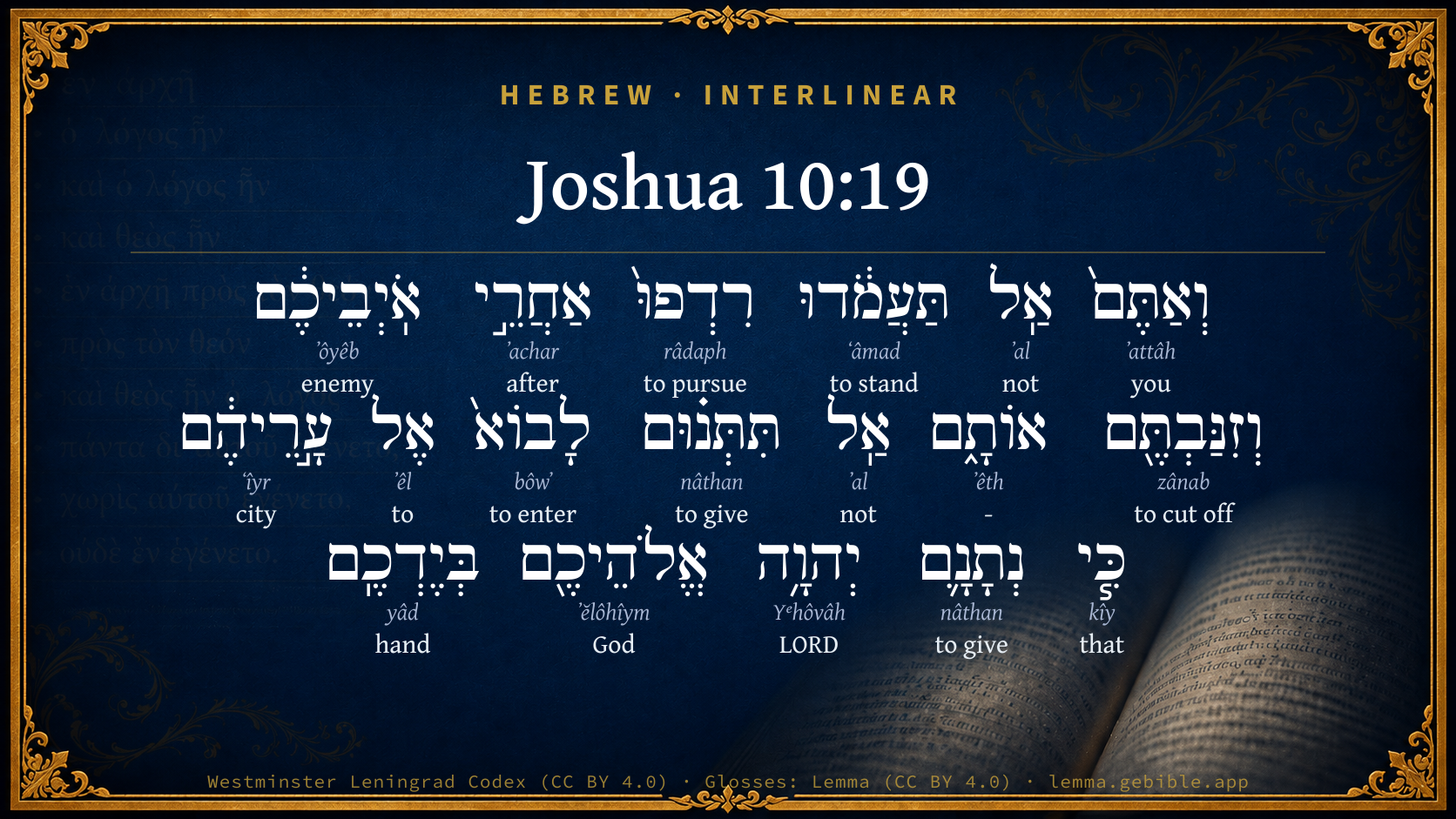
Hebrew (Westminster Leningrad Codex) Joshua 10:19 appears in the Hebrew Old Testament. The text above is from the Westminster Leningrad Codex. Each word links to its Strong’s number, a concise gloss, and parsing drawn from the Open Scriptures Hebrew Bible morphology. Click any word for its full Brown-Driver-Briggs (BDB) entry.
Download image
Cite this verse

Joshua 10:19 (World English Bible). Public Domain. Lemma interlinear Bible study tool, https://lemma.gebible.app/v/joshua/10/19.

Show BibTeX & RIS
BibTeX
RIS
English Translation
but don't stay; pursue after your enemies, and strike the hindmost of them; don't allow them to enter into their cities: for Yahweh your God has delivered them into your hand.
World English Bible · Public Domain
Download a study sheet

One document with this verse’s original text, its word-by-word gloss line, the meaning frame, cross-references with their text, attributed commentary, and full source and license credits — printable, and it pastes into notes with its structure intact.

This verse Autodidact and up

Study sheet (.html) Plain text (.txt)

A passage Seminary Student

Up to 50 verses in one chapter. A passage sheet keeps up to 6 commentary sources and 12 cross-references per verse, in the order this page ranks them, and says so on the sheet whenever that leaves anything out. Ask for a single verse and you get the Autodidact verse sheet above.

Everything on this page stays free to read, with no account — the sheet is a download of what is already on screen, not access to it.

Want to remove ads? Support Godless Engineer
Compare translations 3

The same verse in 3 English versions, stacked beneath the original-language interlinear above. Click any original word for its lexicon entry.

Each is an independent rendering of the whole verse — the interlinear is not word-aligned to these translations.

Highlighted words mark where these versions differ — a whole-verse word diff, not a word-by-word alignment.

  • World English Bible Public Domain
    but don't stay; pursue after your enemies, and strike the hindmost of them; don't allow them to enter into their cities: for Yahweh your God has delivered them into your hand.
  • King James Version Public Domain
    And stay ye not, but pursue after your enemies, and smite the hindmost of them; suffer them not to enter into their cities: for the LORD your God hath delivered them into your hand.
  • unfoldingWord Literal Text CC BY-SA 4.0
    But you, do not stand! Pursue after your enemies and attack their rear. Do not let them enter into their cities, because Yahweh your God has given them into your hand.

unfoldingWord Literal Text — © unfoldingWord, licensed CC BY-SA 4.0. Word-aligned USFM3 via Door43 (git.door43.org/unfoldingWord/en_ult).

Versions to compare (up to 4)

3 of 4 selected

Show all 18 translations

Every available English version of this verse, each an independent rendering of the whole verse.

  • World English Bible Public Domain
    but don't stay; pursue after your enemies, and strike the hindmost of them; don't allow them to enter into their cities: for Yahweh your God has delivered them into your hand.
  • Berean Standard Bible Public Domain
    But you, do not stop there. Pursue your enemies and attack them from behind. Do not let them reach their cities, for the LORD your God has delivered them into your hand.”
  • Majority Standard Bible Public Domain
    But you, do not stop there. Pursue your enemies and attack them from behind. Do not let them reach their cities, for the LORD your God has delivered them into your hand.”
  • King James Version Public Domain
    And stay ye not, but pursue after your enemies, and smite the hindmost of them; suffer them not to enter into their cities: for the LORD your God hath delivered them into your hand.
  • American Standard Version (1901) Public Domain
    but stay not ye; pursue after your enemies, and smite the hindmost of them; suffer them not to enter into their cities: for Jehovah your God hath delivered them into your hand.
  • Revised Version (1885) Public Domain
    but stay not ye; pursue after your enemies, and smite the hindmost of them; suffer them not to enter into their cities: for the LORD your God hath delivered them into your hand.
  • Geneva Bible (1599) Public Domain
    But stand ye not still: follow after your enemies, and smite all the hindmost, suffer them not to enter into their cities: for the Lord your God hath giuen them into your hand.
  • Douay-Rheims (1899) Public Domain
    And stay you not, but pursue after the enemies, and kill all the hindermost of them as they flee, and do not suffer them whom the Lord God hath delivered into your hands to shelter themselves in their cities.
  • Young's Literal Translation Public Domain
    and ye, stand not, pursue after your enemies, and ye have smitten the hindmost of them; suffer them not to go in unto their cities, for Jehovah your God hath given them into your hand.'
  • Literal Standard Version CC BY-SA 4.0
    and you, do not stand, pursue after your enemies, and you have struck them from the rear; do not permit them to go into their cities, for your God YHWH has given them into your hand.”
  • Unlocked Literal Bible CC BY-SA 4.0
    Do not stay yourselves. Pursue your enemies and attack them from the rear. Do not permit them to enter into their cities, because Yahweh your God has given them into your hand.”
  • unfoldingWord Literal Text CC BY-SA 4.0
    But you, do not stand! Pursue after your enemies and attack their rear. Do not let them enter into their cities, because Yahweh your God has given them into your hand.
  • Darby Bible Public Domain
    And ye, stay not, pursue after your enemies, and smite the hindmost of them; suffer them not to enter into their cities; for Jehovah your God has given them into your hand.
  • World Messianic Bible Public Domain
    but don’t stay there. Pursue your enemies, and attack them from the rear. Don’t allow them to enter into their cities; for the LORD your God has delivered them into your hand.”
  • Webster's Bible Public Domain
    And stay you not, but pursue your enemies, and smite the hindmost of them; suffer them not to enter into their cities: for the LORD your God hath delivered them into your hand.
  • Free Bible Version CC BY-SA 4.0
    But don't you stay there. Chase the enemy down and attack them from the rear. Don't let them escape to their towns for the Lord has given them to you to defeat.”
  • Bible in Basic English Public Domain
    But do you, without waiting, go after their army, attacking them from the back; do not let them get into their towns, for the Lord your God has given them into your hands.
  • JPS Tanakh (1917) Public Domain
    but stay not ye; pursue after your enemies, and smite the hindmost of them; suffer them not to enter into their cities; for the LORD your God hath delivered them into your hand.'

Literal Standard Version (2020), Covenant Press — licensed CC BY-SA 4.0. Text via the HelloAO Bible API (eBible.org). Unlocked Literal Bible (unfoldingWord) — licensed CC BY-SA 4.0. Text via the HelloAO Bible API (eBible.org). unfoldingWord Literal Text — © unfoldingWord, licensed CC BY-SA 4.0. Word-aligned USFM3 via Door43 (git.door43.org/unfoldingWord/en_ult). Free Bible Version, Dr. Jonathan Gallagher — licensed CC BY-SA 4.0. Text via the HelloAO Bible API (eBible.org).

Word by word

More ways to search: Search by grammar → Find every occurrence → Compare this word →

Practice this passage: Drill this verse → Learn its vocabulary →

וְזִנַּבְתֶּ֖ם
zânab
H2179
“and · to cut off”
Conjunction + Verb, Piel, Sequential Perfect, 2nd Person, Masculine, Plural
Part of Speech
Conjunction + Verb
Stem
Piel
Form
Sequential Perfect
Person
2nd Person
Gender
Masculine
Number
Plural
Full BDB Definition

Origin: a primitive root meaning to wag; used only as a denominative from H2180

TWOT: 562

to cut off - (Piel) to attack the rear, smite the tail
  1. וְאַתֶּם֙ ʼattâh H859 “and · you” Conjunction + Pronoun, Personal, 2nd Person, Masculine, Plural
  2. אַֽל ʼal H408 “not” Particle, Negative
  3. תַּעֲמֹ֔דוּ ʻâmad H5975 “to stand” Verb, Qal, Jussive, 2nd Person, Masculine, Plural
  4. רִדְפוּ֙ râdaph H7291 “pursue” Verb, Qal, Imperative, 2nd Person, Masculine, Plural
  5. אַחֲרֵ֣י ʼachar H310 “after” Preposition
  6. אֹֽיְבֵיכֶ֔ם ʼôyêb H341 “enemy · you” Verb, Qal, Participle Active, Masculine, Plural, Construct + Suffix, Personal, 2nd Person, Masculine, Plural
  7. אוֹתָ֑ם ʼêth H853 “- · them” Particle, Direct Object + Suffix, Personal, 3rd Person, Masculine, Plural
  8. אַֽל ʼal H408 “not” Particle, Negative
  9. תִּתְּנ֗וּם nâthan H5414 “to give · them” Verb, Qal, Jussive, 2nd Person, Masculine, Plural + Suffix, Personal, 3rd Person, Masculine, Plural
  10. לָבוֹא֙ bôwʼ H935 “to enter” Preposition + Verb, Qal, Infinitive Construct
  11. אֶל ʼêl H413 “to” Preposition
  12. עָ֣רֵיהֶ֔ם ʻîyr H5892 “cities · their” Noun, Common, Feminine, Plural, Construct + Suffix, Personal, 3rd Person, Masculine, Plural
  13. כִּ֧י kîy H3588 “that” Conjunction
  14. נְתָנָ֛ם nâthan H5414 “to give · them” Verb, Qal, Perfect, 3rd Person, Masculine, Singular + Suffix, Personal, 3rd Person, Masculine, Plural
  15. יְהוָ֥ה Yᵉhôvâh H3068 “LORD” Noun, Proper
  16. אֱלֹהֵיכֶ֖ם ʼĕlôhîym H430 “God(s) · your” Noun, Common, Masculine, Plural, Construct + Suffix, Personal, 2nd Person, Masculine, Plural
  17. בְּיֶדְכֶֽם yâd H3027 “in/at · hand · your” Preposition + Noun, Common, Both, Singular, Construct + Suffix, Personal, 2nd Person, Masculine, Plural

About this verse

These counts appear in no published source. They are computed here, from the morphology-tagged text and Lemma’s own curated glosses. What Lemma adds →

18
words
16
distinct lemmas
Historical
section

Notable vocabulary

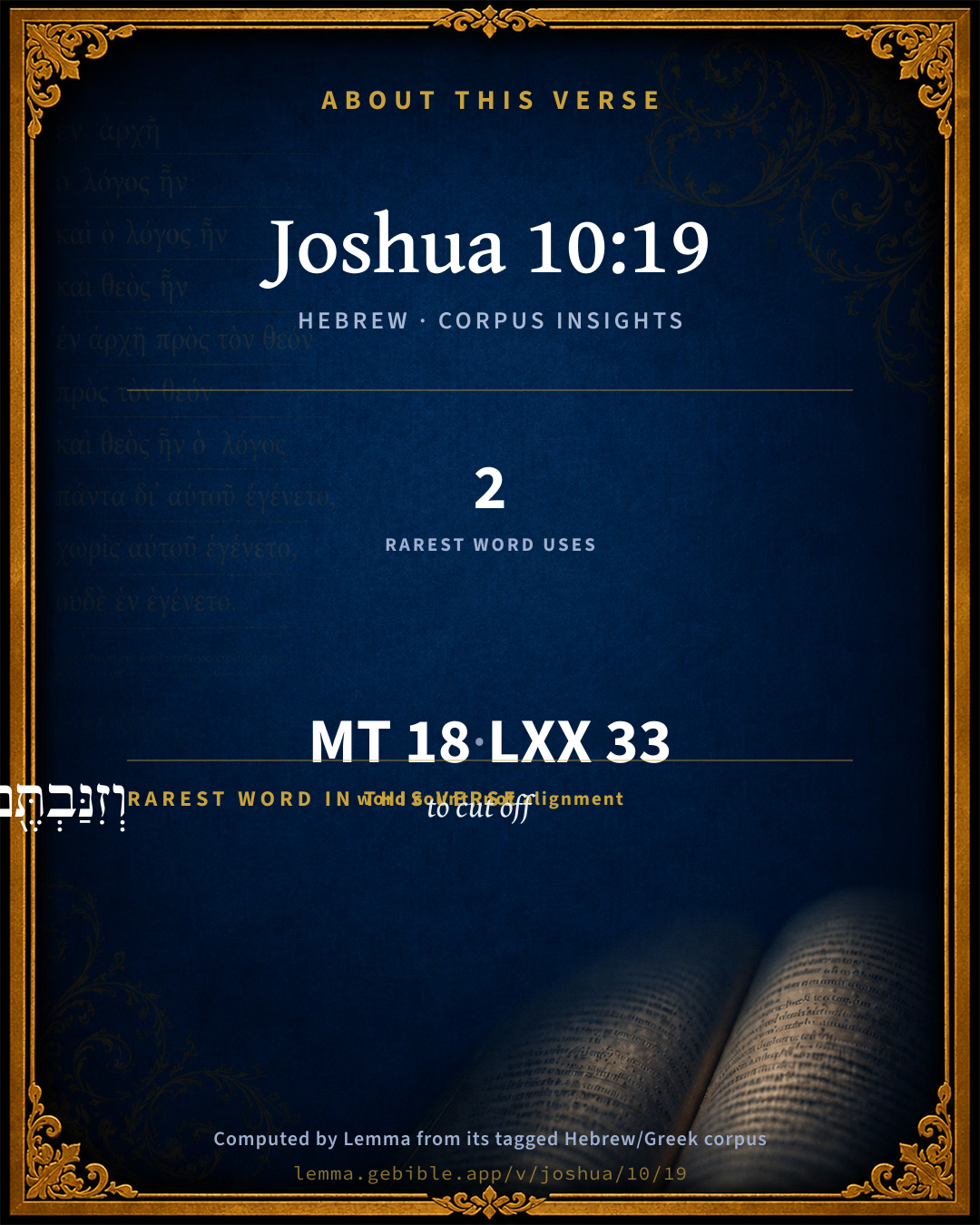
The rarest word here is וְזִנַּבְתֶּ֖ם to cut off H2179 — appearing just 2 times in the whole Hebrew Bible.

Shared distinctive vocabulary

וְזִנַּבְתֶּ֖ם to cut off H2179 occurs in 2 verses of the Hebrew Bible. Also found in:

Grammatical profile

  • 7 verbs
  • 4 nouns
  • 1 pronoun
  • 2 prepositions
  • 1 conjunction
  • 3 particles

Verb forms

  • תַּעֲמֹ֔דוּ Qal · Jussive
  • רִדְפוּ֙ Qal · Imperative
  • אֹֽיְבֵיכֶ֔ם Qal · Participle Active
  • וְזִנַּבְתֶּ֖ם Piel · Sequential Perfect
  • תִּתְּנ֗וּם Qal · Jussive
  • לָבוֹא֙ Qal · Infinitive Construct
  • נְתָנָ֛ם Qal · Perfect

Repetition

Words recur within this verse — often emphatic in Hebrew:

  • תִּתְּנ֗וּם to give H5414 ×2
  • אַֽל not H408 ×2

Hebrew & Septuagint length

In English translation the verse runs 31 words from the Hebrew and 37 from the Septuagint (LXX English) — closely comparable.

A rough comparison of the two English renderings, which tokenize alike — not a word-level alignment.

Word counts can differ between the Hebrew and the Greek without any difference in meaning — e.g. the Hebrew direct-object marker אֵת has no separate Greek word, and Greek often adds the article ὁ.

In the original languages it is 18 Hebrew tokens and 33 Greek tokens — but the two are counted differently (Hebrew bundles its prefixes and suffixes into one token; the Greek is in lemma form), so that isn’t a like-for-like length.

Cross-references

7

Topical passages linked to Joshua 10:19 in the Treasury of Scripture Knowledge — connected by theme and wording, ordered by reader-vote popularity; previews shown in the World English Bible.

  • Psalms 18:37–41 I will pursue my enemies, and overtake them. Neither will I turn again until they are consumed.
  • Joshua 10:20 It happened, when Joshua and the children of Israel had made an end of killing them with a very great slaughter, until they were consumed, and the remnant which remained of them had entered into the fortified cities,
  • 2 Samuel 17:13 Moreover, if he be gotten into a city, then shall all Israel bring ropes to that city, and we will draw it into the river, until there not be one small stone found there.
  • 2 Samuel 20:6 David said to Abishai, Now will Sheba the son of Bichri do us more harm than did Absalom: take your lord's servants, and pursue after him, lest he get him fortified cities, and escape out of our sight.
  • Isaiah 9:14–15 Therefore Yahweh will cut off from Israel head and tail, palm-branch and rush, in one day.
  • Jeremiah 8:14 Why do we sit still? assemble yourselves, and let us enter into the fortified cities, and let us be silent there; for Yahweh our God has put us to silence, and given us water of gall to drink, because we have sinned against Yahweh.
  • Jeremiah 48:10 Cursed be he who does the work of Yahweh negligently; and cursed be he who keeps back his sword from blood.

Cross-references courtesy of OpenBible.info (CC BY 4.0).

Hebrew and Greek witnesses Masoretic Hebrew ↔ Greek Septuagint

The same verse in the two great witnesses to the Old Testament, shown verse-for-verse.

These are two independent witnesses, not word-aligned to each other, and the Septuagint is shown in lemma (dictionary) form.

Hebrew Joshua 10:19 Masoretic · Westminster Leningrad Codex

וְאַתֶּם֙ אַֽל תַּעֲמֹ֔דוּ רִדְפוּ֙ אַחֲרֵ֣י אֹֽיְבֵיכֶ֔ם וְזִנַּבְתֶּ֖ם אוֹתָ֑ם אַֽל תִּתְּנ֗וּם לָבוֹא֙ אֶל עָ֣רֵיהֶ֔ם כִּ֧י נְתָנָ֛ם יְהוָ֥ה אֱלֹהֵיכֶ֖ם בְּיֶדְכֶֽם

but don't stay; pursue after your enemies, and strike the hindmost of them; don't allow them to enter into their cities: for Yahweh your God has delivered them into your hand.

World English Bible · Public Domain

Greek LXX Joshua 10:19 Septuagint · lemma form

σύ δέ μή ἵστημι καταδιώκω ὀπίσω ὁ ἐχθρός σύ καί καταλαμβάνω ὁ οὐραγία αὐτός καί μή ἀποἵημι εἰςἔρχομαι εἰς ὁ πόλις αὐτός παραδίδωμι γάρ αὐτός κύριος ὁ θεός ἐγώ εἰς ὁ χείρ ἐγώ

But do not you⌃ stand, but pursue after your enemies, and attack the rear of them, and do not suffer them to enter into their cities; for the Lord our God has delivered them into our hands.

LXX2012 (modern English Septuagint) · Public Domain

On this verse, The Pulpit Commentary discusses the Septuagint’s reading. Read the note in Commentary ↓

Hebrew: Westminster Leningrad Codex (CC BY 4.0). Greek: Septuagint (public domain); English from LXX2012 (modern English Septuagint) (Public Domain). How the Septuagint differs from the Hebrew →

Targum (Aramaic paraphrase)

1

The Targum is the ancient Jewish Aramaic paraphrase of the Hebrew Scriptures — an interpretive translation, not the Hebrew text itself. Onkelos (literal) and Pseudo-Jonathan (expansive) render the Torah, and Jonathan the Prophets. Coverage is partial: where no permissively-licensed English translation exists for a verse, only the Aramaic is shown. This is verse-level text, not a word-by-word alignment to the Hebrew.

  1. Targum Jonathan Prophets (Joshua–Malachi)
    וְאַתּוּן לָא תְקוּמוּן רְדוּפוּ בָּתַר בַּעֲלֵי דְבָבֵיכוֹן וְתִדְבְּקוּן יַתְהוֹן לָא תִשְׁבְּקוּנוּן לְמֵיעַל לְקִרְוֵיהוֹן אֲרֵי מְסָרִינוּן יְיָ אֱלָהָכוֹן בִּידֵיכוֹן:

    (no public-domain English translation for this verse)

    Targum Jonathan — Aramaic: “Mikraot Gedolot” (public domain). English: “Sefaria Community Translation” (CC0 1.0 (public-domain dedication)); “London "Chaldee Paraphrase," 1871” (public domain). Text via Sefaria.

Commentary

Notes on Joshua 10:19 from classic Christian and Jewish commentators (each source and its license shown beneath its notes). The classic Christian expositions comment on the surrounding passage and are grouped to its opening verse, so a note may address several verses; the Jewish commentaries on the Tanakh (Rashi and others) are per-verse, so they appear only where the commentator wrote on this verse.

Lemma curates 59 commentaries, every one of them public domain or Creative Commons licensed, each selected and text-cleaned for this edition rather than reprinted as found. About our sources →

Trapp's Complete Commentary

John Trapp

Jos 10:19 And stay ye not, [but] pursue after your enemies, and smite the hindmost of them; suffer them not to enter into their cities: for the LORD your God hath delivered them into your hand.

Ver. 19. Smote the hindmost of them.] Heb., Caudate eos, cut off the tail, fall upon the rear.

John Trapp, A Commentary or Exposition upon All the Books of the Old and New Testament (1647–1656) — public domain. Text from a community e-Sword module.

Joseph Benson's Commentary

Jos 10:19. Suffer them not to enter their cities — Whereby they would have recovered their strength, and renewed the war. God hath delivered them — Your work will be easy; God hath already done the work to your hands.

Joseph Benson's Commentary on the Old and New Testaments (1811–1818) — public domain. Text from a community e-Sword module.

Geneva Bible (1599)

Geneva Bible translators

Hebrew, cut off all their train or tail.

Geneva Bible (1599) marginal notes — public domain. Text via Bolls.life.

Ellicott's Commentary for English Readers

(19) Smite the hindmost of them.—See Deu_25:18, the only other place where the same Hebrew verb occurs.

For the Lord your God hath delivered them into your hand.—It is worth while to observe that the command given to Israel to exterminate the Canaanites, though perfectly general, is notwithstanding limited as to time and circumstances by this very condition, in Deuteronomy 7, Jos_10:1-2, “when the Lord thy God shall bring thee in, . . . and hath cast out . . . before thee . . . seven nations, and when the Lord thy God shall deliver them before thee, thou shalt smite them and utterly destroy them.” Again, Jos_10:16, “Thou shalt consume all the people which the Lord thy God shall deliver thee,” and Jos_10:22, “The Lord thy God will put out those nations before thee by little and little; thou mayest not consume them at once.” The extermination of each particular army or nation was to be determined (as to time and circumstances) by the mandate of Jehovah, whose guidance Israel must follow on all occasions. The present occasion was one for pursuit and slaughter without respite or delay. But though the army, as an army, was annihilated, a remnant of fugitives escaped into fortified places (Jos_10:20).

A Bible Commentary for English Readers, edited by Charles John Ellicott (1878–1897) — public domain. Text from a community e-Sword module.

John Gill's Exposition

And it came to pass, when Joshua and the children of Israel,.... Joshua seems to have pitched his camp at Makkedah, while the rest of his army pursued the fleeing Canaanites, and when he and they were at different places:

had made an end of slaying them with a very great slaughter, till they were consumed: and not to be seen in any large bodies, but scattered here and there:

that the rest which remained of them entered into fenced cities; to which they belonged, and which were afterwards taken, as related in the latter part of this chapter, Jos 10:28.

John Gill's Exposition of the Whole Bible (1746–1763) — public domain (CC PDM 1.0). Text via the HelloAO Bible API.

Matthew Poole's English Annotations

Stay ye not; lose not your opportunity by your sloth or negligence. The hindmost of them; their rereward, all whom you can overtake. To enter into their cities, whereby they will recover their strength, and renew the war.

The Lord hath delivered them into your hand; your work will be easy, God hath already done the work to your hands.

Matthew Poole's English Annotations on the Holy Bible (1683–1685) — public domain. Text from a community e-Sword/MySword module.

Whedon's Commentary on the Bible

Daniel D. Whedon

19. Pursue after your enemies — The excitement of such a victory would in a wonderful manner keep up the strength of the soldiers, and perhaps supernatural vigour was also imparted to them.

For the Lord… hath delivered — Compare notes on Jos_6:2; Jos_8:1. But though the enemies’ destruction is a foreseen certainty in the Divine Mind, the conditions, pursue, smite, are insisted on.

Daniel D. Whedon (gen. ed.), Commentary on the Old and New Testaments (1874–1909) — public domain. Text from a community e-Sword module.

The Pulpit Commentary

And stay ye not. The original is stronger, and as for you, stand not still. The active general was not to be diverted from his purpose of annihilating the enemy by the important news that the heads of the confederacy were in his hands. He takes immediate measures to secure their persons, but for the present throws his whole strength, as well as that of his army, into the task of following up the advantage he has gained. And smite the hindmost of them. Literally, "and tail them," a verb denominative from bnz tail. The LXX renders katalabete than . The word is of rare occurrence in the Hebrew, but its obvious meaning is as the text. Comp. also the Vulgate, extremos quosque fugientium coedite.

The Pulpit Commentary (1880–1919), ed. H.D.M. Spence-Jones & Joseph S. Exell — public domain. Text from a community e-Sword module.

John Wesley's Explanatory Notes

Enter their cities - Whereby they will recover their strength, and renew the war. God hath delivered them - Your work will be easy, God hath already done the work to your hands.

John Wesley, Explanatory Notes Upon the Whole Bible (1754–1765) — public domain. Text via the GEBible commentary corpus.

Lesson kit

Teaching starters — assembled from the data on this page, not authored interpretation. Every prompt links to the verse data it draws on. Edit before teaching.

Joshua, in the Historical, opens this verse with 18 words (16 distinct Hebrew lemmas). Its most distinctive word is zânab (“to cut off”). A historical commentator’s framing appears above. Read the whole chapter for the surrounding context.

Discussion questions

  1. What does “to cut off” (zânab) contribute to the verse as a whole?
  2. How does Deuteronomy 25:18, which shares the word «to cut off», read alongside this verse?
  3. What does the repetition of “to give” (2× in this one verse) do in this verse?
  4. The translations on this page render this verse differently — a whole-verse word diff, not a word-by-word alignment. What might account for the different wordings?
  5. «תַּעֲמֹ֔דוּ» is a Qal Jussive verb. How does that grammatical form shape the action described?
  6. Compare how Trapp's Complete Commentary and Joseph Benson's Commentary read this verse. Where do they agree or differ?

Things to notice

Reading settings

Reading text

Shown beneath each verse's original-language words.

Old Testament
Old Testament edition

Read the OT as the Masoretic Hebrew (MT) or the Greek Septuagint (LXX).

English shown for the Greek Septuagint (in the Hebrew ↔ Greek comparison).

Comparing translations? Open the Compare panel on any verse page to stack up to four side by side.