2 Kings 1:15

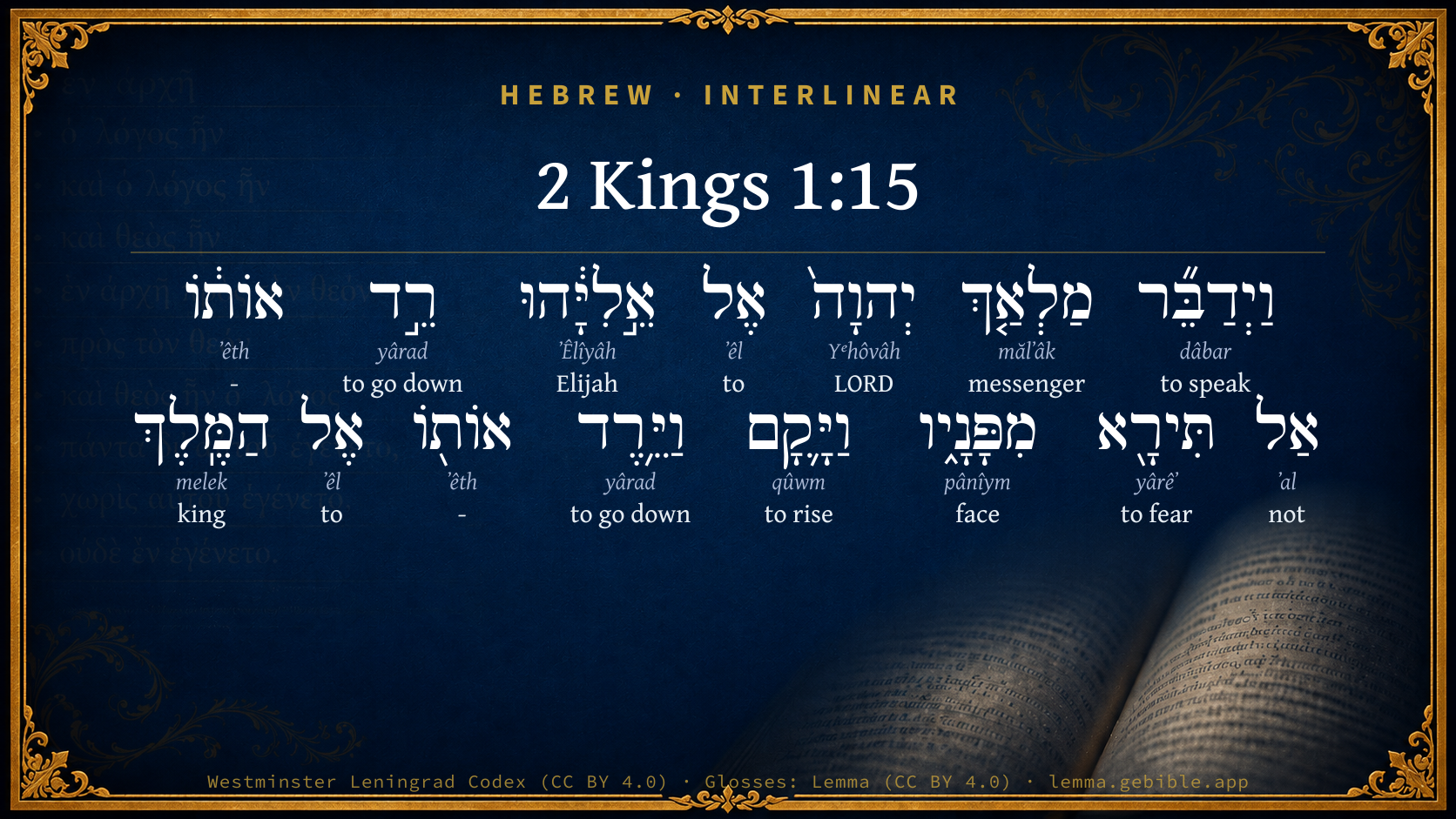
Hebrew (Westminster Leningrad Codex) 2 Kings 1:15 appears in the Hebrew Old Testament. The text above is from the Westminster Leningrad Codex. Each word links to its Strong’s number, a concise gloss, and parsing drawn from the Open Scriptures Hebrew Bible morphology. Click any word for its full Brown-Driver-Briggs (BDB) entry.
Download image
Cite this verse

2 Kings 1:15 (World English Bible). Public Domain. Lemma interlinear Bible study tool, https://lemma.gebible.app/v/2-kings/1/15.

Show BibTeX & RIS
BibTeX
RIS
English Translation
The angel of Yahweh said to Elijah, Go down with him: don't be afraid of him. He arose, and went down with him to the king.
World English Bible · Public Domain
Download a study sheet

One document with this verse’s original text, its word-by-word gloss line, the meaning frame, cross-references with their text, attributed commentary, and full source and license credits — printable, and it pastes into notes with its structure intact.

This verse Autodidact and up

Study sheet (.html) Plain text (.txt)

A passage Seminary Student

Up to 50 verses in one chapter. A passage sheet keeps up to 6 commentary sources and 12 cross-references per verse, in the order this page ranks them, and says so on the sheet whenever that leaves anything out. Ask for a single verse and you get the Autodidact verse sheet above.

Everything on this page stays free to read, with no account — the sheet is a download of what is already on screen, not access to it.

Want to remove ads? Support Godless Engineer
Compare translations 3

The same verse in 3 English versions, stacked beneath the original-language interlinear above. Click any original word for its lexicon entry.

Each is an independent rendering of the whole verse — the interlinear is not word-aligned to these translations.

Highlighted words mark where these versions differ — a whole-verse word diff, not a word-by-word alignment.

  • World English Bible Public Domain
    The angel of Yahweh said to Elijah, Go down with him: don't be afraid of him. He arose, and went down with him to the king.
  • King James Version Public Domain
    And the angel of the LORD said unto Elijah, Go down with him: be not afraid of him. And he arose, and went down with him unto the king.
  • unfoldingWord Literal Text CC BY-SA 4.0
    And the angel of Yahweh said to Elijah, “Go down with him. Do not be afraid of his face.” And he arose and went down with him to the king.

unfoldingWord Literal Text — © unfoldingWord, licensed CC BY-SA 4.0. Word-aligned USFM3 via Door43 (git.door43.org/unfoldingWord/en_ult).

Versions to compare (up to 4)

3 of 4 selected

Show all 18 translations

Every available English version of this verse, each an independent rendering of the whole verse.

  • World English Bible Public Domain
    The angel of Yahweh said to Elijah, Go down with him: don't be afraid of him. He arose, and went down with him to the king.
  • Berean Standard Bible Public Domain
    Then the angel of the LORD said to Elijah, “Go down with him. Do not be afraid of him.” So Elijah got up and went down with him to the king.
  • Majority Standard Bible Public Domain
    Then the angel of the LORD said to Elijah, “Go down with him. Do not be afraid of him.” So Elijah got up and went down with him to the king.
  • King James Version Public Domain
    And the angel of the LORD said unto Elijah, Go down with him: be not afraid of him. And he arose, and went down with him unto the king.
  • American Standard Version (1901) Public Domain
    And the angel of Jehovah said unto Elijah, Go down with him: be not afraid of him. And he arose, and went down with him unto the king.
  • Revised Version (1885) Public Domain
    And the angel of the LORD said unto Elijah, Go down with him: be not afraid of him. And he arose, and went down with him unto the king.
  • Geneva Bible (1599) Public Domain
    And the Angel of the Lord said vnto Eliiah, Goe downe with him, be not afraide of his presence. So he arose, and went downe with him vnto the King.
  • Douay-Rheims (1899) Public Domain
    And the angel of the Lord spoke to Elias, saying: Go down with him, fear not. He arose therefore, and went down with him to the king,
  • Young's Literal Translation Public Domain
    And a messenger of Jehovah speaketh unto Elijah, `Go down with him, be not afraid of him;' and he riseth and goeth down with him unto the king,
  • Literal Standard Version CC BY-SA 4.0
    And a messenger of YHWH speaks to Elijah, “Go down with him, do not be afraid of him”; and he rises and goes down with him to the king,
  • Unlocked Literal Bible CC BY-SA 4.0
    The angel of Yahweh said to Elijah, “Go down with him. Do not be afraid of him.” So Elijah arose and went down with him to the king.
  • unfoldingWord Literal Text CC BY-SA 4.0
    And the angel of Yahweh said to Elijah, “Go down with him. Do not be afraid of his face.” And he arose and went down with him to the king.
  • Darby Bible Public Domain
    And the angel of Jehovah said to Elijah, Go down with him: be not afraid of him. And he arose, and went down with him to the king.
  • World Messianic Bible Public Domain
    The LORD’s angel said to Elijah, “Go down with him. Don’t be afraid of him.” Then he arose and went down with him to the king.
  • Webster's Bible Public Domain
    And the angel of the LORD said to Elijah, Go down with him: be not afraid of him. And he arose, and went down with him to the king.
  • Free Bible Version CC BY-SA 4.0
    Then the angel of the Lord told Elijah, “Go down with him. You don't have to be afraid of him.” So Elijah got up and went down with him to the king.
  • Bible in Basic English Public Domain
    Then the angel of the Lord said to Elijah, Go down with him; have no fear of him. So he got up and went down with him to the king.
  • JPS Tanakh (1917) Public Domain
    And the angel of the LORD said unto Elijah: 'Go down with him; be not afraid of him.' And he arose, and went down with him unto the king.

Literal Standard Version (2020), Covenant Press — licensed CC BY-SA 4.0. Text via the HelloAO Bible API (eBible.org). Unlocked Literal Bible (unfoldingWord) — licensed CC BY-SA 4.0. Text via the HelloAO Bible API (eBible.org). unfoldingWord Literal Text — © unfoldingWord, licensed CC BY-SA 4.0. Word-aligned USFM3 via Door43 (git.door43.org/unfoldingWord/en_ult). Free Bible Version, Dr. Jonathan Gallagher — licensed CC BY-SA 4.0. Text via the HelloAO Bible API (eBible.org).

Word by word

More ways to search: Search by grammar → Find every occurrence → Compare this word →

Practice this passage: Drill this verse → Learn its vocabulary →

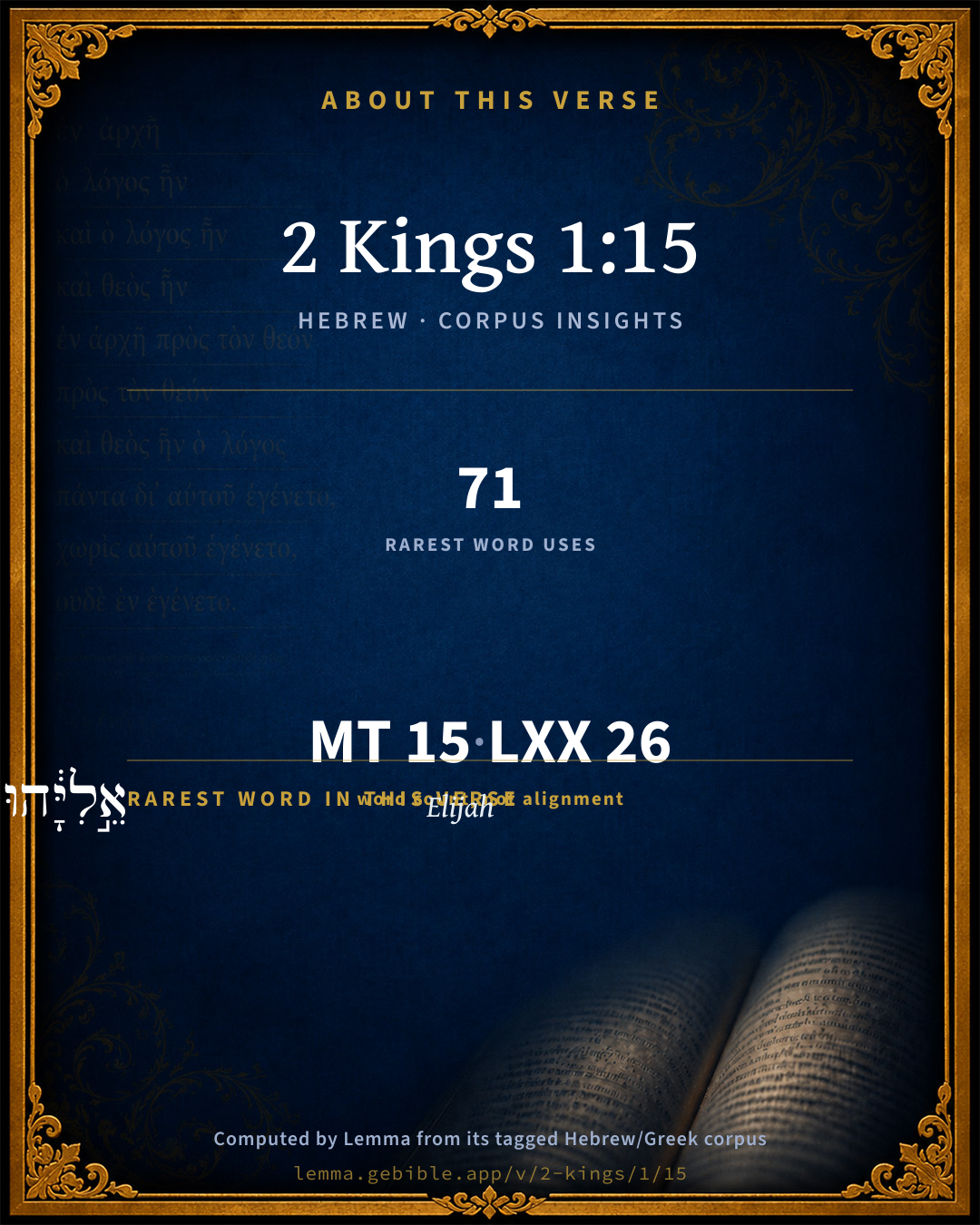
אֵ֣לִיָּ֔הוּ
ʼÊlîyâh
H452
“Elijah”
Noun, Proper
Part of Speech
Noun
Type
Proper
Full BDB Definition

Origin: from H410 and H3050

TWOT: None

Elijah or Eliah = "my God is Jehovah" or " Yah(u) is God" - the great prophet of the reign of Ahab - Benjamite son of Jeroham - a son of Elam with foreign wife during exile - a son of Harim, and priest, with foreign wife during exile
  1. וַיְדַבֵּ֞ר dâbar H1696 “and · to speak” Conjunction + Verb, Piel, Sequential Imperfect, 3rd Person, Masculine, Singular
  2. מַלְאַ֤ךְ mălʼâk H4397 “messenger of” Noun, Common, Masculine, Singular, Construct
  3. יְהוָה֙ Yᵉhôvâh H3068 “LORD” Noun, Proper
  4. אֶל ʼêl H413 “to” Preposition
  5. רֵ֣ד yârad H3381 “go down” Verb, Qal, Imperative, 2nd Person, Masculine, Singular
  6. אוֹת֔וֹ ʼêth H853 “- · him” Particle, Direct Object + Suffix, Personal, 3rd Person, Masculine, Singular
  7. אַל ʼal H408 “not” Particle, Negative
  8. תִּירָ֖א yârêʼ H3372 “to fear” Verb, Qal, Jussive, 2nd Person, Masculine, Singular
  9. מִפָּנָ֑יו pânîym H6440 “from · face(s) · his” Preposition + Noun, Common, Both, Plural, Construct + Suffix, Personal, 3rd Person, Masculine, Singular
  10. וַיָּ֛קָם qûwm H6965 “and · to rise” Conjunction + Verb, Qal, Sequential Imperfect, 3rd Person, Masculine, Singular
  11. וַיֵּ֥רֶד yârad H3381 “and · to go down” Conjunction + Verb, Qal, Sequential Imperfect, 3rd Person, Masculine, Singular
  12. אוֹת֖וֹ ʼêth H853 “- · him” Particle, Direct Object + Suffix, Personal, 3rd Person, Masculine, Singular
  13. אֶל ʼêl H413 “to” Preposition
  14. הַמֶּֽלֶךְ melek H4428 “the · king” Particle, Definite Article + Noun, Common, Masculine, Singular, Absolute

About this verse

These counts appear in no published source. They are computed here, from the morphology-tagged text and Lemma’s own curated glosses. What Lemma adds →

15
words
12
distinct lemmas
Historical
section

Grammatical profile

  • 5 verbs
  • 5 nouns
  • 2 prepositions
  • 3 particles

Verb forms

  • וַיְדַבֵּ֞ר Piel · Sequential Imperfect
  • רֵ֣ד Qal · Imperative
  • תִּירָ֖א Qal · Jussive
  • וַיָּ֛קָם Qal · Sequential Imperfect
  • וַיֵּ֥רֶד Qal · Sequential Imperfect

Repetition

Words recur within this verse — often emphatic in Hebrew:

  • רֵ֣ד to go down H3381 ×2
  • אֶל to H413 ×2

Hebrew & Septuagint length

In English translation the verse runs 26 words from the Hebrew and 32 from the Septuagint (LXX English) — closely comparable.

A rough comparison of the two English renderings, which tokenize alike — not a word-level alignment.

Word counts can differ between the Hebrew and the Greek without any difference in meaning — e.g. the Hebrew direct-object marker אֵת has no separate Greek word, and Greek often adds the article ὁ.

In the original languages it is 15 Hebrew tokens and 26 Greek tokens — but the two are counted differently (Hebrew bundles its prefixes and suffixes into one token; the Greek is in lemma form), so that isn’t a like-for-like length.

Cross-references

10

Topical passages linked to 2 Kings 1:15 in the Treasury of Scripture Knowledge — connected by theme and wording, ordered by reader-vote popularity; previews shown in the World English Bible.

  • Isaiah 51:12 I, even I, am he who comforts you: who are you, that you are afraid of man who shall die, and of the son of man who shall be made as grass;
  • Ezekiel 2:6 You, son of man, don't be afraid of them, neither be afraid of their words, though briers and thorns are with you, and you do dwell among scorpions: don't be afraid of their words, nor be dismayed at their looks, though they are a rebellious house.
  • Jeremiah 1:17 You therefore gird up your loins, and arise, and speak to them all that I command you: don't be dismayed at them, lest I dismay you before them.
  • Genesis 15:1 After these things the word of Yahweh came to Abram in a vision, saying, "Don't be afraid, Abram. I am your shield, your exceedingly great reward."
  • 1 Kings 18:15 Elijah said, As Yahweh of Hosts lives, before whom I stand, I will surely show myself to him today.
  • 2 Kings 1:3 But the angel of Yahweh said to Elijah the Tishbite, Arise, go up to meet the messengers of the king of Samaria, and tell them, Is it because there is no God in Israel, that you go to inquire of Baal Zebub, the god of Ekron?
  • Psalms 27:1 Yahweh is my light and my salvation. Whom shall I fear? Yahweh is the strength of my life. Of whom shall I be afraid?
  • Jeremiah 15:20 I will make you to this people a fortified brazen wall; and they shall fight against you, but they shall not prevail against you; for I am with you to save you and to deliver you, says Yahweh.
  • Matthew 10:28 Don't be afraid of those who kill the body, but are not able to kill the soul. Rather, fear him who is able to destroy both soul and body in Gehenna.
  • Hebrews 11:27 By faith, he left Egypt, not fearing the wrath of the king; for he endured, as seeing him who is invisible.

Cross-references courtesy of OpenBible.info (CC BY 4.0).

Hebrew and Greek witnesses Masoretic Hebrew ↔ Greek Septuagint

The same verse in the two great witnesses to the Old Testament, shown verse-for-verse.

These are two independent witnesses, not word-aligned to each other, and the Septuagint is shown in lemma (dictionary) form.

Hebrew 2 Kings 1:15 Masoretic · Westminster Leningrad Codex

וַיְדַבֵּ֞ר מַלְאַ֤ךְ יְהוָה֙ אֶל אֵ֣לִיָּ֔הוּ רֵ֣ד אוֹת֔וֹ אַל תִּירָ֖א מִפָּנָ֑יו וַיָּ֛קָם וַיֵּ֥רֶד אוֹת֖וֹ אֶל הַמֶּֽלֶךְ

The angel of Yahweh said to Elijah, Go down with him: don't be afraid of him. He arose, and went down with him to the king.

World English Bible · Public Domain

Greek LXX 2 Kings 1:15 Septuagint · lemma form

καί λαλέω ἄγγελος κύριος πρός ηλιου καί εἶπον καταβαίνω μετά αὐτός μή φοβέω ἀπό πρόσωπον αὐτός καί ἀναἵστημι ηλιου καί καταβαίνω μετά αὐτός πρός ὁ βασιλεύς

And the angel of the Lord spoke to Eliu, and said, Go down with him, be not afraid of them. And Eliu rose up, and went down with him to the king.

LXX2012 (modern English Septuagint) · Public Domain

On this verse, Ellicott's Commentary for English Readers discusses the Septuagint’s reading. Read the note in Commentary ↓

Hebrew: Westminster Leningrad Codex (CC BY 4.0). Greek: Septuagint (public domain); English from LXX2012 (modern English Septuagint) (Public Domain). How the Septuagint differs from the Hebrew →

Targum (Aramaic paraphrase)

1

The Targum is the ancient Jewish Aramaic paraphrase of the Hebrew Scriptures — an interpretive translation, not the Hebrew text itself. Onkelos (literal) and Pseudo-Jonathan (expansive) render the Torah, and Jonathan the Prophets. Coverage is partial: where no permissively-licensed English translation exists for a verse, only the Aramaic is shown. This is verse-level text, not a word-by-word alignment to the Hebrew.

  1. Targum Jonathan Prophets (Joshua–Malachi)
    וּמַלֵיל מַלְאָכָא דַייָ עִם אֵלִיָהוּ חוֹת עִמֵיהּ לָא תִדְחַל מִן קֳדָמוֹהִי וְקָם וּנְחַת עִמֵיהּ לְוַת מַלְכָּא:

    (no public-domain English translation for this verse)

    Targum Jonathan — Aramaic: “Mikraot Gedolot” (public domain). English: “Sefaria Community Translation” (CC0 1.0 (public-domain dedication)); “London "Chaldee Paraphrase," 1871” (public domain). Text via Sefaria.

Commentary

Notes on 2 Kings 1:15 from classic Christian and Jewish commentators (each source and its license shown beneath its notes). The classic Christian expositions comment on the surrounding passage and are grouped to its opening verse, so a note may address several verses; the Jewish commentaries on the Tanakh (Rashi and others) are per-verse, so they appear only where the commentator wrote on this verse.

Lemma curates 59 commentaries, every one of them public domain or Creative Commons licensed, each selected and text-cleaned for this edition rather than reprinted as found. About our sources →

Trapp's Complete Commentary

John Trapp

2Ki 1:15 And the angel of the LORD said unto Elijah, Go down with him: be not afraid of him. And he arose, and went down with him unto the king.

Ver. 15. Be not afraid of him.] See 2Ki 1:9. Cur timeat hominem homo in sinu Dei positus?

John Trapp, A Commentary or Exposition upon All the Books of the Old and New Testament (1647–1656) — public domain. Text from a community e-Sword module.

The Biblical Illustrator

Joseph S. Exell

2Ki_1:15-16

Go down with him, be not afraid.

The old courage again

The age of the Mosaic Law, which shed its empire over the times of Elijah, was preeminently the era in which those awful and splendid attributes of the Divine character--Gods holiness, justice, righteousness, and severity against sin--stood out in massive prominence; as some of us, from the ancient capital of Switzerland, have seen the long line of Bernese Alps, rising above the plain in distant and majestic splendour; cold in the grey dawn; or flushed with the light of morn and eve. It was only when those lessons had been completely learnt, that mankind was able to appreciate the love of God which is in Jesus Christ our Lord. That there was no malice in Elijah is clear from his willingness to go with the third captain, who spoke with reverence and humility. And the angel of the Lord said, Go down with him; be not afraid of him. And Elijab went down with him unto the king.

I. The meekness and gentleness of Christ. The only fire He sought was the fire of the Holy Ghost. I came to cast fire upon the earth; and what will I if it is already kindled. He strove not to avenge Himself, or vindicate the majesty of His nature. He endured the contradiction of sinners against Himself.

II. The impossibility of God ever condoning defiant and blasphemous sin. We have fallen on soft and degenerate days when, under false notions of charity and liberality, men are paring down their conceptions of the evil of sin, and of the holy wrath of God, which is revealed from heaven against all ungodliness and unrighteousness of men.

III. Elijahs full restoration to the exercise of a glorious faith. In a former time the message of Jezebel was enough to make him flee. But in this ease he stood his ground, though an armed band came to capture him. (F. B. Meyer, B. A.)

.

The Biblical Illustrator, edited by Joseph S. Exell (c. 1880s–1900s) — public domain. Text from a community e-Sword module.

Joseph Benson's Commentary

2Ki 1:15-16. He arose and went down with him — Not fearing the rage of the king, nor that of Jezebel, or all their forces: wherein he gives an eminent example of his faith in God’s protection, and obedience to his commands. And he said — To his very face: nor durst the king lay hands on him, being daunted with his presence, and great courage and confidence; and affrighted with the late dreadful evidence of his power with God. Thus saith the Lord, Forasmuch, &c. — Probably more discourse passed between them than is here recorded. But this was the conclusion of all, that the sentence which God had pronounced against him was irreversible; and therefore, that he must not expect to live much longer, but make use of the time remaining, to repent of his sins and make his peace with God.

Joseph Benson's Commentary on the Old and New Testaments (1811–1818) — public domain. Text from a community e-Sword module.

Tyndale Open Study Notes

Tyndale Open Resources

1:15 When the angel of the Lord (1:3) instructed Elijah, he responded in faithful obedience.

Tyndale Open Study Notes — © Tyndale Open Resources, licensed CC BY-SA 4.0. Text via the HelloAO Bible API.

Geneva Bible (1599)

Geneva Bible translators

Thus the Lord giveth boldness to his, that they fear not the threatenings of tyrants, which otherwise of themselves are afraid to do God’s message.

Geneva Bible (1599) marginal notes — public domain. Text via Bolls.life.

Jamieson, Fausset & Brown

Robert Jamieson, A. R. Fausset & David Brown

he arose, and went down with him--a marvellous instance of faith and obedience. Though he well knew how obnoxious his presence was to the king, yet, on receiving God's command, he goes unhesitatingly, and repeats, with his own lips, the unwelcome tidings conveyed by the messengers.

Jamieson, Fausset & Brown — Commentary Critical and Explanatory on the Whole Bible (1871) — public domain (CC PDM 1.0). Text via the HelloAO Bible API.

Adam Clarke's Commentary

Verse 15. And the angel of the Lord said - Go down with him] This is an additional proof that Elijah was then acting under particular inspirations: he had neither will nor design of his own. He waited to know the counsel, declare the will, and obey the command, of his God.

And he arose, and went down] He did not even regard his personal safety or his life; he goes without the least hesitation to the king, though he had reason to suppose he would be doubly irritated by his prediction, and the death of one hundred of his men. But with all these consequences he had nothing to do; he was the ambassador of the King eternal, and his honour and life were in the hands of his Master.

Adam Clarke's Commentary on the Bible (1810–1826) — public domain. Text from a community e-Sword/MySword module.

Ellicott's Commentary for English Readers

(15) Said.—So LXX. (εἶπεν). Heb., spake. Vulgate and Arabic add “saying.” (See Note on 2Ki_1:3.)

Go down.—From the mountain top into the city.

With him.—’Othô, later form for ’ittô, which some MSS. read here.

Be not afraid of him—i.e., the captain. The former two, as being the willing tools of the king, might have shown their zeal by instantly slaying the prophet. (Comp. the case of the knights who murdered St. Thomas of Canterbury.)

A Bible Commentary for English Readers, edited by Charles John Ellicott (1878–1897) — public domain. Text from a community e-Sword module.

The Cambridge Bible for Schools and Colleges

gen. ed. J. J. S. Perowne

15. be not afraid of him] Some have taken the pronoun here to refer to the captain. This can hardly be correct. The third messenger was all humility and entreaty, and the only person to be feared was the king Ahaziah, irate because of the destruction of his soldiers and the defiance of his authority.

The Cambridge Bible for Schools and Colleges (gen. ed. J. J. S. Perowne; Cambridge University Press, 1878–1918) — public domain. Text from a community e-Sword module.

John Gill's Exposition

And the angel of the Lord said unto Elijah, The same as in Kg2 1:3 or "had said" (g), as some render it, before this captain came:

go down with him; the captain and his men:

and be not afraid of him; of King Ahaziah, whom he might fear, because of the message he had sent him, that he should die of that sickness, and for turning back his messengers to the god of Ekron, and for destroying his two captains and their fifties; nor of his mother Jezebel, who had threatened his life for killing her prophets:

and he arose, and went down with him unto the king; boldly and courageously, not fearing his wrath; so that the captain not only had his life and the life of his men spared, but answered the end of his message also.

(g) "edixerat autem", Junius & Tremellius.

John Gill's Exposition of the Whole Bible (1746–1763) — public domain (CC PDM 1.0). Text via the HelloAO Bible API.

Matthew Poole's English Annotations

Not fearing the rage of the king, nor of Jezebel, nor of all their forces; wherein he gives an eminent example of his faith and obedience; and withal, of his growth in grace since that time that he fled for fear of Jezebel, 1Ki 19:3.

Matthew Poole's English Annotations on the Holy Bible (1683–1685) — public domain. Text from a community e-Sword/MySword module.

Whedon's Commentary on the Bible

Daniel D. Whedon

15. Be not afraid of him — Notwithstanding all the wonders wrought by God through the ministry of Elijah, he ever continued a man of like passions with ourselves, and in this case needed the assuring voice of the angel in order to go with firmness and utter his message to the king himself.

Daniel D. Whedon (gen. ed.), Commentary on the Old and New Testaments (1874–1909) — public domain. Text from a community e-Sword module.

The Pulpit Commentary

Go down with him: be not afraid of him; i.e. "descend the hill with him have no fear of him, accompany him to the presence of the king; do my will, and there shall no harm happen unto thee." And he arose, and went down. Elijah showed no hesitation, no fear, no undue regard for his own personal safety. He had been contending for God"s honor, not for his own advantage. Now that God bade him contend no more, but yield, he complied promptly, and ceased all resistance.

The Pulpit Commentary (1880–1919), ed. H.D.M. Spence-Jones & Joseph S. Exell — public domain. Text from a community e-Sword module.

Keil & Delitzsch

C. F. Keil & F. Delitzsch

Then Elijah followed him to the king (מפּניו, before him, i.e., before the king, not before the captain; and אתו for ??????, see Ewald, ֗264, b.), having been directed to do so by the angel of the Lord, and repeated to him the word of the Lord, which he had also conveyed to him through his messengers (see Kg2 1:4 and Kg2 1:6).

Keil & Delitzsch — Biblical Commentary on the Old Testament (1861–1891) — public domain (CC PDM 1.0). Text via the HelloAO Bible API. (Old Testament only.)

Scofield Reference Notes

C. I. Scofield

angel

(See Scofield "Heb 1:4").

The Scofield Reference Bible (1917 edition), notes by C. I. Scofield — public domain. Text from a community e-Sword module.

unfoldingWord translationNotes

Door43 World Missions Community

Is it because there is no God in Israel from whom you can ask for information?

This rhetorical question is asked as a rebuke for consulting Baal-Zebub. This may be written as a statement. This is irony because the king is definitely aware of the God of Israel. AT: "You must think there is no God in Israel whom you may ask for information!" or "You fool! You know there is a God in Israel to consult, but you acted as if you did not know." (See: Rhetorical Question and Irony)

you will not come down from the bed where you have gone up

When King Ahaziah was injured, he was placed in a bed. Yahweh said that he will never become well and be able to get out of the bed. See how you translated this statement in 2 Kings 3:4. AT: "you will not recover and you will not get up from the bed where you are lying" (See: Assumed Knowledge and Implicit Information)

translationWords

fear

unfoldingWord translationNotes — © Distant Shores Media and the Door43 World Missions Community, licensed CC BY-SA 4.0. Source: git.door43.org/Door43/en_tn.

Lesson kit

Teaching starters — assembled from the data on this page, not authored interpretation. Every prompt links to the verse data it draws on. Edit before teaching.

2 Kings, in the Historical, opens this verse with 15 words (12 distinct Hebrew lemmas). Its most distinctive word is ʼÊlîyâh (“Elijah”). A historical commentator’s framing appears above. Read the whole chapter for the surrounding context.

Discussion questions

  1. What does “Elijah” (ʼÊlîyâh) contribute to the verse as a whole?
  2. How does Isaiah 51:12, which shares this passage’s theme, read alongside this verse?
  3. What does the repetition of “to go down” (2× in this one verse) do in this verse?
  4. These translations render this verse differently. What is at stake in choosing one wording over another?
  5. «וַיְדַבֵּ֞ר» is a Piel Sequential Imperfect verb. How does that grammatical form shape the action described?
  6. Compare how Trapp's Complete Commentary and The Biblical Illustrator read this verse. Where do they agree or differ?

Things to notice

Reading settings

Reading text

Shown beneath each verse's original-language words.

Old Testament
Old Testament edition

Read the OT as the Masoretic Hebrew (MT) or the Greek Septuagint (LXX).

English shown for the Greek Septuagint (in the Hebrew ↔ Greek comparison).

Comparing translations? Open the Compare panel on any verse page to stack up to four side by side.