
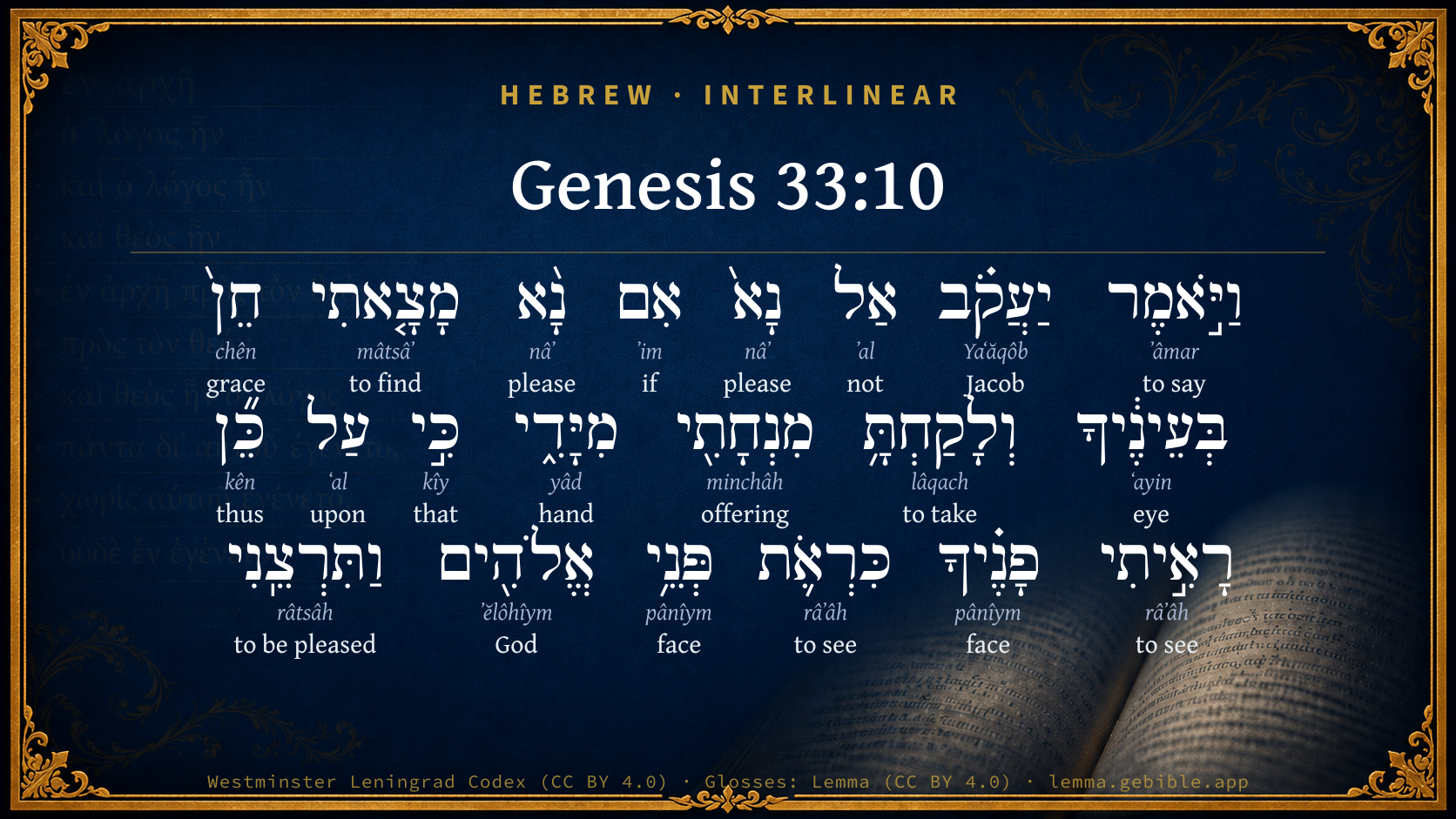
Genesis 33:10

Hebrew (Westminster Leningrad Codex) Genesis 33:10 appears in the Hebrew Old Testament. The text above is from the Westminster Leningrad Codex. Each word links to its Strong’s number, a concise gloss, and parsing drawn from the Open Scriptures Hebrew Bible morphology. Click any word for its full Brown-Driver-Briggs (BDB) entry.
Download image
Cite this verse

Genesis 33:10 (World English Bible). Public Domain. Lemma interlinear Bible study tool, https://lemma.gebible.app/v/genesis/33/10.

Show BibTeX & RIS
BibTeX
RIS
English Translation
Jacob said, "Please, no, if I have now found favor in your sight, then receive my present at my hand, because I have seen your face, as one sees the face of God, and you were pleased with me.
World English Bible · Public Domain
Highlights
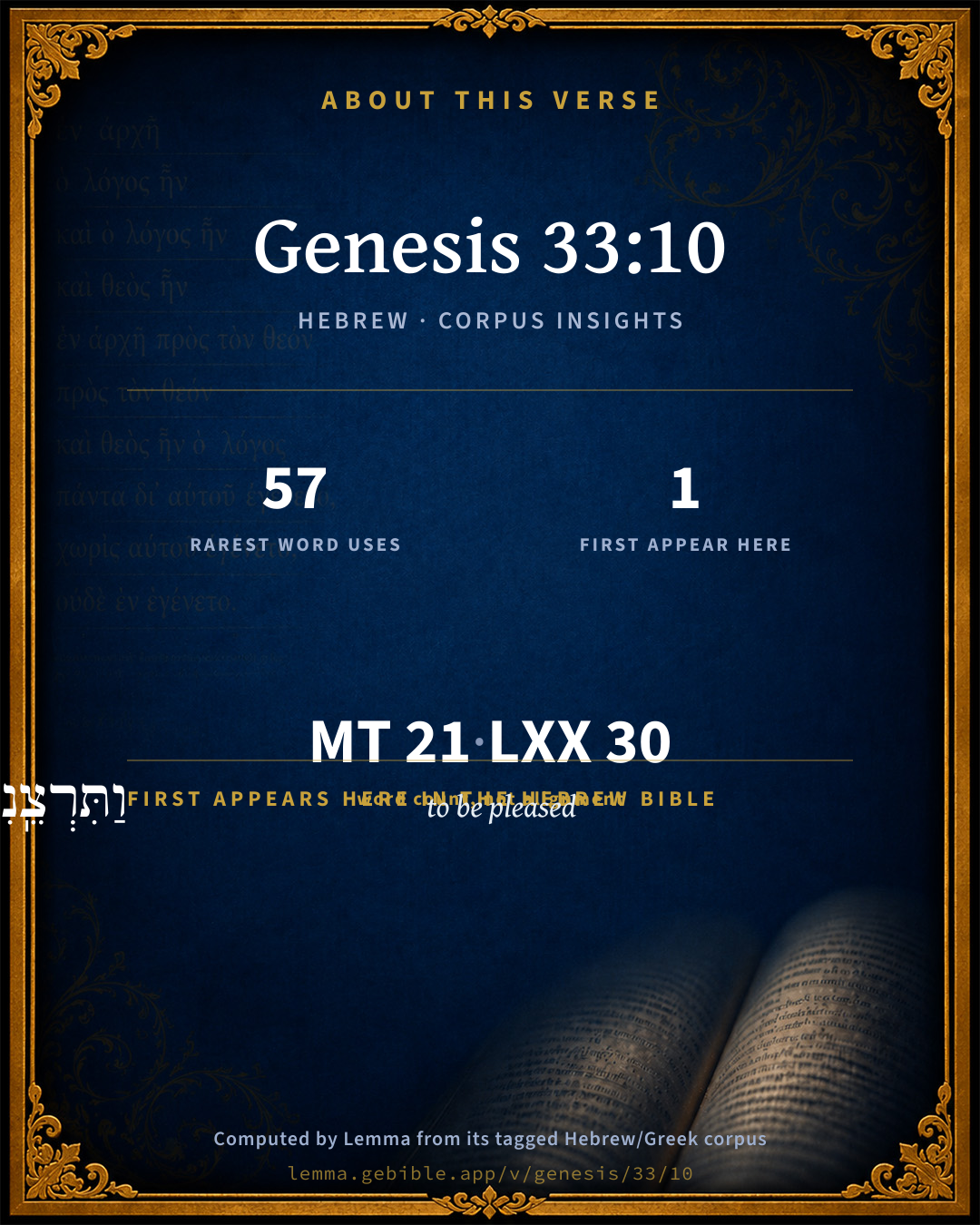
  • 1 first appearance in the Hebrew Bible
Full analysis ↓
Download a study sheet

One document with this verse’s original text, its word-by-word gloss line, the meaning frame, cross-references with their text, attributed commentary, and full source and license credits — printable, and it pastes into notes with its structure intact.

This verse Autodidact and up

Study sheet (.html) Plain text (.txt)

A passage Seminary Student

Up to 50 verses in one chapter. A passage sheet keeps up to 6 commentary sources and 12 cross-references per verse, in the order this page ranks them, and says so on the sheet whenever that leaves anything out. Ask for a single verse and you get the Autodidact verse sheet above.

Everything on this page stays free to read, with no account — the sheet is a download of what is already on screen, not access to it.

Want to remove ads? Support Godless Engineer
Compare translations 3

The same verse in 3 English versions, stacked beneath the original-language interlinear above. Click any original word for its lexicon entry.

Each is an independent rendering of the whole verse — the interlinear is not word-aligned to these translations.

Highlighted words mark where these versions differ — a whole-verse word diff, not a word-by-word alignment.

  • World English Bible Public Domain
    Jacob said, "Please, no, if I have now found favor in your sight, then receive my present at my hand, because I have seen your face, as one sees the face of God, and you were pleased with me.
  • King James Version Public Domain
    And Jacob said, Nay, I pray thee, if now I have found grace in thy sight, then receive my present at my hand: for therefore I have seen thy face, as though I had seen the face of God, and thou wast pleased with me.
  • unfoldingWord Literal Text CC BY-SA 4.0
    But Jacob said, “No, please. If, please, I have found favor in your eyes, then take my gift from my hand. For indeed I have seen your face, like seeing the face of God, and you have received me.

unfoldingWord Literal Text — © unfoldingWord, licensed CC BY-SA 4.0. Word-aligned USFM3 via Door43 (git.door43.org/unfoldingWord/en_ult).

Versions to compare (up to 4)

3 of 4 selected

Show all 18 translations

Every available English version of this verse, each an independent rendering of the whole verse.

  • World English Bible Public Domain
    Jacob said, "Please, no, if I have now found favor in your sight, then receive my present at my hand, because I have seen your face, as one sees the face of God, and you were pleased with me.
  • Berean Standard Bible Public Domain
    But Jacob insisted, “No, please! If I have found favor in your sight, then receive this gift from my hand. For indeed, I have seen your face, and it is like seeing the face of God, since you have received me favorably.
  • Majority Standard Bible Public Domain
    But Jacob insisted, “No, please! If I have found favor in your sight, then receive this gift from my hand. For indeed, I have seen your face, and it is like seeing the face of God, since you have received me favorably.
  • King James Version Public Domain
    And Jacob said, Nay, I pray thee, if now I have found grace in thy sight, then receive my present at my hand: for therefore I have seen thy face, as though I had seen the face of God, and thou wast pleased with me.
  • American Standard Version (1901) Public Domain
    And Jacob said, Nay, I pray thee, if now I have found favor in thy sight, then receive my present at my hand; forasmuch as I have seen thy face, as one seeth the face of God, and thou wast pleased with me.
  • Revised Version (1885) Public Domain
    And Jacob said, Nay, I pray thee, if now I have found grace in thy sight, then receive my present at my hand: forasmuch as I have seen thy face, as one seeth the face of God, and thou wast pleased with me.
  • Geneva Bible (1599) Public Domain
    But Iaakob answered, Nay, I pray thee: if I haue found grace nowe in thy sight, then receiue my present at mine hande: for I haue seene thy face, as though I had seene the face of God, because thou hast accepted me.
  • Douay-Rheims (1899) Public Domain
    And Jacob said: Do not so I beseech thee, but if I have found favor in thy eyes, receive a little present at my hands: for I have seen thy face, as if I should have seen the countenance of God: be gracious to me,
  • Young's Literal Translation Public Domain
    And Jacob saith, `Nay, I pray thee, if, I pray thee, I have found grace in thine eyes, then thou hast received my present from my hand, because that I have seen thy face, as the seeing of the face of God, and thou art pleased with me;
  • Literal Standard Version CC BY-SA 4.0
    And Jacob says, “No, please, now if I have found grace in your eyes, then you have received my present from my hand, because that I have seen your face, as the seeing of the face of God, and you are pleased with me;
  • Unlocked Literal Bible CC BY-SA 4.0
    Jacob said, “No, please, if I have found favor in your eyes, then accept my gift from my hand, for indeed, I have seen your face, and it is like seeing the face of God, and you have accepted me.
  • unfoldingWord Literal Text CC BY-SA 4.0
    But Jacob said, “No, please. If, please, I have found favor in your eyes, then take my gift from my hand. For indeed I have seen your face, like seeing the face of God, and you have received me.
  • Darby Bible Public Domain
    And Jacob said, No, I pray thee; if now I have found favour in thine eyes, then receive my gift from my hand; for therefore have I seen thy face, as though I had seen the face of God, and thou hast received me with pleasure.
  • World Messianic Bible Public Domain
    Jacob said, “Please, no, if I have now found favor in your sight, then receive my present at my hand, because I have seen your face, as one sees the face of God, and you were pleased with me.
  • Webster's Bible Public Domain
    And Jacob said, Nay, I pray thee, if now I have found grace in thy sight, then receive my present at my hand: for therefore I have seen thy face, as though I had seen the face of God, and thou hast been pleased with me.
  • Free Bible Version CC BY-SA 4.0
    “No, please!” Jacob insisted. “If you're happy with me, then please accept the gift I'm giving you. Now I've seen your face again it's like seeing the face of God, and you have welcomed me so kindly!
  • Bible in Basic English Public Domain
    And Jacob said, Not so; but if I have grace in your eyes, take them as a sign of my love, for I have seen your face as one may see the face of God, and you have been pleased with me.
  • JPS Tanakh (1917) Public Domain
    And Jacob said: 'Nay, I pray thee, if now I have found favour in thy sight, then receive my present at my hand; forasmuch as I have seen thy face, as one seeth the face of God, and thou wast pleased with me.

Literal Standard Version (2020), Covenant Press — licensed CC BY-SA 4.0. Text via the HelloAO Bible API (eBible.org). Unlocked Literal Bible (unfoldingWord) — licensed CC BY-SA 4.0. Text via the HelloAO Bible API (eBible.org). unfoldingWord Literal Text — © unfoldingWord, licensed CC BY-SA 4.0. Word-aligned USFM3 via Door43 (git.door43.org/unfoldingWord/en_ult). Free Bible Version, Dr. Jonathan Gallagher — licensed CC BY-SA 4.0. Text via the HelloAO Bible API (eBible.org).

Word by word

More ways to search: Search by grammar → Find every occurrence → Compare this word →

Practice this passage: Drill this verse → Learn its vocabulary →

וַתִּרְצֵֽנִי
râtsâh
H7521
“and · to be pleased · me”
Conjunction + Verb, Qal, Sequential Imperfect, 2nd Person, Masculine, Singular + Suffix, Personal, 1st Person, Common, Singular
Part of Speech
Conjunction + Verb
Stem
Qal
Form
Sequential Imperfect
Person
2nd Person
Gender
Masculine
Number
Singular
Full BDB Definition

Origin: a primitive root

TWOT: 2207

to be pleased with, be favourable to, accept favourably - (Qal) - to be pleased with, be favourable to - to accept - to be pleased, be determined - to make acceptable, satisfy - to please - (Niphal) to be accepted, be pleased with - (Piel) to seek favour of - (Hiphil) to please, pay off - (Hithpael) to make oneself acceptable or pleasing
  1. וַיֹּ֣אמֶר ʼâmar H559 “and · to say” Conjunction + Verb, Qal, Sequential Imperfect, 3rd Person, Masculine, Singular
  2. יַעֲקֹ֗ב Yaʻăqôb H3290 “Jacob” Noun, Proper
  3. אַל ʼal H408 “not” Particle, Negative
  4. נָא֙ nâʼ H4994 “please” Particle, Exhortation
  5. אִם ʼim H518 “if” Conjunction
  6. נָ֨א nâʼ H4994 “please” Particle, Exhortation
  7. מָצָ֤אתִי mâtsâʼ H4672 “to find” Verb, Qal, Perfect, 1st Person, Common, Singular
  8. חֵן֙ chên H2580 “grace” Noun, Common, Masculine, Singular, Absolute
  9. בְּעֵינֶ֔יךָ ʻayin H5869 “in/at · eyes · your” Preposition + Noun, Common, Both, Dual, Construct + Suffix, Personal, 2nd Person, Masculine, Singular
  10. וְלָקַחְתָּ֥ lâqach H3947 “and · to take” Conjunction + Verb, Qal, Sequential Perfect, 2nd Person, Masculine, Singular
  11. מִנְחָתִ֖י minchâh H4503 “offering · my” Noun, Common, Feminine, Singular, Construct + Suffix, Personal, 1st Person, Common, Singular
  12. מִיָּדִ֑י yâd H3027 “from · hand · my” Preposition + Noun, Common, Both, Singular, Construct + Suffix, Personal, 1st Person, Common, Singular
  13. כִּ֣י kîy H3588 “that” Conjunction
  14. עַל ʻal H5921 “upon” Preposition
  15. כֵּ֞ן kên H3651 “thus” Particle, Demonstrative
  16. רָאִ֣יתִי râʼâh H7200 “to see” Verb, Qal, Perfect, 1st Person, Common, Singular
  17. פָנֶ֗יךָ pânîym H6440 “face(s) · your” Noun, Common, Both, Plural, Construct + Suffix, Personal, 2nd Person, Masculine, Singular
  18. כִּרְאֹ֛ת râʼâh H7200 “like/as · to see” Preposition + Verb, Qal, Infinitive Construct
  19. פְּנֵ֥י pânîym H6440 “face(s) of” Noun, Common, Both, Plural, Construct
  20. אֱלֹהִ֖ים ʼĕlôhîym H430 “God(s)” Noun, Common, Masculine, Plural, Absolute

About this verse

These counts appear in no published source. They are computed here, from the morphology-tagged text and Lemma’s own curated glosses. What Lemma adds →

21
words
18
distinct lemmas
Pentateuch
section

First appearance in Scripture

This word makes its first canonical appearance in the Hebrew Bible here:

  • וַתִּרְצֵֽנִי to be pleased H7521

Shared distinctive vocabulary

וַתִּרְצֵֽנִי to be pleased H7521 occurs in 55 verses of the Hebrew Bible. Also found in:

Grammatical profile

  • 6 verbs
  • 8 nouns
  • 1 preposition
  • 2 conjunctions
  • 4 particles

Verb forms

  • וַיֹּ֣אמֶר Qal · Sequential Imperfect
  • מָצָ֤אתִי Qal · Perfect
  • וְלָקַחְתָּ֥ Qal · Sequential Perfect
  • רָאִ֣יתִי Qal · Perfect
  • כִּרְאֹ֛ת Qal · Infinitive Construct
  • וַתִּרְצֵֽנִי Qal · Sequential Imperfect

Repetition

Words recur within this verse — often emphatic in Hebrew:

  • נָא֙ please H4994 ×2
  • רָאִ֣יתִי to see H7200 ×2
  • פָנֶ֗יךָ face H6440 ×2

Hebrew & Septuagint length

In English translation the verse runs 39 words from the Hebrew and 40 from the Septuagint (LXX English) — closely comparable.

A rough comparison of the two English renderings, which tokenize alike — not a word-level alignment.

Word counts can differ between the Hebrew and the Greek without any difference in meaning — e.g. the Hebrew direct-object marker אֵת has no separate Greek word, and Greek often adds the article ὁ.

In the original languages it is 21 Hebrew tokens and 30 Greek tokens — but the two are counted differently (Hebrew bundles its prefixes and suffixes into one token; the Greek is in lemma form), so that isn’t a like-for-like length.

Cross-references

17

Topical passages linked to Genesis 33:10 in the Treasury of Scripture Knowledge — connected by theme and wording, ordered by reader-vote popularity; previews shown in the World English Bible.

  • Job 33:26 He prays to God, and he is favorable to him, So that he sees his face with joy: He restores to man his righteousness.
  • Revelation 22:4 They will see his face, and his name will be on their foreheads.
  • Genesis 32:30 Jacob called the name of the place Peniel: for, he said, "I have seen God face to face, and my life is preserved."
  • Jeremiah 31:2 Thus says Yahweh, The people who were left of the sword found favor in the wilderness; even Israel, when I went to cause him to rest.
  • Genesis 19:19 See now, your servant has found favor in your sight, and you have magnified your loving kindness, which you have shown to me in saving my life. I can't escape to the mountain, lest evil overtake me, and I die.
  • Genesis 47:29 The time drew near that Israel must die, and he called his son Joseph, and said to him, "If now I have found favor in your sight, please put your hand under my thigh, and deal kindly and truly with me. Please don't bury me in Egypt,
  • Genesis 50:4 When the days of weeping for him were past, Joseph spoke to the house of Pharaoh, saying, "If now I have found favor in your eyes, please speak in the ears of Pharaoh, saying,
  • Exodus 33:12–13 Moses said to Yahweh, "Behold, you tell me, 'Bring up this people:' and you haven't let me know whom you will send with me. Yet you have said, 'I know you by name, and you have also found favor in my sight.'
  • Ruth 2:10 Then she fell on her face, and bowed herself to the ground, and said to him, Why have I found favor in your sight, that you should take knowledge of me, seeing I am a foreigner?
  • 1 Samuel 20:3 David swore moreover, and said, Your father knows well that I have found favor in your eyes; and he says, Don't let Jonathan know this, lest he be grieved: but truly as Yahweh lives, and as your soul lives, there is but a step between me and death.
  • 2 Samuel 3:13 He said, Well; I will make a league with you; but one thing I require of you: that is, you shall not see my face, except you first bring Michal, Saul's daughter, when you come to see my face.
  • 2 Samuel 14:24 The king said, Let him turn to his own house, but let him not see my face. So Absalom turned to his own house, and didn't see the king's face.
  • 2 Samuel 14:28 Absalom lived two full years in Jerusalem; and he didn't see the king's face.
  • 2 Samuel 14:32 Absalom answered Joab, Behold, I sent to you, saying, Come here, that I may send you to the king, to say, Why am I come from Geshur? it were better for me to be there still. Now therefore let me see the king's face; and if there be iniquity in me, let him kill me.
  • Psalms 41:11 By this I know that you delight in me, Because my enemy doesn't triumph over me.
  • Genesis 43:3 Judah spoke to him, saying, "The man solemnly warned us, saying, 'You shall not see my face, unless your brother is with you.'
  • Matthew 18:10 See that you don't despise one of these little ones, for I tell you that in heaven their angels always see the face of my Father who is in heaven.

Cross-references courtesy of OpenBible.info (CC BY 4.0).

Hebrew and Greek witnesses Masoretic Hebrew ↔ Greek Septuagint

The same verse in the two great witnesses to the Old Testament, shown verse-for-verse.

These are two independent witnesses, not word-aligned to each other, and the Septuagint is shown in lemma (dictionary) form.

Hebrew Genesis 33:10 Masoretic · Westminster Leningrad Codex

וַיֹּ֣אמֶר יַעֲקֹ֗ב אַל נָא֙ אִם נָ֨א מָצָ֤אתִי חֵן֙ בְּעֵינֶ֔יךָ וְלָקַחְתָּ֥ מִנְחָתִ֖י מִיָּדִ֑י כִּ֣י עַל כֵּ֞ן רָאִ֣יתִי פָנֶ֗יךָ כִּרְאֹ֛ת פְּנֵ֥י אֱלֹהִ֖ים וַתִּרְצֵֽנִי

Jacob said, "Please, no, if I have now found favor in your sight, then receive my present at my hand, because I have seen your face, as one sees the face of God, and you were pleased with me.

World English Bible · Public Domain

Greek LXX Genesis 33:10 Septuagint · lemma form

εἶπον δέ ἰακώβ εἰ εὑρίσκω χάρις ἐναντίον σύ δέχομαι ὁ δῶρον διά ὁ ἐμός χείρ ἕνεκεν οὗτος ὁράω ὁ πρόσωπον σύ ὡς ἄν τις ὁράω πρόσωπον θεός καί εὐδοκέω ἐγώ

And Jacob said, If I have found grace in your sight, receive the gifts through my hands; therefore have I seen your face, as if any one should see the face of God, and you shall be well-pleased with me.

LXX2012 (modern English Septuagint) · Public Domain

Hebrew: Westminster Leningrad Codex (CC BY 4.0). Greek: Septuagint (public domain); English from LXX2012 (modern English Septuagint) (Public Domain). How the Septuagint differs from the Hebrew →

Targum (Aramaic paraphrase)

2

The Targum is the ancient Jewish Aramaic paraphrase of the Hebrew Scriptures — an interpretive translation, not the Hebrew text itself. Onkelos (literal) and Pseudo-Jonathan (expansive) render the Torah, and Jonathan the Prophets. Coverage is partial: where no permissively-licensed English translation exists for a verse, only the Aramaic is shown. This is verse-level text, not a word-by-word alignment to the Hebrew.

  1. Targum Onkelos Torah (Genesis–Deuteronomy)
    וַאֲמַר יַעֲקֹב בְּבָעוּ אִם כְּעַן אַשְׁכָּחִית רַחֲמִין בְּעֵינָיךְ וּתְקַבֵּל תִּקְרֻבְתִּי מִן יְדִי אֲרֵי עַל כֵּן חֲזִתִּנּוּן לְאַפָּיךְ כְּחֵיזוּ אַפֵּי רַבְרְבַיָּא וְאִתְרְעֵית לִי

    (no public-domain English translation for this verse)

    Targum Onkelos — Aramaic: “Onkelos Genesis” (public domain); “Onkelos Exodus” (public domain); “Onkelos Leviticus” (public domain); “Onkelos Numbers” (public domain); “Onkelos Deuteronomy” (public domain). English: “Sefaria Community Translation” (CC0 1.0 (public-domain dedication)); “J.W. Etheridge. The Targums of Onkelos and Jonathan Ben Uzziel on the Pentateuch. London: Longmans, Green, 1862” (public domain). Text via Sefaria.

  2. Targum Pseudo-Jonathan Torah (Genesis–Deuteronomy)
    וַאֲמַר יַעֲקב לָא תֵימָא כֵּן בְּבָעוּ אִין כְּדוּן אַשְׁכָּחִית רַחֲמִין בְּעֵינָךְ וּתְקַבֵּל דוֹרוֹנִי מִן יְדִי אֲרוּם בְּגִין כֵּן חָמִית סְבַר אַפָּךְ וּדְמֵי לִי הֵי כְּמִיחְמֵי אַפֵּי מַלְאָכָא דִידָךְ דְהָא אִתְרְעִיתָא לִי

    And Jakob said, Say not so, I beseech thee. If now I have found favor in thy eyes, accept my present from my hand; because I have seen the look of thy face, and it is to me as the vision of the face of thy angel; for, lo, thou art propitious to me.

    Targum Pseudo-Jonathan — Aramaic: “Targum Jonathan on Genesis” (public domain); “Targum Jonathan on Exodus” (public domain); “Targum Jonathan on Leviticus” (public domain); “Targum Jonathan on Numbers” (public domain); “Targum Jonathan on Deuteronomy” (public domain). English: “The Targum of Jonathan ben Uzziel, trans. J. W. Etheridge, London, 1862” (public domain). Text via Sefaria.

Commentary

Notes on Genesis 33:10 from classic Christian and Jewish commentators (each source and its license shown beneath its notes). The classic Christian expositions comment on the surrounding passage and are grouped to its opening verse, so a note may address several verses; the Jewish commentaries on the Tanakh (Rashi and others) are per-verse, so they appear only where the commentator wrote on this verse.

Lemma curates 59 commentaries, every one of them public domain or Creative Commons licensed, each selected and text-cleaned for this edition rather than reprinted as found. About our sources →

Joseph Benson's Commentary

Gen 33:10. As though I had seen the face of God — That is, thy meeting me in this peaceable manner is very comfortable and refreshing to me, and an evident token of God’s favour to me, Psa 41:11. Or, I have seen thee reconciled to me, and at peace with me, as I desire to see God reconciled.

Joseph Benson's Commentary on the Old and New Testaments (1811–1818) — public domain. Text from a community e-Sword module.

Tyndale Open Study Notes

Tyndale Open Resources

33:10 Jacob knew that Esau’s friendly greeting was God’s work, secured at Peniel when he saw God face to face.

Tyndale Open Study Notes — © Tyndale Open Resources, licensed CC BY-SA 4.0. Text via the HelloAO Bible API.

Geneva Bible (1599)

Geneva Bible translators

In that that his brother embraced him so lovingly, contrary to his expectation, he accepted it as a plain sign of God’s presence.

Geneva Bible (1599) marginal notes — public domain. Text via Bolls.life.

Adam Clarke's Commentary

Verse 10. Receive my present at my hand] Jacob could not be certain that he had found favour with Esau, unless the present had been received; for in accepting it Esau necessarily became his friend, according to the custom of those times, and in that country. In the eastern countries, if your present be received by your superior, you may rely on his friendship; if it be not received, you have every thing to fear. It is on this ground that Jacob was so urgent with Esau to receive his present, because he knew that after this he must treat him as a friend.

Adam Clarke's Commentary on the Bible (1810–1826) — public domain. Text from a community e-Sword/MySword module.

John Calvin's Commentaries

10. Receive my present at my hand. This noun may be taken passively as well as actively. If understood actively, the sense will be, “Accept the present by which I desire to testify my goodwill towards thee.” If understood passively, it may be referred to God, as if Jacob had said, “Those things which the Lord has bestowed upon me by his grace, I liberally impart to thee, that thou mayest be, in some measure, a partaker with me of that divine blessing which I have received.” But not to insist upon a word, Jacob immediately afterwards clearly avows that whatever he possesses, is not the fruit of his labor or industry, but has been received by him through the grace of God, and by this reasoning he attempts to induce his brother to accept the gift; as if he had said, “The Lord has poured upon me an abundance, of which some part, without any loss to me, may overflow to thee.” And though Jacob thus speaks under the impulse of present circumstances, he yet makes an ingenuous confession by which he celebrates the grace of God. Nearly the same words are on the tongues of all; but there are few who truly ascribe to God what they possess: the greater part sacrifice to their own industry. Scarcely one in a hundred is convinced, that whatever is good flows from the gratuitous favor of God; and yet by nature this sense is engraven upon our minds, but we obliterate it by our ingratitude. It has appeared already, how labourious was the life of Jacob: nevertheless, though he had suffered the greatest annoyances, he celebrates only the mercy of God.

John Calvin's Commentaries (1540-1563) — public domain. Text from the Calvin Translation Society English edition (1840s-50s) via the Christian Classics Ethereal Library (ccel.org). Calvin's coverage is partial (roughly two-thirds of the Bible); uncommented books and verses are honest gaps, never fabricated. The 19th-century editor's footnotes and remarks are omitted so the notes are faithfully Calvin's own voice.

Ellicott's Commentary for English Readers

(10) For therefore I have seen thy face.—The latter half of the verse would more correctly be translated, inasmuch as I have seen thy face as one seeth the face of Elohim, and thou hast received me graciously. To the Hebrew the thought of God was not terrifying, and so the vision of God’s face was the sight of something good and glorious. There is much of Oriental hyperbole in comparing the sight of Esau to the beholding of the face of Deity, but it clearly conveyed the idea that Esau was using his power as generously and lovingly as is the wont of God; and God was so much nearer to the Hebrew in those simple days than he is to men now that science has revealed to them the immensity of His attributes, that there was no irreverence in the comparison.

The behaviour of Esau is very generous. He wished to spare his brother so large a present, and therefore leads the conversation to it, knowing, of course, what was the meaning of the five herds, as their drivers had delivered to him Jacob’s message. To have refused it, however, would have been a mark of hostility, especially as Jacob represented it as the gift of an inferior for the purpose of obtaining the favour of one from whom he had feared danger. But Esau expostulates with his brother. He too was rich, and Jacob should keep what was his own. But Jacob still urges its acceptance as the proof of goodwill, magnifies the value of Esau’s favour, and declares that by God’s goodness he has still abundance, even after giving his brother so princely a present. It is called “blessing” because it was considered lucky to receive a gift, and of all good-luck God was the giver. (Comp. 1Sa_25:27; 1Sa_30:26.)

A Bible Commentary for English Readers, edited by Charles John Ellicott (1878–1897) — public domain. Text from a community e-Sword module.

The Cambridge Bible for Schools and Colleges

gen. ed. J. J. S. Perowne

10. forasmuch as I have seen] R.V. marg. for therefore have I seen. See Gen_18:5, Gen_19:8 (J).

as one seeth the face of God] Jacob desires to imply that to have seen the face of Esau, and to have found him friendly, was as if one had looked on the face of God, and found it favourable. The phrase is therefore an elaborate compliment, such as is found in 1Sa_29:9, 2Sa_14:17, where David is compared to an angel of God. We can hardly doubt that this turn of compliment contains a side allusion to the name of the locality, Peniel. Cf. Gen_32:30-31.

The phrase “to see the face” is equivalent to being “admitted into the royal presence”; cf. Gen_43:3; Gen_43:5; 2Ki_25:19.

The Cambridge Bible for Schools and Colleges (gen. ed. J. J. S. Perowne; Cambridge University Press, 1878–1918) — public domain. Text from a community e-Sword module.

John Gill's Exposition

And Jacob said, nay, I pray thee,.... Do not say so, as the Targum of Jonathan supplies it, or do not refuse my present:

if now I have found grace in thy sight, then receive my present at my hand; signifying, that the acceptance of his present would be a token to him, and give him full satisfaction that he bore a good will to him, and did not retain anger and resentment against him:

for therefore I have seen thy face, as though I had seen the face of God; or of princes, as Onkelos, as the face of some great personage, as he was; or as the face of an angel, very pleasant and lovely; or as the face of God himself, he observing the love and favour of God to him, in working upon the heart of Esau, and causing him to carry it so lovingly to him; wherefore for this reason receive it, because I have had such an agreeable sight of thee:

and thou wast pleased with me; accepted of me, and kindly received me:

John Gill's Exposition of the Whole Bible (1746–1763) — public domain (CC PDM 1.0). Text via the HelloAO Bible API.

Matthew Poole's English Annotations

For therefore I have seen thy face; or, for I therefore tender it unto thee, and humbly beg thy acceptance of it, because; for thus the Hebrew al-cen is used, Num 14:43, and elsewhere.

As though I had seen the face of God. It is in a manner as pleasant a sight to me as the sight of God himself, because in thy reconciled face I see the face and favour of God thus manifested unto me.

Matthew Poole's English Annotations on the Holy Bible (1683–1685) — public domain. Text from a community e-Sword/MySword module.

Whedon's Commentary on the Bible

Daniel D. Whedon

10. As though I had seen the face of God — Comp. 1Sa_29:9; 2Sa_14:17. Jacob might most truly say this, and believe in his heart that God himself, the God of Penuel, who had blessed him the last night, had changed and softened the disposition of Esau towards him.

Daniel D. Whedon (gen. ed.), Commentary on the Old and New Testaments (1874–1909) — public domain. Text from a community e-Sword module.

The Pulpit Commentary

Vers. 10, 11. And Jacob said, Nay, I pray thee, if now I have found grace in thy sight, then receive my present at my hand: for therefore KeALOipi, because (Gesenius, Rosenm Quarry), or, for this purpose (Keil, Kalisch, Hengetenberg, Lange, Ewald. Vide (Gen_18:5 Gen_19:8 Gen_38:26) I have seen thy face, as though I had seen the face of God, literally, as a vision of the/ace of Elohim, in which language Jacob neither uses adulation towards his brother (Tostatius), nor calla him a god in the sense in which heathen potentates are styled deities (Vatablus, Arabic, Chaldee), nor simply uses a superlative expression to indicate the majesty (Menochius) or benevolence (Ainsworth) of Esau"s countenance, contended with him at the Jabbok (Bush); but either that he had received from Esau the same friendly welcome that one coming into God"s presence would receive from him (Rosenm Keil, Murphy, "Speaker"s Commentary"), or that he had come into Esau"s presence with the same feelings of penitence as if he had been coming before God (Kalisch), or that, as he had already seen the face of God and his life was preserved, so now he had seen the face of Esau, and the anticipated destruction had not been inflicted on him (Quarry), either of which accords with the words that followand thou wast pleased with me literally, thou hast graciously received me, the unexpressed thought being, as already I have been favorably accepted by Elohim. Hence Jacob with greater urgency renews his entreaty that Esau would not decline his proffered gift, saying, Take, I pray thee, my blessing (i.e. my present, the word signifying, as in 1Sa_25:27 1Sa_30:26; 2Ki_5:15, a gift by which one seeks to express good will) that is brought to thee; or, which has been caused to come to thee, adding, as a special reason to induce him to acceptbecause God hath dealt graciously with me, Elohim, it has been thought, is used here and in ver. 5 by Jacob instead of Jehovah, either to avoid reminding Esau of the blessing of Jehovah which had occasioned his absence" (Delitzsch, Keil), or, " because Jehovah was exalted far above the level of Esau"s superficial religion" Hengstenberg); but it is just possible that by its employment Jacob only wished to acknowledge the Divine hand in the remark- able prosperity which had attended him in Haran and because I have enough literally, there is to me all, i.e. everything I can wish (Murphy), all things as the heir of the promise (Keil). The expression is stronger than that used by Esau (ver. 9), and is regarded by some (Ainsworth) as indicating a more contented spirit than that evinced by Esau. And he urged him. In Eastern countries the acceptance of a gift is equivalent to the striking of a covenant of friendship. If your present be received by your superior yon may rely on his friendship; if it be declined you have everything to fear. It was on this ground that Jacob was so urgent in pressing Esau to accept his present (cf. A. Clarke in loco). And he took it, and so gave Jacob an assurance of his complete reconciliation.

The Pulpit Commentary (1880–1919), ed. H.D.M. Spence-Jones & Joseph S. Exell — public domain. Text from a community e-Sword module.

John Wesley's Explanatory Notes

I have seen thy face as though I had seen the face of God - That is, I have seen thee reconciled to me, and at peace with me, as I desire to see God reconciled.

John Wesley, Explanatory Notes Upon the Whole Bible (1754–1765) — public domain. Text via the GEBible commentary corpus.

Keil & Delitzsch

C. F. Keil & F. Delitzsch

"For therefore," sc., to be able to offer thee this present, "have I come to see thy face, as man seeth the face of God, and thou hast received me favourably." The thought is this: In thy countenance I have been met with divine (heavenly) friendliness (cf. Sa1 29:9; Sa2 14:17). Jacob might say this without cringing, since he "must have discerned the work of God in the unexpected change in his brother's disposition towards him, and in his brother's friendliness a reflection of this divine."

Keil & Delitzsch — Biblical Commentary on the Old Testament (1861–1891) — public domain (CC PDM 1.0). Text via the HelloAO Bible API. (Old Testament only.)

Rashi

Rabbi Shlomo Yitzchaki (Rashi)

אל נא NAY, I PRAY THEE — Do not, I pray thee, speak to me thus.

אם נא מצאתי חן בעיניך ולקחת מנחתי מידי כי על כן ראיתי פניך וגו' IF NOW I HAVE FOUND FAVOUR IN THY EYES THEN TAKE MY PRESENT AT MY HAND: FOR THEREFORE I HAVE SEEN THY FACE etc. — Accept my present because (כי) it is fitting and proper for you to accept my present, for that (על כן) I have seen your face which is as dear to me as the sight of the angel — for I have seen your guardian angel. And a further reason why you should accept my present is ותרצני — because you have agreed to pardon my offence. Why, however, did he mention to him that he had seen the angel? In order that he (Esau) should be afraid of him saying, “He has seen angels and nevertheless escaped safely! Now, certainly, I shall be unable to overcome him” (Sotah 41b)

ותרצני AND THOU WAST PLEASED WITH ME — You are reconciled with me. Wherever the term רצה (the verb, or the noun רצון) occurs in Scripture it means “propitiating”; old French appaisement; English appeasing. An example is, (Leviticus 22:20) “It shall not be (לרצון) acceptable as a propitiatory sacrifice to you”, for the purpose of the sacrifices is to conciliate and to propitiate. Similarly (Proverbs 10:31) "The lips of the righteous know רצון — they understand to conciliate and propitiate.

Rashi on the Tanakh — English translations: “The Judaica Press complete Tanach with Rashi, translated by A. J. Rosenberg” (CC BY 4.0); “Pentateuch with Rashi's commentary by M. Rosenbaum and A.M. Silbermann, 1929-1934” (public domain); “The Metsudah Tanach series, Lakewood, N.J” (CC BY 4.0); and “The Book of Joshua, Metsudah Publications, 1997” (CC BY 4.0). Text via Sefaria.

Ramban (Nachmanides)

Rabbi Moshe ben Nachman (Ramban / Nachmanides)

FORASMUCH AS I HAVE SEEN THY FACE. Jacob said to him: “Take my present from me because I have seen your face, which to me is as one seeth the sight of an angel, ‘vatirtzeini’ (and thou wast pleased with me), as you indicated by accepting the present,” just as G-d ‘rotzeh’ (taketh pleasure) in them that fear Him, by accepting their offerings and sacrifices. This is similar to the verses: ‘Venirtzah’ (And it shall be favourably accepted) for him; Their burnt-offerings and their sacrifices shall be ‘leratzon’ (acceptable) upon Mine altar, this being associated with the expressions: Let him be ‘retzui’ (the favoured) of his brethren, And the light of Thy countenance, for ‘ratzitham’ (Thou wast favourable to them), For Thy servants ‘ratzu’ (take pleasure) in her stones., 102:15. All these forms of ratzah connote desire and pleasure in a matter. But Rashi wrote, “Because you have agreed to pardon my offense. Vatirtzeini, you are reconciled with me.” But I have already said that it was not advisable for Jacob to bring iniquity to remembrance.

Ramban (Nachmanides) on the Tanakh — English translation: “Commentary on the Torah by Ramban (Nachmanides). Translated and annotated by Charles B. Chavel. New York, Shilo Pub. House, 1971-1976” (CC BY 4.0). Text via Sefaria.

Radak

Rabbi David Kimhi (Radak)

ויאמר יעקב...כי על כן ראיתי, this is precisely why it is appropriate that you accept my gift for I give it to you wholeheartedly. When I looked at your face I recognised that it bears the same features as the angel whom I have encountered and who has blessed me. Yaakov alluded to that nocturnal encounter in order to make Esau afraid to harm him. Yaakov had learned from the effect an encounter with angel- albeit it in a nocturnal vision- had had upon Lavan, who had not dared to attack him (29.31) Esau was well aware that Yaakov was a righteous man ever since his youth and he did not hesitate to believe him when told that Yaakov had encounters with angels. When Yaakov flattered Esau that the latter’s features reminded him of the features of the angel he had had a dialogue with, this was an exaggeration, of course. We find a similar exaggeration in Samuel II 14,20 where the woman from Tekoah says to King David that “my lord is wise as an angel of G’d and he knows all that goes on in the land.”

ותרצני, it was a source of satisfaction for me. Alternatively, the word could mean: “after you have displayed your goodwill towards me.”

Radak on the Tanakh — English translations: “Sefaria Community Translation” (CC0 1.0 (public-domain dedication)); “Eliyahu Munk, HaChut Hameshulash” (CC BY 4.0); “Rabbi Mike Feuer, Jerusalem Anthology” (CC BY 4.0); and “R. David Kimhi on the first book of Psalms, Translated by R.G. Finch, London, 1919” (public domain). Text via Sefaria.

Lesson kit

Teaching starters — assembled from the data on this page, not authored interpretation. Every prompt links to the verse data it draws on. Edit before teaching.

Genesis, in the Pentateuch, opens this verse with 21 words (18 distinct Hebrew lemmas). Its most distinctive word is râtsâh (“to be pleased”). A historical commentator’s framing appears above. Read the whole chapter for the surrounding context.

Discussion questions

  1. How does “to be pleased” (râtsâh) shape what this verse is saying?
  2. This is the first place “to be pleased” appears in Scripture (first appears here). What does its debut here establish?
  3. How does Leviticus 1:4, which shares the word «to be pleased», read alongside this verse?
  4. What does the repetition of “please” (2× in this one verse) do in this verse?
  5. These translations render this verse differently; the difference is in the English rendering, not the original. What questions does that raise?
  6. «וַיֹּ֣אמֶר» is a Qal Sequential Imperfect verb. How does that grammatical form shape the action described?
  7. Compare how Joseph Benson's Commentary and Tyndale Open Study Notes read this verse. Where do they agree or differ?

Things to notice

Reading settings

Reading text

Shown beneath each verse's original-language words.

Old Testament
Old Testament edition

Read the OT as the Masoretic Hebrew (MT) or the Greek Septuagint (LXX).

English shown for the Greek Septuagint (in the Hebrew ↔ Greek comparison).

Comparing translations? Open the Compare panel on any verse page to stack up to four side by side.