Joshua 8:4

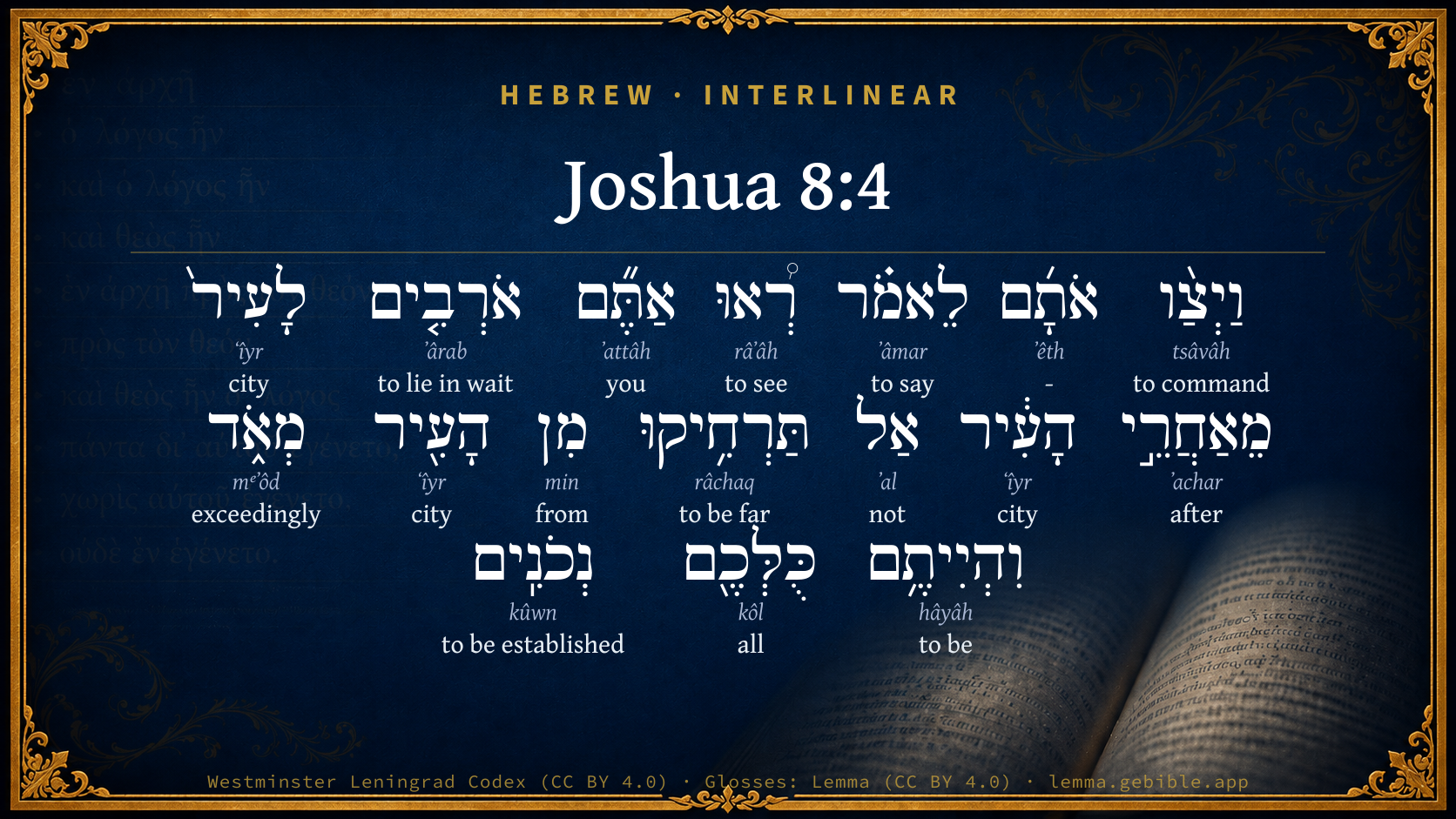
Hebrew (Westminster Leningrad Codex) Joshua 8:4 appears in the Hebrew Old Testament. The text above is from the Westminster Leningrad Codex. Each word links to its Strong’s number, a concise gloss, and parsing drawn from the Open Scriptures Hebrew Bible morphology. Click any word for its full Brown-Driver-Briggs (BDB) entry.
Download image
Cite this verse

Joshua 8:4 (World English Bible). Public Domain. Lemma interlinear Bible study tool, https://lemma.gebible.app/v/joshua/8/4.

Show BibTeX & RIS
BibTeX
RIS
English Translation
He commanded them, saying, Behold, you shall lie in ambush against the city, behind the city; don't go very far from the city, but be all ready:
World English Bible · Public Domain
Download a study sheet

One document with this verse’s original text, its word-by-word gloss line, the meaning frame, cross-references with their text, attributed commentary, and full source and license credits — printable, and it pastes into notes with its structure intact.

This verse Autodidact and up

Study sheet (.html) Plain text (.txt)

A passage Seminary Student

Up to 50 verses in one chapter. A passage sheet keeps up to 6 commentary sources and 12 cross-references per verse, in the order this page ranks them, and says so on the sheet whenever that leaves anything out. Ask for a single verse and you get the Autodidact verse sheet above.

Everything on this page stays free to read, with no account — the sheet is a download of what is already on screen, not access to it.

Want to remove ads? Support Godless Engineer
Compare translations 3

The same verse in 3 English versions, stacked beneath the original-language interlinear above. Click any original word for its lexicon entry.

Each is an independent rendering of the whole verse — the interlinear is not word-aligned to these translations.

Highlighted words mark where these versions differ — a whole-verse word diff, not a word-by-word alignment.

  • World English Bible Public Domain
    He commanded them, saying, Behold, you shall lie in ambush against the city, behind the city; don't go very far from the city, but be all ready:
  • King James Version Public Domain
    And he commanded them, saying, Behold, ye shall lie in wait against the city, even behind the city: go not very far from the city, but be ye all ready:
  • unfoldingWord Literal Text CC BY-SA 4.0
    And he commanded them, saying, “See, you will be lying in ambush against the city from behind the city. You shall not be very far from the city. And all of you shall be prepared.

unfoldingWord Literal Text — © unfoldingWord, licensed CC BY-SA 4.0. Word-aligned USFM3 via Door43 (git.door43.org/unfoldingWord/en_ult).

Versions to compare (up to 4)

3 of 4 selected

Show all 18 translations

Every available English version of this verse, each an independent rendering of the whole verse.

  • World English Bible Public Domain
    He commanded them, saying, Behold, you shall lie in ambush against the city, behind the city; don't go very far from the city, but be all ready:
  • Berean Standard Bible Public Domain
    with these orders: “Pay attention. You are to lie in ambush behind the city, not too far from it. All of you must be ready.
  • Majority Standard Bible Public Domain
    with these orders: “Pay attention. You are to lie in ambush behind the city, not too far from it. All of you must be ready.
  • King James Version Public Domain
    And he commanded them, saying, Behold, ye shall lie in wait against the city, even behind the city: go not very far from the city, but be ye all ready:
  • American Standard Version (1901) Public Domain
    And he commanded them, saying, Behold, ye shall lie in ambush against the city, behind the city; go not very far from the city, but be ye all ready:
  • Revised Version (1885) Public Domain
    And he commanded them, saying, Behold, ye shall lie in ambush against the city, behind the city: go not very far from the city, but be ye all ready:
  • Geneva Bible (1599) Public Domain
    And he commanded them, saying, Behold, yee shall lye in waite against the citie on the backeside of the citie: goe not very farre from the citie, but be ye all in a readinesse.
  • Douay-Rheims (1899) Public Domain
    And commanded them, saying: Lay an ambush behind the city: and go not very far from it: and be ye all ready.
  • Young's Literal Translation Public Domain
    and commandeth them, saying, `See, ye are liers in wait against the city, at the rear of the city, ye go not very far off from the city, and all of you have been prepared,
  • Literal Standard Version CC BY-SA 4.0
    and commands them, saying, “See, you are ones lying in wait against the city, at the rear of the city, you do not go very far off from the city, and all of you have been prepared,
  • Unlocked Literal Bible CC BY-SA 4.0
    He commanded them, “Look, you will lie in ambush against the city, behind it. Do not go very far from the city, but all of you be ready.
  • unfoldingWord Literal Text CC BY-SA 4.0
    And he commanded them, saying, “See, you will be lying in ambush against the city from behind the city. You shall not be very far from the city. And all of you shall be prepared.
  • Darby Bible Public Domain
    And he commanded them, saying, See, ye shall be in ambush against the city, behind the city: go not very far from the city, and be all of you ready.
  • World Messianic Bible Public Domain
    He commanded them, saying, “Behold, you shall lie in ambush against the city, behind the city. Don’t go very far from the city, but all of you be ready.
  • Webster's Bible Public Domain
    And he commanded them, saying, Behold, ye shall lie in wait against the city, even behind the city: go not very far from the city, but be ye all ready:
  • Free Bible Version CC BY-SA 4.0
    He ordered them, “You lie in ambush behind the town, not far away. All of you need to be ready.
  • Bible in Basic English Public Domain
    And he gave them their orders, saying, Go and take up your position secretly at the back of the town: do not go very far away, and let all of you be ready:
  • JPS Tanakh (1917) Public Domain
    And he commanded them, saying: 'Behold, ye shall lie in ambush against the city, behind the city; go not very far from the city, but be ye all ready.

Literal Standard Version (2020), Covenant Press — licensed CC BY-SA 4.0. Text via the HelloAO Bible API (eBible.org). Unlocked Literal Bible (unfoldingWord) — licensed CC BY-SA 4.0. Text via the HelloAO Bible API (eBible.org). unfoldingWord Literal Text — © unfoldingWord, licensed CC BY-SA 4.0. Word-aligned USFM3 via Door43 (git.door43.org/unfoldingWord/en_ult). Free Bible Version, Dr. Jonathan Gallagher — licensed CC BY-SA 4.0. Text via the HelloAO Bible API (eBible.org).

Word by word

More ways to search: Search by grammar → Find every occurrence → Compare this word →

Practice this passage: Drill this verse → Learn its vocabulary →

אֹרְבִ֤ים
ʼârab
H693
“lying in wait”
Verb, Qal, Participle Active, Masculine, Plural, Absolute
Part of Speech
Verb
Stem
Qal
Form
Participle Active
Gender
Masculine
Number
Plural
State
Absolute
Full BDB Definition

Origin: a primitive root

TWOT: 156

to lie in wait, ambush, lurk - (Qal) - to lie in wait - ambush (participle as subst) - (Piel) ambushers, liers-in-wait (plural participle) - (Hiphil) to lay an ambush
  1. וַיְצַ֨ו tsâvâh H6680 “and · to command” Conjunction + Verb, Piel, Sequential Imperfect, 3rd Person, Masculine, Singular
  2. אֹתָ֜ם ʼêth H853 “- · them” Particle, Direct Object + Suffix, Personal, 3rd Person, Masculine, Plural
  3. לֵאמֹ֗ר ʼâmar H559 “to say” Preposition + Verb, Qal, Infinitive Construct
  4. רְ֠אוּ râʼâh H7200 “see” Verb, Qal, Imperative, 2nd Person, Masculine, Plural
  5. אַתֶּ֞ם ʼattâh H859 “you” Pronoun, Personal, 2nd Person, Masculine, Plural
  6. לָעִיר֙ ʻîyr H5892 “to/for the · city” Preposition, Determined + Noun, Common, Feminine, Singular, Absolute
  7. מֵאַחֲרֵ֣י ʼachar H310 “from · after” Preposition + Preposition
  8. הָעִ֔יר ʻîyr H5892 “the · city” Particle, Definite Article + Noun, Common, Feminine, Singular, Absolute
  9. אַל ʼal H408 “not” Particle, Negative
  10. תַּרְחִ֥יקוּ râchaq H7368 “to be far” Verb, Hiphil, Jussive, 2nd Person, Masculine, Plural
  11. מִן min H4480 “from” Preposition
  12. הָעִ֖יר ʻîyr H5892 “the · city” Particle, Definite Article + Noun, Common, Feminine, Singular, Absolute
  13. מְאֹ֑ד mᵉʼôd H3966 “exceedingly” Adverb
  14. וִהְיִיתֶ֥ם hâyâh H1961 “and · to be” Conjunction + Verb, Qal, Sequential Perfect, 2nd Person, Masculine, Plural
  15. כֻּלְּכֶ֖ם kôl H3605 “all · your” Noun, Common, Masculine, Singular, Construct + Suffix, Personal, 2nd Person, Masculine, Plural
  16. נְכֹנִֽים kûwn H3559 “being established” Verb, Niphal, Participle Active, Masculine, Plural, Absolute

About this verse

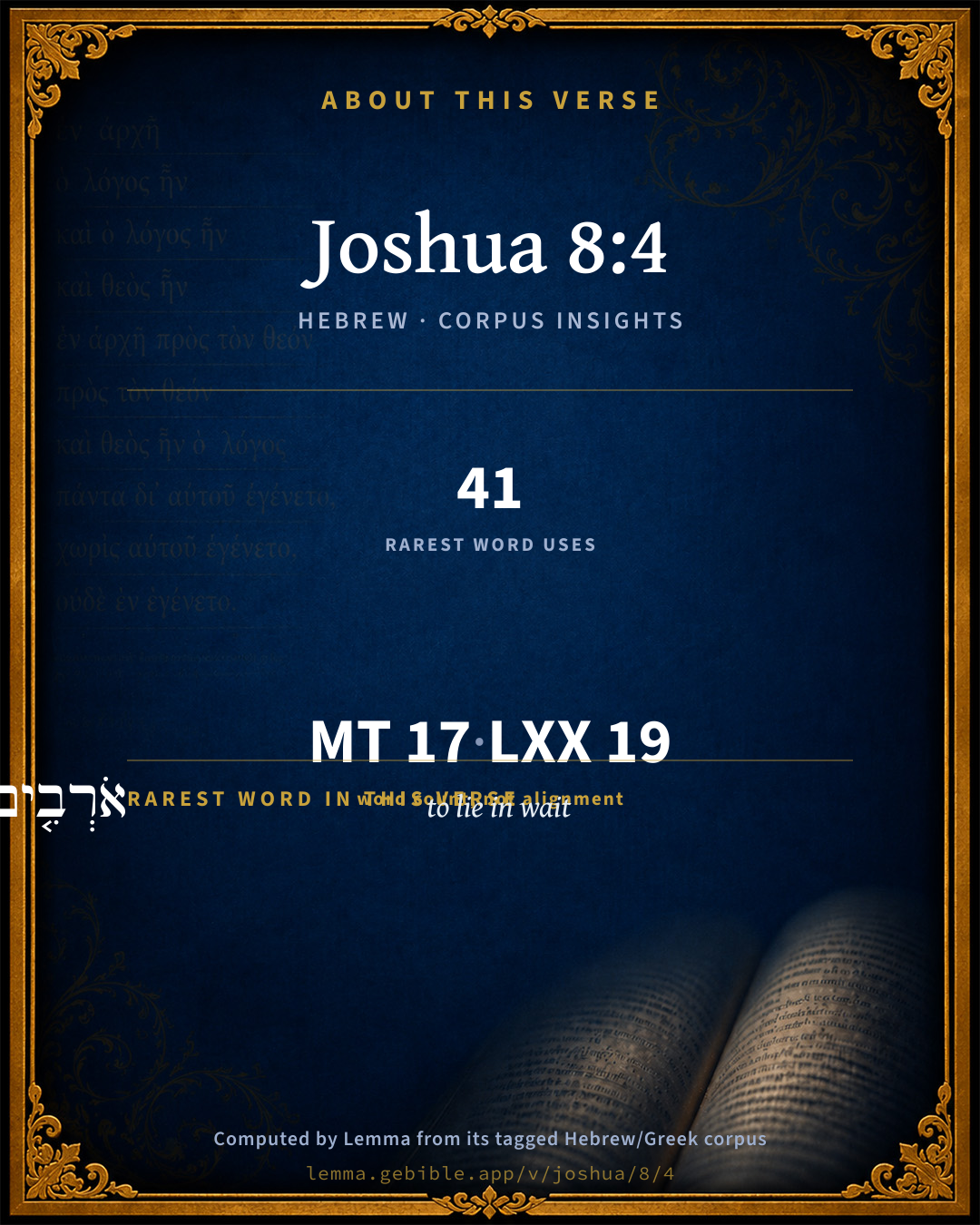
These counts appear in no published source. They are computed here, from the morphology-tagged text and Lemma’s own curated glosses. What Lemma adds →

17
words
15
distinct lemmas
Historical
section

Shared distinctive vocabulary

אֹרְבִ֤ים to lie in wait H693 occurs in 39 verses of the Hebrew Bible. Also found in:

Grammatical profile

  • 7 verbs
  • 4 nouns
  • 1 pronoun
  • 2 prepositions
  • 1 adverb
  • 2 particles

Verb forms

  • וַיְצַ֨ו Piel · Sequential Imperfect
  • לֵאמֹ֗ר Qal · Infinitive Construct
  • רְ֠אוּ Qal · Imperative
  • אֹרְבִ֤ים Qal · Participle Active
  • תַּרְחִ֥יקוּ Hiphil · Jussive
  • וִהְיִיתֶ֥ם Qal · Sequential Perfect
  • נְכֹנִֽים Niphal · Participle Active

Repetition

A word recurs within this verse — often emphatic in Hebrew:

  • לָעִיר֙ city H5892 ×3

Hebrew & Septuagint length

In English translation the verse runs 27 words from the Hebrew and 26 from the Septuagint (LXX English) — closely comparable.

A rough comparison of the two English renderings, which tokenize alike — not a word-level alignment.

Word counts can differ between the Hebrew and the Greek without any difference in meaning — e.g. the Hebrew direct-object marker אֵת has no separate Greek word, and Greek often adds the article ὁ.

In the original languages it is 17 Hebrew tokens and 19 Greek tokens — but the two are counted differently (Hebrew bundles its prefixes and suffixes into one token; the Greek is in lemma form), so that isn’t a like-for-like length.

Cross-references

10

Topical passages linked to Joshua 8:4 in the Treasury of Scripture Knowledge — connected by theme and wording, ordered by reader-vote popularity; previews shown in the World English Bible.

  • Judges 20:29 Israel set liers-in-wait against Gibeah round about.
  • Joshua 8:16 All the people who were in the city were called together to pursue after them: and they pursued after Joshua, and were drawn away from the city.
  • Judges 9:25 The men of Shechem set liers-in-wait for him on the tops of the mountains, and they robbed all who came along that way by them: and it was told Abimelech.
  • Judges 20:33 All the men of Israel rose up out of their place, and set themselves in array at Baal Tamar: and the liers-in-wait of Israel broke forth out of their place, even out of Maareh Geba.
  • Judges 20:36 So the children of Benjamin saw that they were struck; for the men of Israel gave place to Benjamin, because they trusted to the liers-in-wait whom they had set against Gibeah.
  • 1 Samuel 15:2 Thus says Yahweh of Hosts, I have marked that which Amalek did to Israel, how he set himself against him in the way, when he came up out of Egypt.
  • 1 Samuel 15:5 Saul came to the city of Amalek, and laid wait in the valley.
  • Ecclesiastes 7:19 Wisdom is a strength to the wise man more than ten rulers who are in a city.
  • Ecclesiastes 9:16 Then said I, Wisdom is better than strength. Nevertheless the poor man's wisdom is despised, and his words are not heard.
  • Acts 23:21 Therefore don't yield to them, for more than forty men lie in wait for him, who have bound themselves under a curse neither to eat nor to drink until they have killed him. Now they are ready, looking for the promise from you."

Cross-references courtesy of OpenBible.info (CC BY 4.0).

Hebrew and Greek witnesses Masoretic Hebrew ↔ Greek Septuagint

The same verse in the two great witnesses to the Old Testament, shown verse-for-verse.

These are two independent witnesses, not word-aligned to each other, and the Septuagint is shown in lemma (dictionary) form.

Hebrew Joshua 8:4 Masoretic · Westminster Leningrad Codex

וַיְצַ֨ו אֹתָ֜ם לֵאמֹ֗ר רְ֠אוּ אַתֶּ֞ם אֹרְבִ֤ים לָעִיר֙ מֵאַחֲרֵ֣י הָעִ֔יר אַל תַּרְחִ֥יקוּ מִן הָעִ֖יר מְאֹ֑ד וִהְיִיתֶ֥ם כֻּלְּכֶ֖ם נְכֹנִֽים

He commanded them, saying, Behold, you shall lie in ambush against the city, behind the city; don't go very far from the city, but be all ready:

World English Bible · Public Domain

Greek LXX Joshua 8:4 Septuagint · lemma form

καί ἐντέλλομαι αὐτός λέγω σύ ἐνεδρεύω ὀπίσω ὁ πόλις μή μακράν γίγνομαι ἀπό ὁ πόλις καί εἰμί πᾶς ἕτοιμος

And he charged them, saying, Do you⌃ lie in ambush behind the city: do not go far from the city, and you⌃ shall all be ready.

LXX2012 (modern English Septuagint) · Public Domain

Hebrew: Westminster Leningrad Codex (CC BY 4.0). Greek: Septuagint (public domain); English from LXX2012 (modern English Septuagint) (Public Domain). How the Septuagint differs from the Hebrew →

Targum (Aramaic paraphrase)

1

The Targum is the ancient Jewish Aramaic paraphrase of the Hebrew Scriptures — an interpretive translation, not the Hebrew text itself. Onkelos (literal) and Pseudo-Jonathan (expansive) render the Torah, and Jonathan the Prophets. Coverage is partial: where no permissively-licensed English translation exists for a verse, only the Aramaic is shown. This is verse-level text, not a word-by-word alignment to the Hebrew.

  1. Targum Jonathan Prophets (Joshua–Malachi)
    וּפַקֵיד יַתְהוֹן לְמֵימָר חֲזוּ דְאַתּוּן כָּמְנִין לְקַרְתָּא מֵאֲחוֹרֵי קַרְתָּא לָא תַרְחִיקוּן מִן קַרְתָּא לַחֲדָא וּתְהוֹן כּוּלְכוֹן מְתַקְנַיָא:

    (no public-domain English translation for this verse)

    Targum Jonathan — Aramaic: “Mikraot Gedolot” (public domain). English: “Sefaria Community Translation” (CC0 1.0 (public-domain dedication)); “London "Chaldee Paraphrase," 1871” (public domain). Text via Sefaria.

Commentary

Notes on Joshua 8:4 from classic Christian and Jewish commentators (each source and its license shown beneath its notes). The classic Christian expositions comment on the surrounding passage and are grouped to its opening verse, so a note may address several verses; the Jewish commentaries on the Tanakh (Rashi and others) are per-verse, so they appear only where the commentator wrote on this verse.

Lemma curates 59 commentaries, every one of them public domain or Creative Commons licensed, each selected and text-cleaned for this edition rather than reprinted as found. About our sources →

Trapp's Complete Commentary

John Trapp

Jos 8:4 And he commanded them, saying, Behold, ye shall lie in wait against the city, [even] behind the city: go not very far from the city, but be ye all ready:

Ver. 4. Ye shall lie in wait.] See Jos 8:2.

John Trapp, A Commentary or Exposition upon All the Books of the Old and New Testament (1647–1656) — public domain. Text from a community e-Sword module.

Tyndale Open Study Notes

Tyndale Open Resources

8:4-9 Joshua told the select squad what to expect from Israel’s main army. Because this special unit would be separated from Joshua’s command for nearly forty-eight hours, they needed to understand exactly what to do. Israel’s success in this second attempt on Ai depended on the precise timing of their rush into the town.

Tyndale Open Study Notes — © Tyndale Open Resources, licensed CC BY-SA 4.0. Text via the HelloAO Bible API.

Geneva Bible (1599)

Geneva Bible translators

God would not destroy Ai by miracle, as Jericho, to the intent that other nations might fear the power and policy of his people.

Geneva Bible (1599) marginal notes — public domain. Text via Bolls.life.

Jamieson, Fausset & Brown

Robert Jamieson, A. R. Fausset & David Brown

behind the city--is rendered (Jos 8:9), "on the west side of Ai."

Jamieson, Fausset & Brown — Commentary Critical and Explanatory on the Whole Bible (1871) — public domain (CC PDM 1.0). Text via the HelloAO Bible API.

Ellicott's Commentary for English Readers

(4-8) Joshua’s general plan of operations is stated in these verses. The following verses explain how it was worked out.

A Bible Commentary for English Readers, edited by Charles John Ellicott (1878–1897) — public domain. Text from a community e-Sword module.

The Cambridge Bible for Schools and Colleges

gen. ed. J. J. S. Perowne

4. go not very far from the city] They would station themselves high up in the Wâdy Harith, at no great distance from the city, and between it and Bethel.

The Cambridge Bible for Schools and Colleges (gen. ed. J. J. S. Perowne; Cambridge University Press, 1878–1918) — public domain. Text from a community e-Sword module.

John Gill's Exposition

And he commanded them, saying,.... At the time he sent them away:

behold, ye shall lie in wait against the city, even behind the city; that is, on the west side of it, Jos 8:9,

go not very far from the city, but be ye all ready; to enter into it, as soon as the forces are drawn out eastward to meet the army of Israel.

John Gill's Exposition of the Whole Bible (1746–1763) — public domain (CC PDM 1.0). Text via the HelloAO Bible API.

Haydock's Catholic Bible Commentary

Ready to enter the city, when its soldiers are all in pursuit of us. (Haydock)

George Leo Haydock (1774–1849), Haydock's Catholic Family Bible and Commentary, 1859 edition — public domain. Excludes Psalms (Douay-Rheims chapter numbering differs from Protestant) and Deuterocanonical books (Catholic canon only).

Matthew Poole's English Annotations

He commanded them; the same party last spoken of, Jos 8:3, even the five thousand mentioned Jos 8:12. This historical-narration seems obscure and intricate, and at first view to make three parties, one of thirty thousand, Jos 8:3; one of five thousand, Jos 8:12, which may seem to be two several ambushes; and a third of all the people, Jos 8:5,11. But if it be more narrowly and considerately observed, it will appear that there are only two parties engaged in the taking of Ai, and but one ambush, as plainly appears by comparing Jos 8:9 (which manifestly speaks of that party which is mentioned Jos 8:3) with Jos 8:12, which speaks only of five thousand, which is justly supposed to be a part of those thirty thousand named Jos 8:3, and that part which was to lie in ambush; unless we will suppose that there were two ambushes, one of thirty thousand, and the other of five thousand, both lying in wait in the same quarter, even between Beth-el and Ai, on the west side of Ai, the only place where the ambush lay, as is said both Jos 8:9,12,13, which seems absurd and incredible. And besides, in the execution of this command, there is mention but of one ambush, Jos 8:12-14,19, and they are said to consist only of five thousand, Jos 8:12, and they only take and burn the city, Jos 8:19; so that the other supposed ambush of thirty thousand is perfectly vanished and lost, and did nothing in this work; which also is very improbable. And therefore that thirty thousand, Jos 8:3, are the same who are called the people, and the people of war that were with Joshua, Jos 8:5,11, which is pitched on the north side of Ai, Jos 8:11,13, as the ambush did on the west side; but for any other side of the city, or a third party placed elsewhere about Ai, we read not one word; and therefore it may well be presumed there were no more employed to take it.

Matthew Poole's English Annotations on the Holy Bible (1683–1685) — public domain. Text from a community e-Sword/MySword module.

Whedon's Commentary on the Bible

Daniel D. Whedon

4. He commanded them — That is, the five thousand who were to form the ambuscade. To these the words from this verse on through Jos_8:8 are addressed. But of course all these plans for the battle were also made known to the rest of the army.

Daniel D. Whedon (gen. ed.), Commentary on the Old and New Testaments (1874–1909) — public domain. Text from a community e-Sword module.

John Wesley's Explanatory Notes

Them - The same party last spoken of, even the five thousand mentioned ver. 12, there are only two parties engaged in the taking of Ai, and but one ambush, as plainly appears by comparing ver. 9, with ver. 12, which speaks only of five thousand, who are justly supposed to be a part of those thirty thousand named, ver. 3.

John Wesley, Explanatory Notes Upon the Whole Bible (1754–1765) — public domain. Text via the GEBible commentary corpus.

Lesson kit

Teaching starters — assembled from the data on this page, not authored interpretation. Every prompt links to the verse data it draws on. Edit before teaching.

Joshua, in the Historical, opens this verse with 17 words (15 distinct Hebrew lemmas). Its most distinctive word is ʼârab (“to lie in wait”). A historical commentator’s framing appears above. Read the whole chapter for the surrounding context.

Discussion questions

  1. What does “to lie in wait” (ʼârab) contribute to the verse as a whole?
  2. Deuteronomy 19:11 shares the word «to lie in wait» with this verse. How do the two illuminate each other?
  3. “city” occurs 3× in this one verse. What is the effect of the repetition?
  4. These translations render this verse differently; the difference is in the English rendering, not the original. What questions does that raise?
  5. The verb «וַיְצַ֨ו» is Piel Sequential Imperfect. How does its form color the action?
  6. Reading how Trapp's Complete Commentary and Tyndale Open Study Notes read this verse, where do the two commentators agree and where do they part?

Things to notice

Reading settings

Reading text

Shown beneath each verse's original-language words.

Old Testament
Old Testament edition

Read the OT as the Masoretic Hebrew (MT) or the Greek Septuagint (LXX).

English shown for the Greek Septuagint (in the Hebrew ↔ Greek comparison).

Comparing translations? Open the Compare panel on any verse page to stack up to four side by side.