
Genesis 21:12

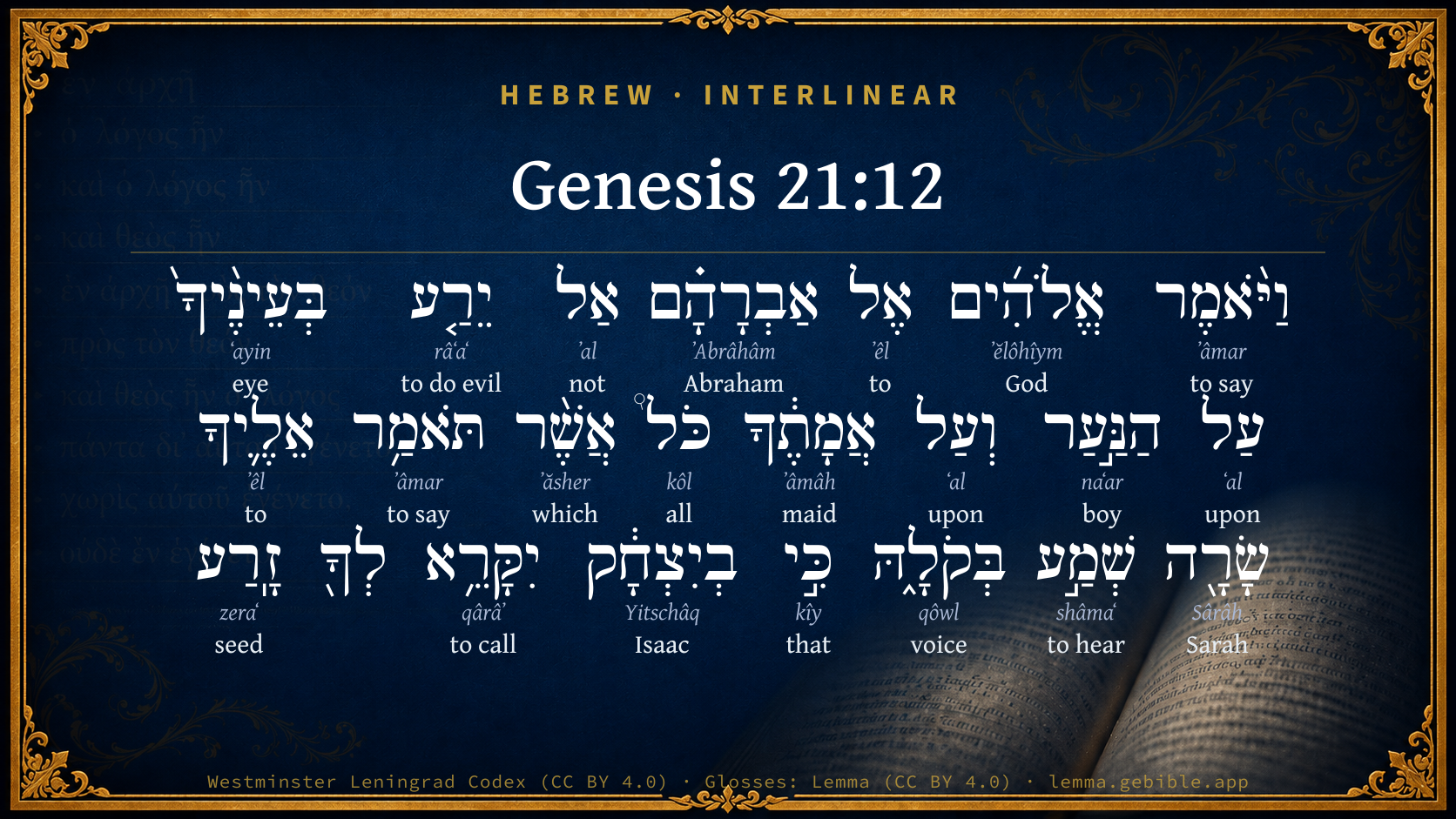
Hebrew (Westminster Leningrad Codex) Genesis 21:12 appears in the Hebrew Old Testament. The text above is from the Westminster Leningrad Codex. Each word links to its Strong’s number, a concise gloss, and parsing drawn from the Open Scriptures Hebrew Bible morphology. Click any word for its full Brown-Driver-Briggs (BDB) entry.
Download image
Cite this verse

Genesis 21:12 (World English Bible). Public Domain. Lemma interlinear Bible study tool, https://lemma.gebible.app/v/genesis/21/12.

Show BibTeX & RIS
BibTeX
RIS
English Translation
God said to Abraham, "Don't let it be grievous in your sight because of the boy, and because of your handmaid. In all that Sarah says to you, listen to her voice. For from Isaac will your seed be called.
World English Bible · Public Domain
Download a study sheet

One document with this verse’s original text, its word-by-word gloss line, the meaning frame, cross-references with their text, attributed commentary, and full source and license credits — printable, and it pastes into notes with its structure intact.

This verse Autodidact and up

Study sheet (.html) Plain text (.txt)

A passage Seminary Student

Up to 50 verses in one chapter. A passage sheet keeps up to 6 commentary sources and 12 cross-references per verse, in the order this page ranks them, and says so on the sheet whenever that leaves anything out. Ask for a single verse and you get the Autodidact verse sheet above.

Everything on this page stays free to read, with no account — the sheet is a download of what is already on screen, not access to it.

Want to remove ads? Support Godless Engineer
Compare translations 3

The same verse in 3 English versions, stacked beneath the original-language interlinear above. Click any original word for its lexicon entry.

Each is an independent rendering of the whole verse — the interlinear is not word-aligned to these translations.

Highlighted words mark where these versions differ — a whole-verse word diff, not a word-by-word alignment.

  • World English Bible Public Domain
    God said to Abraham, "Don't let it be grievous in your sight because of the boy, and because of your handmaid. In all that Sarah says to you, listen to her voice. For from Isaac will your seed be called.
  • King James Version Public Domain
    And God said unto Abraham, Let it not be grievous in thy sight because of the lad, and because of thy bondwoman; in all that Sarah hath said unto thee, hearken unto her voice; for in Isaac shall thy seed be called.
  • unfoldingWord Literal Text CC BY-SA 4.0
    But God said to Abraham, “Do not be distressed in your eyes because of the boy and because of your slave woman. All that Sarah says to you, listen to her voice, because in Isaac, offspring will be called yours.

unfoldingWord Literal Text — © unfoldingWord, licensed CC BY-SA 4.0. Word-aligned USFM3 via Door43 (git.door43.org/unfoldingWord/en_ult).

Versions to compare (up to 4)

3 of 4 selected

Show all 18 translations

Every available English version of this verse, each an independent rendering of the whole verse.

  • World English Bible Public Domain
    God said to Abraham, "Don't let it be grievous in your sight because of the boy, and because of your handmaid. In all that Sarah says to you, listen to her voice. For from Isaac will your seed be called.
  • Berean Standard Bible Public Domain
    But God said to Abraham, “Do not be distressed about the boy and your maidservant. Listen to everything that Sarah tells you, for through Isaac your offspring will be reckoned.
  • Majority Standard Bible Public Domain
    But God said to Abraham, “Do not be distressed about the boy and your maidservant. Listen to everything that Sarah tells you, for through Isaac your offspring will be reckoned.
  • King James Version Public Domain
    And God said unto Abraham, Let it not be grievous in thy sight because of the lad, and because of thy bondwoman; in all that Sarah hath said unto thee, hearken unto her voice; for in Isaac shall thy seed be called.
  • American Standard Version (1901) Public Domain
    And God said unto Abraham, Let it not be grievous in thy sight because of the lad, and because of thy handmaid. In all that Sarah saith unto thee, hearken unto her voice. For in Isaac shall thy seed be called.
  • Revised Version (1885) Public Domain
    And God said unto Abraham, Let it not be grievous in thy sight because of the lad, and because of thy bondwoman; in all that Sarah saith unto thee, hearken unto her voice; for in Isaac shall thy seed be called.
  • Geneva Bible (1599) Public Domain
    But God said vnto Abraham, Let it not be grieuous in thy sight for the childe, and for thy bonde woman: in all that Sarah shall say vnto thee, heare her voyce: for in Izhak shall thy seede be called.
  • Douay-Rheims (1899) Public Domain
    And God said to him: Let it not seem grievous to thee for the boy, and for thy bondwoman: in all that Sara hath said to thee, hearken to her voice: for in Isaac shall thy seed be called.
  • Young's Literal Translation Public Domain
    and God saith unto Abraham, `Let it not be wrong in thine eyes because of the youth, and because of thy handmaid: all that Sarah saith unto thee -- hearken to her voice, for in Isaac is a seed called to thee.
  • Literal Standard Version CC BY-SA 4.0
    and God says to Abraham, “Let it not be wrong in your eyes because of the youth, and because of your handmaid: all that Sarah says to you—listen to her voice, for in Isaac is a seed called to you.
  • Unlocked Literal Bible CC BY-SA 4.0
    But God said to Abraham, “Do not be grieved because of the lad, and because of your servant woman. Listen to her words in all she says to you about this matter, because it is through Isaac that your descendants will be named.
  • unfoldingWord Literal Text CC BY-SA 4.0
    But God said to Abraham, “Do not be distressed in your eyes because of the boy and because of your slave woman. All that Sarah says to you, listen to her voice, because in Isaac, offspring will be called yours.
  • Darby Bible Public Domain
    And God said to Abraham, Let it not be grievous in thy sight because of the lad and because of thy handmaid: [in] all that Sarah hath said to thee hearken to her voice, for in Isaac shall a seed be called to thee.
  • World Messianic Bible Public Domain
    God said to Abraham, “Don’t let it be grievous in your sight because of the boy, and because of your servant. In all that Sarah says to you, listen to her voice. For your offspring will be named through Isaac.
  • Webster's Bible Public Domain
    And God said to Abraham, Let it not be grievous in thy sight, because of the lad, and because of thy bond-woman; in all that Sarah hath said to thee, hearken to her voice: for in Isaac shall thy seed be called.
  • Free Bible Version CC BY-SA 4.0
    But God told Abraham, “Don't feel bad about the boy and the slave woman. Do whatever Sarah tells you, because it's through Isaac that your descendants will be counted.
  • Bible in Basic English Public Domain
    But God said, Let it not be a grief to you because of the boy and Hagar his mother; give ear to whatever Sarah says to you, because it is from Isaac that your seed will take its name.
  • JPS Tanakh (1917) Public Domain
    And God said unto Abraham: 'Let it not be grievous in thy sight because of the lad, and because of thy bondwoman; in all that Sarah saith unto thee, hearken unto her voice; for in Isaac shall seed be called to thee.

Literal Standard Version (2020), Covenant Press — licensed CC BY-SA 4.0. Text via the HelloAO Bible API (eBible.org). Unlocked Literal Bible (unfoldingWord) — licensed CC BY-SA 4.0. Text via the HelloAO Bible API (eBible.org). unfoldingWord Literal Text — © unfoldingWord, licensed CC BY-SA 4.0. Word-aligned USFM3 via Door43 (git.door43.org/unfoldingWord/en_ult). Free Bible Version, Dr. Jonathan Gallagher — licensed CC BY-SA 4.0. Text via the HelloAO Bible API (eBible.org).

Word by word

More ways to search: Search by grammar → Find every occurrence → Compare this word →

Practice this passage: Drill this verse → Learn its vocabulary →

שָׂרָ֖ה
Sârâh
H8283
“Sarah”
Noun, Proper
Part of Speech
Noun
Type
Proper
Full BDB Definition

Origin: the same as H8282

TWOT: None

Sarah = "noblewoman" - wife of Abraham and mother of Isaac
  1. וַיֹּ֨אמֶר ʼâmar H559 “and · to say” Conjunction + Verb, Qal, Sequential Imperfect, 3rd Person, Masculine, Singular
  2. אֱלֹהִ֜ים ʼĕlôhîym H430 “God(s)” Noun, Common, Masculine, Plural, Absolute
  3. אֶל ʼêl H413 “to” Preposition
  4. אַבְרָהָ֗ם ʼAbrâhâm H85 “Abraham” Noun, Proper
  5. אַל ʼal H408 “not” Particle, Negative
  6. יֵרַ֤ע râʻaʻ H7489 “to do evil” Verb, Qal, Jussive, 3rd Person, Masculine, Singular
  7. בְּעֵינֶ֨יךָ֙ ʻayin H5869 “in/at · eyes · your” Preposition + Noun, Common, Both, Dual, Construct + Suffix, Personal, 2nd Person, Masculine, Singular
  8. עַל ʻal H5921 “upon” Preposition
  9. הַנַּ֣עַר naʻar H5288 “the · boy” Particle, Definite Article + Noun, Common, Masculine, Singular, Absolute
  10. וְעַל ʻal H5921 “and · upon” Conjunction + Preposition
  11. אֲמָתֶ֔ךָ ʼâmâh H519 “maid · your” Noun, Common, Feminine, Singular, Construct + Suffix, Personal, 2nd Person, Masculine, Singular
  12. כֹּל֩ kôl H3605 “all of” Noun, Common, Masculine, Singular, Construct
  13. אֲשֶׁ֨ר ʼăsher H834 “which” Particle, Relative
  14. תֹּאמַ֥ר ʼâmar H559 “to say” Verb, Qal, Imperfect, 3rd Person, Feminine, Singular
  15. אֵלֶ֛יךָ ʼêl H413 “to · you” Preposition + Suffix, Personal, 2nd Person, Masculine, Singular
  16. שְׁמַ֣ע shâmaʻ H8085 “hear” Verb, Qal, Imperative, 2nd Person, Masculine, Singular
  17. בְּקֹלָ֑הּ qôwl H6963 “in/at · voice · her” Preposition + Noun, Common, Masculine, Singular, Construct + Suffix, Personal, 3rd Person, Feminine, Singular
  18. כִּ֣י kîy H3588 “that” Conjunction
  19. בְיִצְחָ֔ק Yitschâq H3327 “in/at · Isaac” Preposition + Noun, Proper
  20. יִקָּרֵ֥א qârâʼ H7121 “to call” Verb, Niphal, Imperfect, 3rd Person, Masculine, Singular
  21. זָֽרַע zeraʻ H2233 “seed” Noun, Common, Masculine, Singular, Absolute

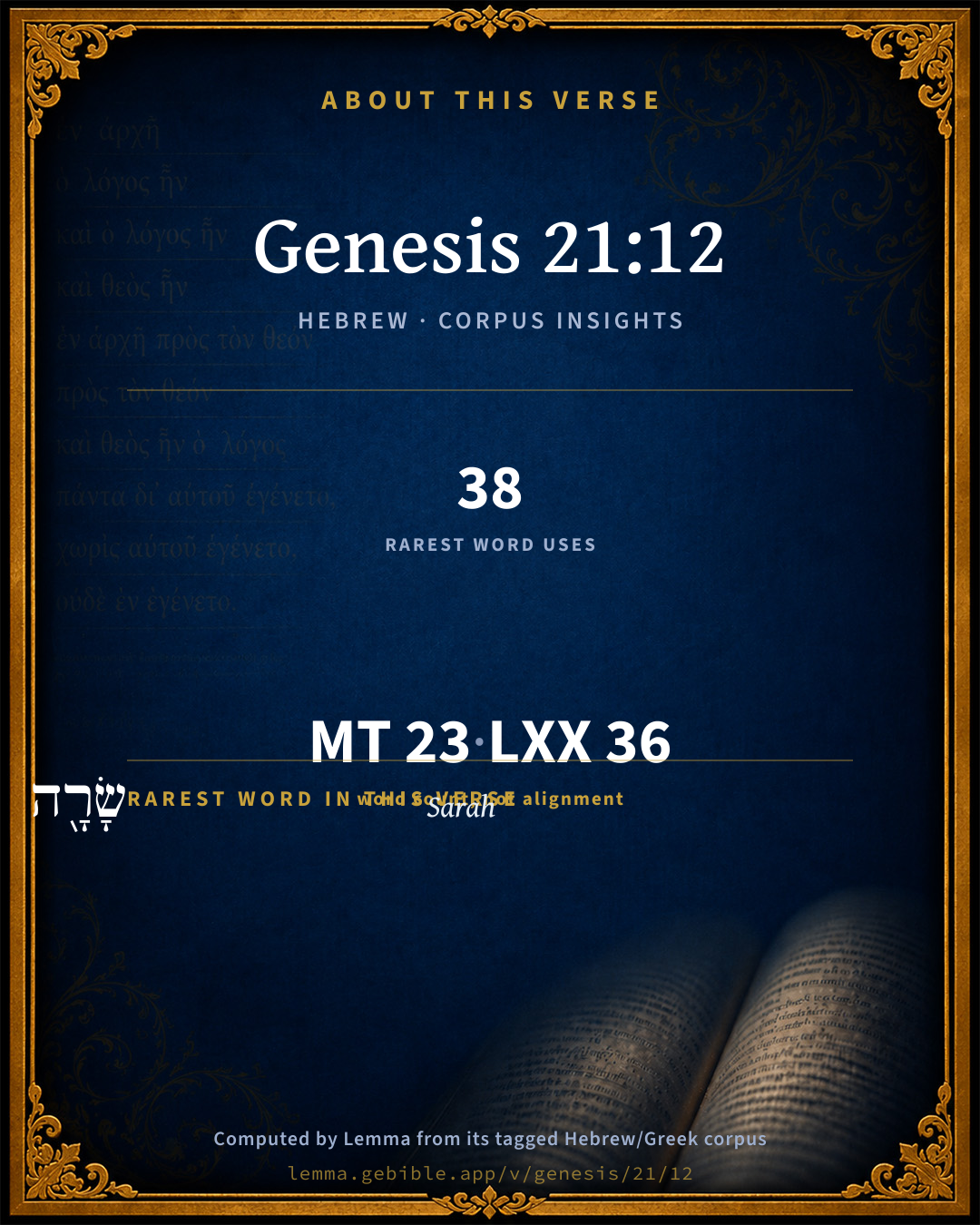
About this verse

These counts appear in no published source. They are computed here, from the morphology-tagged text and Lemma’s own curated glosses. What Lemma adds →

23
words
19
distinct lemmas
Pentateuch
section

Shared distinctive vocabulary

שָׂרָ֖ה Sarah H8283 occurs in 32 verses of the Hebrew Bible. Also found in:

Grammatical profile

  • 5 verbs
  • 10 nouns
  • 5 prepositions
  • 1 conjunction
  • 2 particles

Verb forms

  • וַיֹּ֨אמֶר Qal · Sequential Imperfect
  • יֵרַ֤ע Qal · Jussive
  • תֹּאמַ֥ר Qal · Imperfect
  • שְׁמַ֣ע Qal · Imperative
  • יִקָּרֵ֥א Niphal · Imperfect

Repetition

Words recur within this verse — often emphatic in Hebrew:

  • וַיֹּ֨אמֶר to say H559 ×2
  • עַל upon H5921 ×2
  • אֶל to H413 ×2

Hebrew & Septuagint length

In English translation the verse runs 40 words from the Hebrew and 39 from the Septuagint (LXX English) — closely comparable.

A rough comparison of the two English renderings, which tokenize alike — not a word-level alignment.

Word counts can differ between the Hebrew and the Greek without any difference in meaning — e.g. the Hebrew direct-object marker אֵת has no separate Greek word, and Greek often adds the article ὁ.

In the original languages it is 23 Hebrew tokens and 36 Greek tokens — but the two are counted differently (Hebrew bundles its prefixes and suffixes into one token; the Greek is in lemma form), so that isn’t a like-for-like length.

Cross-references

7

Topical passages linked to Genesis 21:12 in the Treasury of Scripture Knowledge — connected by theme and wording, ordered by reader-vote popularity; previews shown in the World English Bible.

  • Hebrews 11:18 even he to whom it was said, "In Isaac will your seed be called;"
  • Romans 9:7–8 Neither, because they are Abraham's seed, are they all children. But, "In Isaac will your seed be called."
  • Genesis 17:19 God said, "No, but Sarah, your wife, will bear you a son. You shall call his name Isaac. I will establish my covenant with him for an everlasting covenant for his seed after him.
  • 1 Samuel 8:7 Yahweh said to Samuel, Listen to the voice of the people in all that they tell you; for they have not rejected you, but they have rejected me, that I should not be king over them.
  • 1 Samuel 8:9 Now therefore listen to their voice: however you shall protest solemnly to them, and shall show them the manner of the king who shall reign over them.
  • Genesis 17:21 But my covenant I establish with Isaac, whom Sarah will bear to you at this set time in the next year."
  • Isaiah 46:10 declaring the end from the beginning, and from ancient times things that are not [yet] done; saying, My counsel shall stand, and I will do all my pleasure;

Cross-references courtesy of OpenBible.info (CC BY 4.0).

Hebrew and Greek witnesses Masoretic Hebrew ↔ Greek Septuagint

The same verse in the two great witnesses to the Old Testament, shown verse-for-verse.

These are two independent witnesses, not word-aligned to each other, and the Septuagint is shown in lemma (dictionary) form.

Hebrew Genesis 21:12 Masoretic · Westminster Leningrad Codex

וַיֹּ֨אמֶר אֱלֹהִ֜ים אֶל אַבְרָהָ֗ם אַל יֵרַ֤ע בְּעֵינֶ֨יךָ֙ עַל הַנַּ֣עַר וְעַל אֲמָתֶ֔ךָ כֹּל֩ אֲשֶׁ֨ר תֹּאמַ֥ר אֵלֶ֛יךָ שָׂרָ֖ה שְׁמַ֣ע בְּקֹלָ֑הּ כִּ֣י בְיִצְחָ֔ק יִקָּרֵ֥א לְךָ֖ זָֽרַע

God said to Abraham, "Don't let it be grievous in your sight because of the boy, and because of your handmaid. In all that Sarah says to you, listen to her voice. For from Isaac will your seed be called.

World English Bible · Public Domain

Greek LXX Genesis 21:12 Septuagint · lemma form

εἶπον δέ ὁ θεός ὁ αβρααμ μή σκληρός εἰμί ὁ ῥῆμα ἐναντίον σύ περί ὁ παιδίον καί περί ὁ παιδίσκη πᾶς ὅσος ἐάν εἶπον σύ σαρρα ἀκούω ὁ φωνή αὐτός ὅτι ἐν ισαακ καλέω σύ σπέρμα

But God said to Abraam, Let it not be hard before you concerning the child, and concerning the bondwoman; in all things whatever Sarrha shall say to you, hear her voice, for in Isaac shall your seed be called.

LXX2012 (modern English Septuagint) · Public Domain

On this verse, The Cambridge Bible for Schools and Colleges discusses the Septuagint’s reading. Read the note in Commentary ↓

Hebrew: Westminster Leningrad Codex (CC BY 4.0). Greek: Septuagint (public domain); English from LXX2012 (modern English Septuagint) (Public Domain). How the Septuagint differs from the Hebrew →

Targum (Aramaic paraphrase)

2

The Targum is the ancient Jewish Aramaic paraphrase of the Hebrew Scriptures — an interpretive translation, not the Hebrew text itself. Onkelos (literal) and Pseudo-Jonathan (expansive) render the Torah, and Jonathan the Prophets. Coverage is partial: where no permissively-licensed English translation exists for a verse, only the Aramaic is shown. This is verse-level text, not a word-by-word alignment to the Hebrew.

  1. Targum Onkelos Torah (Genesis–Deuteronomy)
    וַאֲמַר יְיָ לְאַבְרָהָם לָא יַבְאֵשׁ בְּעֵינָיךְ עַל עוּלֵימָא וְעַל אַמְתָךְ כֹּל דִּי תֵימַר לָךְ שָׂרָה קַבֵּל מִנַּהּ אֲרֵי בְיִצְחָק יִתְקְרוּן לָךְ בְּנִין

    (no public-domain English translation for this verse)

    Targum Onkelos — Aramaic: “Onkelos Genesis” (public domain); “Onkelos Exodus” (public domain); “Onkelos Leviticus” (public domain); “Onkelos Numbers” (public domain); “Onkelos Deuteronomy” (public domain). English: “Sefaria Community Translation” (CC0 1.0 (public-domain dedication)); “J.W. Etheridge. The Targums of Onkelos and Jonathan Ben Uzziel on the Pentateuch. London: Longmans, Green, 1862” (public domain). Text via Sefaria.

  2. Targum Pseudo-Jonathan Torah (Genesis–Deuteronomy)
    וַאֲמַר יְיָ לְאַבְרָהָם לָא יַבְאִישׁ בְּעֵינָךְ עַל טַלְיָא דִי נְפַק מִתַּרְבּוּתָךְ וְעַל אַמְתָךְ דְאַנְתְּ מְתָרֵךְ כָּל דְתֵימַר לָךְ שָרָה קַבֵּיל מִנָהּ דִנְבִיאֲתָא הִיא אֲרוּם בְּיִצְחָק יִתְקְרוּן לָךְ בְּנִין וְדֵין בַּר אַמְתָא לָא מִתְיַחֵס בַּתְרָךְ

    And the Lord said to Abraham, Let it not be evil in thine eyes on account of the youth who goeth forth from thy nurturning, and of thy handmaid whom thou sendest away. Hearken unto all that Sarah saith to thee, because she is a prophetess; for in Izhak shall sons be called unto thee; and this son of the handmaid shall not be genealogized after thee.

    Targum Pseudo-Jonathan — Aramaic: “Targum Jonathan on Genesis” (public domain); “Targum Jonathan on Exodus” (public domain); “Targum Jonathan on Leviticus” (public domain); “Targum Jonathan on Numbers” (public domain); “Targum Jonathan on Deuteronomy” (public domain). English: “The Targum of Jonathan ben Uzziel, trans. J. W. Etheridge, London, 1862” (public domain). Text via Sefaria.

Commentary

Notes on Genesis 21:12 from classic Christian and Jewish commentators (each source and its license shown beneath its notes). The classic Christian expositions comment on the surrounding passage and are grouped to its opening verse, so a note may address several verses; the Jewish commentaries on the Tanakh (Rashi and others) are per-verse, so they appear only where the commentator wrote on this verse.

Lemma curates 59 commentaries, every one of them public domain or Creative Commons licensed, each selected and text-cleaned for this edition rather than reprinted as found. About our sources →

Trapp's Complete Commentary

John Trapp

Gen 21:12 And God said unto Abraham, Let it not be grievous in thy sight because of the lad, and because of thy bondwoman; in all that Sarah hath said unto thee, hearken unto her voice; for in Isaac shall thy seed be called.

Ver. 12. In all that Sarah hath said unto thee, &c.] The wife then is to be hearkened to when she speaks reason. Samson’s mother had more faith than her husband: {Jdg 13:23} and Priscilla is sometimes set before Aquila. Paul’s hearers at Philippi were only women at first. {Act 16:13} And St Peter tells Christian wives that they may win their husbands to Christ by their "chaste conversation coupled with fear". {1Pe 3:1} "The Scripture" is said to "say" what Sarah here saith. {Gal 4:30}

John Trapp, A Commentary or Exposition upon All the Books of the Old and New Testament (1647–1656) — public domain. Text from a community e-Sword module.

Geneva Bible (1599)

Geneva Bible translators

The promised seed shall be counted from Isaac, and not from Ishmael, Rom. 9:7; Heb. 11:18.

Geneva Bible (1599) marginal notes — public domain. Text via Bolls.life.

Jamieson, Fausset & Brown

Robert Jamieson, A. R. Fausset & David Brown

in all that Sarah hath said--it is called the Scripture (Gal 4:30).

Jamieson, Fausset & Brown — Commentary Critical and Explanatory on the Whole Bible (1871) — public domain (CC PDM 1.0). Text via the HelloAO Bible API.

Adam Clarke's Commentary

Verse 12. In Isaac shall thy seed be called.] Here God shows the propriety of attending to the counsel of Sarah; and lest Abraham, in whose eyes the thing was grievous, should feel distressed on the occasion, God renews his promises to Ishmael and his posterity.

Adam Clarke's Commentary on the Bible (1810–1826) — public domain. Text from a community e-Sword/MySword module.

John Calvin's Commentaries

12. In all that Sarah hath said unto thee. I have just said that although God used the ministry of Sarah in so great a matter, it was yet possible that she might fail in her method of acting. He now commands Abraham to hearken unto his wife, not because he approves her disposition, but because he will have the work, of which he is Himself the Author, accomplished. And he thus shows that his designs are not to be subjected to any common rule, especially when the salvation of the Church is concerned. For he purposely inverts the accustomed order of nature, in order that he may prove himself to be the Author and the Perfecter of Isaac’s vocation. But because I have before declared, that this history is more profoundly considered by Paul, the sum of it is here briefly to be collected. In the first place, he says, that what is here read, was written allegorically: not that he wishes all histories, indiscriminately to be tortured to an allegorical sense, as Origin does; who by hunting everywhere for allegories, corrupts the whole Scripture; and others, too eagerly emulating his example, have extracted smoke out of light. And not only has the simplicity of Scripture been vitiated, but the faith has been almost subverted, and the door opened to many foolish dotings. The design of Paul was, to raise the minds of the pious to consider the secret work of God, in this history; as if he had said, What Moses relates concerning the house of Abraham, belongs to the spiritual kingdom of Christ; since, certainly, that house was a lively image of the Church. This, however, is the allegorical similitude which Paul commends. Whereas two sons were born to Abraham, the one by a handmaid, the other by a free woman; he infers, that there are two kinds of persons born in the Church; the faithful, whom God endues with the Spirit of adoption, that they may enjoy the inheritance; and hypocritical disciples, who feign themselves to be what they are not, and usurp, for a time, a name and place among the sons of God. He therefore teaches, that there are certain who are conceived and born in a servile manner; but others, as from a freeborn mother. He then proceeds to say, that the sons of Hagar are they who are generated by the servile doctrine of the Law; but that they who, having embraced, by faith, gratuitous adoption, are born through the doctrine of the Gospel, are the sons of the free woman. At length he descends to another similitudes in which he compares Hagar with mount Sinai, but Sarah with the heavenly Jerusalem. And although I here allude in few words to those things which my readers will find copiously expounded by me, in the fourth chapter to the Galatians Galatians 4:1; yet, in this short explanation, it is made perfectly clear what Paul designs to teach. We know that the true sons of God are born of the incorruptible seed of the word: but when the Spirit, which gives life to the doctrine of the Law and the Prophets, is taken away, and the dead letter alone remains, then that seed is so corrupted, that only adulterous sons are born in a state of slavery; yet because they are apparently born of the word of God, though corrupted, they are, in a sense, the sons of God. Meanwhile, none are lawful heirs, except those whom the Church brings forth into liberty, being conceived by the incorruptible seed of the gospel. I have said, however, that in these two persons is represented the perpetual condition of the Church. For hypocrites not only mingle with the sons of God in the Church, but despise them, and proudly appropriate to themselves all the rights and honors of the Church. And as Ishmael, inflated with the vain title of primogeniture, harassed his brother Isaac with his taunts; so these men, relying on their own splendor, reproachfully assail and ridicule the true faith of the simple: because, by arrogating all things to themselves, they leave nothing to the grace of God. Hence we are admonished, that none have a well-grounded confidence of salvation, but they who, being called freely, regard the mercy of God as their whole dignity. Again, the Spirit furnishes the consciences of the pious with strong and effective weapons against the ferociousness of those who, under a false pretext, boast that they are the Church. We see that it is no new thing, for persons who are nothing but hypocrites to occupy the chief place in the Church at God. Wherefore, while at this day, the Papists proudly exult, there is no reason why we should be disturbed by their empty and inflated boasts. As to their glorying in their long succession, it just means as much as if Ishmael were proclaiming himself the firstborn. It is, therefore necessary to discriminate between the true and the hypocritical Church. Paul describes a mark, which they are never able, with their cavils, to obliterate. For as large bottles are broken with a slight blast; so by this single word, all their glory is extinguished, ‘the sons of the handmaid shall not be eternal inheritors.’ In the meantime their insolence is to be patiently borne, so long as God shall loosen the rein to their tyranny. For the Apostles, formerly, were oppressed by the Jewish hypocrites of their age, with the same reproaches which these men now cast upon us. In the same way, Ishmael triumphed over Isaac, as if he had obtained the victory. Wherefore, we must not wonder, if our own age also has its Ishmaelites. But lest such indignity should break our spirits, let this consolation perpetually occur to us, that they who hold the preeminence in the Church, will not always remain within it.

John Calvin's Commentaries (1540-1563) — public domain. Text from the Calvin Translation Society English edition (1840s-50s) via the Christian Classics Ethereal Library (ccel.org). Calvin's coverage is partial (roughly two-thirds of the Bible); uncommented books and verses are honest gaps, never fabricated. The 19th-century editor's footnotes and remarks are omitted so the notes are faithfully Calvin's own voice.

Ellicott's Commentary for English Readers

(12) In Isaac shall thy seed be called—Heb., in Isaac there shall be called to thee a seed: that is, the seed that shall especially be accounted thine, and which, as such, shall inherit the promises, will be that sprung from Isaac.

A Bible Commentary for English Readers, edited by Charles John Ellicott (1878–1897) — public domain. Text from a community e-Sword module.

The Cambridge Bible for Schools and Colleges

gen. ed. J. J. S. Perowne

12. And God said] It is revealed to Abraham by night (Gen_21:14), that compliance with Sarah’s demand will be overruled to fulfil the destiny of Hagar’s child. The Israelite tradition, according to the comparatively low moral standard of its time, especially in connexion with the conditions of slave concubinage and its domestic results, attributed to the voice of God a command that in our ears sounds unfeeling and cruel.

in Isaac shall thy seed be called] Lit. “in Isaac shall seed be called to thee.” LXX ἐν Ἰσαὰκ κληθήσεταί σοι σπέρμα, which is quoted in Rom_9:7 and Heb_11:18. The meaning is that in Isaac and in his descendants Abraham will have those who will be called by his name.

Isaac is to be the father of the “children of promise.” He stands, therefore, in the allegory (Gal_4:27-28), in contrast with him “that was born after the flesh” (i.e. Ishmael). Isaac stands for those “born after the spirit.”

The Cambridge Bible for Schools and Colleges (gen. ed. J. J. S. Perowne; Cambridge University Press, 1878–1918) — public domain. Text from a community e-Sword module.

John Gill's Exposition

And also of the son of the bondwoman will I make a nation,.... A great nation, as is promised, Gen 17:20; and such the Ishmaelites and Saracens have been, and the Turks now are, the descendants of Ishmael. The Targum of Jonathan paraphrases it, a people of thieves, or a thieving people; as were the Saracens, and who are thought to have that name from the Arabic word "sarac" (y), to thieve; though they would have it derived from Sarah: but it is not agreeable to the promise of God to Abraham, that when for his comfort he is told that his son Ishmael and his descendants should become a great nation, that they should be described as a company of thieves and robbers; and especially when the reason of the promise is given:

because he is thy seed; or thy son; here the word "seed" is again used of a single individual; see Gen 4:25.

(y) "furatus fuit, furto abstulit", Golius, col. 1167. Castel. col. 2626.

John Gill's Exposition of the Whole Bible (1746–1763) — public domain (CC PDM 1.0). Text via the HelloAO Bible API.

Matthew Poole's English Annotations

Thus Abraham had better authority for his divorce from Hagar than he had for his marriage with her, Gen 16:2.

Thy seed, to wit, the promised Seed, the heir of thy estate, covenant, and promises, the progenitor of my church and people, and particularly of the Messias.

Called, i.e. reputed and valued, both by me and other men. The words may be thus rendered, by Isaac shall thy seed be; for to be called is ofttimes put for to be, as Isa 1:26; 47:1,5; Mt 5:9,19.

Matthew Poole's English Annotations on the Holy Bible (1683–1685) — public domain. Text from a community e-Sword/MySword module.

Whedon's Commentary on the Bible

Daniel D. Whedon

12. In Isaac shall thy seed be called — Literally, In Isaac shall there be called to thee a seed. The meaning evidently is, that the promised seed should spring, not from Ishmael but from Isaac. First, the promise came to Adam; then to Noah; then, in select succession, to Abraham, Isaac, Jacob, Judah, and David.

Daniel D. Whedon (gen. ed.), Commentary on the Old and New Testaments (1874–1909) — public domain. Text from a community e-Sword module.

The Pulpit Commentary

And God said unto Abraham, probably in a dream, or night vision (vide Ver. 14)Let it not be grievous in thy sight because of the lad, and because of thy bondwoman; who was never recognized by God as Abraham"s wife (cf. Gen_16:8) in all that Sarah hath said unto thee, hearken unto her voice. Though Sarah"s counsel was approved by God, it does not follow that her conduct was. On a former occasion Abraham"s hearkening unto Sarah"s voice had led to sin; (Gen_16:2) this time it would lie exactly in the line of duty. For in Isaac shall thy seed be called. Literally, in Isaac shall seed (i.e. posterity) be called to thee; meaning neither, by Isaac shall thy seed be called, or named" (Hofmann, Kalisch, Ainsworth), nor, "in Isaac shall thy seed be called into existence" (Dreschler); but, "in Isaac shall there be posterity to thee which shall pass as such," i.e. be called or recognized as such (Keil); or, more simply, "in Isaac," i.e. in the line of Isaac, "shall be called to thee a seed," i.e. a seed par excellence, the seed already promised (Bleek, Delitzsch, Rosenm Alford, Murphy).

The Pulpit Commentary (1880–1919), ed. H.D.M. Spence-Jones & Joseph S. Exell — public domain. Text from a community e-Sword module.

unfoldingWord translationNotes

Door43 World Missions Community

Do not be grieved because of the lad, and because of your servant woman

"Do not be upset about the boy and your handmaid"

Listen to her words in all she says to you about this matter

"Do everything that Sarah says to you about them"

it is through Isaac that your descendants will be named

The phrase "will be named" means those born through Isaac are the ones God considers to be the descendants that he promised Abraham. This can be stated in active form. AT: "Isaac is the one who will be the forefather of the descendants I promised to give you" (See: Active or Passive)

I will also make the son of the servant woman into a nation

The word "nation" means God will give him many descendants so that they become a great nation of people. AT: "I will make the servant woman's son also become the father of a great nation" (See: Metonymy)

translationWords

God

Abraham

Sarah

servant

Isaac

descend

nation

unfoldingWord translationNotes — © Distant Shores Media and the Door43 World Missions Community, licensed CC BY-SA 4.0. Source: git.door43.org/Door43/en_tn.

Rashi

Rabbi Shlomo Yitzchaki (Rashi)

שמע בקולה HEARKEN UNTO HER VOICE — we may infer that Abraham was inferior to Sarah in respect of prophecy (Exodus Rabbah 1:1).

Rashi on the Tanakh — English translations: “The Judaica Press complete Tanach with Rashi, translated by A. J. Rosenberg” (CC BY 4.0); “Pentateuch with Rashi's commentary by M. Rosenbaum and A.M. Silbermann, 1929-1934” (public domain); “The Metsudah Tanach series, Lakewood, N.J” (CC BY 4.0); and “The Book of Joshua, Metsudah Publications, 1997” (CC BY 4.0). Text via Sefaria.

Radak

Rabbi David Kimhi (Radak)

ויאמר...על הנער ועל אמתך, G’d knew that Avraham was not only displeased about Sarah’s request to expel Ishmael, but he was also chagrined at being asked to expel Hagar, his maid-servant. [described here as his servant rather than as Sarah’s servant. Ed.] Even though the Torah had only spelled out that Avraham had felt aggrieved on account of his son (verse 11), the reason why our text had mentioned only his son was that he was his principal concern. He was prepared to quarrel with Sarah about the future of his son, whereas he was not prepared to make the continued presence of Hagar an issue between them. G’d, however, knew how he really felt concerning Hagar.

כל אשר תאמר, this was not a carte blanche for Sarah except in the matter of Ishmael and Hagar. The point was that Ishmael was not to share in Avraham’ s heritage. כי ביצחק יקרא לך זרע, the promise I had given to you in 17,8 applies only to Yitzchok as he is the seed specifically yours.

Radak on the Tanakh — English translations: “Sefaria Community Translation” (CC0 1.0 (public-domain dedication)); “Eliyahu Munk, HaChut Hameshulash” (CC BY 4.0); “Rabbi Mike Feuer, Jerusalem Anthology” (CC BY 4.0); and “R. David Kimhi on the first book of Psalms, Translated by R.G. Finch, London, 1919” (public domain). Text via Sefaria.

Lesson kit

Teaching starters — assembled from the data on this page, not authored interpretation. Every prompt links to the verse data it draws on. Edit before teaching.

Genesis, in the Pentateuch, opens this verse with 23 words (19 distinct Hebrew lemmas). Its most distinctive word is Sârâh (“Sarah”). A historical commentator’s framing appears above. Read the whole chapter for the surrounding context.

Discussion questions

  1. How does “Sarah” (Sârâh) shape what this verse is saying?
  2. Genesis 17:15 shares the word «Sarah» with this verse. How do the two illuminate each other?
  3. “to say” occurs 2× in this one verse. What is the effect of the repetition?
  4. These translations render this verse differently; the difference is in the English rendering, not the original. What questions does that raise?
  5. The verb «וַיֹּ֨אמֶר» is Qal Sequential Imperfect. How does its form color the action?
  6. Reading how Trapp's Complete Commentary and Geneva Bible (1599) read this verse, where do the two commentators agree and where do they part?

Things to notice

Reading settings

Reading text

Shown beneath each verse's original-language words.

Old Testament
Old Testament edition

Read the OT as the Masoretic Hebrew (MT) or the Greek Septuagint (LXX).

English shown for the Greek Septuagint (in the Hebrew ↔ Greek comparison).

Comparing translations? Open the Compare panel on any verse page to stack up to four side by side.