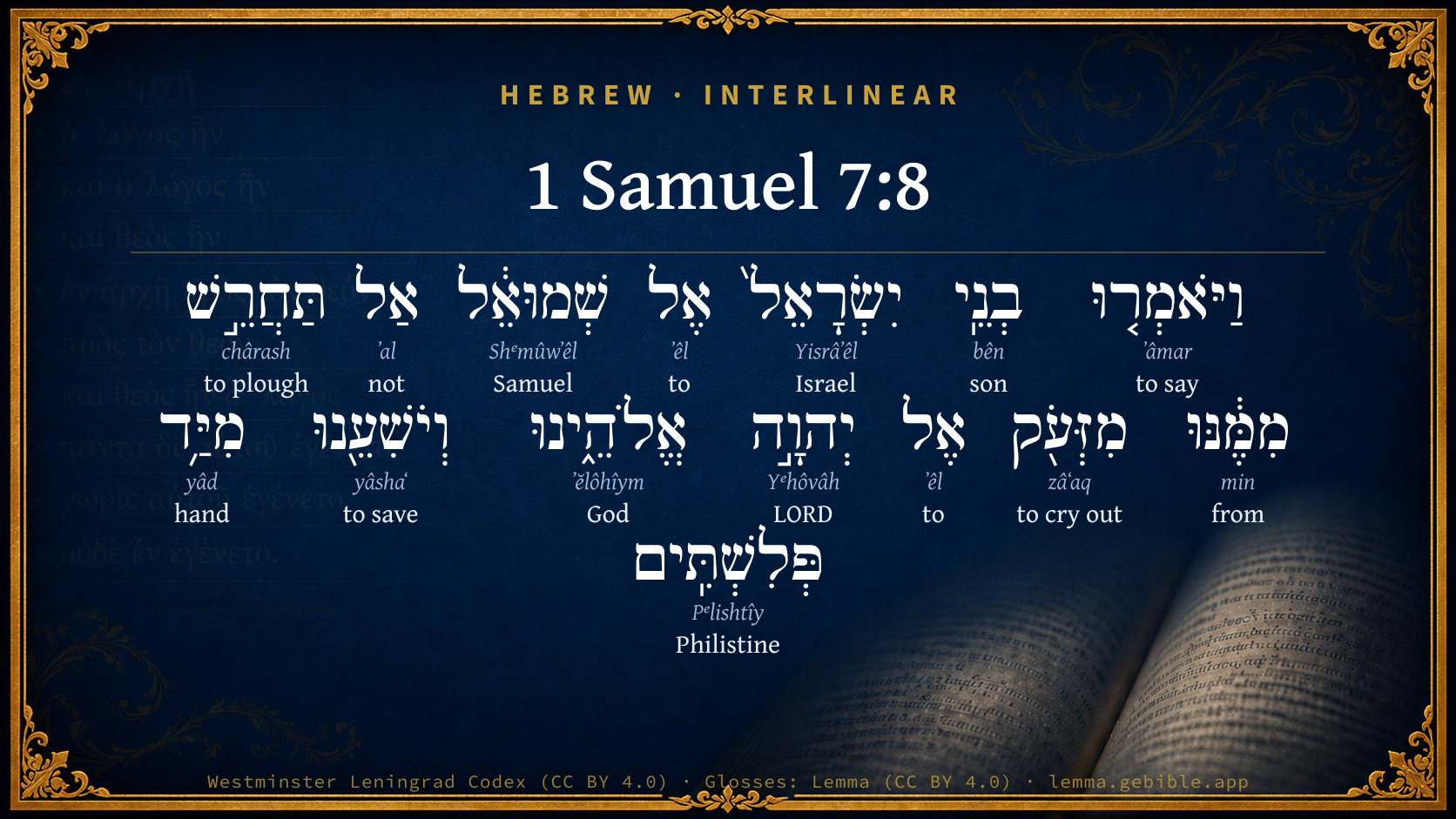
1 Samuel 7:8

Hebrew (Westminster Leningrad Codex) 1 Samuel 7:8 appears in the Hebrew Old Testament. The text above is from the Westminster Leningrad Codex. Each word links to its Strong’s number, a concise gloss, and parsing drawn from the Open Scriptures Hebrew Bible morphology. Click any word for its full Brown-Driver-Briggs (BDB) entry.
Download image
Cite this verse

1 Samuel 7:8 (World English Bible). Public Domain. Lemma interlinear Bible study tool, https://lemma.gebible.app/v/1-samuel/7/8.

Show BibTeX & RIS
BibTeX
RIS
English Translation
The children of Israel said to Samuel, "Don't cease to cry to Yahweh our God for us, that he will save us out of the hand of the Philistines."
World English Bible · Public Domain
Download a study sheet

One document with this verse’s original text, its word-by-word gloss line, the meaning frame, cross-references with their text, attributed commentary, and full source and license credits — printable, and it pastes into notes with its structure intact.

This verse Autodidact and up

Study sheet (.html) Plain text (.txt)

A passage Seminary Student

Up to 50 verses in one chapter. A passage sheet keeps up to 6 commentary sources and 12 cross-references per verse, in the order this page ranks them, and says so on the sheet whenever that leaves anything out. Ask for a single verse and you get the Autodidact verse sheet above.

Everything on this page stays free to read, with no account — the sheet is a download of what is already on screen, not access to it.

Want to remove ads? Support Godless Engineer
Compare translations 3

The same verse in 3 English versions, stacked beneath the original-language interlinear above. Click any original word for its lexicon entry.

Each is an independent rendering of the whole verse — the interlinear is not word-aligned to these translations.

Highlighted words mark where these versions differ — a whole-verse word diff, not a word-by-word alignment.

  • World English Bible Public Domain
    The children of Israel said to Samuel, "Don't cease to cry to Yahweh our God for us, that he will save us out of the hand of the Philistines."
  • King James Version Public Domain
    And the children of Israel said to Samuel, Cease not to cry unto the LORD our God for us, that he will save us out of the hand of the Philistines.
  • unfoldingWord Literal Text CC BY-SA 4.0
    And the sons of Israel said to Samuel, “Do not cease from crying out for us to Yahweh our God, and may he save us from the hand of the Philistines!”

unfoldingWord Literal Text — © unfoldingWord, licensed CC BY-SA 4.0. Word-aligned USFM3 via Door43 (git.door43.org/unfoldingWord/en_ult).

Versions to compare (up to 4)

3 of 4 selected

Show all 18 translations

Every available English version of this verse, each an independent rendering of the whole verse.

  • World English Bible Public Domain
    The children of Israel said to Samuel, "Don't cease to cry to Yahweh our God for us, that he will save us out of the hand of the Philistines."
  • Berean Standard Bible Public Domain
    and said to Samuel, “Do not stop crying out to the LORD our God for us, that He may save us from the hand of the Philistines.”
  • Majority Standard Bible Public Domain
    and said to Samuel, “Do not stop crying out to the LORD our God for us, that He may save us from the hand of the Philistines.”
  • King James Version Public Domain
    And the children of Israel said to Samuel, Cease not to cry unto the LORD our God for us, that he will save us out of the hand of the Philistines.
  • American Standard Version (1901) Public Domain
    And the children of Israel said to Samuel, Cease not to cry unto Jehovah our God for us, that he will save us out of the hand of the Philistines.
  • Revised Version (1885) Public Domain
    And the children of Israel said to Samuel, Cease not to cry unto the LORD our God for us, that he will save us out of the hand of the Philistines.
  • Geneva Bible (1599) Public Domain
    And the children of Israel sayd to Samuel, Cease not to crie vnto the Lord our God for vs, that hee may saue vs out of the hand of the Philistims.
  • Douay-Rheims (1899) Public Domain
    And they said to Samuel: Cease not to cry to the Lord our God for us, that he may save us out of the hand of the Philistines.
  • Young's Literal Translation Public Domain
    And the sons of Israel say unto Samuel, `Keep not silent for us from crying unto Jehovah our God, and He doth save us out of the hand of the Philistines.'
  • Literal Standard Version CC BY-SA 4.0
    And the sons of Israel say to Samuel, “Do not keep silent for us from crying to our God YHWH, and He saves us out of the hand of the Philistines.”
  • Unlocked Literal Bible CC BY-SA 4.0
    Then the people of Israel said to Samuel, “Do not stop calling out to Yahweh our God for us, so he will save us from the hand of the Philistines.”
  • unfoldingWord Literal Text CC BY-SA 4.0
    And the sons of Israel said to Samuel, “Do not cease from crying out for us to Yahweh our God, and may he save us from the hand of the Philistines!”
  • Darby Bible Public Domain
    And the children of Israel said to Samuel, Cease not to cry to Jehovah our God for us, that he will save us out of the hand of the Philistines.
  • World Messianic Bible Public Domain
    The children of Israel said to Samuel, “Don’t stop crying to the LORD our God for us, that he will save us out of the hand of the Philistines.”
  • Webster's Bible Public Domain
    And the children of Israel said to Samuel, Cease not to cry to the LORD our God for us, that he will save us from the hand of the Philistines.
  • Free Bible Version CC BY-SA 4.0
    They told Samuel, “Don't stop pleading with the Lord our God for us so he can save us from the Philistines.”
  • Bible in Basic English Public Domain
    And the children of Israel said to Samuel, Go on crying to the Lord our God for us to make us safe from the hands of the Philistines.
  • JPS Tanakh (1917) Public Domain
    And the children of Israel said to Samuel: 'Cease not to cry unto the LORD our God for us, that He save us out of the hand of the Philistines.'

Literal Standard Version (2020), Covenant Press — licensed CC BY-SA 4.0. Text via the HelloAO Bible API (eBible.org). Unlocked Literal Bible (unfoldingWord) — licensed CC BY-SA 4.0. Text via the HelloAO Bible API (eBible.org). unfoldingWord Literal Text — © unfoldingWord, licensed CC BY-SA 4.0. Word-aligned USFM3 via Door43 (git.door43.org/unfoldingWord/en_ult). Free Bible Version, Dr. Jonathan Gallagher — licensed CC BY-SA 4.0. Text via the HelloAO Bible API (eBible.org).

Word by word

More ways to search: Search by grammar → Find every occurrence → Compare this word →

Practice this passage: Drill this verse → Learn its vocabulary →

תַּחֲרֵ֣שׁ
chârash
H2790
“to plough”
Verb, Hiphil, Jussive, 2nd Person, Masculine, Singular
Part of Speech
Verb
Stem
Hiphil
Form
Jussive
Person
2nd Person
Gender
Masculine
Number
Singular
Full BDB Definition

Origin: a primitive root

TWOT: 760 , 761

to cut in, plough, engrave, devise - (Qal) - to cut in, engrave - to plough - to devise - (Niphal) to be ploughed - (Hiphil) to plot evil - to be silent, be dumb, be speechless, be deaf - (Qal) - to be silent - to be deaf - (Hiphil) - to be silent, keep quiet - to make silent - to be deaf, show deafness - (Hithpael) to remain silent
  1. וַיֹּאמְר֤וּ ʼâmar H559 “and · to say” Conjunction + Verb, Qal, Sequential Imperfect, 3rd Person, Masculine, Plural
  2. בְנֵֽי bên H1121 “sons of” Noun, Common, Masculine, Plural, Construct
  3. יִשְׂרָאֵל֙ Yisrâʼêl H3478 “Israel” Noun, Proper
  4. אֶל ʼêl H413 “to” Preposition
  5. שְׁמוּאֵ֔ל Shᵉmûwʼêl H8050 “Samuel” Noun, Proper
  6. אַל ʼal H408 “not” Particle, Negative
  7. מִמֶּ֔נּוּ min H4480 “from · us” Preposition + Suffix, Personal, 1st Person, Common, Plural
  8. מִזְּעֹ֖ק zâʻaq H2199 “from · to cry out” Preposition + Verb, Qal, Infinitive Construct
  9. אֶל ʼêl H413 “to” Preposition
  10. יְהוָ֣ה Yᵉhôvâh H3068 “LORD” Noun, Proper
  11. אֱלֹהֵ֑ינוּ ʼĕlôhîym H430 “God(s) · our” Noun, Common, Masculine, Plural, Construct + Suffix, Personal, 1st Person, Common, Plural
  12. וְיֹשִׁעֵ֖נוּ yâshaʻ H3467 “and · to save · us” Conjunction + Verb, Hiphil, Jussive, 3rd Person, Masculine, Singular + Suffix, Personal, 1st Person, Common, Plural
  13. מִיַּ֥ד yâd H3027 “from · hand of” Preposition + Noun, Common, Both, Singular, Construct
  14. פְּלִשְׁתִּֽים Pᵉlishtîy H6430 “Philistines” Noun, Gentilic, Masculine, Plural, Absolute

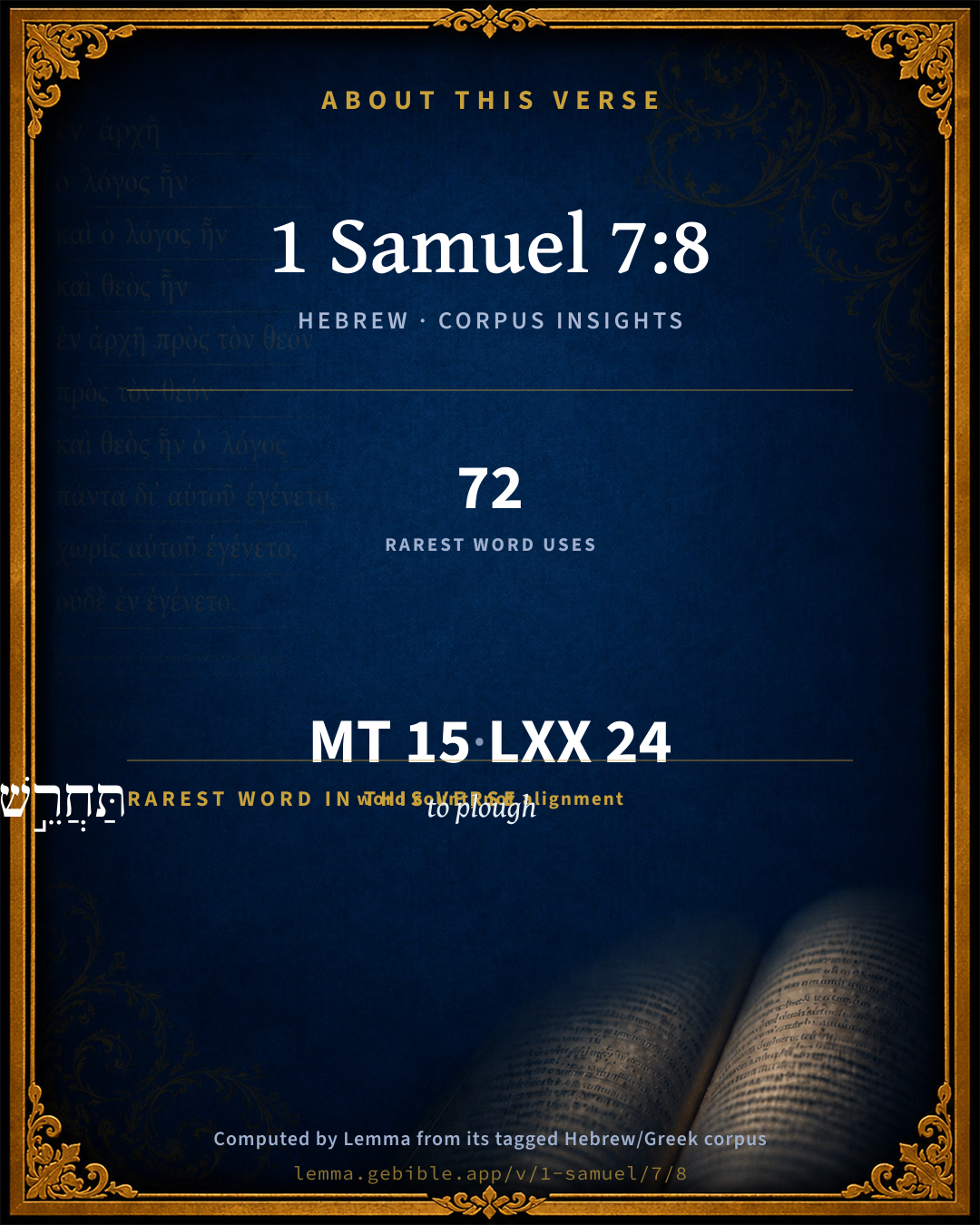
About this verse

These counts appear in no published source. They are computed here, from the morphology-tagged text and Lemma’s own curated glosses. What Lemma adds →

15
words
14
distinct lemmas
Historical
section

Grammatical profile

  • 4 verbs
  • 7 nouns
  • 3 prepositions
  • 1 particle

Verb forms

  • וַיֹּאמְר֤וּ Qal · Sequential Imperfect
  • תַּחֲרֵ֣שׁ Hiphil · Jussive
  • מִזְּעֹ֖ק Qal · Infinitive Construct
  • וְיֹשִׁעֵ֖נוּ Hiphil · Jussive

Repetition

A word recurs within this verse — often emphatic in Hebrew:

  • אֶל to H413 ×2

Hebrew & Septuagint length

In English translation the verse runs 29 words from the Hebrew and 31 from the Septuagint (LXX English) — closely comparable.

A rough comparison of the two English renderings, which tokenize alike — not a word-level alignment.

Word counts can differ between the Hebrew and the Greek without any difference in meaning — e.g. the Hebrew direct-object marker אֵת has no separate Greek word, and Greek often adds the article ὁ.

In the original languages it is 15 Hebrew tokens and 24 Greek tokens — but the two are counted differently (Hebrew bundles its prefixes and suffixes into one token; the Greek is in lemma form), so that isn’t a like-for-like length.

Cross-references

5

Topical passages linked to 1 Samuel 7:8 in the Treasury of Scripture Knowledge — connected by theme and wording, ordered by reader-vote popularity; previews shown in the World English Bible.

  • Isaiah 37:4 It may be Yahweh your God will hear the words of Rabshakeh, whom the king of Assyria his master has sent to defy the living God, and will rebuke the words which Yahweh your God has heard. Therefore lift up your prayer for the remnant that is left.
  • 1 Samuel 12:19–24 All the people said to Samuel, Pray for your servants to Yahweh your God, that we not die; for we have added to all our sins [this] evil, to ask us a king.
  • James 5:16 Confess your offenses to one another, and pray one for another, that you may be healed. The effective, earnest prayer of a righteous man is powerfully effective.
  • Isaiah 62:1 For Zion's sake will I not hold my peace, and for Jerusalem's sake I will not rest, until her righteousness go forth as brightness, and her salvation as a lamp that burns.
  • Isaiah 62:6–7 I have set watchmen on your walls, Jerusalem; they shall never hold their peace day nor night: you who call on Yahweh, take no rest,

Cross-references courtesy of OpenBible.info (CC BY 4.0).

Hebrew and Greek witnesses Masoretic Hebrew ↔ Greek Septuagint

The same verse in the two great witnesses to the Old Testament, shown verse-for-verse.

These are two independent witnesses, not word-aligned to each other, and the Septuagint is shown in lemma (dictionary) form.

Hebrew 1 Samuel 7:8 Masoretic · Westminster Leningrad Codex

וַיֹּאמְר֤וּ בְנֵֽי יִשְׂרָאֵל֙ אֶל שְׁמוּאֵ֔ל אַל תַּחֲרֵ֣שׁ מִמֶּ֔נּוּ מִזְּעֹ֖ק אֶל יְהוָ֣ה אֱלֹהֵ֑ינוּ וְיֹשִׁעֵ֖נוּ מִיַּ֥ד פְּלִשְׁתִּֽים

The children of Israel said to Samuel, "Don't cease to cry to Yahweh our God for us, that he will save us out of the hand of the Philistines."

World English Bible · Public Domain

Greek LXX 1 Samuel 7:8 Septuagint · lemma form

καί εἶπον ὁ υἱός ἰσραήλ πρός σαμουηλ μή παρασιωπάω ἀπό ἐγώ ὁ μή βοάω πρός κύριος θεός σύ καί σώζω ἐγώ ἐκ χείρ ἀλλόφυλος

And the children of Israel said to Samuel, Cease not to cry to the Lord your God for us, and he shall save us out of the hand of the Philistines.

LXX2012 (modern English Septuagint) · Public Domain

Hebrew: Westminster Leningrad Codex (CC BY 4.0). Greek: Septuagint (public domain); English from LXX2012 (modern English Septuagint) (Public Domain). How the Septuagint differs from the Hebrew →

Targum (Aramaic paraphrase)

1

The Targum is the ancient Jewish Aramaic paraphrase of the Hebrew Scriptures — an interpretive translation, not the Hebrew text itself. Onkelos (literal) and Pseudo-Jonathan (expansive) render the Torah, and Jonathan the Prophets. Coverage is partial: where no permissively-licensed English translation exists for a verse, only the Aramaic is shown. This is verse-level text, not a word-by-word alignment to the Hebrew.

  1. Targum Jonathan Prophets (Joshua–Malachi)
    וַאֲמַרוּ בְנֵי יִשְׂרָאֵל לִשְׁמוּאֵל לָא תַשְׁתִּיק מִנָנָא מִלְצַלָאָה קֳדָם יְיָ אֱלָהָנָא וִיִפְרְקִנָנָא מִידָא דִפְלִשְׁתָּאֵי:

    (no public-domain English translation for this verse)

    Targum Jonathan — Aramaic: “Mikraot Gedolot” (public domain). English: “Sefaria Community Translation” (CC0 1.0 (public-domain dedication)); “London "Chaldee Paraphrase," 1871” (public domain). Text via Sefaria.

Commentary

Notes on 1 Samuel 7:8 from classic Christian and Jewish commentators (each source and its license shown beneath its notes). The classic Christian expositions comment on the surrounding passage and are grouped to its opening verse, so a note may address several verses; the Jewish commentaries on the Tanakh (Rashi and others) are per-verse, so they appear only where the commentator wrote on this verse.

Lemma curates 59 commentaries, every one of them public domain or Creative Commons licensed, each selected and text-cleaned for this edition rather than reprinted as found. About our sources →

Trapp's Complete Commentary

John Trapp

1Sa 7:8 And the children of Israel said to Samuel, Cease not to cry unto the LORD our God for us, that he will save us out of the hand of the Philistines.

Ver. 8. Cease not to cry unto the Lord our God for us.] Samuel they knew to be a Pethuel, {Joe 1:1} a God persuader, a man mighty in prayer, a favourite, and one that had the royalty of God’s ear; they beg of him therefore to exercise his faculty, and to improve his interest in God for them in this exigent, Ne destituas nos ope tua quam praestare potes clamando ad Dominum. {a} Help us, say they, now at a dead lift. So the people afterwards told David at Mahanaim, that he should not go into the field with them, but that he "should succour them," viz., by his prayers, "out of the city." {2Sa 18:3}

{a} Vatab.

John Trapp, A Commentary or Exposition upon All the Books of the Old and New Testament (1647–1656) — public domain. Text from a community e-Sword module.

The Biblical Illustrator

Joseph S. Exell

1Sa_7:8

And the children of Israel said to Samuel, Cease not to cry unto the Lord our God for us.

The cry for mediation

I. Mediation sought. The Israelites, unarmed, undefended, are in great dismay. They turn to Samuel and implore his continued intercession.

1. Times of humiliation for sin and of reformation from sin are times in which the foe is very busy--doing what he can to binder.

2. Times of humiliation and awakening produce a sense of need of an intercessor from personal unworthiness, from the gravity and danger of the occasion, from the difficulty of relation to the unseen. We want someone to act for us. The principle of mediation in the Gospel of Jesus Christ does fit in with our nature and condition.

II. Mediation exercised. Samuel prays and sacrifices.

1. Takes a young lamb.

2. Prays. The mediation of Jesus Christ is so divinely suitable and sufficient, as He is both priest and sacrifice. His offering and intercession may give us boldness and access with confidence.

III. Mediation accepted. The Lord heard him.

1. Interposition by means of the elements of the natural world.

2. The foe is completely routed. (H. Gammage.)

The Biblical Illustrator, edited by Joseph S. Exell (c. 1880s–1900s) — public domain. Text from a community e-Sword module.

Joseph Benson's Commentary

1Sa 7:8. Cease not to cry unto the Lord, &c. — We are afraid to look God in the face, because of our great wickedness: do thou therefore intercede for us, as Moses did for his generation. They had reason to expect this, because he had promised to pray for them, had promised them deliverance from the Philistines, and they had been observant of him, in all that he had spoken to them from the Lord. Thus they who receive Christ as their lawgiver and judge, need not doubt of their interest in his intercession. O what a comfort it is to all believers, that he never ceaseth, is never silent, but always appears in the presence of God for us.

Joseph Benson's Commentary on the Old and New Testaments (1811–1818) — public domain. Text from a community e-Sword module.

Geneva Bible (1599)

Geneva Bible translators

Signifying, that in the prayers of the godly, there ought to be a vehement zeal.

Geneva Bible (1599) marginal notes — public domain. Text via Bolls.life.

Adam Clarke's Commentary

Verse 8. Cease not to cry unto the Lord] They had strong confidence in the intercession of Samuel, because they knew he was a holy man of God.

Adam Clarke's Commentary on the Bible (1810–1826) — public domain. Text from a community e-Sword/MySword module.

Ellicott's Commentary for English Readers

(8) Cease not to cry unto the Lord our God for us.—The fear on the part of Israel was very natural Unarmed—or, at least, very poorly armed and equipped—the assembled Israelites saw from the heights the advancing Philistine army. What hope was there for their ill-disciplined masses when they joined battle with that trained host of fighting men? But they remembered the days of old, and how, when Moses prayed, “the Angel of His presence” saved them. Had they not then with them there a seer equal to Moses, greater than Joshua, one with whom the Eternal of Hosts was wont to speak, as friend speaketh with friend? So in that supreme hour of danger they turned to Samuel the seer. We are just going, they said, all unarmed to meet that armed host; “cease not to cry unto the Lord our God for us,” And Samuel, we read in the brief and graphic account before us, hurriedly—for the time was short, and the foe close at hand—and with rites somewhat different from those enjoined in the Law—for the occasion was indeed a critical one—offered up a sacrifice, and raised that weird piercing cry which many in Israel had heard before when Samuel the seer prayed; and while the prophet-statesman was sustaining that loud imploring cry, while the smoke of the slain lamb was still ascending, the first line of the Philistine army appeared on the topmost slope of Mizpeh. Once more, as in old days, the glorious Arm fought with no earthly weapons for the people; an awful thunderstorm burst over the combatant hosts, the storm probably beating in the faces of the advancing Philistines. The tribes welcomed it as the answer to their prophet’s prayer, and with a wild enthusiasm charged down and broke the serried ranks of their oppressors. Josephus tells us of an earthquake, which added fresh horrors to the scene of battle. Each crash of thunder, each wild and furious gust of hail and rain, the men of Israel welcomed as a fresh onslaught on the part of an unseen army fighting by their side. The dismayed Philistines fled, and the rout was complete; the defeated army hurried panic-stricken over the same ground in the neighbourhood of Aphek illustrious twenty years before for their signal victory. The scene of carnage now received the significant name of Eben-ezer, or The Stone of Help.

A Bible Commentary for English Readers, edited by Charles John Ellicott (1878–1897) — public domain. Text from a community e-Sword module.

John Gill's Exposition

And the children of Israel said to Samuel,.... To whom they applied, not as the general of their forces, but as the prophet of the Lord; believing his prayers for them would be of more avail to them than an army of men ever so numerous, or so well accoutred:

cease not to cry unto the Lord our God for us: he had been praying for them that day, and they desired he would continue praying for them, well knowing that the effectual fervent prayer of a righteous man avails much; they knew their salvation was of the Lord, and that he only could save them, and that he must be sought unto for it; and as Samuel had an interest in him, they beg he would continue to make use of it on their behalf; in which they expressed their trust in God, their regard to means, the duty of prayer, and the high esteem they had of the prophet of the Lord, whom they entreat to pray for them:

that he will save us out of the hands of the Philistines; who were now coming up against them, and who had for a long time tyrannised over them.

John Gill's Exposition of the Whole Bible (1746–1763) — public domain (CC PDM 1.0). Text via the HelloAO Bible API.

Haydock's Catholic Bible Commentary

Philistines. Those who distrust their own strength, and join true repentance with prayer, striving to interest the friends of God in their cause, may confidently hope for victory. (Haydock)

George Leo Haydock (1774–1849), Haydock's Catholic Family Bible and Commentary, 1859 edition — public domain. Excludes Psalms (Douay-Rheims chapter numbering differs from Protestant) and Deuterocanonical books (Catholic canon only).

Matthew Poole's English Annotations

We are ashamed and afraid to look God in the face, because of our great wickedness this day remembered and acknowledged; do thou therefore intercede for us, as Moses did for his generation.

Matthew Poole's English Annotations on the Holy Bible (1683–1685) — public domain. Text from a community e-Sword/MySword module.

Whedon's Commentary on the Bible

Daniel D. Whedon

8. Cease not — The marginal reading is more accurate, Be not silent from us from crying. They now feel that if deliverance comes at all, it must come from Jehovah.

Daniel D. Whedon (gen. ed.), Commentary on the Old and New Testaments (1874–1909) — public domain. Text from a community e-Sword module.

John Wesley's Explanatory Notes

Cease not, &c. - We are afraid to look God in the face, because of our great wickedness: do thou therefore intercede for us, as Moses did for his generation. They had reason to expect this, because he had promised to pray for them, had promised them deliverance from the Philistines, and they had been observant of him, in all that he had spoken to them from the Lord. Thus they who receive Christ as their lawgiver and judge, need not doubt of their interest in his intercession. O what a comfort is it to all believers, that he never ceaseth, but always appears in the presence of God for us.

John Wesley, Explanatory Notes Upon the Whole Bible (1754–1765) — public domain. Text via the GEBible commentary corpus.

Lesson kit

Teaching starters — assembled from the data on this page, not authored interpretation. Every prompt links to the verse data it draws on. Edit before teaching.

1 Samuel, in the Historical, opens this verse with 15 words (14 distinct Hebrew lemmas). Its most distinctive word is chârash (“to plough”). A historical commentator’s framing appears above. Read the whole chapter for the surrounding context.

Discussion questions

  1. What does “to plough” (chârash) contribute to the verse as a whole?
  2. How does Isaiah 37:4, which shares this passage’s theme, read alongside this verse?
  3. What does the repetition of “to” (2× in this one verse) do in this verse?
  4. These translations render this verse differently. What is at stake in choosing one wording over another?
  5. «וַיֹּאמְר֤וּ» is a Qal Sequential Imperfect verb. How does that grammatical form shape the action described?
  6. Compare how Trapp's Complete Commentary and The Biblical Illustrator read this verse. Where do they agree or differ?

Things to notice

Reading settings

Reading text

Shown beneath each verse's original-language words.

Old Testament
Old Testament edition

Read the OT as the Masoretic Hebrew (MT) or the Greek Septuagint (LXX).

English shown for the Greek Septuagint (in the Hebrew ↔ Greek comparison).

Comparing translations? Open the Compare panel on any verse page to stack up to four side by side.