
1 Kings 17:13

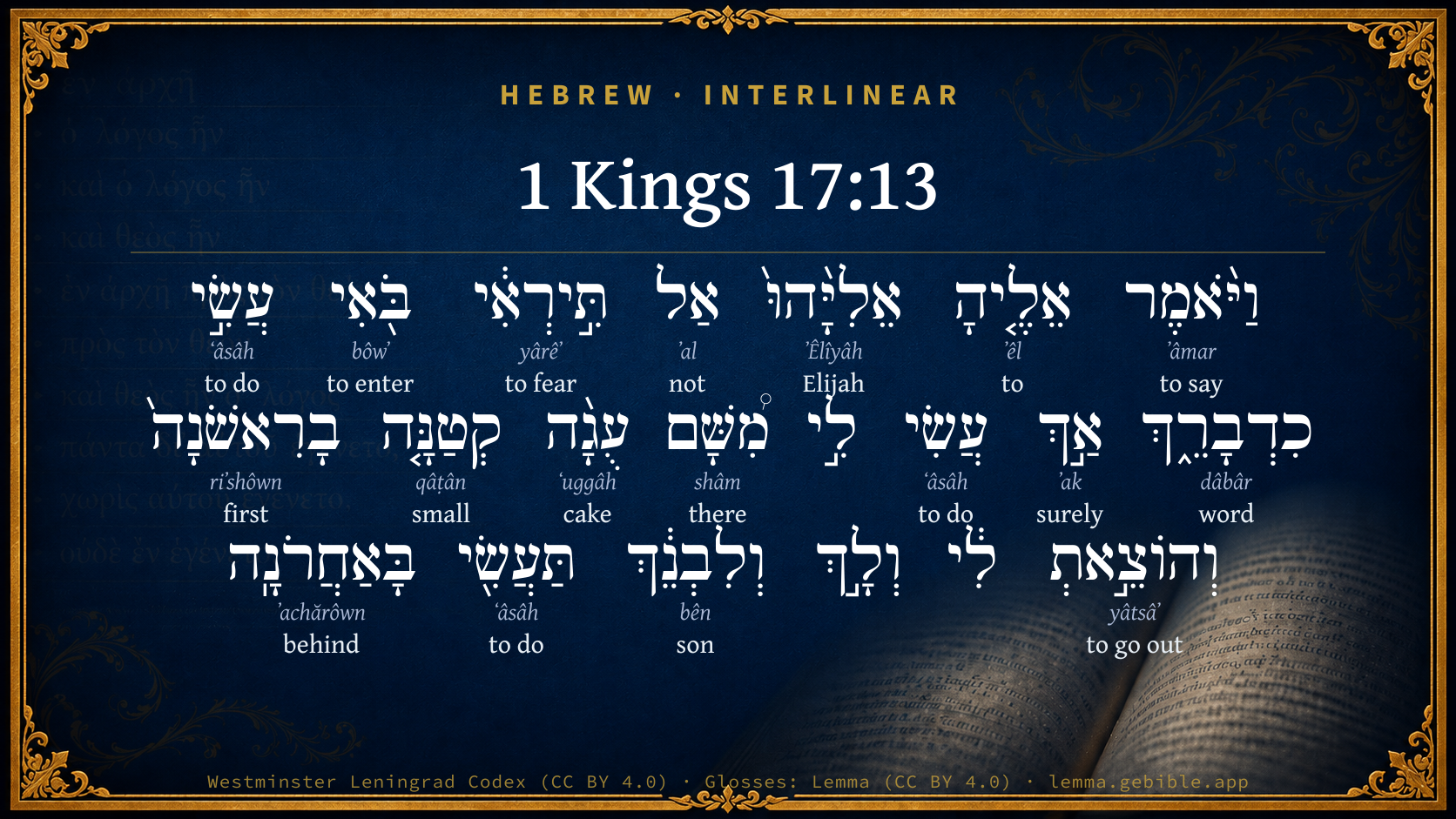
Hebrew (Westminster Leningrad Codex) 1 Kings 17:13 appears in the Hebrew Old Testament. The text above is from the Westminster Leningrad Codex. Each word links to its Strong’s number, a concise gloss, and parsing drawn from the Open Scriptures Hebrew Bible morphology. Click any word for its full Brown-Driver-Briggs (BDB) entry.
Download image
Cite this verse

1 Kings 17:13 (World English Bible). Public Domain. Lemma interlinear Bible study tool, https://lemma.gebible.app/v/1-kings/17/13.

Show BibTeX & RIS
BibTeX
RIS
English Translation
Elijah said to her, Don't be afraid; go and do as you have said; but make me of it a little cake first, and bring it forth to me, and afterward make for you and for your son.
World English Bible · Public Domain
Download a study sheet

One document with this verse’s original text, its word-by-word gloss line, the meaning frame, cross-references with their text, attributed commentary, and full source and license credits — printable, and it pastes into notes with its structure intact.

This verse Autodidact and up

Study sheet (.html) Plain text (.txt)

A passage Seminary Student

Up to 50 verses in one chapter. A passage sheet keeps up to 6 commentary sources and 12 cross-references per verse, in the order this page ranks them, and says so on the sheet whenever that leaves anything out. Ask for a single verse and you get the Autodidact verse sheet above.

Everything on this page stays free to read, with no account — the sheet is a download of what is already on screen, not access to it.

Want to remove ads? Support Godless Engineer
Compare translations 3

The same verse in 3 English versions, stacked beneath the original-language interlinear above. Click any original word for its lexicon entry.

Each is an independent rendering of the whole verse — the interlinear is not word-aligned to these translations.

Highlighted words mark where these versions differ — a whole-verse word diff, not a word-by-word alignment.

  • World English Bible Public Domain
    Elijah said to her, Don't be afraid; go and do as you have said; but make me of it a little cake first, and bring it forth to me, and afterward make for you and for your son.
  • King James Version Public Domain
    And Elijah said unto her, Fear not; go and do as thou hast said: but make me thereof a little cake first, and bring it unto me, and after make for thee and for thy son.
  • unfoldingWord Literal Text CC BY-SA 4.0
    And Elijah said to her, “Do not fear. Come, do according to your word, only first make for me from there a little bread-cake and bring it out to me. And make for yourself and for your son afterward.

unfoldingWord Literal Text — © unfoldingWord, licensed CC BY-SA 4.0. Word-aligned USFM3 via Door43 (git.door43.org/unfoldingWord/en_ult).

Versions to compare (up to 4)

3 of 4 selected

Show all 18 translations

Every available English version of this verse, each an independent rendering of the whole verse.

  • World English Bible Public Domain
    Elijah said to her, Don't be afraid; go and do as you have said; but make me of it a little cake first, and bring it forth to me, and afterward make for you and for your son.
  • Berean Standard Bible Public Domain
    “Do not be afraid,” Elijah said to her. “Go and do as you have said. But first make me a small cake of bread from what you have, and bring it out to me. Afterward, make some for yourself and your son,
  • Majority Standard Bible Public Domain
    “Do not be afraid,” Elijah said to her. “Go and do as you have said. But first make me a small cake of bread from what you have, and bring it out to me. Afterward, make some for yourself and your son,
  • King James Version Public Domain
    And Elijah said unto her, Fear not; go and do as thou hast said: but make me thereof a little cake first, and bring it unto me, and after make for thee and for thy son.
  • American Standard Version (1901) Public Domain
    And Elijah said unto her, Fear not; go and do as thou hast said; but make me thereof a little cake first, and bring it forth unto me, and afterward make for thee and for thy son.
  • Revised Version (1885) Public Domain
    And Elijah said unto her, Fear not; go and do as thou hast said: but make me thereof a little cake first, and bring it forth unto me, and afterward make for thee and for thy son.
  • Geneva Bible (1599) Public Domain
    And Eliiah said vnto her, Feare not, come, do as thou hast sayd, but make me thereof a litle cake first of all, and bring it vnto mee, and afterward make for thee, and thy sonne.
  • Douay-Rheims (1899) Public Domain
    And Elias said to her: Fear not, but go, and do as thou hast said: but first make for me of the same meal a little hearth cake, and bring it to me: and after make for thyself and thy son.
  • Young's Literal Translation Public Domain
    And Elijah saith unto her, `Fear not, go, do according to thy word, only make for me thence a little cake, in the first place, and thou hast brought out to me; and for thee and for thy son make -- last;
  • Literal Standard Version CC BY-SA 4.0
    And Elijah says to her, “Do not fear, go, do according to your word, only make a little cake for me there, in the first place, and you have brought [it] out to me; and for you and for your son make [it] last;
  • Unlocked Literal Bible CC BY-SA 4.0
    Elijah said to her, “Do not fear. Go and do as you have said, but make me a little bread first and bring it out to me. Then afterward make some for you and for your son.
  • unfoldingWord Literal Text CC BY-SA 4.0
    And Elijah said to her, “Do not fear. Come, do according to your word, only first make for me from there a little bread-cake and bring it out to me. And make for yourself and for your son afterward.
  • Darby Bible Public Domain
    And Elijah said to her, Fear not; go, do as thou hast said; but make me thereof a little cake first; and bring it to me; and afterwards make for thee and for thy son.
  • World Messianic Bible Public Domain
    Elijah said to her, “Don’t be afraid. Go and do as you have said; but make me a little cake from it first, and bring it out to me, and afterward make some for you and for your son.
  • Webster's Bible Public Domain
    And Elijah said to her, Fear not; go and do as thou hast said: but make me of it a little cake first, and bring it to me, and afterward make for thee and for thy son.
  • Free Bible Version CC BY-SA 4.0
    Elijah said to her, “Don't be afraid. Go home and do what you said. But first make me a small loaf of bread from what you have and bring it to me. Then make something for yourself and your son.
  • Bible in Basic English Public Domain
    And Elijah said to her, Have no fear; go and do as you have said, but first make me a little cake of it and come and give it to me, and then make something for yourself and your son.
  • JPS Tanakh (1917) Public Domain
    And Elijah said unto her: 'Fear not; go and do as thou hast said; but make me thereof a little cake first, and bring it forth unto me, and afterward make for thee and for thy son.

Literal Standard Version (2020), Covenant Press — licensed CC BY-SA 4.0. Text via the HelloAO Bible API (eBible.org). Unlocked Literal Bible (unfoldingWord) — licensed CC BY-SA 4.0. Text via the HelloAO Bible API (eBible.org). unfoldingWord Literal Text — © unfoldingWord, licensed CC BY-SA 4.0. Word-aligned USFM3 via Door43 (git.door43.org/unfoldingWord/en_ult). Free Bible Version, Dr. Jonathan Gallagher — licensed CC BY-SA 4.0. Text via the HelloAO Bible API (eBible.org).

Word by word

More ways to search: Search by grammar → Find every occurrence → Compare this word →

Practice this passage: Drill this verse → Learn its vocabulary →

עֻגָ֨ה
ʻuggâh
H5692
“cake”
Noun, Common, Feminine, Singular, Absolute
Part of Speech
Noun
Type
Common
Gender
Feminine
Number
Singular
State
Absolute
Full BDB Definition

Origin: from H5746

TWOT: 1575a

disc or cake (of bread) - cake of hot stones (cake baked on hot stones)
  1. וַיֹּ֨אמֶר ʼâmar H559 “and · to say” Conjunction + Verb, Qal, Sequential Imperfect, 3rd Person, Masculine, Singular
  2. אֵלֶ֤יהָ ʼêl H413 “to · her” Preposition + Suffix, Personal, 3rd Person, Feminine, Singular
  3. אֵלִיָּ֨הוּ֙ ʼÊlîyâh H452 “Elijah” Noun, Proper
  4. אַל ʼal H408 “not” Particle, Negative
  5. תִּ֣ירְאִ֔י yârêʼ H3372 “to fear” Verb, Qal, Jussive, 2nd Person, Feminine, Singular
  6. בֹּ֖אִי bôwʼ H935 “enter” Verb, Qal, Imperative, 2nd Person, Feminine, Singular
  7. עֲשִׂ֣י ʻâsâh H6213 “do” Verb, Qal, Imperative, 2nd Person, Feminine, Singular
  8. כִדְבָרֵ֑ךְ dâbâr H1697 “like/as · word · your” Preposition + Noun, Common, Masculine, Singular, Construct + Suffix, Personal, 2nd Person, Feminine, Singular
  9. אַ֣ךְ ʼak H389 “surely” Particle, Accusative
  10. עֲשִׂי ʻâsâh H6213 “do” Verb, Qal, Imperative, 2nd Person, Feminine, Singular
  11. מִ֠שָּׁם shâm H8033 “from · there” Preposition + Adverb
  12. קְטַנָּ֤ה qâṭân H6996 “small” Adjective, Adjective, Feminine, Singular, Absolute
  13. בָרִאשֹׁנָה֙ riʼshôwn H7223 “in/at the · first” Preposition, Determined + Adjective, Adjective, Feminine, Singular, Absolute
  14. וְהוֹצֵ֣אתְ yâtsâʼ H3318 “and · to go out” Conjunction + Verb, Hiphil, Perfect, 2nd Person, Feminine, Singular
  15. וְלִבְנֵ֔ךְ bên H1121 “and · to/for · son · your” Conjunction + Preposition + Noun, Common, Masculine, Singular, Construct + Suffix, Personal, 2nd Person, Feminine, Singular
  16. תַּעֲשִׂ֖י ʻâsâh H6213 “to do” Verb, Qal, Imperfect, 2nd Person, Feminine, Singular
  17. בָּאַחֲרֹנָֽה ʼachărôwn H314 “in/at the · behind” Preposition, Determined + Adjective, Adjective, Feminine, Singular, Absolute

About this verse

These counts appear in no published source. They are computed here, from the morphology-tagged text and Lemma’s own curated glosses. What Lemma adds →

21
words
16
distinct lemmas
Historical
section

Notable vocabulary

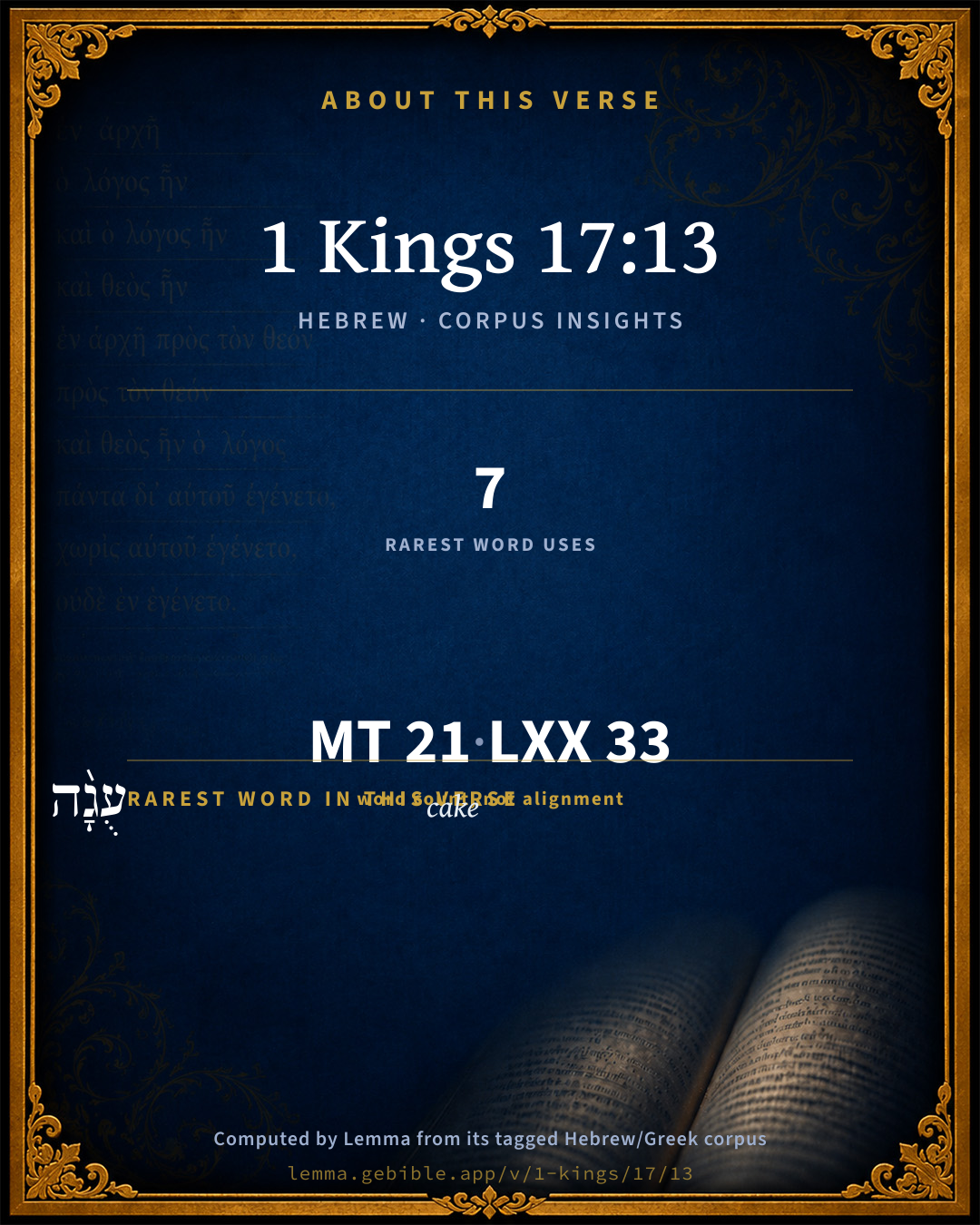
The rarest word here is עֻגָ֨ה cake H5692 — appearing just 7 times in the whole Hebrew Bible.

Shared distinctive vocabulary

עֻגָ֨ה cake H5692 occurs in 7 verses of the Hebrew Bible. Also found in:

Grammatical profile

  • 7 verbs
  • 4 nouns
  • 3 adjectives
  • 4 prepositions
  • 1 adverb
  • 2 particles

Verb forms

  • וַיֹּ֨אמֶר Qal · Sequential Imperfect
  • תִּ֣ירְאִ֔י Qal · Jussive
  • בֹּ֖אִי Qal · Imperative
  • עֲשִׂ֣י Qal · Imperative
  • עֲשִׂי Qal · Imperative
  • וְהוֹצֵ֣אתְ Hiphil · Perfect
  • תַּעֲשִׂ֖י Qal · Imperfect

Repetition

A word recurs within this verse — often emphatic in Hebrew:

  • עֲשִׂ֣י to do H6213 ×3

Hebrew & Septuagint length

In English translation the verse runs 38 words from the Hebrew and 44 from the Septuagint (LXX English) — closely comparable.

A rough comparison of the two English renderings, which tokenize alike — not a word-level alignment.

Word counts can differ between the Hebrew and the Greek without any difference in meaning — e.g. the Hebrew direct-object marker אֵת has no separate Greek word, and Greek often adds the article ὁ.

In the original languages it is 21 Hebrew tokens and 33 Greek tokens — but the two are counted differently (Hebrew bundles its prefixes and suffixes into one token; the Greek is in lemma form), so that isn’t a like-for-like length.

Cross-references

16

Topical passages linked to 1 Kings 17:13 in the Treasury of Scripture Knowledge — connected by theme and wording, ordered by reader-vote popularity; previews shown in the World English Bible.

  • Malachi 3:10 Bring the whole tithe into the store-house, that there may be food in my house, and test me now in this," says Yahweh of hosts, "if I will not open you the windows of heaven, and pour you out a blessing, that there shall not be room enough for.
  • Matthew 6:33 But seek first God's Kingdom, and his righteousness; and all these things will be given to you as well.
  • Genesis 22:1–2 It happened after these things, that God tested Abraham, and said to him, "Abraham!" He said, "Here I am."
  • Exodus 14:13 Moses said to the people, "Don't be afraid. Stand still, and see the salvation of Yahweh, which he will work for you today: for the Egyptians whom you have seen today, you shall never see them again.
  • Judges 7:5–7 So he brought down the people to the water: and Yahweh said to Gideon, Everyone who laps of the water with his tongue, as a dog laps, him shall you set by himself; likewise everyone who bows down on his knees to drink.
  • 2 Kings 6:16 He answered, Don't be afraid; for those who are with us are more than those who are with them.
  • 2 Chronicles 20:17 You shall not need to fight in this [battle]: set yourselves, stand you still, and see the salvation of Yahweh with you, O Judah and Jerusalem; don't be afraid, nor be dismayed: tomorrow go out against them: for Yahweh is with you.
  • Proverbs 3:9 Honor Yahweh with your substance, With the first fruits of all your increase:
  • Isaiah 41:13 For I, Yahweh your God, will hold your right hand, saying to you, Don't be afraid; I will help you.
  • Matthew 28:5 The angel answered the women, "Don't be afraid, for I know that you seek Jesus, who has been crucified.
  • Acts 27:24 saying, 'Don't be afraid, Paul. You must stand before Caesar. Behold, God has granted you all those who sail with you.'
  • 1 Peter 1:7 that the proof of your faith, which is more precious than gold that perishes even though it is tested by fire, may be found to result in praise, glory, and honor at the revelation of Jesus Christ--
  • Isaiah 41:10 Don't you be afraid, for I am with you; don't be dismayed, for I am your God; I will strengthen you; yes, I will help you; yes, I will uphold you with the right hand of my righteousness.
  • Matthew 10:37 He who loves father or mother more than me is not worthy of me; and he who loves son or daughter more than me isn't worthy of me.
  • Hebrews 11:17 By faith, Abraham, being tested, offered up Isaac. Yes, he who had gladly received the promises was offering up his one and only son;
  • Matthew 19:21–22 Jesus said to him, "If you want to be perfect, go, sell what you have, and give to the poor, and you will have treasure in heaven; and come, follow me."

Cross-references courtesy of OpenBible.info (CC BY 4.0).

Hebrew and Greek witnesses Masoretic Hebrew ↔ Greek Septuagint

The same verse in the two great witnesses to the Old Testament, shown verse-for-verse.

These are two independent witnesses, not word-aligned to each other, and the Septuagint is shown in lemma (dictionary) form.

Hebrew 1 Kings 17:13 Masoretic · Westminster Leningrad Codex

וַיֹּ֨אמֶר אֵלֶ֤יהָ אֵלִיָּ֨הוּ֙ אַל תִּ֣ירְאִ֔י בֹּ֖אִי עֲשִׂ֣י כִדְבָרֵ֑ךְ אַ֣ךְ עֲשִׂי לִ֣י מִ֠שָּׁם עֻגָ֨ה קְטַנָּ֤ה בָרִאשֹׁנָה֙ וְהוֹצֵ֣אתְ לִ֔י וְלָ֣ךְ וְלִבְנֵ֔ךְ תַּעֲשִׂ֖י בָּאַחֲרֹנָֽה

Elijah said to her, Don't be afraid; go and do as you have said; but make me of it a little cake first, and bring it forth to me, and afterward make for you and for your son.

World English Bible · Public Domain

Greek LXX 1 Kings 17:13 Septuagint · lemma form

καί εἶπον πρός αὐτός ηλιου θαρσέω εἰςἔρχομαι καί ποιέω κατά ὁ ῥῆμα σύ ἀλλά ποιέω ἐγώ ἐκεῖθεν ἐγκρυφίας μικρός ἐν πρῶτος καί ἐκφέρω ἐγώ σεαυτοῦ δέ καί ὁ τέκνον σύ ποιέω ἐπί ἔσχατος

And Eliu said to her, Be of good courage, go in and do according to your word: but make me thereof a little cake, and you shall bring it out to me first, and you shall make some for yourself and your children last.

LXX2012 (modern English Septuagint) · Public Domain

Hebrew: Westminster Leningrad Codex (CC BY 4.0). Greek: Septuagint (public domain); English from LXX2012 (modern English Septuagint) (Public Domain). How the Septuagint differs from the Hebrew →

Targum (Aramaic paraphrase)

1

The Targum is the ancient Jewish Aramaic paraphrase of the Hebrew Scriptures — an interpretive translation, not the Hebrew text itself. Onkelos (literal) and Pseudo-Jonathan (expansive) render the Torah, and Jonathan the Prophets. Coverage is partial: where no permissively-licensed English translation exists for a verse, only the Aramaic is shown. This is verse-level text, not a word-by-word alignment to the Hebrew.

  1. Targum Jonathan Prophets (Joshua–Malachi)
    וַאֲמַר לָהּ אֵלִיָהוּ לָא תִדְחֲלִין עוּלִי עֱבִידִי כְפִתְגָמַיְכִי בְּרַם עֲבִידִי לִי מִתַּמָן חֲרָרָא זְעִירָא בְּקַדְמֵיתָא וְתִפְקִין לִי וְלִיךְ וְלִבְרִיךְ תַּעְבְּדִין בְּבַתְרַיְתָא:

    (no public-domain English translation for this verse)

    Targum Jonathan — Aramaic: “Mikraot Gedolot” (public domain). English: “Sefaria Community Translation” (CC0 1.0 (public-domain dedication)); “London "Chaldee Paraphrase," 1871” (public domain). Text via Sefaria.

Commentary

Notes on 1 Kings 17:13 from classic Christian and Jewish commentators (each source and its license shown beneath its notes). The classic Christian expositions comment on the surrounding passage and are grouped to its opening verse, so a note may address several verses; the Jewish commentaries on the Tanakh (Rashi and others) are per-verse, so they appear only where the commentator wrote on this verse.

Lemma curates 59 commentaries, every one of them public domain or Creative Commons licensed, each selected and text-cleaned for this edition rather than reprinted as found. About our sources →

Trapp's Complete Commentary

John Trapp

1Ki 17:13 And Elijah said unto her, Fear not; go [and] do as thou hast said: but make me thereof a little cake first, and bring [it] unto me, and after make for thee and for thy son.

Ver. 13. But make me thereof a little cake first.] Here "the trial of" this poor widow’s "faith, being much more precious than that of gold which perisheth, though it be tried in the fire, is found to praise, and honour, and glory." {1Pe 1:7}

John Trapp, A Commentary or Exposition upon All the Books of the Old and New Testament (1647–1656) — public domain. Text from a community e-Sword module.

The Biblical Illustrator

Joseph S. Exell

1Ki_17:13

Make me thereof a little cake first.

Faith tested

First, take the narrative in its literal sense; then, examine the truths which are suggested by it; and finally, note its mystical import.

I. Literal sense.

1. Here is a test of faith: Make me thereof a little cake first, and bring it unto me, and after make for thee and for thy son. It was a sharp test. Famine brings out selfishness in hideous shapes (2Ki_6:28-29). To be asked to give to a stranger a little cake from the handful of meal that was left, before she met the cravings of hunger in herself and her son, must have been a searching demand.

2. A woman, too, of Zidon, like the woman in the Gospel, when Jesus came into those coasts; a woman without the privileges of the covenant of Israel and the opportunities of Gods people; a flower in the common hedge, not in the hothouse, but yet a flower--able to respond to the claim of God through His prophet--Make me a little cake first; for he that loveth son or daughter more than Me is not worthy of Me (Mat_10:37).

3. It was more than a test of faith; it was a test of trust. This is something more. The prophets demand appealed to the will, and not merely to the assent of the understanding. She had to make a sacrifice; it was a trifle in itself--a little cake; but when people are starving it was not a trifle; and she had to trust to a promise, from the standpoint of human calculation, least likely to be fulfilled.

4. She went and did according to the saying of the prophet (1Ki_17:15).

II. The truths which the prophets demand suggests.

1. God to be served first. God must be loved--to use the language of divinity--with a love of preference. As a king, St. Chrysostom says, should be served as a king, so God should be loved as God, that is to say, preferably to all creatures. In the same way, the claims of God and His service must stand first. The demand, Make me thereof a little cake first, is like that which our Lord gave on the mount, Seek ye first the kingdom of God and His righteousness. It is the law of the first-fruits.

2. Gods commands are to be taken upon trust. His positive commands test not only our obedience, but our confidence in Him. Moral commands are echoed from within, so that not to obey them is not folly alone, but also impiety (St. Augustine); but commands of which we do not see the reason, yet which must be obeyed as simply coming from God, are touchstones of trust in Him.

3. How little, after all, God requires of us! Make Me a little cake. He gave our first parents licence to eat of every tree in the garden save one--just an acknowledgment of His Sovereignty. He turns the water into wine; we have only to fill the water-pots. His commandments are not grievous (1Jn_5:3), but we may have made obedience difficult through having abused our powers. God asks little, but makes a large return (Mat_25:23). The barrel of meal did not waste, etc.

III. Its mystical import. When Aristotle in logic, and Plato in philosophy, ruled the day (twelfth century), Hugo and Richard de St. Victor were the great mystics of the period (Milman), and it is from the former of these I transcribe the mystical interpretation of the subject in hand. The widow of Zarephath represents the holy Church--a widow--waiting for the advent of the Saviour. Elijah came to the woman, when Christ, through the mystery of the Incarnation, came to the Church. The woman was gathering two sticks; for the holy Church received the faith of the Cross. The handful of meal is said to signify the imperfection of Divine knowledge at the time when Christ came; and the little oil in a cruse, the scarcity of grace. But Elijah multiplied both, because Christ, full of grace and truth, imparted both to mankind. The woman sustained Elijah; for the faith and holy works of the Church refresh the Lord: I will come in to him, and will sup with him, and he with Me (Rev_3:20).

IV. Lessons.

1. The leading lesson throughout is one of trust. Fear not. The woman of Zarephath affords a striking instance of obedience and submission, not only of the will, but of the judgment.

2. To remember that God should have the first claim upon us and upon our substance, which increases through parting with it, as did the five loaves as they were distributed to others by the disciples hands.

3. It is a great mistake to suppose that only the rich should give into the treasury of God. The poor widows two mites were more to Christ than the large gifts of the rich, because it was her all. (The Thinker.)

The Biblical Illustrator, edited by Joseph S. Exell (c. 1880s–1900s) — public domain. Text from a community e-Sword module.

Joseph Benson's Commentary

1Ki 17:13-14. Make me thereof a little cake first — This he requires as a trial of her faith, charity, and obedience, which he knew God would graciously and plentifully reward; and so this would be a great example to encourage others to the practice of the same graces. Thus saith the Lord God of Israel — In whom I perceive thou trustest. The barrel of meal — The meal of the barrel. So the cruise of oil is put for the oil of the cruise.

Joseph Benson's Commentary on the Old and New Testaments (1811–1818) — public domain. Text from a community e-Sword module.

Tyndale Open Study Notes

Tyndale Open Resources

17:13-14 Despite the woman’s dwindling supplies (17:12), Elijah asked her to serve him before herself and her son. Like the poor widow who gave two small coins (Luke 21:1-4), this woman was asked to give all that she had to the Lord’s prophet. True faithfulness means placing God’s Kingdom ahead of personal concerns (Matt 6:33).

Tyndale Open Study Notes — © Tyndale Open Resources, licensed CC BY-SA 4.0. Text via the HelloAO Bible API.

Adam Clarke's Commentary

Verse 13. But make me thereof a little cake first] This was certainly putting the widow's faith to an extraordinary trial: to take and give to a stranger, of whom she knew nothing, the small pittance requisite to keep her child from perishing, was too much to be expected.

Adam Clarke's Commentary on the Bible (1810–1826) — public domain. Text from a community e-Sword/MySword module.

The Cambridge Bible for Schools and Colleges

gen. ed. J. J. S. Perowne

13. do as thou hast said] i.e. Set about preparing bread from the meal which remains, but instead of taking first for yourselves, bring what is first ready to me.

and bring it [R.V. adds forth] unto me] It appears from what follows that Elijah dwelt afterwards in the house of the widow, but at first he waited outside till she made ready the food, which it must have needed much faith to give forth for the supply of the stranger. For ‘after’ R.V. reads ‘after ward’ to bring the language into accord with modern usage.

The Cambridge Bible for Schools and Colleges (gen. ed. J. J. S. Perowne; Cambridge University Press, 1878–1918) — public domain. Text from a community e-Sword module.

John Gill's Exposition

And Elijah said unto her, fear not,.... That she and her son should die, it would not be the case:

go and do as thou hast said: mix her meal and her oil, and make a cake thereof, and bake it:

but make thereof a little cake first, and bring it unto me, and after make for thee and for thy son: which was not said from a selfish spirit of the prophet, but to try the faith of the woman; and besides, as Abarbinel observes, the prophet was not only hungry and thirsty through his journey, and so required to be served first, but it was for the sake of his sustenance, that the Lord would command a blessing on the meal and oil; wherefore, if she dressed it for herself and her son first, there would have been none left for the divine blessing to descend upon.

John Gill's Exposition of the Whole Bible (1746–1763) — public domain (CC PDM 1.0). Text via the HelloAO Bible API.

Haydock's Catholic Bible Commentary

First. He puts the faith of the widow to a severe trial; and the gospel requires nothing more perfect than what she practised. The true faith, which she then received, was her first and most precious recompense; and we shall soon see, that her guest drew down blessings upon her. (Calmet)

George Leo Haydock (1774–1849), Haydock's Catholic Family Bible and Commentary, 1859 edition — public domain. Excludes Psalms (Douay-Rheims chapter numbering differs from Protestant) and Deuterocanonical books (Catholic canon only).

Matthew Poole's English Annotations

Make me thereof a little cake first; which he requires as a trial and exercise of her faith, and charity, and obedience, which he knew God would graciously and plentifully reward; and so this would be a great example to encourage others to the practice of the same graces upon like occasions.

Matthew Poole's English Annotations on the Holy Bible (1683–1685) — public domain. Text from a community e-Sword/MySword module.

Whedon's Commentary on the Bible

Daniel D. Whedon

13. Make me… a little cake first — Here was a sore trial of her faith. What! share her last morsel with a stranger?

Daniel D. Whedon (gen. ed.), Commentary on the Old and New Testaments (1874–1909) — public domain. Text from a community e-Sword module.

The Pulpit Commentary

And Elijah said unto her This looks at first like a further test. But it is pretty clear that the prophet now knew that the widow of whom God had spoken was before him, Fear not; go and do as thou hast said Heb. according to Shy word but Heb. only, however: make me thereof Heb. thence, i.e., of the oil as well as the meal. The former took the place of butter. Bread was sometimes baked in oil a little cake first, and bring it unto me, and after make for thee and thy son. The "first" and "afterwards" are emphatic by position. When Bahr says that Elijah would never have made this demand, and that still less would the widow have paid any attention to it, had she been a heathen, he appears to forget the words that followed (ver. 14). When one in the garb of a prophet swore, as this man did, by the sacred name, a heathen, with the belief of the heathen in miracles, might well be persuaded that the word was truth. Elijah"s manner alone would carry conviction with it.

The Pulpit Commentary (1880–1919), ed. H.D.M. Spence-Jones & Joseph S. Exell — public domain. Text from a community e-Sword module.

John Wesley's Explanatory Notes

But make, &c. - This he requires as a trial of her faith, and obedience, which he knew God would plentifully reward; and so this would be a great example to encourage others to the practice of the same graces.

John Wesley, Explanatory Notes Upon the Whole Bible (1754–1765) — public domain. Text via the GEBible commentary corpus.

Keil & Delitzsch

C. F. Keil & F. Delitzsch

In order, however, to determine with indisputable certainty whether this believing Gentile was the protectress assigned him by the Lord, Elijah comforted her, and at the same time desired her first of all to bake him a little cake משּׁם, i.e., of the last of the meal in the Kad and of the oil in the pitcher, and then to bake for herself and her son, adding this promise: Jehovah the God of Israel will not let the meal in the Kad and the oil in the pitcher fail, till He sends rain upon the earth again. And the widow did according to his word. She gave up the certain for the uncertain, because she trusted the word of the Lord, and received the reward of her believing confidence in the fact that during the whole time of the drought she suffered from no want of either meal or oil. This act of the pious Gentile woman, who had welcomed with a simple heart the knowledge of the true God that had reached her from Israel, must have been the source of strong consolation to Elijah in the hour of conflict, when his faith was trembling because of the multitude of idolaters in Israel. If the Lord Himself had raised up true worshipers of His name among the Gentiles, his work in Israel could not be put to shame.

The believing widow, however, received from the prophet not only a material blessing, but a spiritual blessing also. For, as Christ tells His unbelieving contemporaries to their shame (Luk 4:25-26), Elijah was not sent to this widow in order that he might be safely hidden at her house, although this object was better attained thereby than by his remaining longer in Israel; but because of her faith, namely, to strengthen and to increase it, he was sent to her, and not to one of the many widows in Israel, many of whom would also have received the prophet if they had been rescued by him from the pressure of the famine. And the miraculous increase of the meal and oil did not merely subserve the purpose of keeping the prophet and the widow alive; but the relief of her bodily need was also meant to be a preparatory means of quieting her spiritual need as well. On the Chethb תתּן, see at Kg1 6:19. In Kg1 17:15 the Keri והוּה היא is an unnecessary emendation of the Chethb והיא הוּא; the feminine form ותּאכל is occasioned primarily by the preceding verbs, and may be taken as an indefinite neuter: "and there ate he and she." The offence which Thenius has taken at ימים (days) has no foundation, if we do not understand the sentence as referring merely to their eating once of the bread just baked, but take it generally as signifying that in consequence of their acting according to the word of Jehovah, they (Elijah, the widow, and her family) ate for days, i.e., until God sent rain again (Kg1 17:14).

Keil & Delitzsch — Biblical Commentary on the Old Testament (1861–1891) — public domain (CC PDM 1.0). Text via the HelloAO Bible API. (Old Testament only.)

Rashi

Rabbi Shlomo Yitzchaki (Rashi)

A small cake first. There is a Midrash Aggdah in Bereishis Rabboh (why he wanted it first) on [the verse], “And Leah said, ‘Unexpected success has come.’”

Rashi on the Tanakh — English translations: “The Judaica Press complete Tanach with Rashi, translated by A. J. Rosenberg” (CC BY 4.0); “Pentateuch with Rashi's commentary by M. Rosenbaum and A.M. Silbermann, 1929-1934” (public domain); “The Metsudah Tanach series, Lakewood, N.J” (CC BY 4.0); and “The Book of Joshua, Metsudah Publications, 1997” (CC BY 4.0). Text via Sefaria.

Lesson kit

Teaching starters — assembled from the data on this page, not authored interpretation. Every prompt links to the verse data it draws on. Edit before teaching.

1 Kings, in the Historical, opens this verse with 21 words (16 distinct Hebrew lemmas). Its most distinctive word is ʻuggâh (“cake”). A historical commentator’s framing appears above. Read the whole chapter for the surrounding context.

Discussion questions

  1. The word ʻuggâh carries the sense “cake.” How does it shape the verse?
  2. How does Genesis 18:6, which shares the word «cake», read alongside this verse?
  3. What does the repetition of “to do” (3× in this one verse) do in this verse?
  4. These translations render this verse differently; the difference is in the English rendering, not the original. What questions does that raise?
  5. «וַיֹּ֨אמֶר» is a Qal Sequential Imperfect verb. How does that grammatical form shape the action described?
  6. Compare how Trapp's Complete Commentary and The Biblical Illustrator read this verse. Where do they agree or differ?

Things to notice

Reading settings

Reading text

Shown beneath each verse's original-language words.

Old Testament
Old Testament edition

Read the OT as the Masoretic Hebrew (MT) or the Greek Septuagint (LXX).

English shown for the Greek Septuagint (in the Hebrew ↔ Greek comparison).

Comparing translations? Open the Compare panel on any verse page to stack up to four side by side.