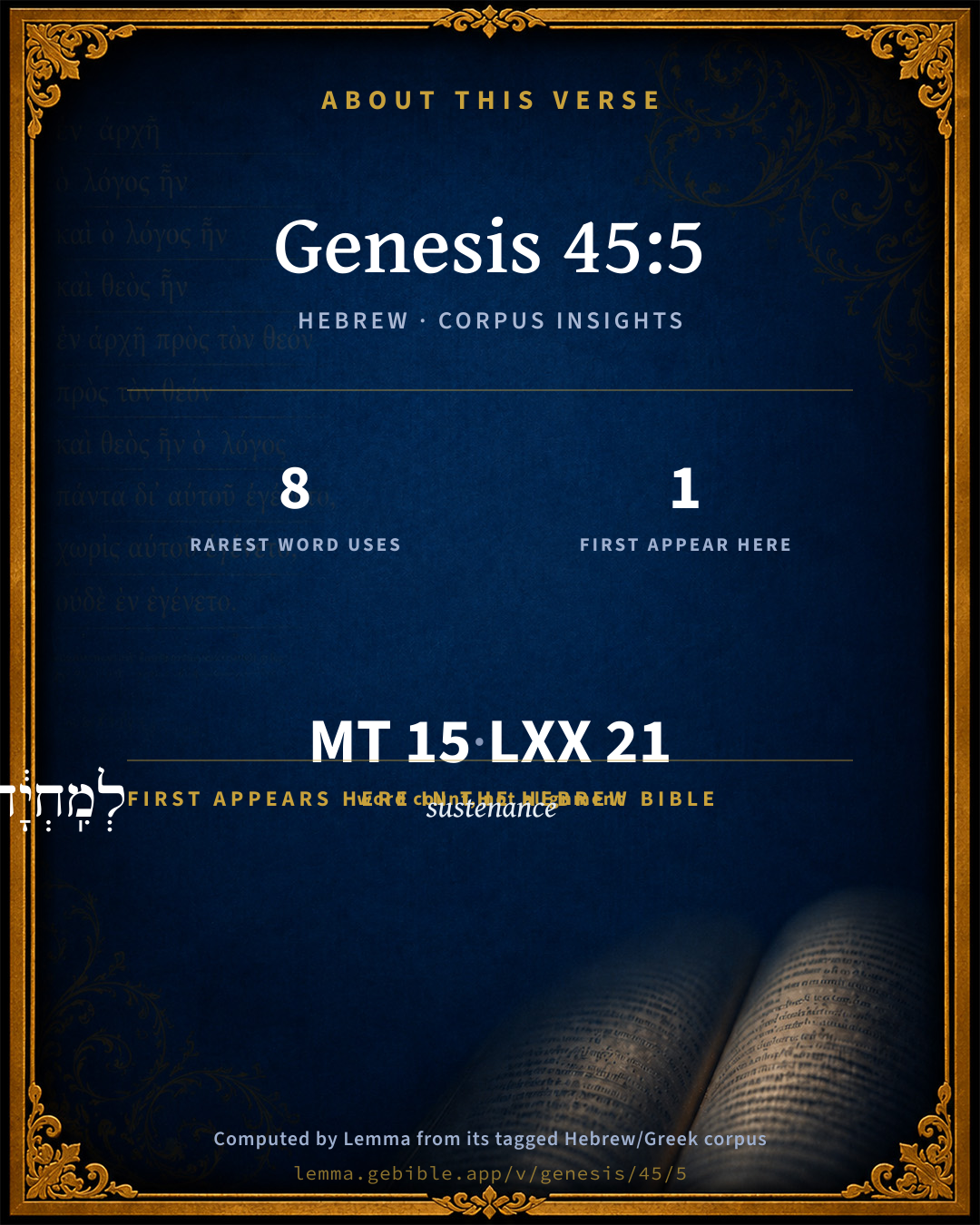
Genesis 45:5

Hebrew (Westminster Leningrad Codex) Genesis 45:5 appears in the Hebrew Old Testament. The text above is from the Westminster Leningrad Codex. Each word links to its Strong’s number, a concise gloss, and parsing drawn from the Open Scriptures Hebrew Bible morphology. Click any word for its full Brown-Driver-Briggs (BDB) entry.
Download image
Cite this verse

Genesis 45:5 (World English Bible). Public Domain. Lemma interlinear Bible study tool, https://lemma.gebible.app/v/genesis/45/5.

Show BibTeX & RIS
BibTeX
RIS
English Translation
Now don't be grieved, nor angry with yourselves, that you sold me here, for God sent me before you to preserve life.
World English Bible · Public Domain
Highlights
  • 1 first appearance in the Hebrew Bible
Full analysis ↓
Download a study sheet

One document with this verse’s original text, its word-by-word gloss line, the meaning frame, cross-references with their text, attributed commentary, and full source and license credits — printable, and it pastes into notes with its structure intact.

This verse Autodidact and up

Study sheet (.html) Plain text (.txt)

A passage Seminary Student

Up to 50 verses in one chapter. A passage sheet keeps up to 6 commentary sources and 12 cross-references per verse, in the order this page ranks them, and says so on the sheet whenever that leaves anything out. Ask for a single verse and you get the Autodidact verse sheet above.

Everything on this page stays free to read, with no account — the sheet is a download of what is already on screen, not access to it.

Want to remove ads? Support Godless Engineer
Compare translations 3

The same verse in 3 English versions, stacked beneath the original-language interlinear above. Click any original word for its lexicon entry.

Each is an independent rendering of the whole verse — the interlinear is not word-aligned to these translations.

Highlighted words mark where these versions differ — a whole-verse word diff, not a word-by-word alignment.

  • World English Bible Public Domain
    Now don't be grieved, nor angry with yourselves, that you sold me here, for God sent me before you to preserve life.
  • King James Version Public Domain
    Now therefore be not grieved, nor angry with yourselves, that ye sold me hither: for God did send me before you to preserve life.
  • unfoldingWord Literal Text CC BY-SA 4.0
    And now, do not be grieved and do not let it burn in your eyes that you sold me here, because God sent me ahead of you for the preservation of life.

unfoldingWord Literal Text — © unfoldingWord, licensed CC BY-SA 4.0. Word-aligned USFM3 via Door43 (git.door43.org/unfoldingWord/en_ult).

Versions to compare (up to 4)

3 of 4 selected

Show all 18 translations

Every available English version of this verse, each an independent rendering of the whole verse.

  • World English Bible Public Domain
    Now don't be grieved, nor angry with yourselves, that you sold me here, for God sent me before you to preserve life.
  • Berean Standard Bible Public Domain
    And now, do not be distressed or angry with yourselves that you sold me into this place, because it was to save lives that God sent me before you.
  • Majority Standard Bible Public Domain
    And now, do not be distressed or angry with yourselves that you sold me into this place, because it was to save lives that God sent me before you.
  • King James Version Public Domain
    Now therefore be not grieved, nor angry with yourselves, that ye sold me hither: for God did send me before you to preserve life.
  • American Standard Version (1901) Public Domain
    And now be not grieved, nor angry with yourselves, that ye sold me hither: for God did send me before you to preserve life.
  • Revised Version (1885) Public Domain
    And now be not grieved, nor angry with yourselves, that ye sold me hither: for God did send me before you to preserve life.
  • Geneva Bible (1599) Public Domain
    Nowe therefore be not sad, neither grieued with your selues, that ye sold me hither: for God did send me before you for your preseruation.
  • Douay-Rheims (1899) Public Domain
    Be not afraid, and let it not seem to you a hard case that you sold me into these countries: for God sent me before you into Egypt for your preservation.
  • Young's Literal Translation Public Domain
    and now, be not grieved, nor let it be displeasing in your eyes that ye sold me hither, for to preserve life hath God sent me before you.
  • Literal Standard Version CC BY-SA 4.0
    and now, do not be grieved, nor let it be displeasing in your eyes that you sold me here, for God has sent me before you to preserve life.
  • Unlocked Literal Bible CC BY-SA 4.0
    Do not be grieved or angry with yourselves that you sold me here, for God sent me ahead of you to preserve life.
  • unfoldingWord Literal Text CC BY-SA 4.0
    And now, do not be grieved and do not let it burn in your eyes that you sold me here, because God sent me ahead of you for the preservation of life.
  • Darby Bible Public Domain
    And now, be not grieved, and be not angry with yourselves, that ye sold me hither, for God sent me before you to preserve life.
  • World Messianic Bible Public Domain
    Now don’t be grieved, nor angry with yourselves, that you sold me here, for God sent me before you to preserve life.
  • Webster's Bible Public Domain
    Now therefore be not grieved, nor angry with yourselves, that ye sold me hither; for God sent me before you to preserve life.
  • Free Bible Version CC BY-SA 4.0
    But don't be worried or get angry with yourselves that you sold me to be a slave here, because it was God who sent me ahead of you to save lives.
  • Bible in Basic English Public Domain
    Now do not be troubled or angry with yourselves for sending me away, because God sent me before you to be the saviour of your lives.
  • JPS Tanakh (1917) Public Domain
    And now be not grieved, nor angry with yourselves, that ye sold me hither; for God did send me before you to preserve life.

Literal Standard Version (2020), Covenant Press — licensed CC BY-SA 4.0. Text via the HelloAO Bible API (eBible.org). Unlocked Literal Bible (unfoldingWord) — licensed CC BY-SA 4.0. Text via the HelloAO Bible API (eBible.org). unfoldingWord Literal Text — © unfoldingWord, licensed CC BY-SA 4.0. Word-aligned USFM3 via Door43 (git.door43.org/unfoldingWord/en_ult). Free Bible Version, Dr. Jonathan Gallagher — licensed CC BY-SA 4.0. Text via the HelloAO Bible API (eBible.org).

Word by word

More ways to search: Search by grammar → Find every occurrence → Compare this word →

Practice this passage: Drill this verse → Learn its vocabulary →

לְמִֽחְיָ֔ה
michyâh
H4241
“to/for · sustenance”
Preposition + Noun, Common, Feminine, Singular, Absolute
Part of Speech
Preposition + Noun
Type
Common
Gender
Feminine
Number
Singular
State
Absolute
Full BDB Definition

Origin: from H2421

TWOT: 644h

preservation of life, sustenance - preservation of life - sustenance - reviving - the quick of the flesh, live flesh, tender or raw flesh
  1. וְעַתָּ֣ה ʻattâh H6258 “and · now” Conjunction + Adverb
  2. אַל ʼal H408 “not” Particle, Negative
  3. תֵּעָ֣צְב֗וּ ʻâtsab H6087 “to pain” Verb, Niphal, Jussive, 2nd Person, Masculine, Plural
  4. וְאַל ʼal H408 “and · not” Conjunction + Particle, Negative
  5. יִ֨חַר֙ chârâh H2734 “to be angry” Verb, Qal, Jussive, 3rd Person, Masculine, Singular
  6. בְּעֵ֣ינֵיכֶ֔ם ʻayin H5869 “in/at · eyes · your” Preposition + Noun, Common, Both, Dual, Construct + Suffix, Personal, 2nd Person, Masculine, Plural
  7. כִּֽי kîy H3588 “that” Conjunction
  8. מְכַרְתֶּ֥ם mâkar H4376 “to sell” Verb, Qal, Perfect, 2nd Person, Masculine, Plural
  9. אֹתִ֖י ʼêth H853 “- · me” Particle, Direct Object + Suffix, Personal, 1st Person, Common, Singular
  10. הֵ֑נָּה hênnâh H2008 “here” Adverb
  11. כִּ֣י kîy H3588 “that” Conjunction
  12. שְׁלָחַ֥נִי shâlach H7971 “to send · me” Verb, Qal, Perfect, 3rd Person, Masculine, Singular + Suffix, Personal, 1st Person, Common, Singular
  13. אֱלֹהִ֖ים ʼĕlôhîym H430 “God(s)” Noun, Common, Masculine, Plural, Absolute
  14. לִפְנֵיכֶֽם pânîym H6440 “to/for · face(s) · your” Preposition + Noun, Common, Both, Plural, Construct + Suffix, Personal, 2nd Person, Masculine, Plural

About this verse

These counts appear in no published source. They are computed here, from the morphology-tagged text and Lemma’s own curated glosses. What Lemma adds →

15
words
13
distinct lemmas
Pentateuch
section

Notable vocabulary

The rarest word here is לְמִֽחְיָ֔ה sustenance H4241 — appearing just 8 times in the whole Hebrew Bible.

First appearance in Scripture

This word makes its first canonical appearance in the Hebrew Bible here:

  • לְמִֽחְיָ֔ה sustenance H4241

Shared distinctive vocabulary

לְמִֽחְיָ֔ה sustenance H4241 occurs in 8 verses of the Hebrew Bible. Also found in:

Grammatical profile

  • 4 verbs
  • 4 nouns
  • 2 conjunctions
  • 2 adverbs
  • 3 particles

Verb forms

  • תֵּעָ֣צְב֗וּ Niphal · Jussive
  • יִ֨חַר֙ Qal · Jussive
  • מְכַרְתֶּ֥ם Qal · Perfect
  • שְׁלָחַ֥נִי Qal · Perfect

Repetition

Words recur within this verse — often emphatic in Hebrew:

  • אַל not H408 ×2
  • כִּֽי that H3588 ×2

Hebrew & Septuagint length

In English translation the verse runs 22 words from the Hebrew and 26 from the Septuagint (LXX English) — closely comparable.

A rough comparison of the two English renderings, which tokenize alike — not a word-level alignment.

Word counts can differ between the Hebrew and the Greek without any difference in meaning — e.g. the Hebrew direct-object marker אֵת has no separate Greek word, and Greek often adds the article ὁ.

In the original languages it is 15 Hebrew tokens and 21 Greek tokens — but the two are counted differently (Hebrew bundles its prefixes and suffixes into one token; the Greek is in lemma form), so that isn’t a like-for-like length.

Cross-references

16

Topical passages linked to Genesis 45:5 in the Treasury of Scripture Knowledge — connected by theme and wording, ordered by reader-vote popularity; previews shown in the World English Bible.

  • Genesis 50:20 As for you, you meant evil against me, but God meant it for good, to bring to pass, as it is this day, to save many people alive.
  • Acts 7:9–15 "The patriarchs, moved with jealousy against Joseph, sold him into Egypt. God was with him,
  • Genesis 45:7–8 God sent me before you to preserve you a remnant in the earth, and to save you alive by a great deliverance.
  • Job 1:21 He said, "Naked I came out of my mother's womb, and naked shall I return there. Yahweh gave, and Yahweh has taken away. Blessed be the name of Yahweh."
  • Acts 2:23–24 him, being delivered up by the determined counsel and foreknowledge of God, you have taken by the hand of lawless men, crucified and killed;
  • Psalms 105:16–17 He called for a famine on the land. He destroyed the food supplies.
  • Luke 23:34 Jesus said, "Father, forgive them, for they don't know what they are doing." Dividing his garments among them, they cast lots.
  • Genesis 47:25 They said, "You have saved our lives! Let us find favor in the sight of my lord, and we will be Pharaoh's servants."
  • Isaiah 40:1–2 Comfort you, comfort you my people, says your God.
  • 1 Samuel 1:19 They rose up in the morning early, and worshiped before Yahweh, and returned, and came to their house to Ramah: and Elkanah knew Hannah his wife; and Yahweh remembered her.
  • 2 Samuel 12:12 For you did it secretly, but I will do this thing before all Israel, and before the sun.'"
  • 2 Samuel 16:10–12 The king said, What have I to do with you, you sons of Zeruiah? Because he curses, and because Yahweh has said to him, Curse David; who then shall say, Why have you done so?
  • 2 Samuel 17:14 Absalom and all the men of Israel said, The counsel of Hushai the Archite is better than the counsel of Ahithophel. For Yahweh had ordained to defeat the good counsel of Ahithophel, to the intent that Yahweh might bring evil on Absalom.
  • Acts 4:24–28 When they heard it, they lifted up their voice to God with one accord, and said, "O Lord, you are God, who made the heaven, the earth, the sea, and all that is in them;
  • 2 Corinthians 2:7 so that on the contrary you should rather forgive him and comfort him, lest by any means such a one should be swallowed up with his excessive sorrow.
  • 2 Corinthians 2:11 that no advantage may be gained over us by Satan; for we are not ignorant of his schemes.

Cross-references courtesy of OpenBible.info (CC BY 4.0).

Hebrew and Greek witnesses Masoretic Hebrew ↔ Greek Septuagint

The same verse in the two great witnesses to the Old Testament, shown verse-for-verse.

These are two independent witnesses, not word-aligned to each other, and the Septuagint is shown in lemma (dictionary) form.

Hebrew Genesis 45:5 Masoretic · Westminster Leningrad Codex

וְעַתָּ֣ה אַל תֵּעָ֣צְב֗וּ וְאַל יִ֨חַר֙ בְּעֵ֣ינֵיכֶ֔ם כִּֽי מְכַרְתֶּ֥ם אֹתִ֖י הֵ֑נָּה כִּ֣י לְמִֽחְיָ֔ה שְׁלָחַ֥נִי אֱלֹהִ֖ים לִפְנֵיכֶֽם

Now don't be grieved, nor angry with yourselves, that you sold me here, for God sent me before you to preserve life.

World English Bible · Public Domain

Greek LXX Genesis 45:5 Septuagint · lemma form

νῦν οὖν μή λυπέω μηδέ σκληρός σύ φαίνω ὅτι ἀποδίδωμι ἐγώ ὧδε εἰς γάρ ζωή ἀποστέλλω ἐγώ ὁ θεός ἔμπροσθεν σύ

Now then be not grieved, and let it not seem hard to you that you⌃ sold me hither, for God sent me before you for life.

LXX2012 (modern English Septuagint) · Public Domain

On this verse, The Cambridge Bible for Schools and Colleges discusses the Septuagint’s reading. Read the note in Commentary ↓

Hebrew: Westminster Leningrad Codex (CC BY 4.0). Greek: Septuagint (public domain); English from LXX2012 (modern English Septuagint) (Public Domain). How the Septuagint differs from the Hebrew →

Targum (Aramaic paraphrase)

2

The Targum is the ancient Jewish Aramaic paraphrase of the Hebrew Scriptures — an interpretive translation, not the Hebrew text itself. Onkelos (literal) and Pseudo-Jonathan (expansive) render the Torah, and Jonathan the Prophets. Coverage is partial: where no permissively-licensed English translation exists for a verse, only the Aramaic is shown. This is verse-level text, not a word-by-word alignment to the Hebrew.

  1. Targum Onkelos Torah (Genesis–Deuteronomy)
    וּכְעַן לָא תִתְנַסְסוּן וְלָא יִתְקָף בְּעֵינֵיכוֹן אֲרֵי זַבִּנְתּוּן יָתִי הַלְכָא אֲרֵי לְקַיָּמָא שַׁלְחַנִּי יְיָ קֳדָמֵיכוֹן

    (no public-domain English translation for this verse)

    Targum Onkelos — Aramaic: “Onkelos Genesis” (public domain); “Onkelos Exodus” (public domain); “Onkelos Leviticus” (public domain); “Onkelos Numbers” (public domain); “Onkelos Deuteronomy” (public domain). English: “Sefaria Community Translation” (CC0 1.0 (public-domain dedication)); “J.W. Etheridge. The Targums of Onkelos and Jonathan Ben Uzziel on the Pentateuch. London: Longmans, Green, 1862” (public domain). Text via Sefaria.

  2. Targum Pseudo-Jonathan Torah (Genesis–Deuteronomy)
    וּכְדוּן לָא תִתְנַסְסוּן וְלָא יִתְקוֹף בְּעֵינֵיכוֹן אֲרוּם זַבִּינְתּוּן יָתִי הַלְכָא אֲרוּם לְקַיְימָא יַתְכוֹן שַׁדְרַנִי יְיָ קֳדָמֵיכוֹן

    Now, therefore, be not grieved, nor consider it a hard thing that you sold me hither; for the Lord sent me hither before you to preserve you.

    Targum Pseudo-Jonathan — Aramaic: “Targum Jonathan on Genesis” (public domain); “Targum Jonathan on Exodus” (public domain); “Targum Jonathan on Leviticus” (public domain); “Targum Jonathan on Numbers” (public domain); “Targum Jonathan on Deuteronomy” (public domain). English: “The Targum of Jonathan ben Uzziel, trans. J. W. Etheridge, London, 1862” (public domain). Text via Sefaria.

Commentary

Notes on Genesis 45:5 from classic Christian and Jewish commentators (each source and its license shown beneath its notes). The classic Christian expositions comment on the surrounding passage and are grouped to its opening verse, so a note may address several verses; the Jewish commentaries on the Tanakh (Rashi and others) are per-verse, so they appear only where the commentator wrote on this verse.

Lemma curates 59 commentaries, every one of them public domain or Creative Commons licensed, each selected and text-cleaned for this edition rather than reprinted as found. About our sources →

Trapp's Complete Commentary

John Trapp

Gen 45:5 Now therefore be not grieved, nor angry with yourselves, that ye sold me hither: for God did send me before you to preserve life.

Ver. 5. Now therefore be not grieved, &c.] See here a lively image of Christ’s love toward his enemies, for whom he prayed and died, "to give them repentance and remission." {Act 5:31} This Angel of the Covenant first troubles the waters, and then cures those cripples that step in. This Sun of Righteousness first draws up vapours of godly grief, and then dispels them. "A bruised reed shall he not break, and smoking flax shall he not quench, till he bring forth judgment to victory"; {Mat 12:20 Isa 42:3} that is, weak grace to perfection.

To preserve life.] Animantis euiusque vita in fuga est, saith the philosopher, and must be maintained by means. Hence it is called "the life of our hands," {Isa 57:10} because upheld by the labour of our hands.

John Trapp, A Commentary or Exposition upon All the Books of the Old and New Testament (1647–1656) — public domain. Text from a community e-Sword module.

The Biblical Illustrator

Joseph S. Exell

Gen_45:5

Be not grieved, nor angry with yourselves

The duty of self-forgiveness

Is it allowable, in any case, to forgive ourselves?

Some of those who have a proper sense of mans responsibility to his Maker would be inclined at first to say, No. Most of those whose views of mans responsibility are inadequate would at once reply, Yes. It is only too evident, in fact, that they do forgive themselves where they ought not. But does it follow that their reply can never, in any case, be correct? The text implies, on the one hand, that we ought to grieve for our sins; and, on the other, that there is a proper limit to grief.

I. LET US CONSIDER OUR SINS IN THEIR ASPECT TOWARDS GOD, the most serious aspect of all. Acts of enmity and rebellion, treating Gods law with dishonour and scorn. Cause enough here for being grieved and angry with ourselves. Yet, if these sins are repented of, and if we have true faith in the Redeemers blood, there is an appointed balm for this wound.

II. THE EFFECTS OF OUR SINS UPON MAN. One sinner destroyeth much good--like an infectious disease introduced into a community. There is not a greater murderer in existence than the man who, through neglect or obstinacy, should introduce a fever into a city. Is the man very much better who sins against other mens souls? Yet we have done this, all of us, in our time; we have sinned against many a soul, and we have occasioned many a pang and many a sin by our sins. On this account, therefore, it well becomes us to be grieved; and yet, as before, not to grieve in the way of despair. For if our sins have been repented of and forgiven, they are not the things that they were, either in Gods sight or in their effects upon men. (Homilist.)

Divine Providence in things evil

It were a mockery to tell us that we should have safety by the hand of Omnipotence, in regard to the powers of irrational nature; but that in all that concerns the free or the wicked actions of men, we must rely on ourselves or on chance. It were a crippled and insufficient Providence which should guard us against the serpent or the tornado, but which should leave us to ourselves the moment a moral and responsible agent came upon the stage. Yet this is the strange uncomfortable doctrine which prompts the language heard in many a Christian circle. Which of us has not listened to such words as these: I could bear this trial if it were ordered of God, but it proceeds from man. It is not Providential, but from wicked human beings. There is in this a sad confusion. Such a government as is here assumed would be no Providence at all; and would render all rule impossible, as excluding the very agencies which are most important. And we venture to say that the Bible teaches no such doctrine. While it abhors the thought of making God the author of sin, it does not exclude sinful acts from His wise and holy plan. While it evermore denies Gods participation in the evil of wicked deeds, it still asserts that, in the directing and governing of such deeds, there is a sovereign Providence, working out its own wise and holy ends: Mans goings are of the Lord; how then can a man understand his own way? A mans heart deviseth his way, but the Lord directeth his steps. The wrath of man shall praise Him, and the remainder of wrath He will restrain. Let it be clearly fixed in our minds, as the only true philosophy of this subject, that an act may be wicked as to the intent of its agent, and yet its result may be really intended by God. Were it not so we could have no relief under our worst sufferings, namely, those which we endure from depraved and malignant human creatures. But these also are Providential. Josephs brethren committed a great sin. This none can deny, so far as they were concerned. Yet was it strictly and particularly Providential: So now it was not you that sent me hither, but God. (Christian Age.)

A comforting thought for the penitent

To say to a hardened, reckless man that God will ever rule his sin for some good end, will only make him more regardless than ever. But when a man is truly penitent, and seems almost paralyzed by the perception of his guilt, to show him that God has brought good out of his evil will exalt Gods grace and wisdom in his eyes, and lead him more implicitly to cling to Him. It is a comforting thought, that while we cannot undo the sin, God has kept it from undoing us, and has over-ruled it for greater good to ourselves and greater blessing to others than perhaps might otherwise have been attained. We can never be as we were before we committed it. Always there will be some sadness in our hearts and lives connected with it and springing out of it. But still, if we really repent of it and return to God, there may come to us meat out of the eater, and sweet out of the bitter. It may give us sympathy with others, and fit us for being helpful to others; so that, though we may be sadly conscious of the evil of our course, we may yet see that through it all God was preparing us for the saving of those who, humanly speaking, but for our instrumentality would have gone down to perdition. But mark the condition--if we truly repent. There is no comfort otherwise; but that being secured, then the penitent may take the consolation, that out of his worst sin God can and may bring good both to himself and others, and he ought to look for the means of bringing that about. (W. M. Taylor, D. D.)

Cranmer and the traitors; or, forgiveness of great injury

Archbishop Cranmer appeared almost alone in the higher classes as the friend of truth in evil times, and a plot was formed to take away his life. The providence of God, however, so ordered it that the papers which would have completed the plan were intercepted and traced to their authors, one of whom lived in the archbishops family, and the other he had greatly served. He took these men apart in his palace, and told them that some persons in his confidence had disclosed his secrets, and even accused him of heresy. They loudly censured such villainy, and declared the traitors to be worthy of death; one of them adding, that if an executioner was wanted he would perform the office himself. Struck with their perfidy, after lifting up his voice to heaven, lamenting the depravity of man, and thanking God for his preservation, he produced their letters, and inquired if they knew them. They now fell on their knees, confessed their crimes, and implored forgiveness. Cranmer mildly expostulated with them on the evil of their conduct, forgave them, and never again alluded to their treachery. His forgiveness of injuries was so well known, that it became a byword, Do my lord of Canterbury an ill-turn, and you make him your friend for ever. (Moral and Religious Anecdotes.)

Providence difficult to interpret

The book of Providence is not so easily read as that of nature; its wisdom in design and perfection in execution are by no means as plain. Here Gods way is often in the sea, His path in the mighty waters, and His footsteps are not known. But that is because the scheme of Providence is not, like creation, a finished work. Take a man to a house when the architect is in the middle of his plan, and with walls half-built and arches half-sprung, rooms without doors, and pillars without capitals--what appears perfect order to the architect, who has the plan all in his eye, to the other will seem a scene of perfect confusion. And so stands man amid that vast scheme of Providence which God began six thousand years ago, and may not finish for as many thousand years to come. (T. Guthrie.)

God did send me before you

Josephs recognition of Gods hand in his life

The words of Joseph in the text contrast somewhat strangely with the words spoken by his brethren of themselves. It is clear that the view he took of their conduct was the one most likely to give them ease. He assured them that after all they were but instruments in Gods hands, that God had sent him, that Gods providence was at work for good when they sold him as a slave.

Both views are true and both important. The brethren had done what they did as wickedly and maliciously as possible; nevertheless it was true that it was not they, but God, who had sent Joseph into Egypt.

I. That God governs the world we do not--we dare not--doubt; but it is equally true that He governs in a way which we should not have expected, and that much of His handiwork appears strange. So strange, indeed, that we know that it has been in all times, and is in our time, easy to say, God cares not, God sees not; or even to adopt the bolder language of the fool, and say There is no God. Scriptural illustrations of the same kind of contradiction as we have in the text are to be found--

(1) in the case of Esau and Jacob;

(2) in the manner in which the hardheartedness and folly of Pharaoh were made to contribute to the carrying out of Gods designs concerning the Israelites;

(3) in the circumstances of our Lords sorrowful life on earth, and especially the circumstances connected with His shameful and yet life-giving death.

II. Our own lives supply us with illustrations of the same truth. Who cannot call to mind cases in which Gods providence has brought about results in the strangest way, educing good from evil, turning that which seemed to be ruin into blessing, making even the sins and follies of men to declare His glory and to forward the spiritual interests of their brethren? We see human causes producing effects, but we may also see Gods hand everywhere; all things living and moving in Him; no sparrow falling without His leave; no hair of one of His saints perishing. (Bishop Harvey Goodwin.)

Providence in life

I. The story of Joseph is to all men for ever the best proof of the working of the hand of Providence.

II. As through the life of Joseph, so through our life, there are threads which connect the different scenes and bind together the destinies of the different actors.

III. This history and the inspired commentary on it in Psa_105:1-45. teach us the wonderful continuity of Gods plan and the oneness of the thread that binds together the histories of Israel and of Egypt. (Dean Butcher.)

Josephs statement

The principles illustrated in Josephs statement are these:

1. Gods absolute control over all creatures and events.

2. That while sinners are encouraged to hope in His mercy, they are left without excuse for their sin.

3. That God orders all human affairs with a view to the preservation of His sacred and gifted family--the Church.

Human and Divine agency inseparably connected

That the Scripture ascribes the actions of men both to themselves and to God. I shall endeavour to illustrate the truth, the propriety, and the importance of this doctrine.

I. We are to consider, THAT THE SCRIPTURE DOES ASCRIBE THE ACTIONS OF MEN BOTH TO THEMSELVES AND TO GOD. It will be universally allowed that the Scripture ascribes the actions of men to themselves. It ascribes to Abel his faith, to Cain his unbelief, to Job his patience, to Moses his meekness. Having just premised this, I proceed to adduce instances in which the Scripture ascribes the actions of men to God as well as to themselves. The first instance that occurs is in the history of Joseph.

II. THY PROPRIETY OF ASCRIBING HUMAN ACTIONS TO BOTH HUMAN AND DIVINE AGENCY. Human agency is always inseparably connected with Divine agency. And though it may be proper in some cases to speak of mans agency alone, and of Gods agency alone, yet it is always proper to ascribe the actions of men not only to themselves, but to God. The propriety of the Scripture phraseology on this subject is so plain and obvious, that it is strange so many have objected against it, and endeavoured to explain it away. But since this is the case, it seems very necessary to show--

III. THE IMPORTANCE OF ASCRIBING THE ACTIONS OF MEN TO GOD, AS WELL AS TO THEMSELVES. We have no reason to suppose that the sacred writers would have used such a mode of speaking, unless it were necessary and important. It is the design of God, in all His works, to set His own character, and the character of all His rational and accountable creatures, in the truest and strongest light. This leads me to observe--

1. It is a matter of importance that the actions of men should be ascribed to themselves. They are real and proper agents in all their voluntary exercises and exertions.

2. The importance of ascribing mens actions to God as well as to themselves. He is really concerned in all their actions; and it is as important that His agency should be brought into view as that theirs should be brought into view; for His character can no more be known without ascribing His agency to Himself, than their characters can be known without ascribing their agency to themselves.

Improvement:

1. In view of this subject, we learn when it is proper to ascribe the actions of men to themselves, and when it is proper to ascribe them to God. Whenever men are required or forbidden to act, and whenever they are approved or condemned for acting, there is a propriety in ascribing their actions to themselves, without any reference to the Divine efficiency. It is their own free, voluntary agency, which alone constitutes their virtue or vice, and which renders them worthy of either praise or blame. Though they always act under a Divine influence, yet that influence neither increases their virtue nor diminishes their guilt, and of consequence ought never to be brought into view when they are to be praised or blamed for their conduct. But when the power, wisdom, goodness, or sovereignty of God in governing their views and actions are to be displayed, then it is proper to mention His, and only His, agency in the case.

2. Since the Scripture ascribes all the actions of men to God as well as to themselves, we may justly conclude that the Divine agency is as much concerned in their bad as in their good actions.

3. If the actions of men may be ascribed to God as well as to themselves, then it is easy to form a just and full view of Divine Providence. If God is actually concerned in all human actions, it necessarily follows that He constantly and absolutely governs the moral as well as the natural world.

4. If it be true that all the actions of men may be ascribed to God as well as to themselves, then it is proper to submit to God under all the evils which He brings upon us by the agency of created beings.

5. If the actions of men may be ascribed to God as well as to themselves, then God will be glorified by all their conduct. Whether they have a good or bad intention in acting, God has always a good design in causing them to act in the manner they do.

6. If the actions of men may be ascribed both to God and to themselves, then we may see the duty and nature of true repentance.

7. Finally, if it be true that the actions of men may be properly ascribed both to God and to themselves, then it is of great importance for mankind to believe and acknowledge this truth. (N. Emmons, D. D.)

The Biblical Illustrator, edited by Joseph S. Exell (c. 1880s–1900s) — public domain. Text from a community e-Sword module.

Joseph Benson's Commentary

Gen 45:5. Be not grieved nor angry with yourselves — Namely, immoderately, for the injury you did to me; or for the danger you have brought upon yourselves. Otherwise, he does not mean to dissuade them from a godly sorrow and displeasure at themselves for their offence against God, their father, and himself, to produce which sorrow and displeasure was the principal end he had in view in his strange and rough conduct toward them. Sinners must grieve and be angry with themselves for their sins; yea, though God, by his power, bring good out of them: for no thanks are due to them on that account. And true penitents should be greatly affected when they see God bring good out of evil. But, although we must not with this consideration extenuate our own sins, and so take off the edge of our repentance; yet it may be well thus to extenuate the sins of others, and so take off the edge of our angry resentments. Thus Joseph does here. God, says he, did send me before you to preserve life — Not only your lives, but the lives of all the people in this and the neighbouring countries. And now, his brethren did not need to fear lest he should revenge upon them an injury which God’s providence had made to turn so much to his advantage and that of his family, as well as thousands and myriads of others.

Joseph Benson's Commentary on the Old and New Testaments (1811–1818) — public domain. Text from a community e-Sword module.

Tyndale Open Study Notes

Tyndale Open Resources

45:5-8 God . . . sent me is the central message of the account of Jacob’s family (37:2). As the Lord had told Abraham, he was leading the Israelites into Egypt (15:13). God had sent Joseph to Egypt to prepare for his family’s rescue during the famine. In what has become a classic statement of God’s sovereignty, Joseph explained that God had been working through all of the circumstances and human acts to bring about his plan. The certainty of God’s will is the basis for forgiveness and reconciliation with those who do wrong, cause hurt, or bring harm. If people do not believe that God is sovereign, then they will blame others and retaliate. Those who are spiritual will trust that God is at work even through human wickedness (see also Rom 8:28-30).

Tyndale Open Study Notes — © Tyndale Open Resources, licensed CC BY-SA 4.0. Text via the HelloAO Bible API.

Geneva Bible (1599)

Geneva Bible translators

This example teacheth that we must by all means comfort them, which are truly humbled and wounded for their sins.

Geneva Bible (1599) marginal notes — public domain. Text via Bolls.life.

Adam Clarke's Commentary

Verse 5. Be not grieved, nor angry with yourselves] This discovers a truly noble mind: he not only forgives and forgets, but he wishes even those who had wronged him to forget the injury they had done, that they might not suffer distress on the account; and with deep piety he attributes the whole to the providence of God; for, says he, God did send me before you to preserve life. On every word here a strong emphasis may be laid. It is not you, but God; it is not you that sold me, but God who sent me; Egypt and Canaan must both have perished, had not a merciful provision been made; you were to come down hither, and God sent me before you; death must have been the consequence of this famine, had not God sent me here to preserve life.

Adam Clarke's Commentary on the Bible (1810–1826) — public domain. Text from a community e-Sword/MySword module.

The Cambridge Bible for Schools and Colleges

gen. ed. J. J. S. Perowne

5. nor angry with yourselves] The Heb. is “let there not be burning in your eyes,” “do not look angry, or vexed,” i.e. with yourselves.

to preserve life] i.e. to preserve the life both of his brethren and father, and also of the people of Egypt. The word is rendered “reviving” in Ezr_9:8-9. LXX εἰς ζωήν; Lat. pro salute vestra. Joseph, with warm-hearted impetuosity, urges them not to take to heart their share in the past. God had overruled it all for good. Cf. Psa_105:17, “he sent a man before them.”

The Cambridge Bible for Schools and Colleges (gen. ed. J. J. S. Perowne; Cambridge University Press, 1878–1918) — public domain. Text from a community e-Sword module.

John Gill's Exposition

Now therefore be not grieved,.... To an excess, so as to be swallowed up with overmuch sorrow; otherwise it became them to be grieved for their sin, and to show a godly sorrow and true repentance for it:

nor angry with yourselves, that ye sold me hither; reflect upon themselves, and afflict themselves in an immoderate way; or break forth into anger and wrath with one another, upbraiding and blaming each other for their conduct in that affair, and so foment contentions and quarrels among themselves:

for God did send me before you to preserve life; the life of thousands of persons in Egypt, Canaan, and other countries; and particularly to preserve their lives was he sent before them into Egypt; where, by interpretation Pharaoh's dreams, by which he understood and did foretell the seven years of plenty and seven years of famine, he was to great honour and trust, and laid up a sufficiency of corn in the time of plenty to answer the exigencies of various countries in the time of famine, and, among the rest, of his own family; and therefore would have this attributed by them to the wise disposing providence of God.

John Gill's Exposition of the Whole Bible (1746–1763) — public domain (CC PDM 1.0). Text via the HelloAO Bible API.

Haydock's Catholic Bible Commentary

Hard. Hebrew, "Be not indignant in your eyes." Perhaps he was afraid, lest they should begin to accuse one another, as the authors of the deed, and thus disturb the harmony of this reconciliation. He perfectly understands the conduct of divine Providence, which can draw good out of evil, and cause even the malice of men to co-operate in the execution of his designs. (Calmet) --- God did not sanction or will this malice, as Calvin, &c., impiously assert. (Tirinus)

George Leo Haydock (1774–1849), Haydock's Catholic Family Bible and Commentary, 1859 edition — public domain. Excludes Psalms (Douay-Rheims chapter numbering differs from Protestant) and Deuterocanonical books (Catholic canon only).

Matthew Poole's English Annotations

1706

Be not grieved, to wit, immoderately, and for the injury which you did to me, or for the danger which you have brought upon yourselves. Otherwise he doth not dissuade them from a godly sorrow for their offence against God, for the procurement of which he dcsigned and used that strange and rough carriage towards them.

Nor angry with yourselves; neither excessively torment yourselves with the remembrance of the fact, neither break forth into contentions and wrath, and upbraidings of one another; for God by his wise, powerful, and gracious providence overruled your evil intentions to a happy end,

to preserve life; not only your lives, for the expression is here indefinite and general, but the lives of all the people in this and the neighbouring countries; which though it doth not lessen your sin, yet ought to qualify your sorrow.

Matthew Poole's English Annotations on the Holy Bible (1683–1685) — public domain. Text from a community e-Sword/MySword module.

Whedon's Commentary on the Bible

Daniel D. Whedon

5. God did send me — Four times he repeats this thought, that God’s hand had directed in all this matter. He sees the wonderful Providence in it now, and wishes them all to see it.

Daniel D. Whedon (gen. ed.), Commentary on the Old and New Testaments (1874–1909) — public domain. Text from a community e-Sword module.

The Pulpit Commentary

HOMILIES BY R.A. REDFORD Ver. 5.

Providence.

"Now therefore be not grieved," &c. ;

I THE END IS GOODNESS AND MERCY.

1. To preserve life.

2. To set the seed of the better society in the midst of the corruptions and imperfections of the old.

3. To prepare the way for the higher revelations of the future.

II GOD"S METHOD OF INSTRUMENTALITIES HIS GLORY.

1. The history of his people, their persecutions, their apparent humiliations, their marvelous victories.

2. The transformation of men, whereby enemies are made friends, &c. ;

3. The biographies of distinguished servants of God illustrate his grace in bestowing fitness for appointed work.

III MYSTERIES LOOKED AT FROM A HIGHER POINT OF VIEW BECOME REVELATIONS.

1. Time a great revealer. Wait for the Lord.

2. The narrow circle of a family history taken up into the higher sphere of Divine purposes concerning nations and humanity itself.

3. Ultimate vindication of the spiritual men and spiritual principles as against the merely earthly and selfish aims of individuals or communities. R.

The Pulpit Commentary (1880–1919), ed. H.D.M. Spence-Jones & Joseph S. Exell — public domain. Text from a community e-Sword module.

John Wesley's Explanatory Notes

Be not grieved or angry with yourselves - Sinners must grieve, and be angry with themselves for their sins; yea, though God, by his power, bring good out of them, for that is no thanks to the sinner: but true penitents should be greatly affected with it, when they see God bringing good out of evil. Though we must not with this consideration extenuate our own sins, and so take off the edge of our repentance; yet it may do well thus to extenuate the sins of others, and so take off the edge of our angry resentments. Thus Joseph doth here. His brethren needed not to fear that he would revenge upon them an injury which God's providence had made to turn so much to his advantage, and that of his family. Now he tells them how long the famine was likely to last, five years yet, ver. 6, and what a capacity he was in of being kind to his relations, which is the greatest satisfaction that wealth and power can give to a good man.

John Wesley, Explanatory Notes Upon the Whole Bible (1754–1765) — public domain. Text via the GEBible commentary corpus.

Rashi

Rabbi Shlomo Yitzchaki (Rashi)

למחיה FOR THE PRESERVATION OF LIFE — i.e. that I may be to you for a preservation of life.

Rashi on the Tanakh — English translations: “The Judaica Press complete Tanach with Rashi, translated by A. J. Rosenberg” (CC BY 4.0); “Pentateuch with Rashi's commentary by M. Rosenbaum and A.M. Silbermann, 1929-1934” (public domain); “The Metsudah Tanach series, Lakewood, N.J” (CC BY 4.0); and “The Book of Joshua, Metsudah Publications, 1997” (CC BY 4.0). Text via Sefaria.

Lesson kit

Teaching starters — assembled from the data on this page, not authored interpretation. Every prompt links to the verse data it draws on. Edit before teaching.

Genesis, in the Pentateuch, opens this verse with 15 words (13 distinct Hebrew lemmas). Its most distinctive word is michyâh (“sustenance”). A historical commentator’s framing appears above. Read the whole chapter for the surrounding context.

Discussion questions

  1. What does “sustenance” (michyâh) contribute to the verse as a whole?
  2. The word “sustenance” first appears here in Scripture. What is being introduced at this debut?
  3. Leviticus 13:10 shares the word «sustenance» with this verse. How do the two illuminate each other?
  4. “not” occurs 2× in this one verse. What is the effect of the repetition?
  5. These translations render this verse differently. What is at stake in choosing one wording over another?
  6. The verb «תֵּעָ֣צְב֗וּ» is Niphal Jussive. How does its form color the action?
  7. Reading how Trapp's Complete Commentary and The Biblical Illustrator read this verse, where do the two commentators agree and where do they part?

Things to notice

Reading settings

Reading text

Shown beneath each verse's original-language words.

Old Testament
Old Testament edition

Read the OT as the Masoretic Hebrew (MT) or the Greek Septuagint (LXX).

English shown for the Greek Septuagint (in the Hebrew ↔ Greek comparison).

Comparing translations? Open the Compare panel on any verse page to stack up to four side by side.