2 Samuel 13:12

Hebrew (Westminster Leningrad Codex) 2 Samuel 13:12 appears in the Hebrew Old Testament. The text above is from the Westminster Leningrad Codex. Each word links to its Strong’s number, a concise gloss, and parsing drawn from the Open Scriptures Hebrew Bible morphology. Click any word for its full Brown-Driver-Briggs (BDB) entry.
Download image
Cite this verse

2 Samuel 13:12 (World English Bible). Public Domain. Lemma interlinear Bible study tool, https://lemma.gebible.app/v/2-samuel/13/12.

Show BibTeX & RIS
BibTeX
RIS
English Translation
She answered him, No, my brother, do not force me; for no such thing ought to be done in Israel. Don't you do this folly.
World English Bible · Public Domain
Download a study sheet

One document with this verse’s original text, its word-by-word gloss line, the meaning frame, cross-references with their text, attributed commentary, and full source and license credits — printable, and it pastes into notes with its structure intact.

This verse Autodidact and up

Study sheet (.html) Plain text (.txt)

A passage Seminary Student

Up to 50 verses in one chapter. A passage sheet keeps up to 6 commentary sources and 12 cross-references per verse, in the order this page ranks them, and says so on the sheet whenever that leaves anything out. Ask for a single verse and you get the Autodidact verse sheet above.

Everything on this page stays free to read, with no account — the sheet is a download of what is already on screen, not access to it.

Want to remove ads? Support Godless Engineer
Compare translations 3

The same verse in 3 English versions, stacked beneath the original-language interlinear above. Click any original word for its lexicon entry.

Each is an independent rendering of the whole verse — the interlinear is not word-aligned to these translations.

Highlighted words mark where these versions differ — a whole-verse word diff, not a word-by-word alignment.

  • World English Bible Public Domain
    She answered him, No, my brother, do not force me; for no such thing ought to be done in Israel. Don't you do this folly.
  • King James Version Public Domain
    And she answered him, Nay, my brother, do not force me; for no such thing ought to be done in Israel: do not thou this folly.
  • unfoldingWord Literal Text CC BY-SA 4.0
    And she said to him, “No, my brother, do not humble me, for it is not done thus in Israel. Do not do this wickedness!

unfoldingWord Literal Text — © unfoldingWord, licensed CC BY-SA 4.0. Word-aligned USFM3 via Door43 (git.door43.org/unfoldingWord/en_ult).

Versions to compare (up to 4)

3 of 4 selected

Show all 18 translations

Every available English version of this verse, each an independent rendering of the whole verse.

  • World English Bible Public Domain
    She answered him, No, my brother, do not force me; for no such thing ought to be done in Israel. Don't you do this folly.
  • Berean Standard Bible Public Domain
    “No, my brother!” she cried. “Do not humiliate me, for such a thing should never be done in Israel. Do not do this disgraceful thing!
  • Majority Standard Bible Public Domain
    “No, my brother!” she cried. “Do not violate me, for such a thing should never be done in Israel. Do not do this disgraceful thing!
  • King James Version Public Domain
    And she answered him, Nay, my brother, do not force me; for no such thing ought to be done in Israel: do not thou this folly.
  • American Standard Version (1901) Public Domain
    And she answered him, Nay, my brother, do not force me; for no such thing ought to be done in Israel: do not thou this folly.
  • Revised Version (1885) Public Domain
    And she answered him, Nay, my brother, do not force me; for no such thing ought to be done in Israel: do not thou this folly.
  • Geneva Bible (1599) Public Domain
    But shee answered him, Nay, my brother, doe not force me: for no such thing ought to be done in Israel: commit not this follie.
  • Douay-Rheims (1899) Public Domain
    She answered him: Do not so, my brother, do not force me: for no such thing must be done in Israel. Do not thou this folly.
  • Young's Literal Translation Public Domain
    And she saith to him, `Nay, my brother, do not humble me, for it is not done so in Israel; do not this folly.
  • Literal Standard Version CC BY-SA 4.0
    And she says to him, “No, my brother, do not humble me, for it is not done so in Israel; do not do this folly.
  • Unlocked Literal Bible CC BY-SA 4.0
    She answered him, “No, my brother, do not force me, for nothing like this should be done in Israel. Do not do this appalling thing!
  • unfoldingWord Literal Text CC BY-SA 4.0
    And she said to him, “No, my brother, do not humble me, for it is not done thus in Israel. Do not do this wickedness!
  • Darby Bible Public Domain
    And she said to him, No, my brother, do not humble me; for no such thing is done in Israel: do not this infamy.
  • World Messianic Bible Public Domain
    She answered him, “No, my brother, do not force me! For no such thing ought to be done in Israel. Don’t you do this folly!
  • Webster's Bible Public Domain
    And she answered him, Nay, my brother, do not force me; for no such thing ought to be done in Israel: do not thou this folly.
  • Free Bible Version CC BY-SA 4.0
    “No, you're my brother!” she exclaimed. “Don't rape me! That's not what we do in Israel! Don't do something so shameful!
  • Bible in Basic English Public Domain
    And answering him, she said, O my brother, do not put shame on me; it is not right for such a thing to be done in Israel: do not this evil thing.
  • JPS Tanakh (1917) Public Domain
    And she answered him: 'Nay, my brother, do not force me; for no such thing ought to be done in Israel; do not thou this wanton deed.

Literal Standard Version (2020), Covenant Press — licensed CC BY-SA 4.0. Text via the HelloAO Bible API (eBible.org). Unlocked Literal Bible (unfoldingWord) — licensed CC BY-SA 4.0. Text via the HelloAO Bible API (eBible.org). unfoldingWord Literal Text — © unfoldingWord, licensed CC BY-SA 4.0. Word-aligned USFM3 via Door43 (git.door43.org/unfoldingWord/en_ult). Free Bible Version, Dr. Jonathan Gallagher — licensed CC BY-SA 4.0. Text via the HelloAO Bible API (eBible.org).

Word by word

More ways to search: Search by grammar → Find every occurrence → Compare this word →

Practice this passage: Drill this verse → Learn its vocabulary →

הַנְּבָלָ֥ה
nᵉbâlâh
H5039
“the · folly”
Particle, Definite Article + Noun, Common, Feminine, Singular, Absolute
Part of Speech
Particle + Noun
Type
Common
Gender
Feminine
Number
Singular
State
Absolute
Full BDB Definition

Origin: from H5036

TWOT: 1285b

senselessness, folly - disgraceful folly - of immorality, profane actions - disgrace, contumely disgrace
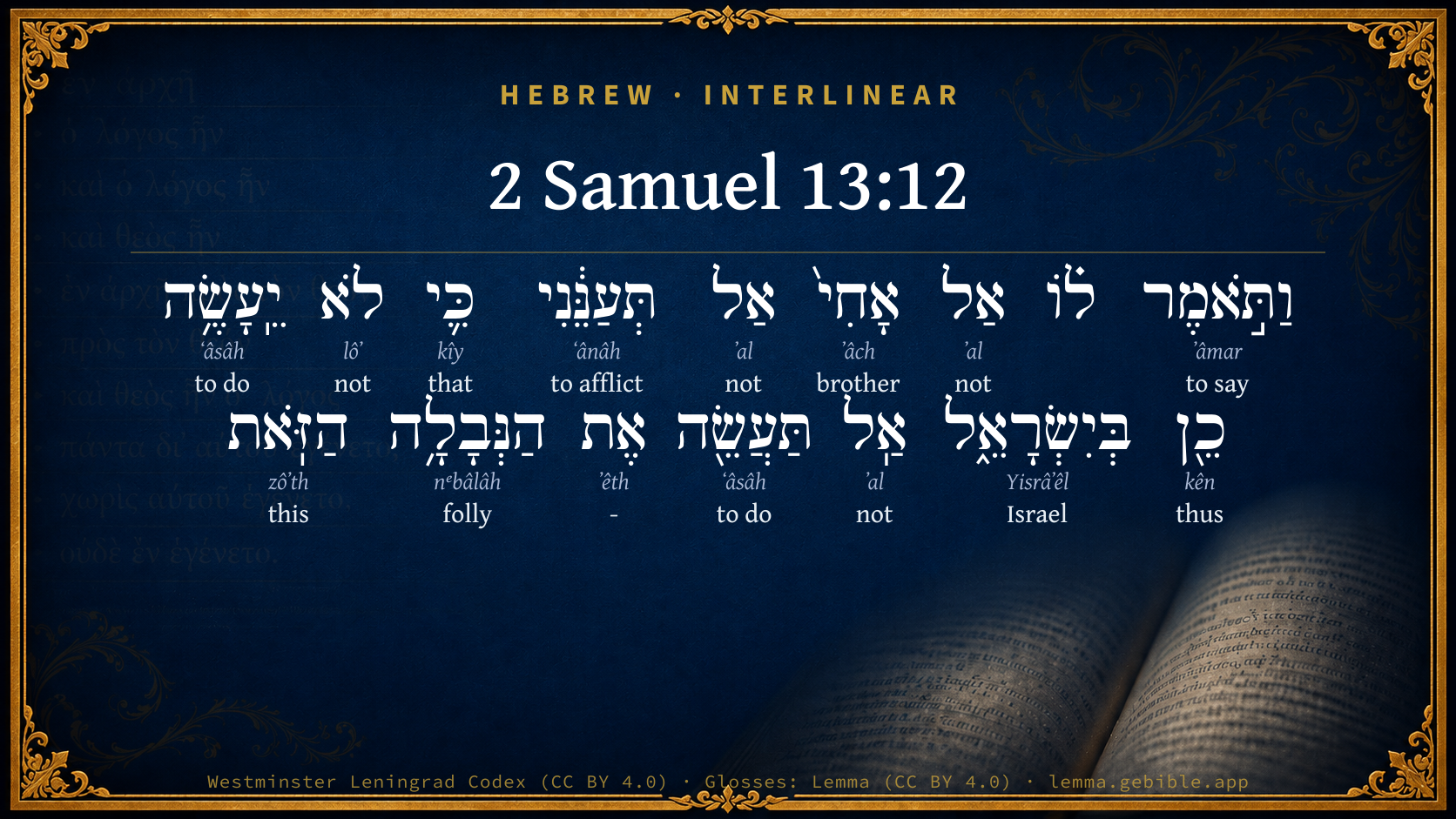
  1. וַתֹּ֣אמֶר ʼâmar H559 “and · to say” Conjunction + Verb, Qal, Sequential Imperfect, 3rd Person, Feminine, Singular
  2. אַל ʼal H408 “not” Particle, Negative
  3. אָחִי֙ ʼâch H251 “brother · my” Noun, Common, Masculine, Singular, Construct + Suffix, Personal, 1st Person, Common, Singular
  4. אַל ʼal H408 “not” Particle, Negative
  5. תְּעַנֵּ֔נִי ʻânâh H6031 “to afflict · me” Verb, Piel, Jussive, 2nd Person, Masculine, Singular + Suffix, Personal, 1st Person, Common, Singular
  6. כִּ֛י kîy H3588 “that” Conjunction
  7. לֹא lôʼ H3808 “not” Particle, Negative
  8. יֵֽעָשֶׂ֥ה ʻâsâh H6213 “to do” Verb, Niphal, Imperfect, 3rd Person, Masculine, Singular
  9. כֵ֖ן kên H3651 “thus” Adverb
  10. בְּיִשְׂרָאֵ֑ל Yisrâʼêl H3478 “in/at · Israel” Preposition + Noun, Proper
  11. אַֽל ʼal H408 “not” Particle, Negative
  12. תַּעֲשֵׂ֖ה ʻâsâh H6213 “to do” Verb, Qal, Jussive, 2nd Person, Masculine, Singular
  13. אֶת ʼêth H853 “-” Particle, Direct Object
  14. הַזֹּֽאת zôʼth H2063 “the · this” Particle, Definite Article + Pronoun, Demonstrative, Feminine, Singular

About this verse

These counts appear in no published source. They are computed here, from the morphology-tagged text and Lemma’s own curated glosses. What Lemma adds →

16
words
12
distinct lemmas
Historical
section

Notable vocabulary

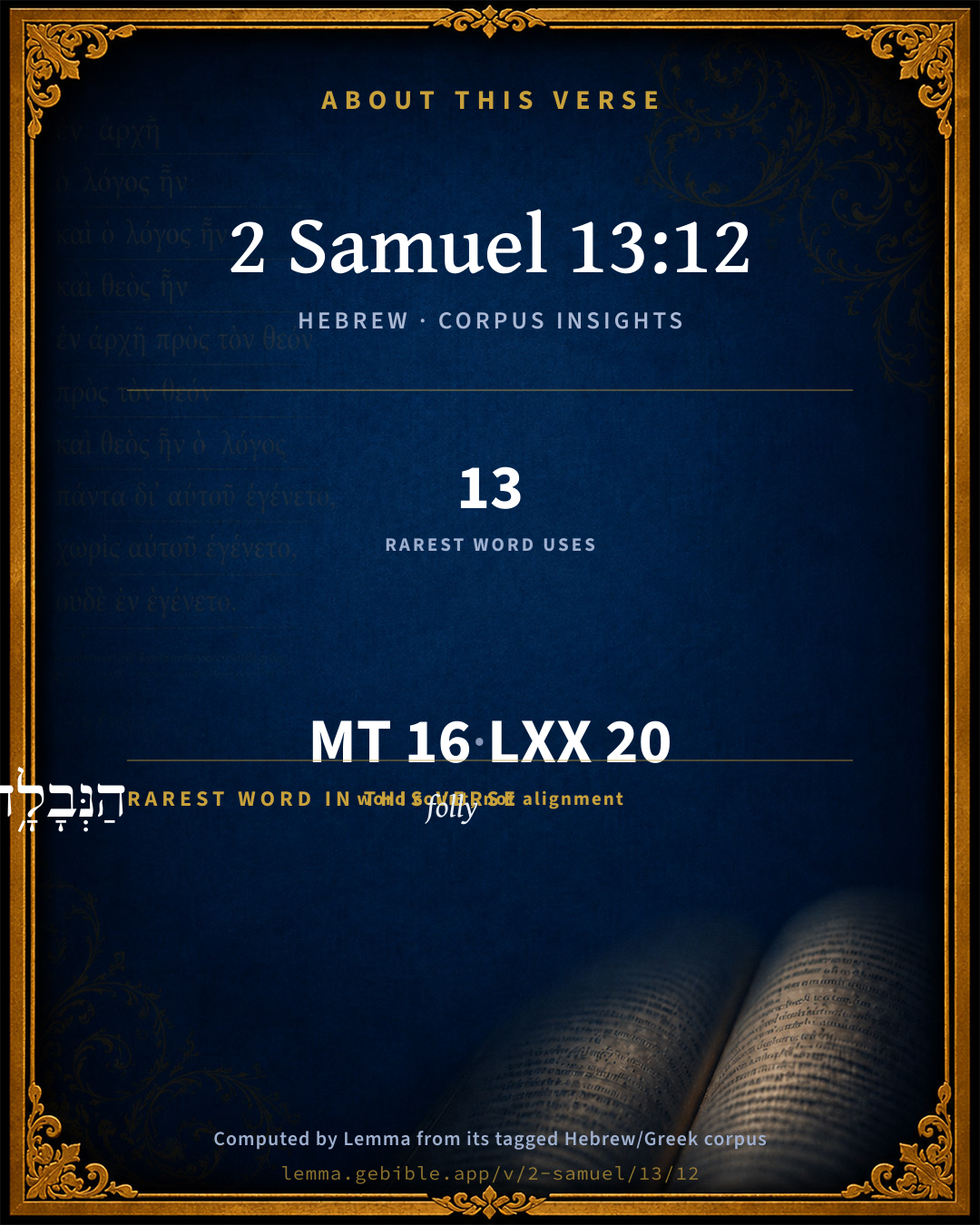
The rarest word here is הַנְּבָלָ֥ה folly H5039 — appearing just 13 times in the whole Hebrew Bible.

Shared distinctive vocabulary

הַנְּבָלָ֥ה folly H5039 occurs in 13 verses of the Hebrew Bible. Also found in:

Grammatical profile

  • 4 verbs
  • 3 nouns
  • 1 pronoun
  • 1 preposition
  • 1 conjunction
  • 1 adverb
  • 5 particles

Verb forms

  • וַתֹּ֣אמֶר Qal · Sequential Imperfect
  • תְּעַנֵּ֔נִי Piel · Jussive
  • יֵֽעָשֶׂ֥ה Niphal · Imperfect
  • תַּעֲשֵׂ֖ה Qal · Jussive

Repetition

Words recur within this verse — often emphatic in Hebrew:

  • יֵֽעָשֶׂ֥ה to do H6213 ×2
  • אַל not H408 ×3

Hebrew & Septuagint length

In English translation the verse runs 25 words from the Hebrew and 26 from the Septuagint (LXX English) — closely comparable.

A rough comparison of the two English renderings, which tokenize alike — not a word-level alignment.

Word counts can differ between the Hebrew and the Greek without any difference in meaning — e.g. the Hebrew direct-object marker אֵת has no separate Greek word, and Greek often adds the article ὁ.

In the original languages it is 16 Hebrew tokens and 20 Greek tokens — but the two are counted differently (Hebrew bundles its prefixes and suffixes into one token; the Greek is in lemma form), so that isn’t a like-for-like length.

Cross-references

10

Topical passages linked to 2 Samuel 13:12 in the Treasury of Scripture Knowledge — connected by theme and wording, ordered by reader-vote popularity; previews shown in the World English Bible.

  • Leviticus 20:17 "'If a man takes his sister, his father's daughter, or his mother's daughter, and sees her nakedness, and she sees his nakedness; it is a shameful thing; and they shall be cut off in the sight of the children of their people: he has uncovered his sister's nakedness; he shall bear his iniquity.
  • Judges 19:23 The man, the master of the house, went out to them, and said to them, No, my brothers, please don't act so wickedly; seeing that this man is come into my house, don't do this folly.
  • Judges 20:6 I took my concubine, and cut her in pieces, and sent her throughout all the country of the inheritance of Israel; for they have committed lewdness and folly in Israel.
  • Genesis 34:7 The sons of Jacob came in from the field when they heard it. The men were grieved, and they were very angry, because he had done folly in Israel in lying with Jacob's daughter; which thing ought not to be done.
  • Leviticus 18:9 "'You shall not uncover the nakedness of your sister, the daughter of your father, or the daughter of your mother, whether born at home, or born abroad.
  • Leviticus 18:11 "'You shall not uncover the nakedness of your father's wife's daughter, conceived by your father, since she is your sister. "'
  • Genesis 34:2 Shechem the son of Hamor the Hivite, the prince of the land, saw her. He took her, lay with her, and humbled her.
  • Deuteronomy 22:29 then the man who lay with her shall give to the lady's father fifty [shekels] of silver, and she shall be his wife, because he has humbled her; he may not put her away all his days.
  • Proverbs 5:22–23 The evil deeds of the wicked ensnare him. The cords of his sin hold him firmly.
  • Proverbs 7:7 I saw among the simple ones. I discerned among the youths a young man void of understanding,

Cross-references courtesy of OpenBible.info (CC BY 4.0).

Hebrew and Greek witnesses Masoretic Hebrew ↔ Greek Septuagint

The same verse in the two great witnesses to the Old Testament, shown verse-for-verse.

These are two independent witnesses, not word-aligned to each other, and the Septuagint is shown in lemma (dictionary) form.

Hebrew 2 Samuel 13:12 Masoretic · Westminster Leningrad Codex

וַתֹּ֣אמֶר ל֗וֹ אַל אָחִי֙ אַל תְּעַנֵּ֔נִי כִּ֛י לֹא יֵֽעָשֶׂ֥ה כֵ֖ן בְּיִשְׂרָאֵ֑ל אַֽל תַּעֲשֵׂ֖ה אֶת הַנְּבָלָ֥ה הַזֹּֽאת

She answered him, No, my brother, do not force me; for no such thing ought to be done in Israel. Don't you do this folly.

World English Bible · Public Domain

Greek LXX 2 Samuel 13:12 Septuagint · lemma form

καί εἶπον αὐτός μή ἀδελφός ἐγώ μή ταπεινόω ἐγώ διότι οὐ ποιέω οὕτως ἐν ἰσραήλ μή ποιέω ὁ ἀφροσύνη οὗτος

And she said to him, Nay, my brother, do not humble me, for it ought not to be so done in Israel; do not this folly.

LXX2012 (modern English Septuagint) · Public Domain

Hebrew: Westminster Leningrad Codex (CC BY 4.0). Greek: Septuagint (public domain); English from LXX2012 (modern English Septuagint) (Public Domain). How the Septuagint differs from the Hebrew →

Targum (Aramaic paraphrase)

1

The Targum is the ancient Jewish Aramaic paraphrase of the Hebrew Scriptures — an interpretive translation, not the Hebrew text itself. Onkelos (literal) and Pseudo-Jonathan (expansive) render the Torah, and Jonathan the Prophets. Coverage is partial: where no permissively-licensed English translation exists for a verse, only the Aramaic is shown. This is verse-level text, not a word-by-word alignment to the Hebrew.

  1. Targum Jonathan Prophets (Joshua–Malachi)
    וַאֲמַרַת לֵיהּ אֲחִי בְּבָעוּ לָא תְעַנַנֵי אֲרֵי לָא מִתְעֲבֵד כֵּן בְּיִשְׂרָאֵל לָא תַעְבֵּד יַת קְלָנָא הָדֵין:

    (no public-domain English translation for this verse)

    Targum Jonathan — Aramaic: “Mikraot Gedolot” (public domain). English: “Sefaria Community Translation” (CC0 1.0 (public-domain dedication)); “London "Chaldee Paraphrase," 1871” (public domain). Text via Sefaria.

Commentary

Notes on 2 Samuel 13:12 from classic Christian and Jewish commentators (each source and its license shown beneath its notes). The classic Christian expositions comment on the surrounding passage and are grouped to its opening verse, so a note may address several verses; the Jewish commentaries on the Tanakh (Rashi and others) are per-verse, so they appear only where the commentator wrote on this verse.

Lemma curates 59 commentaries, every one of them public domain or Creative Commons licensed, each selected and text-cleaned for this edition rather than reprinted as found. About our sources →

Trapp's Complete Commentary

John Trapp

2Sa 13:12 And she answered him, Nay, my brother, do not force me; for no such thing ought to be done in Israel: do not thou this folly.

Ver. 12. Do not force me.] Heb., Do not humble me; sc., by bereaving me of my virginity, which is my chief honour. Custus, quasi καστος, ornatus: αγνος αβ αγος, veneratio.

For no such thing ought to be done in Israel.] As being a holy people, professionally at least. What will the heathen say to this? will not the banks of blasphemy be broken down in them hereupon

Do not thou this folly.] Ne committito flagitium hoc; thus she filleth her mouth with arguments; but to no purpose. {a} As the belly, so that which is beneath it hath no ears. All that Tamar can say in this case is of Davy Dutton’s dream, as the proverb hath it, and he will in no wise heed it. Amantis amentes.

{a} Trem.

John Trapp, A Commentary or Exposition upon All the Books of the Old and New Testament (1647–1656) — public domain. Text from a community e-Sword module.

Joseph Benson's Commentary

2Sa 13:12. Nay, my brother — Whom nature both teaches to abhor such thoughts, and obliges to defend me from such an injury, with thy utmost hazard, if another should attempt it. Do not force me — Thou oughtest to abhor it, if I were willing; but to add violence is abominable. No such thing ought to be done in Israel — Among God’s people, who are taught better things; who also will be infinitely reproached for so base an action. Thus she represents to him that, whatever other nations did, among whom idols were worshipped with filthy lusts, they who worshipped so pure and holy a God; and had such divine laws, ought not to be guilty of any such abomination. Do not this folly — That is, this wickedness, the foolishness of which she prays him to consider, as, for a moment’s gratification of a brutal desire, it would highly provoke the Divine Majesty, and bring lasting disgrace and wretchedness upon them both. Would he expose a sister to infamy? Would he expose himself to indelible reproach?

Joseph Benson's Commentary on the Old and New Testaments (1811–1818) — public domain. Text from a community e-Sword module.

Tyndale Open Study Notes

Tyndale Open Resources

13:12 wicked things: The Hebrew word nebalah (“outrage,” “deplorable act”) often describes sexual crimes such as rape and adultery (Gen 34:7; Deut 22:21; Judg 20:6, 10; Jer 29:23) that the perpetrator must pay for with his life. • in Israel: The addition of this phrase either indicates indignation that the crime happened among Israelites or characterizes the act as a violation of Israelite standards of sexual morality.

Tyndale Open Study Notes — © Tyndale Open Resources, licensed CC BY-SA 4.0. Text via the HelloAO Bible API.

Jamieson, Fausset & Brown

Robert Jamieson, A. R. Fausset & David Brown

do not force me--The remonstrances and arguments of Tamar were so affecting and so strong, that had not Amnon been violently goaded on by the lustful passion of which he had become the slave, they must have prevailed with him to desist from his infamous purpose. In bidding him, however, "speak to the king, for he will not withhold me from thee," it is probable that she urged this as her last resource, saying anything she thought would please him, in order to escape for the present out of his hands.

Jamieson, Fausset & Brown — Commentary Critical and Explanatory on the Whole Bible (1871) — public domain (CC PDM 1.0). Text via the HelloAO Bible API.

Adam Clarke's Commentary

Verse 12. Nay, my brother] There is something exceedingly tender and persuasive in this speech of Tamar; but Amnon was a mere brute, and it was all lost on him.

Adam Clarke's Commentary on the Bible (1810–1826) — public domain. Text from a community e-Sword/MySword module.

Ellicott's Commentary for English Readers

(12) Do not thou this folly.—Tamar, now left alone in the power of her half-brother, endeavours to escape by reasoning. She first speaks of the sinfulness in Israel of that which was allowed among surrounding heathen, quoting the very words of Gen_34:7, as if by the traditions of their nation to recall the king’s son to a sense of right. She then sets forth the personal consequences to themselves; if he had any love for her he could not wish that shame and contempt should meet her everywhere; and for himself, such an act would make him “as one of the fools in Israel,” as one who had cast off the fear of God and the restraints of decency.

A Bible Commentary for English Readers, edited by Charles John Ellicott (1878–1897) — public domain. Text from a community e-Sword module.

The Cambridge Bible for Schools and Colleges

gen. ed. J. J. S. Perowne

12. no such thing ought to be done in Israel] Israel was a holy nation, sanctified by the peculiar presence of Jehovah among them; and therefore all acts of unchastity were an offence against the true character and calling of the nation. Such acts might be common among heathen nations, but to Israel they were forbidden by the Law, which placed them on a loftier level of morality.

The Cambridge Bible for Schools and Colleges (gen. ed. J. J. S. Perowne; Cambridge University Press, 1878–1918) — public domain. Text from a community e-Sword module.

John Gill's Exposition

And she answered him, nay, my brother,.... Which carried in it a reason sufficient for her denial, that he was her brother, and she his sister, and therefore should not offer such an indignity to her:

do not force me; which was another forbidding expression, signifying she would never freely yield to his will; and to force her, to defile her against her will, to commit a rape upon her, would be very criminal indeed:

for no such thing ought to be done in Israel; among God's professing people, who were better taught and instructed; and to give into such impure practices would bring a dishonour upon them, and upon the religion they professed; she urges the honour of religion, and the reputation of Israel, and the glory of the God of Israel:

do not thou this folly: as all sin is, especially such an impure and indecent action as this.

John Gill's Exposition of the Whole Bible (1746–1763) — public domain (CC PDM 1.0). Text via the HelloAO Bible API.

Albert Barnes' Notes on the Bible

Tamar’s words are a verbal quotation from Gen 34:7. The natural inference is that Tamar knew the passage in Genesis, and wished to profit by the warning that it contained. (Compare also 2Sa 13:13.)

Albert Barnes' Notes on the Bible (1834–1885) — public domain. Text from a community e-Sword/MySword module.

Haydock's Catholic Bible Commentary

Folly, or impiety, so directly contrary to the law, Leviticus xviii. 6. and 9. and 11. (Haydock)

George Leo Haydock (1774–1849), Haydock's Catholic Family Bible and Commentary, 1859 edition — public domain. Excludes Psalms (Douay-Rheims chapter numbering differs from Protestant) and Deuterocanonical books (Catholic canon only).

Matthew Poole's English Annotations

Nay, my brother, whom nature both teacheth to abhor such thoughts, and obligeth to defend me from such a mischief with thy utmost hazard if another should attempt it.

Do not force me: thou shouldst abhor it, if I were willing; but to add violence to thy filthiness is abominable.

In Israel; among God’s people, who are taught better things; who also will be infinitely reproached for such a base action.

Matthew Poole's English Annotations on the Holy Bible (1683–1685) — public domain. Text from a community e-Sword/MySword module.

Whedon's Commentary on the Bible

Daniel D. Whedon

12. No such thing ought to be done in Israel — In heathen nations, where idol gods were worshipped by impure practices, this might be tolerated, but not among the chosen people, whose sacred laws condemned it. See marginal references.

Folly — This word is often used in the sense of a disgraceful act.

Daniel D. Whedon (gen. ed.), Commentary on the Old and New Testaments (1874–1909) — public domain. Text from a community e-Sword module.

The Pulpit Commentary

Do not force me; literally, do not humble me. It is to be regretted that the word should be changed, as it bears testimony to the nobleness of the Hebrew women, who regarded their chastity as their crown of honour. The word folly is used in the sense of unchastity in Gen_34:7 and elsewhere, and it is noteworthy that the Jews thus connected crime with stupidity. Vain, that is, empty persons were the criminal part of the population, (Jud_1:9:4) and to call a man "a fool" was to attribute to him every possible kind of wickedness. (Mat_5:22) The thought which lay at the root of this view of sin was that Israel was a peculiar people, sanctified to God"s service; and all unholiness, therefore, was not merely criminal in itself, but a proof that the guilty person was incapable of rightly estimating his privileges. Tamar urges this upon her "empty" brother, and then pathetically dwells upon their mutual shame, and, finding all in vain, she even suggests that the king might permit their marriage. Such marriages, between half-brothers and half-sisters were strictly forbidden, as tending to loosen the bends of family purity (Lev_18:9; Deu_27:22) but possibly the Levitical code was occasionally violated, or Tamar may have suggested it in the hope of escaping immediate violence.

Things that ought not to be done in Israel.

The plea of Tamar, "no such thing ought to be done in Israel," is interesting, as showing that the sentiment was prevalent amongst the Israelites, morally imperfect as they were, that they were not to be as the nations around them; that practices prevalent elsewhere were altogether out of keeping with their position and calling "It may be so elsewhere; but it must not be so in Israel. A similar sentiment as to what is statable and becoming is appealed to in the New Testament. Christians are exhorted to act "as becometh saints" (Eph_5:3; Rom_16:2) to "walk worthy of the Lord," "worthy of their vocation," etc. (Col_1:10; Eph_4:1)

I THE GROUNDS OF SUCH A SENTIMENT. Why should the people of God regard themselves as under special obligations to live pure and holy lives?

1. The character of their God. "Ye shall be holy, for I am holy" was the language of God to Israel; (Lev_11:44) and it was repeated to Christians. (1Pe_1:15, 1Pe_1:16) The injunction could not have been addressed cannot now to the worshippers of other gods.

2. Their own consecration to God. Israel was separated by God from other people to be his own people, devoted to the practice of purity and righteousness. (Lev_20:24, Lev_20:26) All their history, laws, and institutions had this for their aim, and were adapted to it. In like manner Christians are "called to be saints", (Rom_1:7) chosen of God, "that they should be holy and without blame before him in love". (Eph_1:4) The Son of God is called Jesus, because he came to "save his people from their sins". (Mat_1:21) The purpose of his love and self-sacrifice for them is to "redeem them from all iniquity, and purify unto himself a people for his own possession, zealous of good works". (Tit_2:14, Revised Version) This aim is expressed by the rite by which they are consecrated to God and introduced into his kingdom it is a baptism, a washing from uncleanness. For this they are united into a holy fellowship, with sacred ministries and services, and godly discipline; and all the inspired instructions and admonitions addressed to them, and expounded to them by their teachers, have manifestly the same end and tendency. With all and above all, the Spirit which dwells amongst them and gives life and reality to all their communion, worship, and service, is the Holy Spirit, and his work is to regenerate and sanctify their nature, and produce in them all goodness.

3. The wonders by which they have been redeemed and consecrated. Ancient Israel, by a long succession of supernatural revelations, marvellous miracles, and providential interpositions. The Church of Christ, by the incarnation of the Eternal Word, and all that followed in the life, death, resurrection, and ascension of our Lord, and the miraculous bestowment and works of the Holy Ghost. Yea, every true Christian is himself, as such, a product of the Spirit"s supernatural power, being "born again," "born of the Spirit". (Joh_3:3, Joh_3:6) Thus it is that this "holy nation" is perpetuated in the earth.

4. Their privileges and hopes. "The children of Israel" were "a people near unto God". (Psa_148:14) He was their "Portion;" they enjoyed his special presence, guidance, government, and defence. In a yet more emphatic sense Christians have God as their God, enjoy constant union and communion with him, and are assured of his love and sympathy, care and protection. Moreover, to them is given, more clearly and fully than to the Old Testament Church, the hope of eternal life. And what is this hope? It is that of seeing God and being like him, (1Jn_3:2) of becoming "a glorious Church, not having spot, or wrinkle, or any such thing, butholy and without blemish", (Eph_5:27) presented "faultless before the presence of his glory". (Jud_1:24) It is to be admitted into the "New Jerusalem," into which nothing unholy can enter. (Rev_21:27) The condition of realizing this blessedness is purity of heart that "holiness without which no man shall see the Lord". (Mat_5:8; Heb_12:14) it is clear that in such a community nothing unholy "ought to be done," however common elsewhere. Such things are utterly inconsistent with their position, their knowledge, their professions, and their prospects.

II THE CONDUCT WHICH THIS SENTIMENT CONDEMNS. We need not dwell on gross sensuality, such as that against which the words of the text were first used. They were appropriate then, because the standard of morality "in Israel" was so much higher in respect to such practices than in the surrounding nations. But the respectable part of general society in our time and country recognizes "no such thing" as Amnon proposed as lawful. And as to many other departments of morality, the moral standard of society has been elevated by the influence of Christianity. In using the words, therefore, we do well to think of practices which are permitted or at least thought tightly of by others, but which are nevertheless contrary to the precepts or spirit of our religion. Amongst these may be named:

1. Selfishness. Including covetousness, worldly ambition, illiberality, etc., with the disregard or violation of the claims and rights of others that are allied to them. These are common enough in Christian countries, but ought not to exist amongst Christian people, whose religion is a product of Divine love, whose great Leader and Master is the incarnation of love, who have received numberless precepts enjoining the love of others as of themselves, and have been assured that love is greater than faith and hope, (1Co_13:13) much greater, then, than religious ceremonies, and ecclesiastical forms and observances. Covetousness in particular is closely associated in the New Testament with sensuality, as a vice not even to be named amongst Christians, and is declared to be idolatry (Eph_5:3, Eph_5:5; Col_3:5; 1Co_5:10, 1Co_5:11)

1. Pride. Whether of rank, or wealth, or intellect. Holy Scripture, in both Testaments, abounds in precepts and examples against pride. The Lord Jesus "humbled himself" in becoming man, and in the whole of his life on earth, and frequently enjoined humility on his disciples, and reproved every indication of a proud spirit in them. Common, therefore, as pride is in the world, "no such thing ought to be" in the Church.

2. Similar remarks may be made as to unkindness, the revengeful spirit, the unforgiving spirit, quarrelsomeness, uncharitableness, evil speaking, and the like.

3. To these may be added .frivolity, gaiety dissipation, a life of mere amusement, with no serious, worthy purpose or pursuit. These are not becoming in those who are enjoined to work out their salvation with fear and trembling; to be sober and vigilant because of the activity of Satan in seeking their destruction; to deny themselves, etc. (Php_2:12 1Pe_5:8; Luk_9:23)

2. Indifference to the spiritual welfare of others. The gospel brings into prominence the claims which men have upon Christians in this respect. Jesus very solemnly warns against "offending," others, even the least, by doing or saying what would lead them into sin or hinder their salvation. (Mat_18:6, Mat_18:7) He repeatedly teaches his disciples that he gave them light in order that they might "shine before men," and so lead them to glorify God (Mat_5:14-16; Mar_4:21, 22) St. Paul commends the Philippians for their "fellowship in furtherance of the gospel," and urges them to "strive" on its behalf. (Php_1:5, 27, Revised Version) St. Peter enjoins that "as every man hath received the gift," he should use it for the good of others, in teaching and ministering. (1Pe_4:10, 1Pe_4:11) And in general, the cause of Christ is committed to his disciples, that they may sustain and extend it both by active service and by pecuniary gifts. To the discharge of this duty by others we owe our own Christian privileges and character. If we disregard it, we display ingratitude, unfaithfulness to our Lord, insensibility to his great love to ourselves. Unconcern as to the salvation of men is natural enough in men of the world, but "no such thing ought to be" found amongst Christians.

Finally, in the absence of specific precepts, we may settle many a doubt as to our duty by considering whether the act or habit in question is suitable and becoming in those who profess themselves earnest disciples of Jesus Christ; whether it is in harmony with his spirit and character, and conducive, or at least not hostile, to our spiritual benefit, or that of others. G.W.

The Pulpit Commentary (1880–1919), ed. H.D.M. Spence-Jones & Joseph S. Exell — public domain. Text from a community e-Sword module.

John Wesley's Explanatory Notes

Brother - Whom nature both teaches to abhor such thoughts and obliges to defend me from such a mischief with thy utmost hazard, if another should attempt it. Force - Thou shouldst abhor it, if I were willing; but to add violence, is abominable. Israel - Among God's people who are taught better things; who also will be infinitely reproached for such a base action.

John Wesley, Explanatory Notes Upon the Whole Bible (1754–1765) — public domain. Text via the GEBible commentary corpus.

Lesson kit

Teaching starters — assembled from the data on this page, not authored interpretation. Every prompt links to the verse data it draws on. Edit before teaching.

2 Samuel, in the Historical, opens this verse with 16 words (12 distinct Hebrew lemmas). Its most distinctive word is nᵉbâlâh (“folly”). A historical commentator’s framing appears above. Read the whole chapter for the surrounding context.

Discussion questions

  1. What does “folly” (nᵉbâlâh) contribute to the verse as a whole?
  2. Genesis 34:7 shares the word «folly» with this verse. How do the two illuminate each other?
  3. “to do” occurs 2× in this one verse. What is the effect of the repetition?
  4. The translations on this page render this verse differently — a whole-verse word diff, not a word-by-word alignment. What might account for the different wordings?
  5. The verb «וַתֹּ֣אמֶר» is Qal Sequential Imperfect. How does its form color the action?
  6. Reading how Trapp's Complete Commentary and Joseph Benson's Commentary read this verse, where do the two commentators agree and where do they part?

Things to notice

Reading settings

Reading text

Shown beneath each verse's original-language words.

Old Testament
Old Testament edition

Read the OT as the Masoretic Hebrew (MT) or the Greek Septuagint (LXX).

English shown for the Greek Septuagint (in the Hebrew ↔ Greek comparison).

Comparing translations? Open the Compare panel on any verse page to stack up to four side by side.