
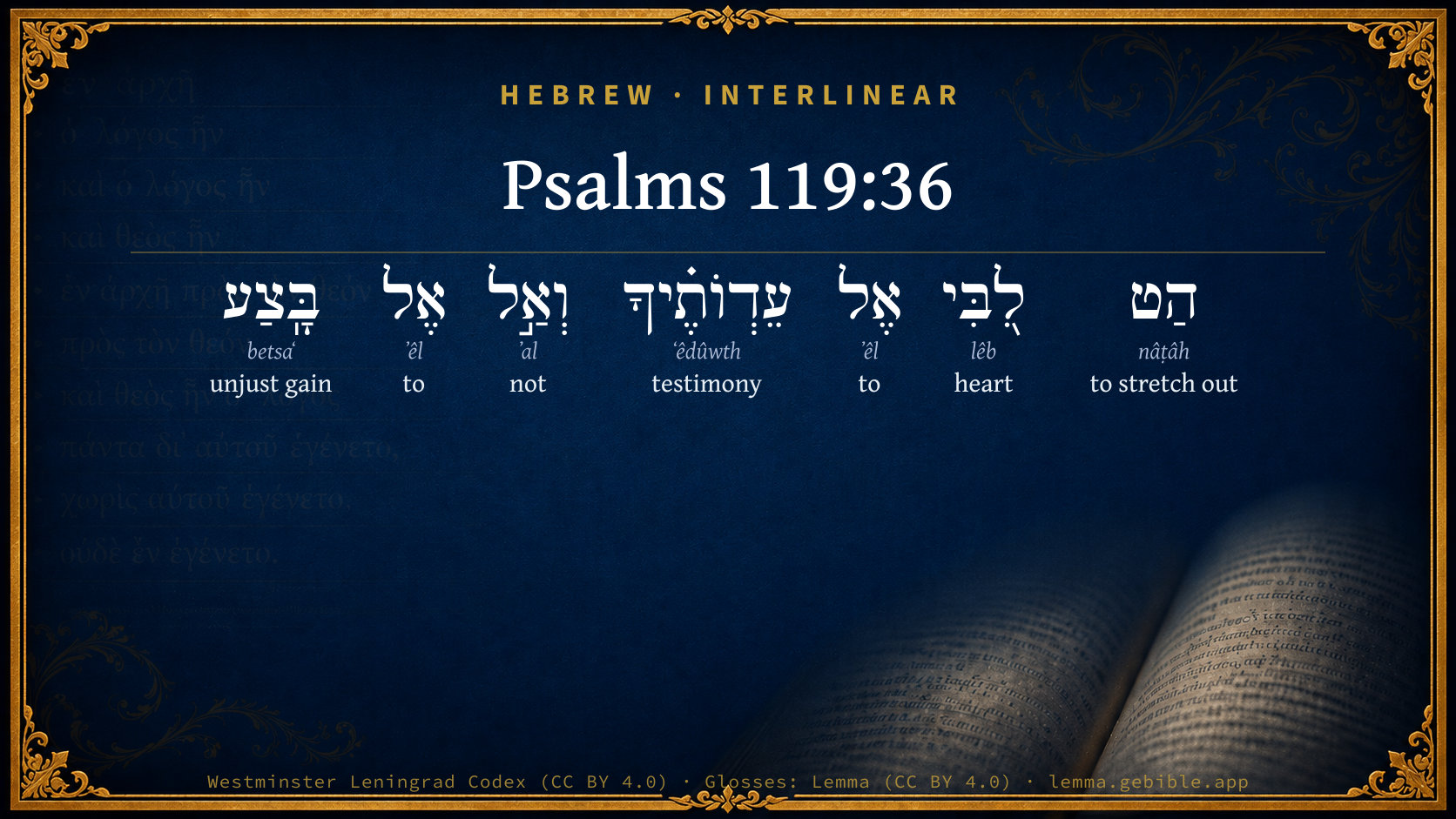
Psalms 119:36

Hebrew (Westminster Leningrad Codex) Psalms 119:36 appears in the Hebrew Old Testament. The text above is from the Westminster Leningrad Codex. Each word links to its Strong’s number, a concise gloss, and parsing drawn from the Open Scriptures Hebrew Bible morphology. Click any word for its full Brown-Driver-Briggs (BDB) entry.
Download image
Cite this verse

Psalms 119:36 (World English Bible). Public Domain. Lemma interlinear Bible study tool, https://lemma.gebible.app/v/psalms/119/36.

Show BibTeX & RIS
BibTeX
RIS
English Translation
Turn my heart toward your statutes, Not toward selfish gain.
World English Bible · Public Domain
Download a study sheet

One document with this verse’s original text, its word-by-word gloss line, the meaning frame, cross-references with their text, attributed commentary, and full source and license credits — printable, and it pastes into notes with its structure intact.

This verse Autodidact and up

Study sheet (.html) Plain text (.txt)

A passage Seminary Student

Up to 50 verses in one chapter. A passage sheet keeps up to 6 commentary sources and 12 cross-references per verse, in the order this page ranks them, and says so on the sheet whenever that leaves anything out. Ask for a single verse and you get the Autodidact verse sheet above.

Everything on this page stays free to read, with no account — the sheet is a download of what is already on screen, not access to it.

Want to remove ads? Support Godless Engineer
Compare translations 3

The same verse in 3 English versions, stacked beneath the original-language interlinear above. Click any original word for its lexicon entry.

Each is an independent rendering of the whole verse — the interlinear is not word-aligned to these translations.

Highlighted words mark where these versions differ — a whole-verse word diff, not a word-by-word alignment.

  • World English Bible Public Domain
    Turn my heart toward your statutes, Not toward selfish gain.
  • King James Version Public Domain
    Incline my heart unto thy testimonies, and not to covetousness.
  • unfoldingWord Literal Text CC BY-SA 4.0
    Incline my heart toward your testimonies and not toward unrighteous gain.

unfoldingWord Literal Text — © unfoldingWord, licensed CC BY-SA 4.0. Word-aligned USFM3 via Door43 (git.door43.org/unfoldingWord/en_ult).

Versions to compare (up to 4)

3 of 4 selected

Show all 17 translations

Every available English version of this verse, each an independent rendering of the whole verse.

  • World English Bible Public Domain
    Turn my heart toward your statutes, Not toward selfish gain.
  • Berean Standard Bible Public Domain
    Turn my heart to Your testimonies and not to covetous gain.
  • Majority Standard Bible Public Domain
    Turn my heart to Your testimonies and not to covetous gain.
  • King James Version Public Domain
    Incline my heart unto thy testimonies, and not to covetousness.
  • American Standard Version (1901) Public Domain
    Incline my heart unto thy testimonies, And not to covetousness.
  • Revised Version (1885) Public Domain
    Incline my heart unto thy testimonies, and not to covetousness.
  • Geneva Bible (1599) Public Domain
    Incline mine heart vnto thy testimonies, and not to couetousnesse.
  • Young's Literal Translation Public Domain
    Incline my heart unto Thy testimonies, And not unto dishonest gain.
  • Literal Standard Version CC BY-SA 4.0
    Incline my heart to Your testimonies, || And not to dishonest gain.
  • Unlocked Literal Bible CC BY-SA 4.0
    Direct my heart toward your covenant decrees and away from unrighteous gain.
  • unfoldingWord Literal Text CC BY-SA 4.0
    Incline my heart toward your testimonies and not toward unrighteous gain.
  • Darby Bible Public Domain
    Incline my heart unto thy testimonies, and not to gain.
  • World Messianic Bible Public Domain
    Turn my heart toward your statutes, not toward selfish gain.
  • Webster's Bible Public Domain
    Incline my heart to thy testimonies, and not to covetousness.
  • Free Bible Version CC BY-SA 4.0
    Help me to concentrate on what you say rather than on making a profit.
  • Bible in Basic English Public Domain
    Let my heart be turned to your unchanging word, and not to evil desire.
  • JPS Tanakh (1917) Public Domain
    Incline my heart unto Thy testimonies, and not to covetousness.

Literal Standard Version (2020), Covenant Press — licensed CC BY-SA 4.0. Text via the HelloAO Bible API (eBible.org). Unlocked Literal Bible (unfoldingWord) — licensed CC BY-SA 4.0. Text via the HelloAO Bible API (eBible.org). unfoldingWord Literal Text — © unfoldingWord, licensed CC BY-SA 4.0. Word-aligned USFM3 via Door43 (git.door43.org/unfoldingWord/en_ult). Free Bible Version, Dr. Jonathan Gallagher — licensed CC BY-SA 4.0. Text via the HelloAO Bible API (eBible.org).

Word by word

More ways to search: Search by grammar → Find every occurrence → Compare this word →

Practice this passage: Drill this verse → Learn its vocabulary →

About this verse

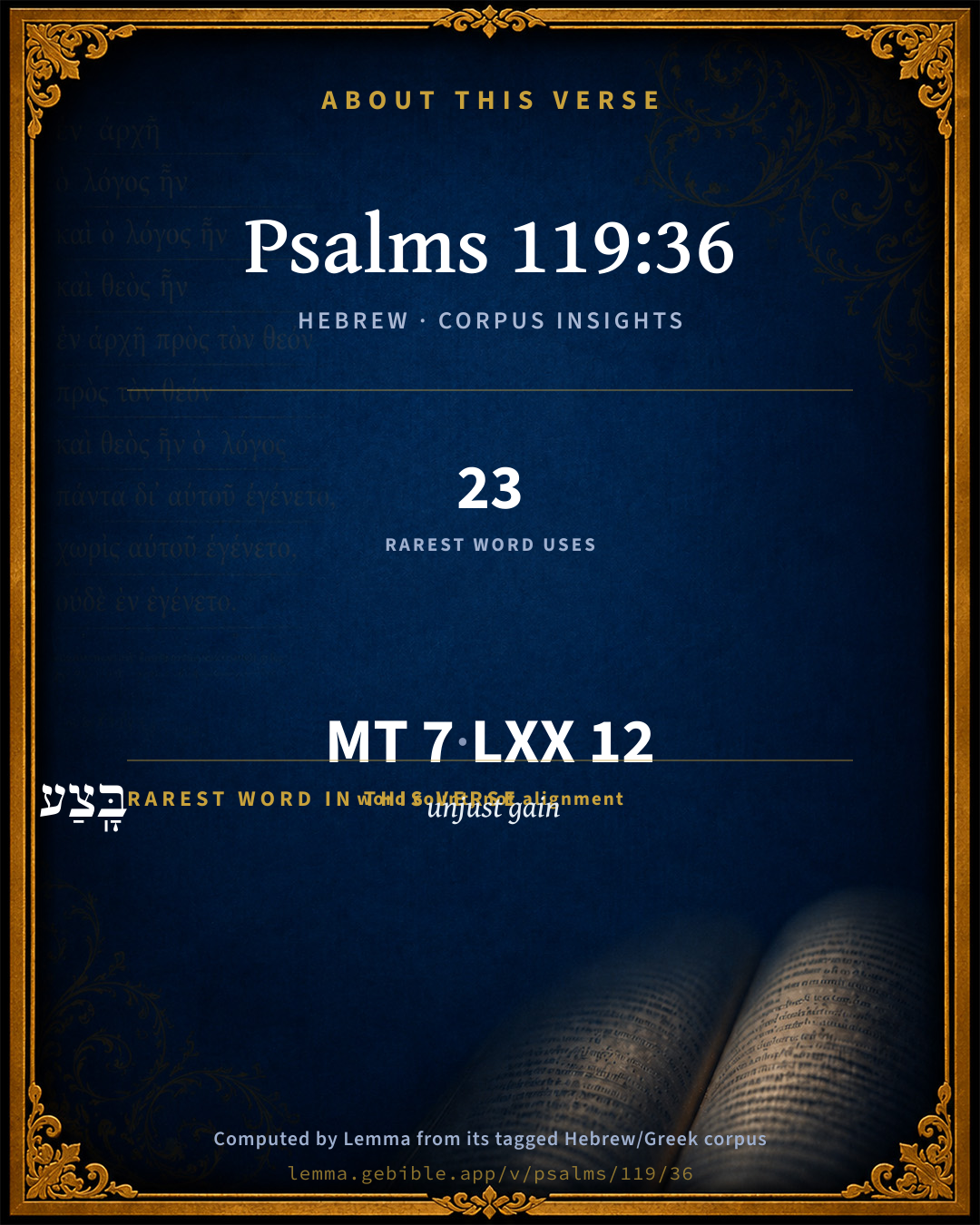
These counts appear in no published source. They are computed here, from the morphology-tagged text and Lemma’s own curated glosses. What Lemma adds →

7
words
6
distinct lemmas
Wisdom
section

Notable vocabulary

The rarest word here is בָּֽצַע unjust gain H1215 — appearing just 23 times in the whole Hebrew Bible.

Shared distinctive vocabulary

בָּֽצַע unjust gain H1215 occurs in 23 verses of the Hebrew Bible. Also found in:

Grammatical profile

  • 1 verb
  • 3 nouns
  • 2 prepositions
  • 1 particle

Verb forms

  • הַט Hiphil · Imperative

Repetition

A word recurs within this verse — often emphatic in Hebrew:

  • אֶל to H413 ×2

Hebrew & Septuagint length

In English translation the verse runs 10 words from the Hebrew and 10 from the Septuagint (LXX English) — the same length.

A rough comparison of the two English renderings, which tokenize alike — not a word-level alignment.

Word counts can differ between the Hebrew and the Greek without any difference in meaning — e.g. the Hebrew direct-object marker אֵת has no separate Greek word, and Greek often adds the article ὁ.

In the original languages it is 7 Hebrew tokens and 12 Greek tokens — but the two are counted differently (Hebrew bundles its prefixes and suffixes into one token; the Greek is in lemma form), so that isn’t a like-for-like length.

Cross-references

19

Topical passages linked to Psalms 119:36 in the Treasury of Scripture Knowledge — connected by theme and wording, ordered by reader-vote popularity; previews shown in the World English Bible.

  • Luke 12:15 He said to them, "Beware! Keep yourselves from covetousness, for a man's life doesn't consist of the abundance of the things which he possesses."
  • Hebrews 13:5 Be free from the love of money, content with such things as you have, for he has said, "I will in no way leave you, neither will I in any way forsake you."
  • Mark 7:21–22 For from within, out of the hearts of men, proceed evil thoughts, adulteries, sexual sins, murders, thefts,
  • 1 Kings 8:58 that he may incline our hearts to him, to walk in all his ways, and to keep his commandments, and his statutes, and his ordinances, which he commanded our fathers.
  • Psalms 51:10 Create in me a clean heart, O God. Renew a right spirit within me.
  • Exodus 18:21 Moreover you shall provide out of all the people able men, such as fear God: men of truth, hating unjust gain; and place such over them, to be rulers of thousands, rulers of hundreds, rulers of fifties, and rulers of tens.
  • Colossians 3:5 Put to death therefore your members which are on the earth: sexual immorality, uncleanness, depraved passion, evil desire, and covetousness, which is idolatry;
  • 2 Peter 2:3 In covetousness they will exploit you with deceptive words: whose sentence now from of old doesn't linger, and their destruction will not slumber.
  • Psalms 10:3 For the wicked boasts of his heart's cravings, He blesses the greedy, and condemns Yahweh.
  • Ezekiel 11:19–20 I will give them one heart, and I will put a new spirit within you; and I will take the stony heart out of their flesh, and will give them a heart of flesh;
  • 1 Timothy 6:17 Charge those who are rich in this present world that they not be haughty, nor have their hope set on the uncertainty of riches, but on the living God, who richly provides us with everything to enjoy;
  • 2 Peter 2:14 having eyes full of adultery, and who can't cease from sin; enticing unsettled souls; having a heart trained in greed; children of cursing;
  • Psalms 141:4 Don't incline my heart to any evil thing, To practice deeds of wickedness with men who work iniquity. Don't let me eat of their delicacies.
  • Ezekiel 33:31 They come to you as the people comes, and they sit before you as my people, and they hear your words, but don't do them; for with their mouth they show much love, but their heart goes after their gain.
  • Jeremiah 32:39 and I will give them one heart and one way, that they may fear me forever, for the good of them, and of their children after them:
  • Luke 16:14 The Pharisees, who were lovers of money, also heard all these things, and they scoffed at him.
  • 1 Timothy 6:9–10 But those who are determined to be rich fall into a temptation and a snare and many foolish and harmful lusts, such as drown men in ruin and destruction.
  • Habakkuk 2:9 Woe to him who gets an evil gain for his house, that he may set his nest on high, that he may be delivered from the hand of evil!
  • Ephesians 5:3 But sexual immorality, and all uncleanness, or covetousness, let it not even be mentioned among you, as becomes saints;

Cross-references courtesy of OpenBible.info (CC BY 4.0).

Hebrew and Greek witnesses Masoretic Hebrew ↔ Greek Septuagint

The same verse in the two great witnesses to the Old Testament, shown verse-for-verse.

You’re reading Greek Psalm 118 (Hebrew Psalm 119). The Septuagint counts the superscription, so verse numbers can differ from the Hebrew — chapter-level alignment, not verse-by-verse. Numbering follows Rahlfs.

These are two independent witnesses, not word-aligned to each other, and the Septuagint is shown in lemma (dictionary) form.

Hebrew Psalms 119:36 Masoretic · Westminster Leningrad Codex

הַט לִ֭בִּי אֶל עֵדְוֺתֶ֗יךָ וְאַ֣ל אֶל בָּֽצַע

Turn my heart toward your statutes, Not toward selfish gain.

World English Bible · Public Domain

Greek LXX Greek Psalm 118:36 Septuagint · lemma form

κλίνω ὁ καρδία ἐγώ εἰς ὁ μαρτύριον σύ καί μή εἰς πλεονεξία

Incline my heart to your testimonies, and not to covetousness.

LXX2012 (modern English Septuagint) · Public Domain

Hebrew: Westminster Leningrad Codex (CC BY 4.0). Greek: Septuagint (public domain); English from LXX2012 (modern English Septuagint) (Public Domain). How the Septuagint differs from the Hebrew →

Commentary

Notes on Psalms 119:36 from classic Christian and Jewish commentators (each source and its license shown beneath its notes). The classic Christian expositions comment on the surrounding passage and are grouped to its opening verse, so a note may address several verses; the Jewish commentaries on the Tanakh (Rashi and others) are per-verse, so they appear only where the commentator wrote on this verse.

Lemma curates 59 commentaries, every one of them public domain or Creative Commons licensed, each selected and text-cleaned for this edition rather than reprinted as found. About our sources →

Trapp's Complete Commentary

John Trapp

Psa 119:36 Incline my heart unto thy testimonies, and not to covetousness.

Ver. 36. Incline my heart] Through the exercises of thy word, and the working of thy Spirit.

And not to covetousness] Which draweth away the heart from all God’s testimonies, and is the root of all evil, 1Ti 6:10. Some think it is put here for all other vices. The Chaldee hath it, and not to mammon, that mammon of iniquity, as Christ calleth it, the next odious name to the devil. Now, to good God inclineth man’s heart efficiently (say the schools), but to evil, deficiently, sc. by withdrawing his grace; for he is a free agent, and not bound to any. David prayeth God to supersede him from this wickedness, and Luther saith he was never tempted to it.

John Trapp, A Commentary or Exposition upon All the Books of the Old and New Testament (1647–1656) — public domain. Text from a community e-Sword module.

The Biblical Illustrator

Joseph S. Exell

Psa_119:36

Incline my heart unto Thy testimonies, and not to covetousness.

The bane and the antidote

I. The evil of man and its antidote.

1. The evil of man is covetousness. This is the root of the moral Upas.

2. The antidote of this evil is Divine truth. The Word of God not only condemns covetousness, but inspires the soul with that love to God and man that expels it.

II. The heart of man and its tendency.

1. The heart of man is his moral self. According to it so he is, right or wrong.

2. According to its tendency will be his destiny.

(1) It has a tendency to covetousness, and this leads to ruin.

(2) It must have a tendency to Divine truth, and this requires Divine help. (Homilist.)

Covetousness a mother-sin

He prays in particular that his heart may be diverted from covetousness, which is not only an evil, but the root of all evil. David here opposes it as an adversary to all the righteousness of Gods testimonies; it inverts the order of nature, and makes the heavenly soul earthly. It is a handmaid of all sins, for there is no sin which a covetous man will not serve for his gain. We should beware of all sins, but specially of mother-sins. (Bishop Cowper.)

The Biblical Illustrator, edited by Joseph S. Exell (c. 1880s–1900s) — public domain. Text from a community e-Sword module.

The Treasury of David

Charles H. Spurgeon

Ver. 36. Incline my heart unto thy testimonies. Does not this prayer appear to be superfluous, since it is evident that the Psalmist's heart was set upon obedience? We are sure that there is never a word to spare in Scripture. After asking for active virtue it was meet that the man of God should beg that his heart might be in all that he did. What would his goings be if his heart did not go? It may be that David felt a wandering desire, an inordinate leaning of his soul to worldly gain, possibly it even intruded into his most devout meditations, and at once he cried out for more grace. The only way to cure a wrong leaning is to have the soul bent in the opposite direction. Holiness of heart is the cure for covetousness. What a blessing it is that we may ask the Lord even for an inclination. Our wills are free, and yet without violating their liberty, grace can incline us in the right direction. This can be done by enlightening the understanding as to the excellence of obedience, by strengthening our habits of virtue, by giving us an experience of the sweetness of piety, and by many other ways. If any one duty is irksome to us it behooves us to offer this player with special reference thereto: we are to love all the Lord's testimonies, and if we fail in any one point we must pay double attention to it. The learning of the heart is the way in which the life will lean: hence the force of the petition, "Incline my heart." Happy shall we be when we feel habitually inclined to all that is good. This is not the way in which a carnal heart ever leans; all its inclinations are in opposition to the divine testimonies.

And not to covetousness. This is the inclination of nature, and grace must put a negative upon it. This vice is as injurious as it is common; it is as mean as it is miserable. It is idolatry, and so it dethrones God; it is selfishness, and so it is cruel to all in its power; it is sordid greed, and so it would sell the Lord himself for pieces of silver. It is a degrading, grovelling, hardening, deadening sin, which withers everything around it that is lovely and Christlike. He who is covetous is of the race of Judas, and will in all probability turn out to be himself a son of perdition. The crime of covetousness is common, but very few will confess it; for when a man heaps up gold in his heart, the dust of it blows into his eyes, and he cannot see his own fault. Our hearts must have some object of desire, and the only way to keep out worldly gain is to put in its place the testimonies of the Lord. If we are inclined or bent one way, we shall be turned from the other: the negative virtue is most surely attained by making sure of the positive grace which inevitably produces it.

Ver. 36. THE WORD SET BEFORE THE HEART. Incline my heart unto thy testimonies. It is nothing for the eyes to see, for the mind to understand, nor even for the feet to be made to go in the way of truth, if the heart be not inclined thereunto also. It is with the heart that man believeth unto righteousness. To be without love is, according to 1Co 13:1-3, to be without everything.

Thus the sense of these four methodical petitions in this section is as follows: Make me to see, make me to understand, make me to go in, and make me to love to go in, the beaten and narrow path of thy testimonies. So far as I gather, Luther gives almost the exact sense of the foregoing exposition; for he translates the opening words of Ps 119:33-36 by terms signifying respectively, "Point out to me, " "Explain to me, ""Lead me, "and "Incline (bend, slope) my heart, "etc.

Ver. 36. Incline my heart unto thy testimonies, and not to covetousness. We must be convinced that covetousness, I mean that our covetousness, is vice; for it holds something of a virtue, of frugality, which is not to that which one hath: and this makes us entertain thoughts that it is no vice; and we often say that it is good to be a little worldly; a little covetousness we like well; which shows that we do not indeed and in heart, hold it to be a sin. For if sin be naught, a little of sin cannot be good. As good say, a little poison were good, so it be not too much. And so we find, that men will rate at their children for spending, and are ready to turn them of doors, if they be given unto waste; but if they be near and pinching then we like that too much; and I scarce know a man who doth use to call upon his children that they spare not, save not. I know youth is rather addicted the other way, and is more subject to waste and consume, by that the natural heat is quick and active in them; and therefore there is more fear and danger that they prove prodigal and turn and therefore the more may be said and done that way to youth. But the thing I press is, that in case we see our children in their youth to begin to be covetous and worldly, we call them good husbands, and are but too to see it so, and are too much pleased with them for it. Little do think that worldliness is a most guilty sin in respect of God, and hurtful in respect of men. Hark what the word of God saith of it, Eph 5:5: It is idolatry, and idolatry is the first sin of the first table. It is the root of all evils, 1Ti 6:10. There is no evil but a worldly man do it to save his purse. Thus David: "Incline my heart unto thy testimonies, and not to covetousness": he saith not, this or that testimony, but (as including all the laws of God) he saith "testimonies"; to show us covetousness draws us away, not from some only, but from all God's commandments. So St. Paul: where covetousness is, there are "many lusts, " 1Ti 6:9, and "many sorrows, "1Ti 6:10. "It drowns men in perdition and destruction, "1Ti 6:9. And the Greek word signifies such a drowning as is almost past all hope and recovery. It is the bane all society: men cry out of it, because they would have none covetous, rich but themselves. A hater he is of mankind; he hates all poor, they would beg something of him; and all rich, because they have which he would have. A covetous man would have all that all have. Thus speaks a noble father (Chrysostom). Such believe not the word, they trust neither nor man. For he that trusts not God, cannot trust man. It robs God that confidence we should have in him, and dependence we owe unto him it turns a man from all the commandments. Hence the prophet prays God to turn his heart to his commandments, "and not to covetousness." For not only we ought not, but as the phrase is, "we cannot serve God mammon, "Lu 16:13. Richard Capel, in "Tentations: their Danger, Cure." 1655.

Ver. 36. Incline my heart unto thy testimonies, and not to covetousness. Without a restraining hand the heart is prone to turn aside into the byways of petty love of pelf. The remedy must be from above. Heavenly aid is therefore sought. Henry Law.

Ver. 36. Incline my heart. Were we naturally and spontaneously inclined to the righteousness of the law, there would be no occasion for the petition of the Psalmist, "Incline my heart." It remains, therefore, that our hearts are full of sinful thoughts, and wholly rebellious until God by his grace change them. John Calvin.

Ver. 36. Incline my heart. In the former verses David had asked understanding and direction to know the Lord's will; now he asketh an inclination of heart to do the Lord's will. The understanding needs not only to be enlightened, but the will to be moved and changed. Man's heart is of its own accord averse from God and holiness, even then when the wit is most refined, and the understanding is stocked and stored with high notions about it: therefore David doth not only say, "Give me understanding, "but, "Incline my heart." We can be worldly of ourselves, but we cannot be holy and heavenly of ourselves; that must be asked of him who is the Father of lights, from whom cometh down every good and perfect gift. They that plead for the power of nature, shut out the use of prayer. But Austin hath said well, Naturn vera confessione non falsa defersione opus habet:we need rather to confess our weakness, than defend our strength. Thus doth David, and so will every broken hearted Christian that hath had an experience of the inclinations of his own soul, he will come to God, and say, Incline my heart unto thy testimonies, and not to covetousness. Thomas Manton.

Ver. 36. Incline. Then shall I not decline. James G. Murphy.

Ver. 36. Unto thy testimonies. The contrast is most striking. There are the divine testimonies on the one hand, and there is "covetousness" on the other. God stands on one side, the world on the other. The renewed man chooses between the two; he does not require long to think, and God is his choice. John Stephen.

Ver. 36. Not to covetousness. He prays in particular that his heart may be diverted from covetousness, which is not only an evil, but as saith the Apostle, "the root of all evil." David here opposes it as an adversary to all the righteousness of God's testimonies: it inverts the order of nature, and makes the heavenly soul earthly. It is a handmaid of all sins; for there is no sin which a covetous man will not serve for his gain. We should beware of all sins, but specially of mother sins. William Cowper.

Ver. 36. Covetousness, or rather, "gain unjustly acquired."... The Hebrew word euk can only mean plunder, rapine, unjust gain. J. J. Stewart Perowne.

Ver. 36. Covetousness. S. Bonaventura, on our Psalm, says Covetousness must be hated, shunned, put away: must be hated, because it attacks the life of nature: must be shunned, because it hinders the life of grace: must be put away, because it obstructs the life of glory. Clemens Alexandrinus says that covetousness is the citadel of the vices, and Ambrose says that it is the loss of the soul. Thomas Le Blanc.

Ver. 36. Covetousness. I would observe to the reader, and desire him duly and seriously to consider, that although this commandment, "Thou shalt not covet, "is placed the last in number, yet it is too often the first that is broken, man's covetous heart leading the van in transgression. William Crouch, in "The Enormous Sin of Covetousness detected, "

1709.

Ver. 36. Covetousness is an immoderate desire of riches, in which these vices concur. First, An excessive love of riches, and the fixing of our hearts upon them. Secondly, A resolution to become rich, either by lawful or unlawful means, 1Ti 6:9. Thirdly, Too much haste in gathering riches, joined with impatience of any delay, Pr 28:20, 22, 20:21.

Fourthly, An insatiable appetite, which can never be satisfied; but when they have too much, they still desire more, and have never enough, Ec 4:8. Like the horseleech, Pr 30:15; the dropsy, and hell itself, Pr 27:20. Fifthly, Miser like tenacity, whereby they refuse to communicate their goods, either for the use of others, or themselves. Sixthly, Cruelty. Pr 1:18-19, exercised both in their unmercifulness and oppression of the poor. Covetousness is a most heinous vice; for it is idolatry, and the root of all evil, Col 3:5 1Ti 6:10; a pernicious thorn, that stifles all grace and chokes the seed of the word, Mt 13:22, and pierceth men through with many sorrows, 1Ti 6:10, and drowns them in destruction and perdition. James Usher, 1580-1655.

Ver. 36. Holiness a cure for covetousness.

Ver. 36,112. The Cooperation of the Divine and the Human in Salvation.

1. It is God that worketh in you: Ps 119:36.

2. Therefore work out your own salvation with fear and trembling: Ps 119:112. C.A.D.

Psalms 119:37*

Charles H. Spurgeon's The Treasury of David (1869–1885) — public domain. Psalms only. Text from a community e-Sword/MySword module.

Joseph Benson's Commentary

Psa 119:36. Incline my heart, &c. — As the wisdom of man may conceive, and his tongue utter, great things of God and holiness, while his heart is averse from both; therefore David saith, not only, Give me understanding, but, incline my heart unto thy testimonies — To the love and practice of them; and not to covetousness — He mentions this in particular, because it is most opposite to God’s testimonies, and does most commonly hinder men from receiving his word, and from profiting by it; and because it is most pernicious, as being the root of all evil.

Joseph Benson's Commentary on the Old and New Testaments (1811–1818) — public domain. Text from a community e-Sword module.

J. A. Alexander on Psalms

Joseph Addison Alexander

36. (Psa 119:36) Incline my heart unto thy testimonies, and not to gain. Here again the sense of absolute dependence or divine influence is strongly implied. Testimonies, as in ver 31. Gain, profit, lucre, as in Psa 30:9, but here put for overweening love of it, supreme devotion to it.

Joseph Addison Alexander, The Psalms Translated and Explained (1850) — public domain. Text from a community e-Sword module.

Tyndale Open Study Notes

Tyndale Open Resources

119:36 The love for money can lead to sin (cp. Exod 18:21; 1 Tim 3:1-5; 6:10).

Tyndale Open Study Notes — © Tyndale Open Resources, licensed CC BY-SA 4.0. Text via the HelloAO Bible API.

Geneva Bible (1599)

Geneva Bible translators

Hereby meaning all other vices, because that covetousness is the root of all evil.

Geneva Bible (1599) marginal notes — public domain. Text via Bolls.life.

Adam Clarke's Commentary

Verse 36. Not to covetousness.] Let me have no inordinate love for gain of any kind, nor for any thing that may grieve thy Spirit, or induce me to seek my happiness here below.

Adam Clarke's Commentary on the Bible (1810–1826) — public domain. Text from a community e-Sword/MySword module.

John Calvin's Commentaries

36. Incline my heart In this verse he confesses the human heart to be so far from yielding to the justice of God, that it is more inclined to follow an opposite course. Were we naturally and spontaneously inclined to the righteousness of the law, there would be no occasion for the petition of the Psalmist, Incline my heart It remains, therefore, that our hearts are full of sinful thoughts, and wholly rebellious, until God by his grace change them. This confession on the part of the prophet must not be overlooked, That the natural corruption of man is so great, that he seeks for any thing rather than what is right, until he be turned by the power of God to new obedience, and thus begin to be inclined to that which is good.

In the second clause of the verse the prophet points to those impediments which prevent mankind from attaining to the desire of righteousness; their being inclined to covetousness. By a figure of speech, in which a part is put for the whole, the species is put for the genus. The Hebrew term, בצע batsang, signifies to use violence, or to covet, or to defraud; but covetousness is most in accordance with the spirit of the passage, provided we admit the prophet to have selected this species, “the root of all evils,” to demonstrate that nothing is more opposed to the righteousness of God, (1 Timothy 6:10). We are here instructed generally, that we are so much under the influence of perverse and vicious affections, our hearts abhor the study of God’s law, until God inspire us with the desire for that which is good.

John Calvin's Commentaries (1540-1563) — public domain. Text from the Calvin Translation Society English edition (1840s-50s) via the Christian Classics Ethereal Library (ccel.org). Calvin's coverage is partial (roughly two-thirds of the Bible); uncommented books and verses are honest gaps, never fabricated. The 19th-century editor's footnotes and remarks are omitted so the notes are faithfully Calvin's own voice.

Ellicott's Commentary for English Readers

(36) Covetousness.—Literally, rapine, prey. In Psa_30:9 simply, “gain.”

A Bible Commentary for English Readers, edited by Charles John Ellicott (1878–1897) — public domain. Text from a community e-Sword module.

The Cambridge Bible for Schools and Colleges

gen. ed. J. J. S. Perowne

36. covetousness] Or, unjust gain. With this and the following verse cp. Isa_33:15.

The Cambridge Bible for Schools and Colleges (gen. ed. J. J. S. Perowne; Cambridge University Press, 1878–1918) — public domain. Text from a community e-Sword module.

John Gill's Exposition

Stablish thy word unto thy servant,.... Either God's word of promise, which never fails, is firm and stable in Christ; and the sense is, that God would assure him of the fulfilment of it, and give him a strong faith and firm belief of it; for otherwise the word of the Lord cannot be surer or more stable than it is: or else the word of his grace; and then the sense is, that he might be established in it, and the truths of it, and be established by it; for the word is a means of establishment, and a good thing it is to have the heart established with grace, with the doctrine of grace, Heb 13:9;

who is devoted to thy fear; who served the Lord with reverence and godly fear; who feared the Lord and his goodness; that grace being a reigning one in his heart, and ever before his eyes. Or, "which is unto thy fear" (d); that is, which word is unto thy fear; which leads unto it, and has a tendency to promote and increase it; and so is a commendation of the word of God from this effect of it.

(d) "quod ad timorem tuum", Pagninus, Montanus; "quod ad timorem tui facit", Musculus; "et ducit", Schmidt; "quod datum est ad timorem tui", Michaelis.

John Gill's Exposition of the Whole Bible (1746–1763) — public domain (CC PDM 1.0). Text via the HelloAO Bible API.

Albert Barnes' Notes on the Bible

Incline my heart unto thy testimonies - Cause my heart to be inclined to them, or to be disposed to keep them. This, too, is a recognition of dependence, and a prayer for guidance.

And not to covetousness - To gain; to the love of money. This seems to be referred to here as the principal thing which would turn away the heart from religion, or as that from which the most danger was to be feared. There are undoubtedly many other things which will do this - for all sin will do it; but this was the chief danger which the psalmist apprehended in his own case, and perhaps he meant to refer to this as the principal danger on this subject which besets the path of man. There are manymore persons turned away from the service of God, and kept away from it, by covetousness than there are by any other one sin. When the psalmist prays that God would not “incline” his heart to covetousness, the language is similar to that in the Lord’s prayer - “And lead us not into temptation.” That is, Restrain us from it; let us not be put in circumstances where we shall be in danger of it. We are not to suppose that God exerts any positive influence either to make a man covetous, or to tempt him. See Jam 1:13-14.

Albert Barnes' Notes on the Bible (1834–1885) — public domain. Text from a community e-Sword/MySword module.

Matthew Poole's English Annotations

Unto thy testimonies; to the love and practice of them.

Not to covetousness; not to the inordinate love and desire of riches: which particular lust he mentions, partly, be cause this lust is most spreading and universal, and there is scarce any man who doth not desire riches either for the love of riches, or upon pretence of necessity, or for the service of pride or luxury, or some other lust; partly, because, this lust is most opposite to God’s testimonies, and doth most commonly hinder men from receiving God’s word, and from profiting by it; see Mat 13:22; Luk 16:2 and partly, because this lust is most pernicious, as being the root of all evil, 1Ti 6:10, and is most mischievous in princes and governors, such as David was, and therefore in a special manner forbidden to them, Exo 18:21.

Matthew Poole's English Annotations on the Holy Bible (1683–1685) — public domain. Text from a community e-Sword/MySword module.

The Pulpit Commentary

Incline my heart unto thy testimonies. The writer recognizes that the right inclination of the heart, which he claims to have (vers. 7, 10, 32, 34, etc.), is itself the gift of God. And not to covetousness; or, "to gain" (comp. ver. 72).

God"s work in men"s hearts.

"Incline my heart;" "Quicken me in thy ways." There is marked difference between "being made" to go in the way of righteousness, and "wanting" to go in the way of righteousness. And creating and sustaining the want is precisely what is here called the "inclining" and "quickening" work of God"s Spirit in men"s hearts. He puts the laws into our hearts, and in our minds he writes them. When a child wants to obey, he ceases to need any formal law he is a "law unto himself." With the inclined heart the life of obedience becomes easy, becomes even a delight.

I THE CONDITION OF MAN"S HEART IN WHICH GOD WORKS. By the heart here is meant the seat of motives and impulses by which the will is moved, and action inspired and directed. The heart is regarded as subject to outside influences, and as actually in the sway of influences both bad and good. It can be moved by the self-spirit to things that are evil. It can be moved by the Divine Spirit to things that are good. It can be inclined. If a thing is moving, the least deviation from the straight line involves an ever-widening departure. In man there is always a sort of centrifugal tendency to fly away, and the constant need of a centripetal tendency to restrain it, and keep it in the right line. "Covetousness" is named as the representative of all the alien inclinations, because the very essence of covetousness is "getting for self." And that is a perpetual enticement to the natural man, which only the grace of God can enable him to overcome. The point of this prayer is that the good man, in the experience of life, will be sure to find the old evil inclinations return upon him as temptations, especially when anything appeals to covetousness. So he finds that he always needs the preventive, and the readjusting, inclinings of God.

II THE KIND OF WORK WHICH GOD DOES IN MEN"S HEARTS. This is often represented as quickening, the renewing of vitality, strength, right purpose, energy. What is here set forth is a more precise, and more unusually recognized, form of Divine dealing with men. The Spirit is the inward power that sways decisions, inclines to good judgments, by putting force into the good motives, reasons, and considerations. Or, to express it in the mode of the psalmist, he inclines to righteousness by making God"s testimonies more attractive and persuasive than our own covetousness. R.T.

The Pulpit Commentary (1880–1919), ed. H.D.M. Spence-Jones & Joseph S. Exell — public domain. Text from a community e-Sword module.

John Wesley's Explanatory Notes

Covetousness - He mentions this in particular, because it is most opposite to God's testimonies, and does most commonly hinder men from receiving his word, and from profiting by it: and because it is most pernicious, as being the root of all evil.

John Wesley, Explanatory Notes Upon the Whole Bible (1754–1765) — public domain. Text via the GEBible commentary corpus.

Lesson kit

Teaching starters — assembled from the data on this page, not authored interpretation. Every prompt links to the verse data it draws on. Edit before teaching.

Psalms, in the Wisdom, opens this verse with 7 words (6 distinct Hebrew lemmas). Its most distinctive word is betsaʻ (“unjust gain”). A historical commentator’s framing appears above. Read the whole chapter for the surrounding context.

Discussion questions

  1. What does “unjust gain” (betsaʻ) contribute to the verse as a whole?
  2. Genesis 37:26 shares the word «unjust gain» with this verse. How do the two illuminate each other?
  3. “to” occurs 2× in this one verse. What is the effect of the repetition?
  4. These translations render this verse differently; the difference is in the English rendering, not the original. What questions does that raise?
  5. The verb «הַט» is Hiphil Imperative. How does its form color the action?
  6. Reading how Trapp's Complete Commentary and The Biblical Illustrator read this verse, where do the two commentators agree and where do they part?

Things to notice

Reading settings

Reading text

Shown beneath each verse's original-language words.

Old Testament
Old Testament edition

Read the OT as the Masoretic Hebrew (MT) or the Greek Septuagint (LXX).

English shown for the Greek Septuagint (in the Hebrew ↔ Greek comparison).

Comparing translations? Open the Compare panel on any verse page to stack up to four side by side.