
Psalms 35:22

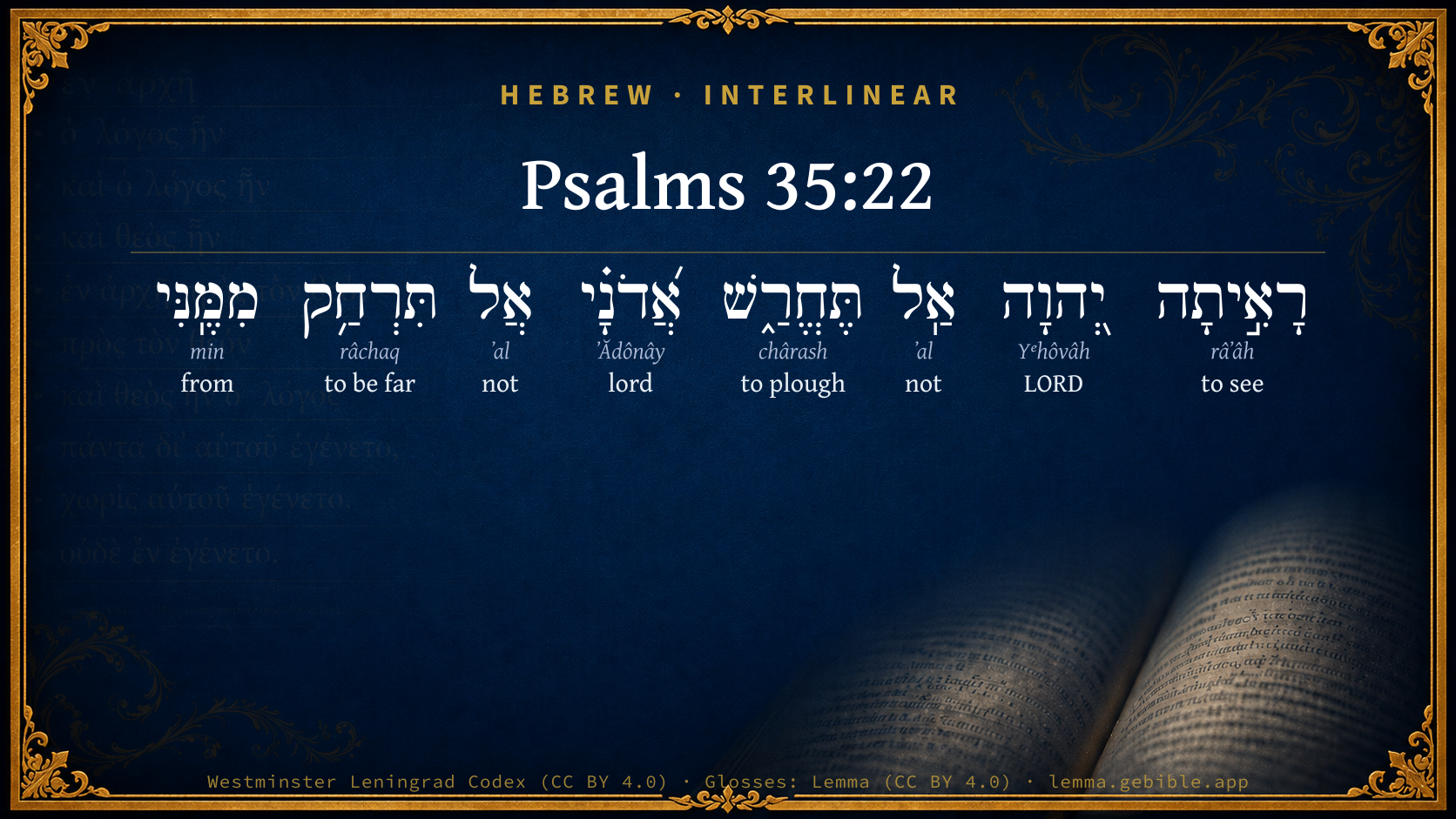
Hebrew (Westminster Leningrad Codex) Psalms 35:22 appears in the Hebrew Old Testament. The text above is from the Westminster Leningrad Codex. Each word links to its Strong’s number, a concise gloss, and parsing drawn from the Open Scriptures Hebrew Bible morphology. Click any word for its full Brown-Driver-Briggs (BDB) entry.
Download image
Cite this verse

Psalms 35:22 (World English Bible). Public Domain. Lemma interlinear Bible study tool, https://lemma.gebible.app/v/psalms/35/22.

Show BibTeX & RIS
BibTeX
RIS
English Translation
You have seen it, Yahweh. Don't keep silent. Lord, don't be far from me.
World English Bible · Public Domain
Download a study sheet

One document with this verse’s original text, its word-by-word gloss line, the meaning frame, cross-references with their text, attributed commentary, and full source and license credits — printable, and it pastes into notes with its structure intact.

This verse Autodidact and up

Study sheet (.html) Plain text (.txt)

A passage Seminary Student

Up to 50 verses in one chapter. A passage sheet keeps up to 6 commentary sources and 12 cross-references per verse, in the order this page ranks them, and says so on the sheet whenever that leaves anything out. Ask for a single verse and you get the Autodidact verse sheet above.

Everything on this page stays free to read, with no account — the sheet is a download of what is already on screen, not access to it.

Want to remove ads? Support Godless Engineer
Compare translations 3

The same verse in 3 English versions, stacked beneath the original-language interlinear above. Click any original word for its lexicon entry.

Each is an independent rendering of the whole verse — the interlinear is not word-aligned to these translations.

Highlighted words mark where these versions differ — a whole-verse word diff, not a word-by-word alignment.

  • World English Bible Public Domain
    You have seen it, Yahweh. Don't keep silent. Lord, don't be far from me.
  • King James Version Public Domain
    This thou hast seen, O LORD: keep not silence: O Lord, be not far from me.
  • unfoldingWord Literal Text CC BY-SA 4.0
    You have seen, Yahweh; do not be silent; Lord, do not be far from me.

unfoldingWord Literal Text — © unfoldingWord, licensed CC BY-SA 4.0. Word-aligned USFM3 via Door43 (git.door43.org/unfoldingWord/en_ult).

Versions to compare (up to 4)

3 of 4 selected

Show all 18 translations

Every available English version of this verse, each an independent rendering of the whole verse.

  • World English Bible Public Domain
    You have seen it, Yahweh. Don't keep silent. Lord, don't be far from me.
  • Berean Standard Bible Public Domain
    O LORD, You have seen it; be not silent. O Lord, be not far from me.
  • Majority Standard Bible Public Domain
    O LORD, You have seen it; be not silent. O Lord, be not far from me.
  • King James Version Public Domain
    This thou hast seen, O LORD: keep not silence: O Lord, be not far from me.
  • American Standard Version (1901) Public Domain
    Thou hast seen it, O Jehovah; keep not silence: O Lord, be not far from me.
  • Revised Version (1885) Public Domain
    Thou hast seen it, O LORD; keep not silence: O Lord, be not far from me.
  • Geneva Bible (1599) Public Domain
    Thou hast seene it, O Lord: keepe not silence: be not farre from me, O Lord.
  • Douay-Rheims (1899) Public Domain
    Thou hast seen, O Lord, be not thou silent: O Lord, depart not from me.
  • Young's Literal Translation Public Domain
    Thou hast seen, O Jehovah, Be not silent, O Lord -- be not far from me,
  • Literal Standard Version CC BY-SA 4.0
    You have seen, O YHWH, || Do not be silent, O Lord—do not be far from me,
  • Unlocked Literal Bible CC BY-SA 4.0
    You have seen it, Yahweh, do not be silent; Lord, do not be far from me.
  • unfoldingWord Literal Text CC BY-SA 4.0
    You have seen, Yahweh; do not be silent; Lord, do not be far from me.
  • Darby Bible Public Domain
    Thou hast seen [it], Jehovah: keep not silence; O Lord, be not far from me.
  • World Messianic Bible Public Domain
    You have seen it, LORD. Don’t keep silent. Lord, don’t be far from me.
  • Webster's Bible Public Domain
    This thou hast seen, O LORD: keep not silence: O Lord, be not far from me.
  • Free Bible Version CC BY-SA 4.0
    But Lord, you've seen all this! Say something! Don't give up on me, Lord!
  • Bible in Basic English Public Domain
    You have seen this, O Lord; be not unmoved: O Lord, be not far from me.
  • JPS Tanakh (1917) Public Domain
    Thou hast seen, O LORD; keep not silence; O Lord, be not far from me.

Literal Standard Version (2020), Covenant Press — licensed CC BY-SA 4.0. Text via the HelloAO Bible API (eBible.org). Unlocked Literal Bible (unfoldingWord) — licensed CC BY-SA 4.0. Text via the HelloAO Bible API (eBible.org). unfoldingWord Literal Text — © unfoldingWord, licensed CC BY-SA 4.0. Word-aligned USFM3 via Door43 (git.door43.org/unfoldingWord/en_ult). Free Bible Version, Dr. Jonathan Gallagher — licensed CC BY-SA 4.0. Text via the HelloAO Bible API (eBible.org).

Word by word

More ways to search: Search by grammar → Find every occurrence → Compare this word →

Practice this passage: Drill this verse → Learn its vocabulary →

About this verse

These counts appear in no published source. They are computed here, from the morphology-tagged text and Lemma’s own curated glosses. What Lemma adds →

8
words
7
distinct lemmas
Wisdom
section

Shared distinctive vocabulary

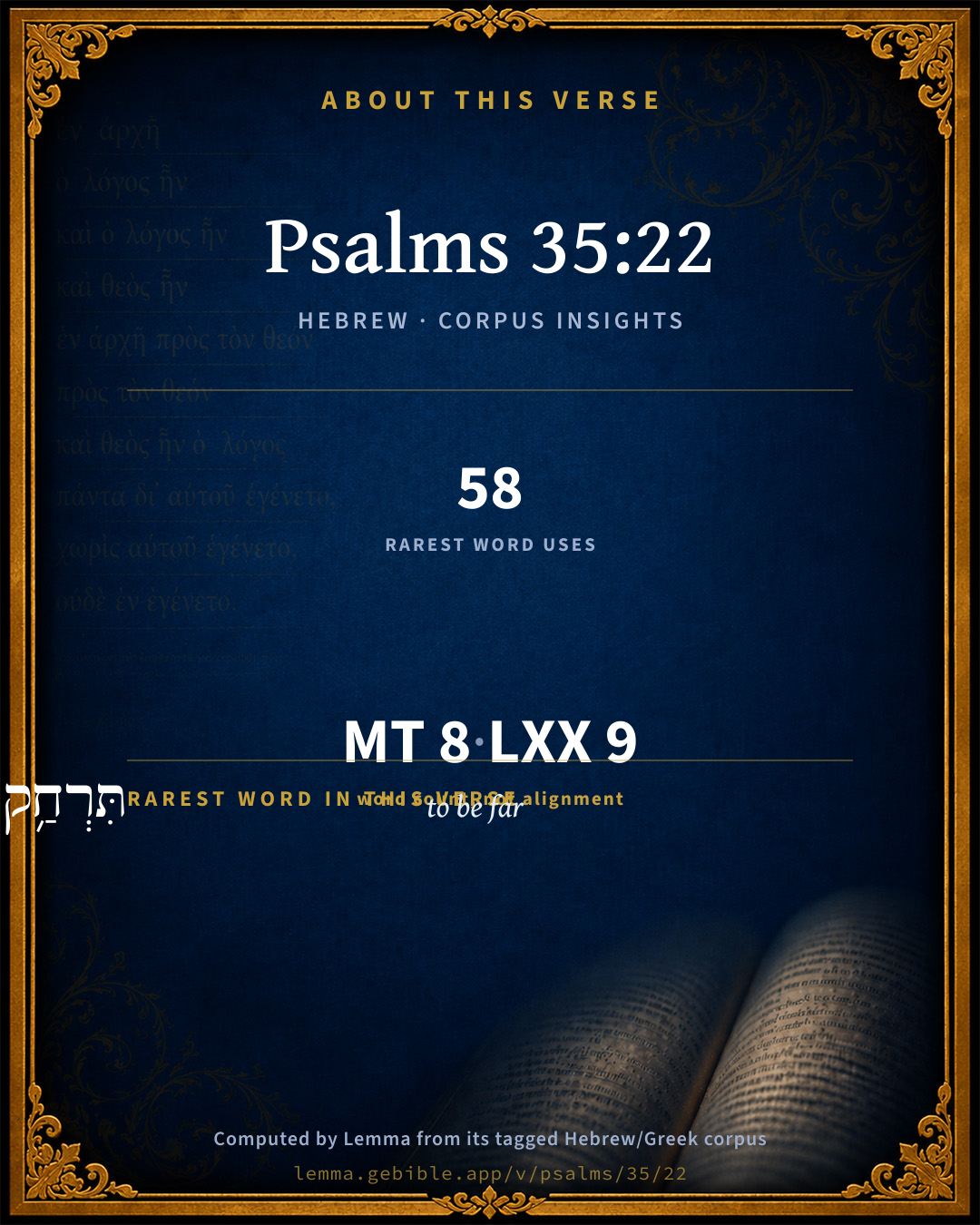
תִּרְחַ֥ק to be far H7368 occurs in 56 verses of the Hebrew Bible. Also found in:

Grammatical profile

  • 3 verbs
  • 2 nouns
  • 1 preposition
  • 2 particles

Verb forms

  • רָאִ֣יתָה Qal · Perfect
  • תֶּחֱרַ֑שׁ Qal · Jussive
  • תִּרְחַ֥ק Qal · Jussive

Repetition

A word recurs within this verse — often emphatic in Hebrew:

  • אַֽל not H408 ×2

Hebrew & Septuagint length

In English translation the verse runs 14 words from the Hebrew and 16 from the Septuagint (LXX English) — closely comparable.

A rough comparison of the two English renderings, which tokenize alike — not a word-level alignment.

Word counts can differ between the Hebrew and the Greek without any difference in meaning — e.g. the Hebrew direct-object marker אֵת has no separate Greek word, and Greek often adds the article ὁ.

In the original languages it is 8 Hebrew tokens and 9 Greek tokens — but the two are counted differently (Hebrew bundles its prefixes and suffixes into one token; the Greek is in lemma form), so that isn’t a like-for-like length.

Cross-references

12

Topical passages linked to Psalms 35:22 in the Treasury of Scripture Knowledge — connected by theme and wording, ordered by reader-vote popularity; previews shown in the World English Bible.

  • Exodus 3:7 Yahweh said, "I have surely seen the affliction of my people who are in Egypt, and have heard their cry because of their taskmasters, for I know their sorrows.
  • Psalms 10:1 Why do you stand far off, Yahweh? Why do you hide yourself in times of trouble?
  • Psalms 28:1 To you, Yahweh, I call. My rock, don't be deaf to me; Lest, if you are silent to me, I would become like those who go down into the pit.
  • Psalms 22:11 Don't be far from me, for trouble is near. For there is none to help.
  • Psalms 38:21 Don't forsake me, Yahweh. My God, don't be far from me.
  • Psalms 71:12 God, don't be far from me. My God, hurry to help me.
  • Isaiah 65:6 Behold, it is written before me: I will not keep silence, but will recompense, yes, I will recompense into their bosom,
  • Psalms 22:19 But don't be far off, Yahweh. You are my help: hurry to help me.
  • Psalms 39:12 "Hear my prayer, Yahweh, and give ear to my cry. Don't be silent at my tears. For I am a stranger with you, A foreigner, as all my fathers were.
  • Psalms 50:21 You have done these things, and I kept silent. You thought that the "I AM" was just like you. I will rebuke you, and accuse you in front of your eyes.
  • Psalms 83:1 God, don't keep silent. Don't keep silent, And don't be still, God.
  • Acts 7:34 I have surely seen the affliction of my people that is in Egypt, and have heard their groaning. I have come down to deliver them. Now come, I will send you into Egypt.'

Cross-references courtesy of OpenBible.info (CC BY 4.0).

Hebrew and Greek witnesses Masoretic Hebrew ↔ Greek Septuagint

The same verse in the two great witnesses to the Old Testament, shown verse-for-verse.

You’re reading Greek Psalm 34 (Hebrew Psalm 35). The Septuagint counts the superscription, so verse numbers can differ from the Hebrew — chapter-level alignment, not verse-by-verse. Numbering follows Rahlfs.

These are two independent witnesses, not word-aligned to each other, and the Septuagint is shown in lemma (dictionary) form.

Hebrew Psalms 35:22 Masoretic · Westminster Leningrad Codex

רָאִ֣יתָה יְ֭הוָה אַֽל תֶּחֱרַ֑שׁ אֲ֝דֹנָ֗י אֲל תִּרְחַ֥ק מִמֶּֽנִּי

You have seen it, Yahweh. Don't keep silent. Lord, don't be far from me.

World English Bible · Public Domain

Greek LXX Greek Psalm 34:22 Septuagint · lemma form

ὁράω κύριος μή παρασιωπάω κύριος μή ἀποἵστημι ἀπό ἐγώ

You have seen it, O Lord: keep not silence: O Lord, withdraw not yourself from me.

LXX2012 (modern English Septuagint) · Public Domain

Hebrew: Westminster Leningrad Codex (CC BY 4.0). Greek: Septuagint (public domain); English from LXX2012 (modern English Septuagint) (Public Domain). How the Septuagint differs from the Hebrew →

Commentary

Notes on Psalms 35:22 from classic Christian and Jewish commentators (each source and its license shown beneath its notes). The classic Christian expositions comment on the surrounding passage and are grouped to its opening verse, so a note may address several verses; the Jewish commentaries on the Tanakh (Rashi and others) are per-verse, so they appear only where the commentator wrote on this verse.

Lemma curates 59 commentaries, every one of them public domain or Creative Commons licensed, each selected and text-cleaned for this edition rather than reprinted as found. About our sources →

Trapp's Complete Commentary

John Trapp

Psa 35:22 [This] thou hast seen, O LORD: keep not silence: O Lord, be not far from me.

Ver. 22. This thou hast seen, O Lord] This answereth to that before, Psa 35:21. Our eye hath seen it, as Aben Ezra observeth. So doth

Keep not silence] To that they opened their mouth wide against me. Ibid.

John Trapp, A Commentary or Exposition upon All the Books of the Old and New Testament (1647–1656) — public domain. Text from a community e-Sword module.

Joseph Benson's Commentary

Psa 35:22-24. Thou hast seen, O Lord — As they say they have seen, so my comfort is, that thou also hast seen, and dost observe all their plots and threats, and all my distresses and calamities, which I suffer for thy sake. Keep not silence — Or, Be not deaf, namely, to my prayers. Be not far from me — Do not withdraw thy favour and help from me. Awake unto my cause — At last undertake to plead my cause against my adversaries. According to thy righteousness — Whereby thou usest to defend the innocent and punish their oppressors.

Joseph Benson's Commentary on the Old and New Testaments (1811–1818) — public domain. Text from a community e-Sword module.

Keil & Delitzsch

C. F. Keil & F. Delitzsch

The poet takes up this malignant "now our eye sees it" and gives another turn to it. With יהוה, alternates in Psa 35:22, Psa 35:23, cf. Psa 35:17, אדני, the pronominal force of which is revived in the combination אלחי ואדני (vid., Psa 16:2). חעיר, carrying its object within itself, signifies to stir, rouse up, and הקיץ, to break off, tear one's self away, gather one's self up from, sleep. "To my right," viz., to prove it by facts; "to my cause," to carry it on in my defence.

Keil & Delitzsch — Biblical Commentary on the Old Testament (1861–1891) — public domain (CC PDM 1.0). Text via the HelloAO Bible API. (Old Testament only.)

J. A. Alexander on Psalms

Joseph Addison Alexander

22. (Psa 35:22) Thou hast seen, Jehovah, be not silent; Lord, be not far from me. "But they are not the only witnesses of my distress, for thou, Lord, like-wise seest and hast long seen it. Seeing it, therefore, be no longer silent; refrain no longer from interposing in my favour; speak in my behalf; be near me in this time of peril." The connection of the verses is like that in Psa 10:13-14, and the prayer in the last clause not unlike that with which the same psalm opens. With the other petition, be not silent, compare that at the beginning of Ps. 28., and with the first words, thou hast seen, those of Psa 35:17 above.

Joseph Addison Alexander, The Psalms Translated and Explained (1850) — public domain. Text from a community e-Sword module.

Adam Clarke's Commentary

Verse 22. This thou hast seen] I have no need to adduce evidences of these wrongs; thou, to whom I appeal, hast seen them. Therefore,

Adam Clarke's Commentary on the Bible (1810–1826) — public domain. Text from a community e-Sword/MySword module.

John Calvin's Commentaries

22. O Jehovah! thou hast also seen it. There is in these words an implied contrast between the view which God is here represented as taking, and the sight at which, as we are told in the preceding verse, the ungodly rejoiced. The import of David’s language is, You have rejoiced exceedingly at the sight of my miseries; but God also sees and takes notice of the cruelty and malice of those who feel a pleasure and gratification in seeing others afflicted and in trouble. David, however, in thus speaking, stays not to reason with his enemies, but rather addresses himself directly to God, and sets his providence as a rampart of defense in opposition to all the assaults of those who sought to shake his confidence, and who caused him much trouble. And certainly, if we would fortify ourselves against the scoffing and derision of our enemies, the best means which we can employ for this end is to overlook them, and to elevate our thoughts to God, and in the confidence of his fatherly care over us, to entreat him to show, in very deed, that our troubles are not unknown to him; yea, that the more he sees the wicked eagerly watching every opportunity to accomplish our ruin, he would the more speedily come to our aid. This David expresses by these various forms of expression — Keep not silence, be not far from me, stir up thyself, awake for my judgment He might justly make use of such expressions, seeing he was already fully persuaded that God regards the poor and afflicted, and marks all the wrongs which are done to them. If, therefore, we would frame our requests aright, a clear conviction and persuasion of the providence of God must first shine into our hearts; nor is it necessary only that this should precede, in point of order, all our desires; it must also restrain and govern them.

John Calvin's Commentaries (1540-1563) — public domain. Text from the Calvin Translation Society English edition (1840s-50s) via the Christian Classics Ethereal Library (ccel.org). Calvin's coverage is partial (roughly two-thirds of the Bible); uncommented books and verses are honest gaps, never fabricated. The 19th-century editor's footnotes and remarks are omitted so the notes are faithfully Calvin's own voice.

The Cambridge Bible for Schools and Colleges

gen. ed. J. J. S. Perowne

22. He turns their taunt into a plea: Thou hast seen, O Jehovah. Cp. Psa_35:17, note.

keep not silence] The same word as in Psa_28:1, where R.V. renders, be not thou deaf unto me. With be not far from me, cp. Psa_22:11; &c.

The Cambridge Bible for Schools and Colleges (gen. ed. J. J. S. Perowne; Cambridge University Press, 1878–1918) — public domain. Text from a community e-Sword module.

John Gill's Exposition

This thou hast seen, O Lord,.... The insults and derisions of these men, and the injuries they did to him, whom they hated. God is omniscient, and sees all things, all the evil wicked men do to him; and he will requite them in his own time; see Psa 10:14;

keep not silence; meaning at his prayers; that he would not be as one deaf and dumb, turning his ears from his cries, and giving no answer to his requests; see Psa 28:1;

O Lord, be not far from me; meaning not as to his general presence, in which sense he is not far from any, Act 17:07; but with respect to his gracious presence and appearance to him for help and deliverance; see Psa 22:1.

John Gill's Exposition of the Whole Bible (1746–1763) — public domain (CC PDM 1.0). Text via the HelloAO Bible API.

Albert Barnes' Notes on the Bible

This thou hast seen, O Lord - Thou hast seen what they have done, as they profess to have seen what I have done Psa 35:21. Thine eye has been upon all their movements, as they say that theirs has been upon mine. Compare the notes at Psa 35:17.

Keep not silence - That is, Speak; rebuke them; punish them. God seemed to look on with unconcern. As we express it, he “said nothing.” He appeared to pay no attention to what was done, but suffered them to do as they pleased without interposing to rebuke or check them. Compare the notes at Psa 28:1.

O Lord, be not far from me - Compare the notes at Psa 10:1.

Albert Barnes' Notes on the Bible (1834–1885) — public domain. Text from a community e-Sword/MySword module.

Matthew Poole's English Annotations

As they say they have seen, so my comfort is, thou also hast seen, and dost observe all their plots and threats, and all my distresses and calamities, which I suffer for thy sake.

Keep not silence; or, be not deaf, to wit, to my prayers. The same word signifies both to be silent and to be deaf. See Poole "Psa 28:1".

Be not far from me; do not withdraw thy favour and help from me.

Matthew Poole's English Annotations on the Holy Bible (1683–1685) — public domain. Text from a community e-Sword/MySword module.

The Treasury of David

Charles H. Spurgeon

Verse 22. ["This thou hast seen, O Lord."] Here is comfort. Our heavenly Father knows all our sorrow. Omniscience is the saint's candle which never goes out. A father will not long endure to see his child abused. Shall not God avenge his own elect? ["Keep not silence."] Rebuke thine enemies and mine, O Lord. A word will do it. Clear my character, comfort my heart. ["O Lord, be not far from me."] Walk the furnace with me. Stand in the pillory at my side. The sweet presence of God is the divine cordial of the persecuted; his painful absence would be their seepest misery.

[Verses] 21, 22:---

They gape and drawe their mouthes in scornful wise,

And crie, fie, fie, wee sawe it with our eyes.

But thou their deed, (O Lord!) dost also see;

Then be not silent soe, nor farr from mee.

[Sir John Davies.]

[Verse] 22. Omniscience pleaded, a word sought for, presence requested, action entreated, affiance urged as a claim.

Charles H. Spurgeon's The Treasury of David (1869–1885) — public domain. Psalms only. Text from a community e-Sword/MySword module.

Whedon's Commentary on the Bible

Daniel D. Whedon

22. This thou hast seen—Antithetic to “our eye hath seen it,” just mentioned, and referring to Psa_35:17

Daniel D. Whedon (gen. ed.), Commentary on the Old and New Testaments (1874–1909) — public domain. Text from a community e-Sword module.

The Pulpit Commentary

This thou hast seen, O Lord. Nothing of this has been hid from thee; thine eye, O Lord, has seen it. Therefore I call upon thee. Keep not silence. Refrain not thyself. "Up, and let not man have the upper hand". (Psa_9:19) O Lord, be not far from me. Draw near, hasten, vindicate my name. (comp. Psa_22:19 Psa_38:21 Psa_70:1-2)

God"s silence.

"There is a time to keep silence, and a time to speak". (Ecc_3:7) So it is with man, and with reverence it may be said, so it is with God. There is a sense in which God is never silent. In manifold ways his voice is ever sounding in our ears. But there are times when God may be said to be silent, even with regard to his own people. There is speech on the one side, but no answer on the other. This silence may be prolonged till it becomes distressingly painful. There is the sense of loss; there is the feeling of desertion; there is the dread of worse things to come of the going down to the pit of darkness and despair. (Psa_23:4) Luther said, in his strong way, "O my God, punish me rather with pestilence, with all the terrible sicknesses on earth, with war, with anything, rather than thou be silent to me!" But though this silence is to be deprecated, yet it is ordained of God for good. It may come as

I JUST RETRIBUTION. The wicked do not seek after God. It is no wonder, therefore, if God should deal with them after their own ways. (Pro_1:24-28 Joh_13:9) But even good men may become negligent they may fall into sin and forget God. Therefore it may be necessary to let them see and learn the evil of departing from the living God. (Psa_94:10 Psa_125:5 Jer_2:19)

II MERCIFUL WARNING. We must not judge of God by ourselves. We must not think that he is arbitrary or cold. If he is silent, it is for just cause. Remember how it was with Saul. (1Sa_28:6) Well would it have been for him, if he had regarded the doings of God, and turned to him in repentance. But he hardened his heart. God warns us also. His silence should bring our sins to our remembrance. "Your sins," saith the prophet, "have hid his face from you, that he will not hear". (Isa_59:2; cf. Hos_5:15)

III GRACIOUS DISCIPLINE. The end of the Lord is merciful. If he is silent, it may be:

1. To try our faith, Remember the Syro-Phoenician woman. (Mat_15:21-28)

2. To quicken our sense of dependence. God is Sovereign. He is under no obligation to us. If he hears, it is in mercy. We are too ready to think we have a claim upon him, and to resent his silence. We need to learn humility. "God resisteth the proud, and giveth grace to the humble". (1Pe_5:8)

3. To enhance the value if the blessings we lack. The worth is known by the want. Memory of past joys makes us the more eager in seeking renewed tokens of love and good will. The light is sweet to the eyes, but it is sweeter if for a while withdrawn. Friendship is dear, but absence makes the heart grow fender. The love of God is the joy of the heart; but if clouds and darkness gather between us and God, the more earnestly do we cry for the restoration of his favour. (Jer_29:11-14)

4. To prepare us for higher manifestations Gods love. We need to be brought low in order to be raised up. We need to be emptied of pride and self-righteousness to be filled with the fulness of God. If we ask and receive not, it is because we ask amiss. This we have to learn. We are led, therefore, to self-examination, to penitence, to confession. God has something better than we thought of in store for us. It may he something to do or to suffer for him. There is a "needs be" we should be made ready. Let us therefore trust, and not be afraid. W.F. (Isa_54:7, Isa_54:8)

The Pulpit Commentary (1880–1919), ed. H.D.M. Spence-Jones & Joseph S. Exell — public domain. Text from a community e-Sword module.

John Wesley's Explanatory Notes

This - Thou also hast seen, all their plots and threats, and all my distresses and calamities. Keep not - Be not deaf, to my prayers. The same word signifies, both to be silent, and to be deaf.

John Wesley, Explanatory Notes Upon the Whole Bible (1754–1765) — public domain. Text via the GEBible commentary corpus.

Lesson kit

Teaching starters — assembled from the data on this page, not authored interpretation. Every prompt links to the verse data it draws on. Edit before teaching.

Psalms, in the Wisdom, opens this verse with 8 words (7 distinct Hebrew lemmas). Its most distinctive word is râchaq (“to be far”). A historical commentator’s framing appears above. Read the whole chapter for the surrounding context.

Discussion questions

  1. The word râchaq carries the sense “to be far.” How does it shape the verse?
  2. Genesis 21:16 shares the word «to be far» with this verse. How do the two illuminate each other?
  3. “not” occurs 2× in this one verse. What is the effect of the repetition?
  4. The translations on this page render this verse differently — a whole-verse word diff, not a word-by-word alignment. What might account for the different wordings?
  5. The verb «רָאִ֣יתָה» is Qal Perfect. How does its form color the action?
  6. Reading how Trapp's Complete Commentary and Joseph Benson's Commentary read this verse, where do the two commentators agree and where do they part?

Things to notice

Reading settings

Reading text

Shown beneath each verse's original-language words.

Old Testament
Old Testament edition

Read the OT as the Masoretic Hebrew (MT) or the Greek Septuagint (LXX).

English shown for the Greek Septuagint (in the Hebrew ↔ Greek comparison).

Comparing translations? Open the Compare panel on any verse page to stack up to four side by side.