
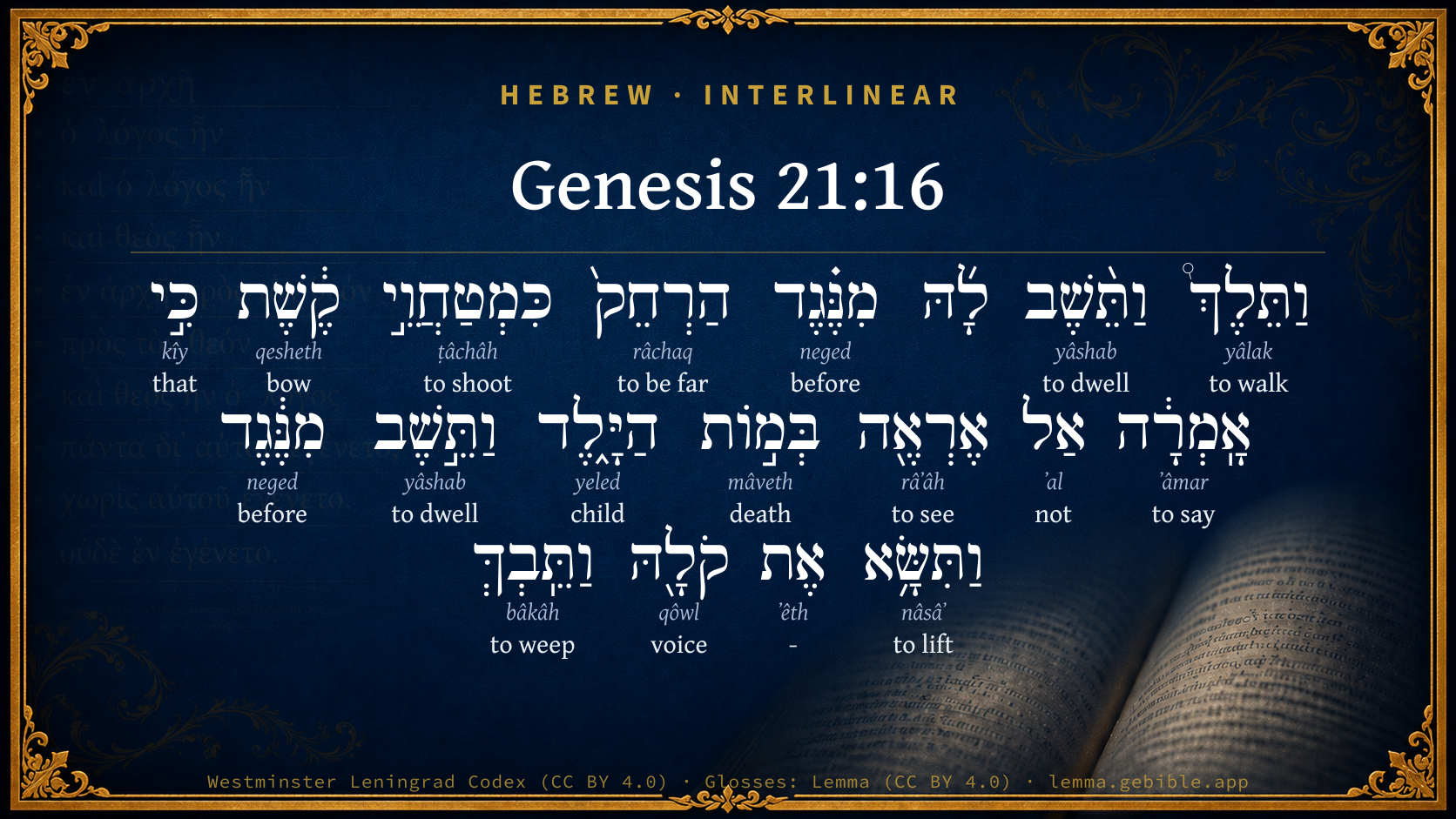
Genesis 21:16

Hebrew (Westminster Leningrad Codex) Genesis 21:16 appears in the Hebrew Old Testament. The text above is from the Westminster Leningrad Codex. Each word links to its Strong’s number, a concise gloss, and parsing drawn from the Open Scriptures Hebrew Bible morphology. Click any word for its full Brown-Driver-Briggs (BDB) entry.
Download image
Cite this verse

Genesis 21:16 (World English Bible). Public Domain. Lemma interlinear Bible study tool, https://lemma.gebible.app/v/genesis/21/16.

Show BibTeX & RIS
BibTeX
RIS
English Translation
She went and sat down opposite him, a good way off, about a bow shot away. For she said, "Don't let me see the death of the child." She sat over against him, and lifted up her voice, and wept.
World English Bible · Public Domain
Highlights
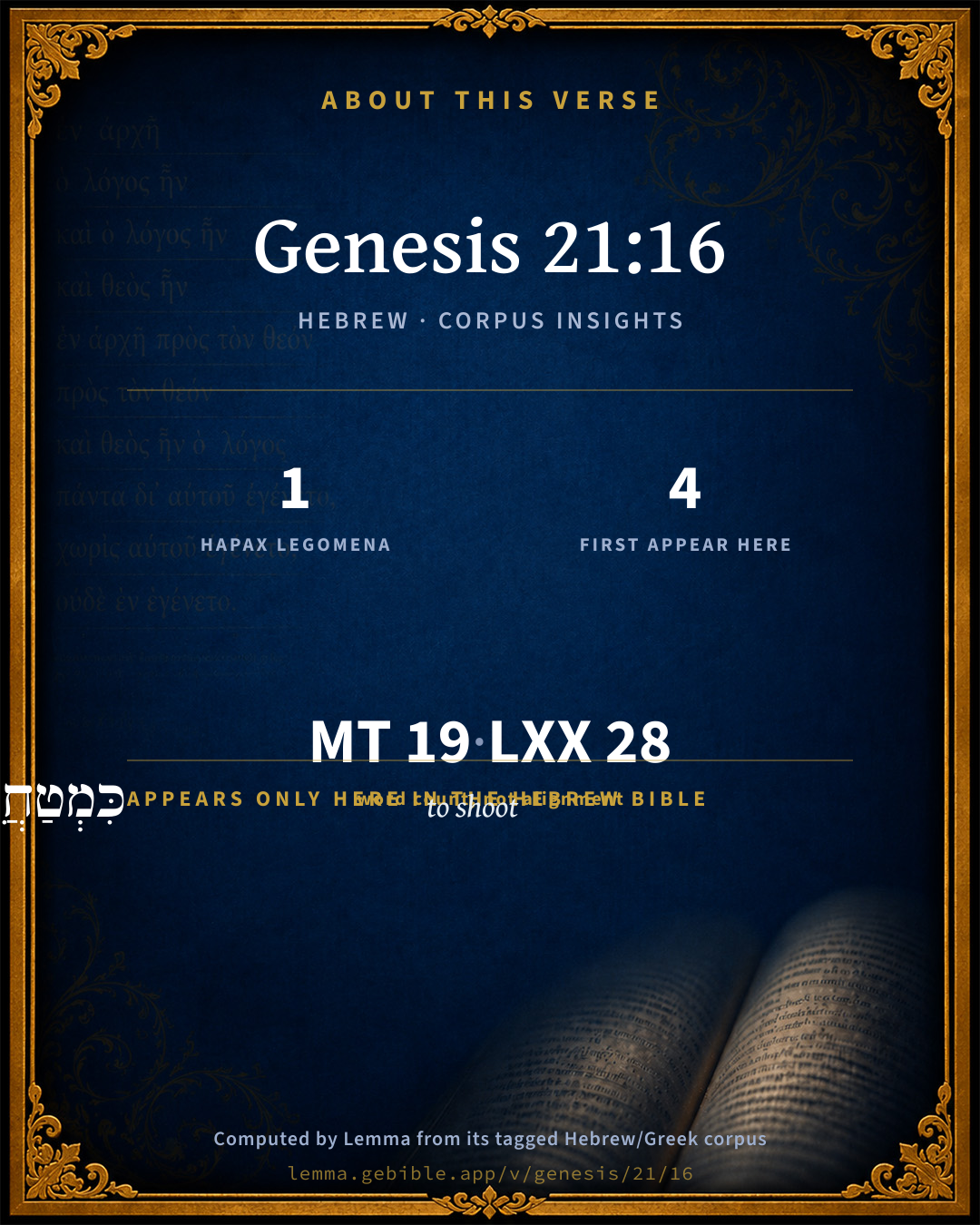
  • 1 hapax legomenon — only here in the Hebrew Bible
  • 4 first appearances in the Hebrew Bible
Full analysis ↓
Download a study sheet

One document with this verse’s original text, its word-by-word gloss line, the meaning frame, cross-references with their text, attributed commentary, and full source and license credits — printable, and it pastes into notes with its structure intact.

This verse Autodidact and up

Study sheet (.html) Plain text (.txt)

A passage Seminary Student

Up to 50 verses in one chapter. A passage sheet keeps up to 6 commentary sources and 12 cross-references per verse, in the order this page ranks them, and says so on the sheet whenever that leaves anything out. Ask for a single verse and you get the Autodidact verse sheet above.

Everything on this page stays free to read, with no account — the sheet is a download of what is already on screen, not access to it.

Want to remove ads? Support Godless Engineer
Compare translations 3

The same verse in 3 English versions, stacked beneath the original-language interlinear above. Click any original word for its lexicon entry.

Each is an independent rendering of the whole verse — the interlinear is not word-aligned to these translations.

Highlighted words mark where these versions differ — a whole-verse word diff, not a word-by-word alignment.

  • World English Bible Public Domain
    She went and sat down opposite him, a good way off, about a bow shot away. For she said, "Don't let me see the death of the child." She sat over against him, and lifted up her voice, and wept.
  • King James Version Public Domain
    And she went, and sat her down over against him a good way off, as it were a bow shot: for she said, Let me not see the death of the child. And she sat over against him, and lift up her voice, and wept.
  • unfoldingWord Literal Text CC BY-SA 4.0
    and she went and sat down by herself at a distance, as far away as they shoot a bow, because she said, “Do not let me look on the death of the child!” And she sat at a distance, then she lifted her voice and sobbed.

unfoldingWord Literal Text — © unfoldingWord, licensed CC BY-SA 4.0. Word-aligned USFM3 via Door43 (git.door43.org/unfoldingWord/en_ult).

Versions to compare (up to 4)

3 of 4 selected

Show all 18 translations

Every available English version of this verse, each an independent rendering of the whole verse.

  • World English Bible Public Domain
    She went and sat down opposite him, a good way off, about a bow shot away. For she said, "Don't let me see the death of the child." She sat over against him, and lifted up her voice, and wept.
  • Berean Standard Bible Public Domain
    Then she went off and sat down nearby, about a bowshot away, for she said, “I cannot bear to watch the boy die!” And as she sat nearby, she lifted up her voice and wept.
  • Majority Standard Bible Public Domain
    Then she went off and sat down nearby, about a bowshot away, for she said, “I cannot bear to watch the boy die!” And as she sat nearby, she lifted up her voice and wept.
  • King James Version Public Domain
    And she went, and sat her down over against him a good way off, as it were a bow shot: for she said, Let me not see the death of the child. And she sat over against him, and lift up her voice, and wept.
  • American Standard Version (1901) Public Domain
    And she went, and sat her down over against him a good way off, as it were a bowshot. For she said, Let me not look upon the death of the child. And she sat over against him, and lifted up her voice, and wept.
  • Revised Version (1885) Public Domain
    And she went, and sat her down over against him a good way off, as it were a bowshot: for she said, Let me not look upon the death of the child. And she sat over against him, and lift up her voice, and wept.
  • Geneva Bible (1599) Public Domain
    Then she went and sate her ouer against him a farre off about a bowe shoote: for she said, I will not see the death of the child. and she sate downe ouer against him, and lift vp her voyce and wept.
  • Douay-Rheims (1899) Public Domain
    And she went her way, and sat over against him a great way off as far as a bow can carry, for she said: I will not see the boy die: and sitting over against, she lifted up her voice and wept.
  • Young's Literal Translation Public Domain
    And she goeth and sitteth by herself over-against, afar off, about a bow-shot, for she said, `Let me not look on the death of the lad;' and she sitteth over-against, and lifteth up her voice, and weepeth.
  • Literal Standard Version CC BY-SA 4.0
    And she goes and sits by herself opposite [him], far off, about a bow-shot, for she said, “Do not let me look on the death of the boy”; and she sits opposite [him], and lifts up her voice, and weeps.
  • Unlocked Literal Bible CC BY-SA 4.0
    Then she went, and sat down a short distance from him, about the distance of a bowshot away, for she said, “Let me not look upon the death of the child.” As she sat there across from him, she lifted up her voice and wept.
  • unfoldingWord Literal Text CC BY-SA 4.0
    and she went and sat down by herself at a distance, as far away as they shoot a bow, because she said, “Do not let me look on the death of the child!” And she sat at a distance, then she lifted her voice and sobbed.
  • Darby Bible Public Domain
    and she went and sat down over against [him], a bow-shot off; for she said, Let me not behold the death of the child. And she sat over against [him], and lifted up her voice and wept.
  • World Messianic Bible Public Domain
    She went and sat down opposite him, a good way off, about a bow shot away. For she said, “Don’t let me see the death of the child.” She sat opposite him, and lifted up her voice, and wept.
  • Webster's Bible Public Domain
    And she went, and sat her down over against him, a good way off, as it were a bow-shot: for she said, Let me not see the death of the child. And she sat over against him, and raised her voice, and wept.
  • Free Bible Version CC BY-SA 4.0
    She went and sat down some way off, a few hundred yards away, saying, “I can't bear to watch my son die!” As she sat down she burst into tears.
  • Bible in Basic English Public Domain
    And she went some distance away, about an arrow flight, and seating herself on the earth, she gave way to bitter weeping, saying, Let me not see the death of my child.
  • JPS Tanakh (1917) Public Domain
    And she went, and sat her down over against him a good way off, as it were a bow-shot; for she said: 'Let me not look upon the death of the child.' And she sat over against him, and lifted up her voice, and wept.

Literal Standard Version (2020), Covenant Press — licensed CC BY-SA 4.0. Text via the HelloAO Bible API (eBible.org). Unlocked Literal Bible (unfoldingWord) — licensed CC BY-SA 4.0. Text via the HelloAO Bible API (eBible.org). unfoldingWord Literal Text — © unfoldingWord, licensed CC BY-SA 4.0. Word-aligned USFM3 via Door43 (git.door43.org/unfoldingWord/en_ult). Free Bible Version, Dr. Jonathan Gallagher — licensed CC BY-SA 4.0. Text via the HelloAO Bible API (eBible.org).

Word by word

More ways to search: Search by grammar → Find every occurrence → Compare this word →

Practice this passage: Drill this verse → Learn its vocabulary →

כִּמְטַחֲוֵ֣י
ṭâchâh
H2909
“like/as · shooting”
Preposition + Verb, Palel, Participle Active, Masculine, Plural, Construct
Part of Speech
Preposition + Verb
Stem
Palel
Form
Participle Active
Gender
Masculine
Number
Plural
State
Construct
Full BDB Definition

Origin: a primitive root

TWOT: 800

to hurl, shoot - (Piel) a bowshot (participle)
  1. וַתֵּלֶךְ֩ yâlak H3212 “and · to walk” Conjunction + Verb, Qal, Sequential Imperfect, 3rd Person, Feminine, Singular
  2. וַתֵּ֨שֶׁב yâshab H3427 “and · to dwell” Conjunction + Verb, Qal, Sequential Imperfect, 3rd Person, Feminine, Singular
  3. מִנֶּ֗גֶד neged H5048 “from · before” Preposition + Preposition
  4. הַרְחֵק֙ râchaq H7368 “to be far” Verb, Hiphil, Infinitive Absolute
  5. קֶ֔שֶׁת qesheth H7198 “bow” Noun, Common, Feminine, Singular, Absolute
  6. כִּ֣י kîy H3588 “that” Conjunction
  7. אָֽמְרָ֔ה ʼâmar H559 “to say” Verb, Qal, Perfect, 3rd Person, Feminine, Singular
  8. אַל ʼal H408 “not” Particle, Negative
  9. אֶרְאֶ֖ה râʼâh H7200 “to see” Verb, Qal, Cohortative, 1st Person, Common, Singular
  10. בְּמ֣וֹת mâveth H4194 “in/at · death of” Preposition + Noun, Common, Masculine, Singular, Construct
  11. הַיָּ֑לֶד yeled H3206 “the · child” Particle, Definite Article + Noun, Common, Masculine, Singular, Absolute
  12. וַתֵּ֣שֶׁב yâshab H3427 “and · to dwell” Conjunction + Verb, Qal, Sequential Imperfect, 3rd Person, Feminine, Singular
  13. מִנֶּ֔גֶד neged H5048 “from · before” Preposition + Preposition
  14. וַתִּשָּׂ֥א nâsâʼ H5375 “and · to lift” Conjunction + Verb, Qal, Sequential Imperfect, 3rd Person, Feminine, Singular
  15. אֶת ʼêth H853 “-” Particle, Direct Object
  16. קֹלָ֖הּ qôwl H6963 “voice · her” Noun, Common, Masculine, Singular, Construct + Suffix, Personal, 3rd Person, Feminine, Singular
  17. וַתֵּֽבְךְּ bâkâh H1058 “and · to weep” Conjunction + Verb, Qal, Sequential Imperfect, 3rd Person, Feminine, Singular

About this verse

These counts appear in no published source. They are computed here, from the morphology-tagged text and Lemma’s own curated glosses. What Lemma adds →

19
words
16
distinct lemmas
Pentateuch
section

Notable vocabulary

1 hapax legomenon — a word that appears only here in the entire Hebrew Bible:

  • כִּמְטַחֲוֵ֣י to shoot H2909

First appearance in Scripture

These words make their first canonical appearance in the Hebrew Bible here:

  • הַרְחֵק֙ to be far H7368
  • כִּמְטַחֲוֵ֣י to shoot H2909
  • בְּמ֣וֹת death H4194
  • וַתֵּֽבְךְּ to weep H1058

Shared distinctive vocabulary

הַרְחֵק֙ to be far H7368 occurs in 56 verses of the Hebrew Bible. Also found in:

Grammatical profile

  • 9 verbs
  • 4 nouns
  • 3 prepositions
  • 1 conjunction
  • 2 particles

Verb forms

  • וַתֵּלֶךְ֩ Qal · Sequential Imperfect
  • וַתֵּ֨שֶׁב Qal · Sequential Imperfect
  • הַרְחֵק֙ Hiphil · Infinitive Absolute
  • כִּמְטַחֲוֵ֣י Palel · Participle Active
  • אָֽמְרָ֔ה Qal · Perfect
  • אֶרְאֶ֖ה Qal · Cohortative
  • וַתֵּ֣שֶׁב Qal · Sequential Imperfect
  • וַתִּשָּׂ֥א Qal · Sequential Imperfect
  • וַתֵּֽבְךְּ Qal · Sequential Imperfect

Repetition

Words recur within this verse — often emphatic in Hebrew:

  • וַתֵּ֨שֶׁב to dwell H3427 ×2
  • מִנֶּ֗גֶד before H5048 ×2

Hebrew & Septuagint length

In English translation the verse runs 40 words from the Hebrew and 40 from the Septuagint (LXX English) — the same length.

A rough comparison of the two English renderings, which tokenize alike — not a word-level alignment.

Word counts can differ between the Hebrew and the Greek without any difference in meaning — e.g. the Hebrew direct-object marker אֵת has no separate Greek word, and Greek often adds the article ὁ.

In the original languages it is 19 Hebrew tokens and 28 Greek tokens — but the two are counted differently (Hebrew bundles its prefixes and suffixes into one token; the Greek is in lemma form), so that isn’t a like-for-like length.

Cross-references

12

Topical passages linked to Genesis 21:16 in the Treasury of Scripture Knowledge — connected by theme and wording, ordered by reader-vote popularity; previews shown in the World English Bible.

  • Isaiah 49:15 Can a woman forget her sucking child, that she should not have compassion on the son of her womb? yes, these may forget, yet I will not forget you.
  • Genesis 29:11 Jacob kissed Rachel, and lifted up his voice, and wept.
  • Judges 2:4 It happened, when the angel of Yahweh spoke these words to all the children of Israel, that the people lifted up their voice, and wept.
  • Ruth 1:9 Yahweh grant you that you may find rest, each of you in the house of her husband. Then she kissed them, and they lifted up their voice, and wept.
  • 1 Samuel 24:16 It came to pass, when David had made an end of speaking these words to Saul, that Saul said, Is this your voice, my son David? Saul lifted up his voice, and wept.
  • 1 Samuel 30:4 Then David and the people who were with him lifted up their voice and wept, until they had no more power to weep.
  • 1 Kings 3:26 Then spoke the woman whose the living child was to the king, for her heart yearned over her son, and she said, Oh, my lord, give her the living child, and in no way kill it. But the other said, It shall be neither mine nor yours; divide it.
  • Esther 8:6 for how can I endure to see the evil that shall come to my people? or how can I endure to see the destruction of my relatives?
  • Zechariah 12:10 I will pour on the house of David, and on the inhabitants of Jerusalem, the spirit of grace and of supplication; and they will look to me whom they have pierced; and they shall mourn for him, as one mourns for his only son, and will grieve bitterly for him, as one grieves for his firstborn.
  • Luke 15:20 "He arose, and came to his father. But while he was still far off, his father saw him, and was moved with compassion, and ran, and fell on his neck, and kissed him.
  • Genesis 27:38 Esau said to his father, "Have you but one blessing, my father? Bless me, even me also, my father." Esau lifted up his voice, and wept.
  • Genesis 44:34 For how will I go up to my father, if the boy isn't with me? Lest I see the evil that will come on my father."

Cross-references courtesy of OpenBible.info (CC BY 4.0).

Hebrew and Greek witnesses Masoretic Hebrew ↔ Greek Septuagint

The same verse in the two great witnesses to the Old Testament, shown verse-for-verse.

These are two independent witnesses, not word-aligned to each other, and the Septuagint is shown in lemma (dictionary) form.

Hebrew Genesis 21:16 Masoretic · Westminster Leningrad Codex

וַתֵּלֶךְ֩ וַתֵּ֨שֶׁב לָ֜הּ מִנֶּ֗גֶד הַרְחֵק֙ כִּמְטַחֲוֵ֣י קֶ֔שֶׁת כִּ֣י אָֽמְרָ֔ה אַל אֶרְאֶ֖ה בְּמ֣וֹת הַיָּ֑לֶד וַתֵּ֣שֶׁב מִנֶּ֔גֶד וַתִּשָּׂ֥א אֶת קֹלָ֖הּ וַתֵּֽבְךְּ

She went and sat down opposite him, a good way off, about a bow shot away. For she said, "Don't let me see the death of the child." She sat over against him, and lifted up her voice, and wept.

World English Bible · Public Domain

Greek LXX Genesis 21:16 Septuagint · lemma form

ἀποἔρχομαι δέ κάθημαι ἀπέναντι αὐτός μακρόθεν ὡσεί τόξον βολή εἶπον γάρ οὐ μή ὁράω ὁ θάνατος ὁ παιδίον ἐγώ καί καταἵζω ἀπέναντι αὐτός ἀναβοάω δέ ὁ παιδίον κλαίω

And she departed and sat down opposite him at a distance, as it were a bow-shot, for she said, Surely I can’t see the death of my child: and she sat opposite him, and the child cried aloud and wept.

LXX2012 (modern English Septuagint) · Public Domain

On this verse, The Cambridge Bible for Schools and Colleges discusses the Septuagint’s reading. Read the note in Commentary ↓

Hebrew: Westminster Leningrad Codex (CC BY 4.0). Greek: Septuagint (public domain); English from LXX2012 (modern English Septuagint) (Public Domain). How the Septuagint differs from the Hebrew →

Targum (Aramaic paraphrase)

2

The Targum is the ancient Jewish Aramaic paraphrase of the Hebrew Scriptures — an interpretive translation, not the Hebrew text itself. Onkelos (literal) and Pseudo-Jonathan (expansive) render the Torah, and Jonathan the Prophets. Coverage is partial: where no permissively-licensed English translation exists for a verse, only the Aramaic is shown. This is verse-level text, not a word-by-word alignment to the Hebrew.

  1. Targum Onkelos Torah (Genesis–Deuteronomy)
    וַאֲזָלַת וִיתִיבַת לַהּ מִקֳּבֵל אַרְחֵיקַת (נ''י אַרְחִיק) כְּמֵיגַד קַשְׁתָּא אֲרֵי אֲמֶרֶת לָא אֶחֱזֵי בְּמוֹתָא דְרַבְיָא וִיתִיבַת מִקֳּבֵל וַאֲרֵימַת יָת קָלַהּ וּבְכָת

    (no public-domain English translation for this verse)

    Targum Onkelos — Aramaic: “Onkelos Genesis” (public domain); “Onkelos Exodus” (public domain); “Onkelos Leviticus” (public domain); “Onkelos Numbers” (public domain); “Onkelos Deuteronomy” (public domain). English: “Sefaria Community Translation” (CC0 1.0 (public-domain dedication)); “J.W. Etheridge. The Targums of Onkelos and Jonathan Ben Uzziel on the Pentateuch. London: Longmans, Green, 1862” (public domain). Text via Sefaria.

  2. Targum Pseudo-Jonathan Torah (Genesis–Deuteronomy)
    וְאָזְלַת וִיתֵיבַת לָהּ לִסְטַר חַד וְטַלְקַת יַת פּוּלְחָנָא נוּכְרָאָה אַרְחִיקַת מִן בְּרָהּ כְּשִׁיעוּר מֵיגַד בְּקַשְׁתָּא אֲרוּם אָמְרַת לֵית אֲנָא יָכְלָא לְמֵיחֲמֵי בְּמוֹתָא דְטַלְיָא וִיתֵבַת מִקְבֵיל בְּרָהּ וַאֲרֵימַת יַת קָלָהּ וּבְכָת

    And she went and sat on one side, and cast away the idol (or the strange worship), and removed from her son, as the distance of an arrow from the bow; for she said, I am not able to see the death of the child. And she sat over against her son, and lifted up her voice and wept.

    Targum Pseudo-Jonathan — Aramaic: “Targum Jonathan on Genesis” (public domain); “Targum Jonathan on Exodus” (public domain); “Targum Jonathan on Leviticus” (public domain); “Targum Jonathan on Numbers” (public domain); “Targum Jonathan on Deuteronomy” (public domain). English: “The Targum of Jonathan ben Uzziel, trans. J. W. Etheridge, London, 1862” (public domain). Text via Sefaria.

Commentary

Notes on Genesis 21:16 from classic Christian and Jewish commentators (each source and its license shown beneath its notes). The classic Christian expositions comment on the surrounding passage and are grouped to its opening verse, so a note may address several verses; the Jewish commentaries on the Tanakh (Rashi and others) are per-verse, so they appear only where the commentator wrote on this verse.

Lemma curates 59 commentaries, every one of them public domain or Creative Commons licensed, each selected and text-cleaned for this edition rather than reprinted as found. About our sources →

Trapp's Complete Commentary

John Trapp

Gen 21:16 And she went, and sat her down over against [him] a good way off, as it were a bowshot: for she said, Let me not see the death of the child. And she sat over against [him], and lift up her voice, and wept.

Ver. 16. Let me not see the death of the child.] This, saith an interpreter, {a} was but poor love. Give me a friend that will not leave in the instant of death. {Gen 46:4}

She lift up her voice, and wept.] As hinds by calving, so we by weeping "cast out our sorrows". {Job 39:3}

“ Expletur lachrymis, egeriturque dolor .”

{a} Babington.

John Trapp, A Commentary or Exposition upon All the Books of the Old and New Testament (1647–1656) — public domain. Text from a community e-Sword module.

The Biblical Illustrator

Joseph S. Exell

Gen_21:16

Let me not see the death of the child

Physical and spiritual life contrasted

I.

THE CIRCUMSTANCE OF CHILDREN DYING BEFORE THEIR PARENTS. A common event. This fact shows--

1. That the Ruler of the world does not treat man here according to his character.

2. That the youngest, as well as the oldest, should live in constant preparation for the change.

3. That parents should not centre their affection upon their children.

II. THE PARENTAL DISTRESS WHICH SUCH AN EVENT PRODUCES. Like the tearing of a branch from a plant quivering all over with sensibility. Spiritual discipline.

III. THE ATTENTIVENESS OF GOD TO DISTRESSED PARENTS (Gen_21:17). God is at all times present with us. This should--

1. Comfort us in our sorrows.

2. Restrain us from all sin.

3. Stimulate us to a true life.

IV. THE APPLICABILITY OF THIS PARENTAL DEPRECATION TO THE SPIRITUAL DEATH OF CHILDREN. (Homilist.)

Parental solicitude

I. WHAT ARE THE PROPER OBJECTS OF PARENTAL SOLICITUDE?

1. Salvation is supreme. It is not the only object of a parents anxiety, but the chief. The favour of God is above all favour. A holy heart is the greatest wealth your child can ever possess.

2. Many other objects harmonize by being made subordinate to that. Hagar wanted water for her child; an object, the value of which in this cooler climate we may seldom have had occasion rightly to prize. It was entirely proper for this mother, at that time, earnestly to long for a spring of water. So there are a thousand wants pertaining to mans complex being which it is legitimate to indulge. Concerning them all, it is only important now to notice that two rules pertain to them.

(1) The first is, that what is legitimate, proper, useful, and healthful, should be distinguished from all that is the opposite. Neither fashion, vanity, pride, nor any evil inclination in the parent should be allowed to select the objects which are to be sought for the child.

(2) The other rule I alluded to is, make all other legitimate objects subordinate to salvation.

II. GOD HAS MANIFESTED A SUPREME REGARD FOR THAT FORM OF PARENTAL SOLICITUDE.

1. The history of children as presented by the Scriptures.

2. God has arranged His covenant of grace with reference to the salvation of children. It appears under the Old Testament in two distinct forms. The one was the application of the seal of the covenant to children. The other was a specific requirement that they should be thoroughly brought under the influence of Gods law and government. Then, in the New Testament, it is to us perfectly clear that the same great principle is continued, because our Lord treated children as if they had the same relation to His kingdom under the New Testament as under the Old.

Conclusion:

1. This subject possesses a great and manifold interest for the

Church of God.

2. Parents, this subject is emphatically yours.

3. And what an interest have the young in this subject. (E. N. Rich, D. D.)

Parental responsibility

But though we all sympathize with Hagar in the disconsolate outburst of her soul, Let me not see the death of the child, though we all acknowledge the intense interest which we feel in our childs welfare, yet many of us are, after all, doing that to and for our child which is not merely sitting bye and seeing him die, but which is helping on his death, and making ready his grave. The proposition that I lay down is this. That a large number of parents in Christian lands are pursuing with their children a course of conduct that must inevitably work out their spiritual death. Alas! the proof is too startling and overpowering to be either gainsayed or set aside.

1. The infinite superiority of the soul to the body, and of eternity to time, being acknowledged, I proceed to remark, that one way in which parents, who cry out in view of physical dissolution, Let me not see the death of the child, are yet accomplishing their childs spiritual death, is, by showing the child, that they regard the body more than the soul.

2. I proceed to remark, secondly, that we are procuring the spiritual death of our child by showing that child that we regard the things of time more than the things of eternity. This superior regard for temporal over eternal things is evidenced by the fact that we lay our plans so much for time, and few or none, perhaps, for eternity.

3. A third way in which parents accomplish the spiritual death of their children is by showing them that they regard the favour and opinions of men more than the favour and law of God. What a Moloch is human opinion! How many thousands of children are cast into its burning arms, and sacrificed to the favour or frowns of a deceitful world, while the deafening din of fashions giddy throng drowns the shrieks of agony which burst from their spirits as they die without hope, without pardon, without Christ!

4. Lastly, we aid and abet the spiritual death of the child by our irreligious example, both in doing that which is positively wrong, and in neglecting to do what is as positively required. (Bishop Stevens.)

Compassion for souls

I. COMPASSION FOR SOULS--THE REASONS WHICH JUSTIFY IT, NAY, COMPEL IT. It scarce needs that I do more than rehearse in bare outline the reasons why we should tenderly compassionate the perishing sons of men.

1. For first, observe, the dreadful nature of the calamity which will overwhelm them. Calamities occurring to our fellow men naturally awaken in us a feeling of commiseration; but what calamity under heaven can be equal to the ruin of a soul? Brethren, if our bowels do not yearn for men who are daily hastening towards destruction, are we men at all?

2. I could abundantly justify compassion for perishing men, even on the ground of natural feelings. A mother who did not, like Hagar, weep for her dying child--call her not mother, call her monster. A man who passes through the scenes of misery which even this city presents in its more squalid quarters, and yet is never disturbed by them, I venture to say he is unworthy of the name of man.

3. In this instance what nature suggests grace enforces. The more we become what we shall be, the more will compassion rule our hearts. If you would be like Jesus, you must be tender and very pitiful. Ye would be as unlike Him as possible if ye could sit down in grim content, and, with a Stoics philosophy, turn all the flesh within you into stone.

4. Brethren, the whole run and current, and tenour and spirit of the gospel influences us to compassion. Ye are debtors, for what were ye if compassion had not come to your rescue? Divine compassion, all undeserved and free, has redeemed you from your vain conversation. Surely those who receive mercy should show mercy; those who owe all they have to the pity of God, should not be pitiless to their brethren.

5. Let me beseech you to believe that it is needful as well as justifiable that you should feel compassion for the sons of men. You all desire to glorify Christ by becoming soul-winners--I hope you do--and be it remembered that, other things being equal, he is the fittest in Gods hand to win souls who pities souls most.

6. But I stand not here any longer to justify what I would far rather commend and personally feel.

II. We shall pass on to notice THE SIGHT WHICH TRUE COMPASSION DREADS. Like Hagar, the compassionate spirit says, Let me not see the death of the child, or as some have read it, How can I see the death of the child? To contemplate a soul passing away without hope is too terrible a task I It will greatly add to your feeling of sorrow if you are forced to feel that the ruin of your child or of any other person may have been partly caused by your example. Is it not an awful thing that a soul should perish with the gospel so near? If Ishmael had died, and the water had been within bow-shot, and yet unseen till too late, it had been a dreadful reflection for the mother.

III. In the third place, I would speak upon COMPASSION FOR THE SOULS OF MEN--THE TEMPTATION IT MUST RESIST. We must not fall into the temptation to imitate the example of Hagar too closely. She put the child under the shrubs and turned away her gaze from the all too mournful spectacle. She could not endure to look, but she sat where she could watch in despair. There is a temptation with each one of us to try to forget that souls are being lost.

IV. I will now speak upon THE PATH WHICH TRUE PASSION WILL BE SURE TO FOLLOW; and what is that?

1. First of all, true pity does all it can. Before Hagar sat down and wept, she had done her utmost for her boy.

2. But what next does compassion do? Having done all it can, it sits down and weeps over its own feebleness. If you know how to weep before the Lord, He will yield to tears what He will not yield to anything besides. Oh, ye saints, compassionate sinners; sigh and cry for them; be able to say, as Whitfield could to his congregation, Sirs, if ye are lost, it is not for want of my weeping for you, for I pour out my soul day and night in petitions unto God that ye may live.

3. And then what else doth Hagar teach us? She stood there ready to do anything that was needful after the Lord had interposed. The angel opened her eyes; until then she was powerless, and sat and wept, and prayed, but when he pointed to the well, did she linger for a minute? Did she delay to put it to her childs lips? Was she slack in the blessed task? Oh, no! with what alacrity did she spring to the well; with what speed did she fill the bottle; with what motherly joy did she hasten to her child, and give him the saving draught! And so I want every member here to stand ready to mark the faintest indication of grace in any soul.

V. But I must close, and the last point shall be THE ENCOURAGEMENT WHICH TRUE COMPASSION FOR SOULS WILL ALWAYS RECEIVE. First take the case in hand. The mother compassionated, God compassionated too. You pity, God pities. The motions of Gods Spirit in the souls of His people are the footfalls of Gods eternal purposes about to be fulfilled. (C. H.Spurgeon.)

Lessons

1. First observe, how affliction followeth affliction, and one grief in the neck of another, when once God beginneth to exercise us. She lost her place, she wandereth in the wilderness with her child, comfortless and desolate; the water of the bottle is spent, and no more to be had when the child crieth for drink, and is ready to die for it; and, lastly, she giveth her child up to death as she thought, getting her far off as unable to hear the cry of it. Let it school us, if the Lord so deal with us; we are not privileged, we have no immunity. If the Cross come to us as a thing judged fit for us of our God, we may not set Him a stint, and say thus much will I bear, and no more; but leave Him to His own good pleasure, expecting and enduring even one upon another, as thick as ever it shall please Him to send them. Taking hold of this promise by a lively faith, that He will never lay more upon us, than He will make us able to bear, but will give the issue with the temptation, that we may endure it. And praying to His Majesty upon that promise, that for His mercy sake He would so do. Oh, pitiful parting betwixt a mother and her child! Oh, sorrow upon sorrow, and the last the greatest by a thousand degrees! Whose stony heart bewaileth not, as we hear it, this truthful case, of a poor mother and her child?

2. Secondly, observe we again the divers passions of love herein, either of parents to children or friend to friend; some cannot be drawn from them either day or night when they are like to die, and it is a great love and a good. But here it is otherwise, for the mothers heart cannot abide to see the child die, and this also because she loved it; so are many where they love entirely. Thus differ our divers natures even in one thing, and we have our divers reasons upon divers circumstances. Blessed is the party whose affections draweth nearest the Lords allowance and an holy patience.

3. Lastly, consider how in this bitter agony and most heavy plight, yet she neither openeth her mouth against the Lord, nor against the means of her woe, Abraham and Sarah--no, not against Sarah--that was the first and chief cause indeed to stir up Abraham to put her away. No cursing, no banning, no raving nor railing is heard out of her; a very great commendation of her, and a very great want in our days in some that think themselves no common Christians, for that thing almost happeneth not to cross their minds, but the very air almost is infected with their bannings, be it never so small and of no account. Their soul is acquainted with bitterness altogether, and their tongues cannot but take like course. Surely, surely, neither Abraham nor Sarah, nor God, I fear me, should have escaped curses ninny and great; but for Sarah, she should have been cursed to the deep pit of hell ten thousand times, and further, if further were any further torment to be had for her. But learn, Oh, fiery and furious spirits l even by Hagar here, no other lesson, follow it, and use it with careful hearts if you mean not to brew for yourselves in hell what you wish to others. (Bp. Babington.)

Approach of death

A plough is coming from the far end of a long field, and a daisy stands nodding and full of dew-dimples. That furrow is sure to strike the daisy. It casts its shadow as gaily, and inhales its gentle breath as freely, and stands as simple and radiant and expectant as ever; and yet that crushing furrow, which is turning and turning others in its course, is drawing near, and in a moment it whirls the headless flower with sudden reversal under the sod! And as is the daisy with no power of thought, so are ten thousand thinking sentient flowers of life, blossoming in places of peril, and yet thinking that no furrow of disaster is running in toward them--that no iron plough of trouble is about to overturn them. Sometimes it dimly dawns upon us, when we see other mens mischiefs and wrongs, that we are in the same category with them, and that perhaps the storms which have overtaken them will overtake us also. But it is only for a moment, for we are artful to cover the ear and not listen to the voice that warns us of our danger. (H. W.Beecher.)

Not afraid to die

In the early part of the career of the Rev. John Wesley, influenced by a desire to do good, he undertook a voyage to Georgia. During a storm on the voyage he was very much alarmed by the fear of death, and being a severe judge of himself, he concluded that he was unfit to die. He observed the lively faith of the Germans, who, in the midst of danger, kept their minds in a, state of tranquility and ease, to which he and the English on board were strangers. While they were singing at the commencement of their service, the sea broke over them, split the mainsail in pieces, covered the ship, and poured in between the decks as if the great deep had swallowed them up. The English screamed terribly: the Germans calmly sung on. Mr. Wesley asked one of them afterwards if he were not afraid. He answered: I thank God, no. But were not your women and children afraid? He replied, mildly, No; our women and children are not afraid to die. (Moral and Religious Anecdotes.)

The Biblical Illustrator, edited by Joseph S. Exell (c. 1880s–1900s) — public domain. Text from a community e-Sword module.

Tyndale Open Study Notes

Tyndale Open Resources

21:16 a hundred yards (literally a bowshot): This description connects with Ishmael’s vocation (21:20).

Tyndale Open Study Notes — © Tyndale Open Resources, licensed CC BY-SA 4.0. Text via the HelloAO Bible API.

Ellicott's Commentary for English Readers

(16) Let me not see the death of the child.—The whole story is most touching. Day after day the mother, with her child, had wandered in the wilderness, using the water in the skin sparingly, ever hoping to come to some spring, but with too little knowledge of the locality to guide her steps wisely. At last the water is spent, and the young life withers first, and the mother knows that soon they both must die. They had made their last effort, and with that hopelessness which travellers have so often described as stealing over the lost wanderer in the desert, they yield themselves to their doom. The boy is entirely passive; but not so the mother. A softer nature would have remained with him to soothe him, but the agony of the wild Egyptian will grant her no rest. She casts his fainting body almost angrily under a shrub, and withdraws to a bowshot distance, because she cannot bear to see him die. She there gives way not to tears only, but to unrestrained outcries of grief. But it is not her loud lamentation, but the mute prayer of Ishmael that is heard, and an angel of God comes to her relief.

A Bible Commentary for English Readers, edited by Charles John Ellicott (1878–1897) — public domain. Text from a community e-Sword module.

The Cambridge Bible for Schools and Colleges

gen. ed. J. J. S. Perowne

16. as it were a bowshot] LXX ὡσεὶ τόξου βολήν, Lat. quantum potest arcus jacere.

The child’s strength had given out before the mother’s. She could not bring herself to watch her child die of thirst, and she could not leave him. She remained within hearing.

and lift up her voice and wept] The LXX probably preserves the right rendering “And the child lifted up its voice and wept,” ἀναβοῆσαν δὲ τὸ παιδίον ἔκλαυσεν.

The Cambridge Bible for Schools and Colleges (gen. ed. J. J. S. Perowne; Cambridge University Press, 1878–1918) — public domain. Text from a community e-Sword module.

John Gill's Exposition

And God heard the voice of the lad,.... By which it appears that he cried also; but whether it was in prayer to God, or through the distress and misery he was in, is not certain; and, be it which it will, his cries came up into the ears of the Lord, and he had compassion on him, and supplied his wants, and delivered him out of his miserable condition:

and the angel of God called to Hagar out of heaven; not a created angel, but the eternal one, the Son of God, the Angel of the covenant, who appeared in the visible heavens, and called to Hagar from thence with an articulate voice, and so loud that she could hear him:

and said unto her, what aileth thee, Hagar? or, what has befallen thee? what is the matter with thee? why criest, why weepest thou? this he said, not as being ignorant of her case, but in order to relieve and comfort her:

fear not; distrust not the power and providence of God in taking care of thee and thy son; do not be afraid of the death of the child:

for God hath heard the voice of the lad where he is; though in a wilderness, and under one of the shrubs in it: God is everywhere, and he can hear the cries of men be they where they will, or in ever so desolate a condition: by this Hagar would know that her son was alive, that he had been crying, and God had heard his cry; he that regards the prayer of the destitute, Psa 102:17, heard the cry of Ishmael under a shrub.

John Gill's Exposition of the Whole Bible (1746–1763) — public domain (CC PDM 1.0). Text via the HelloAO Bible API.

Matthew Poole's English Annotations

Who wept? Either Hagar, for the verb is of the feminine gender; or the lad, as the words following seem to intimate. And for the change of the genders, that is not unfrequent in Scripture use.

Matthew Poole's English Annotations on the Holy Bible (1683–1685) — public domain. Text from a community e-Sword/MySword module.

Whedon's Commentary on the Bible

Daniel D. Whedon

16. As it were a bowshot — This is, doubtless, the sense of the peculiar Hebrew expression used here: far off as shooters of the bow; that is, as far off as they can usually shoot an arrow. This whole passage presents us with one of the most graphic and touching of word-pictures.

Daniel D. Whedon (gen. ed.), Commentary on the Old and New Testaments (1874–1909) — public domain. Text from a community e-Sword module.

The Pulpit Commentary

And she went, and sat her down Hl; Bv,tew, the pronoun being added to the verb, as an ethical dative, to indicate that the action was of special importance to her, meaning, "she, for herself, or for her part, sat down" (vide Ewald"s "Hebrews Synt.," a.; and Glass, "Phil Tract.," 1. 3. tr. 2. c. 6; and of. Gen_12:1 Gen_22:5) over against him a good way off. The hiph. inf. of qjr; to go far away, to recede from any one, is here used adverbially, as in Jos_3:16 (Gesenius, Furst, Kalisch) though by others it is understood as explaining the action of the previous verbs, and as equivalent to a gerund in do, or a participle, elon-gando se (Rosenm or simply" removing to a distance" (Ewald; vide "Hebrews Synt., a.). As it were a bowshot. Literally, as those who draw the bow, i.e. as far off as archers are accustomed to place the target (Keil). The sense is correctly given by the LXX: makroqen wJseixou bolhn. For she said, Let me not seei.e. look upon with anguish (cf. Num_11:15) the death of the child tou paidiou mou (LXX). And she sat over against him, and lift up her voice, and wept. The verbs, being feminine, indicate that it is Hagar"s grief which is here described, and that the rendering, "and the child lifted up his voice and wept" (LXX), is incorrect; although the next verse may suggest that Ishmael, like his mother, was also dissolved in tears.

The Pulpit Commentary (1880–1919), ed. H.D.M. Spence-Jones & Joseph S. Exell — public domain. Text from a community e-Sword module.

Rashi

Rabbi Shlomo Yitzchaki (Rashi)

מנגד means some distance away.

כמטחוי קשת AS IT WERE A BOWSHOT — about two bowshots (since the first word is really plural) (Genesis Rabbah 53:13). The word signifies shooting an arrow — we find it so used in the Mishna (Sanhedrin 46a). If you say that it should have been written כמטחי קשת (since the root is טחה) then I say that it is quite regular for a ו to be inserted in these forms as (Song 2:14) “in the clefts (בחגוי) of the rock”, where בחגוי is of the same derivation as חגא in (Isaiah 19:17) “And the land of Judah shall become a breach (לחגא) to Egypt” and of the same derivation as יחוגו in (Psalms 107:27) “They reeled (וחוגו) to and fro and staggered like a drunken man”. Similar, also, is (Psalms 65:6) “The ends of (קצוי) the earth” which is of the same derivation as,קצה, end.

ותשב מנגד SHE SAT AT A DISTANCE — (this is the second time that it is so said) — now that he came nearer to death she moved further away from him.

Rashi on the Tanakh — English translations: “The Judaica Press complete Tanach with Rashi, translated by A. J. Rosenberg” (CC BY 4.0); “Pentateuch with Rashi's commentary by M. Rosenbaum and A.M. Silbermann, 1929-1934” (public domain); “The Metsudah Tanach series, Lakewood, N.J” (CC BY 4.0); and “The Book of Joshua, Metsudah Publications, 1997” (CC BY 4.0). Text via Sefaria.

Radak

Rabbi David Kimhi (Radak)

ותלך, after she had thrown Ishmael under one of the small trees, she went away a distance and sat down.

הרחק, the word is in the infinitive instead of in the past tense, the reason being that while she did distance herself she wanted not to be so far away that she would be totally unaware of what happened to Ishmael.

כמטחוי קשת, the root of the word is טחוה, the construction being a combination participle and something especially emphasised, such as by means of a dagesh. The meaning is the distance a bow can be tensed for the arrow to be shot to the furthest point of its range. Possibly, the word כמטחוי is a noun.

Radak on the Tanakh — English translations: “Sefaria Community Translation” (CC0 1.0 (public-domain dedication)); “Eliyahu Munk, HaChut Hameshulash” (CC BY 4.0); “Rabbi Mike Feuer, Jerusalem Anthology” (CC BY 4.0); and “R. David Kimhi on the first book of Psalms, Translated by R.G. Finch, London, 1919” (public domain). Text via Sefaria.

Lesson kit

Teaching starters — assembled from the data on this page, not authored interpretation. Every prompt links to the verse data it draws on. Edit before teaching.

Genesis, in the Pentateuch, opens this verse with 19 words (16 distinct Hebrew lemmas). Its most distinctive word is ṭâchâh (“to shoot”). A historical commentator’s framing appears above. Read the whole chapter for the surrounding context.

Discussion questions

  1. The word ṭâchâh carries the sense “to shoot.” How does it shape the verse?
  2. This verse holds 1 word here found nowhere else in the Hebrew Bible. What might the rare word draw attention to?
  3. 4 words here appear for the first time in Scripture. What is being introduced at this debut?
  4. Genesis 44:4 shares the word «to be far» with this verse. How do the two illuminate each other?
  5. “to dwell” occurs 2× in this one verse. What is the effect of the repetition?
  6. These translations render this verse differently; the difference is in the English rendering, not the original. What questions does that raise?
  7. The verb «וַתֵּלֶךְ֩» is Qal Sequential Imperfect. How does its form color the action?
  8. Reading how Trapp's Complete Commentary and The Biblical Illustrator read this verse, where do the two commentators agree and where do they part?

Things to notice

  • 1 word in this verse appears nowhere else in the Hebrew Bible.
  • 4 words make their first canonical appearance in Scripture here.
  • This verse counts 19 Hebrew ↔ 28 Greek words.
  • These translations choose different wording for 24 words in this verse.
  • “to dwell” occurs 2× in this single verse.

Reading settings

Reading text

Shown beneath each verse's original-language words.

Old Testament
Old Testament edition

Read the OT as the Masoretic Hebrew (MT) or the Greek Septuagint (LXX).

English shown for the Greek Septuagint (in the Hebrew ↔ Greek comparison).

Comparing translations? Open the Compare panel on any verse page to stack up to four side by side.