
1 Samuel 6:3

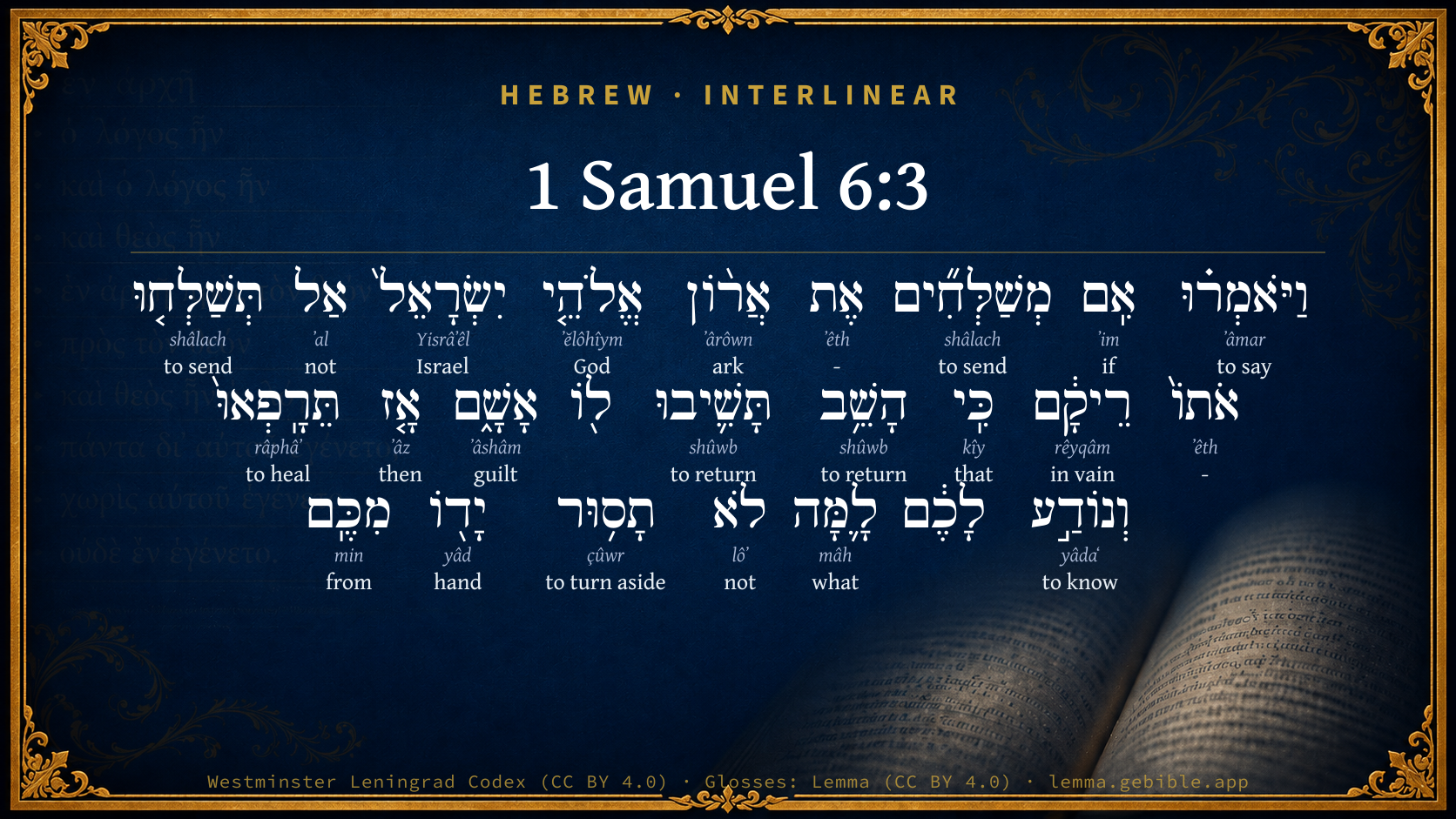
Hebrew (Westminster Leningrad Codex) 1 Samuel 6:3 appears in the Hebrew Old Testament. The text above is from the Westminster Leningrad Codex. Each word links to its Strong’s number, a concise gloss, and parsing drawn from the Open Scriptures Hebrew Bible morphology. Click any word for its full Brown-Driver-Briggs (BDB) entry.
Download image
Cite this verse

1 Samuel 6:3 (World English Bible). Public Domain. Lemma interlinear Bible study tool, https://lemma.gebible.app/v/1-samuel/6/3.

Show BibTeX & RIS
BibTeX
RIS
English Translation
They said, "If you send away the ark of the God of Israel, don't send it empty; but by all means return him a trespass-offering: then you shall be healed, and it shall be known to you why his hand is not removed from you."
World English Bible · Public Domain
Download a study sheet

One document with this verse’s original text, its word-by-word gloss line, the meaning frame, cross-references with their text, attributed commentary, and full source and license credits — printable, and it pastes into notes with its structure intact.

This verse Autodidact and up

Study sheet (.html) Plain text (.txt)

A passage Seminary Student

Up to 50 verses in one chapter. A passage sheet keeps up to 6 commentary sources and 12 cross-references per verse, in the order this page ranks them, and says so on the sheet whenever that leaves anything out. Ask for a single verse and you get the Autodidact verse sheet above.

Everything on this page stays free to read, with no account — the sheet is a download of what is already on screen, not access to it.

Want to remove ads? Support Godless Engineer
Compare translations 3

The same verse in 3 English versions, stacked beneath the original-language interlinear above. Click any original word for its lexicon entry.

Each is an independent rendering of the whole verse — the interlinear is not word-aligned to these translations.

Highlighted words mark where these versions differ — a whole-verse word diff, not a word-by-word alignment.

  • World English Bible Public Domain
    They said, "If you send away the ark of the God of Israel, don't send it empty; but by all means return him a trespass-offering: then you shall be healed, and it shall be known to you why his hand is not removed from you."
  • King James Version Public Domain
    And they said, If ye send away the ark of the God of Israel, send it not empty; but in any wise return him a trespass offering: then ye shall be healed, and it shall be known to you why his hand is not removed from you.
  • unfoldingWord Literal Text CC BY-SA 4.0
    And they said, “If you are sending away the Box of the God of Israel, do not send it away empty, but returning, return to him a guilt offering. Then you will be healed, and it will be known to you why his hand has not turned from you.”

unfoldingWord Literal Text — © unfoldingWord, licensed CC BY-SA 4.0. Word-aligned USFM3 via Door43 (git.door43.org/unfoldingWord/en_ult).

Versions to compare (up to 4)

3 of 4 selected

Show all 18 translations

Every available English version of this verse, each an independent rendering of the whole verse.

  • World English Bible Public Domain
    They said, "If you send away the ark of the God of Israel, don't send it empty; but by all means return him a trespass-offering: then you shall be healed, and it shall be known to you why his hand is not removed from you."
  • Berean Standard Bible Public Domain
    They replied, “If you return the ark of the God of Israel, do not send it away empty, but by all means return it to Him with a guilt offering. Then you will be healed, and you will understand why His hand has not been lifted from you.”
  • Majority Standard Bible Public Domain
    They replied, “If you return the ark of the God of Israel, do not send it away empty, but by all means return it to Him with a guilt offering. Then you will be healed, and you will understand why His hand has not been lifted from you.”
  • King James Version Public Domain
    And they said, If ye send away the ark of the God of Israel, send it not empty; but in any wise return him a trespass offering: then ye shall be healed, and it shall be known to you why his hand is not removed from you.
  • American Standard Version (1901) Public Domain
    And they said, If ye send away the ark of the God of Israel, send it not empty; but by all means return him a trespass-offering: then ye shall be healed, and it shall be known to you why his hand is not removed from you.
  • Revised Version (1885) Public Domain
    And they said, If ye send away the ark of the God of Israel, send it not empty; but in any wise return him a guilt offering: then ye shall be healed, and it shall be known to you why his hand is not removed from you.
  • Geneva Bible (1599) Public Domain
    And they sayd, If you send away the Arke of the God of Israel, send it not away emptie, but giue vnto it a sinne offering: then shall ye be healed, and it shall be knowen to you, why his hand departeth not from you.
  • Douay-Rheims (1899) Public Domain
    If you send back the ark of the God of Israel, send it not away empty, but render unto him what you owe for sin, and then you shall be healed: and you shall know why his hand departeth not from you.
  • Young's Literal Translation Public Domain
    And they say, `If ye are sending away the ark of the God of Israel, ye do not send it away empty; for ye do certainly send back to Him a guilt-offering; then ye are healed, and it hath been known to you why His hand doth not turn aside from you.'
  • Literal Standard Version CC BY-SA 4.0
    And they say, “If you are sending the Ark of the God of Israel away, you do not send it away empty; for you certainly send back a guilt-offering to Him; then you are healed, and it has been known to you why His hand does not turn aside from you.”
  • Unlocked Literal Bible CC BY-SA 4.0
    The priests and diviners said, “If you send back the ark of the God of Israel, do not send it without a gift; by all means send him a guilt offering. Then you will be healed, and you will know why his hand has not been lifted off of you until now.”
  • unfoldingWord Literal Text CC BY-SA 4.0
    And they said, “If you are sending away the Box of the God of Israel, do not send it away empty, but returning, return to him a guilt offering. Then you will be healed, and it will be known to you why his hand has not turned from you.”
  • Darby Bible Public Domain
    And they said, If ye send away the ark of the God of Israel, send it not empty; ye must at any rate return him a trespass-offering: then ye shall be healed, and it shall be known to you why his hand is not removed from you.
  • World Messianic Bible Public Domain
    They said, “If you send away the ark of the God of Israel, don’t send it empty; but by all means return a trespass offering to him. Then you will be healed, and it will be known to you why his hand is not removed from you.”
  • Webster's Bible Public Domain
    And they said, If ye send away the ark of the God of Israel, send it not empty; but in any wise return him a trespass-offering: then ye will be healed, and it will be known to you why his hand is not removed from you.
  • Free Bible Version CC BY-SA 4.0
    “If you're going to send back the Ark of the God of Israel, do not send it back empty-handedly, but make sure to send along with it a gift of a guilt offering to him,” they replied. “Then you will be healed, and you will understand why he has treated you like this.”
  • Bible in Basic English Public Domain
    And they said, If you send away the ark of the God of Israel, do not send it without an offering, but send him a sin-offering with it: then you will have peace again, and it will be clear to you why the weight of his hand has not been lifted from you.
  • JPS Tanakh (1917) Public Domain
    And they said: 'If ye send away the ark of the God of Israel, send it not empty; but in any wise return Him a guilt-offering; then ye shall be healed, and it shall be known to you why His hand is not removed from you.'

Literal Standard Version (2020), Covenant Press — licensed CC BY-SA 4.0. Text via the HelloAO Bible API (eBible.org). Unlocked Literal Bible (unfoldingWord) — licensed CC BY-SA 4.0. Text via the HelloAO Bible API (eBible.org). unfoldingWord Literal Text — © unfoldingWord, licensed CC BY-SA 4.0. Word-aligned USFM3 via Door43 (git.door43.org/unfoldingWord/en_ult). Free Bible Version, Dr. Jonathan Gallagher — licensed CC BY-SA 4.0. Text via the HelloAO Bible API (eBible.org).

Word by word

More ways to search: Search by grammar → Find every occurrence → Compare this word →

Practice this passage: Drill this verse → Learn its vocabulary →

רֵיקָ֔ם
rêyqâm
H7387
“in vain”
Adverb
Part of Speech
Adverb
Full BDB Definition

Origin: from H7386

TWOT: 2161c

vainly, emptily - in empty condition, empty, emptily - in vain, without effect, vainly
  1. וַיֹּאמְר֗וּ ʼâmar H559 “and · to say” Conjunction + Verb, Qal, Sequential Imperfect, 3rd Person, Masculine, Plural
  2. אִֽם ʼim H518 “if” Conjunction
  3. מְשַׁלְּחִ֞ים shâlach H7971 “sending” Verb, Piel, Participle Active, Masculine, Plural, Absolute
  4. אֶת ʼêth H853 “-” Particle, Direct Object
  5. אֲר֨וֹן ʼârôwn H727 “ark of” Noun, Common, Both, Singular, Construct
  6. אֱלֹהֵ֤י ʼĕlôhîym H430 “God(s) of” Noun, Common, Masculine, Plural, Construct
  7. יִשְׂרָאֵל֙ Yisrâʼêl H3478 “Israel” Noun, Proper
  8. אַל ʼal H408 “not” Particle, Negative
  9. תְּשַׁלְּח֤וּ shâlach H7971 “to send” Verb, Piel, Jussive, 2nd Person, Masculine, Plural
  10. אֹתוֹ֙ ʼêth H853 “- · him” Particle, Direct Object + Suffix, Personal, 3rd Person, Masculine, Singular
  11. כִּֽי kîy H3588 “that” Conjunction
  12. הָשֵׁ֥ב shûwb H7725 “to return” Verb, Hiphil, Infinitive Absolute
  13. תָּשִׁ֛יבוּ shûwb H7725 “to return” Verb, Hiphil, Jussive, 2nd Person, Masculine, Plural
  14. אָשָׁ֑ם ʼâshâm H817 “guilt” Noun, Common, Masculine, Singular, Absolute
  15. אָ֤ז ʼâz H227 “then” Adverb
  16. תֵּרָֽפְאוּ֙ râphâʼ H7495 “to heal” Verb, Niphal, Imperfect, 2nd Person, Masculine, Plural
  17. וְנוֹדַ֣ע yâdaʻ H3045 “and · to know” Conjunction + Verb, Niphal, Sequential Perfect, 3rd Person, Masculine, Singular
  18. לָ֛מָּה mâh H4100 “to/for · what” Preposition + Particle, Interrogative
  19. לֹא lôʼ H3808 “not” Particle, Negative
  20. תָס֥וּר çûwr H5493 “to turn aside” Verb, Qal, Imperfect, 3rd Person, Feminine, Singular
  21. יָד֖וֹ yâd H3027 “hand · his” Noun, Common, Both, Singular, Construct + Suffix, Personal, 3rd Person, Masculine, Singular
  22. מִכֶּֽם min H4480 “from · you” Preposition + Suffix, Personal, 2nd Person, Masculine, Plural

About this verse

These counts appear in no published source. They are computed here, from the morphology-tagged text and Lemma’s own curated glosses. What Lemma adds →

25
words
20
distinct lemmas
Historical
section

Notable vocabulary

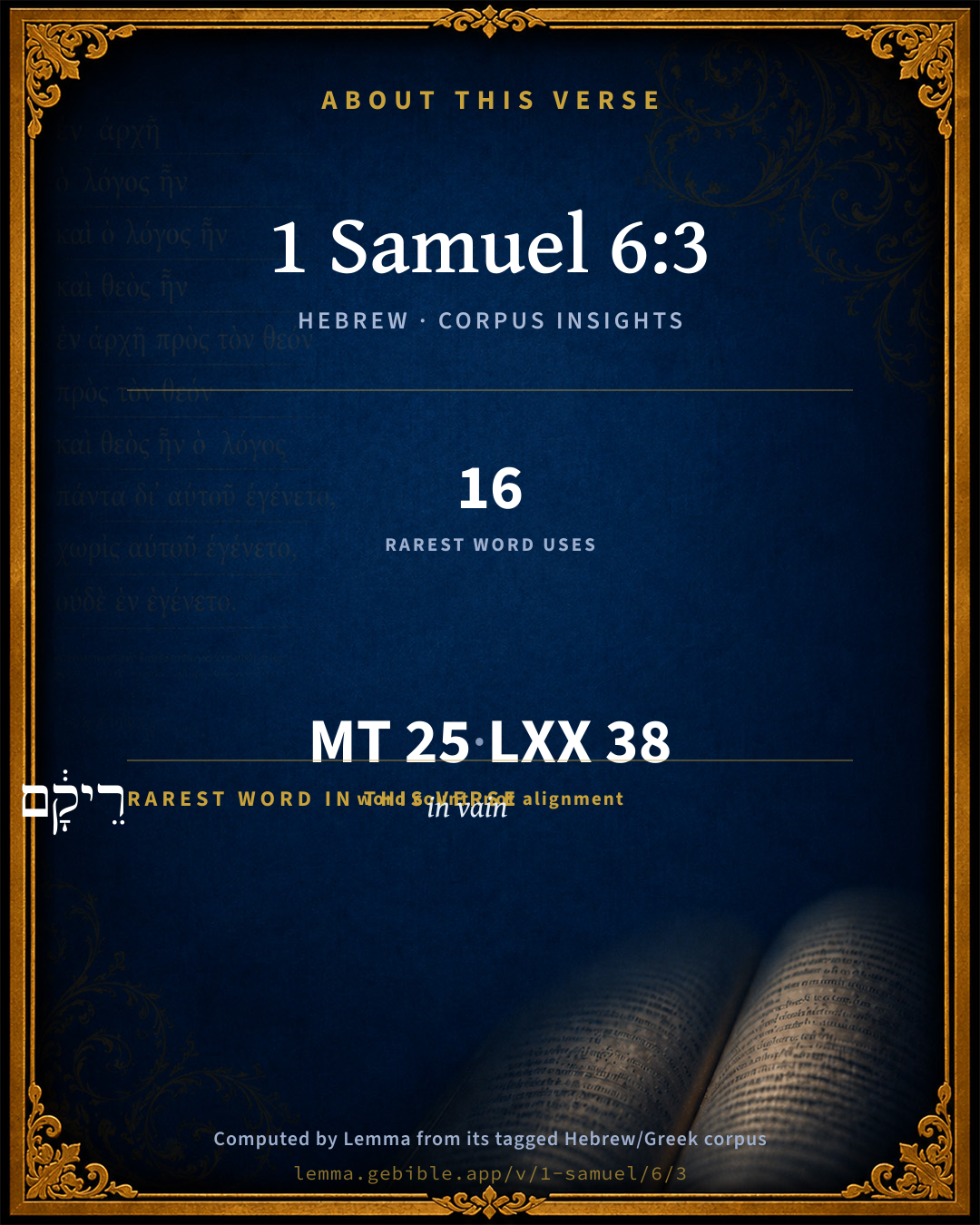
The rarest word here is רֵיקָ֔ם in vain H7387 — appearing just 16 times in the whole Hebrew Bible.

Shared distinctive vocabulary

רֵיקָ֔ם in vain H7387 occurs in 16 verses of the Hebrew Bible. Also found in:

Grammatical profile

  • 8 verbs
  • 5 nouns
  • 3 prepositions
  • 2 conjunctions
  • 2 adverbs
  • 5 particles

Verb forms

  • וַיֹּאמְר֗וּ Qal · Sequential Imperfect
  • מְשַׁלְּחִ֞ים Piel · Participle Active
  • תְּשַׁלְּח֤וּ Piel · Jussive
  • הָשֵׁ֥ב Hiphil · Infinitive Absolute
  • תָּשִׁ֛יבוּ Hiphil · Jussive
  • תֵּרָֽפְאוּ֙ Niphal · Imperfect
  • וְנוֹדַ֣ע Niphal · Sequential Perfect
  • תָס֥וּר Qal · Imperfect

Repetition

Words recur within this verse — often emphatic in Hebrew:

  • מְשַׁלְּחִ֞ים to send H7971 ×2
  • הָשֵׁ֥ב to return H7725 ×2

Hebrew & Septuagint length

In English translation the verse runs 45 words from the Hebrew and 63 from the Septuagint (LXX English) — the Septuagint runs noticeably longer here. See the side-by-side →

A rough comparison of the two English renderings, which tokenize alike — not a word-level alignment.

Word counts can differ between the Hebrew and the Greek without any difference in meaning — e.g. the Hebrew direct-object marker אֵת has no separate Greek word, and Greek often adds the article ὁ.

In the original languages it is 25 Hebrew tokens and 38 Greek tokens — but the two are counted differently (Hebrew bundles its prefixes and suffixes into one token; the Greek is in lemma form), so that isn’t a like-for-like length.

Cross-references

13

Topical passages linked to 1 Samuel 6:3 in the Treasury of Scripture Knowledge — connected by theme and wording, ordered by reader-vote popularity; previews shown in the World English Bible.

  • Exodus 23:15 You shall observe the feast of unleavened bread. Seven days you shall eat unleavened bread, as I commanded you, at the time appointed in the month Abib (for in it you came out from Egypt), and no one shall appear before me empty.
  • Deuteronomy 16:16 Three times in a year shall all your males appear before Yahweh your God in the place which he shall choose: in the feast of unleavened bread, and in the feast of weeks, and in the feast of tents; and they shall not appear before Yahweh empty:
  • 1 Samuel 6:9 Behold; if it goes up by the way of its own border to Beth-shemesh, then he has done us this great evil: but if not, then we shall know that it is not his hand that struck us; it was a chance that happened to us."
  • Exodus 34:20 The firstborn of a donkey you shall redeem with a lamb: and if you will not redeem it, then you shall break its neck. All the firstborn of your sons you shall redeem. No one shall appear before me empty.
  • Leviticus 5:6 and he shall bring his trespass offering to Yahweh for his sin which he has sinned, a female from the flock, a lamb or a goat, for a sin offering; and the priest shall make atonement for him concerning his sin.
  • Leviticus 5:15–19 "If anyone commits a trespass, and sins unwittingly, in the holy things of Yahweh; then he shall bring his trespass offering to Yahweh, a ram without blemish from the flock, according to your estimation in silver by shekels, after the shekel of the sanctuary, for a trespass offering.
  • Leviticus 6:6 He shall bring his trespass offering to Yahweh, a ram without blemish from the flock, according to your estimation, for a trespass offering, to the priest.
  • Leviticus 7:1–7 "'This is the law of the trespass offering. It is most holy.
  • 1 Samuel 5:7 When the men of Ashdod saw that it was so, they said, The ark of the God of Israel shall not abide with us; for his hand is sore on us, and on Dagon our god.
  • 1 Samuel 5:9 It was so, that after they had carried it about, the hand of Yahweh was against the city with a very great confusion: and he struck the men of the city, both small and great; and tumors broke out on them.
  • 1 Samuel 5:11 They sent therefore and gathered together all the lords of the Philistines, and they said, Send away the ark of the God of Israel, and let it go again to its own place, that it not kill us and our people. For there was a deadly confusion throughout all the city; the hand of God was very heavy there.
  • Job 10:2 I will tell God, 'Do not condemn me, Show me why you contend with me.
  • Job 34:31–32 "For has any said to God, 'I am guilty, but I will not offend any more.

Cross-references courtesy of OpenBible.info (CC BY 4.0).

Hebrew and Greek witnesses Masoretic Hebrew ↔ Greek Septuagint

The same verse in the two great witnesses to the Old Testament, shown verse-for-verse.

Here the Septuagint runs noticeably longer than the Hebrew — LXX2012 (modern English Septuagint) 63 words vs World English Bible 45. A rough length comparison of the two English translations, not a word-level alignment — read both below.

These are two independent witnesses, not word-aligned to each other, and the Septuagint is shown in lemma (dictionary) form.

Hebrew 1 Samuel 6:3 Masoretic · Westminster Leningrad Codex

וַיֹּאמְר֗וּ אִֽם מְשַׁלְּחִ֞ים אֶת אֲר֨וֹן אֱלֹהֵ֤י יִשְׂרָאֵל֙ אַל תְּשַׁלְּח֤וּ אֹתוֹ֙ רֵיקָ֔ם כִּֽי הָשֵׁ֥ב תָּשִׁ֛יבוּ ל֖וֹ אָשָׁ֑ם אָ֤ז תֵּרָֽפְאוּ֙ וְנוֹדַ֣ע לָכֶ֔ם לָ֛מָּה לֹא תָס֥וּר יָד֖וֹ מִכֶּֽם

They said, "If you send away the ark of the God of Israel, don't send it empty; but by all means return him a trespass-offering: then you shall be healed, and it shall be known to you why his hand is not removed from you."

World English Bible · Public Domain

Greek LXX 1 Samuel 6:3 Septuagint · lemma form

καί εἶπον εἰ ἐκ ἀποστέλλω σύ ὁ κιβωτός διαθήκη κύριος θεός ἰσραήλ μή δή ἐκ ἀποστέλλω αὐτός κενός ἀλλά ἀποδίδωμι ἀποδίδωμι αὐτός ὁ βάσανος καί τότε ἰάομαι καί ἐκἱλάσκομαι σύ μή οὐ ἀποἵστημι ὁ χείρ αὐτός ἀπό σύ

And they said, If you⌃ send away the ark of the covenant of the Lord God of Israel, do not on any account send it away empty, but by all means render to it an offering for the plague; and then shall you⌃ be healed, and an atonement shall be made for you: should not his hand be thus stayed from off you?

LXX2012 (modern English Septuagint) · Public Domain

Hebrew: Westminster Leningrad Codex (CC BY 4.0). Greek: Septuagint (public domain); English from LXX2012 (modern English Septuagint) (Public Domain). How the Septuagint differs from the Hebrew →

Targum (Aramaic paraphrase)

1

The Targum is the ancient Jewish Aramaic paraphrase of the Hebrew Scriptures — an interpretive translation, not the Hebrew text itself. Onkelos (literal) and Pseudo-Jonathan (expansive) render the Torah, and Jonathan the Prophets. Coverage is partial: where no permissively-licensed English translation exists for a verse, only the Aramaic is shown. This is verse-level text, not a word-by-word alignment to the Hebrew.

  1. Targum Jonathan Prophets (Joshua–Malachi)
    וַאֲמַרוּ אִם אַתּוּן מְשַׁלְחִין יַת אֲרוֹן אֱלָהָא דְיִשְׂרָאֵל לָא תְשַׁלְחוּן יָתֵיהּ רֵיקָן אֱלָהֵין אֲתָבָא תְּתִיבוּן קֳדָמוֹהִי קֻרְבַּן אֲשָׁמָא בְּכֵן תִּתָּסוּן וְיִתְרְוַח לְכוֹן לְמָה לָא תְנוּחַ מְחָתֵיהּ מִנְכוֹן:

    (no public-domain English translation for this verse)

    Targum Jonathan — Aramaic: “Mikraot Gedolot” (public domain). English: “Sefaria Community Translation” (CC0 1.0 (public-domain dedication)); “London "Chaldee Paraphrase," 1871” (public domain). Text via Sefaria.

Commentary

Notes on 1 Samuel 6:3 from classic Christian and Jewish commentators (each source and its license shown beneath its notes). The classic Christian expositions comment on the surrounding passage and are grouped to its opening verse, so a note may address several verses; the Jewish commentaries on the Tanakh (Rashi and others) are per-verse, so they appear only where the commentator wrote on this verse.

Lemma curates 59 commentaries, every one of them public domain or Creative Commons licensed, each selected and text-cleaned for this edition rather than reprinted as found. About our sources →

Trapp's Complete Commentary

John Trapp

1Sa 6:3 And they said, If ye send away the ark of the God of Israel, send it not empty; but in any wise return him a trespass offering: then ye shall be healed, and it shall be known to you why his hand is not removed from you.

Ver. 3. If ye send away the ark.] Which they were full loath to do, but that they could neither will nor choose, and therefore kept it seven months, in hope that in some time their plagues might assuage, and they might keep from the Israelites their enemies that wherein they reposed so much confidence, and whereby they took so much encouragement.

Send it not empty.] This nature itself taught them, that God loveth a full hand. No man might salute the kings of Parthia sine munere, without a present, saith Seneca. {a} See Exo 23:15.

But in any wise return him a trespass offering.] They say not chataah, a sin offering, but ashom, a trespass offering; as if their sin had been but small in meddling with the ark, whereas, indeed, it was very great.

Then ye shall be healed.] For he will be appeased. The kings of Israel were noted for [being] merciful; but God much more.

“ Litatur minimo thuris honore Deus. ”

{a} Epist. 17.

John Trapp, A Commentary or Exposition upon All the Books of the Old and New Testament (1647–1656) — public domain. Text from a community e-Sword module.

The Biblical Illustrator

Joseph S. Exell

1Sa_6:3

Send it not empty.

Superstition the ape of true devotion

These superstitious priests can counsel them not to send away the ark of God empty, but to give it a sin offering. They had not lived so far away from the smoke of Jewish altars, but that they knew God was accustomed to manifold oblations. No Israelite could have said better; superstition is the ape of true devotion, and if it look not to the ground of both many times it is hard, by the very outward acts, to distinguish them. Nature itself teacheth us that God loves a full hand. He that hath been so bountiful to us as to give us all looks for a return of some offering from us. If we present Him with nothing but our sins how can we look to be accepted? The sacrifices under the Gospel are spiritual; with these must we come into the presence of God if we desire to carry away remission and favour. (Bishop Hall.)

The Biblical Illustrator, edited by Joseph S. Exell (c. 1880s–1900s) — public domain. Text from a community e-Sword module.

Joseph Benson's Commentary

1Sa 6:3. Send it not empty — They answer directly to the question, first in general; that it must not be sent back without some offering. In any wise return him a trespass-offering — As an acknowledgment that they had offended the God of Israel by bringing his ark from its proper place; for which they begged his pardon by this offering. Then ye shall be healed, &c. — Le Clerc renders this sentence, Then if ye shall be healed, it shall be known, or manifest unto you, why his hand is not removed from you. And it is evident this is the meaning of the words. For these diviners were not sure whence these plagues came; but they thought in this way they should either be healed or know that the ark was not the cause of their sickness. It shall be known — You shall understand what is hitherto doubtful, whether he is the author of these calamities, and why they are continued so long upon you.

Joseph Benson's Commentary on the Old and New Testaments (1811–1818) — public domain. Text from a community e-Sword module.

Tyndale Open Study Notes

Tyndale Open Resources

6:3 It is unlikely the Philistines were aware of Israelite worship regulations. A Philistine guilt offering would have been a payment to the deity in an attempt to avert his wrath (contrast the notion of atonement from Lev 16).

Tyndale Open Study Notes — © Tyndale Open Resources, licensed CC BY-SA 4.0. Text via the HelloAO Bible API.

Geneva Bible (1599)

Geneva Bible translators

The idolaters confess there is a true God, who justifieth sin justly.

Geneva Bible (1599) marginal notes — public domain. Text via Bolls.life.

Adam Clarke's Commentary

Verse 3. Send it not empty] As it appears ye have trespassed against him, send him an offering for this trespass.

Why his hand is not removed] The sense is, If you send him a trespass-offering, and ye be cured, then ye shall know why his judgments have not been taken away from you previously to this offering.

It is a common opinion, says Calmet, among all people, that although the Supreme Being needs nothing of his creatures, yet he requires that they should consecrate to him all that they have; for the same argument that proves his independence, infinitude, and self-sufficiency, proves our dependence, and the obligation we are under to acknowledge him by offering him due marks of our gratitude and submission. Such sentiments were common among all people; and God himself commands his people not to appear before him without an offering, Ex 23:15: None shall appear before me empty.

Adam Clarke's Commentary on the Bible (1810–1826) — public domain. Text from a community e-Sword/MySword module.

Ellicott's Commentary for English Readers

(3) Send it not empty.—The advice was to propitiate with gifts the powerful Hebrew Deity, whom they imagined was offended and angry at the insult offered Him—the being placed in an inferior position in the Dagon temple.

The priests and diviners evidently thought that the Hebrew Deity, in some way resident in the “golden chest,” was a childish, capricious deity, like one of their own loved gods—Dagon, or Beelzebub, lord of flies. Their people had insulted Him; He had shown Himself powerful enough, however, to injure His captors, so the insults must cease, and He must be appeased with rich offerings.

A Bible Commentary for English Readers, edited by Charles John Ellicott (1878–1897) — public domain. Text from a community e-Sword module.

The Cambridge Bible for Schools and Colleges

gen. ed. J. J. S. Perowne

3. send it not empty] Cp. Exo_23:15. All religions regard offering as a necessary part of worship.

in any wise] i.e. “at all events,” “certainly.” Wise means “way of acting,” “manner,” “mode.”

return him a trespass offering] A satisfaction or compensation in return for the injury done him by the removal of the Ark.

it shall be known to you] If the removal of the plague followed the restoration of the Ark with due propitiation, they would know for certain that its detention was the cause of the continuance of the plague. They were not yet convinced that their misfortune was more than “a chance” (1Sa_6:9).

The Cambridge Bible for Schools and Colleges (gen. ed. J. J. S. Perowne; Cambridge University Press, 1878–1918) — public domain. Text from a community e-Sword module.

John Gill's Exposition

And they said, if ye send away the ark of the God of Israel, send it not empty,.... As they perceived they had either resolved upon, or at least were inclined to do; and which they also thought advisable and therefore would have them by no means send it away as it was, but with some presents along with it; for the meaning of this word "empty" is not that they should take care that all that were in it when taken should go with it, and nothing be taken out of it, or it be stripped of its contents; but that some gifts and offerings should be sent along with it: perhaps they might have some notion of, or respect unto a law in Israel, Exo 23:15 or might say this from a common principle received among Heathens, that deities were to be appeased by gifts (e):

but in any wise return him a trespass offering; here again they seem to have some notion of the sorts and kinds of sacrifice among the Israelites; and advise to a trespass offering, to make satisfaction and atonement for the offence they had committed in taking away the ark; and that they should make restoration not only by returning the ark, but by sending an expiatory offering along with it:

then ye shall be healed; of the disease with which they were smitten; for it seems it still continued on them, at least on many:

and it shall be known to you why his hand is not removed from you; which was because the ark was detained by them; but when that should be sent home, and they be healed upon it, then it would be a plain case that the reason why the disease was inflicted and continued was because of that.

(e) "Munera crede mihi", &c. Ovid. de arte amandi, l. 3.

John Gill's Exposition of the Whole Bible (1746–1763) — public domain (CC PDM 1.0). Text via the HelloAO Bible API.

Albert Barnes' Notes on the Bible

Send it not empty - See the marginal references. The pagan idea of appeasing the gods with gifts, and the scriptural idea of expressing penitence, allegiance, or love to God, by gifts and offerings to His glory and to the comfort of our fellow worshippers, coincide in the practical result.

Albert Barnes' Notes on the Bible (1834–1885) — public domain. Text from a community e-Sword/MySword module.

Haydock's Catholic Bible Commentary

If, &c. The lords were already determined to send back the ark. But the priests knew that some still would not believe that it was the cause of their affliction. To convince all, they try an experiment, which would decide the matter; and in case the ark went back, some suitable presents must accompany it, as a propitiation (Haydock) for the sin which they would not (Menochius) then doubt had been incurred. (Haydock) --- Though God stands in need of nothing, all must acknowledge their dependence on him. The pagans always made some present, when they appeared before their idols or monarchs, and God requires the like testimony of submission, Exodus xxiii. 15.

George Leo Haydock (1774–1849), Haydock's Catholic Family Bible and Commentary, 1859 edition — public domain. Excludes Psalms (Douay-Rheims chapter numbering differs from Protestant) and Deuterocanonical books (Catholic canon only).

Matthew Poole's English Annotations

Empty, i.e. without a present; which they judged necessary, from the common opinion and practice both of Jews and Gentiles.

Return him a trespass-offering; thereby to acknowledge our offence, and obtain his pardon.

It shall be known to you; you shall understand what is hitherto doubtful, whether he was the author of these calamities, and why they continued so long upon you. Compare 1Sa 6:7-9.

Matthew Poole's English Annotations on the Holy Bible (1683–1685) — public domain. Text from a community e-Sword/MySword module.

Whedon's Commentary on the Bible

Daniel D. Whedon

3. Send it not empty — That is, send it not without an offering. Compare Exo_23:15.

Return him a trespass offering — The Hebrew is emphatic — by all means return him a trespass offering. On the trespass offering see Lev_5:6. They doubtless meant to render the God of Israel this offering as a satisfaction for their offence in carrying his ark out of its own land.

Then ye shall be healed — It is better to render this as a conditional sentence, then may ye be healed, etc., for from 1Sa_6:9 we infer that these diviners still suspected that it was only by chance that they were smitten.

Daniel D. Whedon (gen. ed.), Commentary on the Old and New Testaments (1874–1909) — public domain. Text from a community e-Sword module.

The Pulpit Commentary

Vers. 3, 4. A trespass offering. The offering that was to be made when the offence had been unintentional. (Lev_5:15) Why his hand is not removed from you. An euphemism for "why your punishment continues to be so severe, without sign of abatement." If healing follows the gift, you will know that the malady was Jehovah"s doing. The trespass offering was to consist of five golden emerods, and five golden mice, it being an old heathen custom, still constantly practised abroad, of presenting to the deity tokens representing the deliverance wrought for such as had implored his aid. Thus Horace ("Carm.," 1:5) speaks of the custom of hanging up in the temple of Neptune the clothes in which a man had escaped from shipwreck. Slaves when manumitted offered their chains to the Lares; and the idea is so natural that we cannot wonder at its prevalence. One plague was on you all. Rather, "is on you all." It did not cease until the ark had been restored. The Hebrew has on them all; but as all the versions and several MSS. read you all, the substitution of them is probably the mistake of some transcriber.

The Pulpit Commentary (1880–1919), ed. H.D.M. Spence-Jones & Joseph S. Exell — public domain. Text from a community e-Sword module.

John Wesley's Explanatory Notes

It shall be known - You shall understand, what is hitherto doubtful, whether he was the author of these calamities, and why they continued so long upon you.

John Wesley, Explanatory Notes Upon the Whole Bible (1754–1765) — public domain. Text via the GEBible commentary corpus.

Scofield Reference Notes

C. I. Scofield

then ye

Contra. Heb 9:22.

The Scofield Reference Bible (1917 edition), notes by C. I. Scofield — public domain. Text from a community e-Sword module.

unfoldingWord translationNotes

Door43 World Missions Community

the God of Israel

Possible meanings are 1) they were speaking the proper name of the God of Israel or 2) they believed that Israel worshiped one of many gods, "the god of Israel." See how you translated this in 1 Samuel 5:7.

by all means send him a guilt offering

The words "by all means" are a forceful way of saying something. AT: "you must send a guilt offering" (See: Idiom)

you will be healed

"you will no longer be ill"

you

The pronoun "you" is plural, referring to all of the Philistines. (See: Forms of You)

why his hand has not been lifted off of you

Here "hand" is a metonym used to represent God's power to afflict or discipline. AT: "why he has not relieved your suffering" (See: Metonymy)

tumors

Possible meanings are 1) painful swelling under the skin or 2) hemorrhoids. See how you translated this in 1 Samuel 5:6.

mice

more than one mouse

translationWords

God

Israel

gift

guilt offering

cure

know

hand

gold

rule

plague

afflicted

unfoldingWord translationNotes — © Distant Shores Media and the Door43 World Missions Community, licensed CC BY-SA 4.0. Source: git.door43.org/Door43/en_tn.

Rashi

Rabbi Shlomo Yitzchaki (Rashi)

A guilt-offering. As an indication that you confess that you have betrayed Him.

Then you will be healed, and you will realize. That He did this, for why wouldn't His hand turn away from you then?

Rashi on the Tanakh — English translations: “The Judaica Press complete Tanach with Rashi, translated by A. J. Rosenberg” (CC BY 4.0); “Pentateuch with Rashi's commentary by M. Rosenbaum and A.M. Silbermann, 1929-1934” (public domain); “The Metsudah Tanach series, Lakewood, N.J” (CC BY 4.0); and “The Book of Joshua, Metsudah Publications, 1997” (CC BY 4.0). Text via Sefaria.

Lesson kit

Teaching starters — assembled from the data on this page, not authored interpretation. Every prompt links to the verse data it draws on. Edit before teaching.

1 Samuel, in the Historical, opens this verse with 25 words (20 distinct Hebrew lemmas). Its most distinctive word is rêyqâm (“in vain”). The Greek Septuagint runs longer here. A historical commentator’s framing appears above. Read the whole chapter for the surrounding context.

Discussion questions

  1. The word rêyqâm carries the sense “in vain.” How does it shape the verse?
  2. How does Genesis 31:42, which shares the word «in vain», read alongside this verse?
  3. What does the repetition of “to send” (2× in this one verse) do in this verse?
  4. The Septuagint runs longer here than the Hebrew. What might account for the difference?
  5. These translations render this verse differently; the difference is in the English rendering, not the original. What questions does that raise?
  6. «וַיֹּאמְר֗וּ» is a Qal Sequential Imperfect verb. How does that grammatical form shape the action described?
  7. Compare how Trapp's Complete Commentary and The Biblical Illustrator read this verse. Where do they agree or differ?

Things to notice

Reading settings

Reading text

Shown beneath each verse's original-language words.

Old Testament
Old Testament edition

Read the OT as the Masoretic Hebrew (MT) or the Greek Septuagint (LXX).

English shown for the Greek Septuagint (in the Hebrew ↔ Greek comparison).

Comparing translations? Open the Compare panel on any verse page to stack up to four side by side.