
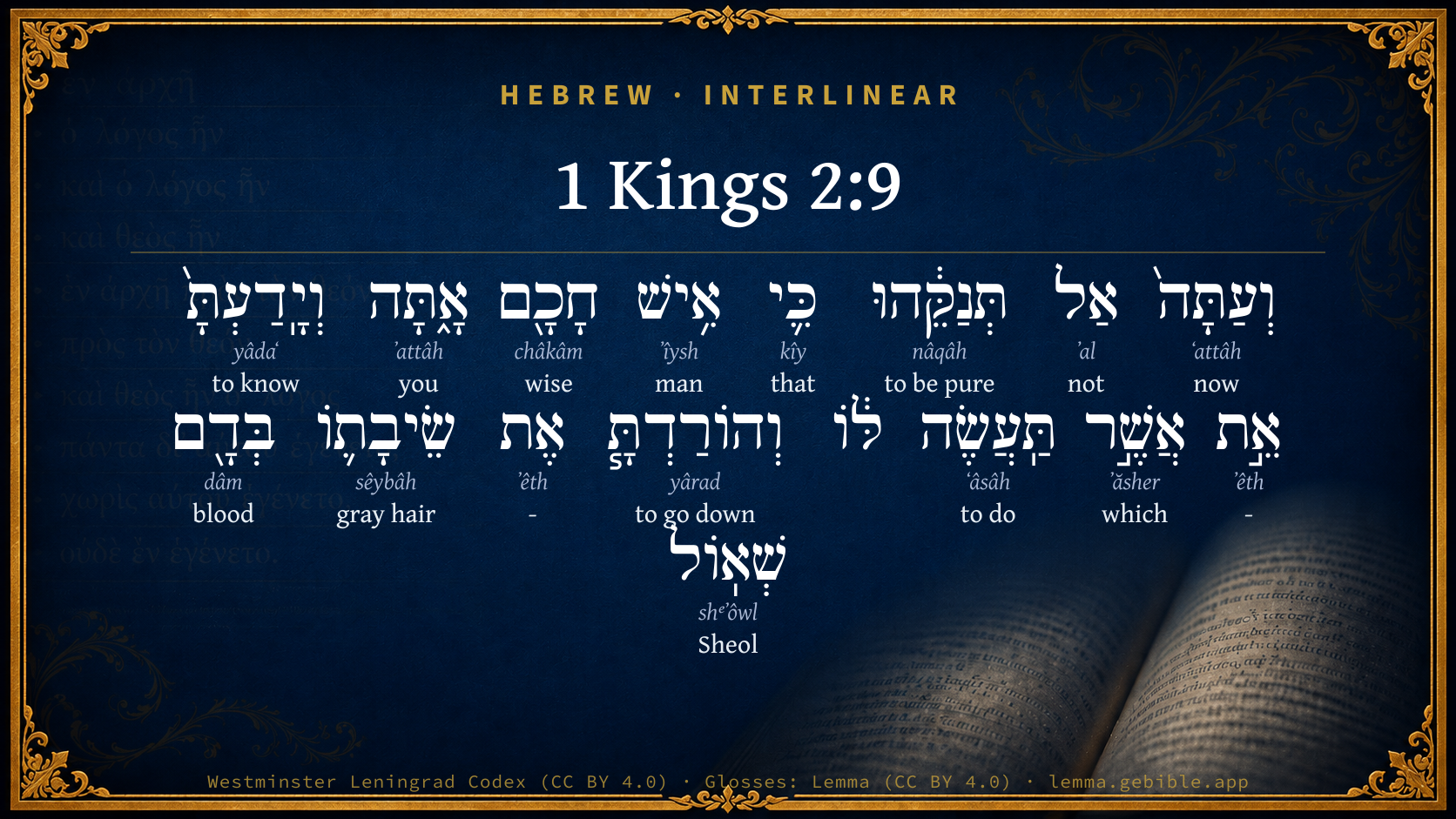
1 Kings 2:9

Hebrew (Westminster Leningrad Codex) 1 Kings 2:9 appears in the Hebrew Old Testament. The text above is from the Westminster Leningrad Codex. Each word links to its Strong’s number, a concise gloss, and parsing drawn from the Open Scriptures Hebrew Bible morphology. Click any word for its full Brown-Driver-Briggs (BDB) entry.
Download image
Cite this verse

1 Kings 2:9 (World English Bible). Public Domain. Lemma interlinear Bible study tool, https://lemma.gebible.app/v/1-kings/2/9.

Show BibTeX & RIS
BibTeX
RIS
English Translation
Now therefore don't hold him guiltless, for you are a wise man; and you will know what you ought to do to him, and you shall bring his gray head down to Sheol with blood.
World English Bible · Public Domain
Download a study sheet

One document with this verse’s original text, its word-by-word gloss line, the meaning frame, cross-references with their text, attributed commentary, and full source and license credits — printable, and it pastes into notes with its structure intact.

This verse Autodidact and up

Study sheet (.html) Plain text (.txt)

A passage Seminary Student

Up to 50 verses in one chapter. A passage sheet keeps up to 6 commentary sources and 12 cross-references per verse, in the order this page ranks them, and says so on the sheet whenever that leaves anything out. Ask for a single verse and you get the Autodidact verse sheet above.

Everything on this page stays free to read, with no account — the sheet is a download of what is already on screen, not access to it.

Want to remove ads? Support Godless Engineer
Compare translations 3

The same verse in 3 English versions, stacked beneath the original-language interlinear above. Click any original word for its lexicon entry.

Each is an independent rendering of the whole verse — the interlinear is not word-aligned to these translations.

Highlighted words mark where these versions differ — a whole-verse word diff, not a word-by-word alignment.

  • World English Bible Public Domain
    Now therefore don't hold him guiltless, for you are a wise man; and you will know what you ought to do to him, and you shall bring his gray head down to Sheol with blood.
  • King James Version Public Domain
    Now therefore hold him not guiltless: for thou art a wise man, and knowest what thou oughtest to do unto him; but his hoar head bring thou down to the grave with blood.
  • unfoldingWord Literal Text CC BY-SA 4.0
    But now, may you not acquit him. For you a wise man, and you know what you shall do to him. And you shall make his gray hair go down with blood to Sheol.”

unfoldingWord Literal Text — © unfoldingWord, licensed CC BY-SA 4.0. Word-aligned USFM3 via Door43 (git.door43.org/unfoldingWord/en_ult).

Versions to compare (up to 4)

3 of 4 selected

Show all 18 translations

Every available English version of this verse, each an independent rendering of the whole verse.

  • World English Bible Public Domain
    Now therefore don't hold him guiltless, for you are a wise man; and you will know what you ought to do to him, and you shall bring his gray head down to Sheol with blood.
  • Berean Standard Bible Public Domain
    Now therefore, do not hold him guiltless, for you are a wise man. You know what you ought to do to him to bring his gray head down to Sheol in blood.”
  • Majority Standard Bible Public Domain
    Now therefore, do not hold him guiltless, for you are a wise man. You know what you ought to do to him to bring his gray head down to Sheol in blood.”
  • King James Version Public Domain
    Now therefore hold him not guiltless: for thou art a wise man, and knowest what thou oughtest to do unto him; but his hoar head bring thou down to the grave with blood.
  • American Standard Version (1901) Public Domain
    Now therefore hold him not guiltless, for thou art a wise man; and thou wilt know what thou oughtest to do unto him, and thou shalt bring his hoar head down to Sheol with blood.
  • Revised Version (1885) Public Domain
    Now therefore hold him not guiltless, for thou art a wise man; and thou wilt know what thou oughtest to do unto him, and thou shalt bring his hoar head down to the grave with blood.
  • Geneva Bible (1599) Public Domain
    But thou shalt not count him innocent: for thou art a wise man, and knowest what thou oughtest to doe vnto him: therefore thou shalt cause his hoare head to goe downe to the graue with blood.
  • Douay-Rheims (1899) Public Domain
    Do not thou hold him guiltless. But thou art a wise man, and knowest what to do with him, and thou shalt bring down his grey hairs with blood to hell.
  • Young's Literal Translation Public Domain
    and now, acquit him not, for a wise man thou `art', and thou hast known that which thou dost to him, and hast brought down his old age with blood to Sheol.'
  • Literal Standard Version CC BY-SA 4.0
    and now, do not acquit him, for you [are] a wise man, and you have known that which you do to him, and have brought down his old age with blood to Sheol.”
  • Unlocked Literal Bible CC BY-SA 4.0
    Now therefore do not let him go free from punishment. You are a wise man, and you will know what you ought to do to him. You will bring his gray head down to the grave with blood.”
  • unfoldingWord Literal Text CC BY-SA 4.0
    But now, may you not acquit him. For you a wise man, and you know what you shall do to him. And you shall make his gray hair go down with blood to Sheol.”
  • Darby Bible Public Domain
    And now hold him not guiltless; for thou art a wise man, and thou shalt know what thou oughtest to do to him; but bring his hoar head down to Sheol with blood.
  • World Messianic Bible Public Domain
    Now therefore don’t hold him guiltless, for you are a wise man; and you will know what you ought to do to him, and you shall bring his gray head down to Sheol with blood.”
  • Webster's Bible Public Domain
    Now therefore hold him not guiltless: for thou art a wise man, and knowest what thou oughtest to do to him; but his hoary head do thou bring down to the grave with blood.
  • Free Bible Version CC BY-SA 4.0
    So don't leave him unpunished. You're a wise man and you know what you have to do to him—send him down into the grave with blood on his gray head.”
  • Bible in Basic English Public Domain
    But do not let him be free from punishment, for you are a wise man; and it will be clear to you what you have to do with him; see that his white head goes down to the underworld in blood.
  • JPS Tanakh (1917) Public Domain
    Now therefore hold him not guiltless, for thou art a wise man; and thou wilt know what thou oughtest to do unto him, and thou shalt bring his hoar head down to the grave with blood.'

Literal Standard Version (2020), Covenant Press — licensed CC BY-SA 4.0. Text via the HelloAO Bible API (eBible.org). Unlocked Literal Bible (unfoldingWord) — licensed CC BY-SA 4.0. Text via the HelloAO Bible API (eBible.org). unfoldingWord Literal Text — © unfoldingWord, licensed CC BY-SA 4.0. Word-aligned USFM3 via Door43 (git.door43.org/unfoldingWord/en_ult). Free Bible Version, Dr. Jonathan Gallagher — licensed CC BY-SA 4.0. Text via the HelloAO Bible API (eBible.org).

Word by word

More ways to search: Search by grammar → Find every occurrence → Compare this word →

Practice this passage: Drill this verse → Learn its vocabulary →

שֵׂיבָת֛וֹ
sêybâh
H7872
“gray hair · his”
Noun, Common, Feminine, Singular, Construct + Suffix, Personal, 3rd Person, Masculine, Singular
Part of Speech
Noun
Type
Common
Gender
Feminine
Number
Singular
State
Construct
Full BDB Definition

Origin: from H7869

TWOT: 2253b

age, gray hair, hoary head, old age - gray hair, hoary head - old age
  1. וְעַתָּה֙ ʻattâh H6258 “and · now” Conjunction + Adverb
  2. אַל ʼal H408 “not” Particle, Negative
  3. תְּנַקֵּ֔הוּ nâqâh H5352 “to be pure · him” Verb, Piel, Jussive, 2nd Person, Masculine, Singular + Suffix, Personal, 3rd Person, Masculine, Singular
  4. כִּ֛י kîy H3588 “that” Conjunction
  5. אִ֥ישׁ ʼîysh H376 “man” Noun, Common, Masculine, Singular, Absolute
  6. חָכָ֖ם châkâm H2450 “wise” Adjective, Adjective, Masculine, Singular, Absolute
  7. אָ֑תָּה ʼattâh H859 “you” Pronoun, Personal, 2nd Person, Masculine, Singular
  8. וְיָֽדַעְתָּ֙ yâdaʻ H3045 “and · to know” Conjunction + Verb, Qal, Sequential Perfect, 2nd Person, Masculine, Singular
  9. אֵ֣ת ʼêth H853 “-” Particle, Direct Object
  10. אֲשֶׁ֣ר ʼăsher H834 “which” Particle, Relative
  11. תַּֽעֲשֶׂה ʻâsâh H6213 “to do” Verb, Qal, Imperfect, 2nd Person, Masculine, Singular
  12. וְהוֹרַדְתָּ֧ yârad H3381 “and · to go down” Conjunction + Verb, Hiphil, Sequential Perfect, 2nd Person, Masculine, Singular
  13. אֶת ʼêth H853 “-” Particle, Direct Object
  14. בְּדָ֖ם dâm H1818 “in/at · blood” Preposition + Noun, Common, Masculine, Singular, Absolute
  15. שְׁאֽוֹל shᵉʼôwl H7585 “Sheol” Noun, Proper

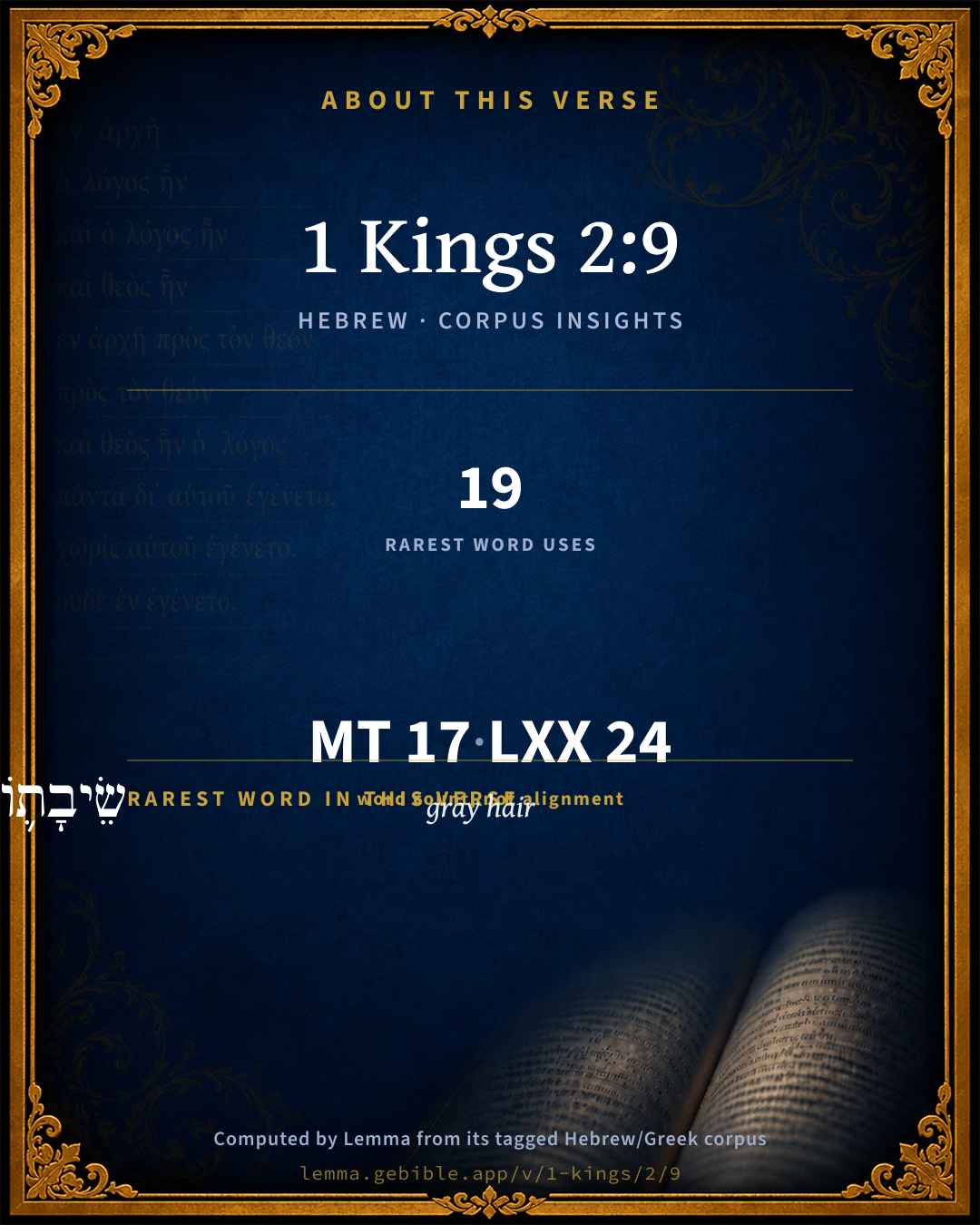
About this verse

These counts appear in no published source. They are computed here, from the morphology-tagged text and Lemma’s own curated glosses. What Lemma adds →

17
words
15
distinct lemmas
Historical
section

Notable vocabulary

The rarest word here is שֵׂיבָת֛וֹ gray hair H7872 — appearing just 19 times in the whole Hebrew Bible.

Shared distinctive vocabulary

שֵׂיבָת֛וֹ gray hair H7872 occurs in 19 verses of the Hebrew Bible. Also found in:

Grammatical profile

  • 4 verbs
  • 4 nouns
  • 1 adjective
  • 1 pronoun
  • 1 preposition
  • 1 conjunction
  • 1 adverb
  • 4 particles

Verb forms

  • תְּנַקֵּ֔הוּ Piel · Jussive
  • וְיָֽדַעְתָּ֙ Qal · Sequential Perfect
  • תַּֽעֲשֶׂה Qal · Imperfect
  • וְהוֹרַדְתָּ֧ Hiphil · Sequential Perfect

Hebrew & Septuagint length

In English translation the verse runs 35 words from the Hebrew and 36 from the Septuagint (LXX English) — closely comparable.

A rough comparison of the two English renderings, which tokenize alike — not a word-level alignment.

Word counts can differ between the Hebrew and the Greek without any difference in meaning — e.g. the Hebrew direct-object marker אֵת has no separate Greek word, and Greek often adds the article ὁ.

In the original languages it is 17 Hebrew tokens and 24 Greek tokens — but the two are counted differently (Hebrew bundles its prefixes and suffixes into one token; the Greek is in lemma form), so that isn’t a like-for-like length.

Cross-references

9

Topical passages linked to 1 Kings 2:9 in the Treasury of Scripture Knowledge — connected by theme and wording, ordered by reader-vote popularity; previews shown in the World English Bible.

  • 1 Kings 2:6 Do therefore according to your wisdom, and don't let his gray head go down to Sheol in peace.
  • Genesis 42:38 He said, "My son shall not go down with you; for his brother is dead, and he only is left. If harm happens to him by the way in which you go, then you will bring down my gray hairs with sorrow to Sheol."
  • Genesis 44:31 it will happen, when he sees that the boy is no more, that he will die. Your servants will bring down the gray hairs of your servant, our father, with sorrow to Sheol.
  • Exodus 20:7 "You shall not take the name of Yahweh your God in vain, for Yahweh will not hold him guiltless who takes his name in vain.
  • Exodus 22:28 "You shall not blaspheme God, nor curse a ruler of your people.
  • Numbers 32:23 But if you will not do so, behold, you have sinned against Yahweh; and be sure your sin will find you out.
  • 1 Kings 3:12 behold, I have done according to your word: behold, I have given you a wise and an understanding heart; so that there has been none like you before you, neither after you shall any arise like you.
  • 1 Kings 3:28 All Israel heard of the judgment which the king had judged; and they feared the king: for they saw that the wisdom of God was in him, to do justice.
  • Job 9:28 I am afraid of all my sorrows, I know that you will not hold me innocent.

Cross-references courtesy of OpenBible.info (CC BY 4.0).

Hebrew and Greek witnesses Masoretic Hebrew ↔ Greek Septuagint

The same verse in the two great witnesses to the Old Testament, shown verse-for-verse.

These are two independent witnesses, not word-aligned to each other, and the Septuagint is shown in lemma (dictionary) form.

Hebrew 1 Kings 2:9 Masoretic · Westminster Leningrad Codex

וְעַתָּה֙ אַל תְּנַקֵּ֔הוּ כִּ֛י אִ֥ישׁ חָכָ֖ם אָ֑תָּה וְיָֽדַעְתָּ֙ אֵ֣ת אֲשֶׁ֣ר תַּֽעֲשֶׂה לּ֔וֹ וְהוֹרַדְתָּ֧ אֶת שֵׂיבָת֛וֹ בְּדָ֖ם שְׁאֽוֹל

Now therefore don't hold him guiltless, for you are a wise man; and you will know what you ought to do to him, and you shall bring his gray head down to Sheol with blood.

World English Bible · Public Domain

Greek LXX 1 Kings 2:9 Septuagint · lemma form

καί οὐ μή ἀθῳόω αὐτός ὅτι ἀνήρ σοφός εἰμί σύ καί γιγνώσκω ὅς ποιέω αὐτός καί καταἄγω ὁ πολιά αὐτός ἐν αἷμα εἰς ᾅδης

But you shall by no means hold him guiltless, for you are a wise man, and will know what you shall do to him, and shall bring down his grey hairs with blood to the grave.

LXX2012 (modern English Septuagint) · Public Domain

On this verse, The Pulpit Commentary discusses the Septuagint’s reading. Read the note in Commentary ↓

Hebrew: Westminster Leningrad Codex (CC BY 4.0). Greek: Septuagint (public domain); English from LXX2012 (modern English Septuagint) (Public Domain). How the Septuagint differs from the Hebrew →

Targum (Aramaic paraphrase)

1

The Targum is the ancient Jewish Aramaic paraphrase of the Hebrew Scriptures — an interpretive translation, not the Hebrew text itself. Onkelos (literal) and Pseudo-Jonathan (expansive) render the Torah, and Jonathan the Prophets. Coverage is partial: where no permissively-licensed English translation exists for a verse, only the Aramaic is shown. This is verse-level text, not a word-by-word alignment to the Hebrew.

  1. Targum Jonathan Prophets (Joshua–Malachi)
    וּכְעַן לָא תְזַכִּינֵיהּ אֲרֵי גְבַר חַכִּים אַתְּ וְתִידַע יַת דְתַעְבֵּיד לֵיהּ וְתָחֵית יַת שֵׂיבָתֵיהּ בִּקְטָלָא לִשְׁאוֹל:

    (no public-domain English translation for this verse)

    Targum Jonathan — Aramaic: “Mikraot Gedolot” (public domain). English: “Sefaria Community Translation” (CC0 1.0 (public-domain dedication)); “London "Chaldee Paraphrase," 1871” (public domain). Text via Sefaria.

Commentary

Notes on 1 Kings 2:9 from classic Christian and Jewish commentators (each source and its license shown beneath its notes). The classic Christian expositions comment on the surrounding passage and are grouped to its opening verse, so a note may address several verses; the Jewish commentaries on the Tanakh (Rashi and others) are per-verse, so they appear only where the commentator wrote on this verse.

Lemma curates 59 commentaries, every one of them public domain or Creative Commons licensed, each selected and text-cleaned for this edition rather than reprinted as found. About our sources →

Trapp's Complete Commentary

John Trapp

1Ki 2:9 Now therefore hold him not guiltless: for thou [art] a wise man, and knowest what thou oughtest to do unto him; but his hoar head bring thou down to the grave with blood.

Ver. 9. Hold him not guiltless.] But when he shall have "added iniquity to his iniquity," pay him home for the new and the old together. It hath been before observed, that sin may sleep a long time, like a sleeping debt, not called for of many years.

John Trapp, A Commentary or Exposition upon All the Books of the Old and New Testament (1647–1656) — public domain. Text from a community e-Sword module.

Joseph Benson's Commentary

1Ki 2:9. Now therefore hold him not guiltless — Though I spared his life, do not treat him as an innocent person, nor consider him as one reconciled to my family, and to thy succession to the throne. He is Shimei still, and wants nothing but a fair opportunity to declare it. Clear him not, therefore, as I did, if thou findest him guilty of any mal-practices; but his hoar head bring down, &c. — Cut him off as an old offender and dangerous enemy, to secure thy own peace, and the safety of thy government. In this sense Josephus understands the words. But, certainly, David’s telling Solomon, that he sware to Shimei he would not put him to death for his outrage and treason, is a demonstrative proof that he did not advise Solomon to put him to death for the crime that he himself had solemnly forgiven; for can any one imagine David would tell Solomon that he had sworn not to put Shimei to death, and in the same breath order him, in defiance of his oath, to be put to death? If he had intended that Solomon should immediately put him to death, there would have been neither reason nor sense in the words, Thou art a wise man, and knowest what thou oughtest to do unto him. For to what purpose was it to tell Solomon that he knew how to behave to Shimei, if David’s command was immediately to cut him off, and Solomon understood him in that sense? But it is certain Solomon did not understand his father in that sense, by his ordering him to build a house for himself in Jerusalem, (1Ki 2:36,) as well as from the different manner in which he treated Shimei and Joab. The fact is, David advised his son to keep a strict watch over Shimei, and to put him to death only, if, on any new offence, he should again forfeit his life; and this, it is hoped, has been made appear to be the truth of the case. Now, how is this inconsistent with piety, or the advice of a prince on his death-bed? It is true, forgiveness of enemies is a duty, provided they cease to become our enemies; but no man is obliged, by any law, so to forgive an enemy, continuing such, as not to take the proper methods to guard against the effects of his enmity, and bring him to justice, if no other method will prove effectual. Much less is a prince obliged so to forgive an implacable enemy to his crown and government, and one who is likely to disturb the settlement of the crown in his successor, as not to order the successor to be upon his guard against him, and punish him, when guilty, according to his demerits. Such a caution and order is what he owes to his people; he may die as a private person, in charity with all mankind, and forgive every private injury against himself; and yet, as a prince, advise what is necessary for the public good after his decease, and even the execution of particular persons, if, by abusing the lenity and respite they once received, they should be guilty of new and capital offences. — Chandler. Doctor Waterland, Le Clerc, and Calmet, give the same interpretation with Doctor Chandler. The reader will probably think that the above reasoning sufficiently justifies David in this particular, even on supposition that the text is rightly translated, which, however, Dr. Delaney is of opinion it is not. The Hebrew particle, ו, vau, he thinks, ought to have been rendered here, as in all similar cases, not connectively, but disjunctively, as it is Pro 30:8, and in many other places. “Agur,” says he, “beseeches God to keep him from the extremes of poverty and wealth. If the particle vau were to be interpreted here connectively, the petition would run thus: Give me not poverty and riches. Every one sees the absurdity of this petition; and therefore the translators rightly rendered it, Give me neither poverty nor riches. In the same analogy, the passage in question, rightly translated, will stand thus: Now, therefore, neither hold him guiltless, (for thou art a wise man, and knowest what thou oughtest to do unto him,) nor his hoar head bring thou down to the grave with blood. This advice, in this sense, is full of humanity, as well as wisdom, and Solomon (we see) understood and observed it in this sense, and in no other.”

Joseph Benson's Commentary on the Old and New Testaments (1811–1818) — public domain. Text from a community e-Sword module.

Geneva Bible (1599)

Geneva Bible translators

Let him be punished with death, see 1 Kings 2:46.

Geneva Bible (1599) marginal notes — public domain. Text via Bolls.life.

Jamieson, Fausset & Brown

Robert Jamieson, A. R. Fausset & David Brown

for thou art a wise man--Solomon had given early indications of wisdom before his miraculous endowment with the heavenly gift (see Kg1 3:11), and his own sagacity would dictate the course that should be followed in any new offense that Shimei might commit.

Jamieson, Fausset & Brown — Commentary Critical and Explanatory on the Whole Bible (1871) — public domain (CC PDM 1.0). Text via the HelloAO Bible API.

Adam Clarke's Commentary

Verse 9. Hold him not guiltless] Do not consider him as an innocent man, though I have sworn to him that I would not put him to death by the sword; yet as thou art a wise man, and knowest how to treat such persons, treat him as he deserves; only as I have sworn to him, and he is an aged man, let him not die a violent death; bring not down his hoary head to the grave with blood. So Solomon understood David, and so I think David should be understood; for the negative particle לא lo, in the former clause, hold him NOT guiltless, should be repeated in this latter clause, though not expressed, his hoary head bring thou NOT down; instances of which frequently occur in the Hebrew Bible. See Dr. Kennicott's note at the end of this chapter. 1Kg 2:46.

Adam Clarke's Commentary on the Bible (1810–1826) — public domain. Text from a community e-Sword/MySword module.

The Cambridge Bible for Schools and Colleges

gen. ed. J. J. S. Perowne

9. hold him not guiltless] i.e. Be sure not to let him go unpunished. Find out some good reason for vengeance to be taken on him. We are not to wonder at these injunctions of David, which were not unnatural, both for the satisfaction of his own feelings and for providing for the security of Solomon’s throne. Joab was a dangerous man to be left alive, and Shimei, with Oriental fickleness, would curse Solomon as readily as he had cursed David, should a reverse of fortune come upon him. Nor are we to look for New Testament virtues in even the best men of the older covenant. The Christian thinks it nobler to forgive, following the lessons of his master, but what David saw of Christ was in the less clear vision of faith, and neither he nor his people are to be expected to rise in any great degree towards the nobility of Christian forgiveness. Yet David was very generous toward Saul. He seems to have become less forgiving in his old age, though doubtless he was thinking chiefly of Solomon’s safety.

The Cambridge Bible for Schools and Colleges (gen. ed. J. J. S. Perowne; Cambridge University Press, 1878–1918) — public domain. Text from a community e-Sword module.

John Gill's Exposition

Now therefore hold him not guiltless,.... Do not look upon him as an innocent person; and if he commits an offence against thee, as he has against me, do not acquit him as I have done:

for thou art a wise man; so it seems he was before the appearance of the Lord to him at Gibeon, even before his father's death he had given some proofs of it to David himself:

and knowest what thou oughtest to do unto him; to watch and observe him, and, if found offending, to punish him according to the rules of justice, and the laws of the land:

but his hoary head bring thou down to the grave with blood; spare him not on account of his age, but put him to death whensoever he shall be found guilty, let him not die a natural death.

John Gill's Exposition of the Whole Bible (1746–1763) — public domain (CC PDM 1.0). Text via the HelloAO Bible API.

Albert Barnes' Notes on the Bible

Hold him not guiltless - i. e. “Do not treat him as an innocent man. Punish him as in thy wisdom thou deemest best. Not capitally at once; but so that he may be likely to give thee in course of time a just occasion to slay him.” So, at least, Solomon seems to have understood the charge. (See 1Ki 2:36-46.)

Albert Barnes' Notes on the Bible (1834–1885) — public domain. Text from a community e-Sword/MySword module.

Haydock's Catholic Bible Commentary

Man. Many have thought that Solomon was only 12 years old. (Eusebius, &c.) --- But the best chronologers suppose that he was about 20. God had blessed him with a happy disposition, which he adorned with various graces, chap. iii. 12., and Wisdom viii. 19.

George Leo Haydock (1774–1849), Haydock's Catholic Family Bible and Commentary, 1859 edition — public domain. Excludes Psalms (Douay-Rheims chapter numbering differs from Protestant) and Deuterocanonical books (Catholic canon only).

Matthew Poole's English Annotations

Hold him not guiltless; though I have spared his life, do not treat him as an innocent person, neither let him go wholly unpunished.

Thou art a wise man, and therefore wilt easily find out just occasions to chastise him, especially considering his perverse and wicked disposition.

What thou oughtest to do unto him; how to punish him, not without just cause, and yet without any violation of my oath, or reflection upon me, or upon religion for my or thy sake.

With blood, i.e. with the effusion of his blood; with a bloody or violent death.

Matthew Poole's English Annotations on the Holy Bible (1683–1685) — public domain. Text from a community e-Sword/MySword module.

Whedon's Commentary on the Bible

Daniel D. Whedon

9. His hoar head bring thou down to the grave with blood — Dr. Kennicott tries to make this passage mean precisely the opposite of what it says by connecting it with the first sentence of the verse, and understanding the negative in that sentence to be carried over and implied in this. But the passages he quotes as grammatical parallels are not at all relevant, for their connexion is so close that no one can mistake the meaning, whilst here the two sentences he proposes to link together in the same way are separated by two intervening affirmative sentences. Then, the ground of this untenable criticism is the assumption that David desired to bind Solomon under the same oath to protect the life of Shimei that he himself had made at Jordan. 2Sa_19:18. But if the honour and dignity of the kingdom called for the life of the bloody Joab, so did it also for the punishment of this blasphemous Benjamite; and this David’s words most clearly imply. He leaves it, however, to Solomon’s wise judgment to decide what his penalty shall be; and Solomon, though at first disposed to let him live and die in peace, was at length obliged in justice to bring down his gray head to the grave with blood. See 1Ki_2:36-46.

Daniel D. Whedon (gen. ed.), Commentary on the Old and New Testaments (1874–1909) — public domain. Text from a community e-Sword module.

The Pulpit Commentary

Now therefore lit., and now. Possibly the "now" is a note of time in apposition to the "day" of ver. 8, or rather the time of David"s oath. "I then unadvisedly swam unto him, but now the law must have its course." Probably it is merely inferential,quae cum ita sint hold him not guiltless rather, thou shalt not leave him unpunished (Vatablus, Gesen., Bahr, al. ); cf. Exo_20:7; Jer_30:11 for thou art a wise man fronimov rather than sofov (LXX) Gesen. renders here, "endued with ability to judge." David clearly desires that wisdom and justice, not malice or passion, should be Solomon"s guide, and knowest what thou oughtest to lit., shalt or shouldest do to him; but Heb. and his hoar head mentioned, not maliciously, but with the idea that punishment, which had been long delayed, must overtake him nevertheless. The age of Joab and Shimei would make the Divine Nemesis the more conspicuous. Men would "see that there was a God that judgeth in the earth" bring thou down to the grave with blood. The Auth. Version here needlessly alters the order of the original, which should be followed wherever it can be (and it generally can) without sacrifice of idiom and elegance. In this case the alteration, by the slight prominence it gives to "hoar head" and to "blood," gives a factitious harshness to the sentence. The Hebrew stands thus: "And thou shalt bring down his hoar head with blood to Sheol." This order of the words also exhibits somewhat more clearly the sequence of thought, which is this: "Thou art wise, therefore thou knowest what by law thou shouldest do. What thou shalt do is, thou shalt bring down," etc. It is clear from these words that if David was actuated by malice, by a "passionate desire to punish those who had wronged him" (Plumptre, Dict. Bib., art. "Solomon"), or by "fierce and profound vindictiveness" (Stanley, "Jewish Church," vol. 2. p. 135), he was profoundly unconscious of it. If it was "a dark legacy of hate" (ibid. ) he was bequeathing to Solomon, then he stands before us in these last hours either as an unctuous hypocrite, or as infatuated and inconsistent to the last degree. That the man who, in his opening words (ver. 3), enjoined upon his son, in the most emphatic manner, a strict and literal obedience to the law of Heaven, should in these subsequent words, delivered almost in the same breath, require him to satiate a long-cherished and cruel revenge upon Joab and Shimei (the latter of whom he had twice delivered from death), is an instance of self contradiction which is almost, if not quite, without parallel. But as I have showed elsewhere, at some length, it is a superficial and entirely erroneous view of David"s last words, which supposes them to have been inspired by malice or cruelty. His absorbing idea was clearly this, that he had not "kept the charge of the Lord;" that he, the chief magistrate, the "revenger to execute wrath," by sparing Joab and Shimei, the murderer and the blasphemer, both of whose lives were forfeited to justice, had failed in his duty, had weakened the sanctions of law, and compromised the honour of the Most High. He is too old and too weak to execute the sentence of the law now, but for the safety of his people, for the security of his throne, it must be done, and therefore Solomon, who was under no obligation to spare the criminals his father had spared, must be required to do it. Of the Jewish king it might be said with a special propriety, "Rex est lex loquens, and seldom has the voice of law spoken with greater dignity and fidelity than by David in this dying charge. To say, as Harwood does, (Lange, American Trans., p. 32) that "nothing but sophistry can justify his (David"s) charge to Solomon, not to let the unfortunate man (Shimei) die in peace," merely shows how imperfectly the writer has entered into the spirit of the theocratic law, that law under which David lived, and by which alone he could be governed and govern others.

The Pulpit Commentary (1880–1919), ed. H.D.M. Spence-Jones & Joseph S. Exell — public domain. Text from a community e-Sword module.

Rashi

Rabbi Shlomo Yitzchaki (Rashi)

For you are a wise man. Turn your attention to find for him a capital iniquity on account of another matter. This is [what it means by], “You will know how to deal with him.”

Rashi on the Tanakh — English translations: “The Judaica Press complete Tanach with Rashi, translated by A. J. Rosenberg” (CC BY 4.0); “Pentateuch with Rashi's commentary by M. Rosenbaum and A.M. Silbermann, 1929-1934” (public domain); “The Metsudah Tanach series, Lakewood, N.J” (CC BY 4.0); and “The Book of Joshua, Metsudah Publications, 1997” (CC BY 4.0). Text via Sefaria.

Lesson kit

Teaching starters — assembled from the data on this page, not authored interpretation. Every prompt links to the verse data it draws on. Edit before teaching.

1 Kings, in the Historical, opens this verse with 17 words (15 distinct Hebrew lemmas). Its most distinctive word is sêybâh (“gray hair”). A historical commentator’s framing appears above. Read the whole chapter for the surrounding context.

Discussion questions

  1. The word sêybâh carries the sense “gray hair.” How does it shape the verse?
  2. Genesis 15:15 shares the word «gray hair» with this verse. How do the two illuminate each other?
  3. These translations render this verse differently. What is at stake in choosing one wording over another?
  4. The verb «תְּנַקֵּ֔הוּ» is Piel Jussive. How does its form color the action?
  5. Reading how Trapp's Complete Commentary and Joseph Benson's Commentary read this verse, where do the two commentators agree and where do they part?

Things to notice

Reading settings

Reading text

Shown beneath each verse's original-language words.

Old Testament
Old Testament edition

Read the OT as the Masoretic Hebrew (MT) or the Greek Septuagint (LXX).

English shown for the Greek Septuagint (in the Hebrew ↔ Greek comparison).

Comparing translations? Open the Compare panel on any verse page to stack up to four side by side.