
Genesis 42:22

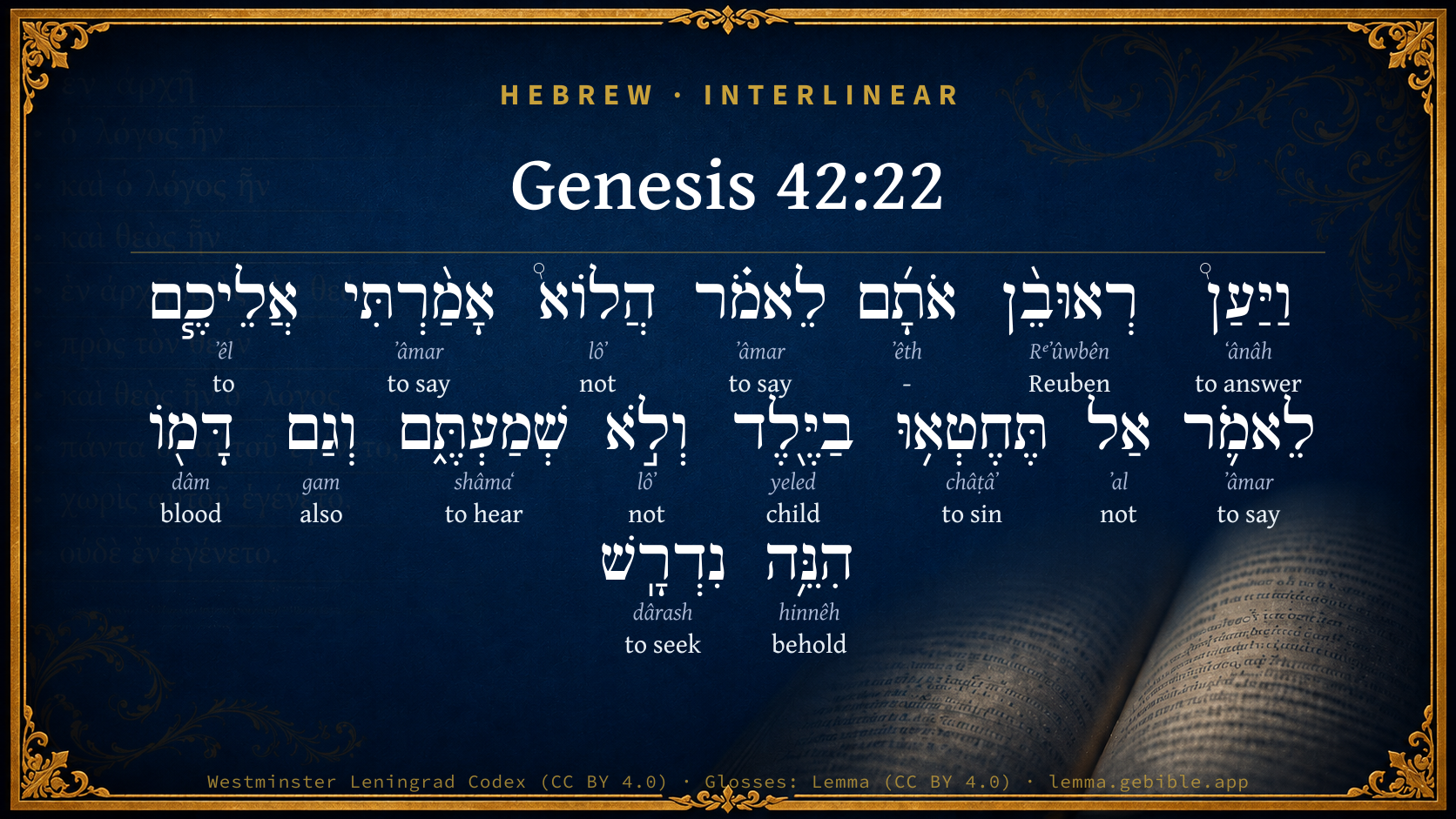
Hebrew (Westminster Leningrad Codex) Genesis 42:22 appears in the Hebrew Old Testament. The text above is from the Westminster Leningrad Codex. Each word links to its Strong’s number, a concise gloss, and parsing drawn from the Open Scriptures Hebrew Bible morphology. Click any word for its full Brown-Driver-Briggs (BDB) entry.
Download image
Cite this verse

Genesis 42:22 (World English Bible). Public Domain. Lemma interlinear Bible study tool, https://lemma.gebible.app/v/genesis/42/22.

Show BibTeX & RIS
BibTeX
RIS
English Translation
Reuben answered them, saying, "Didn't I tell you, saying, 'Don't sin against the child,' and you wouldn't listen? Therefore also, behold, his blood is required."
World English Bible · Public Domain
Download a study sheet

One document with this verse’s original text, its word-by-word gloss line, the meaning frame, cross-references with their text, attributed commentary, and full source and license credits — printable, and it pastes into notes with its structure intact.

This verse Autodidact and up

Study sheet (.html) Plain text (.txt)

A passage Seminary Student

Up to 50 verses in one chapter. A passage sheet keeps up to 6 commentary sources and 12 cross-references per verse, in the order this page ranks them, and says so on the sheet whenever that leaves anything out. Ask for a single verse and you get the Autodidact verse sheet above.

Everything on this page stays free to read, with no account — the sheet is a download of what is already on screen, not access to it.

Want to remove ads? Support Godless Engineer
Compare translations 3

The same verse in 3 English versions, stacked beneath the original-language interlinear above. Click any original word for its lexicon entry.

Each is an independent rendering of the whole verse — the interlinear is not word-aligned to these translations.

Highlighted words mark where these versions differ — a whole-verse word diff, not a word-by-word alignment.

  • World English Bible Public Domain
    Reuben answered them, saying, "Didn't I tell you, saying, 'Don't sin against the child,' and you wouldn't listen? Therefore also, behold, his blood is required."
  • King James Version Public Domain
    And Reuben answered them, saying, Spake I not unto you, saying, Do not sin against the child; and ye would not hear? therefore, behold, also his blood is required.
  • unfoldingWord Literal Text CC BY-SA 4.0
    Then Reuben responded to them, saying, “Did I not tell you, saying, ‘Do not sin against the lad’? But you did not listen, so now behold, his blood is being accounted for!”

unfoldingWord Literal Text — © unfoldingWord, licensed CC BY-SA 4.0. Word-aligned USFM3 via Door43 (git.door43.org/unfoldingWord/en_ult).

Versions to compare (up to 4)

3 of 4 selected

Show all 18 translations

Every available English version of this verse, each an independent rendering of the whole verse.

  • World English Bible Public Domain
    Reuben answered them, saying, "Didn't I tell you, saying, 'Don't sin against the child,' and you wouldn't listen? Therefore also, behold, his blood is required."
  • Berean Standard Bible Public Domain
    And Reuben responded, “Didn’t I tell you not to sin against the boy? But you would not listen. Now we must account for his blood!”
  • Majority Standard Bible Public Domain
    And Reuben responded, “Didn’t I tell you not to sin against the boy? But you would not listen. Now we must account for his blood!”
  • King James Version Public Domain
    And Reuben answered them, saying, Spake I not unto you, saying, Do not sin against the child; and ye would not hear? therefore, behold, also his blood is required.
  • American Standard Version (1901) Public Domain
    And Reuben answered them, saying, Spake I not unto you, saying, Do not sin against the child; and ye would not hear? therefore also, behold, his blood is required.
  • Revised Version (1885) Public Domain
    And Reuben answered them, saying, Spake I not unto you, saying, Do not sin against the child; and ye would not hear? therefore also, behold, his blood is required.
  • Geneva Bible (1599) Public Domain
    And Reuben answered them, saying, Warned I not you, saying, Sinne not against the childe, and ye would not heare? and lo, his blood is now required.
  • Douay-Rheims (1899) Public Domain
    And Ruben one of them, said: Did not I say to you: Do not sin against the boy: and you would not hear me? Behold his blood is required.
  • Young's Literal Translation Public Domain
    And Reuben answereth them, saying, `Spake I not unto you, saying, Sin not against the lad? and ye hearkened not; and his blood also, lo, it is required.'
  • Literal Standard Version CC BY-SA 4.0
    And Reuben answers them, saying, “Did I not speak to you, saying, Do not sin against the boy? And you did not listen; and his blood also, behold, it is required.”
  • Unlocked Literal Bible CC BY-SA 4.0
    Reuben answered them, “Did I not tell you, 'Do not sin against the boy,' but you would not listen? Now, see, his blood is required of us.”
  • unfoldingWord Literal Text CC BY-SA 4.0
    Then Reuben responded to them, saying, “Did I not tell you, saying, ‘Do not sin against the lad’? But you did not listen, so now behold, his blood is being accounted for!”
  • Darby Bible Public Domain
    And Reuben answered them, saying, Did I not speak to you, saying, Do not sin against the lad? But ye did not hearken; and now behold, his blood also is required.
  • World Messianic Bible Public Domain
    Reuben answered them, saying, “Didn’t I tell you, saying, ‘Don’t sin against the child,’ and you wouldn’t listen? Therefore also, behold, his blood is required.”
  • Webster's Bible Public Domain
    And Reuben answered them, saying, Did I not speak to you, saying, Do not sin against the young man; and ye would not hear? therefore behold also his blood is required.
  • Free Bible Version CC BY-SA 4.0
    Reuben said to them, “Didn't I tell you, ‘Don't harm the boy!’ But you didn't listen to me. Now we're paying the price for what we did to him.”
  • Bible in Basic English Public Domain
    And Reuben said to them, Did I not say to you, Do the child no wrong? but you gave no attention; so now, punishment has come on us for his blood.
  • JPS Tanakh (1917) Public Domain
    And Reuben answered them, saying: 'Spoke I not unto you, saying: Do not sin against the child; and ye would not hear? therefore also, behold, his blood is required.'

Literal Standard Version (2020), Covenant Press — licensed CC BY-SA 4.0. Text via the HelloAO Bible API (eBible.org). Unlocked Literal Bible (unfoldingWord) — licensed CC BY-SA 4.0. Text via the HelloAO Bible API (eBible.org). unfoldingWord Literal Text — © unfoldingWord, licensed CC BY-SA 4.0. Word-aligned USFM3 via Door43 (git.door43.org/unfoldingWord/en_ult). Free Bible Version, Dr. Jonathan Gallagher — licensed CC BY-SA 4.0. Text via the HelloAO Bible API (eBible.org).

Word by word

More ways to search: Search by grammar → Find every occurrence → Compare this word →

Practice this passage: Drill this verse → Learn its vocabulary →

רְאוּבֵ֨ן
Rᵉʼûwbên
H7205
“Reuben”
Noun, Proper
Part of Speech
Noun
Type
Proper
Full BDB Definition

Origin: from the imperative of H7200 and H1121

TWOT: None

Reuben = "behold a son" - the eldest son of Jacob by Leah - the tribe descended from Reuben - the territory inhabited by the tribe of Reuben
  1. וַיַּעַן֩ ʻânâh H6030 “and · to answer” Conjunction + Verb, Qal, Sequential Imperfect, 3rd Person, Masculine, Singular
  2. אֹתָ֜ם ʼêth H853 “- · them” Particle, Direct Object + Suffix, Personal, 3rd Person, Masculine, Plural
  3. לֵאמֹ֗ר ʼâmar H559 “to say” Preposition + Verb, Qal, Infinitive Construct
  4. הֲלוֹא֩ lôʼ H3808 “not” Particle, Interrogative + Particle, Negative
  5. אָמַ֨רְתִּי ʼâmar H559 “to say” Verb, Qal, Perfect, 1st Person, Common, Singular
  6. אֲלֵיכֶ֧ם ʼêl H413 “to · you” Preposition + Suffix, Personal, 2nd Person, Masculine, Plural
  7. לֵאמֹ֛ר ʼâmar H559 “to say” Preposition + Verb, Qal, Infinitive Construct
  8. אַל ʼal H408 “not” Particle, Negative
  9. תֶּחֶטְא֥וּ châṭâʼ H2398 “to sin” Verb, Qal, Jussive, 2nd Person, Masculine, Plural
  10. בַיֶּ֖לֶד yeled H3206 “in/at the · child” Preposition, Determined + Noun, Common, Masculine, Singular, Absolute
  11. וְלֹ֣א lôʼ H3808 “and · not” Conjunction + Particle, Negative
  12. שְׁמַעְתֶּ֑ם shâmaʻ H8085 “to hear” Verb, Qal, Perfect, 2nd Person, Masculine, Plural
  13. וְגַם gam H1571 “and · also” Conjunction + Particle, Accusative
  14. דָּמ֖וֹ dâm H1818 “blood · his” Noun, Common, Masculine, Singular, Construct + Suffix, Personal, 3rd Person, Masculine, Singular
  15. הִנֵּ֥ה hinnêh H2009 “behold” Particle, Demonstrative
  16. נִדְרָֽשׁ dârash H1875 “seeking” Verb, Niphal, Participle Active, Masculine, Singular, Absolute

About this verse

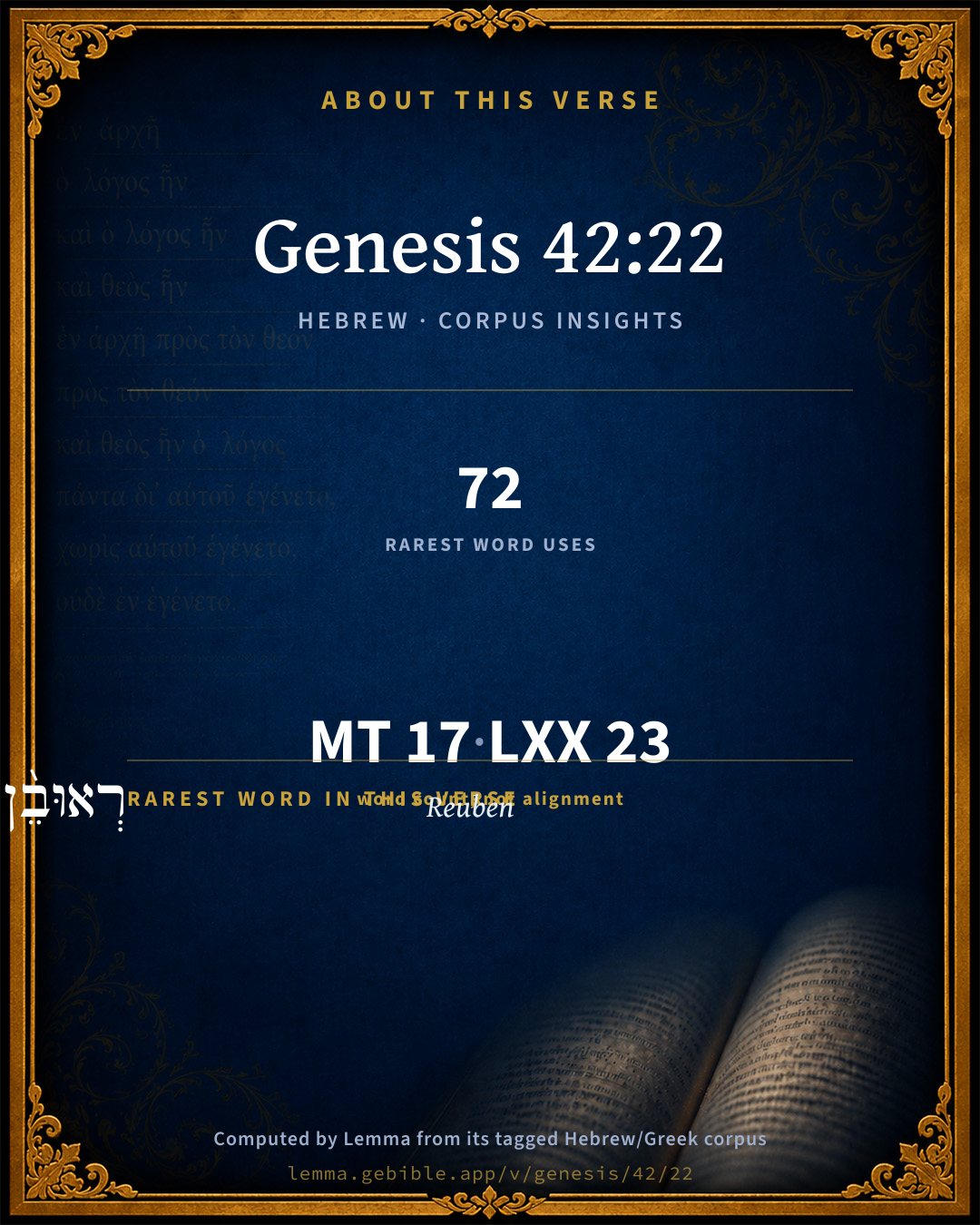
These counts appear in no published source. They are computed here, from the morphology-tagged text and Lemma’s own curated glosses. What Lemma adds →

17
words
14
distinct lemmas
Pentateuch
section

Grammatical profile

  • 7 verbs
  • 3 nouns
  • 1 preposition
  • 6 particles

Verb forms

  • וַיַּעַן֩ Qal · Sequential Imperfect
  • לֵאמֹ֗ר Qal · Infinitive Construct
  • אָמַ֨רְתִּי Qal · Perfect
  • לֵאמֹ֛ר Qal · Infinitive Construct
  • תֶּחֶטְא֥וּ Qal · Jussive
  • שְׁמַעְתֶּ֑ם Qal · Perfect
  • נִדְרָֽשׁ Niphal · Participle Active

Repetition

Words recur within this verse — often emphatic in Hebrew:

  • לֵאמֹ֗ר to say H559 ×3
  • הֲלוֹא֩ not H3808 ×2

Hebrew & Septuagint length

In English translation the verse runs 25 words from the Hebrew and 27 from the Septuagint (LXX English) — closely comparable.

A rough comparison of the two English renderings, which tokenize alike — not a word-level alignment.

Word counts can differ between the Hebrew and the Greek without any difference in meaning — e.g. the Hebrew direct-object marker אֵת has no separate Greek word, and Greek often adds the article ὁ.

In the original languages it is 17 Hebrew tokens and 23 Greek tokens — but the two are counted differently (Hebrew bundles its prefixes and suffixes into one token; the Greek is in lemma form), so that isn’t a like-for-like length.

Cross-references

14

Topical passages linked to Genesis 42:22 in the Treasury of Scripture Knowledge — connected by theme and wording, ordered by reader-vote popularity; previews shown in the World English Bible.

  • 1 Kings 2:32 Yahweh will return his blood on his own head, because he fell on two men more righteous and better than he, and killed them with the sword, and my father David didn't know it, [to wit], Abner the son of Ner, captain of the host of Israel, and Amasa the son of Jether, captain of the host of Judah.
  • 2 Chronicles 24:22 Thus Joash the king didn't remember the kindness which Jehoiada his father had done to him, but killed his son. When he died, he said, Yahweh look on it, and require it.
  • Psalms 9:12 For he who avenges blood remembers them. He doesn't forget the cry of the afflicted.
  • Genesis 37:21–22 Reuben heard it, and delivered him out of their hand, and said, "Let's not take his life."
  • Genesis 9:5–6 I will surely require your blood of your lives. At the hand of every animal I will require it. At the hand of man, even at the hand of every man's brother, I will require the life of man.
  • Luke 11:50–51 that the blood of all the prophets, which was shed from the foundation of the world, may be required of this generation;
  • Genesis 4:10 Yahweh said, "What have you done? The voice of your brother's blood cries to me from the ground.
  • Genesis 37:29–30 Reuben returned to the pit; and saw that Joseph wasn't in the pit; and he tore his clothes.
  • Ezekiel 3:18 When I tell the wicked, You shall surely die; and you give him no warning, nor speak to warn the wicked from his wicked way, to save his life; the same wicked man shall die in his iniquity; but his blood will I require at your hand.
  • Luke 23:41 And we indeed justly, for we receive the due reward for our deeds, but this man has done nothing wrong."
  • Acts 28:4 When the natives saw the creature hanging from his hand, they said one to another, "No doubt this man is a murderer, whom, though he has escaped from the sea, yet Justice has not allowed to live."
  • Romans 2:15 in that they show the work of the law written in their hearts, their conscience testifying with them, and their thoughts among themselves accusing or else excusing them)
  • Revelation 13:10 If anyone has captivity, he will go. If anyone is with the sword, he must be killed. Here is the endurance and the faith of the saints.
  • Revelation 16:9 People were scorched with great heat, and people blasphemed the name of God who has the power over these plagues. They didn't repent and give him glory.

Cross-references courtesy of OpenBible.info (CC BY 4.0).

Hebrew and Greek witnesses Masoretic Hebrew ↔ Greek Septuagint

The same verse in the two great witnesses to the Old Testament, shown verse-for-verse.

These are two independent witnesses, not word-aligned to each other, and the Septuagint is shown in lemma (dictionary) form.

Hebrew Genesis 42:22 Masoretic · Westminster Leningrad Codex

וַיַּעַן֩ רְאוּבֵ֨ן אֹתָ֜ם לֵאמֹ֗ר הֲלוֹא֩ אָמַ֨רְתִּי אֲלֵיכֶ֧ם לֵאמֹ֛ר אַל תֶּחֶטְא֥וּ בַיֶּ֖לֶד וְלֹ֣א שְׁמַעְתֶּ֑ם וְגַם דָּמ֖וֹ הִנֵּ֥ה נִדְרָֽשׁ

Reuben answered them, saying, "Didn't I tell you, saying, 'Don't sin against the child,' and you wouldn't listen? Therefore also, behold, his blood is required."

World English Bible · Public Domain

Greek LXX Genesis 42:22 Septuagint · lemma form

ἀποκρίνω δέ ρουβην εἶπον αὐτός οὐ λαλέω σύ λέγω μή ἀδικέω ὁ παιδάριον καί οὐ εἰςἀκούω ἐγώ καί ἰδού ὁ αἷμα αὐτός ἐκζητέω

And Ruben answered them, saying, Did I not speak to you, saying, Hurt not the boy, and you⌃ heard me not? and, behold, his blood is required.

LXX2012 (modern English Septuagint) · Public Domain

Hebrew: Westminster Leningrad Codex (CC BY 4.0). Greek: Septuagint (public domain); English from LXX2012 (modern English Septuagint) (Public Domain). How the Septuagint differs from the Hebrew →

Targum (Aramaic paraphrase)

2

The Targum is the ancient Jewish Aramaic paraphrase of the Hebrew Scriptures — an interpretive translation, not the Hebrew text itself. Onkelos (literal) and Pseudo-Jonathan (expansive) render the Torah, and Jonathan the Prophets. Coverage is partial: where no permissively-licensed English translation exists for a verse, only the Aramaic is shown. This is verse-level text, not a word-by-word alignment to the Hebrew.

  1. Targum Onkelos Torah (Genesis–Deuteronomy)
    וַאֲתֵיב רְאוּבֵן יָתְהוֹן לְמֵימָר הֲלָא אֲמָרִית לְוָתְכוֹן לְמֵימַר לָא תְחוֹבוּן בְּעוּלֵימָא וְלָא קַבֶּלְתּוּן וְאַף דְּמֵהּ הָא מִתְבְּעֵי

    (no public-domain English translation for this verse)

    Targum Onkelos — Aramaic: “Onkelos Genesis” (public domain); “Onkelos Exodus” (public domain); “Onkelos Leviticus” (public domain); “Onkelos Numbers” (public domain); “Onkelos Deuteronomy” (public domain). English: “Sefaria Community Translation” (CC0 1.0 (public-domain dedication)); “J.W. Etheridge. The Targums of Onkelos and Jonathan Ben Uzziel on the Pentateuch. London: Longmans, Green, 1862” (public domain). Text via Sefaria.

  2. Targum Pseudo-Jonathan Torah (Genesis–Deuteronomy)
    עָנָא יַתְהוֹם רְאוּבֵן וְאָמַר הֲלָא אֲמָרִית לְכוֹן לְמֵימַר לָא תֵיחְטוּן בְּטַלְיָא וְלָא קַבֵּילְתּוּן מִינִי וְאוּף אַדְמֵיהּ הָא מִתְבָּעֵי מִינָן

    And Reuben answered them and said, Did I not tell you, saying, Do not sin against the youth? But you would not listen to me; and thus, behold, his blood is required of us.

    Targum Pseudo-Jonathan — Aramaic: “Targum Jonathan on Genesis” (public domain); “Targum Jonathan on Exodus” (public domain); “Targum Jonathan on Leviticus” (public domain); “Targum Jonathan on Numbers” (public domain); “Targum Jonathan on Deuteronomy” (public domain). English: “The Targum of Jonathan ben Uzziel, trans. J. W. Etheridge, London, 1862” (public domain). Text via Sefaria.

Commentary

Notes on Genesis 42:22 from classic Christian and Jewish commentators (each source and its license shown beneath its notes). The classic Christian expositions comment on the surrounding passage and are grouped to its opening verse, so a note may address several verses; the Jewish commentaries on the Tanakh (Rashi and others) are per-verse, so they appear only where the commentator wrote on this verse.

Lemma curates 59 commentaries, every one of them public domain or Creative Commons licensed, each selected and text-cleaned for this edition rather than reprinted as found. About our sources →

Trapp's Complete Commentary

John Trapp

Gen 42:22 And Reuben answered them, saying, Spake I not unto you, saying, Do not sin against the child; and ye would not hear? therefore, behold, also his blood is required.

Ver. 22. Spake not I unto you, &c.] Fellows in sin oft fall out, and then all comes to light. Mohammed the great Turk had, with great rewards, procured two Turks to undertake to kill Scanderbeg. These traitors came to Seanderbeg, making such a show of the detestation, both of Mohammed’s tyrannical government and vain superstition, that they were, both of Scanderbeg and others, reputed to be indeed the men they desired to be accounted: and so, after they had learned the principles of the Christian religion, were, by their own desire, baptized. But so it happened by God’s good providence, that these false traitors, expecting nothing but opportunity to perform their devilish device upon some occasion, fell at variance between themselves, and in their heat let some such words fall, as being taken up by some there present, drew them both into suspicion. And thereupon, being straitly examined, it was at last by them confessed that they were sent for such a purpose; for which they were both presently executed, as they had well deserved. {a} Evil men are as glass that is soldered together; as soon as the solder is melted, the glass falls in pieces, and all is discovered.

{a} Turk. Hist., fol. 400.

John Trapp, A Commentary or Exposition upon All the Books of the Old and New Testament (1647–1656) — public domain. Text from a community e-Sword module.

The Biblical Illustrator

Joseph S. Exell

Gen_42:22

Do not sin against the child

Do not sin against the child

Thus Reuben reminded his brethren of his admonition concerning Joseph--thus would I address you with regard to your own children.

Note the words of the text: Spake I not unto you saying, Do not sin against the child? The essence of sin lies in its being committed against God. The sword of sin cuts both ways, it not only contends against God but against His creatures too. It is a double evil. Like a bursting shell, it scatters evil on every side. Every relationship which we sustain involves duty, and consequently, may be perverted into an occasion for sin. The text calls us to consider one particular form of sin, namely, sinning against a child, and it is of that I intend to speak this morning, looking up to the Father of spirits that He would teach me to speak aright.

I. WHAT IS THIS WHICH HAS BEEN SAID TO US? Do not sin against the child. This warning may be suitable for every one of us without exception, for those who are not parents, and who are not teachers of the young are nevertheless bound to remember that they are in a commonwealth of which young people make up a very considerable part. Little eyes are so quick to observe the actions of those who are grown up, that adults should be careful what they do. I would say to every man who is giving full swing to his passions, if nothing else will check you, at any rate pause awhile when yonder fair-haired girls and lisping children are gazing upon you. If you care not for angels, stop for the sake of yon blue-eyed boy. Let not the leprosy of your sin pollute your offspring more than must be. To the parent the text speaks with a still small voice, to which I trust none of us will be deaf. Do not sin against the child--against your own dear child! Yet how many parents do so! If, as I now speak, unconverted parents will be compelled to acknowledge the truthfulness of the accusations I shall lay against them, I hope they will be led to deep and true repentance. There are many parents who neglect altogether the religious education of their children. I remember a woman who was converted at an advanced age, who had been left years before a widow with many children; she was a most exemplary, moral, and industrious woman, and earning her living by most laborious work, she yet managed to bring up all her family, and settle them in a suitable manner; but after her conversion I think I never saw more bitter tears than those which she shed when she said, I took care to feed them and clothe their bodies, but I never thought of their souls. Alas! for me, I knew no better; but alas! for them, I left the chief thing undone. The other day I spoke to my eldest son about the things of God, and he told me religion was all a farce, he did not regard a word I said; and well, said she, might he be an infidel when his mother never said a word by which he could have been led to be a believer. Words were spoken by way of comfort to her, but like Rachel she refused to be comforted, because she said, and said truly, her great opportunity had been thrown away. The best time of effort for a mother had been allowed to pass away unused. Her harvest was passed, and her summer was ended, and her children were not saved. Parents who teach their children to sing the silly, frivolous, and perhaps licentious songs, are sacrificing them to Moloch. Shame is it when from a fathers lips the boy hears the first oath, and learns the alphabet of blasphemy. There are crowds of parents upon whose head the blood of their children will certainly descend, because they have launched them on the sea of life with the rudder set towards the rocks, with a false chart, a deceitful compass, and every other appliance for securing eternal shipwreck. The text further bears with equal severity upon the preacher. I feel it chides and chastens me. Preaching is full often too obscure for children; the words are too long, the sentences too involved, the matter too mysterious. Sacred simplicity should be so cultivated by the ambassador of Christ, that lads and lasses should hear intelligently under a good shepherd, and the least lamb should be able to find food. But we must push on. I want the Church of God, and especially this church, to attend carefully to the next few remarks. When teachers and others are earnest about the conversion of children, and some of them are converted, they then come into relationship with the Church, and too often the Lords people need the advice, Do not sin against the child. How can a Church so offend? It can do so by not believing in the conversion of children at all.

II. WHO SAYS THIS TO US?

1. Nature says it first. The instincts of humanity cry, Do not sin against the child. It is but a child; it is little; sin not against it.

2. Experience adds its voice to nature, Do not sin against the child. Hundreds of parents have been brought with sorrow to the grave through the natural result of their own failures and trespasses in reference to their children. They taught the lesson of sin, and the children, having learned it, practised it upon their parents. If you would not stuff your pillow with thorns, do not sin against the child.

3. Conscience repeats the same advice; that inward monitor ceases not to remind us of what is due to God and to His peculiar charge, the weak and feeble. Conscience tells us plainly that we must not sport with responsibilities so vast.

4. The Church adds her voice to that of conscience. Do not sin against the child, for the children are the Churchs hope. Bring them to Christ, that He may put His hands upon them and bless them, that they may become the future teachers and preachers, the pillars and defence of Christs Church below.

5. God Himself, speaking from the excellent glory, this morning, saith to each one of His servants here, Do not sin against the child, and I ask that if no other voice be heard, we may all bow before His glorious Majesty, and ask for grace to be willing and obedient.

III. Thirdly, having heard the message, WHAT THEN? Only two things.

1. Does not that exhortation startle some of the unconverted and unawakened here? I think if I were as you are, sir, if I had lived to be sixty years of age, and my son had died through drunkenness, or my daughter were at this time living a godless life, and I were unconverted, it would shoot a pang through my heart to think that I should have brought such misery upon them through my neglect of Divine things.

2. Does not this command of this morning press upon every Christian here, not alone upbraiding us, but as arousing our laggard energies, exciting us to something more of diligence and effort? Will you not roll away that reproach which I mentioned just now, which rests upon some of you, because there are schools without teachers? Parents, will you not pray for your children, and even to-day seek to hold up Jesus before them? Will we not all, God helping us, say within ourselves, that we will not longer sin against the child, but in Jesus name seek to gather His lambs and feed them for Him? (C. H. Spurgeon.)

Do not hurt the child

I. How MAY WE SIN AGAINST A CHILD?

1. We may sin against a child first of all by spoiling him. If the peach trees and plum trees that are nailed to the garden walls by a hundred little pieces of cloth could but think and speak, they might very likely say to the gardener so busily at work with the hammer--Why fasten us up like this, and forbid our beautiful branches from running on the ground or playing in the breeze. How unkind it is to put so many restraints upon us and leave us so little liberty; let us just for this season run over the wall, along by the wall, or away from the wall, or any way we please. But the gardener, with a smile, would reply, It is out of kindness I do it, not from mere caprice. Wait until the spring has glided into summer, and all thy branches are decked with snowy bloom. Wait until the summer has mellowed into autumn, and then when thy boughs are laden with fruit, which they never could have borne but for these restrictions, then you will see that all has been done for thy good and to make thy fruit the richer. So, parents, out of very kindness to the child you must sometimes say, No, and place restrictions on him.

2. There is a second way in which you may sin against a child, the very reverse of that just mentioned, and it is by harshness.

3. A third way of sinning against a child is by bad example. It is Gilfillan who remarks that any fault in a parent, any inconsistency, any disproportion between profession and practice, or precept and practice, falls upon the childs eye with the force and precision of sunbeams on a daguerreotype plate. On what other ground can you account for the awful proficiency in sin which you find in many a little one?

4. There is a fourth way of sinning against a child which I do not for a moment suppose is followed by any present. It is by selling a child for gain. Would that my Master might enable me to express in language strong enough the indignant thoughts that burn within my breast concerning this miserable traffic in childrens souls. Joseph is not the only child that has been sold for a few pieces of silver. Do you ask me what I mean and to what I refer? I answer to the thoughtless wicked practice of setting the child to any kind of work, and placing him amidst any kind of companionship so as to have the benefit of the few pence he may earn. Better starve without it than live by it, for it is nothing less than blood money.

5. Our next point is one that will, I doubt not, include many present. You may sin against the child by neglecting the means for its salvation.

II. THERE ARE MANY REASONS WHY WE SHOULD NOT SIN AGAINST THE CHILD.

1. Sin not against him, because he is a child. If you must sin against some one, sin against one of your own size and strength, but it is a dastardly thing and Cowardly to sin against a child. The little things innocence ought to be its safeguard, and its very weakness should prove its protection.

2. Sin not against the child, because by so doing you may blast his whole life. You may with your foot so alter the course of that tiny little mountain rivulet that, instead of flowing gently down and widening as it goes until it glides through the smiling valley, refreshing thirsty man and beast, it leaps from rock to rock, from crag to crag, falling at last with hideous roar clown some black precipice. Oh, the fatal result of turning its course so near the spring.

3. Do not sin, moreover, against the child, because children are Christs favourites. He ever showed a peculiar sympathy with and care over children. (A. G. Brown.)

His blood is required

The heinousness of sin

From this, as well as from many other passages of Scripture, may be learnt the unpardonable nature of sin, and that even penitence itself cannot always protect us from the evils which vice naturally brings in its train. And this we see to be continually the case in the world around us. We often perceive that the consequences of one false step, one single error, can never be altogether averted, by any repentance or amendment on the part of the sinner. Suspicion and distrust still cling to him through life, haunting him at every step, and blasting all his prospects. This is the natural course of things; and what is the natural course of things but the will of God, making use of human instruments to manifest to the world His utter abhorrence of even the very appearance of evil. Let us not, then, deceive ourselves in supposing that because God has opened to us a hope of forgiveness, through the death of His Son, sin has thereby lost any of its blackness in His sight. Still less let us imitate the conduct of those who do evil that good may come, and who profanely imagine that God can be glorified by their iniquities. It is true that there is joy in heaven over one sinner that repenteth, more than over ninety and nine just persons which need no repentance--but the joy arises from the unexpectedness and difficulty of his repentance, and not from his greater acceptableness in the sight of a holy God. Let it then be our earnest labour, from our earliest youth to our latest old age, to keep ourselves as much as possible undefiled in the way, and we shall still feel enough of our original frailty within us, to convince us that we are, after all, but unprofitable servants. Let the magnitude of the price which has been paid for our offences be a proof to us of the heinous nature of sin, and not an occasion of negligence. And let us learn, from the example before us, that guilt, though it may be retrieved, by repentance, from eternal punishment in the next world, will hardly ever escape from its evil consequences in this--that though the wound may be healed, yet the scar will still remain--and that though we may sin, like Reuben, from weakness rather than from vice, yet from us, like Reuben, will some bitter atonement for our transgression be hereafter required. (D. Charles.)

Blood-guiltiness

Although it was not certain that Joseph was dead, yet Reuben had too good reason to charge his brethren with blood-guiltiness. They were guilty of a bloody crime even in the eyes of men. No thanks were due to them for the care that Divine Providence took of him, any more than we owe thanks to the murderers of our Lord, because God brought Him again from the dead. We are accountable for those mischiefs that are the probable consequences of our wilful sins, as much as for the real consequences of them, if we had the same reason to dread them. When we repent of such sins, our grief on the whole will not be so painful as it would have been if God had not prevented the fatal effects which we had reason to dread; but the sin is the same, and the grief with which we ought to lament the sin is the same, only it is to be mingled with thankfulness and joy in that mercy which hath counteracted the natural effects of our misconduct. Two pair of combatants go forth to fight a duel. One kills his antagonist. Another fires his pistol with a view to kill his neighbour; but Divine Providence mercifully prevents the shedding of blood. He is no less a murderer in the eye of God than the other, and has the same reason to deplore his bloody purposes. But the other has an additional reason or bitter grief, because God hath suffered him to execute his bloody purpose, and to send into the other world a fellow-creature, who died in an act of wickedness like his own. You will all say, that whatever crimes are chargeable upon you, the guilt of blood is not in your skirts. Josephs brethren might probably have said the same thing. They do not say, We are guilty of our brothers blood, but, We are guilty of turning a deaf ear to his mournful cries. Reuben, however, does not hesitate to charge them in direct terms with the guilt of blood; and we do not find that they had the courage to contradict him. They could not but see that their cruelty to Joseph had brought on, or might have brought on, his death. Isaiah tells the people of his own time, that their hands were full of blood (Isa_1:15). It is not to be supposed that the generality of the people were chargeable with that kind of murder which would have exposed them to an ignominous death by the laws of their country. But in the eyes of the great Judge, they were stained with blood in such a manner, that when they made many prayers with hands stretched out to His throne of mercy, He turned away His eyes from beholding them and His ears from hearing their supplication (Isa_1:15). (G. Lawson D. D.)

The Biblical Illustrator, edited by Joseph S. Exell (c. 1880s–1900s) — public domain. Text from a community e-Sword module.

Tyndale Open Study Notes

Tyndale Open Resources

42:22 you wouldn’t listen: Reuben had lost the reins of leadership (see study notes on 42:37; 49:3-4).

Tyndale Open Study Notes — © Tyndale Open Resources, licensed CC BY-SA 4.0. Text via the HelloAO Bible API.

Geneva Bible (1599)

Geneva Bible translators

God will take vengeance upon us, and measure us with our own measure.

Geneva Bible (1599) marginal notes — public domain. Text via Bolls.life.

John Calvin's Commentaries

22. And Reuben answered them. Because he had attempted to deliver Joseph out of the hands of his brethren, in order to restore him in safety to his father, he magnifies their fault, in not having, at that time, listened to any prudent counsel: and I understand his words as conveying a reproof for their too late repentance. Whereas Joseph was not yet satisfied with this confession, but retained Simeon in bonds, and dismissed the rest in suspense and perplexity, this was not done from malevolence, but because he was not certain about the safety of his brother Benjamin, and the state of his father’s house. For he might justly fear lest, when they found that their wicked contrivance of putting their brother to death, was discovered, they might again attempt some horrible crime, as desperate men are wont to do; or, at least, might desert their father, and flee to some other country. Nevertheless the act of Joseph is not to be drawn into a precedent: because it is not always right to be thus austere. We ought also to beware lest the offender be swallowed up by grief, if we are not mild, and disposed to forgiveness. Therefore we must seek the spirit of discretion from heaven, which shall so govern us that we may do nothing by rash impetuosity, or immoderate severity. This, indeed, is to be remembered, that under the stern countenance of Joseph was concealed not only a mild and placid disposition, but the most tender affection.

John Calvin's Commentaries (1540-1563) — public domain. Text from the Calvin Translation Society English edition (1840s-50s) via the Christian Classics Ethereal Library (ccel.org). Calvin's coverage is partial (roughly two-thirds of the Bible); uncommented books and verses are honest gaps, never fabricated. The 19th-century editor's footnotes and remarks are omitted so the notes are faithfully Calvin's own voice.

Ellicott's Commentary for English Readers

(22) His blood.—Evidently they thought that Joseph was dead, so that the accusation brought against them of falsehood for saying in Gen_42:13 “one is not” is groundless. Moreover, Jacob uses the same words of Simeon (Gen_42:36), meaning by it only that he was lost to him.

A Bible Commentary for English Readers, edited by Charles John Ellicott (1878–1897) — public domain. Text from a community e-Sword module.

The Cambridge Bible for Schools and Colleges

gen. ed. J. J. S. Perowne

22. And Reuben answered] See Gen_37:21-22. Reuben, according to E, believed Joseph to have been killed (Gen_37:30), and had no knowledge of his being “kidnapped.” He can appeal to good intentions, but not to courageous action.

his blood is required] For this phrase see note on Gen_9:5. Cf. 2Ch_24:22. His disappearance meant to his brethren his death. Reuben’s interference had prevented them from shedding Joseph’s blood (Gen_37:22), but they were morally guilty of his life.

The Cambridge Bible for Schools and Colleges (gen. ed. J. J. S. Perowne; Cambridge University Press, 1878–1918) — public domain. Text from a community e-Sword module.

John Gill's Exposition

And they laded their asses with the corn,.... Cattle very fit to carry burdens, and no doubt they had each of them one at least:

and departed thence; from the place where Joseph was, and from the land of Egypt.

John Gill's Exposition of the Whole Bible (1746–1763) — public domain (CC PDM 1.0). Text via the HelloAO Bible API.

Haydock's Catholic Bible Commentary

His blood. Ruben supposed his brother was dead, (ver. 13,) and judging that Jacob would not let Benjamin come, he thought they must all perish. (Haydock)

George Leo Haydock (1774–1849), Haydock's Catholic Family Bible and Commentary, 1859 edition — public domain. Excludes Psalms (Douay-Rheims chapter numbering differs from Protestant) and Deuterocanonical books (Catholic canon only).

Matthew Poole's English Annotations

i.e. The punishment of his blood or death occasioned by us.

Matthew Poole's English Annotations on the Holy Bible (1683–1685) — public domain. Text from a community e-Sword/MySword module.

Whedon's Commentary on the Bible

Daniel D. Whedon

22. Reuben answered — Reuben here acts as the accuser of his brethren. But he seems to have had no real sympathy with their cruelty, and had purposed to secure and restore Joseph to his father. Gen_37:21-22; Gen_37:29-30.

His blood is required — Thus Reuben voices their deepest fears. It seems to him and them as if the avenger of blood (Gen_9:5) in some dire form is suddenly to come upon them.

Daniel D. Whedon (gen. ed.), Commentary on the Old and New Testaments (1874–1909) — public domain. Text from a community e-Sword module.

The Pulpit Commentary

And Reuben who had not consented to, but had been altogether unable to prevent, the wickedness of his brethren (Gen_37:22, Gen_37:29) answered them, saying, Spake I not unto you, saying, Do not sin against the child (or lad); and ye would not hear? therefore, behold, also his blood is required literally, and also his blood, behold it is required. This was in accordance with the Noachic law against bloodshed, (Gen_9:5) with which it is apparent that Jacob"s sons were acquainted.

The Pulpit Commentary (1880–1919), ed. H.D.M. Spence-Jones & Joseph S. Exell — public domain. Text from a community e-Sword module.

Rashi

Rabbi Shlomo Yitzchaki (Rashi)

וגם דמו ALSO HIS BLOOD [IS REQUIRED] — the particles את and גם extend the scope of the clause; here it implies “his blood and also the blood of his old father” (Genesis Rabbah 91:8).

Rashi on the Tanakh — English translations: “The Judaica Press complete Tanach with Rashi, translated by A. J. Rosenberg” (CC BY 4.0); “Pentateuch with Rashi's commentary by M. Rosenbaum and A.M. Silbermann, 1929-1934” (public domain); “The Metsudah Tanach series, Lakewood, N.J” (CC BY 4.0); and “The Book of Joshua, Metsudah Publications, 1997” (CC BY 4.0). Text via Sefaria.

Radak

Rabbi David Kimhi (Radak)

וגם דמו הנה נדרש, seeing that they believed that Joseph had died after he had been sold, they felt that G’d was also holding them responsible now for having shed his blood.

Radak on the Tanakh — English translations: “Sefaria Community Translation” (CC0 1.0 (public-domain dedication)); “Eliyahu Munk, HaChut Hameshulash” (CC BY 4.0); “Rabbi Mike Feuer, Jerusalem Anthology” (CC BY 4.0); and “R. David Kimhi on the first book of Psalms, Translated by R.G. Finch, London, 1919” (public domain). Text via Sefaria.

Lesson kit

Teaching starters — assembled from the data on this page, not authored interpretation. Every prompt links to the verse data it draws on. Edit before teaching.

Genesis, in the Pentateuch, opens this verse with 17 words (14 distinct Hebrew lemmas). Its most distinctive word is Rᵉʼûwbên (“Reuben”). A historical commentator’s framing appears above. Read the whole chapter for the surrounding context.

Discussion questions

  1. The word Rᵉʼûwbên carries the sense “Reuben.” How does it shape the verse?
  2. 1 Kings 2:32 shares this passage’s theme. How do the two illuminate each other?
  3. “to say” occurs 3× in this one verse. What is the effect of the repetition?
  4. These translations render this verse differently; the difference is in the English rendering, not the original. What questions does that raise?
  5. The verb «וַיַּעַן֩» is Qal Sequential Imperfect. How does its form color the action?
  6. Reading how Trapp's Complete Commentary and The Biblical Illustrator read this verse, where do the two commentators agree and where do they part?

Things to notice

Reading settings

Reading text

Shown beneath each verse's original-language words.

Old Testament
Old Testament edition

Read the OT as the Masoretic Hebrew (MT) or the Greek Septuagint (LXX).

English shown for the Greek Septuagint (in the Hebrew ↔ Greek comparison).

Comparing translations? Open the Compare panel on any verse page to stack up to four side by side.