
Deuteronomy 21:8

Hebrew (Westminster Leningrad Codex) Deuteronomy 21:8 appears in the Hebrew Old Testament. The text above is from the Westminster Leningrad Codex. Each word links to its Strong’s number, a concise gloss, and parsing drawn from the Open Scriptures Hebrew Bible morphology. Click any word for its full Brown-Driver-Briggs (BDB) entry.
Download image
Cite this verse

Deuteronomy 21:8 (World English Bible). Public Domain. Lemma interlinear Bible study tool, https://lemma.gebible.app/v/deuteronomy/21/8.

Show BibTeX & RIS
BibTeX
RIS
English Translation
Forgive, Yahweh, your people Israel, whom you have redeemed, and don't allow innocent blood [to remain] in the midst of your people Israel. The blood shall be forgiven them.
World English Bible · Public Domain
Download a study sheet

One document with this verse’s original text, its word-by-word gloss line, the meaning frame, cross-references with their text, attributed commentary, and full source and license credits — printable, and it pastes into notes with its structure intact.

This verse Autodidact and up

Study sheet (.html) Plain text (.txt)

A passage Seminary Student

Up to 50 verses in one chapter. A passage sheet keeps up to 6 commentary sources and 12 cross-references per verse, in the order this page ranks them, and says so on the sheet whenever that leaves anything out. Ask for a single verse and you get the Autodidact verse sheet above.

Everything on this page stays free to read, with no account — the sheet is a download of what is already on screen, not access to it.

Want to remove ads? Support Godless Engineer
Compare translations 3

The same verse in 3 English versions, stacked beneath the original-language interlinear above. Click any original word for its lexicon entry.

Each is an independent rendering of the whole verse — the interlinear is not word-aligned to these translations.

Highlighted words mark where these versions differ — a whole-verse word diff, not a word-by-word alignment.

  • World English Bible Public Domain
    Forgive, Yahweh, your people Israel, whom you have redeemed, and don't allow innocent blood [to remain] in the midst of your people Israel. The blood shall be forgiven them.
  • King James Version Public Domain
    Be merciful, O LORD, unto thy people Israel, whom thou hast redeemed, and lay not innocent blood unto thy people of Israel's charge. And the blood shall be forgiven them.
  • unfoldingWord Literal Text CC BY-SA 4.0
    Cover, Yahweh, your people Israel, whom you have redeemed, and do not put the blood of the innocent in the midst of your people Israel.’ And the blood will be covered for them.

unfoldingWord Literal Text — © unfoldingWord, licensed CC BY-SA 4.0. Word-aligned USFM3 via Door43 (git.door43.org/unfoldingWord/en_ult).

Versions to compare (up to 4)

3 of 4 selected

Show all 18 translations

Every available English version of this verse, each an independent rendering of the whole verse.

  • World English Bible Public Domain
    Forgive, Yahweh, your people Israel, whom you have redeemed, and don't allow innocent blood [to remain] in the midst of your people Israel. The blood shall be forgiven them.
  • Berean Standard Bible Public Domain
    Accept this atonement, O LORD, for Your people Israel whom You have redeemed, and do not hold the shedding of innocent blood against them.” And the bloodshed will be atoned for.
  • Majority Standard Bible Public Domain
    Accept this atonement, O LORD, for Your people Israel whom You have redeemed, and do not hold the shedding of innocent blood against them.” And the bloodshed will be atoned for.
  • King James Version Public Domain
    Be merciful, O LORD, unto thy people Israel, whom thou hast redeemed, and lay not innocent blood unto thy people of Israel's charge. And the blood shall be forgiven them.
  • American Standard Version (1901) Public Domain
    Forgive, O Jehovah, thy people Israel, whom thou hast redeemed, and suffer not innocent blood `to remain' in the midst of thy people Israel. And the blood shall be forgiven them.
  • Revised Version (1885) Public Domain
    Forgive, O LORD, thy people Israel, whom thou hast redeemed, and suffer not innocent blood to remain in the midst of thy people Israel. And the blood shall be forgiven them.
  • Geneva Bible (1599) Public Domain
    O Lord, be mercifull vnto thy people Israel, whom thou hast redeemed, and lay no innocent blood to the charge of thy people Israel, and the blood shalbe forgiuen them.
  • Douay-Rheims (1899) Public Domain
    Be merciful to thy people Israel, whom thou hast redeemed, O Lord, and lay not innocent blood to their charge, in the midst of thy people Israel. And the guilt of blood shall be taken from them:
  • Young's Literal Translation Public Domain
    receive atonement for Thy people Israel, whom Thou hast ransomed, O Jehovah, and suffer not innocent blood in the midst of Thy people Israel; and the blood hath been pardoned to them,
  • Literal Standard Version CC BY-SA 4.0
    receive atonement for Your people Israel, whom You have ransomed, O YHWH, and do not permit innocent blood in the midst of Your people Israel; and the blood has been pardoned to them,
  • Unlocked Literal Bible CC BY-SA 4.0
    Forgive, Yahweh, your people Israel, whom you have redeemed, and do not put guilt for innocent bloodshed in the midst of your people Israel.' Then the bloodshed will be forgiven them.
  • unfoldingWord Literal Text CC BY-SA 4.0
    Cover, Yahweh, your people Israel, whom you have redeemed, and do not put the blood of the innocent in the midst of your people Israel.’ And the blood will be covered for them.
  • Darby Bible Public Domain
    Forgive thy people Israel, whom thou, Jehovah, hast redeemed, and lay not innocent blood to the charge of thy people Israel; and the blood shall be expiated for them.
  • World Messianic Bible Public Domain
    Forgive, LORD, your people Israel, whom you have redeemed, and don’t allow innocent blood among your people Israel.” The blood shall be forgiven them.
  • Webster's Bible Public Domain
    Be merciful, O LORD, to thy people Israel, whom thou hast redeemed, and lay not innocent blood to the charge of thy people Israel. And the blood shall be forgiven them.
  • Free Bible Version CC BY-SA 4.0
    Lord, please forgive your people Israel who you rescued, and do not hold them guilty of shedding of innocent blood. In this way the guilt for shedding blood will be forgiven.”
  • Bible in Basic English Public Domain
    Have mercy, O Lord, on your people Israel whom you have made free, and take away from your people the crime of a death without cause. Then they will no longer be responsible for the man's death.
  • JPS Tanakh (1917) Public Domain
    Forgive, O LORD, Thy people Israel, whom Thou hast redeemed, and suffer not innocent blood to remain in the midst of Thy people Israel.' And the blood shall be forgiven them.

Literal Standard Version (2020), Covenant Press — licensed CC BY-SA 4.0. Text via the HelloAO Bible API (eBible.org). Unlocked Literal Bible (unfoldingWord) — licensed CC BY-SA 4.0. Text via the HelloAO Bible API (eBible.org). unfoldingWord Literal Text — © unfoldingWord, licensed CC BY-SA 4.0. Word-aligned USFM3 via Door43 (git.door43.org/unfoldingWord/en_ult). Free Bible Version, Dr. Jonathan Gallagher — licensed CC BY-SA 4.0. Text via the HelloAO Bible API (eBible.org).

Word by word

More ways to search: Search by grammar → Find every occurrence → Compare this word →

Practice this passage: Drill this verse → Learn its vocabulary →

נָקִ֔י
nâqîy
H5355
“innocent”
Adjective, Adjective, Masculine, Singular, Absolute
Part of Speech
Adjective
Type
Adjective
Gender
Masculine
Number
Singular
State
Absolute
Full BDB Definition

Origin: from H5352

TWOT: 1412a , 1412b

clean, free from, exempt, clear, innocent - free from guilt, clean, innocent - free from punishment - free or exempt from obligations - innocent
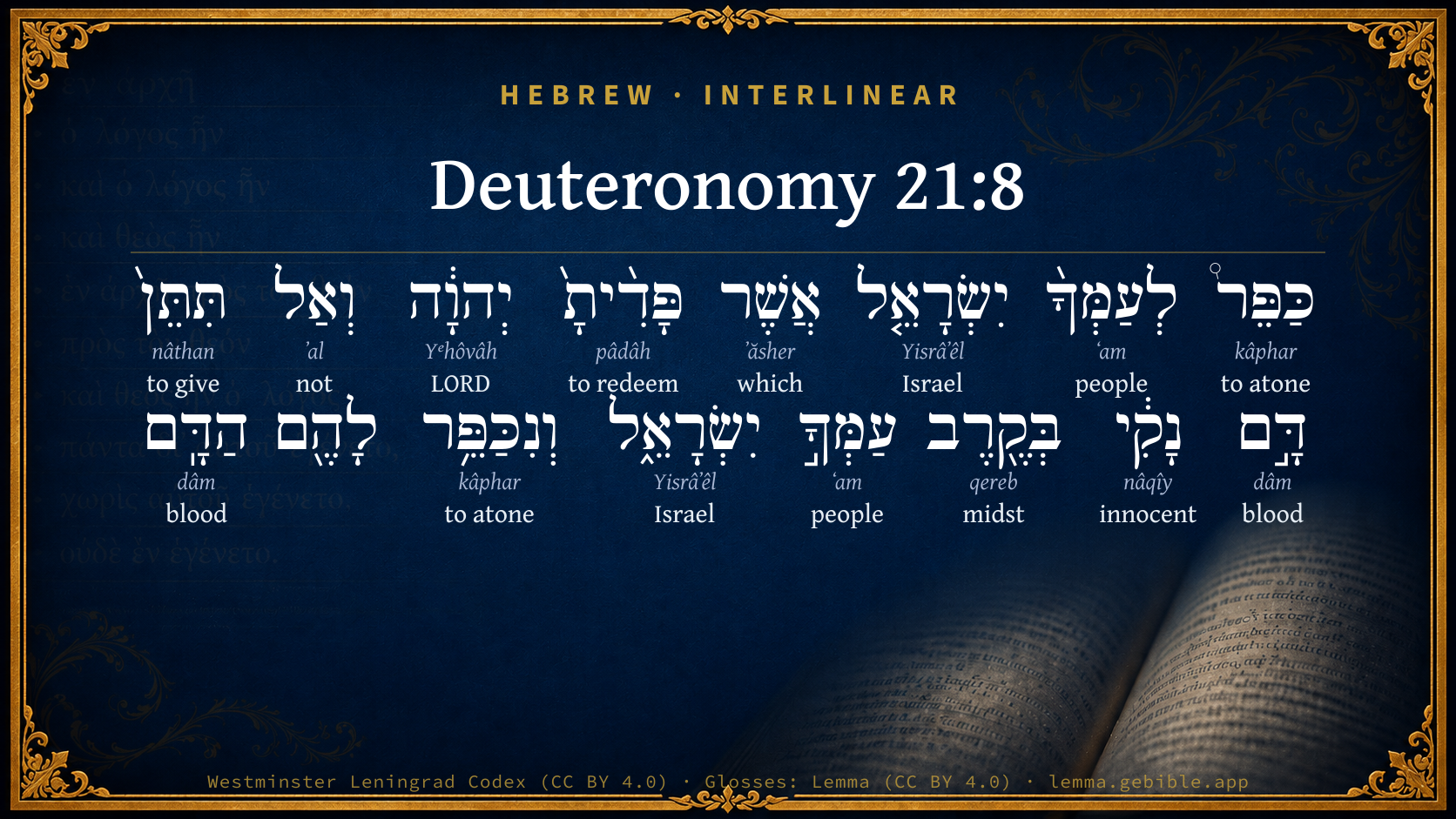
  1. כַּפֵּר֩ kâphar H3722 “atone” Verb, Piel, Imperative, 2nd Person, Masculine, Singular
  2. לְעַמְּךָ֨ ʻam H5971 “to/for · people · your” Preposition + Noun, Common, Masculine, Singular, Construct + Suffix, Personal, 2nd Person, Masculine, Singular
  3. יִשְׂרָאֵ֤ל Yisrâʼêl H3478 “Israel” Noun, Proper
  4. אֲשֶׁר ʼăsher H834 “which” Particle, Relative
  5. פָּדִ֨יתָ֙ pâdâh H6299 “to redeem” Verb, Qal, Perfect, 2nd Person, Masculine, Singular
  6. יְהוָ֔ה Yᵉhôvâh H3068 “LORD” Noun, Proper
  7. וְאַל ʼal H408 “and · not” Conjunction + Particle, Negative
  8. תִּתֵּן֙ nâthan H5414 “to give” Verb, Qal, Jussive, 2nd Person, Masculine, Singular
  9. דָּ֣ם dâm H1818 “blood” Noun, Common, Masculine, Singular, Absolute
  10. בְּקֶ֖רֶב qereb H7130 “in/at · midst of” Preposition + Noun, Common, Masculine, Singular, Construct
  11. עַמְּךָ֣ ʻam H5971 “people · your” Noun, Common, Masculine, Singular, Construct + Suffix, Personal, 2nd Person, Masculine, Singular
  12. יִשְׂרָאֵ֑ל Yisrâʼêl H3478 “Israel” Noun, Proper
  13. וְנִכַּפֵּ֥ר kâphar H3722 “and · to atone” Conjunction + Verb, Nithpael, Sequential Perfect, 3rd Person, Masculine, Singular
  14. הַדָּֽם dâm H1818 “the · blood” Particle, Definite Article + Noun, Common, Masculine, Singular, Absolute

About this verse

These counts appear in no published source. They are computed here, from the morphology-tagged text and Lemma’s own curated glosses. What Lemma adds →

16
words
11
distinct lemmas
Pentateuch
section

Shared distinctive vocabulary

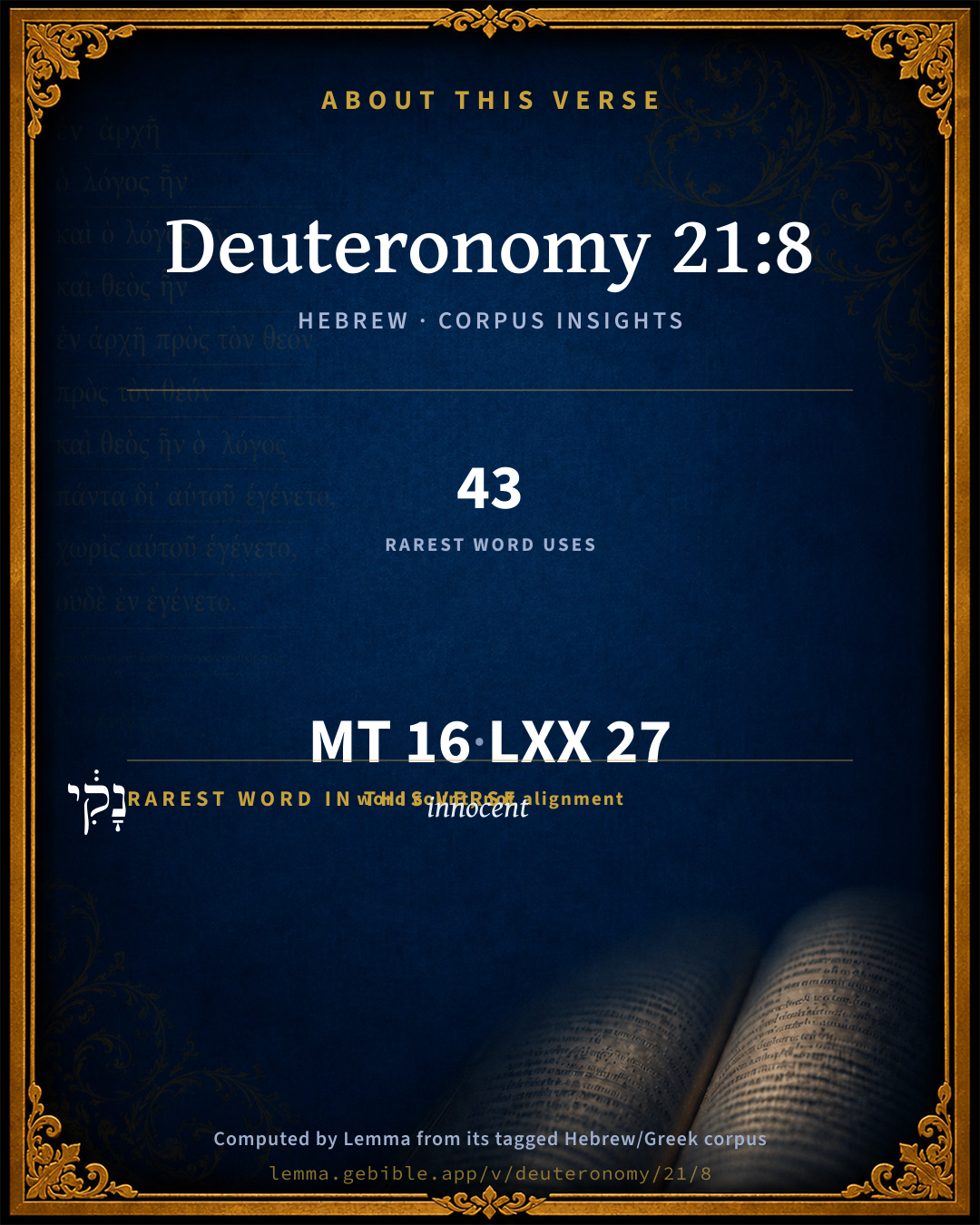
נָקִ֔י innocent H5355 occurs in 42 verses of the Hebrew Bible. Also found in:

Grammatical profile

  • 4 verbs
  • 8 nouns
  • 1 adjective
  • 1 preposition
  • 2 particles

Verb forms

  • כַּפֵּר֩ Piel · Imperative
  • פָּדִ֨יתָ֙ Qal · Perfect
  • תִּתֵּן֙ Qal · Jussive
  • וְנִכַּפֵּ֥ר Nithpael · Sequential Perfect

Repetition

Words recur within this verse — often emphatic in Hebrew:

  • כַּפֵּר֩ to atone H3722 ×2
  • לְעַמְּךָ֨ people H5971 ×2
  • יִשְׂרָאֵ֤ל Israel H3478 ×2
  • דָּ֣ם blood H1818 ×2

Hebrew & Septuagint length

In English translation the verse runs 29 words from the Hebrew and 32 from the Septuagint (LXX English) — closely comparable.

A rough comparison of the two English renderings, which tokenize alike — not a word-level alignment.

Word counts can differ between the Hebrew and the Greek without any difference in meaning — e.g. the Hebrew direct-object marker אֵת has no separate Greek word, and Greek often adds the article ὁ.

In the original languages it is 16 Hebrew tokens and 27 Greek tokens — but the two are counted differently (Hebrew bundles its prefixes and suffixes into one token; the Greek is in lemma form), so that isn’t a like-for-like length.

Cross-references

10

Topical passages linked to Deuteronomy 21:8 in the Treasury of Scripture Knowledge — connected by theme and wording, ordered by reader-vote popularity; previews shown in the World English Bible.

  • Jonah 1:14 Therefore they cried to Yahweh, and said, "We beg you, Yahweh, we beg you, let us not perish for this man's life, and don't lay on us innocent blood; for you, Yahweh, have done as it pleased you."
  • Numbers 35:33–34 So you shall not pollute the land in which you are: for blood, it pollutes the land; and no expiation can be made for the land for the blood that is shed therein, but by the blood of him who shed it.
  • 2 Samuel 3:28 Afterward, when David heard it, he said, I and my kingdom are guiltless before Yahweh forever of the blood of Abner the son of Ner:
  • 2 Kings 24:4 and also for the innocent blood that he shed; for he filled Jerusalem with innocent blood: and Yahweh would not pardon.
  • Psalms 19:12 Who can discern his errors? Forgive me from hidden errors.
  • Jeremiah 26:15 Only know for certain that, if you put me to death, you will bring innocent blood on yourselves, and on this city, and on the inhabitants of it; for of a truth Yahweh has sent me to you to speak all these words in your ears.
  • Ezekiel 23:3 and they played the prostitute in Egypt; they played the prostitute in their youth; there were their breasts pressed, and there was handled the bosom of their virginity.
  • Ezekiel 23:24–25 They shall come against you with weapons, chariots, and wagons, and with a company of peoples; they shall set themselves against you with buckler and shield and helmet round about; and I will commit the judgment to them, and they shall judge you according to their judgments.
  • Matthew 23:35 that on you may come all the righteous blood shed on the earth, from the blood of righteous Abel to the blood of Zachariah son of Barachiah, whom you killed between the sanctuary and the altar.
  • 1 Thessalonians 2:15–16 who killed both the Lord Jesus and their own prophets, and drove us out, and didn't please God, and are contrary to all men;

Cross-references courtesy of OpenBible.info (CC BY 4.0).

Hebrew and Greek witnesses Masoretic Hebrew ↔ Greek Septuagint

The same verse in the two great witnesses to the Old Testament, shown verse-for-verse.

These are two independent witnesses, not word-aligned to each other, and the Septuagint is shown in lemma (dictionary) form.

Hebrew Deuteronomy 21:8 Masoretic · Westminster Leningrad Codex

כַּפֵּר֩ לְעַמְּךָ֨ יִשְׂרָאֵ֤ל אֲשֶׁר פָּדִ֨יתָ֙ יְהוָ֔ה וְאַל תִּתֵּן֙ דָּ֣ם נָקִ֔י בְּקֶ֖רֶב עַמְּךָ֣ יִשְׂרָאֵ֑ל וְנִכַּפֵּ֥ר לָהֶ֖ם הַדָּֽם

Forgive, Yahweh, your people Israel, whom you have redeemed, and don't allow innocent blood [to remain] in the midst of your people Israel. The blood shall be forgiven them.

World English Bible · Public Domain

Greek LXX Deuteronomy 21:8 Septuagint · lemma form

ἵλεως γίγνομαι ὁ λαός σύ ἰσραήλ ὅς λυτρόω κύριος ἐκ γῆ αἴγυπτος ἵνα μή γίγνομαι αἷμα ἀναίτιος ἐν ὁ λαός σύ ἰσραήλ καί ἱλάσκομαι αὐτός ὁ αἷμα

Be merciful to your people Israel, whom you have redeemed, O Lord, that innocent blood may not be charged on your people Israel: and the blood shall be atoned for to them.

LXX2012 (modern English Septuagint) · Public Domain

Hebrew: Westminster Leningrad Codex (CC BY 4.0). Greek: Septuagint (public domain); English from LXX2012 (modern English Septuagint) (Public Domain). How the Septuagint differs from the Hebrew →

Targum (Aramaic paraphrase)

2

The Targum is the ancient Jewish Aramaic paraphrase of the Hebrew Scriptures — an interpretive translation, not the Hebrew text itself. Onkelos (literal) and Pseudo-Jonathan (expansive) render the Torah, and Jonathan the Prophets. Coverage is partial: where no permissively-licensed English translation exists for a verse, only the Aramaic is shown. This is verse-level text, not a word-by-word alignment to the Hebrew.

  1. Targum Onkelos Torah (Genesis–Deuteronomy)
    כָּהֲנַיָא יֵימְרוּן כַּפַּר לְעַמָךְ יִשְׂרָאֵל דִי פְרַקְתָּא יְיָ וְלָא תִתֵּן חוֹבַת דַם זַכַּי בְּגוֹ עַמָךְ יִשְׂרָאֵל וְיִתְכַּפַּר לְהוֹן עַל דְמָא

    (no public-domain English translation for this verse)

    Targum Onkelos — Aramaic: “Onkelos Genesis” (public domain); “Onkelos Exodus” (public domain); “Onkelos Leviticus” (public domain); “Onkelos Numbers” (public domain); “Onkelos Deuteronomy” (public domain). English: “Sefaria Community Translation” (CC0 1.0 (public-domain dedication)); “J.W. Etheridge. The Targums of Onkelos and Jonathan Ben Uzziel on the Pentateuch. London: Longmans, Green, 1862” (public domain). Text via Sefaria.

  2. Targum Pseudo-Jonathan Torah (Genesis–Deuteronomy)
    כַּהֲנַיָא יֵימְרוּן כַּפֵּר לְעַמָךְ יִשְרָאֵל דִּפְרַקְתָּא יְיָ וְלָא תְשַׁוֵי חוֹבַת אֲדַם זַכְּאַי בְּגוֹ עַמָּךְ יִשְרָאֵל וּגְלֵי מַן קַטְלֵיהּ וְיִתְכַּפֵּר לְהוֹן עַל דְּמָא וּמִן יַד נַפְקִין נְחִיל דְּמוֹרָנִין מִגוֹ פָּרָתָא דְעֶגְלְתָא נַגְדִין וְאָזְלִין עַד אַתְרָא דְקָטוֹלָא תַמָּן וְסַלְקִין עֲלוֹי וְאַחֲדִין בֵּי דִינָא יָתֵיהּ וְדַיְינִין יָתֵיהּ

    And the priests shall say: Let there be expiation for thy people Israel, whom Thou, O Lord, hast redeemed, and lay not the guilt of innocent blood upon Thy people Israel; but let him who hath done the murder be revealed. And they shall be expiated concerning the blood; but straightway there will come forth a swarm of worms from the excrement of the heifer, and spread abroad, and move to. the place where the murderer is, and crawl over him: and the magistrates shall take him, and judge him.

    Targum Pseudo-Jonathan — Aramaic: “Targum Jonathan on Genesis” (public domain); “Targum Jonathan on Exodus” (public domain); “Targum Jonathan on Leviticus” (public domain); “Targum Jonathan on Numbers” (public domain); “Targum Jonathan on Deuteronomy” (public domain). English: “The Targum of Jonathan ben Uzziel, trans. J. W. Etheridge, London, 1862” (public domain). Text via Sefaria.

Commentary

Notes on Deuteronomy 21:8 from classic Christian and Jewish commentators (each source and its license shown beneath its notes). The classic Christian expositions comment on the surrounding passage and are grouped to its opening verse, so a note may address several verses; the Jewish commentaries on the Tanakh (Rashi and others) are per-verse, so they appear only where the commentator wrote on this verse.

Lemma curates 59 commentaries, every one of them public domain or Creative Commons licensed, each selected and text-cleaned for this edition rather than reprinted as found. About our sources →

Trapp's Complete Commentary

John Trapp

Deu 21:8 Be merciful, O LORD, unto thy people Israel, whom thou hast redeemed, and lay not innocent blood unto thy people of Israel’s charge. And the blood shall be forgiven them.

Ver. 8. And the blood shall be forgiven.] The fault of not well watching and guarding the place where the murder was committed. Our King Alfred was the first that divided this kingdom into shires: he ordained also that his subjects should be divided into tens or tithings, every of which severally should give bond for the good abearing of each other. By this course men were not only careful of their own actions, but each had an eye to all the nine, for which he stood bound, as the nine had over him: insomuch that a poor girl might travel safely with a bag of gold in her hand, and none durst meddle with her. The ancientest of these men were called the tithing men.

John Trapp, A Commentary or Exposition upon All the Books of the Old and New Testament (1647–1656) — public domain. Text from a community e-Sword module.

Geneva Bible (1599)

Geneva Bible translators

This was the prayer, which the Priests made in the audience of the people.

Geneva Bible (1599) marginal notes — public domain. Text via Bolls.life.

The Cambridge Bible for Schools and Colleges

gen. ed. J. J. S. Perowne

8. Forgive] the meaning of this technical term, kipper, is usually taken either from the Ar. form = to cover, or the Syr. = to wipe away, the latter being also its meaning in Assyr. (Zimmern in KAT3[144], 601, 650). See Driver’s note here.

[144] Die Keilinschriften und das AIte Testament, 3rd edition (1903), by H. Zimmern and H. Winckler.

whom thou hast redeemed] In the Hex. peculiar to D, see on Deu_7:8.

suffer] Heb. give, i.e. appoint, attach or impute.

thy people Israel] The guilt of such a crime affected not only the people of the commune where it was committed but all Israel (cp. Num_35:33). Was this idea in the original law, or added by D? Apparently D’s addition begins with the opening of the next v.

The Cambridge Bible for Schools and Colleges (gen. ed. J. J. S. Perowne; Cambridge University Press, 1878–1918) — public domain. Text from a community e-Sword module.

John Gill's Exposition

Be merciful, O Lord, to thy people Israel, whom thou hast redeemed,.... Out of Egyptian bondage, and claimed as his own; and therefore it is requested he would be favourable to them, and show them mercy, and not punish them for a sin they were entirely ignorant of, though done by some one among them, whom as yet they could not discover. The words seem to be the words of the elders continued, who having made a declaration of their innocence, humbly request mercy of God, not only for themselves, but for all the people of Israel; yet, both the Targums of Onkelos and Jonathan take them to be the words of the priests, and so does Jarchi, and the same is affirmed in the Misnah (z):

and lay not innocent blood unto thy people of Israel's charge; impute not the guilt of innocent blood to a people in general, when only a single person, and he unknown, is chargeable with it: or put it not "in the midst" of thy people; let it not be placed to the whole, because it cannot be found out whose it is, though it is certain it is one in the midst of them:

and the blood shall be forgiven them; that is, God will not impute it, and place it to their account, or lay it to their charge; but will graciously consider the beheading of the heifer as an expiation of it: it is said in the Misnah (a),"if the murderer is found before the heifer is beheaded, it goes forth and feeds among the herd; but if after it is beheaded, it is buried in the same place; and again, if the heifer is beheaded, and after that the murderer is found, he shall be slain;''so the Targums, and Jarchi on the next verse.

(z) Ut supra. (Sotah. c. 9. sect. 5.) (a) Hilchot Rotzeach, c. 9. sect. 7.

John Gill's Exposition of the Whole Bible (1746–1763) — public domain (CC PDM 1.0). Text via the HelloAO Bible API.

Matthew Poole's English Annotations

i.e. Not imputed to them, nor punished in them; for God is sometimes said to

forgive when he doth not punish, as Psa 78:38. Besides, though there was no mortal guilt in this people, yet there was a ceremonial uncleanness in the land, which was to be expiated and forgiven.

Matthew Poole's English Annotations on the Holy Bible (1683–1685) — public domain. Text from a community e-Sword/MySword module.

John Wesley's Explanatory Notes

Forgiven - Though there was no mortal guilt in this people, yet there was a ceremonial uncleanness in the land, which was to be expiated and forgiven.

John Wesley, Explanatory Notes Upon the Whole Bible (1754–1765) — public domain. Text via the GEBible commentary corpus.

Scofield Reference Notes

C. I. Scofield

Israel

(See Scofield "Exo 14:30").

The Scofield Reference Bible (1917 edition), notes by C. I. Scofield — public domain. Text from a community e-Sword module.

unfoldingWord translationNotes

Door43 World Missions Community

General Information:

Moses continues to tell the elders what they should say when they wash their hands over the heifer. He speaks to them as if he were speaking to one man, so the words "you" and "your" are singular. (See: Forms of You)

whom you have redeemed

Yahweh rescuing the people of Israel from being slaves in Egypt is spoken of as if Yahweh paid money to redeem his people from slavery. (See: Metaphor)

do not put guilt for innocent bloodshed in the midst of your people Israel

This is an idiom. AT: "do not treat your people Israel as if they are guilty of killing an innocent person" (See: Idiom)

Then the bloodshed will be forgiven them

This can be stated in active form. AT: "Then Yahweh will forgive his people Israel for the death of an innocent person" (See: Active or Passive)

you will put away the innocent blood from your midst

"you will not be guilty any more of killing an innocent person"

what is right in the eyes of Yahweh

The eyes represent seeing, and seeing represents thoughts or judgment. AT: "what is right in Yahweh's judgment" or "what Yahweh considers to be right" (See: Metaphor)

translationWords

forgive

Israel

redeem

guilt

innocent

bloodshed

blood

unfoldingWord translationNotes — © Distant Shores Media and the Door43 World Missions Community, licensed CC BY-SA 4.0. Source: git.door43.org/Door43/en_tn.

Rashi

Rabbi Shlomo Yitzchaki (Rashi)

ונכפר להם הדם AND THE BLOOD SHALL BE PARDONED THEM — Scripture announces to them that when they have done this (the ceremony prescribed) their sin will be forgiven (Sotah 46a).

Rashi on the Tanakh — English translations: “The Judaica Press complete Tanach with Rashi, translated by A. J. Rosenberg” (CC BY 4.0); “Pentateuch with Rashi's commentary by M. Rosenbaum and A.M. Silbermann, 1929-1934” (public domain); “The Metsudah Tanach series, Lakewood, N.J” (CC BY 4.0); and “The Book of Joshua, Metsudah Publications, 1997” (CC BY 4.0). Text via Sefaria.

Lesson kit

Teaching starters — assembled from the data on this page, not authored interpretation. Every prompt links to the verse data it draws on. Edit before teaching.

Deuteronomy, in the Pentateuch, opens this verse with 16 words (11 distinct Hebrew lemmas). Its most distinctive word is nâqîy (“innocent”). A historical commentator’s framing appears above. Read the whole chapter for the surrounding context.

Discussion questions

  1. How does “innocent” (nâqîy) shape what this verse is saying?
  2. Genesis 24:41 shares the word «innocent» with this verse. How do the two illuminate each other?
  3. “to atone” occurs 2× in this one verse. What is the effect of the repetition?
  4. These translations render this verse differently. What is at stake in choosing one wording over another?
  5. The verb «כַּפֵּר֩» is Piel Imperative. How does its form color the action?
  6. Reading how Trapp's Complete Commentary and Geneva Bible (1599) read this verse, where do the two commentators agree and where do they part?

Things to notice

Reading settings

Reading text

Shown beneath each verse's original-language words.

Old Testament
Old Testament edition

Read the OT as the Masoretic Hebrew (MT) or the Greek Septuagint (LXX).

English shown for the Greek Septuagint (in the Hebrew ↔ Greek comparison).

Comparing translations? Open the Compare panel on any verse page to stack up to four side by side.