2 Kings 2:18

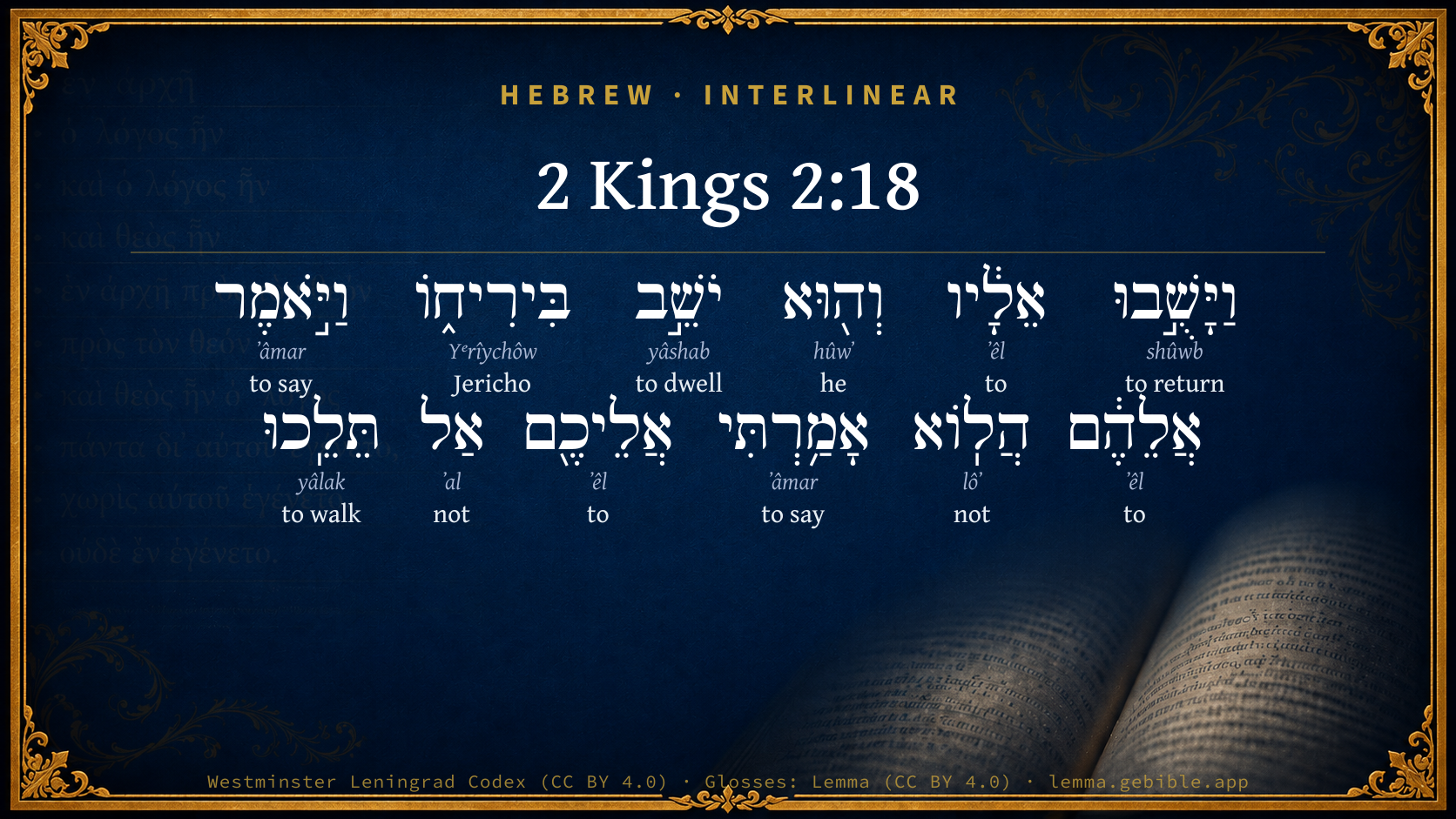
Hebrew (Westminster Leningrad Codex) 2 Kings 2:18 appears in the Hebrew Old Testament. The text above is from the Westminster Leningrad Codex. Each word links to its Strong’s number, a concise gloss, and parsing drawn from the Open Scriptures Hebrew Bible morphology. Click any word for its full Brown-Driver-Briggs (BDB) entry.
Download image
Cite this verse

2 Kings 2:18 (World English Bible). Public Domain. Lemma interlinear Bible study tool, https://lemma.gebible.app/v/2-kings/2/18.

Show BibTeX & RIS
BibTeX
RIS
English Translation
They came back to him, while he stayed at Jericho; and he said to them, "Didn't I tell you, 'Don't go?'"
World English Bible · Public Domain
Download a study sheet

One document with this verse’s original text, its word-by-word gloss line, the meaning frame, cross-references with their text, attributed commentary, and full source and license credits — printable, and it pastes into notes with its structure intact.

This verse Autodidact and up

Study sheet (.html) Plain text (.txt)

A passage Seminary Student

Up to 50 verses in one chapter. A passage sheet keeps up to 6 commentary sources and 12 cross-references per verse, in the order this page ranks them, and says so on the sheet whenever that leaves anything out. Ask for a single verse and you get the Autodidact verse sheet above.

Everything on this page stays free to read, with no account — the sheet is a download of what is already on screen, not access to it.

Want to remove ads? Support Godless Engineer
Compare translations 3

The same verse in 3 English versions, stacked beneath the original-language interlinear above. Click any original word for its lexicon entry.

Each is an independent rendering of the whole verse — the interlinear is not word-aligned to these translations.

Highlighted words mark where these versions differ — a whole-verse word diff, not a word-by-word alignment.

  • World English Bible Public Domain
    They came back to him, while he stayed at Jericho; and he said to them, "Didn't I tell you, 'Don't go?'"
  • King James Version Public Domain
    And when they came again to him, (for he tarried at Jericho,) he said unto them, Did I not say unto you, Go not?
  • unfoldingWord Literal Text CC BY-SA 4.0
    And they returned to him (and he was staying in Jericho), and he said to them, “Did I not say to you, ‘Do not go’?”

unfoldingWord Literal Text — © unfoldingWord, licensed CC BY-SA 4.0. Word-aligned USFM3 via Door43 (git.door43.org/unfoldingWord/en_ult).

Versions to compare (up to 4)

3 of 4 selected

Show all 18 translations

Every available English version of this verse, each an independent rendering of the whole verse.

  • World English Bible Public Domain
    They came back to him, while he stayed at Jericho; and he said to them, "Didn't I tell you, 'Don't go?'"
  • Berean Standard Bible Public Domain
    When they returned to Elisha, who was staying in Jericho, he said to them, “Didn’t I tell you not to go?”
  • Majority Standard Bible Public Domain
    When they returned to Elisha, who was staying in Jericho, he said to them, “Didn’t I tell you not to go?”
  • King James Version Public Domain
    And when they came again to him, (for he tarried at Jericho,) he said unto them, Did I not say unto you, Go not?
  • American Standard Version (1901) Public Domain
    And they came back to him, while he tarried at Jericho; and he said unto them, Did I not say unto you, Go not?
  • Revised Version (1885) Public Domain
    And they came back to him, while he tarried at Jericho; and he said unto them, Did I not say unto you, Go not?
  • Geneva Bible (1599) Public Domain
    Therefore they returned to him, (for he taryed at Iericho) and he said vnto them, Did not I say vnto you, Goe not?
  • Douay-Rheims (1899) Public Domain
    And they came back to him: for he abode at Jericho, and he said to them: Did I not say to you: Do not send?
  • Young's Literal Translation Public Domain
    and they turn back unto him -- and he is abiding in Jericho -- and he saith unto them, `Did I not say unto you, Do not go?'
  • Literal Standard Version CC BY-SA 4.0
    and they return to him—and he is abiding in Jericho—and he says to them, “Did I not say to you, Do not go?”
  • Unlocked Literal Bible CC BY-SA 4.0
    They came back to Elisha, while he stayed at Jericho, and he said to them, “Did I not say to you, 'Do not go'?”
  • unfoldingWord Literal Text CC BY-SA 4.0
    And they returned to him (and he was staying in Jericho), and he said to them, “Did I not say to you, ‘Do not go’?”
  • Darby Bible Public Domain
    And they came again to him (now he was staying at Jericho); and he said to them, Did I not say to you, Go not?
  • World Messianic Bible Public Domain
    They came back to him while he stayed at Jericho; and he said to them, “Didn’t I tell you, ‘Don’t go’?”
  • Webster's Bible Public Domain
    And when they came again to him, (for he tarried at Jericho,) he said to them, Did I not say to you, Go not?
  • Free Bible Version CC BY-SA 4.0
    When they returned to Elisha, who was staying in Jericho, he said to them, “Didn't I tell you not to bother going?”
  • Bible in Basic English Public Domain
    And they came back to him, while he was still at Jericho; and he said to them, Did I not say to you, Go not?
  • JPS Tanakh (1917) Public Domain
    And they came back to him, while he tarried at Jericho; and he said unto them: 'Did I not say unto you: Go not?'

Literal Standard Version (2020), Covenant Press — licensed CC BY-SA 4.0. Text via the HelloAO Bible API (eBible.org). Unlocked Literal Bible (unfoldingWord) — licensed CC BY-SA 4.0. Text via the HelloAO Bible API (eBible.org). unfoldingWord Literal Text — © unfoldingWord, licensed CC BY-SA 4.0. Word-aligned USFM3 via Door43 (git.door43.org/unfoldingWord/en_ult). Free Bible Version, Dr. Jonathan Gallagher — licensed CC BY-SA 4.0. Text via the HelloAO Bible API (eBible.org).

Word by word

More ways to search: Search by grammar → Find every occurrence → Compare this word →

Practice this passage: Drill this verse → Learn its vocabulary →

בִּירִיח֑וֹ
Yᵉrîychôw
H3405
“in/at · Jericho”
Preposition + Noun, Proper
Part of Speech
Preposition + Noun
Type
Proper
Full BDB Definition

Origin: perhaps from H3394

TWOT: 915

Jericho = "its moon" - a city 5 miles (8 kilometers) west of the Jordan and 7 miles (11.5 kilometers) north of the Dead Sea and the first city conquered by the Israelites upon entering the promised land of Canaan
  1. וַיָּשֻׁ֣בוּ shûwb H7725 “and · to return” Conjunction + Verb, Qal, Sequential Imperfect, 3rd Person, Masculine, Plural
  2. אֵלָ֔יו ʼêl H413 “to · him” Preposition + Suffix, Personal, 3rd Person, Masculine, Singular
  3. וְה֖וּא hûwʼ H1931 “and · he” Conjunction + Pronoun, Personal, 3rd Person, Masculine, Singular
  4. יֹשֵׁ֣ב yâshab H3427 “dwelling” Verb, Qal, Participle Active, Masculine, Singular, Absolute
  5. וַיֹּ֣אמֶר ʼâmar H559 “and · to say” Conjunction + Verb, Qal, Sequential Imperfect, 3rd Person, Masculine, Singular
  6. אֲלֵהֶ֔ם ʼêl H413 “to · them” Preposition + Suffix, Personal, 3rd Person, Masculine, Plural
  7. הֲלֽוֹא lôʼ H3808 “not” Particle, Interrogative + Particle, Negative
  8. אָמַ֥רְתִּי ʼâmar H559 “to say” Verb, Qal, Perfect, 1st Person, Common, Singular
  9. אֲלֵיכֶ֖ם ʼêl H413 “to · you” Preposition + Suffix, Personal, 2nd Person, Masculine, Plural
  10. אַל ʼal H408 “not” Particle, Negative
  11. תֵּלֵֽכוּ yâlak H3212 “to walk” Verb, Qal, Jussive, 2nd Person, Masculine, Plural

About this verse

These counts appear in no published source. They are computed here, from the morphology-tagged text and Lemma’s own curated glosses. What Lemma adds →

12
words
9
distinct lemmas
Historical
section

Shared distinctive vocabulary

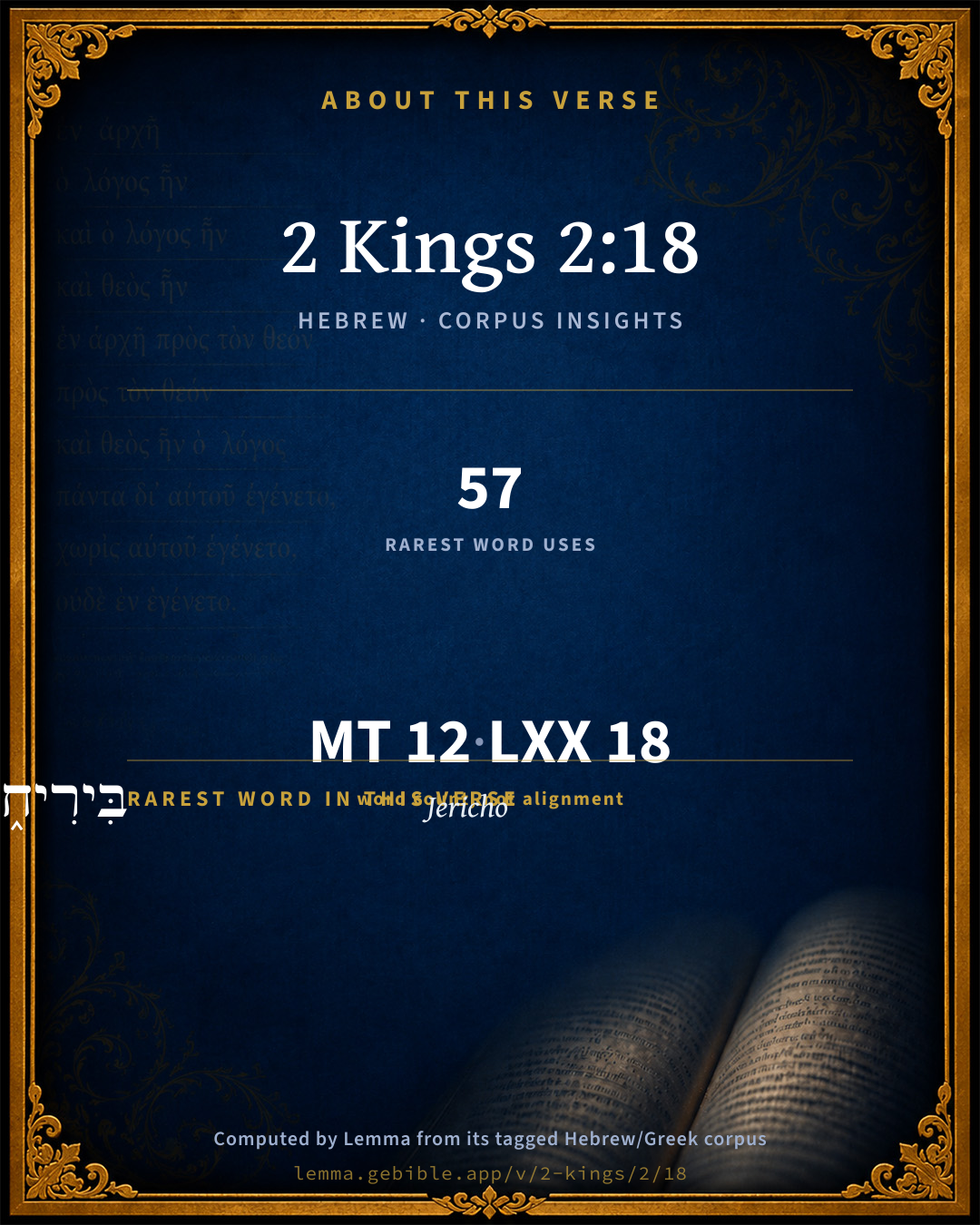
בִּירִיח֑וֹ Jericho H3405 occurs in 53 verses of the Hebrew Bible. Also found in:

Grammatical profile

  • 5 verbs
  • 1 noun
  • 1 pronoun
  • 3 prepositions
  • 2 particles

Verb forms

  • וַיָּשֻׁ֣בוּ Qal · Sequential Imperfect
  • יֹשֵׁ֣ב Qal · Participle Active
  • וַיֹּ֣אמֶר Qal · Sequential Imperfect
  • אָמַ֥רְתִּי Qal · Perfect
  • תֵּלֵֽכוּ Qal · Jussive

Repetition

Words recur within this verse — often emphatic in Hebrew:

  • וַיֹּ֣אמֶר to say H559 ×2
  • אֵלָ֔יו to H413 ×3

Hebrew & Septuagint length

In English translation the verse runs 21 words from the Hebrew and 21 from the Septuagint (LXX English) — the same length.

A rough comparison of the two English renderings, which tokenize alike — not a word-level alignment.

Word counts can differ between the Hebrew and the Greek without any difference in meaning — e.g. the Hebrew direct-object marker אֵת has no separate Greek word, and Greek often adds the article ὁ.

In the original languages it is 12 Hebrew tokens and 18 Greek tokens — but the two are counted differently (Hebrew bundles its prefixes and suffixes into one token; the Greek is in lemma form), so that isn’t a like-for-like length.

Hebrew and Greek witnesses Masoretic Hebrew ↔ Greek Septuagint

The same verse in the two great witnesses to the Old Testament, shown verse-for-verse.

These are two independent witnesses, not word-aligned to each other, and the Septuagint is shown in lemma (dictionary) form.

Hebrew 2 Kings 2:18 Masoretic · Westminster Leningrad Codex

וַיָּשֻׁ֣בוּ אֵלָ֔יו וְה֖וּא יֹשֵׁ֣ב בִּירִיח֑וֹ וַיֹּ֣אמֶר אֲלֵהֶ֔ם הֲלֽוֹא אָמַ֥רְתִּי אֲלֵיכֶ֖ם אַל תֵּלֵֽכוּ

They came back to him, while he stayed at Jericho; and he said to them, "Didn't I tell you, 'Don't go?'"

World English Bible · Public Domain

Greek LXX 2 Kings 2:18 Septuagint · lemma form

καί ἀναστρέφω πρός αὐτός καί αὐτός καταἧμαι ἐν ιεριχω καί εἶπον ελισαιε οὐ εἶπον πρός σύ μή πορεύομαι

And they returned to him, for he lived in Jericho: and Elisaie said, Did I not say to you, Go not?

LXX2012 (modern English Septuagint) · Public Domain

Hebrew: Westminster Leningrad Codex (CC BY 4.0). Greek: Septuagint (public domain); English from LXX2012 (modern English Septuagint) (Public Domain). How the Septuagint differs from the Hebrew →

Targum (Aramaic paraphrase)

1

The Targum is the ancient Jewish Aramaic paraphrase of the Hebrew Scriptures — an interpretive translation, not the Hebrew text itself. Onkelos (literal) and Pseudo-Jonathan (expansive) render the Torah, and Jonathan the Prophets. Coverage is partial: where no permissively-licensed English translation exists for a verse, only the Aramaic is shown. This is verse-level text, not a word-by-word alignment to the Hebrew.

  1. Targum Jonathan Prophets (Joshua–Malachi)
    וְתָבוּ לְוָתֵיהּ וְהוּא יָתֵיב בִּירִיחוֹ וַאֲמַר לְהוֹן הֲלָא אֲמַרִית לְכוֹן לָא תֵיזְלוּן:

    (no public-domain English translation for this verse)

    Targum Jonathan — Aramaic: “Mikraot Gedolot” (public domain). English: “Sefaria Community Translation” (CC0 1.0 (public-domain dedication)); “London "Chaldee Paraphrase," 1871” (public domain). Text via Sefaria.

Commentary

Notes on 2 Kings 2:18 from classic Christian and Jewish commentators (each source and its license shown beneath its notes). The classic Christian expositions comment on the surrounding passage and are grouped to its opening verse, so a note may address several verses; the Jewish commentaries on the Tanakh (Rashi and others) are per-verse, so they appear only where the commentator wrote on this verse.

Lemma curates 59 commentaries, every one of them public domain or Creative Commons licensed, each selected and text-cleaned for this edition rather than reprinted as found. About our sources →

Ellicott's Commentary for English Readers

(18) For he tarried.—Now he (emphatic) was abiding in Jericho (while they were searching).

Did I not say.—Or, command. Elisha could now fairly remind them of his authority. So the phrase “Go not” is, in the Hebrew, imperative. (Comp. “Ye shall not send,” 2Ki_2:16.) With these words, the history of Elijah significantly closes. “Elias resembled Moses in courage and eloquence, and no other prophet was his equal. But when he withdrew from the world, that Providence which guided the destinies of Israel did not, therefore, forsake His people. A portion of Elijah’s spirit passed to his disciples; and they are forbidden to seek their departed master in the desert: they must find among themselves the means of carrying on his work” (Reuss).

Thenius considers the entire section (2Ki_1:2 to 2Ki_2:18) to be a distinct fragment of a lost history of Elijah. Its contents, he says, betray the same poetical (?) spirit as 1 Kings 17-19.

A Bible Commentary for English Readers, edited by Charles John Ellicott (1878–1897) — public domain. Text from a community e-Sword module.

Trapp's Complete Commentary

John Trapp

2Ki 2:18 And when they came again to him, (for he tarried at Jericho,) he said unto them, Did I not say unto you, Go not?

Ver. 18. Did not I say unto you, Go not?] The uncounsellable are commonly unhappy in their attempts.

John Trapp, A Commentary or Exposition upon All the Books of the Old and New Testament (1647–1656) — public domain. Text from a community e-Sword module.

The Cambridge Bible for Schools and Colleges

gen. ed. J. J. S. Perowne

18. And when [R.V. omits when] they came again [R.V. back] to him, (for [R.V. while] he tarried at Jericho)] The alteration of the R.V. of course removes the parenthesis. The Hebrew has in both places only the conjunction usually rendered ‘And’. The two clauses are literally ‘And they came back and he was tarrying’ &c. Having acceded to their request, he waited for the return of the searching party. ‘They turn back as wise as they went. Some men are best satisfied when they have wearied themselves in their own ways. Nothing will teach them wit but disappointments’ (Bp Hall).

We cannot dismiss the history of Elijah, which is brought to a close in this chapter, without some notice of the powerful hold which that history took upon the minds of the Jewish people, and of the prominent place which the prophet fills in the writings of the New Testament. In the Old Testament Elijah is rarely mentioned except in these chapters of the books of Kings, yet from the way in which Malachi (2Ki_4:5-6) foretells his coming again we can see that the character of his mission had been fully appreciated. It was felt to be a mission suited for evil times, for times when God might be expected to come and smite the earth with a curse, if men repented not. Elijah is therefore set forth as mighty rather in works than in words. His was hardly the day for preaching. He is also, nearly always, seen to be supported by the loftiest faith, and his message is on that account attested by signs more striking than usual. On the contrary among his countrymen the decay of faith was so complete, that no work of mercy was wrought by this prophet except for a stranger, the widow of Zarephath.

The son of Sirach (Sir_48:1-12) speaks of Elijah as a fire, no unfit comparison, and of his word as a lamp. He calls him a prophet ordained for the reproof of the times in which he lived, and to pacify the wrath of the Lord’s judgement before it brake forth into fury. The day of the Lord was at hand, and his warnings were sent by a startling messenger. And although the wrath of the Almighty was not ultimately diverted from Israel, we can see how the mighty works of Elijah stirred up a more devout spirit in the land, and thus put back the day of vengeance. This influence of Elijah’s life is specially to be noted in the days of his successor. We come constantly upon evidence that even in the house of Ahab itself the prophet of the Lord was held in some esteem, while Jehovah was truly worshipped by not a few in the land, though Baal and the calves had captivated the multitude.

Hence in later days, to the mind of the pious Jew, Elijah was deemed to be ever interested in the spiritual welfare of the Lord’s people, and a place was set for him at every circumcision-service. We can see too how his ministry for help was in all men’s minds from the mistake which was made at the Crucifixion, when our Lord’s cry of agony was interpreted into a call for Elijah. That his intervention was ever expected to be salutary is testified by the language ‘Let us see whether Elijah will come and save him’. The large place which Elijah filled in the thoughts of the Jews of our Lord’s day is shewn by the mention in the New Testament of his name and his work more frequently than those of any other prophet; while both in his despondency over the evil condition of the nation (Rom_11:2) and in the mention of his effectual prayer (Jas_5:17) he is identified most closely with the people whom he so earnestly served as ‘a man subject to like passions as we are’.

For such a prophet men were looking in those evil days which preceded the coming of Christ, and from a like obscurity in the desert John the Baptist suddenly emerged in the spirit and power of Elijah (Luk_1:17) and all men recognised him as God’s prophet. ‘Art thou Elijah?’ was the first question of those who saw and heard him (Joh_1:21) and Jesus pointed out to His disciples that the office of Elijah was truly fulfilled by the Baptist (Mat_11:14).

The ‘taking up’ of Elijah was accepted by the Jews as a testimony to the doctrine of man’s immortality. ‘Blessed are they that saw thee’ … says the writer of Ecclesiasticus … ‘for we shall surely live.’ Hence the great fitness of the appearance of Elijah with Moses at our Lord’s, Transfiguration. Christ came and brought life and incorruption to light, the former by the fulfilling of the Mosaic law, the latter by taking again His body after it had lain three days dead in the grave. The discourse on the mount of Transfiguration was of the decease which He was shortly to accomplish at Jerusalem. The presence of the prophet who had long before been taken from this world by the chariots of heaven calmed the minds of the disciples concerning the coming decease, taught them that to disappear from among men was not to perish, and so prepared them in a measure to believe the Master’s promise ‘In three days the Son of Man shall rise again’. Hence at a later time they could return in joy to Jerusalem when the angel had announced that this same Jesus whom they had seen taken up, should come again in like manner as they had seen Him depart. They had seen Elijah and by that they were assured that Jesus would be sent again. Thus they became preachers of the times of refreshing when God should send Jesus, the Christ, to bless men, as Elijah in his day fain would have done, by turning them away from their iniquities.

The Cambridge Bible for Schools and Colleges (gen. ed. J. J. S. Perowne; Cambridge University Press, 1878–1918) — public domain. Text from a community e-Sword module.

John Gill's Exposition

And the men of the city said unto Elisha,.... The inhabitants of Jericho, perceiving him to be a prophet, and endowed with a power of working miracles:

behold, I pray thee, the situation of this city is pleasant, as my lord seeth; in a plain, surrounded with gardens and orchards, with vineyards, oliveyards, and groves of palm trees, and other odoriferous ones:

but the water is naught, and the ground barren; that is, that part of it where this water was, or ran, for from thence it became barren; or "caused to miscarry", as the word signifies (q); not only trees cast their fruit, which it watered, but women became abortive that drank of it, as Josephus says (r), and so cattle. Abarbinel thinks it was so from the times of Joshua, being cursed by him; but, if so, it would not have been inhabited again; rather this was owing to a new curse, upon its being rebuilt; though this might affect only a small part of the ground, not the whole, as before observed.

(q) "orbans", Montanus, Vatablus; "facit abortum", Junius & Tremellius, Piscator. (r) De Bello Jud. l. 4. c. 8. sect. 3.

John Gill's Exposition of the Whole Bible (1746–1763) — public domain (CC PDM 1.0). Text via the HelloAO Bible API.

The Pulpit Commentary

And when they came again to him, (for he tarried at Jericho,) he said unto them, Did I not say unto you, Go not? The prophet was not above vindicating the propriety of his past conduct. He waited at Jericho until the fifty men returned from their vain search, and then reminded them that his advice to them had been not to start on a useless errand. The ministers of God have to vindicate themselves, because God"s honor is concerned in their being without reproach.

The Pulpit Commentary (1880–1919), ed. H.D.M. Spence-Jones & Joseph S. Exell — public domain. Text from a community e-Sword module.

Lesson kit

Teaching starters — assembled from the data on this page, not authored interpretation. Every prompt links to the verse data it draws on. Edit before teaching.

2 Kings, in the Historical, opens this verse with 12 words (9 distinct Hebrew lemmas). Its most distinctive word is Yᵉrîychôw (“Jericho”). A historical commentator’s framing appears above. Read the whole chapter for the surrounding context.

Discussion questions

  1. How does “Jericho” (Yᵉrîychôw) shape what this verse is saying?
  2. How does Numbers 22:1, which shares the word «Jericho», read alongside this verse?
  3. What does the repetition of “to say” (2× in this one verse) do in this verse?
  4. These translations render this verse differently; the difference is in the English rendering, not the original. What questions does that raise?
  5. «וַיָּשֻׁ֣בוּ» is a Qal Sequential Imperfect verb. How does that grammatical form shape the action described?
  6. Compare how Ellicott's Commentary for English Readers and Trapp's Complete Commentary read this verse. Where do they agree or differ?

Things to notice

Reading settings

Reading text

Shown beneath each verse's original-language words.

Old Testament
Old Testament edition

Read the OT as the Masoretic Hebrew (MT) or the Greek Septuagint (LXX).

English shown for the Greek Septuagint (in the Hebrew ↔ Greek comparison).

Comparing translations? Open the Compare panel on any verse page to stack up to four side by side.