
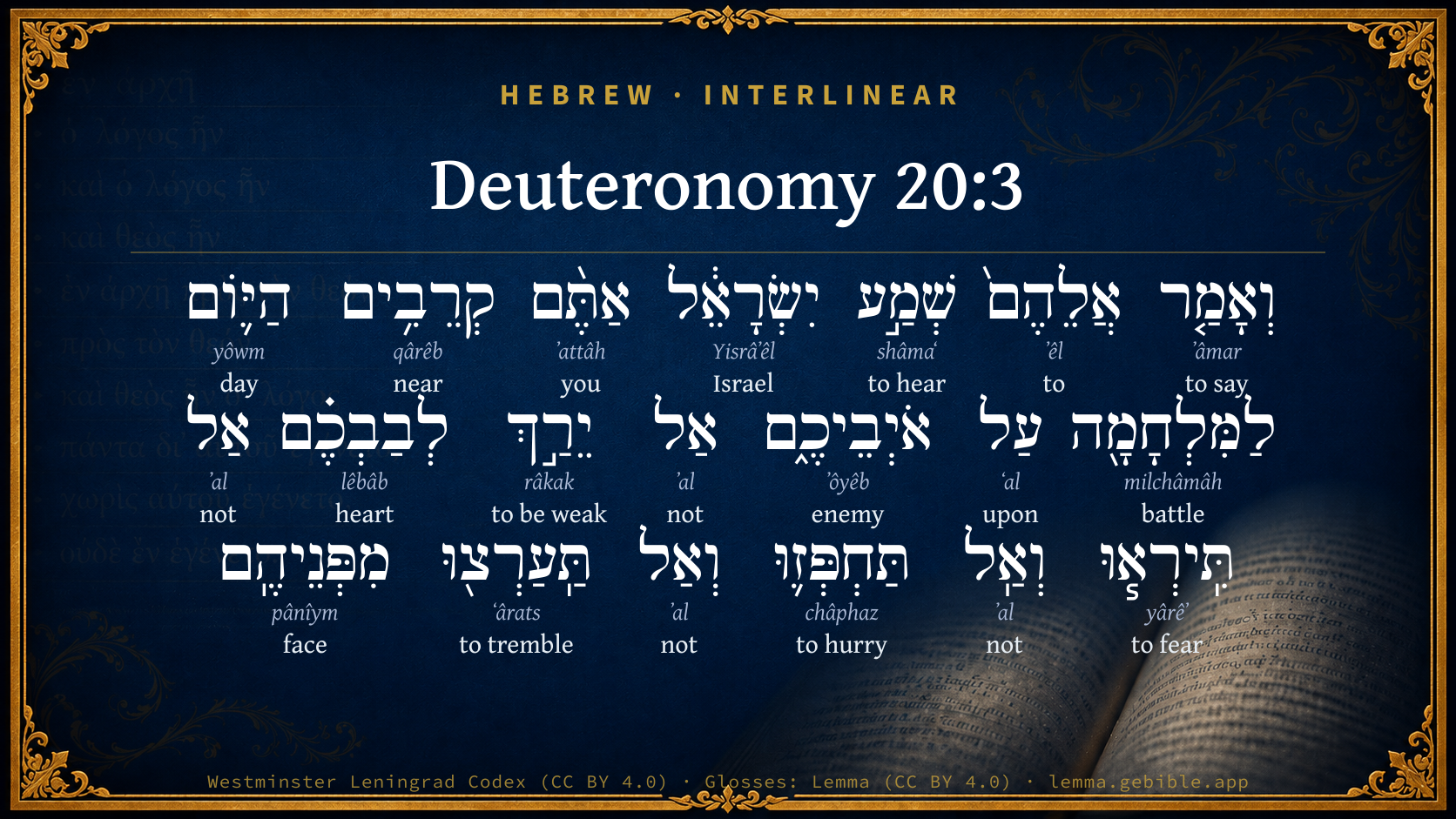
Deuteronomy 20:3

Hebrew (Westminster Leningrad Codex) Deuteronomy 20:3 appears in the Hebrew Old Testament. The text above is from the Westminster Leningrad Codex. Each word links to its Strong’s number, a concise gloss, and parsing drawn from the Open Scriptures Hebrew Bible morphology. Click any word for its full Brown-Driver-Briggs (BDB) entry.
Download image
Cite this verse

Deuteronomy 20:3 (World English Bible). Public Domain. Lemma interlinear Bible study tool, https://lemma.gebible.app/v/deuteronomy/20/3.

Show BibTeX & RIS
BibTeX
RIS
English Translation
and shall tell them, Hear, Israel, you draw near this day to battle against your enemies: don't let your heart faint; don't be afraid, nor tremble, neither be scared of them;
World English Bible · Public Domain
Highlights
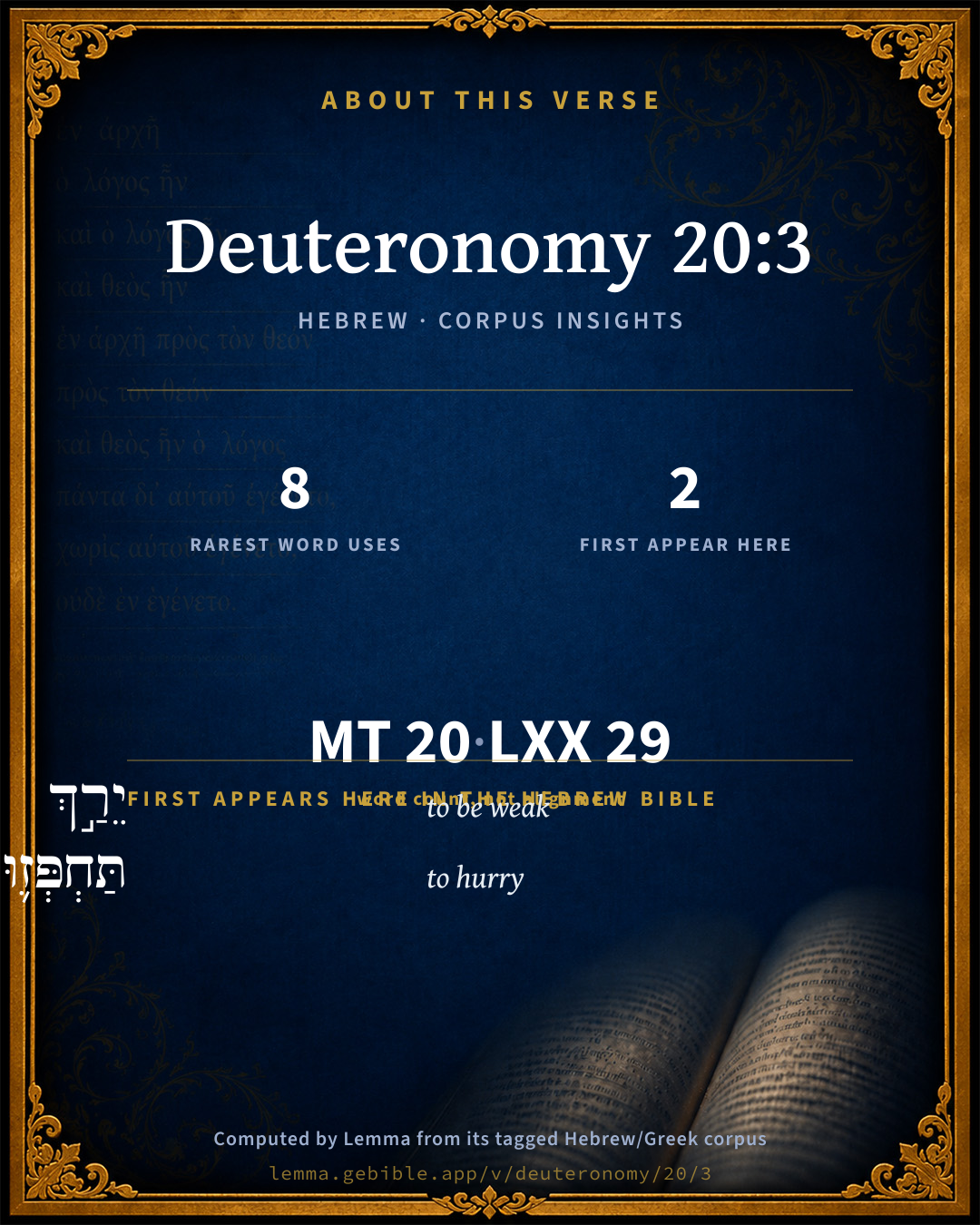
  • 2 first appearances in the Hebrew Bible
Full analysis ↓
Download a study sheet

One document with this verse’s original text, its word-by-word gloss line, the meaning frame, cross-references with their text, attributed commentary, and full source and license credits — printable, and it pastes into notes with its structure intact.

This verse Autodidact and up

Study sheet (.html) Plain text (.txt)

A passage Seminary Student

Up to 50 verses in one chapter. A passage sheet keeps up to 6 commentary sources and 12 cross-references per verse, in the order this page ranks them, and says so on the sheet whenever that leaves anything out. Ask for a single verse and you get the Autodidact verse sheet above.

Everything on this page stays free to read, with no account — the sheet is a download of what is already on screen, not access to it.

Want to remove ads? Support Godless Engineer
Compare translations 3

The same verse in 3 English versions, stacked beneath the original-language interlinear above. Click any original word for its lexicon entry.

Each is an independent rendering of the whole verse — the interlinear is not word-aligned to these translations.

Highlighted words mark where these versions differ — a whole-verse word diff, not a word-by-word alignment.

  • World English Bible Public Domain
    and shall tell them, Hear, Israel, you draw near this day to battle against your enemies: don't let your heart faint; don't be afraid, nor tremble, neither be scared of them;
  • King James Version Public Domain
    And shall say unto them, Hear, O Israel, ye approach this day unto battle against your enemies: let not your hearts faint, fear not, and do not tremble, neither be ye terrified because of them;
  • unfoldingWord Literal Text CC BY-SA 4.0
    And he shall say to them, ‘Hear, Israel, you are approaching today to battle against your enemies. You shall not soften your hearts. You shall not fear or panic or be terrified of them,

unfoldingWord Literal Text — © unfoldingWord, licensed CC BY-SA 4.0. Word-aligned USFM3 via Door43 (git.door43.org/unfoldingWord/en_ult).

Versions to compare (up to 4)

3 of 4 selected

Show all 18 translations

Every available English version of this verse, each an independent rendering of the whole verse.

  • World English Bible Public Domain
    and shall tell them, Hear, Israel, you draw near this day to battle against your enemies: don't let your heart faint; don't be afraid, nor tremble, neither be scared of them;
  • Berean Standard Bible Public Domain
    saying to them, “Hear, O Israel, today you are going into battle with your enemies. Do not be fainthearted or afraid; do not be alarmed or terrified because of them.
  • Majority Standard Bible Public Domain
    saying to them, “Hear, O Israel, today you are going into battle with your enemies. Do not be fainthearted or afraid; do not be alarmed or terrified because of them.
  • King James Version Public Domain
    And shall say unto them, Hear, O Israel, ye approach this day unto battle against your enemies: let not your hearts faint, fear not, and do not tremble, neither be ye terrified because of them;
  • American Standard Version (1901) Public Domain
    and shall say unto them, Hear, O Israel, ye draw nigh this day unto battle against your enemies: let not your heart faint; fear not, nor tremble, neither be ye affrighted at them;
  • Revised Version (1885) Public Domain
    and shall say unto them, Hear, O Israel, ye draw nigh this day unto battle against your enemies: let not your heart faint; fear not, nor tremble, neither be ye affrighted at them;
  • Geneva Bible (1599) Public Domain
    And shall say vnto them, Heare, O Israel: ye are come this day vnto battell against your enemies: let not your heartes faynt, neither feare, nor be amased, nor adread of them.
  • Douay-Rheims (1899) Public Domain
    Hear, O Israel, you join battle this day against your enemies, let not your heart be dismayed, be not afraid, do not give back, fear ye them not:
  • Young's Literal Translation Public Domain
    and said unto them, Hear, Israel, ye are drawing near to-day to battle against your enemies, let not your hearts be tender, fear not, nor make haste, nor be terrified at their presence,
  • Literal Standard Version CC BY-SA 4.0
    and said to them, Hear, O Israel: You are drawing near today to battle against your enemies, do not let your hearts be tender, do not fear, nor make haste, nor be terrified at their presence,
  • Unlocked Literal Bible CC BY-SA 4.0
    He must say to them, 'Listen, Israel, you are going to battle against your enemies. Do not let your hearts faint. Do not fear or tremble. Do not be afraid of them.
  • unfoldingWord Literal Text CC BY-SA 4.0
    And he shall say to them, ‘Hear, Israel, you are approaching today to battle against your enemies. You shall not soften your hearts. You shall not fear or panic or be terrified of them,
  • Darby Bible Public Domain
    and shall say unto them, Hear, Israel, ye are approaching this day unto battle against your enemies: let not your hearts faint, fear not, and do not tremble, neither be afraid of them;
  • World Messianic Bible Public Domain
    and shall tell them, “Hear, Israel, you draw near today to battle against your enemies. Don’t let your heart faint! Don’t be afraid, nor tremble, neither be scared of them;
  • Webster's Bible Public Domain
    And shall say to them, Hear, O Israel, ye approach this day to battle against your enemies: let not your hearts faint, fear not, and do not tremble, neither be ye terrified because of them;
  • Free Bible Version CC BY-SA 4.0
    He is to tell them, “Listen, men of Israel! Today you are going to fight your enemies. Don't be nervous or afraid; don't be panicked or terrified by them.
  • Bible in Basic English Public Domain
    Give ear, O Israel: today you are going forward to the fight; let your heart be strong; do not let uncontrolled fear overcome you because of those who are against you;
  • JPS Tanakh (1917) Public Domain
    and shall say unto them: 'Hear, O Israel, ye draw nigh this day unto battle against your enemies; let not your heart faint; fear not, nor be alarmed, neither be ye affrighted at them;

Literal Standard Version (2020), Covenant Press — licensed CC BY-SA 4.0. Text via the HelloAO Bible API (eBible.org). Unlocked Literal Bible (unfoldingWord) — licensed CC BY-SA 4.0. Text via the HelloAO Bible API (eBible.org). unfoldingWord Literal Text — © unfoldingWord, licensed CC BY-SA 4.0. Word-aligned USFM3 via Door43 (git.door43.org/unfoldingWord/en_ult). Free Bible Version, Dr. Jonathan Gallagher — licensed CC BY-SA 4.0. Text via the HelloAO Bible API (eBible.org).

Word by word

More ways to search: Search by grammar → Find every occurrence → Compare this word →

Practice this passage: Drill this verse → Learn its vocabulary →

קְרֵבִ֥ים
qârêb
H7131
“near”
Adjective, Adjective, Masculine, Plural, Absolute
Part of Speech
Adjective
Type
Adjective
Gender
Masculine
Number
Plural
State
Absolute
Full BDB Definition

Origin: from H7126

TWOT: 2065a

near, approaching
  1. וְאָמַ֤ר ʼâmar H559 “and · to say” Conjunction + Verb, Qal, Sequential Perfect, 3rd Person, Masculine, Singular
  2. אֲלֵהֶם֙ ʼêl H413 “to · them” Preposition + Suffix, Personal, 3rd Person, Masculine, Plural
  3. שְׁמַ֣ע shâmaʻ H8085 “hear” Verb, Qal, Imperative, 2nd Person, Masculine, Singular
  4. יִשְׂרָאֵ֔ל Yisrâʼêl H3478 “Israel” Noun, Proper
  5. אַתֶּ֨ם ʼattâh H859 “you” Pronoun, Personal, 2nd Person, Masculine, Plural
  6. הַיּ֛וֹם yôwm H3117 “the · day” Particle, Definite Article + Noun, Common, Masculine, Singular, Absolute
  7. לַמִּלְחָמָ֖ה milchâmâh H4421 “to/for the · battle” Preposition, Determined + Noun, Common, Feminine, Singular, Absolute
  8. עַל ʻal H5921 “upon” Preposition
  9. אֹיְבֵיכֶ֑ם ʼôyêb H341 “enemy · you” Verb, Qal, Participle Active, Masculine, Plural, Construct + Suffix, Personal, 2nd Person, Masculine, Plural
  10. אַל ʼal H408 “not” Particle, Negative
  11. יֵרַ֣ךְ râkak H7401 “to be weak” Verb, Qal, Jussive, 3rd Person, Masculine, Singular
  12. לְבַבְכֶ֗ם lêbâb H3824 “heart · your” Noun, Common, Masculine, Singular, Construct + Suffix, Personal, 2nd Person, Masculine, Plural
  13. אַל ʼal H408 “not” Particle, Negative
  14. תִּֽירְא֧וּ yârêʼ H3372 “to fear” Verb, Qal, Jussive, 2nd Person, Masculine, Plural
  15. וְאַֽל ʼal H408 “and · not” Conjunction + Particle, Negative
  16. תַּחְפְּז֛וּ châphaz H2648 “to hurry” Verb, Qal, Jussive, 2nd Person, Masculine, Plural
  17. וְאַל ʼal H408 “and · not” Conjunction + Particle, Negative
  18. תַּֽעַרְצ֖וּ ʻârats H6206 “to tremble” Verb, Qal, Jussive, 2nd Person, Masculine, Plural
  19. מִפְּנֵיהֶֽם pânîym H6440 “from · face(s) · their” Preposition + Noun, Common, Both, Plural, Construct + Suffix, Personal, 3rd Person, Masculine, Plural

About this verse

These counts appear in no published source. They are computed here, from the morphology-tagged text and Lemma’s own curated glosses. What Lemma adds →

20
words
17
distinct lemmas
Pentateuch
section

Notable vocabulary

The rarest word here is קְרֵבִ֥ים near H7131 — appearing just 8 times in the whole Hebrew Bible.

First appearance in Scripture

These words make their first canonical appearance in the Hebrew Bible here:

  • יֵרַ֣ךְ to be weak H7401
  • תַּחְפְּז֛וּ to hurry H2648

Shared distinctive vocabulary

קְרֵבִ֥ים near H7131 occurs in 7 verses of the Hebrew Bible. Also found in:

Grammatical profile

  • 7 verbs
  • 5 nouns
  • 1 adjective
  • 1 pronoun
  • 2 prepositions
  • 4 particles

Verb forms

  • וְאָמַ֤ר Qal · Sequential Perfect
  • שְׁמַ֣ע Qal · Imperative
  • אֹיְבֵיכֶ֑ם Qal · Participle Active
  • יֵרַ֣ךְ Qal · Jussive
  • תִּֽירְא֧וּ Qal · Jussive
  • תַּחְפְּז֛וּ Qal · Jussive
  • תַּֽעַרְצ֖וּ Qal · Jussive

Repetition

A word recurs within this verse — often emphatic in Hebrew:

  • אַל not H408 ×4

Hebrew & Septuagint length

In English translation the verse runs 31 words from the Hebrew and 29 from the Septuagint (LXX English) — closely comparable.

A rough comparison of the two English renderings, which tokenize alike — not a word-level alignment.

Word counts can differ between the Hebrew and the Greek without any difference in meaning — e.g. the Hebrew direct-object marker אֵת has no separate Greek word, and Greek often adds the article ὁ.

In the original languages it is 20 Hebrew tokens and 29 Greek tokens — but the two are counted differently (Hebrew bundles its prefixes and suffixes into one token; the Greek is in lemma form), so that isn’t a like-for-like length.

Cross-references

22

Topical passages linked to Deuteronomy 20:3 in the Treasury of Scripture Knowledge — connected by theme and wording, ordered by reader-vote popularity; previews shown in the World English Bible.

  • Psalms 3:6 I will not be afraid of tens of thousands of people Who have set themselves against me on every side.
  • Hebrews 13:6 So that with good courage we say, "The Lord is my helper. I will not fear. What can man do to me?"
  • Revelation 2:10 Don't be afraid of the things which you are about to suffer. Behold, the devil is about to throw some of you into prison, that you may be tested; and you will have oppression for ten days. Be faithful to death, and I will give you the crown of life.
  • Joshua 23:10 One man of you shall chase a thousand; for Yahweh your God, he it is who fights for you, as he spoke to you.
  • Psalms 27:1–3 Yahweh is my light and my salvation. Whom shall I fear? Yahweh is the strength of my life. Of whom shall I be afraid?
  • Isaiah 8:12–13 Don't you say, "A conspiracy!" concerning all about which this people shall say, "A conspiracy!" neither fear their fear, nor be in dread [of it].
  • Matthew 10:28 Don't be afraid of those who kill the body, but are not able to kill the soul. Rather, fear him who is able to destroy both soul and body in Gehenna.
  • Ephesians 6:11–18 Put on the whole armor of God, that you may be able to stand against the wiles of the devil.
  • 1 Timothy 6:12 Fight the good fight of faith. Lay hold of the eternal life to which you were called, and you confessed the good confession in the sight of many witnesses.
  • Hebrews 12:12–13 Therefore, lift up the hands that hang down and the feeble knees,
  • Matthew 10:31 Therefore don't be afraid. You are of more value than many sparrows.
  • Isaiah 28:16 therefore thus says the Lord Yahweh, Behold, I lay in Zion for a foundation a stone, a tried stone, a precious corner -[stone] of sure foundation: he who believes shall not be in haste.
  • Isaiah 35:3–4 Strengthen you the weak hands, and confirm the feeble knees.
  • Isaiah 41:10–14 Don't you be afraid, for I am with you; don't be dismayed, for I am your God; I will strengthen you; yes, I will help you; yes, I will uphold you with the right hand of my righteousness.
  • Isaiah 57:7–8 On a high and lofty mountain have you set your bed; there also you went up to offer sacrifice.
  • Matthew 8:26 He said to them, "Why are you fearful, oh you of little faith?" Then he got up, rebuked the wind and the sea, and there was a great calm.
  • Matthew 10:16 "Behold, I send you out as sheep in the midst of wolves. Therefore be wise as serpents, and harmless as doves.
  • Mark 16:6 He said to them, "Don't be amazed. You seek Jesus, the Nazarene, who has been crucified. He has risen. He is not here. Behold, the place where they laid him!
  • Mark 16:18 they will take up serpents; and if they drink any deadly thing, it will in no way hurt them; they will lay hands on the sick, and they will recover."
  • Acts 18:9–10 The Lord said to Paul in the night by a vision, "Don't be afraid, but speak and don't be silent;
  • Acts 27:24 saying, 'Don't be afraid, Paul. You must stand before Caesar. Behold, God has granted you all those who sail with you.'
  • 1 Thessalonians 5:15 See that no one returns evil for evil to anyone, but always follow after that which is good, for one another, and for all.

Cross-references courtesy of OpenBible.info (CC BY 4.0).

Hebrew and Greek witnesses Masoretic Hebrew ↔ Greek Septuagint

The same verse in the two great witnesses to the Old Testament, shown verse-for-verse.

These are two independent witnesses, not word-aligned to each other, and the Septuagint is shown in lemma (dictionary) form.

Hebrew Deuteronomy 20:3 Masoretic · Westminster Leningrad Codex

וְאָמַ֤ר אֲלֵהֶם֙ שְׁמַ֣ע יִשְׂרָאֵ֔ל אַתֶּ֨ם קְרֵבִ֥ים הַיּ֛וֹם לַמִּלְחָמָ֖ה עַל אֹיְבֵיכֶ֑ם אַל יֵרַ֣ךְ לְבַבְכֶ֗ם אַל תִּֽירְא֧וּ וְאַֽל תַּחְפְּז֛וּ וְאַל תַּֽעַרְצ֖וּ מִפְּנֵיהֶֽם

and shall tell them, Hear, Israel, you draw near this day to battle against your enemies: don't let your heart faint; don't be afraid, nor tremble, neither be scared of them;

World English Bible · Public Domain

Greek LXX Deuteronomy 20:3 Septuagint · lemma form

καί εἶπον πρός αὐτός ἀκούω ἰσραήλ σύ προςπορεύομαι σήμερον εἰς πόλεμος ἐπί ὁ ἐχθρός σύ μή ἐκλύω ὁ καρδία σύ μή φοβέω μηδέ θραύω μηδέ ἐκκλίνω ἀπό πρόσωπον αὐτός

Hear, O Israel; you⌃ are going this day to battle against your enemies: let not your heart faint, fear not, neither be confounded, neither turn aside from their face.

LXX2012 (modern English Septuagint) · Public Domain

Hebrew: Westminster Leningrad Codex (CC BY 4.0). Greek: Septuagint (public domain); English from LXX2012 (modern English Septuagint) (Public Domain). How the Septuagint differs from the Hebrew →

Targum (Aramaic paraphrase)

2

The Targum is the ancient Jewish Aramaic paraphrase of the Hebrew Scriptures — an interpretive translation, not the Hebrew text itself. Onkelos (literal) and Pseudo-Jonathan (expansive) render the Torah, and Jonathan the Prophets. Coverage is partial: where no permissively-licensed English translation exists for a verse, only the Aramaic is shown. This is verse-level text, not a word-by-word alignment to the Hebrew.

  1. Targum Onkelos Torah (Genesis–Deuteronomy)
    וְיֵימַר לְהוֹן שְׁמַע יִשְׂרָאֵל אַתּוּן קְרִיבִין יוֹמָא דֵין לַאֲגָחָא קְרָבָא עַל בַּעֲלֵי דְבָבֵיכוֹן לָא יְזוּעַ לִבְּכוֹן לָא תִדְחֲלוּן וְלָא תִתְבַּהֲתוּן וְלָא תִתָּבְרוּן מִקֳדָמֵיהוֹן

    (no public-domain English translation for this verse)

    Targum Onkelos — Aramaic: “Onkelos Genesis” (public domain); “Onkelos Exodus” (public domain); “Onkelos Leviticus” (public domain); “Onkelos Numbers” (public domain); “Onkelos Deuteronomy” (public domain). English: “Sefaria Community Translation” (CC0 1.0 (public-domain dedication)); “J.W. Etheridge. The Targums of Onkelos and Jonathan Ben Uzziel on the Pentateuch. London: Longmans, Green, 1862” (public domain). Text via Sefaria.

  2. Targum Pseudo-Jonathan Torah (Genesis–Deuteronomy)
    וְיֵימַר לְהוֹן שְׁמָעוּ יִשְרָאֵל אַתּוּן מִתְקַרְבִין יוֹמָא דֵין לְסִדְרֵי קְרָבָא עַל בַּעֲלֵי דְבָבֵיכוֹן לָא יְזוּחַ לִבְּכוֹן לָא תְדַחֲלוּן וְלָא תִרְתְּחוּן וְלָא תִתְרְעוּן מִן קֳדָמֵיהוֹן

    and say to them, Hear, Israel, you draw near this day to fight against your adversaries; let not your heart be moved, be not afraid, tremble not, nor be broken down before them:

    Targum Pseudo-Jonathan — Aramaic: “Targum Jonathan on Genesis” (public domain); “Targum Jonathan on Exodus” (public domain); “Targum Jonathan on Leviticus” (public domain); “Targum Jonathan on Numbers” (public domain); “Targum Jonathan on Deuteronomy” (public domain). English: “The Targum of Jonathan ben Uzziel, trans. J. W. Etheridge, London, 1862” (public domain). Text via Sefaria.

Commentary

Notes on Deuteronomy 20:3 from classic Christian and Jewish commentators (each source and its license shown beneath its notes). The classic Christian expositions comment on the surrounding passage and are grouped to its opening verse, so a note may address several verses; the Jewish commentaries on the Tanakh (Rashi and others) are per-verse, so they appear only where the commentator wrote on this verse.

Lemma curates 59 commentaries, every one of them public domain or Creative Commons licensed, each selected and text-cleaned for this edition rather than reprinted as found. About our sources →

Trapp's Complete Commentary

John Trapp

Deu 20:3 And shall say unto them, Hear, O Israel, ye approach this day unto battle against your enemies: let not your hearts faint, fear not, and do not tremble, neither be ye terrified because of them;

Ver. 4. For the Lord your God is he.] Quid metuit homo in sinu Dei positus, Deo armatus? Creatures of an inferior nature will be courageous in the presence of their masters: and shall not men, when they have God with them? Xerxes was wont to pitch his tent on high, and stand looking on his army when in fight, to encourage them. So God.

John Trapp, A Commentary or Exposition upon All the Books of the Old and New Testament (1647–1656) — public domain. Text from a community e-Sword module.

Ellicott's Commentary for English Readers

(3) Let not your hearts faint, fear not.—In these words Isaiah strengthened Ahaz (Deu_7:4): “fear not, neither be faint-hearted.”

Tremble.—As in the Margin, “make haste.” (Comp. 2Sa_4:4, and 2Ki_7:15.)

Be ye terrified.—A strong word. The idea is, “do not even be unnerved, much less alarmed, at the sight of them.”

A Bible Commentary for English Readers, edited by Charles John Ellicott (1878–1897) — public domain. Text from a community e-Sword module.

The Cambridge Bible for Schools and Colleges

gen. ed. J. J. S. Perowne

3. fear not, etc.] neither the standing phrase of Pl. nor that of Sg.: see on Deu_1:29.

The Cambridge Bible for Schools and Colleges (gen. ed. J. J. S. Perowne; Cambridge University Press, 1878–1918) — public domain. Text from a community e-Sword module.

John Gill's Exposition

And shall say unto them, hear, O Israel,.... Exciting their attention to what he was about to say, and which, as Jarchi observes, was spoken in the holy tongue, or in the Hebrew language:

you approach this day unto battle against your enemies; were marching or ready to march, preparing to engage with them, and a battle seemed near at hand:

let not your hearts faint, fear not, and do not tremble, neither be ye terrified because of them; many words are made use of to animate them against those fears which the strength, number, and appearance of their enemies, would be apt to cause in them. Jarchi observes, that here are four exhortations, answerable to four things which the kings of the nations do (in order to inject terror into their enemies); they shake their shields, to clash them one against another, that hearing their noise they may be afraid of them and flee; they prance their horses, and make them neigh, to cause the noise of the hoofs of their horses to be heard; they shout with their voices, and blow with their trumpets: and accordingly these several clauses are so interpreted in the Misnah (e)""and let not your hearts faint"; at the neighing of the horses, and the brightness of swords: "fear not"; at the clashing of shields: "and do not tremble"; at the sound of trumpets: "neither be ye terrified" at the voice of shouting;''and no doubt but it takes in everything that has a tendency to cause fear, faintness, and dismay, which they are cautioned against.

(e) Misn. Sotah, c. 8. sect. 1.

John Gill's Exposition of the Whole Bible (1746–1763) — public domain (CC PDM 1.0). Text via the HelloAO Bible API.

Haydock's Catholic Bible Commentary

Back. Hebrew, "do not quake," (Haydock) or fall into disorder, hurry, &c.

George Leo Haydock (1774–1849), Haydock's Catholic Family Bible and Commentary, 1859 edition — public domain. Excludes Psalms (Douay-Rheims chapter numbering differs from Protestant) and Deuterocanonical books (Catholic canon only).

Matthew Poole's English Annotations

Faint, Heb. be soft or tender. Softness or tenderness of heart towards God is commended, 2Ki 22:19, but towards enemies it is condemned, here and Deu 20:8; Lev 26:36; 2Ch 13:7; Isa 7:4.

Matthew Poole's English Annotations on the Holy Bible (1683–1685) — public domain. Text from a community e-Sword/MySword module.

Rashi

Rabbi Shlomo Yitzchaki (Rashi)

שמע ישראל [AND HE SHALL SAY UNTO THEM] HEAR O ISRAEL — Even though you have no other merit than the fulfilment of the command of “Reading the Shema” you would deserve that He should help you (Sotah 42a).

על איבכם [YE APPROACH THIS DAY UNTO WAR] AGAINST YOUR ENEMIES — By these apparently redundant words the priest says, as it were: Remember that these are not your brethren, and if you will fall into their hands they will have no pity on you; — it is not like the war of Judah against Israel of which it states, (II Chronicles 28:15) “And the men which were expressed by name rose up, and took the captives, and with the spoil clothed all that were naked among them, and arrayed them, and shod them, and gave them to eat and to drink, and anointed them, and carried all the feeble of them upon asses, and brought them to Jericho, the city of the palm trees, to their brethren: they returned to Samaria” — it is your enemies against whom you march, therefore show yourselves strong for the battle (Sifrei Devarim 192:2; Sotah 42a).

אל ירך לבבכם אל תיראו ואל תחפזו ואל תערצו LET NOT YOUR HEARTS FAINT; FEAR NOT, AND HURRY NOT PRECIPITATELY, NEITHER BE TERRIFIED BECAUSE OF THEM — These are four admonitions corresponding to four things which the kings of the nations do in battle: they bring their shields close together in order to strike them one against the other and thereby make a loud noise so that their opponents should flee precipitately; they trample the ground heavily with their horses — and make them neigh — in order to make a noise through the beating of their horses’ hoofs; they themselves shout aloud and blow trumpets and other noisy instruments.

אל ירך לבבכם LET NOT YOUR HEARTS FAINT — through the neighing of the horses,

אל תיראו FEAR NOT from the noise made by the clashing of the shields,

ואל תחפזו AND HURRY NOT PRECIPITATELY at the sounds of the trumpets,

ואל תערצו NEITHER BE TERRIFIED by the noise of the shouting (Sifrei Devarim 192:3; Sotah 42).

Rashi on the Tanakh — English translations: “The Judaica Press complete Tanach with Rashi, translated by A. J. Rosenberg” (CC BY 4.0); “Pentateuch with Rashi's commentary by M. Rosenbaum and A.M. Silbermann, 1929-1934” (public domain); “The Metsudah Tanach series, Lakewood, N.J” (CC BY 4.0); and “The Book of Joshua, Metsudah Publications, 1997” (CC BY 4.0). Text via Sefaria.

Lesson kit

Teaching starters — assembled from the data on this page, not authored interpretation. Every prompt links to the verse data it draws on. Edit before teaching.

Deuteronomy, in the Pentateuch, opens this verse with 20 words (17 distinct Hebrew lemmas). Its most distinctive word is qârêb (“near”). A historical commentator’s framing appears above. Read the whole chapter for the surrounding context.

Discussion questions

  1. What does “near” (qârêb) contribute to the verse as a whole?
  2. 2 words here appear for the first time in Scripture. What is being introduced at this debut?
  3. Numbers 17:13 shares the word «near» with this verse. How do the two illuminate each other?
  4. “not” occurs 4× in this one verse. What is the effect of the repetition?
  5. These translations render this verse differently. What is at stake in choosing one wording over another?
  6. The verb «וְאָמַ֤ר» is Qal Sequential Perfect. How does its form color the action?
  7. Reading how Trapp's Complete Commentary and Ellicott's Commentary for English Readers read this verse, where do the two commentators agree and where do they part?

Things to notice

Reading settings

Reading text

Shown beneath each verse's original-language words.

Old Testament
Old Testament edition

Read the OT as the Masoretic Hebrew (MT) or the Greek Septuagint (LXX).

English shown for the Greek Septuagint (in the Hebrew ↔ Greek comparison).

Comparing translations? Open the Compare panel on any verse page to stack up to four side by side.