
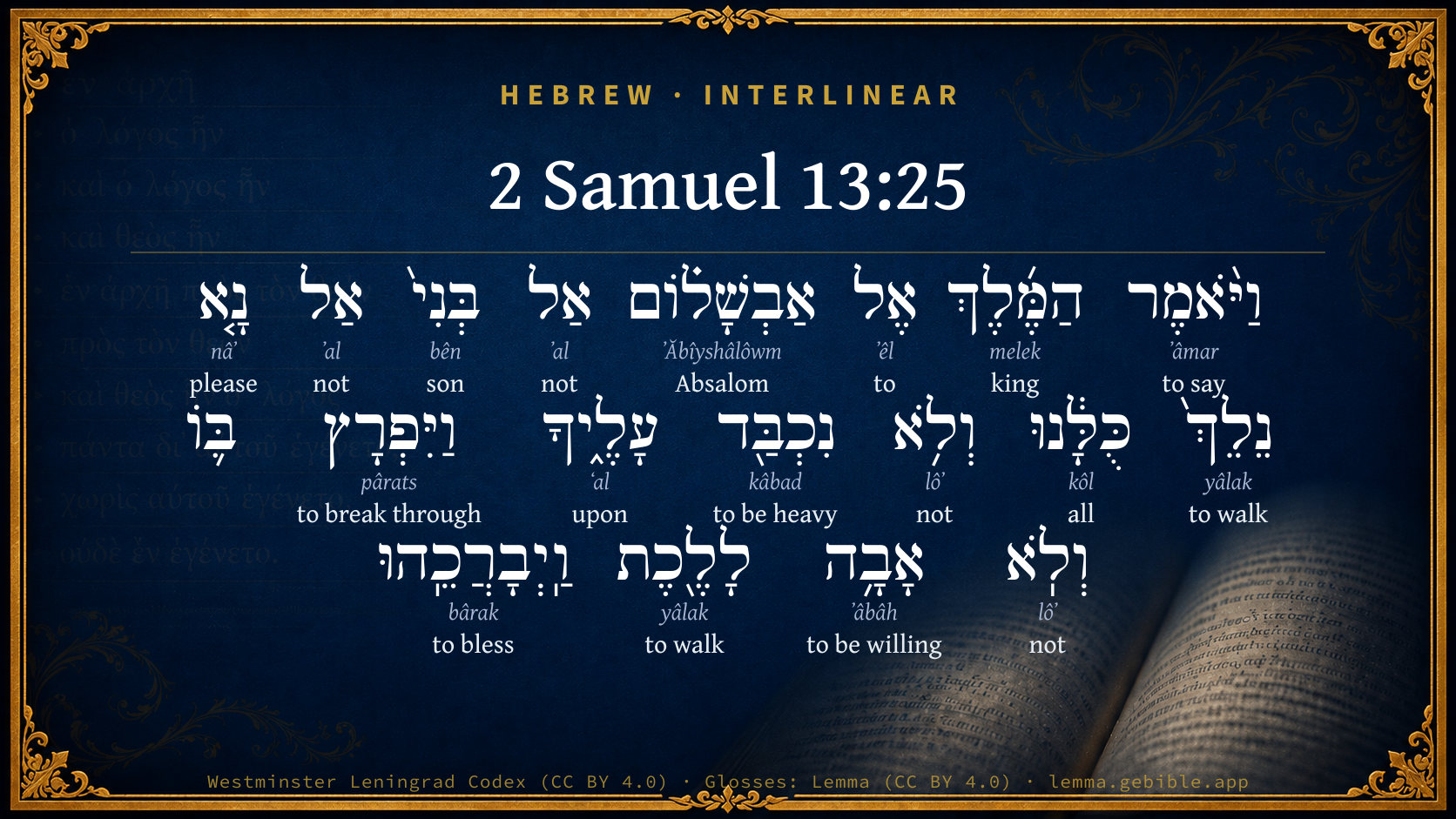
2 Samuel 13:25

Hebrew (Westminster Leningrad Codex) 2 Samuel 13:25 appears in the Hebrew Old Testament. The text above is from the Westminster Leningrad Codex. Each word links to its Strong’s number, a concise gloss, and parsing drawn from the Open Scriptures Hebrew Bible morphology. Click any word for its full Brown-Driver-Briggs (BDB) entry.
Download image
Cite this verse

2 Samuel 13:25 (World English Bible). Public Domain. Lemma interlinear Bible study tool, https://lemma.gebible.app/v/2-samuel/13/25.

Show BibTeX & RIS
BibTeX
RIS
English Translation
The king said to Absalom, No, my son, let us not all go, lest we be burdensome to you. He pressed him: however he would not go, but blessed him.
World English Bible · Public Domain
Download a study sheet

One document with this verse’s original text, its word-by-word gloss line, the meaning frame, cross-references with their text, attributed commentary, and full source and license credits — printable, and it pastes into notes with its structure intact.

This verse Autodidact and up

Study sheet (.html) Plain text (.txt)

A passage Seminary Student

Up to 50 verses in one chapter. A passage sheet keeps up to 6 commentary sources and 12 cross-references per verse, in the order this page ranks them, and says so on the sheet whenever that leaves anything out. Ask for a single verse and you get the Autodidact verse sheet above.

Everything on this page stays free to read, with no account — the sheet is a download of what is already on screen, not access to it.

Want to remove ads? Support Godless Engineer
Compare translations 3

The same verse in 3 English versions, stacked beneath the original-language interlinear above. Click any original word for its lexicon entry.

Each is an independent rendering of the whole verse — the interlinear is not word-aligned to these translations.

Highlighted words mark where these versions differ — a whole-verse word diff, not a word-by-word alignment.

  • World English Bible Public Domain
    The king said to Absalom, No, my son, let us not all go, lest we be burdensome to you. He pressed him: however he would not go, but blessed him.
  • King James Version Public Domain
    And the king said to Absalom, Nay, my son, let us not all now go, lest we be chargeable unto thee. And he pressed him: howbeit he would not go, but blessed him.
  • unfoldingWord Literal Text CC BY-SA 4.0
    And the king said to Absalom, “No, my son, please let not all of us go, and let us not be heavy to you.” Then he urged him, but he was not willing to go, but he blessed him.

unfoldingWord Literal Text — © unfoldingWord, licensed CC BY-SA 4.0. Word-aligned USFM3 via Door43 (git.door43.org/unfoldingWord/en_ult).

Versions to compare (up to 4)

3 of 4 selected

Show all 18 translations

Every available English version of this verse, each an independent rendering of the whole verse.

  • World English Bible Public Domain
    The king said to Absalom, No, my son, let us not all go, lest we be burdensome to you. He pressed him: however he would not go, but blessed him.
  • Berean Standard Bible Public Domain
    “No, my son,” the king replied, “we should not all go, or we would be a burden to you.” Although Absalom urged him, he was not willing to go, but gave him his blessing.
  • Majority Standard Bible Public Domain
    “No, my son,” the king replied, “we should not all go, or we would be a burden to you.” Although Absalom urged him, he was not willing to go, but gave him his blessing.
  • King James Version Public Domain
    And the king said to Absalom, Nay, my son, let us not all now go, lest we be chargeable unto thee. And he pressed him: howbeit he would not go, but blessed him.
  • American Standard Version (1901) Public Domain
    And the king said to Absalom, Nay, my son, let us not all go, lest we be burdensome unto thee. And he pressed him: howbeit he would not go, but blessed him.
  • Revised Version (1885) Public Domain
    And the king said to Absalom, Nay, my son, let us not all go, lest we be burdensome unto thee. And he pressed him: howbeit he would not go, but blessed him.
  • Geneva Bible (1599) Public Domain
    But the King answered Absalom, Nay my sonne, I pray thee, let vs not goe all, lest we be chargeable vnto thee. Yet Absalom lay sore vpon him: howbeit he would not go, but thanked him.
  • Douay-Rheims (1899) Public Domain
    And the king said to Absalom: Nay, my son, do not ask that we should all come, and be chargeable to thee. And when he pressed him, and he would not go, he blessed him.
  • Young's Literal Translation Public Domain
    And the king saith unto Absalom, `Nay, my son, let us not all go, I pray thee, and we are not too heavy on thee;' and he presseth on him, and he hath not been willing to go, and he blesseth him.
  • Literal Standard Version CC BY-SA 4.0
    And the king says to Absalom, “No, my son, please let us not all go, and we are not too heavy on you”; and he presses on him, and he has not been willing to go, and he blesses him.
  • Unlocked Literal Bible CC BY-SA 4.0
    The king answered Absalom, “No, my son, all of us should not go because we would be a burden to you.” Absalom begged the king, but he would not go, but he gave him his blessing.
  • unfoldingWord Literal Text CC BY-SA 4.0
    And the king said to Absalom, “No, my son, please let not all of us go, and let us not be heavy to you.” Then he urged him, but he was not willing to go, but he blessed him.
  • Darby Bible Public Domain
    And the king said to Absalom, No, my son, let us not all go, lest we be burdensome to thee. And he urged him, but he would not go; and he blessed him.
  • World Messianic Bible Public Domain
    The king said to Absalom, “No, my son, let’s not all go, lest we be burdensome to you.” He pressed him; however he would not go, but blessed him.
  • Webster's Bible Public Domain
    And the king said to Absalom, Nay, my son, let us not all now go, lest we be chargeable to thee. And he pressed him: yet he would not go, but blessed him.
  • Free Bible Version CC BY-SA 4.0
    “No, my son,” the king replied, “we can't all go. We would be a burden to you.” Even though Absalom went on asking, he was not willing to go, but he did give Absalom his blessing.
  • Bible in Basic English Public Domain
    And the king said to Absalom, No, my son, let us not all go, or the number will be over-great for you. And he made his request again, but he would not go, but he gave him his blessing.
  • JPS Tanakh (1917) Public Domain
    And the king said to Absalom: 'Nay, my son, let us not all go, lest we be burdensome unto thee.' And he pressed him; howbeit he would not go, but blessed him.

Literal Standard Version (2020), Covenant Press — licensed CC BY-SA 4.0. Text via the HelloAO Bible API (eBible.org). Unlocked Literal Bible (unfoldingWord) — licensed CC BY-SA 4.0. Text via the HelloAO Bible API (eBible.org). unfoldingWord Literal Text — © unfoldingWord, licensed CC BY-SA 4.0. Word-aligned USFM3 via Door43 (git.door43.org/unfoldingWord/en_ult). Free Bible Version, Dr. Jonathan Gallagher — licensed CC BY-SA 4.0. Text via the HelloAO Bible API (eBible.org).

Word by word

More ways to search: Search by grammar → Find every occurrence → Compare this word →

Practice this passage: Drill this verse → Learn its vocabulary →

וַיִּפְרָץ
pârats
H6555
“and · to break through”
Conjunction + Verb, Qal, Sequential Imperfect, 3rd Person, Masculine, Singular
Part of Speech
Conjunction + Verb
Stem
Qal
Form
Sequential Imperfect
Person
3rd Person
Gender
Masculine
Number
Singular
Full BDB Definition

Origin: a primitive root

TWOT: 1826

to break through or down or over, burst, breach - (Qal) - to break or burst out (from womb or enclosure) - to break through or down, make a breach in - to break into - to break open - to break up, break in pieces - to break out (violently) upon - to break over (limits), increase - to use violence - to burst open - to spread, distribute - (Niphal) to be broken through - (Pual) to be broken down - (Hithpael) to break away
  1. וַיֹּ֨אמֶר ʼâmar H559 “and · to say” Conjunction + Verb, Qal, Sequential Imperfect, 3rd Person, Masculine, Singular
  2. הַמֶּ֜לֶךְ melek H4428 “the · king” Particle, Definite Article + Noun, Common, Masculine, Singular, Absolute
  3. אֶל ʼêl H413 “to” Preposition
  4. אַבְשָׁל֗וֹם ʼĂbîyshâlôwm H53 “Absalom” Noun, Proper
  5. אַל ʼal H408 “not” Particle, Negative
  6. בְּנִי֙ bên H1121 “son · my” Noun, Common, Masculine, Singular, Construct + Suffix, Personal, 1st Person, Common, Singular
  7. אַל ʼal H408 “not” Particle, Negative
  8. נָ֤א nâʼ H4994 “please” Particle, Exhortation
  9. נֵלֵךְ֙ yâlak H3212 “to walk” Verb, Qal, Cohortative, 1st Person, Common, Plural
  10. כֻּלָּ֔נוּ kôl H3605 “all · our” Noun, Common, Masculine, Singular, Construct + Suffix, Personal, 1st Person, Common, Plural
  11. וְלֹ֥א lôʼ H3808 “and · not” Conjunction + Particle, Negative
  12. נִכְבַּ֖ד kâbad H3513 “to be heavy” Verb, Qal, Imperfect, 1st Person, Common, Plural
  13. עָלֶ֑יךָ ʻal H5921 “upon · you” Preposition + Suffix, Personal, 2nd Person, Masculine, Singular
  14. וְלֹֽא lôʼ H3808 “and · not” Conjunction + Particle, Negative
  15. אָבָ֥ה ʼâbâh H14 “to be willing” Verb, Qal, Perfect, 3rd Person, Masculine, Singular
  16. לָלֶ֖כֶת yâlak H3212 “to walk” Preposition + Verb, Qal, Infinitive Construct
  17. וַֽיְבָרֲכֵֽהוּ bârak H1288 “and · to bless · him” Conjunction + Verb, Piel, Sequential Imperfect, 3rd Person, Masculine, Singular + Suffix, Personal, 3rd Person, Masculine, Singular

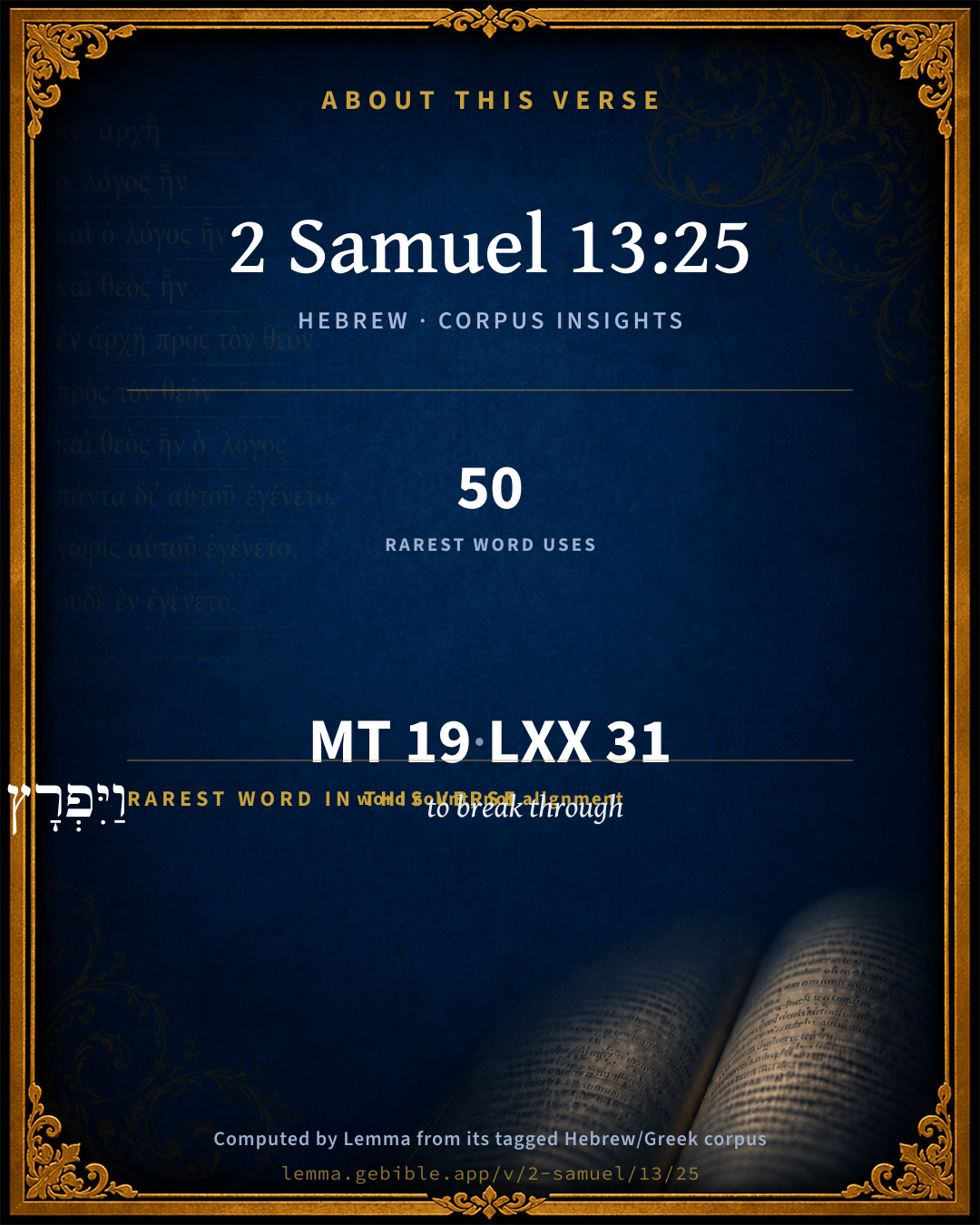
About this verse

These counts appear in no published source. They are computed here, from the morphology-tagged text and Lemma’s own curated glosses. What Lemma adds →

19
words
15
distinct lemmas
Historical
section

Shared distinctive vocabulary

וַיִּפְרָץ to break through H6555 occurs in 48 verses of the Hebrew Bible. Also found in:

Grammatical profile

  • 7 verbs
  • 4 nouns
  • 3 prepositions
  • 5 particles

Verb forms

  • וַיֹּ֨אמֶר Qal · Sequential Imperfect
  • נֵלֵךְ֙ Qal · Cohortative
  • נִכְבַּ֖ד Qal · Imperfect
  • וַיִּפְרָץ Qal · Sequential Imperfect
  • אָבָ֥ה Qal · Perfect
  • לָלֶ֖כֶת Qal · Infinitive Construct
  • וַֽיְבָרֲכֵֽהוּ Piel · Sequential Imperfect

Repetition

Words recur within this verse — often emphatic in Hebrew:

  • נֵלֵךְ֙ to walk H3212 ×2
  • אַל not H408 ×2
  • וְלֹ֥א not H3808 ×2

Hebrew & Septuagint length

In English translation the verse runs 30 words from the Hebrew and 34 from the Septuagint (LXX English) — closely comparable.

A rough comparison of the two English renderings, which tokenize alike — not a word-level alignment.

Word counts can differ between the Hebrew and the Greek without any difference in meaning — e.g. the Hebrew direct-object marker אֵת has no separate Greek word, and Greek often adds the article ὁ.

In the original languages it is 19 Hebrew tokens and 31 Greek tokens — but the two are counted differently (Hebrew bundles its prefixes and suffixes into one token; the Greek is in lemma form), so that isn’t a like-for-like length.

Cross-references

7

Topical passages linked to 2 Samuel 13:25 in the Treasury of Scripture Knowledge — connected by theme and wording, ordered by reader-vote popularity; previews shown in the World English Bible.

  • Genesis 19:2–3 and he said, "See now, my lords, please turn aside into your servant's house, stay all night, wash your feet, and you will rise up early, and go on your way." They said, "No, but we will stay in the street all night."
  • Judges 19:7–10 The man rose up to depart; but his father-in-law urged him, and he lodged there again.
  • Ruth 2:4 Behold, Boaz came from Bethlehem, and said to the reapers, Yahweh be with you. They answered him, Yahweh bless you.
  • 2 Samuel 14:22 Joab fell to the ground on his face, and did obeisance, and blessed the king: and Joab said, Today your servant knows that I have found favor in your sight, my lord, king, in that the king has performed the request of his servant.
  • Luke 14:23 "The lord said to the servant, 'Go out into the highways and hedges, and compel them to come in, that my house may be filled.
  • Luke 24:29 They urged him, saying, "Stay with us, for it is almost evening, and the day is almost over." He went in to stay with them.
  • Acts 16:15 When she and her household were baptized, she begged us, saying, "If you have judged me to be faithful to the Lord, come into my house, and stay." So she persuaded us.

Cross-references courtesy of OpenBible.info (CC BY 4.0).

Hebrew and Greek witnesses Masoretic Hebrew ↔ Greek Septuagint

The same verse in the two great witnesses to the Old Testament, shown verse-for-verse.

These are two independent witnesses, not word-aligned to each other, and the Septuagint is shown in lemma (dictionary) form.

Hebrew 2 Samuel 13:25 Masoretic · Westminster Leningrad Codex

וַיֹּ֨אמֶר הַמֶּ֜לֶךְ אֶל אַבְשָׁל֗וֹם אַל בְּנִי֙ אַל נָ֤א נֵלֵךְ֙ כֻּלָּ֔נוּ וְלֹ֥א נִכְבַּ֖ד עָלֶ֑יךָ וַיִּפְרָץ בּ֛וֹ וְלֹֽא אָבָ֥ה לָלֶ֖כֶת וַֽיְבָרֲכֵֽהוּ

The king said to Absalom, No, my son, let us not all go, lest we be burdensome to you. He pressed him: however he would not go, but blessed him.

World English Bible · Public Domain

Greek LXX 2 Samuel 13:25 Septuagint · lemma form

καί εἶπον ὁ βασιλεύς πρός αβεσσαλωμ μή δή υἱός ἐγώ μή πορεύομαι πᾶς ἐγώ καί οὐ μή βαρύνω ἐπί σύ καί βιάζομαι αὐτός καί οὐ θέλω ὁ πορεύομαι καί εὐλογέω αὐτός

And the king said to Abessalom, Nay, my son, let us not all go, and let us not be burdensome to you. And he pressed him; but he would not go, but blessed him.

LXX2012 (modern English Septuagint) · Public Domain

Hebrew: Westminster Leningrad Codex (CC BY 4.0). Greek: Septuagint (public domain); English from LXX2012 (modern English Septuagint) (Public Domain). How the Septuagint differs from the Hebrew →

Targum (Aramaic paraphrase)

1

The Targum is the ancient Jewish Aramaic paraphrase of the Hebrew Scriptures — an interpretive translation, not the Hebrew text itself. Onkelos (literal) and Pseudo-Jonathan (expansive) render the Torah, and Jonathan the Prophets. Coverage is partial: where no permissively-licensed English translation exists for a verse, only the Aramaic is shown. This is verse-level text, not a word-by-word alignment to the Hebrew.

  1. Targum Jonathan Prophets (Joshua–Malachi)
    וַאֲמַר מַלְכָּא לְאַבְשָׁלוֹם לָא בְרִי לָא כְעַן נֵיזִיל כֻּלָנָא וְלָא נִתְקֵיף עֲלָךְ וְאַתְקֵיף בֵּיהּ וְלָא אָבָה לְמֵיזַל וּבָרְכֵיהּ:

    (no public-domain English translation for this verse)

    Targum Jonathan — Aramaic: “Mikraot Gedolot” (public domain). English: “Sefaria Community Translation” (CC0 1.0 (public-domain dedication)); “London "Chaldee Paraphrase," 1871” (public domain). Text via Sefaria.

Commentary

Notes on 2 Samuel 13:25 from classic Christian and Jewish commentators (each source and its license shown beneath its notes). The classic Christian expositions comment on the surrounding passage and are grouped to its opening verse, so a note may address several verses; the Jewish commentaries on the Tanakh (Rashi and others) are per-verse, so they appear only where the commentator wrote on this verse.

Lemma curates 59 commentaries, every one of them public domain or Creative Commons licensed, each selected and text-cleaned for this edition rather than reprinted as found. About our sources →

Trapp's Complete Commentary

John Trapp

2Sa 13:25 And the king said to Absalom, Nay, my son, let us not all now go, lest we be chargeable unto thee. And he pressed him: howbeit he would not go, but blessed him.

Ver. 25. Lest we be chargeable unto thee.] So tender was David over this his ungracious son: he was ever too passionately affected to his children, as is afore noted.

And he pressed him.] Too fair shows are a just argument of unsoundness. No natural face hath so clear a white and red as the painted.

But blessed him.] Benedixet, i.e., vale dixit ei, as Vatablus rendereth it: he dismissed him with good wishes, et fortassis etiam munere, and haply also with a gift, saith Junius.

John Trapp, A Commentary or Exposition upon All the Books of the Old and New Testament (1647–1656) — public domain. Text from a community e-Sword module.

Geneva Bible (1599)

Geneva Bible translators

Hebrew, blessed.

Geneva Bible (1599) marginal notes — public domain. Text via Bolls.life.

The Cambridge Bible for Schools and Colleges

gen. ed. J. J. S. Perowne

25. lest we be chargeable unto thee] Lest we be burdensome unto thee. Chargeable is derived from charge, in the now obsolete sense of ‘a load’ or ‘burden,’ cp. 1Th_2:9. It is “the first instance history offers of the ruinous cost of royal visits to those who are honoured with them.” Kitto’s Bible Illustr. p. 387.

blessed him] i.e. dismissed him with a farewell blessing. Cp. ch. 2Sa_19:39.

The Cambridge Bible for Schools and Colleges (gen. ed. J. J. S. Perowne; Cambridge University Press, 1878–1918) — public domain. Text from a community e-Sword module.

John Gill's Exposition

And the king said to Absalom, nay, my son, let us not all now go,.... He did not object to the invitation entirely, he was willing some of the family should go, but not all; it seems probable that he particularly excepted himself and his eldest son, the heir to his crown, for the reason following:

lest we be chargeable unto thee; one or two persons more, supposing them to be private persons, would have added but little to the expense, if any; but as David was a king, he must have come with the retinue of a king, with a large number of servants and guards, and must be entertained as such; and Amnon, his eldest son, and heir apparent to the crown, must make a figure suitable to his quality, which would have considerably raised the expense; and perhaps Absalom's estate he had to live upon might be but small, which David knew, and therefore chose not to be burdensome to him:

and he pressed him; urged him to go; not that he expected he would, or really desired he should, but this he did to hide his intention, that he might have no suspicion of his design against Amnon; or otherwise he might think he would not have been so pressing upon him to go with him:

howbeit he would not go, but blessed him; thanked him for the invitation he gave him, and wished him much happiness and pleasure at his entertainment with his friends.

John Gill's Exposition of the Whole Bible (1746–1763) — public domain (CC PDM 1.0). Text via the HelloAO Bible API.

Haydock's Catholic Bible Commentary

Blessed him, wishing him joy. Absalom kept a separate establishment, and had many children, chap. xiv. 27. (Menochius)

George Leo Haydock (1774–1849), Haydock's Catholic Family Bible and Commentary, 1859 edition — public domain. Excludes Psalms (Douay-Rheims chapter numbering differs from Protestant) and Deuterocanonical books (Catholic canon only).

Matthew Poole's English Annotations

He pressed him; pretending great desire of his presence there, to prevent any jealousies, which otherwise he thought would arise in the breast of a king so wise and experienced, and under the expectation of God’s dreadful judgments to be inflicted upon his family.

Blessed him; dismissed him with thanks for his kindness, and with his fatherly blessing·

Matthew Poole's English Annotations on the Holy Bible (1683–1685) — public domain. Text from a community e-Sword/MySword module.

Whedon's Commentary on the Bible

Daniel D. Whedon

25. He would not go — Absalom doubtless expected the king would decline going, and thereby hoped to secure more certainly his permission for Amnon to go.

Daniel D. Whedon (gen. ed.), Commentary on the Old and New Testaments (1874–1909) — public domain. Text from a community e-Sword module.

The Pulpit Commentary

But blessed him. These words, in the courtly language of the East, not only mean that David parted from Absalom with kindly feelings and good wishes, but that he made him a rich present. (see note on 1Sa_25:27, where the same word occurs; and observe the nature of Abigail"s blessing described there) David"s court had evidently become lavish, when thus a visit from him to his son"s farm would be too costly for the young prince"s means; but had he so increased his present as to have made it reasonable for himself and his chief officers to go, Absalom must have deferred his crime. As it was, the invitation put David off his guard, and, forgetting the fatal consequences of his good nature in permitting Tamar"s visit to Amnon, he allowed his sons to go to the festival. Nor must we blame him for his compliance. He had probably at first been full of anxiety as to the course Absalom might pursue, but his silence and forbearance made him suppose that Tamar"s wrong had not caused her brother any deep sorrow. Himself a man of warm feelings, he had expected an immediate outburst of anger, but such stern rancour persevered in for so long a time with such feline calmness of manner was beyond the range of his suspicions; and the invitation, first to himself and then to all his sons, made him suppose that Absalom had nothing but affectionate feelings toward them all.

The Pulpit Commentary (1880–1919), ed. H.D.M. Spence-Jones & Joseph S. Exell — public domain. Text from a community e-Sword module.

Keil & Delitzsch

C. F. Keil & F. Delitzsch

The king declined the invitation that he might not be burdensome to Absalom. Absalom pressed him indeed, but he would not go, and blessed him, i.e., wished him a pleasant and successful feast (see Sa1 25:14).

Keil & Delitzsch — Biblical Commentary on the Old Testament (1861–1891) — public domain (CC PDM 1.0). Text via the HelloAO Bible API. (Old Testament only.)

unfoldingWord translationNotes

Door43 World Missions Community

please let my brother Amnon go with us

The oldest son could often represent his father in Israelite culture. Amnon was David's oldest son.

Why should Amnon go with you?

David knew that Amnon was not Absalom's friend.

translationWords

king

Absalom

bless

brother

Amnon

unfoldingWord translationNotes — © Distant Shores Media and the Door43 World Missions Community, licensed CC BY-SA 4.0. Source: git.door43.org/Door43/en_tn.

Lesson kit

Teaching starters — assembled from the data on this page, not authored interpretation. Every prompt links to the verse data it draws on. Edit before teaching.

2 Samuel, in the Historical, opens this verse with 19 words (15 distinct Hebrew lemmas). Its most distinctive word is pârats (“to break through”). A historical commentator’s framing appears above. Read the whole chapter for the surrounding context.

Discussion questions

  1. How does “to break through” (pârats) shape what this verse is saying?
  2. Genesis 28:14 shares the word «to break through» with this verse. How do the two illuminate each other?
  3. “to walk” occurs 2× in this one verse. What is the effect of the repetition?
  4. These translations render this verse differently. What is at stake in choosing one wording over another?
  5. The verb «וַיֹּ֨אמֶר» is Qal Sequential Imperfect. How does its form color the action?
  6. Reading how Trapp's Complete Commentary and Geneva Bible (1599) read this verse, where do the two commentators agree and where do they part?

Things to notice

Reading settings

Reading text

Shown beneath each verse's original-language words.

Old Testament
Old Testament edition

Read the OT as the Masoretic Hebrew (MT) or the Greek Septuagint (LXX).

English shown for the Greek Septuagint (in the Hebrew ↔ Greek comparison).

Comparing translations? Open the Compare panel on any verse page to stack up to four side by side.