2 Kings 18:29

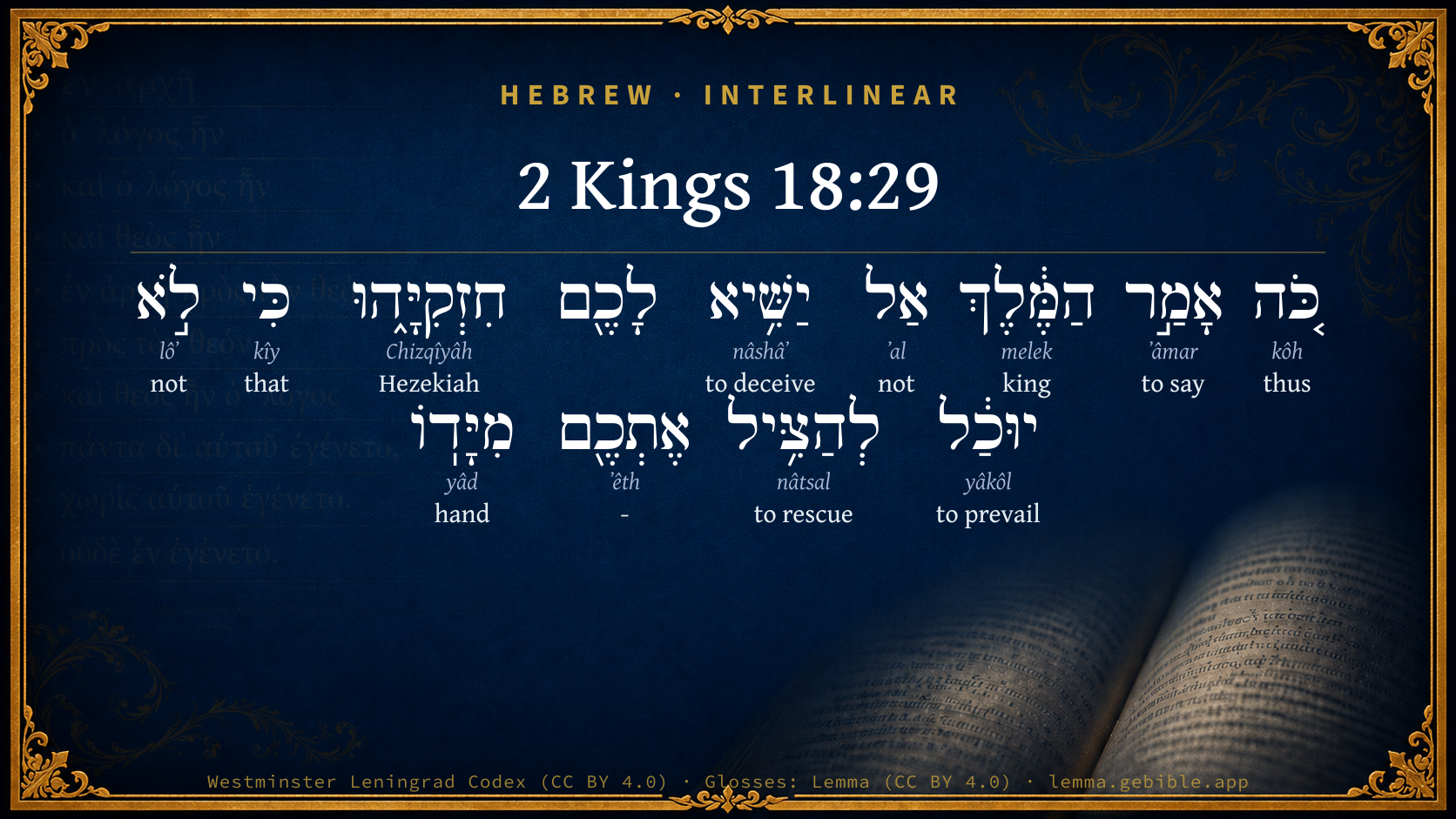
Hebrew (Westminster Leningrad Codex) 2 Kings 18:29 appears in the Hebrew Old Testament. The text above is from the Westminster Leningrad Codex. Each word links to its Strong’s number, a concise gloss, and parsing drawn from the Open Scriptures Hebrew Bible morphology. Click any word for its full Brown-Driver-Briggs (BDB) entry.
Download image
Cite this verse

2 Kings 18:29 (World English Bible). Public Domain. Lemma interlinear Bible study tool, https://lemma.gebible.app/v/2-kings/18/29.

Show BibTeX & RIS
BibTeX
RIS
English Translation
Thus says the king, Don't let Hezekiah deceive you; for he will not be able to deliver you out of his hand:
World English Bible · Public Domain
Download a study sheet

One document with this verse’s original text, its word-by-word gloss line, the meaning frame, cross-references with their text, attributed commentary, and full source and license credits — printable, and it pastes into notes with its structure intact.

This verse Autodidact and up

Study sheet (.html) Plain text (.txt)

A passage Seminary Student

Up to 50 verses in one chapter. A passage sheet keeps up to 6 commentary sources and 12 cross-references per verse, in the order this page ranks them, and says so on the sheet whenever that leaves anything out. Ask for a single verse and you get the Autodidact verse sheet above.

Everything on this page stays free to read, with no account — the sheet is a download of what is already on screen, not access to it.

Want to remove ads? Support Godless Engineer
Compare translations 3

The same verse in 3 English versions, stacked beneath the original-language interlinear above. Click any original word for its lexicon entry.

Each is an independent rendering of the whole verse — the interlinear is not word-aligned to these translations.

Highlighted words mark where these versions differ — a whole-verse word diff, not a word-by-word alignment.

  • World English Bible Public Domain
    Thus says the king, Don't let Hezekiah deceive you; for he will not be able to deliver you out of his hand:
  • King James Version Public Domain
    Thus saith the king, Let not Hezekiah deceive you: for he shall not be able to deliver you out of his hand:
  • unfoldingWord Literal Text CC BY-SA 4.0
    Thus says the king, ‘Do not let Hezekiah deceive you, for he is not able to deliver you from his hand.

unfoldingWord Literal Text — © unfoldingWord, licensed CC BY-SA 4.0. Word-aligned USFM3 via Door43 (git.door43.org/unfoldingWord/en_ult).

Versions to compare (up to 4)

3 of 4 selected

Show all 18 translations

Every available English version of this verse, each an independent rendering of the whole verse.

  • World English Bible Public Domain
    Thus says the king, Don't let Hezekiah deceive you; for he will not be able to deliver you out of his hand:
  • Berean Standard Bible Public Domain
    This is what the king says: Do not let Hezekiah deceive you; he cannot deliver you from my hand.
  • Majority Standard Bible Public Domain
    This is what the king says: Do not let Hezekiah deceive you; he cannot deliver you from my hand.
  • King James Version Public Domain
    Thus saith the king, Let not Hezekiah deceive you: for he shall not be able to deliver you out of his hand:
  • American Standard Version (1901) Public Domain
    Thus saith the king, Let not Hezekiah deceive you; for he will not be able to deliver you out of his hand:
  • Revised Version (1885) Public Domain
    Thus saith the king, Let not Hezekiah deceive you; for he shall not be able to deliver you out of his hand:
  • Geneva Bible (1599) Public Domain
    Thus sayth the King, Let not Hezekiah deceiue you: for he shall not be able to deliuer you out of mine hand.
  • Douay-Rheims (1899) Public Domain
    Thus saith the king: Let not Ezechias deceive you: for he shall not be able to deliver you out of my hand.
  • Young's Literal Translation Public Domain
    thus said the king, Let not Hezekiah lift you up, for he is not able to deliver you out of his hand;
  • Literal Standard Version CC BY-SA 4.0
    thus said the king: Do not let Hezekiah lift you up, for he is not able to deliver you out of his hand;
  • Unlocked Literal Bible CC BY-SA 4.0
    The king says, 'Do not let Hezekiah deceive you, for he will not be able to rescue you from my power.
  • unfoldingWord Literal Text CC BY-SA 4.0
    Thus says the king, ‘Do not let Hezekiah deceive you, for he is not able to deliver you from his hand.
  • Darby Bible Public Domain
    Thus says the king: Let not Hezekiah deceive you; for he will not be able to deliver you out of the [king's] hand.
  • World Messianic Bible Public Domain
    The king says, ‘Don’t let Hezekiah deceive you, for he will not be able to deliver you out of his hand.
  • Webster's Bible Public Domain
    Thus saith the king, Let not Hezekiah deceive you: for he shall not be able to deliver you out of his hand:
  • Free Bible Version CC BY-SA 4.0
    This is what the king says: Don't let Hezekiah trick you! He can't save you from me!
  • Bible in Basic English Public Domain
    This is what the king says: Do not be tricked by Hezekiah, for there is no salvation for you in him.
  • JPS Tanakh (1917) Public Domain
    Thus saith the king: Let not Hezekiah beguile you; for he will not be able to deliver you out of his hand;

Literal Standard Version (2020), Covenant Press — licensed CC BY-SA 4.0. Text via the HelloAO Bible API (eBible.org). Unlocked Literal Bible (unfoldingWord) — licensed CC BY-SA 4.0. Text via the HelloAO Bible API (eBible.org). unfoldingWord Literal Text — © unfoldingWord, licensed CC BY-SA 4.0. Word-aligned USFM3 via Door43 (git.door43.org/unfoldingWord/en_ult). Free Bible Version, Dr. Jonathan Gallagher — licensed CC BY-SA 4.0. Text via the HelloAO Bible API (eBible.org).

Word by word

More ways to search: Search by grammar → Find every occurrence → Compare this word →

Practice this passage: Drill this verse → Learn its vocabulary →

יַשִּׁ֥יא
nâshâʼ
H5377
“to deceive”
Verb, Hiphil, Jussive, 3rd Person, Masculine, Singular
Part of Speech
Verb
Stem
Hiphil
Form
Jussive
Person
3rd Person
Gender
Masculine
Number
Singular
Full BDB Definition

Origin: a primitive root

TWOT: 1425

to beguile, deceive - (Niphal) to be beguiled - (Hiphil) to beguile, deceive - (Qal) utterly (infinitif)
  1. כֹּ֚ה kôh H3541 “thus” Adverb
  2. אָמַ֣ר ʼâmar H559 “to say” Verb, Qal, Perfect, 3rd Person, Masculine, Singular
  3. הַמֶּ֔לֶךְ melek H4428 “the · king” Particle, Definite Article + Noun, Common, Masculine, Singular, Absolute
  4. אַל ʼal H408 “not” Particle, Negative
  5. חִזְקִיָּ֑הוּ Chizqîyâh H2396 “Hezekiah” Noun, Proper
  6. כִּי kîy H3588 “that” Conjunction
  7. לֹ֣א lôʼ H3808 “not” Particle, Negative
  8. יוּכַ֔ל yâkôl H3201 “to prevail” Verb, Qal, Imperfect, 3rd Person, Masculine, Singular
  9. לְהַצִּ֥יל nâtsal H5337 “to rescue” Preposition + Verb, Hiphil, Infinitive Construct
  10. אֶתְכֶ֖ם ʼêth H853 “- · you” Particle, Direct Object + Suffix, Personal, 2nd Person, Masculine, Plural
  11. מִיָּדֽוֹ yâd H3027 “from · hand · his” Preposition + Noun, Common, Both, Singular, Construct + Suffix, Personal, 3rd Person, Masculine, Singular

About this verse

These counts appear in no published source. They are computed here, from the morphology-tagged text and Lemma’s own curated glosses. What Lemma adds →

13
words
12
distinct lemmas
Historical
section

Notable vocabulary

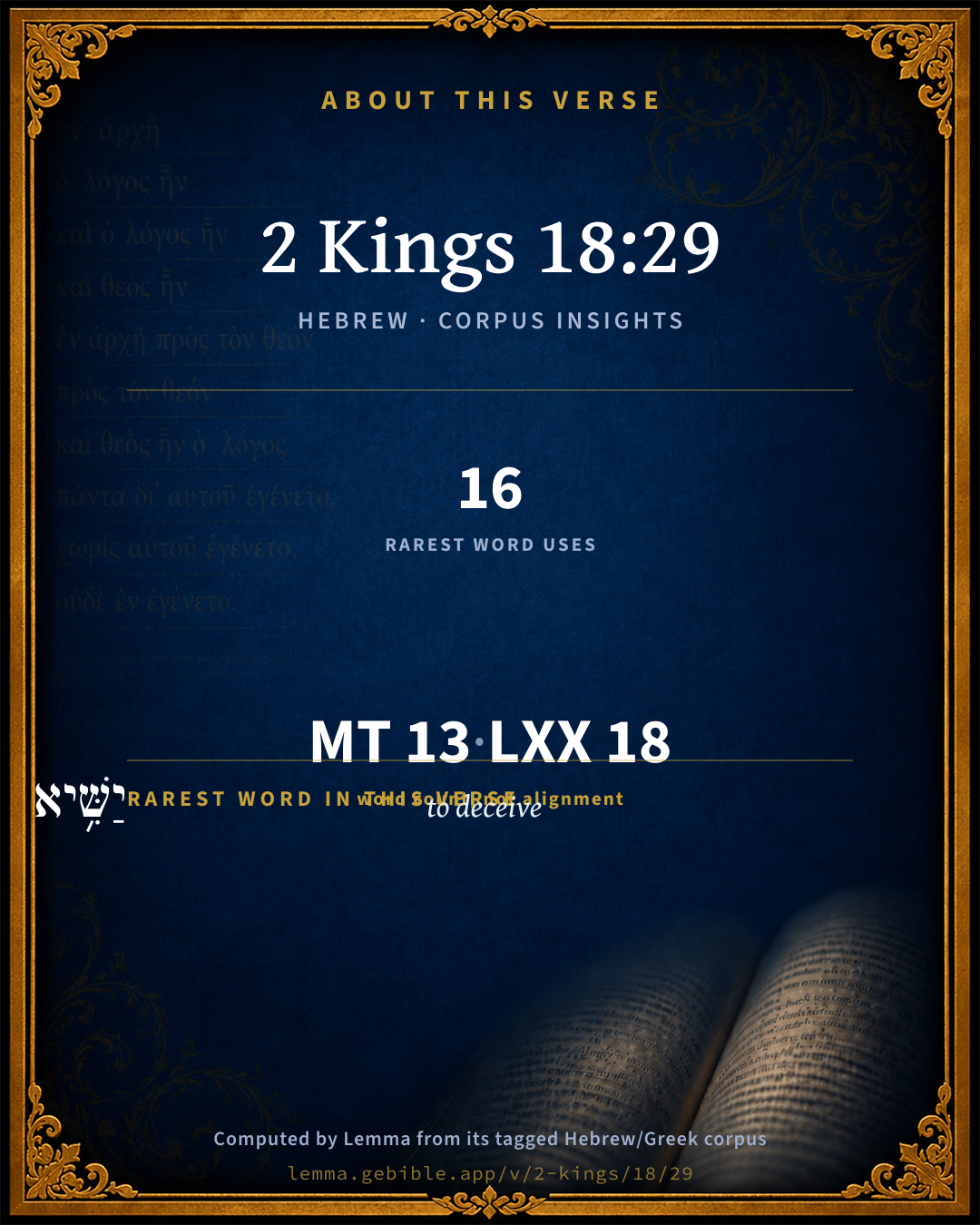
The rarest word here is יַשִּׁ֥יא to deceive H5377 — appearing just 16 times in the whole Hebrew Bible.

Shared distinctive vocabulary

יַשִּׁ֥יא to deceive H5377 occurs in 15 verses of the Hebrew Bible. Also found in:

Grammatical profile

  • 4 verbs
  • 3 nouns
  • 1 preposition
  • 1 conjunction
  • 1 adverb
  • 3 particles

Verb forms

  • אָמַ֣ר Qal · Perfect
  • יַשִּׁ֥יא Hiphil · Jussive
  • יוּכַ֔ל Qal · Imperfect
  • לְהַצִּ֥יל Hiphil · Infinitive Construct

Hebrew & Septuagint length

In English translation the verse runs 22 words from the Hebrew and 24 from the Septuagint (LXX English) — closely comparable.

A rough comparison of the two English renderings, which tokenize alike — not a word-level alignment.

Word counts can differ between the Hebrew and the Greek without any difference in meaning — e.g. the Hebrew direct-object marker אֵת has no separate Greek word, and Greek often adds the article ὁ.

In the original languages it is 13 Hebrew tokens and 18 Greek tokens — but the two are counted differently (Hebrew bundles its prefixes and suffixes into one token; the Greek is in lemma form), so that isn’t a like-for-like length.

Cross-references

8

Topical passages linked to 2 Kings 18:29 in the Treasury of Scripture Knowledge — connected by theme and wording, ordered by reader-vote popularity; previews shown in the World English Bible.

  • 2 Chronicles 32:15 Now therefore don't let Hezekiah deceive you, nor persuade you after this manner, neither believe you him; for no god of any nation or kingdom was able to deliver his people out of my hand, and out of the hand of my fathers: how much less shall your God deliver you out of my hand?
  • 2 Chronicles 32:11 Does not Hezekiah persuade you, to give you over to die by famine and by thirst, saying, Yahweh our God will deliver us out of the hand of the king of Assyria?
  • Psalms 73:8–9 They scoff and speak with malice. In arrogance, they threaten oppression.
  • Daniel 3:15–17 Now if you are ready whenever you hear the sound of the horn, flute, zither, lyre, harp, pipe, and all kinds of music to you fall down and worship the image which I have made, [well]: but if you don't worship, you shall be cast the same hour into the midst of a burning fiery furnace; and who is that god that shall deliver you out of my hands?
  • Daniel 6:16 Then the king commanded, and they brought Daniel, and cast him into the den of lions. [Now] the king spoke and said to Daniel, Your God whom you serve continually, he will deliver you.
  • John 19:10–11 Pilate therefore said to him, "Aren't you speaking to me? Don't you know that I have power to release you, and have power to crucify you?"
  • 2 Thessalonians 2:4 he who opposes and exalts himself against all that is called God or that is worshiped; so that he sits as God in the temple of God, setting himself up as God.
  • 2 Thessalonians 2:8 Then the lawless one will be revealed, whom the Lord will kill with the breath of his mouth, and bring to nothing by the brightness of his coming;

Cross-references courtesy of OpenBible.info (CC BY 4.0).

Hebrew and Greek witnesses Masoretic Hebrew ↔ Greek Septuagint

The same verse in the two great witnesses to the Old Testament, shown verse-for-verse.

These are two independent witnesses, not word-aligned to each other, and the Septuagint is shown in lemma (dictionary) form.

Hebrew 2 Kings 18:29 Masoretic · Westminster Leningrad Codex

כֹּ֚ה אָמַ֣ר הַמֶּ֔לֶךְ אַל יַשִּׁ֥יא לָכֶ֖ם חִזְקִיָּ֑הוּ כִּי לֹ֣א יוּכַ֔ל לְהַצִּ֥יל אֶתְכֶ֖ם מִיָּדֽוֹ

Thus says the king, Don't let Hezekiah deceive you; for he will not be able to deliver you out of his hand:

World English Bible · Public Domain

Greek LXX 2 Kings 18:29 Septuagint · lemma form

ὅδε λέγω ὁ βασιλεύς μή ἐπιαἴρω σύ εζεκιας λόγος ὅτι οὐ μή δύναμαι σύ ἐκαἱρέω ἐκ χείρ ἐγώ

thus says the king, Let not Ezekias encourage you with words: for he shall not be able to deliver you out of his hand.

LXX2012 (modern English Septuagint) · Public Domain

On this verse, Haydock's Catholic Bible Commentary discusses the Septuagint’s reading. Read the note in Commentary ↓

Hebrew: Westminster Leningrad Codex (CC BY 4.0). Greek: Septuagint (public domain); English from LXX2012 (modern English Septuagint) (Public Domain). How the Septuagint differs from the Hebrew →

Targum (Aramaic paraphrase)

1

The Targum is the ancient Jewish Aramaic paraphrase of the Hebrew Scriptures — an interpretive translation, not the Hebrew text itself. Onkelos (literal) and Pseudo-Jonathan (expansive) render the Torah, and Jonathan the Prophets. Coverage is partial: where no permissively-licensed English translation exists for a verse, only the Aramaic is shown. This is verse-level text, not a word-by-word alignment to the Hebrew.

  1. Targum Jonathan Prophets (Joshua–Malachi)
    כִּדְנַן אֲמַר מַלְכָּא לָא יַטְעֵי יַתְכוֹן חִזְקִיָה אֲרֵי לָא יִכּוּל לְשֵׁיזָבָא יַתְכוֹן מִן יְדֵיהּ:

    (no public-domain English translation for this verse)

    Targum Jonathan — Aramaic: “Mikraot Gedolot” (public domain). English: “Sefaria Community Translation” (CC0 1.0 (public-domain dedication)); “London "Chaldee Paraphrase," 1871” (public domain). Text via Sefaria.

Commentary

Notes on 2 Kings 18:29 from classic Christian and Jewish commentators (each source and its license shown beneath its notes). The classic Christian expositions comment on the surrounding passage and are grouped to its opening verse, so a note may address several verses; the Jewish commentaries on the Tanakh (Rashi and others) are per-verse, so they appear only where the commentator wrote on this verse.

Lemma curates 59 commentaries, every one of them public domain or Creative Commons licensed, each selected and text-cleaned for this edition rather than reprinted as found. About our sources →

Trapp's Complete Commentary

John Trapp

2Ki 18:29 Thus saith the king, Let not Hezekiah deceive you: for he shall not be able to deliver you out of his hand:

Ver. 29. Let not Hezekiah deceive you.] He warneth them to beware of Hezekiah as an impostor, and to make sure work for themselves, by yielding up all to Sennacherib, and accepting of him for their liege lord.

John Trapp, A Commentary or Exposition upon All the Books of the Old and New Testament (1647–1656) — public domain. Text from a community e-Sword module.

Geneva Bible (1599)

Geneva Bible translators

Or, by his hand.

Geneva Bible (1599) marginal notes — public domain. Text via Bolls.life.

Ellicott's Commentary for English Readers

(29) Let not Hezekiah deceive you.—Rab-shakeh was quick-witted enough to take instant advantage of Eliakim’s unwary remark, and to come forward in the character of a friend of the people (Cheyne). (For the verb, see Gen_3:13.)

His hand.—To be corrected into “my hand,” in accordance with all the versions, save the Targum.

A Bible Commentary for English Readers, edited by Charles John Ellicott (1878–1897) — public domain. Text from a community e-Sword module.

The Cambridge Bible for Schools and Colleges

gen. ed. J. J. S. Perowne

29. out of his hand] The natural expression would be ‘out of my hand’. And so it is rendered in all the versions but the Chaldee. It is worth noting that in Isaiah these words are not expressed.

The Cambridge Bible for Schools and Colleges (gen. ed. J. J. S. Perowne; Cambridge University Press, 1878–1918) — public domain. Text from a community e-Sword module.

Albert Barnes' Notes on the Bible

There were two grounds, and two only, on which Hezekiah could rest his refusal to surrender,

(1) ability to resist by his own natural military strength and that of his allies; and

(2) expectation based upon the language of Isaiah Isa 30:31; Isa 31:4-9, of supernatural assistance from Yahweh.

The Rab-shakeh argues that both grounds of confidence are equally fallacious.

Albert Barnes' Notes on the Bible (1834–1885) — public domain. Text from a community e-Sword/MySword module.

Haydock's Catholic Bible Commentary

My. Hebrew and Vatican Septuagint, "his (Sennacherib’s) hand." But the other reading of the Syriac, &c., is more natural. These words do not occur [in] Isaias xxxvi. 14.

George Leo Haydock (1774–1849), Haydock's Catholic Family Bible and Commentary, 1859 edition — public domain. Excludes Psalms (Douay-Rheims chapter numbering differs from Protestant) and Deuterocanonical books (Catholic canon only).

The Pulpit Commentary

Thus saith the king, Let not Hezekiah deceive you. Rabshakeh and his master, no doubt, both of them thought Hezekiah"s grounds of confidence would prove fallacious, and that all who should trust in them would find themselves "deceived." There were but two grounds that Hezekiah could possibly put forward:

(1) deliverance by human means by his own armed strength and that of his allies;

(2) deliverance by supernatural means by some great manifestation of miraculous power on the part of Jehovah. Rabshakeh thinks both equally impossible. The first, however, is too absurd for argument, and he therefore takes no further notice of it; but the second he proceeds to combat, in vers. 33-35. For he shall not be able to deliver you out of his hand. Correct grammar requires "out of my hand;" but Rabshakeh forgets that he is professing to report the words of Sennacherib.

The Pulpit Commentary (1880–1919), ed. H.D.M. Spence-Jones & Joseph S. Exell — public domain. Text from a community e-Sword module.

Lesson kit

Teaching starters — assembled from the data on this page, not authored interpretation. Every prompt links to the verse data it draws on. Edit before teaching.

2 Kings, in the Historical, opens this verse with 13 words (12 distinct Hebrew lemmas). Its most distinctive word is nâshâʼ (“to deceive”). A historical commentator’s framing appears above. Read the whole chapter for the surrounding context.

Discussion questions

  1. The word nâshâʼ carries the sense “to deceive.” How does it shape the verse?
  2. Genesis 3:13 shares the word «to deceive» with this verse. How do the two illuminate each other?
  3. These translations render this verse differently. What is at stake in choosing one wording over another?
  4. The verb «אָמַ֣ר» is Qal Perfect. How does its form color the action?
  5. Reading how Trapp's Complete Commentary and Geneva Bible (1599) read this verse, where do the two commentators agree and where do they part?

Things to notice

Reading settings

Reading text

Shown beneath each verse's original-language words.

Old Testament
Old Testament edition

Read the OT as the Masoretic Hebrew (MT) or the Greek Septuagint (LXX).

English shown for the Greek Septuagint (in the Hebrew ↔ Greek comparison).

Comparing translations? Open the Compare panel on any verse page to stack up to four side by side.