Numbers 22:16

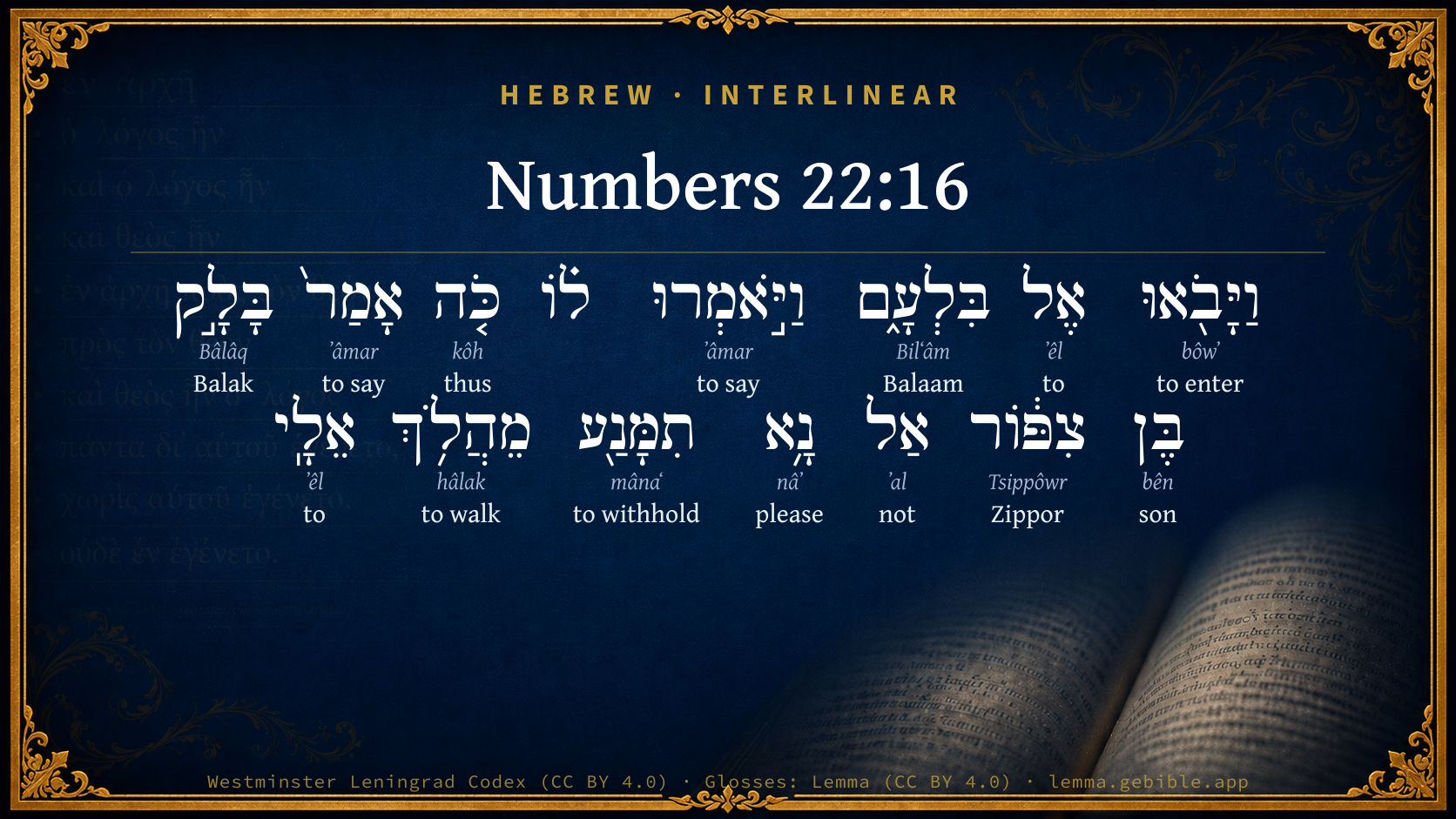
Hebrew (Westminster Leningrad Codex) Numbers 22:16 appears in the Hebrew Old Testament. The text above is from the Westminster Leningrad Codex. Each word links to its Strong’s number, a concise gloss, and parsing drawn from the Open Scriptures Hebrew Bible morphology. Click any word for its full Brown-Driver-Briggs (BDB) entry.
Download image
Cite this verse

Numbers 22:16 (World English Bible). Public Domain. Lemma interlinear Bible study tool, https://lemma.gebible.app/v/numbers/22/16.

Show BibTeX & RIS
BibTeX
RIS
English Translation
They came to Balaam, and said to him, Thus says Balak the son of Zippor, Please let nothing hinder you from coming to me:
World English Bible · Public Domain
Download a study sheet

One document with this verse’s original text, its word-by-word gloss line, the meaning frame, cross-references with their text, attributed commentary, and full source and license credits — printable, and it pastes into notes with its structure intact.

This verse Autodidact and up

Study sheet (.html) Plain text (.txt)

A passage Seminary Student

Up to 50 verses in one chapter. A passage sheet keeps up to 6 commentary sources and 12 cross-references per verse, in the order this page ranks them, and says so on the sheet whenever that leaves anything out. Ask for a single verse and you get the Autodidact verse sheet above.

Everything on this page stays free to read, with no account — the sheet is a download of what is already on screen, not access to it.

Want to remove ads? Support Godless Engineer
Compare translations 3

The same verse in 3 English versions, stacked beneath the original-language interlinear above. Click any original word for its lexicon entry.

Each is an independent rendering of the whole verse — the interlinear is not word-aligned to these translations.

Highlighted words mark where these versions differ — a whole-verse word diff, not a word-by-word alignment.

  • World English Bible Public Domain
    They came to Balaam, and said to him, Thus says Balak the son of Zippor, Please let nothing hinder you from coming to me:
  • King James Version Public Domain
    And they came to Balaam, and said to him, Thus saith Balak the son of Zippor, Let nothing, I pray thee, hinder thee from coming unto me:
  • unfoldingWord Literal Text CC BY-SA 4.0
    And they came to Balaam and said to him, “Thus says Balak the son of Zippor, ‘Please, do not be held back from coming to me,

unfoldingWord Literal Text — © unfoldingWord, licensed CC BY-SA 4.0. Word-aligned USFM3 via Door43 (git.door43.org/unfoldingWord/en_ult).

Versions to compare (up to 4)

3 of 4 selected

Show all 18 translations

Every available English version of this verse, each an independent rendering of the whole verse.

  • World English Bible Public Domain
    They came to Balaam, and said to him, Thus says Balak the son of Zippor, Please let nothing hinder you from coming to me:
  • Berean Standard Bible Public Domain
    They came to Balaam and said, “This is what Balak son of Zippor says: ‘Please let nothing hinder you from coming to me,
  • Majority Standard Bible Public Domain
    They came to Balaam and said, “This is what Balak son of Zippor says: ‘Please let nothing hinder you from coming to me,
  • King James Version Public Domain
    And they came to Balaam, and said to him, Thus saith Balak the son of Zippor, Let nothing, I pray thee, hinder thee from coming unto me:
  • American Standard Version (1901) Public Domain
    And they came to Balaam, and said to him, Thus saith Balak the son of Zippor, Let nothing, I pray thee, hinder thee from coming unto me:
  • Revised Version (1885) Public Domain
    And they came to Balaam, and said to him, Thus saith Balak the son of Zippor, Let nothing, I pray thee, hinder thee from coming unto me:
  • Geneva Bible (1599) Public Domain
    Who came to Balaam, and sayde to him, Thus saith Balak the sonne of Zippor, Bee not thou staied, I pray thee, from comming vnto me.
  • Douay-Rheims (1899) Public Domain
    Who, when they were come to Balaam, said: Thus saith Balac the son of Sephor, Delay not to come to me:
  • Young's Literal Translation Public Domain
    and they come in unto Balaam, and say to him, `Thus said Balak son of Zippor, Be not, I pray thee, withheld from coming unto me,
  • Literal Standard Version CC BY-SA 4.0
    and they come to Balaam and say to him, “Thus said Balak son of Zippor: Please do not be withheld from coming to me,
  • Unlocked Literal Bible CC BY-SA 4.0
    They came to Balaam and said to him, “Balak son of Zippor says this, 'Please let nothing stop you from coming to me,
  • unfoldingWord Literal Text CC BY-SA 4.0
    And they came to Balaam and said to him, “Thus says Balak the son of Zippor, ‘Please, do not be held back from coming to me,
  • Darby Bible Public Domain
    And they came to Balaam, and said to him, Thus says Balak the son of Zippor: Suffer not thyself, I pray thee, to be restrained from coming to me;
  • World Messianic Bible Public Domain
    They came to Balaam, and said to him, “Balak the son of Zippor says, ‘Please let nothing hinder you from coming to me,
  • Webster's Bible Public Domain
    And they came to Balaam, and said to him, Thus saith Balak the son of Zippor, Let nothing, I pray thee, hinder thee from coming to me:
  • Free Bible Version CC BY-SA 4.0
    When they arrived they told Balaam, “This is what Balak son of Zippor says: ‘Please don't let anything stop you from coming to see me,
  • Bible in Basic English Public Domain
    And they came to Balaam and said, Balak, son of Zippor, says, Let nothing keep you from coming to me:
  • JPS Tanakh (1917) Public Domain
    And they came to Balaam, and said to him: 'Thus saith Balak the son of Zippor: Let nothing, I pray thee, hinder thee from coming unto me;

Literal Standard Version (2020), Covenant Press — licensed CC BY-SA 4.0. Text via the HelloAO Bible API (eBible.org). Unlocked Literal Bible (unfoldingWord) — licensed CC BY-SA 4.0. Text via the HelloAO Bible API (eBible.org). unfoldingWord Literal Text — © unfoldingWord, licensed CC BY-SA 4.0. Word-aligned USFM3 via Door43 (git.door43.org/unfoldingWord/en_ult). Free Bible Version, Dr. Jonathan Gallagher — licensed CC BY-SA 4.0. Text via the HelloAO Bible API (eBible.org).

Word by word

More ways to search: Search by grammar → Find every occurrence → Compare this word →

Practice this passage: Drill this verse → Learn its vocabulary →

צִפּ֔וֹר
Tsippôwr
H6834
“Zippor”
Noun, Proper
Part of Speech
Noun
Type
Proper
Full BDB Definition

Origin: the same as H6833

TWOT: None

Zippor = "sparrow" - father of Balak the king of Moab at the time of the exodus
  1. וַיָּבֹ֖אוּ bôwʼ H935 “and · to enter” Conjunction + Verb, Qal, Sequential Imperfect, 3rd Person, Masculine, Plural
  2. אֶל ʼêl H413 “to” Preposition
  3. בִּלְעָ֑ם Bilʻâm H1109 “Balaam” Noun, Proper
  4. וַיֹּ֣אמְרוּ ʼâmar H559 “and · to say” Conjunction + Verb, Qal, Sequential Imperfect, 3rd Person, Masculine, Plural
  5. כֹּ֤ה kôh H3541 “thus” Adverb
  6. אָמַר֙ ʼâmar H559 “to say” Verb, Qal, Perfect, 3rd Person, Masculine, Singular
  7. בָּלָ֣ק Bâlâq H1111 “Balak” Noun, Proper
  8. בֶּן bên H1121 “son of” Noun, Common, Masculine, Singular, Construct
  9. אַל ʼal H408 “not” Particle, Negative
  10. נָ֥א nâʼ H4994 “please” Particle, Exhortation
  11. תִמָּנַ֖ע mânaʻ H4513 “to withhold” Verb, Niphal, Jussive, 2nd Person, Masculine, Singular
  12. מֵהֲלֹ֥ךְ hâlak H1980 “from · to walk” Preposition + Verb, Qal, Infinitive Construct
  13. אֵלָֽי ʼêl H413 “to · me” Preposition + Suffix, Personal, 1st Person, Common, Singular

About this verse

These counts appear in no published source. They are computed here, from the morphology-tagged text and Lemma’s own curated glosses. What Lemma adds →

15
words
12
distinct lemmas
Pentateuch
section

Notable vocabulary

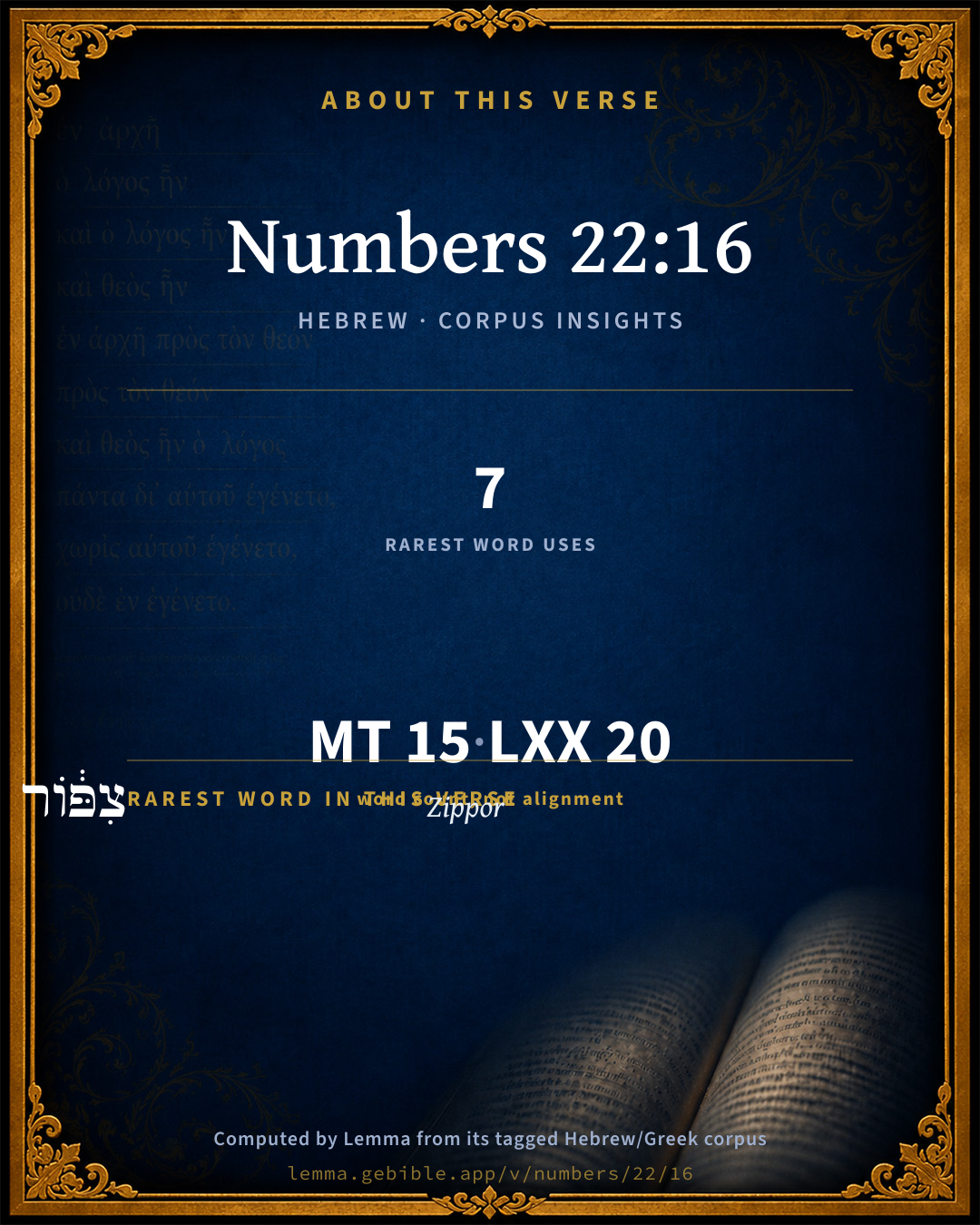
The rarest word here is צִפּ֔וֹר Zippor H6834 — appearing just 7 times in the whole Hebrew Bible.

Shared distinctive vocabulary

צִפּ֔וֹר Zippor H6834 occurs in 7 verses of the Hebrew Bible. Also found in:

Grammatical profile

  • 5 verbs
  • 4 nouns
  • 3 prepositions
  • 1 adverb
  • 2 particles

Verb forms

  • וַיָּבֹ֖אוּ Qal · Sequential Imperfect
  • וַיֹּ֣אמְרוּ Qal · Sequential Imperfect
  • אָמַר֙ Qal · Perfect
  • תִמָּנַ֖ע Niphal · Jussive
  • מֵהֲלֹ֥ךְ Qal · Infinitive Construct

Repetition

Words recur within this verse — often emphatic in Hebrew:

  • וַיֹּ֣אמְרוּ to say H559 ×2
  • אֶל to H413 ×2

Hebrew & Septuagint length

In English translation the verse runs 24 words from the Hebrew and 26 from the Septuagint (LXX English) — closely comparable.

A rough comparison of the two English renderings, which tokenize alike — not a word-level alignment.

Word counts can differ between the Hebrew and the Greek without any difference in meaning — e.g. the Hebrew direct-object marker אֵת has no separate Greek word, and Greek often adds the article ὁ.

In the original languages it is 15 Hebrew tokens and 20 Greek tokens — but the two are counted differently (Hebrew bundles its prefixes and suffixes into one token; the Greek is in lemma form), so that isn’t a like-for-like length.

Hebrew and Greek witnesses Masoretic Hebrew ↔ Greek Septuagint

The same verse in the two great witnesses to the Old Testament, shown verse-for-verse.

These are two independent witnesses, not word-aligned to each other, and the Septuagint is shown in lemma (dictionary) form.

Hebrew Numbers 22:16 Masoretic · Westminster Leningrad Codex

וַיָּבֹ֖אוּ אֶל בִּלְעָ֑ם וַיֹּ֣אמְרוּ ל֗וֹ כֹּ֤ה אָמַר֙ בָּלָ֣ק בֶּן צִפּ֔וֹר אַל נָ֥א תִמָּנַ֖ע מֵהֲלֹ֥ךְ אֵלָֽי

They came to Balaam, and said to him, Thus says Balak the son of Zippor, Please let nothing hinder you from coming to me:

World English Bible · Public Domain

Greek LXX Numbers 22:16 Septuagint · lemma form

καί ἔρχομαι πρός βαλααμ καί λέγω αὐτός ὅδε λέγω βαλακ ὁ ὁ σεπφωρ ἀξιόω σύ μή ὀκνέω ἔρχομαι πρός ἐγώ

And they came to Balaam, and they say to him, Thus says Balac the son of Sepphor: I beseech you, delay not to come to me.

LXX2012 (modern English Septuagint) · Public Domain

Hebrew: Westminster Leningrad Codex (CC BY 4.0). Greek: Septuagint (public domain); English from LXX2012 (modern English Septuagint) (Public Domain). How the Septuagint differs from the Hebrew →

Targum (Aramaic paraphrase)

2

The Targum is the ancient Jewish Aramaic paraphrase of the Hebrew Scriptures — an interpretive translation, not the Hebrew text itself. Onkelos (literal) and Pseudo-Jonathan (expansive) render the Torah, and Jonathan the Prophets. Coverage is partial: where no permissively-licensed English translation exists for a verse, only the Aramaic is shown. This is verse-level text, not a word-by-word alignment to the Hebrew.

  1. Targum Onkelos Torah (Genesis–Deuteronomy)
    וַאֲתוֹ לְוָת בִּלְעָם וַאֲמָרוּ לֵיהּ כִּדְנַן אֲמַר בָּלָק בַּר צִפּוֹר לָא כְעַן תִּתְמְנַע מִלְמֵיתֵי לְוָתִי

    (no public-domain English translation for this verse)

    Targum Onkelos — Aramaic: “Onkelos Genesis” (public domain); “Onkelos Exodus” (public domain); “Onkelos Leviticus” (public domain); “Onkelos Numbers” (public domain); “Onkelos Deuteronomy” (public domain). English: “Sefaria Community Translation” (CC0 1.0 (public-domain dedication)); “J.W. Etheridge. The Targums of Onkelos and Jonathan Ben Uzziel on the Pentateuch. London: Longmans, Green, 1862” (public domain). Text via Sefaria.

  2. Targum Pseudo-Jonathan Torah (Genesis–Deuteronomy)
    וְאָתוּ לְוַת בִּלְעָם וַאֲמָרוּ לֵיהּ כִּדְנַן אָמַר בָּלָק בַּר צִפּוֹר לָא כְּדוֹן תִּתְמְנַע מִלְמֵיתֵי לְוָתִי

    and they came to Bileam, and said to him: Thus saith Balak bar Zippor, Let not anything hinder thee from coming to me;

    Targum Pseudo-Jonathan — Aramaic: “Targum Jonathan on Genesis” (public domain); “Targum Jonathan on Exodus” (public domain); “Targum Jonathan on Leviticus” (public domain); “Targum Jonathan on Numbers” (public domain); “Targum Jonathan on Deuteronomy” (public domain). English: “The Targum of Jonathan ben Uzziel, trans. J. W. Etheridge, London, 1862” (public domain). Text via Sefaria.

Commentary

Notes on Numbers 22:16 from classic Christian and Jewish commentators (each source and its license shown beneath its notes). The classic Christian expositions comment on the surrounding passage and are grouped to its opening verse, so a note may address several verses; the Jewish commentaries on the Tanakh (Rashi and others) are per-verse, so they appear only where the commentator wrote on this verse.

Lemma curates 59 commentaries, every one of them public domain or Creative Commons licensed, each selected and text-cleaned for this edition rather than reprinted as found. About our sources →

Geneva Bible (1599)

Geneva Bible translators

The wicked seek by all means to further their naughty enterprises, though they know that God is against them.

Geneva Bible (1599) marginal notes — public domain. Text via Bolls.life.

John Gill's Exposition

Now therefore, I pray you, tarry ye also here this night,.... As the former messengers had; this shows his strong inclination to go along with them, and do what was desired of him, could he be permitted; otherwise he might and ought to have told the messengers at once that Balak needed not to have given himself and them so much trouble, since it was not in his power to do for him what he requested; nor would he attempt it, as being contrary to the will of God, and therefore it would be their best way to return as soon as they could; but instead of that, he desires them to stay that night, which must give them some hope of succeeding in their embassy:

that I may know what the Lord will say unto me more; he hoped he would change his mind, and say something to him different from, and contrary to what he had before declared unto him, which to suppose of God is great vileness and wickedness; to such a pitch did his greedy desire after riches and honour work him up into; he ought to have been satisfied with the answer already given him, and not to have inquired more.

John Gill's Exposition of the Whole Bible (1746–1763) — public domain (CC PDM 1.0). Text via the HelloAO Bible API.

Matthew Poole's English Annotations

No counsel nor suggestion either of God or man.

Matthew Poole's English Annotations on the Holy Bible (1683–1685) — public domain. Text from a community e-Sword/MySword module.

Lesson kit

Teaching starters — assembled from the data on this page, not authored interpretation. Every prompt links to the verse data it draws on. Edit before teaching.

Numbers, in the Pentateuch, opens this verse with 15 words (12 distinct Hebrew lemmas). Its most distinctive word is Tsippôwr (“Zippor”). A historical commentator’s framing appears above. Read the whole chapter for the surrounding context.

Discussion questions

  1. How does “Zippor” (Tsippôwr) shape what this verse is saying?
  2. How does Numbers 22:2, which shares the word «Zippor», read alongside this verse?
  3. What does the repetition of “to say” (2× in this one verse) do in this verse?
  4. These translations render this verse differently; the difference is in the English rendering, not the original. What questions does that raise?
  5. «וַיָּבֹ֖אוּ» is a Qal Sequential Imperfect verb. How does that grammatical form shape the action described?
  6. Compare how Geneva Bible (1599) and John Gill's Exposition read this verse. Where do they agree or differ?

Things to notice

Reading settings

Reading text

Shown beneath each verse's original-language words.

Old Testament
Old Testament edition

Read the OT as the Masoretic Hebrew (MT) or the Greek Septuagint (LXX).

English shown for the Greek Septuagint (in the Hebrew ↔ Greek comparison).

Comparing translations? Open the Compare panel on any verse page to stack up to four side by side.