
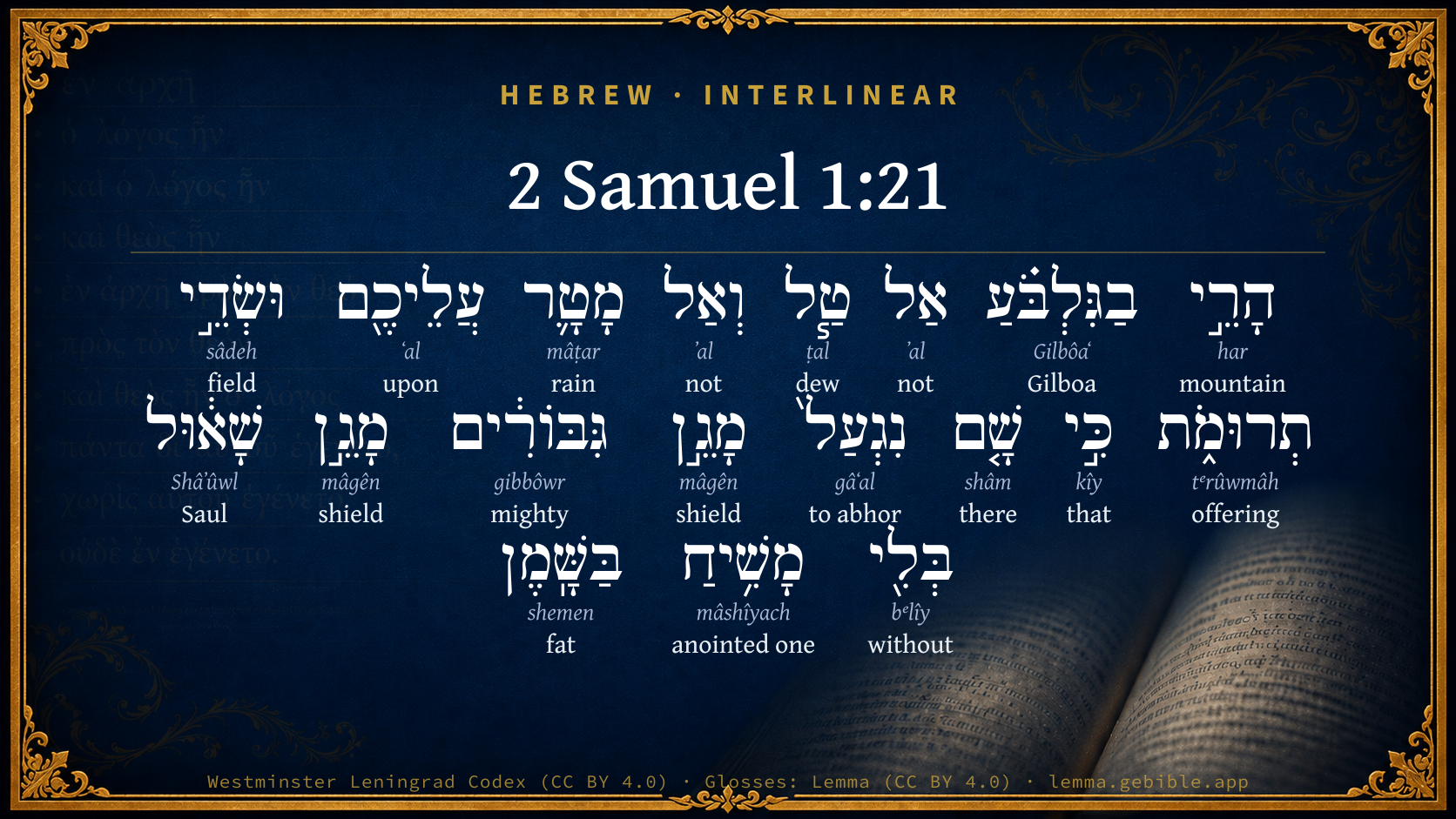
2 Samuel 1:21

Hebrew (Westminster Leningrad Codex) 2 Samuel 1:21 appears in the Hebrew Old Testament. The text above is from the Westminster Leningrad Codex. Each word links to its Strong’s number, a concise gloss, and parsing drawn from the Open Scriptures Hebrew Bible morphology. Click any word for its full Brown-Driver-Briggs (BDB) entry.
Download image
Cite this verse

2 Samuel 1:21 (World English Bible). Public Domain. Lemma interlinear Bible study tool, https://lemma.gebible.app/v/2-samuel/1/21.

Show BibTeX & RIS
BibTeX
RIS
English Translation
You mountains of Gilboa, Let there be no dew nor rain on you, neither fields of offerings: For there the shield of the mighty was vilely cast away, The shield of Saul, not anointed with oil.
World English Bible · Public Domain
Download a study sheet

One document with this verse’s original text, its word-by-word gloss line, the meaning frame, cross-references with their text, attributed commentary, and full source and license credits — printable, and it pastes into notes with its structure intact.

This verse Autodidact and up

Study sheet (.html) Plain text (.txt)

A passage Seminary Student

Up to 50 verses in one chapter. A passage sheet keeps up to 6 commentary sources and 12 cross-references per verse, in the order this page ranks them, and says so on the sheet whenever that leaves anything out. Ask for a single verse and you get the Autodidact verse sheet above.

Everything on this page stays free to read, with no account — the sheet is a download of what is already on screen, not access to it.

Want to remove ads? Support Godless Engineer
Compare translations 3

The same verse in 3 English versions, stacked beneath the original-language interlinear above. Click any original word for its lexicon entry.

Each is an independent rendering of the whole verse — the interlinear is not word-aligned to these translations.

Highlighted words mark where these versions differ — a whole-verse word diff, not a word-by-word alignment.

  • World English Bible Public Domain
    You mountains of Gilboa, Let there be no dew nor rain on you, neither fields of offerings: For there the shield of the mighty was vilely cast away, The shield of Saul, not anointed with oil.
  • King James Version Public Domain
    Ye mountains of Gilboa, let there be no dew, neither let there be rain, upon you, nor fields of offerings: for there the shield of the mighty is vilely cast away, the shield of Saul, as though he had not been anointed with oil.
  • unfoldingWord Literal Text CC BY-SA 4.0
    Mountains in Gilboa, not dew and not rain upon you, nor fields of offerings, for there the shield of the mighty was loathed, the shield of Saul, not anointed with oil.

unfoldingWord Literal Text — © unfoldingWord, licensed CC BY-SA 4.0. Word-aligned USFM3 via Door43 (git.door43.org/unfoldingWord/en_ult).

Versions to compare (up to 4)

3 of 4 selected

Show all 18 translations

Every available English version of this verse, each an independent rendering of the whole verse.

  • World English Bible Public Domain
    You mountains of Gilboa, Let there be no dew nor rain on you, neither fields of offerings: For there the shield of the mighty was vilely cast away, The shield of Saul, not anointed with oil.
  • Berean Standard Bible Public Domain
    O mountains of Gilboa, may you have no dew or rain, no fields yielding offerings of grain. For there the shield of the mighty was defiled, the shield of Saul, no longer anointed with oil.
  • Majority Standard Bible Public Domain
    O mountains of Gilboa, may you have no dew or rain, no fields yielding offerings of grain. For there the shield of the mighty was defiled, the shield of Saul, no longer anointed with oil.
  • King James Version Public Domain
    Ye mountains of Gilboa, let there be no dew, neither let there be rain, upon you, nor fields of offerings: for there the shield of the mighty is vilely cast away, the shield of Saul, as though he had not been anointed with oil.
  • American Standard Version (1901) Public Domain
    Ye mountains of Gilboa, Let there be no dew nor rain upon you, neither fields of offerings: For there the shield of the mighty was vilely cast away, The shield of Saul, not anointed with oil.
  • Revised Version (1885) Public Domain
    Ye mountains of Gilboa, let there be no dew nor rain upon you, neither fields of offerings: for there the shield of the mighty was vilely cast away, the shield of Saul, not anointed with oil.
  • Geneva Bible (1599) Public Domain
    Ye mountaines of Gilboa, vpon you be neither dewe nor raine, nor be there fieldes of offrings: for there the shielde of the mightie is cast downe, the shielde of Saul, as though he had not bene anointed with oyle.
  • Douay-Rheims (1899) Public Domain
    Ye mountains of Gelboe, let neither dew, nor rain come upon you, neither be they fields of firstfruits: for there was cast away the shield of the valiant, the shield of Saul as though he had not been anointed with oil.
  • Young's Literal Translation Public Domain
    Mountains of Gilboa! No dew nor rain be on you, And fields of heave-offerings! For there hath become loathsome The shield of the mighty, The shield of Saul -- without the anointed with oil.
  • Literal Standard Version CC BY-SA 4.0
    Mountains of Gilboa! No dew nor rain be on you, || And fields of raised-offerings! For there has become loathsome || The shield of the mighty, || The shield of Saul—without the anointed with oil.
  • Unlocked Literal Bible CC BY-SA 4.0
    Mountains of Gilboa, let there not be dew or rain on you, nor fields giving grain for offerings, for there the shield of the mighty was defiled. The shield of Saul is no longer anointed with oil.
  • unfoldingWord Literal Text CC BY-SA 4.0
    Mountains in Gilboa, not dew and not rain upon you, nor fields of offerings, for there the shield of the mighty was loathed, the shield of Saul, not anointed with oil.
  • Darby Bible Public Domain
    Ye mountains of Gilboa, let there be no dew, no rain upon you, nor fields of heave-offerings! For there the shield of the mighty was vilely cast away, The shield of Saul, [as] not anointed with oil.
  • World Messianic Bible Public Domain
    You mountains of Gilboa, let there be no dew or rain on you, and no fields of offerings; for there the shield of the mighty was defiled and cast away, the shield of Saul was not anointed with oil.
  • Webster's Bible Public Domain
    Ye mountains of Gilboa, let there be no dew, neither rain upon you, nor fields of offerings: for there the shield of the mighty is vilely cast away, the shield of Saul, as though he had not been anointed with oil.
  • Free Bible Version CC BY-SA 4.0
    Mountains of Gilboa, may no dew or rain fall on you! May you have no fields that produce offerings of grain. For it was there that the shield of the mighty was defiled; Saul's shield, no longer cared for with olive oil.
  • Bible in Basic English Public Domain
    O mountains of Gilboa, let there be no dew or rain on you, you fields of death: for there the arms of the strong have been shamed, the arms of Saul, as if he had not been marked with the holy oil.
  • JPS Tanakh (1917) Public Domain
    Ye mountains of Gilboa, let there be no dew nor rain upon you, neither fields of choice fruits; for there the shield of the mighty was vilely cast away, the shield of Saul, not anointed with oil.

Literal Standard Version (2020), Covenant Press — licensed CC BY-SA 4.0. Text via the HelloAO Bible API (eBible.org). Unlocked Literal Bible (unfoldingWord) — licensed CC BY-SA 4.0. Text via the HelloAO Bible API (eBible.org). unfoldingWord Literal Text — © unfoldingWord, licensed CC BY-SA 4.0. Word-aligned USFM3 via Door43 (git.door43.org/unfoldingWord/en_ult). Free Bible Version, Dr. Jonathan Gallagher — licensed CC BY-SA 4.0. Text via the HelloAO Bible API (eBible.org).

Word by word

More ways to search: Search by grammar → Find every occurrence → Compare this word →

Practice this passage: Drill this verse → Learn its vocabulary →

בַגִּלְבֹּ֗עַ
Gilbôaʻ
H1533
“in/at the · Gilboa”
Preposition, Determined + Noun, Proper
Part of Speech
Preposition + Noun
Type
Proper
Full BDB Definition

Origin: from H1530 and H1158

TWOT: None

Gilboa = "swollen heap" - a mountain-ridge at the southeastern end of the plain of Jezreel, site of the death of Saul and Jonathan
  1. הָרֵ֣י har H2022 “mountains of” Noun, Common, Masculine, Plural, Construct
  2. אַל ʼal H408 “not” Particle, Negative
  3. טַ֧ל ṭal H2919 “dew” Noun, Common, Masculine, Singular, Absolute
  4. וְאַל ʼal H408 “and · not” Conjunction + Particle, Negative
  5. מָטָ֛ר mâṭar H4306 “rain” Noun, Common, Masculine, Singular, Absolute
  6. עֲלֵיכֶ֖ם ʻal H5921 “upon · you” Preposition + Suffix, Personal, 2nd Person, Masculine, Plural
  7. וּשְׂדֵ֣י sâdeh H7704 “and · fields of” Conjunction + Noun, Common, Masculine, Plural, Construct
  8. תְרוּמֹ֑ת tᵉrûwmâh H8641 “offerings” Noun, Common, Feminine, Plural, Absolute
  9. כִּ֣י kîy H3588 “that” Conjunction
  10. שָׁ֤ם shâm H8033 “there” Adverb
  11. נִגְעַל֙ gâʻal H1602 “to abhor” Verb, Niphal, Perfect, 3rd Person, Masculine, Singular
  12. מָגֵ֣ן mâgên H4043 “shield of” Noun, Common, Both, Singular, Construct
  13. גִּבּוֹרִ֔ים gibbôwr H1368 “mighty” Adjective, Adjective, Masculine, Plural, Absolute
  14. מָגֵ֣ן mâgên H4043 “shield of” Noun, Common, Both, Singular, Construct
  15. שָׁא֔וּל Shâʼûwl H7586 “Saul” Noun, Proper
  16. בְּלִ֖י bᵉlîy H1097 “without” Particle, Negative
  17. מָשִׁ֥יחַ mâshîyach H4899 “anointed one” Noun, Common, Masculine, Singular, Absolute
  18. בַּשָּֽׁמֶן shemen H8081 “in/at the · fat” Preposition, Determined + Noun, Common, Masculine, Singular, Absolute

About this verse

These counts appear in no published source. They are computed here, from the morphology-tagged text and Lemma’s own curated glosses. What Lemma adds →

19
words
17
distinct lemmas
Historical
section

Notable vocabulary

The rarest word here is בַגִּלְבֹּ֗עַ Gilboa H1533 — appearing just 8 times in the whole Hebrew Bible.

Shared distinctive vocabulary

בַגִּלְבֹּ֗עַ Gilboa H1533 occurs in 8 verses of the Hebrew Bible. Also found in:

Grammatical profile

  • 1 verb
  • 11 nouns
  • 1 adjective
  • 1 preposition
  • 1 conjunction
  • 1 adverb
  • 3 particles

Verb forms

  • נִגְעַל֙ Niphal · Perfect

Repetition

Words recur within this verse — often emphatic in Hebrew:

  • מָגֵ֣ן shield H4043 ×2
  • אַל not H408 ×2

Hebrew & Septuagint length

In English translation the verse runs 36 words from the Hebrew and 41 from the Septuagint (LXX English) — closely comparable.

A rough comparison of the two English renderings, which tokenize alike — not a word-level alignment.

Word counts can differ between the Hebrew and the Greek without any difference in meaning — e.g. the Hebrew direct-object marker אֵת has no separate Greek word, and Greek often adds the article ὁ.

In the original languages it is 19 Hebrew tokens and 26 Greek tokens — but the two are counted differently (Hebrew bundles its prefixes and suffixes into one token; the Greek is in lemma form), so that isn’t a like-for-like length.

Cross-references

12

Topical passages linked to 2 Samuel 1:21 in the Treasury of Scripture Knowledge — connected by theme and wording, ordered by reader-vote popularity; previews shown in the World English Bible.

  • 1 Samuel 31:1 Now the Philistines fought against Israel: and the men of Israel fled from before the Philistines, and fell down slain on Mount Gilboa.
  • Isaiah 21:5 They prepare the table, they set the watch, they eat, they drink: rise up, you princes, anoint the shield.
  • 1 Samuel 10:1 Then Samuel took the vial of oil, and poured it on his head, and kissed him, and said, Isn't it that Yahweh has anointed you to be prince over his inheritance?
  • Judges 5:23 Curse you Meroz, said the angel of Yahweh. Curse you bitterly the inhabitants of it, Because they didn't come to the help of Yahweh, To the help of Yahweh against the mighty.
  • 1 Chronicles 10:1 Now the Philistines fought against Israel: and the men of Israel fled from before the Philistines, and fell down slain on Mount Gilboa.
  • 1 Chronicles 10:8 It happened on the next day, when the Philistines came to strip the slain, that they found Saul and his sons fallen on Mount Gilboa.
  • Job 3:3–10 "Let the day perish in which I was born, The night which said, 'There is a man-child conceived.'
  • Isaiah 5:6 I will lay it a wasteland. It won't be pruned nor hoed, But it will grow briers and thorns. I will also command the clouds that they rain no rain on it."
  • Jeremiah 20:14–16 Cursed be the day in which I was born: don't let the day in which my mother bore me be blessed.
  • Ezekiel 31:15 Thus says the Lord Yahweh: In the day when he went down to Sheol I caused a mourning: I covered the deep for him, and I restrained the rivers of it; and the great waters were stayed; and I caused Lebanon to mourn for him, and all the trees of the field fainted for him.
  • Joel 1:9 The meal offering and the drink offering are cut off from Yahweh's house. The priests, Yahweh's ministers, mourn.
  • Joel 2:14 Who knows? He may turn and relent, And leave a blessing behind him, Even a meal offering and a drink offering to Yahweh, your God.

Cross-references courtesy of OpenBible.info (CC BY 4.0).

Hebrew and Greek witnesses Masoretic Hebrew ↔ Greek Septuagint

The same verse in the two great witnesses to the Old Testament, shown verse-for-verse.

These are two independent witnesses, not word-aligned to each other, and the Septuagint is shown in lemma (dictionary) form.

Hebrew 2 Samuel 1:21 Masoretic · Westminster Leningrad Codex

הָרֵ֣י בַגִּלְבֹּ֗עַ אַל טַ֧ל וְאַל מָטָ֛ר עֲלֵיכֶ֖ם וּשְׂדֵ֣י תְרוּמֹ֑ת כִּ֣י שָׁ֤ם נִגְעַל֙ מָגֵ֣ן גִּבּוֹרִ֔ים מָגֵ֣ן שָׁא֔וּל בְּלִ֖י מָשִׁ֥יחַ בַּשָּֽׁמֶן

You mountains of Gilboa, Let there be no dew nor rain on you, neither fields of offerings: For there the shield of the mighty was vilely cast away, The shield of Saul, not anointed with oil.

World English Bible · Public Domain

Greek LXX 2 Samuel 1:21 Septuagint · lemma form

ὄρος ὁ ἐν γελβουε μή καταβαίνω δρόσος καί μή ὑετός ἐπί σύ καί ἀγρός ἀπαρχή ὅτι ἐκεῖ προςοχθίζω θυρεός δυνατός θυρεός σαούλ οὐ χρίω ἐν ἔλαιον

You⌃ mountains of Gelbue, let not dew no rain descend upon you, nor fields of first fruits be upon you, for there the shield of the mighty ones has been grievously assailed; the shield of Saul was not anointed with oil.

LXX2012 (modern English Septuagint) · Public Domain

Hebrew: Westminster Leningrad Codex (CC BY 4.0). Greek: Septuagint (public domain); English from LXX2012 (modern English Septuagint) (Public Domain). How the Septuagint differs from the Hebrew →

Targum (Aramaic paraphrase)

1

The Targum is the ancient Jewish Aramaic paraphrase of the Hebrew Scriptures — an interpretive translation, not the Hebrew text itself. Onkelos (literal) and Pseudo-Jonathan (expansive) render the Torah, and Jonathan the Prophets. Coverage is partial: where no permissively-licensed English translation exists for a verse, only the Aramaic is shown. This is verse-level text, not a word-by-word alignment to the Hebrew.

  1. Targum Jonathan Prophets (Joshua–Malachi)
    טוּרֵי גִלְבּוֹעַ לָא יֵחוֹת עֲלֵיכוֹן טַלָא וּמִטְרָא לָא תְהֵי בְּכוֹן עֲלָלָא כְּמִסַת דְיַעְבְדוּן מִנֵיהּ חֲלָתָא אֲרֵי תַמָן אִיתְבָּרוּ תְּרֵיסֵי גִיבָּרַיָא תְּרֵיסָא דְשָׁאוּל דִמְשִׁיחַ כִּדְבְמִשְׁחָא:

    (no public-domain English translation for this verse)

    Targum Jonathan — Aramaic: “Mikraot Gedolot” (public domain). English: “Sefaria Community Translation” (CC0 1.0 (public-domain dedication)); “London "Chaldee Paraphrase," 1871” (public domain). Text via Sefaria.

Commentary

Notes on 2 Samuel 1:21 from classic Christian and Jewish commentators (each source and its license shown beneath its notes). The classic Christian expositions comment on the surrounding passage and are grouped to its opening verse, so a note may address several verses; the Jewish commentaries on the Tanakh (Rashi and others) are per-verse, so they appear only where the commentator wrote on this verse.

Lemma curates 59 commentaries, every one of them public domain or Creative Commons licensed, each selected and text-cleaned for this edition rather than reprinted as found. About our sources →

Trapp's Complete Commentary

John Trapp

2Sa 1:21 Ye mountains of Gilboa, [let there be] no dew, neither [let there be] rain, upon you, nor fields of offerings: for there the shield of the mighty is vilely cast away, the shield of Saul, [as though he had] not [been] anointed with oil.

Ver. 21. Ye mountains of Gilboa.] A poetical exclamation, together with a hyperbolical imprecation-which possibly was as effectual as that of our Saviour pronounced upon the barren fig tree - in monumentum tanti mali, as a monument of this disastrous accident: the ground being clad in black as in mourning. Adrichomius and others say that these mountains of Gilboa are to this day rocky, dry, and barren: like unto which was Hesiod’s country Ascra: and St David’s in Wales is said to be a place neither pleasant, fertile, nor safe: for, as Giraldus Cambrensis reporteth of it, it is neither furnished with woods, watered with rivers, beautified with meadows, nor enriched with any kind of fruitful soil.

Is vilely cast away.] As either useless or cumbersome.

As though he had not, &c.] But either a usurper, or a common soldier. So it is a baleful business when God seemeth to cast off his people, as if they were nothing to him; not "holy," or "partakers of the heavenly calling." {Heb 3:1}

John Trapp, A Commentary or Exposition upon All the Books of the Old and New Testament (1647–1656) — public domain. Text from a community e-Sword module.

The Biblical Illustrator

Joseph S. Exell

2Sa_1:21

Ye mountains of Gilboa, let there be no dew.

The blood of Christ speaking better things than the blood of Saul

These words form a part of that song of lamentation which David composed after that Saul, and Jonathan his son, had fallen in battle with the Philistines. The death of Saul was in the eyes of David an exceedingly grievous event; an event in connexion with which he considered that no small degree of guilt had been incurred; because Saul was the Lord's anointed: and so grievous, and so guiltful, if we may use such an expression, was that event in the eyes of David, that in this solemn lamentation he imprecates Divine vengeance even upon the very place where the foul deed had been perpetrated; he prays, that henceforth on these mountains of Gilboa there might be neither dew nor rain nor fields of offering. We may take occasion from it to illustrate the enormity of that sin of which those were guilty who embrued their hands in our Saviour's blood; and we may take occasion to draw a like contrast with that which the Apostle has drawn in the case of Abel; and we may dwell with delight upon the encouraging fact, that while the blood of Saul that was thus shed called for vengeance on the very spot where it was shed, the blood of Christ calls for nothing but blessings, the very opposite of these curses.

I. The enormity of guilt contracted by those who shed the Saviour's blood, as that guilt may be illustrated by the enormity of the guilt of the death of Saul.

1. What was the principal circumstance upon which David dwelt, but that Saul was the Lord's anointed? But if it be said of Saul, that he was the Lord's anointed, how much more may it be said of Christ, whose very name--Messiah, signifies the Anointed, or the Christ of God. It was indeed manifest to every unprejudiced mind, by the whole course of our Saviour's history, that he was indeed the Lord's Anointed--the Son of God. It is recorded of Saul, that he had on more than one occasion rejected the Lord, rejected the authority of that God who had caused him to be anointed king over Israel. What shall we say, therefore, in contrast, with reference to our blessed Saviour? He glorified and adorned the doctrines of his heavenly Father, by the most unreserved, entire, and continued obedience; so that the great adversary of man when he came to search and to sift him, could find nothing in him; yea, his very accusers had nothing that they could allege or prove against him, when they had arraigned him.

2. David dwelt upon the disgrace connected with his death, as adding bitterness to the event--that he had been slain by the hands of the Philistines, the sworn enemies of the Children of Israel. If we turn to the history of our blessed Saviour we shall find that there were still more embittered circumstances in his history, which made His cup even still more cruel.

3. If we turn again to the history of Saul, we shall find a variety of other particulars, all lessening the enormity of the guilt; and we shall find the contrast again heighten the guilt of our Saviour's death.

4. And whilst in the ease of Saul, we may observe, that it was made most manifest in the hour of his death, that he had not the fear of God before his eyes, it was made most manifest to all those who surrounded our Saviour as he hung upon the cross, that He was indeed the Son of God.

II. To draw an illustration from the case of Saul, and the vengeance of his death--in consequence of his having been the Lord's anointed--the vengeance that was imprecated by David.

1. It may be fairly admitted that the language of David is poetical where he prays, that there may be neither dew nor rain upon the mountains of Gilboa; Ye mountains of Gilboa, etc. And we may, therefore, at once turn to the striking, but all-important contrast which may be obtained as it respects the death of Christ. Had they been dealt with according to their descry-into, the vengeance would have come on those who were guilty of our Saviour's death, and that without remedy.

2. But we shall proceed a little further in this illustration, to show the excellence of the blood-shedding of Christ. And we may take encouragement from this fact, that it was at Jerusalem that the glad tidings of the forgiveness of sins, and of the Spirit of promise, were first to be made known. Surely, if they of Jerusalem--if many of the priests who had been foremost in stirring up the people to ask that Christ might be crucified, if many of these very priests received the dew and the rain of heaven--if many of these very persons were enabled to offer themselves up to God to be His servants for ever, through the merit of the atoning sacrifice of Christ, there are none but may hope that they also, approaching God in the same way, shall also be kept, shall be visited with that grace of the Holy Spirit, and shall be privileged to be numbered among the servants and the children of God. (A. Brandram, A. M.)

The Biblical Illustrator, edited by Joseph S. Exell (c. 1880s–1900s) — public domain. Text from a community e-Sword module.

Joseph Benson's Commentary

2Sa 1:21. Ye mountains of Gilboa, let there be no dew, &c. — This is not an imprecation, but a passionate expression of the sorrow and horror which he felt at this public disgrace and loss, which were such as if he thought every person or thing which contributed to it ought to bear tokens of the divine displeasure, such as the earth does when it is deprived of the influence of dew and rain. Nor fields of offerings — That is, fertile fields, which may produce fair and goodly fruits fit to be offered to God. For there the shield of the mighty is vilely (that is, dishonourably) cast away — “Throwing away the shield was a matter of the highest reproach in all the accounts of antiquity. And this in the practice of so brave a prince as Saul was an example of terrible consequence, and therefore must not go unreproved, especially in a song which soldiers were to learn. David could not censure Saul; he was his prince and his enemy; the infamy, however, must fall somewhere; let the place in which it happened be accursed. Poetry justifies this, and we need not scruple to say, it is the most masterly stroke the science will admit. And with what inimitable address has he conducted this reproach! For at the same time that the mountains are cursed for it, he hath contrived to turn it into praise upon Saul: There the shield of the mighty was cast away; no hint by whom.”

Joseph Benson's Commentary on the Old and New Testaments (1811–1818) — public domain. Text from a community e-Sword module.

Tyndale Open Study Notes

Tyndale Open Resources

1:21 Saul and Jonathan died in the mountains of Gilboa (1 Sam 31:1). • let there be no dew or rain: David was invoking a curse on the place of their death. In a Canaanite text from the 1300s BC, a father invokes a very similar curse on the place of his son’s death. • The shield of Saul symbolizes his military exploits as king. It would no longer be anointed with oil for the same reason that Saul was no longer the anointed king, because of his death.

Tyndale Open Study Notes — © Tyndale Open Resources, licensed CC BY-SA 4.0. Text via the HelloAO Bible API.

Geneva Bible (1599)

Geneva Bible translators

Let their fertile fields be barren, and bring forth no fruit to offer to the Lord.

Geneva Bible (1599) marginal notes — public domain. Text via Bolls.life.

Jamieson, Fausset & Brown

Robert Jamieson, A. R. Fausset & David Brown

let there be no dew, neither let there be rain--To be deprived of the genial atmospheric influences which, in those anciently cultivated hills, seem to have reared plenty of first-fruits in the corn harvests, was specified as the greatest calamity the lacerated feelings of the poet could imagine. The curse seems still to lie upon them; for the mountains of Gilboa are naked and sterile.

the shield of the mighty is vilely cast away--To cast away the shield was counted a national disgrace. Yet, on that fatal battle of Gilboa, many of the Jewish soldiers, who had displayed unflinching valor in former battles, forgetful of their own reputation and their country's honor, threw away their shields and fled from the field. This dishonorable and cowardly conduct is alluded to with exquisitely touching pathos.

Jamieson, Fausset & Brown — Commentary Critical and Explanatory on the Whole Bible (1871) — public domain (CC PDM 1.0). Text via the HelloAO Bible API.

Adam Clarke's Commentary

Verse 21. As though he had not been] In stead of בלי beli, NOT, I read כלי keley, INSTRUMENTS.

Anointed with oil.] See the observations at the end.

2Sa 1:18, c.: He bade them teach the children of Judah the use of the bow, kasheth.

The word kasheth is to be understood of the title of the song which immediately follows, and not of the use of the bow, as our translation intimates.

Many of David's Psalms have titles prefixed to them some are termed Shosannim, some Maschil, Nehiloth, Neginoth, c., and this one here, Kadesh or The Bow, because it was occasioned by the Philistine archers. 1Sa 31:3: "And the archers hit him."

But especially respecting the bow of Jonathan, "which returned not back from the blood of the slain," as the song itself expresses. And David could not but remember the bow of Jonathan, out of which "the arrow was shot beyond the lad," 1Sa 20:36. It was the time when that covenant was made, and that affection expressed between them "which was greater than the love of women."

On these accounts the song was entitled Kasheth, or The song of the Bow, and David commanded the chief musicians, Ethan, Heman, and Jeduthun, to teach the children of Judah to sing it.

"It is written in the book of Jasher." Sept., επι βιβλιου του ευθους, "in the book of the upright."

ספרא דאוריתא siphra deoraitha, "The book of the Law." - Jonathan.

The Arabic says, "Behold it is written in the book of Ashee this is the book of Samuel;" the interpretation of which is, "book of songs or canticles."

This lamentation is justly admired as a picture of distress the most tender and the most striking; unequally divided by grief into longer and shorter breaks, as nature could pour them forth from a mind interrupted by the alternate recurrence of the most lively images of love and greatness.

His reverence for Saul and his love for Jonathan have their strongest colourings; but their greatness and bravery come full upon him, and are expressed with peculiar energy.

Being himself a warrior, it is in that character he sees their greatest excellence; and though his imagination hurries from one point of recollection to another, yet we hear him - at first, at last, everywhere - lamenting, How are the mighty fallen!

It is almost impossible to read the noble original without finding every word swollen with a sigh or broken with a sob. A heart pregnant with distress, and striving to utter expressions descriptive of its feelings, which are repeatedly interrupted by an excess of grief, is most sensibly painted throughout the whole. Even an English reader may be convinced of this, from the following specimen in European characters: -

19. Hatstsebi Yishrael al bamotheycha chalal;

Eych naphelu gibborim;

20. Al taggidu begath,

Al tebasseru bechutsoth Ashkelon;

Pen tismachnah benoth Pelishtim,

Pen taalozenah benoth haarelim.

21. Harey baggilboa al tal,

Veal matar aleychem usedey terumoth;

Ki sham nigal magen Gibborim.

Magen Shaul keley Mashiach bashshamen!

22. Middam chalalim, mecheleb gibborim,

Kesheth Yehonathan lo nashog achor;

Vechereb Shaul lo thashub reykam.

23. Shaul Vihonathan,

Hannee habim vehanneimim bechaiyeyhem,

Ubemotham lo niphradu.

Minnesharim kallu, mearayoth gaberu!

24. Benoth Yishrael el Shaul becheynah;

Hammalbishchem shani im adanim,

Hammaaleh adi zahab al lebushechen.

25. Eych naphelu gibborim bethoch hammilchamah!

Yehonathan al bamotheycha chalal!

26. Tsar li aleycha achi

Yehonathan, naamta li meod

Niphleathah ahabathecha li meahabath nashim!

27. Eych naphelu gibborim,

Vaiyobedu keley milchamah!

The three last verses in this sublime lamentation have sense and sound so connected as to strike every reader.

Dr. Kennicott, from whom I have taken several of the preceding remarks, gives a fine Latin version of this song, which I here subjoin: -

O decus Israelis, super excelsa tua MILES!

Quomodo ceciderunt FORTES!

Nolite indicare in Gatho,

Nolite indicare in plateis Ascalonis:

Ne laetentur filiae Philistaeorum,

Ne exultent filiae incircumcisorum.

Montes Gilboani super vos

Nec ros, nec pluvia, neque agri primitiarum;

Ibi enim abjectus fuit clypeus fortium.

Clypeus Saulis, arma inuncti olec!

Sine sanguine MILITUM,

Sine adipe FORTIUM.

Arcus Jonathanis non retrocesserat;

Gladiusque Saulis non redierat incassum.

Saul et Jonathan

Amabiles erant et jucundi in vitis suis,

Et in morte sua non separati.

Prae aquilis veloces!

Prae leonibus fortes!

Filiae Israelis deflete Saulem;

Qui coccino cum deliciis vos vestivit, Qui vestibus vestris ornamenta imposuit aurea! Quomodo ceciderunt FORTES, in medio belli!

O Jonathan, super excelsa tua MILES!

Versor in angustiis, tui causa,

Frater mi, Jonathan!

Mihi fuisti admodum jucundus!

Mihi tuus amor admodum mirabilis,

Mulierum exuperans amorem!

Quomodo ceciderunt fortes,

Et perierunt arma belli!

DISSERTATION I., p. 122.

In verse 21 I have inserted כלי keley for בלי beli. Dr. Delaney rightly observes that the particle בלי beli is not used in any part of the Bible in the sense of quasi non, as though not, in which sense it must be used here if it be retained as a genuine reading: The shield of Saul as though it had not been anointed with oil.

In a MS. written about the year 1200, numbered 30 in Kennicott's Bible, כלי keley is found; and also in the first edition of the whole Hebrew Bible, printed Soncini 1488. Neither the Syriac nor Arabic versions, nor the Chaldee paraphrase, acknowledge the negative particle בלי beli, which they would have done had it been in the copies from which they translated. It was easy to make the mistake, as there is such a similarity between ב beth and כ caph; the line therefore should be read thus: The shield of Saul, weapons anointed with oil.

In verse 22 נשוג nashog, to obtain, attain, seems to have been written for נסוג nasog, to recede, return. The former destroys the sense, the latter, which our translation has followed, and which is supported by the authority of 30 MSS., makes it not only intelligible but beautiful.

In verses 19, 22, and 25, חלל and חללים chalal and chalalim occur, which we translate the SLAIN, but which Dr. Kennicott, I think from good authority, renders soldier and soldiers; and thus the version is made more consistent and beautiful.

חלל chalal signifies to bore or pierce through; and this epithet might be well given to a soldier, q.d., the PIERCER, because his business is to transfix or pierce his enemies with sword, spear, and arrows.

If it be translated soldiers in the several places of the Old Testament, where we translate it SLAIN or WOUNDED, the sense will be much mended; see Jdg 20:31, Jdg 20:39; Ps 89:11; Pr 7:26; Jer 51:4, Jer 51:47, Jer 51:49; Eze 11:6-7; Eze 21:14. In several others it retains its radical signification of piercing, wounding, c.

AFTER these general observations I leave the particular beauties of this inimitable song to be sought out by the intelligent reader. Much has been written upon this, which cannot, consistently with the plan of these notes, be admitted here. See Delaney, Kennicott, Lowth, &c. and, above all, let the reader examine the Hebrew text.

Adam Clarke's Commentary on the Bible (1810–1826) — public domain. Text from a community e-Sword/MySword module.

Ellicott's Commentary for English Readers

(21) Nor fields of offerings.—This somewhat obscure expression seems to mean, “Let there not be upon you those fruitful fields from which may be gathered the offerings of first-fruits.” Of course, this malediction upon the mountains of Gilboa is to be understood as it was meant, only in a poetical sense.

Vilely cast away.—Another sense of this word is defiled. The ancient versions, as well as modern commentators, adopt some one, and some the other meaning, either of which is appropriate.

As though he had not been anointed.—This translation follows the Vulg., and makes a good sense = as though Saul had not been a king; but it is more than doubtful if the original can bear this construction. There is no pronoun in the Hebrew, and the word “anointed” refers to the shield, “the shield of Saul not anointed with oil.” It was customary to oil metal shields, as well as those of wood and leather, for their preservation, and the idea here is that Saul’s shield was thrown away uncared for.

A Bible Commentary for English Readers, edited by Charles John Ellicott (1878–1897) — public domain. Text from a community e-Sword module.

The Cambridge Bible for Schools and Colleges

gen. ed. J. J. S. Perowne

21. let there be no dew, &c.] The language is poetical. Nature is as it were summoned to share in the mourning. The scene of such a terrible disaster should be unvisited by fertilizing dew and rain, and lie smitten with eternal barrenness. For the thought that nature can sympathize with man compare Eze_31:15.

nor fields of offerings] An expansion of the preceding thought. Gilboa should no longer possess fruitful fields, to produce tithes and offerings for Jehovah. The greatest curse which can befall it is to be cut off from rendering service to Jehovah. Compare the description of extreme famine in Joe_1:9.

is vilely cast away] This rendering seems to be an attempt to combine two possible meanings of the Heb. word, (a) was cast away, (b) was defiled with blood and dust, of which the latter is probably right.

as though he had not been anointed with oil] The original, which might be rendered exactly the shield of Saul unanointed with oil, leaves it uncertain whether the epithet anointed belongs to the shield or to Saul. (a) Most commentators understand it to refer to the shield, left upon the battle-field, uncared for, uncleansed from the stains of the combat. Shields made of metal were oiled to polish them; those made of wood and leather, to preserve them, and make missiles glide off easily. Cp. Isa_21:5; and Verg. Aen. VII. 626:

“Pars leves clypeos et spicula lucida tergunt

Arvina pingui.”

“With unctuous lard their shields they clean,

And make their javelins bright and sheen.”

(b) On the other hand this term anointed is everywhere else applied to persons—in the books of Samuel always to the King—and not to things, and it is certainly grammatically possible to connect it with Saul, as is done by the E. V. The sense thus gained is much more forcible. ‘There the shield of mighty heroes was defiled—yea even the shield of Saul, whose consecrated person shared the common fate as though he had never been set apart as the Anointed of Jehovah.’

The Cambridge Bible for Schools and Colleges (gen. ed. J. J. S. Perowne; Cambridge University Press, 1878–1918) — public domain. Text from a community e-Sword module.

John Gill's Exposition

Ye mountains of Gilboa,.... On which fell Saul and his sons, and many of the people of Israel, Sa2 1:6,

let there be no dew, neither let there be rain upon you; which is not to understood as a real imprecation; for David would never curse any part of the land of Israel, for which he had so great a regard; but only as a poetical figure, expressing his concern for, and abhorrence of what happened on those mountains; much less did this in reality take place, as some have feigned, as if never dew nor rain descended on them (t) afterwards; which has been refuted by travellers, particularly Borchard (u), who, speaking of this mountain, says, that as he was upon it, there was such a violent shower fell, that he was wet through his clothes; and in the year 1273, laying all night upon this hill, there was a great dew fell upon him:

nor fields of offerings; of heave offerings; the meaning is, that he could wish almost that those hills were not fruitful, and that they brought no fruit to perfection, so much as that heave offerings for the service of the sanctuary might be taken; which is expressive of great sterility and scarcity, see Joe 1:13,

for there the shield of the mighty is vilely cast away; mighty men were obliged to cast away their shields and flee, which were greatly to their reproach and scandal, and to that of the whole nation: it was always reckoned very scandalous, and a great crime, even punishable with death, to cast away a shield, both with the Greeks and others (w): yea, also

the shield of Saul, as though he had not been anointed with oil; as if he was not the anointed king of Israel, but a common soldier: or else this respects his shield, as if that was not anointed, as shields used to be, that they might be smooth and glib, and missile weapons, as arrows and others, might not pass through them, but slide off, see Isa 21:5; though Gersom gives a different turn, that Saul's shield being in continual use, needed not to be anointed, as those did which for a time had been laid aside. Abarbinel interprets these words thus, that he, who was the shield of the mighty, even Saul himself, was vilely cast away, or become loathsome; and that his shield was anointed, not with oil, but with the blood of the slain, and the fat of the mighty, connecting them with the words following.

(t) Cippi Heb. p. 34. (u) Apud Hottinger not. in ib. see Bunting's Travels, p, 131. (w) Isocrates de Pace, p. 364. Horat. Carmin. l. 2. Ode 7. Tacitus de Mor. German. c. 6. Alex. ab Alex. Genial. Dier. l. 2. c. 13.

John Gill's Exposition of the Whole Bible (1746–1763) — public domain (CC PDM 1.0). Text via the HelloAO Bible API.

Albert Barnes' Notes on the Bible

Let there be no dew ... - For a similar passionate form of poetical malediction, compare Job 3:3-10; Jer 20:14-18.

Nor fields of offerings - He imprecates such complete barrenness on the soil of Gilboa, that not even enough may grow for an offering of first-fruits. The latter part of the verse is better rendered thus: For there the shield of the mighty was polluted, the shield of Saul was not anointed with oil, but with blood). Shields were usually anointed with oil in preparation for the battle Isa 21:5.

Albert Barnes' Notes on the Bible (1834–1885) — public domain. Text from a community e-Sword/MySword module.

Haydock's Catholic Bible Commentary

Fruits, which may be offered to the Lord. Inanimate things could not offend, nor does David curse them in earnest. But (Tirinus) nothing could more strikingly express his distress and grief, than this imprecation. It is false that those mountains have since been barren. This canton is one of the most fruitful of the country. (Brochard.) (Calmet) --- Job (iii.) speaks with the same animation, and curses his day. (Menochius) --- Of Saul, or "Saul, the shield of his people, was cast away, as," &c. Protestants, "as though he had not been anointed with oil." (Haydock) --- He is not reproached for throwing away his buckler, for nothing was deemed more shameful. The ancient Germans would not allow such a one to enter their temples or places of assembly. (Tacitus, mor. Germ) --- A woman of Sparta told her son, when she delivered on to him, "Bring this back, or be brought upon it" dead. Impositu scuto referunt Pallanta frequentes. (Virgil, Æneid x.) (Sanctius) (Calmet) --- As though. Hebrew seems to have sh, instead of s, (as it is in several manuscripts correctly, in noshug) and bli, instead of cli, (Delany) as the former word seems no where else to signify quasi non; and the Syriac, Arabic, and Chaldean omit the negation. It might therefore be the shield of Saul, "the arms of him who has been anointed with oil." (Kennicott) --- Some would refer this unction to the shield, (Vatable) as this was some times done: (Menochius) but the reflection would be here too trifling. (Calmet)

George Leo Haydock (1774–1849), Haydock's Catholic Family Bible and Commentary, 1859 edition — public domain. Excludes Psalms (Douay-Rheims chapter numbering differs from Protestant) and Deuterocanonical books (Catholic canon only).

Matthew Poole's English Annotations

Let there be no dew, neither let there be rain, upon you: this is no proper imprecation; which he had no reason to inflict upon those harmless mountains; but only a passionate representation of the horror which he conceived at this public loss; which was such, as if he thought every person or thing which contributed to it were fit to bear the tokens of Divine displeasure, such as this is, when the earth wants the blessed and necessary influences of dew and rain.

Nor fields of offerings, i.e. fruitful fields, which may produce fair and goodly fruits fit to be offered unto God.

The shield of the mighty; the shields of the valiant men of Israel.

Vilely dishonourably; for it was a great reproach to any soldier to cast away or lose his shield.

Cast away to wit, by themselves, that they might flee more swiftly away, as the Israelites did, and Saul with the rest; as is said, 1Sa 31:1,2.

As though he had not been anointed with oil; as if he had been no more nor better than a common soldier: he was exposed to the same kind of death and reproach as they were.

Matthew Poole's English Annotations on the Holy Bible (1683–1685) — public domain. Text from a community e-Sword/MySword module.

Whedon's Commentary on the Bible

Daniel D. Whedon

21. Mountains in Gilboa — “Even nature is to join in the mourning. May God withdraw his blessing from the mountains upon which the heroes have fallen, that they may not be moistened by the dew and rain of heaven, but, remaining in eternal barrenness, be memorials of the horrible occurrence that has taken place upon them!” — Keil.

Fields of offerings — Fertile fields, producing the best and most suitable fruits for offering in sacrifice to God.

Vilely cast away the shield — Ingloriously and with abhorrence cast away by the mighty heroes themselves upon realizing that it no longer defends them from the arrows of the enemy.

Not anointed with oil — It is difficult to determine whether this refers to Saul or his shield. The English version, after the Vulgate, supplies the words as though, and refers it to Saul. It favours this interpretation that the word משׁיח is always elsewhere applied to persons, never to things. The Chaldee, Syriac, and Arabic omit the negative particle, and read: The shield of Saul who was anointed with oil. But these versions evidently aimed to correct the Hebrew text. Some have thought to read כלי, instruments, for בלי, not, but this is mere conjecture. Others refer the epithet to the shield, and understand that Saul had not properly anointed his shield previous to the battle. Compare Isa_21:5. Keil, on the other hand, supposes that the shield had not after the battle been polished with oil, so that the marks of Saul’s blood still adhered to it. We prefer, however, to refer the word anointed to Saul, and understand David as implying that after the shield was vilely cast away, and Saul himself was ignobly fallen, he could no longer be regarded as the anointed of Jehovah. Thus: The shield of Saul, (who, after his inglorious fall, is) not (now the) anointed with oil. Comp. Isa_51:21. “Thou afflicted, and drunken, but not with wine.”

Daniel D. Whedon (gen. ed.), Commentary on the Old and New Testaments (1874–1909) — public domain. Text from a community e-Sword module.

The Pulpit Commentary

Fields of offerings; Hebrew, fields of terumoth. The terumoth were heave offerings, (Lev_7:14, Lev_7:32) and the Vulgate, regarding these as thank offerings, translates, "Fields of firstfruits." The sense would thus be, "Fields of corn such as was used for heave offerings." Still, this gives us no suitable meaning; for Gilboa was not a place fit for the growth of corn; and Theodoret, in his version, has preserved a different reading, which is probably right, namely, "Ye fields and mountains of death." The shieldis vilely east away. This rendering contains a classical idea derived from the Greeks and Romans, among whom it was a disgrace for a soldier to return without his shield. But this imputes personal cowardice to Saul a reproach which is entirely undeserved; for he did not east away his shield, but remained steadfast unto death. The right translation is, "For there the shield of heroes, yea, the shield of Saul, was defiled," stained, that is, with blood. We have no proof whatsoever that the Israelites had the same notion as the Greeks, and if they had, David would certainly not have put such a stigma upon the fallen king. As though he had not been anointed with oil. By rejecting the inserted words, we get the original, with all its simplicity, but with all its difficulty.

There the shield of the heroes was defiled: The shield of Saul not anointed with oil.

The interpretation put upon these words in the Authorized Version is taken from the Vulgate, no mean authority, but it is one which cannot be reconciled with the Hebrew, where it is not Saul, but his shield, which is referred to. It was a Jewish custom to anoint the shield with oil before a battle, (Isa_21:5) in order probably to make the missiles of the enemy glance off from it without injury. And bearing this in mind, David now contrasts the sad issue of the battle with the hopes with which the warrior had in old times gone forth to war. Then his shield glistened brightly; now it was defiled with blood. In the Revised Version the rendering, "vilely cast away," is retained, the Revisers not having perceived that "defiled," which they have placed in the margin, is absolutely required for the text by the contrast with "the shield not anointed with oil."

The Pulpit Commentary (1880–1919), ed. H.D.M. Spence-Jones & Joseph S. Exell — public domain. Text from a community e-Sword module.

John Wesley's Explanatory Notes

Let there be, &c. - This is no proper imprecation; but a passionate representation of the horror which he conceived at this publick loss; which was such, as if he thought every person or thing which contributed to it, were fit to bear the tokens of divine displeasure, such as this is, when the earth wants the necessary influences of dew and rain. Fields of offerings - That is, fruitful fields, which may produce fair and goodly fruits fit to be offered to God. Vilely - Dishonourably: for it was a great reproach to any soldier, to cast away or lose his shield. Cast away - By themselves, that they might flee more swiftly as the Israelites did, and Saul with the rest. As though, &c. - As if he had been no more, than a common soldier: he was exposed to the same kind of death and reproach as they were.

John Wesley, Explanatory Notes Upon the Whole Bible (1754–1765) — public domain. Text via the GEBible commentary corpus.

Keil & Delitzsch

C. F. Keil & F. Delitzsch

Even nature is to join in the mourning. May God withdraw His blessing from the mountains upon which the heroes have fallen, that they may not be moistened by the dew and rain of heaven, but, remaining in eternal barrenness, be memorials of the horrible occurrence that has taken place upon them. בגּלבּע הרי is an address to them; and the preposition בּ with the construct state is poetical: "mountains in Gilboa" (vid., Ewald, 289, b.). In עליכם ... אל the verb יהי is wanting. The following words, תרוּמות וּשׂדי, are in apposition to the foregoing: "and let not fields of first-fruit offerings be upon you," i.e., fields producing fruit, from which offerings of first-fruits were presented. This is the simplest and most appropriate explanation of the words, which have been very differently, and in some respects very marvellously rendered. The reason for this cursing of the mountains of Gilboa was, that there the shield of the heroes, particularly of Saul, had been defiled with blood, namely the blood of those whom the shield ought to defend. גּעל does not mean to throw away (Dietrich. ), but to soil or defile (as in the Chaldee), then to abhor. "Not anointed with oil," i.e., not cleansed and polished with oil, so that the marks of Saul's blood still adhered to it. בּלי poetical for לא. The interpolation of the words "as though" (quasi non esset unctus oleo, Vulgate) cannot be sustained.

Keil & Delitzsch — Biblical Commentary on the Old Testament (1861–1891) — public domain (CC PDM 1.0). Text via the HelloAO Bible API. (Old Testament only.)

unfoldingWord translationNotes

Door43 World Missions Community

Mountains of Gilboa

David speaks directly to the "Mountains of Gilboa" as if they were listening to his song. (See: Apostrophe)

let there not be dew or rain on you

David curses the ground where King Saul died in the battle. This was out of reverence for Saul, who was God's anointed king.

the shield of the mighty was defiled

The "mighty" here refers to Saul. The shield was defiled because it fell on the ground, and because the king's blood was shed on it. (See: Metonymy)

The shield of Saul is no longer anointed with oil

Saul's shield was made of leather. To care for the shield, it was rubbed with oil. AT: "No one will care for Saul's shield anymore"

From the blood of those who have been killed, from the bodies of the mighty, the bow of Jonathan did not turn back, and the sword of Saul did not return empty

Saul and Jonathan are shown here to have been fierce and valiant warriors. (See: Parallelism)

the sword of Saul did not return empty

Saul's sword is spoken of as if it were a living thing that could return on its own. Rather than return empty, it was carrying the blood of Saul's enemies that it killed. (See: Personification and Litotes)

translationWords

grain

sacrifice

shield

defile

anoint

oil

body

might

bow and arrow

turn

sword

unfoldingWord translationNotes — © Distant Shores Media and the Door43 World Missions Community, licensed CC BY-SA 4.0. Source: git.door43.org/Door43/en_tn.

Rashi

Rabbi Shlomo Yitzchaki (Rashi)

Mountains in Gilboa. The mountains in Gilboa.

Nor fields [yielding enough for] baking offerings. There will be no harvest among [the fields] that have the amount [that necessitates] making the baking offering.

Because there, the shield of soldiers spit out. They had shields made of skins and when they went to war, they smeared them with oil so that a weapon hitting [the shield] should slip [off of it]. As it is said [in Scriptures] "Get up officers, smear [your] shield with oil. And here this is what the Lamentation means, "There, the shield of soldiers spit out," it spit out its oil and [the oil] did not stick to it and rendered [the shield] as if it wasn't smeared with oil. All [uses of the word] הַגְעָלָה is a language of rejecting what had been put into it as [we find] "His oxen will impregnate, [the seed] will not be rejected."

Rashi on the Tanakh — English translations: “The Judaica Press complete Tanach with Rashi, translated by A. J. Rosenberg” (CC BY 4.0); “Pentateuch with Rashi's commentary by M. Rosenbaum and A.M. Silbermann, 1929-1934” (public domain); “The Metsudah Tanach series, Lakewood, N.J” (CC BY 4.0); and “The Book of Joshua, Metsudah Publications, 1997” (CC BY 4.0). Text via Sefaria.

Lesson kit

Teaching starters — assembled from the data on this page, not authored interpretation. Every prompt links to the verse data it draws on. Edit before teaching.

2 Samuel, in the Historical, opens this verse with 19 words (17 distinct Hebrew lemmas). Its most distinctive word is Gilbôaʻ (“Gilboa”). A historical commentator’s framing appears above. Read the whole chapter for the surrounding context.

Discussion questions

  1. The word Gilbôaʻ carries the sense “Gilboa.” How does it shape the verse?
  2. How does 1 Samuel 28:4, which shares the word «Gilboa», read alongside this verse?
  3. What does the repetition of “shield” (2× in this one verse) do in this verse?
  4. These translations render this verse differently. What is at stake in choosing one wording over another?
  5. «נִגְעַל֙» is a Niphal Perfect verb. How does that grammatical form shape the action described?
  6. Compare how Trapp's Complete Commentary and The Biblical Illustrator read this verse. Where do they agree or differ?

Things to notice

Reading settings

Reading text

Shown beneath each verse's original-language words.

Old Testament
Old Testament edition

Read the OT as the Masoretic Hebrew (MT) or the Greek Septuagint (LXX).

English shown for the Greek Septuagint (in the Hebrew ↔ Greek comparison).

Comparing translations? Open the Compare panel on any verse page to stack up to four side by side.