
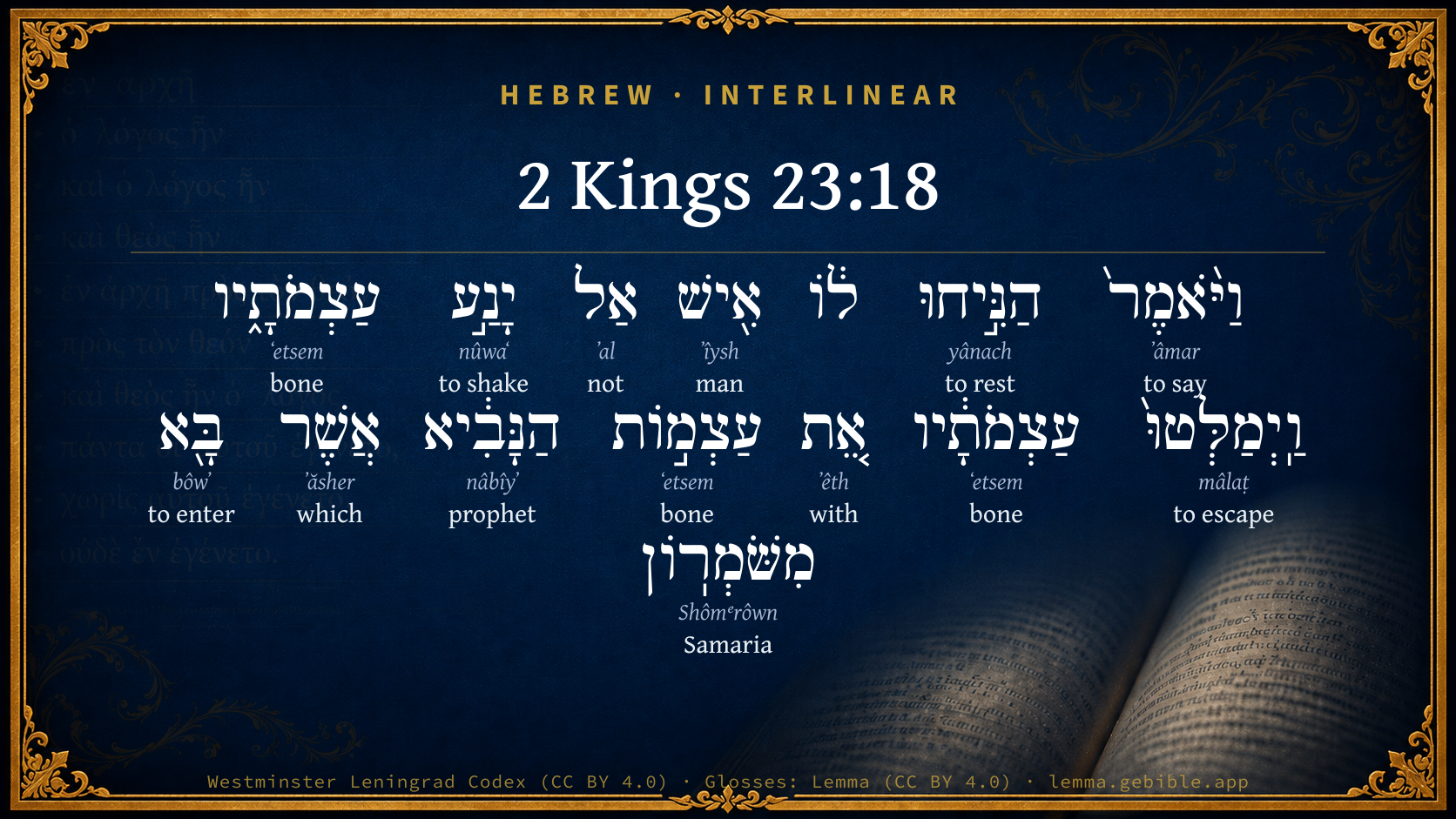
2 Kings 23:18

Hebrew (Westminster Leningrad Codex) 2 Kings 23:18 appears in the Hebrew Old Testament. The text above is from the Westminster Leningrad Codex. Each word links to its Strong’s number, a concise gloss, and parsing drawn from the Open Scriptures Hebrew Bible morphology. Click any word for its full Brown-Driver-Briggs (BDB) entry.
Download image
Cite this verse

2 Kings 23:18 (World English Bible). Public Domain. Lemma interlinear Bible study tool, https://lemma.gebible.app/v/2-kings/23/18.

Show BibTeX & RIS
BibTeX
RIS
English Translation
He said, Let him be; let no man move his bones. So they let his bones alone, with the bones of the prophet who came out of Samaria.
World English Bible · Public Domain
Download a study sheet

One document with this verse’s original text, its word-by-word gloss line, the meaning frame, cross-references with their text, attributed commentary, and full source and license credits — printable, and it pastes into notes with its structure intact.

This verse Autodidact and up

Study sheet (.html) Plain text (.txt)

A passage Seminary Student

Up to 50 verses in one chapter. A passage sheet keeps up to 6 commentary sources and 12 cross-references per verse, in the order this page ranks them, and says so on the sheet whenever that leaves anything out. Ask for a single verse and you get the Autodidact verse sheet above.

Everything on this page stays free to read, with no account — the sheet is a download of what is already on screen, not access to it.

Want to remove ads? Support Godless Engineer
Compare translations 3

The same verse in 3 English versions, stacked beneath the original-language interlinear above. Click any original word for its lexicon entry.

Each is an independent rendering of the whole verse — the interlinear is not word-aligned to these translations.

Highlighted words mark where these versions differ — a whole-verse word diff, not a word-by-word alignment.

  • World English Bible Public Domain
    He said, Let him be; let no man move his bones. So they let his bones alone, with the bones of the prophet who came out of Samaria.
  • King James Version Public Domain
    And he said, Let him alone; let no man move his bones. So they let his bones alone, with the bones of the prophet that came out of Samaria.
  • unfoldingWord Literal Text CC BY-SA 4.0
    And he said, “Let him stay. Let not a man disturb his bones.” And they rescued his bones, with the bones of the prophet who came from Samaria.

unfoldingWord Literal Text — © unfoldingWord, licensed CC BY-SA 4.0. Word-aligned USFM3 via Door43 (git.door43.org/unfoldingWord/en_ult).

Versions to compare (up to 4)

3 of 4 selected

Show all 18 translations

Every available English version of this verse, each an independent rendering of the whole verse.

  • World English Bible Public Domain
    He said, Let him be; let no man move his bones. So they let his bones alone, with the bones of the prophet who came out of Samaria.
  • Berean Standard Bible Public Domain
    “Let him rest,” said Josiah. “Do not let anyone disturb his bones.” So they left his bones undisturbed, along with those of the prophet who had come from Samaria.
  • Majority Standard Bible Public Domain
    “Let him rest,” said Josiah. “Do not let anyone disturb his bones.” So they left his bones undisturbed, along with those of the prophet who had come from Samaria.
  • King James Version Public Domain
    And he said, Let him alone; let no man move his bones. So they let his bones alone, with the bones of the prophet that came out of Samaria.
  • American Standard Version (1901) Public Domain
    And he said, Let him be; let no man move his bones. So they let his bones alone, with the bones of the prophet that came out of Samaria.
  • Revised Version (1885) Public Domain
    And he said, Let him be; let no man move his bones. So they let his bones alone, with the bones of the prophet that came out of Samaria.
  • Geneva Bible (1599) Public Domain
    Then sayde he, Let him alone: let none remooue his bones. So his bones were saued with the bones of the Prophet that came from Samaria.
  • Douay-Rheims (1899) Public Domain
    And he said: Let him alone, let no man move his bones. So his bones were left untouched with the bones of the prophet that came out of Samaria.
  • Young's Literal Translation Public Domain
    And he saith, `Let him alone, let no man touch his bones;' and they let his bones escape, with the bones of the prophet who came out of Samaria.
  • Literal Standard Version CC BY-SA 4.0
    And he says, “Leave him alone, let no man touch his bones”; and they let his bones escape with the bones of the prophet who came out of Samaria.
  • Unlocked Literal Bible CC BY-SA 4.0
    So Josiah said, “Let it alone. No one should move his bones.” So they let his bones alone, along with the bones of the prophet who had come from Samaria.
  • unfoldingWord Literal Text CC BY-SA 4.0
    And he said, “Let him stay. Let not a man disturb his bones.” And they rescued his bones, with the bones of the prophet who came from Samaria.
  • Darby Bible Public Domain
    And he said, Let him alone; let no man move his bones. And they saved his bones, with the bones of the prophet that came out of Samaria.
  • World Messianic Bible Public Domain
    He said, “Let him be! Let no one move his bones.” So they let his bones alone, with the bones of the prophet who came out of Samaria.
  • Webster's Bible Public Domain
    And he said, Let him alone; let no man move his bones. So they let his bones alone, with the bones of the prophet that came out of Samaria.
  • Free Bible Version CC BY-SA 4.0
    “Let him rest in peace,” said Josiah. “Don't anyone touch his bones.” So they left his bones undisturbed, together with the bones of the prophet who came from Samaria.
  • Bible in Basic English Public Domain
    So he said, Let him be; let not his bones be moved. So they let his bones be with the bones of the prophet who came from Samaria.
  • JPS Tanakh (1917) Public Domain
    And he said: 'Let him be; let no man move his bones.' So they let his bones alone, with the bones of the prophet that came out of Samaria.

Literal Standard Version (2020), Covenant Press — licensed CC BY-SA 4.0. Text via the HelloAO Bible API (eBible.org). Unlocked Literal Bible (unfoldingWord) — licensed CC BY-SA 4.0. Text via the HelloAO Bible API (eBible.org). unfoldingWord Literal Text — © unfoldingWord, licensed CC BY-SA 4.0. Word-aligned USFM3 via Door43 (git.door43.org/unfoldingWord/en_ult). Free Bible Version, Dr. Jonathan Gallagher — licensed CC BY-SA 4.0. Text via the HelloAO Bible API (eBible.org).

Word by word

More ways to search: Search by grammar → Find every occurrence → Compare this word →

Practice this passage: Drill this verse → Learn its vocabulary →

יָנַ֣ע
nûwaʻ
H5128
“to shake”
Verb, Hiphil, Jussive, 3rd Person, Masculine, Singular
Part of Speech
Verb
Stem
Hiphil
Form
Jussive
Person
3rd Person
Gender
Masculine
Number
Singular
Full BDB Definition

Origin: a primitive root

TWOT: 1328

to quiver, totter, shake, reel, stagger, wander, move, sift, make move, wave, waver, tremble - (Qal) - to wave, quiver, vibrate, swing, stagger, tremble, be unstable - to totter, go tottering - vagabond (participle) - (Niphal) to be tossed about or around - (Hiphil) - to toss about - to shake, cause to totter - to shake, disturb - to cause to wander
  1. וַיֹּ֨אמֶר֙ ʼâmar H559 “and · to say” Conjunction + Verb, Qal, Sequential Imperfect, 3rd Person, Masculine, Singular
  2. הַנִּ֣יחוּ yânach H3240 “rest” Verb, Hiphil, Imperative, 2nd Person, Masculine, Plural
  3. אִ֖ישׁ ʼîysh H376 “man” Noun, Common, Masculine, Singular, Absolute
  4. אַל ʼal H408 “not” Particle, Negative
  5. עַצְמֹתָ֑יו ʻetsem H6106 “bones · his” Noun, Common, Feminine, Plural, Construct + Suffix, Personal, 3rd Person, Masculine, Singular
  6. וַֽיְמַלְּטוּ֙ mâlaṭ H4422 “and · to escape” Conjunction + Verb, Piel, Sequential Imperfect, 3rd Person, Masculine, Plural
  7. עַצְמֹתָ֔יו ʻetsem H6106 “bones · his” Noun, Common, Feminine, Plural, Construct + Suffix, Personal, 3rd Person, Masculine, Singular
  8. אֵ֚ת ʼêth H854 “with” Preposition
  9. עַצְמ֣וֹת ʻetsem H6106 “bones of” Noun, Common, Feminine, Plural, Construct
  10. הַנָּבִ֔יא nâbîyʼ H5030 “the · prophet” Particle, Definite Article + Noun, Common, Masculine, Singular, Absolute
  11. אֲשֶׁר ʼăsher H834 “which” Particle, Relative
  12. בָּ֖א bôwʼ H935 “to enter” Verb, Qal, Perfect, 3rd Person, Masculine, Singular
  13. מִשֹּׁמְרֽוֹן Shômᵉrôwn H8111 “from · Samaria” Preposition + Noun, Proper

About this verse

These counts appear in no published source. They are computed here, from the morphology-tagged text and Lemma’s own curated glosses. What Lemma adds →

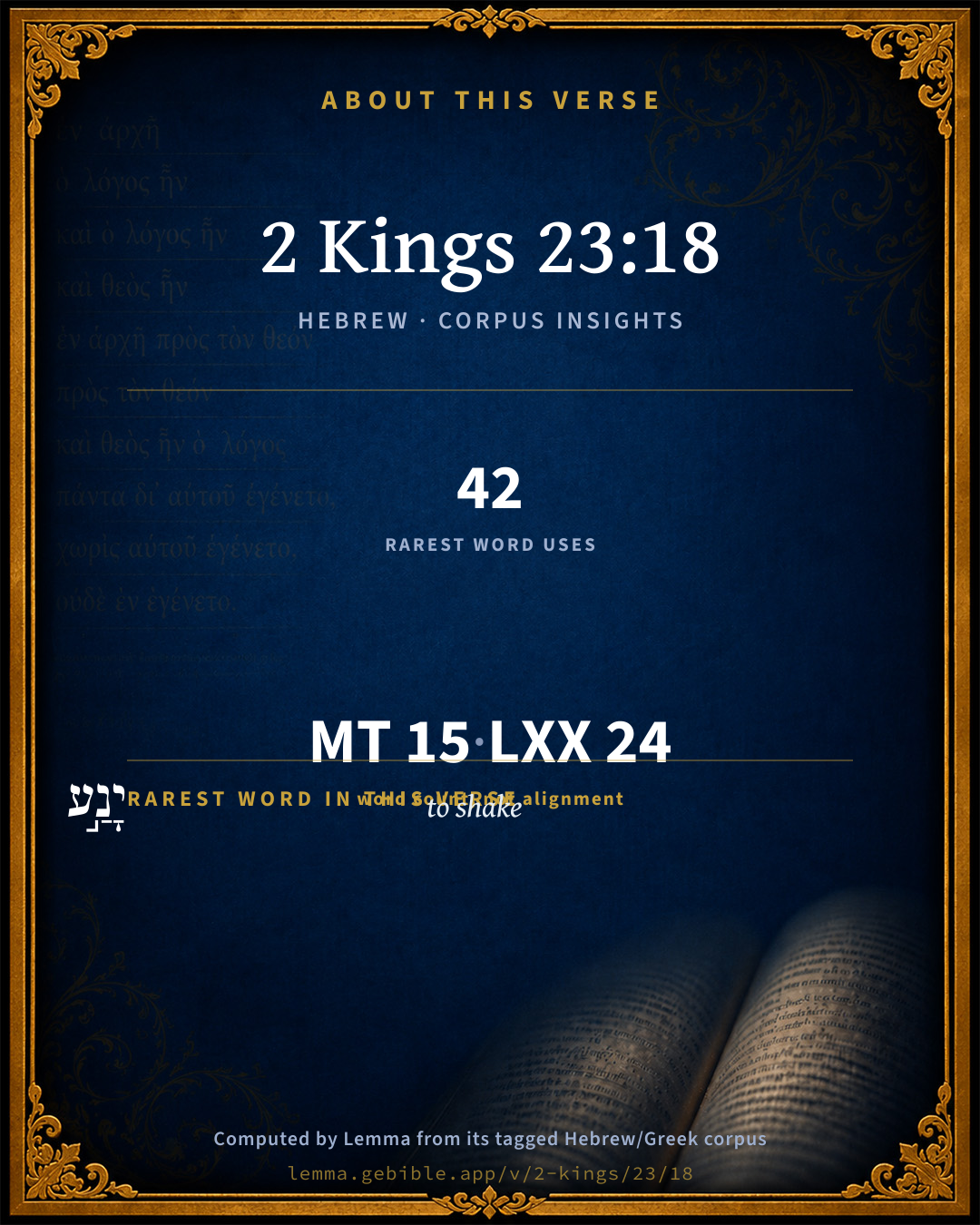
15
words
12
distinct lemmas
Historical
section

Shared distinctive vocabulary

יָנַ֣ע to shake H5128 occurs in 36 verses of the Hebrew Bible. Also found in:

Grammatical profile

  • 5 verbs
  • 6 nouns
  • 2 prepositions
  • 2 particles

Verb forms

  • וַיֹּ֨אמֶר֙ Qal · Sequential Imperfect
  • הַנִּ֣יחוּ Hiphil · Imperative
  • יָנַ֣ע Hiphil · Jussive
  • וַֽיְמַלְּטוּ֙ Piel · Sequential Imperfect
  • בָּ֖א Qal · Perfect

Repetition

A word recurs within this verse — often emphatic in Hebrew:

  • עַצְמֹתָ֑יו bone H6106 ×3

Hebrew & Septuagint length

In English translation the verse runs 28 words from the Hebrew and 29 from the Septuagint (LXX English) — closely comparable.

A rough comparison of the two English renderings, which tokenize alike — not a word-level alignment.

Word counts can differ between the Hebrew and the Greek without any difference in meaning — e.g. the Hebrew direct-object marker אֵת has no separate Greek word, and Greek often adds the article ὁ.

In the original languages it is 15 Hebrew tokens and 24 Greek tokens — but the two are counted differently (Hebrew bundles its prefixes and suffixes into one token; the Greek is in lemma form), so that isn’t a like-for-like length.

Cross-references

2

Topical passages linked to 2 Kings 23:18 in the Treasury of Scripture Knowledge — connected by theme and wording, ordered by reader-vote popularity; previews shown in the World English Bible.

  • 1 Kings 13:31 It happened, after he had buried him, that he spoke to his sons, saying, When I am dead, then bury me in the tomb in which the man of God is buried; lay my bones beside his bones.
  • 1 Kings 13:1–22 Behold, there came a man of God out of Judah by the word of Yahweh to Beth El: and Jeroboam was standing by the altar to burn incense.

Cross-references courtesy of OpenBible.info (CC BY 4.0).

Hebrew and Greek witnesses Masoretic Hebrew ↔ Greek Septuagint

The same verse in the two great witnesses to the Old Testament, shown verse-for-verse.

These are two independent witnesses, not word-aligned to each other, and the Septuagint is shown in lemma (dictionary) form.

Hebrew 2 Kings 23:18 Masoretic · Westminster Leningrad Codex

וַיֹּ֨אמֶר֙ הַנִּ֣יחוּ ל֔וֹ אִ֖ישׁ אַל יָנַ֣ע עַצְמֹתָ֑יו וַֽיְמַלְּטוּ֙ עַצְמֹתָ֔יו אֵ֚ת עַצְמ֣וֹת הַנָּבִ֔יא אֲשֶׁר בָּ֖א מִשֹּׁמְרֽוֹן

He said, Let him be; let no man move his bones. So they let his bones alone, with the bones of the prophet who came out of Samaria.

World English Bible · Public Domain

Greek LXX 2 Kings 23:18 Septuagint · lemma form

καί εἶπον ἀποἵημι αὐτός ἀνήρ μή κινέω ὁ ὀστέον αὐτός καί ῥύομαι ὁ ὀστέον αὐτός μετά ὁ ὀστέον ὁ προφήτης ὁ ἥκω ἐκ σαμαρεία

And he said, Let him alone; let no one disturb his bones. So his bones were spared, together with the bones of the prophet that came out of Samaria.

LXX2012 (modern English Septuagint) · Public Domain

Hebrew: Westminster Leningrad Codex (CC BY 4.0). Greek: Septuagint (public domain); English from LXX2012 (modern English Septuagint) (Public Domain). How the Septuagint differs from the Hebrew →

Targum (Aramaic paraphrase)

1

The Targum is the ancient Jewish Aramaic paraphrase of the Hebrew Scriptures — an interpretive translation, not the Hebrew text itself. Onkelos (literal) and Pseudo-Jonathan (expansive) render the Torah, and Jonathan the Prophets. Coverage is partial: where no permissively-licensed English translation exists for a verse, only the Aramaic is shown. This is verse-level text, not a word-by-word alignment to the Hebrew.

  1. Targum Jonathan Prophets (Joshua–Malachi)
    וַאֲמַר שְׁבוּקוּ מִנֵיהּ אֱנַשׁ לָא יָנִיד גַרְמוֹהִי וְשַׁזֵיבוּ גַרְמוֹהִי (עִם) יַת גַרְמֵי נְבִיָא שִׁקְרָא דַאֲתָא מִשֹׁמְרוֹן:

    (no public-domain English translation for this verse)

    Targum Jonathan — Aramaic: “Mikraot Gedolot” (public domain). English: “Sefaria Community Translation” (CC0 1.0 (public-domain dedication)); “London "Chaldee Paraphrase," 1871” (public domain). Text via Sefaria.

Commentary

Notes on 2 Kings 23:18 from classic Christian and Jewish commentators (each source and its license shown beneath its notes). The classic Christian expositions comment on the surrounding passage and are grouped to its opening verse, so a note may address several verses; the Jewish commentaries on the Tanakh (Rashi and others) are per-verse, so they appear only where the commentator wrote on this verse.

Lemma curates 59 commentaries, every one of them public domain or Creative Commons licensed, each selected and text-cleaned for this edition rather than reprinted as found. About our sources →

Joseph Benson's Commentary

2Ki 23:18. He said, Let no man move his bones — It is pertinently observed by Joh. Wolfius, that if pious persons, in those days, had had the same opinion about relics which has long been prevalent in the Church of Rome, the king would not have ordered his bones to remain quiet and undisturbed, but would have put them into golden boxes, and carried them to Jerusalem, to be there regarded with religious, if not idolatrous veneration by the people.

Joseph Benson's Commentary on the Old and New Testaments (1811–1818) — public domain. Text from a community e-Sword module.

Geneva Bible (1599)

Geneva Bible translators

Meaning, the Prophet which came after him, and caused him to eat contrary to the commandment of the Lord, which were both two buried in one grave, 1 Kings 13:31.

Geneva Bible (1599) marginal notes — public domain. Text via Bolls.life.

Adam Clarke's Commentary

Verse 18. The prophet that came out of Samaria] 1Kg 13:32.

Adam Clarke's Commentary on the Bible (1810–1826) — public domain. Text from a community e-Sword/MySword module.

Ellicott's Commentary for English Readers

(18) Let him alone.—Or, Let him rest.

So they let his bones alone.—A different verb. And they suffered his bones to escape, scil., disturbance.

With the bones of the prophet . . .—See 1Ki_13:31-32.

That came out of Samaria.—This simply designates the old prophet who deceived the Judæan man of God, as a citizen of the Northern kingdom, which was called Samaria, after its capital.

A Bible Commentary for English Readers, edited by Charles John Ellicott (1878–1897) — public domain. Text from a community e-Sword module.

The Cambridge Bible for Schools and Colleges

gen. ed. J. J. S. Perowne

18. Let him alone] R.V. Let him be. The verb translated ‘let alone’, in a later clause of the verse is not the same as this. Hence the change in the English.

that came out of Samaria] i.e. The prophet of Bethel, for that place belonged to what was afterwards known as the kingdom of Samaria. The word ‘Samaria’ is used here in accordance with the language of Josiah’s day. Samaria did not exist in Jeroboam’s time, the city which ultimately gave name to the district having only been built in the reign of Omri (1Ki_16:24).

The Cambridge Bible for Schools and Colleges (gen. ed. J. J. S. Perowne; Cambridge University Press, 1878–1918) — public domain. Text from a community e-Sword module.

John Gill's Exposition

And all the houses also of the high places,.... The temples of the idols there, and the houses for the priests to dwell in:

that were in the cities of Samaria, which the kings of Israel had made to provoke the Lord to anger, Josiah took away; particularly in the cities of Manasseh, Ephraim, and Simeon, unto Naphtali, Ch2 34:6 the Israelites that remained there acknowledging Josiah as their king; and perhaps, after the defeat of Sennacherib, many of the cities of Israel might put themselves under the protection of Hezekiah, and especially upon the destruction of the Assyrian empire; and Manasseh, with his liberty, might have his kingdom enlarged by the king of Babylon; and which being continued and increased in the times of Josiah, might be the reason of his opposing the king of Egypt in favour of the king of Babylon:

and did to them according to all the acts that he had done in Bethel; defiled them, and broke down the altars in them.

John Gill's Exposition of the Whole Bible (1746–1763) — public domain (CC PDM 1.0). Text via the HelloAO Bible API.

Haydock's Catholic Bible Commentary

Samaria. It seems this word has been inserted instead of Juda, as it is certain the prophet came thence, ver. 17., and 3 Kings xiii. 32. (Calmet) --- But thus both prophets would be identified. It would rather appear that the seducing prophet, who resided at Bethel, is here said to have come out of Samaria, though that place was not raised to the dignity of a royal city (Haydock) till 50 years afterwards. (Calmet) --- There might be a town there long before; and, at any rate, he belonged to the kingdom to Jeroboam, or of Samaria. (Haydock) --- His faith in the prophet’s prediction was, perhaps, thus rewarded, (Menochius) as his bones were left unmolested, on account of their being buried in the same sepulchre with the man of God. (Haydock)

George Leo Haydock (1774–1849), Haydock's Catholic Family Bible and Commentary, 1859 edition — public domain. Excludes Psalms (Douay-Rheims chapter numbering differs from Protestant) and Deuterocanonical books (Catholic canon only).

Matthew Poole's English Annotations

Which were now mixed together.

Samaria; the place of his birth or former abode, though now he were in Beth-el, 1Ki 13:11.

Matthew Poole's English Annotations on the Holy Bible (1683–1685) — public domain. Text from a community e-Sword/MySword module.

Whedon's Commentary on the Bible

Daniel D. Whedon

18. They let his bones alone — Literally, let them escape; that is, from the desecration which the bones of others in the neighbouring sepulchres suffered.

Out of Samaria — Out of the country of Samaria, in contrast with the phrase from Judah, in the previous verse.

Daniel D. Whedon (gen. ed.), Commentary on the Old and New Testaments (1874–1909) — public domain. Text from a community e-Sword module.

The Pulpit Commentary

And he said, Let him alone; let no man move his bones. Josiah remembered the circumstances when they were recalled to him, and, in order to show honor to the "man of God", (1Ki 13., passim) commanded that his tomb should be undisturbed. So they let his bones alone, with the bones of the prophet that came out of Samaria; i.e. with the bones of the Israelite prophet, who had taken care to be buried with him. The reference is to 1Ki_13:31.

The Pulpit Commentary (1880–1919), ed. H.D.M. Spence-Jones & Joseph S. Exell — public domain. Text from a community e-Sword module.

Lesson kit

Teaching starters — assembled from the data on this page, not authored interpretation. Every prompt links to the verse data it draws on. Edit before teaching.

2 Kings, in the Historical, opens this verse with 15 words (12 distinct Hebrew lemmas). Its most distinctive word is nûwaʻ (“to shake”). A historical commentator’s framing appears above. Read the whole chapter for the surrounding context.

Discussion questions

  1. How does “to shake” (nûwaʻ) shape what this verse is saying?
  2. Genesis 4:12 shares the word «to shake» with this verse. How do the two illuminate each other?
  3. “bone” occurs 3× in this one verse. What is the effect of the repetition?
  4. The translations on this page render this verse differently — a whole-verse word diff, not a word-by-word alignment. What might account for the different wordings?
  5. The verb «וַיֹּ֨אמֶר֙» is Qal Sequential Imperfect. How does its form color the action?
  6. Reading how Joseph Benson's Commentary and Geneva Bible (1599) read this verse, where do the two commentators agree and where do they part?

Things to notice

Reading settings

Reading text

Shown beneath each verse's original-language words.

Old Testament
Old Testament edition

Read the OT as the Masoretic Hebrew (MT) or the Greek Septuagint (LXX).

English shown for the Greek Septuagint (in the Hebrew ↔ Greek comparison).

Comparing translations? Open the Compare panel on any verse page to stack up to four side by side.