
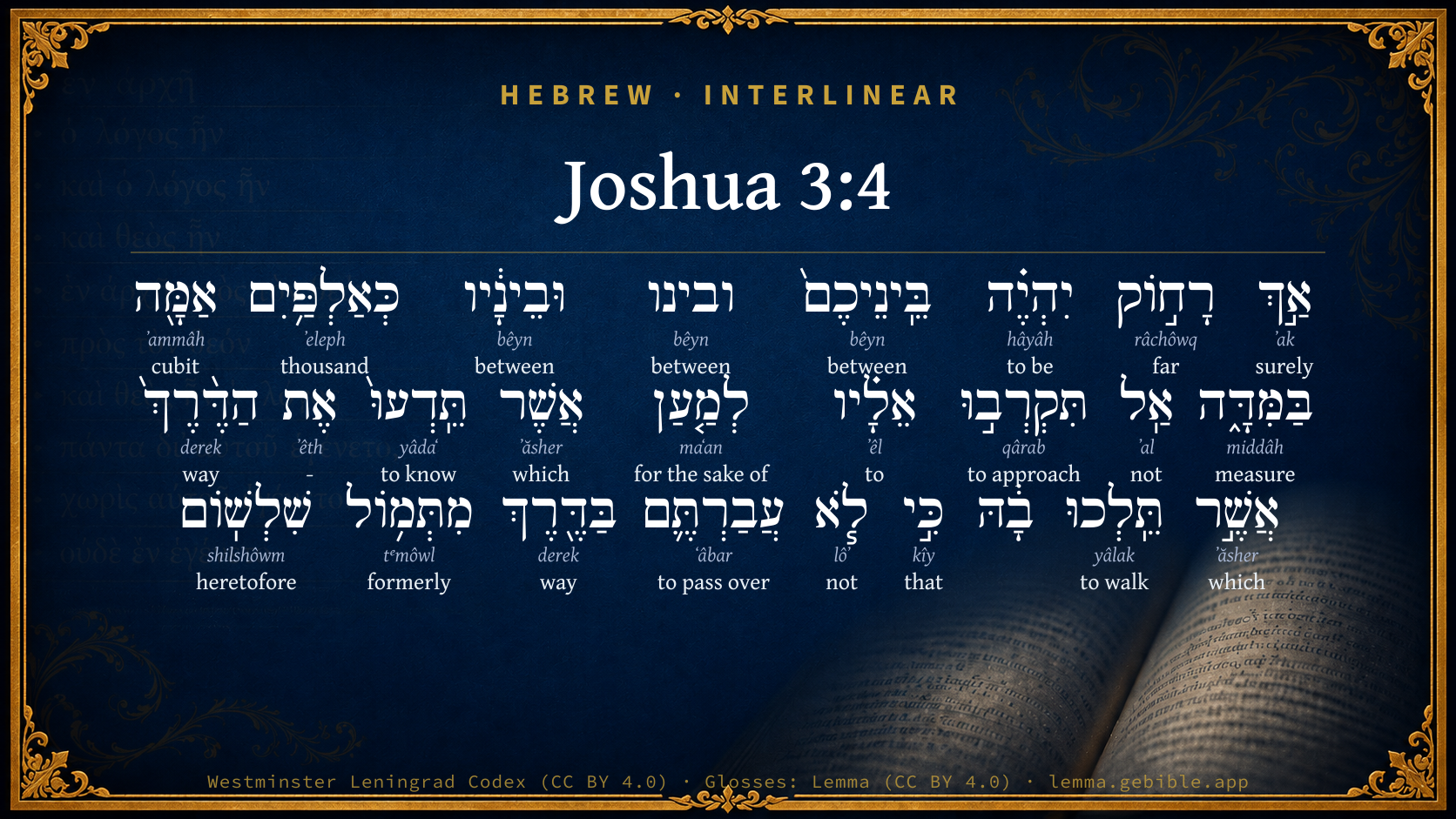
Joshua 3:4

Hebrew (Westminster Leningrad Codex) Joshua 3:4 appears in the Hebrew Old Testament. The text above is from the Westminster Leningrad Codex. Each word links to its Strong’s number, a concise gloss, and parsing drawn from the Open Scriptures Hebrew Bible morphology. Click any word for its full Brown-Driver-Briggs (BDB) entry.
Download image
Cite this verse

Joshua 3:4 (World English Bible). Public Domain. Lemma interlinear Bible study tool, https://lemma.gebible.app/v/joshua/3/4.

Show BibTeX & RIS
BibTeX
RIS
English Translation
Yet there shall be a space between you and it, about two thousand cubits by measure: don't come near to it, that you may know the way by which you must go; for you have not passed this way heretofore.
World English Bible · Public Domain
Download a study sheet

One document with this verse’s original text, its word-by-word gloss line, the meaning frame, cross-references with their text, attributed commentary, and full source and license credits — printable, and it pastes into notes with its structure intact.

This verse Autodidact and up

Study sheet (.html) Plain text (.txt)

A passage Seminary Student

Up to 50 verses in one chapter. A passage sheet keeps up to 6 commentary sources and 12 cross-references per verse, in the order this page ranks them, and says so on the sheet whenever that leaves anything out. Ask for a single verse and you get the Autodidact verse sheet above.

Everything on this page stays free to read, with no account — the sheet is a download of what is already on screen, not access to it.

Want to remove ads? Support Godless Engineer
Compare translations 3

The same verse in 3 English versions, stacked beneath the original-language interlinear above. Click any original word for its lexicon entry.

Each is an independent rendering of the whole verse — the interlinear is not word-aligned to these translations.

Highlighted words mark where these versions differ — a whole-verse word diff, not a word-by-word alignment.

  • World English Bible Public Domain
    Yet there shall be a space between you and it, about two thousand cubits by measure: don't come near to it, that you may know the way by which you must go; for you have not passed this way heretofore.
  • King James Version Public Domain
    Yet there shall be a space between you and it, about two thousand cubits by measure: come not near unto it, that ye may know the way by which ye must go: for ye have not passed this way heretofore.
  • unfoldingWord Literal Text CC BY-SA 4.0
    but a distance shall be between you and between it, about 2, 000 cubits in measurement; do not come near to it—so that you will know the way in which you should go, since you have not passed over by the way from yesterday the third day.”

unfoldingWord Literal Text — © unfoldingWord, licensed CC BY-SA 4.0. Word-aligned USFM3 via Door43 (git.door43.org/unfoldingWord/en_ult).

Versions to compare (up to 4)

3 of 4 selected

Show all 18 translations

Every available English version of this verse, each an independent rendering of the whole verse.

  • World English Bible Public Domain
    Yet there shall be a space between you and it, about two thousand cubits by measure: don't come near to it, that you may know the way by which you must go; for you have not passed this way heretofore.
  • Berean Standard Bible Public Domain
    But keep a distance of about two thousand cubits between yourselves and the ark. Do not go near it, so that you can see the way to go, since you have never traveled this way before.”
  • Majority Standard Bible Public Domain
    But keep a distance of about two thousand cubits between yourselves and the ark. Do not go near it, so that you can see the way to go, since you have never traveled this way before.”
  • King James Version Public Domain
    Yet there shall be a space between you and it, about two thousand cubits by measure: come not near unto it, that ye may know the way by which ye must go: for ye have not passed this way heretofore.
  • American Standard Version (1901) Public Domain
    Yet there shall be a space between you and it, about two thousand cubits by measure: come not near unto it, that ye may know the way by which ye must go; for ye have not passed this way heretofore.
  • Revised Version (1885) Public Domain
    Yet there shall be a space between you and it, about two thousand cubits by measure: come not near unto it, that ye may know the way by which ye must go; for ye have not passed this way heretofore.
  • Geneva Bible (1599) Public Domain
    Yet there shalbe a space betweene you and it, about two thousande cubites by measure: ye shall not come neere vnto it, that ye may knowe the way, by the which ye shall goe: for ye haue not gone this way in times past.
  • Douay-Rheims (1899) Public Domain
    And let there be between you and the ark the space of two thousand cubits: that you may see it afar off, and know which way you must go: for you have not gone this way before: and take care you come not near the ark.
  • Young's Literal Translation Public Domain
    only, a distance is between you and it, about two thousand cubits by measure; ye do not come near unto it, so that ye know the way in which ye go, for ye have not passed over in the way heretofore.'
  • Literal Standard Version CC BY-SA 4.0
    only, a distance is between you and it, about two thousand cubits by measure; you do not come near to it, so that you know the way in which you go, for you have not passed over in the way before.”
  • Unlocked Literal Bible CC BY-SA 4.0
    There must be a distance between you and it of about two thousand cubits. Do not come close to it, so that you can see which way to go, since you have not gone this way before.”
  • unfoldingWord Literal Text CC BY-SA 4.0
    but a distance shall be between you and between it, about 2, 000 cubits in measurement; do not come near to it—so that you will know the way in which you should go, since you have not passed over by the way from yesterday the third day.”
  • Darby Bible Public Domain
    yet there shall be a distance between you and it, about two thousand cubits by measure. Ye shall not come near it, that ye may know the way by which ye must go; for ye have not passed this way heretofore.
  • World Messianic Bible Public Domain
    Yet there shall be a space between you and it of about two thousand cubits by measure—don’t come closer to it—that you may know the way by which you must go; for you have not passed this way before.”
  • Webster's Bible Public Domain
    Yet there shall be a space between you and it, about two thousand cubits by measure: come not near to it, that ye may know the way by which ye must go: for ye have not passed this way heretofore.
  • Free Bible Version CC BY-SA 4.0
    That way you'll know which way to go, since you haven't been here before. Leave about 3,000 feet between you and the Ark. Don't go near it!”
  • Bible in Basic English Public Domain
    But let there be a space between you and it of about two thousand cubits: come no nearer to it, so that you may see the way you have to go, for you have not been over this way before.
  • JPS Tanakh (1917) Public Domain
    Yet there shall be a space between you and it, about two thousand cubits by measure; come not near unto it, that ye may know the way by which ye must go; for ye have not passed this way heretofore.'

Literal Standard Version (2020), Covenant Press — licensed CC BY-SA 4.0. Text via the HelloAO Bible API (eBible.org). Unlocked Literal Bible (unfoldingWord) — licensed CC BY-SA 4.0. Text via the HelloAO Bible API (eBible.org). unfoldingWord Literal Text — © unfoldingWord, licensed CC BY-SA 4.0. Word-aligned USFM3 via Door43 (git.door43.org/unfoldingWord/en_ult). Free Bible Version, Dr. Jonathan Gallagher — licensed CC BY-SA 4.0. Text via the HelloAO Bible API (eBible.org).

Word by word

More ways to search: Search by grammar → Find every occurrence → Compare this word →

Practice this passage: Drill this verse → Learn its vocabulary →

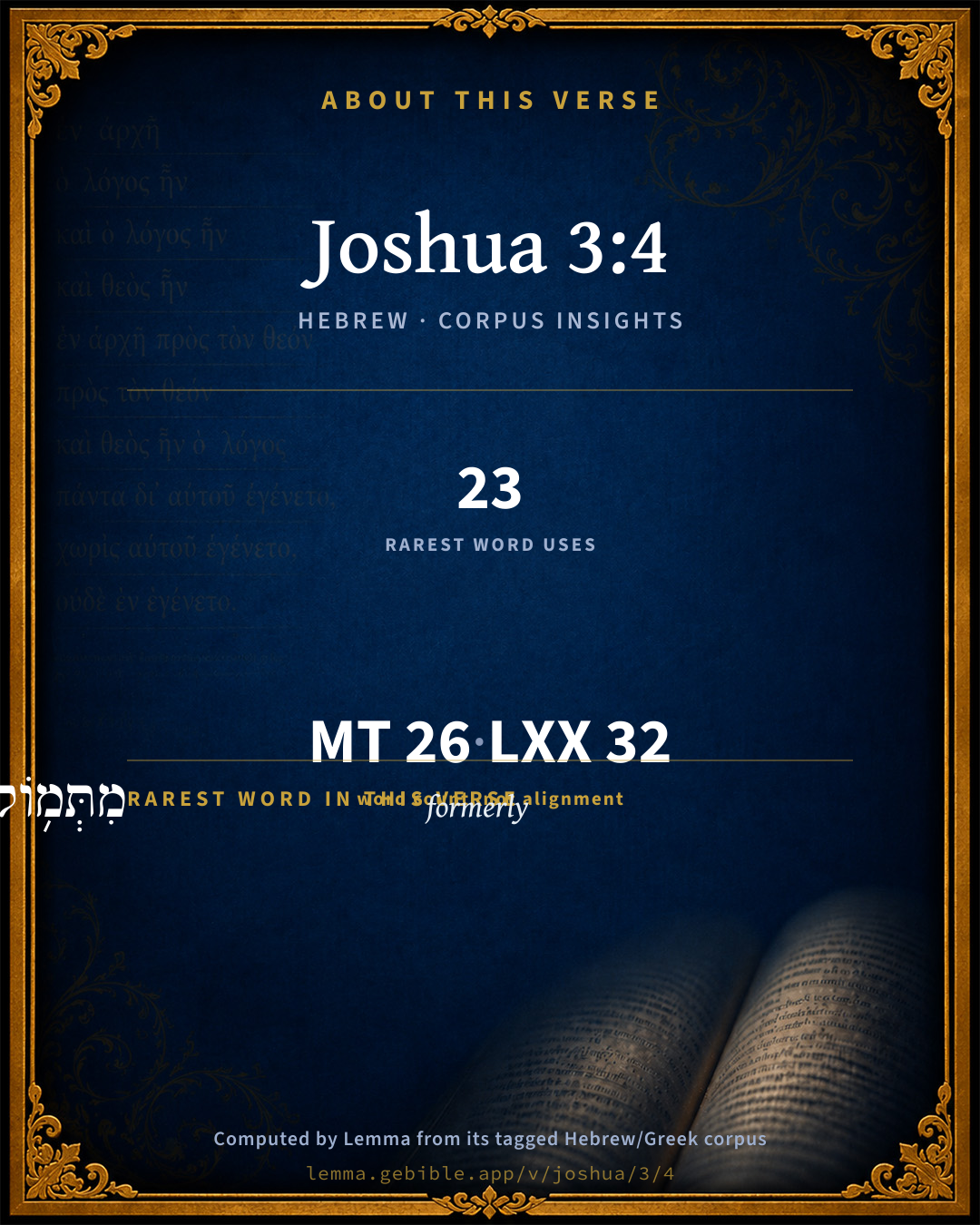
מִתְּמ֥וֹל
tᵉmôwl
H8543
“from · formerly”
Preposition + Adverb
Part of Speech
Preposition + Adverb
Full BDB Definition

Origin: probably for H865

TWOT: 2521

before, before that time, beforetime, heretofore, of late, of old, these days, time(s) past, yesterday, day before yesterday, recently, formerly - yesterday - recently, formerly (usual usage) (figuratively) - as formerly, so more recently - from yesterday, already
  1. אַ֣ךְ ʼak H389 “surely” Particle, Accusative
  2. רָח֣וֹק râchôwq H7350 “far” Adjective, Adjective, Masculine, Singular, Absolute
  3. יִהְיֶ֗ה hâyâh H1961 “to be” Verb, Qal, Imperfect, 3rd Person, Masculine, Singular
  4. בֵּֽינֵיכֶם֙ bêyn H996 “between · you” Preposition + Suffix, Personal, 2nd Person, Masculine, Plural
  5. ובינו bêyn H996 “and · between · him” Conjunction + Preposition + Suffix, Personal, 3rd Person, Masculine, Singular
  6. וּבֵינָ֔יו bêyn H996 “and · between · him” Conjunction + Preposition + Suffix, Personal, 3rd Person, Masculine, Singular
  7. כְּאַלְפַּ֥יִם ʼeleph H505 “like/as · thousand” Preposition + Adjective, Cardinal number, Both, Plural, Absolute
  8. אַמָּ֖ה ʼammâh H520 “cubit” Noun, Common, Feminine, Singular, Absolute
  9. בַּמִּדָּ֑ה middâh H4060 “in/at the · measure” Preposition, Determined + Noun, Common, Feminine, Singular, Absolute
  10. אַֽל ʼal H408 “not” Particle, Negative
  11. תִּקְרְב֣וּ qârab H7126 “to approach” Verb, Qal, Jussive, 2nd Person, Masculine, Plural
  12. אֵלָ֗יו ʼêl H413 “to · him” Preposition + Suffix, Personal, 3rd Person, Masculine, Singular
  13. לְמַ֤עַן maʻan H4616 “for the sake of” Preposition
  14. אֲשֶׁר ʼăsher H834 “which” Particle, Relative
  15. תֵּֽדְעוּ֙ yâdaʻ H3045 “to know” Verb, Qal, Imperfect, 2nd Person, Masculine, Plural
  16. אֶת ʼêth H853 “-” Particle, Direct Object
  17. הַדֶּ֨רֶךְ֙ derek H1870 “the · way” Particle, Definite Article + Noun, Common, Both, Singular, Absolute
  18. אֲשֶׁ֣ר ʼăsher H834 “which” Particle, Relative
  19. תֵּֽלְכוּ yâlak H3212 “to walk” Verb, Qal, Imperfect, 2nd Person, Masculine, Plural
  20. כִּ֣י kîy H3588 “that” Conjunction
  21. לֹ֧א lôʼ H3808 “not” Particle, Negative
  22. עֲבַרְתֶּ֛ם ʻâbar H5674 “to pass over” Verb, Qal, Perfect, 2nd Person, Masculine, Plural
  23. בַּדֶּ֖רֶךְ derek H1870 “in/at the · way” Preposition, Determined + Noun, Common, Both, Singular, Absolute
  24. שִׁלְשֽׁוֹם shilshôwm H8032 “heretofore” Noun, Common, Masculine, Singular, Absolute

About this verse

These counts appear in no published source. They are computed here, from the morphology-tagged text and Lemma’s own curated glosses. What Lemma adds →

26
words
21
distinct lemmas
Historical
section

Notable vocabulary

The rarest word here is מִתְּמ֥וֹל formerly H8543 — appearing just 23 times in the whole Hebrew Bible.

Shared distinctive vocabulary

מִתְּמ֥וֹל formerly H8543 occurs in 22 verses of the Hebrew Bible. Also found in:

Grammatical profile

  • 5 verbs
  • 5 nouns
  • 2 adjectives
  • 6 prepositions
  • 1 conjunction
  • 1 adverb
  • 6 particles

Verb forms

  • יִהְיֶ֗ה Qal · Imperfect
  • תִּקְרְב֣וּ Qal · Jussive
  • תֵּֽדְעוּ֙ Qal · Imperfect
  • תֵּֽלְכוּ Qal · Imperfect
  • עֲבַרְתֶּ֛ם Qal · Perfect

Repetition

Words recur within this verse — often emphatic in Hebrew:

  • בֵּֽינֵיכֶם֙ between H996 ×3
  • הַדֶּ֨רֶךְ֙ way H1870 ×2
  • אֲשֶׁר which H834 ×2

Hebrew & Septuagint length

In English translation the verse runs 40 words from the Hebrew and 46 from the Septuagint (LXX English) — closely comparable.

A rough comparison of the two English renderings, which tokenize alike — not a word-level alignment.

Word counts can differ between the Hebrew and the Greek without any difference in meaning — e.g. the Hebrew direct-object marker אֵת has no separate Greek word, and Greek often adds the article ὁ.

In the original languages it is 26 Hebrew tokens and 32 Greek tokens — but the two are counted differently (Hebrew bundles its prefixes and suffixes into one token; the Greek is in lemma form), so that isn’t a like-for-like length.

Cross-references

7

Topical passages linked to Joshua 3:4 in the Treasury of Scripture Knowledge — connected by theme and wording, ordered by reader-vote popularity; previews shown in the World English Bible.

  • Psalms 89:7 A very awesome God in the council of the holy ones, To be feared above all those who are around him?
  • Exodus 3:5 He said, "Don't come close. Take off your sandals from off your feet, for the place you are standing on is holy ground."
  • Hebrews 12:28–29 Therefore, receiving a Kingdom that can't be shaken, let us have grace, through which we serve God acceptably, with reverence and awe,
  • Genesis 31:2 Jacob saw the expression on Laban's face, and, behold, it was not toward him as before.
  • Exodus 4:10 Moses said to Yahweh, "Oh, Lord, I am not eloquent, neither before now, nor since you have spoken to your servant; for I am slow of speech, and of a slow tongue."
  • Exodus 19:12 You shall set bounds to the people round about, saying, 'Be careful that you don't go up onto the mountain, or touch its border. Whoever touches the mountain shall be surely put to death.
  • 1 Chronicles 11:2 In times past, even when Saul was king, it was you who led out and brought in Israel: and Yahweh your God said to you, You shall be shepherd of my people Israel, and you shall be prince over my people Israel.

Cross-references courtesy of OpenBible.info (CC BY 4.0).

Hebrew and Greek witnesses Masoretic Hebrew ↔ Greek Septuagint

The same verse in the two great witnesses to the Old Testament, shown verse-for-verse.

These are two independent witnesses, not word-aligned to each other, and the Septuagint is shown in lemma (dictionary) form.

Hebrew Joshua 3:4 Masoretic · Westminster Leningrad Codex

אַ֣ךְ רָח֣וֹק יִהְיֶ֗ה בֵּֽינֵיכֶם֙ ובינו וּבֵינָ֔יו כְּאַלְפַּ֥יִם אַמָּ֖ה בַּמִּדָּ֑ה אַֽל תִּקְרְב֣וּ אֵלָ֗יו לְמַ֤עַן אֲשֶׁר תֵּֽדְעוּ֙ אֶת הַדֶּ֨רֶךְ֙ אֲשֶׁ֣ר תֵּֽלְכוּ בָ֔הּ כִּ֣י לֹ֧א עֲבַרְתֶּ֛ם בַּדֶּ֖רֶךְ מִתְּמ֥וֹל שִׁלְשֽׁוֹם

Yet there shall be a space between you and it, about two thousand cubits by measure: don't come near to it, that you may know the way by which you must go; for you have not passed this way heretofore.

World English Bible · Public Domain

Greek LXX Joshua 3:4 Septuagint · lemma form

ἀλλά μακράν εἰμί ἀνά μέσος σύ καί ἐκεῖνος ὅσος δισχίλιοι πῆχυς ἵστημι μή προςἐγγίζω αὐτός ἵνα ἐπίσταμαι ὁ ὁδός ὅς πορεύομαι αὐτός οὐ γάρ πορεύομαι ὁ ὁδός ἀπό χθές καί τρίτος ἡμέρα

But let there be a distance between you and it; you⌃ shall stand as much as two thousand cubits from it. Do not draw near to it, that you⌃ may know the way which you⌃ are to go; for you⌃ have not gone the way before.

LXX2012 (modern English Septuagint) · Public Domain

On this verse, The Pulpit Commentary discusses the Septuagint’s reading. Read the note in Commentary ↓

Hebrew: Westminster Leningrad Codex (CC BY 4.0). Greek: Septuagint (public domain); English from LXX2012 (modern English Septuagint) (Public Domain). How the Septuagint differs from the Hebrew →

Targum (Aramaic paraphrase)

1

The Targum is the ancient Jewish Aramaic paraphrase of the Hebrew Scriptures — an interpretive translation, not the Hebrew text itself. Onkelos (literal) and Pseudo-Jonathan (expansive) render the Torah, and Jonathan the Prophets. Coverage is partial: where no permissively-licensed English translation exists for a verse, only the Aramaic is shown. This is verse-level text, not a word-by-word alignment to the Hebrew.

  1. Targum Jonathan Prophets (Joshua–Malachi)
    בְּרַם רָחִיק יְהֵי בְּינֵיכוֹן וּבֵינוֹהִי כִּתְרֵין אַלְפִין אַמִין בְּמִשְׁחָתָא לָא תְקַרְבוּן לְוָתֵיהּ בְּדִיל דְתִידְעוּן יַת אוֹרְחָא דִי תְהָכוּן בָּהּ אֲרֵי לָא עֲבַרְתּוּן בְּאוֹרְחָא מֵאִתְמָלִי וּמִדְקָמוֹהִי:

    (no public-domain English translation for this verse)

    Targum Jonathan — Aramaic: “Mikraot Gedolot” (public domain). English: “Sefaria Community Translation” (CC0 1.0 (public-domain dedication)); “London "Chaldee Paraphrase," 1871” (public domain). Text via Sefaria.

Commentary

Notes on Joshua 3:4 from classic Christian and Jewish commentators (each source and its license shown beneath its notes). The classic Christian expositions comment on the surrounding passage and are grouped to its opening verse, so a note may address several verses; the Jewish commentaries on the Tanakh (Rashi and others) are per-verse, so they appear only where the commentator wrote on this verse.

Lemma curates 59 commentaries, every one of them public domain or Creative Commons licensed, each selected and text-cleaned for this edition rather than reprinted as found. About our sources →

Trapp's Complete Commentary

John Trapp

Jos 3:4 Yet there shall be a space between you and it, about two thousand cubits by measure: come not near unto it, that ye may know the way by which ye must go: for ye have not passed [this] way heretofore.

Ver. 4. Yet there shall be a space.] That you may know the distance, and show your reverence. See Exo 19:12. As also,

That you may know the way by which you must go,] i.e., Ut ignari vice tuto vado transire possitis, that ye may have a sure and safe passage through the river discovered unto you.

John Trapp, A Commentary or Exposition upon All the Books of the Old and New Testament (1647–1656) — public domain. Text from a community e-Sword module.

Joseph Benson's Commentary

Jos 3:4. There shall be a space between you and it — Thus it was made to appear that the ark needed not to be guarded by the men of war, but was itself a guard to them. With what a noble defiance of the enemy did it leave all its friends far behind, save the unarmed priests that carried it, as perfectly sufficient for its own safety and theirs that followed it. Two thousand cubits — A thousand yards, at which distance from it the Israelites seem to have been encamped in the wilderness. And because they generally went from their tents to the ark to worship God, especially on the sabbath days, hence it hath been conceived that a sabbath day’s journey reached only to two thousand cubits. But that may be doubted; for those who encamped nearest the ark were at that distance from it, and came so far; but the rest were farther from it, and their sabbath day’s journey was considerably longer. Come not near unto it — Partly from the respect they should bear to the ark; but chiefly, that the ark, marching so far before them into the river, and standing still there till they passed over, might give them the greater assurance of a safe passage. Thus also the faith of the priests would be tried, and their confidence and courage displayed for an example to the people. That ye may know the way by which you must go — May see it, as it were, chalked out, or traced by the ark. For had they been allowed to come near, and surround it, none could have had a sight of it but those that were close to it; but as it was at such a distance before them, they would all have the satisfaction of seeing it when it entered the river, and would be animated by the sight, especially if the pillar of cloud and fire still hovered over it, which some think it did; although others judge it to be more probable that it was now removed. For ye have not passed this way heretofore — Therefore there was the more reason that this provision should be made for their encouragement. This, however, had been the character of it all their way through the wilderness: it was a way they had not passed before; but this through Jordan was especially such. While we are in this world we must expect and prepare for unusual events, to pass ways we have not passed before. And much more when we go hence, when we pass through the valley of the shadow of death. But if we have the assurance of God’s presence with us we need not fear; that will furnish us with protection and strength such as we never had, when we come to pass a way we never passed, and to do a work we never did.

Joseph Benson's Commentary on the Old and New Testaments (1811–1818) — public domain. Text from a community e-Sword module.

MacLaren's Expositions of Holy Scripture

Alexander MacLaren

Joshua

THE UNTRODDEN PATH AND THE GUIDING ARK

Jos 3:4.

It was eminently true of Israel that they had ‘not passed this way heretofore,’ inasmuch as the path which was opening before them, through the oozy bed of the river, had never been seen by human eye, nor trodden by man’s foot. Their old leader was dead. There were only two of the whole host that had ever been out of the desert in their lives. They had a hard task before them. Jericho lay there, gleaming across the plain, among the palm-trees, backed by the savage cliffs, up the passes in which they would have to fight their way. So that we need not wonder that, over and over again, in these early chapters of this book, the advice in reiterated, ‘Be of good courage. Be strong and fear not!’ They needed special guidance, and they received very special guidance, and my text tells us what they had to do, in order to realise the full blessing and guidance that was given them. ‘Let there be a space of 2000 cubits by measure between you and the ark’-three-quarters of a mile or thereabouts-’do not press close upon the heels of the bearers, for you will not be able to see where they are going if you crowd on them. Be patient. Let the course of the ark disclose itself before you try to follow it, that ye may know the way by which ye must go, for ye have not passed this way heretofore.’

I. Note the untrodden path.

I suppose that most of us have to travel a very well-worn road, and that our course, in the cases of all except those in early life, is liker that of a millhorse than an untrodden path. Most of us are continually treading again in the prints of our own footsteps. A long, weary stretch of monotonous duties, and the repetition of the same things to-day that we did yesterday is the destiny of most of us.

Some of us, perhaps, may be standing upon the verge of some new scenes in our lives. Some of you young people may have come up to a great city for the first time to carve out a position for yourselves, and are for the first time encompassed by the temptations of being unknown in a crowd. Some of you may be in new domestic circumstances, some with new sorrows, or tasks, or difficulties pressing upon you, calling for wisdom and patience. It is quite likely that there may be some who, in the most prosaic and literal sense of the words, are entering on a path altogether new and untrodden. But they will be in the minority, and for the most of us the days that were full of new possibilities are at an end, and we have to expect little more than the monotonous repetition of the habitual, humdrum duties of mature life. We have climbed the winding paths up the hill, and most of us are upon the long plateau that stretches unvaried, until it begins to dip at the further edge. And some of us are going down that other side of the hill.

But whatever may be the variety in regard to the mere externals of our lives, how true it is about us all that even the most familiar duties of to-day are not quite like the same duties when they had to be done yesterday; and that the path for each of us-though, as we go along, we find in it nothing new-is yet an untrodden path! For we are not quite the same as we were yesterday, though our work may be the same, and the difference in us makes it in some measure different.

But what mainly makes even the most well-beaten paths new at the thousandth time of traversing them is our ignorance of what may be waiting round the next turn of the road. The veil that hangs before and hides the future is a blessing, though we sometimes grumble at it, and sometimes petulantly try to make pinholes through it, and peep in to see a little of what is behind it. It brings freshness into our lives, and a possibility of anticipation, and even of wonder and expectation, that prevents us from stagnating. Even in the most habitual repetition of the same tasks ‘ye have not passed this way heretofore.’ And life for every one of us is still full of possibilities so great and so terrible that we may well feel that the mist that covers the future is a blessing and a source of strength for us all.

Our march through time is like that of men in a mist, in which things loom in strangely distorted shapes, unlike their real selves, until we get close up to them, and only then do we discover them.

So for us all the path is new and unknown by reason of the sudden surprises that may be sprung upon us, by reason of the sudden temptations that may start up at any moment in our course, by reason of the earthquakes that may shatter the most solid-seeming lives, by reason of the sudden calamities that may fall upon us. The sorrows that we anticipate seldom come, and those that do come are seldom anticipated. The most fatal bolts are generally from the blue. One flash, all unlooked for, is enough to blast the tree in all its leafy pride. Many of us, I have no doubt, can look back to times in our lives when, without anticipation on our parts, or warning from anything outside of us, a smiting hand fell upon some of our blessings. The morning dawned upon the gourd in full vigour of growth, and in the evening it was stretched yellow and wilted upon the turf. Dear brethren, anything may come out of that dark cloud through which our life’s course has to pass, and there are some things concerning which all that we know is that they must come.

These are very old threadbare thoughts; I dare say you think it was not worth your while to come to hear them, nor mine to speak them; but if we would lay them to heart, and realise how true it is about every step of our earthly course that ‘ye have not passed this way heretofore,’ we should complain less than we do of the weariness and prosaic character of our commonplace lives, and feel that all was mystical and great and awful; and yet most blessed in its possibilities and its uncertainties.

II. Note, again, the guiding ark.

It was a new thing that the ark should become the guide of the people. All through the wilderness, according to the history, it had been carried in the centre of the march, and had had no share in the direction of the course. That had been done by the pillar of cloud. But, just as the manna ceased when the tribes got across the Jordan and could eat the bread of the land, the miracle ending and they being left to trust to ordinary means of supply at the earliest possible moment, so there ensued an approximation to ordinary guidance, which is none the less real because it is granted without miracle. The pillar of cloud ceased to move before the people in the crossing of the Jordan, and its place was taken by the material symbol of the presence of God, which contained the tables of the law as the basis of the covenant. And that ark moved at the commandment of the leader Joshua, for he was the mouthpiece of the divine will in the matter. And so when the ark moved at the bidding of the leader, and became the guide of the people, there was a kind of a drop down from the pure supernatural of the guiding pillar.

For us a similar thing is true. Jesus Christ is the true Ark of God. For what was the ark? the symbol of the divine Presence; and Christ is the reality of the divine Presence with men. The whole content of that ark was the ‘law of the Lord,’ and Jesus Christ is the embodied law of the present God. The ark was the sign that God had entered into this covenant with these people, and that they had a right to say to Him, ‘Thou art our God, and we are Thy people,’ and the same double assurance of reciprocal possession and mutual delight in possession is granted to us in and through Jesus Christ our Lord.

So He becomes the guiding Ark, the Shepherd of Israel. His presence and will are our directors. The law, which is contained and incorporated in Him, is that by which we are to walk. The covenant which He has established in His own blood between God and man contains in itself not only the direction for conduct, but also the motives which will impel us to walk where and as He enjoins.

And so, every way we may say, by His providences which He appoints, by His example which He sets us, by His gracious word in which He sums up all human duties in the one sweet obligation, ‘Follow Me,’ and even more by His Spirit that dwells in us, and whispers in our ears, ‘This is the way; walk ye in it,’ and enlightens every perplexity, and strengthens all feebleness, and directs our footsteps into the way of peace; that living and personal Ark of the covenant of the Lord of the whole earth is still the guide of waiting and docile hearts. Jesus Christ’s one word to us is, ‘If any man serve Me, let him follow Me. And where I am’-of course, seeing he is a follower-’there shall also My servant be.’

The one Pattern for us, the one Example that we need to follow, the one Strength in our perplexities, the true Director of our feet, is that dear Lord, if we will only listen to Him. And that direction will be given to us in regard to the trifles, as in regard to the great things of our lives.

III. And so the last thought that is here is the watchful following.

‘Come not near unto it, that ye may know the way by which ye ought to go.’ In a shipwreck, the chances are that the boats will be swamped by the people scrambling into them in too great a hurry. In the Christian life most of the mistakes that people make arise from their not letting the ark go far enough ahead of them before they gather up their belongings and follow it. An impatience of the half-declared divine will, a running before we are sent, an acting before we are quite sure that God wills us to do so-and-so, are at the root of most of the failures of Christian effort, and of a large number of the miseries of Christian men. If we would only have patience! Three-quarters of a mile the ark went ahead before a man lifted a foot to follow it, and there was no mistake possible then.

Now do not be in a hurry to act. ‘Raw haste’ is ‘half-sister to delay.’ We are all impatient of uncertainty, either in opinion or in conduct; but if you are not quite sure what God wants you to do, you may be quite sure that He does not at present want you to do anything. Wait till you see what He does wish you to do. Better, better far, to spend hours in silent-although people that know nothing about what we are doing may call it indolent-waiting for the clear declaration of God’s will, than to hurry on paths which, after we have gone on them far enough to make it a mortification and a weariness to turn back, we shall find out to have been not His at all, but only our own mistakes as to where the ark would have us go.

And that there may be this patience the one thing needful-as, indeed, it is the one thing needful for all strength of all kinds in the Christian life-is the rigid suppression of our own wills. That is the secret of goodness, and its opposite is the secret of evil. To live by my own will is to die. Nothing but blunders, nothing but miseries, nothing but failures, nothing but remorse, will be the fruit of such a life. And a great many of us who call ourselves Christians are not Christians in the sense of having Christ’s will for our absolute law, and keeping our own will entirely in subordination thereto. As is the will, so is the man, and whoever does not bow himself absolutely, and hush all the babble of his own inclinations and tastes and decisions, in order that that great Voice may speak, has small chance of ever walking in the paths of righteousness, or finding that his ways please the Lord.

Suppress your own wills, dwell near God, that you may hear His lightest whisper. ‘I will guide thee with Mine eye.’ What is the use of the glance of an eye if the man for whom it is meant is half a mile off, and staring about him at everything except the eye that would guide? And that is what some of us that call ourselves Christian people are. God might look guidance at us for a week, and we should never know that He was doing it; we have so many other things to look after. And we are so far away from Him that it would need a telescope for us to see His face. ‘I will guide thee with Mine eye.’ Keep near Him, and you will not lack direction.

And so, dear brethren, if we stay ourselves on, and wait patiently for, Him, and are content to do what He wishes, and never to run without a clear commission, nor to act without a full conviction of duty, then the old story of my text will repeat itself in our daily life, as well as in the noblest form in the last act of life, which is death. The Lord will move before us and open a safe, dry path for us between the heaped waters; and where the feet of our great High Priest, bearing the Ark of the Covenant of the Lord, stood, amidst the slime and the mud, we may plant our firm feet on the stones that He has left there. And so the stream of life, like the river of death, will be parted for Christ’s followers, and they will pass over on dry ground, ‘until all the people are passed clean over Jordan.’

Alexander MacLaren, Expositions of Holy Scripture (1904–1910) — public domain. Text from a community e-Sword module.

Tyndale Open Study Notes

Tyndale Open Resources

3:4 Stay about half a mile behind them: God did not want his people to take his presence for granted. They were to acknowledge his holiness with reverence, respect, and awe.

Tyndale Open Study Notes — © Tyndale Open Resources, licensed CC BY-SA 4.0. Text via the HelloAO Bible API.

Geneva Bible (1599)

Geneva Bible translators

Or, a mile.

Geneva Bible (1599) marginal notes — public domain. Text via Bolls.life.

Adam Clarke's Commentary

Verse 4. About two thousand cubits] This distance they were to keep,

1. For the greater respect, because the presence of the ark was the symbol and pledge of the Divine presence.

2. That the ark, which was to be their pilot over these waters, might be the more conspicuous which it could not have been had the people crowded upon it.

Adam Clarke's Commentary on the Bible (1810–1826) — public domain. Text from a community e-Sword/MySword module.

John Calvin's Commentaries

4. Yet there shall be a space, etc As the younger Levites, whose province it was to carry the ark, (Numbers 4:15) were strictly forbidden to touch it, or even to look at it, when uncovered, it is not wonderful that the common people were not allowed to approach within a considerable distance of it. The dignity of the ark, therefore, is declared, when the people are ordered to attest their veneration by leaving a long interval between themselves and it. And we know what happened to Uzzah, (2 Samuel 6) when seeing it shaken by restive oxen, he with inconsiderate zeal put forth his hand to support it. For although God invites us familiarly to himself, yet faithful trust so far from begetting security and boldness, is, on the contrary, always coupled with fear. In this way the ark of the covenant was, indeed, a strong and pleasant pledge of the divine favor, but, at the same time, had an awful majesty, well fitted to subdue carnal pride. This humility and modesty, moreover, had the effect of exercising their faith by preventing them from confining the grace of God within too narrow limits, and reminding them, that though they were far distant from the ark, the divine power was ever near.

In the end of the verse it is shown how necessary it was for them to be divinely guided by an unknown way; that anxiety and fear might keep them under the protection of the ark.

John Calvin's Commentaries (1540-1563) — public domain. Text from the Calvin Translation Society English edition (1840s-50s) via the Christian Classics Ethereal Library (ccel.org). Calvin's coverage is partial (roughly two-thirds of the Bible); uncommented books and verses are honest gaps, never fabricated. The 19th-century editor's footnotes and remarks are omitted so the notes are faithfully Calvin's own voice.

The Cambridge Bible for Schools and Colleges

gen. ed. J. J. S. Perowne

4. there shall be a space] Partly for the sake of reverence, partly that it might be observed and marked as it led the way.

two thousand cubits] a Sabbath day’s journey (Act_1:12) = 3000 feet.

The Cambridge Bible for Schools and Colleges (gen. ed. J. J. S. Perowne; Cambridge University Press, 1878–1918) — public domain. Text from a community e-Sword module.

John Gill's Exposition

Yet there shall be a space between you and it,.... The ark; the Keri or marginal reading is, "between you and them"; the priests that bear it: hence sprung a fiction among the Jews, that there were two arks, the ark of the Shechinah or divine Majesty, and the ark of Joseph, in which his bones were put, which went together (q); which Jarchi, Kimchi, and Abarbinel take notice of, but has no foundation in the text:

about two thousand cubits by measure; by a certain well known measure, that of a common cubit; for the "caph" we render "about" is a note of truth, reality, and certainty, and designs the exact precise measure here given: this difference was to be observed, partly in reverence to the ark, the symbol of the divine Presence; Christ is to be reverenced by his people, and so his word and ordinances; and there is a reverence and respect due to his ministers and priests that bear the ark; as also that they might the better see the ark and go after it, as Ben Gersom; or the way in which they should go, as is suggested in the following clause; and likewise have the better view of the greatness of the miracle, as Abarbinel; the dividing of the waters of Jordan as soon as the ark came to it, and while it was in it: the Jews conclude from hence that this was the measure of ground they may go on a sabbath day, and no further, called a sabbath day's journey, Act 1:12,

come not near unto it, that ye may know the way by which ye must go; over Jordan into Canaan's land; for being at some distance from them they could better discern that and the way he directed them to walk in: Christ the antitype of the ark is the way to the heavenly Canaan, and his ministers point out the right way of salvation by him, in the ministration of the word, by attending to which the way is seen and known in which men must go:

for ye have not passed this way heretofore; a path indeed untrodden by any; neither they nor any other ever went into Canaan the way they were now going, through the river Jordan as on dry land: the way to heaven by Christ is only revealed in the Gospel, and only trodden by believers in him, and especially the way to glory through Jordan's river; or death is an untrodden path, which, though the way of all flesh, is a trackless path, and gone through, but once, and those who pass it have never before gone that way.

(q) T. Bab. Sotah, fol. 13. 1.

John Gill's Exposition of the Whole Bible (1746–1763) — public domain (CC PDM 1.0). Text via the HelloAO Bible API.

Albert Barnes' Notes on the Bible

The ark, which was since the making of the covenant the special shrine and seat of God’s presence, went before to show the people that God, through its medium, was their leader. They were to follow at a distance that they might the better observe and mark how the miracle was accomplished. This they would do to the greatest advantage while coming down the heights, the ark going on before them into the ravine.

Albert Barnes' Notes on the Bible (1834–1885) — public domain. Text from a community e-Sword/MySword module.

Haydock's Catholic Bible Commentary

Space of. Hebrew adds, "about...by measure." It was not easy to observe the exact distance in the march. This was prescribed both to keep the people at a respectful distance, and also to enable them to see which way they were to proceed. When the priests stood in the bed of the river, the waters rose up like a firm wall on the north side, while those to the south flowed away into the lake of Sodom, leaving about 16 miles open for the army of Israel to pass on dry land. The soldiers did not approach within 600 paces of the ark. --- Before. This insinuated that they would pass over in a miraculous manner; though perhaps Josue did not know by what means God would enable them to cross (Calmet) the overflowing waters. Josephus only seems to intimate that they abated suddenly, so that they might be forded, &c. He also greatly diminishes or destroys the miracle performed at the passage of the Red Sea. Yet here he acknowledges a sort of "prodigy in the waters being restrained," and resuming their usual course as soon as the priests had left the channel of the river. --- And take, &c. Hebrew places these words at the beginning of the sentence, after cubits. (Haydock)

George Leo Haydock (1774–1849), Haydock's Catholic Family Bible and Commentary, 1859 edition — public domain. Excludes Psalms (Douay-Rheims chapter numbering differs from Protestant) and Deuterocanonical books (Catholic canon only).

Matthew Poole's English Annotations

Two thousand cubits make a thousand yards, and at which distance from it the Israelites seem to have been encamped in the wilderness. And because they generally went from their tents to the ark to worship God, especially on the sabbath days, hence it hath been conceived that a sabbath day’s journey reached only to two thousand cubits. But that may be doubted; for those who encamped nearest the ark were at that distance from it, and came so far; but the most were farther from it, and their sabbath day’s journey was considerably longer.

Come not near unto it; partly from the reverent respect they should bear to the ark; and partly for the following reason.

That ye may know the way by which ye must go; that the ark marching so far before you into the river, and standing still there till you pass over, may give you the greater assurance of your safe passage.

Matthew Poole's English Annotations on the Holy Bible (1683–1685) — public domain. Text from a community e-Sword/MySword module.

Whedon's Commentary on the Bible

Daniel D. Whedon

4. Space… two thousand cubits — The design of this space of a thousand yards — more than half a mile — was that the people might see the way to the opened passage through the Jordan. Some have supposed that this space was required on account of the sacredness of the ark. But it is not stated in the text, nor was such a space ever required during all their journeyings in the wilderness, nor ever afterwards. In this case the miraculous division of waters would be more impressive because the required space would render it visible to all.

For ye have not passed this way heretofore — The Hebrews yesterday and the day before is equivalent to previously. The Greeks have a similar expression: χθιζα τε και πρωιξα. Homer’s Iliad, 2:303.

Daniel D. Whedon (gen. ed.), Commentary on the Old and New Testaments (1874–1909) — public domain. Text from a community e-Sword module.

The Pulpit Commentary

There shall be a space between you and it. Perhaps in order that they might keep it in view. This agrees best with the remainder of the verse, "that ye may know the way by which ye must go." Keil remarks that, had the Israelites pressed close on the heels of the priests who bore the ark, this would have defeated the very object with which the ark was carried before the people, namely, to point them out the way that they should go. But Cornelius Lapide among the earlier commentators and Knobel among the moderns hold that it was the sacredness of the ark which rendered it necessary that there should be a space of more than half a mile between it and the Israelites. Jarchi says the space was "in honour of God." We may learn hence that irreverent familiarity with sacred things is not the best way to obtain guidance in the way in which God would have us walk. "What awful respects doth God require to be given unto the testimony of His presence? Uzzah paid dear for touching it; the men of Bethshemesh for looking into it. It is a dangerous thing to bee too bold with the ordinances of God" (Bp. Hall). "Neither was it only for reverence that the ark must be waited on afar, but for convenience" (Ibid. ). "The work of ministers is to hold forth the word of life, and to take care of the administration of those ordinances which are the tokens of God"s presence and the instruments of His power and grace, and herein they must go before the people of God in their way to heaven" (Matthew Henry in loc. ). (Cf. Num_4:19, 20 1Sa_6:19 2Sa_6:6, 2Sa_6:7; also Exo_19:21) The original here is more emphatic than the translation. "Only there shall be a distance (LXX makra ) between you and it." Ye have not passed this way heretofore. Literally, ye have not crossed since yesterday, the third day. Paulus would translate this "lately," and thus get rid of the miracle, regarding it as an intimation that they were crossing at one of the fords. But they had not crossed the Jordan at all before. Consequently the translation lately is inadmissible. And even if they had been crossing Jordan by one of the fords, there is, as we have seen, a wide difference between crossing at the ford in ordinary times and crossing it when Jordan had overflowed its banks. This is a fair sample of the criticism which seeks to explain away miracles, as well as finds discrepancies where there are none.

The Pulpit Commentary (1880–1919), ed. H.D.M. Spence-Jones & Joseph S. Exell — public domain. Text from a community e-Sword module.

John Wesley's Explanatory Notes

Two thousand cubits - A thousand yards, at which distance from it the Israelites seem to have been encamped in the wilderness. And because they generally went from their tents to the ark to worship God, especially on the sabbath-days; hence it hath been conceived, that a sabbath-day's journey reached only to two thousand cubits. But that may be doubted; for those who encamped nearest the ark, were at that distance from it, and came so far; but the rest were farther from it, and their sabbath-day's journey was considerably longer. Near unto it - Partly from the respect they should bear to the ark; but chiefly, that the ark marching so far before you into the river, and standing still there 'till you pass over, may give you the greater assurance of your safe passage. Ye have not passed this way heretofore - While we are here, we must expect unusual events, to pathways that we have not passed before: and much more when we go hence, when we pass thro' the valley of the shadow of death. But if we have the assurance of God's presence, what have we to fear?

John Wesley, Explanatory Notes Upon the Whole Bible (1754–1765) — public domain. Text via the GEBible commentary corpus.

Rashi

Rabbi Shlomo Yitzchaki (Rashi)

But there must be a distance. This was mandated out of respect for Hashem.

And it. [Even though the word וּבֵינָו is read as וּבֵינָיו ] [which usually indicates the plural] nevertheless here, it refers to the Ark. Similarly, ‘Yisroel will rejoice in its Maker.’ Another explanation: there were actually two Arks, there Ark of the Divine Presence, and the Ark containing the bones of Yosef, which travelled together.

Two thousand Amos. To permit them to go and to pray before the Ark on Shabbos. was the limit permitted for a Jew to walk outside his domain on Shabbos. This is the explanation of Midrash Tanchumah, for Yehoshua knew that eventually they would beseige Yericho on Shabbos.

So that you will know This refers to the last words of verse 3, “and follow it.”

For you have never travelled this route. You have never travelled in this fashion until now.

Rashi on the Tanakh — English translations: “The Judaica Press complete Tanach with Rashi, translated by A. J. Rosenberg” (CC BY 4.0); “Pentateuch with Rashi's commentary by M. Rosenbaum and A.M. Silbermann, 1929-1934” (public domain); “The Metsudah Tanach series, Lakewood, N.J” (CC BY 4.0); and “The Book of Joshua, Metsudah Publications, 1997” (CC BY 4.0). Text via Sefaria.

Lesson kit

Teaching starters — assembled from the data on this page, not authored interpretation. Every prompt links to the verse data it draws on. Edit before teaching.

Joshua, in the Historical, opens this verse with 26 words (21 distinct Hebrew lemmas). Its most distinctive word is tᵉmôwl (“formerly”). A historical commentator’s framing appears above. Read the whole chapter for the surrounding context.

Discussion questions

  1. The word tᵉmôwl carries the sense “formerly.” How does it shape the verse?
  2. How does Genesis 31:2, which shares the word «formerly», read alongside this verse?
  3. What does the repetition of “between” (3× in this one verse) do in this verse?
  4. These translations render this verse differently. What is at stake in choosing one wording over another?
  5. «יִהְיֶ֗ה» is a Qal Imperfect verb. How does that grammatical form shape the action described?
  6. Compare how Trapp's Complete Commentary and Joseph Benson's Commentary read this verse. Where do they agree or differ?

Things to notice

Reading settings

Reading text

Shown beneath each verse's original-language words.

Old Testament
Old Testament edition

Read the OT as the Masoretic Hebrew (MT) or the Greek Septuagint (LXX).

English shown for the Greek Septuagint (in the Hebrew ↔ Greek comparison).

Comparing translations? Open the Compare panel on any verse page to stack up to four side by side.