
Numbers 21:34

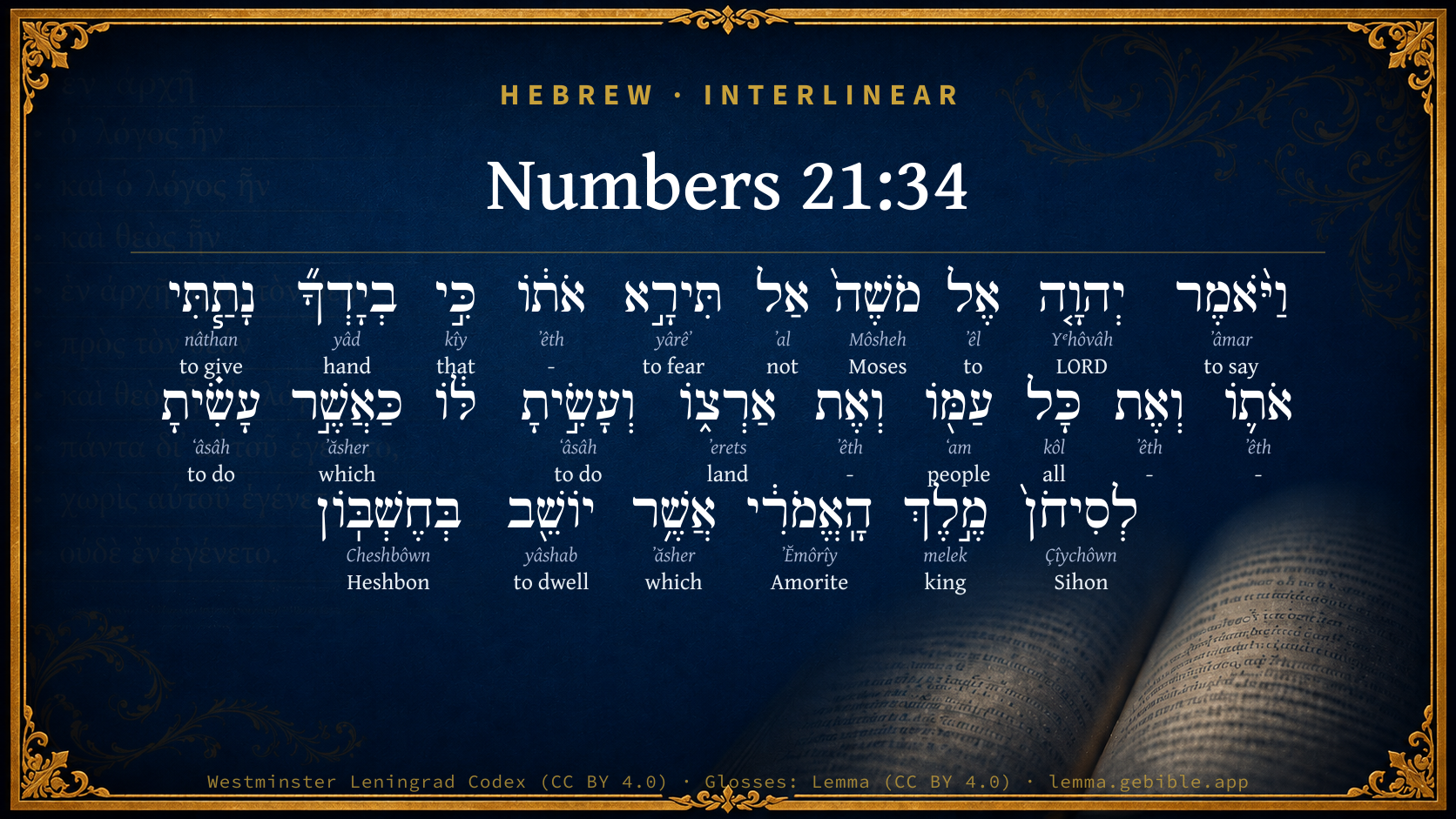
Hebrew (Westminster Leningrad Codex) Numbers 21:34 appears in the Hebrew Old Testament. The text above is from the Westminster Leningrad Codex. Each word links to its Strong’s number, a concise gloss, and parsing drawn from the Open Scriptures Hebrew Bible morphology. Click any word for its full Brown-Driver-Briggs (BDB) entry.
Download image
Cite this verse

Numbers 21:34 (World English Bible). Public Domain. Lemma interlinear Bible study tool, https://lemma.gebible.app/v/numbers/21/34.

Show BibTeX & RIS
BibTeX
RIS
English Translation
Yahweh said to Moses, Don't fear him: for I have delivered him into your hand, and all his people, and his land; and you shall do to him as you did to Sihon king of the Amorites, who lived at Heshbon.
World English Bible · Public Domain
Download a study sheet

One document with this verse’s original text, its word-by-word gloss line, the meaning frame, cross-references with their text, attributed commentary, and full source and license credits — printable, and it pastes into notes with its structure intact.

This verse Autodidact and up

Study sheet (.html) Plain text (.txt)

A passage Seminary Student

Up to 50 verses in one chapter. A passage sheet keeps up to 6 commentary sources and 12 cross-references per verse, in the order this page ranks them, and says so on the sheet whenever that leaves anything out. Ask for a single verse and you get the Autodidact verse sheet above.

Everything on this page stays free to read, with no account — the sheet is a download of what is already on screen, not access to it.

Want to remove ads? Support Godless Engineer
Compare translations 3

The same verse in 3 English versions, stacked beneath the original-language interlinear above. Click any original word for its lexicon entry.

Each is an independent rendering of the whole verse — the interlinear is not word-aligned to these translations.

Highlighted words mark where these versions differ — a whole-verse word diff, not a word-by-word alignment.

  • World English Bible Public Domain
    Yahweh said to Moses, Don't fear him: for I have delivered him into your hand, and all his people, and his land; and you shall do to him as you did to Sihon king of the Amorites, who lived at Heshbon.
  • King James Version Public Domain
    And the LORD said unto Moses, Fear him not: for I have delivered him into thy hand, and all his people, and his land; and thou shalt do to him as thou didst unto Sihon king of the Amorites, which dwelt at Heshbon.
  • unfoldingWord Literal Text CC BY-SA 4.0
    And Yahweh said to Moses, “Do not fear him, for into your hand I have given him and all his people and his land. And you shall do to him as you did to Sihon, king of the Amorite, who dwelled in Heshbon.”

unfoldingWord Literal Text — © unfoldingWord, licensed CC BY-SA 4.0. Word-aligned USFM3 via Door43 (git.door43.org/unfoldingWord/en_ult).

Versions to compare (up to 4)

3 of 4 selected

Show all 18 translations

Every available English version of this verse, each an independent rendering of the whole verse.

  • World English Bible Public Domain
    Yahweh said to Moses, Don't fear him: for I have delivered him into your hand, and all his people, and his land; and you shall do to him as you did to Sihon king of the Amorites, who lived at Heshbon.
  • Berean Standard Bible Public Domain
    But the LORD said to Moses, “Do not fear him, for I have delivered him into your hand, along with all his people and his land. Do to him as you did to Sihon king of the Amorites, who lived in Heshbon.”
  • Majority Standard Bible Public Domain
    But the LORD said to Moses, “Do not fear him, for I have delivered him into your hand, along with all his people and his land. Do to him as you did to Sihon king of the Amorites, who lived in Heshbon.”
  • King James Version Public Domain
    And the LORD said unto Moses, Fear him not: for I have delivered him into thy hand, and all his people, and his land; and thou shalt do to him as thou didst unto Sihon king of the Amorites, which dwelt at Heshbon.
  • American Standard Version (1901) Public Domain
    And Jehovah said unto Moses, Fear him not: for I have delivered him into thy hand, and all his people, and his land; and thou shalt do to him as thou didst unto Sihon king of the Amorites, who dwelt at Heshbon.
  • Revised Version (1885) Public Domain
    And the LORD said unto Moses, Fear him not: for I have delivered him into thy hand, and all his people, and his land; and thou shalt do to him as thou didst unto Sihon king of the Amorites, which dwelt at Heshbon.
  • Geneva Bible (1599) Public Domain
    Then the Lord said vnto Moses, Feare him not: for I haue deliuered him into thine hand and all his people, and his land: and thou shalt do to him as thou diddest vnto Sihon the king of the Amorites, which dwelt at Heshbon.
  • Douay-Rheims (1899) Public Domain
    And the Lord said to Moses: Fear him not, for I have delivered him and all his people, and his country into thy hand: and thou shalt do to him as thou didst to Sehon the king of the Amorrhites, the inhabitant of Hesebon.
  • Young's Literal Translation Public Domain
    And Jehovah saith unto Moses, `Fear him not, for into thy hand I have given him, and all his people, and his land, and thou hast done to him as thou hast done to Sihon king of the Amorite, who is dwelling in Heshbon.'
  • Literal Standard Version CC BY-SA 4.0
    And YHWH says to Moses, “Do not fear him, for into your hand I have given him, and all his people, and his land, and you have done to him as you have done to Sihon king of the Amorite, who is dwelling in Heshbon.”
  • Unlocked Literal Bible CC BY-SA 4.0
    Then Yahweh said to Moses, “Do not fear him, because I have given you victory over him, all his army, and his land. Do to him as you did to Sihon king of the Amorites, who lived at Heshbon.”
  • unfoldingWord Literal Text CC BY-SA 4.0
    And Yahweh said to Moses, “Do not fear him, for into your hand I have given him and all his people and his land. And you shall do to him as you did to Sihon, king of the Amorite, who dwelled in Heshbon.”
  • Darby Bible Public Domain
    And Jehovah said to Moses, Fear him not! for into thy hand have I given him, and all his people, and his land; and thou shalt do to him as thou didst unto Sihon the king of the Amorites, who dwelt at Heshbon.
  • World Messianic Bible Public Domain
    The LORD said to Moses, “Don’t fear him, for I have delivered him into your hand, with all his people, and his land. You shall do to him as you did to Sihon king of the Amorites, who lived at Heshbon.”
  • Webster's Bible Public Domain
    And the LORD said to Moses, Fear him not: for I have delivered him into thy hand, and all his people, and his land; and thou shalt do to him as thou didst to Sihon king of the Amorites, who dwelt at Heshbon.
  • Free Bible Version CC BY-SA 4.0
    The Lord told Moses, “You don't need to be afraid of him, because I have handed him over to you, along with all his people and his land. Do to him what you did to Sihon, king of the Amorites, who ruled from Heshbon.”
  • Bible in Basic English Public Domain
    And the Lord said to Moses, Have no fear of him: for I have given him up into your hands, with all his people and his land; do to him as you did to Sihon, king of the Amorites, at Heshbon.
  • JPS Tanakh (1917) Public Domain
    And the LORD said unto Moses: 'Fear him not; for I have delivered him into thy hand, and all his people, and his land; and thou shalt do to him as thou didst unto Sihon king of the Amorites, who dwelt at Heshbon.'

Literal Standard Version (2020), Covenant Press — licensed CC BY-SA 4.0. Text via the HelloAO Bible API (eBible.org). Unlocked Literal Bible (unfoldingWord) — licensed CC BY-SA 4.0. Text via the HelloAO Bible API (eBible.org). unfoldingWord Literal Text — © unfoldingWord, licensed CC BY-SA 4.0. Word-aligned USFM3 via Door43 (git.door43.org/unfoldingWord/en_ult). Free Bible Version, Dr. Jonathan Gallagher — licensed CC BY-SA 4.0. Text via the HelloAO Bible API (eBible.org).

Word by word

More ways to search: Search by grammar → Find every occurrence → Compare this word →

Practice this passage: Drill this verse → Learn its vocabulary →

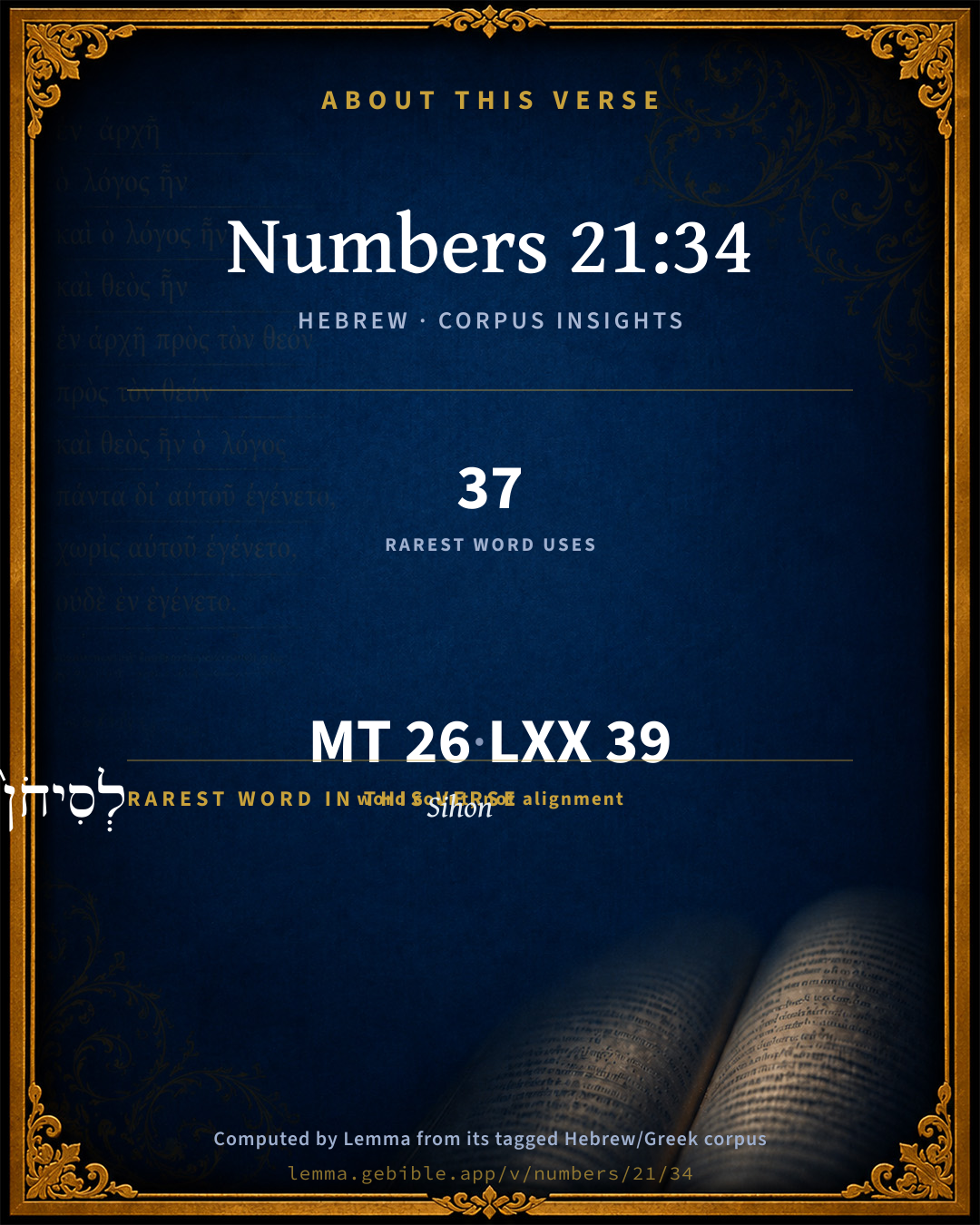
לְסִיחֹן֙
Çîychôwn
H5511
“to/for · Sihon”
Preposition + Noun, Proper
Part of Speech
Preposition + Noun
Type
Proper
Full BDB Definition

Origin: from the same as H5477

TWOT: None

Sihon = "warrior" - king of the Amorites at the time of the conquest and defeated by Moses in Transjordan
  1. וַיֹּ֨אמֶר ʼâmar H559 “and · to say” Conjunction + Verb, Qal, Sequential Imperfect, 3rd Person, Masculine, Singular
  2. יְהוָ֤ה Yᵉhôvâh H3068 “LORD” Noun, Proper
  3. אֶל ʼêl H413 “to” Preposition
  4. מֹשֶׁה֙ Môsheh H4872 “Moses” Noun, Proper
  5. אַל ʼal H408 “not” Particle, Negative
  6. תִּירָ֣א yârêʼ H3372 “to fear” Verb, Qal, Jussive, 2nd Person, Masculine, Singular
  7. אֹת֔וֹ ʼêth H853 “- · him” Particle, Direct Object + Suffix, Personal, 3rd Person, Masculine, Singular
  8. כִּ֣י kîy H3588 “that” Conjunction
  9. בְיָדְךָ֞ yâd H3027 “in/at · hand · your” Preposition + Noun, Common, Both, Singular, Construct + Suffix, Personal, 2nd Person, Masculine, Singular
  10. נָתַ֧תִּי nâthan H5414 “to give” Verb, Qal, Perfect, 1st Person, Common, Singular
  11. אֹת֛וֹ ʼêth H853 “- · him” Particle, Direct Object + Suffix, Personal, 3rd Person, Masculine, Singular
  12. וְאֶת ʼêth H853 “and · -” Conjunction + Particle, Direct Object
  13. כָּל kôl H3605 “all of” Noun, Common, Masculine, Singular, Construct
  14. עַמּ֖וֹ ʻam H5971 “people · his” Noun, Common, Masculine, Singular, Construct + Suffix, Personal, 3rd Person, Masculine, Singular
  15. וְאֶת ʼêth H853 “and · -” Conjunction + Particle, Direct Object
  16. אַרְצ֑וֹ ʼerets H776 “land · his” Noun, Common, Both, Singular, Construct + Suffix, Personal, 3rd Person, Masculine, Singular
  17. וְעָשִׂ֣יתָ ʻâsâh H6213 “and · to do” Conjunction + Verb, Qal, Sequential Perfect, 2nd Person, Masculine, Singular
  18. כַּאֲשֶׁ֣ר ʼăsher H834 “like/as · which” Preposition + Particle, Relative
  19. עָשִׂ֗יתָ ʻâsâh H6213 “to do” Verb, Qal, Perfect, 2nd Person, Masculine, Singular
  20. מֶ֣לֶךְ melek H4428 “king of” Noun, Common, Masculine, Singular, Construct
  21. הָֽאֱמֹרִ֔י ʼĔmôrîy H567 “the · Amorite” Particle, Definite Article + Noun, Gentilic, Masculine, Singular, Absolute
  22. אֲשֶׁ֥ר ʼăsher H834 “which” Particle, Relative
  23. יוֹשֵׁ֖ב yâshab H3427 “dwelling” Verb, Qal, Participle Active, Masculine, Singular, Absolute
  24. בְּחֶשְׁבּֽוֹן Cheshbôwn H2809 “in/at · Heshbon” Preposition + Noun, Proper

About this verse

These counts appear in no published source. They are computed here, from the morphology-tagged text and Lemma’s own curated glosses. What Lemma adds →

26
words
20
distinct lemmas
Pentateuch
section

Shared distinctive vocabulary

לְסִיחֹן֙ Sihon H5511 occurs in 34 verses of the Hebrew Bible. Also found in:

Grammatical profile

  • 6 verbs
  • 10 nouns
  • 2 prepositions
  • 1 conjunction
  • 7 particles

Verb forms

  • וַיֹּ֨אמֶר Qal · Sequential Imperfect
  • תִּירָ֣א Qal · Jussive
  • נָתַ֧תִּי Qal · Perfect
  • וְעָשִׂ֣יתָ Qal · Sequential Perfect
  • עָשִׂ֗יתָ Qal · Perfect
  • יוֹשֵׁ֖ב Qal · Participle Active

Repetition

Words recur within this verse — often emphatic in Hebrew:

  • וְעָשִׂ֣יתָ to do H6213 ×2
  • כַּאֲשֶׁ֣ר which H834 ×2

Hebrew & Septuagint length

In English translation the verse runs 41 words from the Hebrew and 44 from the Septuagint (LXX English) — closely comparable.

A rough comparison of the two English renderings, which tokenize alike — not a word-level alignment.

Word counts can differ between the Hebrew and the Greek without any difference in meaning — e.g. the Hebrew direct-object marker אֵת has no separate Greek word, and Greek often adds the article ὁ.

In the original languages it is 26 Hebrew tokens and 39 Greek tokens — but the two are counted differently (Hebrew bundles its prefixes and suffixes into one token; the Greek is in lemma form), so that isn’t a like-for-like length.

Cross-references

18

Topical passages linked to Numbers 21:34 in the Treasury of Scripture Knowledge — connected by theme and wording, ordered by reader-vote popularity; previews shown in the World English Bible.

  • Psalms 135:10–11 Who struck many nations, And killed mighty kings,
  • Numbers 21:24–25 Israel struck him with the edge of the sword, and possessed his land from the Arnon to the Jabbok, even to the children of Ammon; for the border of the children of Ammon was strong.
  • Deuteronomy 3:2–3 Yahweh said to me, Don't fear him; for I have delivered him, and all his people, and his land, into your hand; and you shall do to him as you did to Sihon king of the Amorites, who lived at Heshbon.
  • Joshua 8:7 and you shall rise up from the ambush, and take possession of the city: for Yahweh your God will deliver it into your hand.
  • Numbers 14:9 Only don't rebel against Yahweh, neither fear the people of the land; for they are bread for us: their defense is removed from over them, and Yahweh is with us: don't fear them.
  • Deuteronomy 3:11 (For only Og king of Bashan remained of the remnant of the Rephaim; behold, his bedstead was a bedstead of iron; isn't it in Rabbah of the children of Ammon? nine cubits was the length of it, and four cubits the breadth of it, after the cubit of a man.)
  • Deuteronomy 7:24 He will deliver their kings into your hand, and you shall make their name to perish from under the sky: there shall no man be able to stand before you, until you have destroyed them.
  • Deuteronomy 20:3 and shall tell them, Hear, Israel, you draw near this day to battle against your enemies: don't let your heart faint; don't be afraid, nor tremble, neither be scared of them;
  • Deuteronomy 31:6 Be strong and of good courage, don't be afraid, nor be scared of them: for Yahweh your God, he it is who does go with you; he will not fail you, nor forsake you.
  • Joshua 10:8 Yahweh said to Joshua, Don't fear them: for I have delivered them into your hands; there shall not a man of them stand before you.
  • Joshua 10:25 Joshua said to them, Don't be afraid, nor be dismayed; be strong and of good courage: for thus shall Yahweh do to all your enemies against whom you fight.
  • Judges 11:30 Jephthah vowed a vow to Yahweh, and said, If you will indeed deliver the children of Ammon into my hand,
  • 1 Samuel 23:4 Then David inquired of Yahweh yet again. Yahweh answered him, and said, Arise, go down to Keilah; for I will deliver the Philistines into your hand.
  • 2 Samuel 5:19 David inquired of Yahweh, saying, Shall I go up against the Philistines? will you deliver them into my hand? Yahweh said to David, Go up; for I will certainly deliver the Philistines into your hand.
  • 1 Kings 20:13 Behold, a prophet came near to Ahab king of Israel, and said, Thus says Yahweh, Have you seen all this great multitude? behold, I will deliver it into your hand this day; and you shall know that I am Yahweh.
  • 1 Kings 20:28 A man of God came near and spoke to the king of Israel, and said, Thus says Yahweh, Because the Syrians have said, Yahweh is a god of the hills, but he is not a god of the valleys; therefore will I deliver all this great multitude into your hand, and you shall know that I am Yahweh.
  • 2 Kings 3:18 This is but a light thing in the sight of Yahweh: he will also deliver the Moabites into your hand.
  • Isaiah 41:13 For I, Yahweh your God, will hold your right hand, saying to you, Don't be afraid; I will help you.

Cross-references courtesy of OpenBible.info (CC BY 4.0).

Hebrew and Greek witnesses Masoretic Hebrew ↔ Greek Septuagint

The same verse in the two great witnesses to the Old Testament, shown verse-for-verse.

These are two independent witnesses, not word-aligned to each other, and the Septuagint is shown in lemma (dictionary) form.

Hebrew Numbers 21:34 Masoretic · Westminster Leningrad Codex

וַיֹּ֨אמֶר יְהוָ֤ה אֶל מֹשֶׁה֙ אַל תִּירָ֣א אֹת֔וֹ כִּ֣י בְיָדְךָ֞ נָתַ֧תִּי אֹת֛וֹ וְאֶת כָּל עַמּ֖וֹ וְאֶת אַרְצ֑וֹ וְעָשִׂ֣יתָ לּ֔וֹ כַּאֲשֶׁ֣ר עָשִׂ֗יתָ לְסִיחֹן֙ מֶ֣לֶךְ הָֽאֱמֹרִ֔י אֲשֶׁ֥ר יוֹשֵׁ֖ב בְּחֶשְׁבּֽוֹן

Yahweh said to Moses, Don't fear him: for I have delivered him into your hand, and all his people, and his land; and you shall do to him as you did to Sihon king of the Amorites, who lived at Heshbon.

World English Bible · Public Domain

Greek LXX Numbers 21:34 Septuagint · lemma form

καί εἶπον κύριος πρός μωυσῆς μή φοβέω αὐτός ὅτι εἰς ὁ χείρ σύ παραδίδωμι αὐτός καί πᾶς ὁ λαός αὐτός καί πᾶς ὁ γῆ αὐτός καί ποιέω αὐτός καθώς ποιέω ὁ σηων βασιλεύς ὁ ἀμορραῖος ὅς καταοἰκέω ἐν εσεβων

And the Lord said to Moses, Fear him not; for I have delivered him and all his people, and all his land, into your hands; and you shall do to him as you did to Seon king of the Amorites, who lived in Esebon.

LXX2012 (modern English Septuagint) · Public Domain

Hebrew: Westminster Leningrad Codex (CC BY 4.0). Greek: Septuagint (public domain); English from LXX2012 (modern English Septuagint) (Public Domain). How the Septuagint differs from the Hebrew →

Targum (Aramaic paraphrase)

2

The Targum is the ancient Jewish Aramaic paraphrase of the Hebrew Scriptures — an interpretive translation, not the Hebrew text itself. Onkelos (literal) and Pseudo-Jonathan (expansive) render the Torah, and Jonathan the Prophets. Coverage is partial: where no permissively-licensed English translation exists for a verse, only the Aramaic is shown. This is verse-level text, not a word-by-word alignment to the Hebrew.

  1. Targum Onkelos Torah (Genesis–Deuteronomy)
    וַאֲמַר יְיָ לְמשֶׁה לָא תִדְחַל מִנֵיהּ אֲרֵי בִידָךְ מְסָרִית יָתֵיהּ וְיָת כָּל עַמֵיהּ וְיָת אַרְעֵיהּ וְתַעֲבֵד לֵיהּ כְּמָא דִי עֲבַדְתְּ לְסִיחוֹן מַלְכָּא דֶאֱמוֹרָאָה דִי יָתֵב בְּחֶשְׁבּוֹן

    (no public-domain English translation for this verse)

    Targum Onkelos — Aramaic: “Onkelos Genesis” (public domain); “Onkelos Exodus” (public domain); “Onkelos Leviticus” (public domain); “Onkelos Numbers” (public domain); “Onkelos Deuteronomy” (public domain). English: “Sefaria Community Translation” (CC0 1.0 (public-domain dedication)); “J.W. Etheridge. The Targums of Onkelos and Jonathan Ben Uzziel on the Pentateuch. London: Longmans, Green, 1862” (public domain). Text via Sefaria.

  2. Targum Pseudo-Jonathan Torah (Genesis–Deuteronomy)
    וַהֲוָה כֵּיוָן דְחָמָא משֶׁה יַת עוֹג זָע וְאַרְתֵּית מִן קֳדָמוֹי עָנֵי וַאֲמַר דֵין הוּא עוֹג רַשִׁיעָא דַהֲוָה מַחְסִיד יַת אַבְרָהָם וְשָרָה אַבְהָתָן לְמֵימָר אַתּוּן מְדַמְיַן לְאִלָנִין שְׁתוּלִין עַל פִּרְקַטוּנִין דְמַיָין בְרַם פֵּירִין לֵית הִינוּן עַבְדִין בְּגִין כֵּן אַמְתִּין לֵיהּ קוּדְשָׁא בְּרִיךְ הוּא לִמְחַוְיָא לְדָרַיָא וְיֶחְמֵי מִן בְּנֵיהוֹן אוּכְלוּסִין סַגִיאִין לְאִתְמַסְרָא בִּידֵיהוֹן בְּכֵן אָמַר יְיָ לְמשֶׁה לָא תִדְחַל מִנֵיהּ אֲרוּם בִּידָךְ מְסָרִית יָתֵיהּ וְיַת כָּל עַמֵיהּ וְיַת כָּל אַרְעֵיהּ וְתַעֲבֵיד לֵיהּ הֵיכְמָא דְעָבַדְתָּ לְסִיחוֹן מַלְכָּא דֶאֱמוֹרָאֵי דַהֲוָה יָתֵיב בְּחֶשְׁבּוֹן

    And it was, when Mosheh saw Og, he trembled before him, stricken with fear: but he (soon) answered and said, This is Og the Wicked, who taunted Abraham our father and Sarah, saying: You are like trees planted by the water channels, but bring forth no fruit: therefore hath the Holy One, blessed be He, spared him to live through generations, that he might see the great multitude of their children, and be delivered into our hands. Then spake the Lord unto Mosheh: Fear him not, for I have delivered him into thy hand, and all his people and country; and thou shalt do to him as thou hast done to Sihon, king of the Amorites, who dwelt in Heshbon.

    Targum Pseudo-Jonathan — Aramaic: “Targum Jonathan on Genesis” (public domain); “Targum Jonathan on Exodus” (public domain); “Targum Jonathan on Leviticus” (public domain); “Targum Jonathan on Numbers” (public domain); “Targum Jonathan on Deuteronomy” (public domain). English: “The Targum of Jonathan ben Uzziel, trans. J. W. Etheridge, London, 1862” (public domain). Text via Sefaria.

Commentary

Notes on Numbers 21:34 from classic Christian and Jewish commentators (each source and its license shown beneath its notes). The classic Christian expositions comment on the surrounding passage and are grouped to its opening verse, so a note may address several verses; the Jewish commentaries on the Tanakh (Rashi and others) are per-verse, so they appear only where the commentator wrote on this verse.

Lemma curates 59 commentaries, every one of them public domain or Creative Commons licensed, each selected and text-cleaned for this edition rather than reprinted as found. About our sources →

Jamieson, Fausset & Brown

Robert Jamieson, A. R. Fausset & David Brown

The Lord said unto Moses, Fear him not--a necessary encouragement, for Og's gigantic stature (Deu 3:11) was calculated to inspire terror. He and all his were put to the sword.

Next: Numbers Chapter 22

Jamieson, Fausset & Brown — Commentary Critical and Explanatory on the Whole Bible (1871) — public domain (CC PDM 1.0). Text via the HelloAO Bible API.

The Cambridge Bible for Schools and Colleges

gen. ed. J. J. S. Perowne

34. Edrei] the modern Edre‘ât or Der‘ât, appears to have been the second royal city of Bashan; cf. Deu_1:4, Jos_12:4; Jos_13:12. It lay on the southern border of Bashan (Deu_3:1; Deu_3:10), about 30 miles east of the Sea of Tiberias, and 30 miles west of the Ḥaurân range.

The Cambridge Bible for Schools and Colleges (gen. ed. J. J. S. Perowne; Cambridge University Press, 1878–1918) — public domain. Text from a community e-Sword module.

Matthew Poole's English Annotations

Fear him not; a necessary caution, for he was a great giant, Deu 3:11, likely to strike them with terror.

Matthew Poole's English Annotations on the Holy Bible (1683–1685) — public domain. Text from a community e-Sword/MySword module.

Whedon's Commentary on the Bible

Daniel D. Whedon

34. I have delivered — The promise is strengthened by the past tense. Israel’s fidelity is the implied condition. Israel’s unbelief would have lost the battle.

Daniel D. Whedon (gen. ed.), Commentary on the Old and New Testaments (1874–1909) — public domain. Text from a community e-Sword module.

The Pulpit Commentary

Fear him not. He might well have been formidable, not only on account of his size, (cf. Deu_1:28 Deu_3:11 1Sa_17:11) but from the formidable nature of those walled cities which are still a wonder to all that see them.

The Pulpit Commentary (1880–1919), ed. H.D.M. Spence-Jones & Joseph S. Exell — public domain. Text from a community e-Sword module.

Rashi

Rabbi Shlomo Yitzchaki (Rashi)

אל תירא אתו FEAR HIM NOT — God said this concerning Og but not about Sihon (cf v. 23), because Moses feared to wage battle, perhaps the merit of Abraham with whom Og had been associated would stand up (i.e., be an advocate) for him, as it is said, (Genesis 14:13) “And the one who escaped came [and told it to Abraham]” — this was Og who had escaped from the Rephaim whom Chedoladmar and his allies had smitten in Ashoreth Karnaim (Genesis 14:5), as it is said, (Deuteronomy 3:11). "For only Og king of Bashan was left of the remnant of the Rephaim" (cf. Midrash Tanchuma, Chukat 25, Niddah 61a).

Rashi on the Tanakh — English translations: “The Judaica Press complete Tanach with Rashi, translated by A. J. Rosenberg” (CC BY 4.0); “Pentateuch with Rashi's commentary by M. Rosenbaum and A.M. Silbermann, 1929-1934” (public domain); “The Metsudah Tanach series, Lakewood, N.J” (CC BY 4.0); and “The Book of Joshua, Metsudah Publications, 1997” (CC BY 4.0). Text via Sefaria.

Ramban (Nachmanides)

Rabbi Moshe ben Nachman (Ramban / Nachmanides)

FEAR HIM [Og] NOT. “For Moses was afraid [to wage war against Og] in case the merit of Abraham [whom Og had helped] would stand him in stead, for it is said about him, And there came ‘hapalit’ (one that had escaped) and told Abram the Hebrew, this being Og who had escaped from the Rephaim whom Amraphel and his allies had defeated at Ashteroth-karnaim.” This is Rashi’s language, based on the words of our Rabbis. 25; Bamidbar Rabbah 19:19. Here too the Rabbis were induced to make this comment because they knew that Moses our teacher would not have been afraid of an arm of flesh, for with him was the Eternal our G-d, and all the nations are as nothing before Him; they are accounted by Him as things of nought, and vanity. [Furthermore], it was he [Moses himself] who admonished Israel: fear not, nor be dismayed on account of them, and who criticized them for being afraid of them, as it is said in connection with the [affair of the] spies, Then I said unto you: ‘Dread not, neither be afraid of them. The Eternal your G-d, Who goeth before you, He shall fight for you.’, 1:29-30. Therefore [we must say] that Moses was afraid [of Og] because he knew of his merit [in having helped Abraham].In accordance with the plain meaning of Scripture, Moses had not intended now to give Israel the land of Sihon and Og as an inheritance, as I have explained. But Sihon had gone out against Israel into the wilderness, Verse 23. and had fought them against their will [in spite of their desire for peace]. Then G-d informed [Moses], Behold, I have begun to deliver up Sihon and his land before thee; begin to possess his land, for here began the conquest of the seven nations [who inhabited the Land of Israel]. But Og [nonetheless] mobilized all his forces at Edrei, which was a city at the end of his border, and Israel could have turned away from him just as they had turned away from Esau [i.e., Edom]. Therefore G-d told Moses, “Fear him not; go to him and contend with him in battle, for I have delivered him into thy hand.” And in Bamidbar Sinai Rabbah I have seen [the following text] “Why was Moses afraid [of Og]? He said: Perhaps Israel committed a trespass in the war against Sihon, [by taking of the spoil for themselves], or maybe they have become defiled by sins.” This is a completely homiletic exposition. And indeed all righteous people have this fear [that they might have sinned in error], and this [fear] likewise occurred [in the case] of Joshua [about whom it says that G-d told him, Fear not, neither be thou dismayed]. Balak

Ramban (Nachmanides) on the Tanakh — English translation: “Commentary on the Torah by Ramban (Nachmanides). Translated and annotated by Charles B. Chavel. New York, Shilo Pub. House, 1971-1976” (CC BY 4.0). Text via Sefaria.

Lesson kit

Teaching starters — assembled from the data on this page, not authored interpretation. Every prompt links to the verse data it draws on. Edit before teaching.

Numbers, in the Pentateuch, opens this verse with 26 words (20 distinct Hebrew lemmas). Its most distinctive word is Çîychôwn (“Sihon”). A historical commentator’s framing appears above. Read the whole chapter for the surrounding context.

Discussion questions

  1. What does “Sihon” (Çîychôwn) contribute to the verse as a whole?
  2. Numbers 21:21 shares the word «Sihon» with this verse. How do the two illuminate each other?
  3. “to do” occurs 2× in this one verse. What is the effect of the repetition?
  4. These translations render this verse differently; the difference is in the English rendering, not the original. What questions does that raise?
  5. The verb «וַיֹּ֨אמֶר» is Qal Sequential Imperfect. How does its form color the action?
  6. Reading how Jamieson, Fausset & Brown and The Cambridge Bible for Schools and Colleges read this verse, where do the two commentators agree and where do they part?

Things to notice

Reading settings

Reading text

Shown beneath each verse's original-language words.

Old Testament
Old Testament edition

Read the OT as the Masoretic Hebrew (MT) or the Greek Septuagint (LXX).

English shown for the Greek Septuagint (in the Hebrew ↔ Greek comparison).

Comparing translations? Open the Compare panel on any verse page to stack up to four side by side.