
1 Samuel 12:19

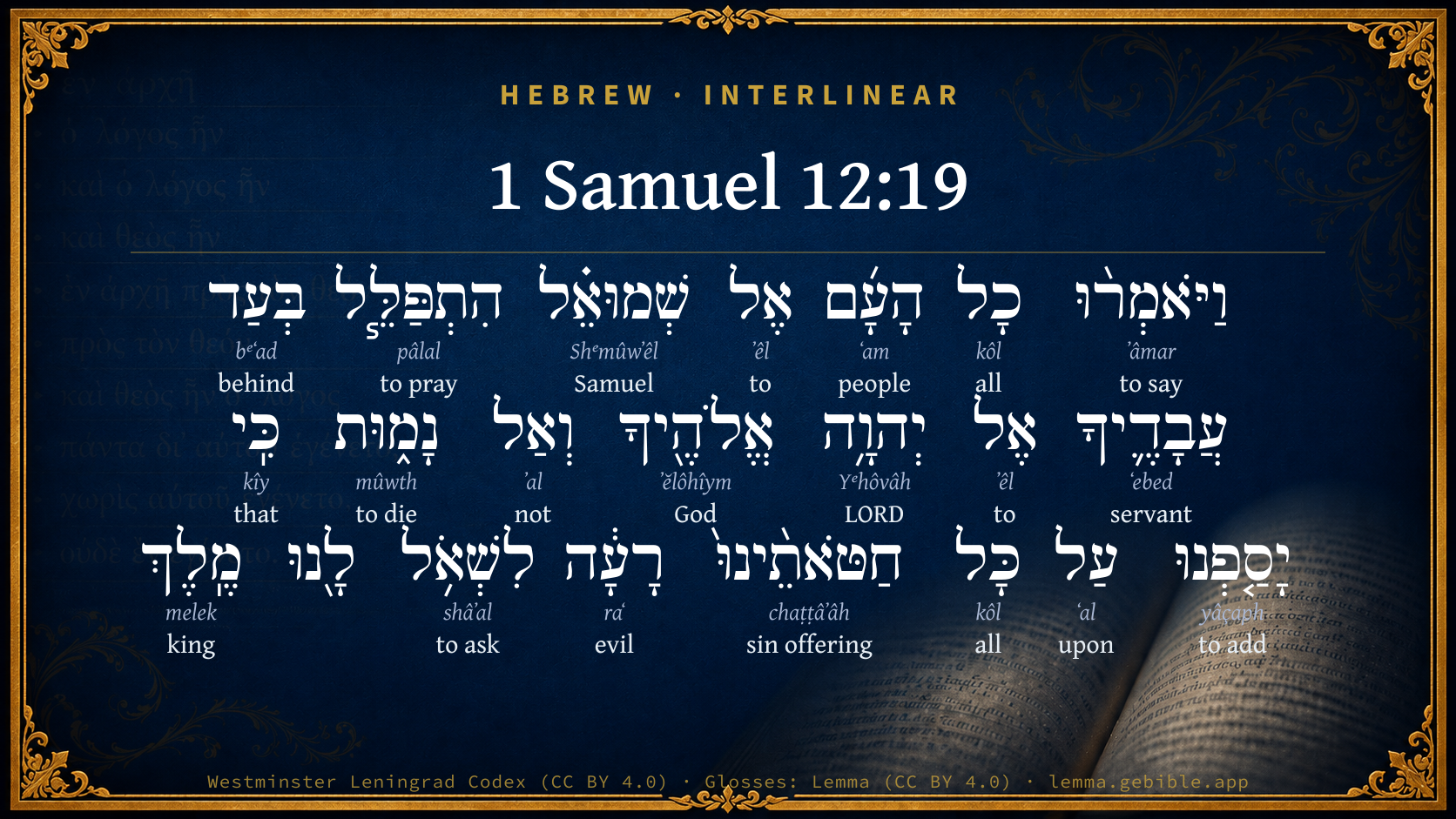
Hebrew (Westminster Leningrad Codex) 1 Samuel 12:19 appears in the Hebrew Old Testament. The text above is from the Westminster Leningrad Codex. Each word links to its Strong’s number, a concise gloss, and parsing drawn from the Open Scriptures Hebrew Bible morphology. Click any word for its full Brown-Driver-Briggs (BDB) entry.
Download image
Cite this verse

1 Samuel 12:19 (World English Bible). Public Domain. Lemma interlinear Bible study tool, https://lemma.gebible.app/v/1-samuel/12/19.

Show BibTeX & RIS
BibTeX
RIS
English Translation
All the people said to Samuel, Pray for your servants to Yahweh your God, that we not die; for we have added to all our sins [this] evil, to ask us a king.
World English Bible · Public Domain
Download a study sheet

One document with this verse’s original text, its word-by-word gloss line, the meaning frame, cross-references with their text, attributed commentary, and full source and license credits — printable, and it pastes into notes with its structure intact.

This verse Autodidact and up

Study sheet (.html) Plain text (.txt)

A passage Seminary Student

Up to 50 verses in one chapter. A passage sheet keeps up to 6 commentary sources and 12 cross-references per verse, in the order this page ranks them, and says so on the sheet whenever that leaves anything out. Ask for a single verse and you get the Autodidact verse sheet above.

Everything on this page stays free to read, with no account — the sheet is a download of what is already on screen, not access to it.

Want to remove ads? Support Godless Engineer
Compare translations 3

The same verse in 3 English versions, stacked beneath the original-language interlinear above. Click any original word for its lexicon entry.

Each is an independent rendering of the whole verse — the interlinear is not word-aligned to these translations.

Highlighted words mark where these versions differ — a whole-verse word diff, not a word-by-word alignment.

  • World English Bible Public Domain
    All the people said to Samuel, Pray for your servants to Yahweh your God, that we not die; for we have added to all our sins [this] evil, to ask us a king.
  • King James Version Public Domain
    And all the people said unto Samuel, Pray for thy servants unto the LORD thy God, that we die not: for we have added unto all our sins this evil, to ask us a king.
  • unfoldingWord Literal Text CC BY-SA 4.0
    And all of the people said to Samuel, “Pray for your servants to Yahweh your God, that we may not die. For we have added evil onto all of our sins by the requesting of a king for ourselves.”

unfoldingWord Literal Text — © unfoldingWord, licensed CC BY-SA 4.0. Word-aligned USFM3 via Door43 (git.door43.org/unfoldingWord/en_ult).

Versions to compare (up to 4)

3 of 4 selected

Show all 18 translations

Every available English version of this verse, each an independent rendering of the whole verse.

  • World English Bible Public Domain
    All the people said to Samuel, Pray for your servants to Yahweh your God, that we not die; for we have added to all our sins [this] evil, to ask us a king.
  • Berean Standard Bible Public Domain
    They pleaded with Samuel, “Pray to the LORD your God for your servants so that we will not die! For we have added to all our sins the evil of asking for a king.”
  • Majority Standard Bible Public Domain
    They pleaded with Samuel, “Pray to the LORD your God for your servants so that we will not die! For we have added to all our sins the evil of asking for a king.”
  • King James Version Public Domain
    And all the people said unto Samuel, Pray for thy servants unto the LORD thy God, that we die not: for we have added unto all our sins this evil, to ask us a king.
  • American Standard Version (1901) Public Domain
    And all the people said unto Samuel, Pray for thy servants unto Jehovah thy God, that we die not; for we have added unto all our sins `this' evil, to ask us a king.
  • Revised Version (1885) Public Domain
    And all the people said unto Samuel, Pray for thy servants unto the LORD thy God, that we die not: for we have added unto all our sins this evil, to ask us a king.
  • Geneva Bible (1599) Public Domain
    And all the people said vnto Samuel, Pray for thy seruaunts vnto the Lord thy God, that we die not: for we haue sinned in asking vs a King, beside all our other sinnes.
  • Douay-Rheims (1899) Public Domain
    And all the people greatly feared the Lord and Samuel. And all the people said to Samuel: Pray for thy servants to the Lord thy God, that we may not die, for we have added to all our sins this evil, to ask for a king.
  • Young's Literal Translation Public Domain
    and all the people say unto Samuel, `Pray for thy servants unto Jehovah thy God, and we do not die, for we have added to all our sins evil to ask for us a king.'
  • Literal Standard Version CC BY-SA 4.0
    and all the people say to Samuel, “Pray for your servants to your God YHWH, and we do not die, for we have added evil to all our sins to ask [for] a king for ourselves.”
  • Unlocked Literal Bible CC BY-SA 4.0
    Then all the people said to Samuel, “Pray for your servants to Yahweh your God, so that we do not die. For we have added to all our sins this evil in asking for a king for ourselves.”
  • unfoldingWord Literal Text CC BY-SA 4.0
    And all of the people said to Samuel, “Pray for your servants to Yahweh your God, that we may not die. For we have added evil onto all of our sins by the requesting of a king for ourselves.”
  • Darby Bible Public Domain
    And all the people said to Samuel, Pray to Jehovah thy God for thy servants, that we die not; for we have added to all our sins the wickedness to ask for ourselves a king.
  • World Messianic Bible Public Domain
    All the people said to Samuel, “Pray for your servants to the LORD your God, that we not die; for we have added to all our sins this evil, to ask for a king.”
  • Webster's Bible Public Domain
    And all the people said to Samuel, Pray for thy servants to the LORD thy God, that we die not: for we have added to all our sins this evil, to ask us a king.
  • Free Bible Version CC BY-SA 4.0
    “Please pray to the Lord your God for us your servants, so we will not die!” they begged Samuel. “For we have added to all our sins the evil of asking for our own king.”
  • Bible in Basic English Public Domain
    And all the people said to Samuel, Make prayer for us to the Lord your God so that death may not overtake us: for in addition to all our sins we have done this evil, in desiring a king.
  • JPS Tanakh (1917) Public Domain
    And all the people said unto Samuel: 'Pray for thy servants unto the LORD thy God, that we die not; for we have added unto all our sins this evil, to ask us a king.'

Literal Standard Version (2020), Covenant Press — licensed CC BY-SA 4.0. Text via the HelloAO Bible API (eBible.org). Unlocked Literal Bible (unfoldingWord) — licensed CC BY-SA 4.0. Text via the HelloAO Bible API (eBible.org). unfoldingWord Literal Text — © unfoldingWord, licensed CC BY-SA 4.0. Word-aligned USFM3 via Door43 (git.door43.org/unfoldingWord/en_ult). Free Bible Version, Dr. Jonathan Gallagher — licensed CC BY-SA 4.0. Text via the HelloAO Bible API (eBible.org).

Word by word

More ways to search: Search by grammar → Find every occurrence → Compare this word →

Practice this passage: Drill this verse → Learn its vocabulary →

הִתְפַּלֵּ֧ל
pâlal
H6419
“pray”
Verb, Hithpael, Imperative, 2nd Person, Masculine, Singular
Part of Speech
Verb
Stem
Hithpael
Form
Imperative
Person
2nd Person
Gender
Masculine
Number
Singular
Full BDB Definition

Origin: a primitive root

TWOT: 1776

to intervene, interpose, pray - (Piel) to mediate, judge - (Hithpael) - to intercede - to pray
  1. וַיֹּאמְר֨וּ ʼâmar H559 “and · to say” Conjunction + Verb, Qal, Sequential Imperfect, 3rd Person, Masculine, Plural
  2. כָל kôl H3605 “all of” Noun, Common, Masculine, Singular, Construct
  3. הָעָ֜ם ʻam H5971 “the · people” Particle, Definite Article + Noun, Common, Masculine, Singular, Absolute
  4. אֶל ʼêl H413 “to” Preposition
  5. שְׁמוּאֵ֗ל Shᵉmûwʼêl H8050 “Samuel” Noun, Proper
  6. בְּעַד bᵉʻad H1157 “behind” Preposition
  7. עֲבָדֶ֛יךָ ʻebed H5650 “servants · your” Noun, Common, Masculine, Plural, Construct + Suffix, Personal, 2nd Person, Masculine, Singular
  8. אֶל ʼêl H413 “to” Preposition
  9. יְהוָ֥ה Yᵉhôvâh H3068 “LORD” Noun, Proper
  10. אֱלֹהֶ֖יךָ ʼĕlôhîym H430 “God(s) · your” Noun, Common, Masculine, Plural, Construct + Suffix, Personal, 2nd Person, Masculine, Singular
  11. וְאַל ʼal H408 “and · not” Conjunction + Particle, Negative
  12. נָמ֑וּת mûwth H4191 “to die” Verb, Qal, Cohortative, 1st Person, Common, Plural
  13. כִּֽי kîy H3588 “that” Conjunction
  14. יָסַ֤פְנוּ yâçaph H3254 “to add” Verb, Qal, Perfect, 1st Person, Common, Plural
  15. עַל ʻal H5921 “upon” Preposition
  16. כָּל kôl H3605 “all of” Noun, Common, Masculine, Singular, Construct
  17. חַטֹּאתֵ֨ינוּ֙ chaṭṭâʼâh H2403 “sin offerings · our” Noun, Common, Feminine, Plural, Construct + Suffix, Personal, 1st Person, Common, Plural
  18. רָעָ֔ה raʻ H7451 “evil” Noun, Common, Feminine, Singular, Absolute
  19. לִשְׁאֹ֥ל shâʼal H7592 “to ask” Preposition + Verb, Qal, Infinitive Construct
  20. מֶֽלֶךְ melek H4428 “king” Noun, Common, Masculine, Singular, Absolute

About this verse

These counts appear in no published source. They are computed here, from the morphology-tagged text and Lemma’s own curated glosses. What Lemma adds →

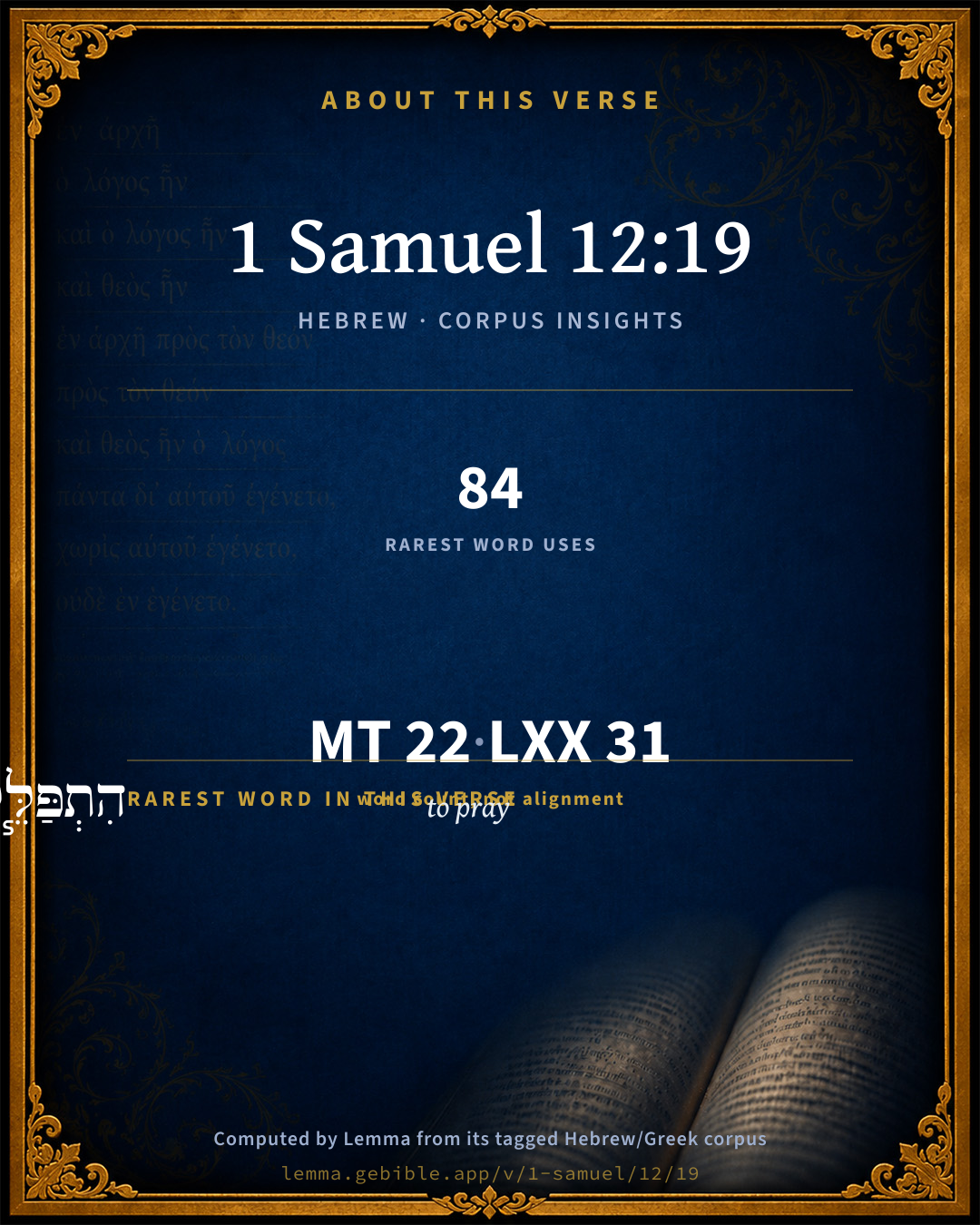
22
words
19
distinct lemmas
Historical
section

Grammatical profile

  • 5 verbs
  • 10 nouns
  • 5 prepositions
  • 1 conjunction
  • 1 particle

Verb forms

  • וַיֹּאמְר֨וּ Qal · Sequential Imperfect
  • הִתְפַּלֵּ֧ל Hithpael · Imperative
  • נָמ֑וּת Qal · Cohortative
  • יָסַ֤פְנוּ Qal · Perfect
  • לִשְׁאֹ֥ל Qal · Infinitive Construct

Repetition

Words recur within this verse — often emphatic in Hebrew:

Hebrew & Septuagint length

In English translation the verse runs 33 words from the Hebrew and 37 from the Septuagint (LXX English) — closely comparable.

A rough comparison of the two English renderings, which tokenize alike — not a word-level alignment.

Word counts can differ between the Hebrew and the Greek without any difference in meaning — e.g. the Hebrew direct-object marker אֵת has no separate Greek word, and Greek often adds the article ὁ.

In the original languages it is 22 Hebrew tokens and 31 Greek tokens — but the two are counted differently (Hebrew bundles its prefixes and suffixes into one token; the Greek is in lemma form), so that isn’t a like-for-like length.

Cross-references

14

Topical passages linked to 1 Samuel 12:19 in the Treasury of Scripture Knowledge — connected by theme and wording, ordered by reader-vote popularity; previews shown in the World English Bible.

  • Exodus 9:28 Pray to Yahweh; for there has been enough of mighty thunderings and hail. I will let you go, and you shall stay no longer."
  • 1 John 5:16 If anyone sees his brother sinning a sin not leading to death, he shall ask, and God will give him life for those who sin not leading to death. There is a sin leading to death. I don't say that he should make a request concerning this.
  • Exodus 10:17 Now therefore please forgive my sin again, and pray to Yahweh your God, that he may also take away from me this death."
  • 1 Samuel 12:23 Moreover as for me, far be it from me that I should sin against Yahweh in ceasing to pray for you: but I will instruct you in the good and the right way.
  • Genesis 20:7 Now therefore, restore the man's wife. For he is a prophet, and he will pray for you, and you will live. If you don't restore her, know for sure that you will die, you, and all who are yours."
  • 1 Samuel 7:5 Samuel said, Gather all Israel to Mizpah, and I will pray for you to Yahweh.
  • 1 Samuel 7:8 The children of Israel said to Samuel, "Don't cease to cry to Yahweh our God for us, that he will save us out of the hand of the Philistines."
  • Job 42:8 Now therefore, take to yourselves seven bulls and seven rams, and go to my servant Job, and offer up for yourselves a burnt offering; and my servant Job shall pray for you, for I will accept him, that I not deal with you according to your folly. For you have not spoken of me the thing that is right, as my servant Job has."
  • Psalms 78:34–35 When he killed them, then they inquired after him. They returned and sought God earnestly.
  • Isaiah 26:16 Yahweh, in trouble have they visited you; they poured out a prayer [when] your chastening was on them.
  • Jeremiah 15:1 Then said Yahweh to me, Though Moses and Samuel stood before me, yet my mind would not be toward this people: cast them out of my sight, and let them go forth.
  • Malachi 1:9 "Now, please entreat the favor of God, that he may be gracious to us. With this, will he accept any of you?" says Yahweh of Hosts.
  • Acts 8:24 Simon answered, "Pray for me to the Lord, that none of the things which you have spoken happen to me."
  • James 5:15 and the prayer of faith will heal him who is sick, and the Lord will raise him up. If he has committed sins, he will be forgiven.

Cross-references courtesy of OpenBible.info (CC BY 4.0).

Hebrew and Greek witnesses Masoretic Hebrew ↔ Greek Septuagint

The same verse in the two great witnesses to the Old Testament, shown verse-for-verse.

These are two independent witnesses, not word-aligned to each other, and the Septuagint is shown in lemma (dictionary) form.

Hebrew 1 Samuel 12:19 Masoretic · Westminster Leningrad Codex

וַיֹּאמְר֨וּ כָל הָעָ֜ם אֶל שְׁמוּאֵ֗ל הִתְפַּלֵּ֧ל בְּעַד עֲבָדֶ֛יךָ אֶל יְהוָ֥ה אֱלֹהֶ֖יךָ וְאַל נָמ֑וּת כִּֽי יָסַ֤פְנוּ עַל כָּל חַטֹּאתֵ֨ינוּ֙ רָעָ֔ה לִשְׁאֹ֥ל לָ֖נוּ מֶֽלֶךְ

All the people said to Samuel, Pray for your servants to Yahweh your God, that we not die; for we have added to all our sins [this] evil, to ask us a king.

World English Bible · Public Domain

Greek LXX 1 Samuel 12:19 Septuagint · lemma form

καί εἶπον πᾶς ὁ λαός πρός σαμουηλ προςεὔχομαι ὑπέρ ὁ δοῦλος σύ πρός κύριος θεός σύ καί οὐ μή ἀποθνήσκω ὅτι προςτίθημι πρός πᾶς ὁ ἁμαρτία ἐγώ κακία αἰτέω ἑαυτοῦ βασιλεύς

And all the people said to Samuel, Pray for your servants to the Lord your God, and let us not die; for we have added to all our sins this iniquity, in asking for us a king.

LXX2012 (modern English Septuagint) · Public Domain

Hebrew: Westminster Leningrad Codex (CC BY 4.0). Greek: Septuagint (public domain); English from LXX2012 (modern English Septuagint) (Public Domain). How the Septuagint differs from the Hebrew →

Targum (Aramaic paraphrase)

1

The Targum is the ancient Jewish Aramaic paraphrase of the Hebrew Scriptures — an interpretive translation, not the Hebrew text itself. Onkelos (literal) and Pseudo-Jonathan (expansive) render the Torah, and Jonathan the Prophets. Coverage is partial: where no permissively-licensed English translation exists for a verse, only the Aramaic is shown. This is verse-level text, not a word-by-word alignment to the Hebrew.

  1. Targum Jonathan Prophets (Joshua–Malachi)
    וַאֲמַרוּ כָּל עַמָא לִשְׁמוּאֵל צַלֵי עַל עַבְדָךְ קֳדָם יְיָ אֱלָהָךְ וְלָא נְמוּת אֲרֵי אוֹסִיפְנָא עַל כָּל חוֹבָנָא בִּישְׁתָא לְמִשְׁאַל לָנָא מַלְכָּא:

    (no public-domain English translation for this verse)

    Targum Jonathan — Aramaic: “Mikraot Gedolot” (public domain). English: “Sefaria Community Translation” (CC0 1.0 (public-domain dedication)); “London "Chaldee Paraphrase," 1871” (public domain). Text via Sefaria.

Commentary

Notes on 1 Samuel 12:19 from classic Christian and Jewish commentators (each source and its license shown beneath its notes). The classic Christian expositions comment on the surrounding passage and are grouped to its opening verse, so a note may address several verses; the Jewish commentaries on the Tanakh (Rashi and others) are per-verse, so they appear only where the commentator wrote on this verse.

Lemma curates 59 commentaries, every one of them public domain or Creative Commons licensed, each selected and text-cleaned for this edition rather than reprinted as found. About our sources →

Trapp's Complete Commentary

John Trapp

1Sa 12:19 And all the people said unto Samuel, Pray for thy servants unto the LORD thy God, that we die not: for we have added unto all our sins [this] evil, to ask us a king.

Ver. 19. Pray … that we die not.] As they now feared they should, so terrible was the tempest: but good Samuel prayed it down again likely, when the people were thoroughly humbled. It is well observed that they say, Pray for thy servants unto the Lord thy God; they say not, the Lord our God: for they might fear they had now forfeited their interest, and that they were discovenanted.

For we have added unto all our sins.] By occasion of this sin, they came to the sight and recognition of many more. Our lives are as full of sins as the firmament is of stars, or the furnace of sparks.

John Trapp, A Commentary or Exposition upon All the Books of the Old and New Testament (1647–1656) — public domain. Text from a community e-Sword module.

The Biblical Illustrator

Joseph S. Exell

1Sa_12:19

Pray for thy servants unto the Lord thy God.

Intercessory prayer

1. This Lesson contains Samuels official farewell to the people--that is, as Judge. There is something touching in all farewells. Retirement from long and distinguished service has ever a shade of melancholy; it reminds us of the transitoriness of human life and human greatness.

2. There was one link with the old Judge which they were anxious to retain. The king might rule them in times of peace, and go forth with them as leader in times of war; he might be the representative of national unity and the keystone of national greatness; but it was to Samuel they turned when they wanted to be remembered before God. With one voice they besought him, Pray for thy servants, etc.

I. The request. Pray for thy servants unto the Lord thy God, that we die not.

1. It is the language of fear. The people were terrified with the thunder and rain. God had shown His displeasure by this sign

2. It is the language of faith. Samuels power as an intercessor with God was a recognised fact. It was not the discovery of a passing emotion.

3. It may not be presumptuous to inquire wherein his great strength in this respect lieth. First, his vocation as a prophet brought him very near to God. Secondly, the office without the life is not of much avail. Samuel lived for God, and it appears that, according to the degree of sanctity to which individuals attain, so is the efficacy of their intercessions.

II. The reasons for this request. Their sense of sin in having asked for a king. They feared death, lest a glittering flash of lightning--a symbol of Divine wrath--should at once consume them.

1. What was their fault? Viewed in reference to Samuel, it was ingratitude.

2. But, regarded in reference to God, the asking for a king was a rejection of His direct rule. (1Sa_8:7).

3. Yet, what, looked at on the side of the spontaneous action of Gods people, was a grave fault--wickedness; when viewed in relation to the course of events, was a result of a variety of causes.

4. But God can bring good out of evil. The formation of a kingdom was in His providence overruled to the ultimate fulfilment of His designs. Through it looms the kingdom of Christ and Christ the King, and, with the realised unity of the nation under a king, the carrying out of the Levitical Law as to one sanctuary; and in the temple, which was a result of this change, and its service and its Psalter, we have an image of the Catholic Church and her solemn ritual to the end of time.

III. Lessons.

1. To quicken our belief in the efficacy of intercessory prayer.

2. To remember that Christ is our invisible King and the Head of His Church; and that obedience to an outward rule must be accompanied by inward obedience, for though the kingdom of God, that is, the Church, is visible, yet it is also an inward kingdom of righteousness, joy, and peace in the Holy Ghost. (The Thinker.)

The Biblical Illustrator, edited by Joseph S. Exell (c. 1880s–1900s) — public domain. Text from a community e-Sword module.

Joseph Benson's Commentary

1Sa 12:19-21. The Lord thy God — Whom thou hast so great an interest in, while we are ashamed and afraid to call him our God. Fear not — With a desponding fear, as if there are no hope left for you. But turn not ye aside — After idols, as they had often done before, and, notwithstanding this warning, did afterward. Vain things — So idols are called Deu 32:21, Jer 2:5; and so they are, being mere nothings, having no power in them, no influence upon us, nor being of any use or benefit to us.

Joseph Benson's Commentary on the Old and New Testaments (1811–1818) — public domain. Text from a community e-Sword module.

Tyndale Open Study Notes

Tyndale Open Resources

12:19 The people asked Samuel to intercede for them (see also 7:8) rather than praying themselves probably because they were out of fellowship with God (note the use of your God rather than “our God”). • added to our sins: The sins included idol worship (12:21; see study note on 8:8).

Tyndale Open Study Notes — © Tyndale Open Resources, licensed CC BY-SA 4.0. Text via the HelloAO Bible API.

Geneva Bible (1599)

Geneva Bible translators

Not only at other times, but now chiefly.

Geneva Bible (1599) marginal notes — public domain. Text via Bolls.life.

Adam Clarke's Commentary

Verse 19. Pray for thy servants - that we die not] As they knew they had rebelled against God, they saw that they had every thing to fear from his justice and power.

We have added unto all our sins this evil] It is no sin to have a king; a good king is one of the greatest blessings of God's providence; but it is a sin to put a man in the place of God. Is it not strange that they did not now attempt to repair their fault? They might have done it, but they did not; they acknowledged their sin, but did not put it away. This is the general way of mankind. "God help us, we are all sinners!" is the general language of all people: but though to be a sinner is to be in the most solemn and awful circumstances, yet they are contented to bear the character, heedless of the consequences!

Adam Clarke's Commentary on the Bible (1810–1826) — public domain. Text from a community e-Sword/MySword module.

The Cambridge Bible for Schools and Colleges

gen. ed. J. J. S. Perowne

19. Pray for thy servants] See note on 1Sa_7:5.

this evil] Wickedness: the same word as in 1Sa_12:17; 1Sa_12:20.

The Cambridge Bible for Schools and Colleges (gen. ed. J. J. S. Perowne; Cambridge University Press, 1878–1918) — public domain. Text from a community e-Sword module.

John Gill's Exposition

And all the people said unto Samuel, During the tempest, and in the midst of it; it was the general cry of the people, they were unanimous in it:

pray for thy servants unto the Lord thy God, that we die not; though they had rejected him as their judge and supreme governor in desiring a king, now they were his humble servants, at least feignedly; and knowing what interest he had with God in prayer, they entreat him to make use of it on their behalf, who having sinned so greatly, had not the assurance to call the Lord their God, though they had no doubt of his being the God of Samuel, whose prayers he had heard, of which this tempest was a full proof; and was so violent, that if it continued, they were afraid they should be destroyed by the thunder and lightning, or they and their cattle, with the fruits of the earth, be washed away with the prodigious rain:

for we have added unto all our sins this evil, to ask us a king; though Samuel had laid before them the evils and inconveniences of having a king, and had in the name of the Lord charged them with rejecting God as their king; yet nothing convinced them of their evil till this storm came, and then all their sins came fresh to their minds; and this added to the weight of them, and lay heaviest on them, that they had rejected the Lord, and slighted his prophets, and, notwithstanding all remonstrances, resolved on having a king.

John Gill's Exposition of the Whole Bible (1746–1763) — public domain (CC PDM 1.0). Text via the HelloAO Bible API.

Haydock's Catholic Bible Commentary

And Samuel, at whose prayer the Lord had sent such a storm, lest he should punish them as they deserved. But the prophet alleviates their fears, and teaches them to refrain from idolatry, and he will still continue to perform his duty in praying for them, and giving them good advice. (Salien) --- The fear of God is increased by that which the people shew for his servants.

George Leo Haydock (1774–1849), Haydock's Catholic Family Bible and Commentary, 1859 edition — public domain. Excludes Psalms (Douay-Rheims chapter numbering differs from Protestant) and Deuterocanonical books (Catholic canon only).

Matthew Poole's English Annotations

Pray for thy servants; for so we shall still own ourselves to be, though we have got another master.

Unto the Lord thy God, whom thou hast so great an interest in, and canst so easily prevail with for any mercy, whilst we are ashamed and afraid to call him our God, because we have so highly offended him.

That we die not; that this terrible storm may be taken away, lest our persons and the fruits of the earth be all destroyed.

To ask us a king: so horribly were they biassed with their prejudices and passions, that nothing but a miracle could convince them of this particular sin.

Matthew Poole's English Annotations on the Holy Bible (1683–1685) — public domain. Text from a community e-Sword/MySword module.

The Pulpit Commentary

Pray for thy servants. On Samuel"s mediatorial office see 1Sa_7:5, 1Sa_7:8.

The Pulpit Commentary (1880–1919), ed. H.D.M. Spence-Jones & Joseph S. Exell — public domain. Text from a community e-Sword module.

John Wesley's Explanatory Notes

Thy God - Whom thou hast so great an interest in, while we are ashamed and afraid to call him our God.

John Wesley, Explanatory Notes Upon the Whole Bible (1754–1765) — public domain. Text via the GEBible commentary corpus.

unfoldingWord translationNotes

Door43 World Missions Community

so that we do not die

The ultimate punishment for sin is death. The nation of Israel had seen Yahweh destroy the nations that had oppressed them. They were concerned that they had become "dedicated for destruction" like those nations.

Do not be afraid

The people did evil and were afraid of God destroying them. AT: "Do not be afraid that God will be angry and destroy you because of this sin" (See: Assumed Knowledge and Implicit Information)

turn away after empty things

"pursue worship of false gods"

translationWords

pray

Yahweh

God

die

sin

fear

turn

heart

profit

unfoldingWord translationNotes — © Distant Shores Media and the Door43 World Missions Community, licensed CC BY-SA 4.0. Source: git.door43.org/Door43/en_tn.

Lesson kit

Teaching starters — assembled from the data on this page, not authored interpretation. Every prompt links to the verse data it draws on. Edit before teaching.

1 Samuel, in the Historical, opens this verse with 22 words (19 distinct Hebrew lemmas). Its most distinctive word is pâlal (“to pray”). A historical commentator’s framing appears above. Read the whole chapter for the surrounding context.

Discussion questions

  1. The word pâlal carries the sense “to pray.” How does it shape the verse?
  2. How does Exodus 9:28, which shares this passage’s theme, read alongside this verse?
  3. What does the repetition of “all” (2× in this one verse) do in this verse?
  4. The translations on this page render this verse differently — a whole-verse word diff, not a word-by-word alignment. What might account for the different wordings?
  5. «וַיֹּאמְר֨וּ» is a Qal Sequential Imperfect verb. How does that grammatical form shape the action described?
  6. Compare how Trapp's Complete Commentary and The Biblical Illustrator read this verse. Where do they agree or differ?

Things to notice

Reading settings

Reading text

Shown beneath each verse's original-language words.

Old Testament
Old Testament edition

Read the OT as the Masoretic Hebrew (MT) or the Greek Septuagint (LXX).

English shown for the Greek Septuagint (in the Hebrew ↔ Greek comparison).

Comparing translations? Open the Compare panel on any verse page to stack up to four side by side.