
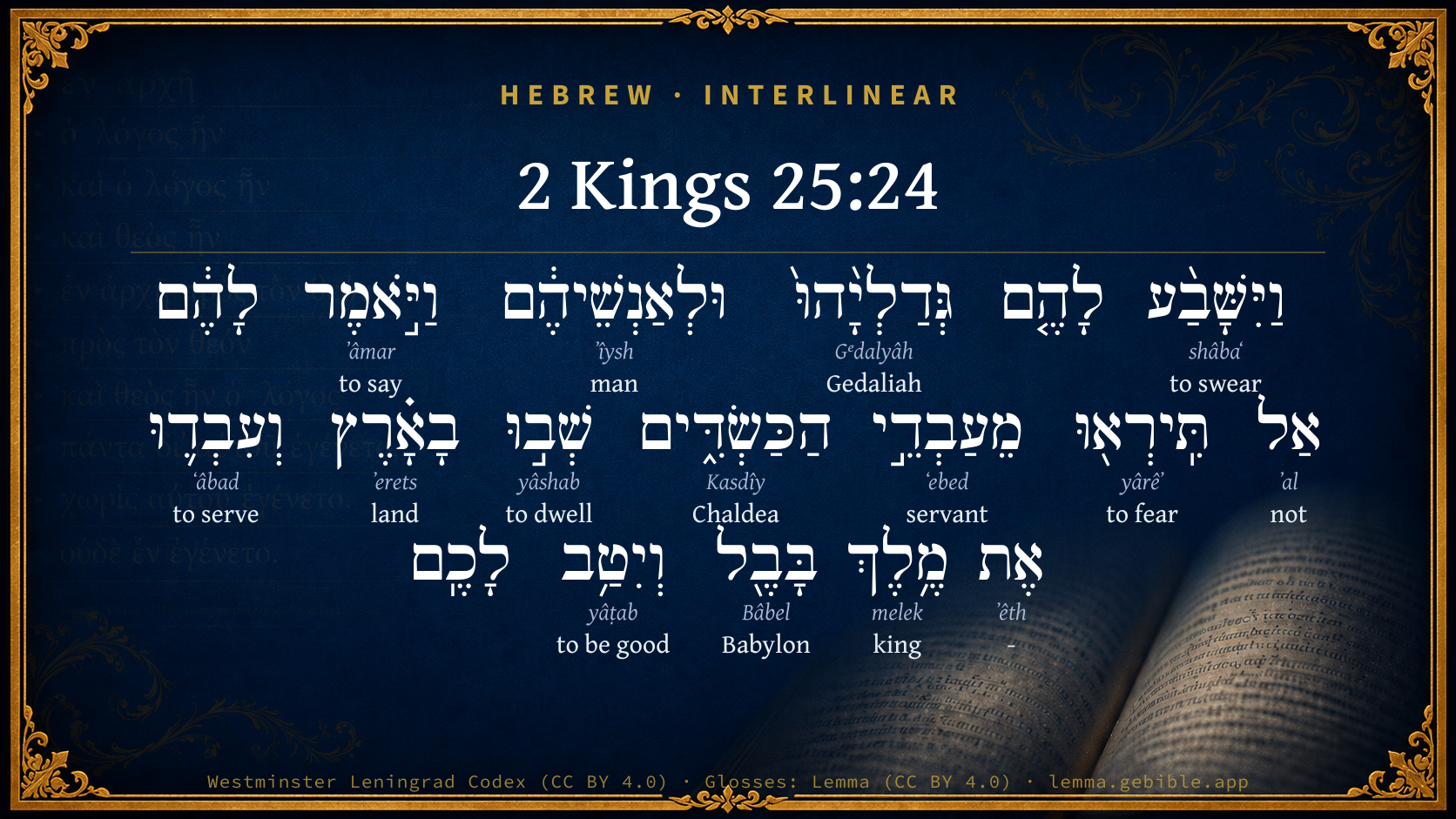
2 Kings 25:24

Hebrew (Westminster Leningrad Codex) 2 Kings 25:24 appears in the Hebrew Old Testament. The text above is from the Westminster Leningrad Codex. Each word links to its Strong’s number, a concise gloss, and parsing drawn from the Open Scriptures Hebrew Bible morphology. Click any word for its full Brown-Driver-Briggs (BDB) entry.
Download image
Cite this verse

2 Kings 25:24 (World English Bible). Public Domain. Lemma interlinear Bible study tool, https://lemma.gebible.app/v/2-kings/25/24.

Show BibTeX & RIS
BibTeX
RIS
English Translation
Gedaliah swore to them and to their men, and said to them, Don't be afraid because of the servants of the Chaldeans: dwell in the land, and serve the king of Babylon, and it shall be well with you.
World English Bible · Public Domain
Download a study sheet

One document with this verse’s original text, its word-by-word gloss line, the meaning frame, cross-references with their text, attributed commentary, and full source and license credits — printable, and it pastes into notes with its structure intact.

This verse Autodidact and up

Study sheet (.html) Plain text (.txt)

A passage Seminary Student

Up to 50 verses in one chapter. A passage sheet keeps up to 6 commentary sources and 12 cross-references per verse, in the order this page ranks them, and says so on the sheet whenever that leaves anything out. Ask for a single verse and you get the Autodidact verse sheet above.

Everything on this page stays free to read, with no account — the sheet is a download of what is already on screen, not access to it.

Want to remove ads? Support Godless Engineer
Compare translations 3

The same verse in 3 English versions, stacked beneath the original-language interlinear above. Click any original word for its lexicon entry.

Each is an independent rendering of the whole verse — the interlinear is not word-aligned to these translations.

Highlighted words mark where these versions differ — a whole-verse word diff, not a word-by-word alignment.

  • World English Bible Public Domain
    Gedaliah swore to them and to their men, and said to them, Don't be afraid because of the servants of the Chaldeans: dwell in the land, and serve the king of Babylon, and it shall be well with you.
  • King James Version Public Domain
    And Gedaliah sware to them, and to their men, and said unto them, Fear not to be the servants of the Chaldees: dwell in the land, and serve the king of Babylon; and it shall be well with you.
  • unfoldingWord Literal Text CC BY-SA 4.0
    And Gedaliah swore to them and to their men and said to them, “Do not be afraid of the servants of the Chaldeans. Dwell in the land and serve the king of Babylon, and it will be well with you.”

unfoldingWord Literal Text — © unfoldingWord, licensed CC BY-SA 4.0. Word-aligned USFM3 via Door43 (git.door43.org/unfoldingWord/en_ult).

Versions to compare (up to 4)

3 of 4 selected

Show all 18 translations

Every available English version of this verse, each an independent rendering of the whole verse.

  • World English Bible Public Domain
    Gedaliah swore to them and to their men, and said to them, Don't be afraid because of the servants of the Chaldeans: dwell in the land, and serve the king of Babylon, and it shall be well with you.
  • Berean Standard Bible Public Domain
    And Gedaliah took an oath before them and their men, assuring them, “Do not be afraid of the servants of the Chaldeans. Live in the land and serve the king of Babylon, and it will be well with you.”
  • Majority Standard Bible Public Domain
    And Gedaliah took an oath before them and their men, assuring them, “Do not be afraid of the servants of the Chaldeans. Live in the land and serve the king of Babylon, and it will be well with you.”
  • King James Version Public Domain
    And Gedaliah sware to them, and to their men, and said unto them, Fear not to be the servants of the Chaldees: dwell in the land, and serve the king of Babylon; and it shall be well with you.
  • American Standard Version (1901) Public Domain
    And Gedaliah sware to them and to their men, and said unto them, Fear not because of the servants of the Chaldeans: dwell in the land, and serve the king of Babylon, and it shall be well with you.
  • Revised Version (1885) Public Domain
    And Gedaliah sware to them and to their men, and said unto them, Fear not because of the servants of the Chaldeans: dwell in the land, and serve the king of Babylon, and it shall be well with you.
  • Geneva Bible (1599) Public Domain
    And Gedaliah sware to them, and to their men, and sayd vnto them, Feare not to be the seruants of the Caldees: dwell in the land, and serue the King of Babel, and ye shalbe well.
  • Douay-Rheims (1899) Public Domain
    And Godolias swore to them and to their men, saying: Be not afraid to serve the Chaldees: stay in the land, and serve the king of Babylon, and it shall be well with you.
  • Young's Literal Translation Public Domain
    and Gedaliah sweareth to them, and to their men, and saith to them, `Be not afraid of the servants of the Chaldeans, dwell in the land and serve the king of Babylon, and it is good for you.'
  • Literal Standard Version CC BY-SA 4.0
    and Gedaliah swears to them and to their men, and says to them, “Do not be afraid of the servants of the Chaldeans, dwell in the land and serve the king of Babylon, and it is good for you.”
  • Unlocked Literal Bible CC BY-SA 4.0
    Gedaliah made an oath to them and to their men, and said to them, “Do not be afraid of the Chaldean officials. Live in the land and serve the king of Babylon, and it will go well with you.”
  • unfoldingWord Literal Text CC BY-SA 4.0
    And Gedaliah swore to them and to their men and said to them, “Do not be afraid of the servants of the Chaldeans. Dwell in the land and serve the king of Babylon, and it will be well with you.”
  • Darby Bible Public Domain
    And Gedaliah swore unto them and to their men, and said to them, Fear not to be servants of the Chaldeans: dwell in the land, and serve the king of Babylon, and it shall be well with you.
  • World Messianic Bible Public Domain
    Gedaliah swore to them and to their men, and said to them, “Don’t be afraid because of the servants of the Kasdim. Dwell in the land and serve the king of Babylon, and it will be well with you.”
  • Webster's Bible Public Domain
    And Gedaliah swore to them, and to their men, and said to them, Fear not to be the servants of the Chaldees: dwell in the land, and serve the king of Babylon; and it shall be well with you.
  • Free Bible Version CC BY-SA 4.0
    Gedaliah swore an oath to them and their men, telling them, “Don't be afraid of the Babylonian officials. Stay here in the land and serve the king of Babylon, and you'll be fine.”
  • Bible in Basic English Public Domain
    Then Gedaliah gave his oath to them and their men, saying, Have no fear because of the servants of the Chaldaeans; go on living in the land under the rule of the king of Babylon, and all will be well.
  • JPS Tanakh (1917) Public Domain
    And Gedaliah swore to them and to their men, and said unto them: 'Fear not because of the servants of the Chaldeans; dwell in the land, and serve the king of Babylon, and it shall be well with you.'

Literal Standard Version (2020), Covenant Press — licensed CC BY-SA 4.0. Text via the HelloAO Bible API (eBible.org). Unlocked Literal Bible (unfoldingWord) — licensed CC BY-SA 4.0. Text via the HelloAO Bible API (eBible.org). unfoldingWord Literal Text — © unfoldingWord, licensed CC BY-SA 4.0. Word-aligned USFM3 via Door43 (git.door43.org/unfoldingWord/en_ult). Free Bible Version, Dr. Jonathan Gallagher — licensed CC BY-SA 4.0. Text via the HelloAO Bible API (eBible.org).

Word by word

More ways to search: Search by grammar → Find every occurrence → Compare this word →

Practice this passage: Drill this verse → Learn its vocabulary →

גְּדַלְיָ֨הוּ֙
Gᵉdalyâh
H1436
“Gedaliah”
Noun, Proper
Part of Speech
Noun
Type
Proper
Full BDB Definition

Origin: from H1431 and H3050

TWOT: None

Gedaliah = "Jehovah is great" - a son of Jeduthun in the time of David - son of Ahikam, the governor of Judea appointed by Nebuchadnezzar - son of Pashur, one of the chiefs of Jerusalem in the time of Jeremiah - son of Amariah and grandson of Hezekiah - a priest of the sons of Jeshua in the time of Ezra
  1. וַיִּשָּׁבַ֨ע shâbaʻ H7650 “and · to swear” Conjunction + Verb, Niphal, Sequential Imperfect, 3rd Person, Masculine, Singular
  2. וּלְאַנְשֵׁיהֶ֔ם ʼîysh H376 “and · to/for · men · their” Conjunction + Preposition + Noun, Common, Masculine, Plural, Construct + Suffix, Personal, 3rd Person, Masculine, Plural
  3. וַיֹּ֣אמֶר ʼâmar H559 “and · to say” Conjunction + Verb, Qal, Sequential Imperfect, 3rd Person, Masculine, Singular
  4. אַל ʼal H408 “not” Particle, Negative
  5. תִּֽירְא֖וּ yârêʼ H3372 “to fear” Verb, Qal, Jussive, 2nd Person, Masculine, Plural
  6. מֵעַבְדֵ֣י ʻebed H5650 “from · servants of” Preposition + Noun, Common, Masculine, Plural, Construct
  7. הַכַּשְׂדִּ֑ים Kasdîy H3778 “the · Chaldea” Particle, Definite Article + Noun, Proper
  8. שְׁב֣וּ yâshab H3427 “dwell” Verb, Qal, Imperative, 2nd Person, Masculine, Plural
  9. בָאָ֗רֶץ ʼerets H776 “in/at the · land” Preposition, Determined + Noun, Common, Both, Singular, Absolute
  10. וְעִבְד֛וּ ʻâbad H5647 “and · serve” Conjunction + Verb, Qal, Imperative, 2nd Person, Masculine, Plural
  11. אֶת ʼêth H853 “-” Particle, Direct Object
  12. מֶ֥לֶךְ melek H4428 “king of” Noun, Common, Masculine, Singular, Construct
  13. בָּבֶ֖ל Bâbel H894 “Babylon” Noun, Proper
  14. וְיִטַ֥ב yâṭab H3190 “and · to be good” Conjunction + Verb, Qal, Imperfect, 3rd Person, Masculine, Singular

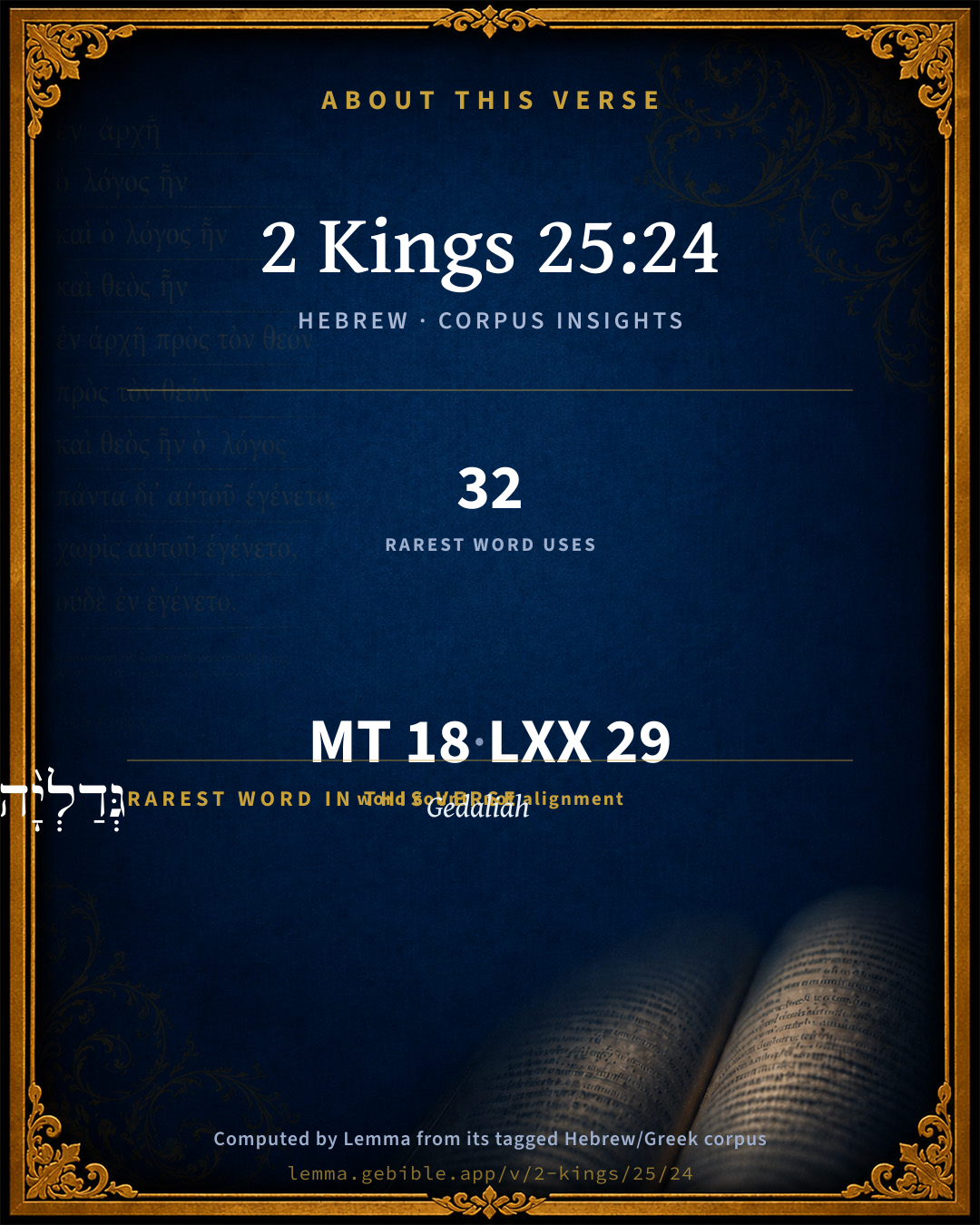
About this verse

These counts appear in no published source. They are computed here, from the morphology-tagged text and Lemma’s own curated glosses. What Lemma adds →

18
words
15
distinct lemmas
Historical
section

Shared distinctive vocabulary

גְּדַלְיָ֨הוּ֙ Gedaliah H1436 occurs in 31 verses of the Hebrew Bible. Also found in:

Grammatical profile

  • 6 verbs
  • 7 nouns
  • 3 prepositions
  • 2 particles

Verb forms

  • וַיִּשָּׁבַ֨ע Niphal · Sequential Imperfect
  • וַיֹּ֣אמֶר Qal · Sequential Imperfect
  • תִּֽירְא֖וּ Qal · Jussive
  • שְׁב֣וּ Qal · Imperative
  • וְעִבְד֛וּ Qal · Imperative
  • וְיִטַ֥ב Qal · Imperfect

Hebrew & Septuagint length

In English translation the verse runs 39 words from the Hebrew and 36 from the Septuagint (LXX English) — closely comparable.

A rough comparison of the two English renderings, which tokenize alike — not a word-level alignment.

Word counts can differ between the Hebrew and the Greek without any difference in meaning — e.g. the Hebrew direct-object marker אֵת has no separate Greek word, and Greek often adds the article ὁ.

In the original languages it is 18 Hebrew tokens and 29 Greek tokens — but the two are counted differently (Hebrew bundles its prefixes and suffixes into one token; the Greek is in lemma form), so that isn’t a like-for-like length.

Cross-references

5

Topical passages linked to 2 Kings 25:24 in the Treasury of Scripture Knowledge — connected by theme and wording, ordered by reader-vote popularity; previews shown in the World English Bible.

  • 2 Samuel 14:11 Then said she, Please let the king remember Yahweh your God, that the avenger of blood destroy not any more, lest they destroy my son. He said, As Yahweh lives, there shall not one hair of your son fall to the earth.
  • 2 Samuel 19:23 The king said to Shimei, You shall not die. The king swore to him.
  • Jeremiah 40:9–10 Gedaliah the son of Ahikam the son of Shaphan swore to them and to their men, saying, Don't be afraid to serve the Chaldeans: dwell in the land, and serve the king of Babylon, and it shall be well with you.
  • Jeremiah 43:6 the men, and the women, and the children, and the king's daughters, and every person who Nebuzaradan the captain of the guard had left with Gedaliah the son of Ahikam, the son of Shaphan; and Jeremiah the prophet, and Baruch the son of Neriah;
  • Ezekiel 33:24–29 Son of man, they who inhabit those waste places in the land of Israel speak, saying, Abraham was one, and he inherited the land: but we are many; the land is given us for inheritance.

Cross-references courtesy of OpenBible.info (CC BY 4.0).

Hebrew and Greek witnesses Masoretic Hebrew ↔ Greek Septuagint

The same verse in the two great witnesses to the Old Testament, shown verse-for-verse.

These are two independent witnesses, not word-aligned to each other, and the Septuagint is shown in lemma (dictionary) form.

Hebrew 2 Kings 25:24 Masoretic · Westminster Leningrad Codex

וַיִּשָּׁבַ֨ע לָהֶ֤ם גְּדַלְיָ֨הוּ֙ וּלְאַנְשֵׁיהֶ֔ם וַיֹּ֣אמֶר לָהֶ֔ם אַל תִּֽירְא֖וּ מֵעַבְדֵ֣י הַכַּשְׂדִּ֑ים שְׁב֣וּ בָאָ֗רֶץ וְעִבְד֛וּ אֶת מֶ֥לֶךְ בָּבֶ֖ל וְיִטַ֥ב לָכֶֽם

Gedaliah swore to them and to their men, and said to them, Don't be afraid because of the servants of the Chaldeans: dwell in the land, and serve the king of Babylon, and it shall be well with you.

World English Bible · Public Domain

Greek LXX 2 Kings 25:24 Septuagint · lemma form

καί ὄμνυμι γοδολιας αὐτός καί ὁ ἀνήρ αὐτός καί εἶπον αὐτός μή φοβέω πάροδος ὁ χαλδαῖος καταἵζω ἐν ὁ γῆ καί δουλεύω ὁ βασιλεύς βαβυλών καί καλῶς εἰμί σύ

And Godolias swore to them and their men, and said to them, Fear not the incursion of the Chaldeans; dwell in the land, and serve the king of Babylon, and it shall be well with you.

LXX2012 (modern English Septuagint) · Public Domain

Hebrew: Westminster Leningrad Codex (CC BY 4.0). Greek: Septuagint (public domain); English from LXX2012 (modern English Septuagint) (Public Domain). How the Septuagint differs from the Hebrew →

Targum (Aramaic paraphrase)

1

The Targum is the ancient Jewish Aramaic paraphrase of the Hebrew Scriptures — an interpretive translation, not the Hebrew text itself. Onkelos (literal) and Pseudo-Jonathan (expansive) render the Torah, and Jonathan the Prophets. Coverage is partial: where no permissively-licensed English translation exists for a verse, only the Aramaic is shown. This is verse-level text, not a word-by-word alignment to the Hebrew.

  1. Targum Jonathan Prophets (Joshua–Malachi)
    וְקַיֵם לְהוֹן גְדַלְיָה וּלְגַבְרֵיהוֹן וַאֲמַר לְהוֹן לָא תִדְחֲלוּן מֵעַבְדֵי כַסְדָאֵי תְּבוּ בְאַרְעָא וּפְלָחוּ יַת מַלְכָּא דְבָבֶל וְיִטַב לְכוֹן:

    (no public-domain English translation for this verse)

    Targum Jonathan — Aramaic: “Mikraot Gedolot” (public domain). English: “Sefaria Community Translation” (CC0 1.0 (public-domain dedication)); “London "Chaldee Paraphrase," 1871” (public domain). Text via Sefaria.

Commentary

Notes on 2 Kings 25:24 from classic Christian and Jewish commentators (each source and its license shown beneath its notes). The classic Christian expositions comment on the surrounding passage and are grouped to its opening verse, so a note may address several verses; the Jewish commentaries on the Tanakh (Rashi and others) are per-verse, so they appear only where the commentator wrote on this verse.

Lemma curates 59 commentaries, every one of them public domain or Creative Commons licensed, each selected and text-cleaned for this edition rather than reprinted as found. About our sources →

Trapp's Complete Commentary

John Trapp

2Ki 25:24 And Gedaliah sware to them, and to their men, and said unto them, Fear not to be the servants of the Chaldees: dwell in the land, and serve the king of Babylon; and it shall be well with you.

Ver. 24. Dwell in the land, and serve.] The Arabians have a good proverb, Os quod in sorte tua cediderit, rodas, Be content with your condition; and if you cannot bring your estate to your mind, bring your mind to your estate.

John Trapp, A Commentary or Exposition upon All the Books of the Old and New Testament (1647–1656) — public domain. Text from a community e-Sword module.

Joseph Benson's Commentary

2Ki 25:24. Gedaliah sware to them — Assured them by his promise and oath, that if they would be patient and peaceable under the government of the king of Babylon, and would conduct themselves properly, they should be kept from the evils which they feared. This he might safely swear, because he had not only Nebuchadnezzar’s promise, and interest too, but also God’s promise, delivered by Jeremiah. And it might seem that a fair prospect was now again opening for them. But, alas! this hopeful settlement was soon dashed to pieces, not by the Chaldeans, but by themselves. The things of their peace were so hid from their eyes that they neither knew when they were well, nor would believe when they were told so even by God himself.

Joseph Benson's Commentary on the Old and New Testaments (1811–1818) — public domain. Text from a community e-Sword module.

Geneva Bible (1599)

Geneva Bible translators

That is, he did exhort them in the Name of the Lord, according to Jeremiah’s counsel, to submit themselves to Nebuchadnezzar, seeing it was the revealed will of the Lord.

Geneva Bible (1599) marginal notes — public domain. Text via Bolls.life.

Adam Clarke's Commentary

Verse 24. Gedaliah sware to them] He pledged himself in the most solemn manner to encourage and protect them.

Adam Clarke's Commentary on the Bible (1810–1826) — public domain. Text from a community e-Sword/MySword module.

Ellicott's Commentary for English Readers

(24) fear not to be the servants.—Rather, Be not afraid of the servants. By “the servants of the Chaldees” Gedaliah probably means those who recognised the Chaldeans as their masters—that is to say, himself and those who adhere to him. He promises immunity for the past if only the captains and their men will settle down quietly as subjects of the conqueror.

A Bible Commentary for English Readers, edited by Charles John Ellicott (1878–1897) — public domain. Text from a community e-Sword module.

The Cambridge Bible for Schools and Colleges

gen. ed. J. J. S. Perowne

24. Gedaliah sware to them] He gave them a most solemn promise that they should enjoy the security which he expected under the rule of the Chaldæans.

Fear not to be [R.V. because of] the servants of the Chaldees] R.V. Chaldæans. The alarm of the returning fugitives would be lest another Chaldæan force should come and do to Mizpah as they had done to Jerusalem.

The Cambridge Bible for Schools and Colleges (gen. ed. J. J. S. Perowne; Cambridge University Press, 1878–1918) — public domain. Text from a community e-Sword module.

Albert Barnes' Notes on the Bible

As rebels against the Babylonian king, their lives were forfeit. Gedaliah pledged himself to them by oath, that, if they gave no further cause of complaint, their past offences should be forgiven.

Albert Barnes' Notes on the Bible (1834–1885) — public domain. Text from a community e-Sword/MySword module.

Matthew Poole's English Annotations

Sware to them, and to their men; assured them by his promise and oath, that they, doing what he required, should be kept from the evils which they feared. This he might safely swear, because he had not only the king of Babylon’s promise and interest too, but also God’s promise, for their indemnity, delivered by Jeremiah.

Matthew Poole's English Annotations on the Holy Bible (1683–1685) — public domain. Text from a community e-Sword/MySword module.

Whedon's Commentary on the Bible

Daniel D. Whedon

24. Sware to them — Assured them upon oath that they had no reason to fear further trouble. They seem to have come to him to understand the situation of things, being yet in fear for their own lives.

Fear not to be the servants — Rather, be not afraid of the servants of the Chaldees. Ishmael was of the royal seed, and had reason to fear a fate similar to that of other members of the royal house who had fallen into the hands of the Chaldees. Gedaliah, as governor, assures him and the rest that no harm will befall them if they continue peaceably in the land. These servants of the Chaldees are to be understood as Babylonian officials stationed in various parts of the land to co-operate with Gedaliah in preserving order.

Daniel D. Whedon (gen. ed.), Commentary on the Old and New Testaments (1874–1909) — public domain. Text from a community e-Sword module.

The Pulpit Commentary

And Gedaliah aware to them, and to their men. As rebels, their lives were forfeit; but Gedaliah granted them an amnesty, and for their greater assurance swore to them that, so long as they remained peaceful subjects of the King of Babylon, they should suffer no harm. Jeremiah adds (Jer_40:10) that he urged them to apply themselves diligently to agricultural pursuits. And said unto them, Fear not to be the servants of the Chaldees: dwell in the land, sad serve the King of Babylon; and it shall be well with you; rather, and said unto them, Fear not because of the servants of the Chaldeans, etc. "Do not be afraid," i.e. , "of the Chaldean officials and guards (Jer_42:3) that are about my court. Be assured that they shall do you no hurt."

The Pulpit Commentary (1880–1919), ed. H.D.M. Spence-Jones & Joseph S. Exell — public domain. Text from a community e-Sword module.

John Wesley's Explanatory Notes

Swear - Assured them by his promise and oath, that they should be kept from the evils which they feared. This he might safely swear, because he had not only the king of Babylon's promise but also God's promise deliver'd by Jeremiah. And it might seem, a fair prospect was opening again. But how soon was the scene changed! This hopeful settlement is quickly dashed in pieces, not by the Chaldeans, but by some of themselves.

John Wesley, Explanatory Notes Upon the Whole Bible (1754–1765) — public domain. Text via the GEBible commentary corpus.

Lesson kit

Teaching starters — assembled from the data on this page, not authored interpretation. Every prompt links to the verse data it draws on. Edit before teaching.

2 Kings, in the Historical, opens this verse with 18 words (15 distinct Hebrew lemmas). Its most distinctive word is Gᵉdalyâh (“Gedaliah”). A historical commentator’s framing appears above. Read the whole chapter for the surrounding context.

Discussion questions

  1. How does “Gedaliah” (Gᵉdalyâh) shape what this verse is saying?
  2. How does 2 Kings 25:22, which shares the word «Gedaliah», read alongside this verse?
  3. These translations render this verse differently. What is at stake in choosing one wording over another?
  4. «וַיִּשָּׁבַ֨ע» is a Niphal Sequential Imperfect verb. How does that grammatical form shape the action described?
  5. Compare how Trapp's Complete Commentary and Joseph Benson's Commentary read this verse. Where do they agree or differ?

Things to notice

Reading settings

Reading text

Shown beneath each verse's original-language words.

Old Testament
Old Testament edition

Read the OT as the Masoretic Hebrew (MT) or the Greek Septuagint (LXX).

English shown for the Greek Septuagint (in the Hebrew ↔ Greek comparison).

Comparing translations? Open the Compare panel on any verse page to stack up to four side by side.