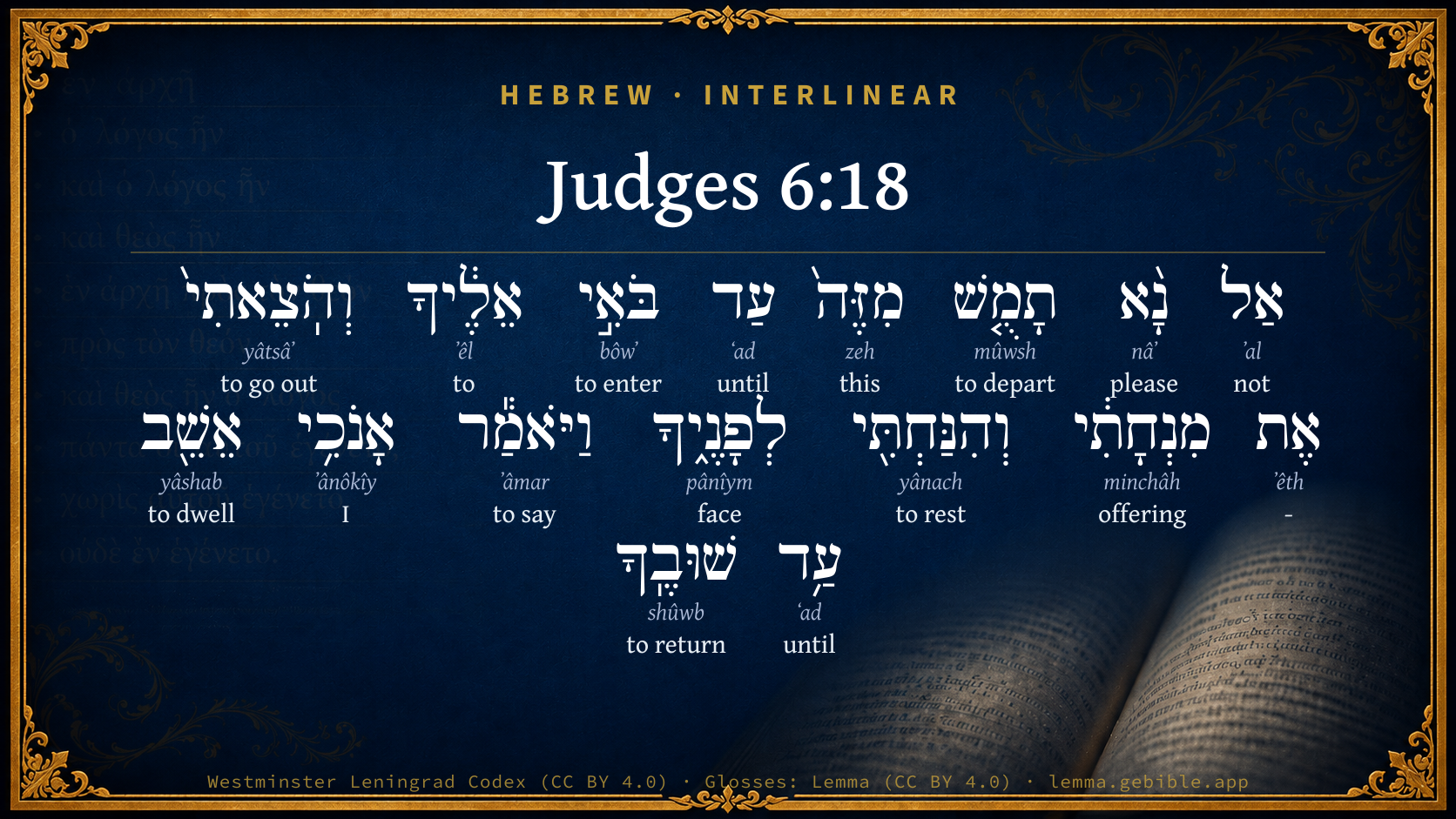
Judges 6:18

Hebrew (Westminster Leningrad Codex) Judges 6:18 appears in the Hebrew Old Testament. The text above is from the Westminster Leningrad Codex. Each word links to its Strong’s number, a concise gloss, and parsing drawn from the Open Scriptures Hebrew Bible morphology. Click any word for its full Brown-Driver-Briggs (BDB) entry.
Download image
Cite this verse

Judges 6:18 (World English Bible). Public Domain. Lemma interlinear Bible study tool, https://lemma.gebible.app/v/judges/6/18.

Show BibTeX & RIS
BibTeX
RIS
English Translation
Please don't go away, until I come to you, and bring out my present, and lay it before you. He said, I will wait until you come again.
World English Bible · Public Domain
Download a study sheet

One document with this verse’s original text, its word-by-word gloss line, the meaning frame, cross-references with their text, attributed commentary, and full source and license credits — printable, and it pastes into notes with its structure intact.

This verse Autodidact and up

Study sheet (.html) Plain text (.txt)

A passage Seminary Student

Up to 50 verses in one chapter. A passage sheet keeps up to 6 commentary sources and 12 cross-references per verse, in the order this page ranks them, and says so on the sheet whenever that leaves anything out. Ask for a single verse and you get the Autodidact verse sheet above.

Everything on this page stays free to read, with no account — the sheet is a download of what is already on screen, not access to it.

Want to remove ads? Support Godless Engineer
Compare translations 3

The same verse in 3 English versions, stacked beneath the original-language interlinear above. Click any original word for its lexicon entry.

Each is an independent rendering of the whole verse — the interlinear is not word-aligned to these translations.

Highlighted words mark where these versions differ — a whole-verse word diff, not a word-by-word alignment.

  • World English Bible Public Domain
    Please don't go away, until I come to you, and bring out my present, and lay it before you. He said, I will wait until you come again.
  • King James Version Public Domain
    Depart not hence, I pray thee, until I come unto thee, and bring forth my present, and set it before thee. And he said, I will tarry until thou come again.
  • unfoldingWord Literal Text CC BY-SA 4.0
    Please do not depart from this until my coming to you, and I will bring out my offering and set it to your face.” And he said, “I will stay until your returning.”

unfoldingWord Literal Text — © unfoldingWord, licensed CC BY-SA 4.0. Word-aligned USFM3 via Door43 (git.door43.org/unfoldingWord/en_ult).

Versions to compare (up to 4)

3 of 4 selected

Show all 18 translations

Every available English version of this verse, each an independent rendering of the whole verse.

  • World English Bible Public Domain
    Please don't go away, until I come to you, and bring out my present, and lay it before you. He said, I will wait until you come again.
  • Berean Standard Bible Public Domain
    Please do not depart from this place until I return to You. Let me bring my offering and set it before You.” And the LORD said, “I will stay until you return.”
  • Majority Standard Bible Public Domain
    Please do not depart from this place until I return to You. Let me bring my offering and set it before You.” And the LORD said, “I will stay until you return.”
  • King James Version Public Domain
    Depart not hence, I pray thee, until I come unto thee, and bring forth my present, and set it before thee. And he said, I will tarry until thou come again.
  • American Standard Version (1901) Public Domain
    Depart not hence, I pray thee, until I come unto thee, and bring forth my present, and lay it before thee. And he said, I will tarry until thou come again.
  • Revised Version (1885) Public Domain
    Depart not hence, I pray thee, until I come unto thee, and bring forth my present, and lay it before thee. And he said, I will tarry until thou come again.
  • Geneva Bible (1599) Public Domain
    Depart not hence, I pray thee, vntil I come vnto thee, and bring mine offring, and lay it before thee. And he sayde, I will tary vntill thou come againe.
  • Douay-Rheims (1899) Public Domain
    And he said: If I have found grace before thee, give me a sign that it is thou that speakest to me,
  • Young's Literal Translation Public Domain
    Move not, I pray Thee, from this, till my coming in unto Thee, and I have brought out my present, and put it before Thee;' and he saith, `I -- I do abide till thy return.'
  • Literal Standard Version CC BY-SA 4.0
    Please do not move from here until my coming to You, and I have brought out my present, and put it before You”; and He says, “I abide until your return.”
  • Unlocked Literal Bible CC BY-SA 4.0
    Please, do not leave here, until I come to you and bring out my gift and set it before you.” Yahweh said, “I will wait until you return.”
  • unfoldingWord Literal Text CC BY-SA 4.0
    Please do not depart from this until my coming to you, and I will bring out my offering and set it to your face.” And he said, “I will stay until your returning.”
  • Darby Bible Public Domain
    Do not depart from here, I pray thee, until I come to thee, and bring out my present, and set it before thee." And he said, "I will stay till you return."
  • World Messianic Bible Public Domain
    Please don’t go away until I come to you, and bring out my present, and lay it before you.” He said, “I will wait until you come back.”
  • Webster's Bible Public Domain
    Depart not hence, I pray thee, until I come to thee, and bring forth my present, and set it before thee. And he said, I will tarry until thou comest again.
  • Free Bible Version CC BY-SA 4.0
    “Don't leave until I come back and present my offering to you.” “I will remain here until you return,” he replied.
  • Bible in Basic English Public Domain
    Do not go away till I come with my offering and put it before you. And he said, I will not go away before you come back.
  • JPS Tanakh (1917) Public Domain
    Depart not hence, I pray thee, until I come unto thee, and bring forth my present, and lay it before thee.' And he said: 'I will tarry until thou come back.'

Literal Standard Version (2020), Covenant Press — licensed CC BY-SA 4.0. Text via the HelloAO Bible API (eBible.org). Unlocked Literal Bible (unfoldingWord) — licensed CC BY-SA 4.0. Text via the HelloAO Bible API (eBible.org). unfoldingWord Literal Text — © unfoldingWord, licensed CC BY-SA 4.0. Word-aligned USFM3 via Door43 (git.door43.org/unfoldingWord/en_ult). Free Bible Version, Dr. Jonathan Gallagher — licensed CC BY-SA 4.0. Text via the HelloAO Bible API (eBible.org).

Word by word

More ways to search: Search by grammar → Find every occurrence → Compare this word →

Practice this passage: Drill this verse → Learn its vocabulary →

תָמֻ֤שׁ
mûwsh
H4185
“to depart”
Verb, Qal, Jussive, 2nd Person, Masculine, Singular
Part of Speech
Verb
Stem
Qal
Form
Jussive
Person
2nd Person
Gender
Masculine
Number
Singular
Full BDB Definition

Origin: a primitive root [perhaps rather the same as H4184 through the idea of receding by contact]

TWOT: 1167

to depart, remove - (Qal) - to depart - to remove - to be removed (of inanimate objects) - (Hiphil) to remove, depart
  1. אַל ʼal H408 “not” Particle, Negative
  2. נָ֨א nâʼ H4994 “please” Particle, Exhortation
  3. מִזֶּה֙ zeh H2088 “from · this” Preposition + Pronoun, Demonstrative, Masculine, Singular
  4. עַד ʻad H5704 “until” Preposition
  5. בֹּאִ֣י bôwʼ H935 “to enter · me” Verb, Qal, Infinitive Construct + Suffix, Personal, 1st Person, Common, Singular
  6. אֵלֶ֔יךָ ʼêl H413 “to · you” Preposition + Suffix, Personal, 2nd Person, Masculine, Singular
  7. וְהֹֽצֵאתִי֙ yâtsâʼ H3318 “and · to go out” Conjunction + Verb, Hiphil, Sequential Perfect, 1st Person, Common, Singular
  8. אֶת ʼêth H853 “-” Particle, Direct Object
  9. מִנְחָתִ֔י minchâh H4503 “offering · my” Noun, Common, Feminine, Singular, Construct + Suffix, Personal, 1st Person, Common, Singular
  10. וְהִנַּחְתִּ֖י yânach H3240 “and · to rest” Conjunction + Verb, Hiphil, Sequential Perfect, 1st Person, Common, Singular
  11. לְפָנֶ֑יךָ pânîym H6440 “to/for · face(s) · your” Preposition + Noun, Common, Both, Plural, Construct + Suffix, Personal, 2nd Person, Masculine, Singular
  12. וַיֹּאמַ֕ר ʼâmar H559 “and · to say” Conjunction + Verb, Qal, Sequential Imperfect, 3rd Person, Masculine, Singular
  13. אָנֹכִ֥י ʼânôkîy H595 “I” Pronoun, Personal, 1st Person, Common, Singular
  14. אֵשֵׁ֖ב yâshab H3427 “to dwell” Verb, Qal, Imperfect, 1st Person, Common, Singular
  15. עַ֥ד ʻad H5704 “until” Preposition
  16. שׁוּבֶֽךָ shûwb H7725 “to return · you” Verb, Qal, Infinitive Construct + Suffix, Personal, 2nd Person, Masculine, Singular

About this verse

These counts appear in no published source. They are computed here, from the morphology-tagged text and Lemma’s own curated glosses. What Lemma adds →

17
words
16
distinct lemmas
Historical
section

Notable vocabulary

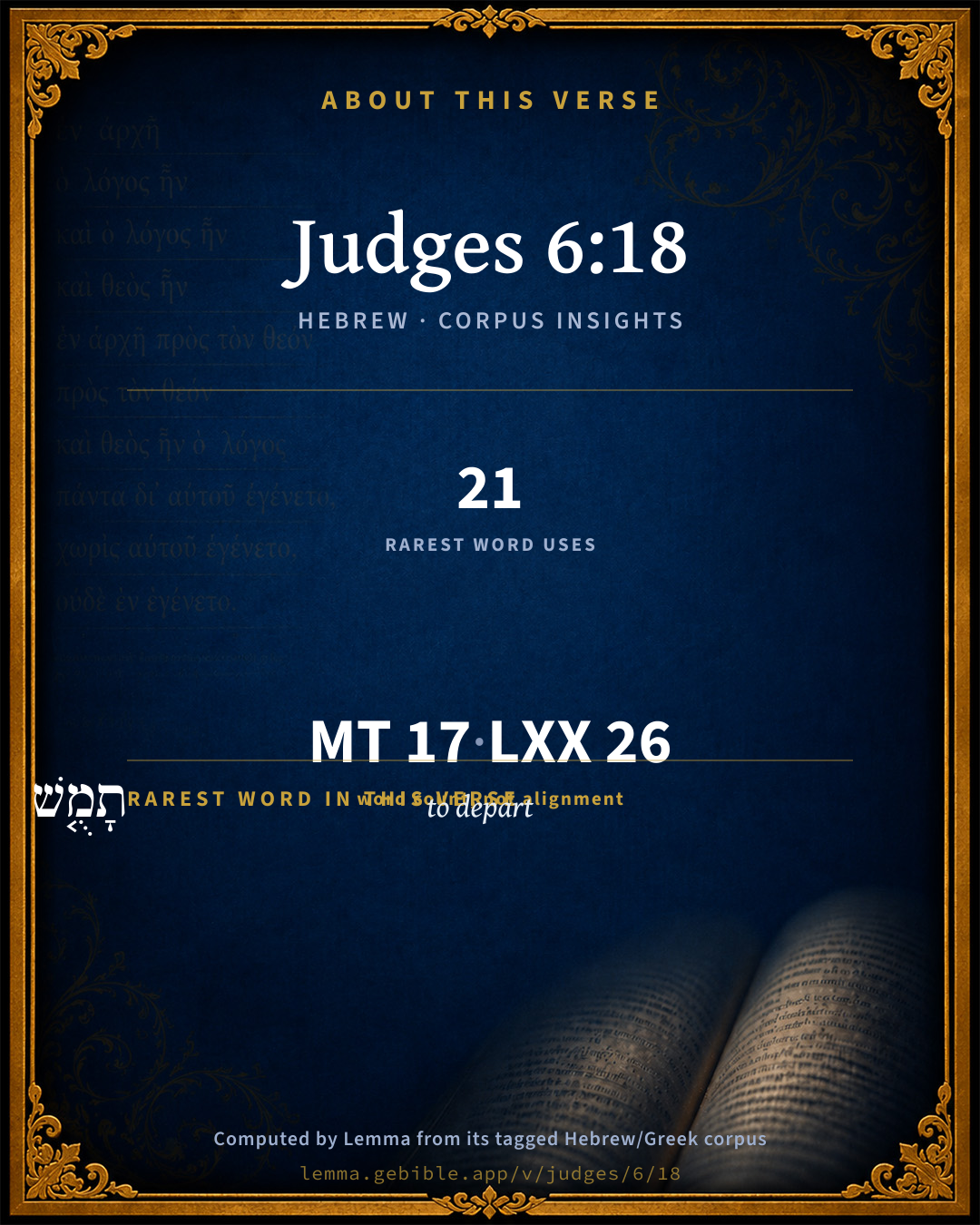
The rarest word here is תָמֻ֤שׁ to depart H4185 — appearing just 21 times in the whole Hebrew Bible.

Shared distinctive vocabulary

תָמֻ֤שׁ to depart H4185 occurs in 19 verses of the Hebrew Bible. Also found in:

Grammatical profile

  • 7 verbs
  • 2 nouns
  • 2 pronouns
  • 3 prepositions
  • 3 particles

Verb forms

  • תָמֻ֤שׁ Qal · Jussive
  • בֹּאִ֣י Qal · Infinitive Construct
  • וְהֹֽצֵאתִי֙ Hiphil · Sequential Perfect
  • וְהִנַּחְתִּ֖י Hiphil · Sequential Perfect
  • וַיֹּאמַ֕ר Qal · Sequential Imperfect
  • אֵשֵׁ֖ב Qal · Imperfect
  • שׁוּבֶֽךָ Qal · Infinitive Construct

Repetition

A word recurs within this verse — often emphatic in Hebrew:

Hebrew & Septuagint length

In English translation the verse runs 28 words from the Hebrew and 29 from the Septuagint (LXX English) — closely comparable.

A rough comparison of the two English renderings, which tokenize alike — not a word-level alignment.

Word counts can differ between the Hebrew and the Greek without any difference in meaning — e.g. the Hebrew direct-object marker אֵת has no separate Greek word, and Greek often adds the article ὁ.

In the original languages it is 17 Hebrew tokens and 26 Greek tokens — but the two are counted differently (Hebrew bundles its prefixes and suffixes into one token; the Greek is in lemma form), so that isn’t a like-for-like length.

Cross-references

4

Topical passages linked to Judges 6:18 in the Treasury of Scripture Knowledge — connected by theme and wording, ordered by reader-vote popularity; previews shown in the World English Bible.

  • Genesis 18:5 I will get a morsel of bread so you can refresh your heart. After that you may go your way, now that you have come to your servant." They said, "Very well, do as you have said."
  • Genesis 18:3 and said, "My lord, if now I have found favor in your sight, please don't go away from your servant.
  • Judges 13:15 Manoah said to the angel of Yahweh, I pray you, let us detain you, that we may make ready a kid for you.
  • Genesis 19:3 He urged them greatly, and they came in with him, and entered into his house. He made them a feast, and baked unleavened bread, and they ate.

Cross-references courtesy of OpenBible.info (CC BY 4.0).

Hebrew and Greek witnesses Masoretic Hebrew ↔ Greek Septuagint

The same verse in the two great witnesses to the Old Testament, shown verse-for-verse.

These are two independent witnesses, not word-aligned to each other, and the Septuagint is shown in lemma (dictionary) form.

Hebrew Judges 6:18 Masoretic · Westminster Leningrad Codex

אַל נָ֨א תָמֻ֤שׁ מִזֶּה֙ עַד בֹּאִ֣י אֵלֶ֔יךָ וְהֹֽצֵאתִי֙ אֶת מִנְחָתִ֔י וְהִנַּחְתִּ֖י לְפָנֶ֑יךָ וַיֹּאמַ֕ר אָנֹכִ֥י אֵשֵׁ֖ב עַ֥ד שׁוּבֶֽךָ

Please don't go away, until I come to you, and bring out my present, and lay it before you. He said, I will wait until you come again.

World English Bible · Public Domain

Greek LXX Judges 6:18 Septuagint · lemma form

μή χωρίζω ἐντεῦθεν ἕως ὁ ἔρχομαι ἐγώ πρός σύ καί ἐκφέρω ὁ θυσία καί τίθημι ἐνώπιον σύ καί εἶπον ἐγώ εἰμί καθίομαι ἕως ὁ ἐπιστρέφω σύ

depart not hence until I come to you, and I will bring forth an offering and offer it before you: and he said, I will remain until you return.

LXX2012 (modern English Septuagint) · Public Domain

On this verse, The Cambridge Bible for Schools and Colleges discusses the Septuagint’s reading. Read the note in Commentary ↓

Hebrew: Westminster Leningrad Codex (CC BY 4.0). Greek: Septuagint (public domain); English from LXX2012 (modern English Septuagint) (Public Domain). How the Septuagint differs from the Hebrew →

Targum (Aramaic paraphrase)

1

The Targum is the ancient Jewish Aramaic paraphrase of the Hebrew Scriptures — an interpretive translation, not the Hebrew text itself. Onkelos (literal) and Pseudo-Jonathan (expansive) render the Torah, and Jonathan the Prophets. Coverage is partial: where no permissively-licensed English translation exists for a verse, only the Aramaic is shown. This is verse-level text, not a word-by-word alignment to the Hebrew.

  1. Targum Jonathan Prophets (Joshua–Malachi)
    לָא כְעַן תַּעֲדֵי מִכָּא עַד מֵתָאִי לְוָתָךְ וְאַפֵק יַת תִּקְרוּבְתִּי וְאַנִיחַ קֳדָמָךְ וַאֲמַר אֲנָא אוֹרִיךְ עַד דִתְתוּב:

    (no public-domain English translation for this verse)

    Targum Jonathan — Aramaic: “Mikraot Gedolot” (public domain). English: “Sefaria Community Translation” (CC0 1.0 (public-domain dedication)); “London "Chaldee Paraphrase," 1871” (public domain). Text via Sefaria.

Commentary

Notes on Judges 6:18 from classic Christian and Jewish commentators (each source and its license shown beneath its notes). The classic Christian expositions comment on the surrounding passage and are grouped to its opening verse, so a note may address several verses; the Jewish commentaries on the Tanakh (Rashi and others) are per-verse, so they appear only where the commentator wrote on this verse.

Lemma curates 59 commentaries, every one of them public domain or Creative Commons licensed, each selected and text-cleaned for this edition rather than reprinted as found. About our sources →

Trapp's Complete Commentary

John Trapp

Jdg 6:18 Depart not hence, I pray thee, until I come unto thee, and bring forth my present, and set [it] before thee. And he said, I will tarry until thou come again.

Ver. 18. And bring forth my present,] i.e., My provision, as Gen 18:5.

John Trapp, A Commentary or Exposition upon All the Books of the Old and New Testament (1647–1656) — public domain. Text from a community e-Sword module.

Joseph Benson's Commentary

Jdg 6:18-19. Until I bring forth my present — A repast for the angel whom he thought to be a man; and set it before thee — That thou mayest eat and refresh thyself. An ephah of flour — The choicest part of a whole ephah; as also he brought to him the best part of a kid dressed; for a whole ephah and a whole kid had been superfluous and improper to provide for one man.

Joseph Benson's Commentary on the Old and New Testaments (1811–1818) — public domain. Text from a community e-Sword module.

Jamieson, Fausset & Brown

Robert Jamieson, A. R. Fausset & David Brown

GIDEON'S PRESENT CONSUMED BY FIRE. (Jdg. 6:17-32)

Depart not hence, I pray thee, until I . . . bring forth my present--Hebrew, my mincha, or "meat offering"; and his idea probably was to prove, by his visitor's partaking of the entertainment, whether or not he was more than man.

Jamieson, Fausset & Brown — Commentary Critical and Explanatory on the Whole Bible (1871) — public domain (CC PDM 1.0). Text via the HelloAO Bible API.

Adam Clarke's Commentary

Verse 18. And bring forth my present] My minchah; generally an offering of bread, wine, oil, flour, and such like. It seems from this that Gideon supposed the person to whom he spoke to be a Divine person. Nevertheless, what he prepared and brought out appears to be intended simply as an entertainment to refresh a respectable stranger.

Adam Clarke's Commentary on the Bible (1810–1826) — public domain. Text from a community e-Sword/MySword module.

The Cambridge Bible for Schools and Colleges

gen. ed. J. J. S. Perowne

18. Depart not hence] is the natural sequel of Jdg_6:17 a. Like Abraham (Gen_18:3 ff.) and Manoah (ch. Jdg_13:15), Gideon presses hospitality upon the stranger. He had to run home in order to prepare the food, for the winepress was outside the village.

my present] The word has this meaning in Jdg_3:15; Jdg_3:17, Gen_32:13 ff; Gen_33:10; Gen_43:11 ff. etc.; but it is used more frequently of an offering made to God, whether of animals or of the fruit of the earth, e.g. Gen_4:3-5, 1Sa_2:17; 1Sa_2:29; in the later ritual usage it becomes the technical term for the meal- or grain-offering, Eze_46:14, and always in P. In the present case Gideon prepares a present of food for his guest, not an offering to God; but in view of what happened the writer chose a word which might bear either sense. The LXX definitely renders ‘sacrifice.’ Cf. Jdg_13:19.

The Cambridge Bible for Schools and Colleges (gen. ed. J. J. S. Perowne; Cambridge University Press, 1878–1918) — public domain. Text from a community e-Sword module.

John Gill's Exposition

And Gideon went in,.... Into his own house, or his father's:

and made ready a kid; boiled it, as appears by the broth he brought, at least part of it was so dressed; and perhaps it was only some part of one that he brought, since a whole one was too much to be set before one person, and if even he himself intended to eat with him:

and unleavened cakes of an ephah of flour; that is, probably those were made out of an ephah of flour; not that the whole ephah was made into cakes; since an omer, the tenth part of an ephah, was sufficient for one man a whole day; and, according to the computation of Waserus (n) an ephah was enough for forty five men for a whole day; unless it can be thought that this was done to show his great hospitality to a stranger, and the great respect he had for him as a messenger of God: the rather unleavened cakes were brought, because of dispatch, being soon made. Jarchi says, from hence it may be learned that it was now the time of the passover, and of waving the sheaf; but this is no sufficient proof of it; besides, if this was new wheat Gideon had been threshing, it shows it to be about the wheat harvest, which was not till Pentecost; it was the barley harvest that began at the passover:

the flesh he put in a basket; the flesh of the kid which was boiled, or if any part of it was dressed another way, it was put by itself in a basket for more easy and commodious carriage:

and he put the broth in a pot; a brazen pot, as Kimchi interprets it, in which the kid was boiled; and this, as he says, was the water it was boiled in:

and brought it out unto him under the oak; where he appeared, and was now waiting the return of Gideon there:

and presented it; set it before him, perhaps upon a table, which might be brought by his servants, or on a seat, which was placed under the oak to sit upon under its shade for pleasure.

(n) De Antiqu. mensuris Heb. l. 2. c. 5. sect. 9.

John Gill's Exposition of the Whole Bible (1746–1763) — public domain (CC PDM 1.0). Text via the HelloAO Bible API.

Albert Barnes' Notes on the Bible

My present - My Minchah: the word used regularly, though not exclusively, for the meat and drink offering (Lev 2:1 note). Its double sense of an offering to God, and of a gift to man, suits the doubt in Gideon’s mind as to who his visitor might be.

Albert Barnes' Notes on the Bible (1834–1885) — public domain. Text from a community e-Sword/MySword module.

Haydock's Catholic Bible Commentary

A sacrifice, or some provisions to present unto thee. Hebrew mincha, is taken for a present, particularly of flour and wine. It is used to denote those presents which were made by Jacob to Esau, and Joseph, and by Aod to the king of Moab, chap. iii. 15., and Genesis xliii. 14. (Calmet) --- To sacrifice, often means to kill things for a feast, Matthew xxii. 4. What Gedeon brought, was afterwards turned into a sacrifice by the angel, ver. 21. (Menochius) --- Gedeon was not a priest, nor was there any altar prepared for a sacrifice. If Gedeon had intended to offer one, he would not have boiled nor baked the food, which he presented before his guest. (Calmet)

George Leo Haydock (1774–1849), Haydock's Catholic Family Bible and Commentary, 1859 edition — public domain. Excludes Psalms (Douay-Rheims chapter numbering differs from Protestant) and Deuterocanonical books (Catholic canon only).

Matthew Poole's English Annotations

My present; not a sacrifice, because neither was Gideon a priest, nor was this the place of sacrifice, nor was any altar here, nor was there any such sacrifice as here follows appointed by God; but a repast, or some food for the angel, which he thought to be a man, as appears by Jdg 6:22. Compare Jdg 13:15; Gen 18:5.

Set it before thee, that thou mayst eat and refresh thyself.

Matthew Poole's English Annotations on the Holy Bible (1683–1685) — public domain. Text from a community e-Sword/MySword module.

Whedon's Commentary on the Bible

Daniel D. Whedon

18. My present — The original word, minchah, “does not mean a sacrifice in the strict sense, nor merely a gift of food, but a sacrificial gift in the sense of a gift presented to God, on the acceptance of which he hoped to receive the sign which would show whether the person who had appeared to him was really God. This sacrificial gift consisted of such food as they were accustomed to set before a guest whom they wished especially to honour.” — Keil. The sign by which Gideon would judge of the character of his guest was probably, as Henry says, “if he ate of it as common meat he would suppose him to be a man, a prophet; if otherwise, as it proved, he should know him to be an angel.”

Daniel D. Whedon (gen. ed.), Commentary on the Old and New Testaments (1874–1909) — public domain. Text from a community e-Sword module.

The Pulpit Commentary

My present. Minehah means sometimes a present made to man, as in Jud_1:3:18; but it more commonly means a sacrificial offering, (Gen_4:3-5) which seems to be its meaning here, as explained vers. 19, 20. When coupled with zevach, the animal sacrifice, minchah means the meat and drink offering.

Vers. 18-21. The sign the present turned into a sacrifice.

The narrative speaks for itself; it is a picture of Eastern hospitality. Gideon"s sense of the extraordinary nature of the visit expresses itself in his taking upon himself the duties of servant as well as host, to keep it secret. As the angel said to Manoah, "I will not eat of thy bread", (Jud_1:13:16) so the visitor betrays his true character as an angel of Jehovah in abstaining from the food. Of the phrase "and they did eat" in Gen_18:8, the Targum gives the gloss,." they seemed to him to eat." Angels, not having a corporeal nature, do not require mortal sustenance. But the most striking incident in the narrative is the touching of the flesh and cakes with the angel"s staff, and their being consumed by fire from the rock. This circumstance betokened not rejection of the gift, but its acceptance in a higher sense; the present becomes a sacrifice.

I ALL BEST GIFTS ARE SACRIFICIAL. That which is given in order to a return; from gratification of self-love, ostentation, vanity; from custom; or without any real sense of loss, sacrifice, etc., is not accounted great by generous minds, however intrinsically precious it may be. As the sentiment enhances the value of the gift, even trifling in our eyes, so that which has cost pain, effort, loss of loving hearts, is "above rubies." Personality often thwarts the purpose of a well-intended gift; therefore it has often to be effaced ere the true end is attained.

II How GOD OFTEN DEALS THUS WITH THE GIFTS OF HIS SERVANTS. It is not in a few isolated miracles that this has taken place. The mode of procedure is a principle of his kingdom, and is seen in every true life.

1. In carrying on a spiritual work to unforeseen developments, and so that demands are made the agent did not at first contemplate. Some kinds of spiritual effort are like sinking a shaft for a mine, the ultimate expenditure of labour and means is not ascertainable. That which was almost a pastime becomes a serious task. Consequences are evolved that call for heroism and generous self-devotion.

2. Results which were aimed at in the first instance are withheld, and the labourer has to continue steadfast amidst apparent want of success.

3. The labour itself becomes dear, and enthusiasm makes the greatest efforts easy, and the heaviest burdens light. At first it is "our" work; by-and-bye it is God s work. We lose ourselves m the presence of the "not ourselves that maketh for righteousness," who accepts our feeble labours and turns them towards infinite and inconceivable purposes.

III WHAT IS SUBSERVED BY THIS CONVERSION.

1. It is educative. The subject of it is being taught a nobler life. He is wooed gradually out of the narrow shell of self into the larger atmosphere and arena of Divine love. At first God provokes us to the disinterested passion for himself, then he surprises us into fitting expression of it. The bridges of retreat are cut.

2. Our vague intention is interpreted to our spirits, and is set free. The alchemy of Divine love turns our dross into gold, our water into wine.

3. The permanent utility of man"s work is thereby secured. Like the devotion of Christ, it receives an absolute worth in perfected sacrifice. M.

The Pulpit Commentary (1880–1919), ed. H.D.M. Spence-Jones & Joseph S. Exell — public domain. Text from a community e-Sword module.

John Wesley's Explanatory Notes

My present - A repast for the angel, whom he thought to be a man. Set it - That thou mayest eat and refresh thyself.

John Wesley, Explanatory Notes Upon the Whole Bible (1754–1765) — public domain. Text via the GEBible commentary corpus.

Lesson kit

Teaching starters — assembled from the data on this page, not authored interpretation. Every prompt links to the verse data it draws on. Edit before teaching.

Judges, in the Historical, opens this verse with 17 words (16 distinct Hebrew lemmas). Its most distinctive word is mûwsh (“to depart”). A historical commentator’s framing appears above. Read the whole chapter for the surrounding context.

Discussion questions

  1. How does “to depart” (mûwsh) shape what this verse is saying?
  2. How does Exodus 13:22, which shares the word «to depart», read alongside this verse?
  3. What does the repetition of “until” (2× in this one verse) do in this verse?
  4. The translations on this page render this verse differently — a whole-verse word diff, not a word-by-word alignment. What might account for the different wordings?
  5. «תָמֻ֤שׁ» is a Qal Jussive verb. How does that grammatical form shape the action described?
  6. Compare how Trapp's Complete Commentary and Joseph Benson's Commentary read this verse. Where do they agree or differ?

Things to notice

Reading settings

Reading text

Shown beneath each verse's original-language words.

Old Testament
Old Testament edition

Read the OT as the Masoretic Hebrew (MT) or the Greek Septuagint (LXX).

English shown for the Greek Septuagint (in the Hebrew ↔ Greek comparison).

Comparing translations? Open the Compare panel on any verse page to stack up to four side by side.