Ruth 3:11

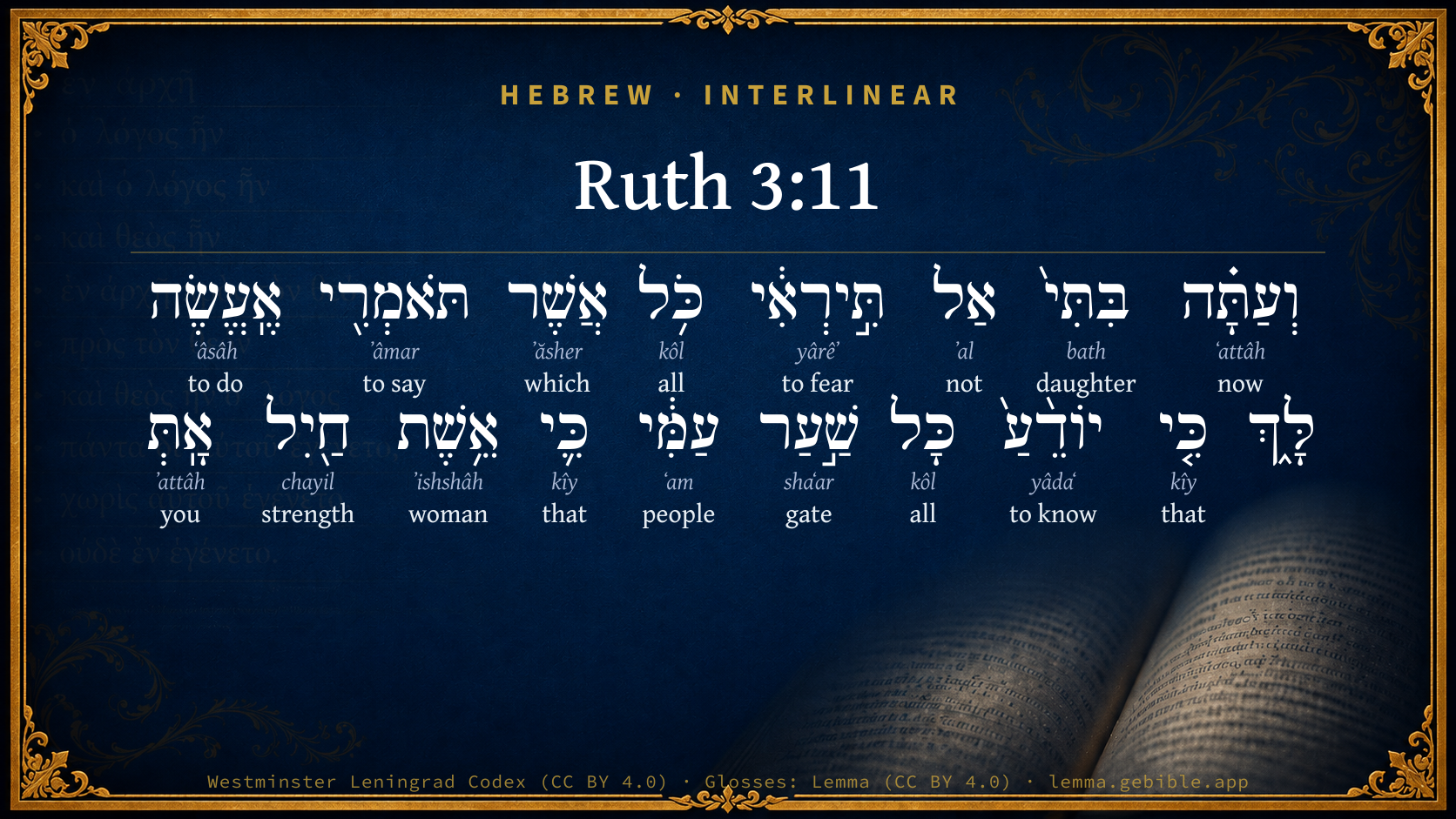
Hebrew (Westminster Leningrad Codex) Ruth 3:11 appears in the Hebrew Old Testament. The text above is from the Westminster Leningrad Codex. Each word links to its Strong’s number, a concise gloss, and parsing drawn from the Open Scriptures Hebrew Bible morphology. Click any word for its full Brown-Driver-Briggs (BDB) entry.
Download image
Cite this verse

Ruth 3:11 (World English Bible). Public Domain. Lemma interlinear Bible study tool, https://lemma.gebible.app/v/ruth/3/11.

Show BibTeX & RIS
BibTeX
RIS
English Translation
Now, my daughter, don't be afraid; I will do to you all that you say; for all the city of my people does know that you are a worthy woman.
World English Bible · Public Domain
Download a study sheet

One document with this verse’s original text, its word-by-word gloss line, the meaning frame, cross-references with their text, attributed commentary, and full source and license credits — printable, and it pastes into notes with its structure intact.

This verse Autodidact and up

Study sheet (.html) Plain text (.txt)

A passage Seminary Student

Up to 50 verses in one chapter. A passage sheet keeps up to 6 commentary sources and 12 cross-references per verse, in the order this page ranks them, and says so on the sheet whenever that leaves anything out. Ask for a single verse and you get the Autodidact verse sheet above.

Everything on this page stays free to read, with no account — the sheet is a download of what is already on screen, not access to it.

Want to remove ads? Support Godless Engineer
Compare translations 3

The same verse in 3 English versions, stacked beneath the original-language interlinear above. Click any original word for its lexicon entry.

Each is an independent rendering of the whole verse — the interlinear is not word-aligned to these translations.

Highlighted words mark where these versions differ — a whole-verse word diff, not a word-by-word alignment.

  • World English Bible Public Domain
    Now, my daughter, don't be afraid; I will do to you all that you say; for all the city of my people does know that you are a worthy woman.
  • King James Version Public Domain
    And now, my daughter, fear not; I will do to thee all that thou requirest: for all the city of my people doth know that thou art a virtuous woman.
  • unfoldingWord Literal Text CC BY-SA 4.0
    So now, my daughter, do not be afraid! Everything that you say, I will do for you; for the whole gate of my people knows that you are a woman of worth.

unfoldingWord Literal Text — © unfoldingWord, licensed CC BY-SA 4.0. Word-aligned USFM3 via Door43 (git.door43.org/unfoldingWord/en_ult).

Versions to compare (up to 4)

3 of 4 selected

Show all 18 translations

Every available English version of this verse, each an independent rendering of the whole verse.

  • World English Bible Public Domain
    Now, my daughter, don't be afraid; I will do to you all that you say; for all the city of my people does know that you are a worthy woman.
  • Berean Standard Bible Public Domain
    And now do not be afraid, my daughter. I will do for you whatever you request, since all my fellow townspeople know that you are a woman of noble character.
  • Majority Standard Bible Public Domain
    And now do not be afraid, my daughter. I will do for you whatever you request, since all my fellow townspeople know that you are a woman of noble character.
  • King James Version Public Domain
    And now, my daughter, fear not; I will do to thee all that thou requirest: for all the city of my people doth know that thou art a virtuous woman.
  • American Standard Version (1901) Public Domain
    And now, my daughter, fear not; I will do to thee all that thou sayest; for all the city of my people doth know that thou art a worthy woman.
  • Revised Version (1885) Public Domain
    And now, my daughter, fear not; I will do to thee all that thou sayest: for all the city of my people doth know that thou art a virtuous woman.
  • Geneva Bible (1599) Public Domain
    And now, my daughter, feare not: I will doe to thee all that thou requirest: for all the citie of my people doeth knowe, that thou art a vertuous woman.
  • Douay-Rheims (1899) Public Domain
    Fear not therefore, but whatsoever thou shalt say to me I will do to thee. For all the people that dwell within the gates of my city, know that thou art a virtuous woman.
  • Young's Literal Translation Public Domain
    And now, my daughter, fear not, all that thou sayest I do to thee, for all the gate of my people doth know that thou `art' a virtuous woman.
  • Literal Standard Version CC BY-SA 4.0
    And now, my daughter, do not fear, all that you say I do to you, for all the gate of my people knows that you [are] a virtuous woman.
  • Unlocked Literal Bible CC BY-SA 4.0
    Now, my daughter, do not be afraid! I will do for you all that you say, because all the city of my people knows that you are a worthy woman.
  • unfoldingWord Literal Text CC BY-SA 4.0
    So now, my daughter, do not be afraid! Everything that you say, I will do for you; for the whole gate of my people knows that you are a woman of worth.
  • Darby Bible Public Domain
    And now, my daughter, fear not: all that thou sayest will I do to thee; for all the gate of my people knows that thou art a woman of worth.
  • World Messianic Bible Public Domain
    Now, my daughter, don’t be afraid. I will do to you all that you say; for all the city of my people knows that you are a worthy woman.
  • Webster's Bible Public Domain
    And now, my daughter, fear not; I will do to thee all that thou requirest: for all the city of my people doth know that thou art a virtuous woman.
  • Free Bible Version CC BY-SA 4.0
    So don't worry, my daughter. I will do everything you ask—everyone in town knows you are a woman of good character.
  • Bible in Basic English Public Domain
    And now, my daughter, have no fear; I will do for you whatever you say: for it is clear to all my townspeople that you are a woman of virtue.
  • JPS Tanakh (1917) Public Domain
    And now, my daughter, fear not; I will do to thee all that thou sayest; for all the men in the gate of my people do know that thou art a virtuous woman.

Literal Standard Version (2020), Covenant Press — licensed CC BY-SA 4.0. Text via the HelloAO Bible API (eBible.org). Unlocked Literal Bible (unfoldingWord) — licensed CC BY-SA 4.0. Text via the HelloAO Bible API (eBible.org). unfoldingWord Literal Text — © unfoldingWord, licensed CC BY-SA 4.0. Word-aligned USFM3 via Door43 (git.door43.org/unfoldingWord/en_ult). Free Bible Version, Dr. Jonathan Gallagher — licensed CC BY-SA 4.0. Text via the HelloAO Bible API (eBible.org).

Word by word

More ways to search: Search by grammar → Find every occurrence → Compare this word →

Practice this passage: Drill this verse → Learn its vocabulary →

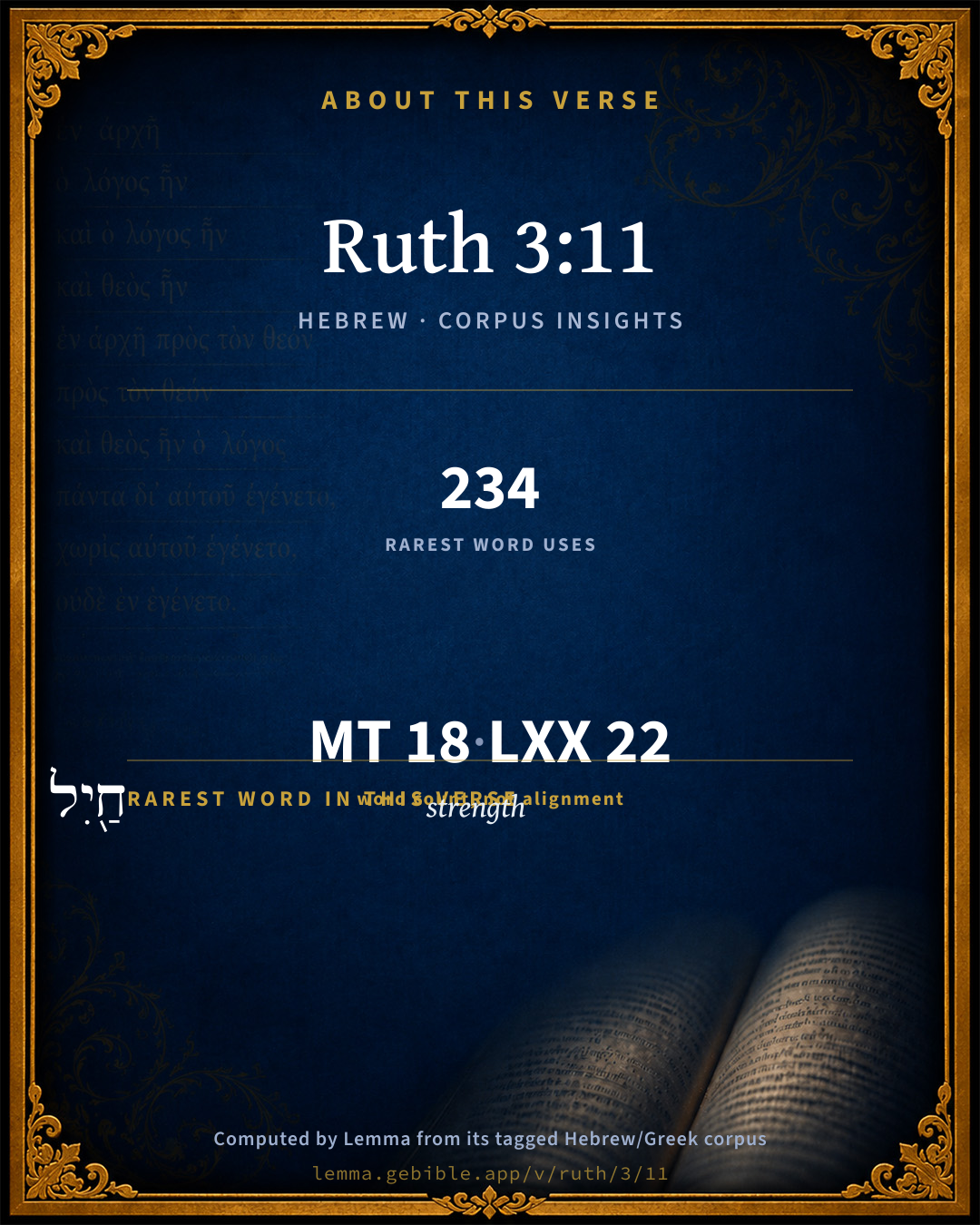
חַ֖יִל
chayil
H2428
“strength”
Noun, Common, Masculine, Singular, Absolute
Part of Speech
Noun
Type
Common
Gender
Masculine
Number
Singular
State
Absolute
Full BDB Definition

Origin: from H2342

TWOT: 624a

strength, might, efficiency, wealth, army - strength - ability, efficiency - wealth - force, army
  1. וְעַתָּ֗ה ʻattâh H6258 “and · now” Conjunction + Adverb
  2. בִּתִּי֙ bath H1323 “daughter · my” Noun, Common, Feminine, Singular, Construct + Suffix, Personal, 1st Person, Common, Singular
  3. אַל ʼal H408 “not” Particle, Negative
  4. תִּ֣ירְאִ֔י yârêʼ H3372 “to fear” Verb, Qal, Jussive, 2nd Person, Feminine, Singular
  5. כֹּ֥ל kôl H3605 “all” Noun, Common, Masculine, Singular, Absolute
  6. אֲשֶׁר ʼăsher H834 “which” Particle, Relative
  7. תֹּאמְרִ֖י ʼâmar H559 “to say” Verb, Qal, Imperfect, 2nd Person, Feminine, Singular
  8. אֶֽעֱשֶׂה ʻâsâh H6213 “to do” Verb, Qal, Imperfect, 1st Person, Common, Singular
  9. כִּ֤י kîy H3588 “that” Conjunction
  10. יוֹדֵ֨עַ֙ yâdaʻ H3045 “knowing” Verb, Qal, Participle Active, Masculine, Singular, Absolute
  11. כָּל kôl H3605 “all of” Noun, Common, Masculine, Singular, Construct
  12. שַׁ֣עַר shaʻar H8179 “gate of” Noun, Common, Masculine, Singular, Construct
  13. עַמִּ֔י ʻam H5971 “people · my” Noun, Common, Masculine, Singular, Construct + Suffix, Personal, 1st Person, Common, Singular
  14. כִּ֛י kîy H3588 “that” Conjunction
  15. אֵ֥שֶׁת ʼishshâh H802 “woman of” Noun, Common, Feminine, Singular, Construct
  16. אָֽתְּ ʼattâh H859 “you” Pronoun, Personal, 2nd Person, Feminine, Singular

About this verse

These counts appear in no published source. They are computed here, from the morphology-tagged text and Lemma’s own curated glosses. What Lemma adds →

18
words
15
distinct lemmas
Historical
section

Grammatical profile

  • 4 verbs
  • 7 nouns
  • 1 pronoun
  • 1 preposition
  • 2 conjunctions
  • 1 adverb
  • 2 particles

Verb forms

  • תִּ֣ירְאִ֔י Qal · Jussive
  • תֹּאמְרִ֖י Qal · Imperfect
  • אֶֽעֱשֶׂה Qal · Imperfect
  • יוֹדֵ֨עַ֙ Qal · Participle Active

Repetition

Words recur within this verse — often emphatic in Hebrew:

  • כֹּ֥ל all H3605 ×2
  • כִּ֤י that H3588 ×2

Hebrew & Septuagint length

In English translation the verse runs 30 words from the Hebrew and 29 from the Septuagint (LXX English) — closely comparable.

A rough comparison of the two English renderings, which tokenize alike — not a word-level alignment.

Word counts can differ between the Hebrew and the Greek without any difference in meaning — e.g. the Hebrew direct-object marker אֵת has no separate Greek word, and Greek often adds the article ὁ.

In the original languages it is 18 Hebrew tokens and 22 Greek tokens — but the two are counted differently (Hebrew bundles its prefixes and suffixes into one token; the Greek is in lemma form), so that isn’t a like-for-like length.

Cross-references

3

Topical passages linked to Ruth 3:11 in the Treasury of Scripture Knowledge — connected by theme and wording, ordered by reader-vote popularity; previews shown in the World English Bible.

  • Proverbs 31:29–31 "Many women do noble things, But you excel them all."
  • Proverbs 31:10 Who can find a worthy woman? For her price is far above rubies.
  • Proverbs 12:4 A worthy woman is the crown of her husband, But a disgraceful wife is as rottenness in his bones.

Cross-references courtesy of OpenBible.info (CC BY 4.0).

Hebrew and Greek witnesses Masoretic Hebrew ↔ Greek Septuagint

The same verse in the two great witnesses to the Old Testament, shown verse-for-verse.

These are two independent witnesses, not word-aligned to each other, and the Septuagint is shown in lemma (dictionary) form.

Hebrew Ruth 3:11 Masoretic · Westminster Leningrad Codex

וְעַתָּ֗ה בִּתִּי֙ אַל תִּ֣ירְאִ֔י כֹּ֥ל אֲשֶׁר תֹּאמְרִ֖י אֶֽעֱשֶׂה לָּ֑ךְ כִּ֤י יוֹדֵ֨עַ֙ כָּל שַׁ֣עַר עַמִּ֔י כִּ֛י אֵ֥שֶׁת חַ֖יִל אָֽתְּ

Now, my daughter, don't be afraid; I will do to you all that you say; for all the city of my people does know that you are a worthy woman.

World English Bible · Public Domain

Greek LXX Ruth 3:11 Septuagint · lemma form

καί νῦν θυγάτηρ μή φοβέω πᾶς ὅσος ἐάν εἶπον ποιέω σύ οἶδα γάρ πᾶς φυλή λαός ἐγώ ὅτι γυνή δύναμις εἰμί σύ

And now fear not, my daughter, whatever you shall say I will do to you; for all the tribe of my people knows that you are a virtuous woman.

LXX2012 (modern English Septuagint) · Public Domain

Hebrew: Westminster Leningrad Codex (CC BY 4.0). Greek: Septuagint (public domain); English from LXX2012 (modern English Septuagint) (Public Domain). How the Septuagint differs from the Hebrew →

Commentary

Notes on Ruth 3:11 from classic Christian and Jewish commentators (each source and its license shown beneath its notes). The classic Christian expositions comment on the surrounding passage and are grouped to its opening verse, so a note may address several verses; the Jewish commentaries on the Tanakh (Rashi and others) are per-verse, so they appear only where the commentator wrote on this verse.

Lemma curates 59 commentaries, every one of them public domain or Creative Commons licensed, each selected and text-cleaned for this edition rather than reprinted as found. About our sources →

Trapp's Complete Commentary

John Trapp

Rth 3:11 And now, my daughter, fear not; I will do to thee all that thou requirest: for all the city of my people doth know that thou [art] a virtuous woman.

Ver. 11. And now, my daughter, fear not.] That I will either reproach thee, or reject thee; mine affection is no whit alienated from thee by thy present practice; which though it hath a show of evil, yet I know that it proceedeth not from lightness or lust.

I will do to thee all that thou requirest.] The desires of the righteous shall be satisfied. {Pro 10:24} Let men bring but lawful requests and honest hearts, and they may have anything. Here Boaz betrotheth Ruth conditionally.

For all the city of my people know.] Heb., All the gate. Her works had praised her in the gates: {Pro 31:31} she was eminently and eximiously virtuous.

That thou art a virtuous woman.] Praised by all, and therefore prized by me "above rubies." But now-a-days, Virtus post nummos. In suits both of law and love: money carrieth it.

“ Haud facile invenias multis e millibus unum,

Virtutem precium qui putat esse sui. ”

John Trapp, A Commentary or Exposition upon All the Books of the Old and New Testament (1647–1656) — public domain. Text from a community e-Sword module.

Joseph Benson's Commentary

Rth 3:11-13. And now, my daughter, fear not — No words can more evidently express any thing than this and the following verse do, that Ruth did nothing immodest. Howbeit, there is a kinsman nearer than I — He does not absolutely refuse to grant her petition, but, influenced by a strict regard to the law of Moses, informs her that as there was a person nearer to her than himself, he could not properly take her to wife till that person had been consulted. If he will perform unto thee the kinsman’s part, &c. — Will take thee to wife to raise up seed to his brother. Bishop Hall thus sums up this matter in his Contemplations: — “Boaz, instead of touching her as a wanton, blesseth her as a father, encourages her as a friend, promises her as a kinsman, rewards her as a patron, and sends her away laden with hopes and gifts, no less chaste, but more happy, than she came. O admirable temperance, worthy the progenitor of Him in whose lips and heart there was no guile!”

Joseph Benson's Commentary on the Old and New Testaments (1811–1818) — public domain. Text from a community e-Sword module.

Tyndale Open Study Notes

Tyndale Open Resources

3:11 what is necessary (literally what you are asking): Boaz agreed to act on Ruth’s behalf. Some interpreters understand Boaz’s statement as an unconditional agreement to marry Ruth (see also study note on 4:5); most take it to mean that Boaz would act to provide for Ruth and Naomi by presenting to the nearer kinsman the opportunity to act as family redeemer before taking the opportunity himself (4:1-12). By voluntarily taking on the role of the family redeemer for Ruth and Naomi, Boaz became a forerunner of Jesus.

Tyndale Open Study Notes — © Tyndale Open Resources, licensed CC BY-SA 4.0. Text via the HelloAO Bible API.

Ellicott's Commentary for English Readers

(11) City.—Literally, gate: the constant meeting-place of persons going in and out. (See Gen_19:1; Gen_34:20; Gen_34:24; Deu_16:18; Deu_21:19, &c.)

A Bible Commentary for English Readers, edited by Charles John Ellicott (1878–1897) — public domain. Text from a community e-Sword module.

The Cambridge Bible for Schools and Colleges

gen. ed. J. J. S. Perowne

11. I will do to thee all that thou sayest] Note Rth_3:4 ‘he will tell thee what thou shalt do’; but Ruth herself suggested what Boaz was to tell. The coincidence was guided by Jehovah’s good providence.

all the city, lit. gate] In ancient times the gate was a place of resort for conversation and business and the administration of justice; cf. Rth_4:1; Rth_4:11, Gen_23:10; Gen_34:20, Job_29:7, Pro_31:23.

a virtuous woman] See Rth_2:1 n. and Pro_31:10. There was no unbecoming forwardness in Ruth’s conduct; it is to be judged in accordance with the customs of the time.

The Cambridge Bible for Schools and Colleges (gen. ed. J. J. S. Perowne; Cambridge University Press, 1878–1918) — public domain. Text from a community e-Sword module.

John Gill's Exposition

And now, my daughter, fear not,.... Either of being forced and defiled, to which he had exposed herself by lying down at a man's feet, or of being reproached as an immodest woman for so doing, or of being despised as a poor woman, and of not succeeding in her suit and enterprise:

and I will do to thee all that thou requirest; which could be done according to the law of God, and without injury to another person after mentioned:

for all the city of my people doth know that thou art a virtuous woman; or righteous, as the Targum; a good woman, possessed of grace and virtue, having every agreeable qualification to recommend to the marriage state; and therefore, should they come to the knowledge of the step taken to obtain it, will never reproach thee for it, nor blame me for marrying a person, though poor, of such an excellent character, which, by her conduct and behaviour, was universally established. It is in the original text, "all the gate of my people" (u); meaning either all the people that pass through the gate of the city, that is, all the inhabitants of it, or the whole court of judicature, the elders of the city, that sit in judgment there, as was usual in gates of cities, see Rut 4:1. So the Targum,"it is manifest before all that sit in the gate of the great sanhedrim of my people that thou art a righteous woman''

(u) "tota porta populi mei", Montanus; so Vatablus, Tigurine version.

John Gill's Exposition of the Whole Bible (1746–1763) — public domain (CC PDM 1.0). Text via the HelloAO Bible API.

Haydock's Catholic Bible Commentary

Woman. Virtuous here may denote, "strong, generous," &c., Proverbs xxxi. 10. (Calmet) --- But it includes the assemblage of all virtues. (Haydock).

George Leo Haydock (1774–1849), Haydock's Catholic Family Bible and Commentary, 1859 edition — public domain. Excludes Psalms (Douay-Rheims chapter numbering differs from Protestant) and Deuterocanonical books (Catholic canon only).

Matthew Poole's English Annotations

Fear not; think not that I despise and reject thee, because I do not immediately comply with thy desire.

I will do to thee all that thou requirest, i.e. marry thee, upon the condition here following.

Matthew Poole's English Annotations on the Holy Bible (1683–1685) — public domain. Text from a community e-Sword/MySword module.

Whedon's Commentary on the Bible

Daniel D. Whedon

11. A virtuous woman — Literally, a woman of strength. It corresponds with the common expression, man of valour. Ruth was strong in all that constitutes female excellence and worth. She was not merely virtuous, in the sense of chaste, but she was full of virtues. “Boaz, no doubt, knew her general character, and knew also that in the present instance she acted in accordance with the advice of her mother in law, who had taught her that she not only had a right to claim Boaz for her husband, but that she was precluded by the law of God from forming any other reputable connexion. Boaz also remembered that he was old, and she young and attractive; and, though from the heathen Moabites, yet she preferred to walk in the sober path of honest married life rather than to associate with the young and the gay, by whom, it is intimated, she had been tempted. He was therefore fully justified in ascribing to this very act an honourable and virtuous principle, notwithstanding the apparent violation of modesty and propriety; and in this he judged correctly, for such was the fact.” — Thomson.

Daniel D. Whedon (gen. ed.), Commentary on the Old and New Testaments (1874–1909) — public domain. Text from a community e-Sword module.

The Pulpit Commentary

And now, my daughter, fear not: all that thou sayest I shall do to thee, for it is on all hands known in the gate of my people that thou art a truly capable woman. The word lyij in the expression lyij tvae is of many-sided import, and has no synonym in English, German, Latin, or Greek. But every side of its import brings into view one or other or more of such affiliated ideas as strength, force, forces, capability whether mental and moral only, or also financial; competency, substantiality, ability, bravery. All who had taken notice of Ruth perceived that she was mentally and morally, as well as physically, a substantial and capable woman. She was possessed of force, both of mind and character. She was, in the New England sense, of the expression, a woman of "faculty. She was full of resources, and thus adequate to the position which, as Boaz"s wife, she would be required to fill. There was no levity about her, "no nonsense." She was earnest, industrious, virtuous, strenuous, brave. There was much of the heroine in her character, and thus the expression connects itself with the masculine application of the distinctive and many-sided word, a mighty man of valor." The expression lyij tvae occurs in Pro_12:4, where, in King James"s version, it is, as here and in Pro_31:10, translated "Ca virtuous woman virtuous woman is a crown to her husband." But it is not so much to moral virtue that there is a reference as to that general capacity which consists in large discourse, looking before and after" ("Hamlet," 4:4).

Compare the masculine expression lyijAyvena in Exo_18:21, Exo_18:25, rendered, in King James"s version, "able men," and meaning capable or substantial men, who, however, as we learn from the additional characteristics that are specified, were to be likewise conspicuous for high moral worth. In Pro_31:10 there is the same reference to general capacity, as is evidenced by the graphic representation that follows a representation that by no means exhausts itself in the idea of moral virtue. Ibn Ezra takes the whole soul out of the expression when he interprets it, both here and in Proverbs, as meaning a woman possessed of riches." When Boaz says, "All that thou sayest I will do to thee," he means, "All that thou hast so winsomely and yet so modestly referred to in what thou didst say, I am prepared to do to thee. There was only one obstacle in the way, and that of a somewhat technical description. If that should be honorably surmounted, nothing would be more agreeable to Boaz s heart than to get nearer to Ruth "For," said he, "it is on all hands known in the gate of my people that," etc. Literally the phrase is, "for all the gate of my people know," a strange inverted but picturesque mode of expression. It was not "the gate of the people," but the people of the gate," that knew.

A virtuous woman.

The circumstances of the narrative read strangely to us. But one nation and one age cannot fairly apply its standards to another. Nothing is more certain than that the conduct of Naomi, of Ruth, and of Boaz was perfectly correct, and probably Ruth"s proceeding was wise and justifiable. Upon her character no breath of suspicion rested; she was, in the language of the text, "a virtuous woman.

I RUTH"S VIRTUE WAS MANIFESTED BY HER CIRCUMSPECT CONDUCT WITH REFERENCE TO YOUNG MEN. "Thou followedst not young men, whether rich or poor.

II HER VIRTUE WAS APPARENT IN HER OBEDIENCE TO HER MOTHER-IN-LAW. Instead of taking counsel of her own comparative inexperience, she listened to the advice of the sage and prudent Naomi.

III HER VIRTUE WAS ACKNOWLEDGED BY ALL HER ACQUAINTANCE. "All the city of my people doth know." If there had been anything in the conduct of the poor, friendless young foreigner inconsistent with virtue, it would not have been hid. She escaped calumny.

IV HER VIRTUE LED TO AN HONORABLE MARRIAGE AND POSITION IN ISRAEL. "A virtuous woman is a crown to her husband.

We can believe that Ruth verified the beautiful description given in Pr 31. T.

Above rubies.

"A virtuous woman." Here is the crown of all beauty. What a renown is this of Ruth"s. No jeweled necklet, no Eastern retinue, can give such attraction as this. We may have women of genius, and we admire genius; we may have women of scientific attainment, and God has given no lack of intellectual endowments to women, but we must have virtue. Let the history of later Rome tell us what the loss of this is.

I NO LIFE IS HIDDEN. "All the city of my people doth know that thou art a virtuous woman." Every history stands revealed. Concerning Nehemiah, we read of the testimony given in time of national trouble: There is a man in thy kingdom in whose heart is the fear of the holy God." And so this simple-hearted Ruth, who had not tried to make herself attractive to the young men, poor or rich, who had been modest in manner and heroic in conduct, left the impress of her character on the city.

II NO LIFE CAN BE RELIGIOUS THAT IS NOT VIRTUOUS. We may, indeed, have virtue of a kind, a morality of respectability, without religion; but we cannot be religious without morality, for religion does not consist in ceremonies however impressive, or days however sacred, or opinions however sound; but in a life of consecration to God, and of obedience to all the sanctities of the moral law. There may be a religion of emotionalism merely; but blessed as it is to feel the true, we must live it out as well in common life.

III NO POWER IS SO PERMANENT AS THAT OF HOLY LIFE. Character lives in others. We do not die when we pass from earth. Ruth lives today. It would be interesting to know how many have been led even in this age to devoutness and decision by the remembrance of her conduct and the exquisite pathos of her words. The little "city" of which our text speaks has passed away, but wherever the word of God is known and read, there Ruth reproduces herself in the history of others. The very name has become a family name, and is honored by constant use in every generation. W.M.S.

The Pulpit Commentary (1880–1919), ed. H.D.M. Spence-Jones & Joseph S. Exell — public domain. Text from a community e-Sword module.

Ibn Ezra

Rabbi Abraham ibn Ezra

"אשת חיל (a virtuous woman):" I will explain this in Proverbs.

"מ"ם ואמנם נוסף כמ"ם חנם (The letter 'mem' in 'ואמנם' is added, like the 'mem' in 'חנם')."

Ibn Ezra on the Tanakh — English translations: “Sefaria Community Translation” (CC0 1.0 (public-domain dedication)); “Yalkut, Sifsei Chachomim Chumash, Metsudah Publications, 2009” (CC BY 4.0); and “Commentary of Ibn Ezra on Isaiah - trans. by M. Friedlander, 1873” (public domain). Text via Sefaria.

Lesson kit

Teaching starters — assembled from the data on this page, not authored interpretation. Every prompt links to the verse data it draws on. Edit before teaching.

Ruth, in the Historical, opens this verse with 18 words (15 distinct Hebrew lemmas). Its most distinctive word is chayil (“strength”). A historical commentator’s framing appears above. Read the whole chapter for the surrounding context.

Discussion questions

  1. How does “strength” (chayil) shape what this verse is saying?
  2. Proverbs 31:29–31 shares this passage’s theme. How do the two illuminate each other?
  3. “all” occurs 2× in this one verse. What is the effect of the repetition?
  4. These translations render this verse differently. What is at stake in choosing one wording over another?
  5. The verb «תִּ֣ירְאִ֔י» is Qal Jussive. How does its form color the action?
  6. Reading how Trapp's Complete Commentary and Joseph Benson's Commentary read this verse, where do the two commentators agree and where do they part?

Things to notice

Reading settings

Reading text

Shown beneath each verse's original-language words.

Old Testament
Old Testament edition

Read the OT as the Masoretic Hebrew (MT) or the Greek Septuagint (LXX).

English shown for the Greek Septuagint (in the Hebrew ↔ Greek comparison).

Comparing translations? Open the Compare panel on any verse page to stack up to four side by side.