Leviticus 19:29

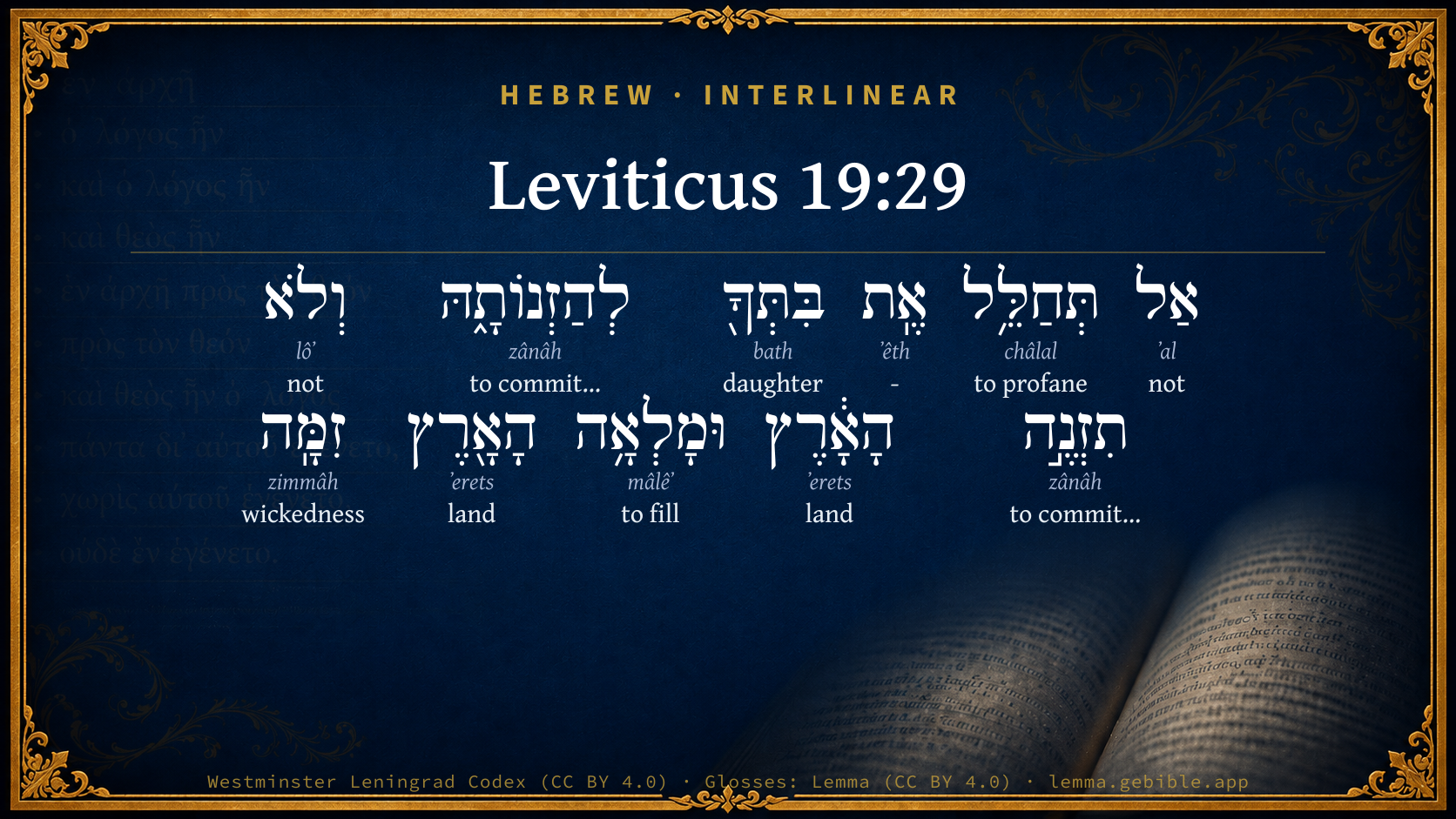
Hebrew (Westminster Leningrad Codex) Leviticus 19:29 appears in the Hebrew Old Testament. The text above is from the Westminster Leningrad Codex. Each word links to its Strong’s number, a concise gloss, and parsing drawn from the Open Scriptures Hebrew Bible morphology. Click any word for its full Brown-Driver-Briggs (BDB) entry.
Download image
Cite this verse

Leviticus 19:29 (World English Bible). Public Domain. Lemma interlinear Bible study tool, https://lemma.gebible.app/v/leviticus/19/29.

Show BibTeX & RIS
BibTeX
RIS
English Translation
Don't profane your daughter, to make her a prostitute; lest the land fall to prostitution, and the land become full of wickedness.
World English Bible · Public Domain
Download a study sheet

One document with this verse’s original text, its word-by-word gloss line, the meaning frame, cross-references with their text, attributed commentary, and full source and license credits — printable, and it pastes into notes with its structure intact.

This verse Autodidact and up

Study sheet (.html) Plain text (.txt)

A passage Seminary Student

Up to 50 verses in one chapter. A passage sheet keeps up to 6 commentary sources and 12 cross-references per verse, in the order this page ranks them, and says so on the sheet whenever that leaves anything out. Ask for a single verse and you get the Autodidact verse sheet above.

Everything on this page stays free to read, with no account — the sheet is a download of what is already on screen, not access to it.

Want to remove ads? Support Godless Engineer
Compare translations 3

The same verse in 3 English versions, stacked beneath the original-language interlinear above. Click any original word for its lexicon entry.

Each is an independent rendering of the whole verse — the interlinear is not word-aligned to these translations.

Highlighted words mark where these versions differ — a whole-verse word diff, not a word-by-word alignment.

  • World English Bible Public Domain
    Don't profane your daughter, to make her a prostitute; lest the land fall to prostitution, and the land become full of wickedness.
  • King James Version Public Domain
    Do not prostitute thy daughter, to cause her to be a whore; lest the land fall to whoredom, and the land become full of wickedness.
  • unfoldingWord Literal Text CC BY-SA 4.0
    You shall not profane your daughter by making her practice prostitution, and the land shall not practice prostitution, or the land will fill depravity.

unfoldingWord Literal Text — © unfoldingWord, licensed CC BY-SA 4.0. Word-aligned USFM3 via Door43 (git.door43.org/unfoldingWord/en_ult).

Versions to compare (up to 4)

3 of 4 selected

Show all 18 translations

Every available English version of this verse, each an independent rendering of the whole verse.

  • World English Bible Public Domain
    Don't profane your daughter, to make her a prostitute; lest the land fall to prostitution, and the land become full of wickedness.
  • Berean Standard Bible Public Domain
    You must not defile your daughter by making her a prostitute, or the land will be prostituted and filled with depravity.
  • Majority Standard Bible Public Domain
    You must not defile your daughter by making her a prostitute, or the land will be prostituted and filled with depravity.
  • King James Version Public Domain
    Do not prostitute thy daughter, to cause her to be a whore; lest the land fall to whoredom, and the land become full of wickedness.
  • American Standard Version (1901) Public Domain
    Profane not thy daughter, to make her a harlot; lest the land fall to whoredom, and the land become full of wickedness.
  • Revised Version (1885) Public Domain
    Profane not thy daughter, to make her a harlot; lest the land fall to whoredom, and the land become full of wickedness.
  • Geneva Bible (1599) Public Domain
    Thou shalt not make thy daughter common, to cause her to be a whore, least the lande also fall to whoredome, and the lande bee full of wickednesse.
  • Douay-Rheims (1899) Public Domain
    Make not thy daughter a common strumpet, lest the land be defiled, and filled with wickedness.
  • Young's Literal Translation Public Domain
    `Thou dost not pollute thy daughter to cause her to go a-whoring, that the land go not a-whoring, and the land hath been full of wickedness.
  • Literal Standard Version CC BY-SA 4.0
    You do not defile your daughter to cause her to go whoring, that the land does not go whoring, and the land has been full of wickedness.
  • Unlocked Literal Bible CC BY-SA 4.0
    Do not disgrace your daughter by making her a prostitute, or the nation will fall to prostitution and the land will become full of wickedness.
  • unfoldingWord Literal Text CC BY-SA 4.0
    You shall not profane your daughter by making her practice prostitution, and the land shall not practice prostitution, or the land will fill depravity.
  • Darby Bible Public Domain
    -- Do not profane thy daughter, to give her up to whoredom; lest the land practise whoredom, and the land become full of infamy.
  • World Messianic Bible Public Domain
    “‘Don’t profane your daughter, to make her a prostitute; lest the land fall to prostitution, and the land become full of wickedness.
  • Webster's Bible Public Domain
    Do not prostitute thy daughter to cause her to be a harlot: lest the land should fall to lewdness, and the land become full of wickedness.
  • Free Bible Version CC BY-SA 4.0
    Don't bring shame on your daughter by making her a prostitute, otherwise the land will become morally and spiritually depraved.
  • Bible in Basic English Public Domain
    Do not make your daughter common by letting her become a loose woman, for fear that the land may become full of shame.
  • JPS Tanakh (1917) Public Domain
    Profane not thy daughter, to make her a harlot, lest the land fall into harlotry, and the land become full of lewdness.

Literal Standard Version (2020), Covenant Press — licensed CC BY-SA 4.0. Text via the HelloAO Bible API (eBible.org). Unlocked Literal Bible (unfoldingWord) — licensed CC BY-SA 4.0. Text via the HelloAO Bible API (eBible.org). unfoldingWord Literal Text — © unfoldingWord, licensed CC BY-SA 4.0. Word-aligned USFM3 via Door43 (git.door43.org/unfoldingWord/en_ult). Free Bible Version, Dr. Jonathan Gallagher — licensed CC BY-SA 4.0. Text via the HelloAO Bible API (eBible.org).

Word by word

More ways to search: Search by grammar → Find every occurrence → Compare this word →

Practice this passage: Drill this verse → Learn its vocabulary →

זִמָּֽה
zimmâh
H2154
“wickedness”
Noun, Common, Feminine, Singular, Absolute
Part of Speech
Noun
Type
Common
Gender
Feminine
Number
Singular
State
Absolute
Full BDB Definition

Origin: from H2161

TWOT: 556b

plan, device, wickedness, evil plan, mischievous purpose - plan, purpose - evil device, wickedness - not chaste, incest, licentiousness, adultery, idolatry, harlotry
  1. אַל ʼal H408 “not” Particle, Negative
  2. תְּחַלֵּ֥ל châlal H2490 “to profane” Verb, Piel, Jussive, 2nd Person, Masculine, Singular
  3. אֶֽת ʼêth H853 “-” Particle, Direct Object
  4. בִּתְּךָ֖ bath H1323 “daughter · your” Noun, Common, Feminine, Singular, Construct + Suffix, Personal, 2nd Person, Masculine, Singular
  5. לְהַזְנוֹתָ֑הּ zânâh H2181 “to commit fornication · her” Preposition + Verb, Hiphil, Infinitive Construct + Suffix, Personal, 3rd Person, Feminine, Singular
  6. וְלֹא lôʼ H3808 “and · not” Conjunction + Particle, Negative
  7. תִזְנֶ֣ה zânâh H2181 “to commit fornication” Verb, Qal, Imperfect, 3rd Person, Feminine, Singular
  8. הָאָ֔רֶץ ʼerets H776 “the · land” Particle, Definite Article + Noun, Common, Both, Singular, Absolute
  9. וּמָלְאָ֥ה mâlêʼ H4390 “and · to fill” Conjunction + Verb, Qal, Sequential Perfect, 3rd Person, Feminine, Singular
  10. הָאָ֖רֶץ ʼerets H776 “the · land” Particle, Definite Article + Noun, Common, Both, Singular, Absolute

About this verse

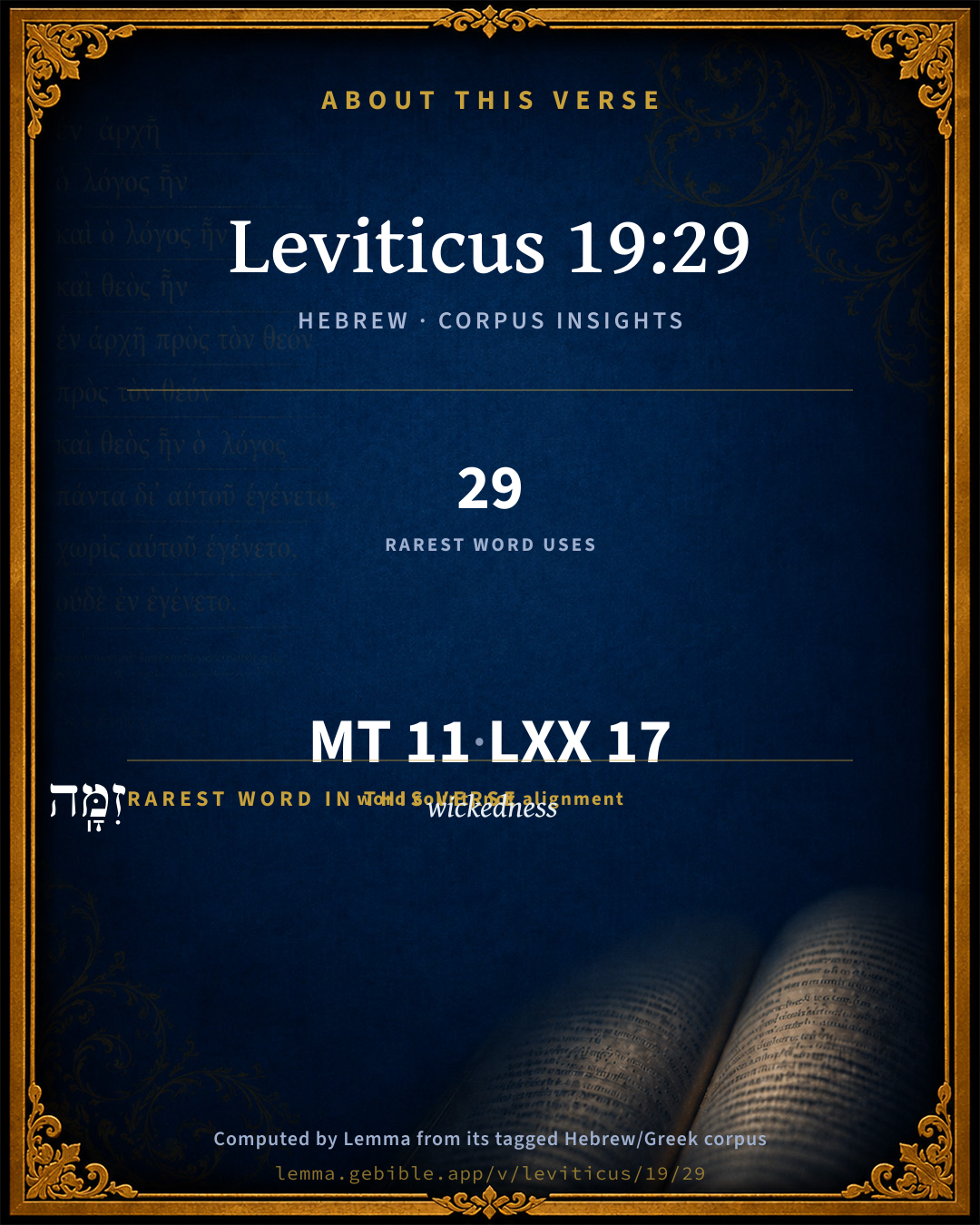
These counts appear in no published source. They are computed here, from the morphology-tagged text and Lemma’s own curated glosses. What Lemma adds →

11
words
9
distinct lemmas
Pentateuch
section

Shared distinctive vocabulary

זִמָּֽה wickedness H2154 occurs in 27 verses of the Hebrew Bible. Also found in:

Grammatical profile

  • 4 verbs
  • 4 nouns
  • 3 particles

Verb forms

  • תְּחַלֵּ֥ל Piel · Jussive
  • לְהַזְנוֹתָ֑הּ Hiphil · Infinitive Construct
  • תִזְנֶ֣ה Qal · Imperfect
  • וּמָלְאָ֥ה Qal · Sequential Perfect

Repetition

Words recur within this verse — often emphatic in Hebrew:

  • לְהַזְנוֹתָ֑הּ to commit fornication H2181 ×2
  • הָאָ֔רֶץ land H776 ×2

Hebrew & Septuagint length

In English translation the verse runs 22 words from the Hebrew and 24 from the Septuagint (LXX English) — closely comparable.

A rough comparison of the two English renderings, which tokenize alike — not a word-level alignment.

Word counts can differ between the Hebrew and the Greek without any difference in meaning — e.g. the Hebrew direct-object marker אֵת has no separate Greek word, and Greek often adds the article ὁ.

In the original languages it is 11 Hebrew tokens and 17 Greek tokens — but the two are counted differently (Hebrew bundles its prefixes and suffixes into one token; the Greek is in lemma form), so that isn’t a like-for-like length.

Cross-references

4

Topical passages linked to Leviticus 19:29 in the Treasury of Scripture Knowledge — connected by theme and wording, ordered by reader-vote popularity; previews shown in the World English Bible.

  • Deuteronomy 23:17–18 There shall be no prostitute of the daughters of Israel, neither shall there be a sodomite of the sons of Israel.
  • 1 Corinthians 6:15 Don't you know that your bodies are members of Christ? Shall I then take the members of Christ, and make them members of a prostitute? May it never be!
  • Leviticus 21:7 "'They shall not marry a woman who is a prostitute, or profane; neither shall they marry a woman divorced from her husband: for he is holy to his God.
  • Hosea 4:12–14 My people consult with their wooded idol, And answer to a stick of wood. Indeed the spirit of prostitution has led them astray, And they have been unfaithful to their God.

Cross-references courtesy of OpenBible.info (CC BY 4.0).

Hebrew and Greek witnesses Masoretic Hebrew ↔ Greek Septuagint

The same verse in the two great witnesses to the Old Testament, shown verse-for-verse.

These are two independent witnesses, not word-aligned to each other, and the Septuagint is shown in lemma (dictionary) form.

Hebrew Leviticus 19:29 Masoretic · Westminster Leningrad Codex

אַל תְּחַלֵּ֥ל אֶֽת בִּתְּךָ֖ לְהַזְנוֹתָ֑הּ וְלֹא תִזְנֶ֣ה הָאָ֔רֶץ וּמָלְאָ֥ה הָאָ֖רֶץ זִמָּֽה

Don't profane your daughter, to make her a prostitute; lest the land fall to prostitution, and the land become full of wickedness.

World English Bible · Public Domain

Greek LXX Leviticus 19:29 Septuagint · lemma form

οὐ βεβηλόω ὁ θυγάτηρ σύ ἐκπορνεύω αὐτός καί οὐ ἐκπορνεύω ὁ γῆ καί ὁ γῆ πίμπλημι ἀνομία

You shall not profane your daughter to prostitute her; so the land shall not go a whoring, and the land be filled with iniquity.

LXX2012 (modern English Septuagint) · Public Domain

Hebrew: Westminster Leningrad Codex (CC BY 4.0). Greek: Septuagint (public domain); English from LXX2012 (modern English Septuagint) (Public Domain). How the Septuagint differs from the Hebrew →

Targum (Aramaic paraphrase)

2

The Targum is the ancient Jewish Aramaic paraphrase of the Hebrew Scriptures — an interpretive translation, not the Hebrew text itself. Onkelos (literal) and Pseudo-Jonathan (expansive) render the Torah, and Jonathan the Prophets. Coverage is partial: where no permissively-licensed English translation exists for a verse, only the Aramaic is shown. This is verse-level text, not a word-by-word alignment to the Hebrew.

  1. Targum Onkelos Torah (Genesis–Deuteronomy)
    לָא תַחֵל יָת בְּרַתָּךְ לְאַטְעֲיוּתַהּ וְלָא תִטְעֵי אַרְעָא וְתִתְמְלֵי אַרְעָא עֵצַת חִטְאִין

    (no public-domain English translation for this verse)

    Targum Onkelos — Aramaic: “Onkelos Genesis” (public domain); “Onkelos Exodus” (public domain); “Onkelos Leviticus” (public domain); “Onkelos Numbers” (public domain); “Onkelos Deuteronomy” (public domain). English: “Sefaria Community Translation” (CC0 1.0 (public-domain dedication)); “J.W. Etheridge. The Targums of Onkelos and Jonathan Ben Uzziel on the Pentateuch. London: Longmans, Green, 1862” (public domain). Text via Sefaria.

  2. Targum Pseudo-Jonathan Torah (Genesis–Deuteronomy)
    לָא תִפְסוּן יַת בְּנָתֵיכוֹן לְמִסְבָא יַתְהוֹן לִזְנוּ וְלָא תִשְׁהוּן לְמִסְבָא בְּנָתֵיכוֹן לְגוּבְרִין סְמוּךְ לְפִירְקֵיהוֹן דְלָא יְטַעֲוַון בִּזְנוּ בָּתַר עַמְמֵי אַרְעָא וְתִיתְמְלֵי אַרְעָא זְנוּ

    You shall not profane your daughters to give them up to fornication: neither delay to give your daughters unto a husband in their proper ages, lest they go astray by fornication after the people of the land, and the land be filled with whoredom.

    Targum Pseudo-Jonathan — Aramaic: “Targum Jonathan on Genesis” (public domain); “Targum Jonathan on Exodus” (public domain); “Targum Jonathan on Leviticus” (public domain); “Targum Jonathan on Numbers” (public domain); “Targum Jonathan on Deuteronomy” (public domain). English: “The Targum of Jonathan ben Uzziel, trans. J. W. Etheridge, London, 1862” (public domain). Text via Sefaria.

Commentary

Notes on Leviticus 19:29 from classic Christian and Jewish commentators (each source and its license shown beneath its notes). The classic Christian expositions comment on the surrounding passage and are grouped to its opening verse, so a note may address several verses; the Jewish commentaries on the Tanakh (Rashi and others) are per-verse, so they appear only where the commentator wrote on this verse.

Lemma curates 59 commentaries, every one of them public domain or Creative Commons licensed, each selected and text-cleaned for this edition rather than reprinted as found. About our sources →

Trapp's Complete Commentary

John Trapp

Lev 19:29 Do not prostitute thy daughter, to cause her to be a whore; lest the land fall to whoredom, and the land become full of wickedness.

Ver. 29. Do not prostitute thy daughter.] As some of the heathens did in honour of their gods. As the papists do at this day, in their stews and brothel houses. {a} Their casuists complain of some harlots there so boldly lascivious, as to solicit others, so as to prostitute themselves to all comers; yea, in some Spanish stews to an unnatural filthiness. But what a shameful thing is that which Espencaeus, a Papist, reports with detestation, that in Rome a Jewish maid might not be admitted into the stews of whoredom, unless she would be first baptized. Dici nequit, saith he, {b} quam incredibili Christianorum tum pudore, tum etiam eorum, qui vere tales sunt, cordollo, ut Iudae filiae scortari non liceat, Dei filiae liceat: What a shameful and sad thing is this, that a Jewess, unless she turn Christian, &c.

{a} Martin. Vival., in Candelabro, Cap. de Confessione.

{b} Espenc., De Continent., lib. iii. cap. 4.

John Trapp, A Commentary or Exposition upon All the Books of the Old and New Testament (1647–1656) — public domain. Text from a community e-Sword module.

Joseph Benson's Commentary

Lev 19:29. Do not prostitute — As the Gentiles frequently did for the honour of some of their idols, to whom women were consecrated, and publicly prostituted.

Joseph Benson's Commentary on the Old and New Testaments (1811–1818) — public domain. Text from a community e-Sword module.

Tyndale Open Study Notes

Tyndale Open Resources

19:29 Cp. 21:9; Deut 23:17.

Tyndale Open Study Notes — © Tyndale Open Resources, licensed CC BY-SA 4.0. Text via the HelloAO Bible API.

Geneva Bible (1599)

Geneva Bible translators

As did the Cyprians, and Locrians.

Geneva Bible (1599) marginal notes — public domain. Text via Bolls.life.

Adam Clarke's Commentary

Verse 29. Do not prostitute thy daughter] This was a very frequent custom, and with examples of it writers of antiquity abound. The Cyprian women, according to Justin, gained that portion which their husbands received with them at marriage by previous public prostitution. And the Phoenicians, according to Augustine, made a gift to Venus of the gain acquired by the public prostitution of their daughters, previously to their marriage. "Veneri donum dabant, et prostitutiones filiarum, antequam jungerent eas viris." - De Civit. Del, lib. xviii., c. 5; and see Calmet.

Adam Clarke's Commentary on the Bible (1810–1826) — public domain. Text from a community e-Sword/MySword module.

Ellicott's Commentary for English Readers

(29) Do not prostitute thy daughter.—This refers to the degrading worship of Astarte which prevailed in ancient times, and which at times also broke out among the Jews.

A Bible Commentary for English Readers, edited by Charles John Ellicott (1878–1897) — public domain. Text from a community e-Sword module.

The Cambridge Bible for Schools and Colleges

gen. ed. J. J. S. Perowne

29. For ‘the land’ in the sense of its inhabitants, cp. Lev_18:25; Jdg_18:30; Hos_1:2.

The Cambridge Bible for Schools and Colleges (gen. ed. J. J. S. Perowne; Cambridge University Press, 1878–1918) — public domain. Text from a community e-Sword module.

John Gill's Exposition

Do not prostitute thy daughter, to cause her to be a whore,.... Not by delaying to marry her, which is the sense the Jews give (l), but it refers to a wicked practice among the Phoenicians or Canaanites, Athanasius (m) speaks of, whose women used to prostitute themselves in the temples of their idols; and to such filthy services, in a religious way, the Israelites, in imitation of them, are forbid to expose their daughters: such filthy practices, under a notion of religion, were committed at Babylon, Corinth, and other places; See Gill on Mic 1:7,

lest the land fall to whoredom, and the land become full of wickedness: of the wickedness of whoredom, both corporeal and spiritual, fornication and idolatry; both of which would be promoted by such abominable practices, and in process of time the land be filled with them.

(l) Targ. Jon. in loc. T. Bab. Sanhedrin, fol. 76. 1. (m) Contra Gentes, p. 21.

John Gill's Exposition of the Whole Bible (1746–1763) — public domain (CC PDM 1.0). Text via the HelloAO Bible API.

Haydock's Catholic Bible Commentary

CHAPTER XIX.

Strumpet, which was done formerly in the honour of idols. "They gave to Venus the prostitution of their daughters." (St. Augustine, City of God xviii. 5.) "In Cyprus they lead the unmarried women to the sea-shore, in order to acquire a dowry by these means on certain stated days, as a libation to Venus." (Justin.) --- Such things were common in the East. See Lucian de dea Syr.; Strabo xvi.) -- Joel (iii. 3,) reproaches the Jews with prostituting their sons and daughters for bread; for there were also effeminate men among them. (3 Kings xiv. 24.; 4 Kings xxiii. 7.) See Baruch vi. 42.; Osee iv. 14. (Calmet)

George Leo Haydock (1774–1849), Haydock's Catholic Family Bible and Commentary, 1859 edition — public domain. Excludes Psalms (Douay-Rheims chapter numbering differs from Protestant) and Deuterocanonical books (Catholic canon only).

Matthew Poole's English Annotations

This the Gentiles frequently did for the honour of some of their idols, to whom divers women were consecrated, and publicly prostituted.

Matthew Poole's English Annotations on the Holy Bible (1683–1685) — public domain. Text from a community e-Sword/MySword module.

Whedon's Commentary on the Bible

Daniel D. Whedon

29. Do not prostitute — The cursed thirst for gold was the motive which incited fathers to an act so unnatural. This prohibition aims at the practice which prevailed in Phenicia, Babylonia, and Syria, nations soon to be neighbours to Israel.

Full of wickedness — Licentiousness is a sin which so corrupts the moral nature that it arouses all the evil passions and breeds all crimes. Herodias was led by evil desire to plot the beheading of John.

Daniel D. Whedon (gen. ed.), Commentary on the Old and New Testaments (1874–1909) — public domain. Text from a community e-Sword module.

The Pulpit Commentary

Do not prostitute thy daughter. This is a peremptory prohibition, applying to every Jewish maiden, introduced in this place with a primary relation to the sanctification of lust by the dedication of young girls at some heathen temples; but by no means confined in its application to such practices. All legal sanction of the sin of prostitution is forbidden, for whatever purpose it may be given; and the certain result of such sanction is indicated in the final words of the verse, lest the land fall to whoredom, and the land become full of wickedness. (cf. Deu_23:17)

Vers. 29-37. The fear of God.

Of this excellent things are spoken by Solomon. It is the "beginning of knowledge," "hatred to evil," "strong confidence," a "fountain of life," "prolongs days," and "gives riches and honour." So here

I IT IS A SOURCE OF PURITY.

1. To the family.

(1) There is a connection between verses 29 and 30. Those who keep God"s sabbaths will not profane their daughters either to idolatry or for gain. The fear of God nourished by the one will prevent the other.

(2) In keeping God"s sabbaths his sanctuary is reverenced. This furnishes an additional motive to social purity. For the sanctuary, whether it be composed of canvas, or of stone, or of flesh and blood, is the temple of the Holy Ghost. Who then can properly reverence it under one form and desecrate it under another? (see 1Co_3:16, 17 6:18, 19 2Co_6:16)

2. To the nation. "Lest the land," etc. (verse 29).

(1) The family is the root of the nation. All nations extant are sprung from the family of Noah.

(2) Nations are blessed or cursed in their families.

(3) God asserts himself here, "I am Jehovah" (verse 30). The character of God is seen in his laws. It is pledged to maintain them.

II IT ARMS AGAINST THE POWER OF DEVILS.

1. Familiar spirits are more than myths.

(1) Their existence is not here challenged, but admitted (verse 31; see also Act_16:16, where the fact is put beyond question).

(2) Pretenders to the unenviable distinction, as well as persons actually possessed of such devils, are here held up to reprobation.

2. The fear of the Lord will preserve us from them.

(1) Their power is greatest over the "children of disobedience." The desperately wicked are given over by God to Satan. (Eph_2:2 1Ti_1:20) Such persons may seek wizards, or wise ones.

(2) But godly persons will avoid them. They could not so reflect upon the wisdom and goodness of God that he should leave anything for our advantage to be communicated by wicked spirits. Spiritualism is a devilish delusion. Pride and selfishness will lead men into the snare.

(3) In this prohibition God asserts himself, "I am Jehovah thy Elohim." He is our covenant Friend, who will so fully satisfy our lawful desires that we shall not need recourse to wicked expedients. He will also be our defense against the devices of the devil.

III IT INSPIRES COURTESY.

1. Respect for age (verse 32).

(1) With age there should be the wisdom of experience, and this should be honoured by youth. Caryl well says, "He that wears the silver crown, should be honoured in his capacity as well as he that wears the golden crown.

(2) In respecting age we are to "fear Jehovah Elohim," our covenant God, whose blessings are from father to son and from generation to generation. (Gen_17:7 Isa_51:8 Luk_1:50) In the aged mart we should see the representative of the "Ancient of days". (Dan_7:22)

(3) It is a sad sign of the degeneracy of a nation when the child behaves himself proudly against the ancient. (Job_30:1, 12 Isa_3:4, Isa_3:5)

2. Civility to strangers.

(1) "Thou shalt not vex," or oppress, "him;" but treat him as though he were a native. "Thou shalt love him as thyself." How tradition obscured this law when the question was prompted, viz. "Who is my neighbour?

(2) The Hebrew is reminded, in connection with this injunction, how bitterly he suffered in the land of Egypt from the operation of the opposite principle. He is also reminded how odious to God was that cruel oppression from which he brought him out, and therefore how, if he would conciliate his favour, he must act from a different principle.

IV IT PROMOTES JUSTICE.

1. In judgment.

a. In the administration of law.

b. In arbitration.

2. In dealings.

(1) Measures and weights must be true to the standards. These were kept in the tabernacle, and afterwards in the temple. (Lev_27:25 1Ch_23:29) Religion and business must not be divorced.

(2) To use false balances, or weights, or measures is worse than open robbery. It is abominable hypocrisy. It is robbing under the very colour of equity.

God claims the authorship of these laws (verses 36, 37).

1. They are worthy of him. He must be infatuated with ignorance or wickedness who would laud the "Roman virtue" in opposition to the "narrow spirit" of the Mosaic code.

2. They were eminently calculated to secure the happiness of the nation at home, and to promote its credit abroad.

3. Let us "observe" the Law of God to understand it, and, understanding, "keep" it. Then happy shall we be. J.A.M.

The Pulpit Commentary (1880–1919), ed. H.D.M. Spence-Jones & Joseph S. Exell — public domain. Text from a community e-Sword module.

John Wesley's Explanatory Notes

Do not prostitute - As the Gentiles frequently did for the honour of some of their idols, to whom women were consecrated, and publickly prostituted.

John Wesley, Explanatory Notes Upon the Whole Bible (1754–1765) — public domain. Text via the GEBible commentary corpus.

unfoldingWord translationNotes

Door43 World Missions Community

the nation will fall to prostitution and the land will become full of wickedness

Here the words "nation" and "land" represent the people who live there. Many people practicing prostitution and other wicked deeds is spoken of as if the they have fallen into or become full of those things. AT: "the people will begin to practice prostitution and many wicked things" (See: Metonymy and Metaphor)

translationWords

prostitute

nation

evil

Sabbath

honor

sanctuary

tabernacle

unfoldingWord translationNotes — © Distant Shores Media and the Door43 World Missions Community, licensed CC BY-SA 4.0. Source: git.door43.org/Door43/en_tn.

Rashi

Rabbi Shlomo Yitzchaki (Rashi)

אל תחלל את בתך להזנותה DO NOT PROSTITUTE THY DAUGHTER TO CAUSE HER TO BE A HARLOT — Scripture speaks of one who gives his unmarried daughter away for illegitimate concubinage (cf. Sifra, Kedoshim, Chapter 7 2; Sanhedrin 76a).

ולא תזנה הארץ LEST THE EARTH BECOME DISLOYAL TO YOU — If you do this the soil will become faithless to you in regard to the distribution of its fruits, producing them in other places and not in your land. Scripture uses this simile also in (Jeremiah 3:2—3) "and thou hast polluted thy land with thy whoredom… Therefore the showers have been withholden etc.” (so that the land yielded no fruit) (Sifra, Kedoshim, Chapter 7 4; Tosefta Kiddushin 1).

Rashi on the Tanakh — English translations: “The Judaica Press complete Tanach with Rashi, translated by A. J. Rosenberg” (CC BY 4.0); “Pentateuch with Rashi's commentary by M. Rosenbaum and A.M. Silbermann, 1929-1934” (public domain); “The Metsudah Tanach series, Lakewood, N.J” (CC BY 4.0); and “The Book of Joshua, Metsudah Publications, 1997” (CC BY 4.0). Text via Sefaria.

Ramban (Nachmanides)

Rabbi Moshe ben Nachman (Ramban / Nachmanides)

PROFANE NOT THY DAUGHTER, TO MAKE HER A HARLOT. “This refers to one who gives his unmarried daughter [to a man] without the intention of betrothal. LEST THE LAND FALL INTO HARLOTRY. If you do so, the soil too will be unfaithful to you and it will produce its fruits in another place and not in your Land. And so does Scripture state, Therefore the showers have been withheld, and there hath been no latter rain, and thou hadst a harlot’s forehead etc.” This is Rashi’s language. But I have not understood his opinion, for the term “harlotry” in the Torah nowhere applies to an unmarried woman, since it is the accepted decision of the law that if an unmarried man has sexual relations with an unmarried woman, without the intention of thereby making her his wife, he has [nonetheless] not rendered her thereby “a harlot.” And in Tractate Sanhedrin the Sages have clearly stated this principle: “And the daughter of any priest, if she profane herself by becoming a harlot etc. I might think that this applies even if she be unmarried.” Thereupon the Rabbis asked: “[But how could one think this to be the case?] Is it not written by becoming a harlot [and the term ‘harlot’ applies only to a married woman who commits adultery]?” To this question the Rabbis answered, that [the above supposition was] “in accordance with the [unaccepted] opinion of Rabbi Eliezer, who said that if an unmarried man has sexual relations with an unmarried woman, without the intention of thereby making her his wife, he does render her ‘a harlot.’” [From this text it is obvious that the accepted opinion of the Sages is that if she was unmarried, he does not render her “a harlot.”] Similarly the Rabbis have said that the verse They [i.e., the priests] shall not take a woman that is a harlot, or profaned, does not apply to an unmarried woman, but only to a proselytess and a freed bondwoman, or to one who had intercourse with a man in the nature of fornication, such as with a man whose betrothal to her would not be valid, as is explained in Yebamoth and in the Sifra: 1:7. “A woman that is a harlot. Rabbi Yehudah says that this refers to a sterile woman. But the Sages say: The word ‘harlot’ refers only to a proselytess, a freed bondwoman, or to one who had intercourse with a man in the nature of fornication. Rabbi Eliezer says: Even if an unmarried man has sexual relations with an unmarried woman, without the intention of thereby making her his wife, this too [is a case of the ‘harlot’].” Similarly the Rabbis have said with reference to the prohibition, Thou shalt not bring the hire of a harlot … into the House of the Eternal, that this has no application whatever to an unmarried woman. But the Beraitha taught in the Torath Kohanim 7:1. [which is the source for Rashi’s interpretation] and which is also mentioned in Tractate Sanhedrin [namely, that the verse before us refers to one who gives his unmarried daughter for immorality], may either be in accordance with the teaching of Rabbi Eliezer [mentioned above] and is not the final decision of the law, or it may be a case of one who gives his [unmarried] daughter for immorality with a person with whom she can contract no marital status, such as with a Cuthean or a slave, or any of those persons [with whom sexual relations are forbidden] by punishment of excision or death by the hands of the court, which is “harlotry” in the opinion of the Sages. It is this which they intended in saying, “[this verse refers to] one who gives his unmarried daughter to a man without the intention of marriage,” that is to say, to a man with whom it is impossible that there be a marital status.Similarly, that which the Rabbi taught there in the Sifra 7:3. This was mentioned here by Rashi. with reference to the expression lest the Land fall into harlotry, that the fruits of the Land will turn faithless [and grow in other places and not in your Land], is a homiletic exposition derived from the word ha’aretz (the Land), since it is not written “lest the people of the Land fall into harlotry.” But the main intention of this expression is [to establish] a second negative commandment, which the author of the “Hilchoth Gedoloth” has already counted in his enumeration of the [three hundred and sixty-five] negative commandments, it being an admonition directed to the man who commits the immoral act and to the daughter herself, that she should not give herself over to immoral relationships. And it is on the basis of this [interpretation of the verse] that the Rabbis have said there in that Beraitha [in Torath Kohanim]: “And similarly she who gives herself over to immoral relationships [transgresses a negative commandment].” And the meaning of the verse is [as follows]: Since a daughter is in the control of her father, and he is permitted “in her youth” [i.e., when she is not yet twelve and a half years old] to betroth her to a man, and to cause her to enter the bridal-canopy, and one who violates or seduces her must pay the fine to the father [thus accordingly we might think that the father is at liberty to allow a man to have an immoral relationship with his unmarried daughter], therefore Scripture explained that he is not permitted to give her to anyone for immoral purposes, admonishing [first] the father [against doing it] by means of a negative commandment. After having admonished the father, He warned also those engaged in the harlotry, the man and the woman.Now Rashi wrote in the section of Emor El Hakohanim: “A harlot. This is a woman who has had sexual intercourse with a man who is forbidden to her [as a husband], such as those [whom she may not marry] under the penalty of excision, or a Nathin [a descendant of the Gibeonites [literally: givers] derived from the verse in Joshua 9:27 stating that Joshua “gave” the Gibeonites as hewers of wood etc.] or a mamzer” [i.e., a person born from a union which is itself prohibited under the penalty of excision]. Now this comment constitutes an admission on the part of Rashi that the term “harlotry” does not apply where marriage between them would be possible, except that he does include under this term [of “harlotry”] also those that are forbidden by means of a negative commandment [the punishment for which being whipping, such as marriage to a mamzer]. This is also Rashi’s opinion in his commentaries on the Gemara [i.e., that “harlotry” applies to all cases where he is forbidden to her — even if only under the penalty of whipping]. But this too is not correct, for it is only [by means of intercourse with] those whom she may not marry under the penalty of excision, or a Cuthean or a bondman with whom she can contract no marital status, that she is rendered a “harlot” so that a priest who takes her as his wife is liable to whipping because of [marrying] a harlot; but [as a result of intercourse] with those whom she is prohibited [to marry] by means of a [mere] negative commandment — such as a mamzer, or an Ammonite or Moabite proselyte — she is not rendered a “harlot,” and a priest who takes her as his wife is not liable to whipping. However, [as a result of that forbidden relationship], she becomes disqualified from eating the heave-offering and from marrying a priest. etc., if she be a priest’s daughter who ordinarily is permitted to eat of the heave-offering [and the priest’s share the thigh and the breast he receives from an Israelite’s peace-offering] she is now forbidden to eat. Similarly, if she was a priest’s daughter, or a Levites or an Israelite’s, she is henceforth forbidden to marry a priest. For it is written, And if a priest’s daughter be married unto an ‘ish zar’. she shall not eat of that which is set apart from the holy things, [which the Sages interpreted ]: as soon as she has intercourse with a man she may not marry, he disqualifies her [from eating the holy food]. And [if she has intercourse with a man who is] guilty of transgressing a prohibition affecting only the priesthood [for which he is liable to whipping, such as a High Priest who had intercourse with a widow], she becomes a chalalah [a woman of impaired priestly status, and therefore she may not marry even a common priest, who is ordinarily allowed to marry a widow]., p. 150, Note 1.

Ramban (Nachmanides) on the Tanakh — English translation: “Commentary on the Torah by Ramban (Nachmanides). Translated and annotated by Charles B. Chavel. New York, Shilo Pub. House, 1971-1976” (CC BY 4.0). Text via Sefaria.

Lesson kit

Teaching starters — assembled from the data on this page, not authored interpretation. Every prompt links to the verse data it draws on. Edit before teaching.

Leviticus, in the Pentateuch, opens this verse with 11 words (9 distinct Hebrew lemmas). Its most distinctive word is zimmâh (“wickedness”). A historical commentator’s framing appears above. Read the whole chapter for the surrounding context.

Discussion questions

  1. What does “wickedness” (zimmâh) contribute to the verse as a whole?
  2. How does Leviticus 18:17, which shares the word «wickedness», read alongside this verse?
  3. What does the repetition of “to commit fornication” (2× in this one verse) do in this verse?
  4. These translations render this verse differently; the difference is in the English rendering, not the original. What questions does that raise?
  5. «תְּחַלֵּ֥ל» is a Piel Jussive verb. How does that grammatical form shape the action described?
  6. Compare how Trapp's Complete Commentary and Joseph Benson's Commentary read this verse. Where do they agree or differ?

Things to notice

Reading settings

Reading text

Shown beneath each verse's original-language words.

Old Testament
Old Testament edition

Read the OT as the Masoretic Hebrew (MT) or the Greek Septuagint (LXX).

English shown for the Greek Septuagint (in the Hebrew ↔ Greek comparison).

Comparing translations? Open the Compare panel on any verse page to stack up to four side by side.