Numbers 11:15

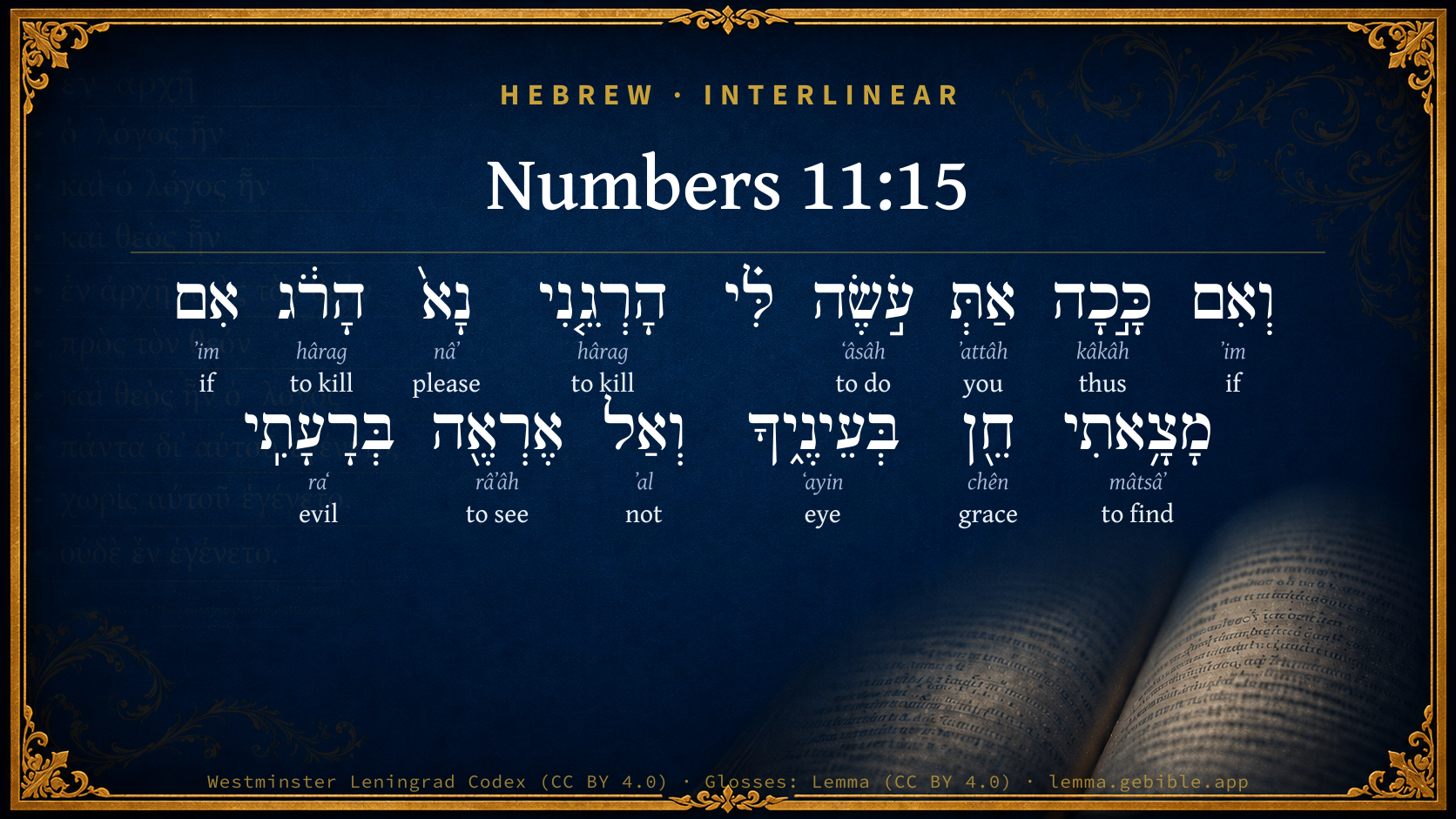
Hebrew (Westminster Leningrad Codex) Numbers 11:15 appears in the Hebrew Old Testament. The text above is from the Westminster Leningrad Codex. Each word links to its Strong’s number, a concise gloss, and parsing drawn from the Open Scriptures Hebrew Bible morphology. Click any word for its full Brown-Driver-Briggs (BDB) entry.
Download image
Cite this verse

Numbers 11:15 (World English Bible). Public Domain. Lemma interlinear Bible study tool, https://lemma.gebible.app/v/numbers/11/15.

Show BibTeX & RIS
BibTeX
RIS
English Translation
If you deal thus with me, please kill me out of hand, if I have found favor in your sight; and let me not see my wretchedness.
World English Bible · Public Domain
Download a study sheet

One document with this verse’s original text, its word-by-word gloss line, the meaning frame, cross-references with their text, attributed commentary, and full source and license credits — printable, and it pastes into notes with its structure intact.

This verse Autodidact and up

Study sheet (.html) Plain text (.txt)

A passage Seminary Student

Up to 50 verses in one chapter. A passage sheet keeps up to 6 commentary sources and 12 cross-references per verse, in the order this page ranks them, and says so on the sheet whenever that leaves anything out. Ask for a single verse and you get the Autodidact verse sheet above.

Everything on this page stays free to read, with no account — the sheet is a download of what is already on screen, not access to it.

Want to remove ads? Support Godless Engineer
Compare translations 3

The same verse in 3 English versions, stacked beneath the original-language interlinear above. Click any original word for its lexicon entry.

Each is an independent rendering of the whole verse — the interlinear is not word-aligned to these translations.

Highlighted words mark where these versions differ — a whole-verse word diff, not a word-by-word alignment.

  • World English Bible Public Domain
    If you deal thus with me, please kill me out of hand, if I have found favor in your sight; and let me not see my wretchedness.
  • King James Version Public Domain
    And if thou deal thus with me, kill me, I pray thee, out of hand, if I have found favor in thy sight; and let me not see my wretchedness.
  • unfoldingWord Literal Text CC BY-SA 4.0
    And if you are doing thus to me, killing, please kill me, if I have found favor in your eyes, and let me not look on my evil.”

unfoldingWord Literal Text — © unfoldingWord, licensed CC BY-SA 4.0. Word-aligned USFM3 via Door43 (git.door43.org/unfoldingWord/en_ult).

Versions to compare (up to 4)

3 of 4 selected

Show all 18 translations

Every available English version of this verse, each an independent rendering of the whole verse.

  • World English Bible Public Domain
    If you deal thus with me, please kill me out of hand, if I have found favor in your sight; and let me not see my wretchedness.
  • Berean Standard Bible Public Domain
    If this is how You are going to treat me, please kill me right now—if I have found favor in Your eyes—and let me not see my own wretchedness.”
  • Majority Standard Bible Public Domain
    If this is how You are going to treat me, please kill me right now—if I have found favor in Your eyes—and let me not see my own wretchedness.”
  • King James Version Public Domain
    And if thou deal thus with me, kill me, I pray thee, out of hand, if I have found favor in thy sight; and let me not see my wretchedness.
  • American Standard Version (1901) Public Domain
    And if thou deal thus with me, kill me, I pray thee, out of hand, if I have found favor in thy sight; and let me not see my wretchedness.
  • Revised Version (1885) Public Domain
    And if thou deal thus with me, kill me, I pray thee, out of hand, if I have found favour in thy sight; and let me not see my wretchedness.
  • Geneva Bible (1599) Public Domain
    Therefore if thou deale thus with mee, I pray thee, if I haue founde fauour in thy sight, kill me, that I behold not my miserie.
  • Douay-Rheims (1899) Public Domain
    But if it seem unto thee otherwise, I beseech thee to kill me, and let me find grace in thy eyes, that I be not afflicted with so great evils.
  • Young's Literal Translation Public Domain
    and if thus Thou art doing to me -- slay me, I pray Thee; slay, if I have found grace in thine eyes, and let me not look on mine affliction.'
  • Literal Standard Version CC BY-SA 4.0
    and if thus You are doing to me—please slay me; slay, if I have found grace in your eyes, and do not let me look on my affliction.”
  • Unlocked Literal Bible CC BY-SA 4.0
    Since you are treating me this way, kill me now—if I find favor in your eyes—do not let me see my misery.”
  • unfoldingWord Literal Text CC BY-SA 4.0
    And if you are doing thus to me, killing, please kill me, if I have found favor in your eyes, and let me not look on my evil.”
  • Darby Bible Public Domain
    And if thou deal thus with me, slay me, I pray thee, if I have found favour in thine eyes, that I may not behold my wretchedness.
  • World Messianic Bible Public Domain
    If you treat me this way, please kill me right now, if I have found favor in your sight; and don’t let me see my wretchedness.”
  • Webster's Bible Public Domain
    And if thou dealest thus with me, kill me, I pray thee, out of hand, if I have found favor in thy sight; and let me not see my wretchedness.
  • Free Bible Version CC BY-SA 4.0
    If this is the way you're going to treat me, then please just kill me now so I don't have to face how depressed I've become. Please grant me this one request.”
  • Bible in Basic English Public Domain
    If this is to be my fate, put me to death now in answer to my prayer, if I have grace in your eyes; and let me not see my shame.
  • JPS Tanakh (1917) Public Domain
    And if Thou deal thus with me, kill me, I pray Thee, out of hand, if I have found favour in Thy sight; and let me not look upon my wretchedness.'

Literal Standard Version (2020), Covenant Press — licensed CC BY-SA 4.0. Text via the HelloAO Bible API (eBible.org). Unlocked Literal Bible (unfoldingWord) — licensed CC BY-SA 4.0. Text via the HelloAO Bible API (eBible.org). unfoldingWord Literal Text — © unfoldingWord, licensed CC BY-SA 4.0. Word-aligned USFM3 via Door43 (git.door43.org/unfoldingWord/en_ult). Free Bible Version, Dr. Jonathan Gallagher — licensed CC BY-SA 4.0. Text via the HelloAO Bible API (eBible.org).

Word by word

More ways to search: Search by grammar → Find every occurrence → Compare this word →

Practice this passage: Drill this verse → Learn its vocabulary →

כָּ֣כָה
kâkâh
  1. וְאִם ʼim H518 “and · if” Conjunction + Conjunction
  2. אַתְּ ʼattâh H859 “you” Pronoun, Personal, 2nd Person, Masculine, Singular
  3. עֹ֣שֶׂה ʻâsâh H6213 “doing” Verb, Qal, Participle Active, Masculine, Singular, Absolute
  4. הָרְגֵ֤נִי hârag H2026 “kill · me” Verb, Qal, Imperative, 2nd Person, Masculine, Singular + Suffix, Personal, 1st Person, Common, Singular
  5. נָא֙ nâʼ H4994 “please” Particle, Exhortation
  6. הָרֹ֔ג hârag H2026 “to kill” Verb, Qal, Infinitive Absolute
  7. אִם ʼim H518 “if” Conjunction
  8. מָצָ֥אתִי mâtsâʼ H4672 “to find” Verb, Qal, Perfect, 1st Person, Common, Singular
  9. חֵ֖ן chên H2580 “grace” Noun, Common, Masculine, Singular, Absolute
  10. בְּעֵינֶ֑יךָ ʻayin H5869 “in/at · eyes · your” Preposition + Noun, Common, Both, Dual, Construct + Suffix, Personal, 2nd Person, Masculine, Singular
  11. וְאַל ʼal H408 “and · not” Conjunction + Particle, Negative
  12. אֶרְאֶ֖ה râʼâh H7200 “to see” Verb, Qal, Infinitive Construct
  13. בְּרָעָתִֽי raʻ H7451 “in/at · evil · my” Preposition + Noun, Common, Feminine, Singular, Construct + Suffix, Personal, 1st Person, Common, Singular

About this verse

These counts appear in no published source. They are computed here, from the morphology-tagged text and Lemma’s own curated glosses. What Lemma adds →

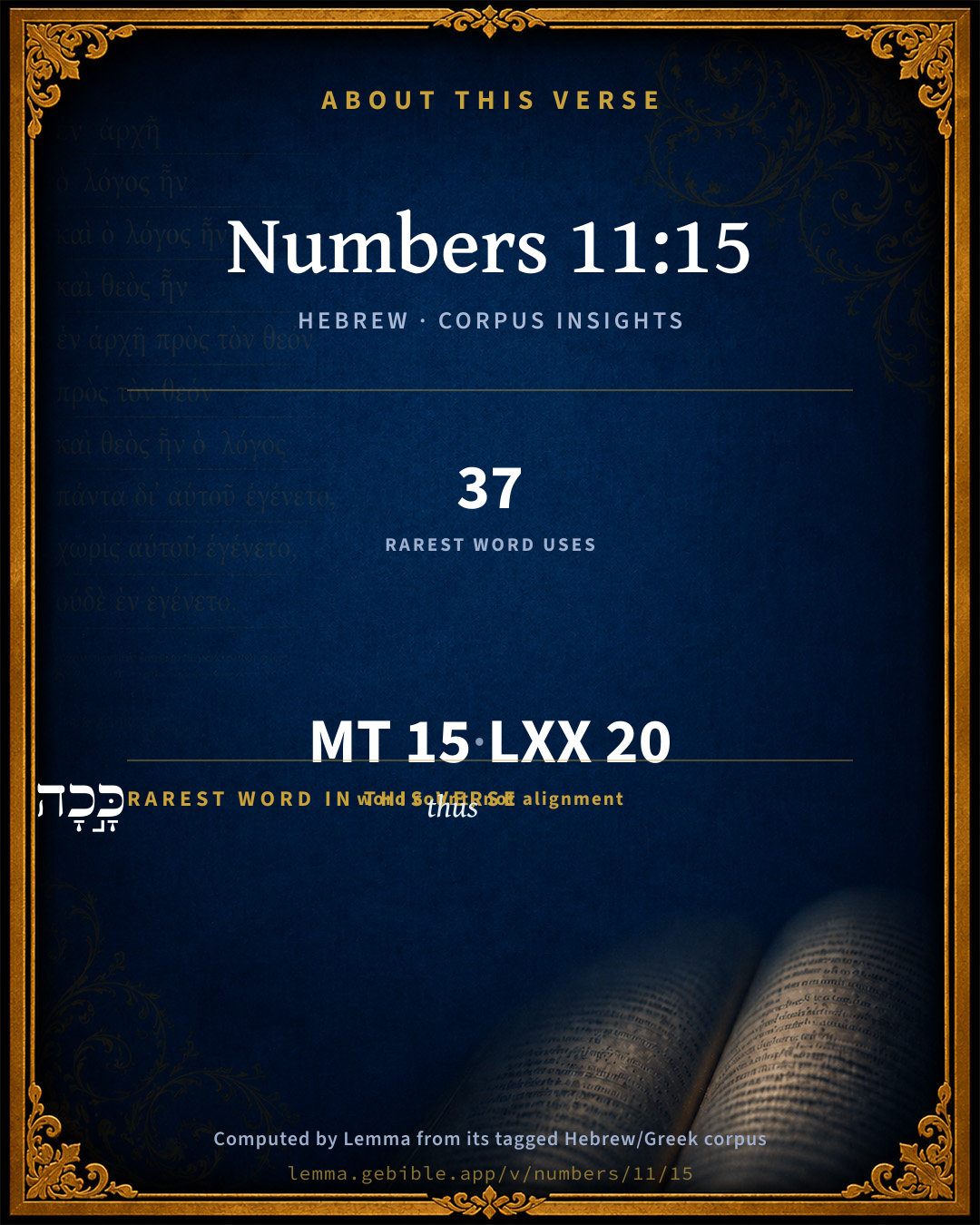
15
words
12
distinct lemmas
Pentateuch
section

Shared distinctive vocabulary

כָּ֣כָה thus H3602 occurs in 35 verses of the Hebrew Bible. Also found in:

Grammatical profile

  • 5 verbs
  • 3 nouns
  • 1 pronoun
  • 1 preposition
  • 2 conjunctions
  • 1 adverb
  • 2 particles

Verb forms

  • עֹ֣שֶׂה Qal · Participle Active
  • הָרְגֵ֤נִי Qal · Imperative
  • הָרֹ֔ג Qal · Infinitive Absolute
  • מָצָ֥אתִי Qal · Perfect
  • אֶרְאֶ֖ה Qal · Infinitive Construct

Repetition

Words recur within this verse — often emphatic in Hebrew:

  • הָרְגֵ֤נִי to kill H2026 ×2
  • וְאִם if H518 ×2

Hebrew & Septuagint length

In English translation the verse runs 27 words from the Hebrew and 24 from the Septuagint (LXX English) — closely comparable.

A rough comparison of the two English renderings, which tokenize alike — not a word-level alignment.

Word counts can differ between the Hebrew and the Greek without any difference in meaning — e.g. the Hebrew direct-object marker אֵת has no separate Greek word, and Greek often adds the article ὁ.

In the original languages it is 15 Hebrew tokens and 20 Greek tokens — but the two are counted differently (Hebrew bundles its prefixes and suffixes into one token; the Greek is in lemma form), so that isn’t a like-for-like length.

Cross-references

12

Topical passages linked to Numbers 11:15 in the Treasury of Scripture Knowledge — connected by theme and wording, ordered by reader-vote popularity; previews shown in the World English Bible.

  • Jonah 4:3 Therefore now, Yahweh, take, I beg you, my life from me; for it is better for me to die than to live."
  • 1 Kings 19:4 But he himself went a day's journey into the wilderness, and came and sat down under a juniper tree: and he requested for himself that he might die, and said, It is enough; now, O Yahweh, take away my life; for I am not better than my fathers.
  • Jeremiah 20:18 Why came I forth out of the womb to see labor and sorrow, that my days should be consumed with shame?
  • Jonah 4:8–9 It happened, when the sun arose, that God prepared a sultry east wind; and the sun beat on Jonah's head, so that he fainted, and requested for himself that he might die, and said, "It is better for me to die than to live."
  • Philippians 1:20–24 according to my earnest expectation and hope, that I will in no way be disappointed, but with all boldness, as always, now also Christ will be magnified in my body, whether by life, or by death.
  • Exodus 32:32 Yet now, if you will, forgive their sin-- and if not, please blot me out of your book which you have written."
  • Zephaniah 3:15 Yahweh has taken away your judgments. He has thrown out your enemy. The King of Israel, Yahweh, is in the midst of you. You will not be afraid of evil any more.
  • Job 3:20–22 "Why is light given to him who is in misery, Life to the bitter in soul,
  • Job 6:8–10 "Oh that I might have my request; That God would grant the thing that I long for!
  • Job 7:15 So that my soul chooses strangling, Death rather than my bones.
  • Jeremiah 15:18 Why is my pain perpetual, and my wound incurable, which refuses to be healed? will you indeed be to me as a deceitful [brook], as waters that fail?
  • James 1:4 Let endurance have its perfect work, that you may be perfect and complete, lacking in nothing.

Cross-references courtesy of OpenBible.info (CC BY 4.0).

Hebrew and Greek witnesses Masoretic Hebrew ↔ Greek Septuagint

The same verse in the two great witnesses to the Old Testament, shown verse-for-verse.

These are two independent witnesses, not word-aligned to each other, and the Septuagint is shown in lemma (dictionary) form.

Hebrew Numbers 11:15 Masoretic · Westminster Leningrad Codex

וְאִם כָּ֣כָה אַתְּ עֹ֣שֶׂה לִּ֗י הָרְגֵ֤נִי נָא֙ הָרֹ֔ג אִם מָצָ֥אתִי חֵ֖ן בְּעֵינֶ֑יךָ וְאַל אֶרְאֶ֖ה בְּרָעָתִֽי

If you deal thus with me, please kill me out of hand, if I have found favor in your sight; and let me not see my wretchedness.

World English Bible · Public Domain

Greek LXX Numbers 11:15 Septuagint · lemma form

εἰ δέ οὕτως σύ ποιέω ἐγώ ἀποκτείνω ἐγώ ἀνααἱρέω εἰ εὑρίσκω ἔλεος παρά σύ ἵνα μή ὁράω ἐγώ ὁ κάκωσις

And if you do thus to me, kill me utterly, if I have found favor with you, that I may not see my affliction.

LXX2012 (modern English Septuagint) · Public Domain

Hebrew: Westminster Leningrad Codex (CC BY 4.0). Greek: Septuagint (public domain); English from LXX2012 (modern English Septuagint) (Public Domain). How the Septuagint differs from the Hebrew →

Targum (Aramaic paraphrase)

2

The Targum is the ancient Jewish Aramaic paraphrase of the Hebrew Scriptures — an interpretive translation, not the Hebrew text itself. Onkelos (literal) and Pseudo-Jonathan (expansive) render the Torah, and Jonathan the Prophets. Coverage is partial: where no permissively-licensed English translation exists for a verse, only the Aramaic is shown. This is verse-level text, not a word-by-word alignment to the Hebrew.

  1. Targum Onkelos Torah (Genesis–Deuteronomy)
    וְאִם כְּדֵין אַתְּ עָבֵד לִי קְטָלְנִי כְעַן קְטוֹל אִם אַשְׁכָּחִית רַחֲמִין קֳדָמָךְ וְלָא אֶחֱזֵי בְּבִישְׁתִּי

    (no public-domain English translation for this verse)

    Targum Onkelos — Aramaic: “Onkelos Genesis” (public domain); “Onkelos Exodus” (public domain); “Onkelos Leviticus” (public domain); “Onkelos Numbers” (public domain); “Onkelos Deuteronomy” (public domain). English: “Sefaria Community Translation” (CC0 1.0 (public-domain dedication)); “J.W. Etheridge. The Targums of Onkelos and Jonathan Ben Uzziel on the Pentateuch. London: Longmans, Green, 1862” (public domain). Text via Sefaria.

  2. Targum Pseudo-Jonathan Torah (Genesis–Deuteronomy)
    וְאִין כִּדְנַן אַנְתְּ עָבִיד לִי דְתִשְׁבּוֹק כָּל טַרְחֵיהוֹן עָלַי קְטוֹלְנִי כְּדוֹן בְּמִיתוּתָא דְנַיְיחִין בָּהּ צַדִיקַיָיא אִין אַשְׁכָּחִית רַחֲמִין קֳדָמָךְ וְלָא אֶחֱמֵי בְּבִישׁוּתִי

    But if Thou do this with me, to leave all the labour of them upon me, let me now die with the death in which the just have repose, if I have found mercy before Thee, that I may not see mine evil.

    Targum Pseudo-Jonathan — Aramaic: “Targum Jonathan on Genesis” (public domain); “Targum Jonathan on Exodus” (public domain); “Targum Jonathan on Leviticus” (public domain); “Targum Jonathan on Numbers” (public domain); “Targum Jonathan on Deuteronomy” (public domain). English: “The Targum of Jonathan ben Uzziel, trans. J. W. Etheridge, London, 1862” (public domain). Text via Sefaria.

Commentary

Notes on Numbers 11:15 from classic Christian and Jewish commentators (each source and its license shown beneath its notes). The classic Christian expositions comment on the surrounding passage and are grouped to its opening verse, so a note may address several verses; the Jewish commentaries on the Tanakh (Rashi and others) are per-verse, so they appear only where the commentator wrote on this verse.

Lemma curates 59 commentaries, every one of them public domain or Creative Commons licensed, each selected and text-cleaned for this edition rather than reprinted as found. About our sources →

Trapp's Complete Commentary

John Trapp

Num 11:15 And if thou deal thus with me, kill me, I pray thee, out of hand, if I have found favour in thy sight; and let me not see my wretchedness.

Ver. 15. And if thou deal thus with me.] Here the word Thou, spoken to God, is of the feminine gender. At, for Atta, - ex magna perturbatione, saith a Rabbin. Moses was so exceedingly moved with anger and grief, these passions did so overcarry him, that he could not complere vocem, utter his whole speech; as he that groaneth or gapeth in the beginning of his sentence cannot make up his breath to speak what he intended.

John Trapp, A Commentary or Exposition upon All the Books of the Old and New Testament (1647–1656) — public domain. Text from a community e-Sword module.

Joseph Benson's Commentary

Num 11:15. If thou deal thus with me, kill me — He begs that God would be pleased either to ease him of the burdensome charge, or take him out of the world, and rid him of a life so troublesome and insupportable. See my wretchedness — Hebrew, my evil, my torment, arising from the difficulty of my office, and work of ruling this people, and from the dread of their utter extirpation, and the dishonour which will thence accrue to thee and religion; as if not only I, but thou also wast a deceiver. He speaks like an affectionate father of a people who makes their sufferings his own. And, indeed, what could make a ruler of such paternal tenderness more distressed than to see the people he was appointed to govern so untoward, not only toward himself, but God? and to see them, by their perverseness, drawing down upon themselves such dire calamities, and the enemies of God rejoicing in their ruin?

Joseph Benson's Commentary on the Old and New Testaments (1811–1818) — public domain. Text from a community e-Sword module.

Geneva Bible (1599)

Geneva Bible translators

I had rather die than to see my grief and misery thus daily increase by their rebellion.

Geneva Bible (1599) marginal notes — public domain. Text via Bolls.life.

Ellicott's Commentary for English Readers

(15) Kill me, I pray thee, out of hand.—Or, Make an utter end of me.

A Bible Commentary for English Readers, edited by Charles John Ellicott (1878–1897) — public domain. Text from a community e-Sword module.

John Gill's Exposition

And if thou deal thus with me,.... Let the whole weight of government lie upon me, and leave the alone to bear it:

kill me, I pray thee, out of hand; take me out of the world at once, or "kill me now, in killing" (n); dispatch me immediately, and make a thorough end of me directly:

if I have found favour in thy sight; if thou hast any love for me, or art willing to show me a kindness, to remove me by death, I shall take as one:

and let me not see my wretchedness; or live to be the unhappy man I shall be; pressed with such a weight of government, affected and afflicted with the wants of a people I cannot relieve, or seeing them bore down with judgments and punishments inflicted on them for their sins and transgressions I am not able to prevail upon them to abstain from: so the Targum of Jerusalem,"that I may not see their evil, who are thy people;''so Abendana, and in the margin of some Hebrew copies, it is read,"this is one of the eighteen words, the correction of the scribes;''who, instead of "my wretchedness" or evil, corrected it, "their wretchedness" or evil; but Aben Ezra says there is no need of this correction.

(n) "occide me nunc occidendo", Drusius; "occide me jam, occide", Junius & Tremellius, Piscator.

John Gill's Exposition of the Whole Bible (1746–1763) — public domain (CC PDM 1.0). Text via the HelloAO Bible API.

Haydock's Catholic Bible Commentary

Evils. Hebrew, "my misfortune." The Rabbins say their, or thy, was formerly written, but corrected by the scribes. (Calmet) --- Moses fears the anger of God falling upon the people. (Haydock) --- It is very wonderful that the Hebrew text here retains the feminine pronoun att, instead of atta; thy, thee; as if Moses were addressing himself to some woman; and this absurd peculiarity is more absurdly accounted for, by saying that Moses was "so exasperated during this his address to the divine Being, as to be incapable of pronouncing both syllables!" The same mistake occurs [in] 1 Kings xxiv. 19. (Kennicott, i. 412.) God does not reprehend Moses as guilty of any disrespect or pusillanimity. (Haydock) --- The holy man prays with due submission to the will of the most High. (Worthington)

George Leo Haydock (1774–1849), Haydock's Catholic Family Bible and Commentary, 1859 edition — public domain. Excludes Psalms (Douay-Rheims chapter numbering differs from Protestant) and Deuterocanonical books (Catholic canon only).

Matthew Poole's English Annotations

Heb. my evil, i.e. my intolerable anguish and torment, arising from the insuperable difficulty of my office and work of ruling this people, and from the dread of their utter extirpation which they will bring upon themselves, and the dishonour which thence will accrue to God and to religion; as if not I only, but God also, were an impostor. Seeing is here put for feeling, as to see death, Psa 89:48; Luk 2:26, is to suffer it; and to see the salvation of God, Psa 50:23; 91:16, is to enjoy it.

Matthew Poole's English Annotations on the Holy Bible (1683–1685) — public domain. Text from a community e-Sword/MySword module.

Whedon's Commentary on the Bible

Daniel D. Whedon

15. Kill me… out of hand — That is, outright, by an instantaneous stroke. The oppressiveness of his official responsibility, and the depth of his despair in this temporary eclipse of faith, are here strikingly portrayed.

My wretchedness — His apprehended future failure and disgrace. Faith alone spans the future with the bow of hope. Unbelief always forebodes evil. Some MSS. read, “their wretchedness.” Thus the Jerusalem Targum, which adds “who are thy people.” Though the spirit of this prayer is reprehensible, no rebuke is administered by the longsuffering Jehovah. He who knoweth our frame saw in the heart of his servant no wilful apostasy.

Daniel D. Whedon (gen. ed.), Commentary on the Old and New Testaments (1874–1909) — public domain. Text from a community e-Sword module.

The Pulpit Commentary

Kill me, I pray thee, out of hand, or "quite." Hebrew, grot, inf. abs. And let me not see my wretchedness. Let me not live to see the total failure of my hopes and efforts.

The Pulpit Commentary (1880–1919), ed. H.D.M. Spence-Jones & Joseph S. Exell — public domain. Text from a community e-Sword module.

John Wesley's Explanatory Notes

My wretchedness - Hebrew. my evil, my torment, arising from the insuperable difficulty of my office and work of ruling this people, and from the dread of their utter extirpation, and the dishonour which thence will accrue to God and to religion, as if, not I only, but God also were an impostor.

John Wesley, Explanatory Notes Upon the Whole Bible (1754–1765) — public domain. Text via the GEBible commentary corpus.

Rashi

Rabbi Shlomo Yitzchaki (Rashi)

ואם ככה את עשה לי AND IF THOU DO THUS WITH ME [KILL ME, I PRAY THEE …] — The Hebrew word for “Thou” appears in the feminine form את instead of the masculine אתה to intimate that Moses’ strength grew weak as that of a woman when the Holy one, blessed be He, showed him the punishment which He was to bring in future upon them for this (for their sin). He, (Moses) therefore, said before Him, “If so, kill me first” (Sifrei Bamidbar 91).

ואל אראה ברעתי AND LET ME NOT SEE MY EVIL — It ought to have written (according to the Midrashic explanation above) “and let me not see their evil”, only that Scripture modified the expression (i.e. it used a euphemistic expression referring the evil to himself instead of to the whole people). This is one of the variations occurring in the Torah such as writers make for the purpose of modifying and improving the phrase (cf. Rashi on Genesis 18:22 and Midrash Tanchuma, Beshalach 16).

Rashi on the Tanakh — English translations: “The Judaica Press complete Tanach with Rashi, translated by A. J. Rosenberg” (CC BY 4.0); “Pentateuch with Rashi's commentary by M. Rosenbaum and A.M. Silbermann, 1929-1934” (public domain); “The Metsudah Tanach series, Lakewood, N.J” (CC BY 4.0); and “The Book of Joshua, Metsudah Publications, 1997” (CC BY 4.0). Text via Sefaria.

Ramban (Nachmanides)

Rabbi Moshe ben Nachman (Ramban / Nachmanides)

AND IF ‘AT’ (THOU) DO THUS WITH ME. “[The Hebrew word for Thou appears here in the feminine form at, instead of atah in the masculine, because] Moses’ strength grew weak, like that of a woman, because the Holy One, blessed be He, showed him the punishment He was to bring upon them for this [sin of theirs]. Moses then said to Him, ‘If so, kill me, I pray Thee.’” This is Rashi’s language. But I do not understand this. For the pronoun at refers here to Him on high, [for since it is Moses who is speaking in the verse, his use of the second-person pronoun must be referring to G-d; so how can Rashi explain that the feminine form is used to indicate that Moses’ strength weakened like that of a woman]! But according to the plain meaning of Scripture, the custom of the [Hebrew] language is [to use the form at] even when referring to a man, such as, ‘at’ (thou) the far-covering cherub. refers to k’ruv (cherub), which is a masculine noun. And by way of the Truth, [the mystic teachings of the Cabala], And if ‘at’ do thus with me refers to the attribute of justice [“attribute” in Hebrew being feminine, and the meaning of the verse is: “if it be decreed that the attribute of justice encounter me, then kill me, I pray Thee], just as it is said, and the anger of the Eternal was kindled greatly. Similarly, ‘v’at’ shalt speak unto us is a reference to the great fire, Verse 22. “Fire” can be feminine or masculine in Hebrew. from which you shall speak the words of G-d unto us, and we will hear it from your mouth, and do it. Similarly, ‘at’ the far-covering cherub refers to k’ruv (cherub), which is a masculine noun. alludes to the second cherub. The student versed [in the mystic lore of the Cabala] will understand.

HORGEINI NA HAROG’ (KILL ME, I PRAY THEE). This means that Thou should send upon me those that kill by the sword, for it is better for me to die even by the sword of man than to live with this grief. It is possible that the sense [of the term horgeini] is “take my life” [and not, as explained before, that it means death by human agency]. A similar [usage of the term is found in these verses]: and let their men be ‘harugei maveth’ (slain of death), and their young men smitten of the sword in battle; and breathe ‘baharugim ha’eileh’ (upon these slain). is to be understood literally: “upon those that were killed [by the sword]” (R’dak).

Ramban (Nachmanides) on the Tanakh — English translation: “Commentary on the Torah by Ramban (Nachmanides). Translated and annotated by Charles B. Chavel. New York, Shilo Pub. House, 1971-1976” (CC BY 4.0). Text via Sefaria.

Lesson kit

Teaching starters — assembled from the data on this page, not authored interpretation. Every prompt links to the verse data it draws on. Edit before teaching.

Numbers, in the Pentateuch, opens this verse with 15 words (12 distinct Hebrew lemmas). Its most distinctive word is kâkâh (“thus”). A historical commentator’s framing appears above. Read the whole chapter for the surrounding context.

Discussion questions

  1. What does “thus” (kâkâh) contribute to the verse as a whole?
  2. Exodus 12:11 shares the word «thus» with this verse. How do the two illuminate each other?
  3. “to kill” occurs 2× in this one verse. What is the effect of the repetition?
  4. These translations render this verse differently. What is at stake in choosing one wording over another?
  5. The verb «עֹ֣שֶׂה» is Qal Participle Active. How does its form color the action?
  6. Reading how Trapp's Complete Commentary and Joseph Benson's Commentary read this verse, where do the two commentators agree and where do they part?

Things to notice

Reading settings

Reading text

Shown beneath each verse's original-language words.

Old Testament
Old Testament edition

Read the OT as the Masoretic Hebrew (MT) or the Greek Septuagint (LXX).

English shown for the Greek Septuagint (in the Hebrew ↔ Greek comparison).

Comparing translations? Open the Compare panel on any verse page to stack up to four side by side.