
Genesis 45:20

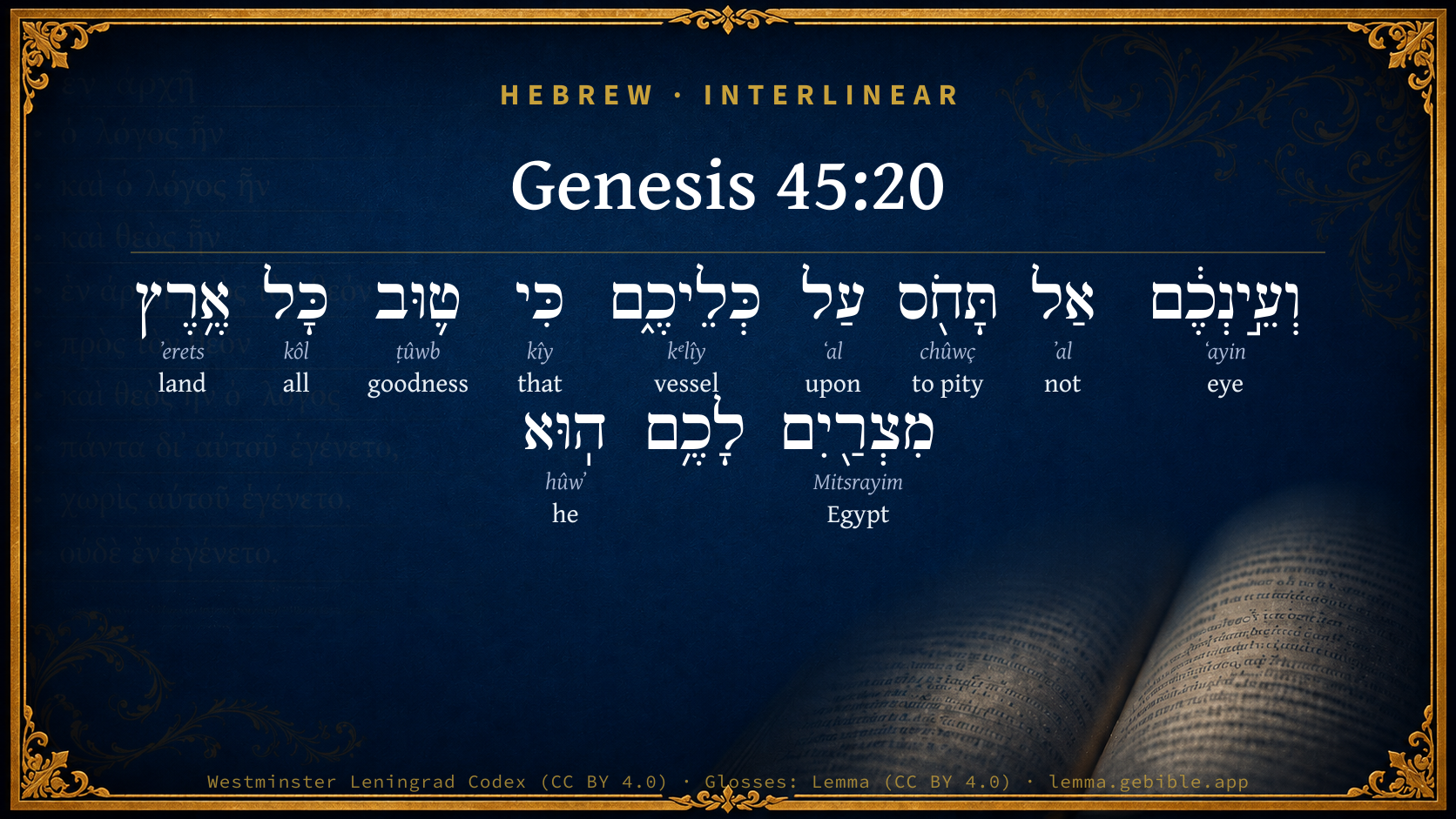
Hebrew (Westminster Leningrad Codex) Genesis 45:20 appears in the Hebrew Old Testament. The text above is from the Westminster Leningrad Codex. Each word links to its Strong’s number, a concise gloss, and parsing drawn from the Open Scriptures Hebrew Bible morphology. Click any word for its full Brown-Driver-Briggs (BDB) entry.
Download image
Cite this verse

Genesis 45:20 (World English Bible). Public Domain. Lemma interlinear Bible study tool, https://lemma.gebible.app/v/genesis/45/20.

Show BibTeX & RIS
BibTeX
RIS
English Translation
Also, don't concern yourselves about your belongings, for the good of all of the land of Egypt is yours."
World English Bible · Public Domain
Highlights
  • 1 first appearance in the Hebrew Bible
Full analysis ↓
Download a study sheet

One document with this verse’s original text, its word-by-word gloss line, the meaning frame, cross-references with their text, attributed commentary, and full source and license credits — printable, and it pastes into notes with its structure intact.

This verse Autodidact and up

Study sheet (.html) Plain text (.txt)

A passage Seminary Student

Up to 50 verses in one chapter. A passage sheet keeps up to 6 commentary sources and 12 cross-references per verse, in the order this page ranks them, and says so on the sheet whenever that leaves anything out. Ask for a single verse and you get the Autodidact verse sheet above.

Everything on this page stays free to read, with no account — the sheet is a download of what is already on screen, not access to it.

Want to remove ads? Support Godless Engineer
Compare translations 3

The same verse in 3 English versions, stacked beneath the original-language interlinear above. Click any original word for its lexicon entry.

Each is an independent rendering of the whole verse — the interlinear is not word-aligned to these translations.

Highlighted words mark where these versions differ — a whole-verse word diff, not a word-by-word alignment.

  • World English Bible Public Domain
    Also, don't concern yourselves about your belongings, for the good of all of the land of Egypt is yours."
  • King James Version Public Domain
    Also regard not your stuff; for the good of all the land of Egypt is yours.
  • unfoldingWord Literal Text CC BY-SA 4.0
    And do not let your eyes grieve over your belongings, because the best of all the land of Egypt to you.’”

unfoldingWord Literal Text — © unfoldingWord, licensed CC BY-SA 4.0. Word-aligned USFM3 via Door43 (git.door43.org/unfoldingWord/en_ult).

Versions to compare (up to 4)

3 of 4 selected

Show all 18 translations

Every available English version of this verse, each an independent rendering of the whole verse.

  • World English Bible Public Domain
    Also, don't concern yourselves about your belongings, for the good of all of the land of Egypt is yours."
  • Berean Standard Bible Public Domain
    But pay no regard to your belongings, for the best of all the land of Egypt is yours.’”
  • Majority Standard Bible Public Domain
    But pay no regard to your belongings, for the best of all the land of Egypt is yours.’”
  • King James Version Public Domain
    Also regard not your stuff; for the good of all the land of Egypt is yours.
  • American Standard Version (1901) Public Domain
    Also regard not your stuff; for the good of all the land of Egypt is yours.
  • Revised Version (1885) Public Domain
    Also regard not your stuff; for the good of all the land of Egypt is yours.
  • Geneva Bible (1599) Public Domain
    Also regarde not your stuffe: for the best of all the land of Egypt is yours.
  • Douay-Rheims (1899) Public Domain
    And leave nothing of your house- hold stuff: for all the riches of Egypt shall be yours.
  • Young's Literal Translation Public Domain
    and your eye hath no pity on your vessels, for the good of all the land of Egypt `is' yours.'
  • Literal Standard Version CC BY-SA 4.0
    and your eye has no pity on your vessels, for the good of all the land of Egypt [is] yours.”
  • Unlocked Literal Bible CC BY-SA 4.0
    Do not be concerned about your possessions, for the good of all the land of Egypt is yours.'”
  • unfoldingWord Literal Text CC BY-SA 4.0
    And do not let your eyes grieve over your belongings, because the best of all the land of Egypt to you.’”
  • Darby Bible Public Domain
    And let not your eye regret your stuff; for the good of all the land of Egypt shall be yours.
  • World Messianic Bible Public Domain
    Also, don’t concern yourselves about your belongings, for the good of all the land of Egypt is yours.”
  • Webster's Bible Public Domain
    Also regard not your furniture; for the good of all the land of Egypt is yours.
  • Free Bible Version CC BY-SA 4.0
    Don't worry about bringing your possessions because the best of all Egypt is yours.’”
  • Bible in Basic English Public Domain
    And take no thought for your goods, for the best of all the land of Egypt is yours.
  • JPS Tanakh (1917) Public Domain
    Also regard not your stuff; for the good things of all the land of Egypt are yours.'

Literal Standard Version (2020), Covenant Press — licensed CC BY-SA 4.0. Text via the HelloAO Bible API (eBible.org). Unlocked Literal Bible (unfoldingWord) — licensed CC BY-SA 4.0. Text via the HelloAO Bible API (eBible.org). unfoldingWord Literal Text — © unfoldingWord, licensed CC BY-SA 4.0. Word-aligned USFM3 via Door43 (git.door43.org/unfoldingWord/en_ult). Free Bible Version, Dr. Jonathan Gallagher — licensed CC BY-SA 4.0. Text via the HelloAO Bible API (eBible.org).

Word by word

More ways to search: Search by grammar → Find every occurrence → Compare this word →

Practice this passage: Drill this verse → Learn its vocabulary →

תָּחֹ֖ס
chûwç
H2347
“to pity”
Verb, Qal, Jussive, 3rd Person, Feminine, Singular
Part of Speech
Verb
Stem
Qal
Form
Jussive
Person
3rd Person
Gender
Feminine
Number
Singular
Full BDB Definition

Origin: a primitive root

TWOT: 626

(Qal) to pity, have compassion, spare, look upon with compassion
  1. וְעֵ֣ינְכֶ֔ם ʻayin H5869 “and · eye · your” Conjunction + Noun, Common, Both, Singular, Construct + Suffix, Personal, 2nd Person, Masculine, Plural
  2. אַל ʼal H408 “not” Particle, Negative
  3. עַל ʻal H5921 “upon” Preposition
  4. כְּלֵיכֶ֑ם kᵉlîy H3627 “vessels · your” Noun, Common, Masculine, Plural, Construct + Suffix, Personal, 2nd Person, Masculine, Plural
  5. כִּי kîy H3588 “that” Conjunction
  6. ט֛וּב ṭûwb H2898 “goodness of” Noun, Common, Masculine, Singular, Construct
  7. כָּל kôl H3605 “all of” Noun, Common, Masculine, Singular, Construct
  8. אֶ֥רֶץ ʼerets H776 “land of” Noun, Common, Both, Singular, Construct
  9. מִצְרַ֖יִם Mitsrayim H4714 “Egypt” Noun, Proper
  10. הֽוּא hûwʼ H1931 “he” Pronoun, Personal, 3rd Person, Masculine, Singular

About this verse

These counts appear in no published source. They are computed here, from the morphology-tagged text and Lemma’s own curated glosses. What Lemma adds →

12
words
11
distinct lemmas
Pentateuch
section

Notable vocabulary

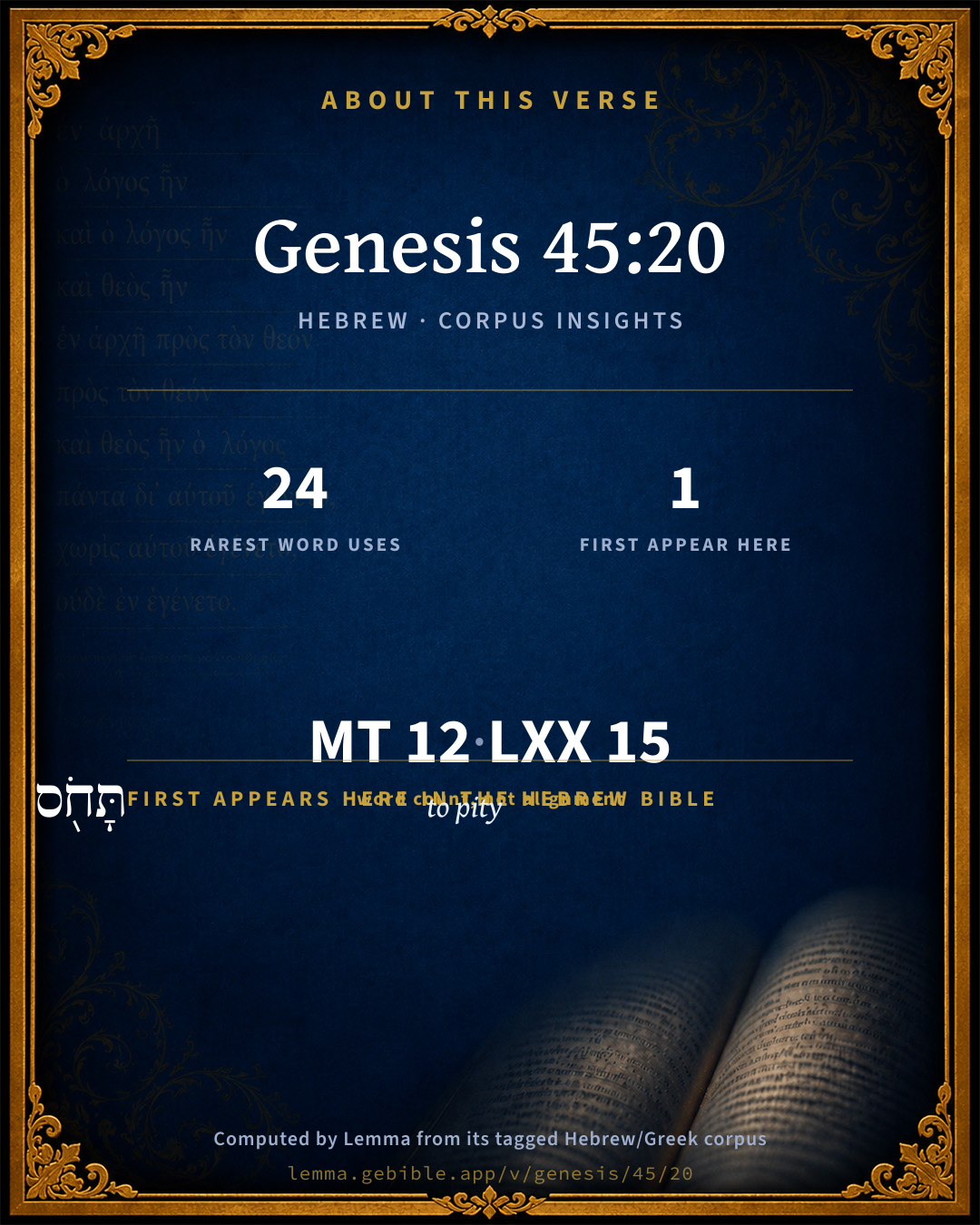
The rarest word here is תָּחֹ֖ס to pity H2347 — appearing just 24 times in the whole Hebrew Bible.

First appearance in Scripture

This word makes its first canonical appearance in the Hebrew Bible here:

  • תָּחֹ֖ס to pity H2347

Shared distinctive vocabulary

תָּחֹ֖ס to pity H2347 occurs in 24 verses of the Hebrew Bible. Also found in:

Grammatical profile

  • 1 verb
  • 6 nouns
  • 1 pronoun
  • 2 prepositions
  • 1 conjunction
  • 1 particle

Verb forms

  • תָּחֹ֖ס Qal · Jussive

Hebrew & Septuagint length

In English translation the verse runs 19 words from the Hebrew and 18 from the Septuagint (LXX English) — closely comparable.

A rough comparison of the two English renderings, which tokenize alike — not a word-level alignment.

Word counts can differ between the Hebrew and the Greek without any difference in meaning — e.g. the Hebrew direct-object marker אֵת has no separate Greek word, and Greek often adds the article ὁ.

In the original languages it is 12 Hebrew tokens and 15 Greek tokens — but the two are counted differently (Hebrew bundles its prefixes and suffixes into one token; the Greek is in lemma form), so that isn’t a like-for-like length.

Cross-references

20

Topical passages linked to Genesis 45:20 in the Treasury of Scripture Knowledge — connected by theme and wording, ordered by reader-vote popularity; previews shown in the World English Bible.

  • Isaiah 1:19 If you are willing and obedient, You shall eat the good of the land;
  • Luke 17:31 In that day, he who will be on the housetop, and his goods in the house, let him not go down to take them away. Let him who is in the field likewise not turn back.
  • Exodus 22:7 "If a man delivers to his neighbor money or stuff to keep, and it is stolen out of the man's house; if the thief is found, he shall pay double.
  • Deuteronomy 7:16 You shall consume all the peoples who Yahweh your God shall deliver to you; your eye shall not pity them: neither shall you serve their gods; for that will be a snare to you.
  • Deuteronomy 19:13 Your eye shall not pity him, but you shall put away the innocent blood from Israel, that it may go well with you.
  • Deuteronomy 19:21 Your eyes shall not pity; life [shall go] for life, eye for eye, tooth for tooth, hand for hand, foot for foot.
  • Joshua 7:11 Israel has sinned; yes, they have even transgressed my covenant which I commanded them: yes, they have even taken of the devoted thing, and have also stolen, and dissembled also; and they have even put it among their own stuff.
  • 1 Samuel 10:22 Therefore they asked of Yahweh further, Is there yet a man to come here? Yahweh answered, Behold, he has hid himself among the baggage.
  • 1 Samuel 25:13 David said to his men, Gird you on every man his sword. They girded on every man his sword; and David also girded on his sword: and there went up after David about four hundred men; and two hundred abode by the baggage.
  • 1 Samuel 30:24 Who will listen to you in this matter? for as his share is who goes down to the battle, so shall his share be who tarries by the baggage: they shall share alike.
  • Ezra 9:12 now therefore don't give your daughters to their sons, neither take their daughters to your sons, nor seek their peace or their prosperity forever; that you may be strong, and eat the good of the land, and leave it for an inheritance to your children forever.
  • Isaiah 13:18 [Their] bows shall dash the young men in pieces; and they shall have no pity on the fruit of the womb; their eye shall not spare children.
  • Ezekiel 7:4 My eye shall not spare you, neither will I have pity; but I will bring your ways on you, and your abominations shall be in the midst of you: and you shall know that I am Yahweh.
  • Ezekiel 7:9 My eye shall not spare, neither will I have pity: I will bring on you according to your ways; and your abominations shall be in the midst of you; and you shall know that I, Yahweh, do strike.
  • Ezekiel 12:3–4 Therefore, you son of man, prepare you stuff for removing, and remove by day in their sight; and you shall remove from your place to another place in their sight: it may be they will consider, though they are a rebellious house.
  • Ezekiel 20:17 Nevertheless my eye spared them, and I didn't destroy them, neither did I make a full end of them in the wilderness.
  • Genesis 20:15 Abimelech said, "Behold, my land is before you. Dwell where it pleases you."
  • Genesis 45:18 Take your father and your households, and come to me, and I will give you the good of the land of Egypt, and you will eat the fat of the land.'
  • Ezekiel 9:5 To the others he said in my hearing, Go you through the city after him, and strike: don't let your eye spare, neither have you pity;
  • Matthew 24:17 Let him who is on the housetop not go down to take out things that are in his house.

Cross-references courtesy of OpenBible.info (CC BY 4.0).

Hebrew and Greek witnesses Masoretic Hebrew ↔ Greek Septuagint

The same verse in the two great witnesses to the Old Testament, shown verse-for-verse.

These are two independent witnesses, not word-aligned to each other, and the Septuagint is shown in lemma (dictionary) form.

Hebrew Genesis 45:20 Masoretic · Westminster Leningrad Codex

וְעֵ֣ינְכֶ֔ם אַל תָּחֹ֖ס עַל כְּלֵיכֶ֑ם כִּי ט֛וּב כָּל אֶ֥רֶץ מִצְרַ֖יִם לָכֶ֥ם הֽוּא

Also, don't concern yourselves about your belongings, for the good of all of the land of Egypt is yours."

World English Bible · Public Domain

Greek LXX Genesis 45:20 Septuagint · lemma form

καί μή φείδομαι ὁ ὀφθαλμός ὁ σκεῦος σύ ὁ γάρ πᾶς ἀγαθός αἴγυπτος σύ εἰμί

And be not sparing in regard to your property, for all the good of Egypt shall be yours.

LXX2012 (modern English Septuagint) · Public Domain

On this verse, The Cambridge Bible for Schools and Colleges discusses the Septuagint’s reading. Read the note in Commentary ↓

Hebrew: Westminster Leningrad Codex (CC BY 4.0). Greek: Septuagint (public domain); English from LXX2012 (modern English Septuagint) (Public Domain). How the Septuagint differs from the Hebrew →

Targum (Aramaic paraphrase)

2

The Targum is the ancient Jewish Aramaic paraphrase of the Hebrew Scriptures — an interpretive translation, not the Hebrew text itself. Onkelos (literal) and Pseudo-Jonathan (expansive) render the Torah, and Jonathan the Prophets. Coverage is partial: where no permissively-licensed English translation exists for a verse, only the Aramaic is shown. This is verse-level text, not a word-by-word alignment to the Hebrew.

  1. Targum Onkelos Torah (Genesis–Deuteronomy)
    וְעֵינְכוֹן לָא תְחוּס עַל מָנֵיכוֹן אֲרֵי טַב כָּל אַרְעָא דְמִצְרַיִם דִּלְכוֹן הוּא

    (no public-domain English translation for this verse)

    Targum Onkelos — Aramaic: “Onkelos Genesis” (public domain); “Onkelos Exodus” (public domain); “Onkelos Leviticus” (public domain); “Onkelos Numbers” (public domain); “Onkelos Deuteronomy” (public domain). English: “Sefaria Community Translation” (CC0 1.0 (public-domain dedication)); “J.W. Etheridge. The Targums of Onkelos and Jonathan Ben Uzziel on the Pentateuch. London: Longmans, Green, 1862” (public domain). Text via Sefaria.

  2. Targum Pseudo-Jonathan Torah (Genesis–Deuteronomy)
    וְעֵינֵיכוֹן לָא תֵיחוֹס עַל מָנֵיכוֹן אֲרוּם שְׁפַר אֲרַג כָּל אַרְעָא דְמִצְרַיִם דִילְכוֹן הוּא

    And your eyes must not look wistfully on your utensils: for the best of what is desirable in all the land of Mizraim is yours.

    Targum Pseudo-Jonathan — Aramaic: “Targum Jonathan on Genesis” (public domain); “Targum Jonathan on Exodus” (public domain); “Targum Jonathan on Leviticus” (public domain); “Targum Jonathan on Numbers” (public domain); “Targum Jonathan on Deuteronomy” (public domain). English: “The Targum of Jonathan ben Uzziel, trans. J. W. Etheridge, London, 1862” (public domain). Text via Sefaria.

Commentary

Notes on Genesis 45:20 from classic Christian and Jewish commentators (each source and its license shown beneath its notes). The classic Christian expositions comment on the surrounding passage and are grouped to its opening verse, so a note may address several verses; the Jewish commentaries on the Tanakh (Rashi and others) are per-verse, so they appear only where the commentator wrote on this verse.

Lemma curates 59 commentaries, every one of them public domain or Creative Commons licensed, each selected and text-cleaned for this edition rather than reprinted as found. About our sources →

Trapp's Complete Commentary

John Trapp

Gen 45:20 Also regard not your stuff; for the good of all the land of Egypt [is] yours.

Ver. 20. Also regard not your stuff.] The same saith God to his; Care not for your lumber and trumpery; suffer with joy the loss of your goods: Come, come away in your affections; I have far better things for you above: the good of all the land of the living is yours, &c. And should we not cheerfully follow the divine call? Many play loath to depart, because they have treasure in the world, as those ten men had in the field. {Jer 12:8} But all that this world affords is but trash to the truly religious. Alexander, hearing of the riches of the Indies, divided his kingdom of Macedon among his captains and soldiers. And being asked what he had left for himself; he answered, Hope. And should not the hope of heaven make us slight all earthly vanities? Spes in terrenis, incerti nomen boni: spes in divinis, nomen est certissimi. Heb 11:1.

John Trapp, A Commentary or Exposition upon All the Books of the Old and New Testament (1647–1656) — public domain. Text from a community e-Sword module.

Geneva Bible (1599)

Geneva Bible translators

Hebrew, let not your eyes spare your vessel.

Geneva Bible (1599) marginal notes — public domain. Text via Bolls.life.

Adam Clarke's Commentary

Verse 20. Regard not your stuff] Literally, Let not your eye spare your instruments or vessels. כליכם keleychem, a general term, in which may be included household furniture, agricultural utensils, or implements of any description. They were not to delay nor encumber themselves with articles which could be readily found in Egypt, and were not worth so long a carriage.

Adam Clarke's Commentary on the Bible (1810–1826) — public domain. Text from a community e-Sword/MySword module.

Ellicott's Commentary for English Readers

(20) Regard not your stuff.—Heb., and let not your eye have pity (Jon_4:10) upon your vessels, that is, upon your implements and household furniture.

A Bible Commentary for English Readers, edited by Charles John Ellicott (1878–1897) — public domain. Text from a community e-Sword module.

The Cambridge Bible for Schools and Colleges

gen. ed. J. J. S. Perowne

20. regard not] Lit. “let not your eye be sparing,” i.e. have no compunction at leaving things behind

your stuff] Lit. “your vessels.” LXX σκεύη; Lat. supellex. For the word “stuff,” cf. 1Sa_10:22. It is Old English for “baggage”; cf. Shakespeare, Com. of Errors, iv. 4: “Therefore away, to get our stuff on board.”

The Cambridge Bible for Schools and Colleges (gen. ed. J. J. S. Perowne; Cambridge University Press, 1878–1918) — public domain. Text from a community e-Sword module.

John Gill's Exposition

Also regard not your stuff,.... Or "your vessels" (g), utensils, household goods; he would not have them to be concerned if they could not bring all their goods with them, but were obliged to leave some behind, and which, because of the distance of the way and difficulty of the road, lying through sandy deserts, could not well be brought, since there was enough to be had in the land of Egypt; therefore, as it may be rendered, "let not your eye spare" (h), or "pity": do not be grieved at it, or say it is a pity to leave these good things behind. Some render and explain the words just the reverse, "leave nothing of your household goods" (i); bring all away with you, as if he would not have them think of returning again, but of settling and continuing in Egypt; but this does not so well agree with what follows as the former sense does:

for the good of all the land of Egypt is yours: whatever good things were in it, whether for food or use for themselves, their houses, or their flocks, all were at their service, and they were welcome to them; or the best or most fruitful part of the country was designed for them, and would be given to them, or was at their option.

(g) "vasis vestris", Fagius, Drusius, "supellectilibus vestris", Pagninus, Schmidt; "propter vestra supellectilia", Junius & Tremellius, Piscator. (h) "oculus vester non parcat", Pagninus, Montanus, Munster, Drusius, Schmidt. (i) "Nee dimittatis quicquam de supellectili vestra", V. L. so Mercerus.

John Gill's Exposition of the Whole Bible (1746–1763) — public domain (CC PDM 1.0). Text via the HelloAO Bible API.

Haydock's Catholic Bible Commentary

Leave nothing. Hebrew may have another meaning, which Calmet approves, "Let not your eye spare your furniture." Be not concerned to leave what may be useless, as most of the husbandry utensils would be in Egypt, "for all," &c.

George Leo Haydock (1774–1849), Haydock's Catholic Family Bible and Commentary, 1859 edition — public domain. Excludes Psalms (Douay-Rheims chapter numbering differs from Protestant) and Deuterocanonical books (Catholic canon only).

Matthew Poole's English Annotations

Regard not your stuff; Heb. let not your eye pity or spare any part of your stuff, as loth to leave it behind you, or afraid to lose it. Sparing or pitying is an act of the mind, but it is ascribed to the eye here, as also Eze 7:4,9; 16:5; partly, because there it discovers itself by tears, or otherwise; and partly, because the sight of the eye doth oft affect the heart, and move pity.

Matthew Poole's English Annotations on the Holy Bible (1683–1685) — public domain. Text from a community e-Sword/MySword module.

Whedon's Commentary on the Bible

Daniel D. Whedon

20. Regard not your stuff — “Be not troubled about your household goods that you cannot move, for they shall be made good. People who move frequently can appreciate this anxiety. Israel came into Egypt by free invitation, and perhaps the sacred historian amplifies in detail here, so as to show that Israel was as free to depart afterwards.” — Newhall.

Daniel D. Whedon (gen. ed.), Commentary on the Old and New Testaments (1874–1909) — public domain. Text from a community e-Sword module.

Radak

Rabbi David Kimhi (Radak)

ועינכם אל תחוס, it is the custom of the Holy Tongue to use the verb חוס, to take pity, in connection with the eyes, although we would expect that it should be used in connection with the heart, seeing it describes an emotion of the heart.

Radak on the Tanakh — English translations: “Sefaria Community Translation” (CC0 1.0 (public-domain dedication)); “Eliyahu Munk, HaChut Hameshulash” (CC BY 4.0); “Rabbi Mike Feuer, Jerusalem Anthology” (CC BY 4.0); and “R. David Kimhi on the first book of Psalms, Translated by R.G. Finch, London, 1919” (public domain). Text via Sefaria.

Lesson kit

Teaching starters — assembled from the data on this page, not authored interpretation. Every prompt links to the verse data it draws on. Edit before teaching.

Genesis, in the Pentateuch, opens this verse with 12 words (11 distinct Hebrew lemmas). Its most distinctive word is chûwç (“to pity”). A historical commentator’s framing appears above. Read the whole chapter for the surrounding context.

Discussion questions

  1. What does “to pity” (chûwç) contribute to the verse as a whole?
  2. This is the first place “to pity” appears in Scripture (first appears here). What does its debut here establish?
  3. How does Deuteronomy 7:16, which shares the word «to pity», read alongside this verse?
  4. These translations render this verse differently; the difference is in the English rendering, not the original. What questions does that raise?
  5. «תָּחֹ֖ס» is a Qal Jussive verb. How does that grammatical form shape the action described?
  6. Compare how Trapp's Complete Commentary and Geneva Bible (1599) read this verse. Where do they agree or differ?

Things to notice

Reading settings

Reading text

Shown beneath each verse's original-language words.

Old Testament
Old Testament edition

Read the OT as the Masoretic Hebrew (MT) or the Greek Septuagint (LXX).

English shown for the Greek Septuagint (in the Hebrew ↔ Greek comparison).

Comparing translations? Open the Compare panel on any verse page to stack up to four side by side.