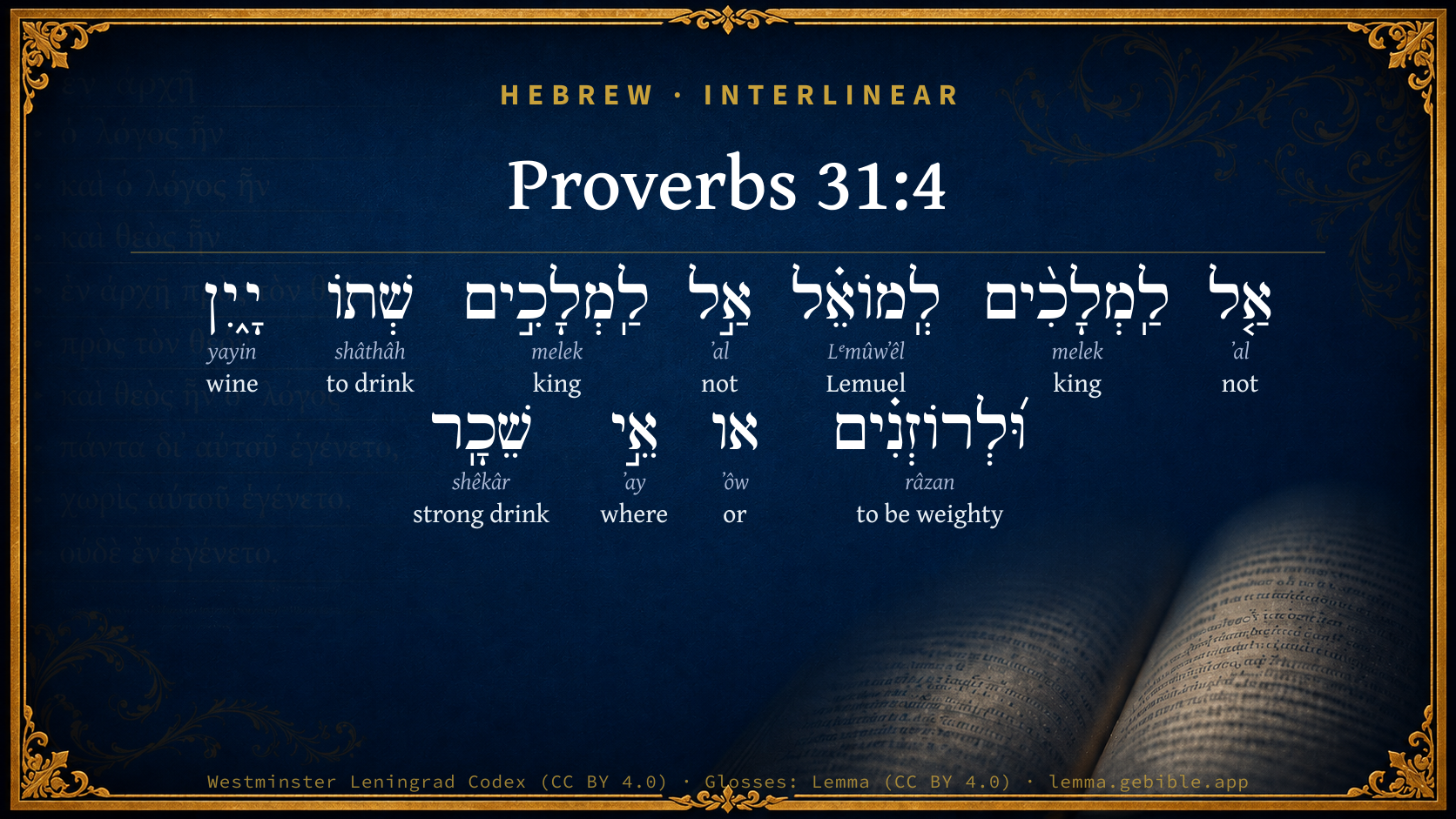
Proverbs 31:4

Hebrew (Westminster Leningrad Codex) Proverbs 31:4 appears in the Hebrew Old Testament. The text above is from the Westminster Leningrad Codex. Each word links to its Strong’s number, a concise gloss, and parsing drawn from the Open Scriptures Hebrew Bible morphology. Click any word for its full Brown-Driver-Briggs (BDB) entry.
Download image
Cite this verse

Proverbs 31:4 (World English Bible). Public Domain. Lemma interlinear Bible study tool, https://lemma.gebible.app/v/proverbs/31/4.

Show BibTeX & RIS
BibTeX
RIS
English Translation
It is not for kings, Lemuel; It is not for kings to drink wine; Nor for princes to say, 'Where is strong drink?'
World English Bible · Public Domain
Download a study sheet

One document with this verse’s original text, its word-by-word gloss line, the meaning frame, cross-references with their text, attributed commentary, and full source and license credits — printable, and it pastes into notes with its structure intact.

This verse Autodidact and up

Study sheet (.html) Plain text (.txt)

A passage Seminary Student

Up to 50 verses in one chapter. A passage sheet keeps up to 6 commentary sources and 12 cross-references per verse, in the order this page ranks them, and says so on the sheet whenever that leaves anything out. Ask for a single verse and you get the Autodidact verse sheet above.

Everything on this page stays free to read, with no account — the sheet is a download of what is already on screen, not access to it.

Want to remove ads? Support Godless Engineer
Compare translations 3

The same verse in 3 English versions, stacked beneath the original-language interlinear above. Click any original word for its lexicon entry.

Each is an independent rendering of the whole verse — the interlinear is not word-aligned to these translations.

Highlighted words mark where these versions differ — a whole-verse word diff, not a word-by-word alignment.

  • World English Bible Public Domain
    It is not for kings, Lemuel; It is not for kings to drink wine; Nor for princes to say, 'Where is strong drink?'
  • King James Version Public Domain
    It is not for kings, O Lemuel, it is not for kings to drink wine; nor for princes strong drink:
  • unfoldingWord Literal Text CC BY-SA 4.0
    not for kings, Lemuel, not for kings to drink wine or for dignitaries or intoxicating drink.

unfoldingWord Literal Text — © unfoldingWord, licensed CC BY-SA 4.0. Word-aligned USFM3 via Door43 (git.door43.org/unfoldingWord/en_ult).

Versions to compare (up to 4)

3 of 4 selected

Show all 18 translations

Every available English version of this verse, each an independent rendering of the whole verse.

  • World English Bible Public Domain
    It is not for kings, Lemuel; It is not for kings to drink wine; Nor for princes to say, 'Where is strong drink?'
  • Berean Standard Bible Public Domain
    It is not for kings, O Lemuel, it is not for kings to drink wine, or for rulers to crave strong drink,
  • Majority Standard Bible Public Domain
    It is not for kings, O Lemuel, it is not for kings to drink wine, or for rulers to crave strong drink,
  • King James Version Public Domain
    It is not for kings, O Lemuel, it is not for kings to drink wine; nor for princes strong drink:
  • American Standard Version (1901) Public Domain
    It is not for kings, O Lemuel, it is not for kings to drink wine; Nor for princes `to say', Where is strong drink?
  • Revised Version (1885) Public Domain
    It is not for kings, O Lemuel, it is not for kings to drink wine; nor for princes to say, Where is strong drink?
  • Geneva Bible (1599) Public Domain
    It is not for Kings, O Lemuel, it is not for Kings to drink wine nor for princes strog drinke,
  • Douay-Rheims (1899) Public Domain
    Give not to kings, O Lamuel, give not wine to kings: because there is no secret where drunkenness reigneth:
  • Young's Literal Translation Public Domain
    Not for kings, O Lemuel, Not for kings, to drink wine, And for princes a desire of strong drink.
  • Literal Standard Version CC BY-SA 4.0
    [It is] not for kings, O Lemuel, || Not for kings, to drink wine, || And for princes—a desire of strong drink.
  • Unlocked Literal Bible CC BY-SA 4.0
    It is not for kings, Lemuel, it is not for kings to drink wine, or for rulers to crave strong drink,
  • unfoldingWord Literal Text CC BY-SA 4.0
    not for kings, Lemuel, not for kings to drink wine or for dignitaries or intoxicating drink.
  • Darby Bible Public Domain
    It is not for kings, Lemuel, it is not for kings to drink wine, nor for rulers [to say], Where is the strong drink?
  • World Messianic Bible Public Domain
    It is not for kings, Lemuel, it is not for kings to drink wine, nor for princes to say, ‘Where is strong drink?’
  • Webster's Bible Public Domain
    It is not for kings, O Lemuel, it is not for kings to drink wine; nor for princes strong drink:
  • Free Bible Version CC BY-SA 4.0
    Lemuel, kings shouldn't be drinking wine, rulers shouldn't be drinking alcohol.
  • Bible in Basic English Public Domain
    It is not for kings, O Lemuel, it is not for kings to take wine, or for rulers to say, Where is strong drink?
  • JPS Tanakh (1917) Public Domain
    It is not for kings, O Lemuel, it is not for kings to drink wine: nor for princes to say: 'Where is strong drink?'

Literal Standard Version (2020), Covenant Press — licensed CC BY-SA 4.0. Text via the HelloAO Bible API (eBible.org). Unlocked Literal Bible (unfoldingWord) — licensed CC BY-SA 4.0. Text via the HelloAO Bible API (eBible.org). unfoldingWord Literal Text — © unfoldingWord, licensed CC BY-SA 4.0. Word-aligned USFM3 via Door43 (git.door43.org/unfoldingWord/en_ult). Free Bible Version, Dr. Jonathan Gallagher — licensed CC BY-SA 4.0. Text via the HelloAO Bible API (eBible.org).

Word by word

More ways to search: Search by grammar → Find every occurrence → Compare this word →

Practice this passage: Drill this verse → Learn its vocabulary →

About this verse

These counts appear in no published source. They are computed here, from the morphology-tagged text and Lemma’s own curated glosses. What Lemma adds →

11
words
9
distinct lemmas
Wisdom
section

Notable vocabulary

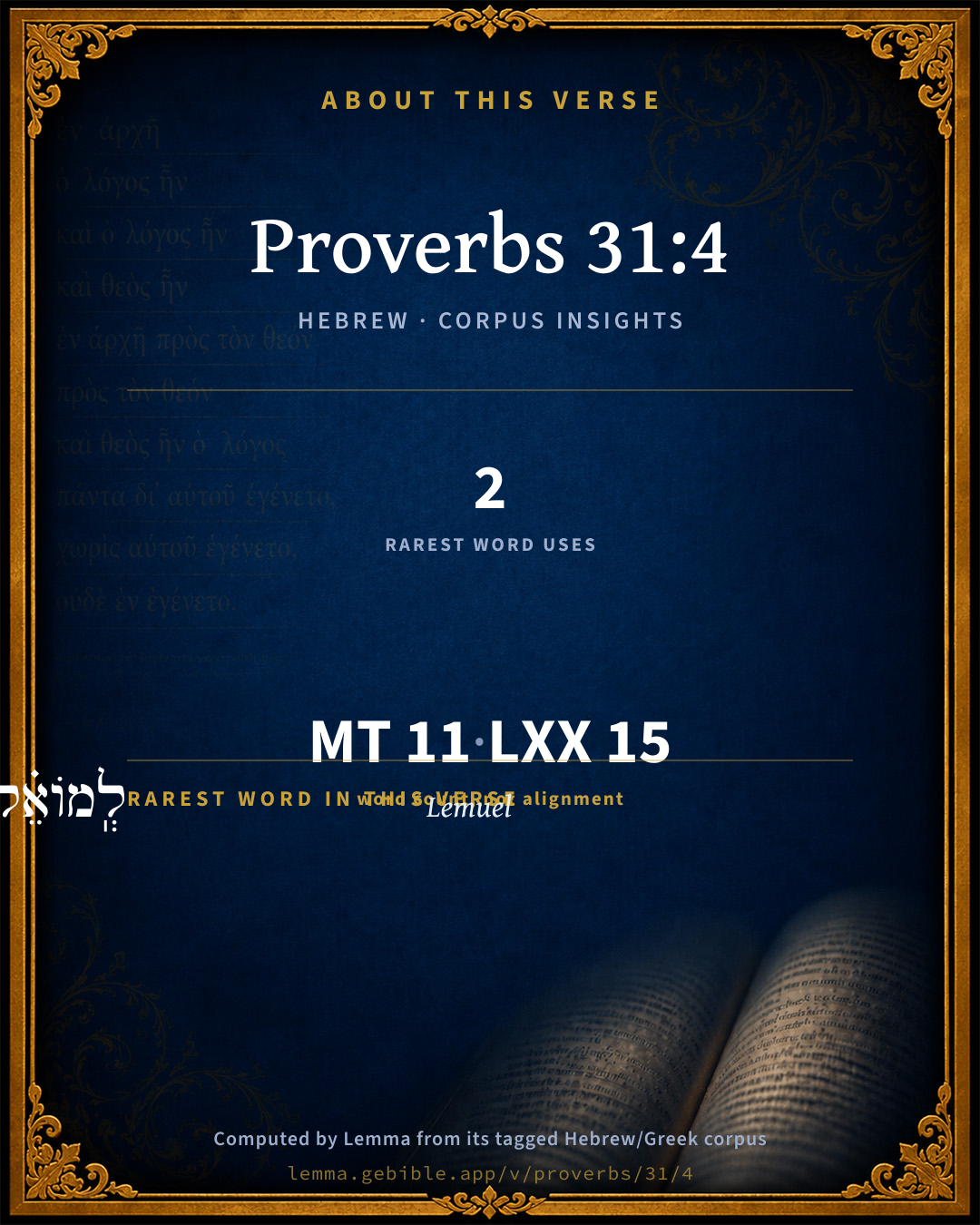
The rarest word here is לְֽמוֹאֵ֗ל Lemuel H3927 — appearing just 2 times in the whole Hebrew Bible.

Shared distinctive vocabulary

לְֽמוֹאֵ֗ל Lemuel H3927 occurs in 2 verses of the Hebrew Bible. Also found in:

Grammatical profile

  • 2 verbs
  • 5 nouns
  • 1 conjunction
  • 3 particles

Verb forms

  • שְׁתוֹ Qal · Infinitive Construct
  • וּ֝לְרוֹזְנִ֗ים Qal · Participle Active

Repetition

Words recur within this verse — often emphatic in Hebrew:

  • לַֽמְלָכִ֨ים king H4428 ×2
  • אַ֤ל not H408 ×2

Hebrew & Septuagint length

In English translation the verse runs 23 words from the Hebrew and 11 from the Septuagint (LXX English) — the Septuagint runs noticeably shorter here. See the side-by-side →

A rough comparison of the two English renderings, which tokenize alike — not a word-level alignment.

Word counts can differ between the Hebrew and the Greek without any difference in meaning — e.g. the Hebrew direct-object marker אֵת has no separate Greek word, and Greek often adds the article ὁ.

In the original languages it is 11 Hebrew tokens and 15 Greek tokens — but the two are counted differently (Hebrew bundles its prefixes and suffixes into one token; the Greek is in lemma form), so that isn’t a like-for-like length.

Cross-references

13

Topical passages linked to Proverbs 31:4 in the Treasury of Scripture Knowledge — connected by theme and wording, ordered by reader-vote popularity; previews shown in the World English Bible.

  • Proverbs 20:1 Wine is a mocker, and beer is a brawler; Whoever is led astray by them is not wise.
  • Ecclesiastes 10:17 Happy are you, land, when your king is the son of nobles, And your princes eat in due season, For strength, and not for drunkenness!
  • Isaiah 5:22 Woe to those who are mighty to drink wine, And champions at mixing strong drink;
  • Hosea 4:11–12 Prostitution, wine, and new wine take away understanding.
  • 1 Kings 20:16–20 They went out at noon. But Ben Hadad was drinking himself drunk in the pavilions, he and the kings, the thirty-two kings who helped him.
  • Habakkuk 2:5 Yes, moreover, wine is treacherous. A haughty man who doesn't stay at home, who enlarges his desire as Sheol, and he is like death, and can't be satisfied, but gathers to himself all nations, and heaps to himself all peoples.
  • Leviticus 10:9–10 "Drink no wine nor strong drink, you, nor your sons with you, when you go into the Tent of Meeting, that you don't die: it shall be a statute forever throughout your generations:
  • Esther 3:15 The posts went forth in haste by the king's commandment, and the decree was given out in Shushan the palace. The king and Haman sat down to drink; but the city of Shushan was perplexed.
  • Isaiah 28:7–8 Even these reel with wine, and stagger with strong drink; the priest and the prophet reel with strong drink, they are swallowed up of wine, they stagger with strong drink; they err in vision, they stumble in judgment.
  • Daniel 5:2–4 Belshazzar, while he tasted the wine, commanded to bring the golden and silver vessels which Nebuchadnezzar his father had taken out of the temple which was in Jerusalem; that the king and his lords, his wives and his concubines, might drink from it.
  • Hosea 7:3–5 They make the king glad with their wickedness, And the princes with their lies.
  • Mark 6:21–28 Then a convenient day came, that Herod on his birthday made a supper for his nobles, the high officers, and the chief men of Galilee.
  • 1 Kings 20:12 It happened, when [Ben Hadad] heard this message, as he was drinking, he and the kings, in the pavilions, that he said to his servants, Set [yourselves in array]. They set [themselves in array] against the city.

Cross-references courtesy of OpenBible.info (CC BY 4.0).

Hebrew and Greek witnesses Masoretic Hebrew ↔ Greek Septuagint

The same verse in the two great witnesses to the Old Testament, shown verse-for-verse.

Here the Septuagint runs noticeably shorter than the Hebrew — LXX2012 (modern English Septuagint) 11 words vs World English Bible 23. A rough length comparison of the two English translations, not a word-level alignment — read both below.

These are two independent witnesses, not word-aligned to each other, and the Septuagint is shown in lemma (dictionary) form.

Hebrew Proverbs 31:4 Masoretic · Westminster Leningrad Codex

אַ֤ל לַֽמְלָכִ֨ים לְֽמוֹאֵ֗ל אַ֣ל לַֽמְלָכִ֣ים שְׁתוֹ יָ֑יִן וּ֝לְרוֹזְנִ֗ים או אֵ֣י שֵׁכָֽר

It is not for kings, Lemuel; It is not for kings to drink wine; Nor for princes to say, 'Where is strong drink?'

World English Bible · Public Domain

Greek LXX Proverbs 31:4 Septuagint · lemma form

μετά βουλή πᾶς ποιέω μετά βουλή οἰνοποτέω ὁ δυνάστης θυμώδης εἰμί οἶνος δέ μή πίνω

Princes are prone to anger: let them then not drink wine:

LXX2012 (modern English Septuagint) · Public Domain

On this verse, Haydock's Catholic Bible Commentary discusses the Septuagint’s reading. Read the note in Commentary ↓

Hebrew: Westminster Leningrad Codex (CC BY 4.0). Greek: Septuagint (public domain); English from LXX2012 (modern English Septuagint) (Public Domain). How the Septuagint differs from the Hebrew →

Commentary

Notes on Proverbs 31:4 from classic Christian and Jewish commentators (each source and its license shown beneath its notes). The classic Christian expositions comment on the surrounding passage and are grouped to its opening verse, so a note may address several verses; the Jewish commentaries on the Tanakh (Rashi and others) are per-verse, so they appear only where the commentator wrote on this verse.

Lemma curates 59 commentaries, every one of them public domain or Creative Commons licensed, each selected and text-cleaned for this edition rather than reprinted as found. About our sources →

Trapp's Complete Commentary

John Trapp

Pro 31:4 [It is] not for kings, O Lemuel, [it is] not for kings to drink wine; nor for princes strong drink:

Ver. 4. It is not for kings to drink wine,] i.e., To be "drunk with wine, wherein is excess," {Eph 5:18} where the apostle determines excessive drinking to be downright drunkenness, viz., when as swine do their bellies, so men break their heads with filthy quaffing. This, as no man may lawfully do, so least of all princes; for in maxima libertate minima est licentia. Men are therefore the worse because they are bound to be better.

Nor for princes strong drink.] Or, as some read it, Where is the strong drink? It is not for princes to ask such a question. All heady and intoxicating drinks are by statute here forbidden them. Of Bonosus the emperor it was said that he was born non ut vivat sed ut bibat, not to live but to drink; and when, being overcome by Probus, he afterwards hanged himself, it was commonly jested that a tankard hung there, and not a man. But what a beast was Marcus Antonius, that wrote (or rather spewed out) a book concerning his own strength to bear strong drink? And what another was Darius King of Persia, who commanded this inscription to be set upon his sepulchre, "I was able to hunt lustily, to drink wine soundly, and to bear it bravely." {a} That Irish rebel Tiroen, A.D. 1567, was such a drunkard, that, to cool his body when he was immoderately inflamed with wine and whisky, he would many times be buried in the earth up to the chin. {b} These were unfit men to bear rule.

{a} Kυνηγειν εκρατουν, οινον πολυν πινειν, και τουτον φερειν καλως. - Strabo.

{b} Camden’s Elisabeth.

John Trapp, A Commentary or Exposition upon All the Books of the Old and New Testament (1647–1656) — public domain. Text from a community e-Sword module.

Joseph Benson's Commentary

Pro 31:4-7. It is not for kings to drink wine — Namely, to excess, as the next verse explains it: Lest they drink and forget the law — The laws of God, by which they are to govern themselves and their kingdoms; and pervert the judgment of the afflicted — Which may be easily done by a drunken judge, because drunkenness deprives a man of the use of his reason; by which alone men can distinguish between right and wrong, and withal stirs up those passions in him, which incline him both to precipitation and partiality. Give strong drink unto him that is ready to perish — To faint; for such need a cordial. This is to be understood comparatively; to him rather than to kings, because he needs a liberal draught of it more than they do. Let him drink and forget his poverty — For wine moderately used allays men’s cares and fears, and cheers the spirits.

Joseph Benson's Commentary on the Old and New Testaments (1811–1818) — public domain. Text from a community e-Sword module.

Tyndale Open Study Notes

Tyndale Open Resources

31:4-7 Too much wine numbs the senses. A king needs his wits about him and should not overindulge in alcohol.

Tyndale Open Study Notes — © Tyndale Open Resources, licensed CC BY-SA 4.0. Text via the HelloAO Bible API.

Geneva Bible (1599)

Geneva Bible translators

That is, the King must not give himself to wantonness, and neglect of his office, which is to execute judgment.

Geneva Bible (1599) marginal notes — public domain. Text via Bolls.life.

Jamieson, Fausset & Brown

Robert Jamieson, A. R. Fausset & David Brown

Stimulants enfeeble reason, pervert the heart, and do not suit rulers, who need clear and steady minds, and well-governed affections (compare Pro 20:1; Pro 22:29).

pervert . . . afflicted--They give unrighteous decisions against the poor.

Jamieson, Fausset & Brown — Commentary Critical and Explanatory on the Whole Bible (1871) — public domain (CC PDM 1.0). Text via the HelloAO Bible API.

Adam Clarke's Commentary

Verse 4. It is not for kings - to drink wine] An intemperate man is ill fit to hold the reins of government.

Adam Clarke's Commentary on the Bible (1810–1826) — public domain. Text from a community e-Sword/MySword module.

Ellicott's Commentary for English Readers

(4) It is not for kings to drink wine.—Another of the temptations of kings. (Comp. 1Ki_16:9; 1Ki_20:16; Ecc_10:17.) Perversion of justice as the result of revelry is also noted by Isaiah (Isa_5:22-23). Comp. St. Paul’s advice to “use this world so as not abusing,” or rather “using it to the full” (1Co_7:31)

A Bible Commentary for English Readers, edited by Charles John Ellicott (1878–1897) — public domain. Text from a community e-Sword module.

The Cambridge Bible for Schools and Colleges

gen. ed. J. J. S. Perowne

4. It is not for] or, Far be it from.

for princes strong drink] Rather, for princes to say, Where is strong drink? This is the corrected Heb. reading for that noticed in R.V., marg., “Another reading is, to desire strong drink.”

The Cambridge Bible for Schools and Colleges (gen. ed. J. J. S. Perowne; Cambridge University Press, 1878–1918) — public domain. Text from a community e-Sword module.

John Gill's Exposition

It is not for kings, O Lemuel,.... It is not fit for them, it is very unbecoming them; it is dishonourable to them, to such as Lemuel was, or was likely to be; or far be it from kings, let no such thing be do ne by them, nor by thee;

it is not for kings to drink wine; nor for princes strong drink; it is lawful for kings to drink wine in a moderate manner, and for princes, counsellors, and judges, to drink strong drink; meaning not such as is made of malt, which in those times was not used; but of honey, dates, pomegranates, and such like things; but then it was very unbecoming for either of them to drink any of these to excess; it is very disgraceful to any man to drink immoderately, to make a beast of himself, and much more a king or judge, who, of all men, ought to be grave and sober; both that they may perform their office well, and maintain the grandeur and dignity of it, which otherwise would become useless and despicable, yea, pernicious, as follows. Solomon, notwithstanding this advice, gave himself unto wine as well as women, Ecc 2:3. The Targum is,

"take care of kings, O Lemuel, of kings who drink wine, and of princes that drink strong drink.''

So the Syriac version, keep no company with them, nor follow their example; see Ecc 10:17; The last clause may be rendered, "nor for princes to say, where is strong drink" (d)? where is it to be had? where is the best? as drunkards do; which is according to the marginal reading; but the "Cetib", or writing, is "or" (e); but some render it as a noun, "the desire of strong drink" (f): it does not become princes to covet it.

(d) "ubi sechar?" Montanus, Vatlablus; "ubi (est) sicera?", Cocceius, Michaelis; so Ben Melech. (e) "siceram", Cocceius, Junius & Tremellius, Piscator, Gussetius. p. 20. Schultens. (f) "Nunc vino pellite curas", Horat. Carmin, l. 1. Ode 7. v. 31. "Tu spem reducis", &c. ib. l. 3. Ode 21. v. 17.

John Gill's Exposition of the Whole Bible (1746–1763) — public domain (CC PDM 1.0). Text via the HelloAO Bible API.

Albert Barnes' Notes on the Bible

Some read: “nor for princes to say, Where is strong drink?” The “strong drink” Pro 20:1 was distilled from barley, or honey, or dates.

Albert Barnes' Notes on the Bible (1834–1885) — public domain. Text from a community e-Sword/MySword module.

Haydock's Catholic Bible Commentary

Give. Septuagint, "Do all with counsel. By advice drink wine. Lords are inclined to anger; let them not drink wine." (Haydock) --- Solomon took this advice, Ecclesiastes ii. 3.

George Leo Haydock (1774–1849), Haydock's Catholic Family Bible and Commentary, 1859 edition — public domain. Excludes Psalms (Douay-Rheims chapter numbering differs from Protestant) and Deuterocanonical books (Catholic canon only).

Matthew Poole's English Annotations

To drink wine, to wit, to drunkenness or excess, as the next verse explains it.

Matthew Poole's English Annotations on the Holy Bible (1683–1685) — public domain. Text from a community e-Sword/MySword module.

Whedon's Commentary on the Bible

Daniel D. Whedon

4. Nor for princes strong drink — Or, the desire of strong drink. שׁכר, (shekhar,) rendered strong drink, usually means any kind of fermented drink other than wine, and sometimes means wine, or is so rendered, as in Num_28:7. There is nothing in the etymology of the word requiring our qualifying term strong. Nor is the qualifier used as distinguishing it from wine, or as compared with wine; but as distinguishing it from other drinks, as water, milk, etc., which possess no inebriating properties. It is the sikera of the Greeks, (see Luk_1:15.) Besides wine, which is properly the juice of the grape, the Hebrews and other ancients manufactured drinks possessing exhilarating and intoxicating qualities from other fruits also, as the date and apple; from grain, as barley; from honey, etc. Shekhar, or sikera, seems to have been a generic term applied to any and all of these drinks. It is generally distinguished from wine, and the poets often use shekhar in one member and יין, (yayin,) wine, in the other member of a verse or distich. It is probable that fermented wine was the strongest drink known to the Hebrews, except such as were mixed with drugs to increase their intoxicating properties. These mixed wines, or other mixed beverages, are also sometimes called shekhar. Isa_5:22. Compare Proverbs xxiii, 29, et seq., and notes.

Daniel D. Whedon (gen. ed.), Commentary on the Old and New Testaments (1874–1909) — public domain. Text from a community e-Sword module.

The Pulpit Commentary

Vers. 4-7. The second admonition. A warning against inebriety, and concerning a proper use of strong drink.

It is not for kings; or, as others read, far be it from kings. The injunction is repeated to indicate its vast importance. Nor for princes strong drink; literally, nor for princes (the word), Where is strong drink? (see on Pro_20:1; and comp. Job_15:23) The evils of intemperance, flagrant enough in the case of a private person, are greatly enhanced in the ease of a king, whose misdeeds may affect a whole community, as the next verse intimates. St. Jerome reads differently, translating, "Because there is no secret where drunkenness reigns." This is in accordance with the proverb, "When wine goes in the secret comes out;" and, "Where drink enters, wisdom departs;" and again, "Quod latet in mente sobrii, hoc natat in ore ebrii." Septuagint, "The powerful are irascible, but let them not drink wine." "Drunkenness," says Jeremy Taylor ("Holy Living," ch. 3, "opens all the sanctuaries of nature, and discovers the nakedness of the soul, all its weaknesses and follies; it multiplies sins and discovers them; it makes a man incapable of being a private friend or a public counsellor. It taketh a man"s soul into slavery and imprisonment more than any vice whatsoever, because it disarms a man of all his reason and his wisdom, whereby he might be cured, and, therefore, commonly it grows upon him with age; a drunkard being still more a fool and less a man."

The Pulpit Commentary (1880–1919), ed. H.D.M. Spence-Jones & Joseph S. Exell — public domain. Text from a community e-Sword module.

John Wesley's Explanatory Notes

To drink - To excess.

John Wesley, Explanatory Notes Upon the Whole Bible (1754–1765) — public domain. Text via the GEBible commentary corpus.

Keil & Delitzsch

C. F. Keil & F. Delitzsch

Hence there now follows a warning against drunkenness, not unmediated by the reading למחות:

4 It is not for kings, O Lemuel,

Not for kings to drink wine,

Not for rulers to ask for intoxicating drink;

5 Lest he drink, and forget what is prescribed,

And pervert the right of all the children of want.

The usual translation of 4a is: non decet reges... (as e.g., also Mhlau); but in this אל is not rightly rendered, which indeed is at times only an οὐ, spoken with close interest, but yet first of all, especially in such paraenetic connection as here, it is a dissuasive μή. But now לא למלכים שׁתות or לא למלכים לשׁתּות, after Ch2 26:18; Mic 3:1, signifies: it is not the part of kings, it does not become them to drink, which may also be turned into a dissuasive form: let it not be the part of kings to drink, let them not have any business therewith, as if it belonged to their calling; according to which Fleischer renders: Absit a regibus, Lemuel, absit a regibus potare vinum. The clearer expression למואל, instead of למוּאל, is, after Bttcher, occasioned by this, that the name is here in the vocative; perhaps rather by this, that the meaning of the name: consecrated to God, belonging to God, must be placed in contrast to the descending to low, sensual lust. Both times we write אל לּמלכים with the orthophonic Dagesh

(Note: Vid., Luth. Zeitschrift, 1863, p. 413. It is the rule, according to which, with Ben-Asher, it is to be written בּן־נּוּן.)

in the ל following ל, and without the recompensative Dagesh, the want of which is in a certain measure covered by the Metheg (vid., Norzi). Regarding the inf. constr. שׁתו (cf. קנה, Pro 16:16), vid., Gesen. 75, Anm. 2; and regarding the sequence of accents here necessary, אל לּמלכים שׁתו־יין (not Mercha, Dechi, Athnach, for Dechi would be here contrary to rule), vid., Thorath Emeth, p. 22 6, p. 43 7.

In 4b nothing is to be gained from the Chethı̂b או. There is not a substantive או, desire, the constr. of which would here have to be read, not או (Umbreit, Gesenius), but או, after the form קו (Maurer); and why did the author not write תּאות שׁכר? But the particle או does not here also fall in with the connection; for if או שׁכר connect itself with יין (Hitzig, Ewald, and others), then it would drag disagreeably, and we would have here a spiritless classification of things unadvisable for kings. Bttcher therefore sees in this או the remains of the obliterated סבוא; a corrector must then have transformed the וא which remained into או. But before one ventures on such conjectures, the Kerı̂ אי [where?] must be tried. Is it the abbreviated אין (Herzog's Real-Wrterbuch, xiv. 712)? Certainly not, because וּלרוזנים אין שׁכר would mean: and the princes, or rulers (vid., regarding רוזנים at Pro 8:15), have no mead, which is inconsistent. But אין does not abbreviate itself into אי, but into אי. Not אי, but אי, is in Heb., as well as in Ethiop., the word with which negative adjectives such as אי נקי, not innocent, Job 22:30, and in later Heb. also, negative sentences, such as אי אפשׁר: it is not possible, are formed.

(Note: The author of the Comm. עטרת זקנים to the ארח חיים, c. 6, Geiger and others would read אי, because אי is abbreviated from אין. But why not from אין, Sa1 21:9? The traditional expression is אי; and Elias Levita in the Tishbi, as also Baer in the Siddur Abodath Jisrael, are right in defending it against that innovation.)

Therefore Mhlau vocalizes אי, and thinks that the author used this word for אל, so as not to repeat this word for the third time. But how is that possible? אי שׁכר signifies either: not mead, or: there is not mead; and both afford, for the passage before us, no meaning. Is, then, the Kerı̂ אי truly so unsuitable? Indeed, to explain: how came intoxicating drink to rulers! is inadmissible, since אי always means only ubi (e.g., Gen 4:9); not, like the Ethiop. aitê, also quomodo. But the question ubi temetum, as a question of desire, fits the connection, whether the sentence means: non decet principibus dicere (Ahron b. Josef supplies שׁיאמרו) ubi temetum, or: absit a principibus quaerere ubi temetum (Fleischer), which, from our view of 4a, we prefer. There is in reality nothing to be supplied; but as 4a says that the drinking of wine ought not to characterize kings, so 4b, that "Where is mead?" (i.e., this eager inquiry after mead) ought not to characterize rulers.

(Note: The translation of Jerome, quia nullum secretum est ubi regnat ebrietas (as if the words were לית רזא אי שׁכר), corresponds to the proverb: נכנס יין יצא סוד :b, when the wine goes in the secret comes out; or, which is the same thing: if one adds יין (= 70), סוד (= 70) comes out.)

Why not? Pro 31:5 says. That the prince, being a slave to drink, may not forget the מחקּק, i.e., that which has been made and has become חק, thus that which is lawfully right, and may not alter the righteous cause of the miserable, who cry against their oppressors, i.e., may not handle falsely the facts of the case, and give judgment contrary to them.

שׁנּה דין (Aquila, Theodotion, Quinta, ἀλλοιοῦν κρίσιν) is elsewhere equivalent to הטּה משׁפּט (עוּת). בּני־עני are those who are, as it were, born to oppression and suffering. This mode of expression is a Semitism (Fleischer), but it here heightens the impression of the Arab. colouring. In כל (Venet. ὡντινοῦν) it is indicated that, not merely with reference to individual poor men, but in general to the whole class of the poorer people, suffering humanity, sympathy and a regard for truth on the part of a prince given to sensuality are easily thrown aside. Wine is better suited for those who are in a condition to be timeously helped over which, is a refreshment to them.

Keil & Delitzsch — Biblical Commentary on the Old Testament (1861–1891) — public domain (CC PDM 1.0). Text via the HelloAO Bible API. (Old Testament only.)

unfoldingWord translationNotes

Door43 World Missions Community

Lemuel

This is the name of a man. See how you translated this in Proverbs 31:1.

what has been decreed

This can be translated in active form. Possible meanings are 1) "what God has decreed" or 2) "what the kings themselves have decreed" (See: Active or Passive)

pervert the rights of all the afflicted

"deny afflicted people their legal rights"

pervert

exchange good for evil

all the afflicted

"all those people whom others wrongfully harm"

translationWords

king

wine

rule

strong drink

afflicted

unfoldingWord translationNotes — © Distant Shores Media and the Door43 World Missions Community, licensed CC BY-SA 4.0. Source: git.door43.org/Door43/en_tn.

Rashi

Rabbi Shlomo Yitzchaki (Rashi)

It is not for kings, Lemoel This matter is not fit for kings who are for the Holy One, blessed be He. Lemoel is like (Job 40:4): “to (למו) my mouth.”

it is not for kings to drink wine It is not proper for them to become intoxicated.

neither is strong drink Heb. אי שכר, like אין שכר, there is no strong drink.

Rashi on the Tanakh — English translations: “The Judaica Press complete Tanach with Rashi, translated by A. J. Rosenberg” (CC BY 4.0); “Pentateuch with Rashi's commentary by M. Rosenbaum and A.M. Silbermann, 1929-1934” (public domain); “The Metsudah Tanach series, Lakewood, N.J” (CC BY 4.0); and “The Book of Joshua, Metsudah Publications, 1997” (CC BY 4.0). Text via Sefaria.

Lesson kit

Teaching starters — assembled from the data on this page, not authored interpretation. Every prompt links to the verse data it draws on. Edit before teaching.

Proverbs, in the Wisdom, opens this verse with 11 words (9 distinct Hebrew lemmas). Its most distinctive word is Lᵉmûwʼêl (“Lemuel”). The Greek Septuagint runs shorter here. A historical commentator’s framing appears above. Read the whole chapter for the surrounding context.

Discussion questions

  1. The word Lᵉmûwʼêl carries the sense “Lemuel.” How does it shape the verse?
  2. How does Proverbs 31:1, which shares the word «Lemuel», read alongside this verse?
  3. What does the repetition of “king” (2× in this one verse) do in this verse?
  4. The Septuagint runs shorter here than the Hebrew. What might account for the difference?
  5. The translations on this page render this verse differently — a whole-verse word diff, not a word-by-word alignment. What might account for the different wordings?
  6. «שְׁתוֹ» is a Qal Infinitive Construct verb. How does that grammatical form shape the action described?
  7. Compare how Trapp's Complete Commentary and Joseph Benson's Commentary read this verse. Where do they agree or differ?

Things to notice

Reading settings

Reading text

Shown beneath each verse's original-language words.

Old Testament
Old Testament edition

Read the OT as the Masoretic Hebrew (MT) or the Greek Septuagint (LXX).

English shown for the Greek Septuagint (in the Hebrew ↔ Greek comparison).

Comparing translations? Open the Compare panel on any verse page to stack up to four side by side.