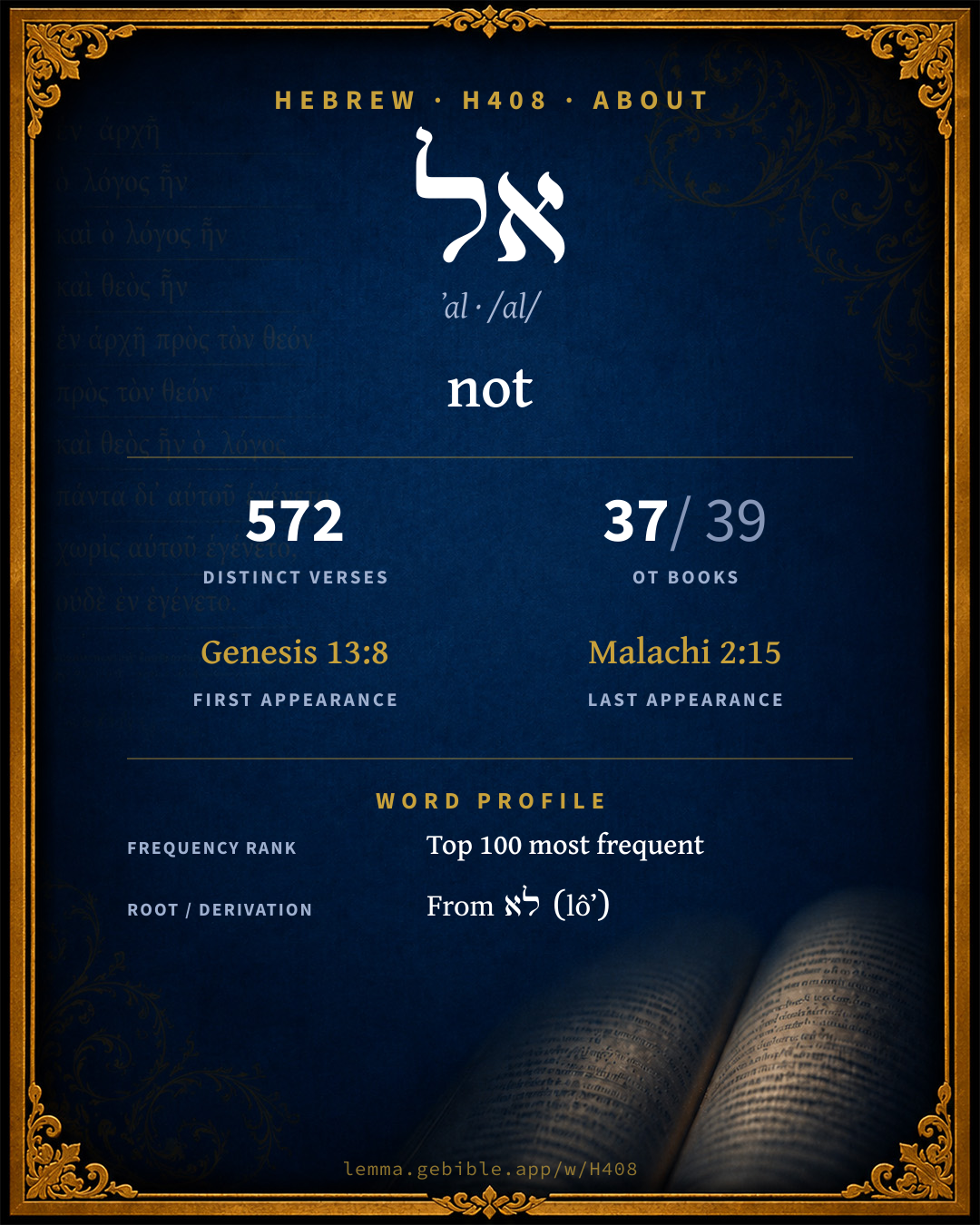
אַל
not
also: no, nor, neither, nothing fuller range ↓
Full lexicon entry — Brown-Driver-Briggs (BDB)
From Brown-Driver-Briggs (BDB)
Where this word appears
Grammar key — what these labels mean
Part of speech
- Particle
- A short function word — article, negation, interrogative, the sign of the direct object, and the like.
- Preposition
- A relational word (e.g. “in,” “to,” “from”) governing a noun.
Every verse where H408 appears in the Book of Obadiah — 3 distinct verses. Click any verse to open its interlinear word-by-word view. Verse text shown in the World English Bible for context — . Each verse’s Hebrew form is shown with its reference; the English is not keyword-highlighted, since the data carries no word-level English alignment. Use “Compare translations” on any verse to read it across multiple English versions. This concordance covers the Hebrew Bible; Septuagint (Greek Old Testament) occurrences are not indexed here.
Obadiah
- Obadiah 1:12 וְ/אַל וְ/אַל וְ/אַל conj + ptcl neg conj + ptcl neg conj + ptcl neg But don't look down on your brother in the day of his disaster, and don't rejoice over the children of Judah in the day of their destruction. Don't speak proudly in the day of distress.
- Obadiah 1:13 אַל אַל וְ/אַל ptcl neg ptcl neg conj + ptcl neg Don't enter into the gate of my people in the day of their calamity. Don't look down on their affliction in the day of their calamity, neither seize their wealth on the day of their calamity.
- Obadiah 1:14 וְ/אַֽל וְ/אַל conj + ptcl neg conj + ptcl neg Don't stand in the crossroads to cut off those of his who escape. Don't deliver up those of his who remain in the day of distress.
About this entry
At a glance — auto-summarized from this page’s data, not written by a person. Every figure links to its source below. This summary describes the numbers; it doesn’t interpret them.
אל — transliterated ʼal — is a Hebrew word carrying the sense “not.” It also covers “no”, “nor”, and “neither”, alongside “not” — see its full sense range. It appears 572 verses across 37 books of the Hebrew Bible, among its most common vocabulary. Debuting at Genesis 13:8, it then recurs through the corpus. Related forms include לא, אל and אלו. See the sense tree, 572-verse concordance, and the renderings breakdown below.
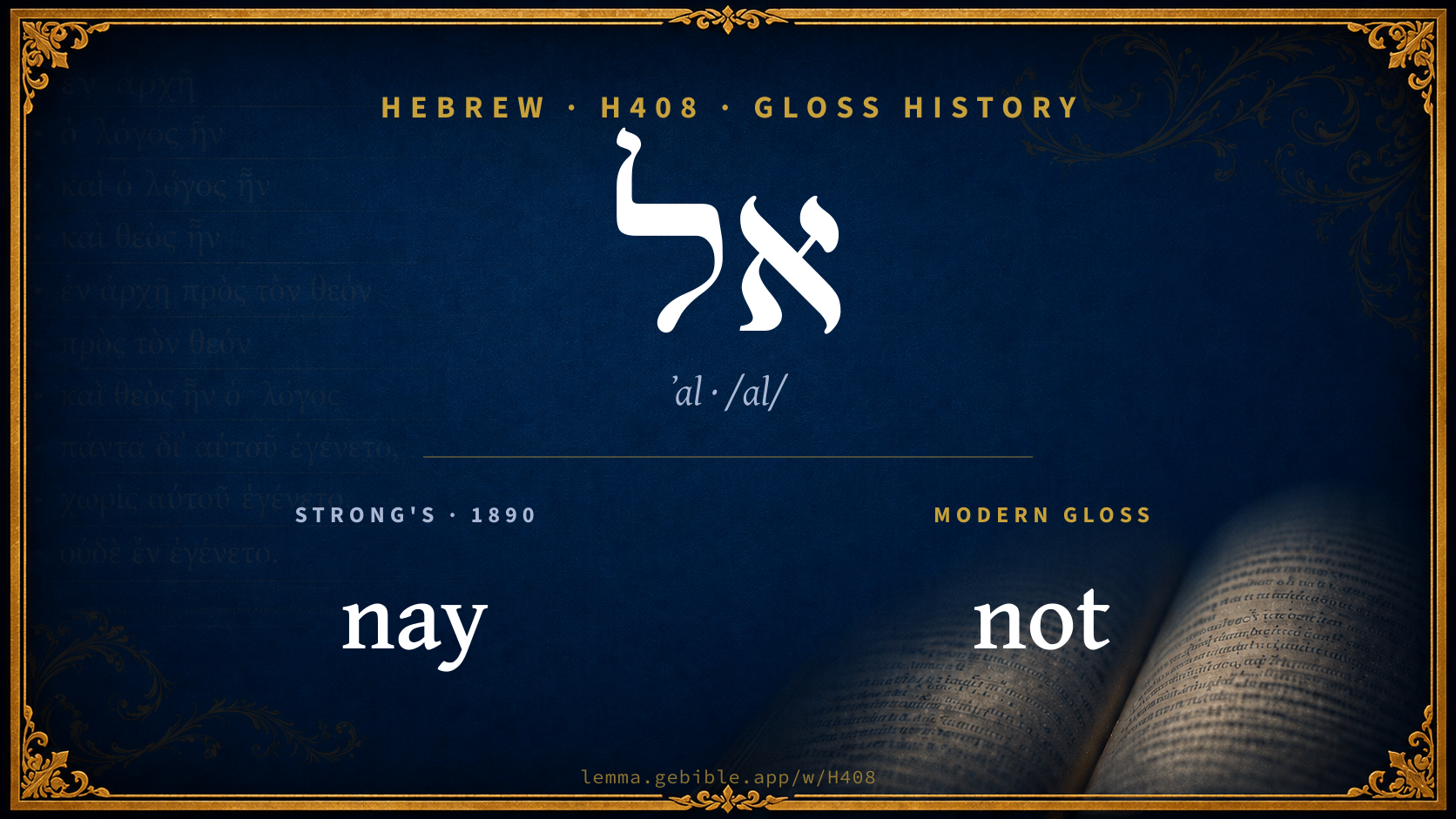
Gloss history
Strong's 1890 vs modern scholarship
About this word
Strong's H408 catalogs a Hebrew word from the Hebrew Old Testament.
These counts are not copied from any lexicon or concordance. They are computed here, from the morphology-tagged Hebrew Old Testament. What Lemma adds →
- 572
- distinct verses
- The word appears in 572 distinct verses.
- 37 / 39
- OT books
- The word appears in 37 of 39 Old Testament books.
- #70
- by frequency
- Top 100 most frequent Hebrew words (rank 70 of 8,640 Hebrew words by occurrence).
View all 572 occurrences in the concordance →
By section of the Old Testament
By traditional corpus
Conventional, traditional groupings — biblical authorship is debated, so this is a traditional corpus grouping, not an authorship claim. Each share is this word’s portion of its verses in that division of the Hebrew canon. Each figure is a share of the word’s 572 distinct verses.
- Writings (Ketuvim) 247 verses · 43%
- Prophets (Nevi'im) 236 verses · 41%
- Torah (Pentateuch) 89 verses · 16%
How translations render this word
Counts come from each version’s own published word-to-Strong’s tagging or interlinear alignment — an approximate guide to how each version renders this word, not a word-level alignment the data otherwise carries. Because each total is that version’s own tagged count, the per-version totals vary from one another and need not match the appearance or distinct-verse counts above. These counts may also differ from a printed concordance because Lemma counts each distinctly tagged rendering and does not collapse phrase taggings into a single head-word total. This is a fixed set of word-tagged versions (KJV, ASV, BSB, ULT) and does not change with the reading translation you choose elsewhere. Each version’s license is shown beside its name below (and on Sources).
BDB lists this Strong’s number as 2 distinct words (homographs). Each count above pools all of them and is not split by sense — see the Senses section below. A low-frequency rendering may belong to a different one of those words, not the primary meaning.
- King James Version†: Let me never 2×
- American Standard Version†: Let me never 2×
- Berean Standard Bible†: Do not 455×, Not 33×, No 26×
- unfoldingWord Literal Text†: Not 583×, And 104×, Do not 62×
King James Version Public Domain
Renders H408 across 12† tagged occurrences — most commonly:
Plus 10 renderings that appear only once — usually multi-word phrases or single function words the recovered tagging swept in, not distinct renderings.
American Standard Version Public Domain
Renders H408 across 12† tagged occurrences — most commonly:
Plus 10 renderings that appear only once — usually multi-word phrases or single function words the recovered tagging swept in, not distinct renderings.
Berean Standard Bible Public Domain
Renders H408 across 662† tagged occurrences — most commonly:
Plus other, less common renderings. Plus 44 renderings that appear only once — usually multi-word phrases or single function words the recovered tagging swept in, not distinct renderings. Not rendered by a distinct English word in 58 further occurrences.
unfoldingWord Literal Text CC BY-SA 4.0
Renders H408 across 807† tagged occurrences — most commonly:
Plus 14 renderings that appear only once — usually multi-word phrases or single function words the recovered tagging swept in, not distinct renderings.
Senses in the full BDB
What do BDB’s symbols mean?
BDB uses these scholarly abbreviations:
| Symbol | Meaning |
|---|---|
| 𝔊 | the Septuagint (the ancient Greek translation, LXX) |
| 𝔙 | the Vulgate (the Latin translation) |
| 𝔖 | the Syriac version (the Peshitta) |
| 𝔗 | the Targum (the Aramaic translation) |
| ψ | the Psalms |
| √ | root (the underlying root or stem) |
| ‖ | parallel passage (a synonymous or contrasted parallel) |
| † | the dagger: every passage where the word occurs is cited |
The 3 senses and sub-senses the full Brown-Driver-Briggs lexicon distinguishes for this word, in lexicon order (not ranked by frequency), with BDB’s own verbatim wording and sub-sense lettering. Shown in Hebrew script with BDB’s own scholarly abbreviations. The condensed entry is in the Lexicon Entry tab. See also the Forms in the corpus table below.
אל I (= اَلْ, Ar. article, preserved perh. in following words derived by Hebrews from (or through) Arabic-speaking tribes
אל II
- a. (a) with a verb, which is then always an impf. (never an imperative), by preference in the cohort. or jussive mood, where this is in use, and may be of any person or number; Gn 15:1 and often אַל־תִּירָא fear not! 22:12 אַל־תִּשְׁלַח יָֽדְךָ put not forth thy hand, 37:27 וְיָדֵנוּ אַל־תְּהִי־בוֹ and let not our hand be upon him, 21:16 אַל־אֶרְאֶה let me not look upon the death of the lad! ψ 25:2 אַל־אֵבוֹשָׁה let me not be ashamed; with 1 pl. (rare) 2 S 13:25 Je 18:18 Jon 1:14. In an imprecation: Gn 49:4 אַל־תּוֹתַר have not thou the excellency! ψ 109:12 Jb 3:4, 6. Sometimes strengthened by נָא: Gn 13:8 18:3 al. (b) without a verb, (α) 2 S 1:21 let (there be) not dew & not rain upon you! Is 62:6 ψ 83:2. (β) used absol., in deprecation Gn 19:18 2 S 13:16 (v. sub אוֹדָה) 2 K 3:13; 4:16; 6:27 (v. RVm: but possibly to be expl. by Dr§ 152 iii; so Th Ke: hardly as Ew§ 355b) Ru 1:13 אַל בְּנֹתַי Nay, my daughters, cf. Ju 19:23; (γ) after a preceding imper. Am 5:14 Jo 2:13 Pr 8:10, a juss. 27:2, an inf. abs. 17:12. (c) in poetry אַל sometimes expresses vividly the emotion or sympathy of the poet (v. Dr§ 56–8); Is 2:9 וְאַל־תִּשָּׂא לָהֶם and forgive them not! (with a touch of passion), ψ 41:3 Pr 3:25 Jb 5:22; ψ 34:6 (but 𝔊 𝔖 Ew Che here rd. וּפְנֵיכֶם, prob. rightly); 50:3a may our God come וְאַל־יֶ֫חֱרָ֥שׁ and not be silent! (the psalmist identifying himself with a spectator of the scene v 2, 3b–c) 121:3 (contrast v 4 לֹא) Je 46:6 +., e.g. Genesis 15:1
- b. once Pr 12:28 joined closely to a subst. (cf. לֹא 2b): In the way of righteousness is life, and in the pathway thereof אַל־מָוֶת there is no-death!; but error for אֶל־ ‘unto’ Capp 𝔊 𝔙 𝔗 𝔅. e.g. Proverbs 12:28
- c. once Jb 24:25 used poet. as a subst., And bring my words לְאַל to nought!—N.B. 1 S 27:10 אַל־פְּשַׁטְתֶּם הַיּוֹם, אַל with the pf. is against all analogy; and either אֶל־מִי (with 𝔊 𝔙), or better אָן whither? (with 𝔖 𝔗: v. 1 S 10:14) must be read. e.g. Job 24:25
Senses from the full Brown-Driver-Briggs lexicon (Brown, Driver, Briggs; Oxford 1906 — public domain), digitized via Sefaria, supplemented by the OpenScriptures HebrewLexicon (CC BY 4.0). Full attribution on Sources.
Word origin
I. (= اَلْ, Ar. article, preserved perh. in following words derived by Hebrews from (or through) Arabic-speaking tribes; cf. Eng. algebra, Alhambra, alkali, alcohol, alcove, etc.)
II. adv. of negation (so Ph. e.g. CIS i.3,4.5.8, Bi Aramaic, Sab. (DHMZMG 1875, 596), and in the Eth. አልቦ albo, is not), denying however, not objectively as a fact (like לֹא, οὐ), but subjectively as a wish (like μή), expressing therefore a deprecation or prohibition:
— Brown-Driver-Briggs (Oxford 1906, public domain), digitized via Sefaria, supplemented by the OpenScriptures HebrewLexicon (CC BY 4.0). See Sources.
Derived from לא (lôʼ) (H3808) — not.
Jastrow Dictionary
A second Hebrew/Aramaic lexicon for comparison, covering Aramaic and post-biblical (Talmudic, Targumic, Midrashic) usage that the biblical-Hebrew BDB does not. Matched by lemma rather than by Strong’s number, so a lemma may carry more than one Jastrow headword (shown separately below), and the entries cover usage well beyond the Bible.
אַל־
- a prefix, = עַל; e.g. אַלְתּוּסְבְּרָאוֹת (= על האוצרות) appointed over treasures, v. אַ־.
אַל
- (b. h.) not, no (according to Talmud a milder form of prohibition than לֹא; v. Y. Pes. VI, 33ᵇ). Aboth I, 3.—אל תקרי (abbr. א"ת), v. אֶלָּא. Taan. 11ᵃ א׳ יראה וכ׳ shall not live to see &c.; a. v. fr.
אֶל
- אול to turn) prep. to, toward. — Pl., with prefix מ a. suffix of pers. pron., of itself, of my (his &c.) own accord, on my (his &c.) authority. Yoma 5ᵇ לא מֵאֵלַי not on my own authority. Orlah I, 2 העולה מֵאֵלָיו growing spontaneously.—Y. Peah VII, 20ᵇ bot. its sacred character מֵאֵלָיו למדו they did derive from itself (i.e. from the wording of the law itself).—Hence מִמֵּילָא, v. מֵילָא.
אֵל
- v. אלל) God. Shebu. 35ᵃ divine names which dare not be erased are El &c. Taan. 6ᵇ bot.; a. fr.
A Dictionary of the Targumim, the Talmud Babli and Yerushalmi, and the Midrashic Literature (Marcus Jastrow; London, Luzac, 1903) — Public Domain. Digitized via Sefaria. Digitized via Sefaria. Full attribution on Sources.
Forms in the corpus
The 16 distinct written forms H408 takes in the Hebrew Bible, most frequent first — each parse links to that state’s occurrences in the concordance. Hebrew forms include their vowel points and cantillation, so a single lemma takes many written forms.
| Form | Parsing | Example | Uses |
|---|---|---|---|
| אַל | Particle, Negative | Daniel 9:19 | 500 |
| וְ/אַל | Particle, Negative | Amos 5:14 | 124 |
| אַֽל | Particle, Negative | Ecclesiastes 8:3 | 65 |
| וְ/אַֽל | Particle, Negative | Amos 5:5 | 13 |
| וְֽ/אַל | Particle, Negative | 2 Samuel 3:29 | 9 |
| אֶל | Preposition | Deuteronomy 2:9 | 3 |
| אַ֣ל | Particle, Negative | Proverbs 31:4 | 2 |
| אֲל | Particle, Negative | Psalms 35:22 | 1 |
| אַ֖ל | Particle, Negative | 1 Samuel 2:24 | 1 |
| אַ֗ל | Particle, Negative | 2 Kings 3:13 | 1 |
| אַ֤ל | Particle, Negative | Proverbs 31:4 | 1 |
| אַ֨ל | Particle, Negative | Jonah 3:7 | 1 |
| אַֽל | Particle, Negative | Psalms 71:9 | 1 |
| וְ/אֶל | Preposition | Jeremiah 51:3 | 1 |
| וְ/אַ֣ל | Particle, Negative | Psalms 119:36 | 1 |
| לְ֝/אַ֗ל | Particle, Negative | Job 24:25 | 1 |
Same root — word family
Other BDB entries built from the same root as H408, grouped by Strong’s listed origin. These share a root / origin per the lexicon — not necessarily a shared meaning. Each links to that word’s own entry.
Derives from
Derived from this word
- אל ʼal H409 not
- אלו ʼillûw H432 if
- אליל ʼĕlîyl H457 worthless
- אלקום ʼalqûwm H510 not
- אל תשחת ʼAl tashchêth H516 do not destroy
Proper names from this root
People and places named from this root — a name, not an additional meaning of the word.
- לא דבר Lôʼ Dᵉbar H3810 Lo-debar
- לא עמי Lôʼ ʻAmmîy H3818 Lo-ammi
- לא רחמה Lôʼ Ruchâmâh H3819 Lo-ruhamah
Compare all same-root words → Showing 4 of 10 — not the complete family. 3 of the same-root words are proper names (people or places). They share a root, not necessarily a meaning.
Septuagint verse parallels
This word appears in 516 verses that also exist in the Greek Old Testament (Septuagint), out of the 572 Hebrew verses it occurs in. You can read those verses in Greek by switching the Old Testament edition to the Septuagint.
Read these verses in the Septuagint
- Genesis 13:8
- Exodus 3:5
- Leviticus 10:6
- Numbers 4:18
- Deuteronomy 1:21
- Joshua 1:7
- Judges 4:18
- Ruth 1:13
- 1 Samuel 1:16
- 2 Samuel 1:20
- 1 Kings 2:9
- 2 Kings 1:15
This is a verse-level parallel only — the same verses exist in both the Hebrew and Greek Old Testaments. No word-level Hebrew↔Greek correspondence is claimed: the data carries no such alignment, so no Greek word is shown as this Hebrew word’s translation. Coverage is not total — the Septuagint omits the deuterocanon and renumbers the Psalms, so some Hebrew verses have no direct Greek parallel.