Exodus 23:7

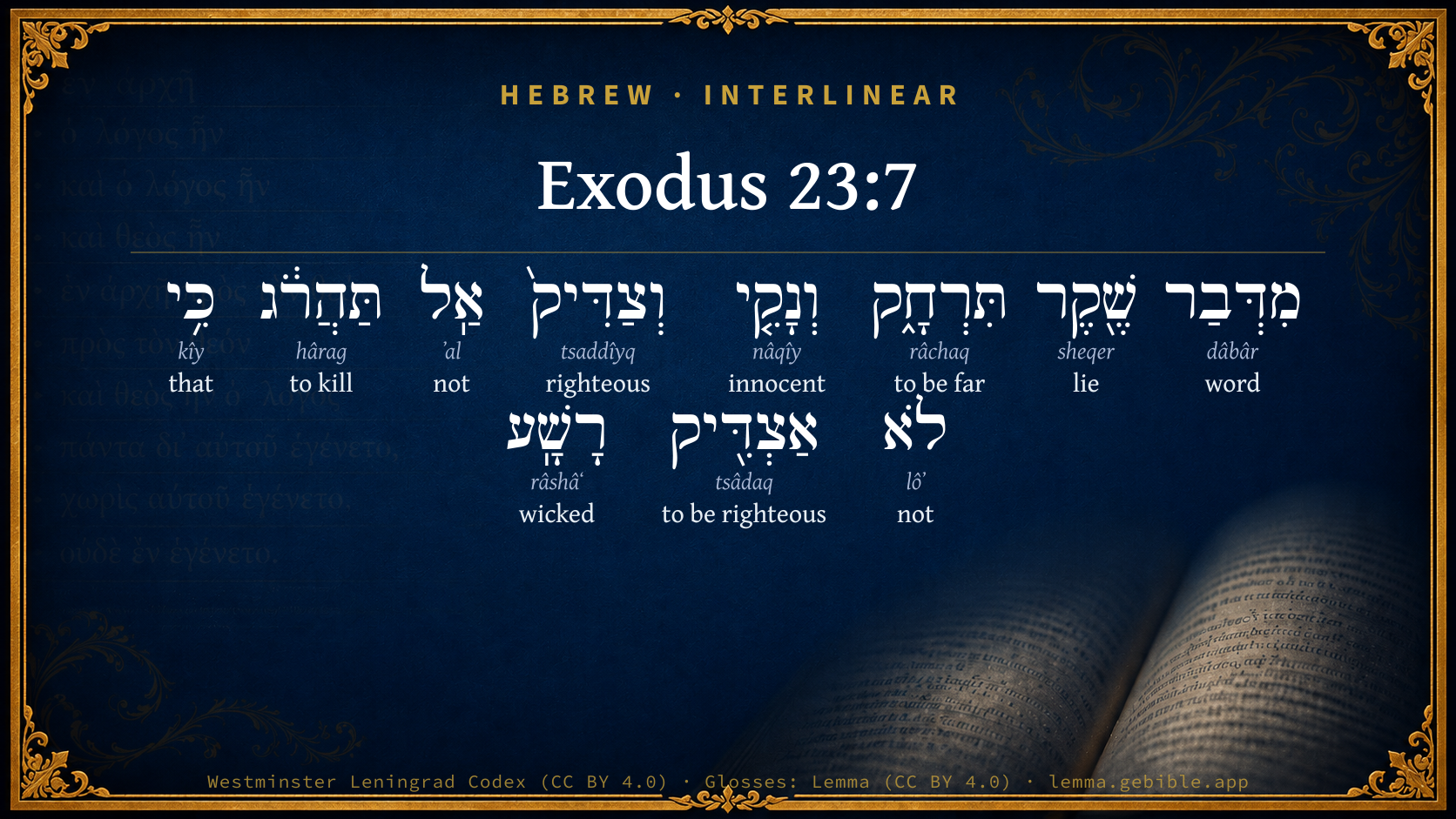
Hebrew (Westminster Leningrad Codex) Exodus 23:7 appears in the Hebrew Old Testament. The text above is from the Westminster Leningrad Codex. Each word links to its Strong’s number, a concise gloss, and parsing drawn from the Open Scriptures Hebrew Bible morphology. Click any word for its full Brown-Driver-Briggs (BDB) entry.
Download image
Cite this verse

Exodus 23:7 (World English Bible). Public Domain. Lemma interlinear Bible study tool, https://lemma.gebible.app/v/exodus/23/7.

Show BibTeX & RIS
BibTeX
RIS
English Translation
"Keep far from a false charge, and don't kill the innocent and righteous: for I will not justify the wicked.
World English Bible · Public Domain
Download a study sheet

One document with this verse’s original text, its word-by-word gloss line, the meaning frame, cross-references with their text, attributed commentary, and full source and license credits — printable, and it pastes into notes with its structure intact.

This verse Autodidact and up

Study sheet (.html) Plain text (.txt)

A passage Seminary Student

Up to 50 verses in one chapter. A passage sheet keeps up to 6 commentary sources and 12 cross-references per verse, in the order this page ranks them, and says so on the sheet whenever that leaves anything out. Ask for a single verse and you get the Autodidact verse sheet above.

Everything on this page stays free to read, with no account — the sheet is a download of what is already on screen, not access to it.

Want to remove ads? Support Godless Engineer
Compare translations 3

The same verse in 3 English versions, stacked beneath the original-language interlinear above. Click any original word for its lexicon entry.

Each is an independent rendering of the whole verse — the interlinear is not word-aligned to these translations.

Highlighted words mark where these versions differ — a whole-verse word diff, not a word-by-word alignment.

  • World English Bible Public Domain
    "Keep far from a false charge, and don't kill the innocent and righteous: for I will not justify the wicked.
  • King James Version Public Domain
    Keep thee far from a false matter; and the innocent and righteous slay thou not: for I will not justify the wicked.
  • unfoldingWord Literal Text CC BY-SA 4.0
    You shall be far from a word of deception, and you shall not kill the innocent or righteous, for I will not justify the wicked.

unfoldingWord Literal Text — © unfoldingWord, licensed CC BY-SA 4.0. Word-aligned USFM3 via Door43 (git.door43.org/unfoldingWord/en_ult).

Versions to compare (up to 4)

3 of 4 selected

Show all 18 translations

Every available English version of this verse, each an independent rendering of the whole verse.

  • World English Bible Public Domain
    "Keep far from a false charge, and don't kill the innocent and righteous: for I will not justify the wicked.
  • Berean Standard Bible Public Domain
    Stay far away from a false accusation. Do not kill the innocent or the just, for I will not acquit the guilty.
  • Majority Standard Bible Public Domain
    Stay far away from a false accusation. Do not kill the innocent or the just, for I will not acquit the guilty.
  • King James Version Public Domain
    Keep thee far from a false matter; and the innocent and righteous slay thou not: for I will not justify the wicked.
  • American Standard Version (1901) Public Domain
    Keep thee far from a false matter; and the innocent and righteous slay thou not: for I will not justify the wicked.
  • Revised Version (1885) Public Domain
    Keep thee far from a false matter; and the innocent and righteous slay thou not: for I will not justify the wicked.
  • Geneva Bible (1599) Public Domain
    Thou shalt keepe thee farre from a false matter, and shalt not slaye the innocent and the righteous: for I will not iustifie a wicked man.
  • Douay-Rheims (1899) Public Domain
    Thou shalt fly lying. The innocent and just person thou shalt not put to death: because I abhor the wicked.
  • Young's Literal Translation Public Domain
    from a false matter thou dost keep far off, and an innocent and righteous man thou dost not slay; for I do not justify a wicked man.
  • Literal Standard Version CC BY-SA 4.0
    you keep far off from a false matter, and you do not slay an innocent and righteous man; for I do not justify a wicked man.
  • Unlocked Literal Bible CC BY-SA 4.0
    Do not join others in making false accusations, and do not kill the innocent or righteous, for I will not acquit the wicked.
  • unfoldingWord Literal Text CC BY-SA 4.0
    You shall be far from a word of deception, and you shall not kill the innocent or righteous, for I will not justify the wicked.
  • Darby Bible Public Domain
    Thou shalt keep far from the cause of falsehood; and the innocent and righteous slay not; for I will not justify the wicked.
  • World Messianic Bible Public Domain
    “Keep far from a false charge, and don’t kill the innocent and righteous; for I will not justify the wicked.
  • Webster's Bible Public Domain
    Keep thee far from a false matter; and the innocent and righteous slay thou not: for I will not justify the wicked.
  • Free Bible Version CC BY-SA 4.0
    Don't have anything to do with making false accusations. Don't kill the innocent or those who do right, for I won't let the guilty go unpunished.
  • Bible in Basic English Public Domain
    Keep yourselves far from any false business; never let the upright or him who has done no wrong be put to death: for I will make the evil-doer responsible for his sin.
  • JPS Tanakh (1917) Public Domain
    Keep thee far from a false matter; and the innocent and righteous slay thou not; for I will not justify the wicked.

Literal Standard Version (2020), Covenant Press — licensed CC BY-SA 4.0. Text via the HelloAO Bible API (eBible.org). Unlocked Literal Bible (unfoldingWord) — licensed CC BY-SA 4.0. Text via the HelloAO Bible API (eBible.org). unfoldingWord Literal Text — © unfoldingWord, licensed CC BY-SA 4.0. Word-aligned USFM3 via Door43 (git.door43.org/unfoldingWord/en_ult). Free Bible Version, Dr. Jonathan Gallagher — licensed CC BY-SA 4.0. Text via the HelloAO Bible API (eBible.org).

Word by word

More ways to search: Search by grammar → Find every occurrence → Compare this word →

Practice this passage: Drill this verse → Learn its vocabulary →

אַצְדִּ֖יק
tsâdaq
H6663
“to be righteous”
Verb, Hiphil, Imperfect, 1st Person, Common, Singular
Part of Speech
Verb
Stem
Hiphil
Form
Imperfect
Person
1st Person
Gender
Common
Number
Singular
Full BDB Definition

Origin: a primitive root

TWOT: 1879

to be just, be righteous - (Qal) - to have a just cause, be in the right - to be justified - to be just (of God) - to be just, be righteous (in conduct and character) - (Niphal) to be put or made right, be justified - (Piel) justify, make to appear righteous, make someone righteous - (Hiphil) - to do or bring justice (in administering law) - to declare righteous, justify - to justify, vindicate the cause of, save - to make righteous, turn to righteousness - (Hithpael) to justify oneself
  1. מִדְּבַר dâbâr H1697 “from · word of” Preposition + Noun, Common, Masculine, Singular, Construct
  2. שֶׁ֖קֶר sheqer H8267 “lie” Noun, Common, Masculine, Singular, Absolute
  3. תִּרְחָ֑ק râchaq H7368 “to be far” Verb, Qal, Imperfect, 2nd Person, Masculine, Singular
  4. וְנָקִ֤י nâqîy H5355 “and · innocent” Conjunction + Adjective, Adjective, Masculine, Singular, Absolute
  5. וְצַדִּיק֙ tsaddîyq H6662 “and · righteous” Conjunction + Adjective, Adjective, Masculine, Singular, Absolute
  6. אַֽל ʼal H408 “not” Particle, Negative
  7. תַּהֲרֹ֔ג hârag H2026 “to kill” Verb, Qal, Jussive, 2nd Person, Masculine, Singular
  8. כִּ֥י kîy H3588 “that” Conjunction
  9. לֹא lôʼ H3808 “not” Particle, Negative
  10. רָשָֽׁע râshâʻ H7563 “wicked” Adjective, Adjective, Masculine, Singular, Absolute

About this verse

These counts appear in no published source. They are computed here, from the morphology-tagged text and Lemma’s own curated glosses. What Lemma adds →

11
words
11
distinct lemmas
Pentateuch
section

Shared distinctive vocabulary

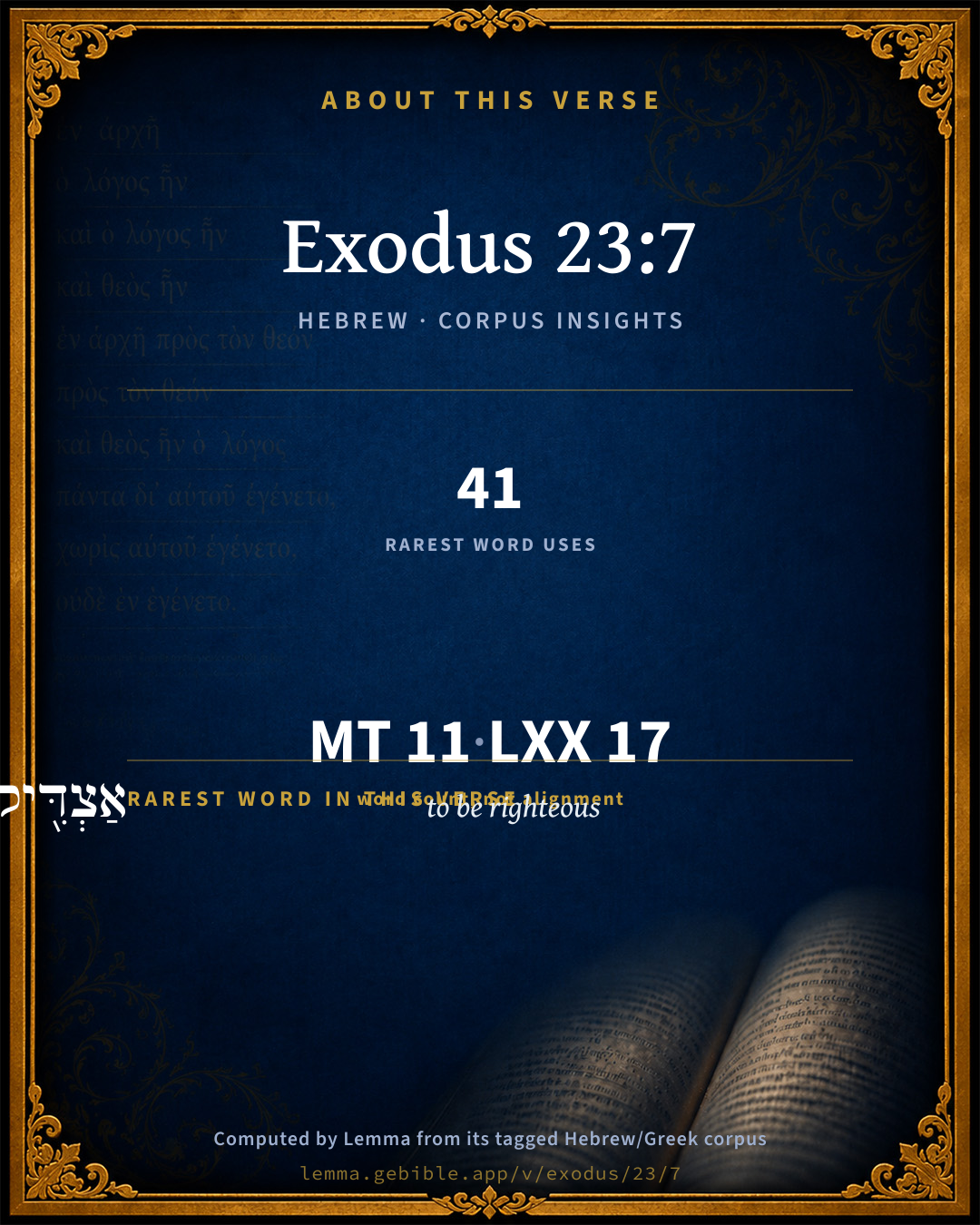
אַצְדִּ֖יק to be righteous H6663 occurs in 40 verses of the Hebrew Bible. Also found in:

Grammatical profile

  • 3 verbs
  • 2 nouns
  • 3 adjectives
  • 1 conjunction
  • 2 particles

Verb forms

  • תִּרְחָ֑ק Qal · Imperfect
  • תַּהֲרֹ֔ג Qal · Jussive
  • אַצְדִּ֖יק Hiphil · Imperfect

Hebrew & Septuagint length

In English translation the verse runs 20 words from the Hebrew and 24 from the Septuagint (LXX English) — closely comparable.

A rough comparison of the two English renderings, which tokenize alike — not a word-level alignment.

Word counts can differ between the Hebrew and the Greek without any difference in meaning — e.g. the Hebrew direct-object marker אֵת has no separate Greek word, and Greek often adds the article ὁ.

In the original languages it is 11 Hebrew tokens and 17 Greek tokens — but the two are counted differently (Hebrew bundles its prefixes and suffixes into one token; the Greek is in lemma form), so that isn’t a like-for-like length.

Cross-references

16

Topical passages linked to Exodus 23:7 in the Treasury of Scripture Knowledge — connected by theme and wording, ordered by reader-vote popularity; previews shown in the World English Bible.

  • Ephesians 4:25 Therefore, putting away falsehood, speak truth each one with his neighbor. For we are members one of another.
  • Exodus 23:1 "You shall not spread a false report. Don't join your hand with the wicked to be a malicious witness.
  • Deuteronomy 27:25 Cursed be he who takes a bribe to kill an innocent person. All the people shall say, Amen.
  • Exodus 34:7 keeping loving kindness for thousands, forgiving iniquity and disobedience and sin; and that will by no means clear the guilty, visiting the iniquity of the fathers on the children, and on the children's children, on the third and on the fourth generation."
  • Romans 1:18 For the wrath of God is revealed from heaven against all ungodliness and unrighteousness of men, who suppress the truth in unrighteousness,
  • Leviticus 19:11 "'You shall not steal; neither shall you deal falsely, nor lie to one another.
  • 1 Thessalonians 5:22 Abstain from every form of evil.
  • Deuteronomy 19:16–21 If an unrighteous witness rise up against any man to testify against him of wrong-doing,
  • Exodus 20:13 "You shall not murder.
  • Job 22:23 If you return to the Almighty, you shall be built up, If you put away unrighteousness far from your tents.
  • Proverbs 4:14–15 Don't enter into the path of the wicked. Don't walk in the way of evil men.
  • Proverbs 17:15 He who justifies the wicked, and he who condemns the righteous, Both of them alike are an abomination to Yahweh.
  • Isaiah 33:15 He who walks righteously, and speaks blamelessly; he who despises the gain of oppressions, who shakes his hands from taking a bribe, who stops his ears from hearing of blood, and shuts his eyes from looking on evil:
  • Nahum 1:3 Yahweh is slow to anger, and great in power, and will by no means leave the guilty unpunished. Yahweh has his way in the whirlwind and in the storm, and the clouds are the dust of his feet.
  • Luke 3:14 Soldiers also asked him, saying, "What about us? What must we do?" He said to them, "Extort from no one by violence, neither accuse anyone wrongfully. Be content with your wages."
  • Romans 2:5–6 But according to your hardness and unrepentant heart you are treasuring up for yourself wrath in the day of wrath, revelation, and of the righteous judgment of God;

Cross-references courtesy of OpenBible.info (CC BY 4.0).

Hebrew and Greek witnesses Masoretic Hebrew ↔ Greek Septuagint

The same verse in the two great witnesses to the Old Testament, shown verse-for-verse.

These are two independent witnesses, not word-aligned to each other, and the Septuagint is shown in lemma (dictionary) form.

Hebrew Exodus 23:7 Masoretic · Westminster Leningrad Codex

מִדְּבַר שֶׁ֖קֶר תִּרְחָ֑ק וְנָקִ֤י וְצַדִּיק֙ אַֽל תַּהֲרֹ֔ג כִּ֥י לֹא אַצְדִּ֖יק רָשָֽׁע

"Keep far from a false charge, and don't kill the innocent and righteous: for I will not justify the wicked.

World English Bible · Public Domain

Greek LXX Exodus 23:7 Septuagint · lemma form

ἀπό πᾶς ῥῆμα ἄδικος ἀποἵστημι ἀθῷος καί δίκαιος οὐ ἀποκτείνω καί οὐ δικαιόω ὁ ἀσεβής ἕνεκεν δῶρον

You shall abstain from every unjust thing: you shall not kill the innocent and just, and you shall not justify the wicked for gifts.

LXX2012 (modern English Septuagint) · Public Domain

On this verse, The Cambridge Bible for Schools and Colleges discusses the Septuagint’s reading. Read the note in Commentary ↓

Hebrew: Westminster Leningrad Codex (CC BY 4.0). Greek: Septuagint (public domain); English from LXX2012 (modern English Septuagint) (Public Domain). How the Septuagint differs from the Hebrew →

Targum (Aramaic paraphrase)

2

The Targum is the ancient Jewish Aramaic paraphrase of the Hebrew Scriptures — an interpretive translation, not the Hebrew text itself. Onkelos (literal) and Pseudo-Jonathan (expansive) render the Torah, and Jonathan the Prophets. Coverage is partial: where no permissively-licensed English translation exists for a verse, only the Aramaic is shown. This is verse-level text, not a word-by-word alignment to the Hebrew.

  1. Targum Onkelos Torah (Genesis–Deuteronomy)
    מִפִּתְגָמָא דְשִׁקְרָא הֱוֵי רָחִיק וְדִזְכֵי וְדִי נְפַק (דְכֵי) מִן דִינָא לָא תִקְטוֹל אֲרֵי לָא אֱזַכֵּי חַיָבָא:

    (no public-domain English translation for this verse)

    Targum Onkelos — Aramaic: “Onkelos Genesis” (public domain); “Onkelos Exodus” (public domain); “Onkelos Leviticus” (public domain); “Onkelos Numbers” (public domain); “Onkelos Deuteronomy” (public domain). English: “Sefaria Community Translation” (CC0 1.0 (public-domain dedication)); “J.W. Etheridge. The Targums of Onkelos and Jonathan Ben Uzziel on the Pentateuch. London: Longmans, Green, 1862” (public domain). Text via Sefaria.

  2. Targum Pseudo-Jonathan Torah (Genesis–Deuteronomy)
    מִפִּתְגַם שִׁיקְרָא הֲוֵי רָחִיק וְדִי נְפַק זַכְּאַי מִבֵּי דִינָךְ וְאַשְׁכָּחוּ לֵיהּ חוֹבָתֵיהּ וְדִי נְפַק חַיָּיב וְאַשְׁכָּחוּ לֵיהּ זְכוּ לָא תִקְטֵיל אֲרוּם לָא הֲוֵינָא מְזַכֵּי לֵיהּ אִין הוּא חַיָּיבָא

    From a false matter keep distant. And when one hath gone forth from thy house of justice acquitted, and they (afterwards) find out his guilt; or one hath been brought out condemned, and they (afterward) find out his innocence,-­thou shalt not put him to death; for I will not hold (the former) innocent, nor the latter guilty.

    Targum Pseudo-Jonathan — Aramaic: “Targum Jonathan on Genesis” (public domain); “Targum Jonathan on Exodus” (public domain); “Targum Jonathan on Leviticus” (public domain); “Targum Jonathan on Numbers” (public domain); “Targum Jonathan on Deuteronomy” (public domain). English: “The Targum of Jonathan ben Uzziel, trans. J. W. Etheridge, London, 1862” (public domain). Text via Sefaria.

Commentary

Notes on Exodus 23:7 from classic Christian and Jewish commentators (each source and its license shown beneath its notes). The classic Christian expositions comment on the surrounding passage and are grouped to its opening verse, so a note may address several verses; the Jewish commentaries on the Tanakh (Rashi and others) are per-verse, so they appear only where the commentator wrote on this verse.

Lemma curates 59 commentaries, every one of them public domain or Creative Commons licensed, each selected and text-cleaned for this edition rather than reprinted as found. About our sources →

Trapp's Complete Commentary

John Trapp

Exo 23:7 Keep thee far from a false matter; and the innocent and righteous slay thou not: for I will not justify the wicked.

Ver. 7. Keep thee far from a false matter.] Stand aloof off; keep at a distance. See Isa 33:15. A public man should be above all price or sale: and every man should carefully keep himself from the occasions of sin. A good man dare not come near the train, though he be far off the blow.

John Trapp, A Commentary or Exposition upon All the Books of the Old and New Testament (1647–1656) — public domain. Text from a community e-Sword module.

Joseph Benson's Commentary

Exo 23:7. Keep thee far from a false matter — From assisting or abetting all ill thing. Yea, keep thee far from it, dread it as a dangerous snare. I will not justify the wicked — That is, I will condemn him that unjustly condemns others.

Joseph Benson's Commentary on the Old and New Testaments (1811–1818) — public domain. Text from a community e-Sword module.

Tyndale Open Study Notes

Tyndale Open Resources

23:7 God’s character is the motive for righteous behavior (see 22:22-24, 27).

Tyndale Open Study Notes — © Tyndale Open Resources, licensed CC BY-SA 4.0. Text via the HelloAO Bible API.

Geneva Bible (1599)

Geneva Bible translators

Whether thou be magistrate or art commanded by the magistrate.

Geneva Bible (1599) marginal notes — public domain. Text via Bolls.life.

Ellicott's Commentary for English Readers

(7) Keep thee far from a false matter.—A false accusation seems to be intended. If we make one it may result in an innocent man’s death, and we shall be murderers; God will then assuredly hold us guilty.

A Bible Commentary for English Readers, edited by Charles John Ellicott (1878–1897) — public domain. Text from a community e-Sword module.

The Cambridge Bible for Schools and Colleges

gen. ed. J. J. S. Perowne

7. a false matter] i.e., as the context shews, a case that can only be carried through with the help of false statements, and false witnesses.

slay thou not] by false accusations, false witness, or an unjust sentence. The words are addressed indifferently to accuser, witness, and judge. Cf. Deu_27:25, Psa_94:6; Psa_94:21.

for I do not justify the wicked] I do not justify the man who is in the wrong (v. 1b), and who accuses the innocent unjustly; and therefore the judges should act similarly. LXX. however read, and thou shalt not justify the wicked, which may be the original reading (Bä.); cf. Deu_25:1.

The Cambridge Bible for Schools and Colleges (gen. ed. J. J. S. Perowne; Cambridge University Press, 1878–1918) — public domain. Text from a community e-Sword module.

John Gill's Exposition

And thou shalt take no gift,.... Of the persons whose cause is to be tried in a court of judicature before judges; neither of those on the one side nor on the other, neither before the trial nor after, neither by words, by a promise, nor by facts, by actually receiving money; and not even to judge truly, as Jarchi observes, neither to clear the innocent nor to condemn the guilty: a gift was not to be taken on any consideration whatever:

for the gift blindeth the wise; or the "seeing" (a); the open ones, who used to have both their eyes and their ears open, and attentive to the cause before them; and yet a gift so blinds them, by casting such a mist before them, that they are inattentive to the true merits of the cause, and their affections and judgments are to be carried away in favour of those that have bribed them, as to pass a wrong sentence:

and perverteth the words of the righteous; either the sentences of righteous judges, as they ought to be, but a gift perverts their judgment, and they give a wrong decree; or the causes of the righteous that are brought before those are perverted by giving the cause to their adversaries, who are wicked men.

(a) "videntes", Pagninus, Vatablus, Cartwright; "apertos", Montanus, Drusius.

John Gill's Exposition of the Whole Bible (1746–1763) — public domain (CC PDM 1.0). Text via the HelloAO Bible API.

Matthew Poole's English Annotations

Keep thee far, i.e. abstain from all occasions, degrees, or appearances of it. Compare Job 22:23; Pro 4:14,15.

A false matter, i.e. an unrighteous judgment; for he is speaking to the judges, as appears both by the foregoing and following verses.

Slay thou not; condemn not to death, nor to any other unjust penalty, for the same reason.

I will not justify the wicked, and therefore not condemn the innocent; one contrary being here understood from the other, as is frequent in the book of the Proverbs; and what I do not, thou who actest in my name and stead shouldst not do. Or rather thus, Know, O judge, (for to such he speaks,) if thou dost pronounce such a wicked sentence, I will not justify thee, or hold thee guiltless, i.e. I will severely punish thee, as Exo 20:7.

Matthew Poole's English Annotations on the Holy Bible (1683–1685) — public domain. Text from a community e-Sword/MySword module.

Whedon's Commentary on the Bible

Daniel D. Whedon

7. Righteous slay thou not — By false testimony against them. If an innocent and righteous man is convicted and suffers the death penalty on account of the testimony of a lying witness, that witness is guilty of his death.

Daniel D. Whedon (gen. ed.), Commentary on the Old and New Testaments (1874–1909) — public domain. Text from a community e-Sword module.

The Pulpit Commentary

Keep thee far from a false matter. Hold aloof, i.e. , from anything like a false accusation. Neither bring one, nor countenance one, else those mayest cause the death of an innocent and righteous man, and bring down on thyself the vengeance of him, who will not justify the wicked.

The Pulpit Commentary (1880–1919), ed. H.D.M. Spence-Jones & Joseph S. Exell — public domain. Text from a community e-Sword module.

John Wesley's Explanatory Notes

Keep thee far from a false matter - From assisting or abetting an ill thing. Yea, keep thee far from it, dread it as a dangerous snare. I will not justify the wicked - That is, I will condemn him that unjustly condemns others.

John Wesley, Explanatory Notes Upon the Whole Bible (1754–1765) — public domain. Text via the GEBible commentary corpus.

Rashi

Rabbi Shlomo Yitzchaki (Rashi)

ונקי וצדיק אל תהרג AND THE GUILTLESS AND RIGHTEOUS SLAY THOU NOT — Whence may we infer that in the case that one who left the court after being found guilty and one says, “I have something to plead in his favour”, he has to be brought back in order that the court may listen to this? From what Scripture states, “and the נקי thou shalt not slay”. Although he is not a צדיק — for he has not been acquitted by the court — he is however “free” (נקי) from the death penalty, for it is your duty to plead — as far as possible — in his favour. And whence may we infer, on the other hand, that in the case of one who left the court after having been acquitted and one says, “I have something to say against him” he is not to be brought back that the judges may hear this? From what Scripture states: “and the צדיק slay thou not” — and this man is a צדיק since he has been acquitted by the court (Sanhedrin 33b).

כי לא אצדיק רשע FOR “I” WILL NOT JUSTIFY THE WICKED — It is not your duty, in the latter case, to bring the man back to the court, for if he is really guilty, “I” will not acquit him in My court. Altough he has left your hands as innocent “I” have many agents (many means) to inflict upon him the death to which he has made himself liable (Mekhilta).

Rashi on the Tanakh — English translations: “The Judaica Press complete Tanach with Rashi, translated by A. J. Rosenberg” (CC BY 4.0); “Pentateuch with Rashi's commentary by M. Rosenbaum and A.M. Silbermann, 1929-1934” (public domain); “The Metsudah Tanach series, Lakewood, N.J” (CC BY 4.0); and “The Book of Joshua, Metsudah Publications, 1997” (CC BY 4.0). Text via Sefaria.

Lesson kit

Teaching starters — assembled from the data on this page, not authored interpretation. Every prompt links to the verse data it draws on. Edit before teaching.

Exodus, in the Pentateuch, opens this verse with 11 words (11 distinct Hebrew lemmas). Its most distinctive word is tsâdaq (“to be righteous”). A historical commentator’s framing appears above. Read the whole chapter for the surrounding context.

Discussion questions

  1. How does “to be righteous” (tsâdaq) shape what this verse is saying?
  2. Genesis 38:26 shares the word «to be righteous» with this verse. How do the two illuminate each other?
  3. The translations on this page render this verse differently — a whole-verse word diff, not a word-by-word alignment. What might account for the different wordings?
  4. The verb «תִּרְחָ֑ק» is Qal Imperfect. How does its form color the action?
  5. Reading how Trapp's Complete Commentary and Joseph Benson's Commentary read this verse, where do the two commentators agree and where do they part?

Things to notice

Reading settings

Reading text

Shown beneath each verse's original-language words.

Old Testament
Old Testament edition

Read the OT as the Masoretic Hebrew (MT) or the Greek Septuagint (LXX).

English shown for the Greek Septuagint (in the Hebrew ↔ Greek comparison).

Comparing translations? Open the Compare panel on any verse page to stack up to four side by side.